Dysfunctional Dystopia? Films reviewed: Sentimental Value, The Running Man, Left-Handed Girl

Posted in Acting, Action, comedy, Drama, Family, Norway, Reality, Science Fiction, Taiwan by CulturalMining.com on November 15, 2025

Hi, this is Daniel Garber at the Movies for culturalmining.com and CIUT 89.5 FM.

Still more Fall film festivals coming at you in Toronto, with the EU film fest — free films from each country of the European Union, plus Ukraine — and Ekran, the Polish Film Festival. So much to see, but look out for Agnieszaka Holland’s biopic of Franz Kafka (called Franz) at Ekran.

But this week, I’m looking at three great new movies, one action and two dramas. There’s an estranged family in Oslo; a fugitive on the run in a dystopian America, and a dysfunctional family in Taipei, Taiwan.

Sentimental Value

Co-Wri/Dir: Joachim Trier

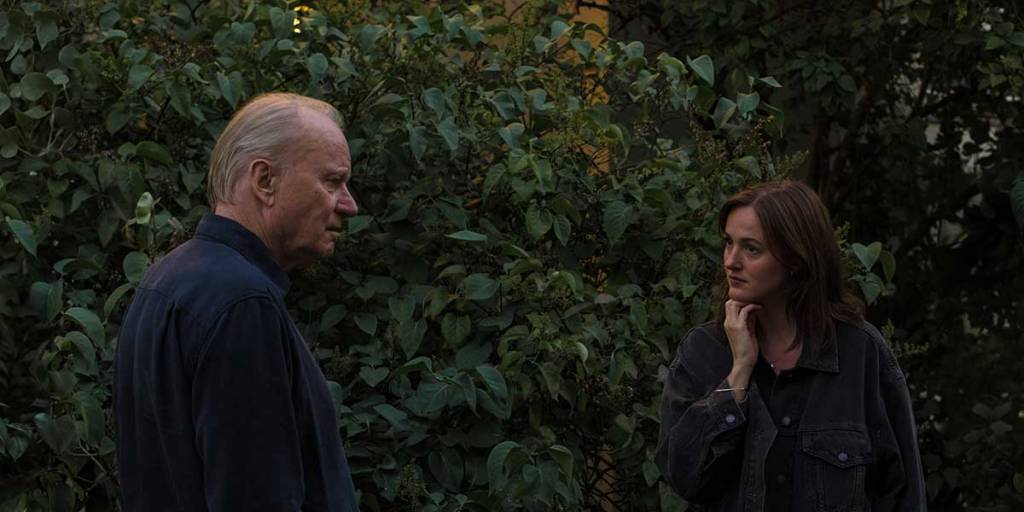
Nora Borg (Renate Reinsve) is a successful stage actress who lives in a grand old house in Oslo. It’s been in her family for generations: it’s where her grandmother killed herself, and where she grew up with her sister Agnes (Inga Ibsdotter Lilleaas) and their mom. Their dad, Gustav, (Stellan Skarsgård) disappeared after their divorce when she was still young, and they haven’t heard much from him in decades. Until now. Their mom just died and she and her sister have to deal with the house and go through all their family’s possessions (that’s the “sentimental value” of the title). And dad owns part of the house, too. But he has a second reason for showing up. 

He wants to make a movie there, to use the house as his set. He’s a famous film director, but not in his prime anymore; he hasn’t shot a movie in decades. And he wants Nora in the main role of what is likely his swan song. You’re the only one who can do it, he says, just read the script! Nora refuses; bad blood runs deep. So, partly to get the funding he needs to make the picture, Gustav casts a Hollywood actress to play the role that Nora turned down. Rachel Kemp (Elle Fanning) is a big name, and she’s also a fan of Gustav’s work. What will happen to the house? Will Gustav make his film? And will they ever be on speaking terms again?

Sentimental Value is dramatic comedy about a Norwegian family. It’s full of clever asides and wide-ranging topics, but with a solid core at its centre.   What makes Trier such a good director (The Worst Person in the World, Thelma,  Oslo August 31st) is he creates believable characters in tough situations but without losing his sense of humour. He constantly plays around with his audience as to what is real and what is artifice: we see Nora having a deep, emotional breakdown and then discover she’s acting a role on a stage set. He also uses biting satire to get his points across, skewering the superficiality of both Hollywood and bourgeois Norwegian society. He also repeatedly casts from a company of actors in his films. Elle Fanning and Swedish actor Stellan Skarsgård are new, but Renate Reinsve and Anders Danielsen Lie are familiar faces if you’ve ever seen Trier’s movies (and if you haven’t, you should).

Sentimental Value is moving, funny and full of good stuff to think about. I really liked this one.

The Running Man

Co-Wri/Dir: Edgar Wright

Based on a story by Steven King

It’s some point in the not-so-distant future in a dystopian America. A few rich people live luxurious lives, but the majority eke out a precarious existence within the endless sprawl of urban slums. They’re constantly surveilled by cameras, drones and DNA detectors while a brutal paramilitary police force patrols the streets. What keeps the people satisfied? Watching the reality shows and game shows broadcast from a single, big-brother-like monopoly network which controls the government, big business and media. 

Ben Richards (Glen Powell) is a skilled labourer and union rep. He also has a volatile temper. He points out dangerous problems on the shop floor, which in this world gets you fired. So he’s out of work, his wife depends on tips in a hostess bar, and their 5 year old daughter is dying of an ordinary flu because they can’t afford basic medicine. What to do? There’s only one choice left: compete on THE RUNNING MAN, a reality show where all contestants try to survive for 30 days being hunted by a gang of professional killers. The winner gets a huge cash prize. And the losers pay with their lives. Luckily, the show’s producer, Dan Killian (Josh Brolin) takes a liking to Ben Richards — he’s smart, strong and most of all, angry! And the audience starts to like him… and his messages of rebellion.  Can Ben outsmart the powers that be and survive? Or will the Network crush him, like they did with every Runner before him?

The Running Man is a non-stop action movie, with good acting and an interesting plot. It’s set in the future, but done in a 1980s style, with zines, nerds and gadgets over spacemen and phasers. There are chase scenes using planes, trains and automobiles, and fiery explosions that level a city block. Glen Powell is wonderful in the lead role, appealing and heroic, painted like a Luigi Mangione fighting the corporate super-villain played by a slimy Josh Brolin. Director Edgar Wright — who brought us Toronto’s greatest Scott Pilgrim vs the Universe — keeps it funny and nerdy; he even casts Michael Cera as a nerdy revolutionary. 

The Running Man is a lot of fun to watch. 

Left-Handed Girl

Co-Wri/Dir: Shih-Ching Tsou

It’s Taipei’s night market, and a small family is moving into a tiny apartment nearby: I-Jing (Nina Ye) a little girl with a wild imagination, I-Ann (Shih-Yuan Ma) a diffident teenager with a chip on her shoulder, and their hardworking mom (Janel Tsai). She’s opening up a noodle stall to pay their basic rent cheque. Dad is nowhere to be seen; he ran off years ago, leaving the family high and dry. I-Jing quickly adjusts to her new kindergarten class and life in the constantly-moving marketplace. She even helps Johnny (Brando Huang) — a huckster with a heart of gold who sells carnival junk to unsuspecting shoppers — by making announcements on his loudspeaker. Mom is constantly busy, cooking and cleaning her stall, but can’t seem to earn a living. She also takes time to visit her ex-husband, now dying of cancer in hospital. Sadly he leaves his abandoned family nothing but funeral debts and a pet meerkat. And I-Ann — who was once top of her class until she suddenly dropped out — works as a scantily-clad “betel nut beauty” selling smokes and the addictive chewing treat from her boyfriend’s shop. 

But things get tense when the kids’ Mom is forced to visit their grandparents to ask for some money to tide them over. Mom’s brother is the golden boy who can do no wrong, and her two sisters both live in nice houses and are unsympathetic about her economic condition. And worst of all is grandpa, who scolds i-Jing for being left handed. He tells her left hand belongs to the devil (which she interprets as having an evil hand over which she has no control.) Now grandma is smuggling migrants through airports, mom faves eviction from the market, I-Ann missed her last period, and tiny I-Jing is turning into an avid shoplifter, using her “devil’s hand” to do the dirty work. Can this dysfunctional family ever pull itself back together? 

Left-Handed Girl is a social drama about a family of women living on the brink. It’s tender, shocking and hilarious. It’s full of fast, clang-y music, flashy lights and hyper-saturated colour. It’s specifically Taiwanese in details (from bubble tea to class snobbery) but universal in its emotional appeal. And it’s co-written and edited by Sean Baker (Tangerine, The Florida Project, Red Rocket, Anora), who swept the Oscars last year with Anora. The characters speak Chinese but it’s clearly a Sean Baker movie, full of imperfect women in precarious times. And its Taiwanese-American director Shih-Ching Tsou worked on all of Baker’s films, so this is part of a long term partnership, with her taking the helm. And it’s Taiwan’s selection for best international Oscar.

I loved Left-Handed Girl, too.

Sentimental Value — opening this weekend — and Left-Handed Girl — next weekend — both played at TIFF. And The Running Man is now playing across Canada; check your local listings.

This is Daniel Garber at the Movies, each Saturday morning, on CIUT 89.5 FM and on my website culturalmining.com.

Rising. Films reviewed: Backspot, The Goldman Case, Handling the Undead

Posted in 1970s, Canada, Courtroom Drama, Death, France, High School, Horror, LGBT, Norway, Protest, Sports, Zombie by CulturalMining.com on June 1, 2024

Hi, this is Daniel Garber at the Movies for culturalmining.com and CIUT 89.5 FM.

Toronto’s Spring Film Festival Season continues with Inside Out closing, TJFF opening, and soon followed by three more: the Toronto Japanese Film Fest offers you the chance to watch the best of contemporary Japanese cinema, including samurai, anime, dramas and arthouse films, running June 6-20 at the Japanese Canadian Cultural Centre;  The Future of Film Showcase celebrating rising young Canadian talent with three world premieres, including the directorial debut for actor Aaron Poole, at the lovely Paradise Theatre from June 20-23; and the ICFF Lavazza Inclucity festival set for June 27th and continuing through most of July, featuring films from Italy and around the world, accompanied by delicious food and projected, outdoors, on a giant screen in the Distillery District.

But this week I’m looking at three new features. There’s an ambitious young cheerleader trying to rise to the top; a convicted criminal trying to elevate his innocence; and dead bodies rising from their graves.

Backspot

Co-Wri/Dir: D.W. Waterson

Riley (Devery Jacobs) is a high school student obsessed with cheerleading. Along with her best friend — and girlfriend — Amanda (Kudakwashe Rutendo) they hope to get a place on with the Thunderhawks squad, the highly competitive award-winning varsity team at their school. They do handsprings, half turns and everything else they need, to qualify, acrobatically. But despite how hard they try, it seems unlikely. Until that team has an accident leaving three empty spots open to new members. And no one is more surprised than Riley and Amanda when they both win places. (Riley is the back spot — part of the base of the human formations they build on the floor.) The third member, for the centre spot, is Tracy (Shannyn Sossamon) known for her slim build, perfect face and hair. As not-so-perfect cheerleaders point out, it’s as much about your looks as it is about your talent. 

The Thunderhawks is headed by two alpha leaders: the cold-as-ice head coach Eileen (Evan Rachel Wood) of the “winning is everything” school of thought; and assistant coach Devon (Thomas Antony Olajide) just as much of a perfectionist, but with a hidden secret life. Before joining the Thunderhawks, Riley and Amanda were inseparable, cuddling at the movies while pigging out on popcorn and liquorice (Amanda is a part-timer at a movie theatre). But as Riley becomes more and more tense, her hear of failure turning into panic attacks, they wonder whether their relationship can stand this much pressure. Can Riley balance her sports life with her love life and family? Can she survive all the potential accidents that come with the sport? Or will it drive her off the cliff?

Backspot is a good sports movie about friendships, relationships and competition. It’s a local film, set in Toronto, and stars indigenous actress Devery Jacobs (known for Reservation Dogs) of the Kahnawa:ke Mohawk nation, in a very strong performance. And they all seem to do their own stunts and acrobatics, which is very impressive. I like both the sports parts and the home parts of the film. The one small thing I wish for, though, is more camera time spent on the actual performance and less on the endless rehearsals and training. The grand finale has less oomph than its lead up. Still, it’s an exciting and moving portrait of women’s sports. 

The Goldman Case

Dir: Cédric Kahn

It’s the 1970s in a Paris courtroom. Pierre Goldman (Arieh Worthalter) is on trial for the murder of two women in the armed robbery of a pharmacy. He was convicted of this crime earlier, but has always pled innocent to that crime, and is now at a retrial of his case. He wrote a celebrated autobiography in prison, outlining his story, and many supporters  are there in the courtroom, calling for his freedom. Born in German-occupied France to two Jewish Polish-born Communist members of the French resistance, he later became a radical leftist himself. He travelled to Cuba and Venezuela to join the revolutionaries there, but rejected the protests of 1968 as a performance. In Paris he supported himself through small-scale holdups and robberies. He admits to those crimes but not to violence or murder, insists he would never kill someone, especially not a woman, and would never rat out another person to the authorities, even if their testimony could set him free.

At the trial, Goldman is a loose cannon, interrupting his own lawyers, calling the court system a farce, and accusing he police force as being a racist organization. His lawyer (Arthur Harari) is increasingly frustrated, saying Goldman is committing suicide with his impromptu testimony. But will he be found guilty or innocent of the crimes of murder?

The Goldman Case is a powerful, dramatic retelling of an actual famous trial. No flashbacks, no memories, no reenactments of the crime, merely a series of witnesses, testimonies and cross-examinations. Just the facts. The acting is superb, with Arieh Worthalter winning this year’s Cesar for best actor for his amazing characterization of Goldman. In North America, we’re inundated by such trials — both real and imaginary —  in the news, on TV shows, and in courtroom dramas. But French trials — which portray a very different legal system — are becoming increasingly popular, in films such as Anatomy of a Fall and Saint Omer. There’s a different kind of emotion and drama there. Courtroom dramas can be tedious, but this one kept my attention. I wanted to see this movie because its director Cedric Kahn tells stories like this of non-conformist anti-heroes who reject mainstream society while holding onto certain core beliefs. This one fills that pattern exactly. The Goldman Case is an intriguing drama about real events. 

Handling the Undead

Co-Wri/Dir: Thea Hvistendahl

It’s present-day Oslo, Norway. Three families are going through a period of mourning, having lost people near and dear to their hearts. A single mom (Renate Reinsve) and father Mahler have been catatonic since the death of her little boy. She works in an industrial kitchen, while he is retired, but they can barely speak to one another. An elderly woman (Bente Børsum) is bereft when her longtime romantic lover and partner dies. She misses dancing and talking and listening to music together. And when Eva dies in an unexpected accident, her close-knit family — her husband, David (Anders Danielsen Lie: The Worst Person in the World, Oslo, August 31st ) a standup comic, their rebellious teenage daughter Flora, and their young son Kian —  is left shocked and rudderless. They walk through their day on autopilot, celebrating the boy’s birthday but with little happiness. 

But something strange is in the air after a city-wide power outage. Grandpa — who slept on his grandson’s grave — hears a knocking underground. He digs up the coffin, and carries him home with him. David is in hospital when his wife — who died in the accident — seems to stir again. And when Tora reclaims her lover’s living body from her casket laying in state at the funeral home, she feels like it’s a gift of the gods Somehow, the dead are waking up again. But are they still the same people the living remember?

Handling the Undead is a very slow and low-key horror movie about how ordinary people react to a seeming miracle, despite all indications to the countrary. It’s beautiful shot indoors and out among natural beauty and scenic islands on the water. And it has a compelling soundtrack. It’s based on the novel by John Ajvide Lindqvist who also wrote Let the Right One In, and like that one, despite elements of the supernatural, much of the story is devoted to ordinary mundane lives. So part of the movie is devoted to the rebellious daughter and her boyfriend, just hanging out in their shack smoking drugs and having sex — nothing to do with the undead. There are also repeated scenes of ritual cleansing of the dead bodies, both loving and grotesque. The living interact with the undead, with one, the single mom, going so far as to carry her son to a cabin on an isolated island, to avoid trouble with the police. But there’s a dark enveloping metaphoric cloud of misery and sorrow hanging over city that seems totally empty and deserted. If you’re looking for a screaming, bloody, slasher film, you’re looking in the wrong place. But if you like pondering, pensive, Nordic art-house horror… this is a good one for you.

The Goldman case is playing at the Toronto Jewish film festival, and Handling the Dead and Backspot both open theatrically this weekend in Toronto; check your local listings. 

This is Daniel Garber at the Movies, each Saturday morning, on CIUT 89.5 FM and on my website 

culturalmining.com.

With love, from Poland. Films reviewed: March’68, Norwegian Dream, Bones of Crows

Posted in 1920s, 1940s, 1960s, Clash of Cultures, Class, Communism, Cree, Indigenous, LGBT, Norway, Poland, Unions, WWII by CulturalMining.com on June 3, 2023

Hi, this is Daniel Garber at the Movies for culturalmining.com and CIUT 89.5 FM.

Spring film festival season continues in Toronto in June. The Inside Out festival which ushered in Pride Month, closes tonight with a jukebox musical called Glitter & Doom, a love story based on songs from the Indigo Girls. And TJFF, the Toronto Jewish Film Fest, is just starting up, with an excellent selection of comedies, dramas and documentaries from four continents, viewable online or in person with a number of special guests. And keep your eyes open for the other TJFF, Toronto Japanese Film Festival, beginning next week. 

This week, I’m looking at three excellent new movies: two Polish romances, one each from Inside-out and TJFF, plus an epic indigenous drama made in Canada.

March’68

Co-Wri/Dir: Krzysztof Lang

It’s 1967 in Warsaw. Hania (Vanessa Aleksander) is a talented young actress studying theatre. She’s in a rush to view a controversial new play from backstage. It references Adam Mickiewicz, the 19th century Polish poet and playwright. But on the way she is bowled over by a young stranger. Janek (Ignacy Liss) is a student at the same university. She brushes him off but he doggedly follows her as far as the theatre. And — perhaps because of his relentless pursuit — Hania gradually begins to like him. Like turns to love, and soon they’re a couple.

But these are not ordinary times. Władysław Gomułka’s one-party state is cracking down on intellectuals and student dissidents. At the same time, it’s running a harsh purge of all Poles of Jewish descent within the Party’s apparatus. This repression soon spreads to University campuses and throughout the country at large. How does this affect the young couple? Hania’s dad is a neurosurgeon who has just lost his prestigious job in the anti-Jewish campaign. While Janek’s father is a Colonel in the Interior Ministry — basically a spy who holds everyone’s secret files, and is a major figure behind both the crackdown on student protesters and the anti-Jewish purge. Can this Romeo and Juliet couple stay together despite the purge? Or will politics cross generations?

March’68 is an excellent romantic drama set in Warsaw during that dark, tumultuous and repressive time. (The title refers to the month when the government imposed their harshest laws.) It deftly combines real historical events and figures — from Gomulka to Adam Michnik, a future intellectual and journalist — with the fictional heroes. Through the use of period footage and reenactments, it brings you right into the middle of riots, mass arrests and interrogations alongside Hania and Janek.

This is an excellent movie.

Norwegian Dream

Dir: Leiv Igor Devold

Robert (Hubert Milkowski) is a 19-year-old boy from Bialystok, Poland. He’s starting a new job in Norway at a remote salmon processing plant. He shares an apartment in a crowded, overpriced dormitory with Marek and the rest of the Polish workers at the plant. The foreman assigns Ivar (Karl Bekele Steinland) a young Norwegian man, to train him. He’s patient and thoughtful, and befriends Robert. He’s also Black. Knowing Robert is in need of income, he offers him a weekend job in Trondheim handling the lights for Ivar’s performance. But when Robert finds out what kind of performance it was, he quits in a panic and runs away. Ivar’s a flamboyant drag queen, and Robert is terrified at being seen with him. Is he repulsed by Ivar, or is there a mutual attraction? And could Robert handle a gay relationship within a racist and homophobic environment?

Norwegian Dream is a touching romantic drama set within the lives of migrant Polish workers in Norway. It’s made in a realistic style, with conversations happening while hundreds of dead salmon roll past on a conveyor belt. It also deals with the bigger issues of class, race, and sexuality. And while told in a simple and straightforward way, it also poses many paradoxes. Ivar may be black, but he’s also the adopted son of the owner of the fish plant and lives in a houseboat, while working-class Robert is just trying to keep his head above water. And though the casual behaviour of the Polish workers’ may be racist and anti-gay, they are also trying to form a union to get a decent wage from their exploitative employers. And while the dialogue — mainly in Polish and English — feels a bit stilted, it actually adds a further element of authenticity to the film. 

I like this movie.

Bones of Crows

Wri/Dir: Marie Clements

It’s the early 20th century in Canada. Aline Spears (Grace Dove) is a girl from a Cree nation in Manitoba. She, her brother and sister are taken away from their parents and forcibly put into a residential school. It’s run by priests who feast on fine food and wine while the kids are left hungry. But Aline is given special privileges when Father Jacobs (Remy Girard) discovers she’s a prodigy on the piano. He nurtures her talent and assigns her a special tutor. But despite her new status, she is far from safe, and after suffering unspeakable acts, she and her siblings try to escape the school.

Much later, she joins the military in WWII and is assigned to London where she becomes part of a crucial team sending telegrams in Cree, this creating a code impossible for the Germans to crack. There she falls in love with and marries Adam (Phillip Lewitski) an indigenous member of the Canadian military. But despite their their bravery, they face a hard life back in Canada, their deeds forgotten. Much of her efforts are now spent caring for their family and trying to protect her little sister Perseverance (Alyssa Wapanatâhk) who has fallen by the wayside.  Can Aline’s past violations and injustices ever be rectified?

Blood of Crows is an epic drama with a gripping story about one woman’s amazing life. Although its about Aline, it’s also a  metaphor for the treatment of an entire people. It’s a 100+ year long story. Stretching back to confederation, it includes the wiping out of the buffalo,  residential schools, the lack of status and Canadian citizenship, denial of services, and the widespread incarceration, death and disappearance suffered by indigenous women. But, don’t worry, this is not meant as a depressing story suffering, it’s actually inspiring, about her descendants who fight for rights and redress. This movie, with its large indigenous cast and crew from the director on down, is both convincing and compelling. I saw this one last fall at TIFF, and it was one of my favourite movies there; I’m so glad it’s finally hitting theatres. 

Don’t miss it.  

Bones of Crows opens this weekend in Toronto; check your local listings. Norwegian Dream played the Inside Out Film Festival, and March’68 is coming to the Toronto Jewish Film Festival.

This is Daniel Garber at the Movies, each Saturday morning, on CIUT 89.5 FM and on my website, culturalmining.com.

Family matters. Films reviewed: I Love My Dad, Easter Sunday, The Innocents

Posted in comedy, Coming of Age, Disabilities, Family, Horror, Kids, L.A., Norway, Supernatural by CulturalMining.com on August 6, 2022

Hi, this is Daniel Garber at the Movies for culturalmining.com and CIUT 89.5 FM.

There’s lots to see in Toronto this week, but here’s a few films you might not know about. The 15th edition of The8Fest small-gauge film festival, showing super 8s, loops, zoetropes and their kin, is on till August 11th. It’s National Indigenous Peoples’ month and the NFB has posted over 200 indigenous-made films on their website.  There’s  a new collection of short docs on CBC Gem, called Mi’kma’ki, showing the indigenous experience in Newfoundland and Labrador, beginning August 19th. And the Japan Foundation Toronto is screening the film Ainu: Indigenous People of Japan for free online, on August 9-11th.

This week I’m looking at three new movies about families.  There’s a divorced dad who drives his estranged son to meet a non-existent girlfriend; another divorced dad who drives his estranged son to attend a wacky family reunion; and four little kids who discover they have secret powers.

I Love My Dad

Wri/Dir: James Morosini

Chuck (Patton Oswalt) is a bad dad. Franklin (James Morosini), his son grew up with constant disappointments and false promises.  Later, Chuck  missed his high school graduation and crucial birthdays. Worst of all, when Franklin contemplated suicide and needed someone to talk to, Chuck was just too busy. Now divorced, Chuck lives in another state, his only contact through social networks. Franklin, now an adult in his twenties, having just finished his psychological recovery from self harm and depression, as a final gesture, he blocks his father from his site. Chuck is shocked — his own son severs all ties. What can Chuck do to solve this problem? Send an apology? Explain his pathological lies?

No!

Ever the grifter, he takes the easy way out by joining Franklin’s Facebook page, not as himself, but as Becca (Claudia Sulewski) a friendly young waitress at his local diner. He uses her photos he steals online, and changes her last name. Franklin, who is lonely and depressed, enters a long-distant relationship with Becca, confessing his problems and professing his love via texts. And as things heat up and he decides to meet her in person, Chuck volunteers to drive his son there (Frank can’t drive), in hope of some father/son bonding.  But how long will this catfish scheme last? What will happen if Franklin finds out the truth? And can Chuck ever change?

I Love My Dad is a dark, indie comedy about fathers and sons, depression and deception as told by way of texting. It’s written and directed by Morosini who also plays the son. And in an interesting sleight of hand, he alternates the focus between him and his dad, because reading texts on a movie screen is boring. Instead, Chucks texts turn into face-to-face conversations — and eventually sex — between Franklin and the imaginary Becca. You see them together on the screen, while Chuck is lurking somewhere else thumbing away on his cel, which reaches its extreme in a motel room. This is a deeply uncomfortable comedy that makes you squirm as you watch this untenable situation heading for disaster, but you still want to know what’s going to happen next.  I Love my Dad is a pretty good movie, both funny and clever, but hard to watch.

Easter Sunday

Dir: Jay Chandrasekhar

It’s springtime in LA. Joe Valencia (Jo Koy) is a successful stand-up comic waiting for his big break. So far he’s most famous for a beer commercial he did. He’s divorced but still cares about his son, Junior (Brandon Wardell), a high school student and camera buff. But Joe never seems to have enough time to spend with him. Like missing an important school meeting to attend an audition for a leading role in a sitcom pilot. The reading goes great, except they want him to put on a funny Filipino accent… which he refuses to do. He needs to clear this up with his agent But it’s also Easter weekend, time to get together with his extended family. So to mend relations with his alienated son, he offers to drive Junior up north to Daly City, outside San Francisco. There they encounter all their wacky relatives, the people Joe grew up with. There are eccentric uncles, ne’erdowel cousins, and feuding aunties. They go to a picnic in the park, and services at church, all culminating at his Mom’s (Lydia Gaston) Sunday dinner. But before that can happen, he has to help his cousin Eugene return a wad of cash he borrowed from a petty gangster… or heads will roll. Can Joe handle his family, clear things up with his agent and pay back the thug? Or has everything gone to hell?

Easter Sunday is a warm and fuzzy family comedy similar to My Big Fat Greek Wedding, but with Filipino-appropriate jokes… the first such American movie I’ve ever seen. There are cameo appearances by Lou Diamond Phillips, Tiffany Haddish, and Jimmy O Yang, and there’s also a car chase, a fistfight, a teenaged romance and a song or two to perk things up. But it doesn’t really work. The problem is Joe isn’t very funny, and as the main character, he pulls down the whole movie. The side characters are great — especially Tia Carrera and Lydia Gaston; they are hilarious as the feuding sisters, both, ironically, with the same put-on accents Joe is complaining about. But you know what? I saw it in a theatre with a largely Filipino audience and they seemed to laugh way more than I did, so maybe I just didn’t get a lot of the jokes.

The Innocents

Wri/Dir: Eskil Vogt

Ida (Rakel Lenora Fløttum) and Anna (Alva Brynsmo Ramstad) are sisters. Their family recently moved to a new home, an apartment building in a woodsy part of Norway. Ida is around 5, with blond pigtails and a mean streak. She steps on worms to see what will happens and pinches her big sister Anna, who never seems to react; Anna has ASD (autism spectrum disorder) and can’t speak. She meets an older boy Ben (Sam Ashraf) at the playground who amazes Ida with what he can do, He can make small objects fly away just by using his mind! But he has a dark side, too.

Anna meets a friend of her own. Aisha (Mina Yasmin Bremseth Ashei) is a kind and gentle girl, with vitiligo, white patches on her skin. She also has special powers. She can read minds and have silent conversations, even with Anna. To test this out, Ida whispers a word into Anna’s ear, and Aisha repeats it from the bottom of a hill. It’s not just the new friends who are special — Ida and Anna are too. And the more they use their powers the stronger they get. Soon Anna can actually speak with Aisha’s help. But as Aisha get’s nicer, Ben gets meaner, starting with experiments on stray cats, and leading to ever-more-terrible deeds. As the kids choose sides, a big battle looms. 

The Innocents is a stunning dramatic horror  about the supernatural and the cruelty of some children, existing alongside the adult world. The acting is terrific and special effects are kept to a minimum. I saw this movie with zero advanced knowledge and it turned out to be quite powerful. Afterwards I discovered the director, Eskil Vogt, has long worked with one of my favourite Norwegian filmmakers Joachim Trier, co-writing all his screenplays, including Thelma, Oslo, August 31st, and others. The Innocents is no run-of-the-mill horror hack-job; it’s an excellent — and quite disturbing — movie.

You can catch I Love My Dad in Toronto at the Tiff Bell Lightbox; The Innocents is streaming on Shudder; and Easter Sunday is opening across North America; check your local listings.

This is Daniel Garber at the Movies, each Saturday morning, on CIUT 89.5 FM and on my website, culturalmining.com

Valentine’s Day Rom-Coms. Films reviewed: Marry Me, The Worst Person in the World

Posted in Clash of Cultures, comedy, Movies, Music, New York City, Norway, Romance, Romantic Comedy by CulturalMining.com on February 12, 2022

Hi, this is Daniel Garber at the Movies for culturalmining.com and CIUT 89.5 FM.

It’s Valentine’s Day weekend and the movie theatres are open. Wanna go on a date? There’s lots of stuff to see. So this week, I’m looking at two new romantic comedies. There’s a pop star who meets a schoolteacher in New York City; and a student who meets a comic book artist in Oslo. 

Marry Me

Dir: Kat Coiro

It’s present-day New York City. Charlie (Owen Wilson) is a math teacher and divorced dad in Brooklyn. He is trying to win the affection of his only daughter Lou (Chloe Coleman), who is now a student at his school. He coaches the math club, but Lou doesn’t want to join it.   But when his best friend and fellow teacher Parker (Sarah Silverman), says she has three tickets to a big event, he reluctantly agrees to come with his daughter. The concert features pop superstars Kat Valdez and Bastian (Jenifer Lopez and Maluma). The two are deeply in love and plan to marry on stage as part of the release of a new ballad version of their latest smash hit, Marry Me. Lou and Parker are very excited because they are huge fans, but Charlie has never even heard of them. Then, at the show, something goes terribly wrong. Immediately before singing the Marry Me song before tens of millions of online viewers, Kat discovers Bastian has been cheating on her. In a fit of rage, she refuses to marry him and instead points to a random man in the audience — Charlie! A few minutes later, on stage before the cameras, she asks him to marry her… and he says OK. Of course it’s just a publicity stunt, but, after consulting with her kindly manager, she decides to make a go of it. After all, her previous three marriages didn’t work out, who’s to say a marriage to a random guy couldn’t work? But can an ordinary man and a fabulously wealthy and famous woman become a happily married couple? Or is it just an impossible dream of separate worlds?

Marry Me is a cute rom-com with a few twists: the ordinary guy is white, while the rich and powerful woman is Latin; then there’s the fact that the romantic leads are both in their fifties — especially unusual for female leads.   Owen Wilson is still projecting his perpetual dumb-boy energy, and J-Lo is just being J-Lo — a large portion of the film is devoted to music. Acting is not the main point here. It’s also pretty predictable, but that’s why people go to rom-coms, a once-popular genre that has fallen by the wayside.  Will Marry Me be its comeback? Probably not. I’m not a fan of the music or the stars, but despite all that I still found it watchable and cute. 

The Worst Person in the World

Co-Wri/Dir: Joachim Trier

Julie (Renate Reinsve) is a middle-class woman in her 20s in Oslo, Norway. She’s bright, pretty, confident and opinionated, but can’t quite figure out what she wants in life, both professionally and personally. She studies a number of disciplines — medicine, psychology, photography — and is very good at whatever she does… but can’t quite find her niche. She does find love, though. She hooks up with a guy named Aksel (Anders Danielsen Lie) an underground comic artist. He created a Fritz the Cat-type character named Bobcat. He’s 15 years older than her, but she decides to put her own life on hold and move in with him. But she gets restless.

One night she crashes a party and meets a guy named Elvind (Herbert Nordrum). They hit it off immediately and have an intimate verbal encounter, without technically cheating on their respective spouses. They don’t exchange names and swear to never meet again. Thing is, Oslo’s a big city, but not that big. They do meet again, in a bookstore where Julie works. Is Elvind the one she’s always been looking for? Or is Aksel? And will she ever find happiness?

To call The Worst Person in the World a rom-com doesn’t do it justice. It’s more of a long, complex dramatic comedy. It’s told in 12 chapters, and the prologue alone could have been its own movie. It’s also a social satire, dealing wth diverse issues — family, relationships,  pregnancy, politics, selling out to the man, sexism, psychedelic drugs, “cancel culture” — even death. And I really love Joachim Trier’s movies (Thelma, Oslo, August 31st ). I guess that’s why I found this one disappointing. It’s not bad, or cheesy or cheap —he doesn’t make movies like that.  It’s well-made, and well acted, nice design and music. And there’s tons of fascinating ideas and content, but it’s thrown at the viewer, almost indifferently, chapter after chapter after chapter. There’s a superficial melancholy to the whole thing, which makes it hard to sympathize with Julie. She’s not the worst person in the world by any means, but she’s not a heroine either. Is it worth seeing? Certainly, there’s lots to chew on, and it made me think. It’s just not as funny, sad, moving or romantic as I might have liked. Just more of that empty, Scandinavian hollowness. It’s actually less of a rom-com than a romantic tragedy… without the tears.

Marry Me just opened and The Worst Person in the World is now playing at the Tiff Bell Lightbox in Toronto; check your local listings.

This is Daniel Garber at the Movies, each Saturday morning, on CIUT 89.5 FM and on my website, culturalmining.com

Not about the US election. Films reviewed: The Crossing, The Kid Detective, Major Arcana

Posted in 1940s, Addiction, Canada, Coming of Age, Crime, Drama, Homelessness, Kids, Mystery, Norway, Romance, Rural, Thriller, WWII by CulturalMining.com on November 6, 2020

Hi, this is Daniel Garber at the Movies for culturalmining.com and CIUT 89.5 FM.

I’m recording this on Thursday before the US election has been settled. So with all the tension and stress, it’s a perfect time to watch some entertainment entirely unrelated to politics. This week I’m looking at three new movies about growing up. There are Norwegian children facing adult responsibilities; a grown-up kid detective fighting real crime; and a man trying to grow up and act his age.

The Crossing (Flukten over grensen)

Dir: Johanne Helgeland

It’s Christmastime in 1942. Norway is occupied by Nazi Germany with the blessings of the Quisling government. Food is rationed and times are tough but life goes on. Gerda (Anna Sofie Skarholt) is a little girl with rosy cheeks and blond hair. She’s obsessed with the Three Musketeers and wears a floppy hat, a cloak (made from an old apron) and brandishes a pie cutter: en garde, rogue! But one day she spies her older brother Otto (Bo Lindquist-Ellingsen) through a window –he’s at a Nazi meeting! Their parents are firmly opposed to the occupation… why is Otto there? Meanwhile, strange things are happening at home –the cocoa is disappearing… and their arents keep talking about sacks of potatoes. Things come to a head when the police bang on the door in the middle of the night. As they’re taken away their parents shout the Christmas presents are in the basement! Take them to your aunt Vigdis! What do they mean? Turns out there are two kids their age hidden behind a wall. Daniel (Samson Steine) and Sarah (Bianca Ghilardi-Hellsten) a brother and sister just like Otto and Gerda except they’re Jewish. With their parents in jail, now it’s up to Gerda and Otto to take them across the border to neutral Sweden. Can they take Daniel and Sarah to safety? Or will they be caught?

The Crossing is an adventure story about friendship and family in a wartime setting. It’s a kids-against-grown-ups situation – most of the good adults have been arrested, while the bad ones – Nazi and local collaborators – seem to be everywhere. They are real life villains, almost witches and monsters in the children’s eyes. There are good people too, but it’s hard to know who to trust. Gerda is excited by their journey, Otto is reluctant to join them, while for proud Daniel and innocent Sarah it’s a matter of life and death. Though made for children, the movie is full of action, close calls and near escapes. It’s also a tear jerker, with some every emotional scenes. Though fictional and clean-scrubbed, it’s an exciting look back at adventures in occupied Norway.

The Kid Detective

Wri/Dir: Evan Morgan

When Abe Applebaum was little (Adam Brodie) he was the smartest kid in town. He solved mysteries at school, figuring out who broke into a locker or cheated on a test. He worked out of his treehouse. His fame grew – the pop shop owner promised him free icecream for life, and the town chipped in to get him a real detective’s office. But people grow up and things change. A 10 year old caught snooping for clues in a little girl’s closet is adorable; for a man in his thirties it’s not cute at all. His reputation tanked when he failed to solve the mystery of a missing girl. Now, Abe is an alcoholic detective, eating alone in neon-lit diners, and addicted to anti-depressants. But things take a turn when he is approached by an innocent student named Caroline (Sophie Nélisse). They soon uncover clues – a photo of a naked woman in a tiger mask and some origami roses – that harken back to the disappearance 20 years earlier. Is he just a wash out? Or will the former kid detective solve this new, terrible mystery and regain his self worth?

The Kid Detective is a totally watchable and cute comedy drama. It starts as a high concept movie – what happens to heroes from kids’ books (like Encyclopedia Brown) – when they grow up? It’s full of kid-ified versions of cinema noir clichés, seen through a mist of bittersweet adult nostalgia and small town life. It starts out a bit slow and silly, but picks up quite nicely. I saw this at TIFF immediately after a shockingly violent horror movie, and it left me with just the right combination of watchable entertainment and warm feelings (with an unexpected and shocking twist). I thought I’d hate it, but I actually liked this movie.

Major Arcana

Wri/Dir: Josh Melrod

Dink (Ujon Tokarski), who is far from dinky, is a tall and rangy alcoholic drifter travelling across America looking for work as a carpenter. He’s a fit man in his thirties, with long hair, a scraggly blond beard; sort of a homeless Jesus. Four years ago, he left his depressed town in rural Vermont under a dark cloud, vowing never to come back. But like the prodigal son, here he is again. His father died leaving him a broken-down shack, some cash and 50 acres of forest. And he’s off drugs and alcohol now, living clean and sober. So he decides to turn his life around.

He pitches a tent and thinks about his future. In the morning he begins, spontaneously, to build a wooden home from scratch with his bare hands. He fells trees with an axe and chainsaw, cuts beams and clears a field dragging lumber across the forest floor. He survives on aerosol cheese and uncooked hotdogs. But his past still haunts him: his shrewish, gambling mom (Lane Bradbury) and his former lover, Sierra (Tara Summers). She’s voluptuous but tough, slapping his face for past transgressions on one night, but showing up at his tent on another. And Dink is still helplessly in love with her. Will he complete his task? Will Sierra leave her boyfriend? And can he show his face in a town that hates him?

Major Arcana — the title refers to a tarot card reading that Sierra does for Dink – is about major changes, life lessons and destiny. It’s a bumpy love story, and a drama about a man trying to redeem himself. While there are some revelations and conflicts this is mainly a meditative look at a man building a cabin in the woods. It sounds kinda dull, but it’s actually a really soothing, healing and life-affirming film. There are hints at spirituality, but it’s not sanctimonious or heavy handed. There’s enough nudity, sex, pain and misery — this is no Sunday school – to keep you watching. The measured pace and natural beauty makes this movie an incredibly relaxing and pleasant experience.

Not my normal choice of film, but I quite liked it.

The Crossing is one of many movies that played digitally at the Toronto Jewish Film Festival, Fall edition; The Kid Detective opens theatrically today across Canada; and Major Arcana is available for viewing on VOD.

This is Daniel Garber at the Movies each Friday morning on CIUT 89.5 FM and on my website culturalmining.com.

Creepy small towns. Films/TV shows reviewed: Hammer, Curon, Ragnarok

Posted in Canada, Crime, Family, Italy, Mystery, Norway, Supernatural, Suspense, Thriller, TV by CulturalMining.com on June 26, 2020

Hi, this is Daniel Garber at the Movies for culturalmining.com and CIUT 89.5 FM.

In light of the pandemic, many people are thinking of cities cities as crowded, dirty and dangerous places, compared to smaller towns. But are small towns any better? This week, I’m looking at three new productions – one film and two limited series – that look at the darker side of family life in small towns. There are nogoodniks in Newfoundland, taboos in Tyrolia, and felonious fat cats among the fjords.

Hammer

Wri/Dir: Christian Sparkes

It’s a paper-mill town somewhere in Canada (possibly Newfoundland).

Chris (Mark O’Brien) is a young man, down on his luck. He deals in drugs and stolen jewels, both valuable commodities, but somehow is deep in debt. Luckily, there’s a big operation – involving satchels of cash to be exchanged deep in the woods – about to go down with a sketchy guy named Adams (Ben Cotton). It should leave him rich. But something goes wrong. Now someone is dead, their body lost in a corn field, and Chris is on the run with Adams on his trail.

So in a chance encounter, he turns to his estranged family — his younger brother Jeremy, his disapproving mom and his angry dad Stephen (Will Patton) – for help. He hasn’t talked to them for years, but they’re his only hope. Can his father help him secure the cash, rescue a hostage, and protect him from Adams? Or will everything fall apart?

Hammer is a short, fast moving drama about a criminal act pulling a small-town family apart. It’s a well-written and well-acted movie. It’s a very of-the-moment, what you see is what you get style movie. No excess dialogue, no wasted scenes, no deep back story, just high-tension thrills. There’s violence but not gratuitous violence, gun battles, chase scenes and a few surprising twists. A noir-ish style but in a natural setting. And an ominous symbol – the ourusborus, a snake swallowing its own tail – gives this crime drama a darker, more sinister feel.

Curon

Created by Ezio Abbate, Ivano Fachin, Giovanni Galassi, Tommaso Matano

A picturesque town in Italy. Mauro and Daria are 17-year-old twins from Milan. Mauro (Federico Russo) is shy and introverted with a hearing impairment. He’s a natural target of bullies. His sister Daria (Margherita Morchio) is tough and self-confident. She’s sexually adventurous, can out-drink anyone she meets, and will likely win in a fistfight. She always looks out for her brother. The two are used to life in the big city, but their divorced mom moves them back to her hometown of Curon. It’s in German-speaking Tyrolia right by Austria and Switzerland. Very different from Milan, where the twins grew up. Curon’s main landmark is a man-made lake with a church bell tower in the middle; the only thing left of the old town they flooded to built a hydro dam. And they say if you ever hear the church bells ring, it means you’re going to die.

Soon after they arrive their mom disappears, so they move into their grandfather (Luca Lionello)’s spooky old hotel (like in The Shining). And they meet some of the popular locals at their highschool. Micki (Juju Di Domenico) and her bullyish boxer brother Giulio (Giulio Brizzi) are the two kids of a highschool teacher… They both hate Curon and want to head south to Milan. Will they be friends or enemies? And then there’s Micki’s wimpy friend Lukas (Luca Castellano) who goes through a strange transformation. Lukas has a crush on Micki, while Micki and Giulio have crushes on someone else. They also find out Micki and Giulio’s dad and Mauro and Daria’s mom share an old history. Will they ever find their mom, discover Curon’s secrets, and escape this creepy old town? Or will it ensare them in its mysterious and sinister ways?

Curon is a good, spooky TV drama, with sex, drugs and hints of horror every once in a while. It’s also full of dopplegangers, disappearing bodies, and strange sounds in the dark. Netflix seems to have created its own sub-genre – big city highschool kids returning to a picturesque town full of dark secrets. No spoilers here, but it’s worth watching. It’s scary but not terrifying, never boring, and with a good, attractive cast.

Ragnarok

Created by Adam Price

Here’s another TV series about a mom and her two kids moving back to her hometown. This time it’s a picturesque, fjord-filled village in Norway called Edda. Magne (David Stakston) and his brother Laurits (Jonas Strand Gravli) arrive by car. Magne has blond hair and glasses. He takes meds each day, has terrible vision and is dyslexic, and is fond of tossing hammers. Laurits has black hair and a pointy nose; he likes playing tricks on his brother. They quickly make friends at school. Magne meets Isolde, a young woman whose dad is their school teacher. She’s an enviroronmental activist who knows all the Edda’s secrets. Toxic wastes dumped into the pristine fjords are ruining the town’s ecology.

Laurits gravitates toward the son and daughter of an elitist family, the Jutals, headed by Vidar (Gísli Örn Garðarsson). They own the toxic chemical plant and have control over the police the school, nearly everything. Only the activists – and the town drunk – dare to defy them. And the girl Magne has the hots for is already dating Fjor Jutul, from the same rich family. It looks as if the town, and possibly the world, is heading toward ecological Armageddon, or Ragnarok as they say in Norse mythology. Can Magne learn in time who this family really is… and his own importance in confronting them?

Ragnarok is a TV series partly about ordinary people standing up to elitist authority figures to protect the environment. But that’s not all. There’s a Harry Potter-type backstory as well, where ordinary people learn about extraordinary things. I really liked this show – beautiful scenery, great acting, suspence, tons of fascinating and endearing characters, with lots of twists and surprises. Sort of a myth or fairy tale set in modern- day Norway. And it’s the work of Adam Price who also wrote Borgen, that popular Danish political drama that was on broadcast TV here a few years back.

Ragnarok is one of the best TV series I’ve seen so far this year.

Season One of Curon and Ragnarok are both streaming now on Netflix; Hammer opens today on Apple TV, Google Play and VOD.

This is Daniel Garber at the Movies each Friday morning on CIUT 89.5 FM and on my website culturalmining.com.

Building walls. Films reviewed: The Rest of Us, The Divided Brain, Mr Jones

Posted in 1930s, Brain, Canada, Communism, documentary, Drama, Family, Feminism, Journalism, Movies, Neuroscience, Norway, Thriller, USSR, Wales, Women by CulturalMining.com on June 19, 2020

Hi, this is Daniel Garber at the Movies for culturalmining.com and CIUT 89.5 FM.

I’m recording this in my home to tell you about some movies you can watch in your home. This week I have two dramas directed by women and a documentary. There’s a psychiatrist looking at the divided brain, two families trying to bridge a gap; and a UK journalist who wants to penetrate the iron curtain.

The Rest of Us

Dir: Aisling Chin-Yee

Cami (Heather Graham) is a divorced mom who writes and illustrates children’s books. She lives in an elegant house with a swimming pool. Her daughter Aster (Sophie Nélisse) is home from university and hanging with a guy she met. She’s mad at her mother so she lives in an Airstream trailer parked out front. Meanwhile, another mother/daughter family live in another nice house. Rachel (Jodi Balfour) lives with her husband and young daughter Talulah (Abigail Pniowsky). What do they have in common? Rachel had an affair with Cami’s husband 10 years back, and now she’s married to him. But when he suddenly dies, the two moms – and their daughters – are brought together, against their will. Turns out the late husband hadn’t kept up with insurance and mortgage payments, leaving Rachel and Talulah homeless. So they end up moving, temporarily, into Cami and Aster’s home. An odd couple indeed. Can four women with very little in common bond together? Or will they stew in their respective juices making for an intractable situation?

The Rest of Us is a light drama about relationships and make-shift families. It’s short – less than 90 minutes – but the characters are really well done, complete with secrets, back stories and quirks. It didn’t exactly blow me away, but it I liked watching it develop — you do care about what happens to them. A nice, light family drama.

The Divided Brain

Dir: Manfred Becker

The human brain is divided in half. The left brain controls the right side of your body, and the right brain handles the left side. So if you’re right-handed that usually means the left side of your brain is dominant. Beyond that, the two sides are said to process information in different ways: The left brain, or so the theory goes, is more analytical, concerned wth facts and minutiae; while the right brain is more creative; it lets you look at the big picture. This documentary is about the theories of Iain McGilchrist, a psychiatrist and neuroimaging researcher who also studied literature. He lives on the Isle of Skye in Scotland. He’s the author of The Master and his Emissary: The Divided Brain and the Making of the Western World (2009). Basically, he says we – meaning our history, civilization, educational system, society, not to mention our individual personalities – can be explained by our emphasis on the left side of the brain at the expense of the right side. And it goes on to show research and experiments on the topic as explained by various talking heads. But is it true, and has McGilchrist proven it?

Personally, I don’t buy it. I don’t even believe the basic left side/right side premise. We all use both sides of our brains, so to make it a simple A vs B, is reductionist. And then to extrapolate this theory to cover all of society, communication, and our educational system, while fascinating just isn’t believable. (I have seen the documentary but not read his book, which could explain his work in greater detail.) While the documentary mainly focuses on McGilchrist’s theories, it does include opposing views. McGilchrist is a heterodox scholar, not part of the mainstream. It also includes magnificent drone shots of cityscapes and farms to illustrate the increasing “left brain”-look of ever more geometrically divided landscapes.

Whether or not you agree with these theories, The Divided Brain does leave you with lots of food for thought.

Mr Jones

Dir: Agnieszka Holland

It’s the early 1930s in London. Gareth Jones (James Norton) is a Cambridge-educated young man from Wales. He’s multilingual and works as a foreign policy advisor to the former PM David Lloyd George. But what he really wants is to be an investigative journalist. He’s already had one big scoop: he was on the plane carrying carrying Hitler, Goebels and other top Nazis right after they came to power. Now he wants to go to Moscow to follow a source about a big story there… and maybe interview Stalin!

Easier said than done. But he does manage to get a visa and a few nights at the posh Hotel Metropol. When he gets there, he discovers his source – another journalist – has been murdered. Luckily, he is taken under the wing of a famous foreign correspondent, Walter Duranty (Peter Saarsgard). He heads the NY Times bureau – known as “our man in Moscow” – and he’s won the Pulitzer. He’s also a total sleazebucket. He takes Jones to a party, right in the middle of Moscow, complete with jazz musicians, sex workers, and party favours… like hypodermic needles, loaded with heroin, ready to shoot.

He also meets a Berlin-based journalist named Ada Brooks (Vanessa Kirby). She trusts Jones and tells him what he needs to know. So he gets on a train with a high-ranked party member who says he’ll show him beautiful Ukraine… but Jones manages to sneak away in the city of Stalino (now Donetsk). And what he sees is shocking. There’s a major famine going on, right in the middle of Europe’s breadbasket. All the wheat is being shipped east, leaving almost nothing for them to eat. He witnesses unspeakable horrors in what is now known as The Holodomor. But he’s arrested before he can file his story. Will Jones make it back home? Can he publish this story? And if he does, will anyone believe him?

Based on a true story, Mr Jones is a combination biopic, thriller and historical drama. It’s a bit too long, and there are a few things I don’t get: for example, the movie is framed by scenes of George Orwell typing Animal Farm, but the story’s about Gareth Jones, not George Orwell. Other than that, the acting’s good (especially James Norton), the story is compelling, and it’s beautifully shot, from the modernistic Moscow hotel to the staid, stone buildings in London. Most of all are the scenes in Ukraine where colour is dimmed to almost black and white with stark snowy landscapes.

A good but harrowing movie.

The Rest of Us is now playing on VOD; Mr Jones opens today online at Apple and Cineplex; check your local listings; and The Brain Divided is available to rent online on Vimeo.com here

This is Daniel Garber at the Movies each Friday morning on CIUT 89.5 FM and on my website culturalmining.com.

Changing Minds. Films reviewed: iHuman, How Holocaust Came to TV, Made in Bangladesh

Posted in Bangladesh, Germany, Norway, Unions, Women by CulturalMining.com on June 5, 2020

Hi, this is Daniel Garber at the Movies for culturalmining.com and CIUT 89.5 FM.

This week I’m looking at three films – from Norway, Germany and Bangladesh – all directed by women and currently playing at Toronto film festivals: Human Rights Watch, TJFF and Hot Docs. There’s a union organizer trying to change a Dhaka factory, a TV show that completely changed Germany, and how AI is changing the entire world.

iHuman

Dir: Tonje Hessen Schei 

You might not think about Artificial Intelligence much but it’s there in almost everything you do, from smart phones to social networking, to purchasing something online. We think of it as a passive device, something that makes things easier to use, a helpful program that nudges you in the right direction (You like this song? Listen to this one.) But we’re less aware of the massive amount of data AI collects about you and what they use it for. Search engines like google knows what you look at, buy, or ask about online. The location indicator in your cellphone uses GPS to know where you are at all times. Drone footage can see you, while facial and voice recognition figures who you are. Social networks like facebook can determine your politics, your sexual orientation, your income and your debt. But what algorythms do with this data is less obvious. They might bombard you with opinions they know will get you indignant, angry or agitated. Political parties can influence who you give money to and who you vote for, or to discouraging you from voting at all. The smarter AI gets, the more it can influence what you do.

This documentary, beautifully illustrated with panoramic overhead drone shots, looks at how governments, corporations and police use AI. Talking heads – investigative journalists and tech experts – explain how AI works and where it’s going. Like bizarre theories straight out of science fiction novels – can observing the facial expression of babies really determine which ones will commit crimes as adults? And should the police be allowed to spy on babies at all? Some people think so.

It also looks at politics – how companies like Cambridge Analytica already influence elections. For me, though, the most surprising scene is a clip of Barack Obama talking about the danger of deep fakes. Then the screen splits and pulls back and you see it’s not Obama at all, it’s someone else, whose voice and image exactly duplicates Obama’s. That’s what a deep fake actually is. iHuman is a disturbing but informative documentary about how AI is changing your life… and influencing your mind.

How Holocaust Came to TV (Wie Holocaust Ins Fernsehen kam)

Dir: Alice Agneskirchner

How can a four-episode TV mini-series transform the loutlook of an entire country and impact future generations? That’s what a new documentary is asking. In 1978 a TV series premiered on US TV called Holocaust. It was a drama about an assimilated, middle-class Jewish-German family during the Nazi era. Three generations of the Weiss family live in Berlin as they passively observe the shocking changes happening in their beloved land, the home of Goethe, Schiller and Beethoven. And over the course of four episodes the sympathetic main characters are systematically attacked, raped, and killed. Though popular among US viewers, many critics said it was too Hollywood, too much like a soap opera that trivializes such a grave and somber topic.

In any case, it did not change America. The country it did change was Germany. It was hugely controversial, generating massive amounts of mail even before it was aired. And when it was broadcast, in German, across the Bundesrepublic, it landed like a juggernaut in the heart of the entire nation. It wasn’t the first show about Germany’s dark past, but somehow it took an American drama to pull the wool from the eyes of a generation. Young people in the 1970s, born after the war, were stunned at what their own parents – their own country – had done. The whole country was glued to the TV each night, both for the show and the hours-long round table discussions that followed it. And the response it generated dominated magazines, newspapers, the movie industry, education and political life.

This was in the 70s, but its impact continued to this day, changing the national psyche. The documentary revisists the making of the show, talking to its producers, crew, and actors like Tovah Feldshuh, Michael Moriarty and Rosemary Harris. More than that, it talks with dozens of ordinary Germans whose lives were changed.

How Holocaust Came to TV while occasionally nostalgic, is always a deeply moving, incisive, and meticulously-made documentary.

Made in Bangladesh

Dir: Rubaiyat Hossain

Shimu (Rikita Nandini Shimu) is a 23-year-old woman in Dhaka. She’s hardworking but outspoken. She works in a clothing sweatshop alongside her best friends Daliya and Reshma (Novera Rahman and Deepanwita Martin), pushing the sewing machine pedals with their bare feet. The workers in the factory are all women, the managers all men. The T-shirts they make each day are sent abroad, bringing in huge profits to places like H&M, Walmart and Zara. But their own wages are so low, they can barely pay rent. Three T-shirts sell in Canada for what they get paid for an entire month in Bangladesh. And the company fires employees they don’t like, docks their wages, and makes them work long hours without paying overtime. But when a fire alarm goes off and the women flee for their lives they realize something’s gotta change. Shimu says it’s time to form a union. But can a poor woman convince skeptical workers, stand up to cruel bosses, and oppose corrupt officials? Or os it all in vain?

Made in Bangladesh is a fantastic drama about a young woman standing up for her rights as she tries to unionize. Shimu’s character is great – a smart, spunky self-taught woman – like Norma Rae or Erin Brockovitch – who learns her rights and won’t give up. The film is strikingly beautiful – a typical scene in the factory has everyone working on the same colour clothes at the same time, huge spools of bright green thread spinning as they sew piles of identical dresses. Shimu’s character might watch Bollywood, but this film is done in the European style, realistic but moving and inspirational. It’s about the perilous work of forming a union, but also about her home life – her husband, her friends, her neighbourhood.

I like this movie a lot.

iHuman is now streaming at Hotdocs; How “Holocaust” Came to TV is online now at TJFF, and Made in Bangladesh is opening across Canada including digitally at Human Rights Watch in Toronto; check your local listings.

This is Daniel Garber at the Movies each Friday morning on CIUT 89.5 FM and on my website culturalmining.com.

Other people’s danger. Films reviewed: Blaze, Ben is Back, The Quake

Posted in Addiction, Biopic, C&W, Christmas, Disaster, Family, Morality, Music, Norway, Romance, Texas by CulturalMining.com on December 14, 2018

Hi, this is Daniel Garber at the Movies for culturalmining.com.


With all the trouble in the world, some people like to safely observe other people’s problems, as a kind of catharsis. This week I’m looking at three new movies about people putting themselves in danger. There’s an opiate addict at Christmas, a quake spotter in Oslo, and an alcoholic musician in a bar.

Blaze

Dir: Ethan Hawke

It’s the 70s in the deep south. Blaze Foley (Ben Dickey) is a hefty, bearded Texan from San Antone, living in an artsy, hippy commune. That’s where he meets a beautiful woman with kinky hair named Sybil Rosen (Alia Shawkat). He’s a musician and a raconteur, she’s a writer and aspiring actress. The two decide to shack up together in a treehouse for some sweet, summer lovin. When they’re not in bed they’re singing songs to each other. But Sybil – or Tsibele, as her parents call her – sees something more. Blaze, she says, you gotta go to Austin to make it big. And Blaze says I don’t wanna be a star, I want to be a legend.

But he agrees to tour blues bars while she works as a waitress. Problem is, when he’s lonely he drinks – he’s a boozehound – and when he drinks he gets angry, and when he gets angry he gets into fights – not a good career move for a budding musician.

Can their relationship survive? And will people ever get to hear his music?

Blaze is a meandering biopic about a musician you’ve probably never heard of. It jumps back and forth over a twenty year period tracing his highs and lows… mainly the lows. (Like the time when a trio of Texas Oilmen — played by Steve Zahn, Richard Linklater and Sam Rockwell — who think they’ve discovered the next big thing and put up the money to record an album.)  And there are lots of concerts in small bars. Blaze’s story is narrated by Towne Van Zandt (Charlie Sexton) recalling his life and his music. Blaze was dead by age 40, but now, 30 years later, he’s finally getting listened to.

It sounds super depressing… but it’s not. It’s actually a very gentle, pleasant movie, mainly because the music – folk, blues, country – never stops for the whole two hours. Lots of plucking of guitars and Ben Dickey’s sweet voice. And Alia’s, too.

OK, it is a bit too long and the plot isn’t that interesting (though the stories Blaze tells are), but if you go to this movie to feel it, not to think about it… well, you just might like it.

Ben is Back

Wri/Dir: Peter Hedges

Holly (Julia Roberts) is happily married to her second husband (Courtney B Vance) and fond of her three kids who live at home. She’s preparing for Christmas: trimming the tree and wrapping the presents. But then a surprise visitor shows up. It’s Ben (Lucas Hedges), the eldest from her first marriage, the return of the Prodigal Son. She over him dearly, but he also makes her nervous. He’s an addict,

and he’s supposed to be at rehab. But she welcomes him for dinner, after carefully hiding all the prescription drugs, money and valuable jewelry. She loves him, but everyone knows addicts lie, cheat and steal… the boy can’t help it.

But maybe this time is different. He’s been clean for 80 days now, and he promises he won’t do anything to hurt his family. He seems back to normal. But when Ben is back, all his history, his baggage, all his friends and enemies are there with him, metaphorically. And some literally: when they go to sister Ivy’s Christmas pageant, they come back to a burglarized home… and Ben’s pet has been dog-napped.

Who dunnit? It’s up to him to visit all the ghosts of his past – people he stole from, families of overdose victims, druggies, dealers and gangsters – until he finds the one with his dog. But Holly won’t let him do it alone. She’ll stick by his side until he’s safe again. Will they find the dog? Or die in trying?

Ben is Back is one of a creepily popular genre: addiction movies. And like many of them it’s not about the addicts, it’s about the harm they bring to their parents or lovers. (The recent Beautiful Boy is a good example – it should have been called Dithering Dad.) While Ben is Back’s story kept me interested, the movie as a whole was both moralistic and grueling to watch… why are moviegoers forced to sit through yet another reenactment of a 12-step meeting? Ugh. That’s not entertaininment. And as if that’s not enough, you also have to sit through an interminable Christmas show.

Equal doses of saccharine and grime… No thanks.

The Quake

Dir: John Andreas Andersen

It’s present-day Norway. Gaunt, bearded Kristian (Krisoffer Joner) lives in the picturesque, fjord-filled town of Geiranger. Three years ago a deadly tsunami swept through there but Kristian saved many people including his wife Idun (Ane Dahl Torp) his son Sondre (Jonas Hoff Oftebro) and his darling daughter Julia (Edith Haagenrud-Sande). He’s a national hero… and a broken man, far away from his family who moved to Oslo. Why? Because Kristian hears tremors everywhere – he’s in a constant state of panic, just waiting for the next earthquake. Perfect for an emergency but unfit to be a normal husband and father.

But his panic starts to escalate when a series of clues – unexplained seismic data, a collapsing tunnel, rats running away – tell him the next earthquake is coming to Oslo. He has to get there fast and warn his family.. and everyone else. Has Kristian gone bananas? Or is he right? The Quake is a disaster movie so of course he’s right. Once the tremors start the real action begins, mainly in a glass and steel highrise in downtown Oslo. Somehow Dad, Mom, Little Julia and Marit (Kathrine T Johansen) a woman helping Kristian find the truth, all end up there, at the very top of a skyscraper, when the earthquake hits. Who will survive?

The Quake is a terrific disaster flic, mainly because the characters are interesting enough to care about. And the special effects are amazing. You believe they’re hanging onto wires in elevator shafts or sliding toward the edge as the skyscraper starts lean. The director of this movie is actually a cinematographer so its very visual: aerial views, long tunnels, fjords, and collapsing new buildings. I had to watch it on a computer screen, but you should try to see it in a theatre with a big screen, and loud rumbles.

Blaze, Ben is Back, and the Quake all open today in Toronto; check your local listings.

This is Daniel Garber at the Movies, each Friday morning, on CIUT 89.5 FM and on my website, culturalmining.com.