It’s dangerous! Films reviewed: Daniela Forever, Apocalypse in the Tropics, We Were Dangerous
Hi, this is Daniel Garber at the Movies for culturalmining.com and CIUT 89.5 FM.
Guillermo del Toro, the celebrated director who splits his time between Mexico and Canada, has curated a series of classic Canadian horror movies called From Rabid to Skinamarink: Canadian Movie Madness, playing at the TIFF Lightbox this weekend. I happen to have seen everyone of them myself, and I totally agree with del Toro’s selection. You can catch Canadian gems like the feminist werewolf drama Ginger Snaps, Vincenzo Natali’s cult-hit Cube, Kyle Edward Ball’s experimental Skinamarink, and many more.
But this week, I’m looking at three new movies from abroad: a surreal fantasy from Spain, a politically documentary from Brazil, and a period drama from New Zealand.
Daniela Forever
Wri/Dir: Nacho Vigalondo
It’s present-day Madrid. Nicolas (Henry Golding: Crazy Rich Asians) is a popular DJ at the city’s hottest nightclubs. But he is thrown into a deep depression when his girlfriend, an artist named Daniela (Beatrice Grannò: The White Lotus) is killed by a negligent driver just outside his home. But things take a turn for the better when a good friend of his, Victoria (Nathalie Poza), tells him of a new, experimental drug that might be just what he needs. But it’s top secret, filled with non-disclosure clauses, and requires regular visits to the pharmaceutical labs. The scientists there tell him each pill, if taken just before bed, will produce lucid dreams, real visions where he can control the content and won’t forget about them when he wakes up. This means he can bring Daniela back to life, at least while he sleeps. But he soon discovers its limitations: he can’t dream about something he’s never seen. If he turns down an ally he’s never visited, it will be covered in unformed, writhing grey matter. Kinda creepy.
Daniela seems artificial at first, but as time progresses, she starts turning real. She even produces creative ideas and thoughts that he doesn’t remember ever experiencing in the awake world. And far from seeming etherial, his lucid dreams are now wide- screen images in living colour, while awake
time is small and drab. He can take Daniela to new places just by thinking about them and opening a door, and change the city of Madrid into something out of one of her paintings. But he soon realizes, not everything is going the way he planned. And when things from his dream world start appearing in awake time, he has to wonder what is real? Can he be in love with someone who doesn’t exist? And can she ever really love him if she’s just a figure of his imagination?
Forever Daniela is a highly- creative science fiction romance about love, death and reality. While it sounds like a Black Mirror jump-scare thriller, it actually avoids most “bad” things except for the sadness of mourning. It also has a very surprising twist at the end (no spoilers). The film is Spanish, but most of the dialogue is in English. Henry Golding (Crazy Rich Asians) is appealing as the leading man, but runs into a bit of acting trouble when he tries to do a full-fledged meltdown. The special effects are excellent, fooling around with unusual concepts like daytime light and shadows in a nighttime environment. I quite like the writer/director Nacho Vigalondo
for the way he incorporates horror movie elements within an otherwise realistic context (like his film Colossal a few years ago.) So if you’re looking for something that’s surreal and supernatural but told in a positive, though bittersweet, way, I think you’ll like Daniela Forever.
Apocalypse in the Tropics
Wri/Dir: Petra Costa
Brasilia — a capital city designed, planned and built from the ground up — was meant to be modern, secular and democratic. But after a coup-d’etat in 1964, Brazil became something other than democratic: a military dictatorship which ruled for the next two decades. So when a new, populist right-wing leader with military ties emerged in the 2010s, many Brazilians were wary of democracy falling again. But Jair Bolsonaro was different, a politician who changed his power base when he forged ties with evangelical Christians.
Apocalypse in the Tropics traces Brazilian politics over the past decade and the rise in religion within government policies. It also gives background, from the building of the capital, through the military coup, American evangelist Billy Graham, the return to democracy, and more recent developments. It uses beautiful period footage, lush music and symbolic paintings — like Hieronymus Bosch’s Garden of Earthly Delights — as a metaphoric portrayal of millenarian changes in Brazilian politics. It is narrated by the filmmaker and includes her one-on-one interviews with Bolsonaro, current President Luiz Inácio Lula da Silva, and the wildly popular televangelist, Silas Malafaia, who served as
Bolsonaro’s right-hand man. We witness Malafaia’s sermons before huge crowds — shouting his opposition to same-sex marriage, abortion rights, and feminism — as well as intimate conversations aboard his private plane. The doc also shows new footage of the beloved capital Brazilia occupied and trashed by massive demonstrators, who called for a coup after Bolsonaro’s defeat.
Apocalypse in the Tropics is a follow-up to Petra Costa’s 2019 film The Edge of Democracy with similar footage, style, and topic but concentrating this time on religion’s role in government policies. I’m not sure if this is a sequel, a reshoot or a continuation, but either way, it’s as aesthetically beautiful as it is disturbing.
We Were Dangerous
Wri/Dir Josephine Stewart-Te Whiu
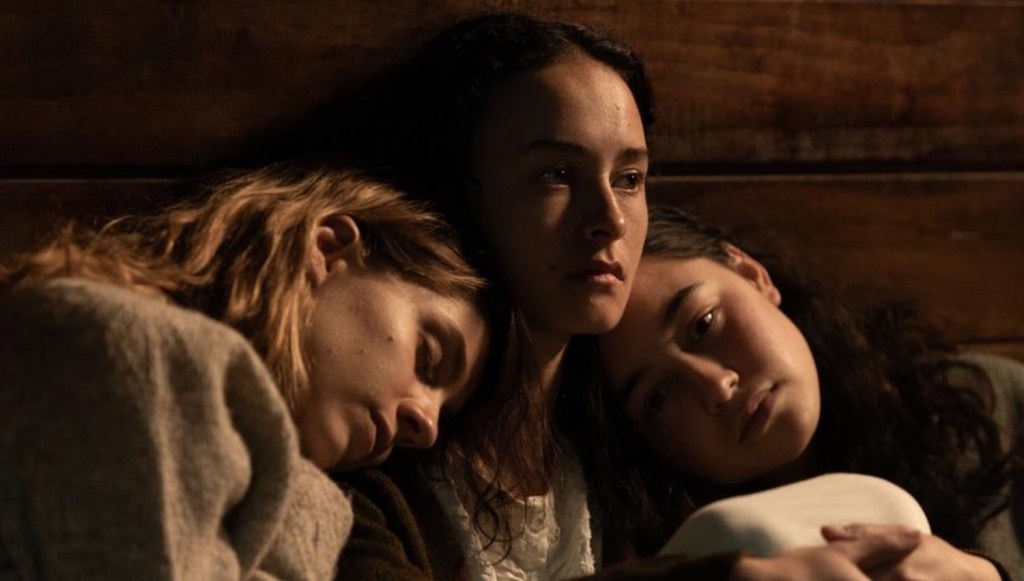
It’s the 1950s on a small island somewhere off the coast of New Zealand, where three girls share a cabin: Daisy, Nelly and Lou (Manaia Hall, Erana James, and Nathalie Morris). They were sent there by the authorities or their parents. Te Motu is a school for “incorrigible” girls or, as the administrators call them, “whores, queers, delinquents and sexual deviants.” Many are orphans or runaways caught stealing food, like Daisy or Nelly. Lou is the exception. She comes from a rich family but was caught making out with her (female) tutor. The school operates under the strict rule of Matron (Rima Te Wiata), who has a cruel streak a mile long. Raised by nuns, she feels the only way to cure these girls’ bad attitudes is through the bible and the lash. Naturally the girls all want to get the hell out of there, but it’s hard to escape from an isolated island in the south pacific. The purpose of the school is to turn bad girls into happy homemakers. They are given lessons in diction and manners but not reading or math.
Matron is frustrated by their outcome: She says they are “too stupid for school, to uncivilized to be maids and too barbaric to work”. Every so often, Matron is visited by men in suits from the mainland, one of whom suggests a horrifying treatment. But when Nelly find out, the three girls decide they have to do something to stop it.
We Were Dangerous is a moving, coming-of-age story about girls surviving in 1950s New Zealand. It’s bright and exuberant, full of playfulness and dancing, Haka and history, and though fictional, it tackles the very real issue of the mistreatment of indigenous girls. The acting is excellent all around, full of subtle clues and delightful details. For a first film, Stewart-Te Whiu avoids many potential stumbles and instead gives us a solid film that’s fun to watch. It played at ImagineNative this year, and is definitely worth seeing.
Apocalypse in the Tropics is playing this weekend at HotDocs and will be streaming on Netflix this coming week; Daniela Forever opens this weekend in Toronto; check your local listings; and We Were Dangerous is available now on VOD.
This is Daniel Garber at the Movies, each Saturday morning, on CIUT 89.5 FM and on my website culturalmining.com.
Unobtainable, unsustainable, inevitable. Films reviewed: Bookworm, Monkey on a Stick, Smile 2
Hi, this is Daniel Garber at the Movies for culturalmining.com and CIUT 89.5 FM.
Toronto Fall Film Festival season continues with Rendezvous with Madness presenting docs and dramas, features and shorts, about addiction and mental health followed by in-person discussions, starting on October 25th.
But this week, I’m looking at three new films, a kids’ movie, a doc and a horror film. There’s a precocious girl looking for the unobtainable; a group of deranged gurus trying to hold onto the unsustainable; and a pop starch wants to escape the inevitable.
Bookworm
Co-Wri/Dir: Ant Timpson
Mildred (Nell Fisher) is a young girl who lives with her mom in New Zealand. She loves reading but hates school. Her desk is surrounded by leather-bound books alongside a microscope, a telescope, a typewriter and a record player. She talks like a grownup, and is obsessed by wild animals. Her dream? To catch on film a black panther said to be roaming in the woods (along with a big fat cash prize for anyone who can take a picture of it.) But her plans all change when her mother is sent to hospital in critical condition following an exploding toaster. That’s when her biological father comes into the picture. He flies in from America to save the day.
Strawn (Elijah Wood) is a professional magician — he prefers “illusionist” — who loves magic: like making small things disappear or pulling coins from behind someone’s ears. Most people are wowed by Strawn’s prestidigitations and puppy dog eyes, but not Mildred. She scoffs at magic and is quick to reveal all his tricks. They two are opposites at heart. If you say “David Copperfield” she thinks of Dickens while he thinks of the
magician. Nonetheless, they are stuck together for now, so he agrees to take her camping. But little do they know of the exciting adventures and frightening dangers — like criminals, wild animals and crazy escapes — that lie ahead.
Bookworm is a very cute coming-of-age adventure about two strangers put together to form a makeshift family. It feels like a cross between a Roald Dahl Matilda and Taika Waititi’s Hunt for the Wilderpeople. It’s shot in the New Zealand wilderness amidst stunning mountains, cliffs and lakes. Nell Fisher is adorable as the obnoxiously mature Mildred, while Elijah Wood is equally adorable as the man-child who won’t grow up. I wanted to see this one because I loved director Ant Timpson’s bizarre debut, the violent comedy Come to Daddy. Bookworm is as different as any film could be but just as enjoyable.
I liked this one a lot.
Monkey on a Stick
Dir: Jason Lapeyre
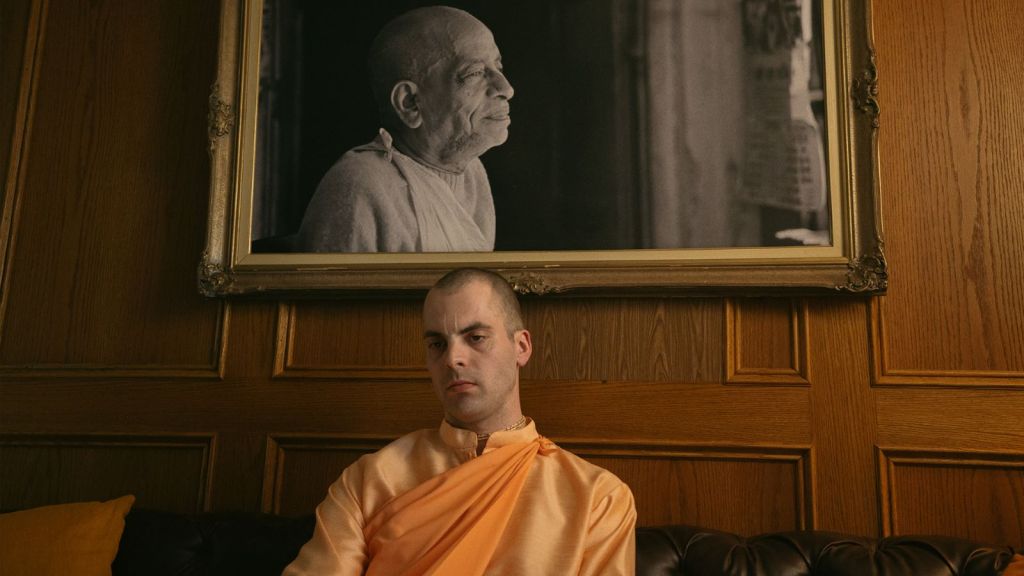
It’s 1965 and America is in high hippie mode. A. C. Bhaktivedanta Swami Prabhupada arrives in New York City from Calcutta. He’s there to sell books, including his own translation of the Baghdad Gita. But he ends up heading the Hare Krishna movement, a vast multinational phenomenon, a religion that espouses dancing, singing and chanting mantras in order to achieve a better afterlife. After picking up many devotees in New York, the movement exploded in popularity once he reaches California. Allen Ginzburg endorses it and George Harrison writes a song about it. Countless people join the religion, throwing away material possessions to dance, chant and collect alms in airports. But when the Swami dies, he leaves behind eleven gurus. That’s when things start to fall apart. This documentary — based on a bestselling book — exposes the crimes and excesses of the Hare Krishna movement in the 1970s and 80s.
One guru — in order to generate more money — sets up a drug ring of devotees instructed to smuggle hash from Pakistan to Canada. They have ties to the mob, leading to a series of violent crimes until it is finally exposed. Another guru collects automatic weapons, and goes on a shooting spree in California. A third guru — a self-declared Swami — the scariest of them all, builds himself an ornate golden castle in West Virginia, while his disciples — who have given away all their worldly
possessions — live in a shanty town beside the castle without toilet paper or plumbing. He later plans murders and is suspected of molesting children.
In fact, the movement as a whole is riddled with problems. Women are treated as inferior beings who distract male practitioners from their religious obligations. Homosexuality is strictly forbidden as is all sex outside marriage. And heavy censorship prevails — no TV, magazines, newspapers, movies, or books are allowed, except for one official newspaper. And by the second generation — the 1970s and 80s, when most of the documentary takes place — kids are sent to schools with teachers who have no training. They lock kids in dark closets or dump them in trashcans as punishment, among even worse crimes.
Monkey on a Stick is a documentary that looks at crimes of the Hare Krishna movement. It’s told using talking heads — including former devotees — period footage, and many reenactments, with actors visually demonstrating what the narrators are talking about. There’s also a series of random people sharing their views on religion, God and the afterlife. Though quite disturbing in parts, on the whole, it’s a fascinating story that exposes events I had never heard about before.
Smile 2
Wri/Dir: Parker Finn
Skye Riley (Naomi Scott) is a pop superstar, about to launch a worldwide tour. She lives in a luxury apartment on Park Avenue, and can buy anything she wants. She’s busy 24/7 at dance rehearsals, talk show appearances and autograph signings, under the constant supervision of her stage mom (Rosemarie DeWitt) and her PA (Miles Gutierrez-Riley). It’s her big comeback, after a year of rehab. This follows a bout of addiction culminating in a terrible car crash that killed her boyfriend and put her in intensive care. A year later, she still suffers from intense pain, pain so bad she is forced to buy opioids on the sly. But everything changes when she witnesses her high school friend (and drug supplier), Lewis (Lucas Gage) kill himself in front of her eyes in the most gruesome manner imaginable. And he dies with a rictus grin plastered on his face.
That’s when things start to go bad. Everywhere she looks she
sees that awful smile. It’s like she caught a disease by witnessing her friend’s death. She starts seeing people who aren’t really there, and experiencing events that never happened — even though they feel so real. She begins to doubt her sanity. It’s like some alien presence has lodged itself into her brain. Her friends, family and colleagues look at her in a strange way, even as she fears she’ll end up dead in a matter of days, with that same awful smile. Can she break this smile cycle? Or is she headed for insanity and death?
Smile 2 is a genuinely-scary psychological thriller/ horror about fame, celebrity, and a deadly condition passed on from person to person. It’s also one of those Hollywood rarities: a sequel that’s demonstrably better than the original. Naomi Scott is terrific as Skye, a punky, self-centred celebrity; Skye’s not just a horror movie screamer, she’s a real character, complete with a psyche and a believable back story. The movie itself is really well made, with beautiful art direction, cool choreography, and ingenious camerawork and editing, where a scene can flip, elliptically, from an elevator ride to an overhead view of the street. Warning: it’s quite violent, so if you don’t like seeing blood and guts, stay away. But otherwise, Smile 2 is a really good, heart-pounding genre movie.
Bookworm, Monkey on a Stick and Smile 2 all open this weekend in Toronto; check your local listings.
This is Daniel Garber at the Movies, each Saturday morning, on CIUT 89.5 FM and on my website culturalmining.com.
Indigenous films at TIFF22. Movies reviewed: Ever Deadly, We Are Still Here
Hi, this is Daniel Garber at the Movies for culturalmining.com and CIUT 89.5 FM.
TIFF, the Toronto International Film Festival is back again with guns ablazin’, after a two-year hiatus. Yes, TIFF didn’t actually stop over the past two years — there were some great films online in 2020 and some in-person shows during last-year’s hybrid version, but very few people were in actual attendance. No celebs, no parties, no volunteers, no lineups, and no red
carpets. When the anti-piracy laws popped up on your home screen, there was no crowd there to say Grrrrr. You couldn’t turn to the stranger sitting beside you and ask what did you think of this movie. It felt more like a simulacrum than an actual event.
Well, this year it’s on again,
They’re sticking a toe in the water to see how it feels. It’s called the TIFF Experience (whatever that means) and you can experience it right now, if you go down to King Street West in Toronto, between Peter and University. Even if you’re not up to going indoors yet, they’re showing outdoor screenings of
classic movies. On stage, there are free concerts, and there are always sponsors handing out free samples to munch on, street performers, people dressed up, fans waiting to photograph arriving celebrities, the whole kit and kaboodle. This is pre-recorded so I can’t promise that’s what it will be but that’s prediction. It’s actually fun. That’s just on this weekend, so if you’re in Toronto, you should drop by.
This week I’m talking about two new movies playing at TIFF, both on indigenous peoples in the two antipodes. There’s throat singing in the far north and a new telling of history, far, far south of the equator.
But first here are a few other TIFF movies I can’t wait to see.
MOVIES AT TIFF
Chevalier (Stephen Williams) is about a little-known Guadaloupe-born composer in Paris during Mozart’s era. I want see it because it stars Kelvin Harrison Jr, one of the best new actors around who creates an entirely new character for each movie he’s in to the point he’s virtually unrecognizable.
Steven Spielberg has a world premier at TIFF with The Fablemans, his first autobiographical movie. Why do I want to see it? I’m just really curious to see what he did.
Women Talking is based on a book by Mirriam Toews about a Mennonite-type colony. It stars Rooney Mara, Claire Foy, Jessie Buckley, Sheila McCarthy, Frances McDormand, but I really want to see it because it’s directed by Sarah Polley.
The Kingdom Exodus is about a weird Danish hospital. It’s a
TV show, something I rarely bother to watch at TIFF, and I know nothing about it, but the reason I want to see it is it’s directed by Lars von Trier, and I’ll watch anything he makes, no matter how painful.
And finally I hope to catch The Hotel, about a bunch of Chinese people stranded in a hotel in Thailand during 2020’s Spring Festival, just as the pandemic lockdown hit. I want to see it because it’s directed by Wang Xiaoshuai, who is an under-appreciated but skilled and thoughtful filmmaker.
Dir:Tanya Tagaq and Chelsea McMullan
Tanya Tagaq is an Inuit throat singer and performance artist from Nunavut. Ever Deadly documents a performance accompanied by musicians and singers. It’s experimental, avant-garde music interspersed with stories and poems recited as part of the concert. Throat singing is a traditional Inuit art form, but she also experiments with it, in a unique, highly sexual, sensual, visceral, animalistic and at times even supernatural voice. If you’ve seen her before you’ll know what I mean. The film is also about her family’s history, and that of Canada. Her nomadic grandparents were forcibly relocated to a barren arctic area, with nowhere to hunt or fish, in order to
claim sovereignty of the land along the northwest passage. Chelsea McMullan also includes stunning scenes of the stark arctic landscape, polar bears, migrating birds, aurora borealis. And not just the visuals but also the sounds like the unique squeaking crunch of walking on pebbles on a beach. There are vintage footage and photos contrasting lawmakers in parliament with Inuit kids gleefully eating bloody raw seal meat. And grotesque, highly-sexualized animated drawings.
If you’ve ever seen Tagaq perform you’ll know exactly why you should see this, but if you haven’t, it’s time for you to experience it.
Dir: (Various)
At the height of the British Empire maps were coloured pink on every continent, showing both colonies and the so-called Dominions, areas, like Canada, Australia and New Zealand that were settled by Europeans who make up most of their populations. But these places weren’t empty when the British arrived.
This film rewrites the history of Australia, New Zealand and the South Pacific as seen from an indigenous point of view. It’s made by eight filmmakers, four each from Australia and Aotearoa, and it consists of a number of scenes set in the past, present and future. The first British ships appear on the horizon to a mother and daughter catching fish. A settler lost in the bush demands an aboriginal guide show him the way back to his town. A Maori village debates whether to go to war against settlers, ending in a Haka war dance. And a soldier in the trenches of Gallipoli, has an unusual conversation with his enemy, a Turkish soldier. There’s also a dystopian view if the future, and a number set in the present day, including a clandestine graffiti artist and a young protestor. One of the
most moving ones is about an ordinary guy, a tradesman, just trying to buy a bottle of wine from a grog shop (liquor store), who is stopped each time by an abusive cop because he’s indigenous, and it’s Northern Territory where, apparently, it’s legal to routinely treat some people as second-class citizens.
I shy away from reviewing short films because they’re too short and there are too many of them. But We Are Still Here functions as a feature film, telling all the stories not as individual short films, but interwoven into a common coherent thread, jumping back and forth between then and now. It’s nicely done and relevant, very moving, and made by indigenous filmmakers. And it helps restore parts of history that have up to now been erased.
We are Still Here and Ever Deadly are both playing at TIFF; Festival Street is open all weekend.
This is Daniel Garber at the Movies, each Saturday morning, on CIUT 89.5 FM and on my website, culturalmining.com
In depth. Films reviewed: The Velvet Underground, Kímmapiiyipitssini: The Meaning of Empathy, The Power of the Dog
Hi, this is Daniel Garber at the Movies for culturalmining.com and CIUT 89.5 FM.
We are all flooded each day with new images and stories, both broadcast and online, but don’t they all seem to be fleeting and ethereal, lasting no longer than the average news cycle or two. Rarely do we get in-depth examinations of anything. But movies can do that, opening your eyes to deeper thoughts. So this week I’m looking at three new movies — a western and two feature-length docs —that look at things up close. There’s cowboys in Montana, First Nations in Alberta, and avant-garde rockers in Greenwich Village.
Wri/Dir: Todd Haynes
It’s the early 1960s. Lou Reed is a Brooklyn-born teenager who lives in suburban Long Island. He’s depressed and his parents send him for electroshock therapy. He teaches himself guitar listening to doo-wop and rockabilly on the radio. Later at university in Syracuse, he studies under Delmore Schwartz. He goes to Harlem with his girlfriend to buy hard drugs and writes poems about furtive sex with men he meets in dark alleys. John Cale is the son of a coal miner in Wales who studies classical music in London. They meet in the Village and start a band within the exploding world of avant-garde film, music, art and poetry. Velvet Underground plays long, drawn-out tones with a dark drone grinding in the background, combining Reed’s dark lyrics and Cale’s musicality (he plays viola in a rock band!) They perform at Andy Warhol’s Factory and Nico, the enigmatic European
actress, completes their sound. Though never a huge success and breaking up after a few years, the Velvets influenced generations of musicians.
This two-hour doc looks at the band itself (Reed and Cale, along with Moe Tucker and Sterling Morrison) and where it fit within New York’s burgeoning underground scene. Aside from the usual suspects, it talks about or interviews unexpected faces,
musicians Jonathan Richman and Jackson Browne, and experimental filmmakers like Jonas Mekas and Jack Smith. Aside from its meticulous retelling of group’s history, it’s the look of this doc that really blew me away. Todd Haynes exploits that era’s avant-garde film techniques, from split screens to three-quarter projections, along with a good dose of 60s pop culture. And there’s a constant stream of music from start to finish, including rare tracks of early songs before they found their groove. I had to watch The Velvet Underground on my laptop but this beautiful documentary deserves to be appreciated on a movie screen.
Kímmapiiyipitssini: The Meaning of Empathy
Dir: Elle-Máijá Tailfeathers
It’s the mid-2010s and opioids are ravaging the Kainai Blackfoot First Nation in Alberta (that’s the largest reserve in Canada). Families are torn apart, and hundreds of lives are lost. The abstinence and cold-turkey programs just aren’t working, especially for the most marginalized, who end up homeless in cities. So instead they start up harm reduction centres like those pioneered on the streets of Vancouver’s Downtown Eastside. This highly-personal documentary follows a number of addicts — of both opioids and alcohol — as they enter harm-reduction treatments and through its various stages. It’s spearheaded by the filmmaker’s own mother, Dr Esther
Tailfeathers, a physician, but also includes Social workers, EMS, nurses and councellors, in drop ins, detox centres, hospitals and clinics, both on the reserve and in nearby cities like Lethbridge.
As the title suggests, caring and empathy saves more lives than punishment, threats or abstinence. Rather than kicking people out, it embraces them while standing by to treat overdoses, and on a bigger scale helping them find purpose and meaning, along with food, shelter and medical care. The doc also looks at the intergenerational causes that led to these addictions, from broken treaties to residential schools. Kímmapiiyipitssini: The Meaning of Empathy is gruelling in parts — and not an easy film to watch — but it is one that turns despair into hope.
Wri/Dir: Jane Campion
It’s the 1920s. Phil Burbank (Benedict Cumberbatch) is durned mean cuss. He owns a ranch in Montana with his brother George (Jesse Plemons), and regularly drives cattle with his posse of young cowboys. They always stop by a roadhouse run by the widow Rose (Kirsten Dunst) and her skinny sensitive son Peter (Kodi Smit-McPhee). Phil went to one of them Ivy League schools in the east, but they don’t know nuthin about the life of a cowboy. He learned everything from an older buckaroo when he was just a lad, and now keeps a shrine to him in his stables. But like I said, Phil is a mean bastard who directs his venom all around him. He calls his brother fatso, and
when George marries Rose, Phil torments her and drives her to drink. And he calls her son Pete a pansy. Until… Pete discovers Phil’s secret. He finds his illicit porn stash and catches him in a hidden grove luxuriating in mud-covered self-love. That’s when Phil changes his mind and decides to mentor Pete in the old cowboy ways. But is that what Pete is really after?
I walked into The Way of the Dog at TIFF expecting a conventional Western, but I saw something much bigger than that. It’s a subversive twist on a classic genre. It’s set in the 1920s, avoiding the blatantly racist portrayals of indigenous
people in most Westerns (the “Indians” in “Cowboys and Indians”) which take place in the 19th century when settlers were slaughtering them with impunity in their western migration. This one is set 50 years later. There are also no hold-ups or show-downs; guns don’t play a major war in this Western. It’s directed by Jane Campion who won big time awards for The Piano thirty years ago, but I hadn’t heard much about her for a long time. So I wasn’t expecting much. But this film really shocked me with its gothic tone, complex characters and twisted plot. The interplay between Cumberbatch and Cody-Smit is fascinating. All of this played out against the wide, western skies (it was actually filmed in New Zealand) makes The Power of The Dog a really great movie.
The Velvet Underground is playing theatrically in Canada for one night only, Sunday, Nov 28th at 8 pm, at the Rogers Hot Docs cinema in Toronto; and Kímmapiiyipitssini: The Meaning of Empathy opens today, also at Hot Docs; and The Power of the Dog just opened at the Tiff Bell Lightbox.
This is Daniel Garber at the Movies, each Saturday morning, on CIUT 89.5 FM and on my website, culturalmining.com.
Some Antipodean Directors. Films reviewed: The Assistant, Come to Daddy
Hi, this is Daniel Garber at the Movies for culturalmining.com and CIUT 89.5 FM.
February is the worst month of the year, full of overcast skies, slush on the ground and a general malaise. So I thought: why not look at movies from a place where our winter is their summer? At least the directors, if not the stories. This week I’m looking at two films by directors from the antipodes, one from Australia, another from New Zealand. There’s a thriller/horror about a young man searching for his father’s secrets; and a tense drama about a young woman uncovering horrible secrets in her office.
Wri/Dir: Kitty Green (Interview: Ukraine is not a Brothel)
Jane (Julia Garner) is a young woman trying to make it in New York City. Hired straight out of Northwestern, she’s currently at the bottom of the ladder, but hopes to work her way up. She’s an assistant at a medium-sized movie industry corporation with offices in New York, London and LA. She’s the first one to arrive, the last one to leave, the sort who eats her fruit loops standing up in the office kitchen. All the grunt work falls to her — order lunch, sort head shots, distribute memos, serve coffee, book hotel rooms, tidy up her boss’s office. And deal with angry abusive people blaming everything on her. She brushes it all off in
exchange for the promise of future work.
But something doesn’t seem quite right. A newly hired assistant, a pretty aspiring actress, has just arrived from Boise, Idaho, fresh out of high school, who has only worked as a waitress in a diner. Jane commutes from remote Astoria while the newest assistant is staying at a first-class hotel. She finds a woman’s earring under a cushion in the boss’s couch. Why do actresses leave the boss’s office in tears? Why is she sending out blank cheques to unnamed people? And what will happen to the new assistant who thinks she’s here for an audition? Although she doesn’t face sexual abuse from her boss, it’s becoming increasingly clear that other women do. Why isn’t anyone talking about it? And is she to blame of she doesn’t speak up?
The Assistant is a cold, hard look at the rampant sexual harassment and abuse women face. It’s set at some point in the past, before the #MeToo movement broke,
when everybody knew what was going on, but nobody ever did anything about it. Or if they did, they would be paid hush money to keep it away from the public. Male assistants laugh nervously, making jokes about which pieces of the boss’s furniture you should never sit in. Older women take it as a given: don’t worry dear, you’re not his type. The movie just lays its out before the audience in all its horribleness… without ever showing it.
Julia Garner gives a stunning performance as Jane, conveying a succession of unspoken emotions over the course of one day through facial expressions and body language: dread, distrust, realization, horror, and fear. There’s a terrific scene where she wraps herself up in a winter coat and a big scarf – like a suit of armour – to somehow shield her from the bad stuff happening all around her. This film gives a realistic look at a widespread problem reduced to a single day in one unnamed office.
The Assistant is a subtly, powerful movie about a difficult and uncomfortable topic that has to be told.
Dir: Ant Timpson (Turbo Boy)
Norval Greenwood (Elijah Wood) is a privileged, 35-year-old guy from LA. He loves fashion, celebrity and the big city. His prize possession is a limited edition, solid gold cel phone designed by Lorde. But something is missing from his life. His father walked out when he was five and Norval was raised by his mother in a Beverley Hills mansion. So when he receives a cryptic, letter from his long-lost Dad telling him he wants to talk to him, he decides to do it. He follows a handwritten map to a rocky beach in the pacific northwest until he finds an isolated, wooden house decorated with christmas lights clinging to the edge of a cliff. He knocks on the door, and a dessicated, grizzled old man opens it. “Hi Dad, Here I am…”
But this is not the kindly father he remembers. Gordon (Stephen McHattie) is a mean drunk, staggering around swilling plonk as he shoots insults at his son. His beady
eyes look like dried out raisins. Norval wants to get the hell out of there but only after his dad tells him why he asked him to come in the first place. But when the old man threatens to chop him up with a cleaver, he knows something is not right.
Come to Daddy is a nihilistic thriller/horror as seen through a darkly comic lens. Elijah Wood is great as a nervous, self-centred guy whose First World problems are dwarfed by real life dangers… involving a killer, an eccentric policeman, a coroner, a swingers convention at a nearby motel, and the unexplained noises, that echo — clang clang clang — around the nearly empty house. The vintage Thai soundtrack helps balance the blood and gore. This is a particular genre; either you like it or
you don’t, but I love darkly twisted movies like this, with the quirky characters and constant surprises that keeps me glued to my seat till the final revelation.
The Assistant and Come to Daddy both open today in Toronto; check your local listings.
This is Daniel Garber at the Movies, each Friday morning, on CIUT 89.5 FM and on my website, culturalmining.com
Blend in, fight back or run away? Movies reviewed: Neon Demon, Free State of Jones, Hunt for the Wilderpeople
Hi, this is Daniel Garber at the Movies for culturalmining.com and CIUT 89.5 FM.
When faced with a monolithic system, do you fight back, try to blend in or run away? This week, I’m looking at movies about people trying to make the land their own. We’ve got soldiers and slaves heading into the swamp; a boy and his uncle heading into the bush; and a teenaged girl heading into the jungle… of modelling.
Neon Demon
Wri/Dir: Nicolas Winding Refn (Drive, Only God Forgives)
Jesse (Elle Fanning, Ginger and Rosa) is a small-town girl recently arrived in L.A. She’s there to make it big as a fashion model. But to do that you need connections. Right away, she meets Dean an earnest young photographer (Karl Glusman, Love). He takes some photos for her portfolio. Then, at a nightclub filled with neon she meets three women ready to lend a hand. Two blonde supermodels named Sara and Gigi (American Abby Lee and Aussie Bella Heathcote) and a makeup artist. Red-haired Ruby (Jena Malone) says she knows all the right people.
Almost immediately, Jesse starts her dizzying rise to the top. She signs with a major agency, lands a gig with a famous photographer, and is chosen as the lead
model in a runway show. A star is born.
But beneath its shiny veneer this world is rotten to the core. She still sleeps in a super-seedy motel room. Hank, her skeezy landlord (Keanu Reeves) is a serial predator always on the lookout for victims. Jesse is startled to find wild animals animals climbing through her window. Other models she encounters are just bitter vipers waiting to strike. And her makeup artist friend, Ruby? She’s a makeup artist all right — for corpses. Only Dean seems genuine…but he’s not famous, so he doesn’t fit in her new world.
When her so-called friends witness Jesse’s triumph at an audition they are consumed by jealousy and rage. In despair, one model smashes a mirror in the washroom. At first Jesse tries to comfort her. When she cuts her hand on the broken glass, something horrible happens. The model literally tries to suck up Jesse’s blood to gain some of her beauty and youth!
Neon Demon is a surreal fable set in the world of modeling. Danish director Refn Wilding is known for his dark, stylized urban dramas like Drive (starring Ryan Gosling). Like his other films, it has great music, pretty people and arresting images, both beautiful and hideous. I liked it, but it’s not your usual narrative. It’s strictly art-house horror, so it’s never clear whether it’s a dream, a fantasy or real life – it’s left up to you to decide.
Free State of Jones
Dir: Gary Ross
Newton Knight (Matthew McConaughey) is a Confederate soldier from Mississippi. He’s a medic, so he sees his fair share of death at the frontlines. But when he sees a young boy (Jacob Lofland, Mud), a draftee from his home town, killed on his first day, he’s
had enough. Newt takes his body back for a proper funeral. Which makes him a deserter.
Back in Jones County he discovers the problems aren’t just at the front – they’re behind the lines too. All the men and boys are being sent to die defending slavery, but the actual slave owners – anyone with more than 20 slaves – is exempt from serving. This war is being fought for rich people, the cotton plantation owners, not for the poor farmers like him and all his neighbours. Not just that. The army is stealing all the food,
clothing, practically anything of value from the poor farmers in what they called taxation. They need it to feed the troops they say. But they leave the plantations untaxed and untouched. The raids are all led by the villanous Lt Barbour (Bill Tangradi) with his foppish blond curls.
Newt has had enough — he flees to the swamps, attacked by a vicious army dog on the way. Runaway slaves there nurse him back to health and become his new family. In particular, beautiful Rachel (the wonderful British/South African actress Gugu Mbatha-Raw) a house slave who serves as a secret go-
between for the runaways and slaves still on the plantation. And the self-named Moses (Mahershala Ali) a righteous leader who escaped with a hideous iron contraption still locked around his neck.
Word spreads and poor white farmers join Newt’s makeshift army. He declares a free state in Jones and
neighbouring counties. He deems them all free men, both black and white, says farmers can reap what they sow, and that no one will ever go to war again for the rich. They start like Robin Hood, taking back food the army is stealing. But end up going to battle against the Confederate government from deep within Mississippi.
This is a fascinating, true story. It’s timely too. with the rise of populism in American politics. Warning – it’s a very long movie (almost feels like a mini-series). It continues long after the civil war, covering things like lynching, post-war slavery and KKK terror, rarely mentioned in mainstream movies. It’s the first time I’ve heard about this slice of history — a genuine civil rights movement born deep in Mississippi, in the midst of civil wat.
Hunt for the Wilderpeople
Dir: Taika Waititi (What We Do in the Shadows)
Ricky (Julian Dennison) is a chubby 12 year old city kid, into hip hop and gangsta movies. He’s a “bad egg” says Paula his tough-as-nails social worker (Rachel House). He’s surly, unresponsive and a frequent runaway. Given up for adoption as an infant he’s reached his final foster home – if he doesn’t fit in here, he’ll be sent to juvie. His new
home is out in the middle of nowhere at an isolated farmhouse in the green-covered hills of New Zealand. He’s immediately welcomed by the warm and giving Bella (Rima Te Wiata). She decorates his room, makes him special food, even gives him a hot water bottle to snuggle up with at night. Her husband
Hec (Sam Neill), on the other hand won’t even give him the time of day. He’s reclusive and anti-social, but he does know his way around the woods. Ricky runs away a few times but soon realizes this is his real home with a loving mom, a new dog, he calls Tupac, and a place to write haiku.
But then disaster strikes, and his new life is imperiled. He flees into the bush to live off the land. Like the South African wildebeest he plans to walk a thousand miles. Unfortunately, he
hasn’t a clue what to do. Luckily, Hec comes to his rescue to help him out. But unbeknownst to them both they become famous – in a bad way: the object of a nationwide manhunt. Can they survive in the bush without driving each other crazy?
This world is full of strange people. Like Psycho Sam, a tin-foil hat devotees and idiot city hunters who want to turn them in and collect the reward.
This movie is told from an indigenous point of view. The director and most of the actors – though not the characters they play – are of Maori descent. The story incorporates indigenous culture. Ironically, it’s Uncle Hec, the white character, who passes on the indigenous learning that Ricky was never taught. And Ricky who shares contemporary culture and basic literacy with the isolated Hec.
Hunt for the Wilderpeople is a feel-good, light, family comedy. I like this movie — it’s cute and a lot of fun.
Neon Demon, Free State of Jones, and Hunt for the Wilderpeople open today in Toronto; check your local listings.
This is Daniel Garber at the Movies, each Friday morning, on CIUT 89.5 FM and on my website, culturalmining.com
Daniel Garber talks with Tickled director David Farrier at #HotDocs
Hi, this is Daniel Garber at the Movies for culturalmining.com and CIUT 89.5 FM.
David Farrier is a New Zealand TV journalist who specializes in odd and off-beat stories. So when he sees an ad online looking for athletic young men, aged 18-23, for Competitive Endurance Tickling, he sees a potential story. But when he contacts the company, run by a secretive woman named Jane O’Brien, he gets a surprising reaction: a series of abusive and
threatening email.
Followed by three men flown all the way to New Zealand from LA, threatening a lawsuit if he doesn’t drop the story. Just for investigating some guys being tickled.
Tickled is also the name of a fascinating and disturbing new documentary about hidden identities, vast conspiracies, and cyber bullying. All surrounding a phenomenon – professional tickling — largely unknown to the general public. It’s co-directed by actor, journalist and crypto-zoologist David Farrier who’s also the film’s narrator and subject.
I spoke to David at Dublin Calling in Toronto at Hot Docs earlier this spring. Tickled opens today in Toronto.
Photos by Jeff Harris
Names. Films reviewed: Beeba Boys, Meet the Patels, The Last Saint
Hi, this is Daniel Garber at the Movies for culturalmining.com and CIUT 89.5 FM.
The imagineNATIVE Film + Media Arts Festival is on right now, with over a hundred works by indigenous artists and filmmakers. Where else could you enjoy tea ‘n’ bannock while checking out virtual reality and video games by First Nations artists? Go to imaginenative.org for info, or, better yet, drop by the TIFF Bell Lightbox to see it in person. Experience indigenous culture and be sure to remember the names of these artists filmmakers.
Names are important, so this week I’m looking at some movies about names and families. There’s a documentary about a man named Patel, a crime drama about a gangster called Jeet, and a coming-of age drama about a Polynesian-Kiwi named Minka.
Beeba Boys
Dir: Deepa Mehta
Jeet (Randeep Hooda) is a charismatic criminal from Vancouver. He lives with his gossipy Mamaji and woebegone Papaji but makes a living trafficking drugs and guns. His underlings dress in garishly-coloured suits, as he carries out his business in a flashy nightclub. And he spends his spare time with Katya (Sarah Allen)
an old-skool gangster’s moll he keeps locked away in a luxury condo.
The movie starts with a bang, involving a dead groom and a parking lot shooting. But his rise in power is challenged by a more powerful Sikh gang headed by a man named Grewal. Jeet is sent to a local jail where he meets a petty gangster named Nep (Ali Momen) just in from Toronto. And he wants to join Jeet’s crew. But
he has a secret: he’s dating Grewal’s pretty daughter even as he makes his name with the Beeba Boys. Which kingpin will triumph – the upstart Jeet or the powerful Grewal? And where does Nep’s loyalty really lie?
Beeba Boys is a stylized gangster pic typical in every way except for its players – all Desi Canadians – and its locale, Vancouver. Except for a few scenes, it lacks humour (despite a character who insists on telling bad jokes). And the women are all hanger-onners, surprising for a film from a female director. This is a guy’s gangster movie. But the action is good, with plenty of gratuitous violence. It holds your attention, and there are even a few truly surprising plot twist. And the acting is mainly good, including a surprising appearance by Paul Gross as a bad guy. If you’re in the mood for an all-Canadian Sikh gangster pic, this one’s for you.
Meet the Patels
Dir: Geeta Patel, Ravi Patel
Ravi Patel is 29 and single. He’s not a doctor, but he’s played one on TV (He’s an actor working in LA). His childhood sweetheart recently dumped him for his fear of commitment. And he foresees a rootless future if he doesn’t do something soon. So he agrees to give in to his parent’s advice and find an Indian woman to marry. Soon he’s plunged into a visit to
Gujarat and a lesson in his heritage.
The Patel’s are more than just a common last name and a lot of motel owners. It’s a gujarati-speaking caste, not a family, per se. And it has an amazing networks of connections in North America with a registry of singles spanning the globe. Their “bio-data” includes their shade of skin (“wheat-coloured” women — whatever that means — are, apparently, considered more desireable), their education, family
background and ancestry.
Followed by his sister Geeta behind the camera, Ravi begins an amazing series of blind dates, speed dates, and online match-ups. But will he ever find love among the Patels?
Meet the Patels has some cool animated sequences, and it told me a lot I didn’t know about a hidden world in North America. But it gets bogged down by endless family discussions and Ravi’s confessions that felt too much like a reality TV show. It’s not the comedy it’s advertised as, but more of an intimate portrait of an insecure, single man.
The Last Saint
Dir: Rene Naufahu
Minka (Beulah Koale) is a young Polynesian guy who lives with his mum Lia in Aukland, N.Z. He enjoys spinning disks and hanging with his only friend, a nihilistic girl named Xi (Like the Warrior Princess, she says).
Lia (Joy Vaele) is a recovering addict, given to terrifying bouts of insane violence involving sharp knives. Minka pleads with social services to help take care of her but they turn him down. So he’s forced to look elsewhere for money. In walks a shady-looking man in black (Calvin
Tuteao) who offers him a job at his nightclub. It’s a seedy joint but he does his work. He refuses his boss’s offers of drugs, alcohol or prostitutes, and shuns all violence.
His boss is impressed and reveals his connection to Minka and his mum: he’s his missing father! Still, he sends him out on a dangerous mission to make a delivery in the middle of the night. Minka encounters a musclebound, tattooed Polynesian dealer named Pinball (Joseph Naufahu). In the midst of
‘roid rage Pinball demands to know Minka’s “real name” and threatens to kill him.
Later, he encounters a gang of intimidating, torturing Tongans and other unexpected strangers. Can he survive the night? And will his family ties save him or drag him deeper into a life of crime.
The Last Saint is an excellent coming-of-age look at a good guy driven to crime. The acting is great, with nearly every portrayal compelling, especially Koale.
Beeba Boys and Meet the Patels both open today in Toronto. Check your local listings. The Last Saint screens tonight as part of ImagineNative.
This is Daniel Garber at the Movies, each Friday morning, on CIUT 89.5 FM and on my website, culturalmining.com.
Peter Pan Syndrome. Movies Reviewed: Whiplash, Laggies, What We Do in the Shadows PLUS ImagineNATIVE
Hi, this is Daniel Garber at the Movies for culturalmining.com and CIUT 89.5 FM.
ImagineNative Film and Media Arts Festival started with a blast on Wednesday night. Two women read aloud the Sami Declaration of Indigenous Cinema. It declares that the oral tradition of native cultures must be preserved through storytelling on the screen. That sums up what this festival brings us – international views and culture, respecting the indigenous creators.
This week, I’m looking at three very different, but very good movies. There’s a thrilling drama about a young musician who won’t give up; a comedy about a woman who won’t grow up; and a mockumentary from New Zealand about vampires who won’t grow old.
Whiplash
Dir: Damien Chazelle
Andrew (Miles Teller) is a 19-year-old music student. Pale-cheeked and dark haired, he lives in a New York City apartment with his single father (Paul Reiser). He plays the drums with a driven passion, and he’s just starting at a prestigious music conservatory. He finds an unused drum set in a dusty school room and plunges right in. Drummer’s heaven. And who walks by and hears him but Fletcher (JK Simmonds). He’s a bald, acerbic music teacher who is also the head of the school’s elite, prize-winning jazz band. And he pulls Andrew out of
class to audition for the band. This is rare, since the band members are much older and more accomplished.
He realizes something big is happening – his talent is finally being recognized! His life is going great, and he even gets the confidence to ask a girl he sees at the local rep cinema on a date.
But, what he doesn’t know is that Fletcher is also a perfectionist who demands top
performances from his players, even during rehearsal times. That’s good, right? No! Fletcher is a cruel and twisted megalomaniac, who loves nothing more than driving his music students to tears. Every position in the band is tenuous, at best, subject to Fletchers’ whims. Now you’re in, now you’re out. And he elevates the importance of the band to mythic proportions.
Andrew soon realizes that he has to devote every waking moment of his life to reaching absolute, synchonistic perfection in his drumming if he wants to stay in the band. And Fletcher seems to have singled him out as the victim he can elevate
and then crush. Who will triumph in this battle of minds? Sensitive young Andrew? Or the fascistic Fletcher?
Whiplash is a fantastic and tense thrilling movie. Director Chazelle manages to portray a music academy as a boot camp or a boxing match. Andrew’s not a musician but an athlete, and one who drums until he bleeds. Miles Teller as the kid and JK Simmonds (Law & Order) as the teacher perfectly play the two sides of this violent duet. The acting, the passion and the relentless tension in this movie is just incredible… you gotta see it. Whiplash was the first movie I saw at press previews at TIFF back in August and and it became the standard against which I measured every movie after it.
Laggies
Dir: Lynn Shelton
Megan (Keira Knightly) is a happily unmarried slacker in her late twenties. OK, her post-graduate school career hasn’t exactly taken off, but she still has her loving dad, her high school friends and Anthony, the longtime boyfriend she lives with. But at a wedding, she discovers maybe her Dad’s not so great, and her best friends aren’t. And when Anthony proposes marriage (and a quicky wedding in Las Vegas) Megan panics. She flees the wedding.
She ends up hanging with some teenagers she meets at a strip mall liquor store. She identifies with them, especially Annika (Chloe Grace Moritz). She was like her in high school…. Which wasn’t that long ago. They become friends. And this new friendship also gives her a chance to get away from her own life. She secretly moves
in with her new best bud for an extended sleepover party. But Craig, Annika’s single dad (Sam Rockwell) discovers his daughter’s new best friend… is a grown up. They have a long talk. Does Megan see herself more as an adult like Craig, or a kid like Annika? Or is she somewhere in between? And how would their relationship change if she dated her dad?
Laggies is a cute, funny romantic comedy about the maturing of a young woman in her twenties. Director Lynn Shelton (Your Sister’s Sister, Humpday) comes from the Seattle low-budget indie scene, and this is her first one with big name stars. And she pulls it off. Keira Knightly and Chloe Moritz are great as the mismatched friends. (My only question? Is “single dad” a new movie trend?)
What We Do in the Shadows.
Dir: Jemaine Clement, Taika Waititi
Four guys with an unusual sense of fashion share a house in downtown Wellington, New Zealand. There’s the flamboyant and sensitive, pirate-shirted Viago (Taika Waititi) who pines for his lost love Katherine. Vladislav (Jemaine Clement) sticks to clandestine orgies behind his velvet drapes. And ex-nazi Deacon (Jonathan
Brugh) can often be found hanging upside down like a bat. They have regular house meetings, complete with job wheels. And of course they love a good night out. Why? So they can find some virgins and suck their blood. They’re vampires, of course! When they say “clean up the bloody dishes” they mean it literally.
And they’re part of the underground – if somewhat cheesy — supernatural subculture
we’re told exists in Wellington, complete with zombies, witches and werewolves. As vampires they can fly around and sleep in coffins. But they don’t know how to use facebook or take selfies. So, with the help of regular not-dead guy Stu, they try to adjust to modern life and avoid spilling blood everywhere.
What we do in the Shadows is a hilarious character-driven fake documentary about
the lives of oddballs in New Zealand. It opened ImagineNative not for its topic, but for the filmmakers, producer and stars of the movie
All three movies played at TIFF this year. Laggies and Whiplash both open commercially today, check your local listings. What We Do in the Shadows opened at ImagineNative – which continues through October 26th featuring Australian movies and many gallery installations. Free before 6:00 pm for students, seniors and underemployed. Go to imaginenative.org for more info.
This is Daniel Garber at the Movies, for CIUT 89.5 FM and culturalmining.com
Family Ties. Movies Reviewed: Boy, A Windigo Tale, Score: a Hockey Musical, Conviction plus ImagineNative festival
This week, I’m talking about four very different movies, two dramas, a comedy drama, and a comic musical, that all deal with family members and family ties: brother/sister; father/son; parents/son; mother/daughter; grandfather/grandson.
But first, let me tell you a bit about the 11th annual ImagineNative film and media arts festival that’s on right now in downtown Toronto. It’s a cultural celebration of First Nations, Inuit, and international aboriginal and indigenous artists and filmmakers, from Canada – urban, rural, and northern – Latin America, as well as Asia and the Pacific, and Europe. There are movies – short films and features, mainstream and experimental — lectures, workshops, art exhibits, installations, and multimedia events, including radio podcasts, and online new media sites. So tons of contemporary media and current issues and artforms. Lots of free exhibits going on, and films every night in the Spadina and Bloor area. You should definitely check this out – look online at http://www.ImagineNative.org
ImagineNative started with a screening of
Boy
Director/Writer: Taika Waititi
The Canadian premier of a popular, new New Zealand movie.
It’s the early 1980s, in a small town in New Zealand. Boy – that’s his name – lives there with his Nana, his little brother, Rocky, and a bunch of cousins. His mom died when he was young, and he can barely remember his dad who took off years ago with some petty hoods in a sort of a biker gang called the Crazy Horses. Boy’s waiting for his promised return to take him away from all this and to see a Michael Jackson concert in the big city. But when his grandmother leaves town for a few days to go to a funeral, who shows up but his dad – for real (played by the director, Waititi.)
He’s up to no good though, and Boy has to reconcile his hood-y pothead of a dad with the hero he had been expecting. Whenever reality gets too hard to handle, Boy retreats into his fantasies, and recasts things – in his mond – like visualizing a bar brawl as a Michael Jackson Beat It video. (His little brother Rocky, on the other hand, imagines he has super powers, and is laden with guilt thinking he’s the one who caused all the bad events in his life.)
This is sort of a sad story, but the tone is light enough, and there are enough very funny scenes that it’s not a downer of a movie at all. It reminded me a lot of a movie from a couple years ago called Son of Ranbow, but Boy’s a bit more serious, less comical. It also gives a realistic glimpse of Maori life in the 80‘s – something I’ve never seen before.
The actors, especially the two kids, (Te Aho Aho Eketone-Whitu, and James Rolleston), and their dad (Waititi) were great. And as a special bonus, there’s even a dance scene in the final credits that’s a mash-up of a Michael Jackson video mixed with a Maori Haka war dance (looked like the Kama Te haka usually performed by the All Blacks rugby team, but his one in full 80s video regalia!)
The closing night movie is a Toronto premier called:
A Windigo Tale
Dir: Armand Garnet Ruffo.
The Windigo is a legendary being – it’s a starving, cannibalistic creature that you can turn into either while you’re alive or else after you die; it comes to eat you up and carries the spirits of the people it eats in its belly. Taking off its clothes will take it out of the body, and burning the bones will get rid of it.
In this movie, Joey is a high school drop-out who wears his hiphop gang colours. He’s communing with his grandfather (Gary Farmer) who tells him their family history and secrets in the form of a folktale.
Lily, and her white boyfriend, David, have driven up so she can talk to her mom, Doris. Lily was sent away from there 15 years before, and blames her mother for abandoning her. And at the same time there’s a reunion – of sorts — of Six Nations people who had been sent to the residential schools – the notorious Canadian religious and educational system that isolated, abused, and even killed natives for generations.
All these story lines are going on at the same time. Doris is sure the Windigo is in the air. Strange things start to happen. Can she fight the Windigo and the demons of her history she carries with her? The story goes back and forth between the serious, realistic family drama and Doris and
Lily’s violently spiritual encounter with a Windigo. Interesting movie. It packs in a lot of stories and plotlines for a 90-minute picture, so I found it a bit confusing over what was the story, what was a flashback, and what was the story-in-the-story. But it’s a totally watchable movie with interesting characters, good acting – especially Jani Lauzon as Doris – and deals with an important, dark part of Canadian and native history that’s only coming to light very recently.
Next, a much lighter Canadian story:
Score: a Hockey Musical
Director/Writer: Michael McGowan
A hockey musical? Yup, that’s what is, no more, no less.
Farley (Noah Reid) and Eve are next door neighbours in Toronto who communicate late at night using a clothesline running between their two houses. She has a crush in him, but he’s more interested in playing a game of shinny with his hockey buds. He gets discovered by an agent who books him as the next hockey star. But, raised by hippy parents who frown upon competition and deplore hockey violence, he’s caught between two worlds. He’s a lover not a fighter. Will he be the next Sidney Crosbie? Will he learn to fight in the rink? Will he be accepted by the hard-ass team coach? And will he ever get together with his starry-eyed neighbour Eve?
It’s a cute movie, very Canadian both in the good sense and the bad, if you know what I mean. Good in that it shows real Canadian topics, national “in” jokes, tons of can-con straight out of an old “I am Canadian” beer ad, but bad in that it’s super corny and cheesy and baaaad in a lot of places, with some real groaner punchlines, and some truly lame lyrics. (Some great ones, too.) The singing’s uneven – ranging from the clear tones of Olivia Newton-John to the sort of voices that should never leave the shower. And one of the dance scenes looks artificially sped-up. But it doesn’t matter – I laughed out loud a lot, and I just took it for what it was – a 90-minute-long, all-Canadian piss in the snow. Score is not a hockey musical, it’s the hockey musical. (And one’s enough.)
And finally, another family drama,
Betty Anne and Kevin are a brother and sister who grew up together in very hard circumstances with neglectful parents and a series of foster homes. But at least they had each other. Kevin (Sam Rockwell) is a high-spirited class-clown type guy, but he also is in and out of trouble with the cops, usually just for mischief. But he gets charged and later convicted of a heinous, vile rape and murder and is sent off to prison for life. His wife testifies against him, and she takes their little daughter away. Betty Anne (Hilary Swank) is sure he didn’t do it, so she makes it her life goal to set him free. She goes to law school and, twenty years later, with the help of a friend, Abra (Minnie Driver) she tries to bring his case back to court. Will she succeed and save her brother? And was he innocent or guilty?
Based on a true story, this has a movie-of-the-week feel to it. It is a tear jerker, got a couple of tears, and it’s an uplifting story, but it’s not the kinda movie I normally go to see. I should also say the acting is all great, including an almost unrecognizable Juliette Lewis as a shady trial witness – she’s fantastic.
Just to review, today I talked about Boy, and A Windigo Tale, two of the many cool movies playing at ImagineNative, which is happening now through Sunday: look online at http://www.imaginenative.org/ ; Conviction (now playing), and Score: the Hockey Musical – which opens tomorrow.


leave a comment