Trapped. Films reviewed: Captives, Here, Emilia Pèrez

Posted in 1800s, 1950s, 1960s, 1970s, AI, Crime, Family, France, Mental Illness, Mexico, Musical, Tom Hanks, Trans, Women by CulturalMining.com on November 1, 2024

Hi, this is Daniel Garber at the Movies for culturalmining.com and CIUT 89.5 FM.

Toronto Fall Film Festival Season continues with Cinefranco showing  contemporary French language movies from around the world at the Carlton Cinema. But this week, I’m looking at three new movies about traps. There’s a big-hearted woman trapped in a male drug-lord’s body, a French woman trapped in a mental hospital, and a movie camera trapped… in somebody’s living room!

Captives

Co-Wri/Dir: Arnaud des Pallières

It’s Paris in the late 19th century. Fanni Devander (Mélanie Thierry) is an elegant and educated woman searching for her mother. She disappeared when Fanni was just a child, but she has reasons to believe she is locked away somewhere in the city’s mental hospital. So Fanni voluntarily checks herself in to try to find her. Pitié-Salpêtrière is a home for the destitute, people with mental illness, learning disabilities or epilepsy, convicted criminals and even some foundling children. The one common factor is they’re all “undesirables” and all women. But once inside she realizes you can check in, but you can’t check out. It’s a de facto prison, presided over by the Matronly Bobette (Josiane Balasko),  and a hench-woman who would make Nurse Ratchet look like Florence Nightingale. Bobette’s one obsession is to perfectly execute their upcoming ball featuring her patients singing and dancing before a crowd of wealthy patrons. 

Fanni quickly learns the ropes and makes allies with Hersilie, a music teacher (Carole Bouquet)  and a lesbian school teacher with an eating disorder. And she finally meets a nearsighted older woman named Camomile (Yolande Moreau) who just might be her real mother. Can Fanni perform at the ball and safely escape with her supposed mother? Or will they all be stuck there forever? 

Captives is a fascinating historical thriller about the treatment of women in state institutions. It’s harrowing in parts — including scenes of torture — as Fanni navigates class and hierarchy within this enclosed universe. I purposely only mentioned some of the characters and plot turns, because the surprise is what makes it worth watching. But rest assured, it’s full of great acting, pathos, and beautiful period costumes — even within that terrible place.

I like this one.

Here

Dir: Robert Zemeckis (Reviews: Flight, Allied)

Ricky (Tom Hanks) is a teenaged baby boomer living the American dream. His Dad and Mom (Paul Bettany and Kelly Reilly) have lived in a house across the street from Ben Franklin’s historical home since they bought it on the GI Bill after WWII. Now Ricky and his kid brother and sister happily share the place, congregating in the living room for holidays, dinners, or just to watch TV. Ricky wants to be an artist, while his girlfriend Margaret (Robin Wright) dreams of going to law school. Unfortunately, when she gets pregnant while they’re both still in high school, they marry and settle down, still within Ricky (now called Richard’s) parents’ home. Life goes on, and the decades pass, and people are born, live and die. But will they always stay “here” in the same house?

Here is a movie about a place, specifically a living room facing the picture window and the street beyond. The camera never movies. It follows this location not just for Ricky’s family, but also the dinosaurs, the ice age, indigenous people, Ben Franklin, and various couples across the 20th century, constantly jumping back and forth in time. The one constant is the frame, the fourth wall, which never shifts. Picture this: a pop-up square will appear with different furniture and wallpaper in it, taking you to another era, in the style of a virtual staging of a house for sale on a real estate website. Indeed we get to meet real estate agents throughout the twentieth century. Which makes sense because its really about the place, not the meat puppets who wander around in it.

Does this new, experimental concept work?  No!  It’s indescribably awful.

I cannot convey the aesthetic revulsion I felt viewing this horrible non-movie movie. It features a de-aged, 68-year-old Tom Hanks playing himself as a teenager with a fake young teenage face plastered on, but who still talks and walks like the old man he is. What were they thinking?! Here is a tired, platitudinous high-concept exercise in futility disguised as an innovative film. All the characters are painful cliches, including a token black family whose sole purpose seems to be to recite a version of Ta-Nehisi Coates Letter to My Son… to their son.

Keep in mind, Zemeckis is known both for classics like Back to the Future but also unforgivable, semi-animated dreck like Polar Express and Forrest Gump. Here falls neatly into the dreck pile.

Emilia Pérez

Co-Wri/Dir: Jacques Audiard 

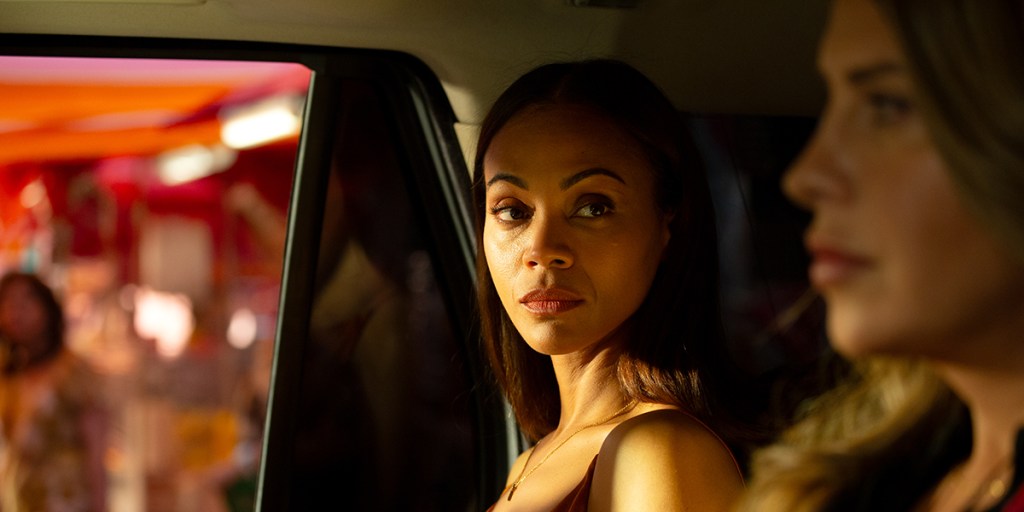
Rita (Zoe Saldaña) is an ambitious young defence lawyer in Mexico City. She spends hours crafting powerful opening statements for trials, but, as a black woman —  originally from the Dominican Republic — she gets none of the credit. But somebody is watching her and appreciates her skill. She finds out who, when she’s kidnapped with a black hood over her head and driven into the middle of the desert. There she meets the notorious head of a huge drug cartel, personally responsible for countless killings. Juan “Manitas” Del Monte, the cartel chief, needs her to help him disappear, in a way no one — including his wife Jessi (Selena Gomez) — will ever find him again.

The twist? This murderous, pock-marked, bearded monster… is trans, and wants to shed the awful male body and face, to live the rest of her life as an attractive woman. She needs someone she can trust to handle all this, both the finances and the surgery, leaving no paper trail. In exchange, Rita will have all the money she needs for the rest of her life, and her own private firm.

Years later, she meets with a potential client, a fabulously rich European woman named Emilia Pèrez (Karla Sofía Gascón). It’s her client from years back, who wants to re-enter the world and be reunited with her beloved family, all of whom think she is dead. And to atone for some of her past sins without revealing who she was. What will happen to these three remarkable women in the next chapter of their lives?

Emilia Pérez is an incredibly passionate and shocking movie. It’s simultaneously an action-thriller, an epic drama, and a musical. Yes, that’s right, a musical, where  characters do break into songs and dances throughout the film. But with its latin beats and shouting crowds, it’s the sort of songs you rarely encounter in a musical.  Zoe Saldaña is amazing as this tough-as-nails lawyer, and Karla Sofía Gascón, a Spanish actress I’ve never seen before, is unmatchable, both as Perez, and as the drug lord Manitas. (She’s a  transwoman herself.) French director Audiard (who previously brought us masterpieces like A Prophet, and Rust and Bone) seems to have no trouble creating a Mexican musical. I gotta say, Netflix churns out a load of content, most of which is forgettable crap, but, every year, they also produce a few really remarkable films. Emilia Pèrez is one of those.

I strongly recommend this movie.

Here and Amelia Perez both open this weekend in Toronto; check your local listings. And Captives is having its English Canada premiere at 8:45 tonight (Saturday, Nov 2, 2024) at Cinefranco at the Carlton.

This is Daniel Garber at the Movies, each Saturday morning, on CIUT 89.5 FM and on my website culturalmining.com.

World premieres at #TIFF24. Films reviewed: Relay, We Live In Time, Hard Truths

Posted in Action, Drama, Espionage, Family, Mental Illness, Romance, UK by CulturalMining.com on September 14, 2024

Hi, this is Daniel Garber at the Movies for culturalmining.com and CIUT 89.5 FM.

TIFF is on its final weekend, but there are still many movies left to watch, including free screenings on Sunday of all the the Peoples Choice winners. So this week, I’m only talking about movies that had their World Premieres at TIFF. There’s an overly angry woman, a secret agent for hire, and a love affair that turns serious.

Relay

Dir: David Mackenzie (Review: Starred Up)

Ash (Riz Ahmed) runs an unusual business in New York City. It’s for whistle blowers who are afraid  for their lives and their family’s and want to make peace with their previous employer and return the incriminating evidence. The genius of Ash’s work is that neither side — the whistle blower and the corporation — know who he is… and both sides pay him. A win-win situation, at least for him. He relays information using an intermediary phone service connected to an ASL keyboard for the deaf that can’t be traced. And he always keeps one copy of the evidence just in case the employer ever reneges on the deal.

His latest client is a biologist named Sarah (Lily James), a would be whistle-blower who has proof of malfeasance by a big agro conglomerate she worked for. But now she wants out, because she’s afraid a gang of thugs working for the company (Sam Worthington, and three others) are going to kill her. Problem is Ash — who never lets his guard down — is smitten by the beautiful and sympathetic Sarah, who he goes out of his way to protect. Can Ash keep her safe from unknown forces? And is there something deeper going on between them?

Relay is an ingenious action film that doubles as a corporate spy flick. It’s full of complex schemes involving the postoffice, telephone services and communication devices. As well as lethal fights. Riz Ahmed is one of those actors who is so good that you can just go and see anything he’s in. Luckily, Relay is a super-taut thriller, with constant suspense, near-misses and clever chase scenes. Beware: you’ll be his with an enormous twist near the end (no spoilers) that will totally blindside you. I’m still trying to figure out whether it’s plausible ir not, but either way, this is a great thriller.

We Live In Time

Dir: John Crowley (Reviews: The Goldfinch, Brooklyn)

 Almut (Florence Pugh) is a chef in London whose restaurant is taking off. She had a long-term relationship with a woman, but eventually separated. Tobias (Andrew Garfield) works for Weetabix — yes the breakfast cereal —  and has been living with his dad since his first wife divorced him. The two meet with a bang. Literally. She runs him over with her car.  But this is no hit and run. She sticks around until he gets out of hospital, and invites him for dinner at her restaurant. Sparks fly and their relationship begins. But certain obstacles lie in their path. Is there any point to marriage? Should they have kids? And what happens when she is diagnosed with cancer?

We Live In Time is a surprisingly good romance. Most romances veer either toward slapstick comedy or treacly cornball. This one does neither. The time in th entitle is reflected in it’s narrative, which hope back and forth between different stages of their lives. And it’s full of evocative details, like when Almut — the chef — teaches Tobias the best way to crack an egg (on a flat surface, she says) While it’s clearly Oscar bait (what with the cancer and baby details artfully placed), it’s also a fully enjoyable and moving film to watch. Irish director John Crowley knows what he’s doing; he brought us movies the classic Brooklyn. Frances Pugh does Almut as tough but lovable  while Andrew plays it goofy and sweet.

This is good one.

Hard Truths

Co-Wri/Dir: Mike Leigh (Reviews: Peterloo, Mr Turner)

Pansy (Marianne Jean-Baptiste) is a middle-aged woman who lives with her family  in a quiet London suburb. Her husband Curtley (David Webber), a plumbing contractor, is away most of the day, while their son Moses (Tuwaine Barrett) in his twenties locks himself in his room with his ear phones on playing video games.  Perhaps because Pansy is so hard to deal with.  When Moses goes for a walk, she yells at him to stay away from police or he’ll be arrested for walking while black. And when Courtley is home she subjects him to a non-stop abusive barrage of complaints and insults about his work, the neighbours, a baby down the street, animals, germs and being disrespected.

Meanwhile, Pansy’s sister Chantal (Michele Austin) lives with her two successful daughters. Chantal is kind and amiable, listening to problems and gossip as she does her clients’ hair. And she — like everyone else — wonders why her sister Pansy is so angry bitter and paranoid all the time. And can she get her to visit the cemetery on Mother’s Day?

The topics — kinship, loss, mental illness —  seem ordinary but the movie is anything but. Hard Truths is a searing comedy-drama about two black families in London. By comedy-drama I mean you will be laughing uproariously through the first half and then crying through the second. It’s just fantastic. The character development, the dialogue, and the acting are dead on. Marianne Jean-Baptist is so funny and so real and so moving, she’s a phenomenon to behold. If she doesn’t get an Oscar nomination for this, I will be shocked. She co-starred with Brenda Blethyn in another Mike Leigh movie, Secrets and Lies, thirty years ago, and this one is even better. 

I would call Hard Truths a perfect movie.

Relay, We Live in Time, Hard Truths, all had their world premieres at TIFF .

This is Daniel Garber at the Movies, each Saturday morning, on CIUT 89.5 FM and on my website culturalmining.com.


Daniel Garber talks with Niels Arden Oplev about his new film Rose

Posted in 1990s, Denmark, Drama, Family, France, Mental Illness, Road Movie by CulturalMining.com on December 15, 2023

Hi, this is Daniel Garber at the Movies for culturalmining.com and CIUT 89.5 FM.

It’s fall of 1997 in northern Denmark. Inger is a woman in her thirties preparing for a trip. She’s going on a group tour of France culminating in a visit to Paris. She’s accompanied on this vacation by her sister Ellen and Ellen’s new husband Vogn. This is her first visit back to Paris since she was a young woman. Why? Because she’s been institutionalized in a mental hospital for many years, and this will be her first big trip. Inger is intelligent, kind and giving, a great pianist and speaks fluent French. But she sometimes says or acts in ways that disturb other people — especially Andreas, a man on the bus who objects to having her on board. Can Ellen take care of Inger? Does she need taking care of? And what does Inger expect from her trip to Paris?

Rose is a touching new drama that looks at families, memories, forgiveness, and what it’s like dealing with mental illness, both oneself and one’s sister. It offers a fresh look at a real-life situation that is seldom talked about. In this case, it’s based on a true story experienced by its writer/director, award-winning Danish filmmaker Niels Arden Oplev. Oplev has won Emmys for his TV work, the Crystal Bear at Berlin, and many others. He is best known for The Girl with a Dragon Tattoo.

I spoke to Niels Arden Oplev in L.A. via ZOOM.

Rose is available on VOD/Digital beginning on December 26th, 2023. 

Girls Adopted. Films reviewed: Queens of the Qing Dynasty, The Quiet Girl, Return to Seoul

Posted in 1980s, Adoption, Canada, China, Coming of Age, France, Gay, Ireland, Korea, LGBT, Mental Illness, Nova Scotia by CulturalMining.com on March 4, 2023

Hi, this is Daniel Garber at the Movies for culturalmining.com and CIUT 89.5 FM.

Who are your “real” parents: the ones who raise you, or the ones who gave birth to you? This week, I’m looking at three new dramas from France, Ireland and Canada, about  daughters who are either adopted or have foster parents. There’s a French woman in Korea looking for her birth parents, a young woman in Nova Scotia leaving the foster parents system, and a little Irish girl sent to live with relatives.

Queens of the Qing Dynasty

Wri/Dir: Ashley McKenzie

Star (Sarah Walker) is a moon-faced 18-year-old in hospital in Nova Scotia. She feels comfortable there having spent most of her young life in and out of institutions. She’s there because she drank poison — they’re pumping her stomach. She’s over- medicated in a nearly catatonic state. And most alarming, she’s about to turn 19, meaning she’s aging out of the foster child system, and will have to take care of herself, if capable, for the first time. She’s diagnosed as bipolar with ADHD, and is prone to addiction, but her real problems lie much deeper. 

An (Zheng Ziyin) a student from Shanghai, volunteering at the hospital, is assigned to keep Star company. He’s artistic, effeminate and flamboyant. He likes traditional Chinese songs (he sings in falsetto), and is obsessed with his fingernails. He imagines himself as a Manchu concubine plotting politics within the Forbidden City. But these two very different people find comfort from each other, confessing their secrets and sending texts late at night when they’re apart.  And form an unusual friendship.

Queens of the Qing Dynasty is a realistic look at two marginalized, oddball characters finding their place within a bigger, constrictive society. It’s shot in brutally drab locations, like snowbound motels, strip mall mani-pedis, hospitals and group homes, using mainly first-time actors. And despite the depressing or even tragic lives of the characters, it somehow remains light, whimsical and endearing.

This movie is both weird and appealing.

The Quiet Girl

Co-Wri/Dir: Colm Bairéad

Rural Ireland in 1981. Cáit (Catherine Clinch) is a little girl from a big, poor family of farmers. Her Dad is away all day, drinking, gambling and philandering, instead of cutting the hay. Her Mom is pregnant while taking care of a toddler and three or four others. With no one taking care of her, Cait falls through the cracks. She has dirty cheeks and mousy brown hair, is painfully shy and wets her bed. At school, she is bullied and laughed at and labeled an idiot. So her Mom asks her cousin if she could take care of Cáit for the summer while her mom’s preparing to give birth. So her father drives her out to Waterford, but forgets to unpack her suitcase before he leaves.

The Cinnsealachs (Carrie Crowley, Andrew Bennett) are a childless, older couple, middle-class dairy farmers who live in a spotlessly clean house. Cait is terrified to live around strangers, but gradually adjusts. They tell her to be honest here — there are no secrets in this house. They give her boys’ clothes to wear around the farm, and pretty dresses from in town. Soon they’re teaching her how to chop onions, fetch water from the well, or how to milk the cows. She brushes Cait’s hair a hundred times and helps her with her reading. He encourages her to run and exercise. Over the course of the summer, Cait gradually emerges as a bright and pretty girl. But locals are gossiping about her — why is she living there? What do they want from her? Does she know their secret? And what will happen once she’s home again?

The Quiet Girl is a deeply touching story of one summer in a neglected girl’s life, amid a caring couple recovering from a loss of their own. The acting is very good, especially Clinch as the quiet girl. The story is both simple and subtle, and sure to move you to tears. Most of the characters speak Irish (with subtitles) throughout the movie, to various degrees of success. (I’ve been mispronouncing Cáit as “Kate” using an Anglicized version of her name.) 

I like this movie — and it was nominated for an Oscar for Best International Film.

Return to Seoul

Wri/Dir: Davy Chou

Freddie (Park Ji-min) is a 25 year old French woman at a guest house in Seoul. She’s supposed to be in Tokyo, but ended up here when all flights to Japan were cancelled due to a typhoon. She instantly bonds with Tena (Guka Han) at the front desk, who can speak French. That evening, Tena and other new friends tell Frankie she has classic Korean features, and doesn’t seem French at all. She decides to prove her Frenchness by being provocative, spontaneous and wilfully rude. When she admits she was born in Korea but adopted as an infant in France, they wonder why she hasn’t been to “Hammond” an adoption agency which holds all relevant data.

Frankie is uninterested — she’s here as a tourist — but does carry a snapshot in her wallet of a woman holding her as a newborn babe. She ends up requesting meetings with both of her birth parents. Her birth father (Oh Kwang-rok) is a former fisherman. He takes her home, feeds her, where he and his family prostrate themselves before her asking her forgiveness. She rudely rejects them, and refuses to answer his drunken teary texts sent to her each night. But her mother remains a mystery. Will Frankie ever he meet her birth mother? Does she have any connection to this strange country? Ad what will her future bring?

Return to Seoul is a dark drama of a western woman discovering her roots. The film is fictional but based on the French director’s own experience in returning to his ancestral home in Cambodia. 

Frankie’s story is told in episodes over the course of a decade, in France and in Korea, always on her birthday. Frankie is an enigmatic character, smart and sexy, but also socially obtuse, selfish and occasionally outright monstrous. At times she seems like a female Wolf of Wall Street. She treats the men she meets, both hookups and partners, like a piece of Kleenex to be discarded after use. Most of her past is only hinted at: Was she once a concert pianist? What was her relationship with her French family? But eventually she lets her real feelings show through, if only for a moment.

Return to Seoul is a troubling, alienating and emotionally powerful film.

Queens of the Qing Dynasty, The Quiet Girl, and Return to Seoul all open this weekend at the TIFF Bell Lightbox; check your local listings.

This is Daniel Garber at the Movies, each Saturday morning, on CIUT 89.5 FM and on my website, culturalmining.com.

Oscar contenders, 2023. Films reviewed: Saint Omer, The Son, Living

Posted in 1950s, 2000s, Courtroom Drama, Death, Drama, Family, France, Mental Illness, TIFF, UK by CulturalMining.com on January 21, 2023

Hi, this is Daniel Garber at the Movies for culturalmining.com and CIUT 89.5 FM.

This week, I’m looking at three potential Oscar contenders opening this weekend. There’s a writer in Paris attending a trial, a bureaucrat in London whose life is a trial, and a Dad dealing with the trials and tribulations of a mentally ill son.

Saint Omer

Wri/Dir: Alice Diop

It’s the early 2000s in a Parisian suburb. Laurence Coly (Guslagie Malanda) is on trial for murder. She admits to leaving the infant on a beach to be washed away with the tides one moonlit night, but why she did it is not so simple. She’s a Senegalese-French woman from Dakar, in Paris as a student. She is beautiful, articulate, poised and intelligent; not your usual murder suspect. As her mother (Salimata Kamate) told her, education and politesse are the two most important traits. But after a series of events she ends up living in a small apartment as a grey-haired, married man’s mistress — no longer in university, with no friends, no job, no future. And virtually no one knows she was pregnant nor that she gave birth at home. She existed in a strange limbo world.

All of this is taken in by Rama (Kayije Kagame) a novelist and university prof in Paris. She is following the trial in person, for a new book she’s writing about Medea. Like Laurence, she’s a French intellectual, and a black woman of West African background. More than that, she’s estranged from her mother and is in her first trimester of pregnancy. In a sea of white faces in the courtroom, she feels both a connection and a revulsion toward Laurence. Could this be me on trial? she wonders. And will I be a fit mother?

Saint Omer is a devastatingly powerful courtroom drama as seen through an observer’s eyes. It’s the opposite of a Law & Order episode — no smoking guns or pot twists. Rather it’s Laurence’s retelling of her story before judge and jury Rama’s reactions that carries all the power. It’s intentionally filled with subtle ambiguity so you’re never quite sure whether Laurence is lying and being coached to do so, or if she’s completely sincere. With women holding most of the key roles — including the judge and the defence council —  it strips away some misconceptions. The acting (by actress Malanda and artist/performer Kagame) is superb, and the filmmaking amazing. This is documentary filmmaker Alice Drop’s first drama.  Somehow, she takes the drab wooden panels of a classroom and a courtroom and turns them into something pulsing with emotion. 

This is a great movie. 

The Son

Wri/Dir: Florian Zeller

Beth and Peter (Vanessa Kirby, Hugh Jackman) are a newly married, upper-middle class couple with a new baby. All I going well until they get an unexpected knock on the door. His teenaged son Nicholas (Zen McGrath) says he can’t take living his mom anymore (Laura Dern) a full-time nurse whom Peter divorced and abandoned a few years earlier. What a dilemma! He can’t turn away his own flesh and blood, can he?  But Nicholas is difficult to live with. It seems he stopped going to school months ago — without telling his parents. And Beth finds him scary. What if he does something to our baby— how can I trust him? So they check him into a psych ward without his consent. But what can they do in the long run with this troublesome teen?

The Son is an overwrought  melodrama about divorced parents forced to care for their troubled son. It deals with anguish, anger and regret but only from the parents’ perspective, never from the son’s. He’s just a pain in the ass… and possibly a threat! This movie falls in that sub-genre of sympathetic parents forced to deal with sons who “selfishly” choose to become drug addicts or mental ill. How dare they! Despite what the parents try, those bad sons are criminals and liars at heart who can never be trusted. This dreadful collection of never-watch movies  includes Beautiful Boy, with Timothy Chalamet and Ben is Back, starring Julia Roberts and Lucas Hedges. This one has equal star power, and is just as hard to watch. It’s especially disappointing because it’s Florian Zeller’s follow-up to The Father a few years back about an elderly man slipping into dementia (Anthony Hopkins, who also appears in this film), as its unreliable narrator. But don’t be fooled. The Son has no redeeming features and is truly one of the worst movies of 2022.

Living

Wri/Dir: Oliver Hermanus

It’s Londin in the 1950s. Williams (Bill Nighy) is a mundane municipal bureaucrat, the head of public works at County Hall.  He spends most of his time at his desk — along with his subordinates Rusbridger, Middleton and Hart — keeping busy by ignoring piles of files and requests. Whenever troublesome locals appear, like a group of mothers requesting they build a tiny playground in a vacant lot, they’re quickly disposed of by sending them to another department in the endless bureaucratic labyrinth of city hall. The newly-hired Wakeling is quickly discouraged from working too hard — an empty inbox means you’re doing something wrong. The sole woman, Margaret (Aimee Lou Wood), is thinking of quitting to take a managerial job at a local restaurant. Since his wife died, Williams has lived a humdrum existence sharing his home with his adult son and daughter-in- law. But everything changes when his doctor brings him some terrible `news: incurable cancer, 6 months left to live. Suddenly everything takes on new meaning as he decides to start enjoying life and making things better for others. But is it too late?

Living is a period drama about life in post-war London. It captures the spark that can be reawakened in even the most humdrum person’s existence. It follows the night Williams spends in the demimonde led by an alcoholic bohemian he meets in a cafe; the days spent helping  Margaret, for the chance to share in her youth and vitaity; and a project he hoped to complete in his final days.

I approached this movie with trepidation, because it’s a remake of Kurosawa’s Ikiru, one of my favourite movies of all time, which I didn’t want to see ruined. Happily, Living it is wonderful film in its own right. Maybe only a writer like UK novelist Kazuo Ishiguro could transport a story from Tokyo to London, while staying true to its original meaning and structure, even while giving this very Japanese film a distinctly English feel. Bill Nighy (who usually plays silly characters in crap movies) is wonderfully understated in this one. And South African director Oliver Hermanus, who brought us the great Moffie, again puts his all into the film he’s making. 

I recommend this movie.

Living, Saint Omer, and The Son all open this weekend in Toronto, with the latter two playing at the TIFF Bell Lightbox; check your local listings.

This is Daniel Garber at the Movies, each Saturday morning, on CIUT 89.5 FM and on my website, culturalmining.com.

On the media. Films reviewed: A Wounded Fawn, Spoiler Alert, Empire of Light

Posted in 1980s, 1990s, Death, Depression, Disease, Feminism, Gay, Greece, Horror, Mental Illness, Movies, Racism, Revenge, Romance, Theatre, Women by CulturalMining.com on December 10, 2022

Hi, this is Daniel Garber at the Movies for culturalmining.com and CIUT 89.5 FM.

It’s December, but not everything is about Christmas. This week I’m looking at three new movies with themes set in the arts: there’s a woman who works at a cinema but never watches movies; a serial killer who finds himself part of an ancient greek play, and a writer for TV Guide who thinks his life is like a sitcom.

A Wounded Fawn

Co-Wri/Dir:Travis Stevens

It’s a fine art auction in NY City, and the collectors and dealers are in fighting mode tonight. The prized item is a small bronze sculpture from ancient Greece showing the Furies seeking revenge on a prone man. Kate (Malin Barr) gets the high bid and returns home triumphant with the piece  in hand. So she’s surprised to see Bruce (Josh Ruben) a rival bidder, show up at her door. His boss still covets the statue and is willing pay double. Doubling her money in 24 hours seems like a good deal. She invites him in for a glass of champagne. But before long, she is dead on the floor in a pool of blood, and the sculpture — and Bruce — are long gone.

Later, Meredith, another beautiful young woman (Sarah Lind) is excited over an upcoming weekend in the country with her latest paramour. Her last boyfriend was abusive, but her new one seems nice, generous and attractive.  And he’s into fine art just like Mer (she works in a museum).They set off for a fun filled adventure at his isolated cottage in the woods. She is thrilled to see the cabin is actually a finished home overlooking a dense forest, and decorated with modern art. But something is strange: she hears a woman’s voice in her ear warning her to leave. And she recognizes the Greek sculpture of the Furies on his coffee table — she authenticated it for an auction just a few weeks ago. (It’s just a copy, says Bruce) What she doesn’t know is that Bruce is a serial killer… and she might be his next victim. (Bruce is waiting for directions from a gigantic man-owl with blood red feathers who tells him who he should kill). Can Mer fight him off? And where do those strange voices come from? 

A Wounded Fawn is a low budget, exquisitely-crafted art-house thriller horror. What starts as a simple slasher, soon turns into a revenge pic about halfway through, where Meredith, Kate and a third victim return as the Furies to visit punishment upon Bruce. What’s really remarkable is how it incorporates greco-roman aesthetics, mythology and theatre into what could have been a simple scary horror movie, to turn it into something totally original. While it’s not always clear whether something happens for real, or just inside Bruce’s damaged brain, it doesn’t matter.  A Wounded Fawn is weird and fascinating, either way.

Spoiler Alert

Dir: Michael Showalter

It’s the 1990s. Michael Ausiello (Jim Parsons) is a nerdy gay guy who lives in NJ but works in Manhattan. He grew up obsessed by TV, living his life as if he were a character on an 80s sitcom. Now he’s a writer for TV Guide, where he devotes himself to work and remains perpetually single. Until he meets Kit Cowan (Ben Aldridge) at a dance club — he’s handsome, fit and popular and says Michael is just his type —a tall geek. Kit’s also in the media — he’s a professional photographer. They hit it off, but keep certain secrets to themselves. Kit lives a free-wheeling sex life — he’s not one to settle down. And Michael never came out to his small-town parents (Sally Field and Bill Irwin); he’s afraid they won’t accept him. And he’s afraid to show Kit his apartment. What is he hiding there? His Smurf collection; a veritable fuzzy blue tsunami filling every nook and cranny. But after settling their deferences, they eventually move in together. Most of the Smurfs are packed away, Michael comes out to his parents (they still love him) and they settle into domestic bliss. 

Flash forward 15 years, and their relationship is on the rocks; the spark has died and they’ve grown a bit distant toward each other. But everything changes when — spoiler alert! — Kit discovers he has terminal cancer. Can they handle his imminent death? Will their love be rekindled? And how will they spend what might be their last year together? 

Spoiler Alert is a touching dramady about love and loss, based on a true story — Michael Ausiello’s own memoir of his life with Kit. Like the book, the movie begins with the death of Kit in Michael’s arms, hence “spoiler alert”. The director Michael Showalter, previously made The Big Sick, also about a couple and their family facing a serious illness. So is this the gay Big Sick? Not exactly — it’s a new story with a different style, like his version of Michael’s childhood as a sitcom, complete with laugh-track. And there are lots of funny parts. The bigger question is, is Jim Parsons up to playing a dramatic role, or is he forever stuck in peoples’ minds as Sheldon on the Big Bang? In this case, I think he pulls it off. He fits the role and manages to make him quirkily sympathetic. So if you’re into terminal illness comedies, here’s a good one to try on for size. 

Empire of Light

Wri/Dir: Sam Mendes

Its the winter of 1981 in a sea-side city in southern England. Hilary (Olivia Coleman) is a middle-aged woman who works at the Empire Theatre as the front of house manager. It’s an art-deco movie palace, but like the town, it’s long past its prime. Half the screens are closed and the third floor ballroom has been taken over by pigeons. Hilary is lonely and depressed, on meds, recovering from a hospital stay. Her social life consists of ballroom dancing with old men, and her sex life is furtive encounters with her sleazy, married boss (Colin Firth) in his darkened office.

But her life changes when a young man, Stephen (Michael Ward) is hired to work there. She finds him attractive, ambitious (he wants to study architecture at university)` and compassionate: he nurses a wounded pigeon back to health. He’s mom’s a nurse, from the Windrush generation, but he wants more. Hillary may be his mom’s age but there’s something there. After a few intimate moments they start a clandestine relationship. But Michael’s real ambition is to leave this town — to escape increasingly racist street violence (he’s black), and to become more than just an usher.  Can their relationship last? And if they break up, can the fragile Hilary handle it?

Empire of Light is a romantic time capsule of life in Thatcher’s England. It’s also about the joy and troubles of an intergenerational, mixed-race love affair.  And it’s also about sexual harassment and anti-black racism in everyday life. And it’s also about Hillary’s mental illness, including her sudden, manic episodes. And it’s also about the rise of skinheads and the National Front, and the concurrent anti-racist ska revival.  And it’s also about the collective friendship that develops among the people working at the Empire theatre. (Maybe too many ands for one movie?)

Like many of Sam Mendes films (which I generally don’t like), it’s pandering and emotionally manipulative and has a  meandering storyline, that keeps you watching while it’s on, but leaves you feeling vaguely unsatisfied afterwards. But the acting is really good, especially Olivia Coleman and Michael Ward, who rise above the movie’s many flaws. Maybe even good enough to make Empire of Light worth a watch, despite all its problems.  

Empire of Light and Spoiler Alert both open this weekend in Toronto; check your local listings. And A Wounded Fawn is now streaming on Shudder. 

This is Daniel Garber at the Movies, each Saturday morning, on CIUT 89.5 FM and on my website, culturalmining.com.

Unexpected adversaries. Films reviewed: White Noise, Violent Night, All the Beauty and the Bloodshed

Posted in 1980s, Addiction, Art, Christmas, comedy, Conspiracy Theory, Crime, documentary, drugs, Family, Horror, Mental Illness by CulturalMining.com on December 3, 2022

Hi, this is Daniel Garber at the Movies for culturalmining.com and CIUT 89.5 FM.

It’s December now with snow on the ground, time for movies to get your blood boiling. This week I’m looking at three new movies about unexpected adversaries: there’s an artist vs a philanthropist, Scrooge vs Santa… and Elvis vs Hitler?

White Noise

Wri/Dir: Noah Baumbach,

It’s the 80s in a small rustbelt college town.  Jack (Adam Driver) is a professor in the new field of Hitler studies. Along with his wife Babette (Greta Gerwig) they raise their children, from babies to teens, in a modern, blended family. The kids Denise, Heinrich, Steffie and Wilder, are inquisitive  and precocious, and come from various marriages. At work, Jack lectures to worshipful students, and has intellectual discussions with his colleagues. His closest is Murray (Don Cheadle), a prof who specializes in cinematic car crashes, wants to raise Elvis studies to the level of Hitler studies. 

But there is trouble at home. Babette is obsessed with death and dying, and suffers from memory loss and unexplained absences. Denise suspects she’s on prescription drugs — she found a hidden bottle of Dylar, an unheard of medicine.  Meanwhile Jack is terrorized by nightmares and at times actually thinks he’s going to die. All these troubles are pushed aside when a real disaster happens: a truck crashes into a train carrying dangerous chemicals. The result? A toxic cloud floating above the area with unknown effects. The town is evacuated, the family forced to flee by station wagon to Camp Daffodil a weirdly-named military base. Rumours abound at the camp, and no one knows for sure what is happening. Can life return to normal? Will the toxic cloud blow away? Is Babette an addict? Will Jack’s academic secrets be revealed? And where does Dylar come from?

White Noise is a satirical look at dread, suspicion and alienation within an academic setting. It also looks at pop culture, art and the omnipresent consumer economy. I read Don Delillo’s novel when it first came out and I was captivated by the way it captured the dark mood at the time. Noah Baumbach takes a different path, treating the film as a comical period piece where people dress in funny 80s clothes and use obsolete technology. It looks for laughs in scenes like Jack getting tangled up in a kitchen phone cord. I have mixed feelings about this movie. Some parts just seem like running gags about those wacky 80s, turning serious scenes into absurdist jokes. Other parts are brilliant — like the pas-de-deux between Jack and Murray in a joint Hitler-Elvis lecture. Or an actual dance sequence down the aisles of a supermarket in the closing credits. And a cameo by the great Barbara Sukowa as a German nun in a hospital, should not be missed. While I couldn’t get emotionally into the characters or plot — Driver and Gerwig are both good actors but never seem real in this movie — and I felt detached from the film, I did find it interesting and visually pleasing. 

Violent Night

Dir: Tommy Wirkola

It’s Christmas Eve, and the Lightstone family are  gathered on their vast, private estate. Gertrude (Beverley D’Angelo) their autocratic matriarch, puts on an elaborate dinner each year with servants dressed as Nutcracker Suite characters. Her adult two adult children Cam and Alva, their spouses, and the grandkids Gertrude and Bertrude, (known as Trudy and Bert)outdo one another sucking up to her, to get their share of the family’s wealth. Everyone, that is, except little Trudy (Leah Brady), who doesn’t want any money or presents from Santa. She just wants her estranged parents back together again. 

This year, though, something goes terribly wrong: the costumed caterers turn out to be highly-trained paramilitary criminals, there to murder everyone and steal millions from the safe. They’re headed by a bitter man, nicknamed Scrooge (John Leguizamo) who hates Christmas. Little Trudy escapes from the family, hides in the attic, and calls to Santa Claus by walkie-talkie for help. And, to everyone’s shock, a drunken, bearded man in Christmas gear (David Harbour) comes to their rescue. He’s the real thing, but only Trudy believes in him. Can Santa and Trudy fight off dozens of ruthless killers? Can her parents overcome their differences? And can a worn-out, depressed and alcoholic Santa hang on for one more year… or is this the end of Christmas for everyone?

Violent Night is a comedy/action movie about a good little girl and a hard-ass Santa fighting cruel killers using horrific violence of their own. It’s a combination of two Christmas classics: Home Alone and Die Hard, but with the gore-level pumped up a few notches. Trudy’s booby traps turn out to be deadly, while Santa channels his past life as a Viking to wreak havoc with a hammer named Skullcrusher. Does this movie work? Totally! David Barbour (from Stranger Things) is great as a nasty Santa who pukes and pisses off his sleigh. He takes a licking but keeps on kicking. Newcomer Leah Brady as Trudy is cute — maybe too cute — but good enough. And most of the rest of the characters are sufficiently unlikeable to keep the story going. So if you’re looking for a fun and twisted action movie in time for Christmas, Violent Night fits the bill. 

All the Beauty and The Bloodshed

Dir: Laura Poitras

Nan Goldin is an artist known for her photographic portraits of the demimonde, with louche images of drugs, sex, and self-destruction. She rose to fame in the 1980s with her ever-changing performances of “The Ballad of Sexual Dependency”, which combined music and a slide show of her pictures. But far from being a dispassionate observer of the lives of strangers or, worse, an ogler of outcastes, Goldin explicitly documented the lives of her closest friends and herself, including drag queens, junkies, artists and musicians, in various stages of undress. This was also the era of AIDS, which decimated the NY City art scene. Goldin recorded this, too. It was also the start of Act Up and other movements demanding attention from the government and Big Pharma.

Flash forward to the 2000s, when pharmaceutical corporations, through doctors, were strongly pushing prescriptions of opiates as non-addictive relief from the worst levels of pain. In fact they’re highly addictive, and one addict was Goldin herself. Though she kicked the habit, many were still dying from overdoses of opioids. And she noticed something strange. A major sponsor of the galleries and museums that displayed her work were sponsored by noted philanthropists The Sackler Family. And the Sacklers made their fortune through Purdue Corporation, peddling drugs like Oxycontin.  We’re talking the Louvre, the Met, Tate Modern, and the Guggenheim, among others. So she started a protest group called P.A.I.N. (Prescription Addiction Intervention Now) which stages protests in the Sackler wings of museums world-wide.

All the Beauty and The Bloodshed is a fantastic documentary that records Goldin’s life and art, and her battle with the Sacklers. It’s engrossing and revealing, a work of art in its own right. The film includes contemporary footage as well as snapshots and films from Nan Goldin’s own personal history. She’s the cinematographer while the director is Laura Poitras, responsible for the world-changing doc Citizenfour, about Edward Snowden. All the Beauty and the Bloodshed is a rare case of a political documentary that is also respectful of art. It’s visually and audibly stunning and though almost two hours long, it’s totally engrossing; one of the best documentaries of the year.

White Noise is screening at the TIFF Bell Lightbox in Toronto; All the Beauty and the Bloodshed, is playing there and at Hot Docs cinema; while Violent Night opens this weekend across North America; check your local listings.

This is Daniel Garber at the Movies, each Saturday morning, on CIUT 89.5 FM and on my website, culturalmining.com.

Smiles and frowns. Films reviewed: Smile, Triangle of Sadness

Posted in Class, Horror, Mental Illness, Psychiatry, Psychological Thriller, Psychology, Supernatural, Thriller by CulturalMining.com on October 8, 2022

Hi, this is Daniel Garber at the Movies for culturalmining.com and CIUT 89.5 FM.

Weather changes with the seasons and so do our moods: one minute it may be sunny, the next dark and overcast. So this week I’m looking at two new movies about changing emotions. There’s a comedy about a frown and a horror movie about a smile.

Smile

Wri/Dir: Parker Finn

Dr Rose Cotter (Sosie Bacon) is a therapist who works in the emergency psych ward at a large New Jersey hospital. She’s always prim and proper, wearing buttoned shirts, with her hair neatly pulled back from her face. She spends most of her time at work, up to 80 hours a week, but on her free time she likes nothing better than sipping white wine in her bungalow, cuddling her fluffy cat Moustache or just chatting with Trevor, her nondescript fiancé. She is devoted to helping her patients, having survived her own mother’s mental illness and suicide when she was a little girl.

It’s just a normal day when she examines a new patient in intake. Laura is a grad student showing signs of paranoid delusions. She is terrified that someone is out to get her. “I’m not crazy, I’m a PhD candidate!” says Laura (as if the two were mutually exclusive).  She’s not sure whether it’s an evil spirit, a ghost or a satanic possession, but whatever it is, it’s been haunting her since she witnessed her prof commit suicide just a few days earlier. It takes the form of people closest to her, that only she can see. And worst of all, it has a horrible smile. And before Rose can do anything, Laura violently kills herself right in front of her… with that awful smile plastered on her face. And from that moment on things feel different for Rose. 

Her nightmares turn into daydreams. She begins to hallucinate — with figures from her past, including a dead patient, reappear before her, smiling. She has very few people to talk to outside of the hospital: Trevor, and her older sister Holly, who only talks about family and real estate. She visits her own former therapist, who refuses to prescribe anti-psychotics, saying it’s just stress and overwork. But Rose knows it’s something more. Everything that happened to Laura — and her professor before her — seems to be inflicted on Rose now. She finally turns to her ex-boyfriend Joel (Kyle Gallner) for help. He’s a police detective now, investigating Laura’s death; perhaps he can find out what’s causing these suicides. Because Rose is sure she’s either going insane, or is controlled by an evil entity… or both! And if she doesn’t do something fast, she’ll be dead in three days. Can Rose figure out what’s happening to her, and stop her impending, smiling suicide? Or is she out of time?

Smile is a good psychological thriller/horror. While it’s occasionally predictable — with some dubiously freudian plot turns — it’s mainly a gripping, scary flick. Great spooky music and some cool visuals, like disorienting, upside down drone shots of a cityscape, and a delightful scene change using the camera’s iris. And lots of cute, smiley-face images popping up everywhere in the background. I’ve never seen Sosie Bacon before, (she’s second generation Hollywood, the daughter of Kevin Bacon and Kyra Sedgwick) but she’s quite good as Rose, gradually transforming from uptight doctor to terrified heroine. 

If you’re in the mood for a good screamer, check out Smile. 

Triangle of Sadness

Wri/Dir: Ruben Östlund

Yaya and Carl (Charlbi Dean, Harris Dickinson) are a millennial power couple. Carl is a fashion model who is featured shirtless in perfume and underwear ads. He is known for his looks. But he still has to show up for cattle-calls. Yaya, though, is an influencer — her posts and selfies are followed by millions, and sponsors are constantly sending her money and goods to promote. But their unequal status spurs an argument. Why does he have to pick up the cheque when they go out to dinner? He’s the man in the relationship but Yaya is much more famous and earns way more money than Carl. It’s just not fair. So she invites him to join her on an elite cruise ship, all expenses paid.

The boat is an exclusive luxury liner, and the passengers are some of the richest people in the world. One couple made billions selling bombs and landmines. Another oligarch, named Dimitri (Zlatko Buric) proudly says he earned his fortune selling shit — literally. He cornered the market in fertilizer. And the staff are trained by Paula, the head of the crew (Vicki Berlin), to fulfill any whims or demands of the passengers no matter how outlandish or nonsensical. And Carl and Yaya soon find out that any casual complaint or criticism of a staff member they might make may lead to their instant dismissal. But the ship hits trouble on the high seas, and the captain (Woody Harrelson), an alcoholic communist, can’t stay sober long enough to prevent a disaster. 

Later, the passengers and staff regroup on a tropical isle, situated somewhere between Gilligan’s Island and Lord of the Flies. But with a new power structure in place, who will make it out of there alive?

Triangle of Sadness — the title refers to that part of the face from the brow to the bridge of the nose that supposedly conveys happy or sad emotions — is a scathing satire about the state of the world. Told in three chapters — in the city, on a ship, and on a remote island — it follows a young couple as they navigate life among the powerful and super-rich. It also shows what could happen if existing power structures (and the money that reinforces them) ceased to exist. Did I mention this is a comedy? I found it bitingly and bitterly hilarious, though at times disgusting. For humour’s sake, it reverses many presumptions: by presenting men — not women — as sexual objects subject to exploitation; and by pulling away the curtains hiding  the transgressions of the rich and powerful.

The acting in this dark comedy — especially by the late Charlbi Dean and Harris Dickinson, as well as Zlatko Buric and Dolly De Leon as Abigail a former toilet cleaner who suddenly finds herself as the big fish in a small pond — is excellent all around. The story is told as a comic fable, intentionally never realistic, with settings, costumes, and music, all reinforcing its farcical nature. This is not Swedish director Ruben Östlund first dark comedy — he previously directed such great movies as The Square and Force Majeure — but Triangle of Sadness is the most extreme of all his films, one that takes his themes beyond the expected limits. Though not universally loved, in my opinion this is one great movie.

Smile is now playing and Triangle of Sadness, which played at #TIFF22 earlier this year, opens at the TIFF Bell Lightbox this weekend.

This is Daniel Garber at the Movies, each Saturday morning, on CIUT 89.5 FM and on my website, culturalmining.com

Gems at #TIFF22. Films reviewed: The Hummingbird, Will-o’-the-Wisp, Unruly

Posted in 1930s, 1970s, 1980s, Dance, Denmark, Disabilities, Family, History, Italy, LGBT, Mental Illness, Portugal, Women by CulturalMining.com on September 24, 2022

Hi, this is Daniel Garber at the Movies for culturalmining.com and CIUT 89.5 FM.

TIFF is finished and after viewing 45+ movies I feel pretty good about it. You’ll be hearing a lot more about TIFF movies like The Fablemans, The Whale, The Glass Onion, Women Talking, The Wonder and The Banshees of Inisherin  by the end of the year, but there are also a lot of movies, gems and sleepers, that get left by the wayside, without all the studios promoting them. So this week I’m talking about some of the other movies I saw there — from Italy, Denmark and Portugal — that deserve to be noticed. There’s a rebellious girl trapped on a remote island; a little prince seeking the facts of life in a firehouse; and a man called hummingbird whose fate is guided by a series of unusual events.

The Hummingbird

Dir: Francesca Archibugi

Marco Carerra is a man who places great importance on seemingly random occurrences. Take a fatal plane ride, for example.  When he’s a student in Florence in the early 1980s he starts winning big at poker.  But when he boards a plane heading for Yugoslavia with his gaming partner, Duccio, that man begins to freak, shouting hysterically at other passengers that they all are “dead” and the seats on the plane are ruined and decrepit. Marco is eventually forced to pull Duccio off the plane, thus missing the flight and their big card game. But it crashes, killing everyone on board. And Marco, with his deep belief in the significance of ordinary events, ends up marrying the flight attendant who also missed that flight. It’s just fate.

Another important date happened at their summer home on the beautiful Tyrhennian shoreline. The Carrera’s summer home is right next door to the Lattes’ house. And Marco has a huge crush on the beautiful Luisa, their daughter. But the night he thought he would lose his virginity to Luisa (for whom he would hold a torch forever) was also the night when his quarrelling parents went out for the evening, his brooding brother Giancarlo got so drunk he passed out, and their sorely neglected sister Adele committed suicide, turning all their worlds upside down. 

The Hummingbird — Marco’s nickname as an unusually small child until a sudden growth spurt in his teens after his father enrols him in hormone treatment — is a wonderful, novelistic  movie that traces the intricately woven story of Marco’s life, his love, his family, his wife, his daughter and eventually his granddaughter. But not in any obvious order. The story jumps back and forth between his childhood, his adolescence, and his middle and old age, keeping you guessing as to why he did what he did. When I say novelistic, I mean literally, with multiple characters coming in and out of his life making shocking revelations along the way, and calling into question his fundamental beliefs. It’s based on the novel Il colibrì by Sandro Veronesi which won the Strega Prize, Italy’s greatest fiction award, and it does feel like a classic story. What’s really surprising is it was published in 2020, during the pandemic, and the film must have been made since then. The movie stars Pierfrancesco Favino  as the adult Marco, Berenice Bejo as Luisa Lattes, Nanni Moretti as Marco’s friend, a psychiatrist (no spoilers here), and Kasia Smutniak as his tempestuous wife.

Keep an eye out for this sleeper and be sure watch it when it comes out.

Will o’the Wisp

Dir: João Pedro Rodrigues

It’s present-day Portugal. Prince Alfredo (Mauro Costa) is a pale young prince with curly blond hair.  heir to the crown. He lives in a palace full of statues and paintings recalling his family’s colonial history. (Though the country gave up its monarchy in 1910, his mother still considers Republican and Castilian the two worst insults in their language.) But with Alfredo coming of age his father, the king, decides to tell him what’s what. He takes him for a walk through the royal forest to admire the tall pine trees there. But his father’s description of tumescent tree trunks throbbing with sap so excites the lad, that he is forced to rethink his future. He doesn’t want to be king anymore, now he wants to be a fireman — specifically one who will protect those trees, about which he has an erotic attachment. 

At the fire station, Afonso (André Cabral) a handsome black student is tasked with introducing the prince to the firehouse and the forest. He introduces him to the other fireman, they practice exercises, search and rescues, recussitation, fireman carries, and sliding down poles, but for Alfredo, everything has a sexual subtext. Soon the subtext turns to out-and-out sex, with the two young fireman rolling around on the forest floor while shouting pornographic and racist epithets in the throws of ecstasy. But can the the little prince find happiness in the arms of a fireman? Or are his regal responsibilities too heavy a burden to bear?

Will o’the Wisp is one of the strangest, least classifiable films you’ve ever seen. It’s an historical  romantic science fiction comedy, and an arthouse-modern dance- musical satire. It’s only 67 minutes long, but in that short time you’ll see The-Sound-of-Music kids in school uniforms singing weird songs as they pop their heads out from behind trees; homoerotic exercise montages, and elaborate dance routines on the firehouse floor. I can’t say I understood all the cultural references that had the Portuguese viewers in the audience howling with laughter, but I could experience the beauty, ridiculousness and shock running throughout the picture. 

Unruly 

Co-Wri/Dir: Malou Reymann

It’s the 1930s in a working-class Copenhagen neighbourhood. Maren (Emilie Kroyer Koppel) is a free-thinking teenaged girl who knows what she likes and what she hates. She likes getting drunk, dancing to jazz and hooking up with guys. And she hates authority figures — including her mom —  telling her what to do. But when her family cuts her off and she becomes a ward of the state, she doesn’t realize her past actions will have grave consequences. She refuses to cooperate with a doctor (Anders Heinrichsen) trying to diagnose her “ailment”. He declares her unruly and out of control, and sends her off to a remote island known for its hospital for mentally handicapped women. Sprogø island is festooned with pretty flowers and picturesque homes where the patients are taught to be submissive, cooperative, quiet girls, under the watchful eye of Nurse Nielsen (Lene Maria Christensen). They are schooled in sewing, cooking and cleaning on the all-female island (though Marin is able to secretly meet with a young repairman). It’s a hospital, not a prison, she is told, but there’s no way to escape. And if you disobey, or even spread bad attitudes, you are strapped to a table and kept in solitary confinement.

Her roommate, Sørine (Jessica Dinnage) acts as the rat, reporting on any woman who disobeys the rules. But as Maren gets to know her better she soon discovers the real reason for Sørine’s behaviour: she just wants to be reunited with the child they took away from her. Will Maren learn to accept her fate? Will she find a way to escape the island? Or is she stuck there forever?

Unruly is a deeply moving drama based on an actual hospital that operated in Denmark until the 1960s. Its many crimes included involuntary sterilization, mis-diagnoses, torture and authoritarian rule. Instead of having a series of stock characters, with easy to categorize heroes and villains, all the women develop over the course of the film, giving it an unexpected profundity. This film is a lovely and tragic look at a terribly flawed institution and the people it affected.

Will-o’-the-Wisp, The Hummingbird, and Unruly all premiered at TIFF.

This is Daniel Garber at the Movies, each Saturday morning, on CIUT 89.5 FM and on my website, culturalmining.com

Psychic bonds. Films reviewed: Marionette, Archive 81

Posted in 1990s, Meltdown, Mental Illness, New York City, Psychiatry, Psychological Thriller, Scotland, Supernatural, TV, VHS by CulturalMining.com on January 22, 2022

Hi, this is Daniel Garber at the Movies for culturalmining.com and CIUT 89.5 FM.

We’re in another lockdown in Toronto with the cinemas all closed, but there are still lots of ways to watch movies at home. Kanopy is a movie service that’s free with your library card, and has a huge catalogue of really good movies. Recent additions include Swedish director Roy Andersson’s ethereal and melancholy About Endlessness;  the splendid Spanish film Blancanieves, a silent movie from 2012 in gorgeous black and white that retells the story of Snow White as a female bullfighter; and the French romantic comedy Belle Epoque, among dozens of others. They’re on Kanopy.

Also playing for free online across Canada is a fascinating new series of five feature-length movies called Difficult Women, 40 years of German Feminist Films. It’s curated by the Goethe Institute. I haven’t seen it yet, but their films always deserve viewing. Just go to their website online and enjoy.

But today I’m talking about two more things you can  watch online or on your TV; a limited series and a new psychological thriller. 

There’s a psychiatrist who wants to get away from a boy she thinks wants to kill her; and a video archivist who wants to get together with a woman he’s seen on a 30-year-old VHS tape.

Marionette

Dir: Elbert van Strien

Dr Marianne Winter (Thekla Reuten) is a child psychiatrist. After losing her husband in a terrible car accident in upstate NY, she decides to turn over a new life by taking a job in Aberdeen, Scotland. She ’s last-minute hire because their previous child psychiatrist was driven to self-immolation for unknown reasons and his patients have no one taking care of them. Marianne arrives at an enormous gothic building and immediately starts to work. One of her patients, a little blond orphan named Manny (Elijah Wolf) piques her interest. Since his parents’ recent death he has stopped talking, expressing himself only by drawing pictures using a black marker. The pictures depict people dying in a horrible circumstances, just like his parents. 

So Marianne settles into a new life. When she’s not working, she hands out a local pub or attends meetings of a book-reading group. There she meets a man named Kieran (Emun Elliot) and sparks fly. He takes her for a ride in his boat where they make passionate love. But around this time, strange things start to happen. The drawings, that her ten-year-old patient Manny scribbles during their sessions, start to come true. She witnesses a car crash in a tunnel that looks exactly like Manny had drawn. Worse still, other drawings depicting Kieran’s death and even her own. Can Manny  predict the future? Or is he actually making these things come true? And is Marianne merely a marionette controlled by an evil little boy?

Marionette is a strange psychological mystery /drama about a psychiatrist brought near the brink of insanity by one of her patients, and her slide into paranoia, madness and revenge.  It delves into the doctor’s own psyche as if her mind were a box containing Schrödinger’s cat. But unlike most psychological thrillers, it doesn’t follow the normal story line you might expect. (No spoilers). Does it work? Yeah, in a strange sort of way. And it kept me interested, but it might leave you scratching your head in the end. 

Archive 81

Dan (Mamoudou Athie) is a museum archivist in New York City. He specializes in restoring and transferring older media — like cassette tapes and VHS — into digital formats. And he nags with his best friend Mark who buys and sells collectables and also hosts a podcast. But one day a stranger named Virgil approaches Dan with an offer he can’t refuse: a $100,000 contract just for restoring and archiving a collection of old video tapes. They are all damaged and partly burned, recovered from an apartment building called the Visser, 30 years earlier. What’s the catch? He must do the archiving and restoration at an isolated concrete building in the Poconos, that’s off the grid: no internet, and no cel phone towers. Any communication must be by the landline.

So he takes the job meticulously restoring each tape in chronological order, and watching the films. They were all made at the Visser, 30 years earlier, by a young woman named Melody (Dina Shihabi).  And from here the story flashes back and forth between Dan (now) and Melody (then). She’s living in the building in search of her birth mother, carrying a video camera everywhere she goes — the source of the tapes that Dan is restoring. And with the help of a 12-year-old girl named Jess (Ariana Neal) who was born in the building, she meets and interviews many of the Visser’s oddball residents. There’s Samuel, a friendly university prof (Evan Jonigkeit), who runs meetings in the common room (which one nosey neighbours claims are  actually satanic sex orgies). There’s also an art collector and spiritualist interested in holding seances.  But she’s distracted by a series of musical notes she hears, and strange dreams she starts to have. And back in the present, Dan is bothered by his isolation, and the feeling he’s being spied on.

Here’s where it gets interesting. Dan keeps dozing off during his monotonous work and having dreams where he meets Melody. The weird thing is, his earlier conversations eventually appear on VHS tapes as he finishes them. In other words, they are actually meeting on recordings from the past. What are these strange faces suddenly appearing on old tapes? Is he going mad? Did she perish in the Visser’s fire? Or can he contact her in the past to save her life?

Archive 81 is a fantastical, science fiction supernatural TV series about alternate realities, communication across time and between the living and the dead, as well as vast conspiracies, evil billionaires, sinister entities, and strange cults. Great writing and acting, with exquisite production design, music and art direction. It starts as a typical found-footage horror movie, but veers away from that genre early on.

I’d call it Stranger Things for grown-ups.

It does have a tendency to fetishize commonplace things from an earlier era (in this case the 90s) but with a contemporary mindset. For example, The character Melody carries her video  camera making selfies and recording everything she sees (much like a smart phone today) but without anyone objecting or finding it strange. Archive 81 came out a week ago, and I binge watched the whole thing in just a few days. It’s interesting, unusual, unpredictable and quite spooky in parts, and will keep you glued to the screen and eagerly awaiting Season 2. 

I recommend this series.

Marionette is now available on VOD, you can catch Archive 81 on Netflix, and for free movies online visit the Goethe Instutute’s website, and watch Kanopy with just your library card.

This is Daniel Garber at the Movies, each Saturday morning, on CIUT 89.5 FM and on my website, culturalmining.com