Remote houses. Films reviewed: Anacoreta, Eat the Night + TBFF!
Hi, this is Daniel Garber at the Movies for culturalmining.com and CIUT 89.5 FM.
February is Black History Month, the perfect time to check out Toronto’s Black Film Festival. It features movies, docs and shorts from Canada and around the world. Like Karen Chapman’s Village Keeper a drama set in Toronto’s Laurence Heights neighbourhood, about an overprotective mom with her two teenage kids who are forced to move into their grandmother’s crowded apartment. And in the documentary feature category, Tara Moore tells the history of apartheid South Africa and how it affects that country now, in Legacy: The De-colonized History of South Africa. Toronto Black Film Festival is running now through February 17th at the Carlton Cinema.
But this week, I’m looking at two new movies, from Canada and France, about remote houses. There’s a group of friends at a haunted cabin in the woods, and a teenage girl and her brother living in a world that only exists online.
Anacoreta
Co-Wri/Dir: Jeremy Schuetze
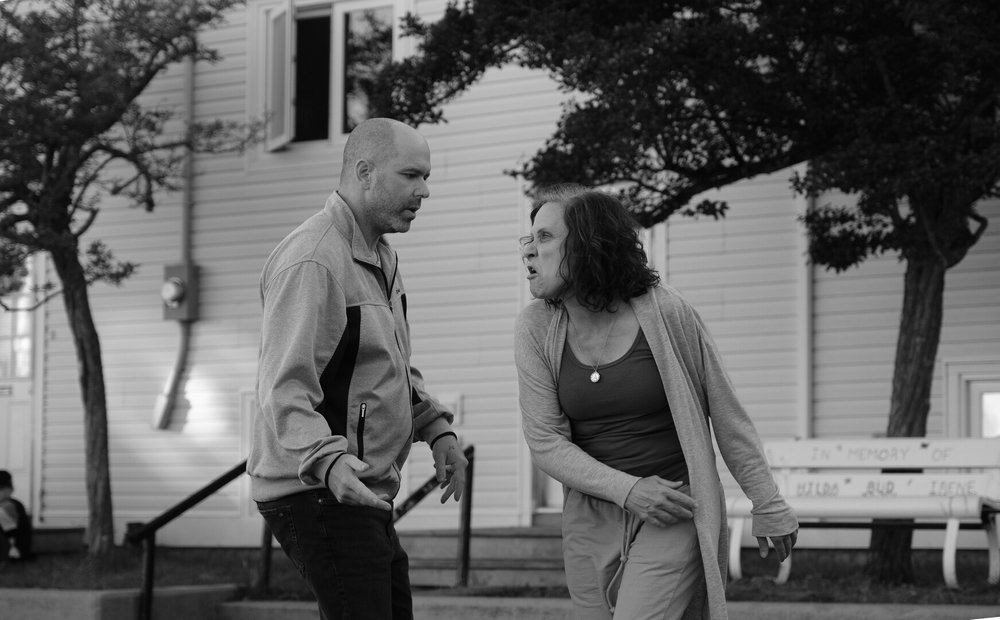
It’s a beautiful cabin in a remote part of Vancouver Island. Jeremy (Jeremy Schuetze) is there with three friends Antonia (Antonia Thomas), Matt (Matt Visser) and Jess (Jess Stanley) for one last look at his late grandfather’s cabin before it’s sold. It’s a beautiful old building overlooking pristine blue waters and mountains rising dramatically right behind them. It’s like paradise: they grill sausages and play beer pong, pick low-hanging fruit while watching a black bear cub sun itself on the grass. But despite all the natural beauty, something is creepy here. Antonia sees a truck following them whenever they’re driving. They find a dead black cat in their freezer. And things get really spooky when Jess starts sleepwalking. Is this place haunted? The thing is, they’re also there to shoot a film. And some of those scary parts might have been planned and executed by Jeremy, their director, to get some good reactions out of the cast. He’s a bit of dick, and the rest of them are not happy about it.
But that’s not all. Jeremy’s grandfather made his fortune
writing Hardy Boys -type mysteries in this very cabin. And when they find an unpublished script things get even weirder. It mentions a place called Afterglow, a mausoleum about seven hours away. That’s where ghosts are said to live just underground. So of course they have to go there and see for themselves. Is it all a hoax? Or is it real? And who will survive this perilous journey?
Anacoreta is a horror movie about four friends in a cabin in the woods and a documentary (or mockumentary) about making a movie. All the actors and crew use their real names, Jeremy and Matt wrote the script, and Anotonia and Jess produced it. Same with the cameraman and the boom, who also appear as characters in the film. But it also takes pains to
remind us they’re shooting a movie, often repeating scenes two or three times, till Jeremy is satisfied. Which partly interrupts the scariness, but also makes the scary parts seem more real, in a found-footage / Blair Witch Project kind of way. Does it work? It kinda does. It makes you believe the movie you’re watching is a disaster project, while at the same time, reminding you it’s all just a scripted story.
Budget? Low.
Indie? Yes.
Acting? Good.
Canadian? Very.
Meta? You bet!
Scary? Not too shabby, especially near the end.
Eat the Night
Wri/Dir: Caroline Poggi, Jonathan Vinel
Apolline (Lila Gueneau) is a high school student with curly reddish hair. She lives with her big brother Pablo (Théo Cholbi). They spend most of their time online, on a role-playing game called Darknoon. It’s an apocalyptic fantasy land, where their avatars live exciting lives, killing thousands of competitors in exotic sword fights. Apo much prefers Darknoon to real life. At school she’s an ordinary girl somewhere in France. Online she’s an anime figure with enormous breasts and sharp, pink leather spikes coming out of her shoulder. Pablo’s avatar has pierced nipples and carries a sabre. Apo rides on the back of a giant blue cat she tamed. In real life, Pablo drops her off at school each day on his acid-green Kawasaki. Their mom’s gone and their dad is never around, so they take turns cooking for each other. But the tide turns when Darknoon announces
it’s shutting down, permanently, on the Winter Solstice, just a few weeks away. Apo is devastated.
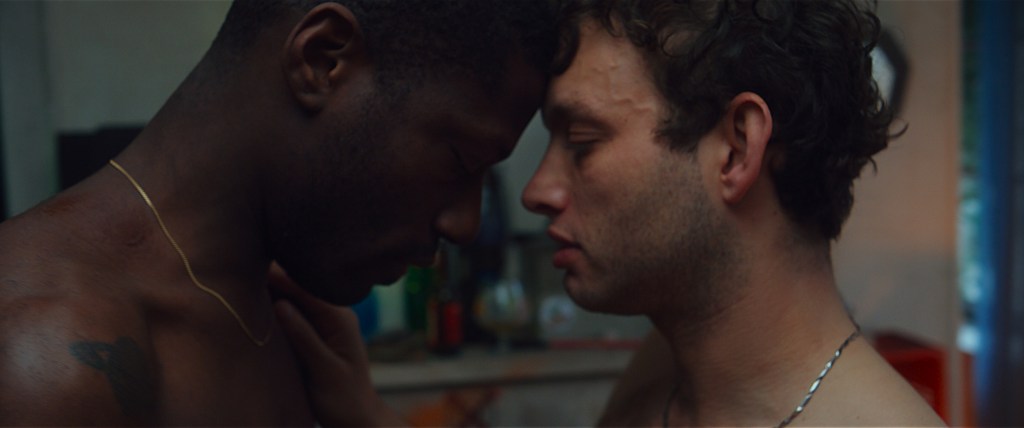
Pablo also has a side hustle selling colourful little pills at clubs and parties. It’s a one-man operation using a metal crank-press to turn out tiny batches of uppers, molly and acid, one by one. But when a big-time dealer sees him encroaching on his turf, his henchmen beat Pablo up. That’s when a stranger appeared to tend his wounds and wipe up the blood. His name is Night (Erwan Kepoa Falé). Pablo needs a bodyguard and a business partner. Night quits his job, and moves in, and soon they’re having passionate, violent sex in Pablo’s hideaway. But Darknoon’s last day is coming soon and the gangster are gathering forces to find and kill Pablo. Can Apo and Pablo leave Darknoon in a blaze of glory? And in the real world, can Pablo and Night permanently leave this crappy town and go somewhere safe and new?
Eat the Night is a glorious French thriller about online role-playing games and real-life crime. It’s passionate and tragic. About 25% takes place inside the otherworldly game, the rest in a cinematically cool, louche real world. Two very different places but visually harmonious. And as the movie progresses characters increasingly appear in the game as like their actual selves. Lila Gueneau plays Apo as a young artist who lives in an animated, comic book world complete with an elaborate pink cos-play outfit. As Pablo, Théo Cholbi is a nihilistic fighter/criminal with a pet green snake. As his lover and defender Night, Erwan Kepoa Falé is kinder and gentler but just as dangerous. Eat the Night (under the even more carnal title Devore la nuit) played in the Directors Fortnight at Cannes. a very violent and highly sexual film.
I think it’s great.
Eat the Night is playing at the Revue Cinema in Toronto on Feb 19, and opens at the Carlton and Yonge/Dundas on the 21st; check your local listings. Anacoreta will be available on demand starting the 21st.
This is Daniel Garber at the Movies, each Saturday morning, on CIUT 89.5 FM and on my website culturalmining.com.
Americans abroad. Films reviewed: Queer, September 5, Oh Canada
Hi, this is Daniel Garber at the Movies for culturalmining.com and CIUT 89.5 FM.
This week I’m looking at three new movies set in the 1950s, 60s and 70s, about Americans abroad. There’s a novelist in Mexico City, a TV sportswriter in Munich, and a documentary filmmaker in Montreal.
Queer
Dir: Luca Guadagnino (I am Love, A Bigger Splash, Call me by your Name, Suspiria)
It’s the 1950s in Mexico City. William Lee (Daniel Craig) is a middle-aged American writer addicted to heroine who hangs around local bar called Ship Ahoy. If he doesn’t get completely drunk he might spend the night with a man he meets. He’s friends with other flamboyant ex-pats, especially Joe (Jason Schwartzman) a portly, bearded man who shares Lee’s lascivious predilections. Lately, he has had his eyes on Eugene Alerton (Drew Starkey), an ex-GI who spends most of his days playing chess with an older red-haired woman. Eugene is no “queer”, but is up to talking with Lee.
After repeated drinks, and some opiates he eventually shares Lee’s bed in his seedy rental. Lee is smitten, Eugene content. Later the two head south in their quest for ever more potent drugs culminating in a journey toward the ultimate psychedelic experience. They end up in the Ecuadorean Amazon, in a remote shack guarded by a vicious but slow-moving three toed sloth. Inside, a mysterious doctor (Lesley Manville) holds the answers to all their questions. Is Eugene the man of his dreams? Will they ever reach hallucinatory
nirvana? Or is life just an illusion?
Queer is a bizarre, sex-and-drug-filled psychedelic fantasy. It’s divided into three chapters: their meeting in Mexico City; their journey south; and their adventures in Ecuador. It’s adapted from William S Burroughs’ semi-autobiographical novel written in the 1950s but not published for another 34 years. It swerves wildly between actual memoirs and pure imagination. Burroughs was a writer in the beat movement, and was married and had a son with another writer Joan Vollmer (perhaps she’s the red-haired woman Mary in the film).
The thing is, Queer is not a grave, serious movie, it’s a high-camp comic fantasy. Psychedelia has always been difficult to film, and there’s a fine line between the profound and the ridiculous. Some scenes, like the unfortunate semi-nude, interpretive dance sequence, falls on the (unintentionally) funny side. Others scenes were kinda cool. It’s a beautiful film to watch, for its music, set, costumes and art direction. Shot
entirely in Rome’s Cinecitta, it’s never meant to look realistic. Daniel Craig plays Burroughs not as the usual chill junkie observer, but as a panting and sweating horndog, with bulging eyes, nearly choking on his own lust.
If your looking for a sentimental romance a la Call Me by You Name, or a deeply profound meditation on psychedelic trips, this ain’t it. But if you just want a weird and funny drug-infused dream-filled movie with lots of soft-core gay sex, you’ll probably have a great time.
September 5
Co-Wri/Dir: Tim Fehlbaum
It’s September 5, 1972 at the Munich Summer Olympics and the crowds are roaring. Americans are glued to their sets watching the US cleaning up, with swimmer Mark Spitz winning an unheard of seven gold medals. ABC is the perennial loser of the top three networks. So their sportscasters are thrilled to have won exclusive coverage rights. The team behind the cameras are hard at work. Geoffrey Mason (John Magaro) is the newbie, trying to prove his chops. His boss Marvin (Ben Chaplin) wants things to run smoothly, and his boss’s boss (Peter Sarsgaard) is thinking of the bigger picture. Jacques (Zinedine Soualem) is their French cameraman with Marianne (Leonie Benesch) the only woman on the team, is a German journalist, and their de facto translator. Everything is great until they hear gunshots… not at the games, but at the nearby Olympic village. A group of masked militants, known as the Black September Organization is holding Israel’s Olympic team hostage.
Suddenly, the ABC sportscasters realize they are the only American TV journalists in Munich. They have the cameras, the boom mics and the broadcast and satellite rights ready to send stories home. They shift their telephoto lenses from pointing toward the swimming pools to the athletes’ dormitories, trying to catch a glimpse of the hostages. What
will happen next? Will German authorities step in? And can a sports crew handle crisis news?
September 5 is a journalistic thriller about 24 hours at the Munich Olympics. Despite its title, this isn’t about the Israel/Palestine conflict — they barely delve into it. That’s just the backdrop. What it really looks at is how a team of US journalists — at the right place at the wrong time — figure out how to get the news out even as the crisis grows. I love the period details: giant-sized spools of reel-to-reel videotapes, and how little white tiles on a black background were superimposed onto a sports channel screen. So cool. I’ve never heard of Swiss director Tim Fehlbaum before, but he keeps the action moving in the midst of constantly shifting mayhem. The acting is ok, but best by far is Leonie Benesch who starred in last year’s The Teacher’s Lounge. I went into this movie full of dread. It’s clearly Oscar-bait; Hollywood churns out journalistic dramas every year. But this one is surprisingly good, and had my heart pumping all the way through. If you’re looking for some journalistic excitement, check out September 5.
Oh Canada
Co-Wri/Dir: Paul Schrader (First Reformed)
Based on the story by Russell Banks
Leo Fife (Richard Gere) is a renowned documentary filmmaker in Montreal. He is getting ready for an interview in his own living room in the grand old home he shares with his wife Emma (Uma Thurman). The director, Malcolm (Michael Imperioli) and his crew are longtime admirers of Leo’s legendary work. After crossing the northern border in the 1960s to protest the war in Vietnam, he ended filming docs that changed the course of history. He uncovered the use of Agent Orange at the military base in Gagetown, New Brunswick, and became a university prof teaching young journalists how to make movies. Now, decades later, Leo is on his deathbed, dying of cancer, so Malcolm wants to record his final thoughts.
Leo treats this film as a confession — he wants to clear the record. He starts by talking about his first wife and son, a family he left behind in Virginia. But she’s not the only skeleton in his closet. His past life is full of lies, deceptions and possibly terrible acts. Emma doesn’t like him talking like this and wants him to stop. Leo’s nurse thinks can’t take all this stress. But the filmmakers persist and Leo perseveres. Are any of his stories true? Was he a good man or a bad man? And what do we really know about Leo Fife?
Oh Canada is a fictional story about a day in the life of an American filmmaker and activist recalling his past. It’s a simple concept with a slight plot. It’s structurally divided between the documentary being made about him, and his
hidden past, shown in a series of flashbacks (He is played by Jacob Elordi as his younger self.) The film is almost too simple. But with Paul Schrader at the helm, you know there’s going to be more to it. He wrote Taxi Driver and Raging Bull for Scorsese, and directed movies like The Yakuza (1974) First Reformed (2017) and American Gigolo (1980) that also starred Richard Gere.
Unfortunately, Gere is the weakest part of this film; he rants and complains, but there’s no heart in his performance. The film’s called Oh Canada, but it’s really Oh America. It was entirely shot there, with so-called Canadian characters using americanisms like “restroom”. What’s interesting is Schrader’s use of false visual narratives. There are flashback scenes where Elordi as a young Leo is suddenly replaced by a contemporary Gere while all the other characters remain unchanged. Likewise, the names of past lovers seem to melt away. Perhaps Leo has dementia, or maybe this contrasts Leo’s current story with his past truths. Also interesting is the way we see Leo’s face throughout the eye of Malcolm’s camera, giving it a meta aspect that messes with your brain.
Oh Canada is not one of Schrader’s better films, but there’s enough stuff going on to keep it intriguing.
Oh Canada, Queer and September 5 all open this weekend in Toronto; check your local listings.
This is Daniel Garber at the Movies, each Saturday morning, on CIUT 89.5 FM and on my website culturalmining.com.
Films reviewed: Your Monster, Drive Back Home, Conclave
Hi, this is Daniel Garber at the Movies for culturalmining.com and CIUT 89.5 FM.
More Film Festivals are coming up soon, with ReelAsian, Cinefranco and BITS, Blood in the Snow, just around the corner.
But this week, I’m looking at three great new movies. There’s a consortium of cardinals locked in their chambers; a monster discovered in a closet by a NY actress, and a Toronto man forced out of his closet by the police.
Your Monster
Wri/Dir: Caroline Lindy
It’s present day Manhattan. Laura (Melissa Barrera) is a triple threat — she can sing, dance and act. She’s helping her boyfriend Jacob (Edmund Donovan) write his breakout musical, soon to open on Broadway with her in the lead role. But when she gets sick — the big C! — and needs surgery, he dumps her — out of the blue — while still in hospital. And casts another actress (Meghann Fahy), in her part. The surgery is a success but Laura is a total wreck. She’s doubly devastated, both from the sudden end of her five year relationship and for being cheated out of her big break. Her anger, frustration and self pity are all ready to explode. That’s when she makes an unexpected discovery. There’s a monster in her closet!
The creature (Tommy Dewey) is an actual monster, bearded with long hair, sharp teeth and leonine features, who talks like a dude. Apparently he has lived there all her life (she grew up in this house) she just never saw him before. It’s hate and fear at first sight. He threatens to tear out her throat and eat her alive — and tells her to
leave the place and never come back. Meanwhile, Laura shows up for the audition uninvited and becomes the understudy for her own role. But things gradually warm up at home, as Laura and her monster get to know each other. But can she take him to the Halloween Ball? Will she ever get to perform her role on stage? And will her boyfriend ever take her back?
Your Monster is a very cute, rom-com/horror with a fair bit of singing, too. It’s a riff on Disney’s Beauty and the Beast but with a funnier monster and brooding beauty with a lot of anger inside. Melissa Barrera and Tommy Dewey have lots of chemistry while Edmund Donovan is suitably villainous as the bad boyfriend. He looks strangely like Jared Kushner. The movie as a whole is enjoyable and adorable. It takes a funny concept to its extreme. I like the costumes, I like tight script — the whole movie is much better than I expected. There’s a play within the play (half the scenes are rehearsals or performances) but even the “real” home scenes are theatrical. Your Monster will make a great date movie, but just keep in mind there’s a bit of horror within this rom-com.
Drive Back Home
Wri/Dir: Michael Clowater
It’s 1970 in the village of Stanley, New Brunswick.
Weldon (Charlie Creed-Miles) is a mechanic who lives with his mom, his wife and his son in the house he was born and grew up in. One night he gets a long distance phone call from Toronto. His estranged younger brother Perly (Alan Cumming) — an advertising exec who he hasn’t heard from in many years — has been arrested for gross indecency (meaning consensual sex with another man). The cop lays it out. If you can pick him up and take him home, all charges will be dropped. If not, he’s going to prison for five years. So Weldon loads up his pickup truck with enough sandwiches and gasoline for a long trip and leaves his village for the first time in his life. He’s terrified of having to speak French so he takes a circuitous route avoiding Montreal altogether.
He picks up Perly from the cop shop but there is no love lost between them. Perly is a city boy who wears a jaunty cravat while his big brother is a hick, who’s never seen a high-rise apartment or an answering machine. He just wants to drive back home. Perly isn’t a happy camper either: His marriage is a shambles, his career has tanked and his dog is dead, since the cops arrested him. But what’s left for him in Toronto? And so they begin their long journey home. But what secrets will be revealed along the way?
Drive Back Home is a bittersweet drama about family and trauma. It’s done in the style of classic Canadian Road movies, like Don
Shebib’s Goin’ Down the Road, but this one is about leaving the big city. Their trip through rural Ontario and Quebec alternates between scenic beauty, rustic kindness, and vicious, small-town bigotry. Canada was still rife with homophobic hatred at the time — it was only decriminalized a year earlier, and there are disturbing gay-bashing scenes in this film along with a lot of homophobic F bombs.
The two main actors are English and Scottish but both quite good, and maintain decent Canadian accents, gruff for Creed Miles and arch for Cumming. The rest of the cast features prominent Canadian actors, with Clare Coulter as Adelaide, the hard-ass mom, Guy Sprung, as a Francophone farmer, Dan Beirne as a priest and Alexandre Bourgeois as a young guy they meet in a roadhouse bar. Drive Back Home is a moving look at Canada’s bad ol’ days.
Conclave
Dir: Edward Berger
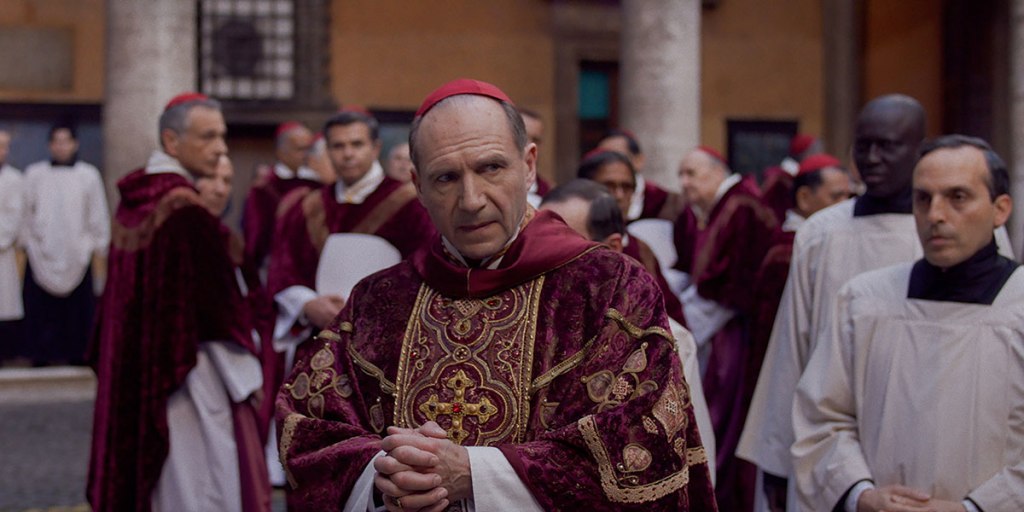
A hush hangs over the Vatican; his holiness the Pope is dead. And the world’s Cardinals, in red robes with white mitres, are congregating to choose the next pontiff from within their group. Ballots are secret, but until one receives 2/3 of the votes, they are literally locked-in, no contact with the outside world. What are their criteria for the next pope? He must be virtuous and humble, but also healthy and strong. And he must be honest as the Pope is infallible. Bishop Lawrence (Ralph Fiennes) is the Dean in charge of the highly secretive process. The most popular candidates: Bellini (Stanley Tucci), a modest liberal reformer, Tedesco (Sergio Castellitto), a bombastic traditionalist, and the highly respected Adeyami (Lucian Msamati). But Lawrence is privy to new information just before the lockdown. A drunken monsignor alleges the Pope fired Tremblay (John Lithgow) just before he died. And mystery man, Benitez (Carlos Diehz), appears out of nowhere claiming to be the Cardinal of Kabul, Afghanistan. And then there are the nuns, including Sister Agnes (Isabella Rossellini) who remain
silent but see and hear everything. Which bishop will they choose to turn the conclave’s smoke from black to white?
Conclave is a stunningly- good thriller about secrets and subterfuge within the Vatican. The constant changes of political alliances as well as shocking revelations will keep your rapt attention until the very end. It presents a Vatican that’s both exquisite and decadent, with black mould spreading on it’s columns. It’s all the work of German director Edward Berger who made All Quiet on the Western Front, with Volker Bertelmann’s powerful music, and fascinating camerawork. It was filmed at Rome’s famous Cinecitta studio who are always deft at recreating the Vatican. I love this constant attention to detail — red sealing wax, Latin prayers, and tortellini soup.The acting is superb, especially Ralph Fiennes. I’ve never been a fan, but he is just sooo good in this role, maybe his best I’ve ever seen. Altogether, this makes Conclave a great night out.
Your Monster and Conclave both open this weekend in Toronto; check your local listings. And Drive Back Home is having its Toronto premiere tonight at CAMH on Queen West as part of the Rendezvous with Madness film fest.
This is Daniel Garber at the Movies, each Saturday morning, on CIUT 89.5 FM and on my website culturalmining.com.
Good Euro at #TIFF24. Films reviewed: Miséricordia, Vermiglio, The Girl with the Needle
Hi, this is Daniel Garber at the Movies for culturalmining.com and CIUT 89.5 FM.
There was a dearth of European movies at TIFF this year with far fewer high-profile films from countries like France, Benelux, Scandinavia, Romania and Poland. But there were still some very good ones. So this week, I’m talking about three new European films that were featured at TIFF. There’s a mom with a baby in Copenhagen, an army deserter in Tyrol, and a funeral-goer in southeastern France.
Miséricordia
Dir: Alain Guiraudie (Review: Stranger by the Lake)
Jeremie (Félix Kysyl) is a boyish-looking man from Toulouse returning to the tiny village of L’Aveyron in southeastern France. He’s there for a funeral, the untimely death of the village’s baker. Jeremie knows the village and all its people very well, as he was the baker’s assistant for many years. He asks the baker’s widow, Martine (Catherine Frot), if he can stay there for a few days.
She puts him up in her adult son Vincent’s old room (Jean-Baptiste Durand) — which still look’s like it’s a kid’s room. Vincent, though, is a married adult, a tough guy known for his moodiness and sudden bursts of anger. Then there’s Walter (David Ayala), the town recluse, a large, droopy man with coarse features who seldom speaks with anyone other than his dog and Vincent. And an Abbey from an ancient monastery who always seems to turns up when anything significant happens.
So Jeremie’s presence upsets the local rhythm. Vincent treats Jeremie like they’re still kids, picking play-fights with him, grabbing and punching. He uses his key to barge in on Jeremie in bed at 4 am (on his way to work, he says). He suspects Jeremie is sleeping with his
mom. But in reality, Jeremie seems more attracted to the late baker than his wife. When Jeremie drops by Walter’s place for some chat and a few glass of the local pastis — Walter warns him not to let Vincent know he was there. With his tongue and inhibitions loosened Jeremie comes on to Walter sexually which shocks and confuses the much bigger man. By the next morning there’s a dead body buried in the woods, a witness, a killer trying to keep it a secret, and the gendarmes starting an investigation. Whodunnit, who will get caught, and what will happen to the rest of the characters?
Miséricordia is a cross between dark comedy and film noir. Like a stage play, it’s full of dialogue overheard through half open doors, people disappearing behind curtains or hiding in someone else’s bed. It deals with lust and passion — and compassion, anger but also forgiveness (Misericordia is Latin for mercy). And a fair amount of unexpected erotic nudity. It’s shot on grainy colour film, among the ancient whitewashed houses, stone monastery, and the wilds of the nearby forests — it’s visually beautiful. Alain Guiraudie who directed the great Stranger by the Lake once again crafts an unusual mystery with a queer undercurrent.
This is a really good movie.
Vermiglio
Dir: Maura Delpero
It’s near the end of WWII in a mountainous village tucked away in Tyrolia, northern Italy. Two faces arrive in town one day, one familiar, one unknown. They are both deserters, Italian soldiers press-ganged into the German army, but the stranger, a Sicilian named Pietro (Giuseppe De Domenico), knows only this friend Attilio, he served with. He also saved his life and practically carried him all the way home. Pietro’s Italian is totally different to them so he seldom speaks. They put them up in a barn, just to be safe, and feed them.
The patriarch of this village is Cesare (Tommaso Ragno) a highly respected schoolteacher with ten kids of his own. Most of the kids sleep together, some three to a bed, and there’s a constant stream of patter and dialogue within the family. The oldest daughter is Lucia (Martina Scrinzi), named after the village’s patron saint. There’s also Flavia, the precocious daughter and Ada the religious one. Lucia knows nothing about sex, but does know she likes Pietro. They flirt, court, kiss, and marry. He signs up for the adult literacy lessons his new father-in-law teaches. And finally, as Lucia’s belly grows, he abruptly leaves the village for a short visit home in far-off Sicily. But when he fails to return after months away without even a postcard, Lucia begins to worry. What has happened to her Pietro?
Vermiglio gives a look at the consequences of ambition, rivalry, love and betrayal in an isolated village where everyone knows what everyone else is doing. It follows all the members of this family, though especially the daughters and their hard-working mother (10 kids!) over the course of one year.There’s a lovely ebb and flow, with
characters appearing and disappearing, deftly interwoven throughout the film in dialogue and action. Though linear in structure there’s no clear explanation of much of what is going on — you have to figure that out yourself. Filmed under soft natural lighting, you’re as likely to see an extreme closeups of milking a cow’s udders, as you are a furtive kiss. I found Vermiglio fascinating and empathetic — you really care about what happens to all these characters.
I like this one.
The Girl with the Needle
Co-Wri/Dir: Magnus von Horn
It’s WWI in Copenhagen Denmark. Karoline (Vic Carmen Sonne) works in a sweatshop making uniforms. She hasn’t heard from her husband Peter since he enlisted with the Germans, and without his income she’s behind on her rent and faces eviction. In desperation she visits the factory owner Jørgen (Joachim Fjelstrup) and asks for her military widow’s pension. But without any proof of his death, there’s nothing he can do. But he does find her attractive and soon they are having furtive sex in back alleys. Inevitably she gets pregnant so he does the honourable thing and proposes… until his aristocratic mother stops him cold. Not only won’t he marry her, she must be
fired from her job. Meanwhile, it seems her husband was not killed at the battlefront, but he’s unrecognizable. Peter (Besir Zeciri) now wears a mask to cover his face that had been blown off and them sewn back together. Peter now works at a carnival freak show revealing his face for a few krone.
In desperation, Karoline takes a knitting needle to a public bath and attempts to kill the foetus in her womb by jabbing it, but ends up injuring herself and nearly passing out. But she’s spotted by Dagmar (Trine Dyrholm) who runs a local candy store, and her pretty, blonde daughter Erena (Ava Knox Martin). She nurses her and tells her what to do if she starts bleeding again. And she gives her a bag of candy with the shop’s address on it. Dagmar is always there when there’s no one else to turn to. And when she finally gives birth, penniless and homeless, Caroline shows up at the candy store asking for help give away her baby. She can’t afford to pay her — this is a business, Dagmar reminds her — but agrees to let her stay there for now, as an
on-call wet nurse. Many young women pass through there with their kids, so she’s always ready to lend a hand. But what really happens to those babies?
Based on a true story, The Girl with the Needle is a powerful movie about a horrifying case that shocked the world (no spoilers). It shows us a Copenhagen riddled with friction and sharp divisions between the haves and have-nots. It also repeats a theme of disturbing images of grotesquely deformed faces. It’s shot in glorious black and white by the Polish cinematographer Michal Dymek, who also filmed Jerzy Skolimowski’s EO two years ago. There’s some serious acting here, especially the three main women. This is one of those jaw-dropping movies where you go in expecting a conventional, scary-type horror movie, but you end up watching something much bigger than that. This is a fantastic and very disturbing movie, but with a touch of hope.
And it’s Denmark’s choice for the Oscar for best international Feature.
Keep your eyes peeled for Miséricordia, The Girl with the Needle, and Vermiglio, that all played at TIFF and should be opening theatrically over the next year.
This is Daniel Garber at the Movies, each Saturday morning, on CIUT 89.5 FM and on my website culturalmining.com.
Fractured families. Films reviewed: Good One, Close to You
Hi, this is Daniel Garber at the Movies for culturalmining.com and CIUT 89.5 FM.
In Anna Karenina, Tolstoy said “All happy families are alike; each unhappy family is unhappy in its own way”.
Sometimes this leads to families torn at the seams, impossible to repair. While others can find the happy side of life. This week I’m looking at two new movies about cross-generational, fractured families. There’s a teenaged girl going camping with her divorced dad, and a trans man repairing relations with his estranged family.
Good One
Wri/Dir: India Donaldson
It’s a summer’s day in New York City. Sam (Lily Collias) is a high school student who lives with her mom; her parents are divorced. She spends most of her time fooling around with her girlfriend who is heading off to University in the fall. But this weekend, she’s preparing for some quality time with her dad, Chris (James Le Gros). Chris is an uptight, clean-freak who resented his ex-wife’s affair, but loves his daughter dearly and unconditionally. That’s why he’s taking her on a camping trip, along with his best friend, and his best friend’s son. Matt (Danny McCarthy) is an actor-turned-salesman. He’s also a bit of a douche, known for his inappropriate comments. Don’t take Matt seriously, says Chris, he has no filter. But his son is mad at him, so he ends up coming alone. Matt’s also irresponsible — he forgets things like basic clothes, camping equipment and even a sleeping bag.
But soon enough, they’re at a camp sight, telling ghost stories and cooking instant ramen over a small fire. They reveal certain secrets from their past and share their deepest beliefs. But when Matt says something to Sam she considers deeply offensive, the tenor of the whole trip shifts. Will the adults learn from their mistakes? Or is it up to the children to teach them?
Good One is low-key, low-budget realistic movie about father/daughter relations. It seems at first like a traditional “generation gap” comedy, but it’s much more subtle than just that. It’s never in your face, you have to think about their facial expressions and what they’re really saying to get the full meaning. The acting is
great — James Le Gros and Danny McCarthy serve as a surrogate Oscar and Felix (the Odd Couple) but as real people, never exaggerated caricatures. I’ve seen Le Gros in dozens of movies, but this is the first I’ve heard of Lily Collias — it’s from her refreshing point of view that we see this film. It’s a lovely looking and sounding film, the dramatic scenes alternating with long nature shots of grey rocks, green leaves and flowing water. It’s lit by campfires at night and sunlight by day. And it’s laced with relaxing acoustic guitar. For a first film (this is India Donaldson’s first feature) this is really good. It may be subtle but it’s never boring.
The title says it all — it’s a good one.
Close To You
Co-Wri/Dir: Dominic Savage
It’s winter in Toronto. Sam (Elliot Page) is a transman in his thirties who rents a room in a friend’s house in Kensington Market. He’s thin and muscular with short black hair, often in a red toque. He likes his new life: single, bisexual, exploring the city, with a good job, and a sense of freedom he never knew growing up. But today he’s taking the train back to ground-zero: his hometown, Cobourg. He’s going to see his family for his Dad’s birthday. It’s also the first time since his transition four years earlier, and he’s really wound up about it. He’s a failure, he’s inadequate, he’s not married like his siblings, and his life in no way resembles his parents’s solidly middle class home. All these thoughts are swirling around his mind and he’s ready to throw in the towel’s but decides to go anyway — he can always leave. And on the train, he recognizes the face of someone important to him as a
teenager. Katherine (Hillary Baack) was his best friend… will she remember him?
Cobourg, isn’t Selma Alabama in the 1960s. No one looks at him funny or calls him names. His parents (Wendy Crewson, Peter Outerbridge) are overjoyed to see him again. But one of his in-laws (David Reale) seems less than enthusiastic. Will they accept his changes? Can he survive this reunion? And will he ever see Cat again?
Close to You is a dramatic, personal portrayal of the anxiety facing a man’s first visit back to his family since his transition. There’s also some unexpected sex and romance (no spoilers). It’s well-acted and realistically told. Locations range from Toronto’s Kensington Market and Union Station to the picturesque streets of Cobourg. It’s co-written by Elliot Page, who you’ve probably seen in hit movies and shows like Juno and The Umbrella Academy. I think the story is partially based on a fictionalized version of Page’s own experiences — like Sam, he transitioned about 4 years ago, though as a major movie star and celebrity always in the public eye, Page’s life is very different from the introverted Sam. This is a very Canadian movie that casts actors who are deaf or black without out that identity ever entering the story line. In Canada, bigotry is quiet, not overt, but still there. It accurately portrays the pain of snide remarks, deadnaming and misgendering. It’s also sympathetic to other members of Sam’s family, struggling with their adult son’s changes.
There have been hundreds of coming out movies about lesbians and gay men, but very few about transgendered men in the same situation. So there’s a real thirst for films like this one.
I liked Close to You.
Close to You and Good One both open this weekend in Toronto; check your local listings.
This is Daniel Garber at the Movies, each Saturday morning, on CIUT 89.5 FM and on my website www.culturalmining.com.
Daniel Garber talks with Eve Lindley and Luke Gilford about National Anthem
Hi, this is Daniel Garber at the Movies for culturalmining.com and CIUT 89.5 FM.
Dylan is a dirt-poor young man who lives with his alcoholic mother and preteen brother in New Mexico. He earns a living as a day labourer doing construction work. His dream? To save enough money to buy an RV and explore the open roads. But everything changes when he is offered a few weeks’ work on an unusual ranch. All the cowboys and cowgirls who live there are LGBT and looking forward to their next queer rodeo. All of which is alien to Dylan. And that’s where he meets Sky, the woman of his dreams: could this be love? And can Dylan figure out where he fits in at this unusual ranch?
National Anthem is a beautiful coming-of-age romantic drama
about a young man discovering himself in Southwestern US. It premiered at SXSW and played at TIFF. The film co-stars Charlie Plummer as Dylan and Eve Lindley as Sky along with a diverse, ensemble cast. It’s based on the photo book National Anthem: America’s Queer Rodeo, by Luke Gilford, who also directed the film. Gilford has shot fashion for Prada and music videos for Troye Sivan and Kesha, but this is his first feature film. Co-star Eve Lindley is a noted model and TV and film actress appearing in Bros, After Yang and Dispatches from Elsewhere.
I spoke with Eve and Luke from Toronto via ZOOM.
National Anthem is now playing in Toronto.
Separated. Films reviewed: I Used to be Funny, Longing, Robot Dreams
Hi, this is Daniel Garber at the Movies for culturalmining.com and CIUT 89.5 FM.
Not all love is sexual, and not all relationships lead to marriage. This week, I’m looking at three bittersweet dramas about people separated, against their will, from those they love. There’s a teenaged girl separated from her nanny (who is also a standup comic); a man separated from his biological son (who is also dead); and a dog separated from his best friend (who is also a robot).
I Used To Be Funny
Wri/Dir: Ally Pankiw
Sam (Rachel Sennott: Shiva Baby) is a standup comic in downtown Toronto. She shares an apartment with friends and fellow comics Paige and Philip (Sabrina Jalee, Caleb Hearon). But Sam can’t do her act anymore. She rarely showers, changes her clothes, or eats. She dumped her longtime boyfriend Noah (Ennis Esmer), and she quit the day job that used to pay her rent. Now she just sits around all day, staring at the wall. Why? Well, obviously she’s severely depressed. She’s also recovering from a traumatic violent event.
Things used to be better. She had a job in the suburbs as a nanny for a troubled 12-year-old named Brooke (Olga Petsa). Brooke’s mother was dying in hospital, her aunt had little free time and her dad was always busy — he’s a cop. But now Brooke has disappeared and her aunt doesn’t even know where to look for her. And when Brooke throws a rock through her window, Sam decides maybe she should join the effort to find the runaway and bring her home. But where is she hiding, why is she angry at Sam, and what will happen if she finds her?
I Used to Be Funny is a bittersweet comedy about a wise-
But it’s also Sam dealing with a not-at-all funny event — no spoilers here. It costars many Canadian comic actors, including Hoodo Hersi, Dan Beirne (The Twentieth Century, Great, Great, Great) and Jason Jones in a rare serious role. Rachel Sennott is excellent as Sam.
I Used to be Funny is a humorous look at depression and assault.
Longing
Wri/Dir: Savi Gabizon
Daniel Bloch (Richard Gere) is a successful businessman, and committed bachelor. He enjoys sex, not commitment or kids. He owns a factory and lives in a luxurious penthouse suite looking down on Manhattan. But when a when a surprise visitor arrives at his door, he is floored by her message. Rachel (Suzanne Clément) is a Canadian woman he had a fling with 20 years earlier. She reveals she was pregnant when she returned to Canada, later married and raised Allen — his biological son — with another man she married. But Allen died in an accident two weeks earlier. Daniel is floored. She hasn’t come for money or legal action, just to tell him the news. So he travels north to Hamilton, to attend a memorial and find out more about the son he never knew. And what he found was both frightening and endearing.
He talks to the people who played a key role in his son’s life, and discovers some surprising facts. He was a piano virtuoso. His best friend (Wayne Burns) says Allen was involved in a drug deal. A much younger girl (Jessica Clement) was in love with him, but says the feelings were not reciprocal. And his school teacher Alice (Diane Kruger) says he was obsessed with her and painted romantic poems about her on the school walls. What was Daniel’s son really like? And what can he do to remember someone he never knew?
Longing is a quirky, disjointed drama about kinship and death as a father desperately tries to become a belated part of his late son’s life. Richard Gere underplays his role, almost to the point of absurdity, but it somehow makes sense within the nature of his character. It’s also about the boy’s parents, not just Daniel and Rachel, but his other de facto parents And it all takes place in a very posh and elegant version of Hamilton, unlike any Hamilton I’ve ever seen. This is a strange movie that sets up lots of tension-filled revelations, but then attempts to resolve them all using an absurd ceremony.
Longing never blew me away, but it stayed interesting enough to watch.
Robot Dreams
Co-Wri/Dir: Pablo Berger
It’s the early 1980s in the East Village of NY City. There are tons of people, but they’re not people, they’re animals. Literally. Bulls and ducks, racoons and gorillas. Dog — a dog with floppy ears and a pot belly — lives there, alone in an apartment, gazing longingly out the window at happy couples cavorting in the summer sun. Dog plays pong by himself, or eats TV dinners while watching TV. He’s bored and lonely, with no one to play Pong with or just hang out. Until he orders a robot — as advertised on TV, some assembly required — and waits eagerly for it to arrive. He’s a delight with tubular arms, a mailbox shaped trunk, an elongated German helmet as a head, with round eyes and a happy smile. They are instant friends, maybe soulmates. They go rollerskating in central park, take pictures in a photo booth. Feelings grow. Another day they head out for the beach. They sunbathe and swim together — a perfect day. Until the robot finds himself rusted solid just as the beach is closing for the night. And despite Dog’s efforts, he is too heavy to drag home, so he comes back one next day to get him. But the beach is closed for the season, locked up behind a metal fence. And despite repeated tries, Dog can’t
seem to rescue Robot from his sandy prison. Can Robot survive for a year, unmoving, in the great outdoors? And will that spark between Robot and Dog still remain in the spring?
Robot Dreams is an amazing animated film about friendship and loss. It’s called Robot Dreams because much of the film takes place inside the robot’s imagination as he lay on the beach, It’s set in the grittiness of 1980s New York, with graffiti-filled subways, punks in East Village, break dancing teens and Jean-Michel Basquiat. Remember Zootopia, that animated movie where everyone is an animal? Robot Dreams is the flip side of
that, darker, cooler, adult, more Fritz the Cat than Disney or Pixar. There’s also no dialogue, but it’s anything but silent, with constant music and grunts and quick-changing gags and cultural references. But it’s also very moving — you can feel the pathos between Dog and Robot. I saw this movie cold (without reading any descriptions) and it wasn’t till afterwards that I realized it’s by Pablo Berger, the Spanish director who, more than a decade ago, made the equally amazing Blancanieves, a silent, B&W version of Snow White as a toreador. The man’s a genius.
I totally love Robot Dreams.
I Used To Be Funny, Longing and Robot Dreams all open theatrically this weekend in Toronto; check your local listings.
This is Daniel Garber at the Movies each Saturday morning on CIUT 89.5 FM and on my website culturalmining.com.
Rising. Films reviewed: Backspot, The Goldman Case, Handling the Undead
Hi, this is Daniel Garber at the Movies for culturalmining.com and CIUT 89.5 FM.
Toronto’s Spring Film Festival Season continues with Inside Out closing, TJFF opening, and soon followed by three more: the Toronto Japanese Film Fest offers you the chance to watch the best of contemporary Japanese cinema, including samurai, anime, dramas and arthouse films, running June 6-20 at the Japanese Canadian Cultural Centre; The Future of Film Showcase celebrating rising young Canadian talent with three world premieres, including the directorial debut for actor Aaron Poole, at the lovely Paradise Theatre from June 20-23; and the ICFF Lavazza Inclucity festival set for June 27th and continuing through most of July, featuring films from Italy and around the world, accompanied by delicious food and projected, outdoors, on a giant screen in the Distillery District.
But this week I’m looking at three new features. There’s an ambitious young cheerleader trying to rise to the top; a convicted criminal trying to elevate his innocence; and dead bodies rising from their graves.
Backspot
Co-Wri/Dir: D.W. Waterson
Riley (Devery Jacobs) is a high school student obsessed with cheerleading. Along with her best friend — and girlfriend — Amanda (Kudakwashe Rutendo) they hope to get a place on with the Thunderhawks squad, the highly competitive award-winning varsity team at their school. They do handsprings, half turns and everything else they need, to qualify, acrobatically. But despite how hard they try, it seems unlikely. Until that team has an accident leaving three empty spots open to new members. And no one is more surprised than Riley and Amanda when they both win places. (Riley is the back spot — part of the base of the human formations they build on the floor.) The third member, for the centre spot, is Tracy (Shannyn Sossamon) known for her slim build, perfect face and hair. As not-so-perfect cheerleaders point out, it’s as much about your looks as it is about your talent.
The Thunderhawks is headed by two alpha leaders: the cold-as-ice head coach Eileen (Evan Rachel Wood) of the “winning is
everything” school of thought; and assistant coach Devon (Thomas Antony Olajide) just as much of a perfectionist, but with a hidden secret life. Before joining the Thunderhawks, Riley and Amanda were inseparable, cuddling at the movies while pigging out on popcorn and liquorice (Amanda is a part-timer at a movie theatre). But as Riley becomes more and more tense, her hear of failure turning into panic attacks, they wonder whether their relationship can stand this much pressure. Can Riley balance her sports life with her love life and family? Can she survive all the potential accidents that come with the sport? Or will it drive her off the cliff?
Backspot is a good sports movie about friendships, relationships and competition. It’s a local film, set in Toronto, and stars indigenous actress Devery Jacobs (known for Reservation Dogs) of the Kahnawa:ke Mohawk nation, in a very strong performance. And they all seem to do their own stunts and acrobatics, which is very impressive. I like both the sports parts and the home parts of the film. The one small thing I wish for, though, is more camera time spent on the actual performance and less on the endless rehearsals and training. The grand finale has less oomph than its lead up. Still, it’s an exciting and moving portrait of women’s sports.
The Goldman Case
Dir: Cédric Kahn
It’s the 1970s in a Paris courtroom. Pierre Goldman (Arieh Worthalter) is on trial for the murder of two women in the armed robbery of a pharmacy. He was convicted of this crime earlier, but has always pled innocent to that crime, and is now at a retrial of his case. He wrote a celebrated autobiography in prison, outlining his story, and many supporters are there in the courtroom, calling for his freedom. Born in German-occupied France to two Jewish Polish-born Communist members of the French resistance, he later became a radical leftist himself. He travelled to Cuba and Venezuela to join the revolutionaries there, but rejected the protests of 1968 as a performance. In Paris he supported himself through small-scale holdups and robberies. He admits to those crimes but not to violence or murder, insists he would never kill someone, especially not a woman, and would never rat out another person to the authorities, even if their testimony could set him free.
At the trial, Goldman is a loose cannon, interrupting his own lawyers, calling the court system a farce, and accusing he police force as being a racist organization. His lawyer (Arthur Harari) is increasingly frustrated, saying Goldman is committing suicide with his impromptu testimony. But will he be found guilty or innocent of the crimes of murder?
The Goldman Case is a powerful, dramatic retelling of an actual
famous trial. No flashbacks, no memories, no reenactments of the crime, merely a series of witnesses, testimonies and cross-examinations. Just the facts. The acting is superb, with Arieh Worthalter winning this year’s Cesar for best actor for his amazing characterization of Goldman. In North America, we’re inundated by such trials — both real and imaginary — in the news, on TV shows, and in courtroom dramas. But French trials — which portray a very different legal system — are becoming increasingly popular, in films such as Anatomy of a Fall and Saint Omer. There’s a different kind of emotion and drama there. Courtroom dramas can be tedious, but this one kept my attention. I wanted to see this movie because its director Cedric Kahn tells stories like this of non-conformist anti-heroes who reject mainstream society while holding onto certain core beliefs. This one fills that pattern exactly. The Goldman Case is an intriguing drama about real events.
Handling the Undead
Co-Wri/Dir: Thea Hvistendahl
It’s present-day Oslo, Norway. Three families are going through a period of mourning, having lost people near and dear to their hearts. A single mom (Renate Reinsve) and father Mahler have been catatonic since the death of her little boy. She works in an industrial kitchen, while he is retired, but they can barely speak to one another. An elderly woman (Bente Børsum) is bereft when her longtime romantic lover and partner dies. She misses dancing and talking and listening to music together. And when Eva dies in an unexpected accident, her close-knit family — her husband, David (Anders Danielsen Lie: The Worst Person in the World, Oslo, August 31st ) a standup comic, their rebellious teenage daughter Flora, and their young son Kian — is left shocked and rudderless. They walk through their day on autopilot, celebrating the boy’s birthday but with little happiness.
But something strange is in the air after a city-wide power outage. Grandpa — who slept on his grandson’s grave — hears a knocking underground. He digs up the coffin, and carries him home with him. David is in hospital when his wife — who died in the accident — seems to stir again. And when Tora reclaims her lover’s living body from her casket laying in state at the funeral home, she feels like it’s a gift of the gods Somehow, the dead are waking up again. But are they still the same people the living remember?
Handling the Undead is a very slow and low-key horror movie about how ordinary people react to a seeming miracle, despite all indications to the countrary. It’s beautiful shot indoors and out among natural beauty and scenic islands on the water. And it has a compelling soundtrack. It’s based on the novel by John Ajvide Lindqvist who also wrote Let the Right One In, and like that one, despite elements of the supernatural, much of the story is devoted
to ordinary mundane lives. So part of the movie is devoted to the rebellious daughter and her boyfriend, just hanging out in their shack smoking drugs and having sex — nothing to do with the undead. There are also repeated scenes of ritual cleansing of the dead bodies, both loving and grotesque. The living interact with the undead, with one, the single mom, going so far as to carry her son to a cabin on an isolated island, to avoid trouble with the police. But there’s a dark enveloping metaphoric cloud of misery and sorrow hanging over city that seems totally empty and deserted. If you’re looking for a screaming, bloody, slasher film, you’re looking in the wrong place. But if you like pondering, pensive, Nordic art-house horror… this is a good one for you.
The Goldman case is playing at the Toronto Jewish film festival, and Handling the Dead and Backspot both open theatrically this weekend in Toronto; check your local listings.
This is Daniel Garber at the Movies, each Saturday morning, on CIUT 89.5 FM and on my website
culturalmining.com.
Born, reborn. Films reviewed: Spark, Wilfred Buck, Babes
Hi, this is Daniel Garber at the Movies for culturalmining.com and CIUT 89.5 FM.
Toronto’s Spring Festival season continues with TJFF, the Toronto Jewish Film Festival, starting on May 30th. I haven’t seen any of the films yet but some of them look really interesting: The Catskills, a doc about the heyday of borscht belt comics; Just Now Jeffrey, a coming-of-age comedy set during the last days of Apartheid South Africa; The Goldman Case, an historical chronicle of a French revolutionary; The Anarchist Lunch, a doc about the 30 year-long friendship of a group of Vancouver leftists; and Midas Man, a biopic about Brian Epstein, the man who made the Beatles into stars.
But this week I’m looking at three new features, two directed by first timers and one by an accomplished pro. There are two women preparing for births, a man who sees the same day constantly reborn, and another man who passes his knowledge on to the next generation.
Spark
Wri/Dir: Nicholas Giuricich
Aaron (Theo Germaine) is a young artist who lives with his platonic roommate Dani (Vico Ortiz). He’s single and on the prowl, looking for a lover, but with not much luck. So he is intrigued when he gets a mysterious invitation in a red envelope. A friend of his is planning a big party and she want to match up some of her friends before they arrive. So Aaron drives to the appointed place. He’s an artist at heart and draws little sketches on post-it notes to lead his potentially perfect match to his car. He is pleased to meet Trevor (three-time Olympic medalist Danell Leyva) a swarthy and smouldering athlete. In an otherwise empty house they tenuously chat, take a selfie, and pour a couple Old Fashioneds. Aaron is smitten, Trevor less so. But sparks do fly, and they wind up having passionate sex. But just at the point of climax… Aaron wakes up, groggy headed, and back in his own bed. Was that all a dream? But when Dani repeats the same
things they had said the day before, and his publisher calls again for his drawings which he had sent him yesterday, he realizes something: it’s as if that day never happened. In fact, it’s the same day. He goes through the steps again, with Trevor, this time trying to fix his past mistakes, but to no avail — he’s back in his home, in a flash, right after sex. He repeats this date, over and over, testing out tiny changes to see how they might effect him or Trevor’s reactions, but no luck. Is he doing something wrong? What can he change to fix things? Or is he trapped in a never-ending cosmic sex loop.
Spark is a queer fantasy drama about a man caught in the never-ending cycle of a repeated day. I like these kinds of movies, from Groundhog Day to Russian Doll, where people are caught in a time warp. It’s also “queer” in that it’s about a gay relationship of sorts, between Aaron a gay transman who desires Trevor, presumably a gay cis man. And this is where it gets even more interesting. First that Aaron’s gender and his sexuality are never mentioned by anyone in the film; they don’t need explanation — they’re accepted as given. And Aaron is played by a non-binary actor, Theo Germaine, who was also a terrific — though very different character — in the TV series The Politician. Dani is played a non-binary performer as well. Perhaps in some future world this will be commonplace, but for now at least this is rare in its casually deft handling of identity, gender and sexuality within a science fiction milieu.
Very good first feature.
Wilfred Buck
Wri/Dir: Lisa Jackson
Wilfred Buck is an indigenous astronomer, educator and writer. He was born in the Opaskwayak Cree Nation in Northern Manitoba, near the Saskatchewan border. As a child he learned the thrill of the hunt with his friends, fishing at a nearby lake. As a young man, he made his way south to Winnipeg, where he was jailed almost immediately. In the 1960s, he fell in with a bad crowd, there. He liked the music, the drugs and alcohol a little too much, and ended up living on the streets, a self-described liar, thief and drug dealer. He was harassed, beaten up and almost drowned left to die in icy waters. But things started to change when he was taken under the wing of elders from his first nation and educated about his culture. He learned about rocks and nature, participated in a pow wow, and gradually learned about preparing crucial ceremonies like the Sun Dance: how to build a sweat lodge, and when to present tobacco. And he learned to look up into the night sky and
understand the stars there. He became a knowledge keeper and an astronomer telling stories of what the constellations are, where the stars point and what they mean.
I grew up loving trips to the planetarium where the astronomer pointed out the three stars of Orion’s belt, or the chair-shaped throne of Cassiopeia. I took it for granted that they were discovered and named by the ancient Greeks and were accompanied by their stories. But what I didn’t know was that there are whole other constellations up there with their own stories attached to them. Wilfred Buck has devoted his life to passing on this knowledge of the skies to a new generation.
Wilfred Buck is a beautiful retelling of this charismatic man’s life story, partly narrated, partly reenacted, partly composed of period footage. Actors recreate the four stages of his life. All this is combined with the man himself pointing out gorgeous images in the night skies and on a planetarium dome. This story is both inspiring and invaluable as Buck passes on his knowledge to new generations.
Babes
Dir: Pamela Adlon
It’s early morning on Thanksgiving Day in New York City. Eden and Dawn (Ilana Glazer, Michelle Buteau) are meeting in Greenwich Village for a movie. It’s a tradition, one the best friends have kept for decades, ever since they were neighbours in Astoria, Queens. Eden, a yoga teacher, still lives there but Dawn is a dentist now, married with a kid and lives in a fancy brownstone in the Upper West Side. And she’s 9 months pregnant. But their tradition changes suddenly when her water breaks. To make sure it’s a birth to remember Eden sets out to buy her the most luxurious and expensive sushi ever… but is turned away from the hospital. Instead she shares it with a stranger in a red tux she meets in the subway. She ends up sleeping with Claude (Stephan James) and a few months later, she’s pregnant! He’s out of the picture, but she can’t wait to see her experience through from now till birth with her besty Dawn by her side. But how much time can a married mom with a full-time job, a 3 year old, and a crying newborn devote to her friend?
Babes is a comedy about how two friends deal with pregnancy and
giving birth. It’s funny, surprising and audacious. It looks at morning sickness, amniocentesis, labour, placentas, lactation, breastfeeding, daycare, and everything — I mean everything — else, in an entirely new way. But it’s mainly just funny schtick, both in dialogue and their whole-body style of acting. The lines are clever and twisted, with virtually nothing I can repeat verbatim on daytime radio. I was laughing my head off, especially in the first half hour. And the bawdy acting — things like Dawn on mushrooms shooting imaginary jets of breast milk across the room, or Eden crawling between Dawn’s legs to see how dilated her vagina looks — is just brilliant. They’re both former standup and sketch comics — Ilana Glazer is known for Broad City, Michelle Buteau for Survival of the Thickest — and with their totally different body types, size and ethnicity, they play off each other with a sort of sloppy synchronicity. Not every gag works, and the serious parts of the story are less interesting than the funny ones. It’s also loaded with scatological references, way too many for my taste, but at least they talk about their bowel movements rather than showing them. And the men serve mainly as sidekicks — this is a women’s movie. Does’t matter; the side roles, from Elena Ouspenskaia as a doula, to Susanna Guzman as a babysitter, there are a couple dozen great characters.
Babes knows how to work it just fine.
Wilfred Buck now playing at the Hot Docs cinema in Toronto; Spark had its world premiere last night at the Inside Out Film Festival; and Babes opens this weekend at the TIFF Lightbox in Toronto; check your local listings.
This is Daniel Garber at the Movies, each Saturday morning, on CIUT 89.5 FM and on my website culturalmining.com.
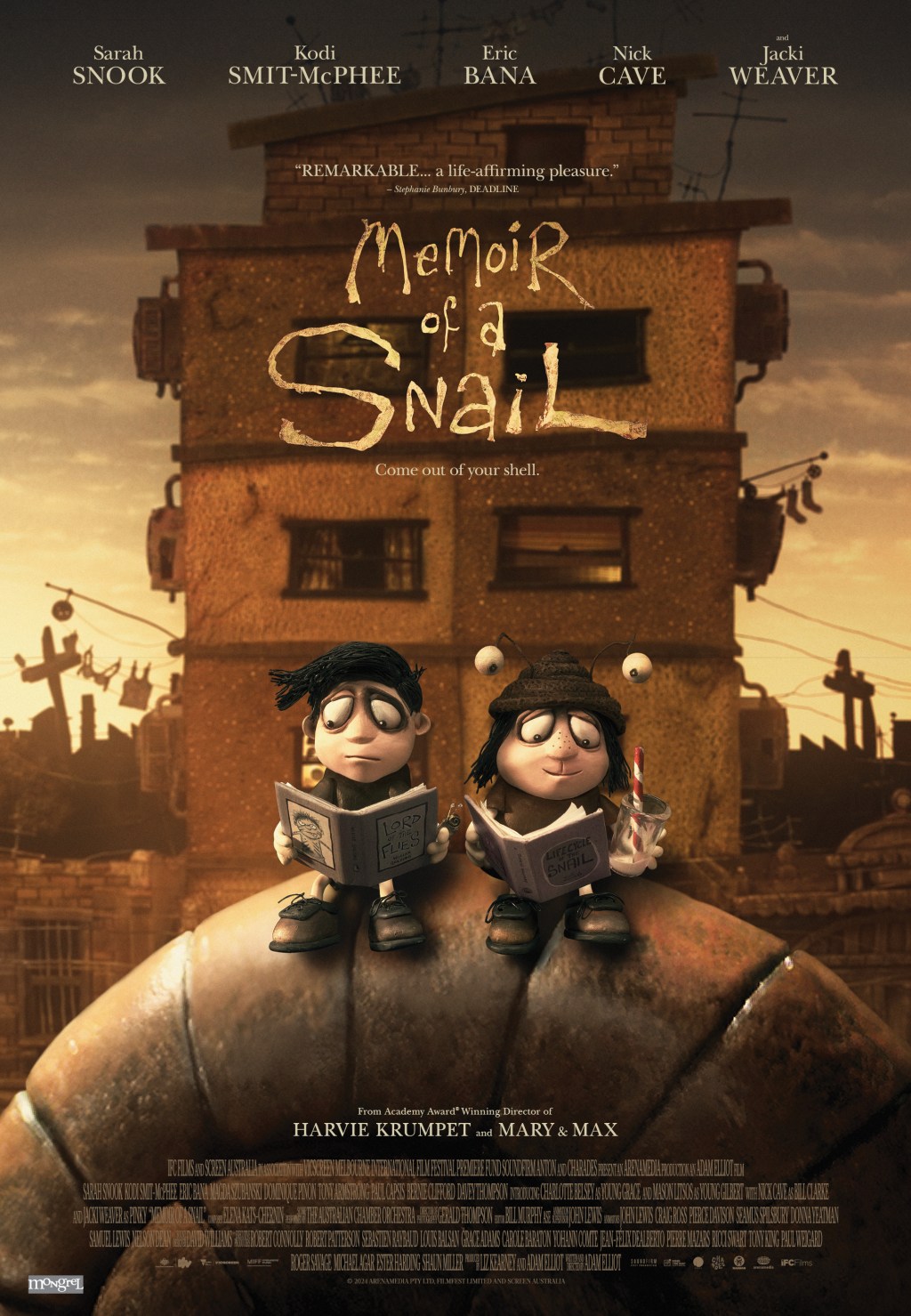
Memoir of a Snail
The two survive only by sending one another letters. Gilbert wants desperately to leave, while Grace becomes a recluse holed up in her home surrounded by the kitty snail-like objects she hoards. Can they survive in their dystopian prisons? And will they ever see one another again?
The Line
dating a black, feminist who doesn’t shave her armpits. And the university itself is coming down hard on the Greeks, following reports of dangerous practices going on there.
leave a comment