Parts of history. Films reviewed: Fanon, Train Dreams, Christy

Posted in 1920s, 1950s, 1990s, Algeria, Biopic, Boxing, Class, Colonialism, Lesbian, LGBT, Politics, Psychiatry, Resistance, Trains, violence by CulturalMining.com on November 9, 2025

Hi, this is Daniel Garber at the Movies for culturalmining.com and CIUT 89.5 FM.

Toronto’s Fall Film Festival season continue with two series on right now. Reelasian features films from Asia and its diaspora, including two great ones from Canada: Min Sook Lee’s heart-wrenching doc There are No Words, and Koala Kid’s whimsical, animated Space Cadet. Cinefranco has movies in French from Europe, Africa, and Quebec, including many Toronto premieres: look out for la Venue de l’Avenir by Cedric Klapisch (Ma Part du Gateau), and le Dernier Souffle by the legendary Costa-Gavras. 

But this week, I’m looking at three new films set in historical eras. There’s a lumberjack at the turn of the previous century, a psychiatrist in Algeria in the 1950s, and a female boxer from West Virginia in the 1990s. 

Fanon

Co-Wri/Dir: Jean-Claude Flamand-Barny

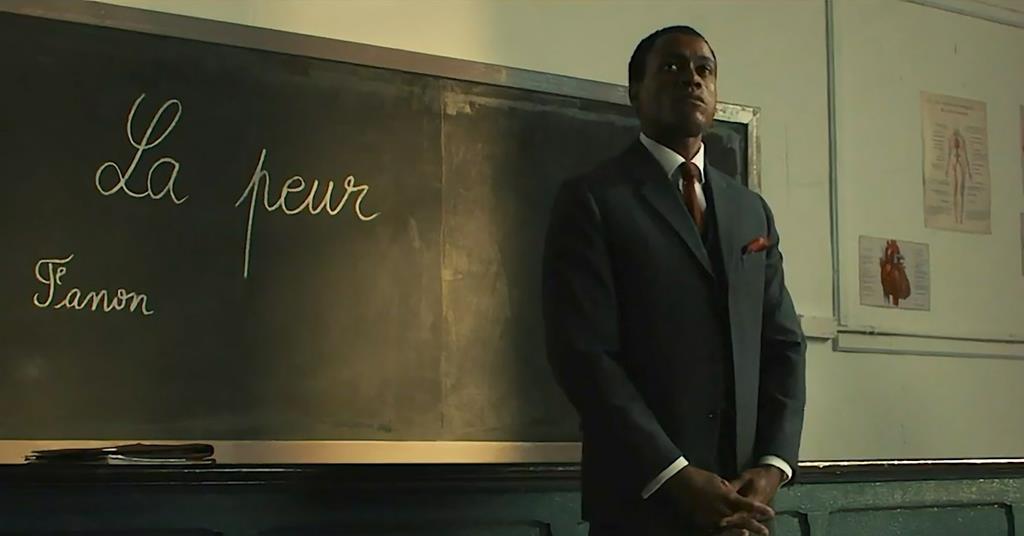
It’s the early 1950s in Algeria. Frantz Fanon (Alexandre Bouyer) is a renowned psychiatrist from the French Island of Martinique. He is starting his new job at a mental hospital. But he’s shocked at how Algerian patients are treated there. In contrast to Europeans, the “savage” north Africans are kept shackled in filthy cells, because of their “barbarous and dangerous” nature. Fanon (who is black) insists his North African patients be treated like any others. He lets them walk in the garden, plant vegetables, play soccer and make friends. Their mental health quickly improves. He’s assisted by diverse Algerian interns and staff: Hocine (Mehdi Senoussi) Jacques (Arthur Dupont) and Alice (Salomé Partouche), all followers of his techniques. But he’s strongly opposed by traditionalists and the French military, who are increasingly violent in their tactics. (Algeria was annexed by France but most of the locals are not considered full citizens.) He and his wife Josie (Déborah François) are upper-middle-class French citizens playing their role supporting the sprawling Empire. Fanon fought the Nazis in WWII. He likes Sartre, elegant suits and and fine wine. But his views are changing. He now writes books (dictated to his wife) about the effect of colonization on the mental health of the colonized in Algeria. Their own self-image is denigrated by their oppressors, he writes, when they internally accept their status as “the other”. Word gets out and he’s invited to join the FLN, (considered terrorists by the French). But the threat of violence reaches his hospital, as personified by Sergeant Rolland (Stanislas Merhar), a particularly violent soldier who checks in as a patient. How can Frantz Fanon simultaneously balance his various roles — as a husband and father, as a Black man serving the French empire, as an innovative psychiatrist, and as an intellectual joining the Algerian struggle for independence?

Fanon is a vibrant biopic about a decade in the life of the renowned author. I find it gripping and fascinating. Alexandre Bouyer is strong and statesman-like in the title role. I’ve known of Fanon for many years — as the author of books like The Wretched of the Earth and Black Skin, White Masks — but never knew about his background in psychiatry. Though occasionally heavy-handed and hagiographic, this movie opened my eyes to the exciting and intellectually stimulating story of his life in Algeria and the history that surrounded it. 

I like this one a lot.

Train Dreams

Co-Wri/Dir: Clint Bentley (Jockey) 

It’s the early twentieth century in the US Northwest. Robert Grainier (Joel Edgerton) is a bearded lumberjack who rarely speaks. He earns his living chopping down trees at migrant lumber camps and building the railroad.  He meets a woman named Gladys (Felicity Jones), they fall in love and build a homestead in a grassy patchl near a flowing river. He cuts all of the wood by hand. Gladys is good with a rifle and shoots foul and deer to eat. The rest they buy in town at a general store owned by Ignatius Jack (Nathaniel Arcand).

He spends lonely months away earning money, but always returns home in the end. He makes friends with a Chinese labourer named Fu Sheng — they don’t talk but that’s fine with Rainier who never has much to stay. But he is shocked when a crowd decides to murder Fu Sheng just because he’s a celestial. He later makes friends with an old-timer named Peebles (William H. Macy) who handles the dynamite explosions. He loves their new baby girl  but his home and family are threatened when a wildfire sweeps through the forest while he’s away. What will Grainier do?

Train Dreams is a series of events in one unremarkable man’s life set along the early 20th century northwestern frontier. A folksy omniscient voice narrates the story, hoping to add profundity; it doesn’t work. The film is meandering,  pointless and stupid. It gives token nods toward environmentalism and against racism but they’re not really part of the plot. I hated this movie from the first few seconds, with its over-produced images and inappropriate soundtrack. We see a guy sawing wood until the camera pulls back revealing…? Nothing, just more trees, as if we’re supposed to applaud the scenery! At times it’s twee, like a Wes Anderson film, but without the humour or intellect. The men all look like they’re posing for a Carhartt fashion shoot. I try to feel sympathy toward Rainier  but he’s deliberately opaque. Worst of all are the Train Dreams of the title — we keep seeing the same montages of flashbacks from previous scenes… but the original ones are as short-lived as his memories of them. 

You might enjoy the pretty pictures in Train Dreams, but I can’t see any other reason to watch this annoying blunderbuss of a film.

Christy

Co-Wri/Dir: David Michôd (The Rover)

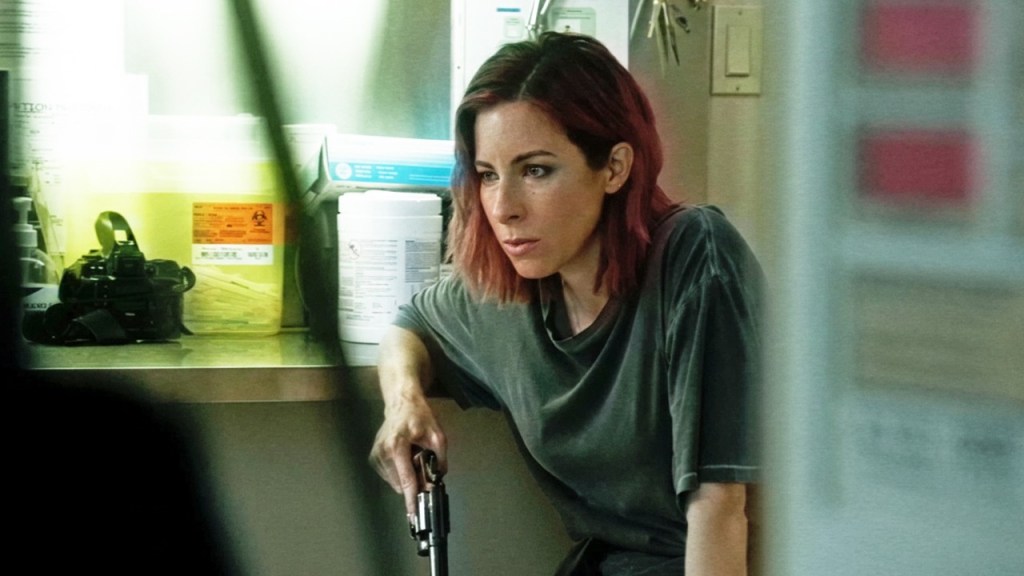
It’s 1989 in West Virginia. Christy Salters (Sydney Sweeney) is a high school kid, and a star player on the girls’ basketball team. She’s also in love with her girlfriend Rosie (Jess Gabor), a relationship her mom (Merritt Wever) doesn’t approve. She ends up trying out as a novelty act at a boxing match, and, though she has zero training, she scores a KO on her first try. She’s a natural. She catches the eye of a middle-aged boxing entrepreneur named Jim Martin (Ben Foster). He reluctantly takes her on and lets her train at his gym, but he will not allow her to see — or even talk to — Rosie. He sets her up in a trailer park where he can keep an eye on her. Though a great fighter, she’s isolated and unprotected outside of the ring. 

Christy is a powerhouse. Her career takes off, including a new hairstyle and a trademark pink silk hooded robe to make her look more “feminine”. She knocks out all contenders and after much pressure, the 22-year-old Christy sleeps with the middle- aged Jim… and they eventually marry. 

Her career soars, she meets Don King (hilariously played by Chad Coleman) and is signed to Mike Tyson’s slate. She gains fans worldwide, but her life is micromanaged by her Svengali husband. She may be a professional fighter but he’s twice her size, unstable, and increasingly violent. And he tries matching her up with boxers way above her weight class; that’s just dangerous. Is there any way to escape this oppressive relationship?

Christy is a biopic about the first prizewinning female boxer, who paved the way for a new professional women’s sport. I was hesitant about this one — ugh, yet another boxing movie — but Christy is as good as Rocky. It’s exciting, thrilling and moving, and despite her flaws, Christy Martin’s life is super-sympathetic. Sydney Sweeney is amazing. Yes, it’s Oscar-bait (you can tell by the prosthetic teeth and mullet haircuts, playing down her image as a sex-object) but she totally gets into this role. And Ben Foster is superbly hate-able as Jim — I seriously didn’t realize it was him till the credits rolled; he’s that skillful.

Christy is a good, old-fashioned biopic and a hell of a great boxing movie. 

Train Dreams and Christy both played at TIFF and are opening in Toronto this weekend; check your local listings. And Fanon is premiering today at Cinefranco, 4 pm at the Carlton Cinema.

This is Daniel Garber at the Movies, each Saturday morning, on CIUT 89.5 FM and on my website culturalmining.com.

Pot o’ Gold. Films reviewed: French Girl, One Life, Love Lies Bleeding

Posted in 1930s, 1980s, Bodybuilders, Canada, Clash of Cultures, Cooking, Crime, Czechoslovakia, Kids, Lesbian, LGBT, Nazi, Quebec, Romantic Comedy, WWII by CulturalMining.com on March 16, 2024

Hi, this is Daniel Garber at the Movies for culturalmining.com and CIUT 89.5 FM.

Tomorrow is St Paddy’s day so this week I’m looking at three new movies, from Canada, England and the US, about people looking for their own pot o’ gold. There’s a New Yorker in Quebec looking for love, an Englishman in wartime Prague searching for orphans to rescue, and a young woman in New Mexico looking to flee to Vegas with her bodybuilder girlfriend.

French Girl

Wri/Dir:  James A. Woods, Nicolas Wright

Sophie and Gordon are an unmarried couple in New York in their late 30s. Gordon Kinski (Zach Braff) is an eighth grade English teacher in a public school in Brooklyn. He loves donning 16th century tunics to teach Shakespeare to 14 year olds. Sophie Tremblay (Evelyne Brochu) is a wizard in the kitchen — professional kitchens that is. She’s the chef at a popular restaurant. They’re getting ready for a long-planned vacation in upstate New York, far away from their jobs. But their plans are changed when a strange woman appears. Ruby (Vanessa Hudgens) is a celebrity chef with cooking shows and restaurants all around the world. She wants Sophie to audition for executive chef at her newest branch. The restaurant is in the Chateau Frontenac in Quebec City, Sophie’s home town. For Gordon, who has rarely left NY City, Quebec is terra incognito. But he agrees to come with her, thinking it’s the perfect time to propose marriage. He also will offer moral support and meet her family. And what a family it is.

The Tremblays live on their sheep farm near Quebec City. There’s an angry Dad, a doting mom, a gossipy older sister, and Junior

(Antoine Olivier Pilon) an intimidating cage boxer who collects samurai swords. And then there’s their elderly grandma who has a tendency to pop up beside their bed when they’re having sex. Gordon, who speaks no French, feels very out of place, but still tries desperately to fit in. What he doesn’t know, but the family does, is that Ruby, Sophie’s potential future boss, is also her former lover. Will Sophie get the job? Will her family accept Gordon? And is the rich and glamorous Ruby competing with him for Sophie’s hand?

French Girl is a funny and cute romcom about a culture clash between an eccentric family and a fish out of water. It’s also bilingual — the Tremblays speak French while Gordon and Ruby speak English. While French Girl follows many of the cliches and conventions of a romantic comedy, it still seems sweet, fresh and delightful. 

I liked it despite myself. 

One Life

Dir: James Hawes

It’s the late 1980s in a small city in England. Nicky Winton (Anthony Hopkins) is a retired stockbroker who lives with his wife Greta (Lena Olin). They’re expecting a visit soon from their expecting daughter, so she tells him to throw out all his junk to make way for baby. He has tons of files and papers from the 1930s he hasn’t looked at in years. Plus a treasured leather briefcase with a photo album in it. Everything in the album happened in 1938. That was when Hitler invaded Czechoslovakia to annex the “Sudetenland”, sending thousands of refugees — including Jews, intellectuals, leftists, Socialists, and Communists — to Prague to stay out of Nazi hands. 

A much younger Nicky (Johnny Flynn) visits Prague and is overwhelmed by all the refugees, including countless children, many orphans, living in the streets. He wonders, how many children could he transport by train to England before Germany invades Prague? There were similar programs for kids in Austria and Germany, but not Czechoslovakia. His German-born mom (Helena Bonham-Carter) says she’ll do whatever she can to help. And a team in Prague is recording names of kids who can be saved. Can Nicky convince the British government to issue visas, raise the needed funds, and find foster parents to take care of them? Will he get them out before the Nazis march in? Or is it a fools game? 

One Life is an historical drama — based on a true story — about an unsung hero and what he accomplished in 1938. The story jumps back and forth between the 30s and the 80s, half about the daring mission of a young man, and half about the old Nicky telling his story. I wanted to see this film for two reasons: because of the story — who doesn’t want to see children rescued from the Nazis? — and because it’s directed by James Hawes, who brought us that excellent TV spy thriller series Slow Horses. Sadly,  One Life couldn’t possibly be less thrilling. While there are a few touching moments near the end, most of this film is as slow as molasses. Hopkins sleepwalks through his part while the audience nods off.

Sad to say, One Life is a snooze fest.

Love Lies Bleeding

Co-Wri/Dir:  Rose Glass

It’s 30 years ago in a small town in New Mexico.  Lou (Kristen Stewart) works at her estranged father’s hardcore gym, a rusty warehouse filled with muscleheads spouting No Pain No Gain slogans. Most of her time is spent unclogging toilets with her bare hands or fending off the amorous advances of a crackhead named Daisy (Anna Baryshnikov). It’s a hell-hole. Until a breath of fresh air blows in through the door. Jackie (Katy O’Brian) is a competitive bodybuilder in pink and purple lycra with big hair and bigger muscles. She’s an Okie just passing though town on her way to a competition in Vegas. But when she decks two lugs who threaten Lou, it’s love at first punch. Soon they’re making passionate love in Lou’s lonely apartment. Soon enough, she’s supplying Jackie with steroids to reach body perfection before they head off to Vegas.

But all is not well in rural New Mexico. Lou’s brother in law, JJ (Dave Franco) is a mega-douche who works for her Dad, Lou Sr’s (Ed Harris). Lou Sr is a crime boss who runs the town from his gaudy mansion. When JJ’s not cheating on his wife (Lou’s sister), he’s beating her up. And he has hired Jackie to work at Lou Sr’s gun club, after she agreed to have sex with him. (She doesn’t yet know that Lou is related to all of them). But when the truth comes out, and Lou’s sister ends up in ER, Jackie is jacked. She slips into a manic ‘roid rage looking for revenge, while pulling Lou into a spiral of violence, death and retribution. Will Jackie make it to Vegas? Will someone pay for the murders? And where will the dead bodies go?

Love Lies Bleeding is a brilliantly dark film noir, about small-town crime in the southwest. It’s filled with distorted psychedelic fantasies within a tragic world. It’s also a love story filled with lots of hot lesbian sex. The production design is amazing. Most of the characters sport 80s mullets and the whole movie pulses with a driven soundtrack and neon colours. This is only Rose Glass’s second feature (after Saint Maud) but she once again incorporates real settings within a surreal plot. This one includes a behind-the-scenes look at professional bodybuilding, complete with spray-on suntans and their strangely contorted muscle-popping poses. But beware — the movie is filled with shocking, graphic violence. Dave Franco is great as a sleaze ball, a grizzled Ed Harris is suitably sinister as a crime boss with foot long greasy blond hair spouting beneath a completely bald tonsure. Anna Baryshnikov (the dancer’s daughter!) is perfect as a hippy girl long past her prime. And Kristen Stewart and newcomer Katy O’Brian absolutely sizzle together.

If you’re looking for a crime-thriller that’s gripping, shocking and aesthetically stunning, don’t miss Love Lies Bleeding.

One Life, French Girl, and Love Lies Bleeding all open this weekend in Toronto; check your local listings.

This is Daniel Garber at the Movies, each Saturday morning, on CIUT 89.5 FM and on my website culturalmining.com.

Road movies. Io Capitano, Ordinary Angels, Drive Away Dolls

Posted in 1990s, Adventure, Africa, comedy, Coming of Age, Crime, Disease, Italy, Kids, Lesbian, LGBT, Migrants, Politics, Road Movie, Senegal by CulturalMining.com on February 24, 2024

Hi, this is Daniel Garber at the Movies for culturalmining.com and CIUT 89.5 FM.

The road from the festival circuit to your local cinema is a slow and tortuous one. I reviewed Meredith Hana-Brown’s Seagrass — a moving drama about a young couple and their daughters at an island retreat in BC — five months ago, but it’s finally hitting theatres this weekend — check it out! (Review here).

So, in recognition of that long and twisted path, this week I’m looking at three new road movies. There’s two lesbians in their twenties driving south from Philly, two teenaged boys travelling across the Sahara desert from Dakar, and a middle-aged hairdresser trying to get a little girl to a far-off hospital in time for a transplant.

Io Capitano

Co-Wri/Dir: Matteo Garrone

It’s present-day in Dakar, Senegal. Seydou (Seydou Sarr) is a 16-year-old student who works part time as a builder. With his best friend Moussa (Moustapha Fall) they’re saving money for a major purchase. Their goal? To travel to Europe to make it big as singer-songwriters. But though Seydou’s mother and others object —  People die at sea! Europe is not like what they show on TV — the two boys sneak out one night, and head off on their journey. They buy their tickets for a long trip across the Sahara, via Mali and Niger to Tripoli, Libya, and from their on to Europe. They are promised modern new trucks to whiz them there.  But they soon discover, the world is full of thieves, swindlers, and worse. They are forced to pay bribes to cross borders. Anyone who falls out of the rusty flatbed trucks is left behind to die.  They are set upon by cruel bandits, separating the boys, with Seydou sent to a prison run by the Libyan Mafia. Inmates are subject to extortion and torture. And those who survive are sold into de facto slavery. But, somehow, Seydou makes it to Tripoli. Now he has to find Moussa, and get a boat to take them to Italy. But what will the future bring?

Io Capitano is a powerful, heartfelt drama about two young migrants trying to reach Europe. Seydou is a heroic figure who gradually matures from boy to man to leader. (The title means I am the Captain.) Garrone, as in most of his films (Reviews: Dogman, Reality, Gomorrah), again casts first-time actors in the main roles, giving the movie a hyper-realistic feel. Seydou, for one, is amazing, totally believable. And lest you think this is a gruelling journey, it is also filled with music, dance and magical fantasies that appear in Seydou’s mind. 

Io Capitano is an uplifting and heroic story.

Ordinary Angels

Co-Wri/Dir: Jon Gunn (Writer/Producer: I Still Believe, American Underdog, Jesus Revolution)

It’s the 1990s in Louisville, Kentucky. Sharon (Hilary Swank) is a hair stylist who owns a beauty parlour. She’s known for her sparkling skirts, fringed leather jackets, and her long, curly hair with frosted tips. She likes getting drunk at roadhouses and dancing on the bar. But her best friend and coworker Rose (Tamala Jones), sees trouble ahead if she doesn’t stop drinking. Clearly, Sharon needs something — a lover, a religion, or a cause — to devote herself to. But her first marriage was a bomb (her adult son won’t even talk with her), and going to church isn’t her thing. But when she spots a local newspaper headline — Man’s wife dies, his 5-year-old daughter is suffering from a rare illness — she decides to do something about it. She starts raising funds at the hair salon, and spreading awareness of this family’s plight. Ed Schmitt (Alan Ritchson) is a simple roofer in debt half a million bucks, and his daughter Michelle (Emily Mitchell) needs expensive treatment. Sharon starts giving him envelopes of cash she raises, but he doesn’t feel comfortable. Why is this strange alcoholic woman giving him money?

But the kids and Ed’s mom take to Sharon like bees to honey. She helps him balance his books, and raises money from the bigwigs in Louisville. Soon everyone knows about Michelle’s plight. But when the big day comes for a liver transplant, the city is closed down by a freak snowstorm. And the hospital is halfway across the country. Are Sharon — and the community’s — wits and determination be enough to save a dying girl?

Ordinary Angels is an uplifting, non-preachy faith-based drama about an ordinary woman trying to change the world. It feels a bit manipulative at times, with gushing music, and twinkling stars overhead . Ed barely talks —  he’s the strong, silent type, just yes ma’am, no ma’am — and little dying Michelle is way too cute. Luckily, Hilary Swank is just great as the indefatigable Sharon, a woman who won’t take “no” for an answer. Yeah, the movie is a little bit forced and a little too long, but it also tugs your heart-strings in just the right places. And it’s great seeing a large group of people working together in an attempt to save a life. (It’s based on a true story.)

So if you like tear-jerkers, this one is a two-hankie classic, one that’ll leave you crying, for sure. 

Drive Away Dolls

Co-Wri/Dir: Ethan Coen

It’s 1999 in Philadelphia.

Jamie and Marion are best friends, but couldn’t be more different. Jamie (Margaret Qualley) has a southern drawl and a wild-at-heart attitude. She’s always up for a roll in the hay with any chick she meets in a lesbian bar. Marian (Geraldine Vishvanathan) is reserved and uptight, stuck in a futureless, cubicle office job. But when Jamie’s long-time girlfriend Sukie (Beanie Feldstein) catches her cheating in their own apartment, she goes ballistic. Sukie is a hot-headed cop and Jamie knows when it’s time to skedaddle. So she decides to go for a drive home to Tallahassee with Marian as her co-pilot. Luckily, Jamie knows about a great deal at Drive Away autos — they deliver the car to Tallahassee and they get the ride for free. What they don’t know, is they’re driving the wrong car, carrying unexpected cargo in the trunk: a metal suitcase… and a human head!

You see, that metal suitcase contains something of crucial importance to someone with a lot of power, and a gang of ruthless men want it back. And they’re racing down the highway trying to catch up with Jamie and Marion and take back the suitcase. But the clueless pair are taking their own sweet time, with Jamie smoking pot and meeting up with nubile soccer players in honky-tonk bars and sleazy motel rooms on the way,  while Marion has to deal with over-zealous redneck sheriffs. But the criminals are steadily getting closer, and who knows what will happen if they meet. What’s in the metal suitcase? Can Jamie and Marion stay friends? And is there something deeper going on between them?

Drive Away Dolls is an unapologetic B-movie, a non-stop comedy-thriller about lesbians on the road. It’s full of wanton sex and gratuitous violence, though nothing overly explicit. It also features cameos by A-listers like Matt Damon, Pedro Pascal and Colman Domingo. And it’s all strangely interspersed with vintage, psychedelic soft-core hippy-porn, (its meaning only revealed at the end). This is like a Coen Brothers movie, but no Joel. Instead Ethan is paired with longtime film-editor (and wife) Tricia Cooke who also co-directed and cowrote it, apparently based on her own salad days. It’s great raunchy fun. The only thing that puzzles me is, in a movie that’s all about lesbians, why does the trailers completely hide that fact? (Not to mention changing the title from Drive Away Dykes to Drive Away Dolls.) But I guess you have to sell a movie to a broader audience or you won’t get the crowds. 

Either way, I really enjoyed this one.

Io Capitano is now playing at the TIFF Lightbox; with Drive Away Dolls and Ordinary Angels both opening theatrically this weekend in Toronto; check your local listings. 

This is Daniel Garber at the Movies, each Saturday morning, on CIUT 89.5 FM and on my website culturalmining.com.

August potpouri. Films reviewed: Bad Things, Lasting Impressions, Strays

Posted in 1900s, Animals, Art, comedy, France, Ghosts, Horror, Lesbian, LGBT, Penis by CulturalMining.com on August 19, 2023

Hi, this is Daniel Garber at the Movies for culturalmining.com and CIUT 89.5 FM.

August is a time to relax travel and have fun, not a time when people want to watch serious movies. So this week I’m looking at a potpourri of different sorts of entertainment than you’re probably used to. I’m talking about lesbians in a haunted hotel, French impressionist paintings on a bistro wall, and abandoned talking dogs in a big city. 

Bad Things

Wri/Dir: Stewart Thorndike

It’s dead winter in upstate New York. Ruthie (Gayle Rankin) and her friends are up from the city to spend a night or two at a completely deserted hotel. 

Ruthie inherited the place from her grandmother and has to decide whether to give it a go or sell it. With her, are her enthusiastic girlfriend Cal (Hari Nef: Barbie) their hard-boiled pal Maddie (Rad Pereira) and Maddie’s flirtatious acquaintance Fran (Annabelle Dexter-Jones). And it could be a fun weekend: there’s an indoor swimming pool, karaoke, a huge kitchen and tons of empty rooms for pillow fights or foolin’ around. On the negative side, the hotel might be haunted. Fran is the first one to see ghosts, a little girl worried about her fingers, and a pair of female ski champs. Worse, the ghosts can also see her. But when she freaks, the other three just blame it on drugs. Things heat up when Ruthie cheats on her girlfriend. But when things start getting really scary, like someone wearing a gas mask while brandishing a chainsaw — they have to decide whether to hightail it back to the city, or stick it out. 

Bad Things is a new take on Stanley Kubrick’s The Shining from a feminist perspective. It keeps some of the original concepts but twists them all into something new and original. Instead of blood in the hallway it’s mothers’ milk. And there are lots of psychological thrills and chills — it’s hard to know who is crazy, who’s a ghost, who is living, who is dead, and who is killing them all. The acting is good all around, along with appearances by token heterosexuals, Canadian Jared Abrahamson (American Animals, Hello Destroyer, Hollow in the Land, Sweet Virginia) as Brian the handyman and 80s icon Molly Ringwald as the Woman in Red. Bad Things is a low budget movie shot during the height of the pandemic —  The Shining it ain’t — but it is good, funny and scary.

Lasting Impressions: The Magic of the Impressionists in 3D

When is a painting not a painting? When it’s an experience. Over the past 5-10 years there’s been a boom in exhibitions of the art of famous painters… but without the paintings. Van Gogh, Chagal, Monet — they take a huge space and fill it with enormous moving projections of their most famous works to view as you walk around a warehouse or convention centre temporarily turned into a pop-up gallery. These were especially popular during the pandemic when it was hard to travel. But this show is different: instead of an ersatz art gallery, it’s a show, almost like dinner theatre. You sit at small numbered tables, where servers bring wine and snacks. When the show begins, the lights dim and you turn your chair to face the screen. And here’s where out gets interesting. To the accompaniment of popular French music — Debussy to Charles Aznavour to Ella Fitzgerald —  enormous blowups of French impressionist paintings — sort of a greatest hits — are displayed one by one. The projections use super-saturated colour with intense effect. Part of the paintings are animated: water ripples, clouds drift, leaves shake. And — with the help of 3D glasses —  elements of a painting feel like they’re moving: you’re drifting down a stream, floating above Monet’s waterlilies, or at a ballet rehearsal with poised ballerinas drifting slowly toward you in mid-air. It’s not the same thing as seeing a painting on a wall; this is art as a commodity to be consumed. While the animation doesn’t always work — I’d rather see a Frenchman’s long beard or a Tahitian woman’s hair staying still in a Renoir or Gaugin painting, than to watch it sway rhythmically in the breeze — the technical quality is excellent: great sound and beautiful images. I’m of the view, if you want art, go to a museum — there’s a show on right now of Mary Cassatt’s impressionist painting at the AGO. But if you want a pleasant, nostalgic outing, where you can enjoy choreographed pictures, music and a glass of wine, this is it.

Strays 

Dir: Josh Greenbaum

Reggie is the perfect dog. Though a bit scruffy around the edges, he is loving, faithful, and true to his master Doug (Will Forte). All he wants is a pat on the head and an occasional “good boy”. So what is Reggie (Will Ferrell) doing in a dark alley in some big city? Turns out Doug is a good-for-nothing, scum-of-the-earth master who abandoned poor Reggie 3 hours away from the small town they live in, so the dog could never make his way back home. Reggie is still hopeful — he’s naive and an eternal optimist —  but he is quickly disabused of that notion by some big mean dogs who threaten him. Luckily, the street-smart Bug (Jamie Foxx), comes to his rescue like the Artful Dodger, showing him the lay of the land. Being a stray dog is paradise — you can live like a king with no responsibility. They’re soon joined by two other strays: Maggie (Isla Fisher) an elegant pooch with a keen sense of smell who was traded in by her mistress for a smaller cuter lapdog; and Hunter (Randall Park) a former therapy dog who is always sympathetic.  But when they discover Reggie’s tragic story they decide to help him get revenge. Their mission? For Reggie to find his way back to Doug… and bite off his penis! Will they make it to the town? And what adventures will they encounter along the way?

Strays is a comedy road movie that’s coarse, bawdy, and raunchy. It’s a typical bro movie, with the sort of humour that appeals to 14-year-old boys… you know, lots of jokes about feces, vomit, urine and penises. But somehow, because it’s guileless dogs (not people) telling the jokes, you can laugh all you want without feeling guilty or self conscious. These are real dogs, not CGI images (except when their mouths move). It gets a bit dark at times — jokes about serial killers and lost kids — and I’m really not a fan of explicit, extended images of dog poop… but despite all that, Strays is quite a funny movie. 

Lasting Impressions is now playing at the CAA Mirvish Theatre in Toronto; Bad Things is streaming on Shudder, and Strays is opening across Canada this weekend; check your local listings.

This is Daniel Garber at the Movies, each Saturday morning, on CIUT 89.5 FM and on my website, culturalmining.com.

Organized religion. Films reviewed: Hand of God, Agnes, Benedetta

Posted in 1600s, 1980s, Breasts, Catholicism, Coming of Age, Horror, Italy, Lesbian, LGBT, Nun, Religion, Sex, Supernatural, Women by CulturalMining.com on December 4, 2021

Hi, this is Daniel Garber at the Movies for culturalmining.com and CIUT 89.5 FM.

It’s December and we’re entering holiday season, so I thought it’s time to talk about movies involving religion. So this week I’m looking at three new movies with (small c) catholic themes. There’s an adolescent boy in 1980s Naples who witnesses the “Hand of God”, a lesbian nun in renaissance Tuscany who is in love with God, and another nun in the US who may be possessed by the Devil.

Benedetta

Co-Wri/Dir: Paul Verhoeven

It’s the 1600s in Tuscany Italy. Benedetta (Virginie Efira) is a beautiful young  nun with blond hair and a quick wit. She was placed in small town convent as a young girl, paid for by a rich dowry her parents gave the Abbess (Charlotte Rampling). Now Benedetta is married to God, both metaphorically, and literally, in her mind. She goes through vivid spells, where she has sex with a violent Jesus after he slays all her attackers with a sword. She also has a streak of cruelty since she was told that suffering, by oneself and others,  brings one closer to God. The cynical Abbess thinks Benedetta’s trances are just an elaborate hoax. But everything changes when Bartolomea (Daphné Patakia) a gorgeous young novice, appears at their doorstep. 

She is illiterate, and the victim of horrific abuses from her father and brothers. Benedetta takes her under her wing, nurtures her and schools her in divinity, reading and math. In exchange, Bartolomea sleeps with her, awakening hidden desires. Could this be love? Benadetta says she’s having chaste, spiritual sex with Jesus himself, not carnal passion with the young novice. And her spontaneous stigmata — bleeding that appears in her hands and feet like Jesus on the cross — attracts pilgrims and followers from far and wide seeking advice and cures. But when she’s caught using a wooden statue of the Virgin Mary as a sex toy, things take a turn for the worse. A cruel Nuncio (Lambert Wilson) arrives from plague-ridden Florence for an inquisition. Will he manage to wring a confession from the two women? Or will Benedetta’s spiritual powers protect her from being burned at the stake?

Benedetta (based on  actual historical records)  is a bittersweet and passionate look at the life and love of a lesbian nun in Northern Italy. It’s sexually explicit with lots of matter-of-fact nudity throughout the film as well as some horrific violence  (remember, this is a movie by the great Paul Verhoeven who knows well how to keep bums in seats). This is a visually stunning film, with sumptuous views of sunlit cathedrals, long-flowing costumes, diaphanous bed curtains and beautiful faces and bodies. Never has a convent looked so erotic. But it’s also a fascinating look at faith in the face of cynical religious practices. Benedetta is a beautiful and shocking film.

Agnes

Wri/Dir: Mickey Reece

Sister Agnes (Hayley McFarland) is a young nun in a convent whose birthday celebration turns into a disaster. Now he’s tied to her bed, foaming at the mouth and speaking in strange otherworldly voices. What is going on?Enter Father Donoghue (Ben Hall). He’s a grizzled priest with a shady past, but also many successful exorcisms under his belt.  And he takes a newby with him, the devout Benjamin (Jake Horowitz) a divinity student who has yet to take his vows. Father Donoghue doesn’t believe that they’re actually possessed, just that they think they are. And only the elaborate song and dance of an exorcism will allow them to give it up. At the convent, Mother Superior (Mary Buss) a stickler for rules, is much less enthusiastic. She’s not comfortable with men under her roof, especially a young one without a priest’s collar. But she allows it to proceed. And the routine exorcism takes an unexpected turn.

The story picks up with Sister Agnes’s friend Sister Mary (Molly C. Quinn). She left the convent after the incident. Now she works at two jobs — a convenience store and a laundromat, —and is trying to live a normal life. But she doesn’t know what to do or how to act. Can she keep the faith? Matters aren’t helped when she meets a cynical stand up comic at a local dive bar (Sean Gunn). Can he teach her what she needs to know?

Agnes is a look at faith, and self-doubt within the church. It starts as a genre pic, a conventional, low-budget horror, but it ends up as a deeper and darker melodrama propelled by scary undertones. It’s called Agnes, but it’s actually in two acts, the second part mainly about Sister Mary. It’s unpredictable and uncomfortable, and sometimes a bit bloody. This may be the first Mickey Reece film I’ve ever watched but I can see why this indie filmmaker has such an avid following. The film has an interesting mix of experimental film and conventional, even kitschy, horror, comparable to avant-garde filmmakers like Ben Wheatley and Peter Strickland. Not for everyone, but I enjoyed it — and I think want to see more Mickey Reece.

Hand of God 

Dir: Paolo Sorrentino

It’s 1984. Fabietto (Filippo Scotti) is a young man at Don Bosco high school in Naples, Italy. He is precocious and well-read, — constantly quoting classic verse — but has neither friends nor sexual experience. He gets most of his advice from his big brother (who shares a room with him) and his parents. Dad (Toni Servillo) is a self-declared communist while his mom (Teresa Saponangelo) is a inveterate practical joker. Then there are all the odd-ball neighbours in their apartment building (including a former countess) and his even stranger family members. But foremost in Fabio’s eyes is his aunt Patrizia (Luisa Ranieri). She suffers from delusions which cause her to innocently expose her flawless naked body at unusual times — which provide fodder for the sexually-starved Fabio’s fantasies. 

It’s also the year when rumour has it that international soccer star Maradona may start playing for the local team — an obsession of most of his family. Third on Fabietto’s list — after sex and football — are the movies. Fellini is casting extras in Napoli — he goes to the audition —  while another up-and-coming director is shooting his latest film downtown. That director is also dating the very actress Fabio is dying to meet. Will he ever fulfill any of his wishes? And how will this pivotal year affect the rest of his life?

Hand of God (the title refers to a legendary goal scored by Maradona) is a coming-of-age story based on the filmmaker’s own recollections. It seems like the straight version of the popular Call Me By Your Name, another Italian feature. Set in the 80s, it’s also about a precocious adolescent’s first sexual experiences, situated within a quirky but loving family. There’s lots of 80s music, fashion and hairstyles to look at. Filippo Scotti also happens to looks a hell of a lot like Timothée Chalamet. That said, it is its own film, and fits very firmly within Sorentino’s work, including his fascination with celebrities as characters,

perennial actors like the great Toni Servillo  hapless men, as well as the requisite “naked woman with perfect breasts” who manages to turn up, in one form or another, in all his movies. Although Hand of God isn’t that original, and a bit contrived, it does have some very funny and a few honestly shocking scenes that should not be missed. I liked this one.

Hand of God and Benedetta both open theatrically in Toronto this weekend at the TIFF Bell Lightbox; check your local listings; and Agnes starts next Friday at the Carlton Cinema in Toronto.

This is Daniel Garber at the Movies, each Saturday morning, on CIUT 89.5 FM and on my website, culturalmining.com

Canadian Film Day! The Courier, Bloodthirsty, The Marijuana Conspiracy

Posted in 1960s, 1970s, Cold War, drugs, Espionage, Lesbian, Mental Illness, Music, Toronto, UK, USSR, Werewolves by CulturalMining.com on April 16, 2021

Hi, this is Daniel Garber at the Movies for culturalmining.com and CIUT 89.5 FM.

Hey, did you know next Wednesday is Canadian Film Day? Yeah, I know all the theatres will be closed but you can still attend Canadian movies all across the country. Things like 11 new short films from emerging filmmakers, called Light(s) at the End of the Tunnel; online discussions, and lots of films you can watch on TV or streaming online. Go to canadianfilmday.ca for details.

This week I’m looking at three new movies, two of which are Canadian. There’s tokes in Toronto, Spooks in the Soviet Union, and lycanthropes in Alberta.

The Courier

Dir: Dominic Cooke

It’s 1960 in Moscow and the space race, the arms race and the cold war are in full swing. Oleg Pankovsky (Merab Ninidze) is a high-ranked officer in Soviet military intelligence. He has access to secret documents,  and knows something big and potentially dangerous is coming. And he doesn’t like Kruschev’s inflammatory speeches. It feels like the USSR and the USA are heading toward all out nuclear war. So he decides to do something. He leaks a bundle of documents to the American embassy with a promise of more to come. But Oleg is too important for the  CIA and the MI5 to risk exposing him by using one of their own agents.

So, instead, a CIA agent named Emily (Rachel Brosnahan) and her MI5 counterpart approach a mild-mannered British businessman who already conducts trade behind the Iron Curtain. Greville Wynne (Benedict Cumberbatch) is just an ordinary fellow, who lives in a modest London home with his wife Sheila (Jessie Buckley) and their young son. And he wants nothing to do with it. He’s untrained and uninterested. But when he learns that the fate of the world may be at stake, he agrees. All he has to do is continue what he was always doing — making deals and signing import and export contracts. And regular meeting with Oleg to carry secret documents back to London. Heh’s a courier. But as tensions rise moles on both sides are revealing secrets. Wynne and Oleg both face growing suspicion, and their home lives suffer (Wynne’s wife thinks he’s having an affair). And when something goes wrong both Oleg and Wynne are in grave danger. Will they be discovered? Can they safely make it to the west? Or is their fate already sealed?

The Courier is a gripping historical spy thriller set at the height of the Cold War, during the Cuban Missile Crisis. It’s exciting and mysterious, filled with quirky realistic characters. It’s also based on an actual case. On the other hand, it regurgitates Cold War politics as if it’s still 1960.  The KGB was surely a nasty agency, but so were the CIA and the MI5. They were all busy assassinating leaders, supporting coups, installing dictators and thwarting democratic elections worldwide. But in this movie it’s “Russians bad, Anglo-Americans good”.

Keep that in mind, but it doesn’t detract from the gripping story, and excellent acting. I liked this one.

Bloodthirsty

Dir: Amelia Moses

Grey (Lauren Beatty) is a singer-songwriter in Edmonton, Alberta. She’s a vegan and an animal lover who treats everyone, even the four-legged, with love and respect. She lives with her long-time girlfriend  Charlie, an artist (Katharine King So).  Her first album was a smash hit, but now she’s facing two problems: First she has writer’s block and sophomore blues — she’s afraid her second album will suck. She’s also  on prescription meds to battle a strange phenomenon: frequent, realistic nightmares about gorging on raw flesh, dripping with blood, and similar hallucinations when she’s awake.

So, when a famous but reclusive record producer named Vaughn Daniels (Greg Bryk) invites her to his home to record her next album, she jumps at the chance. Charlie is less enthusiastic. Why does he live in a house in the woods. And isn’t he a convicted murderer? (Actually he was charged but never convicted.) So they drive up north. He takes Grey under his wing, so she can let her mind free. It’s not writer’s block it’s your inhibitions that are holding you back, he tells her. He takes off her meds, plies her with hard liquor and tries to get her to eat raw meat.  And Grey notices she’s changing — she’s creating good, dark music,  but her head is filled with violent ideas. Why did Vaughn choose her? What is he after? And why do dead animals and humans — ostensibly killed by wolves — keep turning up near his home?

Bloodthirsty, as the title suggests, is a dark and brooding, horror movie about werewolves and music.  It’s spooky but not all that scary. It’s a low-budget movie with a very small cast and low-rent special effects. And it could have used a bit more humour… and a scarier-looking house. (Vaughn’s lair just looks strange.)

What’s great about this movie is the way it combines the creative process of composing and writing lyrics with supernatural bloodlust! That is totally original, and and Lauren Beatty as Grey does it really well (with a beautiful voice, too). 

The Marijuana Conspiracy 

Wri/Dir: Craig Pryce

It’s 1972 in downtown Toronto. Trudeaumania has swept across Canada but here in True Blue Ontario, the Tories are worried. Rumour has it that Trudeau — Pierre, not Justin — might legalize marijuana. So they commission a study of the dangers of the demon weed. 20 young women, age 18-25 are paid subjects at the Addiction Research Foundation, (later merged with CAMH). They’re given rooms to live in, food and recreation for three months. What’s the catch? They’re not allowed to leave the premises and  have to smoke cannabis every day. The doctors observe the results but don’t interfere. And to measure the long term effects the patients weave macrame wall hangings out of hemp and beads, and they’ll be paid upon completion of the study for each one they successfully finish (that measures motivation.)  What they’re measuring is whether smoking grass impedes work production. (There’s also a control group in the study identical in every way except they don’t smoke.)

The movie focuses on a few of the subjects. One is homeless, another is upper middle class, a third is hippy who wants to move to a commune in Vancouver, and one whose father is serving time for drug possession. There’s also intrigue, sex, humour music, and friendship. And it touches on sexuality, race, psychiatry, politics and many other issues. Here’s the biggest twist: This is not a documentary! It’s base on the actual study but this is character-driven drama about the the young volunteers, and the doctors, nurses, and grad students they interact with.

This is such an unusual movie, it really grabbed me, both for the characters and drama and surprises, but also the weirdness of it all — and because it actually happened right here in Toronto.

The Courier is released today on PVOD; The Marijuana Conspiracy opens across North America on Tuesday, April 20th, and you can pre-order Bloodthirsty beginning next Friday.

This is Daniel Garber at the Movies, each Friday morning, on CIUT 89.5 FM and on my website, culturalmining.com

Separated. Films reviewed: Dear Comrades!, A Glitch in the Matrix, Two of Us

Posted in 1960s, documentary, Family, France, Lesbian, LGBT, Protest, Psychology, Romance, Russia, TIFF, USSR, video games, Women by CulturalMining.com on February 5, 2021

Hi, this is Daniel Garber at the Movies for culturalmining.com and CIUT 89.5 FM.

Festival and award season has begun, so this week I’m looking at three new movies – from the US, Russia and France – now playing at Sundance or already nominated for upcoming awards. There are people who believe perception is separate from reality; a Communist official separated from her daughter; and an elderly woman separated from the love of her life.

Dear Comrades!

Co-Wri/Dir: Andrey Konchalovskiy 

It’s summer in a small Russian city on the Don River, and the people are angry. Food prices are soaring while wages are going down. Thousands of factory workers take to the streets carrying red flags and pictures of Lenin. Is this the Russian revolution of 1905? Or is it 1917?

Neither… it’s the Soviet Union in 1962!

Lyuda (Yuliya Vysotskaya) is a single mom who lives with her and her daughter Svetka (Yuliya Burova) who works in a train factory, She’s an ardent Stalinist. And because she’s an apparatchik — a high-placed local official and member of the Communist Party — she lives a good life. This means access to hair salons, nylon stockings, negligees, and Hungarian salami. She’s having an affair with a married official. 

The food shortages and wage cuts don’t really affect her.

But her life is shaken up by the  walkout at a locomotive factory (where Svetka works) and spreading across the city of Novocherkassk. And their meetings — they’re trying to figure out how to handle this — end up with bricks through the window and Lyuda and the rest forced to sneak out through a sewer tunnel. In comes the KGB who want to bring guns ammunition into the equation: the instigators must be stopped. Mayhem and killings ensue. Lyuda is a hardliner, but when her daughter disappears she has to decide whether her loyalty is to the state or to her kin.

Dear Comrades is a moving drama about a real event and the massive cover-up that followed it. It’s shot in glorious, high-contrast black and white, similar to Polish director Pawilowski’s Ida and Cold War, but with magnificent, classic cinematic scenes involving hundreds of rioters and soldiers in the public square. Yuliya Vysotskaya’s  performance as Lyuda runs the gamut from cold official to angry mother to disillusioned and drunken party member as her entire existence and beliefs are called into question.

This is Russia’s nominee for best foreign film Oscar and definitely deserves to be seen.

A Glitch in the Matrix

Dir: Rodney Ascher 

Have you ever had the sensation that everything around you — other people, your job, what you see and hear — is an illusion, that you’re living in a programmed reality? If so, you’re not alone. A new documentary talks to people who are convinced they are trapped in a world like the Wachowskis’ 1999 movie The Matrix, where everything they perceive is just a computer simulation. And anyone else — other than one’s self — is either a part of this conspiracy, or a victim of it, or they don’t even exist outside of your head. And it is only detectable by paying attention to weird glitches in the system, like odd examples of deja vu, or coincidences that are too absurd or fantastical to be merely random events. 

The doc interviews people rendered into 3-D animated avatars who tell about their own experiences. It also gives a full history of these beliefs, dating back to Plato’s concept of shadows on the wall of a cave, through Descarte’s  epistemological example of an “Evil Demon” deceiving us, all the way to the present. This includes a rare recording of a speech given by author Phillip K Dick in the 1970s, who says the ideas in his books are not science fiction but science fact. His stories inspired movies like Blade Runner, Total Recall.

A Glitch in the Matrix is a fascinating, informative and bizarre documentary that premiered at the Sundance Film Festival a couple days ago. Aside from the animated interviews and narration, it presents a veritable tsunami of visual references to movies and TV shows video games that deal with these topics. I’m talking hundreds of clips, from the game Minecraft, to The Truman Show, to the kids’ book Horton Hears a Who, all of which propose that there are worlds or universes who don’t know they are just tiny self-contained units within much larger realities.

Do I believe I’m living in a glass dome or floating in a sensory deprivation tank? No. But that didn’t stop me from enjoying this mind-warp of a documentary.

Two of Us

Co-Wri/Dir: Filippo Meneghetti

Nina and Madeleine (Barbara Sukowa, Martine Chevallier) are two elderly women who live in Paris (Nina’s originally from Berlin). They first met as children in a public park in Rome, and kept in touch ever since. And for the past 20 years they’ve been passionate lovers who share one floor of an apartment building, floating back and forth between the two homes separated by a hallway. And they’re planning on selling them leaving Paris and retiring somewhere in Rome. The only thing holding them back are Madeleine (or Made as Nina calls her)’s two adult children and her Anne and Frédéric and her grandson Théo.

She was married to an abusive husband for Amy years until he died, though her actual relationship was with her lover Nina. But she’s never told her family the truth — she’s too worried about what they’ll think. But when Mado has a sudden stroke rendering her speechless, Nina is suddenly separated from her de facto wife. Mado’s family just think of her as the kindly neighbour Mme Dorn who lives down the hall. They bring in a paid caregiver who blocks her entry into the other apartment. When Nina demands to spend time with her lover, Anne and Frederic begin to regard Nina as a crazy woman who won’t leave their mother alone and cut off all contact. Will Nina and Mado ever see each other again?  And can their relationship be saved?

Two of Us is a wonderful and passionate drama about two elderly lovers. It’s the young, Paris-based Italian director’s first feature, but it feels mature and masterfully done. And it co-stars the great Barbara Sukowa (If you’re into German cinema, you may remember her from movies in the 70s and 80s by Fassbinder and more recently by von Trotta), Sukowa is just as good now as she’s ever been.  And Chevalier conveys volumes even when she can’t speak. The movie is full of pathos and tears and frustration and joy, you feel so much for both of them.

Two of Us is France’s nominee for best Foreign Oscar, and it’s definitely worth seeing.

A Glitch in the Matrix starts today, and Dear Comrade and Two of Us are both opening at the digital TIFF Bell Lightbox.

This is Daniel Garber at the Movies, each Friday morning, on CIUT 89.5 FM and on my website, culturalmining.com

More festival films. Ammonite, Labyrinth of Cinema, La Belle Époque

Posted in Dinosaurs, France, Japan, Lesbian, Meta, Movies, Romance, Science, Time Travel, UK by CulturalMining.com on November 13, 2020

https://culturalmining.com/wp-content/uploads/2020/11/garber-november-13-20-review-1.mp3Hi, this is Daniel Garber at the Movies for culturalmining.com and CIUT 89.5 FM.

Toronto is a Red Zone and movie theatres are closed, but the fall film festival season continues with ReelAsian, featuring films from East, Southeast and South Asia and the diaspora; and Cinefranco showing new, French-language films from Europe, Africa, and Quebec.

This week I’m looking at three new festival movies. There are three young Japanese guys sent back in time; an English woman who digs up dinosaur bones; and a grumpy French artist who wants to go back in time… so people will stop treating him like a dinosaur.

Ammonite

Wri/Dir: Francis Lee

It’s the 1840s in Lyme Regis, a small town in Dorset, England. Mary Anning (Kate Winslet) lives with her mother Molly in a small house attached to a tourist shop. She sells seashells by the seashore. Fossils, to be exact, the remains of ancient dinosaurs. Her archaeological findings are on display in the British Museum, but, as a woman, she gets no credit for her discoveries and is blocked from joining the male scientists. But she continues her dogged work each day on the cliffs and pebbled beach. Which is why she is uninterested when Murchison, a rich London dilettante, knocks on her door, unannounced. Mary is gruff and headstrong and has no time for fools. But he persists. He loves her work and wants her to mentor him. And he’ll pay her well for her time. He’s accompanied by his young wife Charlotte (Saoirise Ronan) who suffers from melancholia. But when he takes off for the continent, Mary is stuck taking care of the depressed woman. She’s uninterested in frail, pale Charlotte until she takes ill and almost dies. She nurses her back to health, and the two women discover an unknown connection. Is it love, lust or just a passing fantasy? And what will happen when Murchison comes back?

Ammonite is a beautiful historical drama, a romance based on real-life characters. Kate Winslet and Saorise Ronan play the passionate pair, in a relationship riddled with jealousy, class-differences and misunderstandings… but also friendship as they explore new grounds, both emotionally and sexually. With really great performances set against a stark, cold world of water, pebbles and bones, Ammonite is an exquisite love story.

Labyrinth of Cinema

Wri/Dir: Nobuhiko Obayashi

A movie theatre near Hiroshima, Japan is closing down after many years, so everyone in town shows up. There’s Noriko – an innocent young girl in a sailor suit (Rei Yoshida) who says she learns about history by going to movies; Mario, a nerdy film buff (Takuro Atsuki); Hōsuke – a war movie fanatic with little round glasses (Takahito Hosoyamada); and Shigeru – a flashy-dressed, son of a buddhist monk (Yoshihiko Hosoda) who moonlights as a debt collector for the Yakuza. But as the movie starts, they step into the actual film and find themselves transported to the past. They’re in the Tokugawa era, the days of the samurai, feudal Japan ridden with uprisings and civil war. Later they’re soldiers in the Japanese Imperial army, invading China. And they end up trapped in Hiroshima on the day of the atom bomb. And at each stage of history, despite their efforts, they witness young Noriko in danger – whether as a Chinese spy, a sex slave, or a starving Japanese girl. Can they protect innocent Noriko without being killed themselves? Or will they fall into the trap of senseless, nationalistic war?

Labyrinth of Cinema is a highly-stylized retelling of modern Japanese history through movies. It starts out at a confusing, frantic pace, jumping from scene to scene recreating silent films with comical overacting. Later it slows a bit as the scenes get darker and more troubling. Over the course of this three hour epic, it uncovers aspects of Japanese history – war atrocities, women-led armies, the Kenpeitai, the slaughter of Okinawans – shown in the manner of films in each era: jerky movements in the 19th century; melodramatic scenes in the 30s and 40s.  It’s narrated by the poems of Nakahara Chuya, and the screen is kept busy with superimposed, sidebar quotes. The various characters are played by the same group of actors alternating roles in a theatrical style. This is director Obayashi’s last film – he died of cancer after completing it this summer – who was known both for his TV commercials and his horror movies. Labyrinth of Cinema is a long, devastating survey of history and war. If you want to really understand Japan, you should watch this experimental film.

La Belle Époque

Wri/Dir: Nicolas Bedos

Victor (Daniel Auteuil) was once a successful cartoonist known for his graphic novels and editorial cartoons. But when his newspaper goes digital he loses his job, and no one reads his comics anymore. Now in his sixties he’s unemployed, bitter and depressed, a dinosaur who can’t keep up with the times. He’s been married to Marianne – a beautiful Freudian psychoanalyst (Fanny Ardant) – for decades, but the spark is gone. She can’t stand his constant complaining anymore. So one night she kicks him out with just his clothes, a portfolio of drawings, and a small paper card he received at a dinner party.

It’s an exclusive invitation issued by Time Travellers, a high-priced service that lets you revisit the past. In their vast studio, they recreate clients’ own memories, using actors and scripts, accurate down to the smallest detail.  Victor goes back to that day in the 70s when he first met his wife in a bar called La Belle Époque. The Time Travellers CEO Antoine (Guillaume Canet) is an arrogant perfectionist, a tyrant who treats his actors like trash. He views each scene with hidden cameras and, using tiny mics, shouts directions into his actor ears. He hires his tempestuous on-again, off-again girlfriend Margot (Doria Tillier) to play Marianne, because he wants this recreation to be flawless – he feels he owes Victor a personal debt. But she’s too good, and Victor thinks he’s falling in love again… and not with his wife. Can the marriage be saved? Or will this hi-tech re-creation lead to disaster?

La Belle Époque is a satirical French comedy about romance, nostalgia, and second chances. It deals with French stereotypes: the men are either insensitive boors or intellectual bores, the women moody harridans. His re-created memories are funny and surprising but still just a simulacrum.  But as the story develops, you begin to care about the characters, and join in with their laughs, tears and surprises. La Belle Époque uses a fascinating concept to make a very entertaining movie

La Belle Époque will play at Cinefranco film festival which starts next Friday;  Labyrinth of Cinema is showing at  ReelAsian film festival from November 12th through 19th; and Ammonite which premiered at TIFF, opens theatrically today across Canada (check your local listings), and digitally on December 4th.

This is Daniel Garber at the Movies each Friday morning on CIUT 89.5 FM and on my website culturalmining.com.


Do opposites attract? Films reviewed: Tito, Uncle Peckerhead, My Days of Mercy

Posted in Canada, Cannibalism, Class, comedy, Horror, Lesbian, LGBT, Music, Prison, Punk, Romance, Uncategorized by CulturalMining.com on August 28, 2020

Hi, this is Daniel Garber at the Movies for culturalmining.com and CIUT 89.5 FM.

Do opposites attract? This week I’m looking at three new indie movies about odd combinations. There’s an introvert confronting an aggressive frat boy; a law-and-order lawyer vs an activist opposed to capital punishment; and a punk band with a hillbilly roadie… who’s also a cannibal!

Tito

Wri/Dir: Grace Glowicki

Tito (Grace Glowicki) is a young guy who lives alone in an empty wooden house. He’s tall and gangly, dressed in black with heavy brow and sideburns, and straight hair tucked behind his ears. He always carries a red plastic whistle around his neck, to scare way the baddies. And they’re everywhere, banging at the doors, scratching at the windows or just roaring and howling inside his head. He’s very hungry – down to just pickle brine in the fridge – but he’s too scared to go outside.

Everything changes when he wakes up to find a strange man in his kitchen, cooking breakfast. Who is he? John (Ben Petrie) says he’s there to lend a hand and make a friend. Tito is petrified and repulsed by this invasion, but he joins him at the table. John is the yin to Tito’s yang. He’s a frat boy bro who gesticulates with grand gestures and talks and shouts non-stop; while the introverted Tito can barely choke out a syllable. But when he passes Tito a joint, the voices in his head turn to music, and he even lets John take him for a walk. Can Tito emerge from his shell? Can this odd couple become friends? Or will it lead to trouble?

Tito is a stylized and impressionistic character study, a look inside an introvert’s brain. Sort of a cross between acting, modern dance and pantomime. Petrie is great as John, the self-declared “pussy-hound”. He’s loud, manipulative and bursting with barely-controlled aggression. And Glowicki perfectly conveys a young man’s paranoia with a hunched-over walk, pulled inward and cringing at the slightest provocation. Tito isn’t your usual comedy, drama or art house film, but is fascinating and watchable nonetheless.

Uncle Peckerhead

Wri/Dir: Matthew John Lawrence

Judy (Chet Siegel) is a happy-go-lucky musician in her thirties whose dream is finally coming true. Her punk band – called Duh – is going on their first tour! They make a good trio: Mel (Ruby McCollister) on drums is a ginger-haired nihilist, Max (Jeff Riddle) on bass and vocals is a friendly chowderhead, bald and bearded; and Judy – skinny with long black-hair, who plays bass and lead vocals – keeps the group running. She has everything ready – demo tapes, T shirts, a full roster of music, and clubs booked to play it in. There’s only thing missing: money – barely two coins to rub together. They’ve already quit their day jobs and they’re being kicked out of their apartment. But when their van gets repossessed, they’re really in trouble. How can they go on tour without wheels?

Luckily they meet a polite and friendly man with a van (David Littleton) who offers to be their roadie. He’ll drive and do the heavy lifting in exchange for meals and gas money. It’s a deal! And what’s his name? “My dad always called me Peckerhead, but you can call me Peck.” They’re all set… except for one problem. At midnight, Peck changes in strange ways, and a hidden evil beast emerges. And pretty soon they’re leaving a pile of half-eaten mutilated corpses wherever they go.

Uncle Peckerhead is a horror/comedy road movie, about the usual aspects a touring band faces – pretentious musicans, unscrupulous managers, adoring fans – combined with hilarious extreme violence and gore. It starts out quirky and funny, but gradually builds to an over-the-top, blood-drenched finish. Fun music, silly characters, unexpected situations and lots of splashing blood. Siegel is great as Judy and Littleton steals the show as the aw-shucks, cannibal yokel.

My Days of Mercy

Dir: Tali Shalom-Ezer (Princess)

Lucy (Ellen Page) is a woman in her twenties who lives in a small Ohio town with her older sister Martha (Amy Seimetz) and her little brother Ben (Charlie Shotwell). The three of them drive their camper across the country to protest capital punishment in front of prisons where an execution is about to take place. She’s part of a large community of protesters that regularly meet and comfort one other. At one such demo she shares a cigarette with a woman named Mercy (Kate Mara). The two are quite different – Mara is a well-dressed lawyer with neatly cut blond hair from Illinois, while Lucy is working class, in jeans and T-shirt – but something clicks. When the two meet again they become friends, and ther friendship leads to a relationship. Soon they’re meeting in motels, the RV or in Lucy’s home for passionate sex.

But something keeps them apart. Mercy’s father is a cop whose partner was killed. She’s at the demos to support the executions. While Lucy is there because her dad is on death row, blamed for the murder of her mom. She, Martha and Ben have spent the past six years devoting their lives to save him. Can Lucy and Mercy overcome the political and family divisions that keep them on opposing sides? Or is their romance doomed from the start?

My Days of Mercy is a great Romeo and Juliet (or Juliet and Juliet?) romantic drama, tender and moving, and starkly told. Each episode is set outside a different prison, punctuated by a still shot of a dying prisoner’s last meal. Their romance is erotic, the sex scenes tastefully done, though surprisingly vanilla (were Lucy and Mercy both raised by missionaries?) It’s beautifully shot in a realistically rendered working-class home and the insides of actual prisons. Ellen Page and Kate Mara are full of passion and pathos as the star-crossed lovers, their story skillfully told. It’s a real tear-jerker – I cried at least twice – both for the couple and the horrors of executions. I recommend this one.

Tito and Uncle Peckerhead are now playing digitally and VOD and My Days of Mercy starts today.

This is Daniel Garber at the Movies each Friday morning on CIUT 89.5 FM and on my website culturalmining.com.

Lost Boys. Films reviewed: Stage Mother, Summerland

Posted in 1940s, Adoption, Canada, comedy, Gay, Lesbian, LGBT, Music, Romance, UK, WWII by CulturalMining.com on August 21, 2020

Hi, this is Daniel Garber at the Movies for culturalmining.com and CIUT 89.5 FM.

This week I’m looking at two new movies – a comedy and an historical drama. There’s a Texas mom who inherits a San Francisco drag bar from her late son; and a reclusive Englishwoman during WWII dragged out of isolation to care for someone else’s son.

Stage Mother

Dir: Thom Fitzgerald (Cloudburst)

It’s a conservative small town in Texas. Maybelline (Jacki Weaver: Animal Kingdom) is a woman in her 70s who lives with her husband Jeb, a good ol’ boy. She spends most of her time as the choirmaster at a local Baptist church, or sharing gossip with her sister Babette. One day, her quiet life is disrupted by a phone call from San Francisco. Their adult son Ricky is dead. So she hops on a plane to attend the funeral and sort out his affairs. They’ve been estranged for many years but she’s still the next of kin. But when she visits his apartment an angry man named Nathan (Adrian Grenier: Entourage) slams the door in her face. And the funeral service itself is full of salacious double-entendres and drag queens vamping on the church stage. What’s going on?

Luckily, she meets Sienna (Lucy Liu: Kill Bill) a bleach-blonde single mom with a cute little baby who was Ricky’s friend (the baby was named after him) She explains it all to Maybelline: Ricky was not just gay, but also a drag performer who owned a bar in the Castro district called Pandora’s Box. Nathan was his lover, and the club’s manager, but since they weren’t married he’s left high and dry. Hence his anger and bitterness. So she visits the club to see what’s what. It’s a sad, depressing place with few patrons. And the lipsynch act is tired. She decides to turn the business around as a tribute to her late son.

She’s used to dealing with divas and wigs at her Baptist church choir; how different can this be? So she takes the three drag queens – Joan of Arkansas (Alister MacDonald), Cherry (Mya Taylor: she was amazing in Tangerine), and Tequila Mockingbird (Oscar Moreno) under her wing to teach them how to sing for real. Turns out they all have great voices. But each has baggage to sort out. Joan has a drug problem, Cherry is dealing with her transition, and Tequila has been rejected by his family. Meanwhile, Maybelline meets a man in a hotel who is everything her husband Jeb is not – kind, elegant and sophisticated. What should she do? Can she save the bar and turn her own life around? Or will she just give it all up and move back to Texas?

Stage Mother is a musical/comedy about an older woman who finds her new mission in a San Francisco drag bar. It’s a very camp romp, cute but not so funny, and extremely predictable. About a third of the film consists of the traditional drag performances themselves, with all the songs, dances, and lipsynching, as well as the elaborate costumes and makeup, the torch songs and jokes… everything you want if you’re into drag. Australian actress Jacki Weaver makes for a great Texas mom, Lucy Liu is almost unrecognizable as Sienna, and the drag trio – Cherry, Joan and Tequila – are totally believable as performers. Drag is very popular these days, with lots of TV shows devoted to it, so if that’s your thing and you can’t get enough of it, you’ll probably like Stage Mother.

But it didn’t do much for me.

Summerland

Wri/Dir: Jessica Swale

It’s WWII in Kent County, England. German bombs are falling on the big cities, but it’s peaceful in the countryside. Alice Lamb (Gemma Arterton: Byzantium; Hansel and Gretel Witch Hunters) is a recluse who lives alone in a cliffside house. Locals call her a witch and schoolkids torment her with practical jokes. She’s a writer, not a witch, and earns her living researching folktales and magic from a scientific bias. She’s currently obsessed with Fata Morgana – mirages of ships or castles that sometimes appear over the ocean. She’s been living on her own since a painful breakup in university.

But her solitude is broken when a boy is left at her door. Frank (Lucas Bond) is an evacuee, the child of an unnamed airforce pilot and a government bureaucrat sent to the town to escape the Blitz. He’s a sociable boy who likes playing and asking questions. It’s hate at first sight. She rejects him categorically, but is forced to take care of him for a week, until they find somewhere else to place him. Can Alice and Frank somehow learn to get along?

Summerland is an elegantly constructed and touching film about people forced to live together in extreme times. The main storyline alternates with flashbacks to Alice’s passionate love affair with a woman (Gugu Mbatha-Raw: Free State of Jones) that left her with a broken heart. It also looks at Frank’s growing friendship at school with a free-spirited girl (Dixie Egerickx: The Secret Garden) who lives with her grandmother in the town. The backstories of all these characters are gradually revealed, along with a few unexpected, exciting twists. There have been so many movies about life in WWII that references here can be reduced to quick tropes – a toy airplane, a burning building – without seeming clichéd. The acting is good, the characters endearing, and the beautiful scenery and wardrobe make it a pleasure to watch. I cried at least twice over the course of the movie.

So if you’re looking for a romantic historical drama, artfully told, this is one for you.

Summerland and Stage Mother both open today digitally and VOD.

This is Daniel Garber at the Movies each Friday morning on CIUT 89.5 FM and on my website culturalmining.com.