Tough Cookies. Films reviewed: Maria, Flow, The G

Posted in 1950s, 1960s, 1970s, Animals, Animation, Corruption, Crime, France, Latvia, Opera, Vengeance, Women by CulturalMining.com on November 30, 2024

Hi, this is Daniel Garber at the Movies for culturalmining.com and CIUT 89.5 FM.

With a rapidly aging population, the traditional image of frightened, little-old cat ladies is gradually shifting to one of strength and cunning. Witness new TV shows like Matlock. So this week I’m looking at two new movies about tough older women and one about a cat. There’s an opera diva in Paris preparing her swan song; a rustbelt widow who wants to go out with a bang; and a cat on a sailboat in a world covered in water.

Maria

Dir: Pablo Larraín (Reviews: Spencer, The Club)

It’s 1977 in Paris, and Maria Callas (Angelina Jolie: Salt, The Tourist, Unbroken) — one of the greatest divas in opera history, is not doing well. She rarely eats, often never leaving the bedroom of her palatial apartments for days at a time. She rarely speaks with anyone anymore, aside from her servants. She runs her butler ragged (Pierfrancesco Favino: The Hummingbird, in a red monkey suit) and she relies on her cook (Alba Rohrwacher: Sworn Virgin, Hungry Hearts, The Ties/Lucci ) for judgement on the quality of her vocal chords. 

But she’s not completely alone. She is seeing a pianist for his unvarnished opinion on whether her legendary “voice” has returned. And has agreed to an unheard-of interview with a young journalist named Mandrax (Kodi Smit-McPhee: The Road, The Congress, The Power of the Dog, Memoir of a Snail). But Maria faces a number of problems. She refuses to see a doctor, despite her rapidly declining health, and she won’t stop popping Quaaludes, leading to frequent hallucinations and delusions. Can her devoted servants save her life? Or is this the end?

Maria is a biopic about the death of a legendary Greek-American diva. The movie begins with her demise at age 53, then goes back in time to show what led up to it. This includes flashbacks to her chubby adolescence in German-occupied Athens in WWII, her failed marriage, and at the peak of career, including trysts with Aristotle  Onassis and JFK. 

But is this biopic any good? I have very mixed feelings about that. I love the beautifully shot interiors, the ostentatious costumes and the amazing arias provided by recordings of Callas herself. Italian actors Rohrwacher and Favino provide wonderfully painful performances. And, as the latest in a series of films about famous woman by Chilean director Pablo Larraín it has good pedigree, especially Spencer (with Kristen Stewart as Princess Diana). But this movie depends on Angeline Jolie, and she doesn’t carry it off. She always seems to be acting. I don’t see Maria Callas here, I see Jolie posing for the camera, with  a haughty face here and a dramatic gestures there; so you rapidly lose sympathy with the main character. Perhaps Maria Callas really did act like that, even behind closed doors, but Jolie plays her somewhere between high camp and kitsch. 

Maria is never boring… just a bit embarrassing. 

Flow

Co-Wri/Dir: Gints Zilbalodis

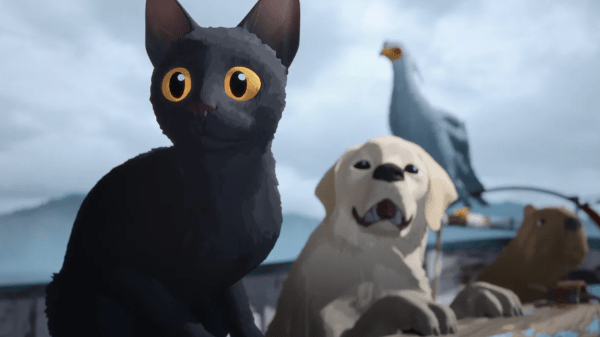
It’s some time in the future, somewhere in the world. A small grey cat with golden eyes and pointy ears is enjoying a walk in the woods. The cat lives by an abandoned old house surrounded by enormous cat statues. The cat is very shy, and fears, most of all, a pack of feral dogs. Suddenly, there’s a stampede of animals running in one direction, full speed. They‘re trying to avoid a massive flood, sweeping away everything in its path. But cat and a friendly, white dog are among its victims. Survival instinct kicks in and eventually cat manages to climb on board a tattered sailboat. There Cat discovers a gentle, sloth-like capybara already on board. Other animals make their way onto the sailboat, including an ingenious lemur, that big, white dog and a majestic-looking phoenix. Together they form an uneasy friendship as they brave a dangerous water-covered world. But can they learn to get along? And is this world worth living in?

Flow is a brilliantly animated film about a picaresque journey by a mismatched troupe of animals. It’s tender, heart moving and lovely to watch. It’s all about friendship and cooperation learned by animals living in a gently hostile world. And though they behave a tiny bit like humans, there are no people in the story, and no dialogue either; just grunts meows and barks. Dogs still want to fetch. Cats want to catch fish.  

And though it’s post-apocalyptic, there is nothing futuristic in this film; human technology is limited to abandoned ancient cities, glass bottles and sailboats; no cars or smartphones to be seen. The science fiction comes in with its universality, where animals from different continents, along with mythical beasts like sea monsters, can randomly encounter and learn from one another. I just watched Flow, and I already want to see it again.

Flow is Latvia’s Oscar submission for Best International Feature.

The G

Wri/Dir: Karl R. Hearne

It’s a rust-belt city somewhere in North America. Ann Hunter (Dale Dickey) is a tough cookie in her 70s, who is feeling depressed. You can see it  in every wrinkle on her face. She lives with her ailing husband in their fully-owned condo. He was once a tough guy, but is rapidly sliding into immobility and dementia. She grudgingly takes care of him, and drowns her sorrows in rot-gut alcohol straight from the bottle. Aside from him, she only spends time with Emma, step-granddaughter (Romane Denis). Emma models her life on The G (as she calls her grandmother) someone who doesn’t take crap from anyone. The G also helps her out financially, and doles out hardboiled words of wisdom.

But everything changes when a man in a suit  named Rivera (Bruce Ramsay), out of the blue, breaks down The G’s front door, accompanied by two toughs:  Matt (Joey Scarpellino), a handsome but simple-minded gardener; and Ralph, a psychopath with bleach blond hair (Jonathan Koensgen). Together they violently shove Ann and her husband into a van, who wind up locked in a threadbare room without a phone, in a nursing home that feels more like a prison. This is your new home, Rivera says, and there’s nothing you can do to stop me. He’s now their legal guardian and has the documents to prove it; their doctor (a silent partner in the scam) has declared them both incompetent. No one’s allowed to go in or out for the first month. He roughs up her husband to try to find the proverbial pot of gold he thinks they’re hiding. But they underestimate the G, her stubbornness, and her shady connections back in Texas.

Meanwhile, Emma is shocked when she discovers her grandparents have suddenly disappeared, leaving behind just a torn-up home. She scours the city to find them, and makes friends with a caretaker who works at the home (who also happens to be Matt, the friendly thug). It’s too late to save her grandpa but she vows to get the G out of there. And even while Emma is trying to free her, the G has vowed vengeance on all her enemies — and she’s not messing around. Who can they trust? Can two women best a criminal organization? Or will they end up buried alive? 

The G is a great revenge thriller about the very real phenomenon of organized criminals attacking and abusing the elderly. It’s dark and disturbing. Dale Dickey blows this movie out of the water, supported by a good Quebecois cast. (It’s shot in Montreal). If you’re looking for a gratifyingly violent revenge flic, this is the one to see.

Maria and Flow are now playing at the TIFF Lightbox, with Maria streaming on MUBI on December 11th; and The G is opening across Canada; check your local listings.

This is Daniel Garber at the Movies, each Saturday morning, on CIUT 89.5 FM and on my website culturalmining.com.

Only in the Movies. Films reviewed: Teenage Mutant Ninja Turtles: Mutant Mayhem, My Love Affair with Marriage, Talk to Me

Posted in Animation, Australia, Fantasy, Feminism, Ghosts, Latvia, Monsters, New York City, Science, Supernatural, US, USSR by CulturalMining.com on July 29, 2023

Hi, this is Daniel Garber at the Movies for culturalmining.com and CIUT 89.5 FM.

In the film industry, one of the biggest gender gaps is with directors — very few movies are directed by women, and corporate studios are loathe to hire them. Which means we get tons of stories told from a male point of view, but far fewer from women. (Documentaries are an exception.) The Female Eye Film Festival showing this week in Toronto is trying to even the odds, by presenting new movies by women from around the world. But things might be changing. I went to a midweek promo screening when theatres are usually quiet, and was shocked to encounter a bright pink crowd. Women in pink skirts and wigs posing for selfies, skinny guys sporting neckerchiefs, kids, grownups, even grannies, were lined up for popcorn and packing the house with a degree of enthusiasm I haven’t seen since Harry Potter. Clearly, Greta Gerwig’s Barbie is a cultural phenomenon, and I do plan to see it, once the pink tsunami dies down.

This week, though, I’m looking at three new films, one horror and two animation. There’s a hand in Adelaide, Australia, a girl in Riga, Latvia, and four turtles in the sewers beneath Manhattan.

Teenage Mutant Ninja Turtles: Mutant Mayhem

Dir: Jeff Rowe, Kyler Spears

For anyone who hasn’t heard, Raphael, Michelangelo, Donatello, and Leonardo are four teenagers who live together in the sewer underground in New York City. When they were babies, a secret lab was raided spilling radioactive goo, turning four tiny turtles into mutant humanoid creatures. They were raised by a rat who also was exposed to the slime, and who trained them in martial arts. He has just one rule: never let humans see you, or they will call you a monster and hand you over to evil scientists who will milk you dry to create supersonic weapons. But the masked foursome, being teenagers, wish they could just be like normal humans, going to high school, the prom, meeting other friends… They finally get their chance when they team up with April O’Neil, an aspiring student journalist (nicknamed Puke Girl).  If the TMNTs can stop a bizarre crime spree plaguing the city — and April report that story on TV news —  maybe the people will welcome them in as heroes. Alas, it’s not as easy as it looks. There’s a gang of evil scientists who want their blood, and a mysterious group of mutant supervillains who may be just as strong they are. Can the Turtles avoid the scientists and defeat the mutants? Or will they live their lives eating pizza in the sewers of Manhattan?

Teenage Mutant Ninja Turtles: Mutant Mayhem is a new reboot of the  beloved comic, TV and movie franchise. Gone are the skateboards, surfer slang and whitebread voices of their earlier versions; this origin story starts again from scratch, in a multiracial city moving to the tune of 90s hiphop. At least they still eat pizza.. As always, it’s meant for small children, who seemed to like it a lot at the screening I went to. I liked it too. It’s visually stunning, with a colour palette ranging from acid green to day-glo blue and fluorescent red projected against dark city alleys. The characters themselves are a combo of 3-D models and hand-drawn illustration, with squiggles and scribbles appearing everywhere. And the voices —of the Ninja Turtles — are actual teenagers instead of grown ups faking it. I went in expecting very little and was surprised and pleased by its fast pace, sophisticated art work and fine music. 

My Love Affair with Marriage

Wri/Dir: Signe Baumane (Rocks in my Pockets)

It’s the Soviet Union. Zelma is a little girl at her first day of school in Latvia. She’s tough and self-assured. When a boy starts bothering her, she clocks him. So she’s shocked when she is punished and ostracized for defending herself. “Girls don’t fight” she is told. She doesn’t wear makeup or bows un her hair, so the boy she has a crush on, studiously ignores her. Her mother instructs her to find a man, get married and put up with whatever he does. Later at university, she meets a fellow artist, Sergei, who flatters her and says he loves her. Could he be her soulmate?

Or is love just an illusion?

My Love Affair with Marriage is an animated, feminist coming-of-age story about a Latvian girl — and later as a woman and an artist trying to fit into a society that doesn’t seem ready to accept her. It handles her first period, her sex life, and her frustrating relationships and marriages. And it takes place both both during the USSR and after its collapse. (There’s even some scenes in Toronto.) It’s presented in the form of a highly-stylized animated musical, with three, bird-like women who sing songs about her progress like a veritable Greek chorus. The characters are beautifully-coloured, hand-drawn pen and ink, that vary from spare, to surreal, to scientific and even psychedelic. And that’s not all. It’s narrated through a series of medical drawings, narrated by a talking synapse. Each time Zelma falls in love or gets angry, it’s explained as her hypothalamus secreting hormones, oxytocin and dopamine. The film is told and sung in American English (Baumane is Latvian, based in Brooklyn) but it’s totally Eastern European in its humour, style and look. This is the second movie of hers I’ve seen, and I quite liked it. 

Talk to Me

Dir: Danny and Michael Philippou

There’s a phenomenon going around on TikTok in Adelaide, South Australia. On the clips, people have weirdly distorted faces for a little while before they turn back to normal. Those who have done it swear it’s the most incredible thing they’ve ever experienced. So some friends decide to try it out one night. It isn’t drugs, it isn’t hypnotism, it’s something totally different. Mia (Sophie Wilde) has been deeply depressed since her mom died of a sleeping pill overdose so she’s  sleeping on her best friend Jade’s couch (Alexandra Jensen). They go to high school together. Mia helps out with Jade’s younger brother  Riley (Joe Bird). She picks him up from school and comforts him when he has one of his frequent nightmares. Riley and Jade’s single mom is working all the time. So they decide it’s time to try this new thing out, along with Jade’s boyfriend Daniel.

The party — if that’s what it is — focuses on a graffiti covered plaster hand. You light a candle, hold onto the hand and say “talk to me”. Then you say “I let you in” and that’s where the fun starts. You experience mind-blowing visions, your face distorts wildly, and some people do or say godawful things. 90 seconds later you blow out the candle and let go of the hand and it’s all over. The thing is, what you’re doing is opening the gate between the living and the dead, and allowing these ghosts/spirits/demons into your brain, for that short period of time. But when Mia, Jade, Daniel And Riley try it out, things don’t go exactly as planned. What is that hand? What does it do, exactly? And can they undo what they unwittingly started? 

Talk to Me is a terrifying thriller/horror, one of the scariest movies I’ve seen in a long time. I’m talking pounding heart, gasping for breath, out-and-out horrifying sensations. It also includes a good dose of psychological thriller, in case you like that too. So if you don’t like scary — stay far away. There are some short-lived but shocking scenes of violence at key points in the film.  I’ve seen countless movies about seances and ouija boards going bad, but there’s something about this one that feels entirely fresh and new. If you’re looking for some great horror, see Talk To Me.

Talk to Me opens this weekend, check your local listings; My Love Affair with Marriage is the closing film at the Female Eye Film Festival at the HotDocs Cinema in Toronto; and Teenage Mutant Ninja Turtles: Mutant Mayhem opens across the continent on August 2nd.

This is Daniel Garber at the Movies, each Saturday morning, on CIUT 89.5 FM and on my website, culturalmining.com.

Grand Ambitions. Films reviewed: Edge of the World, The Sign Painter, Lune

Posted in 1800s, 1930s, 1940s, 1990s, Apartheid, Bipolar, Canada, Feminism, Latvia, Malaysia, Nazi, Toronto, WWII by CulturalMining.com on June 4, 2021

Hi, this is Daniel Garber at the Movies for culturalmining.com and CIUT 89.5 FM.

It’s spring Film festival season in Toronto. Inside Out continues through the weekend featuring some more pics, like Knocked a Swedish psychological thriller about a lesbian widow who hears knocks in her apartment at night; and Being Thunder, a doc about a two-spirited, genderqueer teen’s experiences at a pow wow. The Toronto Japanese Film fest starts today and runs through the month — more on this one next week — and the Toronto Jewish Film Festival, featuring films from around the world, has just begun.

This week I’m looking at three new features (two from the TJFF), from Malaysia, Latvia, and Canada, about people with grand ambitions. There’s a a sign painter in Latvia who wants to be an artist, a Victorian explorer making friends with head-hunters in Borneo; and a radical anti-apartheid feminist who wants to vote for Nelson Mandela.

Edge of the World

Dir: Michael Haussman

It’s the 1840s in Sarawak, Borneo. James Brooke (Jonathan Rhys Meyers) is an India-born British explorer, collecting butterflies and plants to send back to the academy. He arrives by ship on the shores of this island beside his cousin Crookshank (Dominic Monaghan) and his nephew young Charley (Otto Farrant). But once he enters the jungle they’re captured by warriors who celebrate victory by chopping off heads. Luckily they are brought before two Malay princes to rule on their fate. Prince Makota (Bront Palkarae) is aggressive and devious — he sees a chance to gain British guns and cannons. The younger Prince Bedruddin (Samo Rafael) on the other hand, likes James, as in lust — a future ally and bed-partner?

He says James has semangat — a certain virility and vitality fit for a ruler. James, on the other hand, only has eyes for the beautiful Fatima (Atiqa Hasholan). But after a battle, the Sultan of Brunei makes him king, the Rajah of Sarawak. But danger awaits at every turn of the river, with the snake people, and double-crossing royals, out to get him. And the British Empire would love to get their hands on the gold, coal and spices.  Can he hold onto his kingdom, and fight off enemies abroad and at home? Or will his head land up as just another trophy on somebody’s mantlepiece?

Edge of the World is an exciting adventure in Southeast Asia when most of the world was still coloured pink (the British Empire). This is based on a true story, celebrated at the time, and told by Malaysians themselves. It includes Dayak music and dance,  and a multi-ethnic, multi-linguistic cast (Malay, Chinese, Indigenous, Indian, and European). Far from a tribute to colonialism and imperialism, most of the British (save for Sir James) come across as cruel, greedy and racist murderers.

If you like historical dramas — this is a good one.

The Sign Painter

Dir: Viesturs Kairišs

It’s the 1930s in a remote, small town beside a river in Latvia. Ansis (Davis Suharevskis) is a gawky, gangly young man who works with his father as a sign painter, but secretly wants to be an artist, painting on canvas, not words on doors and walls. His other secret is his love for a beautiful young woman. He visits Zisele (Brigita Cmuntová) Romeo and Juliet style, climbing ladders to knock on her window. She’s a modernist, often reading books on free love. But like Romeo and Juliet, they are separated two forces: her father, Bernstein — a local Jewish shopkeeper (Gundars Abolins) — and Ansis’s Catholic priest.  Neither want them to marry, and it doesn’t help that he’s poor. There are also others in the mix. The self-centred Naiga (Agnese Cirule) — the literal girl next door, her father owns the pharmacy next to Bernstein’s shop — has a crush on him. And then there’s Andreas, a bombastic Baltic German, who has the hots for Zisele. Who will end up with whom? But all of their young plans are up in the air when war comes, and the country already under a fascist dictator, is invaded first by the Soviets, and later by the Nazis. What are their fates?

The Sign Painter is a tragi-comedy about life in Latvia during the 30s and 40s as seen through the eyes of one young man. It starts out with a light humorous tone — a sign painter gets lots of work changing the name of main street, with different colours — from Green to Red to Black — and fonts from roman to cyrillic to gothic, depending on who’s in charge.  But about half way through, it takes on a much darker tone, as changing political whirlwinds bring arrests, deportations and massacres. Based on a novel, it’s laden with characters and unexpected plot turns.

I like this movie.

Lune

Dir: Arturo Perez Torres,

Aviva Armour-Ostroff

It’s 1994 in Toronto. Miriam (Aviva Armour-Ostroff) is a single mom who is excited. She’s a radical feminist an artist and a long-time anti-apartheid activist. She’s generous and helpful, giving food and comfort to random homeless people and political dissidents. Why is she so excited? Her birthplace, South Africa, is about to have their first free election — and she wants to go back and vote for Nelson Mandela. Problem is she is penniless (she lives in an apartment above a pawn shop) jobless, and nearly friendless — though she’s has many, many sexual partners.  And then there’s her daughter Eliza (Chloe Van Landschoot). Eliza is finishing high school and trying to get a scholarship to a Montreal Dance Academy. She’s dating  Mike (Vlad Alexis) a naive, young DJ with very well-established parents. Miriam says she wants to take Eliza and Mike to South Africa with her to witness democracy at work. Did I mention? Miriam and Eliza are white, and Mike is black. 

Mike is enchanted by Miriam’s antics and thrilled by the idea of rediscovering his poetry, music, creativity and inner blackness. Eliza, though is pissed. What about her dancing? What about her boyfriend? She’s seen episodes like this throughout her life. Miriam is off her meds and in an increasingly manic state.  So even as her creativity and enthusiasm grows, so does her recklessness. Can they make it to South Africa and back in one piece? Or is this all just a pipe dream?

Lune is a drama about an unusual family in Toronto in the 90s. It’s an amazingly moving piece, a biting satire and an explosion of creativity from spoken word to art to modern dance (Eliza retells her own story in the form of a dance, done by Chloe Van Landschoot.) Vlad Alexis is perfect as the bourgeois black guy trying to get woke. But the centre of it all is co-writer, co-diirector and star Aviva Armour-Ostroff, who as Miriam pushes all her boundaries in a shocking performance, grounded in politics you rarely see. Miriam talks like a combination of Edina Monsoon and Cornell West… with a good dose of cannabis-induced lunacy. (The title, Lune, divides the film into chapters marked by the stages of the moon). 

Lune is a fantastic movie, and has already won the 2021 Micki Moore Award. Don’t miss this one!

Lune has it’s Canadian premier at TJFF today and is playing through Saturday; The Sign Painter has its Ontario premier at TJFF on June 8th and 9th; and Edge of the World opens today on VOD and all major platforms.

This is Daniel Garber at the Movies, each Friday morning, on CIUT 89.5 FM and on my website, culturalmining.com

Cracks in the Foundation. The Continent, Rocks in my Pockets, Rosewater

Hi, this is Daniel Garber at the Movies for culturalmining.com and CIUT 89.5 FM.

From far away, porcelain looks smooth, shiny and flawless, but look too close and fine cracks appear. This week, I‘m looking at movies that expose the cracks in faraway Latvia, China and Iran. There’s an Iranian man who wants to leave prison; three Chinese men who want to leave their island, and a Latvian woman who, at times, wants to leave life altogether.

TheContinentThe Continent
Dir: Han Han

Three young men have lived their lives on a tiny, windswept island off the east coast of China. But they decide it’s time to check out the continent. Like in the classic Chinese novel, they set out on a “Journey to the West. They each have a different reason. Jianghe (Chen Bolin  [陈柏霖], who also starred in Buddha Mountain [觀音山] — read my review here) a school teacher an”d eternal optimist, is transferred by the government to a remote location far, far away. Haohan (Feng Shaofeng [冯绍峰]) is a blustering young man dying to see the world. He longs to stand on a determined mountaintop and shout to the world about the size of his dick. And he has a childhood pen-pal Yingying TheContinent_still2(Yolanda Yuan [袁泉]), a pretty girl he’ll finally meet face to face. And true love will soon follow. Their third friend, Hu Sheng, is mentally challenged, and depends on the other two to tell him what to do.

But they soon discover life outside their tiny island is bewildering and confusing. They stumble onto a movie set in WWII. And at their first hotel Jianghe is approached by an escort named Sumi, immediately followed by knocks on the door from aggressive police. Bewildered, he plays the hero, HanHanbusting out through a barred window and “saving” Sumi from a fate worse than death. Or so he thinks. And a sketchy, Cantonese hitchhiker helps them with their navigating – but can he be trusted? Maybe not, in a place where anything that you don’t hold onto with both hands when you gp to sleep will likely be gone by morning. But it’s also a country with stunning and empty vast vistas, rockets flying to outer-space, and cool and savvy people at every turn.

The Continent is writer-director Han Han’s (韩寒) first film, but he’s far from unknown. His blog is the best-known one in China which automatically makes him one of the most famous people in the world. This is not just a simple, picaresque road movie. It’s also a slyly humorous — if bleak — cautionary tale about life in contemporary China.

RocksinMyPockets_Poster_MediumRocks in My Pockets
Wri/Dir Signe Baumane

Signe is a Brooklyn artist, originally from Latvia, with a hidden family past. She wants to find out the truth behind the family matriarch, her late grandmother. On the surface, she was a preternaturally hard-worker, known for her Sisyphean feat of carrying endless buckets of water up a steep mountain. She had retreated to a backwoods cabin with her husband, an eccentric entrepreneur, to escape the difficulties of life in the city. But, after a bit of digging, Signe discovers a streak of depression, suicide and mental illness in her family stretching back three generations. The title refers to her grandmother’s attempted suicide by drowning – she was unsuccessful because she forgot to fill her pocket with rocks. Even if the mind wants to end it all, the body – until the last breath — will fight against dying. At the same time, Signe realizes that the many children and grandchildren managed to survive and succeed despite harsh time. In this film, Riga is imagined as a rocksinmypockets-1024x576place with enormous human faces on their buildings, within a country filled with animistic creatures with long tails, dog ears and goggly eyes that lurk everywhere, just out of sight.

Her odd family history is portrayed in a series of short, animated episodes, using panels of sketched characters moving against brightly-tinted Linda_Sc_080_with_WS_Thumbnailbackgrounds. These are interspersed with super-imposed stop-motion images made of rope and papier-mache figurines. This giuves the whole movie an unusual three-dimensional feel, combining classic drawing with computer-manipulated mixes. And omnipresent is the wry and funny –though at times grating – voice of the narrator telling and commenting on her family history. The director shows the deleterious effects of Soviet era psychiatry – one where cures consist of medicinal corrections to chemical imbalances – and how it makes some people long to “erase themselves” and ceasing to exist. A poignant, fascinating and great animated feature.

RW_LM_20130810_0238.jpgRosewater
Dir: Jon Stewart

Maziar Bahari (Gael Garcia Bernal) is an Iranian-Canadian journalist based in London. He lives there with his beautiful (and pregnant) wife. He is assigned to cover the upcoming elections in Iran, but quickly runs unto trouble as soon as he arrives. He quickly makes friends with a politically active and sympathetic taxi driver who takes him to areas fertile with dissent. But after witnessing a potentially explosive event he is arrested. His charge? Spying.

Ironically, a comic TV interview he had given to an American comedian on the Daily Show is used as evidence of his wrong doing. He is quickly thrown into solitary confinement in a notorious prison. He is psychologically tortured until — says the warden — his will is broken and he will lose all hope.

His family, it turns out, is no stranger to death and imprisonment for RW_NK_20130729_0700.jpgpolitical views under earlier regimes. Both his father and his sister had gone through it, and appear, in his mind, to convince him to hold on. But will he make it?

Rosewater is Jon Stewart’s first film, and it shows it. Stewart is known for the brilliant and funny The Daily Show that skewers mass media from a left-ish perspective. But a feature film is not a three-minute sketch. The movie starts out great with exciting scenes of news-gatering, but it starts to drag, heavily, once it moves to the prison. While it conveys the loneliness and suffering,  solitary confinement does not make for good cinema. Bernal and the supporting actors are fine, but the buffoonish prison guard and the sinister administrator seem too much like the evil twins of  Schultz and Klink to take seriously.

The Continent played at the ReelAsian Film Festival which continues for another week (reelasian.com), Rosewood played at TIFF this year and opens today in Toronto, check your local listings; and Rocks in my Pockets opened the Rendezvous with Madness Film Festival (which features films on addiction and mental health – with an additional screening tomorrow: go to rendezvouswithmadness.com for times. Also opening: next week at Hot Docs there’s the great documentary called Point and Shoot about a young American traveler/journalist who, despite being non-religious and non-radicalized, nevertheless joins the rebel armies fighting in Libya (listen to my review here). And a surprising story about the Life of Pigeons on CBC’s the Nature of Things.

This is Daniel Garber at the Movies, each Friday morning on CIUT 89.5 FM and on my website, culturalmining.com.