Outstanding, great… or just ugly? Films reviewed: Eleanor the Great, Out Standing, The Ugly
Hi, this is Daniel Garber at the Movies for culturalmining.com and CIUT 89.5 FM.
Toronto Palestine Film Festival is on right now, with movies, shorts and docs by and about Palestinians, as well music, cuisine and art to share with other Canadians. This is it’s 17th year and it’s never been more relevant, so check it out.
But this week, I’m looking at three new movies that premiered at TIFF and are all opening theatrically this weekend. There’s an elderly woman who tells a lie, a woman with an “ugly” face who disappears without a trace, and a female officer in the Canadian Army who wishes a certain photo would just go away.
Eleanor the Great
Dir: Scarlett Johansson
Eleanor Morganstein (June Squibb) is a grandmother in her 90s. Since her husband died ten years back, she has shared her Florida condo with her best friend Bessie whom she’s known for 70 years. They do everything together, and work well as a team. Where Bessie is timid, Eleanor is brash and outspoken. If there’s something Bessie wants, Eleanor knows how to get it, even if it involves telling a few fibs. She has chutzpah to spare. But when Bessie suddenly dies, she realizes there’s no reason to stick around, so she packs up her stuff and flies back to New York for the first time in decades. She’s staying with her daughter Lisa (Jessica Hecht) and her grandson Max (Will Price). She’s hoping for some quality time but Lisa’s a worrywart and Max is always busy at school. So she takes up her daughter’s offer to attend some classes at the JCC she signed her up for; maybe she’ll make some friends. The first class is a washout — broadway musicals — so she wanders into another group almost by accident. It’s a support group for Holocaust survivors, and the members urge Eleanor — as a newcomer — to tell her story. She’s not a holocaust survivor, but her best friend Bessie was… and she knows all her memories, especially the death of her brother. So, in deference to Bessie, she tells them to the group as if they’re her own. Why not, right? It goes over well… a bit too well, actually. A teenaged college student Nina (Erin Kellyman) is auditing the group and soon bonds with Eleanor (her mom recently died and her dad is distant and
withdrawn.) The two women bond and start sharing intimate stories.
Nina is in a journalism class, and wants to make a video of her telling her holocaust memories as part of an assignment. Then things get really out of hand: Nina’s dad (Chiwetel Ejiofor) happens to be a popular TV news journalist… and he wants to make Eleanor his next feature. But what will happen to her friendship with Nina — never mind her own family — once the truth inevitably comes out?
Eleanor the Great is a nice, light movie-of-the-week-type drama about death, mourning, and inter-generational relations. It’s a very simple and easy movie, part comedy, part weeper. What’s good about it is the acting. June Squibb — who really is in her 90s — is great as the energetic, down-home Eleanor. (She played another rebellious granny in last year’s hit Thelma.) This is Scarlett Johansson’s first time as a director, and luckily she doesn’t bite off more than she can chew. She concentrates on characters — Squibb and Kellyman are both great in their roles — more than the basic story. And you know what? That’s good enough.
I wouldn’t call Eleanor the Great great, but it’s worth the watch.
Out Standing
Co-Wri/Dir: Mélanie Charbonneau
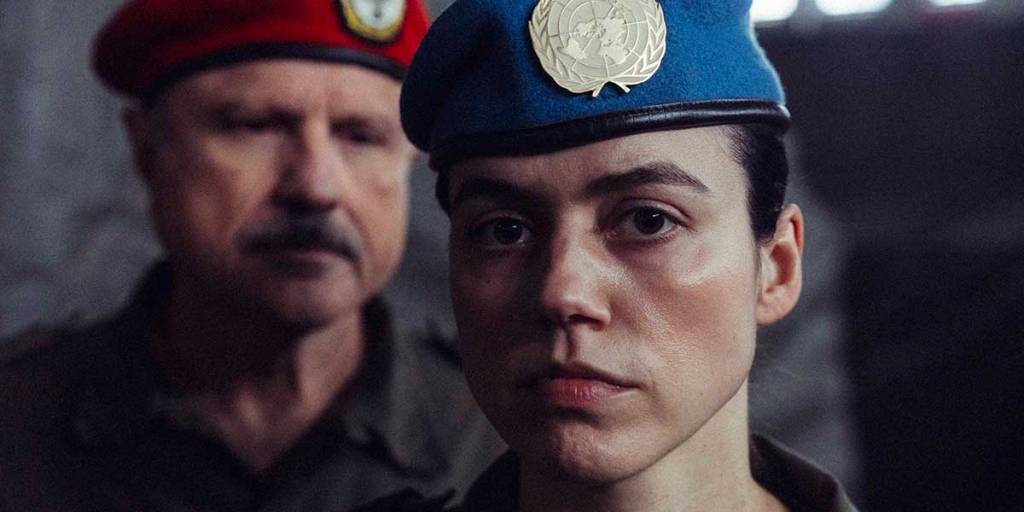
It’s the 1990s, and Captain Perron is leading a troop of UN peacekeeping forces in the former Yugoslavia. Why is this unusual? Sandra Perron (Nina Kiri) is a Canadian woman, the first to lead a squad of infantry soldiers in combat, and the first female to serve in the prestigious 22nd division, known as the Van Doos. Raised as an army brat in bases across Canada, she comes from a long line of soldiers, so it makes sense that she is following in her father’s vocation. She trained as a cadet and received commendations while still a teenager. And she’s the first woman to survive the brutal training that squadron demands. But there’s a photo circulating from her past that’s threatening to derail her military career. It’s a picture of her tied to a tree, barefoot, in the snow and semiconscious.
It was part of her training in a Prisoner of War exercise that went far beyond the normal treatment soldiers are forced to endure. A Canadian woman facing treatment tantamount to torture at CFB Gagetown in New Brunswick. But Captain Perron isn’t the one who released the photo, one fact she didn’t want the photo circulated. She had endured years of hazing bullying, harassment, obscene phone calls, sabotage to her kit, and a hidden campaign by certain officers to get rid of her. They detest the idea of serving alongside or under the command of a woman. And unlike the other women who
attempted to to join the Van Doos, she alone managed to survive and not quit.
Out Standing is a biopic about a trailblazing woman in the Canadian Armed Forces. It’s both moving and disturbing. The title, based on her memoirs, refers both to her achievements and to the notorious photo of her standing tied to a tree. (That pic was eventually published by the press, triggering a wave of shock and disgust across the country, and, one hopes, an improvement in how women are treated in the military.) Nina Kiri gives an excellent performance, totally believable as Perron.
While Hollywood churns out dozens of war movies each year, showcasing the latest weapons and fighter planes, you rarely see a Canadian one. This one is full of details carefully chosen to distinguish how soldiers behave here. The military culture is quite different. Unlike in the US there’s no Sir-yes-sir! And instead of saluting a Canadian soldier stand sharply at attention. I never knew this because you never see it in movies. For this alone it’s a eye-opener. The film is not perfect — there’s a particularly clumsy scene near the end — but altogether it’s a compelling and disturbing look at a Canadian woman’s life in the military.
The Ugly
Wri/Dir: Yeon Sang-ho (Peninsula, Train to Busan)
Lim Yeon-gyu (Kwon Hae-hyo) is a well-known carver of dojang, the name stamps used in Korea like a signature on official documents. He built up his business from scratch while raising his son as a single parent. (His wife ran away soon after the baby was born.) He trained his son Lim Dong-hwan (Park Jeong-min) in every aspect of the craft. Now an adult he is taking over the family business. At this moment, a documentary filmmaker (HAN Ji-hyeon) is celebrating this dad’s life as a national treasure. Why did she choose this man for her documentary? He’s been blind since birth, which makes his many accomplishments even more impressive. But filming is put on hold when a surprise announcement arrives. They’ve found Dong-hwan’s mother decades after she disappeared. Turns out she’s been dead all that time and only her bones remain. This comes as a total shock to Dong-hwan, and it just gets worse.
First his mother’s long lost relatives arrive for the funeral but they’re despicable people who just want to make sure he doesn’t claim any family inheritance.They bullied and beat his mother, a veritable Cinderella raised by this cruel family. It’s also the first time he hears his mother described as ugly. Ugly how? He longs to see a photo of her, something to display at the funeral, but there are no photos anywhere. Of course his blind father doesn’t have one. While Dong-hwan is trying to process all this new information, the filmmaker leaps on it as a great story and insists on continuing the documentary but with a new twist: who killed his mom and why? Together, over a series of interviews with hidden cameras, they uncover
events and people from her past as the tragic puzzle gradually falls into place.
The Ugly is a mystery about a kind-hearted woman — the main character’s mother — and how she is horribly treated because of her looks. It’s a heart wrenching story, a dark, bleak view of humanity with only Dong-hwan (and his mother) as redeeming characters. The story is told as a series of interviews with the various characters and extended flashbacks to what actually happened (The actor who plays Dong-hwa also plays his blind father as a young man in the flashbacks, while Jung Young-hee plays his mother, but always from behind or from the side, without ever revealing her face). In Yeon Sang-ho’s previous movies (Peninsula, Train to Busan) the action hero is surrounded by mutants or zombies or killers. The Ugly is about normal people but they’re just as hideous.
The Ugly is a powerful and dark look at human cruelty and physical beauty.
Eleanor the Great, Out Standing and the Ugly all open this weekend in Toronto; check your local listings. This is Daniel Garber at the Movies, each Saturday morning, on CIUT 89.5 FM and on my website culturalmining.com.
Daniel Garber talks with Min Sook Lee about There are No Words at TIFF
Hi, this is Daniel Garber at the Movies for culturalmining.com and CIUT 89.5 FM.
Photos by Jeff Harris.
It’s the 1970s, and the Lee family — Dad, Mom and three daughters — are experiencing the typical immigrant life in Toronto. A brash dad and a soft-spoken mom spend all their time in the family convenience store so the girls can study for school in their high-rise apartment tower. But everything
changes when, seemingly out of nowhere, their mom dies by suicide, leaving only a few photos and silent memories. Now, decades later, one of those sisters has made a documentary about their hidden past… but there are no words to describe the shocking family history and generational trauma she unveils.
The film’s called There are no Words, and is written and directed by multiple award-winning Toronto-based documentary filmmaker Min Sook Lee. She is known for her moving documentaries that bring crucial global political issues down to a personal scale, as in
her doc Migrant Dreams in 2016, the last time I spoke with her on this show.
Incorporating period news footage and photos with new interviews with her family’s relatives and friends in Canada and Korea, as well as a shocking and revelatory talk with her father, There are No Words is a highly personal heart-wrenching look at the filmmaker’s own hidden family history.
I spoke with Min Sook Lee via Zoom.
There are No Words had its world premiere at TIFF, played at ReelAsian and will be released theatrically.
When to stop. Films reviewed: Friendship, Hurry up Tomorrow, The Old Woman with the Knife
Hi, this is Daniel Garber at the Movies for culturalmining.com and CIUT 89.5 FM.
This week, I’m looking at three new movies — an action thriller, a dark comedy, and a fictional music biopic — all about people who don’t know when to stop. There’s a middle-aged dad looking for a friend, a super-fan looking for the object of her obsession; and an elderly hitman in her declining years who refuses to retire.
Friendship
Wri/Dir: Andrew DeYoung
Craig (Tim Robinson) is an ordinary guy in the suburbs who works at a tech communications firm. He’s geeky and boorish with marginal social skills. He spends time with his wife Katie (Kate Mara) who is in remission and their teenaged son Steven (Jack Dylan Grazer). He likes watching TV or for a real treat ordering the dinner specials at his favourite chain restaurant. But everything changes one day when a package is delivered to his house by mistake. He carries it over, rings the bell, and meets his neighbour for the first time. Austin (Paul Rudd) is everything Craig is not. He’s suave, handsome and self-confident. He’s even a minor celebrity as the weatherman on the local TV station.
And he smiles at Craig. Wow… Craig is ensorcelled. And when Austin takes him under his wing for an adventure in the woods, he is absolutely thrilled. A real friend! But the bromance is short-lived, when he makes a number of unforgivable faux pas at a get together with Austin’s entourage. He’s cancelled and so is their friendship. But Craig refuses to accept it, and vows to do anything to get Austin back. And as his obsession grows so does his hazardous behaviour. Is Craig a stalker or just an unrequited friend. And how far is too far?
Friendship is a very dark and very funny comedy about adult male friendships. Tim Robinson — best known for his show I
Think You Should Leave — is famous for his uncomfortable style of humour. This is comedy that makes you squirm, cringe or look away. You can see the results of his terrible mistakes coming a mile away but there’s you can do to stop it and it’s still painfully funny. Paul Rudd is good as his “straight man” but this is all about Tim Robinson.
I haven’t laughed this hard or this often at a comedy movie in at least six months.
Hurry up Tomorrow
Co-Wri/Dir: Trey Edward Shults
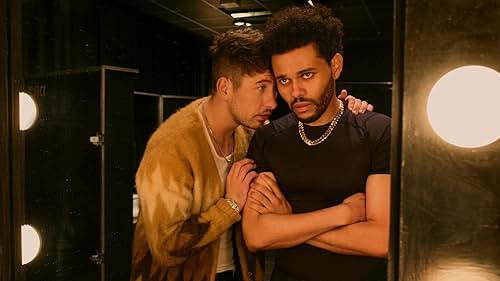
It’s the green room of a huge concert hall. The Weeknd (Toronto musician Abel Tesfaye) is a superstar in the midst of an exhausting world tour. He depends on his mellifluous voice to perform the songs his fans come to see. But he’s tense tonight and his throat is contracting. He’s upset with a voicemail from a woman he knows who recents his selfish and cold behaviour. Now plagued with self-doubt, he doesn’t feel up to performing. But his ever-present manager (Barry Keoghan) convinces him — through a combination of confidence-building words plus copious drugs and alcohol — that he owes it to his fans. But once on stage his voice fails him in the middle of a song and he runs off in disgrace.
There he collides with a super-fan who somehow got past bouncers and security. Anima (Jenna Ortega) offers words of love and comfort. They spend an enchanted day together far from his source of stress. But the next morning brings unanticipated and perilous consequences. Can The Weeknd return to his tour as of that day never happened?
Hurry Up Tomorrow is a complex but deeply flawed look at one day in the life of a singer on his world tour. The story is told at least four times through elliptical points of view. Anima sees herself as The Weeknd’s soulmate who only she can understand. But she is portrayed by the neutral camera as a deranged sadistic arsonist determined to erase her past problems by burning them down — literally. Ortega is allowed to run wild here. Keoghan as his manager sees himself as his best bud, almost his brother, the only one who can save The Weeknd from self-destruction (there are countless shots of him gazing longingly into his eyes.) Neutral camera? A sleazy, mercenary drug dealer. Then there’s the star himself. His mind drifts into hallucinatory depictions from deep in his psyche conveying, paranoia, claustrophobia and childlike helplessness. Neutral camera? A self-obsessed narcissist. So watching it with all these different points of view floating around, it’s hard to tell what’s real and what is a fantasy. Are the frequent tear-filled eyes actual or in one of their
imaginations? I’ve seen director Trey Edward Shults’s features It Comes at Night and Waves, both excellent movies — he’s highly skilled, but this one seems more muddy with less of an identifiable narrative. And it starts with a shockingly inappropriate music video… why? Why? On the other hand, the references to Stephen King movies like The Shining and Misery are much more interesting.
I’m glad I watched Hurry Up Tomorrow, but I wish it were a bit better.
The Old Woman with the Knife
Co-Wri/Dir: Min Kyu-dong
It’s winter in Seoul in the 1970s. A starving young woman, barefoot and dressed in rags is desperately searching for food in the drifting snow like The Little Match Girl. A kindly couple save her life by inviting her into their tiny diner for a meal, and later take her on as a dishwasher in exchange for room and board. But her relatively stable new life is shattered one night when she is cornered by an American GI in the cafe’s kitchen. She manages to fight off his sexual advances until he turns violent and starts to choke her to death with his barehands. In desperation, she grabs a nearby knife and stabs him. He dies. This is witnessed by a man named Ryu (Kim Mu-yeol) who invites her to join a secret organization that specializes in pest control. That’s their euphemism for the murderers, rapists and torturers, the scum of the earth, whom they are hired to kill.
Fifty years later and she’s still at it. Now known as Hornclaw (Lee Hye-yeong), she’s the hitman with the best reputation in the business. No one suspects an unassuming old woman — she can get away from any murder scene without anyone noticing. But she’s showing compassion — a complete taboo in the business — for a stray dog she finds. Her doctor is telling her to slow down, and her boss wants her to retire. Hornclaw, retire? Nevah!
But things really start to change when a brash newcomer
walks in. Bullfight (Kim Sung-cheol) doesn’t know the codes or rules, he just plays it by ear. He’s violent fearless and will stop at nothing to get her out of his way. Can he usurp her seat on the throne? And what grudge does he hold against his rival?
The Old Woman with the Knife is an action thriller with an elderly woman as the protagonist. And if you think this is a Murder She Wrote with little handguns and stilettos you couldn’t be more wrong.
She’s tough as Helen Mirren, and can take down and slice up a room full of thugs singlehandedly. And since it’s a Korean action movie, you can bet there’s a melodramatic subplot and at least one character whose motivation is revenge. (No spoilers.)
I liked this movie a lot.
Friendship, Lady with the Knife and Hurry up Tomorrow all open in Toronto this weekend; check your local listings. This is Daniel Garber at the Movies, each Saturday morning, on CIUT 89.5 FM and on my website culturalmining.com.
Dangerous, exotic. Films reviewed: Sinners, Yadang: the Snitch, The Legend of the Ochi
Hi, this is Daniel Garber at the Movies for culturalmining.com and CIUT 89.5 FM.
Hotdocs International Documentary Film festival is on now in Toronto, with free daytime admission for students and seniors. So get out there and watch some docs!
But this week I’m looking at three new movies about unexpected dangers in exotic locales. There are vampires in the Mississippi Delta, snitches in the drug wars of South Korea, and elusive, sharp-toothed creatures on an island in Carpathia.
Sinners
Wri/Dir: Ryan Coogler
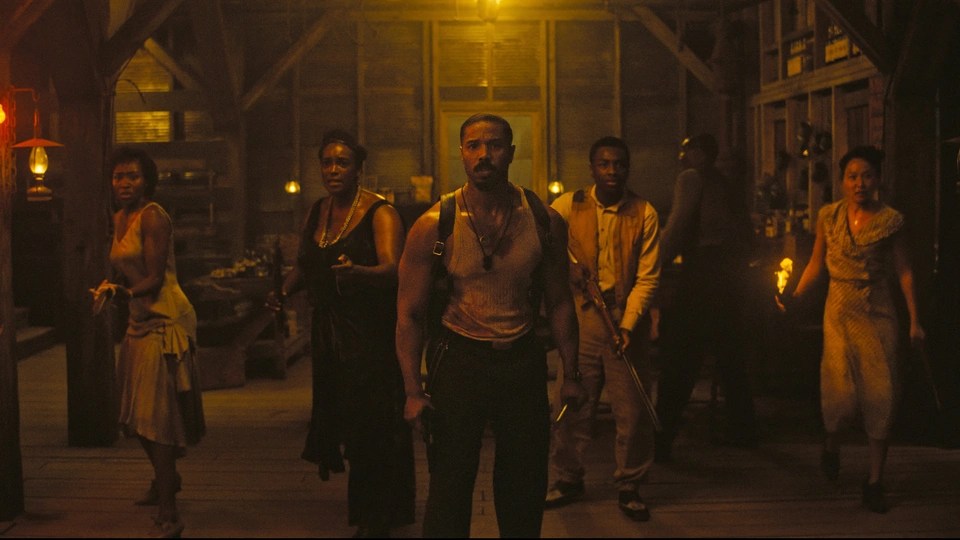
It’s 1932 in a small town in the Mississippi Delta. The Smokestack brothers aka Smoke and Stack (Michael B Jordan: The Fantastic Four, Chronicle) are identical twin who spent years making money working for the mob in Chicago. Now they’re back in town with a truck full of bootleg alcohol, a wad of cash and big ideas on how to make it rich. Namely, they’re opening a juke joint in an abandoned woodmill they bought from a local good ol’ boy. They’re rounding up the necessary musicians, like their cousin Sammie (Miles Caton), the preacher’s son, on blues guitar and Delta Slim (Delroy Lindo) on the piano and mouth organ. Bo and Grace Chow furnish the provisions and Cornbread minds the door. Even Smoke’s and Stack’s ex-partners show up: Mary (Hailee Steinfeld) a glamorous married woman who can pass for white, and Annie (Wunmi Mosaku) an experienced practitioner of Hoodoo. By sunset the place is hopping, the
customers are drinking and gambling, everything is going great, until… a mysterious, smiling stranger who loves Irish music (Jack O’Connell; Seberg, Unbroken, ’71, Starred Up ) appears at the door asking to be let in. They don’t know who he is but he just looks shifty. Turns out he’s a vampire who wants all their blood — not to wipe them out, just to turn everyone over to the dark side. But can the people on the inside keep the demons on the outside until the sun comes up in the morning?
The Sinners is a black history drama about life in the Jim Crow south in the 1930s combined with the action and horror of a conventional genre movie, that succeeds on both fronts. It’s rich in meticulous historical detail in the background: sharecroppers picking cotton in the same fields as their grandparents had as slaves, paid in company scrip not dollars; chain gangs on the highway; and the omnipresent KKK.
All this is counterposed with raunchy dialogue and the sexualized dancing and singing of the juke joint. Every character has a backstory, devoid of cookie-cutter cliches. The costumes, scenery and especially the music — from delta blues to Irish folk songs — evoke that period in a way only a movie can. The acting is superb, though I do wish Michael B Jordan made Smoke and Stack a little less identical. The vampires are more conventional. They still hate garlic, sunlight and stakes through the heart but interestingly these demons lose also racial prejudice once they become vampires. Put this all together and you end up with this amazing movie that’s multifaceted, educational and really fun to watch.
Yadang: The Snitch
Dir: Hwang Byeong-gug
It’s present-day Korea. Lee Kang-su (Kang Ha-neul) is a self-confident young man with a perpetual grin. Why does he swagger and show off his gold lighter? It’s because he’s always two steps ahead of anyone else. He’s a yadang, an informant, and plays a crucial role in the government’s war on drugs. But things weren’t always this way. He was incarcerated after being falsely accused of drug dealing, where he was beaten up and bullied on a daily basis. Until Ku Gwan-hee (Yoo Hai-jin) an ambitious prosecutor pulled him out of that world to be his personal Yadang. Now the two of them are pledged as eternal brothers, functioning like a well-oiled machine, pulling off repeated sting operations and arrests of drug kingpins and thugs across the country. Much to the chagrin of a police detective trying to arrest those same criminals. So Det. Oh Sang-jae (Park Hae-joon) a.k.a. the Jade Emperor of Narcotics Division, finds a Yadang of his own, a rising young actress (Chae Won-been) who is caught using illegal amphetamines as diet pills. Now the lines are drawn and the two sides — the prosecutors and the police — are in direct competition. But the Prosecutor, in his rapid rise to the top, has to make some uncomfortable political alliances, including a rich junkie named Cho Hoon, whose dad just happens to be running for President. Will Cho-hoon’s influence on the Prosecutors rise in power threaten the Yadang’s status and the delicate balance of that world?
Yadang: the Snitch is a Korean action-thriller about
crime, corruption, and the complex relationships among politicians, police and informants in the world of organized drug-crime. Fast moving and compelling, it maintains a frenetic pace throughout the film, with some flashbacks that last only a few seconds. It’s dizzying. It’s also quite violent, sometimes disturbingly so. Luckily, it has interesting characters and a clever plot with enough double- and triple-crosses to keep you guessing until the very end.
Yadang: The Snitch is an entertaining action flic.
The Legend of Ochi
Wri/Dir: Isaiah Saxon
Yuri (Helena Zengel) is a teenaged girl who lives with her dad and adopted brother, Petro. She likes reading library books and listening to loud music. Her farm is on a mountainous island in the Black Sea, off the coast of Romania, and though it’s decades since the fall of Ceausescu, people there still drive Ladas and keep to the old ways. Above all, they fear the Ochi, mythical beasts unique to their island who live in trees, attack sheep and kidnap children. Her Dad (Willem Dafoe) lives in constant fear of the Ochi. He leads a ragtag army of children to capture and kill the monsters… though they have never been successful. Her step-brother Petro (Finn Wolfhard) is a member too, though her rarely speaks. Yuri, on the other hand, is angry at her father and wonders why her mother (Emily Watson) abandoned her. (It’s the Ochi! says her dad.)
One day, when her father sends her out to do her rounds, she finds a small ochi with its paw caught in an animal trap. She frees him and takes him home in her knapsack. He looks like a blue-faced koala until he bares his teeth revealing long pointed fangs. But Yuri is not afraid, she nurses him back to health and eventually the two form an unexpected bond. But can she get him back to his homeland without her father finding out?
The Legend of Ochi is a highly-original adventure story about a young girl and the creature she befriends. It’s warm and delightful. While on the surface it’s a kids’ movie, the
sumptuous, painted scenery and retro feel makes it an instant cult classic. (Think ET, and Charlie and the Chocolate Factory.) It’s full of panpipes and medieval crusaders overladen with Soviet kitsch. Even the odd faces of the kids in the army are straight out of Dr Seuss. I’ve never heard of director Isaiah Saxon before, but I get the impression he’s been doodling pictures of Ochis since he was a little kid. And they are amazing: not cheap-ass CGI, but a combination of puppetry and animatronics that make them seem totally real in their own fantastical way.
I love this movie.
The Legend of the Ochi, Yadang: The Snitch and The Sinners all open this weekend in Toronto; check your local listings. This is Daniel Garber at the Movies, each Saturday morning, on CIUT 89.5 FM and on my website culturalmining.com.
Dangerous jobs? Movies reviewed: Love Hurts, Dark Nuns, Bring Them Down
Hi, this is Daniel Garber at the Movies for culturalmining.com and CIUT 89.5 FM.
Look at Me, a movie from Nova Scotia about an insecure, bisexual actor with an eating disorder, is finally opening in Toronto! In a review about year ago, I called it a “scathing — and humorous — self-examination that exposes Taylor Olsen’s innermost thoughts and fears.” Check it out.
But this week, I’m looking at three new movies (two by first-time directors) from around the world. They’re all about people who work at peaceful and innocuous jobs who encounter danger and even death. There’s a Catholic nun in South Korea, a real estate agent in Milwaukee, Wisconsin, and a sheep farmer in rural Ireland.
Dark Nuns
Dir: Hyeok-jae Kwon
Somewhere in Korea, a teenaged boy named Hae-Jun (Moon Woo-jin) is suffering from a serious illness. The doctors are baffled by his condition; nothing they try is working. But Sister Giunia (Song Hye-kyo) a Catholic nun, identifies the problem immediately: the boy is possessed. You see, Sister Giunia is a Dark Nun, a woman born with indigenous shamanistic powers. She can hear what demons say. And this boy needs a full-blown exorcism. But she can’t do it alone.
She turns to Sister Michela (Jeon Yeo-been), a much younger nun, for help. A Dark Nun like herself, Michela is adept at reading tarot cards,
and can use her powers to see vision, and manifestations of evil. But she is a nun now, and a nurse. She said goodbye to all that mumbo-jumbo years ago, and, besides it’s expressly forbidden by the Church — especially Father Paolo (Lee Jin-wook). He may be a scholar of exorcism, but he doesn’t believe in it. But Giunia is convinced the boy will die unless they intervene. Can she get sister Michela to come aboard? Will the church ever let them do it? And can two nuns and a stammering shaman defeat Satan himself?
Dark Nuns is a pretty typical exorcism/horror movie but with a twist: It incorporates Buddhism and Shamanism within a Catholic ritual. There are a lot of quirks in this movie. Like why do all the Korean priests and nuns have Italian names, like Paolo, and Michela? Are they Ninja Turtles? And the exorcism seemed way off: heavy on the holy water — she pours gallon after gallon of it on the kid! — but awfully light on bibles, crosses or rosary beads. Then there’s the biggest problem of all: it’s a horror movie, but it just isn’t scary. What’s good about this movie? I like the way it compares Korean patriarchal neo-Confucianism with a Catholic Church keeping women out of positions of power. I’m intrigued by the culture-clash of Christianity meets Shamanism. But if you’re looking for a Korean horror movie about shamans and possession, you should watch last year’s Exhuma, instead.
Love Hurts
Dir: Jonathan Eusebio
It’s Valentine’s Day in the suburbs of Milwaukee, and Marvin Gable (Ke Huy Quan) is busy baking heart-shaped cookies. No, he’s not in love or in a relationship; all his efforts are focussed on his career as a real estate agent. And he considers all his clients as his friends. But everything changes when a valentine’s day letter appears on his desk. Rose (Ariana DeBose) is back in town. You see, before he went straight, he used to be a killer employed by his older brother Knuckles (Daniel Wu) who is a powerful local gangster. And killing Rose was his last job. The thing is, he didn’t kill her and now everyone wants to have a word to Marvin Gable. There’s the poet-assassin Raven (Mustafa Shakir) along with a slew of other killers, with weird names like King, Otis Merlo and Kippy. Can he dodge the bullets and kill the killers, without harming all the clients trying to buy his houses? Or will he be dragged back into a dark world he thought he had left far behind?
Love Hurts is an action movie about people trying to kill each other. Despite the extreme violence it’s told a light and somewhat humorous manner. Unfortunately, it’s also tedious and predictable. The dialogue is dumb, the plot is basically non-existent. (There is also a rom-com sub-plot, with various characters falling in love with their respective crushes, but that seems like an afterthought more than part of the story.) So what’s good about it? Two things. Jonathan Eusebio is
obviously a first-time director, but what he is not new at is fight scenes. He’s a highly experienced fight choreographer, and luckily most of the movie consists of creative takes on people throwing knives and kicks as they destroy the interiors of houses and video stores. This I like. First time I’ve ever witnessed a killing using a bubble tea straw. And the cast is appealing too. It’s nice to see Ke Huy Quan back again after his big comeback in Everything, Everywhere, All at Once. He’s funny! So are Ariana DeBose, Lio Tipton, Sean Astin and Drew Scott… the whole crew.
Is this a good movie? Not really, but it’s very light, easy to watch, and the fight scenes are well-done.
Bring Them Down
Wri/Dir: Chris Andrews
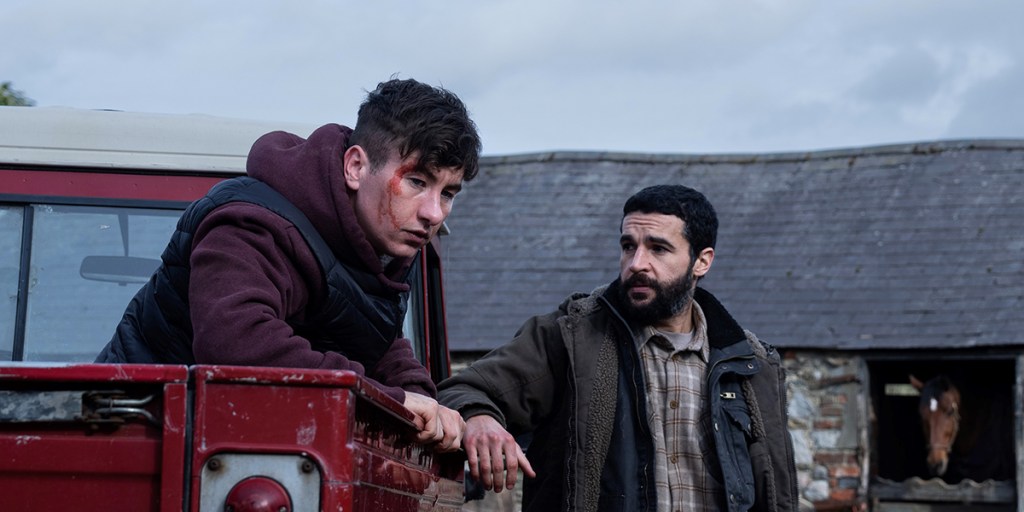
It’s rural Ireland in the present day. Michael (Christopher Abbott) runs a one-man sheep farm, where prize-winning rams graze on rocky hillsides. His abusive dad Ray (Colm Meaney) sits in the kitchen all day shouting angry epithets in Irish at Michael about all the things he’s doing wrong. In the next sheep farm over, young Jack Keeley (Barry Keoghan) does much the same as Michael but not very well. His dad Gary (Paul Ready) — who is Michael’s age — tries to keep things going but the farm is bleeding money. Gary is married to Caroline (Nora-Jane Noone), Michael’s ex, and Jack can see his parents are not getting along. Michael hasn’t seen her for 20 years, ever since a car accident killed his mother and sent Caroline to hospital with serious injuries (The accident was Michael’s fault).
But their relatively bucolic lives are interrupted when two rams disappear from Michael’s flock. And there’s only one place they can go — to the Keeley farm just over the hill. But Jack claims they both suddenly died and he threw their bodies into a pit…a very unlikely story. This signals the start of a feud between the two families, involving simmering grudges, sheep poachers, and organized crime. Can their conflicts ever be resolved? Or are both farms headed for
ruin, violence and possibly even death?
Bring Them Down is a violent, suspenseful drama about escalating grudges between two houses. It’s done in that chop-up style popular among some European arthouse directors where the narrative is not told chronologically. Your perception of “who is to blame for what” gradually shifts as new scenes fill in the blanks. I liked the acting and the dialogue — half of which is in Irish — and it has a compelling plot. The settings are just beautiful, with wide panoramic views of hillsides at dusk and dawn, and images like Michael carrying a lame sheep draped over his shoulders. There are also some strikingly original tableaux like the sheep at an auction house. This is a good first film — it reminds me of Frozen River and Winter’s Bone, all serious looks at crime in rural settings. But why are all these movies about brooding Irish men so depressing? What miserable lives these people seem to lead! If there were a bit of humour or love, Bring them Down would have been a lot easier to take.
But it’s still a good movie, anyway.
Dark Nuns, Love Hurts, and Bring them Down are all opening this weekend in Toronto; check your local listings. This is Daniel Garber at the Movies, each Saturday morning, on CIUT 89.5 FM and on my website culturalmining.com.
The thrill of uncertainty. Films reviewed: Harbin, Babygirl, The Brutalist
Hi, this is Daniel Garber at the Movies for culturalmining.com and CIUT 89.5 FM.
First let me wish you all a Happy New Year! With a new year comes renewal, hope… and potential dread. So this week, I’m looking at three new movies where people face potentially dreadful situations, partly of their own making. There’s an abused architect, a compromised CEO, and a sympathetic assassin.
Harbin
Co-Wri/Dir: Min-ho Woo
It’s 1909 in Korea. After defeating a European empire in the Russo-Japanese war, Japan is flush with imperial ambition. They want more colonies on the mainland and are looking hungrily at Korea, Manchuria, Mongolia, and China. But some independence-minded Koreans are regrouping to fight Japan. Their leader, Ahn Jung-geun (Hyun Bin), managed to defeat a Japanese battalion in a bloody battle. But when, following international laws, Anh released the disarmed POWs, their leader Mori (Park Hoon) shot a cannon at their base killing everyone except Anh. Now the survivors are meeting in Vladivostok to decide what to do next. This includes Kim (Jo Woo-jin) his closest ally, and Woo, (Park Jeong-min) his biggest rival. And some of them think Anh is a Japanese mole. To atone for his mistakes and to do something big, he vows to assassinate Ito
Hirobumi (Lilly Franky: Shoplifters, Like Father, Like Son) one of the top statesmen of Imperial Japan who is calling for the annexation of Korea.
To do this killing Anh must make his way to Harbin, a rail hub city right on the border of Russia and northeast China where Ito plans to give a public speech. But If he travels by train he will be caught. He must turn to a former comrade turned bandit, Ms Gong (Jeon Yeo-been) to try to secure explosives. But there is a traitor in their midsts, telling the Japanese all their plans. Can they make it to Harbin undetected, find the rat, fool their enemies, and carry out the assassination? Or are they fated to be erased from their country’s history?
Harbin is a vivid and gripping retelling of a famous historical event. It’s a classic cloak & dagger, full of action, thrills, drama, and deception. It’s done in the traditional style, with the name of each character appearing on the screen to help
you keep track of which moustachioed fighter is which. But easier said than done, when everyone pulls down the brims of their fedoras to cover their faces. The locations are amazing: Anh crawling across the frozen waters of the Tumen River, horse caravans on the sands of Mongolia, ancient Russian train stations… very impressive! The sets and costumes are great too, with a drunken warlord festooned in animal furs or the ceiling lamps aboard a Russian train, swinging from side to side. If you have any interest in action-thrillers, spy stories or even NE Asian history, Harbin is the film for you.
Babygirl
Co-Wri/Dir: Halina Reijn
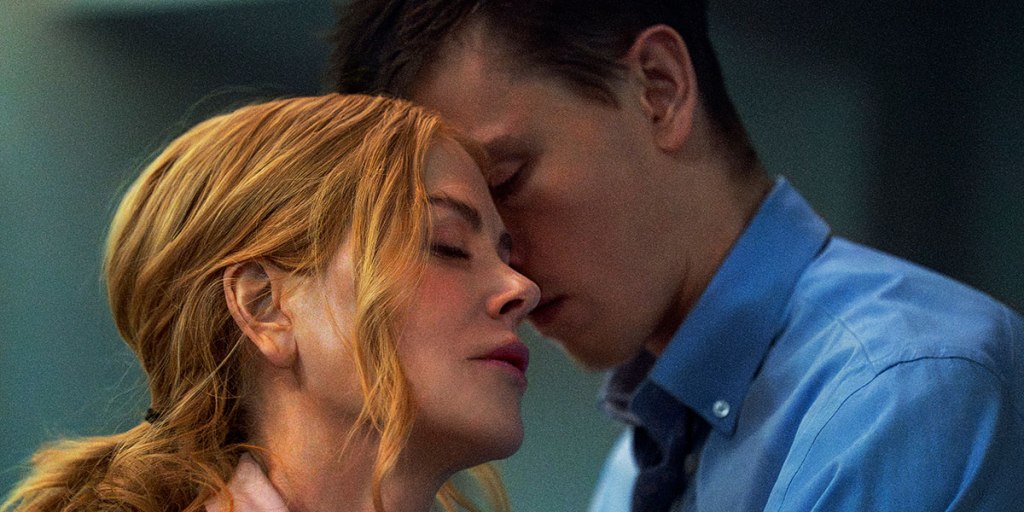
Romy (Nicole Kidman) is the CEO of a large, successful corporation that makes automated parcel-sorting equipment — similar to what Amazon has in their warehouses. She lives with her husband Jason a play director (Antonio Banderas) and their two teenage daughters, Isabel and Nora. Her life is almost perfect, but is missing a certain…. je ne said quoi. She is not sexually satisfied. One day she is startled by a vicious dog running rampant outside her office tower. She witnesses a random young man calm the dog down and return it to its owner. Later, inside her office, she is introduced to her latest intern; it’s the same guy she saw outside. Samuel (Harris Dickinson) has an unusually forthright manner, almost rude and overbearing for someone so young. He makes her feel unhinged and yet… intrigued. Who is this twerp, and why is he like that? She finds him overconfident and almost ridiculous. And yet… eventually, to her great surprise, they kiss and sparks fly.
Soon she is secretly meeting him in seedy hotel rooms for furtive sex. But he wants more — total domination over her in an S&M relationship. Romy loves her husband and kids has never done anything like this before. Even though he takes the dominant role, in real life she holds all the cards: she’s older, richer and his boss. She has more to lose, though, and it’s that threat that excites her. And she can’t got enough of him. What will happen if word gets out? Has she bit off more than she can chew?
Babygirl is an erotic drama about an older woman’s fling with
a much younger man for the thrill of it all. It’s both highly sexualized and yet uncomfortable to watch in parts. It’s entirely told from Nicole Kidman’s (Before I go to Sleep, Genius, The Beguiled, The Killing of a Sacred Deer, Boy Erased, The Upside, Destroyer, The Goldfinch, Bombshell, The Northman) Romy’s point of view; we share her agony, her ecstasy, her cringing embarrassment (he treats her like a domesticated pet). As Samuel, Dickinson is opaque, functioning mainly as her erotic foil. He’s usually an excellent actor (Beach Rats, Triangle of Sadness, Scrapper, The Iron Claw) but in this movie he takes second all the way. Some people love this movie, others despise it. I’m somewhere in between. The plot is just a slight twist to the hoary old cliche of the powerful executive submitting to a dominatrix. I don’t need to watch a grown woman lick milk from a saucer. But other parts are quite exciting and altogether it’s worth it for Nicole Kidman’s performance.
The Brutalist
Co-Wri/Dir: Brady Corbet
It’s post-WWII. László Tóth (Adrian Brody: Splice, Predators, The French Dispatch, Asteroid City) is a holocaust survivor from Hungary who arrives in America as a displaced person. His wife Erzsébet (Felicity Jones) and niece Zsófia are nowhere to be seen. His cousin Attila (Alessandro Nivola) gives him a place to stay in his furniture store and puts him to work designing and building chairs. Things look up when the son of an oligarch offers him a job redesigning his father’s home library. Laszlo takes to it like a fish out of water, building a modernistic room with synchronized wooden panels and shelves beneath an open skylight. But when the industrialist Harrison Lee Van Buren Sr. (Guy Pearce) sees it, he goes ballistic and fires him without pay. Soon after his cousin falsely accuses him of sleeping with his wife Laszlo finds himself unemployed, homeless and addicted to drugs. He gets work doing manual labour at a ship yard with Gordon (Isaach De Bankolé) a man he
befriended earlier until the industrialist who fired him seeks him out ago. Turns out Laszlo was a Bauhaus architect before the war, and the library was featured in modern architecture. Lee immediately rehires him, this time to build a monumental memorial on a hilltop in honour of his mother. But conflicts still trouble the two men’s relationship. Will Laszlo ever complete his masterpiece? Or will Lee crush him with his oppressive and egoistical nature?
The Brutalist is a moving drama about the American Dream and the class struggle between two men. (The title refers to the Brutalist style of architecture Laszlo favours). It’s a full-fledged four hour epic, compete with an overture, intermission and various story lines within the plot. I’m only giving you a taste of it here, a three-minute review of a four hour movie. It is visually and audibly stunning, both in design and execution, from the score to the crisp camera work, even the surprising credit roll. The acting is superb — I’m referring to Brody, Pierce, Jones and the rest of the large cast. This is a mature film made by a young director and former child actor. I’ve only seen one other movie by him, Vox Luxe, which, while visually interesting, didn’t have much to it. The Brutalist takes a quantum leap beyond that, filling in all the parts left out of his previous work. The movie is exciting, full of both hope and crushing devastation. It’s so well done that I left the theatre assuming it was a biopic, only later realizing it’s entirely fictional.
The Brutalist is a stupendous movie that must be seen to be appreciated.
The Brutalist and Babygirl are now playing in Toronto, with Harbin opening this weekend; check your local listings.
This is Daniel Garber at the Movies, each Saturday morning, on CIUT 89.5 FM and on my website culturalmining.com.
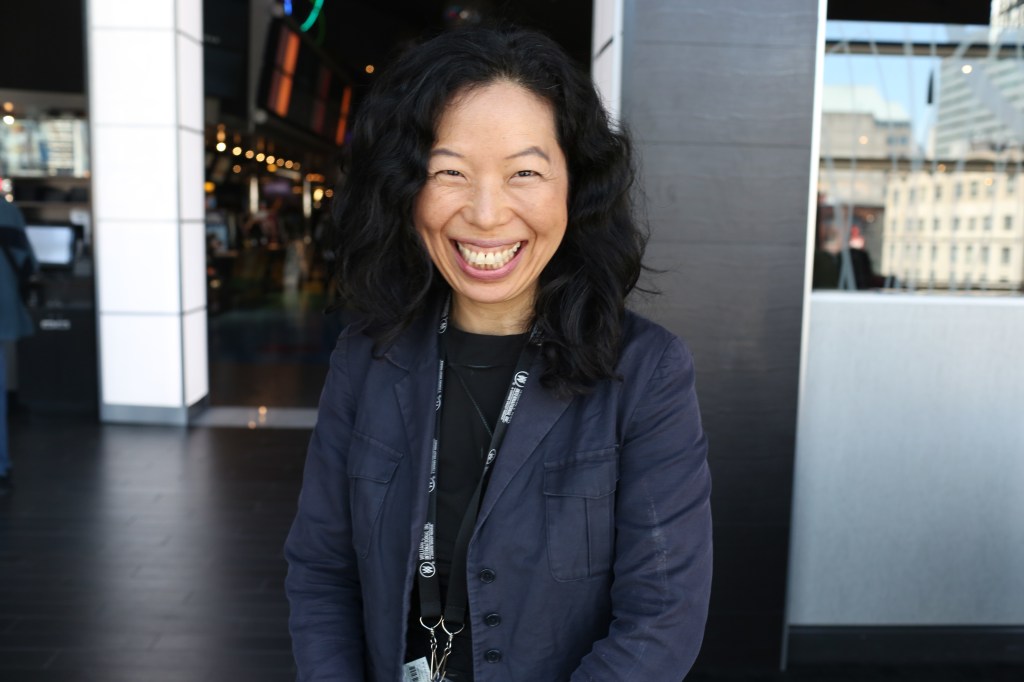
Daniel Garber talks with filmmaker Helen Lee about Tenderness at #TIFF24
Hi, this is Daniel Garber at the Movies for culturalmining.com and CIUT 89.5 FM.
It’s the 2010s in Seoul, South Korea.
Yumi is a high school girl studying at cram tests to get into a good university. She spends her spare time hanging with a young guy named Yohan who works at a local convenience store. But hanging above her is news of a terrible ferry disaster that threatens the lives of hundreds of Korean students her age. She should go home, but it’s the one place she doesn’t want to be; her single dad is dating a gyopo — an English-speaking Korean woman — and Yumi isn’t happy. She’s also dealing with grief, trauma and puberty. Where can she find a little tenderness?
Tenderness is a coming-of-age film about a young woman’s emotions and conflicts as she deals tragedy and trauma. It’s beautiful, powerful and introspective, but threaded with unexpected humour. And it packs a wallop of content in just half an hour. The film stars Kim Sewon as Yumi
and Jeon Chan Hyeong as Yohan. It’s written, directed and co-produced by filmmaker and theorist Helen Lee. Helen is an alumna of the University of Toronto, York, NYU, and the CFC, was a critic and journalist and has gone on to teach film aesthetics, screenwriting and directing at Queen’s, Yonsei University, Korea National University of Arts, and OCAD. She has also directed many films of her own, including My Niagara, Subrosa and Prey.
Tenderness had its world premiere at TIFF on Wednesday, September 11th at 915 PM, as part of the Short Cuts program.
I spoke with Helen Lee in Toronto, via ZOOM, during TIFF.
Archnemeses! Films reviewed: Kill, Despicable Me 4, Escape
Hi, this is Daniel Garber at the Movies for culturalmining.com and CIUT 89.5 FM.
Classic novels and movies needed a hero or a heroine to save the day. But in really good stories there’s also a nemesis, an enemy to fight and defeat. This week I’m looking at three new movies, from Korea, India and France — two action thrillers and an animated comedy — about arch-nemeses. There’s a former villain in witness protection, a commando on a train heading in a southern direction and a communist sergeant preparing his own defection!
Kill
Co-Wri/Dir: Nikhil Nagesh Bhat
Amrit (Lakshya) is a commando in a special unit of the Indian army. Along with his best buddy Viresh (Abhishek Chauhan) they lead their troops in tactical operations using martial arts and hand-to-hand combat. But he’s in a bit of a jam. The love of his life, Tulika (Tanya Maniktala) is pledged to another man in an arranged marriage. To elope seems too risky; her father is an oligarch with immense power and wealth. Even so, they arrange for a secret meeting aboard the express train her family are riding south from Amritsar to Delhi. And, right there, with the two of them squeezed into a cramped toilet Amrit proposes marriage, complete with ring. But what neither of them realize is the train has been targeted by a brutal gang of bandits for an attack on the sleeper cars. The dacoits kill the guards, and steal watches, jewelry and cash from everyone there. And they sexually threaten the women. They’re led by a capricious Fani (Raghav Juyal) the nefarious son of the clan’s patriarch. But when Amrit and Viresh see what’s happening, they decide it’s time to fight back… but can just two commandos take on an entire family of bandits?
Kill is a non-stop, violent action movie, the first of its kind out of
India. It’s nothing like Bollywood, no songs, dances, or extended flirting. This is heavy-duty fighting all the way through. This is Lakshya’s first starring role — he’s good-looking and intense, a natural leading man. He plays Amrit as a regular Punjabi drawn almost to madness when he sees his lover threatened. Then he goes berserk. He wears a blood-stained shirt for most of the film, and beware: there’s a lot of blood to be spilt. Much of the action takes place in the aisles of an express train, between cars, on the roof, and out the exit doors. Weapons range from sabres, to rifles, a metal fire extinguisher and the fighters’ bare fists. The fighting is superbly choreographed, really well done. And the sound effects are chilling — the sound of skull hitting metal the slash. Off a knife, the thud if fists hitting flesh…I’ve never seen an Indian movie like this, and I quite enjoyed it. If you can get into intensely violent, non-stop action movies — on the scale of the great Indonesian flic The Raid — then I think you’ll really like Kill.
Despicable Me 4
Dir: Chris Renaud, Patrick Delage
Gru (Steve Carell) is a former supervillain who is now on the straight and narrow. He lives with his beloved wife Lucy (Kristen Wiig), their three adopted daughters, Margo, Edith and Agnes, and their newborn baby son. But he has to dive back into the world of villainy when he is sent on a secret assignment: to return to the criminal boarding school of his childhood, the Lycée Pas Bon. Once there he must capture and jail his lifelong rival Maxime Le Mal (Will Ferrell). Now Gru has his Minions — diminutive bright yellow creatures who obey his orders but are always up to no good — but Maxime has minions of his own: cockroaches! He’s built up a veritable army of the insects, and when he escapes from prison, he vows revenge against Gru and all those around him. To safeguard his family, Gru enters a witness protection program where they are all given new names and identities and a suburban home to live, and told to “blend in”.
The problem is their next door neighbours, the Prescotts, have a precocious but obnoxious daughter named Poppy. She has guessed Gru’s true identity and threatens to expose him unless he helps her pull off a heist of her own. But can Gru keep his family safe while pulling off this audacious caper? Or will they fall prey to Maxime and his cockroach empire?
Despicable Me 4 is an animated kids’ comedy about a former villain facing off against a current villain. It’s the latest in an immensely successful French movie franchise (Reviews: Despicable Me, Minions: The Rise of Gru) about a likeable villain and his makeshift family. It combines simple animation with funny lines and goofy characters, Once again, I viewed it in an audience packed with kids who seem to love it. Personally, it seems to be getting a bit tired, like they’re running out of new ideas. The one genuinely funny aspect are the Minions, all voiced by Pierre Coffin. When they’re around, you’ll be laughing with their silly and imaginative slapstick humour. Despicable Me 4 isn’t great, but it did keep me entertained. And the kids will love it.
Escape
Dir: Lee Jong-pil
It’s present day at the DMZ in North Korea. The Demilitarized Zone — it separates the north from the south — is full of landmines, with sentinels in towers watching closely for any movement on either side. Kyu-nam (Lee Je-hoon) is a Sergeant in the Korean Peoples Army nearing the end of his ten-year term there, and dreads returning to work in a coal mine. There is no family to go home to. He has firmly embraced the national ideology of Juche, or self-reliance. But in Kyu-nam’s case, self-reliance has taken on new meaning. Each night, he sneaks out of his bunker, climbs through a window, and crawls his way across the minefields toward the border, recording all the safe spots along the way. He plans to defect to the South before the next rainfall causes the landmines to shift. But he runs into trouble when a pudgy private named Dong-hyuk (Hong Sa-bin), who idolizes the Sergeant sees his trial runs. Dong-hyuk longs to be reunited with his mother and sister in South Korea. So he tries to escape on his own, using Kyunam’s map… but he mucks things up, putting them both in danger of a firing squad.
But who appears at the desertion trial, but Hyun-sang (Koo Kyo-hwan), a Major with connections. He has connections with Kyu-nam going way back, and declares him a national hero, and sets him up in a cushy job as an aide-de-camp for a drunk general. But Kyu-nam is committed to his plans. Can he reach the border before Hyun-sang can catch him? Or are they doomed to a violent end?
Escape is a fast-moving action thriller, full of complex schemes
and near escapes… along with plenty of unexpected surprises. Koo Kyo-hwan plays the major as a slightly effeminate, upper-class nepo-baby who would rather be a concert pianist than an officer. This villain reveals hints of a secret gay past, adding to his mystery. Lee Je-hoon plays a macho, self-reliant soldier who just wants to choose his own future and have enough food to eat (based on what he heard about the South from the propaganda broadcasts he picked up on his transistor radio). The entire film takes place in the North. It portrays a country filled with poverty, malnutrition and class divisions— based on Party membership — where the ordinary people just scrape by, while the effete elites gorge on fine meats and liquors. I have no idea how accurate it is, but I liked the details, from the socialist realist murals, the giant slogans, and the maroon coloured dress-uniforms the officers wear.
And, of course, its gripping plot that will keep you glued to the screen.
Kill, and Despicable Me 4, both open this weekend in Toronto, and you can catch Escape at the TIFF Lightbox; check your local listings. This is Daniel Garber at the Movies, each Saturday morning, on CIUT 89.5 FM and on my website culturalmining.com.
Three Women. Films reviewed: Immaculate, Exhuma, The Queen of my Dreams
Hi, this is Daniel Garber at the Movies for culturalmining.com and CIUT 89.5 FM.
This week, I’m looking at three new movies about three distinct women from three different religions. There’s a nun fighting for her life in Italy, a shaman fighting demons in Korea, and a Canadian woman fighting with her Mom in Karachi.
Immaculate
Dir: Michael Mohan
Sister Cecilia (Sydney Sweeney) is a novice at a convent in Italy. It’s an ancient edifice dating back hundreds of years, with an airy courtyard surrounded by lovely white pillars, and situated amongst Italy’s rolling hills. She has just arrived from Michigan, but is already taking her vows of chastity, poverty and obedience. She was invited to join the convent by Father Sal Tedeschi (Álvaro Morte) a former scientist who, like Cecilia, had a calling. Her job? To tend to the sick and dying, mainly older nuns who have lived their entire lives within their stone walls. There is little privacy there, especially for novices. Anyone can wander into their rooms, day or night.
But something strange is going on. When she touches a relic of the true cross, she faints. She wakes up days later with few memories of what happened. She goes to confession but her priest seems to fade away inside the booth. And one morning she throws up in the shared baths. Could that be morning sickness? Could she be pregnant? Bishops and doctors examine her closely: she is still a virgin. Which makes this an immaculate conception! It’s a miracle! It’s the second coming! Soon people are gazing at her in awe, reaching out to touch
her face. But this is not why Cecilia took her vows. She doesn’t trust the convent’s doctor — who just happens to be an obstetrician in a convent full of nuns. And then there are the frightening sisters who cover their faces in masques of red gauze to carry out enforcement. When her only friend, Sister Gwen (Benedetta Porcaroli) disappears, Cecilia realizes she has get out of this place — or this nun will be done. But how can she escape?
Immaculate is a thriller/horror about an innocent young woman trapped in an Italian house of by some religious fanatics. But for a movie about a nunnery there sure are a lot of breasts on display… draped in damp white diaphanous gowns in the baths or partly exposed late at night. That’s half of this exploitation movie: soft-core porn. The other half, though, is extreme, bloody violence and sadistic torture — what I call “gorno”: Disgusting, extended violence you’re forced to watch for its titillating effect. This leaves the movie both ridiculous and over the top, and more gross than scary, in the manner of an Italian Giallo movie from the 70s… but without any camp.
That said, I actually liked Sydney Sweeney as the innocent woman who fights back. And while this is clearly a B movie, it does end on a suitably shocking note.
Exhuma
Wri/Dir: Jang Jae-hyun
Hwarim (Kim Go-eun) is a young Korean woman on a Japanese flight to LA. She’s going there to investigate a client from a filthy-rich Korean family that suffers from strange dreams and illnesses. Not just the man himself, but his new born baby, and other relatives. She’s a shaman, travelling with her coworker Bong-Gil a heavily-tattooed, former baseball player (Lee Do-hyun) who can see visions and dreams. They determine evil forces are at work here, and call for an exhumation of a distant ancestor’s grave to rectify some unknown problem. The family agrees and pays them a hefty salary to make it work. Back in Korea, they turn to Kim a geomancer (Choi Min-sik) and his assistant. He knows about how Yin and Yang, Feng Shui and the Five Elements all must be correctly aligned to make for a peaceful grave. But the grave they find is anything but peaceful. The coffin is buried beneath an unmarked tombstone, on a distant hilltop near North Korea, reachable only through a chain-locked road where no one ever goes. It’s home to a skulk of foxes and a pit of snakes. And despite their lengthy shamanic
rituals, somehow an ancient evil spirit escapes from the grave wreaking havoc on everyone nearby. It’s not just a ghost that says “boo”; it takes on a physical form, looking for humans as his slaves, to feed him sweet melons and mincemeat. And woe be to him or her who disobeys. Human livers taste just as good. Can these four brave souls defeat a dark evil from a rich family’s hidden past?
Exhuma is a supernatural horror/thriller about a fight against the deep, dark mysteries from Korea’s history (including references to their brutal occupation under Imperial Japan). The film is done in an interesting way, incorporating actual shamanic rituals into the story. In one scene, to the sound of pounding drums, Hwarim does an extended ecstatic dance around the bodies of four hogs impaled on skewers. Not the sort of thing you usually see in a horror movie.
Exhuma was a huge hit in Korea when it was released there a month ago, and I’m not at all surprised.
I like this one.
The Queen of My Dreams
Wri/Dir: Fawzia Mirza
It’s 1999 in Toronto. Azra (Amrit Kaur) is an aspiring actress with a steady girlfriend. She has been on bad terms with her mother Mariam (Nimra Bucha: Polite Society) since she was caught playing spin the bottle with a girl at her teenage birthday party. But she still communicates with her friendly Dad (Hamza Haq: Transplant) a doctor. The one thing Azra has in common with her mother is their obsession with an old Bollywood movie starring Sharmila Tagore. But when her Dad suddenly dies on a visit to Karachi, Pakistan, Azra and her brother must fly there for the funeral. This sets off a series of revealing memories both from Azra and Mariam. Suddenly we’re
transported back to 1969, when Mariam is a totally different person and Karachi a swinging city, filled with bars, discos, VW bugs and Beatlemania.
Mariam is a rebel who rejects her parents’ arranged marriages when she falls for her future husband. Then we’re in Sydney, Nova Scotia, in 1989. Young Azra (wonderfully played by Ayana Manji) joins her mom’s work as a Tupperware lady. These scenes are a coming of age replete with a moustache on her upper lip, her first dance with a boy, and being excused from class during Christian prayers. But can the 1999 mother and daughter reconcile with their pasts in 1989 Nova Scotia and 1969 Karachi and learn to love each other again?
The Queen of my Dreams is a wonderful family drama that deftly weaves three eras and three generations across two continents. It deals with religion and sexuality, rules that are made to be broken and others that are upheld. I don’t know if this film is autobiographical or not, but it really rings true. Amrit Kaur plays both the adult Azra and a younger version of Mariam, while Hamza Haq plays the Dad both in youth and middle age. Not just that: Nimra Bucha (Mariam) and Kaur in their daydreams are both transformed into the main character in their favourite Bollywood film. Sounds really complicated, right? It’s not! It’s totally accessible and understandable with wonderful realistic characters, funny lines and deeply moving dialogue. The production design deserves a special mention. The ’60s scenes use traditional film to perfectly capture the look of Kodacolor movies from the period, through costumes, hair, locations, cars — and especially its cinematography. And on top of everything else, this is Fawzia Mirza first feature film.
I’ve seen The Queen of my Dreams twice now and I still love it.
Exhuma opens at the TIFF Lightnox; Immaculate, and The Queen of My Dreams also playing this weekend in Toronto; check your local listings.
This is Daniel Garber at the Movies, each Saturday morning, on CIUT 89.5 FM and on my website culturalmining.com.
Outcastes. Films reviewed: The Childe, Nimona
Hi, this is Daniel Garber at the Movies for culturalmining.com and CIUT 89.5 FM.
It’s the Canada Day long weekend — what better time is there to catch up on some movies? You might want to make time for a fascinating new documentary called Making Time about some rebellious and original horologists, people who literally make time.
But this week I’m looking at two new movies — an action thriller, and an animated fairy tale — about outcastes, and how we can embrace differences. There’s a mixed-race man who discovers his dad is a millionaire… and a commoner accused of murdering a queen!
The Childe
Wri/Dir: Park Hoon-jung
Marco (Kang Tae-Ju) is an impoverished young man in the Philippines who lives with his ailing mother. He’s an amateur boxer saving as much money as he can to pay for her operation, but it’s never enough. So when a strange man shows up representing a wealthy client in Seoul, Korea, his ears perk up. The man offers to pay for the surgery and then some; in return, Marco would have to fly to Seoul immediately to meet the client. Why him? Because the millionaire is Marco’s dad and he wants to meet his son before he dies. Now people call Marco a “Kopino” — his biological father (who he’s never met) is Korean and his mom Filipina. She insisted he study English and Korean when he was growing up, so he’ll be able to communicate with him when he gets there.
So off he flies to Korea, first class, but he finds the people he meets are not particularly friendly. Not just unfriendly, but outright abusive, calling him a mutt — and worse — because of his mixed background. Which quickly turns to actual danger — some people are trying to kill him. There’s a sadistic and sinister young man (Kim Seon-ho) who constantly chews gum and sips coca-cola as he brags about his
expensive shoes and car. He tells Marco that he’s his best friend, even as he kidnaps him (some friend). Then there’s a woman named Yun-ju (Go Ara) who clearly wants him gone And his half brother Han (Kim Kang-woo) and half sister each of whom have evil plans of their own all involving Marco. What’s so special about him? What do they want from him? And why do some of them want him dead?
The Childe is a very fast- moving action-thriller shot in SE Asia and Korea. Lots of fights, excellent chase scenes and plot twists. Although quite violent, most of it takes okay off-camera, giving the film a lighter tone. Kim Seon-ho is sufficiently creepy to be humorous, and Kang Tae-Ju is just right as the hapless hero. And — no spoilers — I did not guess the big revelation near the end. Nothing deep here — The Childe is an action movie, after all — but it is totally watchable.
Nimona
Dir: Nick Bruno, Troy Quane
(Based on the graphic novel by ND Stevenson)
Picture a medieval town with modern technology. That’s where
Ballister Boldheart lives.. It’s a walled city — to keep out monsters — with a castle, a benevolent queen and knights in shining armour. But it’s also a place with flying cars, cel phones and video cameras. Ballister is a knight himself, or about to become one. The queen has declared henceforth that a commoner like Ballister, not just royalty, can become a knight. This is a historic occasion, and he — along his boyfriend, Ambrosius Goldenloin, a knight himself — are overjoyed at this upcoming change. Until something terrible happens in front of thousands of onlookers. While handing his sword to the queen, a laser beam shoots out of it, killing her on the spot. And this is done in front of the horrified face of his lover who sees it all. Next thing you know, he goes from noble hero to public enemy #1, and is thrown into the dungeon.
That’s where he meets a punky and spunky young girl dressed in pink named Nimona. She wants to work for Ballister as his henchman. She likes killing people and blowing things up, and who better to do it with than an arch-villain like him. But when he explains he’s innocent, she
says she’ll work for him anyway. But what can a little girl do that a knight like Ballister cannot? A whole lot, it turns out. She has special powers that let her turn into a rhinoceros, a mouse, a gorilla or a whale in a moment’s notice. The little girl is just one of her identities. Can they escape from the prison, clear his good name, find the killer, and win back his boyfriend? Or will he languish behind bars to the bitter end?
Nimona is a very cute animated fairy tale with science fiction and fantasy elements worked in. It’s made in a traditional style, but frequently shifts to other designs for flashbacks and origin stories woven throughout — love the art direction. (The killing of the queen is strangely close to Alec Baldwin’s tragic shooting on a movie set
immediately after being handed a weapon, but I’m pretty sure this was made before the real-life incident happened.)
Riz Ahmed plays the voice of Ballister, with Chloe Grace Moretz as Nimona — two actors who always seem to choose just the right movies to appear in (this is another one). Nothing earth-shattering about this one — it’s basically for kids or families — but it is fun, exciting and quite touching in parts. Ballister and Ambrosius happen to be gay, but it’s not central to the plot, any more than Ballister’s brown skin. So if you’re looking for something fun that also has a message and is very well made, check out Nimona.
The Childe opens theatrically this weekend in Toronto; check your local listings; and Nimona is now streaming on Netflix.
This is Daniel Garber at the Movies, each Saturday morning, on CIUT 89.5 FM and on my website, culturalmining.com.
leave a comment