Outcastes. Films reviewed: The Mastermind, Regretting You, Bugonia

Posted in 1970s, Crime, Drama, Family, Heist, Kidnapping, Romance, Science Fiction by CulturalMining.com on October 25, 2025

Hi, this is Daniel Garber at the Movies for culturalmining.com and CIUT 89.5 FM.

There are a ton of movies opening this weekend with lots of choices for every taste. This week I’m looking at three of them, all about outcasts and rebels. There’s a self-styled art thief in Massachusetts, a daughter fighting her mom when two families are brought together by tragedy in North Carolina, and a pair of cousins trying to save the earth… by kidnapping a CEO they think is an alien.

The Mastermind

Wri/Dir: Kelly Reichardt

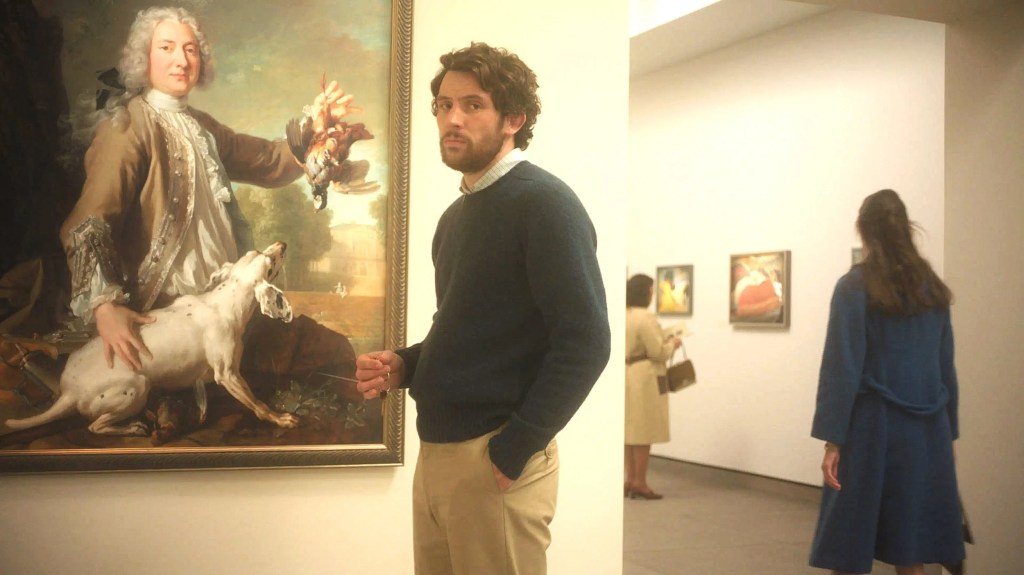
It’s 1970 in Framingham, Massachusetts. James Blaine Mooney (Josh O’Connor) is an architect who is down on his luck. He loves his wife Terri (Alana Haim) and their two bright sons, Carl and Tommy (Sterling and Jasper Thompson), but he’s just not earning a living. He has no clients, and is forced to borrow money on the sly from his high-society mom. (Don’t let your father know about this.) He is smart, savvy and full of ideas but spends most of his time puttering around with his ne’erdowell pals. But now he has a get-rich-quick scheme he’s sure will solve all his family problems: stealing modern paintings from his small town art museum.

He tests and calculates every step: a sleepy unarmed guard, no alarms, clear exits, art easily taken off walls. He even has a stolen getaway car, and two henchmen with pantyhose to pull over their faces. It’s foolproof, and they pull it off with barely a hitch. But things goes south when one of the robbers gets caught at another job and spills the beans to the cops. James is labeled the mastermind behind the crime and is forced to flee the town and his family for an uncertain future. Where will he go and how will he survive on the lam?

The Mastermind is a brilliant period piece, a portrait of an America full of sketchy bus stations and flophouses, totally free of patriotic nostalgia. It’s set against — but separate from — the widespread antiwar protests of 1970. Josh O’Connor portrays James as a flawed antihero, who is nevertheless sympathetic. He commits his petty crimes wearing wooly sweaters and corduroy pants. The details in the production design are astoundingly precise. Kelly Reichardt is one of the best American directors you’ve probably never heard of. She makes films, not high-concept schlock and if you haven’t seen her movies, this is a good one to start with. The Mastermind is one of those movies that starts in the middle of things and ends suddenly, before you think it’s over, but it all makes perfect sense. 

This is a really good movie.

Regretting You

Wri/Dir: Josh Boone

It’s 17 years ago on a hot summer night in North Carolina. Two teenaged couples are at a pool party: Morgan and Chris, and Jonah and Jenny. Morgan and Jenny are sisters, Chris and Jonah best friends. They say opposites attract; Chris and Jenny are wild partiers, who like getting drunk and having wild sex, while Jonah and Morgan are smart, conscientious and non drinkers. Fast forward to the present.

Morgan (Allison Williams) has been married to Chris for 17 years, and they have raised their daughter Clara (Mckenna Grace) since they were still young. Jonah (Luigi-Mangione-lookalike Dave Franco) left town soon after graduation but came back recently and restarted his relationship with Jenny, soon leading to a newborn son. And then there’s Clara: everyone loves her. She’s a high school senior who dreams of becoming an actress after college. She tells her aunt Jenny all the things she can’t tell her mom; she’s like her best friend. She adores her dad Chris, and respects Jonah, who is also her high school teacher. And Clara is crushing on Miller, a popular guy at school,(Mason Thames) who lives on a farm with his gramps, cause his dad is in prison. He likes movies, sucking lollipops and moving roadsigns. But he has a girlfriend so he’s a no-go for Clara.

But everything is messed up when Chris and Jenny are killed in a terrible car crash, leaving Clara without her Dad and her Aunt, Jonah without his lover and the mother of their baby, and Morgan without her sister and the only man she’s ever been with. So Jonah turns to Morgan to form a make-shift family to deal with shock, grief, and the temporary raising of their two kids. (Clara and her Mom aren’t talking.) And while all this is going on, Clara and Miller start hanging out. Can these estranged family members adjust to the drastic changes? What secrets will be revealed and what hidden loves awakened?

Regretting You is a very conventional drama/romance about two families recovering from unexpected loss. It’s also a coming-of-age story, along with some unrequited love. Based on a popular novel, it’s a very easy movie, with nothing transgressive: its set among church and proms and school plays and going to the movies. The characters are pleasant, and its directed in an easy-to-watch way: texts sent between Clara and Miller are also voiced, so no need to read. The story is divided between the grown ups and the teens, with the teens the more interesting half. But what’s weird about this one is the catastrophic events all happen off-camera, and toward the beginning. The rest of the movie is just about mending relations and recovering from the shocks. So instead of building up to a satisfying emotional purge, this one starts with the dramatic shock and then just coasts.

While I don’t regret seeing Regretting You, it’s not my preferred type of movie.

Bugonia

Dir: Yorgos Lanthimos

High-strung Teddy (Jesse Plemons) and shy, neurodivergent  Don (Aidan Delbis) are cousins. They share a dilapidated house they inherited along with an attached farm, where they eke out a meagre existence — dressed in filthy Hazmat suits — through the cultivation of honey bees. But the bees are disappearing. What’s happening to their colony? They also work at a shipping station for a nearby big pharma corporation that specializes in lethal pesticides. Teddy holds a special grudge toward that company for past digressions it inflicted on him and his family.

The company is Auxolith and its CEO is Michelle (Emma Stone), a high-power, alpha careerist. She lives a magazine-like lifestyle in her modern mansion equipped with high security. She is a perfectionist, who only eats heathy food and insists her hair, makeup and power suits are always flawless. She works out using the latest machinery and is fully trained in martial arts. At work, though surrounded by a retinue of yes-men, she seems oddly sterile and detached from all her employees. 

But everything changes when Teddy — with Donny’s help — kidnap Michelle and drag her, undetected, to their lair. They shave her head, tie her to a bed, and cover her skin with weird emollients. Does they want money? Fame? A platform for their manifesto? No! Teddy is convinced Michelle is personally responsible for widespread ecological destruction of the planet — including his bees. And her motive? He is convinced she’s an alien from Andromeda with ties to a mothership parked just outside of the earth. Where do his bizarre theories come from? How can Michelle escape their clutches?

Bugonia is a weird movie pitting an eco-terrorists against a cold billionaire industrialist. Like all of Yorgos Lanthimos’s movies, Bugonia is simultaneously hilarious and disturbing. Grown adults talk like stilted children saying profound but outlandish statements. It’s laden with conspiracy theories, that are no less ridiculous than the corporate-speak the other half uses. Lanthimos likes to cast the same retinue of actors from his past pictures, so Emma Stone and Jesse Plemons are back again playing more quirky oddballs (though Aidan Delbis is entirely new). Bugonia is comical and absurd but also dark. 

I really like Lanthimos’s style, but some people hate it; he’s not for everybody. But if you’re looking for something wack and dark and weird, you’ve got to see Bugonia. 

Bugonia, Mastermind and Regretting You all open in Toronto this weekend; check your local listings.

This is Daniel Garber at the Movies, each Saturday morning, on CIUT 89.5 FM and on my website culturalmining.com.


Movies with two directors. Films reviewed: Abigail, Unsung Hero, Sasquatch Sunset

Posted in 1990s, Australia, Christianity, Family, Horror, Kidnapping, Music, Mystery, Vampires by CulturalMining.com on April 21, 2024

Hi, this is Daniel Garber at the Movies for culturalmining.com and CIUT 89.5 FM.

Not everyone likes every type of movie. Some want to be excited or scared, others want to be gently reassured, and still others expect to be intellectually stimulated. So this week I’m looking at three new movies — a horror, a  family drama, and a strange arthouse flick — basically, something for everyone. There’s a group of kidnappers lured by a huge ransom, a family of Australian musicians with big ambitions, and a near-family of near-humans with very big feet. 

Abigail

Dir: Matt Bettinelli-Olpin, Tyler Gillett (Review: Ready or Not)

Abigail (Alisha Weir) is a poor little rich girl who loves ballet dancing. Though still very young, she is diligently rehearsing the lead role in Swan Lake, complete with tutu and toe shoes. Until she is injected with sedative, dragged from her mansion, and wakes up chained to a bed in a creepy castle far away. Who is responsible? A gang of professional criminals, none of whom have ever met before, but promised 7 million in cash each, if they can babysit Abigail until the whopping ransom arrives the next day. 

The gang consists of Frank (Dan Stevens) a canny former cop, Dean (the late Angus Cloud) their ginger-bearded pothead driver; Peter (Kevin Durand) a musclehead enforcer, Sammy (Kathryn Newton) an expert hacker who favours expensive jewelry; Rickles (William Catlett) a sniper and former marine, and Joey (Melissa Barrera), their de-facto organizer.  She’s the only one talking with the little girl… who is very frightened and distraught. To calm her down, Joey promises nothing bad will happen to her, pinky swear.

But things take a turn when one of the gang is discovered in the kitchen, headless. Even worse, they find out Abigail’s dad is one of the richest — and most dangerous — men in the world, known for cruelly torturing and killing anyone who crosses his path. And then there’s little Abigail herself: she’s not actually a girl — she’s a centuries-old vampire who feeds on human blood… who happens to like ballet. Can the gang escape this house of horrors? Or will they be killed, one by one?

Abigail is a violent and gory vampire horror/thriller. It’s a reboot of the classic story: “if you can stay in a haunted house overnight I’ll give you a million bucks”. It also plays on Agatha Christie’s And Then There Were None, Rian Johnson’s Glass Onion, or Tim Story’s The Blackening, where characters locked in an old house are killed, one by one. That said, the characters — and plot turns — in Abigail are different enough to keep you interested. Yes, there are cliches — a house full of suits of armour and widows that close and lock themselves —  but it also adds shocking new twists to the old vampire myths — like, what happens to vampires when they die? (No spoilers).

If you like mystery and horror, with lots of blood guts and gore, tempered a fair amount of ballet dancing, I think you’ll enjoy Abigail. 

Unsung Hero

Wri/Dir: Richard L. Ramsey, Joel Smallbone

It’s 1991. David Smallbone (Joel Smallbone) is a successful music promoter in Sydney, Australia. He lives with his pregnant wife Helen (Daisy Betts) and six kids in an enormous mansion, and manages tours by big musical stars. But when a bad business deal leaves him completely broke, they all decide to fly halfway around the globe to Memphis, Tennessee. But the promised job awaiting him… wasn’t there, and the pre-arranged rental house was completely empty. Luckily Mum is a quick thinker, and turns their suitcases into beds — who needs furniture, anyway? The kids love playing cricket in the empty rooms. But she still has eight mouths to feed — David, Helen, Becca, Daniel, Luke, Joel, Josh and Ben —  three times a day, and no money to do it. But the heavens are shining bright on the Smallbones and they soon find work gardening and house cleaning, including with some of his former musical clients. The kids are pitching in, too, when they’re not being home-schooled. They have a money jar to pay for food and rent, and a wall chart with things they want and want to pray for; the Smallbones are a devout Christian family. It’s at a Church service that everyone notices what a beautiful and angelic voice Becca, the oldest daughter has (Kirrilee Berger). This provides David with the motivation he needs to get a music contract signed for Becca, thus saving their family from wrack and ruin. But can David and Becca do it? Or will the family fly back to Australia with their collective tails between their legs?

Unsung Hero is a biopic of the real-life Smallbone family, before the kids became famous, as seen through their mother Helen’s eyes. It shows how they pulled themselves back up after a major setback. It’s a faith-based movie, where praying and church play central roles throughout the film. The father David (circa 1991), is played by his actual son (in 2024). And the music they produce — from the beautiful singing of Kirrilee Berger, to the band For King + Country that Joel and Luke later founded — is good. Not to my taste, but it’s actually good. The problem comes from producing a biopic where the subjects have a central role in its content. I grew up in a family of seven and we kids fought verbally and physically all the time. In this movie, though, they are so kind and whitewashed they make the Brady Bunch kids seem like gangstas. Maybe that’s true in this family, but it rings false to me. Way too Hallmark-y. There are also a number of basic faux pas. Like having a flashback within a flashback in the opening scenes — that’s just clumsy editing. 

If you want to watch an inspiring and positive 90s- era story about a musical family’s Christian life, you might like Unsung Hero. Otherwise, I don’t think you’ll get much out of it. 

Sasquatch Sunset

Dir: David Zellner, Nathan Zellner

Somewhere in the redwood forests in Northern California, a pack of four unclassified animals are wandering around searching for food. They are covered in brown and grey hair, walk on two legs, and have opposing thumbs. Are they human, or are they animals? They are Sasquatches, popularly known as the Bigfoot. And they are a lot like us. They eat, sleep and have sex. Urinate, defecate, and puke when they eat something poisonous.  They give birth and die. They play, communicate, make music and look at the stars in the sky. And they come in at least two genders and a number of sizes. 

They commune with nature, and vice versa; snakes, skunks, deer and porcupines happily coexist, and even play with them. Sasquatch are mainly vegetarian though they do eat fish. They also make mistakes, especially the biggest of the four, the alpha Sasquatch. He has a tendency to stick his “stick” where it doesn’t belong. And the other three react loudly and emphatically when he does something he shouldn’t do. But when they encounter signs of humans — felled trees, camping equipment, a paved road — they are shaken to their core. Will they ever spot one of us?

Sasquatch Sunset is a very weird, arthouse film about the journey of Sasquatches in their natural habitat and the encroaching presence of humans. It feels partly like a nature documentary or an anthropological newsreel, but it’s also very funny at times. Sad too. And it has actual characters. They don’t have names but let’s call them the big, mean one, the relaxed one with breasts, the pensive intellectual and the adolescent (Nathan Zellner, Riley Keough, Jesse Eisenberg, Christophe Zajac-Denek). There is also dialogue — grunts and whoops, the banging of sticks and  lots of jumping around and screeching. At first, I couldn’t tell them apart or even what their sex is — they‘re all really hairy! — but it gradually becomes quite apparent. And by the end I think you’ll feel for them and understand them, too.

Sasquatch Sunset is a very strange movie, but I liked it. 

Abigail and Sasquatch Sunset, open this weekend in Toronto, while Unsung Hero starts next Friday; check your local listings.

This is Daniel Garber at the Movies, each Saturday morning, on CIUT 89.5 FM and on my website culturalmining.com.

Ambitions. Films reviewed: Minions: The Rise of Gru, Ennio, Mr Malcolm’s List

Posted in 1800s, 1960s, 1970s, Animation, documentary, Italy, Kidnapping, Movies, Music, Romantic Comedy, UK by CulturalMining.com on July 2, 2022

Hi, this is Daniel Garber at the Movies for culturalmining.com and CIUT 89.5 FM.

Summer is definitely here, and this long holiday weekend is the perfect time to take in some new movies. This week I’m talking about three of them: — a rom-com, a cartoon and a documentary — about people with ambitions. There’s a spinster in Victorian England who wants revenge on the man who has scorned her; a spaghetti western composer in 1960s Italy who wants to be taken seriously; and a little boy in San Francisco in the ’70s who wants to become a super villain.

Minions: The Rise of Gru

Dir: Kyle Balda, Brad Ableson, Jonathan del Val

It’s the late 1970s, and Gru is a little kid in elementary school. While his classmates say they want to be a fireman or a ballet dancer when they grow up, Gru wants to be a super villain. And he has a basement filled with strange mechanical devices to prove it. They were built with the help of his minions. The minions are bright-yellow, lozenge-shaped creatures with googly eyes. Dressed in matching denim overalls, they speak their own incomprehensible dialect, a mishmash of all the world’s languages. Gru idolizes a gang of six supervillains, who are now one villain short of a pack (since they did away with their leader) and are looking for a replacement. But when he shows up for an interview at their secret hideaway they dismiss him as just a kid. To prove them wrong, he steals their prize possession, a Chinese jade-green amulet. He gives it to a minion to keep it safe, who soon loses it in exchange for a pet rock. (The minions aren’t always the brightest bulb in the chandelier.) Gru is kidnapped by the villains’ former leader, and threatened with torture and death. Can the minions find the amulet, bring it to San Francisco, and save their best friend, Gru?

Minions: The Rise of Gru is a funny, easy-to-watch kids’ movie, where the villains are the good guys, even though they’re evil. It’s a prequel to the surprise hit from 2010, Despicable Me. The voice actors are mainly American or British, but the animated film is actually from France. The catchy soundtrack, groovy 1970s characters, the San Francisco setting, the fast-moving plot and the very colourful graphics make it a fun watch. It stars the voices of Steve Carell as Gru, Pierre Coffin as all of the minions, and Alan Arkin, Taraji P. Henson, Jean-Claude Van Damme, Jill Lawless, Danny Trejo, Dolph Lundgrin as the six villains. I enjoyed Minions, but the five-and-under set that filled the theatre absolutely loved it. 

Ennio

Dir: Giuseppe Tornatore

Ennio Morricone is born in Rome in 1928 to a professional trumpet player. He enters a music conservatory at the age of 12 and studies under Italian composer Goffredo Petrassi. (He spends most of his life yearning to be taken seriously by Petrassi and the rest of the traditional music establishment.) At an early age, he’s already composing and arranging pieces which include both melodic themes and counterpoint, an oft repeated characteristic of his music.  He writes the tunes for a number of pop songs, and eventually gets a job working for RCA. From there he goes on to compose the soundtracks — always anonymously — for the new film genre known as Spaghetti Westerns. But when he recognizes a director’s name from his elementary school, he becomes a close friend and life-long collaborator with Sergio Leone. He quickly rises to fame writing the distinctive musical scores of films like A fistful of Dollars and The Good the Bad and the Ugly, using harmonicas, whistling, electric guitars, and sound effects in place of the more common symphony orchestras. (Today those films remain his most recognizable works.) He also forms an experimental group that makes improvisational music out of non-musical sounds, influenced by avant-garde composer John Cage.

Morricone goes on to compose the scores of over 500 films, working with Italian masters like Pasolini, Wertmüller and Bertolucci, the giallo horror/thriller director Dario Argento, and Giuseppe Tornatore director of Oscar winner Cinema Paradiso (who also directed this doc).

Ennio died in 2020, and this film is as much a loving tribute to the composer as it is a documentary. While it reveals Morricone’s personality quirks, there are no scandals or salacious secrets of his private life. It’s told using film clips, period footage, audio tracks and many talking heads commenting about him, including fellow composers, John Williams and Hans Zimmer, stars and directors he worked with like Quentin Tarantino Terrance Mallick and Clint Eastwood. (Eastwood says something like Morricone’s music provided the emotions that he never could) Then there are also a bunch of celebs — Bruce Springsteen, Pat Metheny, Wong Kar-Wai — who probably never worked with him, but just felt like praising him or commenting on how he influenced them. Ennio is an informative and fascinating doc, and I liked it a lot, but… couldn’t Tornatore  have told this story in 90 minutes, instead of the two and a  half hours he took?

Mr Malcolm’s List

Dir: Emma Holly Jones

It’s England in the early 19th century. Julia and Selina were best friends at boarding school, but haven’t seen each other in years. Which is why Selina the pure and virtuous daughter of a country vicar (Freida Pinto) is surprised to receive an invitation to visit Julia an upper-class city woman (Zawe Ashton), after all these years. But she does have a reason: she was slighted by a man who took her to the opera once and never called back. The man is Jeremy Malcolm (Sope Dirisu), who is also the most eligible bachelor in town, not least because he inherited a lot of money. And Julia can’t bear being slighted in public (made even worse when it was depicted in a widely circulated cartoon pamphlet). First Julia turns to her cousin Cassy (Oliver Jackson Cohen) who happens to be Malcolm’s best friend and wingman, who knows all of his secrets. Somehow he leaks the biggest secret of all: that Mr Malcolm keeps a list of 10 characteristics a woman must have for him to consider marrying her — things like talent, poise, intelligence, a knowledge of politics, literature and the arts and one who easily forgives small offences. 

Enter Selina. Would she go along with Julia’s scheme — to date Mr Malcolm, knowing what was on that list, and afterwards to dump him — so Julia can get her sweet revenge? Selina is hesitant but agrees at least to meet him. And wouldn’t you know it? It’s love at first sight. This is further complicated by another man, a dashing military officer (Theo James), who likes Celina a lot, and happens to be in town on the same day. Which one will she choose? And if it’s Mr Malcolm, what will become of Julia’s nefarious revenge plot?

Mr Malcolm’s List is a classic, Jane Austen-style light romantic comedy, complete with a masquerade ball, a hidden scheme, whacky relatives,  and star-crossed lovers. There are also some modern twists. The most obvious is the colour-blind casting, with Black, Indian, White and East Asian actors playing the various roles, without ever bringing up questions of race or ethnicity. Like the musical Hamilton, the film The Personal History of David Copperfield, and, most recently, the Netflix series Bridgerton, this film shows that race on the screen doesn’t need to have any special significance — it just is. Family bloodlines and facial resemblances are not part of the plot. I think it works great in this movie, and I hope to see more of it. The mansions are all stately, the costumes — though a bit odd-looking — are all pretty. And the actors and the characters they play are quite delicious.  They’re clearly having a good time doing this. You can revel in their ludicrous scheming without ever taking it too seriously. Even the credits — accompanied by quaint hand-coloured drawings — are delightful. Rom-coms are not my cuppa tea, but if I have to watch one, I like it when they‘re like this.

Ennio is one of many films playing at the ICFF;  Mr Maxwell’s List, as well as  Minions: the Rise of Gru both open this weekend: check your local listings.

This is Daniel Garber at the Movies, each Saturday morning, on CIUT 89.5 FM and on my website, culturalmining.com

Cults and kidnappers. Films reviewed: The Black Phone, One Summer Story

Posted in Animation, Coming of Age, Death, Horror, Japan, Kidnapping, Magic, Manga, Religion, Suspense, Thriller, 日本电影, 日本映画 by CulturalMining.com on June 25, 2022

Hi, this is Daniel Garber at the Movies for culturalmining.com and CIUT 89.5 FM.

Spring film festival season continues in Toronto with the Japanese and Jewish film festivals coming to a close, while ICFF — the Italian contemporary film festival — and Lavazza IncluCity are just beginning. The festival features film composer Ennio Morricone, Giuseppe Tornatore (who won an Oscar for Cinema Paradiso), and Allesandro Gassmann, the son of star Vittorio Gassman, and an accomplished actor in his own right. Movies at this festival are being shown both in theatres and outdoors in open air screenings.

This week, I’m looking at two new movies. There’s a thriller-horror about a boy who is kidnapped in 1970s Colorado; and a girl who discovers her biological father was a member of a religious cult in Japan.

The Black Phone

Dir: Scott Derrickson

It’s the late 1970s in Denver, Colorado. Finney (Mason Thames) is a kid in junior high who lives with his sister Gwen (Madeleine McGraw), and their angry and depressed dad, a widower. Finney is into rocket ships and baseball — he’s the pitcher on his team. But he’s bullied at school. Luckily his best friend Robin is always looking out for him.

But all is not well in Denver. Teenagers are disappearing, one by one, with no bodies ever found. But when Robin disappears, he turns to Gwen for help — she has psychic dreams that might tell them where he is. But before they can do anything, Finney finds himself locked in a basement cell, somewhere in the city. theres just a toilet, a mattress, and a barred window way up near the ceiling. And an old black phone mounted on the wall, but with all the wires cut. The guy who kidnapped him — known as the Grabber (Ethan Hawke) — is a freelance magician who always covers his face with hideous masks reflecting changes in his warped psyche.  Before long, Finney is in despair and figures he’s going to be killed soon, just like the other boys before him. Until… the black phone starts to ring! And coming from somewhere is the voice of one of the previous victims, who says he can tell Finney how to escape.

Is this real or just his imagination?  Can the dead really speak? And will Finney ever get out of there?

The Black Phone is a fantastic thriller about a kid vs a deranged serial killer. Though billed as a horror movie,  and there are some very scary scenes here and there, it’s miles ahead above most of the gory schlock passing for horror movies these days.  This one is more about suspense, mystery and adventure than meaningless, gratuitous violence. There is violence, but it fits within the movie. The characters are all well-rounded with complex back stories. There are lots of red herrings to lead you astray, but the whole movie leaves you with a sense of satisfaction, not dread. And it avoids the cheap scares typical of many horror flicks. The film perfectly captures the feel of the 1970s, through the rock soundtrack, costumes and locations. The acting — especially heroes McGraw and Thames, as well as the villains including the creepy killer and the brooding father, and the many school bullies —  is really well done. The Black Phone  is based on a story by Joe Hill, who also wrote the graphic novel the great TV series Locke & Key was based on. He’s an amazing storyteller… who also happens to be Stephen King’s son.  (I mention that because he’s of the same calibre). And writer-director Scott Derickson has done some good stuff himself.

If you don’t want to be scared — stay far away. But if you’re looking for a good chiller-thriller, you’re really gonna like this one.

One Summer Story (Kodomo ha Wakatteagenai)

Dir: Okita Shûichi

It’s present-day Japan. Minami (Kamishiraishi Moka) is a teenaged girl who lives with her Mum, stepfather, and little brother. Backstroke is her thing — she’s on the school swim team. And she’s obsessed with a TV anime series called Koteko, about a Count who is literally a royal sack of cement and his two gloopy sons Concrete and Plaster. One day she’s at a swim practice when she sees something unbelievable on the roof of their school: a boy is painting something on a large easel. could it be true? she runs over to take a look.  A boy is painting a character from her favourite anime series. They hit it iff immediately.

Moji-kun (Chiba Yûdai) comes from a long line of Japanese calligraphers.  But when she visits his home, she sees a paper talisman with the exact writing as one she always carries with her. The words come from an obscure religious cult, a client of Moji’s father. After some investigation, they discover Minami’s birth father is somehow associated with the cult… and perhaps is why she never knew him. So she decides to secretly show up at his door to find out the truth. Will she find out about her missing history? Or is she just opening a can of worms?

One Summer Story is an extremely cute coming-of-age drama about a girl discovering her birth father with unexpected results. Its also about her new friend — and his unusual family — who helps her on her way.

Based on a manga, it also incorporates a non-existent, animated TV show within the story line. Lots of quirky but likeable characters and an unpredictable plot make it a pleasure to watch. And with much of it set at a beachside home or a swimming pool, it gives  off a nice cool energy on a hot summer’s day.

The Black Phone opens this weekend; check your local listings; One Summer Story’s is playing at the Toronto Japanese Film Festival for its Canadian premiere on Sunday, June 26th at 7:00pm, at the Japanese Canadian Cultural Centre.

This is Daniel Garber at the Movies, each Saturday morning, on CIUT 89.5 FM and on my website, culturalmining.com.

Tricks, Tracks, Traps. Films reviewed: The Killing of Two Lovers, Deliver Us From Evil, In the Earth

Hi, this is Daniel Garber at the Movies for culturalmining.com and CIUT 89.5 FM.

Spring Film Festival Season is on in Toronto, digitally speaking. Coming in the next few weeks are the Toronto Japanese Film festival, the Toronto Jewish Film Festival, Inside Out, Toronto’s LGBT film festival, and events organized by the Toronto Palestine Film Festival.

Starting in two weeks is the ReelAbilities film festival with shorts, features and docs about deaf and disability cultures, including a comedy night. All screenings are pay-what-you-can. Go to reelabilities.org/toronto for more info. 

This week I’m looking at three new movies, from the US, the UK and Korea. There’s  a husband who feels tricked by his wife, a hitman tracked by a killer; and an earth scientist trapped in a psychedelic forest.

The Killing of Two Lovers

Wri/Dir: Robert Machoian

David (Clayne Crawford) lives in a small-town in the southern US. He used to have ambitions to be a singer-songwriter, but now he works as a handyman doing odd jobs to keep his family afloat. He married Nikki (Sepideh Moafi) straight out of high school, and they now have four kids. But the spark is gone. David is living with his Dad now — he and Nikki are on a trial separation. It’s meant to help fix their broken relationship. But when he finds her in bed sleeping with another man, he feels lost and angry, and starts to carry a gun. 

Meanwhile he wants to bond with his kids and keep the family together. His oldest daughter is furious with them both. And the younger ones (played by real-life siblings) are just getting by. Can Nikki and David ever get back together? Or will David’s brooding anger finally explode into violence?

The Death of Two Lovers is a relationship movie done in the style of a high-tension crime pic. It’s told through David’s eyes, so we feel his boiling rage and inner turmoil. He takes out his anger on a boxing dummy, and practices shooting with an old pistol. The soundtrack is full of repeating sounds — slamming car doors, creaking noises — unrelated to the actual images you see. And his encounters with Derek (Chris Coy) his moustached rival looks like it’s headed for disaster. No spoilers, but this is not a crime drama; it’s a movie about the (potential) collapse of a family. The acting is great and bit of a it’s tear-jerker, but it seems trapped within an unclassifiable and misleading genre. 

Deliver Us From Evil

Wri/Dir: Hong Wan-Chan

In-Nam (Hwang Jung-min) is a Korean hitman who kills for money, but only targets organized criminals. His assignment: a ruthless yakuza boss in Tokyo who exploits sex workers. It’s his final assignment; once complete, he plans to retire somewhere with warm beaches and lax banking laws where he can enjoy his blood money in peace…somewhere like Panama? But his dreams are shattered with a blast from the past. His ex-girlfriend he hasn’t seen in 9 years is trying to reach him. Her nine-year-old daughter Yoo-min has been kidnapped. He drops everything and flies to Bangkok to investigate. He’s too late to save her but maybe little Yoo-min is still alive. He hires a local Korean woman named Yoo-Yi (Park Jeong-Min) to translate for him and serve as his guide. She works at a Patpong bar, and needs the extra cash to pay for sex-reassignment surgery. Together they uncover a terrible truth: a ruthless Thai operation that kidnaps small kids, especially Japanese and Koreans in Thailand, to sell their organs to rich people back home! 

What In-Nam doesn’t realize is that he’s a marked man… the hitman is on a hit-list. The Yakuza boss he assassinated had a brother named Ray aka The Butcher (Lee Jung-jae). This guy is ruthless and deranged, and can do terrible things with his very sharp knives. Can In-min rescue Yoomin (and the other kidnapped kids) before their organs are yanked from their innocent bodies? Is little Yoomin — who he’s never met — his own daughter? And who will survive the fight to the death: Ray who is out for vengeance; or In-Min?

Deliver us from Evil is an intense crime action/thriller set in in the underworlds of Korea, Japan and Thailand. The first half hour is a bit dull: too much talk, talk, talk, and not enough action. It’s a complicated plot that needs a lot of explaining. But once it starts going it never let’s you down, with lots of fistfights, marital arts, knives, guns and cars. It’s a world where everyone’s corrupt: competing criminal gangs, local con artists, international syndicates and cops on the take. If you’re disturbed by violence, blood and awful situations— stay away. But if you like action, suspense, intense fighting, and some interesting characters, Deliver Us From Evil is a good watch.

In the Earth

Wri/Dir: Ben Wheatley

It’s England in the near future, where an unknown  virus pandemic is wiping out the population. The country is a mess with food shortages and strange new laws. Martin (Joel Fry), is a mousy scientist who arrives at a nature preserve to study the soil there. (He also has a hidden agenda, to contact Alma another scientist who disappeared, leaving a puzzling diary.) After passing the medical tests,  he sets out into the woods  accompanied by a guide. Olivia (Hayley Squires) is a no-nonsense forest ranger with her hair pulled back in a ponytail. She can assemble a pop tent in a couple minutes and knows every inch of the woods.  But while they slept a stranger  attacked them, stealing their shoes, clothes and Martin’s crucial radio equipment. Luckily they encounter Zach (Reece Shearsmith), an eccentric, bearded, back-to-the-land type who is shacked up nearby. He tends to their wounds, makes them some food and gives them comforting elderflower tea. Unluckily Zach is a lunatic who drugged their tea and tied them up. He says all nature is connected, and we must listen to a common brain to find out her wishes. And this includes using Martin and Olivia in bizarre rituals and possible sacrifices. They must escape!  But a natural mist has settled all around them generating  microscopic mushroom spores and unbearable sounds. What is the truth in these woods? And can Olivia and Martin overcome its allure?

In the Earth is a weird, science-fiction/horror/ fantasy about humans fighting nature — and the earth fighting back. It was filmed just a few months ago during the height of the pandemic in the UK. And it’s full of psychedelic visions and creepy sounds. Ben Wheatley’s movies are unique and either you like them or you don’t. But I thought it was fantastic. There’s a fair amount of violence and gross-outs, but it’s all done in an art-house style, not your typical Hollywood horror. If you’re in the mood for a freaky, indie movie, this one’s for you.

The Killing of Two Lovers Starts today on all major platforms, In the Earth also opens today at the Virtual TIFF Bell Lightbox; and Deliver us From Evil will be available on VOD, digital and on disc on May 25th.

This is Daniel Garber at the Movies, each Friday morning, on CIUT 89.5 FM and on my website, culturalmining.com

Crimes and punishments. Films reviewed: Tijuana Jackson: Purpose over Prison, Random Acts of Violence, A Girl Missing

Posted in Canada, comedy, Comics, Horror, Japan, Journalism, Kidnapping, Movies, Prison by CulturalMining.com on July 31, 2020

Hi, this is Daniel Garber at the Movies for culturalmining.com and CIUT 89.5 FM.

They say movie theatres will open again in Toronto, but aside from drive-ins, so far = nada. In the mean time, there are still lots of movies to watch at home. This week I’m looking at three new ones – from the US, Canada and Japan – that deal with crimes and their punishments. There’s a man on parole trying to stick to the straight and narrow; a cartoonist driving on a dangerous highway; and a caregiver caught up in a twisted path of vengeance and betrayal.

Tijuana Jackson: Purpose over Prison

Wri/Dir: Romany Malco

Tijuana Jackson, or TJ, is an audacious and bombastic speaker who operates out of a prison cell in Florida. He has a shaved head and a goatee. TJ has great ambitions as a life coach and motivational speaker, skills honed through years of practice. But once he’s released back into the real world, his captive audience is gone. His life is still centred on cigarettes, cheap suits and mixtapes, but the world has moved on. He moves back in with his deeply religious Momma Jackson, his adult sister Sharia, and his devoted nephew Lil’ Eric Jackson (Alyoka Brunson). He tries to recreate his previous life in his new home – there’s a payphone in his bedroom, and Lil’ Eric passes him contraband messages through cracks in his window.

But he’s under the constant watch of his angry sister and Cheryl, his strict parole officer with whom he shares a history. If he doesn’t straighten up and find a job soon, it’s back behind bars. He tries working – unsuccessfully — as a life coach by hustling random people he meets in a city park. Fortunately he still has one prospect – the chance of appearing on a reality show. It’s run by Toastmasters where competitors take turns as motivational speakers. But can he make it to the audition on time and become a media star? Or is it just a revolving door back to prison?

Tijuana Jackson is a comedy / mocumentary that looks at life within the carceral system, both inside and out, in an exaggerated but still realistic way. Everything he says is recorded by a film school student named Rachel who follows him everywhere with her cameraman. Is it funny? Yes – not so much the simple plot as TJs persona. It’s one Malco has been polishing for years in a series of monologues on youtube called Prison Logic. This is just the movie version, but I liked it.

Random Acts of Violence

Dir: Jay Baruchel

Todd (Jesse Williams) is an indie comic book writer and artist who lives with his partner Kathy (Jordana Brewster) in Toronto. He’s famous for his gruesome series about Slasherman, a sadistic serial killer. Slasherman wears a metal welder’s mask and arranges his victims’ corpses in grotesque artistic poses. Although Slasherman has many fans, Todd plans to finish the series as soon as he can figure out a good ending. So they’re going on a road trip to the states with Kathy, his geeky publisher Ezra (Jay Baruchel) and his assistant artist Aurora (Niamh Wilson). They’re heading toward New York City for a comic con, but taking the scenic route, stopping at comic shops on the way.

But the America they encounter is a scary and dangerous place, full of cheap motels, gas stations run by distrustful rednecks, and black vans with tinted windows. They’re driving along the I-90, the highway where the real slasherman had a reign of terror back in 91 before disappearing. But he seems to have awakened again with a new series of killings… murders that exactly imitate Todd’s own comic books. And as the killer gets closer and closer, they start fearing for their own lives. Who is the killer? What is the connection? And are they somehow to blame?

Random Acts of Violence is a psychological thriller/horror movie with a stylized look. It inserts comic book images with spooky scenes of terror and horrific violence. The slasher movie aspect is totally predictable, but the telling is done in an unsual way. So if you’re in the mood for something scary and bloody, with characters you want to watch, this is a good one.

A Girl Missing

Wri/Dir: Fukada Kōji

Ichiko (Tsutsui Mariko) is a middle-aged woman who lives in a quiet suburb north of Tokyo. She’s pretty and unassuming a nurse who goes out of her way to help others. She has worked for many years as a caregiver for the Ōishi family headed by an elderly matriarch who was once a well-known artist but is now in her last years. And she serves as a mentor for the granddaughters Saki and Motoko, selflessly spending her free time with them, helping them study for cram schools at a nearby coffee shop. The tall and gawky Motoko (Ichikawa Mikako) declares she’s planning her whole life to follow in Ichiko’s footsteps. Ichiko is dating a much older doctor – a single dad with a mentally disabled son – and they plan to get married and move in together soon. Everything is going fine, until… something terrible happens.

Saki, the younger Oishi sister, is kidnapped and held captive for a day. And when she’s rescued, it turns out the kidnapper is Ichiko’s own nephew, an introverted 20 year old. Now her job, her marriage, indeed her whole life is potentially in jeopardy for something she didn’t do. Will the relentless tabloids discover the connection? And how will this crime affect her life?

A Girl Missing is an ingenious, astounding and very disturbing psychological drama about the compelling character of Ichiko as she changes from an unassuming nurse to something quite different. It’s told, simultaneously, in two parts: as she experiences the fallout of the kidnapping; and a number of years later when she encounters a younger man named Kazumichi (Sôsuke Ikematsu). By “simultaneous” I mean it switches back and forth between the periods as the two stories unfold, always chronologocally, but without explicitly stating the time period you’re watching, or the connection between the two. Tsutsui Mariko’s portrayal of Ichiko is masterful as she goes through these monumental and unexpected changes.

This is a great movie.

Random Acts of Violence premiered at a drive-in theatre earlier this week; Tijuana Jackson is available on VOD, and A Girl Missing is now playing in the US and coming soon to Canada.

This is Daniel Garber at the Movies each Friday morning on CIUT 89.5 FM and on my website culturalmining.com.

Daniel Garber talks with Stephen McHattie and Bruce McDonald about Dreamland

Posted in Addiction, Canada, Crime, drugs, Jazz, Kidnapping, Music, psychedelia, violence by CulturalMining.com on June 5, 2020

Hi, this is Daniel Garber at the Movies for culturalmining.com and CIUT 89.5 FM.

A once-great jazz trumpeter in his declining years is in a European capital to play a private performance at a royal wedding – a simple gig for the money. Minor problem is, he’s a junkie, prone to OD-ing before a performance. Major problem is there’s a gangster who wants to see him dead or at least injured before the wedding. And the hitman assigned to his case? It’s his doppelganger! Throw in a vampire and a kidnapped 14-year-old girl and the world starts to spin out of control. Can he ever escape this dreamland from hell?

Dreamland is a new fantasy/ comedy/drama film with a good bit of horror thrown in. It stars Stephen McHattie in the two lead roles and is directed by Bruce McDonald. Stephen is known on stage and screen for his sketchy hardboiled characters, from Watchmen to Come to Daddy. Bruce is a prize-winning chronicler of Canada’s rough underbelly, on TV and film, from Roadkill to Weirdos, known for his punk sensibility and hard-core tastes. They made the cult classic Pontypool together back in 2008 about zombies attacking a radio station.

I spoke to Stephen and Bruce at their respective homes via Zoom.

Dreamland is now playing VOD across Canada.

Movies Made by Women. Films reviewed: What Will People Say?, Zama

Posted in 1500s, Argentina, Clash of Cultures, Drama, Family, Indigenous, Kidnapping, Norway, Slavery, Spain, Women by CulturalMining.com on April 20, 2018

Hi, this is Daniel Garber at the Movies for culturalmining.com and CIUT 89.5 FM.

Spring festival season is on right now, with two or three new ones popping up each week. There are established festivals like Hot Docs, celebrating its 25th anniversary, as well as some new ones. Reelabilities is only in its third year, but already programs a full international slate of dramas and docs – and even a comedy night — for and about people with deafness, mental illness, autism, down’s syndrome, and many others. And they’re dealing with important topics like sexuality and disabilities and disability rights. This week I’m looking at two movies directed by women and that played film festivals in Toronto (TIFF, Human Rights Watch Film Fest). There’s a coming-of-age drama about a Norwegian schoolgirl whose parents come from Pakistan, and an historical drama about a colonial Argentine whose ancestors came from Spain.

What Will People Say?

Dir: Iram Haq

Nisha (Maria Mozdah)is a high school student living in a snow-swept Oslo housing project. She has beautiful long hair, dark eyes and a shy but winning smile. Nisha is a typical Norwegian girl. She hangs with a tight-knit group of friends for partying, listening to music, texting. At night, though, she’s the grudgingly loyal daughter to her traditional Pakistani parents. She is the apple of her fathers eye. Mirza (Adil Hussein) piles money and gifts on his smart and beautiful daughter whom he dreams of becoming a doctor or an engineer. But Her mother is more strict, always wondering what other people – meaning people from Pakistan – will say, if they see Nisha doing outrageous things like… dancing? Little does she know. she’s dating a guy named Daniel who looks like Archie Andrews. But when her dad catches them in her bedroom, flirting, all hell breaks loose.

Before she knows what’s happening she’s on a plane to Pakistan on her way to a relative’s home in a remote town. They take away her phone, burn her passport, and forbid her from using the internet. Mirza says he’s doing it for her own good, but Nisha feels betrayed, lost and abandoned. And then there’s the physical dangers. She can’t just put on a hoodie and explore the streets alone like she did in Norway. Only a young cousin who idolizes her, and Amir, a boy she likes, make her life worth living. But her eyes and tastebuds are awakening to new sights and flavours she never encountered in cold, grey Norway.  She gradually adapts to her new home…. until a big change threatens her life and her future. Will she ever regain her old life and friends? Can she achieve success as a woman? And will she and her family learn to accept each other?

What Will People Say is a great coming-of-age drama that’s a bit of a thriller, too. It gives a multi-faceted look at a teenaged girl, partly self-centred and spoiled, partly facing a miserable life not of her own making. Pakistan is portrayed as a scary and violent place but also a vibrant and beautiful one, filled with both kindness and terror. The director (herself of Pakistani/ Norwegian background) eschews what could have been a one-sided kidnapping thriller in favour of a realistic and touching drama. She avoids easy stereotypes opting instead for a nuanced and loving look.

Zama

Wri/Dir: Lucrecia Martel

It’s 300 years ago in imperial Spain in South America.

Don Diego Zama (Daniel Giménez Cacho) is a low- level magistrate decked out in a white wig and three cornered hat, with a bright reddish jacket and a shiny sword. He’s there to provide justice and compassion in disputes among the colonists, their slaves and the indigenous peoples in the remote colony of Asunción. But he soon discovers his rulings are ignored, his requests disregarded, and his status questioned. He’s far from his wife in Buenos Aires, and his native mistress in Asunción doesn’t like him much, even after she gives birth to his son.

His life depends on the indulgences of a king in far off Spain, and a corrupt and decadent local Governor who spends most of his time gambling to win obscene tokens of power. He covets worthless geodes and decrepit ears sliced off a dead convict’s head. Colonial landholders slaughter Indios with impunity. As his life gets worse and worse, Zama feels trapped in a cesspit he can’t climb out of.

He finally gets his chance by joining a posse searching for Vicuña Porto (Matheus Nachtergaele) a villainous criminal terrorizing the locals. But his search seems equally pointless and circuitous, achieving nothing, waiting for a Godot who may never arrive.

On his journey he faces dangers and fascinations both real and imagineary: small boys with psychic abilities, hidden ghosts and potergeists infecting his lodges. People appear and disappear, seamingly at random, dying and coming back to life, in a colourful whirlwind of unexplained phenomena.

Zama is a fantastic, non-linear adventure based on an Argentinian novel. It explores name and identity, position and class, and race and ethnicity in Colonial Spain. Indigenous languages are spoken without subtitles – we hear it all through Zama’s ears.

I’m not going to pretend I completely understood this movie, but like Embrace of the Serpent (which I reviewed here), the images and exotic scenes in Zama are so engrossing I didn’t worry too much about the plot. Picture a group of women on a riverbank covering their naked bodies with thick brown mud. And the scenery in Argentina’s northeast Formosa province — green moss, sweeping hills, twisting rivers and impossibly tall bare tree trunks — is like seeing those Dr Seuss books I read as a kid again but in real life.

What a great movie.

Zama opens today in Toronto. check your local listings.What will people say is playing at Human Rights Watch film fest.  This is Daniel Garber at the Movies, each Friday morning, on CIUT 89.5 FM and on my website, culturalmining.com.

Action, Anarchy and Audacity. Films reviewed: Kanto Wanderer, Tokyo Drifter, 10 Cloverfield Lane

Posted in 1960s, Crime, Cultural Mining, Japan, Kidnapping, Psychological Thriller, Science Fiction, Yakuza by CulturalMining.com on March 11, 2016

RgKr3w_Kanto_Wanderer_2_o3_8897472_1450193360Hi, this is Daniel Garber at the Movies for culturalmining.com and CIUT 89.5 FM.

Suzuki Seijun is a great Japanese director who made his mark in the 1960s as a b-movie director at Nikkatsu, specializing in low-budget yakuza “B” movies. Still directing movies, he’s known for his stylized images and experimental takes on traditional themes. A retrospective of his work — Action, Anarchy and Audacity — is now playing at TIFF. This week I’m going to talk about two of Suzuki’s early Yakuza films, as well as a psychological thriller from the US.

644613_1140220552677881_5773406903098755507_n10 Cloverfield Lane
Dir: Dan Trachtenberg

It’s a present-day city in the Gulf Coast. Michelle (Mary Elizabeth Winstead) is an aspiring young fashion designer with dark hair and a determined look. She’s leaving her husband and driving she knows not where. But out on the highway there’s a sudden boom! and her car rolls over into a field. She wakes up in a cell, cuffed to a metal bed in a cell. What happened? What was she doing there?

And there’s a young guy in the next room. Is this some sort of prison? She stages an 12804810_1136381339728469_8736079247145773773_nelaborate escape only to discover she’s deep underground, in a hermetically-sealed bunker. It’s the home of Howard (John Goodman) a huge man with a child-like demeanour. He’s no kidnapper, he says; he’s a DIY survivalist. Apparently one with a “black belt in conspiracy theories”. He found her on the road and saved her life. There’s no reason to go back outside since everyone’s dead and the air is filled with poison gas. Emmet (the guy in the next room) says he helped build the place and he isn’t a prisoner — he fought his way *into* the cell when the invasion started.

They form an odd trio. Emmett (John Gallagher, Jr) who regrets not tattooing YOLO on his forehead; Howard, a budding dictator who loves being isolated with a young woman; and our resourceful heroin, Michelle. Is it safer inside or out? Can Howard be trusted? And are they really under attack, or is this just one of Howard’s fantasies?

10 Cloverfield Lane is a follow-up to Cloverfield but completely different. I’m not sure if it’s a sequel, a prequel, or an e-quel (a word I just made up meaning it takes place at the same time as the original). Cloverfield was a found-footage Sci-Fi thriller shot on a hand-held video camera. This one feels more like a stage play on a small set: part horror, part psychological thriller. Excellent acting with an interesting story but one that sometimes meanders. Not perfect but totally watchable.

oYn9wY_Kanto_Wanderer_4_o3_8897506_1450193380Kanto Wanderer (1963)

Dir: Suzuki Seijun

It’s the 1960s in Tokyo. Three high school girls – one the daughter of a Yakuza godfather — are thrilled and fascinated when handsome Katsuta (Akira Kobayashi) a young bodyguard notices them. The three sneak into a shop to ogle another Yakuza j2gVp4_Kanto_Wanderer_3_o3_8897489_1450193370enduring the painful, but exotic practice of tattooing. It’s Diamond Fuyu, (Hirata Daizaburo) from a rival gang. These short encounters help trigger a series of events of rivalry and revenge within the two groups. One of the young women – the one Fuyu likes —  is determined to see the world, falls for a hood from Katsuta’s gang, who secretly sells her to a pimp.

Katsuta, meanwhile, still crushes on Fuyu’s sister, who’s a con artist married to a much older cheater at cards. In this world, Yakuza members are told they should “only wear red or white”: Red means a prison uniforms, white means a corpse. What will Katsuta end up wearing?

JZK2n2_tokyodrifter3_o3_8899020_1450193455Tokyo Drifter (1966)

Dir: Suzuki Seijun

Tetsuya (Watari Tetsuya) is a yakuza hood who protects and reveres the gang’s leader who owns a Tokyo nightclub. His gang is falling on hard times. He’s in love with Chiharu (Chieko Matsubara) a high-class singer. But when a rival gang try to takeover the club ownership, it leads to a gun battle. Someone dies. Tetsuya takes the fall for his boss. He and decides to “drift”, a modern-day ronin without ties to his gang. HE’s forced to flee to the southern city of Sasebo (a zm4Egm_tokyodrifter2_o3_8898958_1450193442major US navy base). But chased by the cops and rival gangs, he’s a marked man: he’s going to die. Will he fight to the end or die quietly? And who sold him out?

There’s also a “meta” dimension to this movie. The title of the film is also the title of a song sung by the Chiharu the nightclub singer. The song is about a Tokyo drifter, just like Tetsuya.  And in a crucial scene, he whistles that song about himself and about the movie he doesn’t know he’s in!

MjKmym_Kanto_Wanderer_5_o3_8897523_1450193349Kanto Wanderer and Tokyo Drifter are similar movies, both about yakuza members who are criminals, but also good, true and above all loyal to their boss. And they both have bosses who are corrupt, selfish and venal. Are they spending their lives defending men who don’t deserve to be defended?

The two films were made 3 years apart but what an incredible difference. Many people say the Tokyo Olympics (1964) was a turning point in modernizing Japan. Kanto Wanderer could be a traditional Samurai period piece with Katsuta  wearing kimono and carrying a sword. His gamblers play traditional card games, with nothing modern about it.
Tetsuya, in contrast, is totally modern, western, dressed in a pale blue suit, and lives in aqjprn0_tokyodrifter1_o3_8898896_1450193481 world of pop art nightclubs with glass walls and yellow halls.

Following Suzuki’s films is like watching the stages of Picasso, developing from realistic to interpretive to almost cubistic.  He hints at his future style in Kanto Wanderer in a scene where the backdrop turns instantly to an intense red the moment Katsuta commits a bloody crime. But by the time we reach Tokyo Drifter, the characters dress in pale blue or bright red, and most scenes are shot on enormous soundtages with vibrant yellow or snowy white backdrops and stairways going nowhere. Suzuki’s movies are a pleasure to watch and you should see them on the big screen while you have a chance.

10 Cloverdale Lane opens today in Toronto: check your local listings. And Action, Anarchy and Audacity: A Seijun Suzuki Retrospective is now playing; go to tiff.net for times.

This is Daniel Garber at the Movies, each Friday morning, on CIUT 89.5 FM and on my website, culturalmining.com

Daniel Garber talks with James Carman about his documentary The Hidden Hand: Alien Contact and the Government Cover-Up

Posted in Aliens, Cold War, Conspiracy Theory, Cultural Mining, documentary, Kidnapping, Mystery, Secrets, Uncategorized by CulturalMining.com on May 15, 2014

James CarmanUFOs and ETs: unidentified flying objects and extra-terrestrials. What are they? Are they real? Or is this all just crazy talk?

What happened at area 51? Is it all just a relic of cosmonaut  2the Cold War? A depository of secret weapons? Or have people really made contact with aliens from outer (or inner-) space?

A new documentary, The Hidden Hand: Alien Contact and the Government Cover-Up, looks at all of these cosmonaut 3controversial issues in depth. It won the Best Documentary Film at the Philip K. Dick Film Festival and is now on iTunes and Vimeo. I spoke to filmmaker James Carman by telephone at the United Nations building in New York to find out more…