Dangerous jobs? Movies reviewed: Love Hurts, Dark Nuns, Bring Them Down
Hi, this is Daniel Garber at the Movies for culturalmining.com and CIUT 89.5 FM.
Look at Me, a movie from Nova Scotia about an insecure, bisexual actor with an eating disorder, is finally opening in Toronto! In a review about year ago, I called it a “scathing — and humorous — self-examination that exposes Taylor Olsen’s innermost thoughts and fears.” Check it out.
But this week, I’m looking at three new movies (two by first-time directors) from around the world. They’re all about people who work at peaceful and innocuous jobs who encounter danger and even death. There’s a Catholic nun in South Korea, a real estate agent in Milwaukee, Wisconsin, and a sheep farmer in rural Ireland.
Dark Nuns
Dir: Hyeok-jae Kwon
Somewhere in Korea, a teenaged boy named Hae-Jun (Moon Woo-jin) is suffering from a serious illness. The doctors are baffled by his condition; nothing they try is working. But Sister Giunia (Song Hye-kyo) a Catholic nun, identifies the problem immediately: the boy is possessed. You see, Sister Giunia is a Dark Nun, a woman born with indigenous shamanistic powers. She can hear what demons say. And this boy needs a full-blown exorcism. But she can’t do it alone.
She turns to Sister Michela (Jeon Yeo-been), a much younger nun, for help. A Dark Nun like herself, Michela is adept at reading tarot cards,
and can use her powers to see vision, and manifestations of evil. But she is a nun now, and a nurse. She said goodbye to all that mumbo-jumbo years ago, and, besides it’s expressly forbidden by the Church — especially Father Paolo (Lee Jin-wook). He may be a scholar of exorcism, but he doesn’t believe in it. But Giunia is convinced the boy will die unless they intervene. Can she get sister Michela to come aboard? Will the church ever let them do it? And can two nuns and a stammering shaman defeat Satan himself?
Dark Nuns is a pretty typical exorcism/horror movie but with a twist: It incorporates Buddhism and Shamanism within a Catholic ritual. There are a lot of quirks in this movie. Like why do all the Korean priests and nuns have Italian names, like Paolo, and Michela? Are they Ninja Turtles? And the exorcism seemed way off: heavy on the holy water — she pours gallon after gallon of it on the kid! — but awfully light on bibles, crosses or rosary beads. Then there’s the biggest problem of all: it’s a horror movie, but it just isn’t scary. What’s good about this movie? I like the way it compares Korean patriarchal neo-Confucianism with a Catholic Church keeping women out of positions of power. I’m intrigued by the culture-clash of Christianity meets Shamanism. But if you’re looking for a Korean horror movie about shamans and possession, you should watch last year’s Exhuma, instead.
Love Hurts
Dir: Jonathan Eusebio
It’s Valentine’s Day in the suburbs of Milwaukee, and Marvin Gable (Ke Huy Quan) is busy baking heart-shaped cookies. No, he’s not in love or in a relationship; all his efforts are focussed on his career as a real estate agent. And he considers all his clients as his friends. But everything changes when a valentine’s day letter appears on his desk. Rose (Ariana DeBose) is back in town. You see, before he went straight, he used to be a killer employed by his older brother Knuckles (Daniel Wu) who is a powerful local gangster. And killing Rose was his last job. The thing is, he didn’t kill her and now everyone wants to have a word to Marvin Gable. There’s the poet-assassin Raven (Mustafa Shakir) along with a slew of other killers, with weird names like King, Otis Merlo and Kippy. Can he dodge the bullets and kill the killers, without harming all the clients trying to buy his houses? Or will he be dragged back into a dark world he thought he had left far behind?
Love Hurts is an action movie about people trying to kill each other. Despite the extreme violence it’s told a light and somewhat humorous manner. Unfortunately, it’s also tedious and predictable. The dialogue is dumb, the plot is basically non-existent. (There is also a rom-com sub-plot, with various characters falling in love with their respective crushes, but that seems like an afterthought more than part of the story.) So what’s good about it? Two things. Jonathan Eusebio is
obviously a first-time director, but what he is not new at is fight scenes. He’s a highly experienced fight choreographer, and luckily most of the movie consists of creative takes on people throwing knives and kicks as they destroy the interiors of houses and video stores. This I like. First time I’ve ever witnessed a killing using a bubble tea straw. And the cast is appealing too. It’s nice to see Ke Huy Quan back again after his big comeback in Everything, Everywhere, All at Once. He’s funny! So are Ariana DeBose, Lio Tipton, Sean Astin and Drew Scott… the whole crew.
Is this a good movie? Not really, but it’s very light, easy to watch, and the fight scenes are well-done.
Bring Them Down
Wri/Dir: Chris Andrews
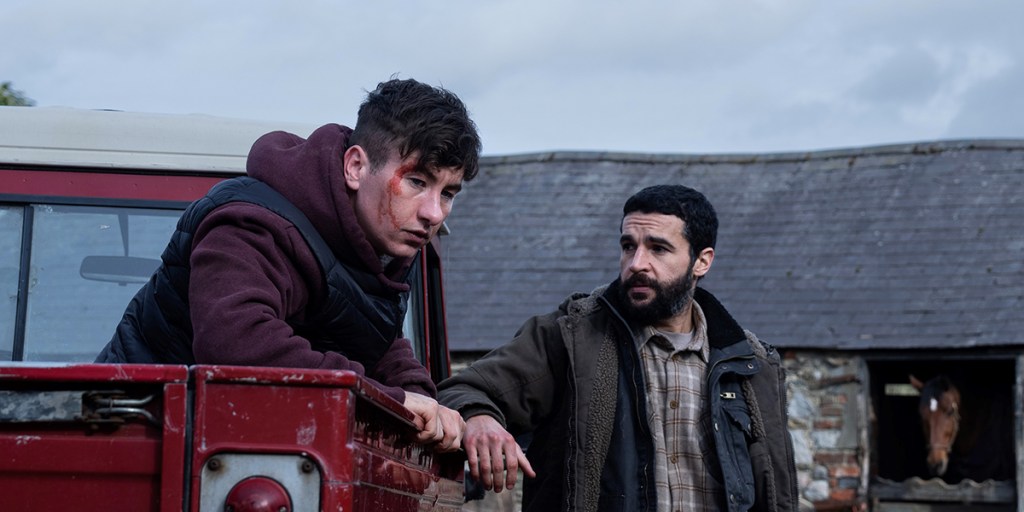
It’s rural Ireland in the present day. Michael (Christopher Abbott) runs a one-man sheep farm, where prize-winning rams graze on rocky hillsides. His abusive dad Ray (Colm Meaney) sits in the kitchen all day shouting angry epithets in Irish at Michael about all the things he’s doing wrong. In the next sheep farm over, young Jack Keeley (Barry Keoghan) does much the same as Michael but not very well. His dad Gary (Paul Ready) — who is Michael’s age — tries to keep things going but the farm is bleeding money. Gary is married to Caroline (Nora-Jane Noone), Michael’s ex, and Jack can see his parents are not getting along. Michael hasn’t seen her for 20 years, ever since a car accident killed his mother and sent Caroline to hospital with serious injuries (The accident was Michael’s fault).
But their relatively bucolic lives are interrupted when two rams disappear from Michael’s flock. And there’s only one place they can go — to the Keeley farm just over the hill. But Jack claims they both suddenly died and he threw their bodies into a pit…a very unlikely story. This signals the start of a feud between the two families, involving simmering grudges, sheep poachers, and organized crime. Can their conflicts ever be resolved? Or are both farms headed for
ruin, violence and possibly even death?
Bring Them Down is a violent, suspenseful drama about escalating grudges between two houses. It’s done in that chop-up style popular among some European arthouse directors where the narrative is not told chronologically. Your perception of “who is to blame for what” gradually shifts as new scenes fill in the blanks. I liked the acting and the dialogue — half of which is in Irish — and it has a compelling plot. The settings are just beautiful, with wide panoramic views of hillsides at dusk and dawn, and images like Michael carrying a lame sheep draped over his shoulders. There are also some strikingly original tableaux like the sheep at an auction house. This is a good first film — it reminds me of Frozen River and Winter’s Bone, all serious looks at crime in rural settings. But why are all these movies about brooding Irish men so depressing? What miserable lives these people seem to lead! If there were a bit of humour or love, Bring them Down would have been a lot easier to take.
But it’s still a good movie, anyway.
Dark Nuns, Love Hurts, and Bring them Down are all opening this weekend in Toronto; check your local listings. This is Daniel Garber at the Movies, each Saturday morning, on CIUT 89.5 FM and on my website culturalmining.com.
Blacks, Jews and Irishmen. Films reviewed: The Piano Lesson, A Real Pain, Small Things Like These
Hi, this is Daniel Garber at the Movies for culturalmining.com and CIUT 89.5 FM.
Fall Film Festival Season continues with the EU Film Fest, showing free films from across Europe at Spadina Theatre starting on the 14th.
This week, I’m looking at three family dramas. There’s Black siblings in Pittsburgh, Jewish cousins in Warsaw, and an Irish dad with his five daughters, in… well, Ireland.
The Piano Lesson
Dir: Malcolm Washington
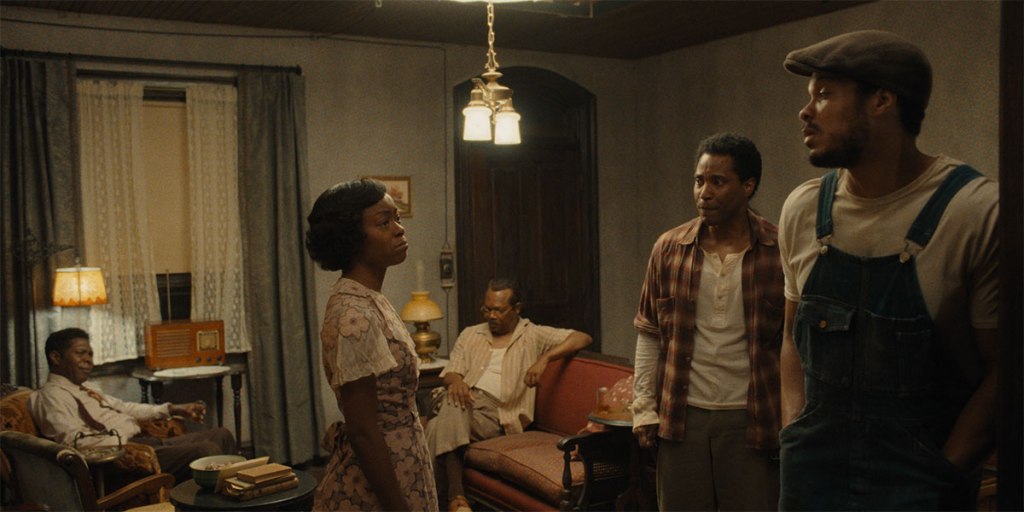
It’s 1936. Boy Willie Charles (John David Washington) and his friend Lymon are driving north from Mississippi with a truckload of watermelons, to visit his sister Berniece (Danielle Deadwyler) in Pittsburgh, Pennsylvania. She’s living with their uncle Doaker (Samuel L. Jackson). Once they sell the melons, Boy Willie plans to take his share of the profit (along with his savings) to purchase Sutter’s land. That’s the same place where his great grandparents were slaves, and where he still toils the land as a share-cropper. This is his one chance to own it. But he’ll only have enough money if he sells the family piano. That’s why he’s visiting Pittsburgh. But Berniece refuses to sell it. Why? She grew up playing that piano, and more to the point it has family faces elegantly carved into the wood itself, dating back to pre-Civil War days. Besides, she says, that piano is haunted… and the ghost is getting meaner. Meanwhile various family and friends, like a trickster and a preacher, are congregating at this house with different motives for being there. Can Boy Willie and Berniece come to terms about the piano? Or will bad spirits — both supernatural and human — ruin everything first?
The Piano Lesson is an excellent filmed version of playwright August Wilson’s drama. Fine acting all around, with Danielle Deadwyler outstanding as Berniece. Now, plays and movies are two different things. Actors emote louder and move bigger on
stage (so everyone can see and hear them). And even the blocking and dialogue is different. Movies are no more real, but different. This Piano Lesson is very much a play. So I was a bit put off by it’s style… until the my brain started watching it as a play, at which point I really liked it.
If you notice a lot of Washingtons here, it’s no coincidence. Denzel Washington is the producer, and actor John David and director Malcolm are both sons of his. Denzel is committed to putting all ten of August Wilson’s Pittsburg Cycle on the big screen to preserve crucial Black American culture. Witness Fences in 2016 and Ma Rainey’s Black Bottom in 2020. The Piano Lesson is a fine addition to this series and should be watched.
A Real Pain
Wri/Dir: Jesse Eisenberg
Benji and David Kaplan are cousins in their 30s, as close as brothers, but totally different. Benji (Kieran Culkin) is loud, gregarious, obnoxious and larger than life. He likes to raise a ruckus and mess things up. He lives alone in Binghamton, NY. David is shy, insecure and withdrawn. He’s married with a small kid and lives in Manhattan. He’s in a constant state of dithering and worrying. They’re travelling together to Poland to explore their family’s heritage. Their grandmother was Polish and a Holocaust survivor.
Benji was very close to her and devastated by her recent death, much more so than David. They’re part of a small tour group, all Jewish. Their guide (Will Sharpe) is a nerdy English guy, very accommodating. Also on the tour are Marcia (Jennifer Grey) who suffers from intergenerational trauma; Eloge (Kurt Egyiawan) from Winnipeg but originally from Rwanda where he survived Tutsi genocide; and a middle-class couple whose family immigrated from Poland generations ago but want to see where they came from. (“We’re Mayflower Jews”, he says).
Their journey takes in cultural and historical sites across Poland, but the closer they get to the concentration camp where their
grandmother was imprisoned, the more agitated Benji gets. He slips into shouted diatribes and lectures, causing scenes within their group and in public places — to David’s acute embarrassment. Can they both make it through the whole tour? Or will one of them drop out?
A Real Pain is a low-key, social comedy — yes, a comedy — about the uncomfortable dynamics within a family. it’s actually pretty funny, No slapstick or pratfalls, rather unexpected squirmy riffs on the two main characters’ personalities. (Like Benji telling David his bare feet are gorgeous, making him stare at them for the rest of the trip.) It’s told in a series of clever vignettes over the course of the trip, all hovering over unvoiced feelings of personal and collective mourning. I’m always suspicious when actors play at directing, but this is no vanity pic. Eisenberg stays suitably subdued, letting Culkin go wild.
I like this movie.
Small Things Like These
Dir: Tim Mielants
It’s winter in a small town in Ireland in the 1980s. Bill Furlong (Cillian Murphy) is a working man who scrubs coal dust off his hands and face each day. But he doesn’t work in a coal mine; he has his own business, built from scratch, selling coal. His wife Eileen (Eileen Walsh) and his eldest daughter handle the finances. One day, he’s making a delivery when he’s alarmed to see a teenaged girl being dragged, kicking and screaming, into the local convent. That’s not right. She may be unmarried and pregnant, but why are they kidnapping that poor girl?
So he steps inside to take a look. It’s the Magdalene Laundries, a Church organization that operates across Ireland, to care for unwed mothers. They put the babies up for adoption, and the girls and young women are trained to work as industrial laundresses. But to Bill it seems almost like a prison, where the girls are treated horribly. When one girl runs over, begging him to help her escape, he doesn’t know to do. The nuns quickly disabuse him of any notions he might have, and rush him out the front door.
But Bill has history. He was brought up in this same town by his own single mum, who chose to stay away from that convent. He was bullied as a child because of this, but he still remembers how his mother — and her employer, an independently wealthy woman — defied the church. He feels he has to do something for that girl. But the nuns have their fingers in every pie; the school, government, they’re even a client of his own business. Should he confront the cold-eyed Sister Mary (Emily Watson) who runs everything? Or should he just worry about his own family, and pretend nothing is wrong?
Small Things Like These is a deeply-moving drama about families, moral dilemmas and the checkered history of the Catholic Church in Ireland. This is the third such movie, after The Magdalene
Sisters and Philomena, but its repercussions are still very much alive. Cillian Murphy — who you probably recognize from Oppenheimer or Peaky Blinders — once again pulls you into the character he plays. He rarely speaks but the emotion in his features really affect you. So if you’re looking for a real tear-jerker, this is the one to watch.
A Real Pain, Small Things Like These, and The Piano Lesson all open in Toronto this weekend; check your local listings.
This is Daniel Garber at the Movies, each Saturday morning, on CIUT 89.5 FM and on my website culturalmining.com.
Reduplicatives. Films reviewed: Didi, Sing Sing, Kneecap
Hi, this is Daniel Garber at the Movies for culturalmining.com and CIUT 89.5 FM.
Any given movie can be placed somewhere between truth and fiction — just depends on how close a fictionalization sticks to the true story. But when actors play themselves it tends to shift toward the truth side. This week, I’m looking at three great new movies that deal in dramatizations, semi-autobiographies, and fictionalizations. There’s a group of actors in a maximum security prison, some Irish rappers in Belfast, and a Taiwanese-American adolescent in the Bay Area.
Didi (弟弟)
Wri/Dir: Sean Wang
Chris (Izaac Wang) is a preteen schoolboy in Fremont, California in the Bay Area. He lives with his Mom (Joan Chen) his big sister Vivian (Shirley Chen) and his elderly grandmother Nai-nai (Zhang Li Hua). Missing from this picture is his dad who supports the family from his job in their native Taiwan but whom they rarely see in person. Home life is fractious at best — Chris is waging a long war with Vivian, and their practical jokes are getting increasingly extreme. Nai-nai feels isolated and takes out her anger on his mom, while she just tries to keep the family from falling apart. At school and in the streets, Chris’ best bro is Fahad (Raul Dial), who hangs with the rest of their crew. They’re all Asian-Americans — Filipino, Korean, Indian — but no one else is Taiwanese. He goes to his first house parties, and decides to meet a girl. He has crush on Madi (Mahaela Park) but doesn’t know what to do once they meet. And this is a seminal year. Vivian is heading off to college, and Nai-nai is rapidly aging. His mom pressures him to take tutoring with her friends’ kids, but he can’t stand that group.
When his first try at dating ends ends up in a fiasco, he feels betrayed by his usual crew. So he tries to make new, cooler friends. He approaches three skaters at a skate park and proposes shooting their videos. He doesn’t know the first thing about it, but at least he has new friends to hang with. He reinvents himself and hides his
ethnicity (I’m half, he says). But as his anger, frustrations, insecurities and self-doubt build up, and his whole life feels uncertain, he doesn’t know which way to turn. Can Chris survive the unbearable pressures of adolescence?
Didi (the title means younger brother in Chinese) is a semi-autobiographical coming-of-age story about Sean Wang’s own life growing up in Fremont in 2008. It feels honest and real, full of the angst and heartbreak of youth. It’s full of myspace and early texting, his computer screens filled with nihilistic accidents and explosions. Something about this movie really hit me; yes it’s a coming-of-age story with many of the expected scenes, but without any of the usual cliches. The acting is all-around great and for a first feature this one’s a real accomplishment.
I quite liked this one.
Sing Sing
Dir: Greg Kwedar
It’s Sing Sing, the infamous, maximum security prison, 30 miles up the river from New York City. Divine G (Coleman Domingo) is a long-time prisoner there, known for his acting and oratory skills, as well as his kind and giving nature. He’s also a star of the plays they put on at the prison. And they’re looking for new participants. Like Clarence “Divine Eye” Macklin (played by himself). Macklin shakes down people in the yard and always displays a tough, gangsta image. But Divine G recognizes his talent and encourages him to join up. And at the same time he’s working on the play, he also helps other prisoners appeal for parole or pardons. He himself was wrongfully convicted, but has less luck than the people he helps.
Now prisoners don’t just act there, they also direct, come up with the story, and do the production work as well. But despite his efforts to help him, Macklin brushes him off and puts down the acting exercises. This year’s play is made up of a fantastical amalgam of concepts: pirates, aliens, ancient Egyptians, and Shakespeare’s Hamlet, to name just a few. But obstacles threaten the whole production. Will Divine Eye learn to get along with Divine G? And can this experimental play work?
Sing Sing is a wonderfully revealing and well-acted drama about people putting on a show while incarcerated. It tells, sequentially, all the stages of putting on a play: auditions,
exercises, read- throughs, dress-rehearsals and the show itself. Some of the main characters are played by accomplished actors, like the wonderful Coleman Domingo, and Paul Raci as the director. But co-star Clarence “Divine Eye” Macklin plays himself; the film is based on his own story. Other formerly incarcerated performers play themselves or other prisoners. More than that, it fleshes out the true stories of the characters they play. Some of the actors — huge bruisers with facial tattoos — if you ran into them in a dark alley, you’d probably scream and run away. But they’re actually nice, creative, and intelligent guys who needed something like this. Rehabilitation Through the Arts (RTA) is a highly successful program that gives meaning and purpose to the lives of prisoners. Within three years of being released from prison in New York State, 43% are back behind bars. But for participants in RTA the 3-year recidivism rate is less than 3%. That shows you how important it is.
Despite the desolate, horrific and overcrowded conditions in prisons, this drama will make you feel good about the world again.
Kneecap
Co-Wri/Dir: Rich Peppiatt
(Co-written by Móglaí Bap, Mo Chara)
JJ teaches music and the Irish language to bored students at a public school in West Belfast. He also speaks Irish at home with his girlfriend. They’re interrupted in bed one night by a phone call asking her to translate at the police station. She doesn’t want to, so JJ goes in her stead. The suspect is Liam, a lad in trackies arrested at a rave in the woods, who claims to speak only Irish no English. The detective wants JJ to help with the interrogation. She’s also curious about Liam’s notebook, filled with scrawled poems. Thing is, speaking Irish has a political dimension, too — it’s been an act of rebellion since long before independence from the British. So JJ stealthily sides with Liam, pocketing the book while Liam distracts the detective. JJ loves the rhymes, and wants Liam to rap them, in Irish, to hip hop beats (something never done before). Liam says, never without Naoise, his best pal and business partner.
They’re childhood friends, since Naoise’s IRA dad taught them to speak Irish before he went underground. Now they’re not just besties, they’re the main local dealers in drugs and hallucinogens. They agree to make a go of it, and come up with a name, Kneecap. (Kneecapping was a form of torture and punishment during The
Troubles). Naoise calls himself Móglaí Bap, Liam’s handle is Mo Chara, and JJ is DJ Próvai. But he has to hide his face behind an Irish-flag-striped balaclava, or risk losing his job. Their first gig is at a local pub before a handful of old geezers. But word spreads, and soon enough, kids everywhere are copying their rhymes to JJ’s backbeats.
But not everyone loves them. The police detective is watching them closely, with veiled threats. A vigilante group — Radical Republicans Against Drugs — threaten physical punishment for snorting coke on stage. Naoise’s dad says their performance jeopardizes the cause. And even Liam’s clandestine girlfriend, Georgia — a Protestant no less! — hurls abuse at him as they have passionate sex in her bedroom. Will this Irish rap trio become famous? Or will they die trying?
Kneecap is a fast-moving musical, and a sex-and-drug-filled romp, with a large dose of Irish republican politics. This hilariously fictionalized biopic of the hiphop trio shows the nitty gritty of their sketchy lives. Surprisingly, the three chose to play themselves… and more surprising, they can actually act! They’re good. The rest of the cast are pro actors, including Josie Walker as the cop and Jessica Reynolds as Georgia, Liam’s sex friend. Gerry Adams plays himself, and Michael Fassbender — who was Bobby Sands in Steve McQueen’s gruelling Hunger — plays a similar role as Naoise’s underground Dad.
The film is stylized in presentation, with lots of cute animated details worked into the live action, plus occasional drug-filled fantasies using claymation. Even the violence — be it from guns or police clubs — is fantasy-like not gruesome. Most of the dialogue, and the rap, is in Irish/Gaelige, a once nearly dead language having a modern renaissance. Now, I don’t speak the language, but still, many of the Irish speakers in the movie sounded like absolute beginners, sounding out the words; but at least the three mains were speaking like it’s their native tongue, which is quite remarkable.
I found Kneecap a lot of fun.
Didi, Sing Sing and Kneecap all open in Toronto at the TIFF Lightbox this weekend; check your local listings.
This is Daniel Garber at the Movies, each Saturday morning, on CIUT 89.5 FM and on my website culturalmining.com.
Current cinema. Films reviewed: Destroy All Neighbours, Freud’s Last Session, T.I.M.
Hi, this is Daniel Garber at the Movies for culturalmining.com and CIUT 89.5 FM.
It’s “award season” when prizes are handed out to the best — or most widely publicized — movies. But not every film is prestigious or a blockbuster. So this week, I’m looking at three new movies — one each from the US, Ireland and England — that might otherwise fall through the cracks. There’s a robot with human traits, a music producer turned serial killer, and a psychoanalyst talking about God.
Destroy All Neighbours
Wri/Dir: Jonah Ray Rodrigues
William (Jonah Ray Rodrigues) lives in a rundown apartment with his girlfriend Emily (Kiran Deol) a lawyer. He’s tall, skinny, and wears unfashionable clothes and nerd glasses. He works in a studio at the soundboard, helping bands record their music. But sometimes he feels like he’s just a knob- turner, going through the motions. His real passion is recording the ultimate prog-rock album, and is constantly coming up with new ideas, but never finishing it. Emily encourages him to give up and move on, but he feels he has to do it. But he’s getting more and more tired and frustrated by the people around him. At work, his boss is constantly ragging him for being late. And the latest client, Caleb Bang Jansen is insufferable. Even the panhandler where he parks his car is getting on his nerves. At home, Eleanor, the elderly pothead superintendent (Randee Heller) is constantly calling him for help with the fuses. Another neighbour, Phillip, lets his pet pig roam the halls. But worst of all is the new tenant next door. Vlad (Alex Winter) is hideously ugly, aggressive and incredibly loud, playing non-stop euro disco all night long. Vlad lifts weights using buckets of cement attached to his barbell. He’s a scary guy, William is passive aggressive and terrified of face to face confrontations.
When he finally visits Vlad to ask him to turn down the music, they get in a fight and somehow Vlad ends up impaled on a stake, and — accidentally — decapitated!
William doesn’t know what to do, but finally realizes he has to dispose of the body. But things have changed since Vlad — new bodies keep piling up — always killed unintentionally by him, by strange coincidences. He becomes a serial killer by default, or a serial manslaughterer, as he likes to say.
But when the all the people he killed come back to life, he realizes something really strange is going on. Can William keep his boss and girlfriend happy, record his prog rock album, stop killing people, and living a normal life? Is he destined for a very dark future? Or is he just losing his marbles?
Destroy all Neighbours (the title says it all) is a comedy/horror movie, with an emphasis on in-your-face, gross-out humour. So there’s lots of disgusting blood and
gore, but it’s always so exaggerated it’s funny, not scary, in the manner of Monte Python or Army of Darkness. Jonah Ray Rodrigues is the writer/ director/star and the current host of Mystery Science Theatre 3000. I admit it’s an acquired taste, and some of the gags and schtick fall flat, but I was laughing more than not. I happen to like that kind of humour (in moderation) but, admittedly, it’s not for everyone. So if you’re into bloody horror-comedy set in L.A.s skid row, or even if you’ve ever had annoying neighbours, I think you’ll love Destroy all Neighbours.
Freud’s Last Session
Co-Wri/Dir: Matt Brown
It’s September, 1939. Germany has invaded Poland and Great Britain is about to go to war. Sigmund Freud (Anthony Hopkins) and his daughter Anna (Liv Lisa Fries) left their homes and vocations in Vienna after the Anschluss — the unification of Austria and the Third Reich, and moved to London. His office is decorated with the art and bric-a-brac of home: Persian rugs, African fertility statues and Catholic saints. Anna continues to research and give lectures on psychoanalysis and child psychology, but Sigmund, due to his age (he’s 83) and poor health (he’s dying of cancer) rarely leaves his home now. But on this day he has an unusual visitor: CS Lewis (Matthew Goode). Lewis is a don at Oxford where he teaches English and has written a book about Pilgrims Progress. (He later goes on to write The Chronicles of Narnia.) And he’s still suffering from shell shock from WWI. But why are they meeting? Lewis wants to talk with Freud about God and religion. He once was an atheist but now has adopted theism and Christianity as his guiding light. Freud, on the other hand, is a committed atheist and finds all religions equally fascinating and equally false. Still, they have a spirited discussion on a wide range of issues. But certain topics are taboo. For example, Freud refuses to talk about the fact that Anna has a female lover. And Lewis considers his own sexual relationship with his late best friend’s mother as something too private to share. Meanwhile, air raid sirens are going off, Freud is struggling with the oral prosthetic he calls his “Monster” and nobody knows what the future will bring. Will this be Freud’s very last session?
Freud’s Last Session is a fictional historical drama adapted from the successful stage play. There’s no evidence that an elderly Freud and a younger Lewis ever actually met; the story functions more as an intellectual exercise than a theatrical drama. So it’s not captivating, but it did keep my attention. They try to perk it up a bit with flashbacks — Lewis in the trenches in WWI; Freud as a small child — but I found them lacklustre at
best. There are some clever touches, where Freud ends up reclining on the settee while Lewis takes on the analysts role. Of course it has nice period costumes and sets, but the main reasons to see this film is first the topics and second the acting. The topics range from sex to psychoanalysis to theology. Devotees of Freud and/or Lewis may get a kick out of it, but no major revelations here. The acting, though is delightful. Hopkins walks through his usual role — along with a few artfully-placed wunderbars and ja ja ja and das ist gut! so we don’t forget he’s Austrian. Goode is more passionate, fearful and sad. Best of all is German actress Liv Lisa Fries (from Babylon Berlin) as Anna Freud, who gets to rush around London looking for meds for her Dad.
Freud’s Last Session is not bad, but not noteworthy, either.
T.I.M.
Co-Wri/Dir: Spencer Brown
Abi and Paul Granger (Georgina Campbell, Mark Rowley) are married, professionals, double-income, no kids, moving into a beautiful, modern home in rural England. It’s at the end of a long country road, with open staircases, glass walls and a huge garden, all paid for and arranged by Abi’s employer. She’s an engineer who specializes in AI robotic prostheses. She designs the human-looking hands of robots. Paul is currently unemployed, but is in line for a corporate position in London. They’re both looking forward to their first child, and are working hard at it each night.
Now this house is completely on the grid. Everything’s smart — smart windows, locks, heating, computers, lighting — all controlled through a central console, and co-ordinated with their smart watches and phones. The central console, though, is something her company invented. It’s a Technologically Integrated Manservant, T.I.M. for short, or just Tim. Tim (Eamon Farren) is a humanoid robot with perfect male features, blond hair, and artificial intelligence; he’s constantly learning. He’s a prototype: he can cook gourmet foods, do heavy lifting, play the piano, send and answer emails. Abi’s boss is adamant that all his employees have a T.I.M., so they can get rid of the bugs in the system before the upcoming release. Abi, loves her new toy, but Paul is less enthusiastic. Why did T.I.M. barge into their bedroom while they were making love? T.I.M. says Abi’s blood pressure and temperature had risen, he just wanted to make sure she was OK. But Paul suspects T.I.M. of spying on him. He thinks TIM sends messages to Abi whenever Paul visits Rose their only neighbour (Amara Karan), feeding Abi’s suspicious jealousies. And when he catches T.I.M. perving through Abi’s clothes, he knows something is very wrong. Is T.I.M. morphing into something bad? Can a robot even have feelings? And if things go wrong, who will Abi trust: Paul, the fallible human, or T.I.M., the perfect machine?
T.I.M. is a sci-fi thriller about the potential dire consequences of AI given a human form. This isn’t the first humanoid movie — there have been at least a dozen in the past few years — and some of the plot is predictable. And it does have that “pandemic movie feel” to it, with a tiny cast (just four main characters) located in an isolated country setting, but, in this case, it really works. It’s scary, it’s creepy, it’s interesting. It feeds on your worst fears about electronic devices communicating without your knowledge, and the possibility of the singularity, when humans will no longer be essential. I’m not familiar with any of the actors but the cast is good. The storyline is compelling, and most of all, the movie feels believable. So if you ever feel like your smart phone is a bit too smart, you’ll like this scary, sci-fi thriller. It’s a good one.
Freud’s Last Session opens this weekend in Toronto; check your local listings. Destroy All Neighbours is streaming exclusively on shudder.com, starting today; and T.I.M. is now available digitally and on V.O.D.
This is Daniel Garber at the Movies, each Saturday morning, on CIUT 89.5 FM and on my website culturalmining.com.
Girls Adopted. Films reviewed: Queens of the Qing Dynasty, The Quiet Girl, Return to Seoul
Hi, this is Daniel Garber at the Movies for culturalmining.com and CIUT 89.5 FM.
Who are your “real” parents: the ones who raise you, or the ones who gave birth to you? This week, I’m looking at three new dramas from France, Ireland and Canada, about daughters who are either adopted or have foster parents. There’s a French woman in Korea looking for her birth parents, a young woman in Nova Scotia leaving the foster parents system, and a little Irish girl sent to live with relatives.
Queens of the Qing Dynasty
Wri/Dir: Ashley McKenzie
Star (Sarah Walker) is a moon-faced 18-year-old in hospital in Nova Scotia. She feels comfortable there having spent most of her young life in and out of institutions. She’s there because she drank poison — they’re pumping her stomach. She’s over- medicated in a nearly catatonic state. And most alarming, she’s about to turn 19, meaning she’s aging out of the foster child system, and will have to take care of herself, if capable, for the first time. She’s diagnosed as bipolar with ADHD, and is prone to addiction, but her real problems lie much deeper.
An (Zheng Ziyin) a student from Shanghai, volunteering at the hospital, is assigned to keep Star company. He’s artistic, effeminate and flamboyant. He likes traditional Chinese songs (he sings in falsetto), and is obsessed with his fingernails. He imagines himself as a Manchu concubine plotting politics within the Forbidden City. But these two very different people find
comfort from each other, confessing their secrets and sending texts late at night when they’re apart. And form an unusual friendship.
Queens of the Qing Dynasty is a realistic look at two marginalized, oddball characters finding their place within a bigger, constrictive society. It’s shot in brutally drab locations, like snowbound motels, strip mall mani-pedis, hospitals and group homes, using mainly first-time actors. And despite the depressing or even tragic lives of the characters, it somehow remains light, whimsical and endearing.
This movie is both weird and appealing.
The Quiet Girl
Co-Wri/Dir: Colm Bairéad
Rural Ireland in 1981. Cáit (Catherine Clinch) is a little girl from a big, poor family of farmers. Her Dad is away all day, drinking, gambling and philandering, instead of cutting the hay. Her Mom is pregnant while taking care of a toddler and three or four others. With no one taking care of her, Cait falls through the cracks. She has dirty cheeks and mousy brown hair, is painfully shy and wets her bed. At school, she is bullied and laughed at and labeled an idiot. So her Mom asks her cousin if she could take care of Cáit for the summer while her mom’s preparing to give birth. So her father drives her out to Waterford, but forgets to unpack her suitcase before he leaves.
The Cinnsealachs (Carrie Crowley, Andrew Bennett) are a childless, older couple, middle-class dairy farmers who live in a spotlessly clean house. Cait is terrified to live around strangers, but gradually adjusts. They tell her to be honest here — there are no secrets in this house. They give her boys’ clothes to wear around the farm, and pretty dresses from in town. Soon they’re teaching her how to chop onions, fetch water from the well, or how to milk the cows. She brushes Cait’s hair a hundred times and helps her with her reading. He encourages her to run and exercise. Over the course of the summer, Cait gradually emerges as a bright
and pretty girl. But locals are gossiping about her — why is she living there? What do they want from her? Does she know their secret? And what will happen once she’s home again?
The Quiet Girl is a deeply touching story of one summer in a neglected girl’s life, amid a caring couple recovering from a loss of their own. The acting is very good, especially Clinch as the quiet girl. The story is both simple and subtle, and sure to move you to tears. Most of the characters speak Irish (with subtitles) throughout the movie, to various degrees of success. (I’ve been mispronouncing Cáit as “Kate” using an Anglicized version of her name.)
I like this movie — and it was nominated for an Oscar for Best International Film.
Return to Seoul
Wri/Dir: Davy Chou
Freddie (Park Ji-min) is a 25 year old French woman at a guest house in Seoul. She’s supposed to be in Tokyo, but ended up here when all flights to Japan were cancelled due to a typhoon. She instantly bonds with Tena (Guka Han) at the front desk, who can speak French. That evening, Tena and other new friends tell Frankie she has classic Korean features, and doesn’t seem French at all. She decides to prove her Frenchness by being provocative, spontaneous and wilfully rude. When she admits she was born in Korea but adopted as an infant in France, they wonder why she hasn’t been to “Hammond” an adoption agency which holds all relevant data.
Frankie is uninterested — she’s here as a tourist — but does carry a snapshot in her wallet of a woman holding her as a newborn babe. She ends up requesting meetings with both of her birth parents. Her birth father (Oh Kwang-rok) is a former fisherman. He takes her home, feeds her, where he and his family prostrate themselves before her asking her forgiveness. She rudely rejects them, and refuses to answer his drunken teary texts sent to her each night. But her mother remains a mystery. Will Frankie ever he meet her birth mother? Does she have any connection to this strange country? Ad what will her future bring?
Return to Seoul is a dark drama of a western woman discovering
her roots. The film is fictional but based on the French director’s own experience in returning to his ancestral home in Cambodia.
Frankie’s story is told in episodes over the course of a decade, in France and in Korea, always on her birthday. Frankie is an enigmatic character, smart and sexy, but also socially obtuse, selfish and occasionally outright monstrous. At times she seems like a female Wolf of Wall Street. She treats the men she meets, both hookups and partners, like a piece of Kleenex to be discarded after use. Most of her past is only hinted at: Was she once a concert pianist? What was her relationship with her French family? But eventually she lets her real feelings show through, if only for a moment.
Return to Seoul is a troubling, alienating and emotionally powerful film.
Queens of the Qing Dynasty, The Quiet Girl, and Return to Seoul all open this weekend at the TIFF Bell Lightbox; check your local listings.
This is Daniel Garber at the Movies, each Saturday morning, on CIUT 89.5 FM and on my website, culturalmining.com.
Fall dramas. Films reviewed: The Swearing Jar, The Wonder, Armageddon Time
Hi, this is Daniel Garber at the Movies for culturalmining.com and CIUT 89.5 FM.
Fall Festival Season continues in Toronto with Cinefranco showing the latest films from France, Belgium and Quebec, and Reelasian with movies from East and South Asia, and the Asian diaspora.
But this week I’m looking at three great new movies, all worth seeing. There’s a phenomenon in Victorian Ireland, a pregnancy in Ontario, and a friendship in Flushing, Queens.
Dir: Lindsay MacKay
(Wri: Kate Hewlett)
Carey and Simon (Adelaide Clemens, Patrick J. Adams) are a couple in their thirties living in Carey’s large childhood home in in an unnamed Canadian city. She’s a school teacher who would rather be a musician, and he’s a writer who loves Shakespeare. They enjoy drinking, cussing and having fun. But when, after years of trying, Carey is finally pregnant, they decide to change their lives for the better, to be good examples for their upcoming baby (hence the swearing jar of the title). But for some reason, communication is breaking down. And when Bev, Simon’s alcoholic mom (Kathleen Turner) drops by unannounced, the tension grows. She repeatedly tells Carey that Simon is just like his dad — he’s gonna leave you, she says, they always leave you. Later, Carey sees Simon’s novel in the window of a
bookstore, and makes friends with the guy who works there. Owen (Douglas Smith) is a musician like Carey once was… maybe they can write and play music together? But would that amount to cheating on her husband?
The Swearing Jar is a delightful musical-romance about a
couple dealing with her pregnancy along with an unexpected twist (no spoilers here). The story is told through a series of vignettes alternating with related songs performed on stage by Carey and Owen in honour of Simon’s 40th birthday. The music is great with some catchy tunes, and the script (originally a play) is generally engaging and funny. Adelaide Clemens has a lovely voice — she and Douglas Smith show real chemistry — and I had no idea she’s actually Australian! This is good one.
Dir: Sebastián Lelio (Based on the story by Emma Donoghue)
It’s rural Ireland in the 19th century, not long after the Great Famine. Lib (Florence Pugh) is a respected nurse from England who trained under Florence Nightingale in the Crimean War. She is hired to oversee an unusual patient. Her name is Anna, an 11-year-old girl who has stopped eating. She hasn’t taken a bite for months, but somehow she’s still alive. How is this possible? People arrive from all over, both penitents and tourists, to gawk at or be blessed by the saintly girl. So a local committee, headed by a doctor and a priest (Toby Jones, Ciarán Hinds), appoints a nun and a nurse (Lib) to take turns watching over Anna, one to make sure it’s a miracle, and the other that she’s not in physical danger. But something smells fishy here. So she joins with an investigative journalist from
London, William Byrne (Tom Burke). But will their snooping around put the girl’s life on the line? And if so, what can they do to save her?
The Wonder is a wonderful historical drama, beautifully made. Pugh plays Lib as a modern woman who is serious about her career, but also takes recreational drugs and has casual sex for the pleasure of it, probably not typical in the Victorian era. But it
also exposes dark and hidden secrets, which gives the movie a serious and disturbing undertone. It’s directed by Chilean Sebastián Lelio, who brought us other great movies with dynamic female characters like Gloria (my review here) and A Fantastic Woman (my interview with Daniela Vega). The Wonder doesn’t quite reach that level of angsty, subversive excellence (it’s more conventional), but still very good.
Wri/Dir: James Gray (my review of The Lost City of Z)
It’s Flushing, Queens, NY City in 1980. Paul Graff (Banks Repeta) is a little guy with red hair and blue eyes who wants to be a famous artist when he grows up. He lives in a small house with his bullying brother, his plumber dad, (Jeremy Strong) and Home-Ec teacher mom (Anne Hathaway). Encouraged by her and his beloved Liverpool-born grandpa (Anthony Hopkins) Paul devotes himself to reading Jansen’s History of Art and drawing everything he sees. But he has a short attention span — often drifting into daydreams — and acts up at home. On his first day of sixth grade, Paul manages to get into trouble even before his teacher, Mr Turtletaub, finishes taking attendance. His crime? Accurately drawing his teacher’s face. He’s soon relegated to chalkboard-cleaning at the front of the class alongside perpetual trouble-maker Johnny Davis (Jaylin Webb). Johnny, who lives with his grandmother, is into NASA, space ships, and Grandmaster Flash. He is repeating sixth grade for
disobedience. They soon become best friends, with Johnny introducing Paul to hiphop and rockets, and the much shyer Paul standing up for his friend. Paul is white and Jewish, while Johnny is one of the only black kids in class.
They are both bright but are labelled as “slow”. Rejected by the school, they increasingly turn to rebelliousness to fight back. Soon the pre-teens are cutting class to smoke pot in the boys room. But when events escalate, Paul is sent to a strict, conservative prep school favoured by the Trump family, while Johnny finds himself homeless and on the run. Will their new situation make their friendship impossible?
Armageddon Time is an autobiographical, coming-of-age drama about a rebellious kid growing up in Flushing Queens, his family and his friends. It’s also a glimpse at the period, its music, attitudes and politics. Ronald Reagan is running for President, the subways are covered in graffiti and punk and
hiphop are pushing disco away. Closely based on James Gray’s own childhood, it deals with racism, class, corporal punishment and loss, but also friendship, kinship and family. I can’t help comparing it to Stephen Spielberg’s The Fabelmans, coming out later this year, another great autobiographical movie about a future filmmaker’s childhood; but while Spielberg’s is cinematic and full of gushing music, Armageddon Time is much grittier, less idealized. This one is more about the not-so-nice aspects of growing up. Banks Repeta and Johnny Davis are both remarkable as the two kids — they don’t bother learning Flushing accents, concentrating instead on their performance. Hathaway, Hopkins and Strong were also excellent.
I was really moved by Armageddon Time.
The Wonder is now playing at the TIFF Bell Lightbox; The Swearing Jar and Armageddon Time also open this weekend; check your local listings.
This is Daniel Garber at the Movies, each Saturday morning, on CIUT 89.5 FM and on my website, culturalmining.com.
Friends divorce, killer nurse, even worse. Films reviewed: Decision to Leave, The Good Nurse, The Banshees of Inisherin
Hi, this is Daniel Garber at the Movies for culturalmining.com and CIUT 89.5 FM.
It’s Halloween weekend, with lots of good scary movies playing now, but if you’re staying home, you check out the streamer Shudder, with some of the coolest indie horror and fantasy movies out there. Or if you’re on Netflix, check out Guillermo del Toro’s Cabinet of Curiosities, his new anthology series of well-made, one-hour dramas.
But this week I’m looking at three new movies, all of which I saw this year at TIFF. There’s an Irish friendship threatened with divorce, a killer who may be a nurse, and a detective obsessed with a suspect who may be a killer… or worse.
Co-Wri/Dir: Park Chan-wook
Hae jun (Park Hae-il) is a homicide detective in Busan, Korea. He is devoted to his job, but less so to his wife, whom he only sees on weekends. She lives in Ipo, a small town with very few murders. In comparison, Busan is a veritable hotbed of organized crime, drugs and violence. But one unusual case catches his attention: a middle aged mountain-climbing enthusiast who fell to his death from an especially steep cliff. it seems to be a cut and dry accident, except for his widow’s reaction, she barely had one. He decides to follow her, stake her out and surveil and record her every movement. The widow Seo-rae (Tang Wei) is a femme fatale, young, beautiful, and exotic in his eyes (she’s originally from China.) And unknown to him, she gets off on being followed and watched. His obsession shifts from interrogation to first-hand contact and eventually to a passionate, clandestine affair. He later moves to the quiet town of Ipo to be with his wife. But when he discovers Seo-rae lives
there too, and is remarried to very rich man, his suspicions are raised. Is she a killer or just an innocent woman? And will seeing her again lead to trouble?
Decision to Leave is a fast-moving and stylish police thriller, told with an absurdist touch. It never takes itself too seriously, but it’s a lot of fun to watch. Tang Wei (who was great in Ang Lee’s Lust, Caution) has a classic noir feel to her. And Park Hae-il plays the beguiled but committed police detective very well. The movie is beautifully crafted but constantly plays tricks on the viewers. It has some of the strangest shifts in point of view I’ve ever seen, including even one shot seen through the cloudy eyes of a dead fish. Which makes the movie a bit challenging to follow, but worth it.
Dir: Tobias Lindholm
Amy (Jessica Chastain) is a single mom with two cute but rambunctious young girls. She has a woman who takes care of the kids when she works late, but her patience is running out. Amy works full time as a registered nurse at a corporate hospital in New Jersey. She also has a heart condition, which requires major surgery. But if the hospital finds out about her pre-existing condition before she finishes her probationary period, she’ll be let go. enter Charlie (Eddie Redmayne) a kindly inoffensive nurse who just transferred from another hospital. He helps her out, covering for her when she faints at work, and volunteering to help with her kids. He’s divorced with kids himself so he’s good with children.
But things start to go wrong at the hospital. Patients are dying for no good reason. And when the police come to investigate,
they are stonewalled by the hospital management, who refuse to cooperate. But two of the patients died on Amy’s shift, so she needs to find out what happened. Like why did an otherwise healthy senior die of a suddenly skyrocketing insulin level? And what about a little kid? All of the patients are in hospital for a reason, but that’s not how they died. The more she investigates, the more it looks like good ol’ Charlie is somehow connected. Can she figure out why the patients are dying and who is responsible? Or will this put her and her family in danger?
The Good Nurse is a mystery thriller, based on a true story. It’s two hours long, and it doesn’t get good till near the end of the first hour. I saw this movie at TIFF on a huge screen at Roy Thompson Hall, and I found it visually oppressive. Everything is drab and dull, grey and light blue, dim and soft focussed, with an intensely boring colour palate. All you see are institutions —
hospitals and police— at their most plain and mundane. Movies are meant to be a pleasure watch, why make it so a chore to look at. (Admittedly, I saw it again on Netflix on a small screen, and it didn’t bother me visually nearly as much.) In any case, the story is good, thrilling and tense, once it picks up. Jessica Chastain is sympathetic as Amy, and Eddie Redmayne is excellent as a milquetoast guy with a dark side. If you just want to spend two hours on a true crime hospital mystery with no expectations, The Good Nurse will probably satisfy you.
Dir: Martin McDonagh
It’s 1923, on a tiny, fictional island, separated by water from the Irish civil war raging in the distance. Pádraic (Collin Farrell) is a simple man living a simple life. He plays with his miniature donkey, sells his cows’ milk to the local shop, and sleeps soundly in his cottage close to his sister Siobhan’s bed (Kerry Condon). But most important of all, is his best friend Colm (Brendan Gleeson). They meet each afternoon to walk to the pub and chat over beer. Which is why he is shocked and confused when Colm decides one day, not to go drinking with Pádraic. Just today? No, now and forever. Colm doesn’t want to drink with him, Colm talk with him, He doesn’t even look at him. He has wasted enough time on pointless chatter, and now wants to his life worthwhile, to do something noteworthy. Colm plays the fiddle, perhaps he can
compose a great work. But Pádraic refuses to allow his best friend to just walk away. He won’t leave him. Until Colm makes a vow: If you ever speak with me again, I will cut off one of my own fingers. And if you persist, I will cut off another and another until you leave me alone. What’s wrong with Colm? Should Pádraic take him seriously? Is this all his own fault?
The Banshees of Inisherin is a really good dark comedy, that builds from a simple disagreement to one of increasingly dramatic reactions on each side. I’m only touching on one plot — there are also subplots involving Dom (Barry Keoghan) a simpleton who has a crush on Padraic’s sister; Mrs McCormick
(Shiela Flitton) a creepy, banshee-like neighbour, as well as an abusive policeman who is also Dominic’s dad.
I’m guessing here, but maybe — even though it’s never explicitly mentioned in the movie — the story is a metaphor for the Irish Civil War, with Pádraic as the pro-treaty side who wants things to stay the same, and Colm as the IRA who wants a dramatic change even if it involves violence and loss. Or maybe it’s just director Martin McDonagh having his usual brilliant, chaotic fun with great characters, some violence and a cool political subtext. He’s known for movies like Seven Psychopaths and Three Billboards Outside Ebbing Missouri… maybe this one should be called The Five Fingers of Inisherin?
Decision to Leave is starting at the Tiff Bell Lightbox; The Banshees of Inisherin opens this weekend, check your local listings; and The Good Nurse is now screening on Netflix.
This is Daniel Garber at the Movies, each Saturday morning, on CIUT 89.5 FM and on my website, culturalmining.com.
Daniel Garber talks with Frankie Fenton and IIda Ruishalme about Atomic Hope at #Hotdocs22
Hi, this is Daniel Garber at the Movies for culturalmining.com and CIUT 89.5 FM.
Photo by Jeff Harris.
Climate change is at a crisis point: enormous forest fires are breaking out around the world, catastrophic weather events are becoming the norm, polar ice caps are melting at an alarming rate, and sea levels are constantly rising. So any changes that slow down carbon emissions are welcomed by everyone, right? Not necessarily. Nuclear power plants are closing, and climate
activists are cheering.
Is anyone supporting the “nuclear option” or is it considered too… radioactive?
A new documentary called Atomic Hope – Inside the Pro-Nuclear Movement just had its world premier at the Hot Docs International Documentary Festival. It follows members of the widely unpopular pro-nuclear movement as they challenge current beliefs and promote nuclear energy as a viable option to fossil fuels. The film is made by award-winning Irish Director/producer Frankie Fenton, and features nuclear advocates like Iida Ruishalme, a Zurich-based, Finnish biomedical researcher, science communicator, and fiction writer.
Atomic Hope had its world premiere at #Hotdocs22.
I spoke with Frankie and IIda on location at the Hotdocs Networking Lounge at the TIFF Bell Lightbox.
Troubles. Films reviewed: Vicious Fun, Inbetween Girl, Belfast
Hi, this is Daniel Garber at the Movies for culturalmining.com and CIUT 89.5 FM.
Fall Film Festival Season continues in November. ReelAsian is on now, and Blood in the Snow (aka “BITS”) with new made-in-Canada horror movies — both features and shorts — showing on the big screen at Toronto’s beautiful Royal Cinema starting next week.
So this week I’m looking at three movies showing at Toronto film festivals. There’s an 8-year-old boy in Belfast at the start of the Troubles, a high school girl in Texas who learns having secret boyfriend can lead to trouble, and a film critic in Minnesota whose 12-step self-help group turns out to be nothing but very big trouble.
Wri/Dir: Cody Calahan
It’s the 1980s in Minnesota.
Joel (Evan Marsh) is a film critic who writes reviews for a horror movie fanzine. He’s a real devotee of slasher pics and is well versed on all the details. He lives with his apartment-mate Sarah, who he has a huge crush on. So he doesn’t like her new douchey boyfriend, Bob, at all. So he follows him to an isolated Chinese restaurant and bar where he tries to entrap him using hidden mic as the unfaithful boyfriend he thinks Bob is. But he ends drunk as a skunk and passed out in the restaurant bathroom. He wakes up a few hours later to the voice if a motivational speaker coming from the next room. He
wanders into a sort of a self-help group, a twelve step… but for whom? He takes his place in the circle and the confessions begin. Turns out they’re not alcoholics, they’re all serial killers! The worst in the world! Carrie (Amber Goldfarb) slices and dices men. Fritz (Julian Richings) enjoys paralysing victims with a hypodermic then torments them dressed as a clown. Mike, a bearded giant in a iron mask (former pro wrestler Robert Maillet) chops up coeds while having sex with them. Hideo (Sean Baek) is sushi chef-slash-cannibal who uses Ninja like skills to trap his prey. Zachary is the group leader (David Koechner) who looks like a used car salesman but had killed more than any of the others — there’s a sort of a competition going on. So Poor Joel — who they think is new serial killer who didn’t show up to this first meeting — has to
squirm his way out of it. But his cover is blown when guess who arrives late? It’s Bob (Ari Millen) the douchey sociopath he met earlier!
The group turns into a mad orgy of killing and violence once they discover his deception. But luckily, Carrie, for reasons all her own, decides to protect him from the other serial killers. What’s her secret? Can they escape these ruthless deranged serial killers? And can Joel warn Sarah in time to protect her from the evil Bob?
Vicious Fun is a comedy horror movie about a horror movie enthusiast who discovers it’s not as much fun in real life. It’s full of lots of blood and gore, as expected, but also a heavy dose of retro-80s camp, from moustachioed cops, to vintage drive in, pay phones and a seedy bar. The characters are all played to the max with the appropriate excess a group of weird serial killers demands, with Marsh as the fish-out-of-water film critic and Goldfarb as the killer with a heart off gold — as well as Millen as arrogant evil incarnate, are especially good.
Vicious Fun (just like the title says) is a very entertaining, low-budget, over-the-top movie with a clever premise that carries it through to the very end. It’s funny, bloody, and bloody funny.
I like this one a lot.
Wri/Dir: Mei Makino
Angie Chen (Emma Galbraith) is a high school girl at St Michael’s a posh private school in Texas. It’s also very white. But as a mixed race kid (white Mom, Chinese dad) she feels both self-conscious and ignored. So she’s surprised that Liam (William Magnuson) the most popular guy in the school says he likes her. He drives her home everyday, and later climbs through her window to spend time with her. They hang out, make out, have sex, and share their thoughts in addition to an occasional joint. So what’s the problem? He’s dating Sheryl (Emily Garrett), an equally popular girl, who has millions of followers on Instagram. She’s an influencer. So Liam keeps their relationship a secret. Sheryl’s too fragile, he says, not a battleship like you. if she finds it out it could kill her. (I’m a Battleship? Angie wonders.) She goes along with Liam’s game but doesn’t quite get it.
Meanwhile, there’s trouble at home. She’s disconnected from her recently divorced parents. Mom’s always busy with work and
dad has a new family, including a daughter who speaks Chinese. What’s the point of it all? But when she is assigned a school project with Sheryl, Liam’s girlfriend, Angie realizes it can’t go on like this. They’re in love… how can they keep it a secret? Will Liam choose her over Cheryl? Does Angie even want him anymore? And what will Sheryl do if she finds out the truth?
Inbetween Girl is a delightful and quirky coming-of-age story. Though the plot seems run-of-the-mill, it’s told through Angie’s art (she loves drawing comics and taking analog photos) her video monologues along with the normal story. It covers family relationships, first love and deceit, along with questions of cultural identity she has no control over. It has lots of picturesque settings in and around Galveston, giving it a view of modern cosmopolitan Texas you don’t always see.
I like this movie.
Wri/Dir: Kenneth Branagh
It’s Belfast in the last 1960s. Buddy (Jude Hill) is a little boy who lives with his brother Will, his Ma (Caitriona Balfe) and his grandparents, Granny and Pop (Judi Dench and Ciarán Hinds). His Pa (Jamie Dornan) is off in England somewhere earning a living as a joiner. He can only come home every couple weeks. Buddy misses him but spends his time studying at the Grove Park elementary school. While the classrooms never change, the seating arrangements do, where kids with the top marks move to the front each week. That’s his main motivation to study — so he can be bumped up beside the girl he wants to meet.
But things take a turn for the worse. Barricades appear on street corners patrolled by the military, while paramilitary thugs throw rocks through windows to get the Catholics to move out of their street. Buddy’s family is Protestant but he can’t tell the difference among his friends and neighbours. And as violence and intimidation increases, so does the push to join Pa in England till
the Troubles are over.
Money troubles, taxes, Pop’s illness and the friction between Ma and Pa all threaten the family. Will they stick by their beloved Belfast and the little street they’ve lived on for so long? Or will they be forced to move to England till the Troubles blow away?
Belfast is a touching look at life in Belfast during the Troubles as seen through the eyes of a small boy. Well-known actor/director Kenneth Branagh grew up there, and presumably it’s based on his memories. As such, there’s a misty-eyed sentimentality to much of the film, as would any adult thinking back to his childhood. It’s nicely shot in black and white, and the acting is generally good, though the characters seem straight out of central casting — no big creative leaps here. The best parts are
the unusual and realistic childhood memories that are totally separate from the Troubles. Things like kid gangs and shoplifting happening simultaneously with the looting, intimidation and riots. But there’s also a disjointed feel to the film itself. Van Morisson’s music is great but it doesn’t fit the mood. And there’s a strange music video inserted into the movie, for no apparent reason other than providing footage for a trailer. Gimmicks — like having people filmed in black and white watching a movie in colour — are just embarrassing. Even so, there are enough surprising plot turns and beautiful images that linger after the movie. While flawed, Belfast is still a touching, bittersweet look at one boy’s childhood in an historical moment.
Vicious Fun is the opening film at B.I.T.S., the Blood in the Snow Film Festival; In-between Girl is now screening at ReelAsianfilm Festival, and Belfast — which won the people’s choice award at TIFF this year, opens this weekend in Toronto at the TIFF Bell Lightbox.
This is Daniel Garber at the Movies, each Saturday morning, on CIUT 89.5 FM and on my website, culturalmining.com
Northern Europe. Films reviewed: The Good Traitor, Boys from County Hell, About Endlessness
Hi, this is Daniel Garber at the Movies for culturalmining.com and CIUT 89.5 FM.
I don’t care what they tell you, movies are not the same without the whole movie experience — going out, choosing a movie, standing in line, eating popcorn… and sitting in a large space beside a crowd of strangers laughing, booing or screaming to the same things you are. You can’t get that watching a laptop or a flat screen TV.
Remember TimePlay? That movie trivia game you used to play before the film starts? Well, they’re about to launch a TimePlay app, replicating the movie experience, where you get to compete against other movie buffs in real time (The winner gets Cineplex Scene card points). I tried it out this week in a trial run for media, and it’s goofy but a lot of fun.
This week I’m looking at three very different movies, all from northern Europe; an existential arthouse film, a comedy/ horror, and an existential arthouse film, and an historical drama. There’s a Swedish storyteller, a Celtic vampire, and a Danish diplomat.
Dir: Christina Rosendahl
It’s 1939 in Washington DC, on the brink of WWII. Henrik Kauffmann (Ulrich Thomsen) is the Danish Ambassador, who lives with his brilliant wife Charlotte (Denise Gough) and their two young daughters. It’s a pleasant life, drinking champagne by the swimming pool or mingling at a cocktail party… but beneath the surface, everyone knows Hitler is going to invade Denmark. Should they just let it happen? Or should they do what they can to stop it? The Nazis march in and the Danish government declares nothing bad is happening here. But Henrik and an earnest young Danish lawyer (Mikkel Boe Følsgaard) decide to do something drastic. They declare themselves representatives of the Free Danish Government in exile. And they’re joined by a dozen other Danish Embassies around the world. But can they do for money? And will they get US government support them. (The US stayed out of the war until Pearl Harbour in late 1941).
This is where the real power comes to play. It’s Charlotte, his
brilliant wife. Her family has been friends with the Roosevelts since long before she met Henrik. But can she convince FDR to side with her husband? But there’s a twist; Henrik had a fling with Zilla, Charlotte’s vivacious younger sister (Zoë Tapper) a decade earlier in Beijing. And now she’s sure they’re sleeping together again in Washington. Will Charlotte and Henrik’s troubled relationship influence the geopolitical fate of the world?
The Good Traitor is a fascinating WWII drama viewed from afar, within the safe confines of Washington’s diplomatic corps. It gives hints at the importance of diplomacy and politics in world events, and how much of it takes place behind closed doors. And so do their personal relationships. This is a very tame retelling of true events, with no battles, no death, no violence, except for a shocking twist (no spoilers). But I liked it.
Dir: Chris Baugh
Eugene (Jack Rowan) is a youngish guy who lives in a small Irish town called Six Mile Hill. Its main claim to fame is its association with Dracula author Bram Stoker, and an ancient cairn (that’s a pile of stones) on a field. It’s said to be the burial place of a legendary vampire known as the Abhartach. When he’s not cleaning up an old house his mother left him, Eugene is probably hanging at the local pub with his best mates William (Fra Fee) his girl friend Claire (Louisa Harland) and SP (Michael Hough) the bearded maniac. They earn extra bucks as tour guides for gullible tourists. But one night, in the dark, William is brutally slaughtered near the cairn. Is there something to this vampire myth? Things are brought to a head when Eugene’s dad Francie, a hard-ass contractor, hires him to tear down the cairn, to make way for a development plan, damn the possible consequences. But someone, or something, doesn’t like that. Have they gone to far? And is the entire village in danger if the Abhartach returns?
Boys from County Hell is a horror comedy, with an emphasis on
the horror, but told in a lighter style. That means lots of blood, in the most disgusting way possible (when a vampire gets close, blood starts to flow spontaneously from the eyes and noses of anyone nearby.) But there are also a lot of over-the-top violence of the dark humour type, and quite a few surprises — there’s a mystery element. This is a very Irish movie, meaning you may have to turn on the subtitles to understand what some of them are saying. I haven’t seen a good vampire movie in quite a while, and this one varies from a lot of the cliches. The cast is appealing and the pace never drags. I quite liked this one, too.
Wri/Dir: Roy Andersson
A middle-aged man and woman are sitting on a park bench on a hillside overlooking a vast grey city. They tell each other interlocking stories, about men or women they saw — either in a dream, in a fantasy or in reality (it’s never made clear) People like an awkward virginal young man staring longingly at a busty hairdresser watering a dying potted palm. Or a man who gets increasingly frustrated by a stranger who ignores him passing by on an outdoor staircase, who he recognizes as someone he had bullied years ago in public school. And a catholic priest having a nervous breakdown because he lost his faith while preparing the communion — with a psychiatrist who refuses to see him because he doesn’t want to miss the bus home. Add to this Hitler in his
bunker, a father killing his daughter in an honour killing, prisoners in a Siberia trudging toward a gulag, and an ethereal couple in their nightgowns floating far above a city.
If you’ve ever seen a Roy Andersson movie, you’ll understand that there’s no linear narrative, no main characters, or plot, per se. Rather it’s a series of vignettes that together share a theme. In this one this Ione the theme seems to be about the unrelenting melancholy, frustration and futility, passing from generation to generation. Everything is ordinary, sepia toned and middling in its regularity. People wear plain, dumpy clothes, with average bodies and faces, People rarely speak and the camera hardly moves.
It sounds like I hated this movie, but I actually loved it. About Endlessness avoids prettiness like the plague, and is never twee. And it somehow manages to imbue common, depressing thoughts with an ethereal majesty.
The Good Traitor is now playing in VOD, Boys from County Hell starts streaming today on Shudder, and Beyond Endlessness opens next Friday at the Digital TIFF Bell Lightbox. And Timeplay is now running online every Sunday, Tuesday and Thursday at 8:30 pm ET.
This is Daniel Garber at the Movies, each Friday morning, on CIUT 89.5 FM and on my website, culturalmining.com


leave a comment