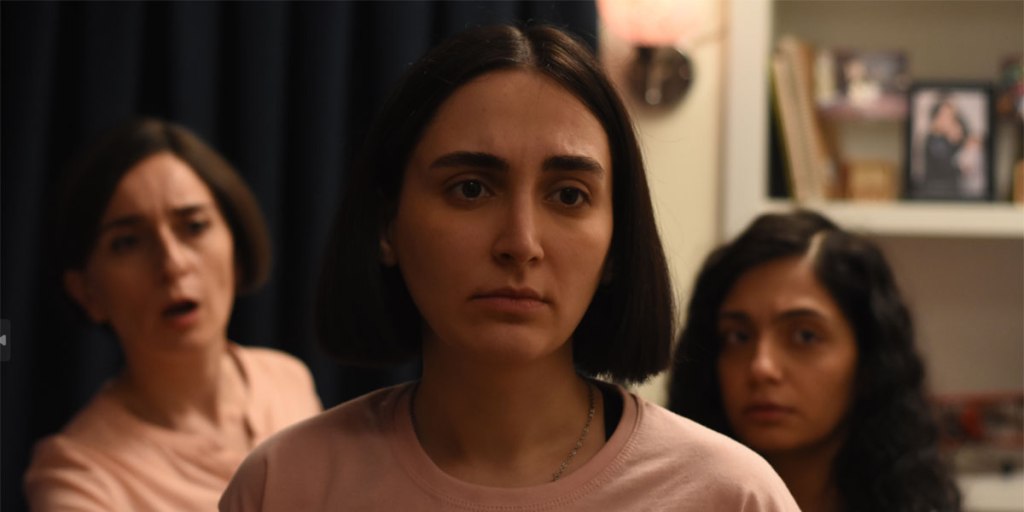
Daniel Garber talks with Matthew Rankin, Ila Firouzabadi and Pirouz Nemati about Universal Language at #TIFF24

Posted in Canada, comedy, Fantasy, Farsi, History, Iran, Language, Satire, Winnipeg by CulturalMining.com on January 25, 2025

Photographs by Jeff Harris.

Hi, this is Daniel Garber at the Movies for culturalmining.com and CIUT 89.5 FM.

It’s December in Winnipeg. Matthew Rankin, a Montreal bureaucrat, is travelling home to see his elderly mother. Most of his favourite spots are still there, but something is different; he feels lost, alienated. He sees two girls trying to free a large banknote frozen in ice. And he encounters a man who welcomes him into his home. After many years spent working in French, he is relieved to return to his native tongue and culture. But who would have guessed his universal language… is Farsi?

Universal Language is the name of a dream-like and haunting new feature that reimagines Canada’s two solitudes: francophone Quebec, and the rest of the country a unique mixture of Iran and the vast northern dominion. It’s as if Winnipeg froze unchanged somewhere in the 1980s and morphed into a non-religious People’s Republic of Iran. It’s co-written and directed by award-winning Winnipeg filmmaker Matthew Rankin, whose experimental films reimagine the country in a stylized and retro milieu. I interviewed him in 2020 about his first feature The Twentieth Century. The co-writers are both Iran-born and Montreal-based. Actor and multi-disciplinary artist Ila Firouzabadi is known for the violence and intimacy of her sculptures; while independent filmmaker, artist and actor Pirouz Nemati is completing an upcoming documentary on the matriarch of Montreal’s Byblos Le Petit Café.

I spoke with Matt, Ila and Pirouz on site at #TIFF24

Universal Language was lauded at Cannes and TIFF, on the list for an Oscar nomination for best international film, and will open in theatres soon. 

Freedom or death? Films reviewed: The Seed of the Sacred Fig, The Room Next Door PLUS Canada’s Top Ten!

Posted in 2020s, Death, Family, Friendship, Iran, Protest, Spain, Thriller, Women, Writers by CulturalMining.com on January 11, 2025

Hi, this is Daniel Garber at the Movies for culturalmining.com and CIUT 89.5 FM.

Mark your calendars, boys and girls, because the annual Canada’s Top Ten film series starts in just a few weeks. If you’re into highly original movies, you really gotta check this out. I’ve already reviewed many of them, or interviewed them already, but there’s lots left to discover.  Things like David Cronenberg’s The Shrouds, a truly bizarre mystery about an entrepreneur who invents burial shrouds that allow you to see in real time the decaying buried body of your loved one. It stars Vincent Cassell, Diane Kruger and Guy Pearce. Or Kazik Radwanski (Interview: 2013)  & Samantha Chater’s brilliant Matt & Mara, with an almost totally improvised script follows old friends (Matt Johnson, Deragh Campbell) who suddenly meet each other again, opening a real can of worms. There are also short films at this festival — I can’t wait to see NFB animator Torill Kove’s latest short Maybe Elephants; her films are just enchanting. And I’m curious what Canadian actor Connor Jessup is up to now with his short film Julian and the Wind. He starred in the movies Blackbird (2013) Closet Monster (2016) and the Netflix series Locke and Key (2021) but I have never seen his own work. These are just a few of the great movies in Canada’s Top Ten and they’re all showing at the TIFF Lightbox in Toronto.

But this week, I’m looking at two new movies, one from Iran (via Germany), and another one from Spain (via the US). There are three female activists looking for freedom in Tehran; and two female writers looking for peace in New York.

The Seed of the Sacred Fig

Co-Wri/Dir: Mohammad Rasoulof

Najmeh (Soheila Golestani) and Iman (Missagh Zareh) are a happily married couple in Tehran. They live out their two daughters, Rezvahn (Mahsa Rostami) and Sana (Setareh Maleki). The kids fight a lot, but the family is still close and trusting; no secrets here. But everything changes once their Dad — a government bureaucrat — gets a promotion. He is issued a gun for protection, due to the nature of his new position. You see, he is now sort of a judge within the Islamic Revolutionary Court. This means convicting and sentencing anyone accused of disobeying religious or political laws, ranging from women who expose their uncovered hair, to anyone caught insulting the Supreme Leader or the government itself. And especially anyone caught at a pro-democracy demonstration.  

But when Rezvahn’s best friend Sadaf gets beaten up at a demo, and they hide her in the apartment they have to keep it from her Dad. Is he responsible for this crackdown? And when his gun disappears, Iman suspects everyone. Has his family turned on him? A wall of distrust divides the family, threatening its very existence. Can they reconcile or is it too late?

The Seed of the Sacred Fig is a powerful and harrowing drama about distrust and betrayal, within a family torn apart by the influence of an authoritarian government on all of their lives. It was shot entirely in Iran, on the sly, by noted director Mohammad Rasoulof who smuggled it out of the country. (It was edited in Germany.)  He fled for obvious reasons: he was sentenced to 8 years in prison, and corporal punishment — that’s whipping — for his film work.

Two thirds of it was shot within a claustrophobic apartment in Tehran, two years ago, right when a women-led, pro-democracy movement was in full swing. The final third was shot outdoors in a spectacularly eerie lunar landscape, shifting in tone from tense psychological drama to a genuine action/thriller. This movie is neither short nor easy to watch, but it is amazing. 

I recommend this one.

The Room Next Door

Co-Wri/Dir: Pedro Almodovar

Ingrid (Julianne Moore) is a successful novelist who lives in New York. At a book signing — her latest one is about her fear of dying — an old acquaintance approaches her. She tells Ingrid that Martha (Tilda Swinton), her old friend from University days, is dying of cancer. Can’t she visit her in hospital? Ingrid hasn’t seen her in decades, though they had been quite close. They even once had a boyfriend in common, Damian (John Turturro). And while Ingrid stayed close to home, Martha (Tilda Swinton) became a renowned war reporter for the NY Times. Her travels took her around the world covering frontline battles in West Africa and the Middle East. They are both happy to see each other again, and Ingrid loves keeping Martha company as she recounts some of her past adventures. 

That is until Martha makes a big request. Her death is inevitable, but she hopes Ingrid will stay with her in the room next door (hence the title) so someone will be around when the inevitable happens. (Ingrid is estranged from her only daughter). And though deathly afraid of death, Ingrid agrees. They move to a gorgeous isolated wood-and-glass  country home. But what will happen next?

The Room Next Door is a touhing, gentle story about two old friends reunited under bittersweet circumstances. Though clearly an Almodovar movie it differs in two ways. This is his first English language feature, and the dialogue seems stilted and clumsy, at least at the very beginning, but interestingly, I stopped noticing it after the first few minutes. Second, the passionate melodrama, the sex, the outrageous humour I expect to see in any Almodovar movie aren’t there. Any conflicts, secrets, betrayals or revelations are few and far between. Instead it is subtle, soft, and gentle. And yet it still clearly is Almodovar’s work. The set design, colour palette, camerawork, the  structure and the music are instantly recognizable. I love the gorgeous, two-coloured wooden lounge chairs by the swimming pool, the clothes they wear, the soundtrack. Almodovar loves long, intricately told flashbacks, and stories within stories like The Arabian Nights. It satisfies your brain and your heart. And Tilda Swinton and Julianne Moore are just right in their roles. 

So in the end, though The Room Next Door was not the Almodovar film I expected to see, it was still satisfying to watch.

The Room Next Door and The Seed of the Sacred Fig are both opening this weekend in Toronto; check your local listings.

This is Daniel Garber at the Movies, each Saturday morning, on CIUT 89.5 FM and on my website culturalmining.com.

Talking, listening, fighting back. Films reviewed: No Bears, Puss in Boots, Women Talking

Posted in 2000s, Animals, Animation, Fairytales, Fantasy, Iran, Movies, Religion, Turkey, violence, Women by CulturalMining.com on December 24, 2022

Hi, this is Daniel Garber at the Movies for culturalmining.com and CIUT 89.5 FM.

It’s holiday time with lots of new movies for people of all ages. This week I’m looking at three new movies opening on Christmas weekend. There are women in a barn, talking; a movie director in a village, listening; and a cat in a hat, fighting. 

No Bears

Wri/Dir: Jafar Panahi

Jafar Panahi is an Iranian  filmmaker from Tehran. His current project is about a glamorous middle-aged couple trying to escape to freedom in Europe. But Panahi is forbidden by law from making movies or leaving the country. So he’s doing the next best thing: directing his film in long-distance using his cellphone and laptop. It’s being shot in a picturesque city in Turkey, while he’s renting an apartment in a tiny Azerbaijani village in Iran. It’s close to the border an area rife with black market smugglers. Panahi can speak some Azeri but is unfamiliar with local traditions. So he likes talking pictures of the locals. And here’s where he runs into trouble.

A young couple wants to get married and leave the village. But the woman was promised to another man at birth. Now everyone thinks Panahi caught the young couple in a photograph. The couple want him to destroy the photo, while the groom’s family want a copy to prove her dishonour. Meanwhile, across the border, another crisis is threatening the film movie. As he gets pulled deeper and deeper into the world of local politics and feuds, his work — and possibly his life — is at risk. Will he ever finish his film? And what will happen to the two couples — the actor-lovers in Turkey and secret lovers back home?

No Bears is a neorealist movie about making a film, the film he’s making, and how real life gets in the way. It’s about honour, revenge and identity. It also exposes the image of “the director as a dispassionate observer and documentarian” as a myth. Panahi’s very presence in a small village disrupts their lives and leads to unforeseen consequences. He plays himself, who in real life is forbidden from making films — accused of propaganda against the system. Any movie that’s against the system is one I want to watch. But this means it was shot openly in Turkey but secretly in Iran. No Bears  is a clever, humorous and complex film with an unexpected conclusion. I liked this one.

Puss in Boots: The Last Wish

Co-Dir:  Joel Crawford, Januel Mercado

Puss in Boots is a cat in a hat who wears boots, and carries a sword. He’s known for both his fencing skills and his rapier-like wit. He lives a fairytale life — literally. He exists in a world where those stories are real. He’s both a hero and an outlaw, sought by bounty-hunters everywhere. But as a cat with nine lives he has no fear of death and will fight monsters and villains, alike. Until one day his doctor tells him he’d better slow down because he’s on his last life. If he is killed again, that’s the end, no more Puss in Boots.  So he reluctantly decides  to retire. He gives up his identity, and becomes an ordinary orange cat named Pickles in a home for abandoned cats. Now he has to use a litter box, eat cat chow and say “meow”.  How humiliating! But his past catches up to him with some surprise visitors: Kitty Softpaws, another outlaw he left standing at the altar; and Goldilocks and the Three Bears. They all want him to help find a map to a fallen star that can grant a wish. Goldilocks wants a proper family, Kitty is looking for her future, and Puss in Boots wants his 9 lives back. Accompanied by a little dog named Perro he sets out to steal the map from the evil Little Jack Horner (who is now quite big and bakes pies for living). But he must fight off his rivals, journey through a mystical forest, and find the magic star if he wants to stay alive. And he is being pursued by a truly scary villain, the Big Bad Wolf, a huge killer carrying a sickle in each hand.

Puss in Boots is a kids’ cartoon comedy set in the world of Shrek, where nursery rhymes and fairytales coexist with Alice in Wonderland and the Wizard of Oz. It’s somehow simultaneously a spaghetti western and medieval Europe.  It features the voices of Antonio Banderas, Salma Hayek and Florence Pugh. What’s good about it? I’ll watch any cartoon, especially one with cool psychedelic images. This one has a few funny bits, along with a neat journey-adventure story. On the negative side, it’s not very funny, the lines are predictable and the story is both unoriginal and forgettable. And I’m not sure why they switch to two-dimensional jerky animation whenever there’s a fight scene. But I still enjoyed it, even if it’s just glowing bright colours on a giant screen. 

Women Talking

Dir: Sarah Polley

It’s summertime at an Anabaptist colony somewhere in the US. It’s 2010, but it could be 1910; forget about cel phones and computers. There are no cars, radios, no electric lights — they still use lanterns. Even more unusual, there are no men around, only women and kids. What’s going on?

One of the women woke up in the middle of the night to find a man physically attacking her. She fought him off and beat him with a stick. Suddenly everything made sense. Countless women in the colony had woken up in the past with bruises and blood, but up till now, the men had insisted out was just a dream, her imagination or the work of Satan. Turns out the men have been raping women for years now and denying it, using cow tranquilizers. Now they are at the police station baling out one of their attackers. So all the women face an enormous decision: should they stay and fight back? Or should they just pack up the kids and go, leaving the place forever?

They designate the women and girls from three families to decide for all of them. Now they’re gathered in a barn to debate the issues and make the big decision. And one man, a school teacher named August — not part of the colony; his family was excommunicated  — is there to record it all on paper; the women were never taught to read or write. What will their decision be?

Women Talking is a movie about women talking, but it is much deeper than that. It’s a devastating story, a scathing indictment of endemic physical and sexual violence against women in their own homes. Though it’s never shown on the screen, nor are its perpetrators, its results are always apparent. One woman has a scar on her face, one woman is mysteriously pregnant, others have missing teeth or black eyes, and another has panic attacks, seemingly for no reason. And now they’re really angry, not just for the violence, but because they’ve been lied to for so many years. There’s a spontaneous wellspring of grassroots feminism suddenly bursting loose.

The storytelling is very simple — it sticks to the barn, the fields, their houses and horses and buggies; it’s all they’ve experienced. At the same time, perhaps because they can’t write, they are amazingly eloquent speakers. It’s based on the novel by Canadian author Miriam Toewes who grew up in a Mennonite community. (The film never specifies their denomination or location, giving it a timeless, universal feeling.) It provides an internal view of life in the colony, with different opinions expressed passionately by each character. And it’s very well-acted by an ensemble cast, including Rooney Mara, Jesse Buckley, Claire Foy, Frances McDormand, Sheila McCarthy, Ben Whishaw. And despite the grave topic, the movie itself is more fulfilling than depressing. I’ve seen it twice, and appreciated it much more the second time — Women Talking is a subtle movie that deserves your attention. 

Puss n Boots: The Last Wish, No Bears and Women Talking, all opened this weekend; check your local listings.

This is Daniel Garber at the Movies, each Saturday morning, on CIUT 89.5 FM and on my website, culturalmining.com.

Reasons. Films reviewed: Silent Night, Sun Children

Posted in Coming of Age, Crime, Drama, Iran, Kids, UK by CulturalMining.com on June 25, 2021

Hi, this is Daniel Garber at the Movies for culturalmining.com and CIUT 89.5 FM.

Toronto is finally opening up — well, kinda. Now you can see movies away from home, just not yet in theatres.  The Lavazza Drive-In Film Festival is coming to Ontario Place, showing a huge selection of crowd-pleasing international films. It also incorporates the wonderful annual Italian Contemporary Film Fest, now celebrating its 10th year. It starts this Sunday and continues through July 17th, featuring, on Canada Day, the North American premier of Peace By Chocolate — based on the inspiring, true story of a family of Syrian refugees  who start a chocolate factory in Nova Scotia.

And for those of you without cars, the Toronto Outdoor Picture Show (or TOPS & Friends, for short) is showing outdoor movies  in person at Old Fort York, incorporating special features selected from a year of Toronto film festivals, including the Geothe Institute, Real Asian, Toronto Palestine, Inside-Out film fests,  Viewers can sit on the grass, physically distanced, while watching a whole bunch of movies — for free! Details and showtimes will be released in July.

But this week I’m looking at two new movies you can watch at home: a crime flick and a coming of age story, one from the UK the other from Iran. There’s a gangster in London who agrees to kill someone in order to save his young daughter; and a 12-year-old kid in Teheran who agrees to break the law in order to save his mother.

Silent Night

Wri/Dir: Will Thorne

London in the present day. Mark (Bradley Taylor) is just out of a London prison, and looking for work. His six-year-old daughter Daisy is overjoyed tp see her dad again, but his ex-wife Rosey is skeptical. Mark insists he’s a different man now, and wants nothing to do with the gangsters he used to pal around with. He just wants to carve a wooden hobby horse to give to Daisy for Christmas. But when he gets a job trimming trees in a forest, who is the first guy he runs into? Alan (Cary Crankson) a truly sketchy character if he’s ever met one who is also his former cell-mate. More former “friends” start gathering around him, including Pete and Seamus a friendly pair of pot dealers; Toni, the gang’s matriarch; Nicky, girlfriend of the boss; and Caddy (Frank Harper), the gruff and paranoid kingpin. 

They urge, cajole, pressure and threaten Mark offering a carrot and a stick, for this, they promise will be his final job. The carrot is enough money to keep his family secure and stable (the government jobs pay terribly). The stick is they’ll kill Daisy if he doesn’t follow through. What does he have to do? Catch and kill a rival mob boss who Caddy thinks is threatening his business. But when the bodies start piling up, with no end in sight, Mark has to make some heavy decisions. Can he complete the job, save his daughter, and figure out who is really behind this scheme… before getting killed or sent back to prison first?

Silent Night — it’s set during the days leading up to Christmas — is a heavy-duty London crime drama. There’s lot’s of death and violence — some quite explicit, others comical — as Mark tries to navigate his life as a former criminal gone straight despite all the forces working against him. No spoilers, but there’s also a major twist that caught me totally by surprise, and raised my enjoyment level considerably. The acting is good and the script is punchy and fast-moving, without being stupid (like so many crime dramas.)

I like this one.

Sun Children

Co-Wri/Dir: Majid Majidi

Ali (Rouhollah Zamani) is a 12-year old boy in Teheran. His father died in an accident and the shock sent his mother to a psychiatric hospital, where she lies tied to a bed, unresponsive. He has no money and nowhere to live, but does work for a pigeon-keeper and petty criminal named Hashem, who is like Fagin in Oliver Twist. Ali is the head of a group of four young guys, with Abolfazl, Reza, and Mamad.  They make money stealing hubcaps. They also look out for Zahra, a little girl who sells trinkets on the subway. Some of them are Afghan refugees, others have fathers in prison, on drugs or dead. So when the boys are offered a chance to go back to school, and get paid for it, they jump at the opportunity. Ali and his gang may be street smart but they’re uneducated. And he’s promised a safe place to live so he can take his mom out of hospital. 

There’s just one catch. He has to enrol in a specific school — the Sun School — and do a bit of side work without getting caught. When they’re not in class, they’re supposed to be secretly digging a long underground tunnel using a pickaxe and their bare hands. At the end of the tunnel,  beneath a cemetery, there’s buried treasure beyond their wildest dreams.  So begins their new lives, studying full time but also doing hard labour between classes. Abolfazl proves to be a great math student, and Reza excels at soccer. Ali has his own skills: he head-butts two classmates and scares off a third for insulting his mother. He still has to avoid the cops and the self-important school principal, while looking after the others, and relentlessly digging, digging, digging through the walls. What lies at the other end?

Sun Children — that’s what all the boys in the school are called — is a marvellous, realistic, entertaining and deeply-moving look at the lives of street kids. (If this film doesn’t bring tears to your eyes, I don’t know what will.) The children are all non-actors but pull off amazing performances, including Rouhollah Zamani, who won a top prize at Venice. This coming-of-age drama looks at political corruption, poverty, child labour and the duplicitous  and exploitative nature of grown-ups as seen through the eyes of children.

I strongly recommend this movie.

Sun Children and Silent Night both open today on VOD and digital platforms.

This is Daniel Garber at the Movies, each Friday morning, on CIUT 89.5 FM and on my website, culturalmining.com

Life changes. Films reviewed: Dating Amber, No Hard Feelings, Keyboard Fantasies: the Beverly Glenn-Copeland Story at #InsideOut30

Posted in African-Americans, Canada, Coming of Age, documentary, Germany, High School, Iran, Ireland, LGBT, Music, Trans by CulturalMining.com on October 10, 2020

Hi, this is Daniel Garber at the Movies for culturalmining.com and CIUT 89.5 FM.

Fall festival season continues with Toronto’s Inside Out LGBT festival playing now both digitally and at drive-ins through the weekend. So this week I’m looking at three movies playing at Inside Out. There’s love amongst refugees in present-day Germany, an odd-ball relationship in Ireland in the 90s, and a Canadian musician whose fantasies finally come true in his seventies.

Keyboard Fantasies: The Beverly Glenn Copeland Story

Dir: Posey Dixon

Beverly is a musician who grows up in a comfortable middle class home in post-war Philadelphia. Her father is a classical pianist and her mother sings spirituals at church. They send her to McGill in the early 1960s, where she is one of the first black students in her discipline, and where she comes out as a lesbian, virtually unheard of at the time, when homosexuality was still illegal in Canada. Later, she moves to Toronto where the Yorkville scene is nurturing folk musicians like Joni Mitchell. She cuts an eponymous record album with famous players on backup, in a unique style, combining jazz with blues and classical music. Unfortunately it disappears without a trace. She finds work as a musician and on TV – she is a regular on Mr Dressup! – but eventually moves into an isolated house in Muskoka with her lover.

In the 1980s she discovers computer-generated electronic music and self-produces a cassette of beautiful passionate songs. It sells maybe a few dozen copies. But in the 2000s, two big things happen: First Beverly realizes he’s trans, and begins transitioning female-to-male; and in the 2010s his album Keyboard Fantasies from the mid-80s is rediscovered in a tiny record shop in Japan. The owner requests more copies – all of which sell out in a day or two. The record is remastered and re-released and goes viral, and Beverly in his mid-seventies, is sudden’y a star with a devoited following. He embarks on a European tour backed up by a band of millennial hipsters and adoring young fans.

Keyboard Fantasies is a fascinating documentary about Beverley Glenn Copeland’s life, music and career. It’s filled with unusual psychedelic imagery, and upside-down and negative-coloured camera work reflecting the sudden reversals of Beverly’s own gender and career. His music is captivating, his voice sublime, and his life story like none other. This tale of rebirth in old age is a beautiful history not to be missed.

No Hard Feelings (Futur Drei)

Dir: Faraz Shariat

Parvis (Benny Radjaipour) is a young, gay German with dyed blond hair who lives in his family home in Hannover. He’s into sex, dancing and Sailor Moon. His Iranian parents sought asylum there 40 years earlier, to give their kids a better life, but he feels unmotivated, cut-off and trapped in limbo between two worlds. Raised within German pop-culture he knows nothing about Iranian dance or music. At home he speaks Farsi with a German accent, but the men he meets in gay bars constantly ask “where are you from?” (He’s from there!) But his life changes when, after being caught shoplifting, he is sentenced to community service as a translator at a refugee centre.

There he meets an adult sister and brother, a pair that seem almost joined at the hip, who eventually become his friends. They live together almost like lovers. Banafshe (Banafshe Hourmazdi) is outgoing and savvy, fluent in German, but facing deportation back to Iran. Her brother Amon (Eidin Jalali) is a nice guy but a bit stand-offish. He tells the flamboyant Parvis not to be seen with him at the refugee centre; his friends told him gayness is contagious. But the situation changes when the brother and sister spend the night at Parvis’s home. Parvis and Amon become lovers but are forced to keep it on the down low, constantly searching for secret places they can meet undetected. Will their love last? Can Amon and Bana gain refugee status in Germany or will she be deported? And can Parvis find his identity both within his family and in the larger German gay community?

No Hard Feelings is a touching and realistic drama about cultural and sexual alienation set within the vast and lethargic bureaucracy of the country’s immigration machine. It’s a distinctly German story, but one told mainly in Farsi and from that point of view. Good acting with some beautiful cinematography as well as occasional experimental, stylized footage. This is a great story about a subculture rarely represented on film. And it won the Inside Out prize for Best First Feature.

Dating Amber

Wri/Dir: David Freyne

It’s Ireland in 1995. Homosexuality was decriminalized just two years earlier, divorce is still against the law, and sex education is taught by nuns. Eddie (Fionn O’Shea: Handsome Devil) is a student at a rural high school outside of Dublin near an army base. He’s wants to become a cadet to please his dad but he’s not the right type; he’s frail, naïve and skittish. And he has a crush on his (male) math teacher. Amber (Lola Petticrew) is a plain-talking girl with blue streaks in her hair, who walks like she’s wearing army boots. She lives in a trailer with her mom since her father died. She’s saving up enough money to move to London after graduation to open an anarchist bookstore. She likes punk rock, but hates penises – they make her “vom” she says. Like Eddie, she’s bullied on a daily basis. Why? Because they’re both gay (though Eddie won’t admit it). So Amber comes up with a plan. Let’s pretend to be a couple until we graduate, so they’ll leave us alone. Will it work? Will it last? And what will it lead to?

Dating Amber is a terrific coming-of-age comedy about an unusual relationship in rural Ireland. It draws on a wry nostalgia for the 90s – fashion, hairstyles, pop music and attitudes — to construct some very real, funny characters. It’s romantic, hilarious, and deeply touching. This is a great movie.

Dating Amber, No Hard Feelings, and Keyboard Fantasies: the Beverly Glenn-Copeland Story are all playing at the Inside Out Festival which continues through the weekend. Go to insideout.ca for details.

This is Daniel Garber at the Movies each Friday morning on CIUT 89.5 FM and on my website culturalmining.com.

Daniel Garber talks with Jawad Rhalib about When Arabs Danced at #TIFF18

Posted in Belgium, Dance, documentary, Egypt, Iran, Islam, Religion, Women by CulturalMining.com on September 21, 2018

Hi, this is Daniel Garber at the Movies for culturalmining.com and CIUT 89.5 FM.

In the 1950s Egypt was known for its dancers.

From belly dancing to ballet dancing to ballroom dancing, dance was an acceptable, even revered part of Arab culture. But with the rise of fundamentalism, dancing has become frowned upon, or even banned in some countries. When will we see Arabs dancing again?

When Arabs Danced is a new documentary that looks at creativity and performance arts within the Arab community in the Middle East, North Africa and in Europe. It also celebrates dance and performance art that continues to thrive… when not being suppressed.

And it treads the fine line between community censorship and religion.  This documentary had its North American premier at Toronto International Film Festival and is directed by the Belgian writer, novelist, director and journalist Jawad Rhalib.

I spoke with Jawad Rhalib in studio at CIUT 89.5 FM during TIFF.

When Arabs Danced is coming soon…

Middle Class, Middle East. Films reviewed: Ava, The Insult

Posted in Canada, Coming of Age, High School, Iran, Lebanon, Movies, Palestine, Refugees, War, Women by CulturalMining.com on February 2, 2018

Hi, this is Daniel Garber at the Movies for culturalmining.com and CIUT 89.5 FM.

Looking for new things to watch other than big studio crap? Here’s what to look out for in February. It’s Black History Month, and Toronto’s Black Film Festival is coming up this month. The Goethe Foundation is showing movies set in Asia by Ulrike Ottinger. At TIFF Cinematheque they’ve got a retrospective of French New Wave director Philippe Garrel. To name just a few…

This week, though, I’m looking at two dramas about the Middle Class in the Middle East. There’s a teen drama set in Iran about a dare, and a courtroom drama in Lebanon about an insult.

Ava

Wri/Dir: Sadaf Foroughi

Ava (Mahour Jabbari) is a high school girl in Iran. An only child, she’s pretty but determined and self-confident. She lives with her mom, a psychiatrist, and her dad when he’s not out of town. She brightens up her obligatory, all-back uniform with some red Converse running shoes and a backpack. Her prized possession is her metronome. Her life consists of violin lessons, studying for exams, and hanging with her best friend Melody. Another friend Shirin, is a know-it-all always putting her down so she bets she can get a guy, Nima, to go out with her. She knows him from music lessons where he accompanies her on the piano… and she thinks he’s cute.

So she arranges an elaborate plot where she says she’s going to study with Melody (Shayesteh Sajadi), but actually plans to meet up with Nima, and drop by Shirin’s place to show him off so she can win the bet. Easy as pie. Except Shirin isn’t home – so no bet – and worse, when she sneaks back to Melody’s place her suspicious mom is there going ballistic and taking it out on Melody and her mom. And when Ava arrives her mom’s all Where were you? what did you do? Why did you lie? Then she drags Ava to a doctor to check that her virginity is intact!

In school the next day it gets even worse, with teachers searching through her backpack for forbidden things (whatever that may be). Even the school principal lectures all the girls about the dangers of doing the unspeakable with their unmentionables! She lost the bet, is humiliated in front of everyone, forbidden to see her best friend, and forced to quit her music lessons. All this, even though she didn’t do anything. Her stress and frustration rises to a boiling point and she has a meltdown in class.

Why is her mom so worried about her daughter having premarital sex? Can Ava pull her life back together, pass her exams, play violin at the recital, make up with her friends and family and maybe get back together with her non-boyfriend Nima? Or is her life ruined?

Ava might sound like a YA soap opera, but it’s actually a realistic coming-of-age drama about life in contemporary Iran. This is a good movie, surprisingly mature for a first feature. It has the look of an arthouse flick, with experimental camera work — like characters shot from behind, from above, from far away, with parts of them obscured, or even out of the frame entirely. And Jabari is excellent as Ava.

The Insult

Dir: Ziad Doueiri

Yasser Salameh (Kamel El Basha) is an engineer working on contract for the city. He supervises dozens of workers who repair potholes, drainage and infrastructure. He’s at the height of his career, known for his skill, diligence and bringing projects in under budget, while still looking out for the little guy.

Tony Hanna (Adel Karam) runs his own business, an auto repair shop, fixing BMWs. He lives in a second floor apartment with his pregnant wife. The young couple are saving up to buy their first home. Everything’s peachy until one day Tony spills dirty water through a faulty drainage pipe all over Yasser on the street below. Yasser calls Tony a rude name, but later fixes the pipe at the city’s expense. Tony smashes it to pieces. Words escalate with neither side apologizing for their insults. Until Tony voices the ultimate insult, and Yasser responds by beating him up.

Seems like a small problem, easily solved, right? Wrong. It turns into a lawsuit and the ensuing trial captures the attention of the whole country, leading to riots, molotov cocktails, even a meeting with the President of Lebanon. What is so important about this dispute? Yasser is Palestinian and Tony is Maronite Christian, and their disputes go back for generations, including the bloody, 15-year-long Lebanese civil war.

Their two lawyers, both working pro bono, are the famous Wajda Webb on Tony’s side and rising legal eagle Nadine working for Yasser. Both sides discover hidden histories from their two clients’ pasts, as victims and perpetrators of some of the massacres that tore the region apart: Black September in Jordan, Damour, Sabra and Shatilla.

The Insult has been nominated for an Academy Award for Best Foreign Film and I understand why. It manages to handle controversial topics in a sometimes humorous, sometimes serious manner. The movie is told from Tony’s point of view, and therefore that of Maronite Christians as a group – including his political influences, their role in the civil war and Tony’s personal memories. That said, it is respectful and sympathetic to Yasser’s side and takes pains to portray him in a positive way. And Kamal El Basha gives a great performance as Yasser, both subtle and explosive at appropriate places.

The Insult is a good crash course in Lebanese modern history.

Ava and The Insult are both playing now in Toronto; check your local listings.  This is Daniel Garber at the Movies, each Friday morning, on CIUT 89.5 FM and on my website, culturalmining.com.

Heimat Films. Movies reviewed: Schultze Gets the Blues, Window Horses

Posted in Animation, Canada, Clash of Cultures, comedy, Germany, Iran, Movies, Music, Poetry by CulturalMining.com on March 10, 2017

Hi, this is Daniel Garber at the Movies for culturalmining.com and CIUT 89.5 FM.

Heimat is the German word for home, homeland and fatherland… with hints of blood and soil. It’s also the name of a particular postwar film genre. Backed with strong American encouragement it helped Germans forget their economic problems and troublesome past, and look blithely forward toward a better tomorrow. Heimat films were made in southern Germany and popular in Bavaria, Austria and Switzerland, depicting traditional small towns filled with girls in blonde pigtails. Heimat films are having a comeback in contemporary Germany, perhaps in response to Conservative governments and feelings of turmoil and insecurity. They concentrate on a mixture of traditional, homogeneous, smalltown Germany, so-called authentic culture, and a longing for a simpler past. Toronto’s Goethe Films: Heimat Now series is running until March 14th.

This week I’m looking at movies about home. There’s a comedy about German man whose accordion leads him to zydeco; and an animated feature about a Canadian woman whose poems lead her to Shiraz.

Schultze Gets the Blues

Wri/Dir: Michael Schorr

Schultze (Horst Krause) is a miner in a small town Germany. This town is so small that the radio traffic report is just a long pause. The village is dominated by a railroad crossing, a motorcross track and an enormous slag pile, expelled from the mine where Schultze works with his two friends Jurgen (Harald Warmbrunn) and Manfred (Karl Fred Muller). But when the three men retire they find they have nothing to do. Chess games end in fights, and trips to the local pub means just the same old faces, over and over.

At least Schultze has his garden gnomes and his trusty accordion. Like his father before him, he’s been entertaining townsfolk with his polkas for two generations. They’re even planning on sending a cultural emissary to its twin city in Texas. Nothing ever changes, until one day, out of nowhere, he hears accordion music on his radio that isn’t quite right. It disturbs him. It’s not a polka, it’s faster, jumpier, and catchier. What is this Amerikanische music? It has entered Schultze’s brain and will not go away. Locals listen in horror and shout the N-word at him. So Schultze sets off for the swamps and bayous of America in search of Zydeco. And he finds the people in small town Texas a whole lot like the ones he left back home.

Schultze Gets the Blues is a simple, endearing comedy about a big-bellied man looking for meaning in music. I have to admit watching this movie felt, at first, like watching paint dry. I guess I’m a city boy used to a faster pace. But once I adjusted to the slower small-town rhythms, it was funnier, fascinating, almost profound. I ended up liking it.

Window Horses

Wri/Dir: Ann Marie Fleming

Rosie Ming (Sandra Oh) is a young woman with pigtails who lives in Vancouver but dreams of Paris. Her mom died, and her dad abandoned her when she was just a little girl so now she lives with her kind but overprotective grandparents.

She works in a fast food joint, and loves poetry, berets and the romance of far-off France. She writes down the words that come to her as she strums at her guitar, and publishes a collection of these poems at a vanity press. Imagine her surprise when she’s invited to a poetry festival far away. Not in Paris, France, but in Shiraz, Iran. With her grandparents consent she arrives there, a Chinese-looking Canadian dressed in a black chador, the most conservative type of Iranian dress, a combination black hijab and full-length gown.

At the poetry festival, she seems out of place. Iran is a land of poetry and Shiraz its poetic capital. At poetry slams she tries to understand what she hears, but the poems in Farsi, German and Chinese evade her. Gradually she meets people who had heard of her… through her father. Far from abandoning her, she discovers her dad was forced to leave her and kept away from her by outside forces. Not only that, but he was Iranian, loved poetry and once lived in Shiraz. His story, and its connection to Rosie May is gradually revealed through the music, the poetry and the people who seek her out. But will she ever discover the truth about her Iranian father?

Window Horses is a visually and musically beautiful movie, portraying a naïve Canadian woman exposed to a colourful and culturally rich country. This is an animated film with simple drawings. Rosie is a stick figure with two lines for eyes, who almost disappears in her Chador. Others have faces decorated with oblong jowls and curlicue eyes. Animation shifts from traditional two dimensional figures to sepia -coloured 3-D frescoes. Voices are provided by Sandra Oh as Rosie, with Don McKellar, Ellen Page and Shohreh Aghdashloo in other roles.

I like this movie.

Window Horses starts today in Toronto; check your local listings. And Schultze Gets the Blues is playing at the Heimat Now series at the Goethe Institute in Toronto.

This is Daniel Garber at the Movies, each Friday morning, on CIUT 89.5 FM and on my website, culturalmining.com

The Wind Will Carry Us: The Films of Abbas Kiarostami. Movies reviewed: Certified Copy, Like Someone in Love

Posted in Cultural Mining, Drama, Iran, Italy, Japan, Movies, Romance, Uncategorized by CulturalMining.com on March 25, 2016

AnXEQz_likesomeoneinlove_dir01_o3_8907959_1454607476Hi, this is Daniel Garber at the Movies for culturalmining.com and CIUT 89.5 FM.

Is love real? Are we who we pretend to be? And what is the meaning of life? The great Iranian director Abbas Kiarostami deals with giant topics like these in movies that appear to be small and simple. But they’re not.

The Wind Will Carry Us: The Films of Abbas Kiarostami is an extensive, curated retrospective of the director’s work. It’s on now through April at TIFF Cinematheque and the Aga Khan Museum, with screenings, exhibitions and lectures. If you’ve never seen his films before, now’s your chance. Most of his films were made in Iran, many akm-logoinvolving children to avoid government censorship. His movies have an amazing international feel and a distinctive neo-realist look, full of road trips shot through windshields and off-screen voices.

But this week I’m talking about his two most recent features, both shot abroad with non-Iranian actors. There’s a May/December relationship in Japan that might only last a day, and a 15-year-old marriage in Tuscany that may not exist at all.

48vyn1_CertCopy_2_o3_8906737_1454607393Certified Copy (2010)

James (William Shimell) is a British writer and cultural critic who’s in Italy to promote his book. It’s called Certified Copy, and asks: can reproductions of great paintings or sculptures be considered great works of art? But he shows up late for his own speech. And midway through the talk, in walks a beautiful woman with her young son. Elle (Juliette Binoche) sits right in the front k5j0k5_CertCopy_3_o3_8906790_1454607402row. Is she James’s wife? Or just a random passerby? She walks out again before he’s finished, but not before leaving her phone number on a piece of paper.

They meet again the next day. Elle offers James a ride through the lovely Tuscan hills, ostensibly to autograph some of his books. He tells her the meaning of life is having fun. But they use the ride to discuss the book’s meaning. 0gorkX_CertCopy_4_o3_8906843_1454607411She drives him to an old church to show him a painting on the wall. It’s a copy, she says, but one considered to be the original for hundreds of years. The church itself is a popular place for young couples to take wedding pictures, even though they weren’t actually married in that church. Are those wedding pictures real or fake?

Later, they stop in a café, where the owner, a woman, tells Elle, in Italian, how lucky she is to have such a good husband. (James speaks English and a little French). She gets him to play along, and whispers they’ve been married for 15 years.

The rest of the film consists of the two of them continuing their real vs fake art debate, but extending it to real life, taking on the roles of a married couple. But… has the movie been misleading the viewers all along, and are they, in fact, a long-time couple?

This is a fascinating film, the kind that makes you want to walk out of the theatre and talk about it for half an hour. Binoche is her usual fantastic self, and Shimell (a British opera singer), is credible as the husband/not husband.

DRZK8x_likesomeoneinlove_05_o3_8907861_1454607471Like Someone in Love (2012)

Akiko (Takahashi Rin) is a small-town University girl living in the big city. She’s wants to study sociology, but to survive in Tokyo she works as a paid escort. She has money troubles, and is fighting with her boyfriend Noriaki (Kase Ryo). Noriaki is a tough guy with a volatile personality who works in a garage.

Today’s the day her grandma is coming to town to discuss something important. But her boss says she has to meet a new client in Kanagawa who specially requested her services. vgx6jr_likesomeoneinlove_06_o3_8907910_1454607485And no matter how much she protests he won’t let her take time off. The best she can do is get the taxi driver to drive slowly past the train station so she might see her grandma.

Later, she meets Watanabe (Okuno Tadashi), a kindly old university professor at his home. With his white moustache, he looks like everyone’s grandpa. He even cooks her a meal, featuring her hometown specialties. He treats her like family, while she just wants to hop into bed and get it over with.

xGzW29_likesomeoneinlove_04_o3_8907812_1454607457But things heat up the next day when he drops her off at school and waits in a parked car. Through the window he sees her argue with her abusive boyfriend. But Noriaki also sees Watanabe, and when she’s gone he climbs into his car for a chat. He’s clearly nervous to meet Aki’s “grandpa”, and wants to get his approval to marry Akiko. Clever Watanabe plays along, never exactly saying he’s her grandfather, but never denying it. Things get antsy when Akiko joins them for a long ride. She is forced to play along as the faithful y8AWoP_liesomeoneinlove_01_o3_8907713_1454607479granddaughter – a role she had rejected at his home. Will their impromptu role-playing lead to a happy ending? Or will it explode with serious consequences?

This is another great movie from Kiarostami with an intriguing story and a great cast. Even though this one is in Japanese and Certified Copy is in French, English and Italian, they are both unmistakably Kiarostami. The car trips, role-play and false relationships make for an intriguing pair of Iranian films far from Teheran.

Certified Copy and Like Someone in Love are two of the films playing at the Abbas Kiarostami retrospective. Go to tiff.net for details.

This is Daniel Garber at the Movies each Friday morning on CIUT 89.5 FM and on my website culturalmining.com

Creative Help. Movies Reviewed: Desert Dancer, True Story, Masters of Suspense

Posted in comedy, Crime, Cultural Mining, Dance, Drama, Iran, Journalism, Movies, Quebec by CulturalMining.com on April 17, 2015

Hi, this is Daniel Garber at the Movies for culturalmining.com and CIUT 89.5 FM.

Do you have a story to tell but need help getting it down on paper? Or maybe you just want to express yourself, but you can’t do it alone – you need other people to work with. This week I’m looking at three movies. An accused murderer looking for a journalist to tell his story; an Iranian student seeking friends to dance with; and a successful Quebec novelist hiring a ghostwriter to write his book for him.

Desert DancerDesert Dancer
Dir: Richard Raymond

Afshin is a little boy in southern Iran who loves to dance. His teacher recognizes his creative nature but knew school wasn’t the place for it. o He signs him up for classes at the Saba Arts Academy. There he learns that in Iran there are two worlds: the outside world where you have to toe the line, and the inside world where you can do what you want… as long as nobody finds out.

Flash forward and Afshin (Reece Ritchie) goes to University in the big city – Teheran. A place where he can go wild, he thinks. But there, too, he learns he 69757-M-166_Still-Request-3834_rgbneeds to be careful. The Basaji – the morality police – keep their eyes out for anything too western or licentious. And thugs who work for President Ahmadinejad’s party – it’s an election year – are even worse, violently suppressing dissent and protest. He must be careful. He meets a circle of friends on campus and they decide to do something creative. With the help of Elaheh (Freida Pinto) the daughter of a modern dancer, they create a dance club on campus. So what? You may be thinking. What’s the big deal? The big deal is that the country is like that small town in Footloose – dancing is forbidden.

_SDM0097.jpgSo they continue dancing secretly, behind closed doors. But for Afshin that’s not enough. If a tree falls in a forest and no one is there… So they plan a public performance far away from intruding eyes. They will dance in the desert, among the rocks and sand dunes. But, he doesn’t realize that one member of the club has an older brother who wants him to report on his friends, find out what their up to, and catch them in the act.. Can Afshin and his friends perform their dance? Or will they end up in prison… or worse?

Based on a true story, Desert Dancer is good look at life in present-day Iran. The two stars, Reece Ritchie and Freida Pinto are neither Persian nor dancers, but they are both good actors, so that’s not so important. The movie itself is the problem. It’s too earnest and plodding, and not moving enough. It’s hard to make the personal struggle of one amateur dancer… into a Gandhi.

image-165c3f6f-e645-47fb-8611-a97bc1a663ecTrue Story
Dir: Rupert Goold

Mike (Jonah Hill) is a celebrated reporter who jets around the world writing feature stories for the NY Times Magazine. But when they catch him fudging facts in an article, They fire him. Deeply embarrassed, he goes back home to Wyoming to be with his wife Jill (Felicity Jones). Then something strange happens: a story falls into his lap. An American is arrested in Mexico for fleeing after murdering his wife and three kids. And the name he gives is Michael Finkel – that’s Mike’s name. He’s intrigued so he visits the man in a high security prison. Christian Longo (James Franco) says he used Mike’s name when he was on the lam image-ecb2619b-6986-479a-9948-91d08c2d2f4bbecause he had read all his articles and respected him. So he gives Mike all his handwritten papers that he says show the real story of what happened to his wife and three children. It’s a chilling and scary story, told in scribbles and drawings. They make a deal – the disgraced reporter gets a potential bestseller and a reputation, while Chris gets a professional reporter to tell his image-9f77255b-a544-49bc-89ab-0e1544dc83bcside of the story. But it can’t be released until after the trial. Who’s fooling who? Are Chris’s stories true? Or are they made from whole cloth?

True Story is not a great movie, but it’s not a bad one, either. Hill and Franco have already made two movies together – both silly pothead comedies. This one is serious. So are they believable as accused killer and reporter? Yeah… I guess. It’s the director’s first feature, and you can tell. There are some painfully bad scenes, slow and awkward, especially Jonah Hill’s scenes at the start of the movie. And the film as a whole is a bit of a letdown. Luckily there’s enough meat in the middle to keep you watching and interested.

10662147_685552898180782_20430642239133877_oMasters of Suspense
Dir: Stéphane Lapointe

Hubert Wolfe (Michel Cote) is a rare thing — a rich, successful pulp novelist – out of Quebec. Books and movies about detective Scarlett Noe, has brought him fame and fortune. He might even get to date the actress who plays Scarlett (Maria de Medeiros). But nobody knows — except one man — that he doesn’t actually write the books. Dany Cabana (Robin Aubert) has been his ghostwriter for a dozen years, churning out the novels but getting none of the glory or respect.

Dany is married with a kid, and ready to ready to start on the latest book: “Paradise Zombie”. But his wife leaves him because she considers him a failure — she doesn’t realize he’s a successful ghostwriter – he has a non-disclosure contract). Dany stops writing and drowns his sorrows at the bar. Allyssa the bartender (Anne Hopkins) is a Louisiana expat who in the past kept him up-to-date with story ideas from the swamps back home. But now the ghostwriter has to hire a ghostwriter. He subcontracts to Quentin (Antoine Betrand) a daycare worker who also writes kids books. Quentin is a good storyteller but, 10712657_716892658380139_5127358223572381622_ovirginal and shy around grownups, he still lives with his mom. All three face an imminent deadline: the book must be finished immediately. Somehow they all end up in New Orleans, where the novel takes place. But, in a Romancing the Stone-type reversal, they land up in real trouble, involving criminals, voodoo zombies and redneck cops. They’re all in way over their heads. Will they ever finish the book and escape to the safety of Montreal?

This is a fun, cute, mainstream story out of Quebec. Like a lot of Quebec comedy, it goes for dubious ethnic stereotypes, like scenes involving African Americans as fanatical, half-naked voodoo worshippers. But they’re equal opportunity insulters – everyone in the film is seedy, rude and dubious.  I enjoyed it. See it just for the fun of it.

Desert Dancer and True Story both open today in Toronto: check your local listings.  Masters of Suspense plays tonight – its English Canada debut – as part of the Cinefranco film festival: go to cinefranco.com for details. And be sure to check out the imagesfestival, which continues through the weekend.

This is Daniel Garber at the Movies, each Friday morning, on CIUT 89.5 FM and on my website, culturalmining.com.