By Women. Films reviewed: Angela’s Shadow, Samia, Oh, Hi!
Hi, this is Daniel Garber at the Movies for culturalmining.com and CIUT 89.5 FM.
If you’re feeling overwhelmed by big, blockbuster movies, try something smaller. Cinecycle is having a free, open screening of super-8 films this Sunday. Bring your own or watch other people’s — just no videos, please. Also on now at the TIFF Lightbox is Marlee Matlin: Not Alone Anymore, a surprisingly intimate documentary about the Oscar winning deaf actress — a really great doc.
Speaking of films directed by women, this week I’m looking at three more movies wth female directors. There’s a girl in Somalia running in circles, a woman north of Ottawa pulled in two directions, and a couple in New York… whose relationship is tied up in knots.
Angela’s Shadow
Co-Wri/Dir: Jules Koostachin
It’s the 1930s in Ottawa. Angela (Sera-Lys McArthur) is a happy middle-class housewife who lives with her husband Henry (Matthew Kevin Anderson) an aspiring journalist. She’s pregnant with their first child. But everything changes when an urgent letter arrives from her childhood nanny Mary (Renae Morriseau). She writes that she must see Angela on her reserve (Mary is Cree) before the baby is born. While Angela is hesitant, Henry is gung-ho. He loves a good adventure, and hopes to get some good shots and news scoops in Canada’s North. But once they get there, Angela is separated from Henry — she to meet the elders and he to try his hand at “native style” hunting.
Angela is taken to a sacred area where she discovers the
secrets of her past: she was born to a Cree mother and an Irish father, and when both parents died, she was sent to live with her father’s sister in Ottawa. Turns out, Mary is actually her aunt, too, on her mother’s side. This was kept a secret to keep Angela safe from the Residential Schools. And they tell her the meaning of a little girl she keeps imagining.
Henry, meanwhile, is taken on a hunting trip by two young men: Isaiah and Malachi, Angela’s cousins (Asivak and Mahiigan Koostachin). Henry is eager to learn about there way of life, but understands everything from his Christian upbringing. So when he starts to see visions after a sweat lodge, something snaps. And while Angela welcomes her visions and feels an attachment to the land, Henry feels a deep
fear and repulsion, and an urgent need to take his wife out of there. Can they reconcile their differences? Or will their visions prove hazardous to their health?
Angela’s Shadow is an historical drama about a clash of cultures between Anglo and Cree, Christianity and spirituality, and education in residential schools vs the passing on of outlawed culture, language and rituals. Visually, it’s quite lavish, with period costumes, sets, and lush camerawork, a la Murdoch Mysteries. It’s also meticulous in its portrayals of indigenous culture. I found the acting a bit over the top in the beginning, but it redeems itself once it turns into a psychological thriller.
Yes, Angela’s Shadow is a bit melodramatic, but, hey, I like melodramas. This is an engrossing indigenous story about Canada’s chequered history.
Samia
Co-Dir: Yasemin Samdereli, Deka Mohamed
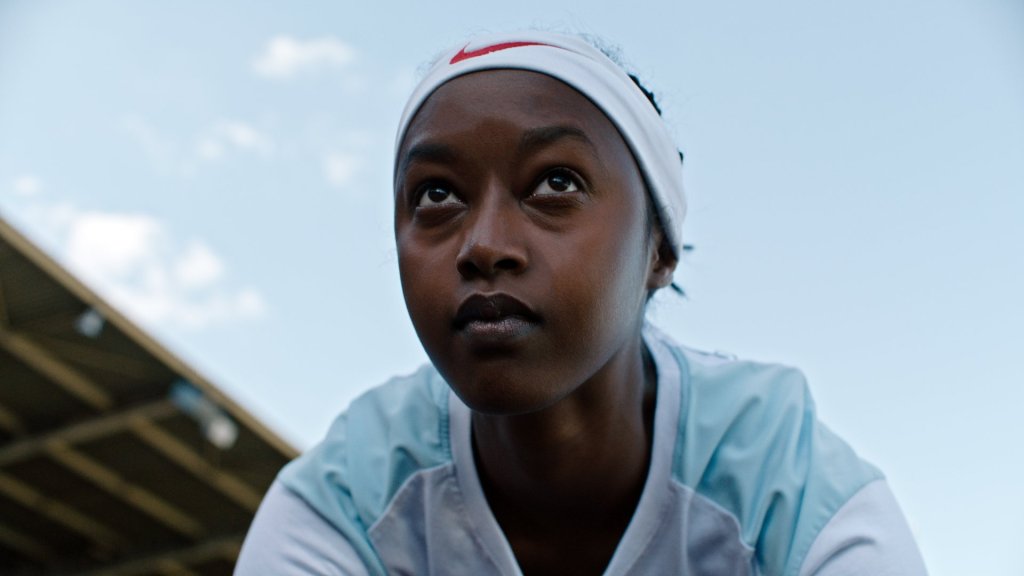
Samia (Riyan Roble) loves to run. Though only a little girl, she places among the top 10 runners in her town’s annual race. She lives in a walled compound with her strict mother, her fun-loving dad, her conservative brother Said, and her singing sister Hodan. She’s also good friends with Ali (Zakaria Mohammed) who is almost like a brother to her; his family shares their compound. But he’s a terrible runner so he appoints himself Samia’s coach.Like Rocky, they train outdoors, racing around corners and down back allies. Their goal? To make her the fastest girl in town! And as they grow older, the teenaged Samia and Ali (llham Mohamed Osman, Elmi Rashid Elmi) discover there’s a world beyond their city, beckoning Samia toward international competition.
But Somalia is unstable, with armed military tanks roaming the streets. Fundamentalists demand all girls wear a head scarf — but what about my running? asks Samia. Regional differences are on the rise and so are religious fights. Local armies and child soldiers are popping up everywhere, making it a dangerous place to live. Can Samia fulfill her dreams in an unstable country? Will she ever make it to the Olympics? And will her family support her if she does?
Samia is a bittersweet, naturalistic biopic inspired by true
events. It’s told in a series of extended flashbacks from her past remembered by an adult Samia, now fleeing Somalia for Italy, via Libya. This is an Italian film, co-directed by a Kurdish German, and an all-Somali cast. It reminds me a lot of Io Capitano (review here) from a few years ago, though this one, while touching and sympathetic, is less triumphant. It’s also rare — the first movie I’ve seen set in Somalia with Somali actors.
I liked this movie.
Oh, Hi!
Co-Wri/Dir: Sophie Brooks
Iris and Isaac (Molly Gordon, Logan Lerman: Indignation, The Lightning Thief) are a young couple in their twenties staying at a BnB in upstate New York. She is pretty, sexy and fond of practical jokes. He is good looking, chill, and open-minded. They’ve been dating for three months, but this one looks like a turning point. Isaac has perfectly arranged everything for the weekend: a beautiful house to stay in with a lake in the back, and delicious meals he cooks for her. And the sex! They are adventurous and passionate together. So when they uncover some bondage material in closet, they decide to try it out. Isaac agrees to be chained to the bed and it works out better than either of them hoped. But somehow the post-coital cuddling leads to some discussions, which reveal she thinks they have a monogamous long term relationship, while he thinks she’s fun and friendly but just another sex partner with no commitment. And all of
this happens while he is still tied to the bed.
Iris does not take this lightly; she feels betrayed. Isaac, on the other hand is genuinely frightened with her jokes about wanting to stab a previous boyfriend to death. And as time passes with little progress, both sides begin to panic. If she lets him go, will he call the cops and have her arrested for kidnapping? Is his life in danger? And when Iris’s best friend Max (Geraldine Viswanathan) and her boyfriend arrive to find Isaac still tied to the bed, it gets even more complicated. How will they ever get themselves out of this colossal mess?
Oh, Hi! is a hilarious sex comedy about trust, relationships and a date gone wrong. While I found some of the relationship psychologizing wasn’t fun, it only made up a small part of the movie. I’ve never seen Molly Gordon before — she co-wrote the script — but she has this uncanny ability to suddenly switch from gorgeous sex-goddess to google-eyed maniac. Logan Lerman is more of the straight man, but carries off his laid-back role quite nicely, considering he’s tied to the bedpost for much of the film. The story itself — along with the unexpected twists it takes — keeps you squirm-laughing almost all the way through. Though the audience at the screening I saw was maybe 80% women (who really seemed to like it), I think there’s lots there for men to think about, too.
This is a very funny movie.
Angela’s Shadow, Samia and Oh, Hi! all open this weekend in Toronto; check your local listings.
This is Daniel Garber at the Movies, each Saturday morning, on CIUT 89.5 FM and on my website culturalmining.com.
It’s dangerous! Films reviewed: Daniela Forever, Apocalypse in the Tropics, We Were Dangerous
Hi, this is Daniel Garber at the Movies for culturalmining.com and CIUT 89.5 FM.
Guillermo del Toro, the celebrated director who splits his time between Mexico and Canada, has curated a series of classic Canadian horror movies called From Rabid to Skinamarink: Canadian Movie Madness, playing at the TIFF Lightbox this weekend. I happen to have seen everyone of them myself, and I totally agree with del Toro’s selection. You can catch Canadian gems like the feminist werewolf drama Ginger Snaps, Vincenzo Natali’s cult-hit Cube, Kyle Edward Ball’s experimental Skinamarink, and many more.
But this week, I’m looking at three new movies from abroad: a surreal fantasy from Spain, a politically documentary from Brazil, and a period drama from New Zealand.
Daniela Forever
Wri/Dir: Nacho Vigalondo
It’s present-day Madrid. Nicolas (Henry Golding: Crazy Rich Asians) is a popular DJ at the city’s hottest nightclubs. But he is thrown into a deep depression when his girlfriend, an artist named Daniela (Beatrice Grannò: The White Lotus) is killed by a negligent driver just outside his home. But things take a turn for the better when a good friend of his, Victoria (Nathalie Poza), tells him of a new, experimental drug that might be just what he needs. But it’s top secret, filled with non-disclosure clauses, and requires regular visits to the pharmaceutical labs. The scientists there tell him each pill, if taken just before bed, will produce lucid dreams, real visions where he can control the content and won’t forget about them when he wakes up. This means he can bring Daniela back to life, at least while he sleeps. But he soon discovers its limitations: he can’t dream about something he’s never seen. If he turns down an ally he’s never visited, it will be covered in unformed, writhing grey matter. Kinda creepy.
Daniela seems artificial at first, but as time progresses, she starts turning real. She even produces creative ideas and thoughts that he doesn’t remember ever experiencing in the awake world. And far from seeming etherial, his lucid dreams are now wide- screen images in living colour, while awake
time is small and drab. He can take Daniela to new places just by thinking about them and opening a door, and change the city of Madrid into something out of one of her paintings. But he soon realizes, not everything is going the way he planned. And when things from his dream world start appearing in awake time, he has to wonder what is real? Can he be in love with someone who doesn’t exist? And can she ever really love him if she’s just a figure of his imagination?
Forever Daniela is a highly- creative science fiction romance about love, death and reality. While it sounds like a Black Mirror jump-scare thriller, it actually avoids most “bad” things except for the sadness of mourning. It also has a very surprising twist at the end (no spoilers). The film is Spanish, but most of the dialogue is in English. Henry Golding (Crazy Rich Asians) is appealing as the leading man, but runs into a bit of acting trouble when he tries to do a full-fledged meltdown. The special effects are excellent, fooling around with unusual concepts like daytime light and shadows in a nighttime environment. I quite like the writer/director Nacho Vigalondo
for the way he incorporates horror movie elements within an otherwise realistic context (like his film Colossal a few years ago.) So if you’re looking for something that’s surreal and supernatural but told in a positive, though bittersweet, way, I think you’ll like Daniela Forever.
Apocalypse in the Tropics
Wri/Dir: Petra Costa
Brasilia — a capital city designed, planned and built from the ground up — was meant to be modern, secular and democratic. But after a coup-d’etat in 1964, Brazil became something other than democratic: a military dictatorship which ruled for the next two decades. So when a new, populist right-wing leader with military ties emerged in the 2010s, many Brazilians were wary of democracy falling again. But Jair Bolsonaro was different, a politician who changed his power base when he forged ties with evangelical Christians.
Apocalypse in the Tropics traces Brazilian politics over the past decade and the rise in religion within government policies. It also gives background, from the building of the capital, through the military coup, American evangelist Billy Graham, the return to democracy, and more recent developments. It uses beautiful period footage, lush music and symbolic paintings — like Hieronymus Bosch’s Garden of Earthly Delights — as a metaphoric portrayal of millenarian changes in Brazilian politics. It is narrated by the filmmaker and includes her one-on-one interviews with Bolsonaro, current President Luiz Inácio Lula da Silva, and the wildly popular televangelist, Silas Malafaia, who served as
Bolsonaro’s right-hand man. We witness Malafaia’s sermons before huge crowds — shouting his opposition to same-sex marriage, abortion rights, and feminism — as well as intimate conversations aboard his private plane. The doc also shows new footage of the beloved capital Brazilia occupied and trashed by massive demonstrators, who called for a coup after Bolsonaro’s defeat.
Apocalypse in the Tropics is a follow-up to Petra Costa’s 2019 film The Edge of Democracy with similar footage, style, and topic but concentrating this time on religion’s role in government policies. I’m not sure if this is a sequel, a reshoot or a continuation, but either way, it’s as aesthetically beautiful as it is disturbing.
We Were Dangerous
Wri/Dir Josephine Stewart-Te Whiu
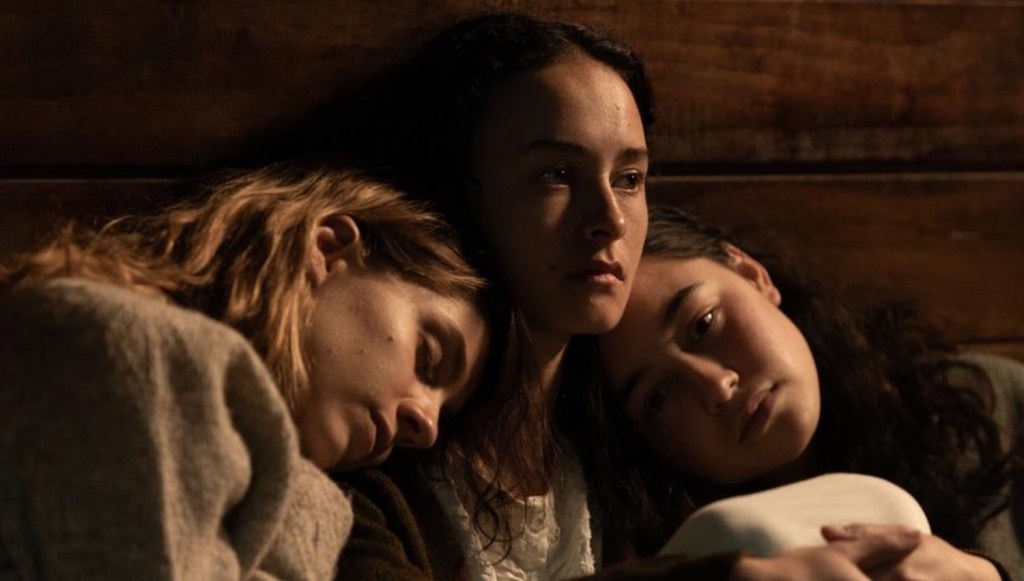
It’s the 1950s on a small island somewhere off the coast of New Zealand, where three girls share a cabin: Daisy, Nelly and Lou (Manaia Hall, Erana James, and Nathalie Morris). They were sent there by the authorities or their parents. Te Motu is a school for “incorrigible” girls or, as the administrators call them, “whores, queers, delinquents and sexual deviants.” Many are orphans or runaways caught stealing food, like Daisy or Nelly. Lou is the exception. She comes from a rich family but was caught making out with her (female) tutor. The school operates under the strict rule of Matron (Rima Te Wiata), who has a cruel streak a mile long. Raised by nuns, she feels the only way to cure these girls’ bad attitudes is through the bible and the lash. Naturally the girls all want to get the hell out of there, but it’s hard to escape from an isolated island in the south pacific. The purpose of the school is to turn bad girls into happy homemakers. They are given lessons in diction and manners but not reading or math.
Matron is frustrated by their outcome: She says they are “too stupid for school, to uncivilized to be maids and too barbaric to work”. Every so often, Matron is visited by men in suits from the mainland, one of whom suggests a horrifying treatment. But when Nelly find out, the three girls decide they have to do something to stop it.
We Were Dangerous is a moving, coming-of-age story about girls surviving in 1950s New Zealand. It’s bright and exuberant, full of playfulness and dancing, Haka and history, and though fictional, it tackles the very real issue of the mistreatment of indigenous girls. The acting is excellent all around, full of subtle clues and delightful details. For a first film, Stewart-Te Whiu avoids many potential stumbles and instead gives us a solid film that’s fun to watch. It played at ImagineNative this year, and is definitely worth seeing.
Apocalypse in the Tropics is playing this weekend at HotDocs and will be streaming on Netflix this coming week; Daniela Forever opens this weekend in Toronto; check your local listings; and We Were Dangerous is available now on VOD.
This is Daniel Garber at the Movies, each Saturday morning, on CIUT 89.5 FM and on my website culturalmining.com.
Daniel Garber talks with Ross “Memphis” Pambrun about Red River Gold on APTN
Hi, this is Daniel Garber at the Movies for culturalmining.com and CIUT 89.5 FM.
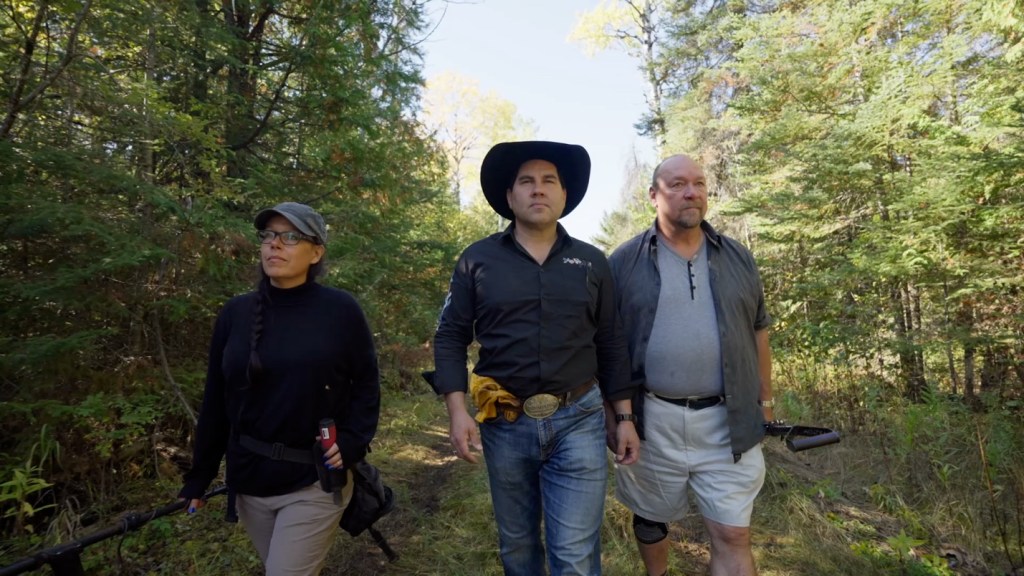
It’s 1870, and John A McDonald is the first Prime Minister of a newly-confederated Canada. And he doesn’t like what’s going on in the Red River Settlement led by Louis Riel. The PM wants to crush what he calls a rebellion. So he sends soldiers up the Dawson Trail a newly surveyed road that connects the great Lakes to the Prairies. And soldiers need to get paid, so a courier on horseback is sent on the trail with heavy satchels stuffed with gold coins. But somewhere on the way from what is now known as Thunder Bay to Winnipeg, he lost all the
gold… and it has never been seen since. What has become of that Red River Gold?
Red River Gold is the name of a new documentary series that follows Métis Treasure hunters looking for $1M worth of lost gold coins. It’s history, it’s geography, it’s archaeology, and it’s a brand new adventure. The series is directed by Saxon de Cocq who I spoke with on this show last year. Red River Gold features Ross “Memphis” Pambrun, a Winnipeg-based Métis musician, fire chief, raconteur and the owner and operator of a satellite data company. He and his two co-hosts take us down that trail throughout the season in their quest for gold and history.
Red River Gold is now playing on APTN — the Aboriginal People’s Television Network — and on their streaming site Lumi.
I spoke with Ross “Memphis” Pambrun in Calgary via ZOOM.
Daniel Garber talks with Neil Diamond and Catherine Bainbridge about Red Fever
Hi, this is Daniel Garber at the Movies for culturalmining.com and CIUT 89.5 FM.
Photos by Jeff Harris.
What do a feathered headdress on the cover of Vogue, a 70s pop video by Cher, and the gesture used by fans of the Kansas City chiefs have in common? They’re all about the world’s obsession with North American indigenous culture and how it’s been appropriated by the mainstream for fun and profit. And it’s used and misused everywhere, in Europe, North America — even in Asian culture — but with little or no attributions or compensation ever given to the people who originated them. What’s wrong with this, how
can it be corrected, and what is the cause of Red Fever?
Red Fever is a punchy new documentary that takes a look at cultural appropriation of indigenous art, religion, customs, and their bodies and faces within the mainstream of art, fashion, sports, entertainment, and even democracy. Using fast-moving historical footage, photos and music, it brings us back to the largely unrecognized origins of many aspects of our daily lives. It’s seen through the eyes of
Cree filmmaker Neil Diamond who guides us across oceans and continents, as he confronts, in a humorous way. Neil Diamond is known for Reel Injun, The Last Explorer and One More River. It’s co-directed by Catherine Bainbridge, a Canadian writer, producer and director who co-founded the award-winning indigenous production company Rezolution Pictures, and is best known for co-directing the award doc Rumble: The Indians Who Rocked the World.
I spoke with Neil and Catherine in person, in Toronto during Hot Docs.
Red Fever opens in Toronto on June 14th, 2024 at the TIFF Lightbox.
Born, reborn. Films reviewed: Spark, Wilfred Buck, Babes
Hi, this is Daniel Garber at the Movies for culturalmining.com and CIUT 89.5 FM.
Toronto’s Spring Festival season continues with TJFF, the Toronto Jewish Film Festival, starting on May 30th. I haven’t seen any of the films yet but some of them look really interesting: The Catskills, a doc about the heyday of borscht belt comics; Just Now Jeffrey, a coming-of-age comedy set during the last days of Apartheid South Africa; The Goldman Case, an historical chronicle of a French revolutionary; The Anarchist Lunch, a doc about the 30 year-long friendship of a group of Vancouver leftists; and Midas Man, a biopic about Brian Epstein, the man who made the Beatles into stars.
But this week I’m looking at three new features, two directed by first timers and one by an accomplished pro. There are two women preparing for births, a man who sees the same day constantly reborn, and another man who passes his knowledge on to the next generation.
Spark
Wri/Dir: Nicholas Giuricich
Aaron (Theo Germaine) is a young artist who lives with his platonic roommate Dani (Vico Ortiz). He’s single and on the prowl, looking for a lover, but with not much luck. So he is intrigued when he gets a mysterious invitation in a red envelope. A friend of his is planning a big party and she want to match up some of her friends before they arrive. So Aaron drives to the appointed place. He’s an artist at heart and draws little sketches on post-it notes to lead his potentially perfect match to his car. He is pleased to meet Trevor (three-time Olympic medalist Danell Leyva) a swarthy and smouldering athlete. In an otherwise empty house they tenuously chat, take a selfie, and pour a couple Old Fashioneds. Aaron is smitten, Trevor less so. But sparks do fly, and they wind up having passionate sex. But just at the point of climax… Aaron wakes up, groggy headed, and back in his own bed. Was that all a dream? But when Dani repeats the same
things they had said the day before, and his publisher calls again for his drawings which he had sent him yesterday, he realizes something: it’s as if that day never happened. In fact, it’s the same day. He goes through the steps again, with Trevor, this time trying to fix his past mistakes, but to no avail — he’s back in his home, in a flash, right after sex. He repeats this date, over and over, testing out tiny changes to see how they might effect him or Trevor’s reactions, but no luck. Is he doing something wrong? What can he change to fix things? Or is he trapped in a never-ending cosmic sex loop.
Spark is a queer fantasy drama about a man caught in the never-ending cycle of a repeated day. I like these kinds of movies, from Groundhog Day to Russian Doll, where people are caught in a time warp. It’s also “queer” in that it’s about a gay relationship of sorts, between Aaron a gay transman who desires Trevor, presumably a gay cis man. And this is where it gets even more interesting. First that Aaron’s gender and his sexuality are never mentioned by anyone in the film; they don’t need explanation — they’re accepted as given. And Aaron is played by a non-binary actor, Theo Germaine, who was also a terrific — though very different character — in the TV series The Politician. Dani is played a non-binary performer as well. Perhaps in some future world this will be commonplace, but for now at least this is rare in its casually deft handling of identity, gender and sexuality within a science fiction milieu.
Very good first feature.
Wilfred Buck
Wri/Dir: Lisa Jackson
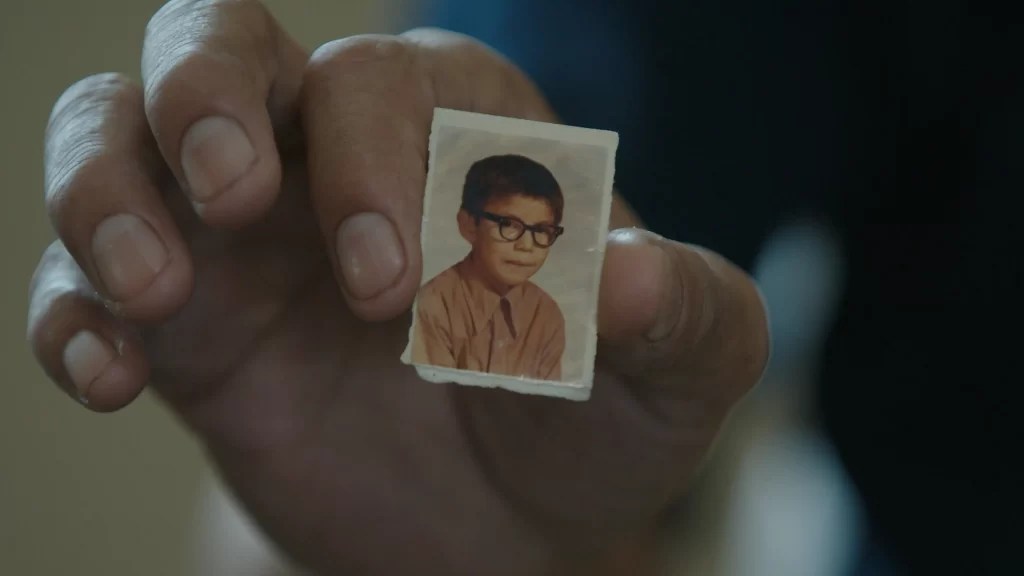
Wilfred Buck is an indigenous astronomer, educator and writer. He was born in the Opaskwayak Cree Nation in Northern Manitoba, near the Saskatchewan border. As a child he learned the thrill of the hunt with his friends, fishing at a nearby lake. As a young man, he made his way south to Winnipeg, where he was jailed almost immediately. In the 1960s, he fell in with a bad crowd, there. He liked the music, the drugs and alcohol a little too much, and ended up living on the streets, a self-described liar, thief and drug dealer. He was harassed, beaten up and almost drowned left to die in icy waters. But things started to change when he was taken under the wing of elders from his first nation and educated about his culture. He learned about rocks and nature, participated in a pow wow, and gradually learned about preparing crucial ceremonies like the Sun Dance: how to build a sweat lodge, and when to present tobacco. And he learned to look up into the night sky and
understand the stars there. He became a knowledge keeper and an astronomer telling stories of what the constellations are, where the stars point and what they mean.
I grew up loving trips to the planetarium where the astronomer pointed out the three stars of Orion’s belt, or the chair-shaped throne of Cassiopeia. I took it for granted that they were discovered and named by the ancient Greeks and were accompanied by their stories. But what I didn’t know was that there are whole other constellations up there with their own stories attached to them. Wilfred Buck has devoted his life to passing on this knowledge of the skies to a new generation.
Wilfred Buck is a beautiful retelling of this charismatic man’s life story, partly narrated, partly reenacted, partly composed of period footage. Actors recreate the four stages of his life. All this is combined with the man himself pointing out gorgeous images in the night skies and on a planetarium dome. This story is both inspiring and invaluable as Buck passes on his knowledge to new generations.
Babes
Dir: Pamela Adlon
It’s early morning on Thanksgiving Day in New York City. Eden and Dawn (Ilana Glazer, Michelle Buteau) are meeting in Greenwich Village for a movie. It’s a tradition, one the best friends have kept for decades, ever since they were neighbours in Astoria, Queens. Eden, a yoga teacher, still lives there but Dawn is a dentist now, married with a kid and lives in a fancy brownstone in the Upper West Side. And she’s 9 months pregnant. But their tradition changes suddenly when her water breaks. To make sure it’s a birth to remember Eden sets out to buy her the most luxurious and expensive sushi ever… but is turned away from the hospital. Instead she shares it with a stranger in a red tux she meets in the subway. She ends up sleeping with Claude (Stephan James) and a few months later, she’s pregnant! He’s out of the picture, but she can’t wait to see her experience through from now till birth with her besty Dawn by her side. But how much time can a married mom with a full-time job, a 3 year old, and a crying newborn devote to her friend?
Babes is a comedy about how two friends deal with pregnancy and
giving birth. It’s funny, surprising and audacious. It looks at morning sickness, amniocentesis, labour, placentas, lactation, breastfeeding, daycare, and everything — I mean everything — else, in an entirely new way. But it’s mainly just funny schtick, both in dialogue and their whole-body style of acting. The lines are clever and twisted, with virtually nothing I can repeat verbatim on daytime radio. I was laughing my head off, especially in the first half hour. And the bawdy acting — things like Dawn on mushrooms shooting imaginary jets of breast milk across the room, or Eden crawling between Dawn’s legs to see how dilated her vagina looks — is just brilliant. They’re both former standup and sketch comics — Ilana Glazer is known for Broad City, Michelle Buteau for Survival of the Thickest — and with their totally different body types, size and ethnicity, they play off each other with a sort of sloppy synchronicity. Not every gag works, and the serious parts of the story are less interesting than the funny ones. It’s also loaded with scatological references, way too many for my taste, but at least they talk about their bowel movements rather than showing them. And the men serve mainly as sidekicks — this is a women’s movie. Does’t matter; the side roles, from Elena Ouspenskaia as a doula, to Susanna Guzman as a babysitter, there are a couple dozen great characters.
Babes knows how to work it just fine.
Wilfred Buck now playing at the Hot Docs cinema in Toronto; Spark had its world premiere last night at the Inside Out Film Festival; and Babes opens this weekend at the TIFF Lightbox in Toronto; check your local listings.
This is Daniel Garber at the Movies, each Saturday morning, on CIUT 89.5 FM and on my website culturalmining.com.
From Venus to Limbo. Films reviewed: The Strangers: Chapter 1, Limbo
Hi, this is Daniel Garber at the Movies for culturalmining.com and CIUT 89.5 FM.
Toronto’s Spring Festival season continues with Inside Out, the 2SLGBTQ+ film festival which opens this Friday, and runs through June 1st. The opening night show is the comedy My Old Ass, starring Aubrey Plaza, and the closing night show is a must-see for Toronto music-lovers; it’s called We Forgot to Break Up, and features tunes by iconic artists like Peaches, Gentleman Reg, The Hidden Cameras and Torquil Campbell of Stars.
But this week, I’m looking at two new movies — a mystery and a horror — about what can happen when you end up in a small town. There’s a police detective caught in Limbo an outpost in the Australian outback, and a young couple looking for a way out of Venus, a small town in Oregon.
The Strangers: Chapter 1
Dir: Renny Harlin
Maya (Madelaine Petsch) and Ryan (Froy Gutierrez) are a young couple driving from New York City to Oregon in a fancy new SUV. Maya is a young architect aiming for a position at a Portland firm, and Ryan is willing to relocate if she gets the job — they’ve been together for 5 years and things are looking good. Until they turn off the highway for a bite to eat, and find themselves in an isolated town called Venus, Oregon. GPS doesn’t work here and wifi and telephone signals are intermittent at best. And the people all seem like extras from the movie Deliverance. And when they come out from the local diner their car — mysteriously — isn’t working anymore. Says the mechanic: We gotta wait for parts before we can fix it. So they are forced to spend the night at an Air BnB, a small cabin in the woods isolated even from the town. It’s a creepy place, filled with scary, old things like… record players! And a piano! And a chicken coop out front! They’re disturbed by a loud rapping on the door by a young woman in a hoody, her face obscured. But when the girl leaves,
everything seems kinda normal again. So, like the sensible couple they are, he drives back in town, leaving her alone in the cabin to smoke a joint. That’s when things get really scary.
A man in a mask keeps sneaking up on her and spying on her but he disappears as soon as she turns around. Not eventually she discovers it’s not her imagination. There are three sadistic killers chasing her and Ryan all over the place, holding a giant axe. They’re all wearing masks: a burlap sack with a face drawn on it, a baby doll mask, and one that looks like a 1920s flapper. Can Maya and Ryan somehow escape these scary people, and get away from this awful little town? Or will they just die?
The Strangers: Chapter 1 is a cabin-in-the-woods horror movie. Cabin in the Woods movies are sub-genre I like. And the acting is not bad — Madelaine Petsch is Blossom from the TV series Riverdale. You can sympathize with the two main characters. And it even a bit scary. But there’s something wrong with this movie. It’s non-stop deja vue. It’s like a collage of scenes blatantly stolen from countless other horror movies. I’ve seen all these masks before. I’ve
seen the guy with the axe. The wooden house, the chickens — it’s like they didn’t even try to think up something new. I’m tempted to blame this on AI, but I think it’s just lazy writers. And it doesn’t even make sense. Do the killers wait around for hapless strangers to arrive at random so they can put on their stupid masks and terrify them. And if so… Why? The title should tell you something — it’s “Chapter 1” in a potentially endless series. So don’t expect it to explain anything — maybe that comes in chapter 19 or 20.
I was actually looking forward to seeing this movie, because it’s by Finnish director Renny Harlin who was a big name in the 90s for his classic action thrillers like Die Hard 2, and The Long Kiss Goodnight. But The Strangers is so deeply stupid it tarnishes his reputation.
Limbo
Dir: Ivan Sen
Travis (Simon Baker) is a police detective in South Australia. He has buzzed hair and beard, aviator-style glasses and tattoos all over his body. He’s also a junkie — he carries his paraphernalia wherever he goes. This time, he’s been sent to the outback to investigate a cold case about a girl named Charlotte who disappeared two decades earlier. The police never caught the actual criminal, nor find the missing girl… maybe because she’s aboriginal. So Travis pokes around for clues. Unsurprisingly, the locals are not impressed. Charley (Rob Collins) Charlottes brother, had been blamed for her disappearance.
He tells Travis to fuck off. Emma (Natasha Wanganeen) the waitress in the town diner, wants to help — and likes having Travis around. And the three kids she takes care of also want to find out what happened to Aunt Charlotte. And then there’s Joseph (Nicholas Hope), a sketchy old guy who lives in a cave, and who used to run dodgy party nights for teenagers with a friend. He denies any involvement but seems to know a lot. Meanwhile, Travis is stuck there till they fix his car — he’s forced to drive around in an ancient jalopy. Can he get the locals to talk? Will he ever discover what happened to Charlotte and why? And as he uncovers deep dark secrets, will the people there end up better or worse?
Limbo is a detective drama about an old mystery. It’s a slow burn — very slow in fact — more like a revelatory drama than a mystery. It deals with dark secrets and the pervasive class divisions and racism toward the indigenous people there. It takes place in the lunar landscape of an area once exploited for opal mines, with deep tunnels drilled into the ground and hills made of the rubble they dug up. The hotel he stays in has walls drilled into the earth. Everything is dirt, sand, rock and sun. The people all seem to live in caves or mobile homes.
This indigenous Australian director, Ivan Sen, is also the writer, producer, cinematographer, editor and the composer of the soundtrack, so it has a completeness about it, the work of a single mind. It has amazing panoramic views, all done in black and white. The production design and aesthetics of the film — sets, costumes, cars — is very cool as well. And great acting. If you want to watch a moody, noir-ish drama under a bright summer sun, I think you’ll like Limbo.
The Strangers: Chapter 1 opens theatrically this weekend; check your local listings. Limbo is now available on VOD.
This is Daniel Garber at the Movies, each Saturday morning, on CIUT 89.5 FM and on my website culturalmining.com.
Latin America? Films reviewed: Autumn and the Black Jaguar, Satanic Hispanics PLUS #Hotdocs24!
(missing some background music)
Hi, this is Daniel Garber at the Movies for culturalmining.com and CIUT 89.5 FM.
Spring is here, and so is Toronto’s Spring film festival season. And its crowning glory is Hot Docs the world’s biggest International Documentary Film Festival. It’s a month away — it runs from April 25 to May 5 — but now’s a good time to start booking tickets. As usual there are over 100 docs from more than 60 countries, with many international premieres. And, as always, students and seniors (over 60) can go to daytime screenings for free.
They just released the whole festival slate, so here are a few docs that I haven’t seen yet, but look interesting to me. Black Box Diaries is about a young Japanese journalist who was raped, and is taking her case to court in a demand for justice. Grand Theft Hamlet shows some UK actors attempting to mount a production of Shakespeare entirely within the notorious game Grand Theft Auto. Norwegian Democrazy is about extreme street level politics in that country, and Stray Bodies takes a similar look at how people handle bodily restrictions within their own countries can be resisted by crossing national borders within the EU. Pelikan Blue is an animated film about what young Hungarians did to leave the country when the Iron Curtain fell. There are also video diaries: The Here Now Project about how climate change effects people around the world; and XiXi, an intimate look at the innermost thoughts and beliefs of a Chinese improvisation artist living in Europe. Curl Power is a funny and tender examination of five teenage girls over three years on a curling team. And for those interested in musical celebs, there are features about Toronto’s own Peaches, called Teaches of Peaches, and Disco’s Revenge about the legendary musical producer Nile Rogers.
Like I said, Hotdocs is a full month away, but now’s the time to start thinking about it.
This week, though, I’m looking at two movies, one for children and one for definitely for grownups. There’s a girl looking for a wild beast in the jungle, and a man in an El Paso jail trying to explain why he’s the only one to survive a mass killing.
Autumn and the Black Jaguar
Dir: Gilles de Maistre
Autumn Edison (Lumi Pollack) is a young girl in middle school in New York City. She grew up in a rainforest somewhere in Latin America with her environmentalist parents. Her Dad is from the North, her Mom a member of the local indigenous nation. So Autumn treats the jungle as her backyard. As a small child she befriended a baby black jaguar who was left parentless when poachers shot the mother jaguar. So they grew up together. Developers and animal traffickers, led by the evil Poacher, Doria Dargan (Kelly Hope Taylor) wanted to evict her people from their land. They also hunted rare species to sell on the black market. But when Autumn’s mother is killed, her Dad takes her back to North America, where it’s safe. Seven years later, she’s almost a teen, but still hates it up there. No one seems to care about our animal friends or the environment. Especially her biology teacher Anja (Emily Bett Rickards). She wants the class to dissect frogs — can you believe it? — and Autumn refuses to participate in such cruelty. She stages a one-person protest. So she’s suspended from school, and not the first time. Stuck at home, she finds a letter from her uncle in the rain forest, a veritable cry for help. Our lives are teetering on the brink, he writes. They want to build a dam, flooding where we have lived for millennia. And they’re after Hope, the beloved black jaguar!
Autumn takes this as a beacon, calling her back to her ancestral home.
She lies to her father that everything’s fine, and secretly rushes off to the airport. What she doesn’t realize is her teacher — notable for her fear of germs, insecurity and agoraphobia — is somehow following her; she’s afraid Autumn is in danger, and wants to bring her back home. She’s risking her worst phobias to rescue the little girl. But they both end up in the rainforest, alone, with Autumn the one who is confident and at home. Will she find Hope the Jaguar? Will Hope still recognize her? And can they somehow stop the destruction of her culture, and the kidnapping of the last black jaguar?
Autumn and the Black Jaguar is a heart-warming kids’ movie. By kids, I mean little kids. As a grown-up, I found the dialogue klunky at best and cringy at worst, as if written by Chat GBT and edited by Google Translate. The teacher talks like a cartoon character. comically overreacting to everything she sees (as in most kids’ TV shows). But there are also some very cool adventures, like when they climb a tall tree and walk around on top of the forest’s canopy. I think little kids will really like this.
Watching the movie, I was impressed by the CGI version of a Jaguar playing with Autumn — it looked real. Could it be a CGI head superimposed on a friendly dog’s body? But after I did a bit of research, I found out the actress, Lumi Pollack, spent 10 months learning to bond with two actual jaguars. That wild cat is real! Impressive. Which moved it up quite a few notches on my mental score card.
Satanic Hispanics
Dir: Alejandro Brugués, Mike Mendez, Gigi Saul Guerrero, Eduardo Sánchez, Demián Rugna
It’s El Paso, Texas, just across the border from Juarez, Chihuahua. The police discover dozens of dead bodies in an old, abandoned building, with only one man still alive, unarmed, and handcuffed to a metal table. So they arrest him. He calls himself the Traveler (Efren Ramirez) and says he was born here — meaning in the US — and speaks at least 5 languages. But he’s undocumented, with no papers to prove his existence. Still, he pleads for the police to let him go. If they don’t, in 90 minutes they’ll all end up dead, just like the others they found. You see, he says he’s being followed by the Saint of Death, a terrifying, mystical being who wants to kill him. That’s why he’s the traveller: he always has to keep a step ahead of the Saint, to avoid massive bloodshed like this one.
But the cops don’t believe him — they accuse him of drug trafficking. They bring out his cache of strange paraphernalia and ask for an explanation. So, like Scheherazade, he embarks on a series of stories that tell where each item comes from. One of his strangest stories is called Tambien Lo Vi. It’s about a mathematical genius named Gustavo (Demián Salomón) a Rubik’s cube champ who somehow transfers his mental algorithms into light patterns projected on a wall using the light from his cel phone. He flaps his arms wildly flashing… that seems to bridge the gap between the living and the dead.
Other stories deal with a voracious vampire having a night on the town on Halloween — the only time of year when he can dress as a blood sucker in public — and a very bizarre take of a man fighting off a demon using a prodigious weapon known as the Hammer of
Zanzibar that I cannot describe on daytime radio. But back to the main plot: can The Traveller finish his stories before the evil entity arrives to kill us all?
Satanic Hispanics is a compilation horror movie told by 5 directors and countless writers, producers, cast and crew. Each story is told as discrete, complete short film, within the whole movie, but with all sharing a similar look. The directors themselves are originally from Argentina, the US, Mexico and Cuba, with dialogue shifting from English to Spanish to pre-Columbian languages. Being a horror movie, there’s lots of gratuitous violence, blood and guts, some shocks and chills, and some horrible-looking evil entities.
Does it work? Oh yes! Not every segment is perfect, but altogether they tell us some very original and scary stories.
Autumn and the Black Jaguar opens this weekend in Toronto: check your local listings; Satanic Hispanics is currently streaming on Shudder.
This is Daniel Garber at the Movies, each Saturday morning, on CIUT 89.5 FM and on my website culturalmining.com.
Hi, this is Daniel Garber at the Movies for culturalmining.com and CIUT 89.5 FM.
it’s the work of award-winning documentary filmmaker Tasha Hubbard, known for her powerful docs featuring indigenous subjects. Meadowlarks is her first narrative feature. I last interviewed Tasha in 2019 on this show about
Hi, this is Daniel Garber at the Movies for culturalmining.com and CIUT 89.5 FM.
histories on the reserve and in the big city — the images of the people involved will be added later.
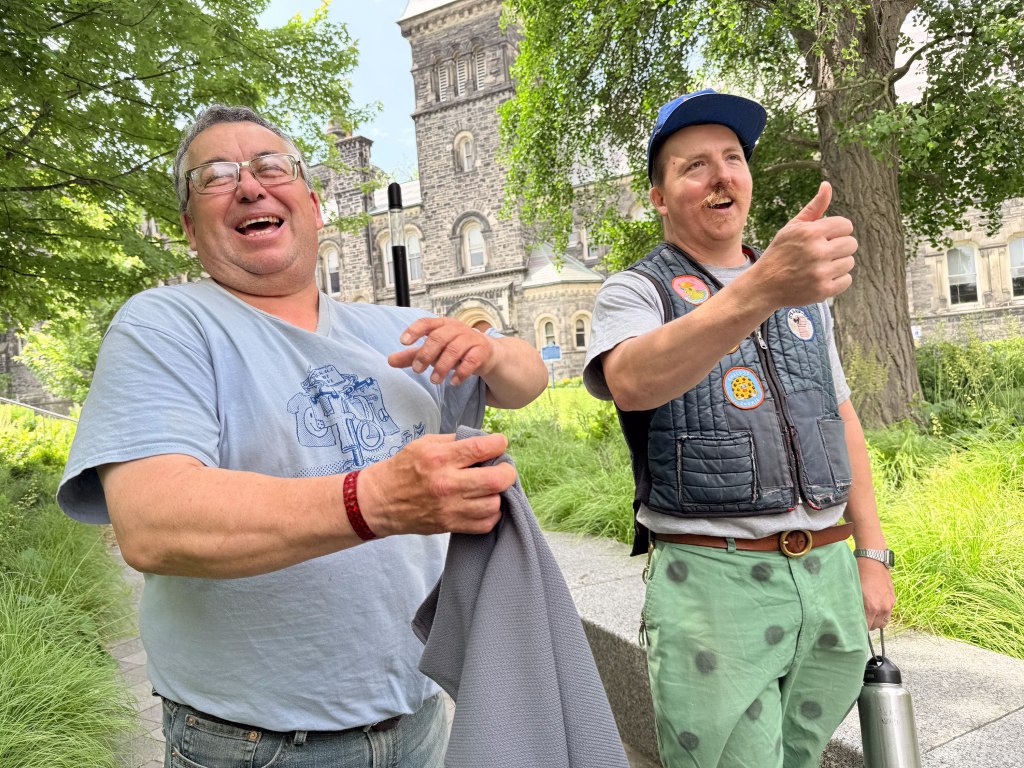
voices to present an oral history of two very different parts of Canada: Shamatawa and Toronto. It focuses on the lives, histories, and stories, of the filmmakers Seth and Peter Scriver, their friends and families. It’s hilarious, visceral and chaotic, and not like anything you’ve ever seen before. Seth is a Toronto-based writer, sculptor, carpenter, comic book artist and
animator, whose first film Asphalt Watches won best Canadian first feature at TIFF in 2013. Peter is a storyteller, writer and woodcarver, who has served as Chief and Magistrate of
the Shamattawa First Nation in Northern Manitoba. He lived in Toronto as a teen. A skilled hunter and trapper, he now works as a Canadian Ranger while he raises his nine amazing kids.
Hi, this is Daniel Garber at the Movies for culturalmining.com and CIUT 89.5 FM.
leave a comment