Returns. Films reviewed: All We Imagine as Light, The Return PLUS Streaming Sites!
Hi, this is Daniel Garber at the Movies for culturalmining.com and CIUT 89.5 FM.
As the days grow shorter and colder, people tend to snuggle up at home. I’m here to tell you to get off your collective asses and go see a real movie on a big screen! But I know some of you are going to stay at home so today, I’m going to talk about some of the streaming sites out there you might want to join. And I’m looking two new dramas. A warrior king in ancient Greece returning to his island, and three nurses in Mumbai returning to Kerala.
Streaming Sites
Here are some streaming sites you might want to try.
First the free ones: CBC Gem, Kanopy and Tubi. CBC Gem has ads, but also plays some great docs, including There are no Fakes. You can find Tubi — a commercial site — online, again with irritating ads but a huge selection of middlebrow films. You can check out terrific movies on Kanopy using your library card, but you’re limited to a certain number per month. Britbox and Acorn TV both specialize in British TV series, especially detective mysteries. If you want Miss Marple peeking over your shoulder, this is what you want. Apple TV produces all their own stuff, including Slow Horses and the great Steve McQueen’s new film Blitz. On the other hand, the Apple TV app itself is extremely aggressive — you can only watch full screen and it flips back to the main site every time you navigate away.
If you’re into horror, thriller and the supernatural Shudder is the site for you. It’s exceptionally well-curated, with excellent art-house movies right beside slashers. Paramount+ has a seemingly endless supply of cop and military shows, plus CIA, FBI, firemen, navy, and — count ‘em! — 7 different NCIS spinoffs! Not my thing, but they do land some good movies like Smile 2, playing right now. Crave gives you access to everything HBO makes, as well as Canadian movies you might otherwise miss like the NFB doc Wilfred Buck. Criterion has the rights to some of the best movies of all time, from early Kurosawa to recent releases. MUBI streams new movies likely heading for the Oscars this year, including Maria, Girl with the Needle and The Substance.
And finally Netflix, the grande-dame of all streamers, has the most consistent and sheer quantity of good TV and self-produced movies, like Emilia Perez… but it’s getting way too expensive! They even have a new website called netflixinyourneighbourhood.ca which takes you to

THE MADNESS. The Donut Shop, 617 Parkdale Avenue, Hamilton, Ontario, featured in Episode 107 of The Madness. Cr. Courtesy of Netflix © 2024
locations where their movies are shot: in places like Toronto, Ottawa, Hamilton, Brockville, Dundas and Oshawa!
I still think movies should be seen in theatres but if you’re determined to stay at home, those are some of streaming sites you might want to subscribe to.
All We Imagine as Light
Wri/Dir: Payal Kapadia
It’s present-day Mumbai.
Prabha (Kani Kusruti) is a middle-aged hospital nurse. She is skilled at her job, teaching young trainees how to get over their feelings of revulsion. She spends time with a starry-eyed Doctor Manoj, who writes poems to her, but she is still very much married. Her husband moved to Germany to work in a factory, and he may as well not exist. Prabha shares an apartment with Anu (Divya Prabha), a vivacious young nurse at the same hospital. She likes shopping, fashion and romance, and most of all her secret boyfriend Shiaz (Hridhu Haroon). They’re in love (or at least young lust) but frustrated; it’s hard to find a private space to be together. More than that, she’s Hindu and he’s Muslim, and never the twain shall meet – their families will prevent that. Finally, Parvaty (Chhaya Kadam), an older nurse and a close friend of Prabha’s, is facing eviction from her home. Developers want to tear it down to build a high-rise condo. Since she’s a widow and doesn’t have the proper papers to
prove the place is hers, they’re sending goons to her door to kick her out.
For all these reasons the three of them end up back in Kerala, the place of their birth in southwest India. They stay in a beautiful beach town, where the three of them can finally shake off the heavy responsibility and stress of life in that big city. But how long will this last?
All We Imagine as Light is a personal, intimate drama about the lives of three women in Mumbai. It’s notable for a number of reasons. This is director Payal Kapadia’s first feature, and tells her story from a distinctly feminine gaze. It deals with big contemporary political and social issues — like Parvaty attending an angry tenants’ rights meeting — but also the importance of personal friendships among the three woman. In look and style, this film is strictly European cinema verite, about as far from Bollywood as a movie could possibly be. But it is set in Bombay and exults in that city, from the slums to the skyscrapers, with stunning aerial views of rooftop clotheslines and raucous street festivals. There’s amazing footage taken through the window of a fast-moving commuter train. Some scenes have documentary-style unidentified voices, expressing their bittersweet love and hatred for that
city that never sleeps, spoken in a plethora of languages: Hindi, Gujarati, Malayalam, and Bengali. I liked this movie for it’s emotions, but found much of it bleak and slow-moving; the story drags you down until it finally shifts from Mumbai to the beaches of Kerala, two-thirds of the way through.
But by the end it redeems itself with an unexpectedly satisfying finish.
All We Imagine as Light has been nominated for Best Foreign Language Film at the Golden Globes.
The Return
Dir: Uberto Pasolini
It’s 1200 BC in ancient Greece, and the island of Ithaca has no ruler. Decades ago, it was a mighty kingdom, ruled by the hero Odysseus — known for his bravery, fighting skills and intelligence. He devised the Trojan Horse and led the army that defeated Troy. But the soldiers — and their leader — never came home, and Ithaca has gone to seed. The queen, Penelope (Juliette Binoche) sits alone in her tower, weaving cloth, as she patiently waits for Odysseus’s return. Their son, Telemachus (Charlie Plummer) doesn’t know his father except from legends. The palace is filled aggressive brutes from abroad, each wanting to marry the widow Penelope so they can take over the kingdom. But is she actually a widow?
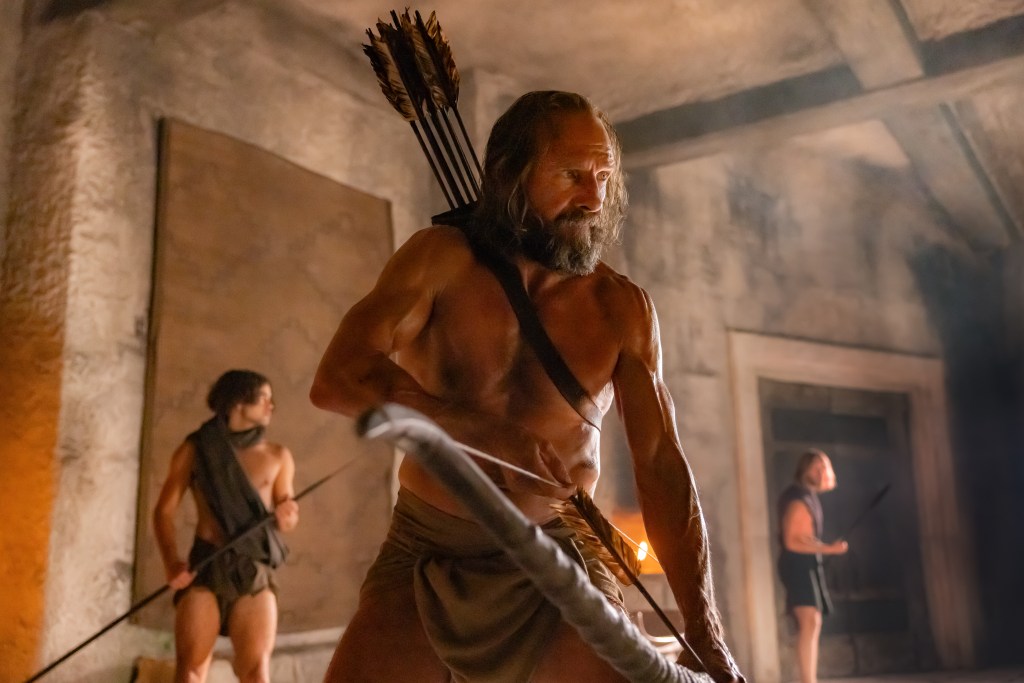
Around this time, the battle-scarred body of a soldier washes up on shore. He’s barely alive, but is nursed back to health by an honest pig farmer named Eumeo (Claudio Santamaria) and his sons. It is of course Odysseus (Ralph Fiennes), but without any uniform or weapon. He’s actually naked. He wraps himself in a blanket and carries a bowl — the clothing of a homeless beggar. And when he approaches the palace, almost no one recognizes him. Only Eurycleia (Ángela Molina), both his and his son Telemachus’s nurse as a child, realizes who

The Return, directed by Uberto Pasolini, with Ralph Fiennes (Odysseus), Juliette Binoche (Penelope), Charlie Plummer (Telemachus), Marwan Kenzari (Antinous), Claudio Santamaria (Eumaeus).
that beggar is. Is he still fit to be king? Can one man, tired and old, confront a bloodthirsty mob of young toughs? And will Penelope ever forgive him for staying away so long?
The Return is a magnificent retelling of a chapter in Homer’s The Odyssey. But it’s not about triumphant heroes; it’s more about the grinding effects war has upon both the victors and the vanquished. It contrasts Odysseus’s shame and self-doubt with Penelope’s eternal fidelity. Yes, this is an ancient greek story, with swords and sandals, but it feels very immediate. Parts of it even resemble a Hollywood action/thriller, with chase scenes and some very bloody fights.
The film was shot among the rocky cliffs of Corfu and the ruins of an ancient castle, which is echoed in the soundtrack. I love the dramatic look and sound of waves crashing on the sharp rocks. Though the women are all wrapped up, most of the male actors are dressed in togas or prancing around half naked, with Ralph Fiennes going full monty at the drop of a hat. I didn’t used to like him much, but after Conclave and now this one, I gotta admit, he’s a really good actor. Juliette Binoche is skillfully understated as Penelope, and Dutch actor Marwan Kenzari is very creepy as Antinous, the threateningly oleaginous suitor closest to Penelope.
The Return is a really good movie.
The Return and All we Imagine as Light is on at the TIFF Lightbox in Toronto; and Standing on the Shoulders of Kitties, A Trailer Park Boys movie featuring Bubbles and his band on tour, is now playing; check your local listings.
This is Daniel Garber at the Movies, each Saturday morning, on CIUT 89.5 FM and on my website culturalmining.com.
Unobtainable, unsustainable, inevitable. Films reviewed: Bookworm, Monkey on a Stick, Smile 2
Hi, this is Daniel Garber at the Movies for culturalmining.com and CIUT 89.5 FM.
Toronto Fall Film Festival season continues with Rendezvous with Madness presenting docs and dramas, features and shorts, about addiction and mental health followed by in-person discussions, starting on October 25th.
But this week, I’m looking at three new films, a kids’ movie, a doc and a horror film. There’s a precocious girl looking for the unobtainable; a group of deranged gurus trying to hold onto the unsustainable; and a pop starch wants to escape the inevitable.
Bookworm
Co-Wri/Dir: Ant Timpson
Mildred (Nell Fisher) is a young girl who lives with her mom in New Zealand. She loves reading but hates school. Her desk is surrounded by leather-bound books alongside a microscope, a telescope, a typewriter and a record player. She talks like a grownup, and is obsessed by wild animals. Her dream? To catch on film a black panther said to be roaming in the woods (along with a big fat cash prize for anyone who can take a picture of it.) But her plans all change when her mother is sent to hospital in critical condition following an exploding toaster. That’s when her biological father comes into the picture. He flies in from America to save the day.
Strawn (Elijah Wood) is a professional magician — he prefers “illusionist” — who loves magic: like making small things disappear or pulling coins from behind someone’s ears. Most people are wowed by Strawn’s prestidigitations and puppy dog eyes, but not Mildred. She scoffs at magic and is quick to reveal all his tricks. They two are opposites at heart. If you say “David Copperfield” she thinks of Dickens while he thinks of the
magician. Nonetheless, they are stuck together for now, so he agrees to take her camping. But little do they know of the exciting adventures and frightening dangers — like criminals, wild animals and crazy escapes — that lie ahead.
Bookworm is a very cute coming-of-age adventure about two strangers put together to form a makeshift family. It feels like a cross between a Roald Dahl Matilda and Taika Waititi’s Hunt for the Wilderpeople. It’s shot in the New Zealand wilderness amidst stunning mountains, cliffs and lakes. Nell Fisher is adorable as the obnoxiously mature Mildred, while Elijah Wood is equally adorable as the man-child who won’t grow up. I wanted to see this one because I loved director Ant Timpson’s bizarre debut, the violent comedy Come to Daddy. Bookworm is as different as any film could be but just as enjoyable.
I liked this one a lot.
Monkey on a Stick
Dir: Jason Lapeyre
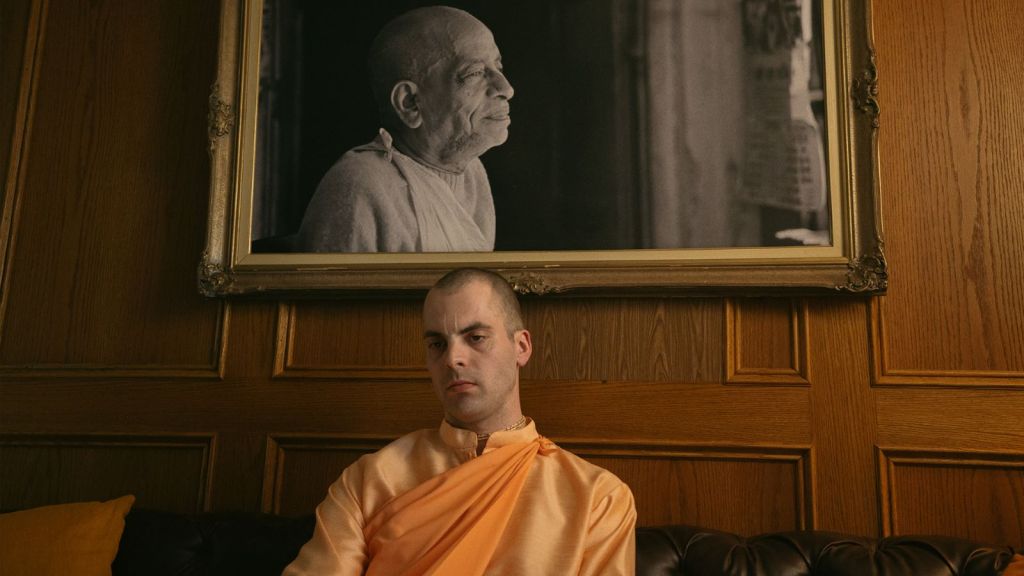
It’s 1965 and America is in high hippie mode. A. C. Bhaktivedanta Swami Prabhupada arrives in New York City from Calcutta. He’s there to sell books, including his own translation of the Baghdad Gita. But he ends up heading the Hare Krishna movement, a vast multinational phenomenon, a religion that espouses dancing, singing and chanting mantras in order to achieve a better afterlife. After picking up many devotees in New York, the movement exploded in popularity once he reaches California. Allen Ginzburg endorses it and George Harrison writes a song about it. Countless people join the religion, throwing away material possessions to dance, chant and collect alms in airports. But when the Swami dies, he leaves behind eleven gurus. That’s when things start to fall apart. This documentary — based on a bestselling book — exposes the crimes and excesses of the Hare Krishna movement in the 1970s and 80s.
One guru — in order to generate more money — sets up a drug ring of devotees instructed to smuggle hash from Pakistan to Canada. They have ties to the mob, leading to a series of violent crimes until it is finally exposed. Another guru collects automatic weapons, and goes on a shooting spree in California. A third guru — a self-declared Swami — the scariest of them all, builds himself an ornate golden castle in West Virginia, while his disciples — who have given away all their worldly
possessions — live in a shanty town beside the castle without toilet paper or plumbing. He later plans murders and is suspected of molesting children.
In fact, the movement as a whole is riddled with problems. Women are treated as inferior beings who distract male practitioners from their religious obligations. Homosexuality is strictly forbidden as is all sex outside marriage. And heavy censorship prevails — no TV, magazines, newspapers, movies, or books are allowed, except for one official newspaper. And by the second generation — the 1970s and 80s, when most of the documentary takes place — kids are sent to schools with teachers who have no training. They lock kids in dark closets or dump them in trashcans as punishment, among even worse crimes.
Monkey on a Stick is a documentary that looks at crimes of the Hare Krishna movement. It’s told using talking heads — including former devotees — period footage, and many reenactments, with actors visually demonstrating what the narrators are talking about. There’s also a series of random people sharing their views on religion, God and the afterlife. Though quite disturbing in parts, on the whole, it’s a fascinating story that exposes events I had never heard about before.
Smile 2
Wri/Dir: Parker Finn
Skye Riley (Naomi Scott) is a pop superstar, about to launch a worldwide tour. She lives in a luxury apartment on Park Avenue, and can buy anything she wants. She’s busy 24/7 at dance rehearsals, talk show appearances and autograph signings, under the constant supervision of her stage mom (Rosemarie DeWitt) and her PA (Miles Gutierrez-Riley). It’s her big comeback, after a year of rehab. This follows a bout of addiction culminating in a terrible car crash that killed her boyfriend and put her in intensive care. A year later, she still suffers from intense pain, pain so bad she is forced to buy opioids on the sly. But everything changes when she witnesses her high school friend (and drug supplier), Lewis (Lucas Gage) kill himself in front of her eyes in the most gruesome manner imaginable. And he dies with a rictus grin plastered on his face.
That’s when things start to go bad. Everywhere she looks she
sees that awful smile. It’s like she caught a disease by witnessing her friend’s death. She starts seeing people who aren’t really there, and experiencing events that never happened — even though they feel so real. She begins to doubt her sanity. It’s like some alien presence has lodged itself into her brain. Her friends, family and colleagues look at her in a strange way, even as she fears she’ll end up dead in a matter of days, with that same awful smile. Can she break this smile cycle? Or is she headed for insanity and death?
Smile 2 is a genuinely-scary psychological thriller/ horror about fame, celebrity, and a deadly condition passed on from person to person. It’s also one of those Hollywood rarities: a sequel that’s demonstrably better than the original. Naomi Scott is terrific as Skye, a punky, self-centred celebrity; Skye’s not just a horror movie screamer, she’s a real character, complete with a psyche and a believable back story. The movie itself is really well made, with beautiful art direction, cool choreography, and ingenious camerawork and editing, where a scene can flip, elliptically, from an elevator ride to an overhead view of the street. Warning: it’s quite violent, so if you don’t like seeing blood and guts, stay away. But otherwise, Smile 2 is a really good, heart-pounding genre movie.
Bookworm, Monkey on a Stick and Smile 2 all open this weekend in Toronto; check your local listings.
This is Daniel Garber at the Movies, each Saturday morning, on CIUT 89.5 FM and on my website culturalmining.com.
Archnemeses! Films reviewed: Kill, Despicable Me 4, Escape
Hi, this is Daniel Garber at the Movies for culturalmining.com and CIUT 89.5 FM.
Classic novels and movies needed a hero or a heroine to save the day. But in really good stories there’s also a nemesis, an enemy to fight and defeat. This week I’m looking at three new movies, from Korea, India and France — two action thrillers and an animated comedy — about arch-nemeses. There’s a former villain in witness protection, a commando on a train heading in a southern direction and a communist sergeant preparing his own defection!
Kill
Co-Wri/Dir: Nikhil Nagesh Bhat
Amrit (Lakshya) is a commando in a special unit of the Indian army. Along with his best buddy Viresh (Abhishek Chauhan) they lead their troops in tactical operations using martial arts and hand-to-hand combat. But he’s in a bit of a jam. The love of his life, Tulika (Tanya Maniktala) is pledged to another man in an arranged marriage. To elope seems too risky; her father is an oligarch with immense power and wealth. Even so, they arrange for a secret meeting aboard the express train her family are riding south from Amritsar to Delhi. And, right there, with the two of them squeezed into a cramped toilet Amrit proposes marriage, complete with ring. But what neither of them realize is the train has been targeted by a brutal gang of bandits for an attack on the sleeper cars. The dacoits kill the guards, and steal watches, jewelry and cash from everyone there. And they sexually threaten the women. They’re led by a capricious Fani (Raghav Juyal) the nefarious son of the clan’s patriarch. But when Amrit and Viresh see what’s happening, they decide it’s time to fight back… but can just two commandos take on an entire family of bandits?
Kill is a non-stop, violent action movie, the first of its kind out of
India. It’s nothing like Bollywood, no songs, dances, or extended flirting. This is heavy-duty fighting all the way through. This is Lakshya’s first starring role — he’s good-looking and intense, a natural leading man. He plays Amrit as a regular Punjabi drawn almost to madness when he sees his lover threatened. Then he goes berserk. He wears a blood-stained shirt for most of the film, and beware: there’s a lot of blood to be spilt. Much of the action takes place in the aisles of an express train, between cars, on the roof, and out the exit doors. Weapons range from sabres, to rifles, a metal fire extinguisher and the fighters’ bare fists. The fighting is superbly choreographed, really well done. And the sound effects are chilling — the sound of skull hitting metal the slash. Off a knife, the thud if fists hitting flesh…I’ve never seen an Indian movie like this, and I quite enjoyed it. If you can get into intensely violent, non-stop action movies — on the scale of the great Indonesian flic The Raid — then I think you’ll really like Kill.
Despicable Me 4
Dir: Chris Renaud, Patrick Delage
Gru (Steve Carell) is a former supervillain who is now on the straight and narrow. He lives with his beloved wife Lucy (Kristen Wiig), their three adopted daughters, Margo, Edith and Agnes, and their newborn baby son. But he has to dive back into the world of villainy when he is sent on a secret assignment: to return to the criminal boarding school of his childhood, the Lycée Pas Bon. Once there he must capture and jail his lifelong rival Maxime Le Mal (Will Ferrell). Now Gru has his Minions — diminutive bright yellow creatures who obey his orders but are always up to no good — but Maxime has minions of his own: cockroaches! He’s built up a veritable army of the insects, and when he escapes from prison, he vows revenge against Gru and all those around him. To safeguard his family, Gru enters a witness protection program where they are all given new names and identities and a suburban home to live, and told to “blend in”.
The problem is their next door neighbours, the Prescotts, have a precocious but obnoxious daughter named Poppy. She has guessed Gru’s true identity and threatens to expose him unless he helps her pull off a heist of her own. But can Gru keep his family safe while pulling off this audacious caper? Or will they fall prey to Maxime and his cockroach empire?
Despicable Me 4 is an animated kids’ comedy about a former villain facing off against a current villain. It’s the latest in an immensely successful French movie franchise (Reviews: Despicable Me, Minions: The Rise of Gru) about a likeable villain and his makeshift family. It combines simple animation with funny lines and goofy characters, Once again, I viewed it in an audience packed with kids who seem to love it. Personally, it seems to be getting a bit tired, like they’re running out of new ideas. The one genuinely funny aspect are the Minions, all voiced by Pierre Coffin. When they’re around, you’ll be laughing with their silly and imaginative slapstick humour. Despicable Me 4 isn’t great, but it did keep me entertained. And the kids will love it.
Escape
Dir: Lee Jong-pil
It’s present day at the DMZ in North Korea. The Demilitarized Zone — it separates the north from the south — is full of landmines, with sentinels in towers watching closely for any movement on either side. Kyu-nam (Lee Je-hoon) is a Sergeant in the Korean Peoples Army nearing the end of his ten-year term there, and dreads returning to work in a coal mine. There is no family to go home to. He has firmly embraced the national ideology of Juche, or self-reliance. But in Kyu-nam’s case, self-reliance has taken on new meaning. Each night, he sneaks out of his bunker, climbs through a window, and crawls his way across the minefields toward the border, recording all the safe spots along the way. He plans to defect to the South before the next rainfall causes the landmines to shift. But he runs into trouble when a pudgy private named Dong-hyuk (Hong Sa-bin), who idolizes the Sergeant sees his trial runs. Dong-hyuk longs to be reunited with his mother and sister in South Korea. So he tries to escape on his own, using Kyunam’s map… but he mucks things up, putting them both in danger of a firing squad.
But who appears at the desertion trial, but Hyun-sang (Koo Kyo-hwan), a Major with connections. He has connections with Kyu-nam going way back, and declares him a national hero, and sets him up in a cushy job as an aide-de-camp for a drunk general. But Kyu-nam is committed to his plans. Can he reach the border before Hyun-sang can catch him? Or are they doomed to a violent end?
Escape is a fast-moving action thriller, full of complex schemes
and near escapes… along with plenty of unexpected surprises. Koo Kyo-hwan plays the major as a slightly effeminate, upper-class nepo-baby who would rather be a concert pianist than an officer. This villain reveals hints of a secret gay past, adding to his mystery. Lee Je-hoon plays a macho, self-reliant soldier who just wants to choose his own future and have enough food to eat (based on what he heard about the South from the propaganda broadcasts he picked up on his transistor radio). The entire film takes place in the North. It portrays a country filled with poverty, malnutrition and class divisions— based on Party membership — where the ordinary people just scrape by, while the effete elites gorge on fine meats and liquors. I have no idea how accurate it is, but I liked the details, from the socialist realist murals, the giant slogans, and the maroon coloured dress-uniforms the officers wear.
And, of course, its gripping plot that will keep you glued to the screen.
Kill, and Despicable Me 4, both open this weekend in Toronto, and you can catch Escape at the TIFF Lightbox; check your local listings. This is Daniel Garber at the Movies, each Saturday morning, on CIUT 89.5 FM and on my website culturalmining.com.
Class. Films reviewed: The Old Oak, Monkey Man, Wicked Little Letters
Hi, this is Daniel Garber at the Movies for culturalmining.com and CIUT 89.5 FM.
Ordinary people fighting back is an old story, but not a tired one. This week I’m looking at three new movies — one from northern England, one from southern England, and one from India — about people confronting injustice. There are women fighting the courts, a poor man fighting the oligarchs, and a lonely man trying to stop his town’s gradual collapse.
The Old Oak
Dir: Ken Loach (my interview: 2020)
It’s 2016 in a seaside village in northern England. TJ Ballantyne (Dave Turner) is the publican of The Old Oak, one of the few gathering places left standing. But like the town — once a thriving coal pit, but now impoverished and depressed — the pub is not what it used to be. It has few customers aside from a few regulars. The sign is sagging, and half of the building is no longer used. TJ lives above the pub; he’s lonely and pessimistic. His son won’t speak to him, and he has only a little dog to keep him company. But when a group of Syrian refugees arrives in town, TJ decides to help. Alongside Laura (Claire Rodgerson) he distributes furniture and food — donated through local churches and unions — to the newcomers. They are grateful, but some people resent it. Why are they helping refugees when local kids are going without food and heating? Syrian kids are bullied in schools, and a young photographer Yara (Ebla Mari)’s camera is broken.
What can they do to bring the community together? Together with Yara,
Laura, and dozens of volunteers, they reopen a long boarded up section of the Old Oak to provide a place where people can come to eat and spend time together. The photographs on the walls recall the coal miners strike of Thatcher’s England: If you eat together, you stick together, says one sign. But can they overcome old prejudices to form new friendships? Or will it all fall apart?
The Old Oak is a wonderfully poignant and deeply-moving drama that deals with big issues but on a personal scale. It looks at racism, poverty, unions and scabs, and how geopolitics affect us all. Like all of Ken Loach’s movies, it looks at imperfect people from multiple viewpoints. Some you like and end up hating, others seem like villains but you find out later they’re good people. Lots of grey, no black and white (aside from the photographs Yara takes.)
Once again, the script is by Loach’s longtime collaborator Paul Laverty, and the ensemble cast includes both professionals and first-time actors, many hired at the location.
It shows the real Britain, warts and all, not the shiny tourist-attraction you see in Hollywood movies. It’s a tear jerker, with more than one heartbreaking scenes. But it still leaves room for hope. The Old Oak may be Ken Loach’s final film, so you should get out and see it. I really like this film.
Monkey Man
Co-Wri/Dir: Dev Patel
Kid (Dev Patel) is a man with a vengeance — to punish those whose crimes he witnessed as a small child. Raised by his mother in a forest in rural India, he now lives in an unnamed megalopolis in the mythical state of Yatana (= torment, anguish). It is ruled by a god-king followed by throngs of devoted cult-like followers. They kick farmers off their land for corporate profit and persecute minorities with impunity. Kid earns his money as a boxer, beaten up regularly by bigger, stronger men. In the ring, he conceals his face behind a monkey mask, in honour of the god Hanuman whose story his mother had told him as a child. Following a complex scheme, he somehow manages to get work inside an exclusive nightclub ruled by a woman named Queenie (Ashwini Kalsekar). She warns him to never disobey her or step out of his class. He gradually works his way up the latter until he makes it into the kitchen. His goal? To shoot a corrupt police chief named Rana Singh (Sikandar Kher). But his plans all fail, and he ends up a nearly-dead fugitive, his body floating in a canal. He is rescued and brought back to health by a temple dedicated to Shiva, and run by androgynous priests.
They admire that he, an outcaste, dares to fight authority. But he needs the strength and skill if he wants to succeed. So, to the sounds of a tabla drum, he trains in the temple, gradually building up his stamina and muscles until he its
ready to face his enemies to the death once again. But does he even have a chance against the powers that be?
Monkey Man is a class-struggle action-thriller about one man’s quest for personal vengeance and his plan to overthrow by force corrupt and autocratic leaders. It’s told using intricate plotting, involving dozens of people cooperating for a single goal. And it interweaves visions and sounds, like a child’s picture book, an elaborate mural, and the thumping of a tabla music. There’s a lot of content to digest. The problem is, a large part of the movie consists of chases and violent fights, and they’re not very good. Blurred shots using a jiggly, hand-held camera may be artistic, but they’re unpleasant and hard to look at. Seasickness is not a valid substitute for good fight choreography.
I admire Dev Patel’s first attempt as a director and his transformation into an action hero, but Monkey Man doesn’t cut it.
Wicked Little Letters
Dir: Thea Sharrock
It’s the 1920s in Littlehampton, Sussex, a small town in southern England. Edith Swan (Olivia Colman) is a middle aged educated woman who still lives with her strict parents in a tiny row house. She reads the bible and quotes its teachings; basically, she’s an uptight prig. She shares a wall with Rose (Jessie Buckley) a migrant from the Emerald Isle. She is fond of drinking and carousing, can swear a blue streak, and is often seen wandering in just a slip outside her home. Rose likes her live-in boyfriend Bill (her husband died in WWI) but most of all, adores her daughter Nancy (Elisha Weir). But her neighbour, Edith’s father Edward Swan (Timothy Spall) despises Rose and her libertine ways, and blames her for everything going wrong in Littlehampton. They live in a tenuous detente, until everything changes when Edith receives a piece of hate mail. The unsigned letter is filled with cruel insults and vulgar words.
And when the letters pile up, the police come to investigate. They arrest Rose for the nasty letters and throw her in jail, despite her protests of innocence. The press picks up the story and it becomes a national scandal. But not everyone believes Rose is guilty. A small group of women, led by Police Officer Gladys Moss (Anjana Vasan), think Rose is innocent and set out to prove it. But can they find the true culprit before the trial? And what will happen to Nancy if her
mother ends up behind bars?
Wicked Little Letters is a delightful dark comedy, based on a true story; apparently this was a hot topic 100 years ago. Little is the key word: little letters, Littlehampton, and the kind of petty quarrels that can blow up into serious events. This is a movie that knows it’s own boundaries and sticks to them perfectly, without veering off into remote tangents, flashbacks or lengthy soliloquies. It’s tight, set in tiny homes around town, and in the courthouse and jail. The acting is wonderful — everyone’s a character. Olivia Colman and Jesse Buckley previously co-starred in The Lost Daughter, but I like this one much better. And though it’s a period drama set in 1920s England, it uses colourblind casting, with many roles played by black and brown actors, without racial or ethnic issues ever entering the story (except, of course, Rose being Irish in England).
If you’re looking for a fun night out, I think you’ll like this one.
Wicked Little Letters, Monkey Man and The Old Oak all open this weekend in Toronto: check your local listings.
This is Daniel Garber at the Movies, each Saturday morning, on CIUT 89.5 FM and on my website culturalmining.com.
Daniel Garber talks with Rebecca Snow about Pandora’s Box
Hi, this is Daniel Garber at the Movies for culturalmining.com and CIUT 89.5 FM.
It’s as old as humanity, directly experienced by more than half the population, and indirectly by the rest; is crucial to our existence as a species. And yet it’s treated as a dirty and shameful taboo. It’s omnipresent yet never mentioned in public.
I’m talking about menstruation. And because we never talk
about it, women and girls suffer social discrimination and economic hardship, at work and at home, in schools and in prisons. Isn’t it time we open this Pandora’s Box?
Pandora’s Box: Lifting the Lid on Menstruation is a new documentary that delves into its history and culture, and looks at human rights advocates around the world — in India, Kenya, North America and Europe — who are trying to normalize periods and to make them affordable, safe and accessible. It’s written and directed by Rebecca Snow, an award-winning Canadian filmmaker who specializes in social issue documentaries.
Pandora’s Box premiers on Monday, March 8th, International Women’s Day.
I spoke with Rebecca Snow in Toronto, via ZOOM. (Some of the dialogue is inaudible, due to technical difficulties.)
Secrets and Lies. Films reviewed: The Secret Garden, She Dies Tomorrow, The Burnt Orange Heresy
Hi, this is Daniel Garber at the Movies for culturalmining.com and CIUT 89.5 FM.
This week I’m looking at three new movies about secrets and lies. There’s a little girl with a secret garden, an art critic with a secret past, and a woman whose future night be ending tomorrow.
Dir: Marc Munden
Based on the book by Frances Hodgson Burnett
It’s 1947. Mary (Dixie Egerickx) is a little English girl raised by servants in India. They dress her, feed her and bring her whatever she wants. She likes telling stories and playing with dolls. But when her parents both die, she’s shipped back to England to live in the stately Misselthwaite Manor. It’s a huge mansion with secret rooms and passageways, haunted each night by scary voices eachoing in the halls. It’s owned Mary’s uncle, the reclusive Lord Craven (Colin Firth) and strictly supervised by the housekeeper Mrs Medlock (Julie Walters). who warns Mary, keep quiet, eat your porridge, and stay away from forbidden rooms or Lord Craven will send you off to boarding school! Needless to say Mary hates it there.
But things take a turn when she discovers she’s not the only kid there. Colin (Edan Hayhurst) is the source of the wailing cries she hears each night. He’s pale and bedridden and never leaves his room – he’s her first cousin. And there’s young Dickon (Amir Wilson) who knows his way around the estate grounds and the misty moors beyond. When a little bird leads Mary to an ivy covered gate, she‘s delighted to find a walled garden, full of sunlight,
flowers, butterflies and a bit of magic. It’s a wonderful place where she can play with Dickon, and tell stories. Can Mary keep her beloved garden? Will Colin ever leave his room? Will Lord Craven come out of his shell? And what other secrets does Misselthwaite Manor hold?
The Secret Garden is a new adaptation of the famous children’s book written more than a hundred years ago. It’s definitely a kids’ movie, but the children aren’t cutesy they’re interesting, argumentative and rude… and their characters develop over the course of the film. The acting is good all around. It deals with issues like death, loss and depression within the exciting adventure story. I wasn’t crazy about the excessive use of CGIs reflecting Mary’s internal thoughts, but, like I said, it’s a kids’ movie. And its multi-racial cast provides a nice break from the traditional, lily-white British historical dramas.
I enjoyed this movie.
Wri/Dir: Amy Seimetz
Amy (Kate Lyn Sheil) is a young woman who has it all: a lover, a devoted friend, and her first house – she just moved in today. She’s happy, healthy and financially secure, and hasn’t touched a drop of alcohol for months. So why is she so depressed? Because she just found out she’s going to die. Really soon. And there’s nothing she can do about it. There’s no medical report, or threatening letter or anything… she just knows, deep down inside. How should she spend her last 24 hours? Making love? Saying goodbye?
Instead, Amy grabs a bottle of liquor, puts on her favourite sequined gown, and goes into the backyard to do some gardening. That’s where her best friend Jane (Jane Adams) finds her a few hours later. She tries to understand Amy’s feelings of fear and dread and calm her down, talk some sense into her. But a few hours later, it’s Jane who is sure she’s going to die. And she passes it on to her brother at a birthday party where it spreads to others throughout the building. Is this mass delusion? A psychological virus? And can it be stopped?
She Dies Tomorrow is an uncategorizable movie, with equal parts dark
comedy, horror, fantasy and satirical social drama. It’s about a highly contagious virus that makes people believe they’re about to die and then (maybe) kills them. It’s also about what we choose to do in our last 24 hours. It dramatizes the infection using a series of intensely coloured flashes of light – red, blue, green – accompanied by murmuring voices inside characters’ heads. And it alternates the scary parts with inane conversations about the sex lives of dolphins and dune-buggy rides, all set in a southwestern American desert town. Although She Dies Tomrrow was made before the current pandemic, its surreal and impressionistic feel perfectly captures the current malaise infecting everyone right now.
Dir: Giuseppe Capotondi
Based on the novel by Charles Willford
James (Claes Bang) is a handsome but cynical art critic who lives in northern Italy. He earns his living selling his books and giving lectures to American tourists. His theme? it’s not the artists who make art great it’s the critics. Berenice (Elizabeth Debicki) is a strikingly beautiful woman with an acid tongue. She mysteriously appears at one of his lectures and calls his bluff. It’s art, truth and beauty that’s important, not criticism and spin. They end up making passionate love in his apartment.
James invites her on a trip to Lac Como, to visit Joseph Cassidy (Mick Jagger) a dilletente who married into money and is famous as an art collector.
Cassidy supports eccentric artist Jerome Debney (Donald Sutherland) who lives on his estate, with the hope he will someday create a masterpiece. Although critically acclaimed, all of his paintings were destroyed in a series of fires, and he allows no one, not even his benefactor to look at his work. Cassidy offers James a deal – you can have an exclusive interview with Debney if you bring me one of his paintings… And I don’t care how you get it. Will James get the painting? Will
his relentless ambition lead to unforeseen ends? And what is Berenice’s role in all this?
The Burnt Orange Heresy is a taut, tense noir thriller about deceit and lies within the rotten world of fine art. It’s full of twists and surprises throughout the film. The beautiful settings, clever dialogue and attractive cast stand in sharp contrast to its dark – and sometimes violent – theme. Debicki and Bang are fantastic, like a modern day Katherine Hepburn and Cary Grant, shifting from lovers to friends to potential rivals. I liked this one a lot, but beware: it’s anything but a romantic comedy.
The Secret Garden, She Dies Tomorrow, and The Burnt Orange Heresy, all open today in Toronto, theatrically or VOD – check your local listings.
This is Daniel Garber at the Movies each Friday morning on CIUT 89.5 FM and on my website culturalmining.com.
Still more TIFF. Films Reviewed: Fahrenheit 11/9, The Wife, The Man Who Feels No Pain
Hi, this is Daniel Garber at the Movies for culturalmining.com and CIUT 89.5 FM.
TIFF is over now, but you’ll have lots of chances to catch up on films you missed as they release them over the next few months… or years. This week I’m looking at three movies that played at TIFF. They look at secrets in Stockholm, mayhem in Mumbai, and what went wrong in Washington DC.
Dir: Michael Moore
Torch-bearing Nazis, tax cuts for the richest Americans, and a president who brags about assaulting women, who makes friends with dictators and throws the country’s allies under the bus. How did this happen? Michael Moore is back again, attempting to explain what brought a celebrity-obsessed, egotistical racist to the White House. He talks to a few experts and travels to places like West Virginia, but most of the film is devoted to news clips, recordings and and photos. He tells the story as a series of concentric circles: the
country, the state of Michigan, the city of Flint and Michael Moore himself.
He doesn’t spare anyone from criticism. That means Hillary Clinton, Bill Clinton, and even Barak Obama all get a drubbing. News media – and not just Fox news — are rightly blamed for the endless free publicity they gave Trump. And it was Moore who predicted Trump’s victory… and is praised for it by the likes of Steve
Bannon, Fox News, Jared Kushner and Trump himself.
The juiciest clips are about the president, including some that make your skin crawl. Like the lewd sexual comments he makes about his own daughter Ivanka, starting when she was just a little girl.
He also deals with the #MeToo movement, Black Lives Matter, the Flint water scandal, the Stoneman Douglas protesters, and a whole lot more. Fahrenheit 9/11 is a funny, entertaining and fast-moving doc that keeps you glued to the screen for over two hours. It’s not perfect – it seems to “end” a couple times before its actually over; and he should retire his trademark schtick of the little guy Michael Moore confronting famous people at their homes (especially when he’s more famous than they are).
But as a whole, if you want a smart, sharp and funny take on American politics, this is the movie to watch.
Dir: Vasan Bala
Surya (Abhimanyu Dassani) is a brave little boy in Bombay. Raised by his father and grandpa (his mother was killed by a chain snatcher the day he was born) he fears nothing. Along with his best friend, a girl named Supri (Radhika Madan) they stand up to bullies, and stage impossible escapes, jumping off rooves when there’s no other way out. Surya thinks they’re heroes with superpowers. In fact, his only superpower is a dangerous medical conditional known
as CIP (Congenital Insensitivity to Pain). Surya risks illness or death from not noticing the bruises, burns, broken bones and internal injuries that make most kids cry out in pain. And when their adventures lead to the near-death of Supri’s abusive father, Surya is rushed away to avoid jail time.
Over the next 12 years his worrisome dad and hippie grandpa keep him safe indoors, checking his body daily for injuries, and always keeping him hydrated (he wears a water sac on his back with a plastic tube he can drink from). His only pastime is
watching old VHS tapes of Bruce Lee and action movies. He teaches himself martial arts by imitating what he sees on the screen. His goals? To find his childhood friend Surya, to catch the chain snatchers, and to meet his VHS hero, a one-legged, Indian master known as Karate Manni who once fought and beat a 100 men! He thinks two of his goals have been reached when
he spots a grown-up Surya putting up Karate Man posters. But first he must win back Surya’s heart, gain Karate Man’s trust and defeat a Scarface-like super villain. Will his self-taught fighting moves – and imperviousness to pain – save him against an army of enemies?
The Man Who Feels No Pain is a delightful new mash-up, a novel combination of comedy, Hong Kong Shaolin, Bollywood musicals, and found-footage videotapes. Dasani and Madan make a wonderful pair of fighters – and love interests? – and the fast-moving plot, saturated with pop culture movie references, is fun to watch.
This movie won the TIFF 18 Grolsch Midnight Madness People’s Choice Award.
Dir: Björn Runge
It’s 1992, somewhere over the Atlantic. Joe and Joan Castleman (Glenn Close, Jonathon Pryce) a happily married retired couple, are flying to Stockholm, first class. Joe is preparing his acceptance speech for the Nobel prize for literature. And Joan? Well, she’s his wife, his plus one. Also on the plane is their adult son David (Max Irons) an aspiring writer. Joan told him she liked the story but he needs his
father’s approval. But their conversation is interrupted by Nathanial Bone (Christian Slater) an aggressively obsequious journalist who wants to pen Joe’s biography… and who is looking for some inside dirt.
Part of their story becomes clear in flashbacks to the 1950s where they met. At the time, Joe is still a young, married English prof at Smith, where Joan is a student. He woos her with a walnut. True love? He divorces his wife and marries Joan.
She wants to be a writer, but her plans are quashed by a bitter, female novelist who says women like them will never succeed in a man’s world. So she devotes herself to her husband’s career instead, and overlooks his frequent peccadilloes. And now he’s in Sweden, about to win the Nobel Prize. So why is Joan so resentful? Is it Joe’s infidelity? Or is there a deeper secret? And what is the scandal the biographer threatens to reveal?
The Wife is a good, small drama about marriage, women and the secrets that they keep. It’s also about writers. And it’s full of royal references: the writer is named Castleman, Joan dubs herself a “king-maker” and the screen is filled with the regal opulance, music and grandeur surrounding the Nobel prize. I liked this movie.
Fahrenheit 11/9 and The Wife open today in Toronto; check your local listings. The Man Who Feels No Pain played at TIFF’s Midnight Madness and is coming soon. And don’t forget about the Toronto Palestine Film Festival which is on now through the weekend. Go to TPFF.ca for details.
This is Daniel Garber at the Movies, each Friday morning, on CIUT 89.5 FM and on my website, culturalmining.com.
Indoors, Outdoors. Films reviewed: The Black Prince, Dunkirk, A Ghost Story
Hi, this is Daniel Garber at the Movies for culturalmining.com and CIUT 89.5 FM.
Summer is the perfect time to see movies outdoors. There are open air screenings in city parks, free Canadian films at Yonge Dundas square, and an Open Roof festival, complete with music at 99 Sudbury, that is showing the amazing documentary Brimstone and Glory next Tuesday.
But sometimes it’s nice just to sit inside. This week I’m looking at three movies opening today to watch inside a theatre. There’s a wartime thriller about an army’s retreat, an historical drama about a royal defeat, and an arthouse ghost story… about a white sheet?
The Black Prince
Wri/Dir: Kavi Raz
It’s the Victorian era. Maharaja Duleep Singh (Satinder Sartaaj) is a proper English gentleman. He lives a life of luxury in a country palace furnished with a retinue of servants, fine clothing and sumptuous meals. He spends his free time hunting on his estate. But something is missing. You see, he is the heir to the throne of the Punjab Empire that once stretched across northern India. But palace intrigue and assassinations left the Sikh kingdom in disarray, and the British swooped in and took control. The young prince was shipped off to England where he now lives under under the benevolent but
watchful eyes of Queen Victoria (Amanda Root) and the prince’s surrogate father, Dr Login (Jason Flemyng). He’s a Sikh but wears no turban and carries no kirpan.
But back in Lahore the crowds are clamouring for his return. And when he is reunited with his mother (Shabana Azmi) he realizes he’s more than just Victoria’s “Black Prince” — he’s a Maharaja! He returns to his faith and starts a lifetime of plots and alliances to restore his kingdom with armed insurrections. But can a single man – and his followers – defeat the British Raj?
The Black Prince is a film filled with beautiful scenery and costumes, and a potentially interesting story. Unfortunatly, it moves at a glacial pace. The exciting parts of the movie — the battles and assassinations — are relegated to quick flashbacks, leaving us with endless scenes of talk, talk, talk. While Shabana Azmi adds fun to the scenes she appears in, the star, singer Satinder Sartaaj, is like a Punjabi Keanu Reeves – wooden and emotionless.
Dunkirk
Wri/Dir: Christopher Nolan
It’s 1944 on the northern tip of France near Belgium. The German Army has taken much of Europe, save for this one beach, called Dunkirk. Hundreds of thousands of British troops, along with French and Belgian allies, are completely surrounded. German bombers fill the skies and U-Boat submarines patrol underwater, shooting torpedoes and dropping bombs on the British ships. It’s time for a massive retreat back to England – but
how? The film follows three stories.
Tommy (Fionn Whitehead) is a young soldier on the run, after his unit is wiped out. Together with a mute fighter he meets on the beach, they attempt to board departing warships, but with limited success… the boats keep sinking. Meanwhile, back in England, the government has commandeered all private boats, from sailboats to mudskippers, to
help rescue the soldiers. Mr Dawson (Mark Rylance) along with two teenaged boys, George and Peter, attempt to cross the channel in a pleasure boat… but meet trouble when they rescue a shell-shocked soldier (Cillian Murphy). And above it all, an RAF pilot (Tom Hardy) flies his Spitfire to keep the skies clear of
German bombers while the boats cross.
Dunkirk is an unusual war movie that celebrates not a triumphant battle but a potentially disastrous retreat. The enemy is invisible, faceless and nameless, and we never see a British soldier raise a gun against the Germans. No fighting, just survival. And though there’s lots of people dying, there is little blood or gore in this strangely clean war. Dunkirk is a non-stop action movie that rarely takes a breather. It’s tense, thrilling and kept my eyes riveted to the screen from beginning to end.
A Ghost Story
Wri/Dir: David Lowery
A nameless married couple (Casey Affleck, Rooney Mara) live with their dog and a standup piano in an ordinary bungalow in the American Southwest. She wants to move to a better place but he feels strangely attached to the house. Perhaps it’s the creaks and
bumps they hear late at night. Is it haunted? Then disaster strikes. He is killed in a car crash, and she has to identify his body in the hospital morgue. And after she leaves, the sheet covered corpse gets up and walks slowly back to the house. Is he a
zombie? No, he’s just a ghost moving back into his home where no one can see him.
When I first heard about this movie – Casey Affleck playing ghost with a sheet over his head – I thought gimme a break. It sounds like a self-conscious bad joke. So I was completely surprised at how emotionally wrenching, how shocking, how wonderful this movie actually is. The silent ghost just stands
in the background as time passes, observing all as his sheet tumbles majestically around his feet. It shows the passage of time, in a series of linked tableaux, fading one to the next – his wife’s mourning, new residents, a tear-it-down party. It’s like a dream.
Do you remember the Tree of Life, that extremely long movie about creation and the meaning of life? A Ghost Story does that, more simply, and in just 90 minutes. It’s a beautiful and haunting look at love, death, memory and the passage of time.
I like this one a lot.
The Black Prince, Dunkirk and A Ghost Story all open today in Toronto: check your local listings.
This is Daniel Garber at the Movies, each Friday morning, on CIUT 89.5 FM and on my website, culturalmining.com
Daniel Garber talks to Elisa Paloschi about her new documentary Driving with Selvi premiering at the ReelAsian Film Festival
Hi, this is Daniel Garber at the Movies for cultural mining,com and CIUT 89.5 FM.
Selvi was a 14-year-old child bride in Southern India. Her husband was so abusive she contemplated suicide, but instead ran away. She made her way to
home for young women where she learned to be a driver, and after a ten-year journey, she became South India’s first female taxi driver. How did she reach that stage? And what’s it like to go driving with Selvi?
Driving with Selvi is also the name of a new Canadian documentary that tells her story. It’s directed by Toronto-based filmmaker Elisa Paloschi, known for her documentaries dealing with social issues around the world. Her film is having its premier at
Toronto’s ReelAsian film festival. I spoke with Elisa in studio about visiting India as a tourist, how she first met Selvi, 10 years of shooting the film, making a film in a developing nation, why Indian women in smaller cities rarely drive, Selvi’s motivation, human trafficking, child brides, poverty, feminism, women as second-class citizens, dowries, divorce, motivation, how to share her story …and more! The film has its Toronto premier on November 5, 2015, at the ReelAsian Film Festival.


1 comment