Potential explosions. Films reviewed: House of Gucci, Resident Evil: Welcome to Raccoon City, Drive My Car
Hi, this is Daniel Garber at the Movies for culturalmining.com and CIUT 89.5 FM.
With all the stress in people’s lives these days, movies are a good place to purge personal tensions by watching other people’s explosive disasters. This week I’m looking at three new movies about potential explosions.
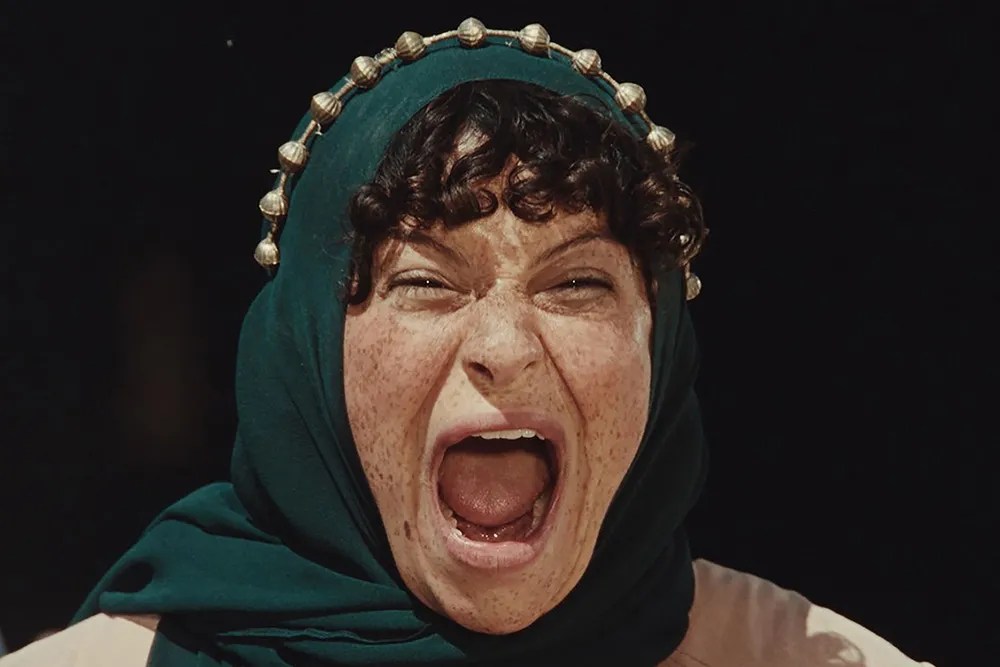
There’s a zombie-infested city about to be bombed to oblivion, a Hiroshima theatre festival facing an explosive personal conflict; and a bombshell in Italy who threatens a powerful family.
Wri/Dir: Ridley Scott
It’s the 1970s in northern Italy. Gucci is a major luxury brand specializing in leather goods. Founded 50 years earlier, it is now in the hands of the second generation. Rodolfo Gucci (Jeremy Irons), an ailing but piss-elegant man who surrounds himself with priceless art, works behind the scenes, He is grooming his smart but nerdish son Maurizio (Adam Driver) to take over. But the law school student shows little interest in the company or the family. The other half is headed by Aldo (Al Pacino) a hands-on guy who heads the company’s American branch, and wants to expand into the Asian market. But he considers his hapless son Paolo (Jared Leto) an idiot. Enter Patrizia Reggiani (Lady Gaga). She’s an accountant at her dad’s trucking business, but has greater ambitions. She meets Maurizio at a party, when she
mistakes him for the bartender, but when she hears the name Gucci, her ears perk up. She wants in. After a few dates it’s true love, but Rodolfo doesn’t want his family name besmirched by a trucker’s daughter (forgetting that his own father who founded the company was not a rich man.) So Maurizzio marries into her family gives up his inheritance, and starts hosing down trucks — the best job he’s ever had, he says. But not for long. Following her TV psychic’s instructions Patricia manipulates and manoeuvres Maurizzio’s family to bring him back into the fold (with her at his side) to claw his way back to the top. And she’ll stop at nothing to get what she wants. But can they survive the troubles yet to come?
House of Gucci is a true crime/corporate family drama about the rise and fall of a rich family… which isn’t that interesting on its own. And I can’t stand an entire movie of American actors putting on vaguely foreign euro accents — we’re supposed to imagine them speaking their native Italian — why the awful accents?
But that’s not why the movie is so much fun. What makes this movie work are two things. One is the amazing fashion and design of the whole movie. Everyone is constantly dressing up— more dresses and purses and tuxes and jewelry than you can shake a stick at.. Even more than this are all the campy, over-the-top characters, chewing the scenery as each one tries to out-do the others. Effete Jeremy Irons, a dazed Salma Hayek, a wonderful Al Pacino, and best of all, Jared Leto, as the hilarious Paolo. Lady Gaga is OK, but can’t compare to the masterful performers all around her. And Adam Driver is the dull straight man who steps back and lets the others shine. House of Gucci is a very enjoyable feast of high-fashion schlock.
Resident Evil: Welcome to Raccoon City
Wri/Dir: Johannes Roberts
It’s the 1990s, somewhere in the US. Chris and Claire Redfield are an estranged brother and sister. They grew up in the Racoon City Orphanage, a creepy place filled with weird dolls and strange creatures that appear late at night. It is run by the Umbrella corporation the worlds largest pharmaceutical company. But Claire (Kaya Scodelario) runs away when she sees something terrible, while Chris (Robbie Amell) joins the local police force. But now she’s back… to warn Chris that something terrible is about to happen. A leak at the lab has let loose a horrible epidemic infecting nearly everyone in the town. But rather than getting sick, this virus
makes your eyes bleed, your hair fall out and you turn into a flesh eating zombie. Or worse (no spoilers). They have until 6 am to fight off these monsters and escape from this hell-hole, or else they, and the rest of the town will be wiped off the face of the earth. They split up; Chris, and fellow cops Wesker and Valentine (Tom Hopper, Hannah John-
Kamen) investigate the Spencer mansion, while Claire, the Police Chief, and Leon, a newby on his first day of work (Avan Jogia) set out from the police station. Will they ever get together? Who will live and who will die? And what secrets do these labs hold?
Resident Evil: Welcome to Raccoon City is a movie based on a video game, plain and simple. There are some good laughs, and a threadbare plot line, but it’s mainly reenacting the game, from the long dark hallways where zombies run towards you, to the dark and scary Spencer mansion. Even some of the camera angles and pans duplicate the game itself. But it’s very cool to see on the big screen scary pitch-black scenes lit only by a lighter and the flash of gunfire revealing zombie faces. That said, it’s more eerie than scary, more action than horror. Not bad, but not much to it.
Dir: Hamaguchi Ryusuke
Kafuku and Oto are a happily married couple in Tokyo. Kafuku (Hidetoshi Nishijima) is an actor and director in theatres, while Oto (Reika Kirishima) is a famous scriptwriter for TV and film. Oto’s ideas come to her at an unexpected time — while they’re having sex. Her bizarre stories are generated in the throws of orgasmic bliss, recited aloud to her husband, so it’s up to him to listen and remind her the next morning of what she said. But everything changes one day when he comes back early from a cancelled flight to Vladivostok. He catches sight of her making love to another, much younger, man in their bedroom. He sneaks
away instead of barging in, but before they have a chance to talk about it, she dies of an unexpected cerebral hemorrhage.
Years later he’s invited to direct a play — Chekhov’s Uncle Vanya — for a festival in Hiroshima. Kafuku’s trademark method is to cast his plays with actors who speak other languages and can’t understand each other. In this one the actors speak Japanese, Korean, Chinese, and even signs language. So they practice under his exacting direction, forced to keep each line perfectly timed. But there’s a twist: the most famous actor in the play is Takatsuki (Masaki Okada) a handsome and arrogant star who says he idolizes Kafuku and his late wife Oto. And he’s the one Kafuku thinks he saw having sex with his wife before she died.
Meanwhile, in line with the theatre company’s rules, all directors must be driven to and from the theatre each day. So Kafuku gets to know the introverted Misaki (Tôko Miura), a young female driver from Hokkaido with a strange story. But as the production nears its premier date something terrible happens, forcing all the main players to reevaluate their priorities.
Drive My Car is a beautiful drama about love, loss, jealousy, and guilt. The movie builds slowly in an exacting manner, as the director and the various actors get to know one another. And the excerpts from Uncle Vanya we see as they rehearse exactly mirror the feelings and thoughts of the characters in the movie. That’s not the only story. There’s also Oto’s own stories she told her husband, and the personal confessions from the driver herself about her dark past. The acting is superb, and the panoramic views, ranging from drives on causeways and through tunnels to footage of a vast municipal incinerator, are breathtaking. The film is based on a Murakami story, with all the weird quirky fantasy combined with mundane realism you’d expect from him. Drive My Car is a long movie but one that is deeply, emotionally satisfying.
House of Gucci and Resident Evil: Welcome to Racoon City are now playing theatrically in Toronto; check your local listings; and Drive My Car has just opened at the Tiff Bell Lightbox.
This is Daniel Garber at the Movies, each Saturday morning, on CIUT 89.5 FM and on my website, culturalmining.com.
East Asia. Movies reviewed: The Assassin, Miss Hokusai, Port of Call
Hi, this is Daniel Garber at the Movies for culturalmining.com and CIUT 89.5 FM.
Toronto’s fall film festival season continues in November.
Rendezvous with Madness opens tonight, featuring films and documentaries made by or about people with mental health or addiction issues. Each screening is followed by a
panel discussion. And don’t miss the ReelAsian International Film Festival which started last night. I find movies from East Asia doubly interesting, not just for the story, acting and cinematography, but also for the cultural insights. This week, I’m looking at three Asian movies: a true crime drama set in contemporary Hong Kong, a martial arts epic set in Tang dynasty China, and Japanese anime set in 19th Century Edo.
The Assassin
Dir: Hou Hsiao-hsien
Nie Yinniang (Shu Qi) is a young woman in Tang dynasty China born into high-ranked family. As children, she and Tian Ji’an – a first cousin (Chang Chen) — are given matching disks carved from yellow jade, as a symbol of their future marriage. But destinies change. So to save her life, her mother sends the 10-year-old away to study with a Taoist nun.
But what does she study? She leaves there with a moral drive to defend the empire against all foes, both inside and at its fringes. With her long black
hair hanging down, the beautiful Nie Yinniang now dresses in black robes to remain unseen, a veritable Chinese ninja. She can handle a sword like none other. Her profession? Assassin. The kind who can take down an official on horseback in the midst of a royal retinue and disappear a second later.
But does she have the mental toughness to kill on command? She refuses to kill a target when she sees him protecting his child. The nun says “to be
a true assassin, first kill the one that victim loves, then the victim himself.” And she sends her back to her beginnings with a mission. Kill the one she loves most — Tian Ji’An!
This sounds like just another martial arts movie, and it does have some excellent sword fights, battles and chase scenes. But don’t go to this movie expecting an ordinary action film. Cause it ain’t. It’s by renowned Taiwanese director Hou Hsiao-hsien, known for his stunning visual and musical style, cultural sensitivity… and sloooow pace. Cloak and dagger politics, sumptuous costumes, stilted language, they’re all there, but without the driving music and non-stop action of most Wushu movies. This is suitable for Hou Hsiao-hsien fans, but anyone looking for a crouching tiger or a hidden dragon will search in vain.
Miss Hokusai
Dir: Hara Keiichi
Based on the manga Sarusuberi by Sugiura Hinako
O-ei is an accomplished painter in 19th century Edo (now called Tokyo), known for her scary images of hell, and erotic portraits of women. She spends her days painting in her father’s studio, or trolling the lanes of Yoshiwara, the red light district. She lives in the floating world of actors, sex workers, geisha, samurai and nouveau-riche merchants. And she visits her blind little sister, sent away by their dad who doesn’t like being near disabled people. The movie follows episodes from her life, both realistic and fantastical: painting her first
dragon (the spirit has to possess you), seeing demons, even witnessing a long-necked geisha’s out-of-body experience. And her first sexual experience with a man, an onna-gata kabuki actor, who spends his life dressed as a woman.
Based on a true story, you may be wondering how come you’ve never heard of her? The answer is simple: she lived under the shadow of one of
the most famous Japanese artists of all time, Hokusai. His ukiyo-e block prints of mount Fuji and his big blue cresting wave are still ubiquitous images when you think of Japan. He was quite the showman, creating the world’s largest brush painting of Zen Buddhist monk Daruma, using a brush bigger than he was.
Miss Hokusai is both faithful to, and a victim of, Japanese anime based on manga. It follows the winding pace and endless variations of Japanese manga, not the neat beginning/middle/end of a western graphic novel. I like its non-judgemental view of the pre-Meiji demi-monde, and it’s all-around Japaneseness. Just wish it had a more linear plot.
Port of Call
Dir: Philipp Yung
Wang Jiamei (Jessie Li) is a student at a Catholic high school in Hong Kong. Originally from Hunan on the mainland, she arrived with her ambitious divorced mom and her innocent little sister. Her dad is a layabout gambler who makes his money whenever Manchester United loses a game. She picks up the local language but can’t fit in. She feels cold and detached inside, alienated. When a girl at the next desk slits her wrist in class, she doesn’t even blink. She drops out and drifts from job to job. A modelling agency sends her to one gig – she becomes the poster girl – literally – in an ad warning about domestic violence. Prophetic.
Ting (Michael Ning) is a friendless, chubby boy whose mother was killed in
a truck accident when he was a kid. After online chatting, he had hired Kama (Jiamei’s name she uses as an escort.) But their meeting leads to a series of horrific events. And when she completely disappears her mother calls the cops to investigate. Detective Chong (Aaron Kwok) quickly determines she’s not missing, she’s dead. But her body is nowhere to be found. Until Ting walks into a police station and confesses all.
Through a series of flashbacks and courtroom testimony, the three
characters – the murderer, the relentless detective and the dead victim – all reveal their secrets, feelings, histories and surprising motivations. What starts out as a simple police procedural turns into a moving — and at times shocking – drama of a case that had Hong Kongers glued to the tabloids just a few years ago.
Port of Call is a bit long and has some truly disgusting scenes. But it captures a feeling unique to parts of Hong Kong: gritty, grimy, cramped and crowded. The great performances by two unknown actors (plus veteran singer/star Aaron Kwok), its indie soundtrack, the unmistakable images of HK cinematographer Christopher Doyle, plus a surprise ending, all place this film a step above most true crime movies.
The Assassin is playing now in Toronto at the TIFF Bell Lightbox, and you can catch Miss Hokusai and Port of Call at the ReelAsian Film Festival. This is Daniel Garber at the Movies, each Friday morning, on CIUT 89.5 FM and on my website culturalmining.com.
November 16th, 2012. Up and Down. Movies Reviewed: Floating City, Pusher
Hi, this is Daniel Garber at the Movies for culturalmining.com and CIUT
89.5 FM, looking at high-brow and low-brow movies, indie, cult, foreign, festival, documentary, genre and mainstream films, helping you see movies with good taste, movies that taste good, and how to tell the difference.
We’re nearing the end of the fall festival season here in Toronto. But there are still a few you can catch.
ReelAsian shows movies by and about people in or from East and Southeast Asia. The
festival continues this weekend with movies shown north of Toronto in Thornhill. It’s a great place to see current films from Asia that don’t normally make it to Toronto theatres. Rendezvous with Madness, which shows movies aboiut addiction and mental health is notable for it’s offbeat, rare and creative works. They’re each followed by panel discussions by the filmmakers, experts, and, here’s what’s different… psychiatrists! And I’m going to be moderating a panel of some great Canadian local films (North of Normal: A Collection of Canadian Shorts) so be sure to check that out series out this Saturday at 4 pm! SAD NEWS: ALL SCREENINGS AT RENDEZVOUS WITH MADNESS THIS WEEKEND HAVE BEEN CANCELLED DUE TO ROOF COLLAPSE.
The EU festival shows one movie from each country in the European Union chosen by representatives from each country’s diplomatic corps. Aside from the great films… it’s also completely free! It’s at the Royal Cinema on College street all week. And finally don’t miss the best named festival in Toronto: that’s Darryl’s Hard Liquor And Porn Film Festival at the Projection Booth on Gerrard St East. It;’s actually funny short films made by indie movie makers — not so much porn, but lots of funny adult topics.
This week I’m looking at two dramas about the fortunes of two ambitious but rudderless men whose fortunes rise and fall within the tides of the former British Empire.
Dir: Ho Yim
When a desperately poor woman loses her son in childbirth she buys a newborn to replace him – a Eurasian Chinese boy with bluish eyes. She raises him as her own and guards him with her life on a little fishing junk in the fragrant harbor of Hong Kong. He grows up literally barefoot, illiterate, beaten by his father, in debt, and bullied. His light-coloured hair marks him as an outsider. And the local corruption and bribery makes it very hard for a poor person to leave the underclass.
But one day he sees one of the legendary taipans – the ruling business oligarchs of Hong Kong – and vows to join their ranks. A missionary priest teaches him to read and write. And Bo is ambitious; rather than becoming a labourer or a fisherman, he manages to join the legendary East India Company. Despite the racist bully businessman Dick, his boss, he swallows his pride, even letting Dick call him “mixed” and “halfbreed”.
This movie – based on actual people – shows the rise of Bo (Aaron Kwok) against the history of post-war Hong Kong. It stretches from the social unrest uin the 60s through the panic in the 80’s and the ultimate signing of the British colony to the People’s Republic. It also shows his eternal question – who am I? – as he tries to find love, to fit into European
society, always pondering is that all there is? And will any loss of pride to kowtowing pay-off in the end? Or will he always be considered “second class”.
I liked the story and the characters, but it seemed more plodding than moving or thrilling. And the film seems a bit dry for such a monumental topic. Still, Floating World gives a comprehensive view of Hong Kong’s history and its people and its bitter-sweet role as a loyal British colony that was never accepted by the mother country.
Dir: Luis Prieto
Things are going well for Frank (Richard Coyle). He’s got a nice arrangement with a sleazy dry-cleaner (Danish actor Zlatko Buric) to supply him with drugs that he sells in dubstep nightclubs alongside his skinny, toothy side-kick Tony (Bronson Webb). And he is sleeping with a beautiful, ice-blond stripper (Agyness Deyn).
He decides to expand – he sends a woman to Amsterdam to pick up some coke, and — after a chance meeting with a casual acquaintance he met in the big house – he decides to go for an easy deal that will make him lots and lots of money.
But things are not what they seem. The Amsterdam deal isn’t working, his buddy seems to have turned on him, he suspects the set-up guy might be a narc, and all the money he borrowed from Milo The Dry Cleaner… has disappeared. He’s forced to accompany a violent enforcer to reclaim some of the money he is owed, knowing all the while that he might well be the next one crushed by the big time criminals.
Will he dig himself out if his hole, get back his money, avoid prison, escape the low life, and maybe find a quiet existence with his lover?
Pusher (a remake of Nicolas Refn Wilding’s film) is extremely violent, gritty, low-budget and depressing. It has some good intrigue and action, it’s fast moving and tense, but it’s not a fun movie. The acting is pretty good and you get to like the characters (even though they’re loathsome criminals)… but they’re all so beaten down by the even nastier bosses that you mentally want it all just to end already.
Pusher is playing now, Floating City is playing at reelasian.com this weekend in Thornhill; Rendezvous with Madness, Hard Liquor and Porn, and EUtorontofilmfest.ca all continue through the weekend.
This is Daniel Garber at the Movies, each Friday morning on CIUT 89.5 FM and on my website, culturalmining.com .


2 comments