It’s all lies! Films reviewed: Jay Kelly, Zodiac Killer Project, Wicked: For Good

Posted in 1960s, Acting, Crime, documentary, History, Hollywood, Musical, Witches by CulturalMining.com on November 22, 2025

Hi, this is Daniel Garber at the Movies for culturalmining.com and CIUT 89.5 FM.

This week, I’m looking at three new movies, about people who lie. There’s a movie star who smiles for the cameras, onscreen and off; two witches and a wizard who hides behind his curtain, and a filmmaker who looks at what lies behind True Crime documentaries.

Jay Kelly

Co-Wri/Dir: Noah Baumbach

Jay Kelly (George Clooney) a major Hollywood star known for his action movies, is wrapping up the last scene of his latest film. He gets a few days off before starting his next feature after attending a tribute to him in Tuscany, as his friend and manager, Ron (Adam Sandler) keeps reminding him. But then a series of unfortunate events begins to occur. Ron tells him that Peter (Jim Broadbent) a noted director who launched Jay’s career when he was just an acting student — has died. And his younger daughter says she’s heading off to backpack and ride the rails in Europe  before starting University in the fall… meaning his nest will be empty from now on. So when he runs into Tim (Billy Crudup) at Peter’s funeral — a blast from the past who he hasn’t seen in decades — he decides to join him for a drink at one of their old LA haunts. Tim was a method actor, someone so good he could read a menu aloud in a way that will make you cry. But their drinks turn to fisticuffs when Tim blames Jay for stealing his first role, sleeping with his girlfriend and generally ruining his life. Jay leaves the reunion with a black eye and Tim with a broken nose and a smouldering grudge. 

So Jay decides on a change of plans: he’ll fly to Europe and surprise his daughter in Paris for some spontaneous fun. But nothing can be spontaneous for an A-list movie star. Jay flies there in his private jet, with a huge entourage, including his manager, hair stylist, PA, bodyguard and publicist (Laura Dern). But  aside from his adoring fans, he can’t seem to make friends, spend time with his family, or do anything of lasting value. What’s a lonely, rich-and-famous guy to do?

Jay Kelly is a sardonic look at the hollowness of a Hollywood movie star’s life. Jay Kelly seems to be modelled on George Clooney’s own career; they even show clips from Clooney’s past films at Jay Kelly’s tribute, thus blurring the line between reality and fiction. Jay Kelly is always flashing his pearly whites, but seems to have no actual feelings, just poses — that his director, or his publicist tells him to do. The movie’s not bad, but it’s hard to have deep feelings about someone so fake, a character that only finds his true self on the silver screen. It’s like he’s always acting. The biggest surprise is Adam Sandler in a serious role, without any bombastic elements.  He’s actually good!

Jay Kelly is a cute light story, with a dark undertone. While not fantastic, it’s still worth watching.

Zodiac Killer Project

Dir: Charlie Shackleton

Charlie Shackleton is a documentary filmmaker from the UK who is obsessed with the case of the Zodiac Killer. He was a notorious serial killer who murdered any number of victims in the 1960s around the SF Bay Area, but was never caught. Part of his mystique was the  many killings later attributed to him, and the series of cryptic letters sent to his victims and fans. Charlie wants to make a documentary based on a book by a policeman who actually encountered the killer…  but negotiations with the authors of the book falls through, thus killing any chance of making the Zodiac Killer doc. Instead he decides to make a doc about how he would have made the doc he can’t make.

So the movie ends up being a spoken word-essay — Charlie’s words throughout — as he walks us through what he would have shot, scene by scene: a road stop outside of San Francisco; an urban street corner in Vallejo; a modernistic suburban church. Mundane images all, but always accompanied by clanky music and his eerie descriptions of what eyewitnesses saw in their search for the Zodiac Killer. Added to this are short clips and commentary of other True Crime docs, including films like Joe Berlinger and Bruce Sinofsky’s Paradise Lost trilogy,  about the three teenagers falsely accused of ritual child murder in West Memphis, Arkansas.

(Which is a great series, btw). But what Charlie points out is, many True Crime directors manipulate viewers using music, camera work and edited interviews to put the suspicion on someone the filmmakers want to blame, but who may or may not be responsible for the crime.  And he calls into question the myth of the documentary director as an impartial observer rather than a biased manipulator of the truth. 

Zodiac Killer Project is not a normal movie, by any stretch of the imagination (though it is pretty funny) It’s a filmmaker’s monologue on (what I think is) a very interesting topic, that is the deception and self-righteousness behind an entire genre — True Crime; accompanied by extended film images of, frankly, mundane locations. If you’re a cineaste, a movie buff, or a true crime fan, I think you’ll like this one; I do. But if you go expecting the bread-and-butter of True Crime media, the titillating images, the exploitational gross-outs, or self righteous harrumphing about the killer’s innate barbarism, you ain’t gonna find it here.

Wicked: for Good

Dir: Jon M. Chu

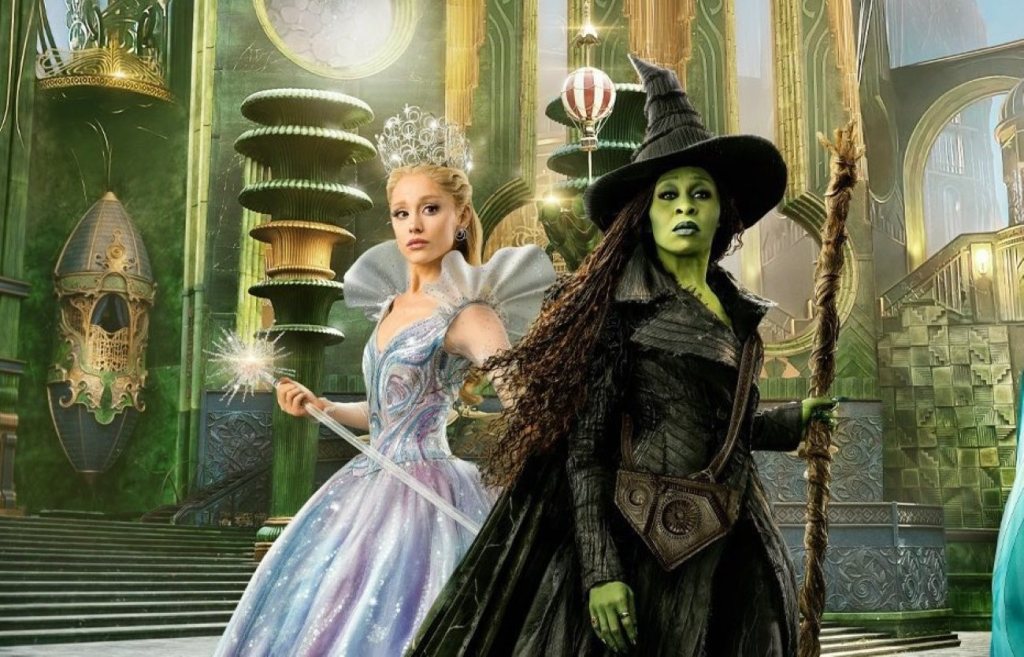
It’s another day in the Land of Oz, but things have changed over the past few years. Elphaba (Cynthia Erivo) has been in hiding ever since a massive government propaganda campaign has labeled her the “Wicked Witch of the West”. Her former best friend Glinda (Ariana Grande) is a figurehead who appears before the public in a mechanical bubble. She has no real magic but her job is to keep the peasants calm. She publicly professes her love for handsome Prince Fiyero (Jonathan Bailey) a captain in the army, but he pines only for the green-faced Elphaba. And Elphaba’s little sister Nessarose (Marissa Bode) is now an autocratic Governor, passing vindictive laws. But Nessa, too, suffers from setbacks: her long-time companion, the Munchkin Buck (Ethan Slater) has had enough of her (he’s secretly in love with Glinda.) And under the under the direction of the two scheming bullies with the only real power in this world — the Wizard of Oz (Jeff Goldblum) and Madame (Michelle Yeoh) — Oz is passing ever more draconian laws, including the stripping of all rights from animals, who once lived and worked side by side with humans. Will Elphaba and Glinda ever be friends again? Can they stop the Wizard’s nefarious plans? And who will Prince Fiyero choose to marry?

Wicked: for Good is part two of the film adaptation of the hit Broadway musical. It’s an intriguingly revisionist version of the original Wizard of Oz story. Dorothy and the cowardly Lion appear but only as insipid background characters, The Wizard of Oz is a bad guy, and the Wicked Witch of the West a potential heroine. It’s 2 1/2 hours long but never boring, including three new songs by Stephen Schwartz that weren’t in the original play. Now, personally, I’m not a fan of that genre of music, but Cynthia Erivo and Ariana Grande’s voices are a pleasure to listen to. It’s visually dead-on, from the artificial, candy-coloured palate of the Emerald City, to cute and rustic Munchkinland. And I love the Art Deco, steam-punk machinery everywhere. It’s exquisite. Great production values all around: sets, costumes, elaborate dance numbers, and, of course, the flying monkeys.

It does feel like the second part of a two-act play — following a year-long intermission — and it is a much darker ride than last year’s Wicked — but I still enjoyed it.  

Jay Kelly, Wicked for good and Zodiac Killer Project are all playing now in Toronto; check your local listings.

This is Daniel Garber at the Movies, each Saturday morning, on CIUT 89.5 FM and on my website culturalmining.com.

Daniel Garber talks with Jeff Harris about #TIFF24!

Hi, this is Daniel Garber at the Movies for culturalmining.com and CIUT 89.5 FM.

Photo of Jeff by Daniel Roher

TIFF is the most important film festival in this hemisphere, that gives us hints about the upcoming Awards season, what movies we should look out for, and where contemporary cinema is going. It ended six weeks ago, so it’s a good time to take a look at what TIFF brought us — the hits, flops, changes and sleepers, and just about the TIFF vibe itself. Jeff Harris is a professional photog who has covered TIFF for more than two decades, in photos and features for Macleans, The Walrus, and culturalmining among other outlets. So I’m very pleased have friend of the show Jeff Harris, here, in person, for a spirited discussion about this year’s TIFF.

TIFF 24 RECAP – PART 1

Films discussed include:

  • The Substance
  • The Assessment
  • Bird
  • Heretic
  • Emilia Pérez
  • The End
  • Fanatical: The Catfishing of Tegan and Sara
  • Elton John: Never Too Late
  • The Tragically Hip: No Dress Rehearsal
  • Piece By Piece
  • Better Man

TIFF 24 RECAP – PART 2

Films discussed include:

  • Paul Anka: His Way
  • The Luckiest Man in America
  • The Last Republican
  • The Order
  • The Seed of the Sacred Fig
  • The Girl with the Needle
  • Kill the Jockey
  • Nightbitch

TIFF 24 RECAP – PART 3

Films discussed include:

  • The Life Of Chuck
  • The Wild Robot
  • Mother Mother
  • Pepe
  • Dahomey
  • The Brutalist
  • Riff Raff
  • Nutcrackers

Americana, Canadiana. Films reviewed: Reagan, You Gotta Believe PLUS Canadian films at #TIFF24

Posted in 1980s, Canada, Hollywood, Politics, Sports, Texas by CulturalMining.com on August 31, 2024

Hi, this is Daniel Garber at the Movies for culturalmining.com and CIUT 89.5 FM.

The Toronto International Film Festival is less than a week away, bringing you the best of next year’s movies today. So this week I’m going to share a bit of Canadiana, an overview of movies playing at TIFF. But first, some Americana, two nostalgic biopics opening this weekend. There’s a president straight out of Hollywood, and a baseball team deep in the heart of Texas.

Reagan

Wri/Dir: Sean McNamara (The King’s Daughter, The Miracle Season)

Ronald Reagan is born in the town of Tampico, Ill, in 1911, to a bible-thumping mom, and an alcoholic dad. After summer jobs as a lifeguard he plays on a college football team for three years. His life in show business starts as a radio announcer, but he is eventually is drawn to Hollywood, where he has minor success in B-Movies. He marries Jane Wyman (Mena Suvari) a much bigger star than he is. They get divorced and he eventually marries Nancy Reagan (Penelope Ann Miller), who stays with him throughout his career, He rises in the union ranks till he’s head of the Screen Actors Guild. As his acting career tanks he turns to politics, and is elected Republican governor of California, from 1967 through 1985. And eventually becomes the 40th president of the United States. 

He runs on an upbeat conservative platform, and wins he a landslide. He cuts taxes to the very rich, brings a huge increase in military spending and a decimation of public welfare, while also running up the national debt. He pointedly ignores the AIDS epidemic, killing 100,000 mainly young people in the 1980s. And he brings the world to the brink of a nuclear holocaust, before switching to a more cooperative stance with the USSR’s new leader Gorbachev. He survives an assassination attempt, the Iran Contra scandal, and much, much more, all carefully noted in the film.

Reagan (the movie) is a comprehensive dramatic biopic about the life and career of this man. It’s hagiographic in its outlook and revisionist in its politics. It clocks in at 2:15 minutes but seems even longer, with its plodding retelling of every one of Reagan’s more famous moments or speeches. The costumes all look like recreations of Ralph Lauren fashion spreads in Vanity Fair. The acting varies widely. Dennis Quaid is adequate but not  believable as the much older Reagan. Lesley-Anne Down is absurd as a genteel and elegant Margaret Thatcher. But Penelope Ann Miller is uncanny as Nancy Reagan, perfectly capturing her look, voice, and expressions. It’s chronologically precise but full of blatant opinions and half-truths. Were the Contras really freedom fighters? Was it Reagan’s speeches and policies that brought down the Berlin Wall and the fall of the Iron Curtain? If you think so, this movie is for you. The twist is it’s all narrated by Jon Voigt (with a heavy Russian accent) as a KGB agent who supposedly followed Reagan’s career. Which fits, given the Cold War propaganda vibe of the whole movie.

This one’s a clunker.

You Gotta Believe

Dir: Ty Roberts (12 Mighty Orphans)

It’s the early 2000s in Fort Worth, Texas. Bobby and Jon (Luke Wilson, Greg Kinnear) are best friends. They go fishing together and are the coach and manager of the local Little League baseball team. Both their sons are players. Unfortunately, the team is terrible, ranked last in their division. They can’t even make it to first base. They’re a gang of 

oddballs and misfits. One with glasses, one with braces, a redhead, sleepy, happy, sneezy, doc… you get the picture.  Due to some odd circumstances they’re asked to go to the playoffs. But both Jon and the team members are less than enthusiastic. Why subject ourselves to even more of this constant failure?  Until they come up with a real reason to play, to try hard… and maybe even to win. Bobby has cancer. And he would love to see them in the championships. So they get together, enter heavy training, exercise and practice, practice, practice. And guess what? They make it all the way to the Little League World Cup in Massachusetts! But now they’re in the big (little) leagues… can they pull off a win? And can their enthusiasm help Bobby in his fight against cancer?

You Gotta Believe is a cute and funny family picture about kids and baseball. It’s based on a true story, and shows where the characters are now, 20 years later. The teams are all male, and so are most of the characters, except Sarah Gadon and Molly Parker as Jon and Bobby’s wives.  I am the opposite of a baseball fan, but even I know the difference between a strike out and a home run. (Lots of both in this film, though strangely very few singles doubles or triples.) There’s nothing terribly new or original in the story, but it’s still watchable by kids and some grownups. If you like baseball, and stories of comradery and teamwork, you’ll like this one.

Canada at TIFF24

TIFF brings us great movies from around the world; here are a few Canadian movies that I want to see. From the classics there’s Young Werther a contemporary retelling of Goethe’s famous novel, minus the sturm und drang; as well as a new version of  Bonjour Tristesse, based on the 1950s book written by a teenager. Guy Maddin’s Rumours is about the G7 leaders lost in the woods, while David Cronenberg’s The Shrouds has an inventor connecting with the dead. Matthew Rankin’s Universal Language envisions a bilingual Canada where everyone speaks French or Farsi; and Sofia Bohdanowicz’s Measures for a Funeral, about a renowned violinist. Sophie Deraspe’s Shepherds (Bergers) tells of a Montreal copywriter who flees to the alps; and Kazik Radwanski’s Matt and Mara about college friends reconnecting.

There are also some first features: Omar Wala’s Shook about a writer who falls for a barista, and Marie-Hélène Viens and Philippe Lupien’s Vous n’êtes pas seuls, about a pizza deliverer who falls for a musician but gets kidnapped by aliens. And Seeds, by Kaniehtiio Horn, about an influencer who signs a juicy contract promoting a multinational corporation only to discover they’re bad, bad, bad. And I’ve already told you about Sook-Yin Lee’s Paying for It. That’s just some of the Canadian films at TIFF this year. 

Reagan and You Gotta Believe both open this weekend in Toronto; check your local listings. TIFF starts next Thursday — go to tiff.net for tickets.

This is Daniel Garber at the Movies, each Saturday morning, on CIUT 89.5 FM and on my website culturalmining.com.

Daniel Garber talks with Jeff Harris about #Oscars 2023!

Posted in Academy Awards, Acting, Hollywood, Interview, Movies, TV by CulturalMining.com on March 11, 2023

Hi, this is Daniel Garber at the Movies for culturalmining.com and CIUT 89.5 FM.

It’s post-pandemic Oscar time, when they roll out the red carpets for the stars, choose some issue to temporarily weep about, and pay homage to some of the best, (and not-so-best) movies from the past year.  And always a surprise. Will this year be a punch or a slap? A photobomb? Or maybe a misread best picture award? Stay tuned tomorrow to find out.

And to help us understand the movies in competition at this year’s academy awards — what to see, what to avoid, what’s great, what’s terrible, who should win, and who we think will win — I’m going to speak with cinephile Jeff Harris. Jeff is a Toronto-based photographer, former photo editor at Maclean’s, and who is continuing a twenty five year art project of self-portraits taken each day. You may recognize his he takes the pics that go with my interviews each year at Hot Docs and TIFF (which he has been covering since 2002). And now he’s the one producing my segments on this show.

I spoke with Jeff Harris in person, in Toronto.

The Academy Awards will be televised on Sunday, March 12th.

Sex & Drugs & Rock & Roll. Films reviewed: Body Parts, Drinkwater, Happy FKN Sunshine

Posted in Canada, comedy, Coming of Age, documentary, Feminism, High School, Hollywood, Music, Sex, Sexual Harassment, Women by CulturalMining.com on January 31, 2023

Hi, this is Daniel Garber at the Movies for culturalmining.com and CIUT 89.5 FM.

Have you ever seen an actual performance of Kabuki? There’s a new monthly series opening in Cineplex theatres across Canada, including one playing tonight called Fortress of Skulls. If you’re in Milton right now, check out the Milton Film Festival, featuring Go On and Bleed, a short film by CIUT’s own Christian Hamilton. And if you’re in Toronto, you can catch Canada’s Top Ten at TIFF, featuring fantastic movies like Bones of Crows and Brother, as well as fun flicks like Rosie and  Cronenberg’s Crimes of the Future.

This week, I’m looking at three new, indie movies, one from LA and two from Canada. There are actors in Hollywood, runners in BC, and rockers in Northern Ontario.

Body Parts 

Dir: Kristy Guevara-Flanagan 

Is nudity in movies a good thing or a bad thing? How does it affect the actors and the viewers? And is it shown from a male or a female perspective? These are some of the questions talked about in a new documentary that takes a look at nudity and sex in Hollywood and it’s films. And it does so in a new and unusual way. Talking heads from the industry and academics, narrate the story, but it’s illustrated with a barrage of well-known movie clips, manipulated, pixilated and animated to both emphasize and obscure women’s bodies. By “barrage”, I mean a phenomenal number of images often just a second long, where what you see is what the interviewees are talking about. It deals with contemporary issues, like the #metoo movement, but makes it clear that Harvey Weinstein isn’t unusual or unique, just its epitome. Women reveal how as young actresses they were coerced into filming topless scenes never mentioned in the script. Bikini auditions were commonplace, completely unrelated to a part they’re trying out for, basically just for the titillation of male movie execs. It also traces the entire history of Hollywood, dating back to the libertine, pre-Code 1920s and 30s where female scriptwriters flourished, and subversive sex was common. Later a prudish America hid sexual transgressions off-camera. 

Stars and filmmakers interviewed in this movie include Jane Fonda, Karyn Kusama, Rose McGowan, and Rosanna Arquette among many others. But this is not a confessional reality-show-type exposee. It also includes on-set recreations of what the people describe; and fascinating types you never hear from, like the intimacy coordinators, sex choreographers, and body doubles — the nameless ones whose bodies replace A-list stars in nude scenes.  It also celebrates a taboo even bigger than nudity in Hollywood: a positive portrayal of sex and nudity involving people with disabilities, trans bodies and actors who aren’t proportioned like Barbie dolls.

If you’re a movie lover, a film student, a young actor or anyone in the industry, Body Parts is a must-see, a crucial, insiders’ look at the rapid changes involving sex, nudity, consent and the male gaze.  It’s a feminist reimagining of what movies are, and what they should be. This film might deserve a place alongside Thom Andersen’s Los Angeles Plays Itself in the pantheon of great documentaries about Hollywood.  

Drinkwater

Dir: Stephen S. Campanelli (Indian Horse)

It’s present day in Penticton, BC. Mike Drinkwater (Daniel Doheny) is a high school student who lives with his selfish, layabout father. Mike is into Rubik’s cubes, Bruce Lee, and drives a Gremlin. He’s smart and creative but his head is in the clouds. He’s infatuated with Dani, the most popular girl in his school. Hank Drinkwater (Eric McCormack) used to work at the mill but is on paid medical leave due to an accident. He wears a fake neck brace so he won’t have to go back to work. Mike wants to go to U Vic but Hank would rather spend his money on toys and model trains than cough up for his son’s education.

Luckily there is a way out. If he wins the annual cross-country race, the prize will cover his tuition. And Wallace (Louriza Tronco) the orphan-girl next door who lives with her grandparents, agrees to help Mike train for the race. She has a secret crush on him, just as Mike loves Dani. But Dani’s dating Luke (Jordan Burtchett) the homecoming king, a rich kid whose dad owns the paper mill, where Mike’s dad works. Luke is Mike’s main rival in the race, just as their fathers competed years back in the same contest — a grudge spanning generations. Who will win the race? Who will Dani choose to date? Will Hank ever start caring about life? And will Mike ever realize that Wallace is the one he should crush on, not Dani?

Drinkwater is a coming-of- age comedy about growing up in a BC lumber town. The story is conventional, but told in a stylized way, incorporating 70s and 80s looks with a retro rock soundtrack. It also celebrates local culture and lore. The director is best-known for his camerawork, and the film is full of breathtaking aerial views of scenic lakes and forests. Very few surprises, but it’s still cute and easy to watch.

Happy FKN Sunshine

Dir: Derek Diorio

It’s the 2000s in a pulp and paper mill city in Northern Ontario. Will (Matt Close) is a high school student and aspiring musician. He has styling hair and slacker clothes. He plays the guitar, loves music and wants to form a rock band — it night be his ticket out of this place. So he tries to recruit a motley crew to join the band. Vince (Connor Rueter) an arrogant bully can be the lead singer; River (Maxime Lauzon) the blasé friend of his sister on drums; and Artie, a long-haired, heavy metal enthusiast on bass. Artie, who lives with his brain-dead father, invents fantasies of his secret jam sessions  with famous rockers… which drives Vince insane.

Times are tough, and there’s a strike at the mill where all their parents’ work. Will’s abusive, hard-ass father refuses to spring for an electric guitar. Fortunately, Will’s tiny-but-tough sister Ronnie (Mattea Brotherton) is the local pot dealer, so she steps up to buy him the instrument. And Artie’s Newfoundland uncle Eddie, a former musician (famous stage actor/pianist Ted Dykstra), promises to introduce them to some big names in Toronto, if they ever making some good music. Can the band become famous before it breaks up?  And can Will ever make it out of this place?

Happy FKN Sunshine (the title is also the name of their band, and reflects the constant foul language all the characters use) is a realistic, bittersweet coming-of-age story about a group of mismatched friends who form a band. It’s shot on location in North Bay and in the Canadian Shield forests around it. The acting is generally quite good, turning stereotypes into well-rounded characters. And it deals with the harsh realities of living in a declining economy. The pace is a bit slow, with too much time spent making music, but the multiple side plots will keep you interested. 

I like this movie.

Look for Drinkwater and Happy FKN Sunshine both available on VOD; Body Parts opens next week in select theatres and on VOD; check your local listings.

This is Daniel Garber at the Movies, each Saturday morning, on CIUT 89.5 FM and on my website, culturalmining.com.

New Year Movies. Films reviewed: Babylon, Broker

Posted in 1920s, Corruption, Crime, Drama, drugs, Family, Hollywood, Korea, Sex by CulturalMining.com on December 31, 2022

Hi, this is Daniel Garber at the Movies for culturalmining.com and CIUT 89.5 FM.

This week I’m looking at two new movies to bring in the new year. There’s an abandoned baby in Busan, and excessive abandon of 1920s Hollywood.

Babylon

Wri/Dir: Damien Chazelle (La La Land, Whiplash)

It’s a hot day in Santa Ana, near LA, in the 1920s. Manny (Diego Calva) has a strange job. He has to get an elephant through the desert to a mansion in time for a huge Hollywood party that night. There he meets Nellie LeRoy (Margot Robbie) an aspiring young actress who claims to be a movie star. She’s never actually been in anything yet but she says in Hollywood if you say you’re a star you are a star. The doorman is unimpressed but Manny, now in a sweaty tux, gets her through the door. Inside it’s a jazz-filled mayhem of half-naked dancers snorting cocaine as they prepare for their next writhing orgy. The guest of honour is Jack Conrad (Brad Pitt), Hollywood’s top moustachioed movie star.

Manny stays relatively sober but Nellie goes whole hog, successfully transforming herself into a wild-child party animal. Manny saves the day when he manages to sneak a dead body out of the party on behalf of the studio, without the gossip rags — including Photoplay’s notorious columnist (Jean Smart) —  noticing. A woman died in a back room with a Fatty Arbuckle lookalike. By morning, both Manny and Nellie are invited to work on location on some movies being shot there; she as a starlet and he as a fixer, helping out in emergencies. 

The movie follows the three of them — Manny, Nellie and Jack — as they make their way up and down Hollywood’s precarious ladder. Nellie is a smash hit — she can cry on cue in a tragedy, and minutes later turn herself into a laughing floozie in a western bar. Manny works behind the scenes, doing the dirty things the top producers shy away from. Jack is still the top star, but is gradually slipping at the box office, acting in one flop after another. has a meteoric rise but faces trouble when the talkies arrive. Manny makes his way to executive level, but likes himself less and less. Will Jack find a wife who loves him? Can Nellie lose her Jersey accent in time for the talkies? Which one of them will survive the dog-eat-dog world of the movie industry?

Babylon is a very long but frenetically-paced movie about the early days of the motion picture industry. It recreates a version of that world with exquisite attention to detail — the music, the costumes, and incredible reenactments of the filming of war scenes and dance numbers using hundreds of extras. It gives you an uncommon, behind-the-scenes look at the silent movie era. Scenes in Babylon melt one into the next with cameras that lead you through tunnels, up staircases, from room to room in seemingly endless long shots. The story is part myth, part history. I’m guessing Chazelle found his inspiration in books like Kenneth Anger’s Hollywood Babylon, about the excessive and scandalous depravity that rocked the industry before the restrictive Hays code came into effect in the mid 1930s. He frequently quotes other famous movies set in LA about the movies themselves, everything from Sunset Boulevard to A Star is Born, to Singin’ in the Rain. (See how many you can spot.) And the over-the-top acting, especially Margot Robbie, is a lot of fun.

Is Babylon a good film? I had trouble identifying with the main characters — they all seem like pawns in the director’s hands as he tells his epic story. It features some non-white, non-conventional characters, from a female movie director, to a lesbian singer from Shanghai, and a black Jazz musician showing off his trumpet skills. Ironically they all seem to be inserted more to demonstrate the director’s commitment to historical diversity rather than as central characters. But it’s not really about the characters, it’s about the city of Los Angeles. Chazelle puts in lots of things meant to shock — nudity, defecation, urination, projectile vomiting, even characters who die as punchlines to jokes — that don’t quite fit.  But all that didn’t stop me from loving the movie-making on display.

If you’re a movie-lover, this epic deserves to be seen.

Broker

Wri/Dir:  Kore-eda Hirokazu (Shoplidters, After the Storm, Our Little Sister, Like Father Like Son)

It’s nighttime at a church in present-day Busan, South Korea. A young woman, a sex worker named So-young (Lee Ji-eun) is carrying her newborn infant which she leaves in a “baby box”, a small door where unwed mothers can leave their unwanted infants, knowing that they’ll be taken care of. What she doesn’t realize is there are two men on the other side of the door: Sang-hyun (Song Kang-ho), a younger guy who works at the church; and Dong-soo (Gang Dong-won) a middle aged man who owns a tiny hand laundry shop. Right after So-young leaves, they erase the surveillance video and make off with the infant. Their plan? To sell it to a young married couple with fertility problems and keep the profit. But these two men don’t realize that Detective Ji-Sun (Bae Doona) and her subordinate (Lee Joo-young) are watching the whole thing from their police car parked just down the hill. They’re excited that what they see tonight might solve the baby trafficking case they’ve been working on for a long time. But they can’t prove anything until a transaction takes place.

But nothing is as simple as it seems. After a few days, So-young wants her baby back. She left a note saying the arrangement was only temporary. But she can’t involve the police. So she tracks down the two brokers. Turns out Sang-hyun grew up in an orphanage, so finding loving parents will spare the baby from growing up within the bleak institution he lived through. And Dong-soo has both monetary reasons — he’s deeply in debt — and personal reasons why this has to go through. So the three of them form an easy alliance of brokers looking for a permanent home for the infant. And when they discover Hae-jin (Lim Seung-Soo) a feisty kid from an orphanage they’re dealing with stowed away in their car, they suddenly become a makeshift family. But how long will it last? 

Broker is a wonderful, multifaceted movie about love, kinship and makeshift families. It’s also a murder mystery, a romance, a police procedural, and a road movie. Each of the characters has a rich background full of secrets and motives all of which a are gradually revealed. It’s directed by Kore-eda Hirokazu, one of favourite directors who always finds a way to make dramas with unforgettable characters who are deeply flawed but still sympathetic. He made Shoplifters a few years ago, and this one picks up on some of his themes. Kore-eda is Japanese, but everything else in this film is Korean — from the language to the locations and the fantastic cast. You’ll recognize some of them: Song Kang-ho starred in Parasite, Bae Doona has been in everything from The Host to Cloud Atlas. So Broker is both a Korean movie, and unmistakably Kore-eda. I saw it four months ago at TIFF, but it really is stuck in my head.

I strongly recommend this movie.

Babylon is now playing; check your local listings. Broker opens this weekend in Toronto at the TIFF Bell Lighbox.

This is Daniel Garber at the Movies, each Saturday morning, on CIUT 89.5 FM and on my website, culturalmining.com.

Hollywood movies. Films reviewed: Glass Onion, The Fabelmans

Posted in 1950s, 1960s, comedy, Coming of Age, Family, Hollywood, Movies, Mystery, Secrets by CulturalMining.com on November 28, 2022

Hi, this is Daniel Garber at the Movies for culturalmining.com and CIUT 89.5 FM.

It’s Thanksgiving weekend south of the border, so movies are being released midweek. This week I’m looking at two new, big-ticket Hollywood movies, you might want to watch this weekend. There’s a mystery/comedy set on a private Greek island, and a coming-of-age drama set in postwar America.

Glass Onion: A Knives Out Mystery

Wri/Dir: Rian Johnson

Miles Bron (Edward Norton) is a conceited, ultra-rich tycoon who made his fortune in the tech sector. Now he amuses himself by throwing elaborate parties on his private Greek Island, where his select guests try to solve a mystery during their stay. But this year, there’s a surprise visitor — the famous detective Benoit Blanc (Daniel Craig). He’s there on the invitation of one of the party guests — Bron’s former business partner — who was secretly murdered, with her identical sister (Janelle Monáe) a meek introvert, impersonating the flamboyant victim. (She invites Benoit as her guest to find her sister’s killer.)

Benoit Blanc, of course, is the famous gay private investigator known for his dapper suits, southern drawl, and legendary detective skills. Other guests include a flaky fashion designer (Kate Hudson), an insufferable online celebrity (Dave Bautista), a devious politician (Kathryn Hahn), and a shady scientist (Leslie Odom, Jr.), among others. But the week-long game is spoiled when Benoit guesses the answer almost immediately, to the host’s displeasure. But, soon after, the real mystery begins, when one of the guests is murdered in plain sight without anyone knowing whodunnit. It becomes a race against time, as other guests start to disappear, one by one. Can Benoit identify the killer, uncover their motive, prevent any more murders, and solve the bigger mystery of why these particular people were invited to this party?

The Glass Onion is a brilliant sequel to Ryan Johnson’s Knives Out from a few years ago, with Daniel Craig repeating the role of Benoit Blanc. It’s hard to review a mystery without giving away the plot, but I’ll do my best. This movie is very cleverly done: like any good Agatha Christie-style mystery, all the different characters — both potential killer or killers and victims — are introduced at the beginning, with no surprises

Glass Onion: A Knives Out Mystery (2022). (L-R) Jessica Henwick as Peg, Kate Hudson as Birdie, and Janelle Monáe as Andi. Cr. John Wilson/Netflix © 2022.

parachuting onto the Island. It’s also good because each character has their own quirks, back stories, secrets and motives, all of which are gradually revealed.  It’s even more fun because many of them are satirically modelled after certain celebrities. On top of that, there are a number of intricate clues hidden within clockwork-type devices featured in the film. 

I’ve been watching Rian Johnson’s work since his first film, Brick, came out almost 20 years ago, as he gradually honed his skills. I loved Knives Out, but was worried that a sequel might be a let down. But have no fear, Glass Onion is as good as or better than Knives Out. It’s hard to find movies these days that are there just for the viewers’ pleasure without ever pandering, dumbing down a plot, trying to sell you stuff or stealing ideas. Glass Onion avoids all that, concentrating instead on giving you a really fun night out. 

The Fabelmans

Dir: Steven Spielberg 

Written by Spielberg and Tony Kushner.

It’s Christmastime in the 1950s. Sammy Fabelman (Gabriel LaBelle) is a little boy who lives with his parents and sisters in New Jersey. Mitzi his mom (Michelle Williams) is a former concert pianist forced to adjust to suburban family life. But she manages to keep her sense of creativity front and centre. She refuses to do dishes, insisting instead on paper plates and plastic forks.  She’s the kind of woman who doesn’t hide from tornados, she chases them… and reads music scores in bed. She has a blonde pixie haircut and loves diaphanous white gowns. 

Burt (Paul Dano) his dad, is an engineer and part-time inventor who works for RCA and repairs old TV sets as a side job. He thinks science is superior, while art and movies are just for fun… but he worships the ground Mitzi walks on. And always close at hand is Burt’s best friend and workmate Bennie (Seth Rogan) who the kids all call Uncle.

The story begins with the parents taking Sammy to his first movie, Cecil B DeMille’s The Greatest Show on Earth. Sammy is frightened but also mesmerized by a trainwreck in the movie where circus cars are derailed and wild animals run free. Sammy wants to film it. He manages to duplicate it on 8 mm film, repeatedly using his model train set seen from all the angles used in the movie. Sammy’s love of film is ignited — now he’s making silent monster movies at home starring his sisters. Later the family moves to Colorado, where Burt has a new position developing computers for General Electric.

And Uncle Bennie moves with them.

Teenage Sammy is now a boy scout, and, with his new friends, starts shooting and editing elaborate westerns and war movies to everyone’s delight. But in editing family films he discovers a hidden secret that threatens to pull them apart. 

Years later, they move to northern California where Burt now works for IBM. But Mitzi feels depressed and alienated and Sammy is bullied at school by guys who, he says, look like giant Sequoia trees. Can he still find solace making films? Will Mitzi adjust to a strange new environment? Or is the family heading for disaster?

The Fabelmans (meaning storytellers) is Steven Spielberg’s first fictionalized, semi-autobiographical look at how his childhood and adolescence led to his career as a filmmaker. I usually dislike movies about movies — they tend to be overly nostalgic and sentimental, and mainly there as Oscar-bait, to get people in the industry to vote for them. But this one is surprisingly good. And while there are many scenes of people staring at movie screens, there’s way more to it. It’s a bittersweet coming of age story, it’s a family story, and it’s a rare mother-son story: Sammy and Mitzi are both obsessive artists driven by their craft, but facing constant roadblocks put up by the conventional world. The film also incorporates the southwest, circuses, evangelism, folk singing, secular Judaism, family camping trips, and baby boom youth culture.

Michelle Williams is excellent as Mitzi, a complex character with many regrets. Canadian newcomer Gabriel LaBelle as Sammy is also great. And Judd Hirsch totally steals the scene as crazy Uncle Boris (Judd Hirsch), a lion tamer who wants Sammy to understand that following your artistic dreams is like sticking your head into a lion’s mouth: it takes guts, drive and determination… and might hurt a lot.

The Fabelmans is a very enjoyable movie. 

Glass Oinion is on at the TIFF Bell Lightbox for one week only, while The Fabelmans is playing across North America; check your local listings. 

This is Daniel Garber at the Movies, each Saturday morning, on CIUT 89.5 FM and on my website, culturalmining.com.

Daniel Garber talks with Jeff Harris about Oscars 22!

Posted in Academy Awards, Acting, Hollywood, Movies by CulturalMining.com on March 26, 2022

Oscar interview

(Interview continued)

Hi, this is Daniel Garber at the Movies for culturalmining.com and CIUT 89.5 FM.

Photo of Jeff Harris by Jeff Harris.

Yes, it’s Oscar time again, but are you ready for more pomp circumstance, the swimming pools and movie stars, the red carpets and fancy clothes?

Or are you just going to give it a miss?

Either way, you’ll hear all about after this year’s awards this weekend, on Sunday, March 27th.

Did you notice anything different this year? Have you seen any of the movies yet? Do you want to see them? How many could be considered Oscar Bait?

Well to answer some of these questions, to look at the nominations, and to give you a taste of what’s to come, I’m going to join today’s guest in a discussion about the Oscars. Jeff Harris is a Toronto-based photographer, former photo editor at Maclean’s, and is continuing a twenty five year art project of self portraits taken each day. You may also know him for taking the pics that accompany my interviews each year at Hot Docs and TIFF (which he has been covering since 2002).

Jeff Harris is back again for the fifth year as resident cinephile to add his voice to our annual  Oscar rundown.

I spoke with Jeff via Zoom.

The Oscars air on March 27, 2022.

Daniel Garber speaks with Jeff Harris about the Oscars

Posted in Hollywood, Movies, TV by CulturalMining.com on April 16, 2021

Hi, this is Daniel Garber at the Movies for culturalmining.com and CIUT 89.5 FM.

Photo by Jeff Harris.

Yes, it’s Oscar time again, albeit a few months late, and selected from a much smaller pool since most movie theatres have been closed for a year now, and distributors are sitting on their big-ticket blockbusters.

But hey, however you slice it, it’s still the Oscars. What are the biggest changes this year? Are the Oscars a tired warhorse that should be put out pasture? Or is it an always fresh and always surprising look at the past year’s best movies?

Well to answer some of these questions, to look at the nominations, and to give you a taste of what’s to come, I’m going to join today’s guest in a discussion about the Oscars. Jeff Harris is a Toronto-based photographer, former Photo editor at Maclean’s, and is continuing a twenty-year long art project of self portraits taken each day. You may also know him since he takes the photos that accompany my interviews at Hot Docs and TIFF. Most recently he completed a music video for Toronto musician Regina Gently released later this month.

I spoke with Jeff Harris on April 13th, 2021 via Zoom.

The Academy Awards will be broadcast on April 25th. 

My predictions:

Best Picture: Nomadland

Best Director: Chloe Zhao ✓

Best Actress: Frances McDormand ✓

Best Actor: Riz Ahmed Anthony Hopkins X

Best Supporting Actress: Youn Yuh-jung ✓

Best Supporting Actor: Daniel Kaluuya ✓

Best International Film: Quo Vadis, Aida? Another Round X


Different from the norm. Films reviewed: Blood Machines, The Roads Not Taken, Code of the Freaks

Posted in Disabilities, documentary, Drama, Dreams, Family, Hollywood, Science Fiction, Space by CulturalMining.com on May 22, 2020

Audio: unedited, no music

Hi, this is Daniel Garber at the Movies for culturalmining.com and CIUT 89.5 FM.

I’m still recording at home in the midst of this pandemic, but movies are still being released, just not theatriclly. So this week I’m looking at three new indie films that celebrate the unusual. There’s a psychedelic pilot in outer space, a man with dementia retreating into his innermost thoughts, and a radical re-look at the disabled in film.

Blood Machines

Dir: Seth Ickerman

It’s the distant future on a desolate planet in outer space. The spaceship is headed by Vascan (Anders Heinrichsen) with second-in-command Lago (Christian Erickson), along with a glowing metallic robot as its brain. It’s a ramshackle outfit, held together with nuts, bolts and duct tape. But they are surprised one day by a huge, snakelike machine that crash-lands nearby. Vascan ventures outside to neutralize it, but he’s stopped by a small group of all-women warriors, their hair dyed bright red. Don’t hurt her they say, referring to the AI-powered machine. Her? And when Vascan attacks the machine, something remarkable happens. A naked woman emerges from the wreck and flies up into the sky. She has a flawless body with the image of a glowing, upside down crucifix covering her groin and lower torso. What is she, a friend or foe? And why is she there?

Blood Machines is a surreal, psychedelic science fiction fantasy, told in three short chapters. The lines are delivered in comic book fashion, accompanied by brilliant electronic music (by Carpenter Brut). Vascan looks like an angry Jared Kushner in a tailored suit with Members Only epaulettes, while Lago is more like the original Scotty (on Star Trek) with a hangover. They are later joined by Corey (Elisa Lasowski) who adds rivalry and sexual tension to the mix –the giant laser gun Vascan likes to brandish, keeps malfunctioning when Corey’s around. There are holograms, fight scenes and writhing naked bodies. There’s not much of a story to speak of, but it doesn’t matter – It’s saturated with hot pinks, violets and acid greens, powered by constant musical thrumming, and loaded with endless science fiction tropes, from Fritz Lang’s Metropolis to Mystery Science Theater 3000.

Beautiful to watch and to listen to.

The Roads Not Taken

Wri/Dir: Sally Potter

Leo (Javier Bardem) is a middle aged man who is not all there. He lives in a spartan NY apartment beside the El-train. His daughter Molly (Elle Fanning), a career woman in her twenties, has the morning off to take him to the dentist and the eye doctor. But when she arrives he’s almost comatose. He barely responds to her questions. Is he just a hollow vessel with no spark inside? In fact his mind is elsewhere, caught between two other lives progressing simultaneously.

In one alternate reality, he lives with his first love Dolores (Salma Hayek) in an adobe home in the desert with rose coloured walls and bars on the window. She wants him to come with her to a Day of the Dead celebration to communicate with someone they lost. In a second life he’s a novelist on a picturesque Greek island where he writes and chats with tourists in open-air tavernas. But back in the present day his life is miserable. He’s prone to wander at night, barefoot and unaware. He drinks the dentist’s mouthwash and wets his pants, and calls strange women Dolores. Can Molly get through to her dad? And can he accept reality or will he retreat permanently into the recesses of his mind?

The Roads Not Taken is a grim look at the miserable life of a man suffering from dementia living a life he regrets, mitigated by the kindness of his daughter and the vibrant world he lives in inside his head. I have mixed feelings toward this movie. On the positive side, it has a stellar cast: Javier Bardem, Elle Fanning, Salma Hayek and Laura Linney as his ex-wife. But the narrative is fragmented among the three worlds, and not entirely satisfying. Elle Fanning is sympathetic, but how many times can a character have tear-streaked cheeks in one movie? She never turns off the waterworks. The musical score is great, and the cinematography is really effective, with a constant movement – trains, taxis, pickup trucks – that neatly ties together disparate scenes. Still, this movie just didn’t deeply move me. Sally Potter may be a great director, but this film is not one of her best.

Code of the Freaks

Dir: Salome Chasnoff

Are disabled people hideous villains or saintly, childlike freaks who need to be rescued? People with secret superpowers? Or ones who desire either to die or to be “cured”? All of the above, if you go by Hollywood movies. This new documentary looks at 100 years of film portrayals of people with disabilities and finds it sorely lacking in real-life characters.

The doc consists of movie clips – everything from The Miracle Worker, to Rain Man, to My Left Foot — alternated with brilliant commentary by artists, writers, academics and activists. There’s no group-think here, more of a cross-section of ideas from the community. And it covers very wide ground. Like the portrayal of sex and disabilities. White women are eroticized by upping their vulnerability, while black men are neutered, made non-threatening and asexual. And, as one commentator points out, you virtually never see two disabled people having sex with each other.

Blind people have “super-power hearing abilities” (Daredevil) or a carnal need to touch other people’s faces (!? ). If you have a mental illness or disability, you have no self-control, and are liable to explode… so you have to be either institutionalized, or killed, before you “hurt someone” (eg Of Mice and Men). Little people are turned into figures of fun. Wheelchairs are made symbols of limitation, not the vehicle they use to get around. (Are drivers ever described as “confined to cars”?)

The doc pinpoints some of the most offensive movies of all, skewering the hateful Million Dollar Baby, in which the heroine valiantly chooses death over living with a disability. It’s a running theme in this documentary – a happy ending in a drama with a disabled character means they’re either “cured”, institutionalized, or killed. Even worse are the dreadfully insipid “inspirational movies” where people are congratulated for their “bravery” just for existing, instead of portraying them as real people. The one thing you almost never see are disabled characters portrayed by disabled actors (though that’s gradually improving). Probably because roles like this are too valuable as Oscar Bait for the stars.

Code of the Freaks is a scathing look at Hollywood’s portrayal of disabilities and a radical rethink of the genre. This is a must-see documentary for all moviegoers everywhere.

The Roads Not Taken is available now on VOD; Code of the Freaks was the opening night film at the RealAbilities Film Festival; and Blood Machines is now streaming on Shudder.

This is Daniel Garber at the Movies each Friday morning on CIUT 89.5 FM and on my website culturalmining.com.