Unobtainable, unsustainable, inevitable. Films reviewed: Bookworm, Monkey on a Stick, Smile 2

Posted in 1970s, 1980s, Addiction, Canada, Crime, Family, Hippies, Horror, India, Kids, Magic, New York City, New Zealand, Religion by CulturalMining.com on October 19, 2024

Hi, this is Daniel Garber at the Movies for culturalmining.com and CIUT 89.5 FM.

Toronto Fall Film Festival season continues with Rendezvous with Madness presenting docs and dramas, features and shorts, about addiction and mental health followed by in-person discussions, starting on October 25th. 

But this week, I’m looking at three new films, a kids’ movie, a doc and a horror film. There’s a precocious girl looking for the unobtainable; a group of deranged gurus trying to hold onto the unsustainable; and a pop starch wants to escape the inevitable. 

Bookworm

Co-Wri/Dir: Ant Timpson

Mildred (Nell Fisher) is a young girl who lives with her mom in New Zealand. She loves reading but hates school. Her desk is surrounded by leather-bound books alongside a microscope, a telescope, a typewriter and a record player. She talks like a grownup, and is obsessed by wild animals. Her dream? To catch on film a black panther said to be roaming in the woods (along with a big fat cash prize for anyone who can take a picture of it.) But her plans all change when her mother is sent to hospital in critical condition following an exploding toaster. That’s when her biological father comes into the picture. He flies in from America to save the day.

Strawn (Elijah Wood) is a professional magician — he prefers “illusionist” — who loves magic: like making small things disappear or pulling coins from behind someone’s ears. Most people are wowed by Strawn’s prestidigitations and puppy dog eyes, but not Mildred. She scoffs at magic and is quick to reveal all his tricks. They two are opposites at heart.  If you say “David Copperfield” she thinks of Dickens while he thinks of the magician. Nonetheless, they are stuck together for now, so he agrees to take her camping. But little do they know of the exciting adventures and frightening dangers — like criminals, wild animals and crazy escapes — that lie ahead.

Bookworm is a very cute coming-of-age adventure about two strangers put together to form a makeshift family. It feels like a cross between a Roald Dahl Matilda and Taika Waititi’s Hunt for the Wilderpeople. It’s shot in the New Zealand wilderness amidst stunning mountains, cliffs and lakes. Nell Fisher is adorable as the obnoxiously mature Mildred, while Elijah Wood is equally adorable as the man-child who won’t grow up. I wanted to see this one because I loved director Ant Timpson’s bizarre debut, the violent comedy Come to Daddy. Bookworm is as different as any film could be but just as enjoyable.

I liked this one a lot.

Monkey on a Stick

Dir: Jason Lapeyre

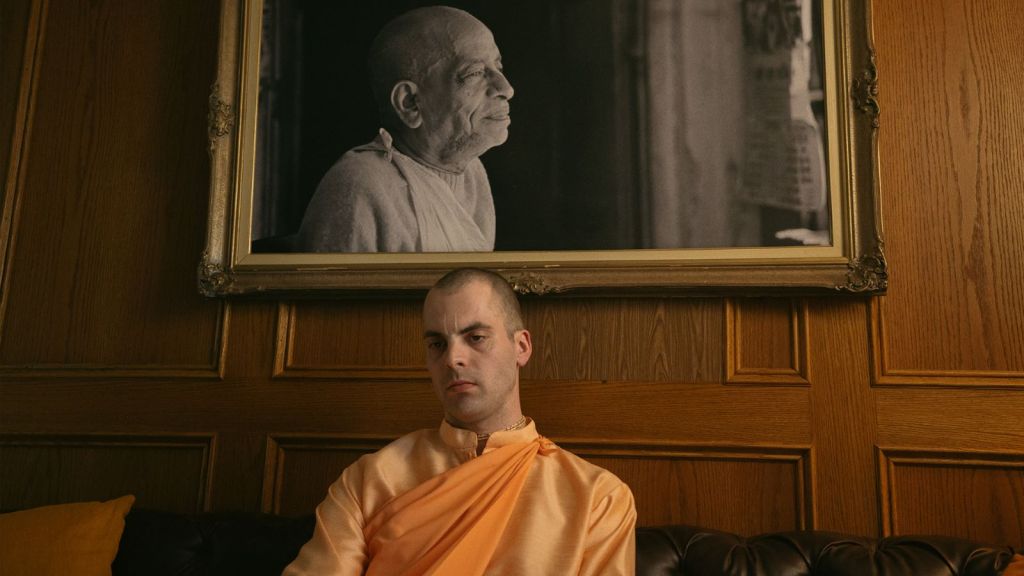
It’s 1965 and America is in high hippie mode.  A. C. Bhaktivedanta Swami Prabhupada arrives in New York City from Calcutta. He’s there to sell books, including his own translation of the Baghdad Gita. But he ends up heading the Hare Krishna movement, a vast multinational phenomenon, a religion that espouses dancing, singing and chanting mantras in order to achieve a better afterlife. After picking up many devotees in New York, the movement exploded in popularity once he reaches California. Allen Ginzburg endorses it and George Harrison writes a song about it. Countless people join  the religion, throwing away material possessions to dance, chant and collect alms in airports. But when the Swami dies, he leaves behind eleven gurus. That’s when things start to fall apart. This documentary — based on a bestselling book — exposes the crimes and excesses of the Hare Krishna movement in the 1970s and 80s.

One guru — in order to generate more money —  sets up a drug ring of devotees instructed to smuggle hash from Pakistan to Canada. They have ties to the mob, leading to a series of violent crimes until it is finally exposed. Another guru collects automatic weapons, and goes on a shooting spree in California.  A third guru — a self-declared Swami —  the scariest of them all, builds himself an ornate golden castle in West Virginia, while his disciples — who have given away all their worldly possessions — live in a shanty town beside the castle without toilet paper or plumbing. He later plans murders and is suspected of molesting children. 

In fact, the movement as a whole is riddled with problems. Women are treated as inferior beings who distract male practitioners from their religious obligations. Homosexuality is strictly forbidden as is all sex outside marriage. And heavy censorship prevails — no TV, magazines, newspapers, movies, or books are allowed, except for one official newspaper. And by the second generation — the 1970s and 80s, when most of the documentary takes place — kids are sent to schools with teachers who have no training. They lock kids in dark closets or dump them in trashcans as punishment, among even worse crimes. 

Monkey on a Stick is a documentary that looks at crimes of the Hare Krishna movement. It’s told using talking heads — including former devotees — period footage, and many reenactments, with actors visually demonstrating what the narrators are talking about. There’s also a series of random people sharing their views on religion, God and the afterlife. Though quite disturbing in parts, on the whole, it’s a fascinating story that exposes events I had never heard about before.

Smile 2

Wri/Dir: Parker Finn

Skye Riley (Naomi Scott) is a pop superstar, about to launch a worldwide tour. She lives in a luxury apartment on Park Avenue, and can buy anything she wants. She’s busy 24/7 at dance rehearsals, talk show appearances and autograph signings, under the constant supervision of her stage mom (Rosemarie DeWitt) and her PA (Miles Gutierrez-Riley). It’s her big comeback, after a year of rehab. This follows a bout of addiction culminating in a terrible car crash that killed her boyfriend and put her in intensive care. A year later, she still suffers from intense pain, pain so bad she is forced to buy opioids on the sly. But everything changes when she witnesses her high school friend (and drug supplier), Lewis (Lucas Gage) kill himself in front of her eyes in the most gruesome manner imaginable. And he dies with a rictus grin plastered on his face.

That’s when things start to go bad. Everywhere she looks she sees that awful smile. It’s like she caught a disease by witnessing her friend’s death. She starts seeing people who aren’t really there, and experiencing events that never happened — even though they feel so real. She begins to doubt her sanity. It’s like some alien presence has lodged itself into her brain. Her friends, family and colleagues look at her in a strange way, even as she fears she’ll end up dead in a matter of days, with that same awful smile. Can she break this smile cycle? Or is she headed for insanity and death?

Smile 2 is a genuinely-scary psychological thriller/ horror about fame, celebrity, and a deadly condition passed on from person to person. It’s also one of those Hollywood rarities: a sequel that’s demonstrably better than the original. Naomi Scott is terrific as Skye, a punky, self-centred celebrity; Skye’s not just a horror movie screamer, she’s a real character, complete with a psyche and a believable back story. The movie itself is really well made, with beautiful art direction, cool choreography, and ingenious camerawork and editing, where a scene can flip, elliptically, from an elevator ride to an overhead view of the street. Warning: it’s quite violent, so if you don’t like seeing blood and guts, stay away. But otherwise, Smile 2 is a really good, heart-pounding genre movie.

Bookworm, Monkey on a Stick and Smile 2 all open this weekend in Toronto; check your local listings.

This is Daniel Garber at the Movies, each Saturday morning, on CIUT 89.5 FM and on my website culturalmining.com.

Autobiographies? Films reviewed: North of Normal, A Compassionate Spy, Shortcomings

Hi, this is Daniel Garber at the Movies for culturalmining.com and CIUT 89.5 FM.

August is here in Toronto, a great time for some outdoor screenings. TOPS — Toronto Outdoor Picture Show — is showing films for free, after dark at Christie Pits, Corktown Common, Bell Manor, Old Fort York and the Evergreen Brickworks, with no tickets or advance registration required — just show up and sit on the grass.

This week I’m looking at three new movies — a memoir, a doc and dramedy. There’s a hippy in a tipi in Yukon, a spy in Los Alamos, and a frustrated filmmaker in Oakland.

North of Normal

Dir: Carly Stone

Cea Sunrise Person (Amanda Fix) is a teenage girl experiencing city life for the first time. She’s both naive and worldly. Her mother Michelle (Sarah Gadon) gave birth to her when she was only 15, and acts more like a sister than a mom. Since she was a child, she’s been raised, hippy style, in Yukon, by her grandparents, including Michelle’s dad Papa Dick (Robert Carlyle). 

They shoot animals, go fishing and gather foraged foods.  She grew up living in a tipi, where any visitor to their mobile encampments likely slept with one or more of the adults. She’s familiar with the concepts of free sex, a barter economy, and the use of soft drugs, as well as living off the grid, avoiding any government interference — Papa Dick hasn’t paid taxes in decades.  So life down south (in an unnamed Canadian city) is totally alien to her. Though bright and friendly, she doesn’t understand school rules or social norms, and gets into fights with the locals. But she gradually adjusts — well, kind of — to a new life. But she really doesn’t get along with her mom’s new boyfriend, Sam (James D’Arcy) who happens to be a married man. Why does Michelle always fall for the bad boys? But one thing keeps her steady: Cea holds onto a childhood wish to move to Paris; she carries an Eiffel Tower snow globe wherever she goes. So when she is approached on the beach by a legit modelling scout, she wonders if this will be the fulfillment of her dreams. 

North of Normal is a touching, coming-of-age film based on Cea Sunrise Person’s memoir about her unusual life (she ended up as a professional fashion model and entrepreneur.) She’s beautifully portrayed by Amanda Fix as a teenager and by River Price-Maenpaa as a little girl. And it’s shot amongst the forests and lakes of Canada’s north. The plot is eliptical, bouncing back and forward in time as her suppressed memories are gradually revealed, while leaving out large parts of her life. Even so, I liked this story.

A Compassionate Spy

Dir: Steve James

It’s the 1940s and WWII is raging, and there are rumours the Third Reich is developing an atomic bomb. So the US government initiates the secretive Manhattan Project in Las Alamos, supervised by the Army. It’s a collection of scientists brought together to create the ultimate weapon before Germany does. Most of the names are already famous: Oppenheimer, Teller, Niels Bohr, von Neuman. But the youngest one of all is Ted Hall. Only 18 years old, the child prodigy has already graduated from Harvard. He’s an ardent leftist, and wants to defeat fascism in Europe. As a drafted soldier, he has to wear a uniform and sleep in a barracks on the site, but otherwise he works each day beside other scientists. Aside from his age, he is different from the rest of them in another way. He is passing intel to the Soviet Union. Hall is disturbed by the idea of an impending  nuclear holocaust, and doesn’t trust the US government to show restraint, if they’re the only holder of such a dangerous tool. So totally independently — with the help of is best friend, Savvy Sax — he seeks out the Soviets to tell them what’s going on. Is he arrested? Put in the electric chair like Ethel and Julius Rosenberg? No, he (and his wife Joan) keep their secret for half a century. 

A Compassionate Spy is a fascinating documentary packed with info that sheds light on what Hall did and why, and what became of his life afterwards. Hall worked on cancer cures at the Sloane Kettering institute, and later became a professor at Cambridge University. Most surprising is that while he opposed the bomb, his own brother created and built ICBMs — Intercontinental Ballistic Missiles which may have brought the two sides closer to destruction.) The doc is made up of a confessional video Hall made before he died, new interviews with his wife Joan and their kids, as well as with Savvy Sax’s family. It also recreates dramatic scenes from the period, along with contemporary newsreels, diaries, letters and photos. Joan Hall is this really fascinating and feisty  character who tells most of the story. Equally important, the film presents a lot of crucial information that is glossed over in the recent hit biopic Oppenheimer. Like the fact that many scientists (including Hall) petitioned FDR and Truman not to drop the bomb on Japan; the letter was stifled by Leslie Groves, and never sent. I never knew the US threatened to use the bomb on the USSR in 1946 after the Russian army occupied Iran. And lots more eye-openers. A Compassionate Spy is an excellent documentary by the Oscar-winning director of Hoop Dreams.

Shortcomings

Dir: Randall Park

Ben (Justin H. Min) is an aspiring filmmaker in Oakland, California. After  dropping out of cinema studies at Berkeley, he’s now he’s the manager of an art house theatre, so he still has a peripheral connection. He loves all women but treats any man as a potential competitor. His best friend is Alice (Sherry Cola), a queer Korean American. They hang together ogling girls in local cafes — for Ben, that’s mainly women with blonde hair. He acts as her beard, posing as her fiancé when she has to visit her conservative family.

He lives with Miko (Ally Maki) who also wants to make films; she’s involved with the local Asian American Film Festival. She’s the love of his life. But despite the fact that he, his girlfriend and his best friend are all Asian American he is quick to point he feels no racial identity or kinship, and loathes identity politics. His abrasive and defeatist attitude leads to frequent arguments with Miko. But everything changes when she suddenly moves to NY City for a film internship, leaving Ben unexpectedly unmoored. Does their temporary separation offer him a chance to explore his sexual fantasies (that is, sleeping with a white woman)? Or will he try to win Miko back again?

Shortcomings is a hilariously deadpan look at the life and thoughts of an Asian-American man. Its observations are simultaneously scathing social satire and self-deprecating humour. It’s based on the graphic novels of Adrian Tomine whom I’ve read for decades now, so I was worried the comics wouldn’t translate well into film. Luckily, Tomine wrote the screenplay, and it’s told, like his comics, in a series of connected vignettes. The characters are brilliant — Justin H Min is sympathetically  annoying as Ben, the guy who never misses a chance to mess things up. Sherry Cola is equally brilliant, as are the many priceless side characters — Autumn, a performance artist who photographs her own toilet use, Sasha, a frustrated bisexual, Leon, an annoying fashion designer who Ben calls a rice king, and Gene, a smug popcorn maker.

From the opening parody of Crazy Rich Asians to the closing scene, this perfect comedy has no shortcomings to speak of.

North of Normal is now playing; Shortcomings opens this weekend across Canada, check your local listings; and A Compassionate Spy is on now at the Rogers Hot Docs Cinema in Toronto.

This is Daniel Garber at the Movies, each Saturday morning, on CIUT 89.5 FM and on my website, culturalmining.com.

60s, 70s, 80s. Films reviewed: Cocaine Bear, Jesus Revolution, Metronom

Posted in 1960s, 1970s, 1980s, Animals, Christianity, comedy, Coming of Age, Communism, drugs, Georgia, High School, Hippies, Religion, Romance, Romania by CulturalMining.com on February 25, 2023

Hi, this is Daniel Garber at the Movies for culturalmining.com and CIUT 89.5 FM.

This week, I’m looking at three new movies. There are spiritual revolutionaries in California in the 1960s, teenaged dissidents in Bucharest in the 1970s, and a crazed animal in Georgia in the 1980s.

Cocaine Bear

Dir: Elizabeth Banks

It looks like a typical day in 1985 in the Chattahoochee National Forest in Georgia. Two little kids are playing hooky, three skateboard-riding teenage delinquents are looking for some petty crime to commit, a pair of Scandinavian backpackers are on a hike, and a middle-aged forest ranger is dressed to impress a guy she wants to date. But everything changes when a prop-plane pilot drops a dozen duffel bags of uncut cocaine into the woods… and then promptly dies. Suddenly the supply chain is broken, and out-of-state traffickers looking to retrieve their supply — and the cops who want to nab them — all descend on the park at once. And here’s where the actual movie starts: a huge black bear sticks its nose into the duffel bag and emerges as a frantic, delirious, coke head, forever on the lookout for more snow to blow. Who will find the drugs — the cops, the gangsters, the delinquents, or the children? And who will not be eaten by the bear?

Cocaine Bear is a low-brow, high-concept comedy that’s basically 90 minutes of extreme-gore violence. I was a bit dubious at the beginning, but about half an hour in it started to get really funny. I know it’s stupid-funny, but it still made me laugh. The all-CGI bear is one of the main characters, but there’s a great assortment of humans, too, played by an all-star cast: Margo Martindale as the forest ranger, the late Ray Liotta was the gangster, Alden Ehrenreich as his diffident son, O’Shea Jackson Jr as his henchman, and Keri Russell as a mom searching for the two missing children. It’s hilariously directed by TV actor Elizabeth Banks. Cocaine Bear easily beats Snakes on a Plane and Sharknado as best movie based solely on its title. Supposedly inspired by true events (yeah, right) it has lots of room for ridiculous 80s haircuts, music and other gags to good effect. Stoner movies are a dime a dozen and half of the movies coming out of Hollywood are clearly made by cokeheads, but this may be the first comedy about cocaine I’ve ever seen.  If you’re comfortable laughing at blood, gore and gratuitous violence, along with lots of base humour, I think you’ll love this one. 

Jesus Revolution

Dir: Jon Erwin, Brent McCorkle

It’’s the late 1960s in California, where young people everywhere are tuning in, turning on, and dropping out. One of these kids is Greg Laurie (Joel Courtney), who attends a military academy but would rather be drawing cartoons. He lives in a trailer with his Mom, a  glamorous but alcoholic barfly. He meets a pretty girl named Kathe hanging with the hippies outside a public high school, and decides that’s where he’d rather be. But Kathe is from an upper-class family whose parents frown on Greg. Meanwhile, Chuck Smith (Kelsey Grammer), a local pastor, wonders why no one is coming to his Calvary Chapel anymore. It’s because your a square, his daughter tells him. So she introduces him to a unique man she met at a psychedelic Happening. Lonnie Frisbee (Jonathan Roumie) is a charismatic, touchy-feely type who talks like a hippie and looks like Jesus. He emerged from the sex-and-drug world of Haight Ashbury with a mission from God, and now wants to spread the gospel. Chuck Smith is less than impressed, but decides to give him a try.

Soon there are block-long lineups to hear what Lonnie — and Chuck — have to say. This includes Kathe and Greg, who barely survived a bad acid trip. Lonnie gives Greg a place to live and invites him to join the church. Calvary Chapel is attracting people from everywhere, culminating in mass baptisms in the Pacific ocean. But as their fame grows, so does the friction. The more moderate Chuck frowns on Lonnie’s in-your-face style —  from faith-healing to his talk of being closer to God. Can Greg find a place in this world? Will Kathe’s family ever accept him? And is this a movement or just a flash in the pan?

Jesus Revolution is a retelling of the unexpected upsurge in grassroots Christianity among baby boomers in the 70s. The film is clearly aimed at evangelical church-goers, a subject in which I have absolutely no interest. Zero. Which is why I’m surprised how watchable this film is to a general audience. It’s not preachy — it shows, not tells. It’s well-acted with compelling characters and a surprisingly good story. No angels or miracles here, just regular — flawed but sympathetic — people.  I think it’s because the Erwin Brothers (American Underdog, I Still Believe)have figured out how to make mainstream, faith-based movies that are actually good. The film is based on real people, so I was a bit surprised they never mention that Lonnie Frisbee was actually a gay man who later died of HIV AIDS. I guess it doesn’t fit the story they want to tell That said, if you’re involved in a church or a fan of spiritual films, this might be just what you’re looking for.

Metronom

Wri/Dir: Alexandru Belc 

It’s 1972 in Bucharest, Romania.  Ana and Sarin (Mara Bugarin, Serban Lazarovici) are a beautiful couple still in high school, and madly in love. They both come from “intellectual” families, who are given special privileges in Ceausescu’s communist regime. They go to an elite school together, and hope to pass their Baccalaureates to get into an equally good university. They meet in front of a WWII heroes monument dressed in stylish trench coats and school uniforms. So why is Ana crying? Sarin and his family are emigrating to Germany. That means they’re breaking up for good and will probably never see each other again. Ana is crushed — her world is broken. Which is why she has no interest in going to an afternoon party at a friend’s house, but changes her mind at the least minute. Her father, a law professor, is easy going, but her mother absolutely forbids it. So Ana sneaks out of the apartment and heads to the get-together. This is her last chance before he leaves to make out with Sarin and express her eternal love. 

The party is centred around listening to music — Led Zepplin, Hendrix, The Doors — as played on a radio show called Metronom on Radio Free Europe. Western music is underground, subversive and illicit. They decide to write a letter to the show and pass it on to a French journalist. But two bad things happened. When they make love behind a closed door, Sarin won’t say he loves her. And the party gets raided by the secret police and all the kids are arrested and forced to write confessions. But Ana is so caught up in her relationship she barely notices the interrogation she has landed up in. Who ratted them out to the authorities? And what will happen to Ana?

Metronom is a passionate story of young love in the 1970s under the omnipresent gaze of an authoritarian government. It’s a coming of age story, about heartbreak and the loss of innocence as the real world reveals its ugly face.  

If you’ve never seen a Romanian film before (such as Întregalde, Bad Luck Banging or Loony Porn, Poppy Field, The Whistlers, The Fixer, One Floor Below), this is a good place to start. They all have this feeling of tension, corruption, mistrust and unease, whether they’re set during Ceaucescu’s reign or long after his fall. This one also has hot sex, good music, stark cinematography, and terrific acting, especially Mara Bugarin as Ana. It manages to be a thriller, a romance and a coming-of-age story, all at once.

This is a good one.

Metronom is now playing a the TIFF Bell Lightbox; Cocaine Bear and Jesus Revolution open nationwide this weekend; check your local listings.

This is Daniel Garber at the Movies, each Saturday morning, on CIUT 89.5 FM and on my website, culturalmining.com.

Humans and other animals. Films reviewed: We Are As Gods, Beast

Posted in 1960s, 1970s, Africa, Animals, Climate Change, Conservation, documentary, drugs, Family, Hippies, psychedelia, South Africa, Thriller by CulturalMining.com on August 20, 2022

Hi, this is Daniel Garber at the Movies for culturalmining.com and CIUT 89.5 FM.

This week I’m talking about two new movies, about humans and other animals. There’s a man who wishes he’d never met a lion face to face, and another man who wishes woolly mammoths walked the earth again. 

We Are As Gods

Wri/ Dir: David Alvarado, Jason Sussberg

Stewart Brand is a man who was at the centre of many of the 20th century’s biggest changes, including psychedelic drugs, environmentalism, personal computers, hacking, and The Whole Earth Catalog. Born in a small city in the midwest he liked playing with wild animals as a child, making friends with squirrels, ‘possums and ducks. He studied biology at Stanford, but by the early 60s wound up in San Francisco, around the time of Ken Kesey’s experimentation with psychedelic drugs. He joined the Merry Pranksters, dropping acid, dancing around and generally having a wild hippie good time.

This was during the Space Race, when the US and USSR were competing at the exploration of outer space. But what Stewart wanted was a photograph of the earth from up there. He publicly and loudly demanded such a photo, and eventually someone took it. It became the cover of a technologically friendly, do-it-yourself guidebook called the Whole Earth Catalog, which embraced environmentalism and conservationism through DIY tools and simple technology. Filled with geodesic domes and quonset huts, it showed how to co-exist in a natural setting. A huge bestseller, it inspired many within the baby boomers’ burgeoning youth culture.

He was also around in the earliest stages of Apple computers, inspiring both Steve Jobs and Steve Wozniak. Fast forward to the present: Stewart Brand is back in the spotlight, attempting to change the world by “de-extincting” long-lost plants and animals. He points out how entire species that used to dominate North America — from the American chestnut tree to the passenger pigeon — which were wiped out over the course of a few decades about 100 years ago. But their DNA remains, and, he says, with some genetic tweaking, they could be restored. Why is this so important?  Because our system is made up of complex, intertwining and interdependent species and when even one disappears it causes a major natural reorganization.

But that’s not all. Building on the work of Pleistocene Park in Siberia (the subject of another doc), he promotes the reintroduction of large animals (like wooly mammoths) into our biosphere. Maybe new flocks of pre-historic elephants, camels, wild horses and buffalo now missing from these areas will help stop global warming by allowing the permafrost to survive. 

We Are As Gods is a documentary about Brand, his life and his ideas. The title comes from an epigraph from the Whole Earth Catalogue. Yes, some his ideas sounds ridiculous at first listen, but the film makes a believable argument for a real-life Jurassic Park (Pleistocene actually) — despite the dangers it could pose. He’s also a really interesting character, both smart and ridiculous — he admits to mistakes such as inhaling a tank of laughing gas (nitrous oxide) each week for a couple of years. The movie includes period footage, TV videos, still photos and new interviews with friends, his ex-wife, family members and various scientists. Lots of  interesting stuff, packed into one documentary.

Beast

Dir: Baltasar Kormákur

It’s summertime in South Africa. Dr. Nate Samuels (Idris Elba) a well-off physician from New York, arrives in a remote game park with his two daughters, Mer and Norah. Mer (Iyana Halley) is angry at her father, but but is swept away by the beauty and grandeur of the African bush. Her little sister Norah (Leah Jeffries), is more innocent and naive. This visit is a homecoming of sorts. Their late mom (she died of cancer in New York) came from a nearby Tsonga village where she met their dad. They were introduced by Uncle Martin (Sharlto Copley), as the kids call him. He’s a game ranger who helps stop poachers from killing the animals, and he’s their host. He shows them giraffes and wildebeests and introduces them to a pride of lions one of whom he raised — they all run to him like playful pups. Lions are social animals, he explains. The lionesses hunt for food, while the lions protect the pride if threatened. Otherwise they don’t attack people.

Which is why all of them — including Martin — are shocked and frightened when, later, another lion violently attacks their jeep. It seems poachers had killed his entire pride except him, leaving only the rogue beast looking for vengeance — and they’re not his first target. But can a middle-aged doctor and his two teenaged girls fight off a lion three times their size? Or are they all doomed?

Beast is a dramatic thriller set amidst the spectacular beauty of South Africa. After a mundane start, it quickly turns into a heart-thumper, as one impossible situation follows another as the four of them try to escape this monster. Idris Elba portrays Nate as a neglectful dad but a caring doctor, devoted to saving patients not killing animals. But he also has to connect with his daughters who don’t completely trust him. (He was never around when their mother — his wife — was dying).

I assume the animals were all CGI, but they’re believable enough that you can’t tell. The music spans the continent with tunes from Nigeria to South Africa. I have to admit I saw the trailer and the movie looked pretty bad — a rich American going to Africa to shoot lions? But that’s not what it’s about at all. Though not deeply moving,  it’s actually a fun movie with a compact story and all-around good acting. It’s directed by the under-appreciated Icelandic filmmaker Baltasar Kormákur; I’ve seen a few of his movies (like Contraband, 2 Guns, The Deep), and he’s always really good at manipulating sympathetic characters through enormous disasters. He’s not afraid of moving the viewer deep into swampy water, up trees, on top of small mountains or through disorienting tunnels, so you feel you’re a part of it all. So if you’re looking for some well-made thrills, check out Beast.

You can catch Beast this weekend across Canada, check your local listings; and We Are As Gods opens today in select US theatres, and on VOD in September. 

This is Daniel Garber at the Movies, each Saturday morning, on CIUT 89.5 FM and on my website, culturalmining.com

Dissidents. Films reviewed: The Dissident, The Chicago 10

Posted in Animation, Chicago, documentary, Hippies, History, Politics, Protest, Resistance, Saudi Arabia, War by CulturalMining.com on January 8, 2021

Hi, this is Daniel Garber at the Movies for cultural mining.com and CIUT 89.5 FM.

I’m recording this on Wednesday (January 6th), when the Q Anon army, red-pilled and red-capped, at the behest of a certain, soon-to-be-former President, has just stormed the (widely anticipated but strangely unguarded) Capitol building and many state government buildings, too. Sort of a reverse-coup, an attempt to block regime change? The mob has dispersed and Trump has temporarily been stripped of his Twitter account, a fate worse than impeachment. But if you’re listening to this on Friday morning, things may have changed so much that these comments are already old hat.

Either way, I think it’s as good a time as any to talk about political unrest and dissent. So this week I have two new movies, both documentaries. There are antiwar radicals who disrupt the Democrats in Chicago; and a Saudi journalist who disappears in Istanbul.

The Dissident
Dir: Bryan Fogel

Jamal Khashoggi is a successful journalist born into an illustrious family in Medina, Saudi Arabia. For thirty years he works tirelessly for the government, and is part of the country’s elite. But in a sudden about face, he divorces his wife, and leaving his family behind, relocates in Washington DC. He is hired by The Washington Post to write columns, some of which criticize the Saudi government and its royal family. But in the authoritarian monarchy this is a no-no. He becomes a dissident.

Later, he falls in love with a young Turkish woman — a scholar who speaks Arabic — he met at a conference. He travels to Turkey to meet his fiancee’s family. In order to marry, they need a document from the Saudi consulate in Istanbul, proving he has divorced his first wife. But this is where things get weird; after entering the consulate a year ago, he is never seen again.

After widespread outrage, Turkish detectives are allowed into the building. Based on the evidence they find — in addition to wiretaps, recordings and external video footage — they came to a shocking conclusion: Khashoggi was murdered in cold blood by a hit team of Saudi team of special ops flown in especially for that purpose. He was suffocated in front of a diplomat=, his body dismembered by a pathologist and burned to ashes in a barbecue pit

The Dissident is a detailed documentary — in Arabic, Turkish and English — that traces Khashoggi’s life and death from inisder to dissident to victim. Using new interviews with most of the key players — though no one inside the Kingdom — it solves many of the mysteries dogging his case. It rarely veers from its central topic, Khashoggi and freedom of speech, and stays away from important issues like women’s rights, the war in Yemen, never mind cultural expression and sexual liberation. But the one area the doc does explore is an insider’s look at dissidents across the Arab world. The film is narrated by Omar Abdulaziz, a young Saudi who sought asylum in Canada. He helped guide Khashoggi when he becomes a dissident. And this is where the movie gets really interesting. It explores a government-sponsored troll army that silences dissent on social networks like Twitter — a site used by 80% of Saudis; and the work Omar has done to counter it. While some of the doc is a bit dry, it shines when it digs deep into cyber warfare, political activism and and newly revealed secrets of the Kingdom.

The Chicago 10 (2007)
Wri/Dir: Brett Morgen

It’s the summer of ’68, and the youth of America, the product of the baby boom, is revolting. LBJ has plunged the country into war in Vietnam; civil rights leaders, Malcolm X, Martin Luther King and Robert F Kennedy have been assassinated. People are sitting in, dropping out, fighting back. It’s also an election year, and the DNC (Democratic National Committee) is holding its convention in Chicago. To confront this and to have their voices heard, radical political action youth groups converge on Chicago from across the country. The Yippies, from the east coast, headed by Abbie Hoffman, Jerry Rubin and poet Allen Ginsberg, are humorous, media savvy, sex-positive masters of performance art.

Rennie Davis and Tom Hayden fight against war, poverty and racism. David Dellinger is a long-time anti-war activists. They plan a massive be-in, a festival of life, based in Lincoln Park, full of speeches and music culminating in a march to the Hilton Hotel to confront the Democratic convention. But they are met by riot police, ordered by Mayor Daley, and the national guard who violently attack the largely unarmed peace activists. Loads of people were arrested and injured, and a key few — including Davis, Hoffman, Rubin, Heyden, and Dellinger — are put on trial in 1969 by the feds and charged with conspiracy. For some reason they throw Bobby Seale of the Black Panther Party into the group, when he was only in Chicago for a few hours that summer. And thus begins the lengthy show trial.

The Chicago 10 is an excellently researched documentary on that famous trial and the demonstrations that led to it. The film jumps back and forth, chronologically, between the trial and the summer demos. No cameras were allowed into the courtroom, so the trial scenes are 3-D animated using the actual transcripts, and the voices of actors like Nick Nolte, Leiv Schrieber, Hank Azaria, Roy scheider, Mark Ruffalo,Jeffrey Wright and many others. The voices are occasionally cartoonish, because, well, its a cartoon, but generakky feel like the r eal thing. The demonstations are taken from beautifully restored contemporary footage and news clips, as well as radio recordings, and onstage performamces all done while the trial was actually taking place. (none of the accused were locked away during the trial so they were constantly on the media.

It’s full of revelations. Allen Ginsberg is called in as a witness, and the prosecutor makes him recite his most salacious erotic poems, presumably to shock the jury. There are great news stories, like little kids in Chicago seen playing cops and protesters, instead of cops and robbers, where in this game activists get clubbed by police.

You may have seen the much lauded the Trial of the Chicago 7, Aaron Sorkin’s star-studded take on the story. While the production values and acting are great in that one, Chicago 10 is much more historically accurate than Sorkin’s revisionist drama.

If the topic interests you, Chicago 10 is definitely worth a watch.

The Chicago 10 is now available online, and The Dissident opens today across North America, check your local listings.

This is Daniel Garber at the Movies each Friday morning on CIUT 89.5 fm and on my website culturalmining.com.

Revision. Films reviewed: The Stone Speakers, Free Trip to Egypt, Once Upon a Time… in Hollywood

Posted in 1960s, Bosnia, Communism, documentary, Egypt, Hippies, Hollywood, Islam, L.A., Movies, War by CulturalMining.com on July 26, 2019

Hi, this is Daniel Garber at the Movies for culturalmining.com and CIUT 89.5 FM.

They say he who pays the piper calls the tune. This week I’m looking at two documentaries and a drama that retell history. There’s a doc about changing American minds in Egypt, another one about rewriting history in Bosnia, and a drama that rewrites the history of Hollywood.

The Stone Speakers

Wri/Dir: Igor Drljaca

It’s present-day Bosnia-Herzogovina. Since the end of the Bosnian war, the formerly multicultural country has been divided ethnically and religiously among Serbs, Croats and Bosniaks. As its factories close down and young people move away cities have turned to tourism for income… in some unusual ways, fiddling with history on the way. The film looks at four Bosnian cities.

In Medjugorje, millions of pilgrims visit a site where six children are said to have seen the Virgin Mary. Tuzla, once known for its ancient salt mines, has opened man-made salt springs lakes where the city had gradually been sinking. Visoko is dominated by a strange hill, once an Ottoman fortress, built over an unknown ancient pyramid. Tourists cluster in its tunnels to absorb its energy, even as Orthodox, Catholic and Muslim leaders all condemn it as heretical. And Višegrad, a crossroads city, once known for its Ottoman stone bridge, is now the site of a cultural centre built by Bosnian Serb director Emir Kusturica in honour of Nobel laureate Ivo Andric’s novel. (A museum about a movie about a book about a bridge…!)

The movie presents these oddball Bosnian towns at face value in a series of carefully composed shots, both portraits and landscapes, as panoramic long takes… almost like still photographs but ones that move. Voiceovers, by discontented residents of the cities, provide arms-length analysis, uncovering the absurdity and revisionist history of these places.

The Stone Speakers is a humorous and hauntingly beautiful look at what has become of the Toronto director’s homeland.

Much simpler is…

Free Trip to Egypt

Dir: Ingrid Serban

Tarek Mounib is a Halifax-born Canadian of Egyptian ancestry, who looks a bit like Jon Stewart. As a university student he was an activist but has mellowed in middle age. But he is dismayed at the explosion of Islamophobia and anti-Arab sentiment in the US today, especially since Trump’s election. So he sets out to remedy this by offering strangers an unusual proposition: free guided trips to Egypt! He recruits these adventurers in unusual places, both online and at Trump’s MAGA rallies.

There’s a policeman, two young evengelicals, a single woman, a war vet and an older couple, each with their own prejudices and expectations. In Egypt they are paired with local singles and families to show them how real Egyptians live, along with their religions, food, music, and culture as well as visiting the more famous tourist sites like the pyramids of Giza.

But can a group of Americans change their dead-set views about Arabs and Muslims?

Free Trip to Egypt is exactly what the title promises. Nothing surprising or unexpected in this film. It actually feels closer to reality TV than to a documentary – but it has a good heart.

Once Upon a Time… in Hollywood

Wri/Dir: Quentin Tarantino

It’s the late 1960s in LA.

Rick Dalton and Cliff Booth are good friends, both on and off screen, but they are not equals. Rick (Leonardo DiCaprio) is a movie star, best known for his TV series Bounty Law. He lives in a beautiful home in the Hollywood Hills, next door to Sharon Tate (Margot Robbie) and Roman Polanski. Cliff (Brad Pitt) is a stuntman, and Rick’s double. He lives in the valley with his dog in a rundown trailer behind a drive-in movie park in Van Nuys.

They’re both pushing forty and things aren’t looking good. Rick has shifted from white hat to black hat, playing the heavy on TV cop shows. A mover and shaker (played by Al Pacino) wants to restart his career, but Rick isn’t sure he can shift from star to actor. Cliff is still limber and seemingly indestructible, but hasn’t worked as a stuntman since he accidentally killed his wife. He has a bad rep, picking fights on set with a young Bruce Lee. Now he’s mainly just Rick’s driver and personal assistant, with too much free time on his hands.

Rick struggles through his latest role – as the villain in a True Grit-type western – and wonders if he has lost his mojo… while Cliff cruises around LA in his sports car, listening to AM radio and flirting with a nubile, hippy hitchhiker named Pussycat (Margaret Qualley). What he doesn’t realize is Pussycat – and her sketchy friends Squeaky (Dakota Fanning) and Tex (Austin Butler) – are members of the not-yet- notorious Charles Manson’s “Family”. And that they’re living on the Spahn ranch, a movie location where Rick and Cliff’s TV show was shot in the 1950s. Meanwhile, with Polanski out of the country, Sharon Tate is enjoying her newfound stardom. But what will happen when the players all meet?

Once Upon a Time… in Hollywood is Tarantino’s latest movie and one of his tamest. It’s an affectionate tribute to the movies of the 60s: its look, it’s stars, it’s pop music. Everything – from car models to movie trailers to neon lights and billboards – is painstakingly recreated, to give you the feel of the era. There are dozens of cameos played by long-forgotten hollywood favourites and former child stars. The story itself – that takes a leisurely two hours and forty minutes to tell – seems less important than the mood.

Tarantino is known for endless scenes that don’t seem to quit… even when they’re supposed to. In past films, it meant extended scenes of torture and endless violence. In this movie it’s more likely a very long, behind-the-scenes reenactment of shooting a movie. He’s one of few directors I can say I saw every one of his movies in theatres when they first came out. Once Upon a Time… in Hollywood while shallow, was very enjoyable: constant eye candy, a terrific soundtrack, and Pitt and DiCaprio are a lot of fun as buddies. And despite the Manson subplot, there is much less gratuitous violence than in most of his movies.

If you like movies about movies, this is the one to see.

The Stone Speakers opens today at the TIFF Bell Lightbox; Once Upon a Time… in Hollywood starts across North America today; and A Free Trip to Egypt starts next Friday (August 2) in Toronto; check your local listings.

This is Daniel Garber at the Movies, each Friday morning, on CIUT 89.5 FM and on my website, culturalmining.com.

Extreme non-conformists. Movies reviewed: Sworn Virgin, Wild Life PLUS Drone and EUFF

Posted in Albania, Clash of Cultures, Coming of Age, Cultural Mining, France, Hippies, Italy, Movies, Trans by CulturalMining.com on November 19, 2015

Hi, this is Daniel Garber at the Movies for culturalmining.com and CIUT 89.5 FM.

drone posterThe horrible attacks in Beirut and Paris last week have shaken the world. But how to respond to these attacks? For many governments, the War on Terror is the answer. Others turn toward diplomacy. Some say drone attacks are what keep terrorism at bay. But other experts warn that US drone kills are the best recruitment ads groups like ISIS have. A new documentary that opens today across North Amerioca is called Drone (Dir: Tonje Hessen Schei). It features Brandon Bryant, a former drone pilot turned whistle-blower, as well as the people in the lands where the drone attacks happen — Afghanistan and the Middle East — who experienced drone attacks as “collateral damage”.

Some non-conformists choose to dissociate themselves from mainstream culture. They find non-conformity works better if you live far from other people, away from the mainstream. This week I’m looking at two European dramas about non-conformists who leave it all behind. People who flee the cities but at a price. There’s a French father and two sons who go back to the wild, and an Abanian who heads for the freedom of the mountains, before ending up in Italy.

11807365_970026939685133_7963239791947681248_oSworn Virgin
Dir: Laura Bispuri

Hana (Alba Rohrwacher) lives with her parents in an isolated part of the mountains of Albania. But when her parents die, she is found and adopted by a family in a village. But she runs into trouble almost immediately just for living her life the way she always has. Her new sister Lila (Flonja Kodheli) tells her what’s what.

It’s not good to drink before a man drinks, speak before a man speaks, smoke, touch a rifle, go into the woods, choose a husband, do a man’s work, even look at a man funny. Basically, she has no rights at all. Hana says that’s just not fair, how can she live this way, how can she stand it? Is there a way out? There is. A woman can live like a man does and get all his privileges. BUt there’s a catch. She has to cut her hair, bind her breasts, wear pants and carry a gun. But she has to take an oath and give up all sex and live her life as a so-called sworn virgin.

So the movie picks up many years later in a Tyrolian town in Italy. Mark shows up at Lila’s Italy_SWORNVIRGINdoor direct from the mountains of Albania. He’s still a sworn virgin but wants to give that life up. But Mark is the ultimate fish out of water. Exposed to weird things like women’s bras, nudity, supermarkets, money, and synchronized swimming, it’s almost too much to take in. Lila’s daughter Jonida (Emily Ferratello) finds Mark fascinating, but doesn’t understand him. And for Mark, making the shift back to life as a woman, is overwhelming. The women’s and men’s bodies he sees at the local swimming pool is all a fascinating mystery. Lila is the only person he’s shared a bed with. But Bernhard – the swimming cioach at the pool attracts her. Which way will Mark/Hana choose for their identity, gender and sexuality?

Sworn Virgin is an incredibly fascinating movie, based on a true practice. To this day there are people in Albania – largely unknown in the rest if the world — who choose to live as so-called “sworn virgins” for the advantages it gives them. The movie, especially the performance of Alba Rohwacher, looking like a young KD Lang, is really remarkable, like nothing you’ve ever seen before.

Vie Sauvage afficheWild Life
Dir: Cedric Kahn

Paco and Nora (Mathieu Kassovitz and Celine Sallette) meet in a teepee circle in France, and fall in love. Along with Nora’s own son, Thomas, they have two sons together: Tsali and Okyesa (David Gastou, Sofiane Neveu). They live a nomadic farming life in rural France. A back-to-nature, hippie life. But after about a decade Nora calls it quits and takes the three boys – kicking and screaming – with her. Overnight, their lives change home-schooled hippy-farmers to conservative townies at Nora’s parent’s home. And Paco is forbidden all contact, except on national holidays, until the custody agreement is settled. Which takes many years.

But Paco — and the two youngest sons — decide to go back to living a wild life, back to the woods, with no possessions and only the clothes on their backs. They do the mandated education – French dictee, times tables – but they also learn to catch fish with their bare hands, to tame wild birds, and handle live scorpions and snakes without getting bit. They can catch and skin a rabbit, climb trees, and hide from any passing helicopters.

As they grow older, the boys have to use fake names, and avoid cities, trains, and police at all costs. PacoFrance_THEWILDLIFE is a fugitive. Paco tells them they are allowed to go back to their Mom at any time, as long as they ask. The boys say they choose to be with him… but can ten-year-old boys make such decisions? They eventually settle at a hippy commune and build stone houses from scratch, and live with no electricity.

But as teenagers, Paco is dismayed to see them reading comic books, dancing to rave music, spending cash and hanging out with friends they meet. They want to be accepted, see the world, see their mother again. And they want to meet girlfriends, have sex, move away… just like any other teenager. Can this fragile family stay together?

This is a great movie. It’s doubly interesting because it’s based on true story, a book written by the people who lived it — the Fortin Brothers and their father. The actors playing the briothers as kids, and later as teenagers (Romain Depret, Jules Ritmanic) are all new to the screen. But they seem to be the real thing. Only the troubled idealistic Paco (played by well-known director Matthieu Kassovitz) is familiar. Don’t miss this one.

Sworn Virgin, played last weekend, and Wild Life is opening tonight at the EU mw83vp_brooklyn_02_o3_8667104_1441138255Film Festival. This is a festival that shows movies from each country in the European Union for free at the Royal Cinema on College St. Go to europeanfilmfest.ca for details. Also opening today is the wonderful drama Brooklyn about a young migrant woman in the 1950s (Saorise Ronan) who travels between big city New York and small-town Ireland. Do not miss this movie.

This is Daniel Garber at the Movies, each Friday morning, on CIUT 89.5 FM and on my website, culturalmining.com.


June 22, 2012. Square Pegs. Movies Reviewed: Your Sister’s Sister, Kryptonite!, Alps.

Hi, this is Daniel Garber at the Movies, for culturalmining.com and CIUT 89.5 FM, looking at high-brow and low-brow movies, indie, cult, foreign, festival, genre and mainstream movies, helping you see movies with good taste, movies that taste good, and how to tell the difference.

Can square pegs fit into heart-shaped holes? This week I’m looking at three movies about odd-balls adjusting their lives to fit into new families and relationships. There’s an indie rom-com from Seattle about a middle-aged slacker caught between two beautiful women; an Italian drama about a bullied 9-year-old who explores 70’s hippie culture; and an experimental Greek film about people trying to temporarily replace the dead.

Your Sister’s Sister
Dir: Lynn Shelton

Jack, (Mark Duplass) is depressed, unemployed, single, and stuck in a bottomless pit of negativity following his brother’s death. So to cheer him up, his friend Iris (Emily Blunt) – who was also his late brother’s ex-girlfriend – offers him the use of her family cabin, off on some island in the Pacific North West.  But when he gets there, he sees an attractive woman inside, coming out of her shower. And after a clumsy confrontation involving a wooden paddle, Hannah, a lesbian who has just broken up with her long-time lover, gets into a drunken confessional with this stranger, Jack. He’s a lumpish, impulsive ne’erdowell; while Hannah (Rosemarie DeWitt) is a strikingly beautiful, but acid-tongued meat-is-murder vegan. Is there a spark there? Uh, oh… Sometimes things that happen in the night are best forgotten in the morning.

Who shows up but the next day but Iris – who it turns out is Hannah’s half-sister! She’s been through a series relationships with swooshy haired, skinny jeaned, rock- and-roll hipster boyfriends… but could she also harbour feelings of her own toward her platonic best friend Jack? All these new complications throw a wrench into their mutual relationships.

Your Sister’s Sister is a really good, extreme-low-key romantic comedy. It’s mainly about the characters, not the plot, with most of the dialogue improvised by the actors themselves. The three of them work very well together and Mark Duplass is everywhere! (He was in another low-budget, Seattle-based comedy, Safety Not Guaranteed, just last week. Anyway, this movie’s worth seeing if you’re looking for a Left-coast romcom.

Kryptonite!
Wri & Dir: Ivan Cotroneo  (I Am Love)

Peppino (Luigi Catani) is a 9-year- old school kid in Naples in the early 70’s. He wears glasses and that’s enough to get picked on by his schoolmates. When he plays soccer, he‘s stuck being the goalpost. So, aside from his father who works in a sewing machine shop, and his loving mother he turns to his eccentric uncle Gennaro (Vincenzo Nemolato) who thinks he’s Superman.

But things start to go wrong. His mom (Valeria Golino) discovers her husband is having an affair. Instead of making a scene, she collapses and becomes bed-written until sent to psychoanalysis. His dad shoos him away so he can spend time with his secret girlfriend. And Genarro is found dead, hit by a car. So, without a functional family, and to keep him out of trouble, he’s lent out to his many uncles and aunts. They’re Neapolitan hippies, given to wearikng eye makeup and dancing to Ziggy Stardust and Nancy Sinatra.

They introduce him to their own new world of bra-burning, acid tripping, folk-dancing, nudity and mass love-ins. And the Superman Genarro periodically returns

from the dead to impart words of superhero wisdom to the bullied and “different” Peppino, as he struggles to understand and appreciate his differences.

Kryptonite! is a really great coming-of-age drama. It has a complex, but easy-to-follow story with a dozen main characters; Visually and aurally it’s a fantastic feast of eye- (and ear-) candy, including sets, costumes, amazing locations and seventies music.

ALPS
Dir: Giorgos Lanthimos

Something’s strange: why is a moustachioed EMT worker asking a dying patient about their favourite movie star, instead of allergies and past illnesses? Well, he’s gathering data for his second job: it’s a private enterprise where he and his colleagues – a nurse at his hospital, a competitive gymnastic dancer and her coach – rent themselves out to take the place of recently dead or injured people. This way their families and friends can ease more gradually into their new lives, and cope with the large gap. The business is called “Alps” (to evoke the steadfastness and immovable nature of the Alps mountains), with each of the four answering to a secret code name based on a famous Swiss peak (Mont Blanc, Monte Rosa…). The bossy paramedic declares himself the highest peak of the Alps.

Their role is ambiguous, lying somewhere among therapist, actor and prostitute.

They memorize pat dialogue, likes and dislikes so they can pretend to be the missing ones. But the four of them have different aims. The gymnast yearns to leave stodgy classical ribbon dancing and move onto modern pop sounds… like Prince. But she’s is kept tethered by a cruel coach who says he’ll break every bone in her body if she deviates from his orders. Meanwhile the paramedic is a petty dictator, a suspicious popinjay who wants to keep the others members in line with his power scheme. But the nurse would rather fall in love — even artificially — and if the process involves sex, all the better. So the two men want more control, while the women want more freedom.

This is the same director who made the great movie Dogtooth and ALPS shares a lot of its style: intentionally stilted dialogue, long pauses, long takes; a story about vainglorious adults behaving like adolescent bullies and their oppressed victims; and an unnervingly dated and outré look to everything. I guess I’ve adjusted to Lanthimos’s style since Dogtooth, as it no longer bowls me over, but it’s still funny and absurd and shocking with an amazingly strange story. The acting and the characters still grab my attention.

Your Sister’s Sister, and ALPS both open tonight in Toronto, check your local listings; and Kryptonite! plays the opening night of the Italian Contemporary Film Festival next week – for details go to icff.ca . Also opening is the excellent but heart-wrenching documentary 5 Broken Cameras, about the Israel/Palestine conflict from the point of view of a Palestinian activist in a small village; the experimental Indian drama Patang (aka Kites), co-starring Seema Biswas; and the Toronto Korean Film Fest, featuring great Korean classics from years past, like The Tale of Two Sisters; Mother; and Old Boy. Go to TKFF.ca for details.

This is Daniel Garber at the Movies each Friday morning on CIUT 89.5 FM, with podcasts and complete reviews available on my web site CulturalMining. com.

Cabins in the Woods. Movies Reviewed: Happy People: A Year in the Taiga, The Hunter, The Cabin in the Woods

Hi, this is Daniel Garber at the Movies, for culturalmining.com and CIUT 89.5 FM, looking at high-brow and low-brow movies, indie, cult, foreign, festival, genre and mainstream movies, helping you see movies with good taste, movies that taste good, and how to tell the difference.

I’m back again, and I’m reviewing three good movies opening this weekend, that are all about the hunters and the hunted in their cabins in the woods. There’s a documentary about a Siberian trapper in the Taiga; a drama about a hunter looking for a tiger; and a horror/ comedy about five college students trapped in a cabin by a hunter zombie.

Happy People. A Year in the Taiga

Dir: Werner Herzog, Dimitry Vasyukov

Genady is an enigmatic, bearded trapper and hunter who lives in Bakhtia, Siberia, in a town reachable only by boat (or helicopter). He sets handmade wooden sable traps over an area so enormous it would take a day and a half to cross by skidoo. He builds a series of little wooden huts across his trapping territory and the camera is there to show it. This is the Taiga, the boreal forest south of the Tundra that looks a lot like most of northern Canada. (Actually, Siberia is bigger than all of Canada.)

The directors follow Genady and other fur trappers for a year, showing the cycle of the seasons, the holidays, the intimate relationship between a hunter and his dogs, and the happy time when they’re welcomed back home for the new year.

You watch him carve skis from a living tree, using just a hatchet and wooden wedges, and some moose fur. He does the same thing people there have been doing there for centuries.

Everything is just how it always was… except maybe an occasional chainsaw, and a few skidoos whizzing across the crusty snow, past some wolves or a stumbling moose.

This is a low-key, educational documentary that gives a realistic and fascinating look at trappers in Siberia, filled with rot-gut vodka, fluffy white animals, frozen fish, and grizzled neighbours wearing black toques or flowery headscarves. Some of the scenes of river vistas, huge clouds and vast frozen tracts are truly beautiful. It’s not quite as funny or shocking as some of Herzog’s other documentaries, but it’s still good, and his deadpan narration is delightful, as always. My one complaint is, whenever anyone starts speaking Russian, instead of subtitles we get English voiceovers. (This is the theatrical version of a four hour German TV series.)

The Hunter

Dir: Daniel Nettheim

Willem Dafoe plays Martin, a cold, mercenary shootist, hired by a military bio- medical conglomerate to track down and kill the Tasmanian tiger, a rare animal in a remote island state in Australia. He is an anal, precision-obsessed anti-social pro, who is friendless — and likes it that way. He’s a loner. But when he arrives, he finds the rustic, wooden house he’s supposed to stay at is filthy, dysfunctional, and falling apart… and occupied by a family.

The father is missing, the mother (Frances O’Connor) is in a perpetual prescription-drug-induced stupor, and the kids run wild, climbing naked into the bathtub with him as he tries to get clean. He brushes them all off, as well as his local guide, Jack (Sam Neill) – he just wants to catch the Tazzie tiger.

But, gradually he adjusts to family life. He helps the mom detox, and starts to spend time with the kids. And, it turns out that the son, a tiny tyke, had accompanied his missing father on a similar tiger hunt. So he has first-hand experience and his drawings could help Martin in his search. But, as his heart warms up, his conscience begins to bother him: should he be killing the last member of a species? And can he survive the barren life in the bush, the xenophobic, redneck townies, the crusading “greenies” (enviro-activists), and the sinister corporation itself?

This is a good, tense drama – not an action movie, despite the way it’s being advertised – that shows Martin stalking the Tiger and resisting the deadly attacks from his rivals. This has good acting, spectacular and unusual scenery, a moving story, and an interesting plot.

Cabin in the Woods

Dir: Drew Goddard

Five college students head off for a fun weekend at a cottage in the woods, where they plan to hang out, maybe have sex, get drunk, and take drugs. It looks like it’ll be fun, despite the warnings of a crusty, tobacco-chewing local who predicts their demise. The five of them — Jules (Anna Hutchison), the newly-blonde party girl, Curt (Chris “Thor” Hemsworth) the “dumb” jock, Dana (Kristen Connolly) the shy, good girl, and Holden (Jesse Williams) the nice-guy nerd — just want to have a good time, and enjoy a game of truth or dare.

Only Marty (Fran “Dollhouse” Kranz) the stoner, suspects something is up:  why are the very smart students behaving like celebutantes and french-kissing wolf heads? It doesn’t make sense. And when the game leads them down to the basement, why do they accidentally summon redneck killer zombies from the grave by reading a spell they find in an old diary? Whatever the reason is, they find themselves fighting for their lives against an endless series of scary, trap-and-chain wielding hunter zombis. Just what you’d expect from a horror movie.

Except… this isn’t a conventional slasher story. It’s a meta-meta-meta movie, more layers than you can shake a stick at. You see, they don’t realize it, but it’s all been a set-up by technicians in a laboratory somewhere who have made their own hunger games inside and around the cottage, complete with little cameras hidden everywhere. It’s total manipulation and mind control! To get them to act sexier, they spray pheremones into the building. And when they try to escape, they discover they’re trapped in what may be something like a movie set (which eventually morphs into an extended version of Vincenzo Natali’s “Cube”…) Is there any way to escape?

The movie switches back and forth between the boring, white-jacketed, middle-aged pocket-protector guys in the lab causing all the trouble (Richard Jenkins, Bradley Whitford, and the perennial lab-geek Amy Acker, from Whedon’s Angel and Dollhouse), and the teens in the cabin running for their lives.

It’s a matter of taste, of course, but I just loved this comedy-horror movie by first-time director Goddard who previously wrote Cloverfield; and written by Joss Whedon, the man whose series Buffy the Vampire Slayer inspired more PhD theses than Jane Austin. The best way to understand it is to compare it to a one season (BTVS) story arc, building from an innocuous start, through a twisted plot, and with a grand finale where everyone runs amok. Of course, the lines are hilarious, and the violence is scary, extreme and bloody.

Cabin in the Woods, and The Hunter open today in Toronto, Check your local listings; Happy People: a Year in the Taiga, opens at the TIFF Bell Light Box. The Images festival is on now. Also opening is Gus Madden’s long-awaited Keyhole; the wonderful, heart-wrenching drama, The Deep Blue Sea, (which I’ll talk about next week); and the slapstick meat puppets of The Three Stooges. And tickets for HotDocs, Toronto’s documentary festival, are now on sale.

And if you like what you hear, be sure to support CIUT in its membership drive, on now!

This is Daniel Garber at the Movies each Friday morning on CIUT 89.5 FM, and on my web site CulturalMining.com.

October 16, 2011. Toronto. An Interview With Derek Hayes, Author of the New Book “The Maladjusted”

Daniel Garber: I’ve read all of your stories many times, but now I’d like to hear you talk a bit about them. There’s a tone of black humour in this book, Derek, but would you say most of the short stories in your new collection, The Maladjusted (October, 2011, Thistledown Press) are comedies or tragedies… and why?

Derek Hayes: I think they are tragic for some of the characters, but not in any way that matters to anyone but themselves. And for this reason I hope readers will find the stories funny. I’m interested in characters that for their own personal, deeply-rooted reasons have bad habits about how they think about the environment they live in.

I know the title of the book comes from the name of one of the short stories, but is it safe to say that the protagonists in most of them are having trouble fitting in… in social situations, workplaces, or relationships?

Yes, each story has at least one character who has trouble fitting in. I’d also add that it’s not the social situations, workplace or relationship per se that is inherently troublesome, but the characters thinking that is distorted or “off” in some way.

Most of the stories are told through the point of view of the male characters; do you see a bit of yourself in those guys, or is it more often your impressions of people you observe?

I definitely see myself in some of the characters. And others. It wouldn’t be much of a surprise for people close to me to know that I suffer from anxiety sometimes. But the actual details of the stories are madeup. It’s easy to take material from my own life and adjust, exaggerate, fabricate in order to make a narrative that works on its own terms.

A lot of your stories take place overseas — why is that?

About twelve years ago I worked in Istanbul for a year and then Taipei, Taiwan for two years. Three of the most enjoyable years of my life. I met a lot of interesting people and for lack of a better way of saying it, felt “alive” for the first time in a few years.

What’s your favourite story from the collection?

I think most writers of short stories would be reluctant to pick one, or maybe some writers would. I can’t speak for others I guess. I tried to arrange the collection in a way to keep the reader engaged, interspersing the more neurotic of the stories throughout so as not to exhaust readers.

I think some of your characters are just a little bit odd or off, while others are way out there. Which type of personality is harder to capture in writing?

The ‘way out there’ characters are more difficult to capture. Perhaps like the author is trying too hard. For a story to work readers have to feel a connection to a character, and if a character is too strange, readers may feel manipulated or put off. But having said that I’m not so sure I’m thinking about any of this when I’m writing a story.

Congratulations on your first published book, Derek! I know you have some great novels to follow.

Yeah, I have three novels. Mentee is about a struggling teacher. Kadikoy is about expats in Istanbul, and The Streets is about a basketball coach. It’s also about a guy who is looking for his mentally ill brother. All of which, you, Daniel, edited by the way 🙂 And you edited The Maladjusted. I’ll take this opportunity to thank you for that as well.

Thanks Derek, and thanks for the interview.

Derek Hayes will be launching his book across Canada with a series of readings, beginning October 19th in Toronto.

  • October 16: Ottawa, Nicholas Hoare (downtown), 5-7p.m.
  • October 19: Toronto, Type Books on Queen West (near Trinity Bellwoods Park), 7-9p.m.
  • October 23: (with Sean Johnston) Vancouver, Cafe Montmartre (downtown), 7-8p.m.
  • October 29: London, Oxford Books  (Oxford and Richmond), 2:30-4:30p.m.
  • November 20: Edmonton, Thomson/ Wright House, 1-2 p.m.

Here’s an excerpt from Derek Hayes’s The Maladjusted:

I climb out of my fourth floor window and onto the fire escape landing, where I look down the alley for Ming. Spring has come and it’s starting to warm up a little. I’m wearing a white robe and flip-flops, and carrying a basket that is attached to a long rope. Inside the basket is the exact amount of money for a medium vegetarian pizza, a bottle of Pepsi and a side order of garlic bread. This is the special from Tony’s. Like an old house-ridden Middle Eastern woman, I lower down the basket of money to Ming, who is standing below the fire escape. Ming is non-judgmental, waiting patiently on the ground, as if all his customers order in this way. He takes the money and places the food into the basket. I carefully pull my dinner towards the fourth floor, stopping just before it reaches the metal landing. I remove the box of pizza and bottle of Pepsi and the garlic bread and yank the basket over the rail. I lie down on the cool surface of the fire escape landing and rest my arm on the warm pizza box.

For the first fifteen days of each month I order a pizza from Tony’s. Then I run out of money. Until the end of the month I live on crackers, canned tuna and tomatoes, which I buy in bulk. My belly fluctuates in size according to the time of month, just as a python’s shape changes depending on what it has eaten.

I’ve got to find somewhere else to buy my groceries. Three weeks ago, as I was leaving Value Mart, I said goodbye to two men, probably fathers, who were waiting for a taxi. They gave me a look, from which I inferred that they thought this was strange. So I told them that I have a mental illness. They said that they were sorry. I refuse to go back there.

I don’t watch TV. I have nothing in common with Chandler, Joey or Ross. My alley’s good for entertainment. My fire escape is on the fourth floor and, because of some creepers – really weeds that I’ve tended that have climbed up from some dirt in three mouldy flowerpots – I am afforded some camouflage, allowing me to watch while being unobserved. The alley teems with life, with meth-heads providing the main drama. Look at them now. The one with the stringy blonde hair, all ninety pounds of him, has picked up a dead mouse and is holding it by its tail. The other has a garbage can lid, thrust out as a shield. He’s trying to knock the rodent from the other kid’s hand, his head craned back in revulsion.