Returns. Films reviewed: All We Imagine as Light, The Return PLUS Streaming Sites!

Posted in Feminism, Friendship, Greece, India, Italy, Royalty, soldier, War, Women by CulturalMining.com on December 7, 2024

Hi, this is Daniel Garber at the Movies for culturalmining.com and CIUT 89.5 FM.

As the days grow shorter and colder, people tend to snuggle up at home. I’m here to tell you to get off your collective asses and go see a real movie on a big screen! But I know some of you are going to stay at home so today, I’m going to talk about some of the streaming sites out there you might want to join. And I’m looking two new dramas. A warrior king in ancient Greece returning to his island, and three nurses in Mumbai returning to Kerala.

Streaming Sites

Here are some streaming sites you might want to try.

First the free ones: CBC Gem, Kanopy and Tubi. CBC Gem has ads, but also plays some great docs, including There are no Fakes. You can find Tubi — a commercial site — online, again with irritating ads but a huge selection of middlebrow films. You can check out terrific movies on Kanopy using your library card, but you’re limited to a certain number per month. Britbox and Acorn TV both specialize in British TV series, especially detective mysteries. If you want Miss Marple peeking over your shoulder, this is what you want. Apple TV produces all their own stuff, including Slow Horses and the great Steve McQueen’s new film Blitz. On the other hand, the Apple TV app itself is extremely aggressive — you can only watch full screen and it flips back to the main site every time you navigate away.

If you’re into horror, thriller and the supernatural Shudder is the site for you. It’s exceptionally well-curated, with excellent art-house movies right beside slashers. Paramount+ has a seemingly endless supply of cop and military shows, plus CIA, FBI, firemen, navy, and — count ‘em! — 7 different NCIS spinoffs! Not my thing, but they do land some good movies like Smile 2, playing right now. Crave gives you access to everything HBO makes, as well as Canadian movies you might otherwise miss like the NFB doc Wilfred Buck. Criterion has the rights to some of the best movies of all time, from early Kurosawa to recent releases. MUBI streams new movies likely heading for the Oscars this year, including Maria, Girl with the Needle and The Substance.

And finally Netflix, the grande-dame of all streamers, has the most consistent and sheer quantity of good TV and self-produced movies, like Emilia Perez… but it’s getting way too expensive! They even have a new website called netflixinyourneighbourhood.ca which takes you to

THE MADNESS. The Donut Shop, 617 Parkdale Avenue, Hamilton, Ontario, featured in Episode 107 of The Madness. Cr. Courtesy of Netflix © 2024

locations where their movies are shot: in places like Toronto, Ottawa, Hamilton, Brockville, Dundas and Oshawa!

I still think movies should be seen in theatres but if you’re determined to stay at home, those are some of streaming sites you might want to subscribe to.

All We Imagine as Light
Wri/Dir: Payal Kapadia

It’s present-day Mumbai.
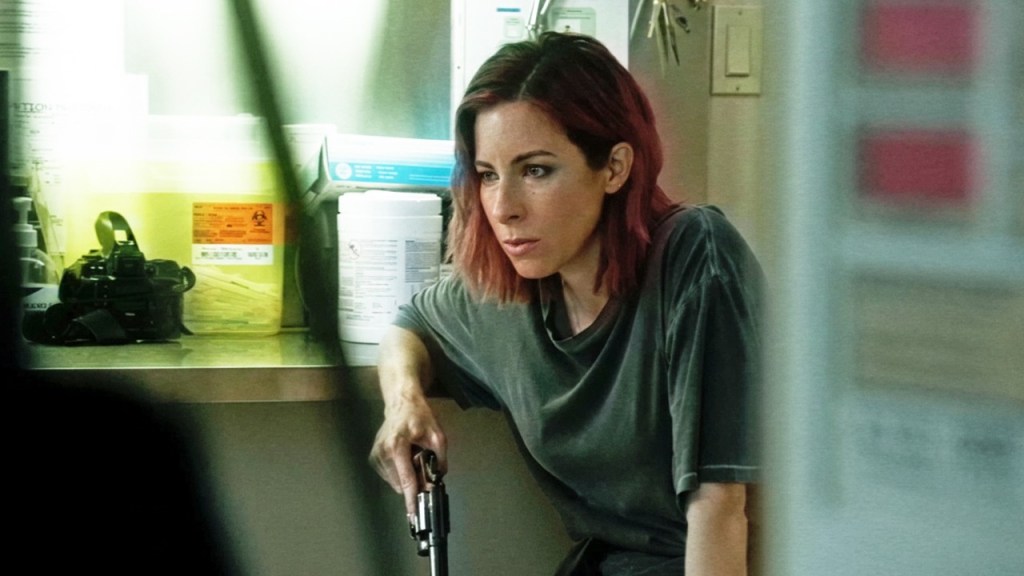
Prabha (Kani Kusruti) is a middle-aged hospital nurse. She is skilled at her job, teaching young trainees how to get over their feelings of revulsion. She spends time with a starry-eyed Doctor Manoj, who writes poems to her, but she is still very much married. Her husband moved to Germany to work in a factory, and he may as well not exist. Prabha shares an apartment with Anu (Divya Prabha), a vivacious young nurse at the same hospital. She likes shopping, fashion and romance, and most of all her secret boyfriend Shiaz (Hridhu Haroon). They’re in love (or at least young lust) but frustrated; it’s hard to find a private space to be together. More than that, she’s Hindu and he’s Muslim, and never the twain shall meet – their families will prevent that. Finally, Parvaty (Chhaya Kadam), an older nurse and a close friend of Prabha’s, is facing eviction from her home. Developers want to tear it down to build a high-rise condo. Since she’s a widow and doesn’t have the proper papers to prove the place is hers, they’re sending goons to her door to kick her out.

For all these reasons the three of them end up back in Kerala, the place of their birth in southwest India. They stay in a beautiful beach town, where the three of them can finally shake off the heavy responsibility and stress of life in that big city. But how long will this last?

All We Imagine as Light is a personal, intimate drama about the lives of three women in Mumbai. It’s notable for a number of reasons. This is director Payal Kapadia’s first feature, and tells her story from a distinctly feminine gaze. It deals with big contemporary political and social issues — like Parvaty attending an angry tenants’ rights meeting — but also the importance of personal friendships among the three woman. In look and style, this film is strictly European cinema verite, about as far from Bollywood as a movie could possibly be. But it is set in Bombay and exults in that city, from the slums to the skyscrapers, with stunning aerial views of rooftop clotheslines and raucous street festivals. There’s amazing footage taken through the window of a fast-moving commuter train. Some scenes have documentary-style unidentified voices, expressing their bittersweet love and hatred for that city that never sleeps, spoken in a plethora of languages: Hindi, Gujarati, Malayalam, and Bengali. I liked this movie for it’s emotions, but found much of it bleak and slow-moving; the story drags you down until it finally shifts from Mumbai to the beaches of Kerala, two-thirds of the way through.

But by the end it redeems itself with an unexpectedly satisfying finish.

All We Imagine as Light has been nominated for Best Foreign Language Film at the Golden Globes.

The Return
Dir: Uberto Pasolini

It’s 1200 BC in ancient Greece, and the island of Ithaca has no ruler. Decades ago, it was a mighty kingdom, ruled by the hero Odysseus — known for his bravery, fighting skills and intelligence. He devised the Trojan Horse and led the army that defeated Troy. But the soldiers — and their leader — never came home, and Ithaca has gone to seed. The queen, Penelope (Juliette Binoche) sits alone in her tower, weaving cloth, as she patiently waits for Odysseus’s return. Their son, Telemachus (Charlie Plummer) doesn’t know his father except from legends. The palace is filled aggressive brutes from abroad, each wanting to marry the widow Penelope so they can take over the kingdom. But is she actually a widow?

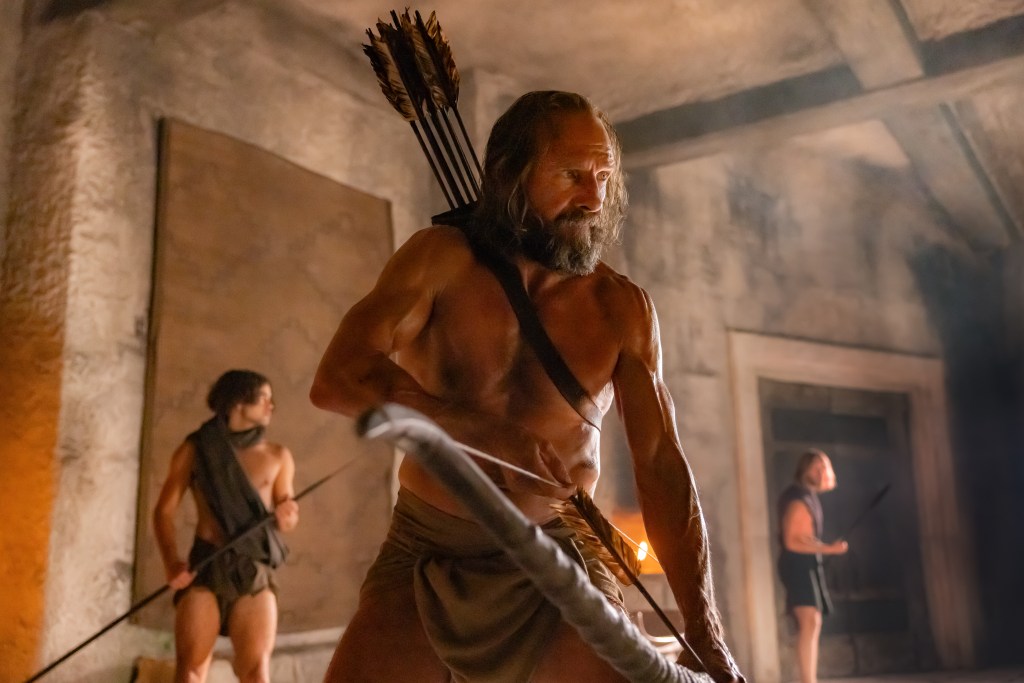
Around this time, the battle-scarred body of a soldier washes up on shore. He’s barely alive, but is nursed back to health by an honest pig farmer named Eumeo (Claudio Santamaria) and his sons. It is of course Odysseus (Ralph Fiennes), but without any uniform or weapon. He’s actually naked. He wraps himself in a blanket and carries a bowl — the clothing of a homeless beggar. And when he approaches the palace, almost no one recognizes him. Only Eurycleia (Ángela Molina), both his and his son Telemachus’s nurse as a child, realizes who

The Return, directed by Uberto Pasolini, with Ralph Fiennes (Odysseus), Juliette Binoche (Penelope), Charlie Plummer (Telemachus), Marwan Kenzari (Antinous), Claudio Santamaria (Eumaeus).

that beggar is. Is he still fit to be king? Can one man, tired and old, confront a bloodthirsty mob of young toughs? And will Penelope ever forgive him for staying away so long?

The Return is a magnificent retelling of a chapter in Homer’s The Odyssey. But it’s not about triumphant heroes; it’s more about the grinding effects war has upon both the victors and the vanquished. It contrasts Odysseus’s shame and self-doubt with Penelope’s eternal fidelity. Yes, this is an ancient greek story, with swords and sandals, but it feels very immediate. Parts of it even resemble a Hollywood action/thriller, with chase scenes and some very bloody fights.

The film was shot among the rocky cliffs of Corfu and the ruins of an ancient castle, which is echoed in the soundtrack. I love the dramatic look and sound of waves crashing on the sharp rocks. Though the women are all wrapped up, most of the male actors are dressed in togas or prancing around half naked, with Ralph Fiennes going full monty at the drop of a hat. I didn’t used to like him much, but after Conclave and now this one, I gotta admit, he’s a really good actor. Juliette Binoche is skillfully understated as Penelope, and Dutch actor Marwan Kenzari is very creepy as Antinous, the threateningly oleaginous suitor closest to Penelope.

The Return is a really good movie.

The Return and All we Imagine as Light is on at the TIFF Lightbox in Toronto; and Standing on the Shoulders of Kitties, A Trailer Park Boys movie featuring Bubbles and his band on tour, is now playing; check your local listings.

This is Daniel Garber at the Movies, each Saturday morning, on CIUT 89.5 FM and on my website culturalmining.com.

Daniel Garber talks with Mia McKenna-Bruce about How to Have Sex

Posted in Coming of Age, Dance, Greece, High School, Movies, Music, Sex, Sexual Assault, UK, Women by CulturalMining.com on February 10, 2024

Mia McKenna-Bruce Photography: David Reiss, Hair: Ben Talbot, Make-Up: Sara Hill, Styling: Tilly Wheating

Hi, this is Daniel Garber at the Movies for culturalmining.com and CIUT 89.5 FM.

Tara and her two best friends, Em and Skye, have finished school, written their A Levels and want to celebrate. So, like tens of thousands of others, off they go to a mediterranean resort with more sex, drugs, alcohol and loud music than you can shake a stick at. But the elephant in the room is Tara — she’s a “big fat virgin”, and her mates want to make sure she returns home cured of that ailment. But when the time comes, Tara doesn’t know what she’s supposed to do, who she’s doing it with, and whether she has any say in the matter. And when it doesn’t go as planned, she doesn’t know what to do, or who to turn to. Turns out she still doesn’t know how to have sex.

How to Have Sex is a stunning bittersweet, coming-of-age drama about friendship, cultural expectations and consent. It’s writer-director Molly Manning Walker’s first feature and stars Mia McKenna-Bruce as Tara. The film won the prestigious Un Certain Regard Best Film prize at Cannes, and is nominated for best British film at the BAFTA awards. Mia won Best Lead Performance at the British Independent Film Awards and was named Screen International’s ‘Star of Tomorrow’.  She has also appeared in many TV shows and films since 2009, including The Witcher, Jane Austen’s Persuasion, and Vampire Academy. 

How to Have Sex opens in Canada 0n February 9th.

I spoke with Mia in London via Zoom.

Mia won the 2024 BAFTA Rising Star Award on February 18, 2024.

Daniel Garber talks with Valerie Kontakos and David Bourla about Queen of the Deuce

Posted in 1930s, 1960s, 1970s, documentary, Family, Feminism, Greece, LGBT, Movies, New York City, Porn by CulturalMining.com on June 3, 2023


Hi, this is Daniel Garber at the Movies for culturalmining.com and CIUT 89.5 FM.

New York City in the 1970s is a gritty city with a chip on its shoulder. Crime is rampant, and its government faces bankruptcy. But it’s also exploding with creativity and freedom of expression, in film, theatre, music and art, while the sexual revolution, the women’s movement and gay rights are in full swing. The city’s centre is 42nd street, and the strip running from Times Square to the Port Authority and north on 8th ave is filled with porn theatres and peep shows. And on top of it all sits a Jewish Greek-American woman, Chelly Wilson, ruling over her porn empire. 

Queen of the Deuce is a fantastic new documentary about Chelly’s life, her work, her family and the world she built. Born in Thessaloniki, she hid her children, escaped the Nazi invasion, and gradually made her way to the top of the NY porn movie industry. The doc includes personal photos and letters, period footage, animation and talking heads to give a first-hand look at a previously unknown hero. 

The film was directed by Valerie Kontakos, a well-known documentarian, founder of the NY Greek Film festival and on the Board of Directors of the Greek Cinematheque. The film features members of Chelly’s family, including her grandson, David Bourla, a screenwriter in his own right, known for action films like Push.

I spoke with Valerie in Athens and David in New York City from Toronto, via Zoom.

Queen of the Deuce is playing in Toronto at the Hot Docs Cinema as part of TJFF on June 3rd, 2023.

On the media. Films reviewed: A Wounded Fawn, Spoiler Alert, Empire of Light

Posted in 1980s, 1990s, Death, Depression, Disease, Feminism, Gay, Greece, Horror, Mental Illness, Movies, Racism, Revenge, Romance, Theatre, Women by CulturalMining.com on December 10, 2022

Hi, this is Daniel Garber at the Movies for culturalmining.com and CIUT 89.5 FM.

It’s December, but not everything is about Christmas. This week I’m looking at three new movies with themes set in the arts: there’s a woman who works at a cinema but never watches movies; a serial killer who finds himself part of an ancient greek play, and a writer for TV Guide who thinks his life is like a sitcom.

A Wounded Fawn

Co-Wri/Dir:Travis Stevens

It’s a fine art auction in NY City, and the collectors and dealers are in fighting mode tonight. The prized item is a small bronze sculpture from ancient Greece showing the Furies seeking revenge on a prone man. Kate (Malin Barr) gets the high bid and returns home triumphant with the piece  in hand. So she’s surprised to see Bruce (Josh Ruben) a rival bidder, show up at her door. His boss still covets the statue and is willing pay double. Doubling her money in 24 hours seems like a good deal. She invites him in for a glass of champagne. But before long, she is dead on the floor in a pool of blood, and the sculpture — and Bruce — are long gone.

Later, Meredith, another beautiful young woman (Sarah Lind) is excited over an upcoming weekend in the country with her latest paramour. Her last boyfriend was abusive, but her new one seems nice, generous and attractive.  And he’s into fine art just like Mer (she works in a museum).They set off for a fun filled adventure at his isolated cottage in the woods. She is thrilled to see the cabin is actually a finished home overlooking a dense forest, and decorated with modern art. But something is strange: she hears a woman’s voice in her ear warning her to leave. And she recognizes the Greek sculpture of the Furies on his coffee table — she authenticated it for an auction just a few weeks ago. (It’s just a copy, says Bruce) What she doesn’t know is that Bruce is a serial killer… and she might be his next victim. (Bruce is waiting for directions from a gigantic man-owl with blood red feathers who tells him who he should kill). Can Mer fight him off? And where do those strange voices come from? 

A Wounded Fawn is a low budget, exquisitely-crafted art-house thriller horror. What starts as a simple slasher, soon turns into a revenge pic about halfway through, where Meredith, Kate and a third victim return as the Furies to visit punishment upon Bruce. What’s really remarkable is how it incorporates greco-roman aesthetics, mythology and theatre into what could have been a simple scary horror movie, to turn it into something totally original. While it’s not always clear whether something happens for real, or just inside Bruce’s damaged brain, it doesn’t matter.  A Wounded Fawn is weird and fascinating, either way.

Spoiler Alert

Dir: Michael Showalter

It’s the 1990s. Michael Ausiello (Jim Parsons) is a nerdy gay guy who lives in NJ but works in Manhattan. He grew up obsessed by TV, living his life as if he were a character on an 80s sitcom. Now he’s a writer for TV Guide, where he devotes himself to work and remains perpetually single. Until he meets Kit Cowan (Ben Aldridge) at a dance club — he’s handsome, fit and popular and says Michael is just his type —a tall geek. Kit’s also in the media — he’s a professional photographer. They hit it off, but keep certain secrets to themselves. Kit lives a free-wheeling sex life — he’s not one to settle down. And Michael never came out to his small-town parents (Sally Field and Bill Irwin); he’s afraid they won’t accept him. And he’s afraid to show Kit his apartment. What is he hiding there? His Smurf collection; a veritable fuzzy blue tsunami filling every nook and cranny. But after settling their deferences, they eventually move in together. Most of the Smurfs are packed away, Michael comes out to his parents (they still love him) and they settle into domestic bliss. 

Flash forward 15 years, and their relationship is on the rocks; the spark has died and they’ve grown a bit distant toward each other. But everything changes when — spoiler alert! — Kit discovers he has terminal cancer. Can they handle his imminent death? Will their love be rekindled? And how will they spend what might be their last year together? 

Spoiler Alert is a touching dramady about love and loss, based on a true story — Michael Ausiello’s own memoir of his life with Kit. Like the book, the movie begins with the death of Kit in Michael’s arms, hence “spoiler alert”. The director Michael Showalter, previously made The Big Sick, also about a couple and their family facing a serious illness. So is this the gay Big Sick? Not exactly — it’s a new story with a different style, like his version of Michael’s childhood as a sitcom, complete with laugh-track. And there are lots of funny parts. The bigger question is, is Jim Parsons up to playing a dramatic role, or is he forever stuck in peoples’ minds as Sheldon on the Big Bang? In this case, I think he pulls it off. He fits the role and manages to make him quirkily sympathetic. So if you’re into terminal illness comedies, here’s a good one to try on for size. 

Empire of Light

Wri/Dir: Sam Mendes

Its the winter of 1981 in a sea-side city in southern England. Hilary (Olivia Coleman) is a middle-aged woman who works at the Empire Theatre as the front of house manager. It’s an art-deco movie palace, but like the town, it’s long past its prime. Half the screens are closed and the third floor ballroom has been taken over by pigeons. Hilary is lonely and depressed, on meds, recovering from a hospital stay. Her social life consists of ballroom dancing with old men, and her sex life is furtive encounters with her sleazy, married boss (Colin Firth) in his darkened office.

But her life changes when a young man, Stephen (Michael Ward) is hired to work there. She finds him attractive, ambitious (he wants to study architecture at university)` and compassionate: he nurses a wounded pigeon back to health. He’s mom’s a nurse, from the Windrush generation, but he wants more. Hillary may be his mom’s age but there’s something there. After a few intimate moments they start a clandestine relationship. But Michael’s real ambition is to leave this town — to escape increasingly racist street violence (he’s black), and to become more than just an usher.  Can their relationship last? And if they break up, can the fragile Hilary handle it?

Empire of Light is a romantic time capsule of life in Thatcher’s England. It’s also about the joy and troubles of an intergenerational, mixed-race love affair.  And it’s also about sexual harassment and anti-black racism in everyday life. And it’s also about Hillary’s mental illness, including her sudden, manic episodes. And it’s also about the rise of skinheads and the National Front, and the concurrent anti-racist ska revival.  And it’s also about the collective friendship that develops among the people working at the Empire theatre. (Maybe too many ands for one movie?)

Like many of Sam Mendes films (which I generally don’t like), it’s pandering and emotionally manipulative and has a  meandering storyline, that keeps you watching while it’s on, but leaves you feeling vaguely unsatisfied afterwards. But the acting is really good, especially Olivia Coleman and Michael Ward, who rise above the movie’s many flaws. Maybe even good enough to make Empire of Light worth a watch, despite all its problems.  

Empire of Light and Spoiler Alert both open this weekend in Toronto; check your local listings. And A Wounded Fawn is now streaming on Shudder. 

This is Daniel Garber at the Movies, each Saturday morning, on CIUT 89.5 FM and on my website, culturalmining.com.

Lost Souls. Films reviewed: Apples, Moloch, Passengers of the Night

Posted in 1980s, Archaeology, comedy, Covid-19, Depression, Disease, Drama, Family, Feminism, France, Ghosts, Greece, Homelessness, Horror, Netherlands, Radio by CulturalMining.com on July 10, 2022

Hi, this is Daniel Garber at the Movies for culturalmining.com and CIUT 89.5 FM.

It’s Nunavut day, so what better time is there to catch up on Inuit movies. Slash/Back, a brand-new movie about aliens in a small arctic town, is playing right now. The Grizzlies is a feel-good film about a high school lacrosse team. And if you’ve never seen Zacharias Kunuk’s movies — including The Journals of Knud Rasmussen and Atanarjuat: The Fast Runner — well… you’d better.

But this week I’m looking at three new European movies — from Greece, the Netherlands and France — about lost souls. There’s a lonely guy in Athens who loses his memory in a pandemic; a divorced mom in Paris who seeks solace in late night talk radio; and a widowed mom in the Netherlands who is haunted by the lost souls… in a peat-moss bog. 

Apples

Wri/Dir: Christos Nikou

Aris (Aris Servetalis) lives by himself in Athens, Greece. One day while going for a walk he forgets where he lives. Also his family, his identity, even his first name. He has acute amnesia, the symptom of a strange pandemic, sweeping across the planet. He’s taken to hospital, with the hope a family member will arrive to identify him. But no one comes. About the only thing he knows is he likes apples. The hospital arranges for him to move into an apartment, where they hope he can regain his memory, or at least achieve some level of self worth and identity.  To achieve this they put him into an experimental program. He’s given a series of mundane tasks, all of which he is expected to record, using a polaroid camera. Ride a bike, go to a movie, attend a party, drink alcohol, meet a new friend. It also includes things like picking up a woman in a bar (he accidentally goes to a strip bar with embarrassing consequences) But during his recovery, while viewing the Texas Chainsaw Massacre, he encounters another alienated, memory-deficient person.   

Anna (Sofia Georgovasili) is clearly on the same program. Two is better than one, so they begin to see one another, if in a detached, alienated way. But as time progresses, Aris begins to remember things, including sad memories he wants to suppress. Will Anna be his soul mate? Will he ever find his original home? And is there any meaning to his life?

Apples is a satirical look at modern urban alienation in a time of pandemic. Interestingly, this film was completed in 2019 BC, (before Covid). But somehow it captures the mundane, seemingly meaningless medical obsessions, the injections, the tests,  the isolation, loneliness and self-doubt that we all experienced over the past two years.

Writer-director Christos Nikou worked with the now famous Yorgos Lanthimos, on his earliest film, Dogtooth, and like that movie, it’s funny, weird and extremely awkward, with adults behaving like children, and people blindly obeying seemingly nonsensical rules. It takes place in the present day but it’s filled with obsolete gadgets like polaroid cameras, and cassette tape players not a cel phone or a laptop in sight. Aris Servetalis is excellent as the main character, who fits perfectly within the film’s minimalist feel.

I like this one.

Moloch

Co-Wri/Dir: Nico van den Brink

Betriek (Sallie Harmsen) is a woman in her thirties who lives in an isolated home with her parents and her young daughter, in northern Netherlands. Her home is in a forest, surrounded by peat moss bogs. Her daughter goes to public school but Betriek likes the isolation — she thinks her family is cursed so it’s best to keep to herself. Easier said than done. Especially when a strange man appears in her living room! He can’t stop it, he says, they won’t let him! And his voice seems to be an unworldly chorus of a thousand souls. And then he tries to kill them all. Turns out he worked at a nearby archaeological dig, headed by Jonas (Alexandre Willaume) a Danish man.

Peat moss is a natural preservative and they’re digging up mummified bodies from ancient times. And when they examine them, they discover they are all victims of the same sort of ancient ritual sacrifice to some primeval god. By disturbing the graves they may have let loose ancient demons, possessing her friends and family. Meanwhile, her mother is going through another difficult period with her brain — is it related? Her father says they’d better leave the place and never come back. And when Betriek encounters strange visions of a little girl sending her a message, she realizes things are very wrong. Will Jonas ever believe there’s something evil going on? Can Betriek break her family’s curse? Will they fall in love? And together can they fight off an ancient evil god?

Moloch is an excellent Dutch horror movie about life in a remote village built over secrets that never should have been disturbed. It sounds like a simple story, but actually it’s a multi-layered drama. The film even incorporates a school Christmas pageant where small children innocently reenact an ancient pagan tribute even while mayhem is happening outside. The movie’s in Dutch, but because of the multiplicity of languages, much of the dialogue is in English. And remarkable for a horror movie, the cinematography is gorgeous, as warm and grainy as any 70s Hollywood movie. I liked this one, too.

Passengers of the Night

Dir: Mikhaël Hers

It’s the mid-1980s in Paris. Elisabeth (Charlotte Gainsbourg) lives with her two teenaged kids high up in an apartment tower. Her daughter Judith, is outspoken and into politics, while her son Matthias (Quito Rayon- Richter) is more introspective — he gets in trouble for writing poems in history class. The dad, though, is nowhere to be seen. He moved in with his girlfriend and pays no child support. So Elisabeth is forced to search for a job to keep her family afloat.  She finds solace listening to a late-night radio talk show, and applies to work there. She lands a job at the switchboard vetting callers and guests for the host, Vanda (Emmanuelle Béart). She invites a young woman to the show based on a touching letter she wrote. Tallulah (Noée Abita) is 18 but has lived on the streets of Paris for years, sleeping under bridges and in squats. She has raven hair, pale skin and doe eyes. 

Elisabeth can’t stand the thought of her sleeping in the rough, so she invites Tallulah to stay, temporarily, in a spare room tucked away far above their apartment. She wants to keep her separate from her kids, but they soon meet up. She’s street smart, and teaches them how to live on nothing and tricks like how to get into a movie theatre without a ticket. Matthias is smitten by her and longs to take it further. But after a late night tryst, she flees the apartment and disappears, leaving the family shocked and saddened. Four years later, things have changed. The kids are growing up, Elisabeth has gained self-confidence and she has a day job and a much younger boyfriend named Hugo.  But when her ex says he’s selling the home, it’s time for major changes. That’s when Tallulah reappears again at their door in a bad state. Can Elisabeth save Tallulah from her spiral into darkness? And what will the future bring?

Passengers of the Night is a beautiful and heartfelt look at a Parisian family navigating its way through unexpected shifts in their lives, and how a visitor can change everything. The film is set in the 80s (from 1981 through 1988), not just the costumes, music, and Talulah’s big hair but also the tumultuous political and social changes from that era. And it’s punctuated by views of Paris from that era — high-rises, sunsets and views through commuter train windows — shot on a narrower bias, to give it a realistic feel. While more gentle than a sob story, it still brings tears to your eyes.

Passengers of the Night and Apples are both playing at the TIFF Bell Lightbox. And Moloch is now streaming on Shudder.

This is Daniel Garber at the Movies, each Saturday morning, on CIUT 89.5 FM and on my website, culturalmining.com

Tough older women. Films reviewed: The Lost Daughter, June Again

Posted in Australia, Dementia, Depression, Drama, Family, Greece, Kids, Secrets, Women by CulturalMining.com on January 8, 2022

Hi, this is Daniel Garber at the Movies for culturalmining.com and CIUT 89.5 FM.

Well, as I’m sure you know, we’re under lockdown, and all the movie theatres are closed. It’s like Groundhog Day all over again. But that doesn’t mean you can’t watch movies at home on streaming networks or VOD.  So this week I’m looking at two such movies about tough older women. There’s a professor who finds a lost child as she interacts with a family of strangers; and a former matriarch who finds her missing past as she interacts with her own lost family.

The Lost Daughter

Dir: Maggie Gyllenhall

Leda (Olivia Coleman) is an established author and Harvard professor specializing in comparative literature. She has two adult daughters but she’s on vacation alone at a Greek beachside resort for some “me time”. Since she arrived, two men are already flirting with her: Will (Paul Mescal), an Irish lad working there for the summer, and Lyle (Ed Harris) an American old-timer who has been there for thirty years. Though flattered, she’d rather just lie on the beach (she describes herself a selfish person.) But her peace and quiet is broken by a noisy American family, who tell her to move down so they can sit together. She refuses, earning her a chorus of dirty looks. Later, she sees Nina (Dakota Johnson), a young mother from the same family, struggling with her little daughter who is chewing contentedly on a baby doll. The little girl disappears and panic sets in. And to everyone’s surprise it’s Leda who finds the missing girl, and the family is now grateful to her. But the girl’s doll is still missing, and she is driving Nina crazy with her constant crying. 

Later we discover it’s missing because Leda stole it for herself. Huh….? You see, like young Nina, she has her own checkered history of dealing with her daughters. Can neurotic Leda find happiness on the beach in Greece? Will she sleep with Will or Lyle (or neither)? Can Nina learn to deal with a cranky child? And what about the doll?

The Lost Daughter — based on the novel by Elena Ferrante — is an uncomfortable drama about a middle-aged woman coming to terms with her past. Her younger self is played by Jessie Buckley in a series of extended flashbacks. The “doll” aspect of the story, makes it seem like a psychological thriller… but it’s not. Rather it’s an intense character study of Leda, past and present. The acting is superb, especially Olivia Coleman as a woman dealing with an internal crisis. But the movie itself is hard to watch. Leda is not that sympathetic a character — we see all her faults and terrible decisions, because we’re inside her mind.  It’s mainly about her internal struggles, something harder to convey in a movie than in a novel.  It does have other parts I haven’t talked about — her poetry, her love affair, her time with her daughters — that make it richer and more complex than I described. It’s not a simple film. But it’s mainly about fear, suspicion, guilt and regret. Does it work? I guess so. It’s well-made but largely uncomfortable and unpleasant to watch.

June Again

Wri/Dir: JJ Winlove

It’s a normal day in New South Wales, Australia. June (Noni Hazlehurst) is an older woman living in a nursing home. Ever since a stroke, five years earlier, she has suffered from vascular dementia and aphasia — she can’t finish a sentence, and barely recognizes her own family when they come to see her. She just sits there in a semi-comatose state. Until, one morning, she wakes up as a whole new June. Or rather the old June. Suddenly she can complete a cryptic crossword, and responds to staff inquiries with a witty riposte. She is disturbed to see where she’s living. What are these hideous clothes she’s wearing, why is this place so tacky, and why is she there? They tell her she has dementia, and although she’s back to normal now, it’s only temporary. But June decides to use her time wisely.  She engineers an escape from that “prison”, zooming away in a taxi, and stealing some brightly-patterned clothes on the way. But everything has changed. 

Her home is no longer hers — there’s another family living there, and all her possessions are gone, including a prized wooden wardrobe.  The company she founded — a prestigious manufacturer of hand-printed wallpaper — has gone to seed, and is headed by a douchey manager who calls her former colleagues “girls”.  They‘re printing on low-grade paper now and have lost al their prestigious clients.  And her two adult children aren’t on speaking terms. When she last saw her son Dev (Stephen Curry) he was studying architecture and raising a family. Now he’s divorced, spends little time with beloved her grandson Piers (Otis Dhanji) and is working as a clerk in a copy shop. Her daughter Ginny (Claudia Karvan) has completely abandoned the factory, June’s life work. And June’s finances are a mess.  But what can she do — with the limited time she has left — to make everything right again?

June Again is a funny and heartwarming story of a woman given a second chance. The early scenes of Dementia June are similar to the movie The Father (starring Anthony Hopkins) where time sudden’y jumps forward to signify her frequent memory loss. But most of the movie is about Normal June, a brash, funny and bossy matriarch who won’t take no for an answer. Noni Hazlehurst is wonderful as June — the whole movie revolves around her, and luckily she’s marvellous to watch. June again is fun to watch, and though dealing with a sad topic is upbeat all the way. 

I liked this one a lot. 

June Again is now available on VOD, and The Lost Daughter is now streaming on Netflix. 

This is Daniel Garber at the Movies, each Saturday morning, on CIUT 89.5 FM and on my website, culturalmining.com

Far from home. Movies reviewed: Greed, Wendy, Blame Game

Posted in comedy, Corruption, Espionage, Germany, Greece, Kids, Satire, UK, US by CulturalMining.com on March 6, 2020

Hi, this is Daniel Garber at the Movies for culturalmining.com and CIUT 89.5 FM.

It’s International Women’s Day, and you can see films directed by Women all weekend long at FEFF, the Female Eye Film Festival at the TIFF Bell Lightbox.

This week I’m looking at three new movies – one from England, one from Germany, one from the United States — about people who willingly travel far from home. There’s a German agent meddling in Central Asia, little kids running rampant on a volcanic paradise, and a filthy-rich tycoon planning a birthday party in a coliseum he’s building on a Greek island.

Greed

Dir: Michael Winterbottom

Sir Richard McCreadie (Steve Coogan) is a vulture capitalist and a tycoon in the rag trade. His M.O. is to take over successful clothing stores, selling all its real estate, moving factories to Sri Lanka and hiding all the profits in a European tax haven. McCready is filthy rich — Fleet Street calls him McGreedy – catering to the endless demand for ready-made, disposable fashion. He’s also insufferable. His pearly whites look factory- made and his tan is as fake as Donald Trump’s.

For his 60th birthday he plans a mammoth celebration on a Greek island, complete with a newly-built colliseum, gladiators, and a lion. He also wants to rescue his reputation and his brand from scandal. But things aren’t going the way they’re supposed to. Members of his family and his ex-wife keep getting into trouble. There’s a reality show being shot there, Syrian refugees living on the public beach “spoil his view”, and his various servants and employees find him impossible to work with. But when he foces his employees to dress as Roman slaves, the tide turns.

Can money buy happiness? Or are the peasants revolting?

Greed is a political satire about the immense wealth and greed of the richest few, and the suffering of everyone else. It’s a complex story chronicled by his  official biographer’s eyes (David Mitchell). It jumps back and forth from his days at an elite boarding school, his rise to fame, and the people he trampled on on the way to the top. It also includes scenes in his Sri Lankan factory, with allusions to the the horrors of similar places in Bangladesh. I will see anything directed by Winterbottam and anything starring Steve Coogan, so I had great expectations. Which also meant  I automatically enjoyed this movie. But I was mildly disappointed that it wasn’t as funny nor as outrageous as I’d hoped. They could have done so much more — it felt almost like Coogan and Winterbottom were holding back.

Greed is a fun movie but not a great one.

Wendy

Dir: Benh Zeitlin

Wendy (Devin France) lives above a whistle-stop diner in Louisiana, with her mom and her twin brothers . It’s always Egg O’Clock at the Darling’s restaurant. Wendy draws pictures while Dougo and James (Gage and Gavin Naquin) do elaborate dances and poses by the jukebox. Kids have hope while the Olds are all miserable. Who would want to grow up? So the three of them jump aboard a freight train for a chugga-chugga, choo-choo, down by the bayous.

Their tour guide is a mischevious boy named Peter Pan (Yeshua Mack), who takes them to a secret island inhabited only by kids known as the Lost Boys. There’s a volcano, steep cliffs, spouting geysers, and hidden caves — a great place for exploring, playing, and having a kickass good time. It’s a place where you never have to grow up. They are ruled by an ancient deity, deep in the ocean, called Mother. As long as they believe in her nothing bad can happen. But when Doug disappears his twin loses faith… and as soon as you lose faith, you start to age, and are forced join the old codgers on the other side of the island. Things in Never Neverland might not be the paradise she expected. Does Wendy have faith in the ocean mother?  Can she find her twin brothers and take them home? Or is she stranded forever on this island?

Wendy is a new spin on the classic Peter Pan story told through Wendy’s eyes, and transferred from Victorian London to the Gulf Coast with a multiracial cast. It uses experimental, handheld camera work and first-time actors to give the film spontaneity and authenticity. Problem is the movie isn’t fun. The characters don’t seem that interested in where they are, and the storytelling is too slow. But the biggest problem is the musical score: it’s orchestral and lush and traditional but totally at odds with the film’s experimental look.

It just doesn’t work.

Blame Game (Das Ende der Wahrheit)

Wri/Dir: Philipp Leinemann

Martin Behrins (Ronald Zehrfeld) is a spy. He poses as a translator for the German refugee board, and uses his position to recruit assets from the middle east and central asia by blackmailing them into compliance. In the fight against terrorism’ he arranges for the assassination of an anti-western figure. Martin is divorced — his ex wife and son couldn’t handle the constant  threat of death and danger.  So he spends his off hours at a beautiful lakeside cottage with his girlfriend Aurice (Antje Traue). She’s an investigative journalist focussing on government corruption. They’re at odds but agree to keep their work separate from their home lives. But when she uncovers a story about the assassination that Martin planned, things go south. The “simple” drone killing turns out be not simple at all. And then a terror attack kills someone Martin knows very well.

A new bureaucrat named Lemke (Alexander Fehling) – a pencil pusher from another department – is brought in to take over. He knows nothing about the world of espionage, but he lords his authority over Martin. Martin, meanwhile is trying to figure out what’s really going on. Is there a private corporation involved? Was this all a set up with him as the patsy? Who is corrupt and who can be trusted?

Blame Game is a fascinating look at international espionage, the “war on Terror”, the international politics, shady arms deals and the CIA. It has a juicy conspiracy at its core, and enough twists and turns to the plot to keep you guessing. While I found the camerawork and editing pedestrian, the acting and the gripping suspenseful story more than made up for it. If you’re into German film you’ll recognize Zehrfeld from Phoenix and Babylon Berlin, with Traue and Fehling also everywhere. Blame Game is a great political thriller reminiscent of Three Days of the Condor, Homeland, or 24. And the upcoming screening will be its North American debut. I liked this spy thriller a lot.

Wendy and Greed both open today in Toronto; check your local listings. Blame Game is playing on March 17 at the TIFF Bell Lightbox as part of a Goethe Film series called The End of Truth.

This is Daniel Garber at the Movies, each Friday morning, on CIUT 89.5 FM and on my website, culturalmining.com.

Quirky films at TIFF 19. Entwined, Parasite, 37 Seconds, Love Me Tender

Posted in Class, Disabilities, Fairytales, Fantasy, Greece, Japan, Korea, Manga, Mental Illness, Poverty, Switzerland by CulturalMining.com on September 6, 2019

Hi, this is Daniel Garber at the Movies for culturalmining.com and CIUT 89.5 FM.

TIFF – the Toronto International Film Festival – started last night with over 300 movies to see. There’s more glamour and celebrity than you can shake a stick out down on King St. West. But this week I’m going to talk about some of the unusual, odd or quirky movies you might otherwise miss. There’s a woman in the woods in Greece, a poor family in a Korean mansion, a disabled manga artist in Japan, and a house-bound woman in Switzerland.

Entwined

Dir: Minos Nokolakakis

Panos (Prometheus Aleifer) is a young doctor starting a practice in a remote Greek village. But on a drive through the forest, his car hits a beautiful young woman, all dressed in white. Though injured, she flees into the woods. He follows enchanted music until he finds her cabin. It’s an old place built around an ever burning hearth, with music coming from an ancient windup Victrola. But to his horror, he finds her under the spell of a violent, old man who keeps her as his bride. He defeats the ogre, drives him to a hospital and comes back for the woman, Danae (Anastasia Rafaella Konidi).

He intends to bring her to the city for counselling and medical care (she has a strange skin disease). But Danae refuses to leave – she owes it to the trees, earth and sky to keep the hearth burning. Instead she gives him strange potions that make him sleep for days, or possible months. And whenever he tries to leave the forest the trees seem to lead him back to the cabin. Who is this strange woman? What does she want? How old is she? What is she hiding behind her locked door? And is he her lover…orher victim?

Entwined is a contemporary take on classic fairytales, with a bit of mythology thrown in. Though somewhat predictable, it’s pretty to watch, well-acted and… well, I like fairytales.

Parasite

Wri/Dir: Bong Joon-ho

Ki-woo (Choi Woo-shik) lives with his family in a desolate basement apartment in Seoul. They’re destitute but clever; Ki-woo earns money writing exams for rich but stupid college applicants. So when Min offers him his parttime job tutoring a highschool girl, he smells bucks. Big Bucks. She lives in a beautiful home built by a famous architect, along with her bratty little brother, vapid mother and absentee Dad, a CEO. Through some skillful manoeuvring Ki-woo manages to find jobs for his sister, father and mother in the same house, as, respectively, art therapist, chauffeur and housekeeper without ever letting on they are all related. Only the youngest notices they “all have the same smell”. They’re the sort of people who take the subway, explains the father. They all have a disgusting smell that never comes off…

Now that they all have well-paid employment they can turn their lives around, and leave their apartment. Until… something awful happens which sends their lives spinning in a new direction. [No Spoilers: this movie depends on its surprises].

Parasite starts as a knock off of last year’s Shoplifters, about a poor family making do. But once they’re in the rich house, the plot spirals outward in ever-more shocking, funny, and impossible directions, until it becomes a bizarre fantasy.

Brilliant.

Parasite won the Palme d’Or at Cannes.

37 Seconds

Wri/Dir: Hikari

Yuma (Kayama Mei) is a woman in her twenties who lives with her single mom (Misuzu Kanno). She was born with Cerebral Palsy, and depends on her mother for basic functions, including bathing, dressing herself and getting around in her electric wheelchair. Though she can’t walk, she’s a gifted manga artist who works for an instagram star named Sayaka. Sayaka passes Mayu’s work as her own, and pretends she doesn’t know her at book signings. But when Maya tries to publish work under her own name, she gets snubbed.The only publisher who will consider her work is a comic book porn publisher. But when they meet, Maya is told the sex scenes just aren’t real enough. Come back after you get some sexual experience. Now Mayu has a goal, which opens a new world to her, and uncovers some secrets from her past. But can she get what she wants under the ever-watchful eye of her over-protective mother? And can an inexperienced and naïve disabled woman find independence and happiness?

37 Seconds (the title refers to the amount of time she was deprived of oxygen in childbirth) is a wonderful and warm, feel-good movie. It’s a bittersweet coming-of-age story about a disabled woman in a big city, as she encounters aspects of adult life – including sex work, porn and sex toys – she knows nothing about. No spoilers, but the story also takes her on an unexpected journey, unrelated to the other plot line.

First-time actor Kayama Mei is both touching and adorable as Yuma, and breaks new boundaries as a disabled actress. 37 Seconds is an unexpected treat.

Love Me Tender

Wri/Dir: Klaudia Reynicke

Somewhere in Italian-speaking Switzerland. Seconda (Barbara Giordano) is an adult woman who lives with her parents in an apartment overlooking a courtyard. She likes to dance in a green leotard and stare at passersby outside her window. Life is uneventful until two things happen: her mother suddenly dies and her father disappears leaving just a post-it note on the fridge. At first she feels free to do what she wants and eat what she wants. She throws her meds out the window. But she finds she also has adult responsibilities: feeding the cat and the fish, — at which she fails miserably – keeping the house in order and, most important, feeding herself.

And she encounters a rude debt collector who leaves threatening voicemail messages, and a hapless young man Santo (Antonio Bannò) who collects deposit bottles. But when she runs out of food, she realizes she has to go shopping. Problem is, she’s never been outside her home – she has acute agoraphobia. But rather than starve to death, she dresses in protective blue armour – a zippered jumpsuit – and ventures into the outside world for the first time.

Love me Tender is a fantastical comedy abut an unusual woman living with mental illness. Klaudia Reynicke’s style feels a bit like Yorgos Lanthimos’ early films, with the simplistic tone and the childlike behaviour of adult characters… but she does it in a manner all her own. And Barbara Giordano is just so good, imaginative and full-body-expressive as Seconda… she totally owns the role.

Entwined, Parasite, 37 Seconds and Love Me Tender are all playing at TIFF. Go to tiff.net for details.

This is Daniel Garber at the Movies, each Friday morning, on CIUT 89.5 FM and on my website, culturalmining.com.

“What is Democracy?” Daniel Garber talks with Astra Taylor about her new documentary

Posted in documentary, Economics, Greece, Interview, Italy, Morality, Movies, Philosophy, Politics, Poverty, Protest, US by CulturalMining.com on November 9, 2018

Hi, this is Daniel Garber at the Movies for culturalmining.com and CIUT 89.5 FM.

Photos by Jeff Harris

Is democracy justice or is it freedom? And if it’s freedom, is it freedom to think and say what you want, or is it freedom from hunger, poverty, and homelessness? Or is it just choosing which political party to vote for once every four years?

Should democracy just exist inside a nation, or should it extend across borders? Is majority rule fair and equal?

What is democracy, anyway?

A new documentary poses just that question to intellectuals and the hoi polloi in America and across the Atlantic. It talks to barbers and doctors, students and politicians, in legislatures and at Trump rallies, to try to determine what democracy actually is.

It’s called What Is Democracy and is written and directed by noted documentary filmmaker Astra Taylor, whose works include Examined Life and Zizek!

What is Democracy had its world premier at #TIFF18.

I spoke with Astra Taylor at NFB’s Toronto headquarters during TIFF. Her film is opening soon.

Daniel Garber talks with director Håvard Bustnes about his new doc Golden Dawn Girls

Posted in documentary, Greece, Journalism, Nazi, Politics, Racism, violence by CulturalMining.com on April 13, 2018

Hi, this is Daniel Garber at the Movies for culturalmining.com and CIUT 89.5 FM.

It’s the 2010s in Greece. The EU and northern European banks are foreclosing on Greek debt, demanding the country adopt austerity measures. There is talk of Grexit — Greece pulling out of the European Union altogether. Newcomers, fleeing war in the Middle East and Africa, are seeking refuge on their shores. And new political parties are springing up amidst the turmoil, with one, the leftist Syriza, eventually rising to prominence. But on the extreme right, another party arises. Golden Dawn combines Nazi regalia, fascist ideology, and anti-immigrant violence in its attempt to seize power. What is Golden Dawn, what does it stand for, and who are the people in its inner circle?

A bold new documentary looks at the party from an insiders’ point of view. The filmmaker gained access by appealing to the women closest to the party leaders – a mother, a wife and a daughter – who offer their candid insights while the men are in jail. The documentary is Golden Dawn Girls, by the noted Norwegian filmmaker Håvard Bustnes.

I spoke to Håvard in Norway via telephone from CIUT 89.5 FM in Toronto.

Golden Dawn Girls will have its North American premier at Toronto’s Hot Docs International Documentary Film Festival on May 1st, 2018.