Blacks, Jews and Irishmen. Films reviewed: The Piano Lesson, A Real Pain, Small Things Like These
Hi, this is Daniel Garber at the Movies for culturalmining.com and CIUT 89.5 FM.
Fall Film Festival Season continues with the EU Film Fest, showing free films from across Europe at Spadina Theatre starting on the 14th.
This week, I’m looking at three family dramas. There’s Black siblings in Pittsburgh, Jewish cousins in Warsaw, and an Irish dad with his five daughters, in… well, Ireland.
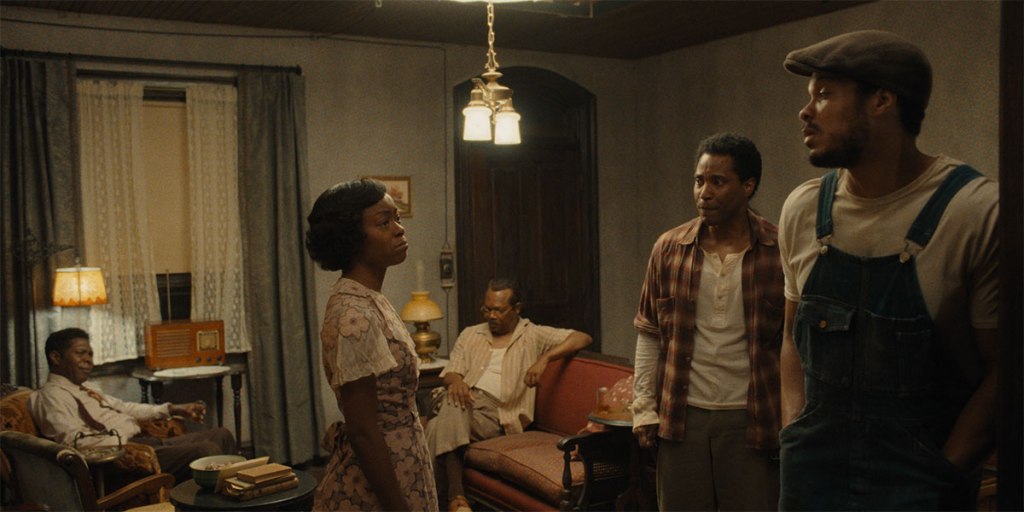
The Piano Lesson
Dir: Malcolm Washington
It’s 1936. Boy Willie Charles (John David Washington) and his friend Lymon are driving north from Mississippi with a truckload of watermelons, to visit his sister Berniece (Danielle Deadwyler) in Pittsburgh, Pennsylvania. She’s living with their uncle Doaker (Samuel L. Jackson). Once they sell the melons, Boy Willie plans to take his share of the profit (along with his savings) to purchase Sutter’s land. That’s the same place where his great grandparents were slaves, and where he still toils the land as a share-cropper. This is his one chance to own it. But he’ll only have enough money if he sells the family piano. That’s why he’s visiting Pittsburgh. But Berniece refuses to sell it. Why? She grew up playing that piano, and more to the point it has family faces elegantly carved into the wood itself, dating back to pre-Civil War days. Besides, she says, that piano is haunted… and the ghost is getting meaner. Meanwhile various family and friends, like a trickster and a preacher, are congregating at this house with different motives for being there. Can Boy Willie and Berniece come to terms about the piano? Or will bad spirits — both supernatural and human — ruin everything first?
The Piano Lesson is an excellent filmed version of playwright August Wilson’s drama. Fine acting all around, with Danielle Deadwyler outstanding as Berniece. Now, plays and movies are two different things. Actors emote louder and move bigger on
stage (so everyone can see and hear them). And even the blocking and dialogue is different. Movies are no more real, but different. This Piano Lesson is very much a play. So I was a bit put off by it’s style… until the my brain started watching it as a play, at which point I really liked it.
If you notice a lot of Washingtons here, it’s no coincidence. Denzel Washington is the producer, and actor John David and director Malcolm are both sons of his. Denzel is committed to putting all ten of August Wilson’s Pittsburg Cycle on the big screen to preserve crucial Black American culture. Witness Fences in 2016 and Ma Rainey’s Black Bottom in 2020. The Piano Lesson is a fine addition to this series and should be watched.
A Real Pain
Wri/Dir: Jesse Eisenberg
Benji and David Kaplan are cousins in their 30s, as close as brothers, but totally different. Benji (Kieran Culkin) is loud, gregarious, obnoxious and larger than life. He likes to raise a ruckus and mess things up. He lives alone in Binghamton, NY. David is shy, insecure and withdrawn. He’s married with a small kid and lives in Manhattan. He’s in a constant state of dithering and worrying. They’re travelling together to Poland to explore their family’s heritage. Their grandmother was Polish and a Holocaust survivor.
Benji was very close to her and devastated by her recent death, much more so than David. They’re part of a small tour group, all Jewish. Their guide (Will Sharpe) is a nerdy English guy, very accommodating. Also on the tour are Marcia (Jennifer Grey) who suffers from intergenerational trauma; Eloge (Kurt Egyiawan) from Winnipeg but originally from Rwanda where he survived Tutsi genocide; and a middle-class couple whose family immigrated from Poland generations ago but want to see where they came from. (“We’re Mayflower Jews”, he says).
Their journey takes in cultural and historical sites across Poland, but the closer they get to the concentration camp where their
grandmother was imprisoned, the more agitated Benji gets. He slips into shouted diatribes and lectures, causing scenes within their group and in public places — to David’s acute embarrassment. Can they both make it through the whole tour? Or will one of them drop out?
A Real Pain is a low-key, social comedy — yes, a comedy — about the uncomfortable dynamics within a family. it’s actually pretty funny, No slapstick or pratfalls, rather unexpected squirmy riffs on the two main characters’ personalities. (Like Benji telling David his bare feet are gorgeous, making him stare at them for the rest of the trip.) It’s told in a series of clever vignettes over the course of the trip, all hovering over unvoiced feelings of personal and collective mourning. I’m always suspicious when actors play at directing, but this is no vanity pic. Eisenberg stays suitably subdued, letting Culkin go wild.
I like this movie.
Small Things Like These
Dir: Tim Mielants
It’s winter in a small town in Ireland in the 1980s. Bill Furlong (Cillian Murphy) is a working man who scrubs coal dust off his hands and face each day. But he doesn’t work in a coal mine; he has his own business, built from scratch, selling coal. His wife Eileen (Eileen Walsh) and his eldest daughter handle the finances. One day, he’s making a delivery when he’s alarmed to see a teenaged girl being dragged, kicking and screaming, into the local convent. That’s not right. She may be unmarried and pregnant, but why are they kidnapping that poor girl?
So he steps inside to take a look. It’s the Magdalene Laundries, a Church organization that operates across Ireland, to care for unwed mothers. They put the babies up for adoption, and the girls and young women are trained to work as industrial laundresses. But to Bill it seems almost like a prison, where the girls are treated horribly. When one girl runs over, begging him to help her escape, he doesn’t know to do. The nuns quickly disabuse him of any notions he might have, and rush him out the front door.
But Bill has history. He was brought up in this same town by his own single mum, who chose to stay away from that convent. He was bullied as a child because of this, but he still remembers how his mother — and her employer, an independently wealthy woman — defied the church. He feels he has to do something for that girl. But the nuns have their fingers in every pie; the school, government, they’re even a client of his own business. Should he confront the cold-eyed Sister Mary (Emily Watson) who runs everything? Or should he just worry about his own family, and pretend nothing is wrong?
Small Things Like These is a deeply-moving drama about families, moral dilemmas and the checkered history of the Catholic Church in Ireland. This is the third such movie, after The Magdalene
Sisters and Philomena, but its repercussions are still very much alive. Cillian Murphy — who you probably recognize from Oppenheimer or Peaky Blinders — once again pulls you into the character he plays. He rarely speaks but the emotion in his features really affect you. So if you’re looking for a real tear-jerker, this is the one to watch.
A Real Pain, Small Things Like These, and The Piano Lesson all open in Toronto this weekend; check your local listings.
This is Daniel Garber at the Movies, each Saturday morning, on CIUT 89.5 FM and on my website culturalmining.com.
Assorted monsters. Films reviewed: The Apprentice, Piece by Piece, Don’t F**k with Ghosts
Hi, this is Daniel Garber at the Movies for culturalmining.com and CIUT 89.5 FM.
Toronto’s fall film festival season is in full swing with Planet in Focus, celebrating it’s 25th anniversary. It’s running from Tuesday through Sunday next week, with international features and shorts on climate change, activism, environmentalism and indigenous issues. And on Friday, October 18, there’s a free screening at Hot Docs of We Will Be Brave, about Good Guise, a Toronto collective that sparks conversations around healthy masculinity through art. That’s part of the For Viola series honouring Viola Desmond.
But this is also October, when ghouls and ghosties flock to our screens. So this week, I’m talking about three new movies about various types of monsters. There’s a monstrously popular music producer from Virginia Beach; a notorious real estate developer trained by a monster in New York; and two guys searching for ghosts in Winnipeg.
The Apprentice
Dir: Ali Abassi (Review: Border)
It’s the mid 1970s, and New York is a wreck, with soaring crime, homelessness and bankruptcy. When the Mayor asks the feds for help, Gerald Ford tells them to “drop dead”. Into the world emerges an ambitious young developer. Donald Trump (Sebastian Stan) was born rich, but cowers under his oppressive father’s rule. Fred Trump (Martin Donovan) a real estate developer from Queens, made his fortune building segregated public housing. Donald is stuck at crap jobs, collecting rent and evicting destitute tenants. But he has big ideas. His plan? To buy the venerable Commodore, an old hotel with 2000 rooms on 42nd street a hotbed of porn palaces and drug dealers. But how can he raise the money with his dad being sued by the feds for his racist rental practices? Donald has an idea. He joins an exclusive club with the hopes of meeting a certain lawyer he thinks can solve all his problems. The lawyer is Roy Cohn (Jeremy Strong) a notorious rightwing attorney with ties to organized crime. Cohn played a central role in the
McCarthy Hearings, and still brags about executing the Rosenbergs. He agrees to take on Donald as his protege, and teaches him his three crucial rules: Attack, attack, attack (whether lawsuits, blackmail or intimidation) Deny everything , and always declare victory, even when you lose. (See: 2020 election). The club is also where he meets the beautiful and brash Ivana (Maria Bakalova), whom he is destined to marry. She will instill in him a love of garish, nouveau-riche interiors. The film follows these three people’s intertwined lives through the 70s and 80s until Cohn’s death.
The Apprentice (absolutely no connection to Trump’s much later reality show) is a very dark biopic about the origin of Trump’s bizarre motivations and strategies. Sebastian Stan gives an excellent portrayal of Trump; he’s actually sympathetic for his earnestness and naivety in the beginning, but who spirals into something deeply disturbing by the end. This is not an SNL parody, it’s a realistically developed character. Likewise, Strong plays Roy Cohn as a dead-eyed, sybaritic bully, hosting gay orgies, even while publicly denying his sexuality to the end. He doesn’t look like Roy Cohn, but he sure does act like him. With a great selection of 70s and 80s pop songs throughout the film, and the grotesque golden opulence of Trump’s homes captured on grainy colour film of the era, The Apprentice is a funny and disturbing biopic.
Piece by Piece
Co-Wri/Dir: Morgan Neville (Review: Best of Enemies)
Pharrell Williams is a highly successful music producer, musician, singer, composer and fashion designer. His work spans the genres from hiphop, to pop music and electronica. But his life hasn’t always been that way. He grows up in a working-class housing area in Virginia Beach, Va. and starts drumming at an early age using kitchen utensils. He’s into Star Trek, Stevie Wonder and Greek Gods (his apartment is actually named Atlantis!) He soon forms a band with his schoolmates, and later, starts working at a nearby recording studio, learning the ins and outs of music producing.
He soon rises in popularity, both for his own work, and that of the stars he works with, a who’s who of hip hop and pop. He has a succession of hits with Kendrick Lamar, Snoopdog, Timbaland, and Jay-Z, then branches out to include pop stars like Justin Timberlake, Gwen Stefani, Robin Thicke, and Daft Punk, all producing worldwide hits. They come to him for the tracks he creates and samples, as well as a certain je ne sais quoi he adds to their music. But how long will his popularity last?
Piece by Piece is a documentary about the life and career of Pharrell Williams. It’s narrated by Pharrell himself, in an interview with the director, as well as talking heads of most of the stars he’s worked with. What’s unusual about this doc is it’s all done using LEGO animation. Instead of the actual people, you see LEGO people who waddle when they walk and have basic faces
painted onto cylindrical plastic heads. But does it work? I’m of mixed feelings. I was expecting a LEGO movie — fast moving, constant jokes, mind-blowing psychedelic animation — featuring Pharrell, but what I got was an interview with Pharrell using the style of LEGO. (Picture the movie Barbie, but without people just Barbie and Ken dolls) There are some cool creative parts. I love the animation of waves on the beach, the re-creation of video clips, and a cool conceit running through the story — Pharrell’s magic musical touch symbolized by glowing geometric shapes that he puts together for that perfect beat. And I loved the constant music. But in general the images and interviews were more or less the same as any music doc venerating its star— largely unremarkable. A LEGO recording studio is still just a recording studio. And those LEGO people are just irritating. This movie is OK, but I was not blown away.
Don’t F**k with Ghosts
Co-Wri/Dir: Stuart Stone
Stu and Adam (Stuart Stone and Adam Rodness, who co-wrote the script) are a pair of Toronto filmmakers pitching their latest project — Bigfoot! But their financiers have another idea in mind: put together a film proving the existence of ghosts, and it’s sure to be a hit. But, just in case, they take their contract to a ginger- bearded entertainment lawyer (Josh Cruddas) for help. He warns them to find some real ghosts or else they won’t get paid. So they head off to Winnipeg “the Murder Capital of Canada”. And to help them find the spooks, they enlist a series of experts to help them in their quest. It seems Winnipeg is also the capital of supernatural hustlers: ouija board specialists, psychics, aura readers, fortune tellers, magicians, clowns… even a “ghost sherpa” (Tony Nappo), who takes them on a strange journey involving smoking jackets, psilocybin and a
jacuzzi. They finally locate a house where some grizzly murders once took place. But will they ever find any real ghosts?
Don’t F**k with Ghosts is a low-budget, semi-supernatural Canadian comedy, done in the form of a reality show. So there’s the usual bickering between the two main characters (who also happen to be in-laws), hot mic “gotcha” scenes, and various other embarrassments “accidentally” caught on camera. And no spoilers, but I will say there are some unexpectedly well-done special effects toward the end.
Is Don’t F**k with Ghosts scary? No, not a bit. But is it funny? Well, not too bad…
The Apprentice, Piece by Piece, and Don’t F**K with Ghosts all open this weekend in Toronto; check your local listings. This is Daniel Garber at the Movies, each Saturday morning, on CIUT 89.5 FM and on my website culturalmining.com.
“B” movies. Films reviewed: The Boy in the Woods, Blackwater Lane, The Bikeriders
Hi, this is Daniel Garber at the Movies for culturalmining.com and CIUT 89.5 FM.
In weather like this, don’t you want to be watching a movie in an air-conditioned theatre? I sure do. This week I’m looking at three new “B” movies, as in the letter B. There’s a biker gang in the 1960s; a serial killer on the loose on Blackwater Lane in an English town; and a boy trying to survive in the woods in WWII.
The Boy in the Woods
Wri/Dir: Rebecca Snow (Pandora’s box: Interview)
It’s 1943 in Nazi-occupied Poland. The city of Buczacz is home to Poles, Jews and Ukrainians who lived together in relative peace, until the German invasion. But by 1943 the Jews were in captivity, soon to be executed or deported. 12-year-old Max (Jett Klyne) wants to stay with his mother and younger sister, but when they are loaded onto trucks, she insists Max escape. His aunt has arranged for him to stay on a farm until the war is over. Joska (Richard Armitage) helps him out by burning his clothes, dressing him in peasant garb and hat, and giving him a new name and history: if you want to survive, he says, you must totally change your identity. But following a near-death experience when the police come knocking at his door looking for hidden Jews, Joska decides it’s too dangerous to keep him there any longer. He finds him a cave in the forest to hide in, and gives him lifesaving advice: where he can find running water, which mushrooms or berries are safe to eat, and how to snare a rabbit and light a fire.
Max has no possessions except the knife Joska gave him and a
white feather he finds. After many close calls, he meets an even younger boy, Yanek (David Kohlsmith), who has lost his family. Now Max has someone else to look out for. Together they try to fight the elements and escape their many potential enemies. But how long can two children survive alone in the woods?
The Boy in the Woods is a moving dramatization based on the memoirs of Canadian artist and writer Maxwell Smart. It’s similar to Jerzy Kosinski’s The Painted Bird. I found it quite touching in parts; it’s a holocaust movie but with a different look — none of the expected ghettos or concentrations camps. It’s also a Canadian film, so, to me, the woods themselves — the trees and plants and streams — feel nice and familiar, not scary and alienating, despite the harrowing episodes he experiences there. I also don’t understand why everyone speaks English but put on heavy, generic European accents. But these are quibbles. In general I thought it works well as a gripping personal history about a 12-year-old kid trying to survive in wartime.
Blackwater Lane
Dir: Jeff Celentano
Cass (Minka Kelly) is a strikingly beautiful young woman who teaches theatre arts at a posh English private school. She likes G&Ts and tarot cards. She lives in an isolated but beautiful manor house — surrounded by a lush forest, a verdant pond and tall hedges — with her husband Matthew (Dermot Mulroney), a business executive. When there are problems with her home life, she can always turn to her best friend and confidant, Rachel (Maggie Grace). They’ve known each other since they were kids. And she enjoys flirting with the seductive John (Alan Calton), a fellow teacher at her school. But her peaceful life is disrupted when she sees a woman in a car on Blackwater Lane in a thunderstorm. Turns out the woman is dead, and her murderer — possibly a serial killer — is still on the loose. That’s when strange things start happening to her. Edward, (Judah Cousin) a student who seems to have a crush on her, keeps showing up unexpectedly. A sketchy builder knocks on her door saying she asked him to repair the alarm system — which she has no memory of. She starts hearing strange creaks and knocks all around the house, and strange shadows appear just out of sight calling her name. An inquisitive police detective (Natalie Simpson) comes around when she calls, but sees nothing. And her husband keeps reminding Cass of her frequent memory loss, and wild imagination, as he calls it. But when dead birds, a fox and a blood soaked knife keep appearing and disappearing, she realized something is going wrong. Is she encountering ghosts in the old haunted house? Is the serial killer out to get her? Is
he someone she knowns? And is she being gaslit by a stranger, or losing her mind?
Blackwater Lane is a psychological thriller, about a woman who can’t convince anyone else that her life is threatened. It’s loaded with classic suspense and mystery — almost gothic in story, but not in style. It’s based on a bestselling novel by B.A. Paris. Thing is, it has a movie-of-the-week feeling to it, good but not great, loaded with many clichés. The acting varies from OK to mediocre, and there are way too many scenes that end with slow fades. And the ending is a messy attempt to try to tie up all the loose ends. Even so, I always find it fun to watch this kind of psychological thriller late at night.
Bikeriders
Wri/Dir: Jeff Nichols
Kathy (Jodie Comer) is a working-class woman in the mid 1960s.She lives in the midwest near Chicago. One day she wanders into a tough local bar and is smitten by a young guy playing pool. Benny (Austin Butler) is the sort of bad boy she knows to stay away from. But when a tough, fatherly figure, Johnny (Tom Hardy) tells her she should feel safe, they’re just a bunch of guys in a motorcycle club, she lets her guard down a bit. Benny takes her for a ride on his hog, heads out on the highway… and they fall in love. Eventually Benny moves in with her and they start a normal happy life. Thing is, Benny is not the kind of guy who likes to be tied down — he’s a free spirit, never happier than when he’s on the road with his buds. He’s also a firecracker, and neither the threat of violence or jail will calm him down.
Johnny, the leader of the Vandals, doesn’t look for trouble. But if anyone challenges his leadership, he’s always ready for a fight — fists or knives, your choice. But as the years go by, Kathy tells Benny he has to choose — keep riding with Johnny and the boys, or stay with her and their baby. But with teenagers who don’t know the rules trying to join the gang, its hierarchy starts to crumble. Which way will Benny turn?
The Bikeriders is an historical drama about the rise and file of the Vandals motorcycle club. Though it concentrates on those three characters — all very well acted — it’s really an ensemble piece with a dozen other characters: Zipco (Michael Shannon), Wahoo (Beau Knapp), Cockroach (Emory Cohen), Funny Sonny (Norman Reedus), Corky (Karl Glusman), The Kid (Toby Wallace) — each with their on quirks and personalities. It’s based on a famous collection of pics of motorcycle gangs in the 60s and 70s taken by photographer Danny Lyons. Naturally, the cinematography is of top quality, as are the clothes, hair, tats, and music. What it doesn’t have is much of a plot, just a series of linked vignettes. Instead, for reasons unknown, they bring the photographer (Mike Faist) into the story, thus alienating the viewers by keeping us at arms length from the characters. The thing is, Jeff Nichols is not just good, he’s a great director. And he redeems himself in the last third, where there are some really powerful scenes. With great acting and a huge talented cast — though far from perfect, the Bikeriders is a good movie to watch.
The Bikeriders and The Boy in the Woods both open this weekend in Toronto; check your local listings. And Blackwater Lane also opens, both theatrically and VOD.
This is Daniel Garber at the Movies, each Saturday morning on CIUT 89.5 FM and on my website culturalmining.com.
Current cinema. Films reviewed: Destroy All Neighbours, Freud’s Last Session, T.I.M.
Hi, this is Daniel Garber at the Movies for culturalmining.com and CIUT 89.5 FM.
It’s “award season” when prizes are handed out to the best — or most widely publicized — movies. But not every film is prestigious or a blockbuster. So this week, I’m looking at three new movies — one each from the US, Ireland and England — that might otherwise fall through the cracks. There’s a robot with human traits, a music producer turned serial killer, and a psychoanalyst talking about God.
Destroy All Neighbours
Wri/Dir: Jonah Ray Rodrigues
William (Jonah Ray Rodrigues) lives in a rundown apartment with his girlfriend Emily (Kiran Deol) a lawyer. He’s tall, skinny, and wears unfashionable clothes and nerd glasses. He works in a studio at the soundboard, helping bands record their music. But sometimes he feels like he’s just a knob- turner, going through the motions. His real passion is recording the ultimate prog-rock album, and is constantly coming up with new ideas, but never finishing it. Emily encourages him to give up and move on, but he feels he has to do it. But he’s getting more and more tired and frustrated by the people around him. At work, his boss is constantly ragging him for being late. And the latest client, Caleb Bang Jansen is insufferable. Even the panhandler where he parks his car is getting on his nerves. At home, Eleanor, the elderly pothead superintendent (Randee Heller) is constantly calling him for help with the fuses. Another neighbour, Phillip, lets his pet pig roam the halls. But worst of all is the new tenant next door. Vlad (Alex Winter) is hideously ugly, aggressive and incredibly loud, playing non-stop euro disco all night long. Vlad lifts weights using buckets of cement attached to his barbell. He’s a scary guy, William is passive aggressive and terrified of face to face confrontations.
When he finally visits Vlad to ask him to turn down the music, they get in a fight and somehow Vlad ends up impaled on a stake, and — accidentally — decapitated!
William doesn’t know what to do, but finally realizes he has to dispose of the body. But things have changed since Vlad — new bodies keep piling up — always killed unintentionally by him, by strange coincidences. He becomes a serial killer by default, or a serial manslaughterer, as he likes to say.
But when the all the people he killed come back to life, he realizes something really strange is going on. Can William keep his boss and girlfriend happy, record his prog rock album, stop killing people, and living a normal life? Is he destined for a very dark future? Or is he just losing his marbles?
Destroy all Neighbours (the title says it all) is a comedy/horror movie, with an emphasis on in-your-face, gross-out humour. So there’s lots of disgusting blood and
gore, but it’s always so exaggerated it’s funny, not scary, in the manner of Monte Python or Army of Darkness. Jonah Ray Rodrigues is the writer/ director/star and the current host of Mystery Science Theatre 3000. I admit it’s an acquired taste, and some of the gags and schtick fall flat, but I was laughing more than not. I happen to like that kind of humour (in moderation) but, admittedly, it’s not for everyone. So if you’re into bloody horror-comedy set in L.A.s skid row, or even if you’ve ever had annoying neighbours, I think you’ll love Destroy all Neighbours.
Freud’s Last Session
Co-Wri/Dir: Matt Brown
It’s September, 1939. Germany has invaded Poland and Great Britain is about to go to war. Sigmund Freud (Anthony Hopkins) and his daughter Anna (Liv Lisa Fries) left their homes and vocations in Vienna after the Anschluss — the unification of Austria and the Third Reich, and moved to London. His office is decorated with the art and bric-a-brac of home: Persian rugs, African fertility statues and Catholic saints. Anna continues to research and give lectures on psychoanalysis and child psychology, but Sigmund, due to his age (he’s 83) and poor health (he’s dying of cancer) rarely leaves his home now. But on this day he has an unusual visitor: CS Lewis (Matthew Goode). Lewis is a don at Oxford where he teaches English and has written a book about Pilgrims Progress. (He later goes on to write The Chronicles of Narnia.) And he’s still suffering from shell shock from WWI. But why are they meeting? Lewis wants to talk with Freud about God and religion. He once was an atheist but now has adopted theism and Christianity as his guiding light. Freud, on the other hand, is a committed atheist and finds all religions equally fascinating and equally false. Still, they have a spirited discussion on a wide range of issues. But certain topics are taboo. For example, Freud refuses to talk about the fact that Anna has a female lover. And Lewis considers his own sexual relationship with his late best friend’s mother as something too private to share. Meanwhile, air raid sirens are going off, Freud is struggling with the oral prosthetic he calls his “Monster” and nobody knows what the future will bring. Will this be Freud’s very last session?
Freud’s Last Session is a fictional historical drama adapted from the successful stage play. There’s no evidence that an elderly Freud and a younger Lewis ever actually met; the story functions more as an intellectual exercise than a theatrical drama. So it’s not captivating, but it did keep my attention. They try to perk it up a bit with flashbacks — Lewis in the trenches in WWI; Freud as a small child — but I found them lacklustre at
best. There are some clever touches, where Freud ends up reclining on the settee while Lewis takes on the analysts role. Of course it has nice period costumes and sets, but the main reasons to see this film is first the topics and second the acting. The topics range from sex to psychoanalysis to theology. Devotees of Freud and/or Lewis may get a kick out of it, but no major revelations here. The acting, though is delightful. Hopkins walks through his usual role — along with a few artfully-placed wunderbars and ja ja ja and das ist gut! so we don’t forget he’s Austrian. Goode is more passionate, fearful and sad. Best of all is German actress Liv Lisa Fries (from Babylon Berlin) as Anna Freud, who gets to rush around London looking for meds for her Dad.
Freud’s Last Session is not bad, but not noteworthy, either.
T.I.M.
Co-Wri/Dir: Spencer Brown
Abi and Paul Granger (Georgina Campbell, Mark Rowley) are married, professionals, double-income, no kids, moving into a beautiful, modern home in rural England. It’s at the end of a long country road, with open staircases, glass walls and a huge garden, all paid for and arranged by Abi’s employer. She’s an engineer who specializes in AI robotic prostheses. She designs the human-looking hands of robots. Paul is currently unemployed, but is in line for a corporate position in London. They’re both looking forward to their first child, and are working hard at it each night.
Now this house is completely on the grid. Everything’s smart — smart windows, locks, heating, computers, lighting — all controlled through a central console, and co-ordinated with their smart watches and phones. The central console, though, is something her company invented. It’s a Technologically Integrated Manservant, T.I.M. for short, or just Tim. Tim (Eamon Farren) is a humanoid robot with perfect male features, blond hair, and artificial intelligence; he’s constantly learning. He’s a prototype: he can cook gourmet foods, do heavy lifting, play the piano, send and answer emails. Abi’s boss is adamant that all his employees have a T.I.M., so they can get rid of the bugs in the system before the upcoming release. Abi, loves her new toy, but Paul is less enthusiastic. Why did T.I.M. barge into their bedroom while they were making love? T.I.M. says Abi’s blood pressure and temperature had risen, he just wanted to make sure she was OK. But Paul suspects T.I.M. of spying on him. He thinks TIM sends messages to Abi whenever Paul visits Rose their only neighbour (Amara Karan), feeding Abi’s suspicious jealousies. And when he catches T.I.M. perving through Abi’s clothes, he knows something is very wrong. Is T.I.M. morphing into something bad? Can a robot even have feelings? And if things go wrong, who will Abi trust: Paul, the fallible human, or T.I.M., the perfect machine?
T.I.M. is a sci-fi thriller about the potential dire consequences of AI given a human form. This isn’t the first humanoid movie — there have been at least a dozen in the past few years — and some of the plot is predictable. And it does have that “pandemic movie feel” to it, with a tiny cast (just four main characters) located in an isolated country setting, but, in this case, it really works. It’s scary, it’s creepy, it’s interesting. It feeds on your worst fears about electronic devices communicating without your knowledge, and the possibility of the singularity, when humans will no longer be essential. I’m not familiar with any of the actors but the cast is good. The storyline is compelling, and most of all, the movie feels believable. So if you ever feel like your smart phone is a bit too smart, you’ll like this scary, sci-fi thriller. It’s a good one.
Freud’s Last Session opens this weekend in Toronto; check your local listings. Destroy All Neighbours is streaming exclusively on shudder.com, starting today; and T.I.M. is now available digitally and on V.O.D.
This is Daniel Garber at the Movies, each Saturday morning, on CIUT 89.5 FM and on my website culturalmining.com.
Dark movies. Films reviewed: Night Swim, The Zone of Interest, All of us Strangers
Hi, this is Daniel Garber at the Movies for culturalmining.com and CIUT 89.5 FM.
With winter comes grey skies and cold winds that can chill you to the bone. So this week I’m looking at three new movies with a dark theme. There’s an evil swimming pool, a Nazi Commandant, and a man visiting his parents… who died decades earlier.
Night Swim
Co-Wri/Dir: Bryce McGuire
Ray and Eve Waller (Wyatt Hawn Russell, Kerry Condon) are moving into a new home in suburban Minneapolis-St Paul. Their two kids, Izzie and Eliot, are less than pleased to be moving again. Izzie (Amélie Hoeferle) is popular and athletic, so she’ll have no trouble making new friends, but her little brother Eliot (Gavin Warren) is shy and withdrawn. But they are all happy their new home has a huge, built-in swimming pool, whose water comes directly from an underground hot spring. Ray used to be a pro baseball player but was forced to retire because he has Progressive Multiple Sclerosis. He hopes exercise and physio will help him recover and return to pro ball, though his doctor thinks that’s unlikely. Until Ray starts to improve — with a great gain in strength and stamina — which Rayattributes to the waters in their pool. But all is not well in swimming pool-land. There’s something strange in those waters. Apparently, a little girl drowned there 30 years earlier. Next, Eliot’s cat disappers. And now everyone in the family is seeing creatures — and hearing voices! — when they spend too much time underwater. What is going on? Is this pool haunted? Do its waters hold magical powers? And can it be trusted around Izzie and Eliot?
Nightswim is a thriller/horror where the unlikely villain is a swimming pool. While the title “night swim” hints at skinny dipping (or other vaguely erotic plot devices) this film is strictly P.G. No sex, no nudity, just all around spookiness. Even Izzie’s crush is on a squeaky clean Christian swim club member. It’s all about families and little league. But is it scary? Maybe a little. There are some disturbing and violent scenes, but for the most part it’s pretty tame. I love the underwater camera work — you see the swimmers from an unknown point of view somewhere deep down in the water. Sometimes the pool feels a hundred feet deep. And the cast is pretty good, especially Kerry Condon (The Banshees of Inisherin). On the other hand, there are a lot of red herrings — scares that don’t go anywhere. And there’s a little plastic pool toy, a wind-up boat, that I guess is supposed to terrify moviegoers, but it just doesn’t.
Night Swim is not bad, but it’s not very scary, either.
The Zone of Interest
Dir: Jonathan Glazer
It’s the 1940s in Poland. Rudolph Höss (Christian Friedel) is a careerist member of the Nazi SS who is doing very well for himself. He lives a comfortable, middle class life in a nice suburban home with his wife Hedwig (Sandra Hüller) and his daughter and two sons. There are attentive staff to serve their every need, along with all the luxuries of modern living. Rudolf is later transferred to an office job in Germany, but his family stays behind to enjoy their cherished home. He eventually is transferred back again and they continue to live their wonderful lives. Except there’s a twist. His job is Commandant of Auschwitz-Birkenau, a death camp where 1.1 million people were being murdered.
But except for a few small hints of what’s going on inside the camp, it’s pretty easy for the Höss family to ignore all of that. The subtle hints include women fighting over newly-arrived stolen clothes; Rudolf having clandestine sex with a female prisoner; and human body parts floating past Rudolf and the kids while they bathe in the river. In one poignant scene the daughter plays a piano piece she found scrawled on a piece of paper by one of the prisoners. She leaves apples tucked into shrubbery by the wall in the hope of helping the music’s composer. But it all ends up with him and other prisoners killed because of what she did. And that scene is filmed using a green, night-vision camera, presumably from the point of view of the guards.
Zone of Interest is a drama about the lifestyles of the SS during the
Holocaust. It’s loosely based on a novel by Martin Amis, and wholly embraces Hannah Arendt’s concept of the “banality of evil” — that the men who carried out mass murder were just boring, ordinary bureaucrats. But it’s really about the supposition that everyone already knows everything there is to know about the Nazi death camps, so why not make a Holocaust movie all about the Nazis, instead. And Glazer (review: Under the Skin) does that very well. He’s an innovative and fascinating filmmaker. But let me ask you this: do you really want to spend one hour and 45 minutes watching a boring but creepy Nazi family living their mundane daily lives just outside of Auschwitz?
I sure don’t.
All of Us Strangers
Wri/Dir: Andrew Haigh (Lean on Pete, 45 Years)
Adam (Andrew Scott) is a guy in his forties who lives on the 27th floor of a new condo in London. He’s working on a screenplay. Adam is gentle quiet and a bit depressed. One night, when a fire alarm goes off, he has to step out of the building, and he realizes he’s the only one in the tower, except a man he sees in a window. Later, Harry (Paul Mescal) the guy he saw, shows up at his door. He’s a real charmer in his 20s, and talks his way inside. They chat, flirt, and eventually end up in bed together.
But aside from Harry and the script he’s writing, there’s something else on Adam’s mind. One day he spontaneously hops on a train out to the London suburb where he grew up. He walks to his childhood home and thinks he sees a boy in his old bedroom window. So he knocks on the door. And to his surprise, it’s his Mum and Dad (Claire Foy, Jamie Bell) still living in the same house. Except “living” isn’t quite right; they both died in an accident in the 1980s when he was twelve,
leaving his as an orphan. But here they are, the same age as they were then, now younger than Adam is now, but still his parents. They don’t know how long they’ll still be there but they want to make use of this time. Could he take Harry to meet them? How will they react if he tells them he’s gay? Or is this just a fleeting dream?
All of us Strangers is a lovely fantasy drama about isolation and alienation vs family, companionship and love. It’s languidly paced and elegantly presented, though with a surprising end. It’s full of wide, panoramic sunsets, open fields, and empty parks. I’ve never thought of London this way, but in All of us Strangers, this city is nearly empty and
full of natural beauty, seen through the window of his high-rise condo. From the excellent tiny cast — Andrew Scott, Paul Mescal, Claire Foy and Jane Bell — to the exquisite cinematography, this is a well-crafted film that manages to be —simultaneously — eerie, dreamlike and romantic.
I like this one.
The Zone of Interest is now playing, with Night Swim and All of us Strangers both opening this weekend in Toronto; check your local listings.
This is Daniel Garber at the Movies, each Saturday morning, on CIUT 89.5 FM and on my website, culturalmining.
Halloweeniness! Films reviewed: Five Nights at Freddy’s, The Killer, Suzume
Hi, this is Daniel Garber at the Movies for culturalmining.com and CIUT 89.5 FM.
Toronto Fall Film Festival Season continues with Rendezvous with Madness, showing and discussing films about addiction and mental health, on now through November 5th. And on the horizon are Cinefranco, showing great French- language movies from Canada, Europe and Africa starting Nov 3rd; and ReelAsian Film Fest, celebrating its 27th incarnation, featuring pan-Asian cinema, events and media artists beginning on Nov 8th.
But this week I’m talking about three new genre movies — an action- thriller, a horror and an animated fantasy — just in time for Halloween. There’s a hitman tying up loose ends, a night watchman guarding animatronic beasts, and a Japanese schoolgirl closing doors.
Five Nights at Freddy’s
Co-Wri/Dir: Emma Tammi
(Based on the game by Scott Cawthon)
Mike (Josh Hutcherson) is a night watchman at a crumbling, former kids’ pizza emporium. He’s working there because, since their parents died, he needs to take care of his little sister Abby (Piper Rubio). Abby is withdrawn and introverted; she spends most of her days drawing pictures. Mike is especially protective of her, since their brother Garret was abducted by a stranger years earlier and never found. Now he’s worried social services will take her away and give custody to their sinister aunt Jane (Mary Stuart Masterson). And without a steady job, he’s a lost cause.
The thing is, Freddy’s is a weird and creepy place, filled with rusty old animatronic figurines — Freddy, Foxie, Bonnie, Chica, and Cupcake — life-sized robotic creatures that once welcomed kids to the restaurant… until children started disappearing in the 1980s, and the place was closed down. Luckily, Vanessa (Elizabeth Lail) a friendly local cop, is always dropping by to make sure Mike is OK. (Is there a possible romance brewing?) But once ghosts of the abducted kids start appearing in his dreams — and he wakes up with real-life wounds — Mike starts to question the entire job. And when Abby gets involved
and is playing with the animatronic creatures, things start to look ominous. Can Mike protect Abby from her new “friends”? Will Aunt Jane take her away? And will he ever discover what happened to their brother Garret?
Five Nights at Freddy’s is a light kids’ horror movie about a haunted restaurant, a sort of a Chuck E Cheese from hell. It’s based on a computer game from the early 2000s, which dictates a lot of the characters, plot and even the images. Which gives an ultra-simplistic feel to the movie. The movie mainly takes place inside the dusty pizza emporium, filled with retro video screens and pinball machines; and the scenes with the animatronic characters are uniquely creepy and cool. But in general, the film is predictable, repetitive and not terribly original. But I’ve never actually played the game. The audience where I saw it was screaming and yelling at every line, revelation or scene-change, so, clearly, if you’re already a fan, you’ll love it. Personally, I enjoyed watching it, but found it instantly forgettable.
The Killer
Dir: David Fincher
A self-described ordinary man (Michael Fassbender) who likes egg McMuffins and 70s sitcoms is camping out in a Paris office building, across from a hotel. He enjoys listening to The Smiths whenever he needs to relax. He normally lives in a palatial estate in the Dominican Republic. So what is he doing in Paris and why is he sleeping on a table? He’s a hitman assigned to assassinate a stranger through hotel window. Don’t take it the wrong way; he’s not a bad guy, it’s just his job. But when the assignment goes wrong, everything falls apart. Now he thinks killers are tracking him, and his girlfriend is attacked and almost killed inside his home. Who can he trust? So he sets out to discover who exactly has turned on him, and once he figures that out, he plans to systematically kill them all. But will he succeed in his revenge plot?
The Killer is an action/thriller based on a graphic novel and told from the viewpoint of a sympathetic murderer. There are chase scenes and stake-outs, fistfights and shoot-outs, everything you’d expect in a thriller. It’s chock-full of violence and death, but the twist is it’s narrated in a light and breezy voice-over by the killer himself.
Fassbender is a great actor, here at his wiriest, and surrounded by a top-notch cast: including Tilda Swinton, Charles Parnell and Arliss Howard. And it’s directed by David Fincher who brought us Fight Club and The Usual Suspects. And it has recurring gags, like the killer using fake names taken from 70s sitcoms (Archie Bunker and Richie Cunningham) to hide his identity. So why isn’t it very good? The problem is the story is more pointless than it is funny or exciting or interesting. It’s lots of action, not so many thrills. The plot itself is plodding, going from numbered chapter to chapter about the next person he’s going to encounter and possibly kill. It just leaves you feeling hollow — killers killing killers. Sure, The Killer is totally watchable as an action movie, it just doesn’t live up to its potential. Instead it elevates mundaneness into mock profundity.
Suzume
Wri/Dir: Shinkai Makoto
Suzume is a teenage girl in Kyushu, Japan. She has lived with her aunt since her single mom died when she was four, but she’s still troubled by nightmares. One day, on her way to school, a handsome young man asks her for directions to an abandoned part of town. Intrigued, she follows him and discovers a strange, freestanding door and a small statue of a cat. After she walks through the door, everything seems the same… and yet somehow different. She can now see things other people can’t — like a huge red plume rising into the sky. The cat, Daijin, comes to life and starts talking. The stranger, named Souta, explains what’s going on. He’s a closer, one of only a few people who can close those doors using a special key. The red plume is actually a giant worm — it’s what causes the earthquakes and tsunamis in Japan. And it will be a disaster unless he closes these doors wherever they start to open. But when the cat turns Souta into a little, three-legged chair, things start to get more complicated. Can Suzume do Souta’s work? Can she turn him back into a human? Can they stop Daijin the cat from causing any more problems? And what will Suzume’s aunt do if she just takes off?
Suzume is a beautiful fantasy-adventure about a girl trying to save the
world. It’s a picaresque story that spans Japan’s islands, historic sites and the very diverse people at work — from a hostess bar to a bath house — she meets on her journey. It’s fascinating, exciting, and full of surprises. Beautiful images and a nostalgic soundtrack — full of Japanese pop songs from the 70s and 80s — make it a pleasure to watch. It’s especially meaningful in Japan because it takes place in 2023, exactly 100 years after the Great Kanto Earthquake flattened Tokyo. Add to this a semi-romantic story full of world-altering decisions (no spoilers) and you’ll get why it’s so good. The director Shinkai Makoto who brought us the smash hit Your Name again deftly handles tricky stuff like time and space and alternate realities and unrequited love.
If you like Japanese anime, Suzume is a must-see.
Five Nights at Freddy’s and Suzume both open this weekend in Toronto — check your local listings — with The Killer showing exclusively at the TIFF Bell Lightbox.
This is Daniel Garber at the Movies, each Saturday morning, on CIUT 89.5 FM and on my website, culturalmining.com.
August potpouri. Films reviewed: Bad Things, Lasting Impressions, Strays
Hi, this is Daniel Garber at the Movies for culturalmining.com and CIUT 89.5 FM.
August is a time to relax travel and have fun, not a time when people want to watch serious movies. So this week I’m looking at a potpourri of different sorts of entertainment than you’re probably used to. I’m talking about lesbians in a haunted hotel, French impressionist paintings on a bistro wall, and abandoned talking dogs in a big city.
Bad Things
Wri/Dir: Stewart Thorndike
It’s dead winter in upstate New York. Ruthie (Gayle Rankin) and her friends are up from the city to spend a night or two at a completely deserted hotel.
Ruthie inherited the place from her grandmother and has to decide whether to give it a go or sell it. With her, are her enthusiastic girlfriend Cal (Hari Nef: Barbie) their hard-boiled pal Maddie (Rad Pereira) and Maddie’s flirtatious acquaintance Fran (Annabelle Dexter-Jones). And it could be a fun weekend: there’s an indoor swimming pool, karaoke, a huge kitchen and tons of empty rooms for pillow fights or foolin’ around. On the negative side, the hotel might be haunted. Fran is the first one to see ghosts, a little girl worried about her fingers, and a pair of female ski champs. Worse, the ghosts can also see her. But when she freaks, the other three just blame it on drugs. Things heat up when Ruthie cheats on her
girlfriend. But when things start getting really scary, like someone wearing a gas mask while brandishing a chainsaw — they have to decide whether to hightail it back to the city, or stick it out.
Bad Things is a new take on Stanley Kubrick’s The Shining from a feminist perspective. It keeps some of the original concepts but twists them all into something new and original. Instead of blood in the hallway it’s mothers’ milk. And there are lots of psychological thrills and chills — it’s hard to know who is crazy, who’s a ghost, who is living, who is dead, and who is killing them all. The acting is good all around, along with appearances by token heterosexuals, Canadian Jared Abrahamson (American Animals, Hello Destroyer, Hollow in the Land, Sweet Virginia) as Brian the handyman and 80s icon Molly Ringwald as the Woman in Red. Bad Things is a low budget movie shot during the height of the pandemic — The Shining it ain’t — but it is good, funny and scary.
Lasting Impressions: The Magic of the Impressionists in 3D
When is a painting not a painting? When it’s an experience. Over the past 5-10 years there’s been a boom in exhibitions of the art of famous painters… but without the paintings. Van Gogh, Chagal, Monet — they take a huge space and fill it with enormous moving projections of their most famous works to view as you walk around a warehouse or convention centre temporarily turned into a pop-up gallery. These were especially popular during the pandemic when it was hard to travel. But this show is different: instead of an ersatz art gallery, it’s a show, almost like dinner theatre. You sit at small numbered tables, where servers bring wine and snacks. When the show begins, the lights dim and you turn your chair to face the screen. And here’s where out gets interesting. To the accompaniment of popular French music — Debussy to Charles Aznavour to Ella Fitzgerald — enormous blowups of French impressionist paintings — sort of a greatest hits — are displayed one by one. The projections use super-saturated colour with intense effect. Part of the paintings are animated: water ripples, clouds drift, leaves shake. And — with the help of 3D glasses — elements of a painting feel like they’re moving: you’re drifting down a stream, floating above Monet’s waterlilies, or at a ballet rehearsal with poised ballerinas drifting slowly toward you in mid-air. It’s not the same thing as seeing a painting on a wall; this is art as a commodity to be consumed. While the animation doesn’t always work — I’d
rather see a Frenchman’s long beard or a Tahitian woman’s hair staying still in a Renoir or Gaugin painting, than to watch it sway rhythmically in the breeze — the technical quality is excellent: great sound and beautiful images. I’m of the view, if you want art, go to a museum — there’s a show on right now of Mary Cassatt’s impressionist painting at the AGO. But if you want a pleasant, nostalgic outing, where you can enjoy choreographed pictures, music and a glass of wine, this is it.
Strays
Dir: Josh Greenbaum
Reggie is the perfect dog. Though a bit scruffy around the edges, he is loving, faithful, and true to his master Doug (Will Forte). All he wants is a pat on the head and an occasional “good boy”. So what is Reggie (Will Ferrell) doing in a dark alley in some big city? Turns out Doug is a good-for-nothing, scum-of-the-earth master who abandoned poor Reggie 3 hours away from the small town they live in, so the dog could never make his way back home. Reggie is still hopeful — he’s naive and an eternal optimist — but he is quickly disabused of that notion by some big mean dogs who threaten him. Luckily, the street-smart Bug (Jamie Foxx), comes to his rescue like the Artful Dodger, showing him the lay of the land. Being a stray dog is paradise — you can live like a king with no responsibility. They’re soon joined by two other strays: Maggie (Isla Fisher) an elegant pooch with a keen sense of smell who was traded in by her mistress for a smaller cuter lapdog; and Hunter
(Randall Park) a former therapy dog who is always sympathetic. But when they discover Reggie’s tragic story they decide to help him get revenge. Their mission? For Reggie to find his way back to Doug… and bite off his penis! Will they make it to the town? And what adventures will they encounter along the way?
Strays is a comedy road movie that’s coarse, bawdy, and raunchy. It’s a typical bro movie, with the sort of humour that appeals to 14-year-old boys… you know, lots of jokes about feces, vomit, urine and penises. But somehow, because it’s guileless dogs (not people) telling the jokes, you can laugh all you want without feeling guilty or self conscious. These are real dogs, not CGI images (except when their mouths move). It gets a bit dark at times — jokes about serial killers and lost kids — and I’m really not a fan of explicit, extended images of dog poop… but despite all that, Strays is quite a funny movie.
Lasting Impressions is now playing at the CAA Mirvish Theatre in Toronto; Bad Things is streaming on Shudder, and Strays is opening across Canada this weekend; check your local listings.
This is Daniel Garber at the Movies, each Saturday morning, on CIUT 89.5 FM and on my website, culturalmining.com.
Only in the Movies. Films reviewed: Teenage Mutant Ninja Turtles: Mutant Mayhem, My Love Affair with Marriage, Talk to Me
Hi, this is Daniel Garber at the Movies for culturalmining.com and CIUT 89.5 FM.
In the film industry, one of the biggest gender gaps is with directors — very few movies are directed by women, and corporate studios are loathe to hire them. Which means we get tons of stories told from a male point of view, but far fewer from women. (Documentaries are an exception.) The Female Eye Film Festival showing this week in Toronto is trying to even the odds, by presenting new movies by women from around the world. But things might be changing. I went to a midweek promo screening when theatres are usually quiet, and was shocked to encounter a bright pink crowd. Women in pink skirts and wigs posing for selfies, skinny guys sporting neckerchiefs, kids, grownups, even grannies, were lined up for popcorn and packing the house with a degree of enthusiasm I haven’t seen since Harry Potter. Clearly, Greta Gerwig’s Barbie is a cultural phenomenon, and I do plan to see it, once the pink tsunami dies down.
This week, though, I’m looking at three new films, one horror and two animation. There’s a hand in Adelaide, Australia, a girl in Riga, Latvia, and four turtles in the sewers beneath Manhattan.
Teenage Mutant Ninja Turtles: Mutant Mayhem
Dir: Jeff Rowe, Kyler Spears
For anyone who hasn’t heard, Raphael, Michelangelo, Donatello, and Leonardo are four teenagers who live together in the sewer underground in New York City. When they were babies, a secret lab was raided spilling radioactive goo, turning four tiny turtles into mutant humanoid creatures. They were raised by a rat who also was exposed to the slime, and who trained them in martial arts. He has just one rule: never let humans see you, or they will call you a monster and hand you over to evil scientists who will milk you dry to create supersonic weapons. But the masked foursome, being teenagers, wish they could just be like normal humans, going to high school, the prom, meeting other friends… They finally get their chance when they team up with April O’Neil, an aspiring student journalist (nicknamed Puke Girl). If the TMNTs can stop a bizarre crime spree plaguing the city — and
April report that story on TV news — maybe the people will welcome them in as heroes. Alas, it’s not as easy as it looks. There’s a gang of evil scientists who want their blood, and a mysterious group of mutant supervillains who may be just as strong they are. Can the Turtles avoid the scientists and defeat the mutants? Or will they live their lives eating pizza in the sewers of Manhattan?
Teenage Mutant Ninja Turtles: Mutant Mayhem is a new reboot of the beloved comic, TV and movie franchise. Gone are the skateboards, surfer slang and whitebread voices of their earlier versions; this origin story starts again from scratch, in a multiracial city moving to the tune of 90s hiphop. At least they still eat pizza.. As always, it’s meant for
small children, who seemed to like it a lot at the screening I went to. I liked it too. It’s visually stunning, with a colour palette ranging from acid green to day-glo blue and fluorescent red projected against dark city alleys. The characters themselves are a combo of 3-D models and hand-drawn illustration, with squiggles and scribbles appearing everywhere. And the voices —of the Ninja Turtles — are actual teenagers instead of grown ups faking it. I went in expecting very little and was surprised and pleased by its fast pace, sophisticated art work and fine music.
My Love Affair with Marriage
Wri/Dir: Signe Baumane (Rocks in my Pockets)
It’s the Soviet Union. Zelma is a little girl at her first day of school in Latvia. She’s tough and self-assured. When a boy starts bothering her, she clocks him. So she’s shocked when she is punished and ostracized for defending herself. “Girls don’t fight” she is told. She doesn’t wear makeup or bows un her hair, so the boy she has a crush on, studiously ignores her. Her mother instructs her to find a man, get married and put up with whatever he does. Later at university, she meets a fellow artist, Sergei, who flatters her and says he loves her. Could he be her soulmate?
Or is love just an illusion?
My Love Affair with Marriage is an animated, feminist coming-of-age story about a Latvian girl — and later as a woman and an artist trying to fit into a society that doesn’t seem ready to accept her. It handles her first period, her sex life, and her frustrating relationships and marriages. And it takes place both both during the USSR and after its collapse. (There’s even some scenes in Toronto.) It’s presented in the form of a highly-stylized animated musical, with three, bird-like women who
sing songs about her progress like a veritable Greek chorus. The characters are beautifully-coloured, hand-drawn pen and ink, that vary from spare, to surreal, to scientific and even psychedelic. And that’s not all. It’s narrated through a series of medical drawings, narrated by a talking synapse. Each time Zelma falls in love or gets angry, it’s explained as her hypothalamus secreting hormones, oxytocin and dopamine. The film is told and sung in American English (Baumane is Latvian, based in Brooklyn) but it’s totally Eastern European in its humour, style and look. This is the second movie of hers I’ve seen, and I quite liked it.
Talk to Me
Dir: Danny and Michael Philippou
There’s a phenomenon going around on TikTok in Adelaide, South Australia. On the clips, people have weirdly distorted faces for a little while before they turn back to normal. Those who have done it swear it’s the most incredible thing they’ve ever experienced. So some friends decide to try it out one night. It isn’t drugs, it isn’t hypnotism, it’s something totally different. Mia (Sophie Wilde) has been deeply depressed since her mom died of a sleeping pill overdose so she’s sleeping on her best friend Jade’s couch (Alexandra Jensen). They go to high school together. Mia helps out with Jade’s younger brother Riley (Joe Bird). She picks him up from school and comforts him when he has one of his frequent nightmares. Riley and Jade’s single mom is working all the time. So they decide it’s time to try this new thing out, along with Jade’s boyfriend Daniel.
The party — if that’s what it is — focuses on a graffiti covered plaster hand. You light a candle, hold onto the hand and say “talk to me”. Then you say “I let you in” and that’s where the fun starts. You experience mind-blowing visions, your face distorts wildly, and some people do or say godawful things. 90 seconds later you blow out the candle and let go of the hand and it’s all over. The thing is, what you’re doing is opening the gate between the living and the dead, and allowing these ghosts/spirits/demons into your brain, for that short period of time. But when Mia, Jade, Daniel And Riley try it out, things don’t go exactly as planned. What is that hand? What does it do,
exactly? And can they undo what they unwittingly started?
Talk to Me is a terrifying thriller/horror, one of the scariest movies I’ve seen in a long time. I’m talking pounding heart, gasping for breath, out-and-out horrifying sensations. It also includes a good dose of psychological thriller, in case you like that too. So if you don’t like scary — stay far away. There are some short-lived but shocking scenes of violence at key points in the film. I’ve seen countless movies about seances and ouija boards going bad, but there’s something about this one that feels entirely fresh and new. If you’re looking for some great horror, see Talk To Me.
Talk to Me opens this weekend, check your local listings; My Love Affair with Marriage is the closing film at the Female Eye Film Festival at the HotDocs Cinema in Toronto; and Teenage Mutant Ninja Turtles: Mutant Mayhem opens across the continent on August 2nd.
This is Daniel Garber at the Movies, each Saturday morning, on CIUT 89.5 FM and on my website, culturalmining.com.
Lost Souls. Films reviewed: Apples, Moloch, Passengers of the Night
Hi, this is Daniel Garber at the Movies for culturalmining.com and CIUT 89.5 FM.
It’s Nunavut day, so what better time is there to catch up on Inuit movies. Slash/Back, a brand-new movie about aliens in a small arctic town, is playing right now. The Grizzlies is a feel-good film about a high school lacrosse team. And if you’ve never seen Zacharias Kunuk’s movies — including The Journals of Knud Rasmussen and Atanarjuat: The Fast Runner — well… you’d better.
But this week I’m looking at three new European movies — from Greece, the Netherlands and France — about lost souls. There’s a lonely guy in Athens who loses his memory in a pandemic; a divorced mom in Paris who seeks solace in late night talk radio; and a widowed mom in the Netherlands who is haunted by the lost souls… in a peat-moss bog.
Wri/Dir: Christos Nikou
Aris (Aris Servetalis) lives by himself in Athens, Greece. One day while going for a walk he forgets where he lives. Also his family, his identity, even his first name. He has acute amnesia, the symptom of a strange pandemic, sweeping across the planet. He’s taken to hospital, with the hope a family member will arrive to identify him. But no one comes. About the only thing he knows is he likes apples. The hospital arranges for him to move into an apartment, where they hope he can regain his memory, or at least achieve some level of self worth and identity. To achieve this they put him into an experimental program. He’s given a series of mundane tasks, all of which he is expected to record, using a polaroid camera. Ride a bike, go to a movie, attend a party, drink alcohol, meet a new friend. It also includes things like picking up a woman in a bar (he accidentally goes to a strip bar with embarrassing consequences) But during his recovery, while viewing the Texas Chainsaw
Massacre, he encounters another alienated, memory-deficient person.
Anna (Sofia Georgovasili) is clearly on the same program. Two is better than one, so they begin to see one another, if in a detached, alienated way. But as time progresses, Aris begins to remember things, including sad memories he wants to suppress. Will Anna be his soul mate? Will he ever find his original home? And is there any meaning to his life?
Apples is a satirical look at modern urban alienation in a time of pandemic. Interestingly, this film was completed in 2019 BC, (before Covid). But
somehow it captures the mundane, seemingly meaningless medical obsessions, the injections, the tests, the isolation, loneliness and self-doubt that we all experienced over the past two years.
Writer-director Christos Nikou worked with the now famous Yorgos Lanthimos, on his earliest film, Dogtooth, and like that movie, it’s funny, weird and extremely awkward, with adults behaving like children, and people blindly obeying seemingly nonsensical rules. It takes place in the present day but it’s filled with obsolete gadgets like polaroid cameras, and cassette tape players not a cel phone or a laptop in sight. Aris Servetalis is excellent as the main character, who fits perfectly within the film’s minimalist feel.
I like this one.
Co-Wri/Dir: Nico van den Brink
Betriek (Sallie Harmsen) is a woman in her thirties who lives in an isolated home with her parents and her young daughter, in northern Netherlands. Her home is in a forest, surrounded by peat moss bogs. Her daughter goes to public school but Betriek likes the isolation — she thinks her family is cursed so it’s best to keep to herself. Easier said than done. Especially when a strange man appears in her living room! He can’t stop it, he says, they won’t let him! And his voice seems to be an unworldly chorus of a thousand souls. And then he tries to kill them all. Turns out he worked at a nearby archaeological dig, headed by Jonas (Alexandre Willaume) a Danish man.
Peat moss is a natural preservative and they’re digging up mummified bodies from ancient times. And when they examine them, they discover they are all victims of the same sort of ancient ritual sacrifice to some primeval god. By disturbing the graves they may have let loose ancient demons,
possessing her friends and family. Meanwhile, her mother is going through another difficult period with her brain — is it related? Her father says they’d better leave the place and never come back. And when Betriek encounters strange visions of a little girl sending her a message, she realizes things are very wrong. Will Jonas ever believe there’s something evil going on? Can Betriek break her family’s curse? Will they fall in love? And together can they fight off an ancient evil god?
Moloch is an excellent Dutch horror movie about life in a remote village built over secrets that never should have been disturbed. It sounds like a simple story, but actually it’s a multi-layered drama. The film even incorporates a school Christmas pageant where small children innocently reenact an ancient pagan tribute even while mayhem is happening outside. The movie’s in Dutch, but because of the multiplicity of languages, much of the dialogue is in English. And remarkable for a horror movie, the cinematography is gorgeous, as warm and grainy as any 70s Hollywood movie. I liked this one, too.
Dir: Mikhaël Hers
It’s the mid-1980s in Paris. Elisabeth (Charlotte Gainsbourg) lives with her two teenaged kids high up in an apartment tower. Her daughter Judith, is outspoken and into politics, while her son Matthias (Quito Rayon- Richter) is more introspective — he gets in trouble for writing poems in history class. The dad, though, is nowhere to be seen. He moved in with his girlfriend and pays no child support. So Elisabeth is forced to search for a job to keep her family afloat. She finds solace listening to a late-night radio talk show, and applies to work there. She lands a job at the switchboard vetting callers and guests for the host, Vanda (Emmanuelle Béart). She invites a young woman to the show based on a touching letter she wrote. Tallulah (Noée Abita) is 18 but has lived on the streets of Paris for years, sleeping under bridges and in squats. She has raven hair, pale skin and doe eyes.
Elisabeth can’t stand the thought of her sleeping in the rough, so she invites Tallulah to stay, temporarily, in a spare room tucked away far above their apartment. She wants to keep her separate from her kids, but they soon meet up. She’s street smart, and teaches them how to live on nothing and tricks like how to get into a movie theatre without a ticket. Matthias is smitten by her and longs to take it further. But after a late night tryst, she flees
the apartment and disappears, leaving the family shocked and saddened. Four years later, things have changed. The kids are growing up, Elisabeth has gained self-confidence and she has a day job and a much younger boyfriend named Hugo. But when her ex says he’s selling the home, it’s time for major changes. That’s when Tallulah reappears again at their door in a bad state. Can Elisabeth save Tallulah from her spiral into darkness? And what will the future bring?
Passengers of the Night is a beautiful and heartfelt look at a Parisian family navigating its way through unexpected shifts in their lives, and how a visitor can change everything. The film is set in the 80s (from 1981 through 1988), not just the costumes, music, and Talulah’s big hair but also the tumultuous political and social changes from that era. And it’s punctuated by views of Paris from that era — high-rises, sunsets and views through commuter train windows — shot on a narrower bias, to give it a realistic feel. While more gentle than a sob story, it still brings tears to your eyes.
Passengers of the Night and Apples are both playing at the TIFF Bell Lightbox. And Moloch is now streaming on Shudder.
This is Daniel Garber at the Movies, each Saturday morning, on CIUT 89.5 FM and on my website, culturalmining.com
Knock at the Cabin
Ardiane (Abby Quinn) is a short-order cook; and Redmond (Rupert Grint) is a bartender.
Knock at the Cabin is a high-concept thriller-horror with a pseudo-religious theme. It’s also a simplistic and pointless exercise in absolute stupidity. It’s both laboriously sentimental, and predictable, without M Night Shyamalan’s usual surprises and twists. The movie is ridden with plot holes which I’m going to try to mention a few without spoiling the story. Why should the fate of the entire world be decided by seven Americans in a cabin in Pennsylvania? Why would God make their visions identical to one channel’s TV footage rather than actual events? Shyamalan has made one great movie — The Sixth Sense — a few good ones, and a whole lot of clunkers. I’d place this one near the bottom of the pile.
Attachment
new lover.
is a haunting look at a same-sex romance ensorcelled by folk religion, mysticism and black magic. Using


1 comment