Daniel Garber talks with Zacharias Kunuk about The Wrong Husband at #TIFF50

Posted in Canada, Fairytales, Inuit, Nunavut, Romance, Supernatural by CulturalMining.com on November 28, 2025

Hi, this is Daniel Garber at the Movies for culturalmining.com and CIUT 89.5 FM.

Photos by Jeff Harris.

It’s 400 years ago in the north. Kaujak and Sapa have known one another since they were babies and they were promised to one another. But when kaujak’s father dies suddenly — at the sometime as a stranger, Sapa leaves for a hunting trip. While he is gone, a man with no wife who is a figure of fun, arrives by Kayak. He takes her and her daughter Kajuak away. In the new area people are not kind and life is bad. But Kaujak continues to fight back. And always lurking in the background is a terrible beast, a giant troll who takes people away.

Will the proposed young couple ever see each each there again? Or will Kaujak be forced to marry the wrong husband?

The Wrong Husband is a new film from Nunavut that interprets ancient stories and the oral tradition with traditional ways of life. It combines the supernatural; with religion to make a moving emotional Romeo and Juliet story. The story is told in Inuktitut with an Indigenous cast. The film is directed and co-written by award-winning Inuit director Zacharias Kunuk. His feature Atanarjuat: The Fast Runner won the Camera d’Or at Cannes and countless Canadian prizes, and was a critical and commercial success. Other notable films include  The Journals of Knud Rasmussen and Maliglutit or Searchers. The Wrong Husband had its Canadian Premier at the Toronto International Film Festival.

I spoke with Zacharias Kunuk on site during TIFF50 at the Royal York Hotel.

The Wrong Husband is opening in Canada on Nov 28, 2025. 

Winner: Best Canadian Feature Film Award, TIFF ’25.

More Cabins in the Woods. Films reviewed: Anemone, Queen of Bones, Bone Lake

Posted in 1930s, 1990s, Cabin in the Woods, Fairytales, Family, Horror, Sex, Witches by CulturalMining.com on October 6, 2025

Hi, this is Daniel Garber at the Movies for culturalmining.com and CIUT 89.5 FM.

From Goldilocks to Hansel and Gretel, we’ve all grown up with an innate  fear and fascination of cabins in the woods. They’re isolated, mysterious and possibly dangerous. And that goes for movies, too, with cabins in the woods a common recurring theme, especially in horror movies. So this week, I’m looking at three such movies all opening this weekend. 

There’s a fugitive in a house made of stone, a pair of twins looking for the Queen of Bones, and a young couple renting a place beside Bone Lake.

Anemone

Co-Wri/Dir: Ronan Day-Lewis

Jem and Nessa (Sean Bean, Samantha Morton) are a comfortably couple raising their 19 year old son Brian (Samuel Bottomley). So why is Brian at home in his room? He got in a fight and nearly beat the other guy to death. He’s depressed and frustrated, and desperately needs the help that they can’t provide. So Nessa asks Jem to do something he’s sworn never to do: find a man who disappeared 20 years ago. So Jem, armed with only a cryptic piece of paper with longitudinal measurements and a sealed letter from Nessa, sets out for a journey into a forest somewhere in the UK. 

His clues lead him to a stone hut, literally in the middle of nowhere. As he approaches, a grizzled old man almost blows his  head off with a rifle, but, just in time, he recognizes the sound of a clicking, childhood toy. It’s Ray (Daniel Day-Lewis) a fugitive from justice, who has been hidden away all this time. He is somehow  connected to a killing that occurred during The Troubles in Northern Ireland. Not only that, he’s Jem’s big brother. What happened all those years back, what is Ray’s connection to Nessa and Brian, and will he agree to come out of hiding?

Anemone is a passionate and personal story about brothers, fathers and family history. Along the way, there’s lots of whiskey spilt and dirty jokes told, along with hiking and camping, punch-outs and wrestling. Lots of guy stuff, a Man’s-Own story. And it’s filmed among spectacular scenery, a stone beach, a glowing moon, distant hills and mountains. Just gorgeous. Daniel Day- Lewis — who retires every 5-10 years, then makes another movie — puts a lot into his role, and Sean Bean is excellent as his foil. Samuel Bottomley seems like another Barry Keoghan. And there are some cool dreamlike sequences, and I even shed a tear near the end. But the movie as a whole just doesn’t seem quite right. It’s too contrived, too set up.  I got a lot out of it aesthetically, but found it hard to connect emotionally. It’s directed by Daniel’s son Ronan and they wrote it together, but it’s just OK, not great. 

Maybe it’s too weak a script and too strong an actor for a first-time directors to handle.

Queen of Bones

Dir: Robert Budreau

It’s the 1930s in a small house deep in the woods outside Portland, Oregon. Fraternal twins Lily and Sam are in their early teens. They were raised together by their single dad, a devout Christian (Martin Freeman).  He’s a craftsman who makes exquisite violins to order. Lily (Julia Butters) takes after her mom, a violin virtuoso, while Sam (Jacob Tremblay) is more interested in trains and cars — he wants to be a mechanic, though his family still rides a horse and buggy. Their father has always said their mother died before they were born and it’s a miracle they came out alive, but they still wonder about what happened to her. And around this time, when they both reach puberty, Lily starts seeing strange cryptic signs carved into trees in the woods. What could they mean? She has dreams about wolves, and, if she concentrates hard enough, she thinks she can control the weather.

One day,  Ida-May (Taylor Schilling) a local shopkeeper, drops by their home. She flirts with their dad, as they’re both widowed. But she also leaves behind a trunk of the twins’ mother’s possessions they inherited from their late grandfather. It’s full of shawls and dresses. But hidden at the bottom is a book of spells and incantations written by her mom. Lily hopes they can explain the mysteries surrounding her mother. But they have to keep it hidden from their dad, who abhors anything related to witchcraft, and keeps the twins separated from anyone but him. Who is the Queen of the Bones? Was their mom a witch?Did Lily inherit her powers?  And is there someone out there who can answer all these questions?

The Queen of Bones is a fairytale about a pair of twins trying to find a witch while evading their over-protective father. It’s low-budget, and simple, but kinda neat. It’s told in a series of short chapters, leading inexorably toward a dramatic end. Though set in Oregon, the locations and some of the cast is Canadian, from Jacob Tremblay (he was the little boy in Room) to the great stage actor Clare Coulter. Julia Butters is excellent as Lily. 

I like witches and fairytales and cabins in the woods so, while not a terrific movie, I enjoyed it anyway.

Bone Lake

Dir: Mercedes Bryce Morgan

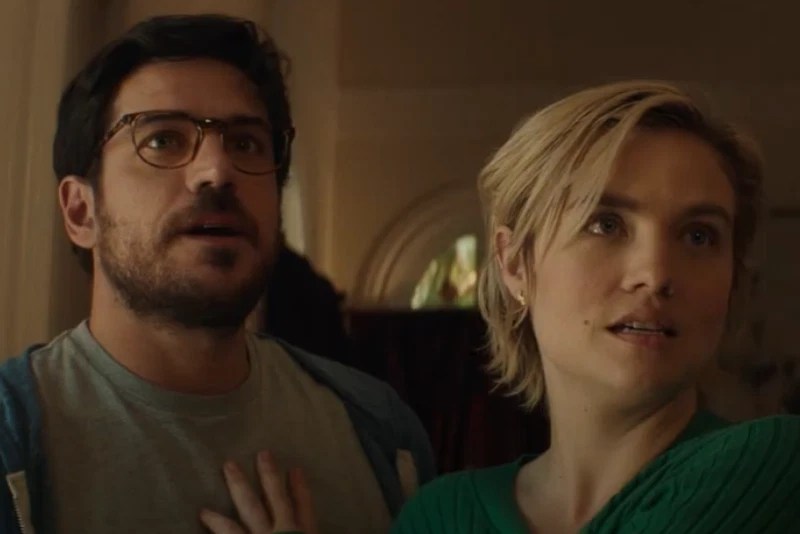
Sage and Diego are a professional couple heading for a luxury weekend in the country. Diego (Marco Pigossi) teaches creative writing at a community college but wants to write a novel. Sage (Maddie Hasson) is a freelance journalist known for her provocative features about sex toys. They are at a turning point in their relationship. Sage has agreed to take a desk job — an editing position —  so Diego can pursue his dream for a year. And unbeknownst to her, he plans to propose to her, with his late grandmother’s ring. But when they get there, The BnB they rented is far from the rustic cabin they expected. It’s an enormous, elegant mansion on a huge lot overlooking a lake. It seems way too fancy for what they payed, but they decide not to look a gift horse in the mouth. They settle quite nicely in their new digs. Until another couple shows up claiming they rented the house for the weekend, too!

Sage and Diego decide  to go with the flow, and let them share the place — it’s a huge mansion, remember. And the other couple happens to be younger, better-looking and scantily dressed. The appropriately-named Cin, short for Cinnamon (Andra Nechita), looks like a model, and so does her boyfriend, Will (Alex Roe). While Sage and Diego are looking for some alone time, Can and Will prefer games, both sexual and psychological. Together they explore the locked rooms in the house, one quite sexual, another occult. Cin and Will proceed to ingratiate themselves into Sage and Diego’s lives, splitting them apart for intimate talks… and possible seductions. But as the games turn serious, no one knows who to trust. Who is behind this weird house, and what do they want?

Bone Lake is a psychological thriller about the relations between two couples in an isolated house in the woods. What starts out as a sex comedy, gradually shifts into a violent thriller/horror. There are hints from the start — the opening scene involves a naked couple pursued by unknown assailants carrying crossbows — but it’s left ambiguous whether it’s just a scene from Diego’s novel or an actual event within the movie. While not entirely original, there’s more than enough enough sex and violence to keep you interested. The acting’s good and the tension is palpable.

All in all, Bone Lake is pretty good horror.

Anemone and Bone Lake both open this weekend in Toronto; check your local listings. And Queen of Bones is now available digitally and on demand.

This is Daniel Garber at the Movies, each Saturday morning, on CIUT 89.5 FM and on my website culturalmining.com.

Pleasant danger. Films reviewed: How to Train a Dragon, The Life of Chuck PLUS TJFF!

Posted in 1940s, 1960s, Dragons, Fairytales, Fantasy, Finland, France, Kids by CulturalMining.com on June 14, 2025

Hi, this is Daniel Garber at the Movies for culturalmining.com and CIUT 89.5 FM.

As the days get longer and the skies get warmer, people want to go out and have fun, looking for an enjoyable night out. So this week, I’m looking at two new entertaining, feel-good movies, that at first glance seem to be just the opposite. One’s about horrible monsters terrorizing a small island, the other’s about the end of the world. 

But before that, let me tell you about a few movies playing at the Toronto Jewish Film Festival showing movies from around the world through this weekend, and digitally until June 18th.

TJFF, 2025

The festival opened with Once Upon My Mother, (Ma Mere, Dieu et Sylvie Vartan), bilingual-Canadian director Ken Scott’s (review: Starbuck) humorous look at the memoir of Roland Perez, a renowned Parisian attorney and writer. He’s the 6th child in a crowded family of Moroccan immigrants born with a clubfoot in 1963, but whose driven mother, Esther (wonderfully played by Leïla Bekhti), refuses to accept it. She — and will power alone  — will make him walk, no, dance!, as if there were no physical problems standing in his way. These efforts are all done to the tunes of pop singer Sylvie Vartan on his sisters’ record player, as he struggles to learn to read.

This is a charming and quirky family comedy.

In The Other, documentarian Joy Sela attempts the impossible: to film people from two sides of an intractable conflict — that of Israel and Palestine — talking frankly with each other. Ordinary Israelis, and Palestinians from the West Bank, East Jerusalem, Gaza and those from Israel proper, voluntarily getting together. People on both sides of this polarizing conflict, whose families or friends have been killed, kidnapped, jailed or persecuted, attempt to share personal photos and stories, and actually get to know “The Other”. While most of the film was shot before the enormities of the current Gaza war took place, it’s still important in that it holds out the hope of peace and understanding, and the end of this brutal war and the events and conditions that led up to it.

Never Alone (by Finnish director Klaus Härö) is a true story set in Helsinki in 1942, where an outspoken, prominent businessman, Abraham Stiller (Ville Virtanen), comes to the rescue of a group of Jewish refugees who arrive by ship from Austria. And soon after, Stiller has a noisy run-in in his store with a random man who loudly opposes the presence of refugees. What he doesn’t realize is he has picked a fight with Arno Anthoni, a Nazi collaborator and the head of the Finnish State Police. The movie has a noir-ish feel, full of secret papers, clandestine backroom deals, and shadowy prison cells. Never Alone is a tense, historical drama that looks at Finland’s somewhat spotty record in the first half of WWII.

How to Train Your Dragon

Co-Wri/Dir: Dean DeBlois

It’s the middle ages on a remote, mountainous island populated by a multicultural Viking consortium. They speak with Scottish brogues and wear pointy horns on their helmets. Their biggest problem? Dragons — of every shape and form —  who steal their sheep and wreak havoc. Stoic, the island’s ridiculously bearded chieftain (Gerard Butler) leads them repeatedly into dangerous battles with these fire-breathing monsters, in the hope of someday discovering their lair, and killing them all. But young Hiccup (Mason Thames), an inventive, non-conformist, doesn’t want to kill dragons. He’s a lover, not a fighter, and has a major crush on the young swordswoman Astrid (Nico Parker).  When he discovers a disabled Night Fury dragon that he names Toothless, Hiccup fashions a prosthesis so he can fly again. He trains Toothless to fill a space somewhere between rival, best friend and pet. And by closely observing his strengths and foibles Hiccup learns all the dragons’s secrets. But his dad — the Chieftain — enrols him in a gladiator-like training camp, full of ambitious viking wannabes — like Snotlout, Fishlegs, Ruffnut and Tuffnut,—  to teach him to kill the beasts, including his secret best friend. Are dragons the dreaded enemies of the Vikings, or are they just big misunderstood puppy dogs?

If “How to Train Your Dragon” sounds familiar, it’s because it’s a live action remake of the hit 2010 3-D animated kids’ movie by the same name. (And in the same vein, this review is largely the same as the one I wrote 15 years ago. If they can do it, so can I) But I was a bit trepidacious about what they might do to the cartoon version which I really liked. Well no need to worry. It’s similar but not identical. The animated version is funnier and goofier. I like the new costumes, especially the furry mukluks they all wear. Part of the cast — like Gerard Butler —  are back again, and the newbies, especially Mason Thames, with his cartoon-like features, fit their parts fine. But as I watched this one on the big screen, I was blown away by the spectacular mid air flying scenes, where Hiccup rides through the skies on Toothless’s back. I don’t remember that from the first one. When I looked at my old review, there it was. The “…effects were great…with a lot of breathtaking scenes and battles, and a good amount of suspense. At times it felt like being part of a good video game – weaving between rock formations, through the clouds, under the northern lights – and I mean that as a compliment.”

This may be a kids’ movie, but I totally enjoyed watching How to Train Your Dragon all over again.

The Life of Chuck

Co-Wri/Dir: Mike Flanagan

Marty (Chiwetel Ejiofor) is a school teacher in a bucolic small town… who feels a bit strange. Things aren’t functioning like they used do. Everyday people and buildings disappear, even as the stars in the sky fizzle out, one by one. The one thing that is working are posters, billboards, skywriters and flashy ads everywhere celebrating an unknown man named Chuck. Who is this Chuck? What’s going on? Is this the end of the world? Yes, it is… well, sort of.

But then comes act two.

A well dressed man in a business suit hears a busker playing the drums in a city square in Boston. He begins to dance, first alone, and then with a ginger-haired woman, who, caught up in the excitement, joins him. Here is the ‘Chuck’ Krantz (Tom Hiddleston) we’ve been hearing so much about. Act three fills in the blanks: where Chuck came from (played here as a young man by Jacob Tremblay), why he is so central to this story, and what he represents for this world, and how magic plays a small part.

While The Life of Chuck is ostensibly a film about the end of the world as seen through horror-meister Stephen King’s eyes —  the man who brought us The Shining, and Carrie and Misery and Cujo and Pet Semetary —  it’s actually a sweet and gentle revelatory movie that owes more to the poems of Walt Whitman than to any ghosts or vampires.

I have to admit, I’m no fan of Tom Hiddleston I didn’t like him in the Hank Williams biopic, or as Loki in the Thor Movies.  But he is perfect in this movie about Chuck. So if you’re in the mood for a really nice, inspiring, easy-to-watch movie with lots of semi-profundities, you should see the uncategorizable and always surprising Life of Chuck.

I really liked this one.

How TO Train Your Dragon and The Life of Chuck open this weekend in Toronto; check your local listings. Never Alone, The Other and Ma Mere, Dieu et Sylvie Vartan. Are among many films playing at TJFF in person and digitally.

This is Daniel Garber at the Movies, each Saturday morning, on CIUT 89.5 FM and on my website culturalmining.com.

Blockbusters. Movies reviewed: Gladiator II, Wicked, PLUS Scared Sh*tless at #BITS

Posted in Fairytales, Family, Horror, Magic, Musical, Romance, Rome, Toronto by CulturalMining.com on November 23, 2024

Hi, this is Daniel Garber at the Movies for culturalmining.com and CIUT 89.5 FM.

What’s a blockbuster? Apparently they were named after the American bombs in WWII that were so powerful they could flatten a city block. And as winter holidays approach, the big studios are releasing potential blockbusters; real movies not just Disney, Marvel and Star Wars drivel. Two new movies, Wicked and Gladiator II, open this weekend perhaps in an attempt to duplicate the way Barbie and Oppenheimer drew crowds into theatres. If they’re both hits, I wonder what people will call them? Wick-iator? Gladwick? Who knows? (Since recording, “Glicked” has become the word of choice.) This week I’m looking at those two big-budget Hollywood films: swords and sandals in ancient Rome and songs and dances in the land of Oz. But before that, for something completely different, a low-budget horror comedy about Toronto toilets.

Scared Shitless

Dir: Vivieno Caldinelli

Sonny (Daniel Doheny) is a depressed college drop out. Since his mom died of an unspecified infection, he’s suffered from a pathological fear of germs. He relentlessly washes his hands after touching almost anything and is always armed with small plastic bottles of Pepto-Bismol to keep himself from being sick. He lives with his dad, Don Donahue (Steven Ogg), the owner and sole employee of Donahue plumbing. Unlike Sonny, Don has no qualms about getting his hands dirty — it’s part of his job. So he decides to take a leap, and bring his germaphobic, OCD son with him on his next assignment. Maybe the shock of plumbing will pull him out of his stupor.

Luckily, it’s an easy one. Old Mrs Applebaum (Marcia Bennett) calls him almost weekly to help with a dripping faucet or a backed up toilet. “I think she just likes the company” he says. Sonny gets the dry heaves from look at a toilet, never mind touching one. But he agrees to do it. Meanwhile, all is not well at the Palmer Estates,  that low-rise 1960s apartment building with questionable plumbing. Turns out, one of the tenants is a mad scientist who has created an apocalyptic monster, which is living within the building’s pipes. (The biologist is played by Kids in the Hall’s Mark McKinney channelling Captain Kangaroo). The beast is shaped like a giant fleshy tadpole, but with four lethal appendages dangling out of its razor sharp gullet, big enough to bite off your head or your nether regions. 

And when blood starts appearing in the toilets, Sonny realizes this is bigger than he thought. He turns to the building’s superintendent to call 911. But Patricia, the super, (Chelsea Clark) who coincidentally was Sonny’s classmate at university, refuses to call. The building belongs to her parents, and she doesn’t like any bad PR. So the two of them — and his Dad — bravely set off to find the trouble before it gets any worse. But are they two late?

Scared Shitless is a crude and funny comedy/horror movie about a monster who lives in your toilet. Since it takes place in an apartment, you get to meet all sorts of weird and kinky characters, like an elderly couple into S&M role play. I think it’s trying more for the funny than the scary, and that’s fine with me. It’s also very much a Toronto movie, with both the main actors and the supporting ones — including perennial horror favourite Julian Richings — are recognizable as locals. Ogg, Doheney and Clark are all fun in their roles, as is the monster, known as Project X. It’s the creation of the legendary Steven Kostanski  who previously brought us Manborg and Psycho Goreman. So if you’re the kind of person who keeps copies of Fangoria hidden under your bed, you will love Scared Shitless. 

Paul Mescal plays Lucius in Gladiator II from Paramount Pictures.

Gladiator II

Dir: Ridley Scott

It’s the early 200s in ancient Rome. Lucius (Paul Mescal) is a gladiator preparing for a fight in the coliseum. But he’s not there for the coins he might win or the chance of buying his freedom in the future. He wants revenge and he wants it now. He’s a slave,  captured after a battle in Numidia where his wife was killed. And he blames Marcus Acacius (Pedro Pascal), a much-admired  general. Lucius was discovered by entrepreneur and kingmaker Macrinus (Denzel Washington) who thought he noticed rage in Lucius face — just what a great fighter needs. But others are interested in Lucius too. The crowds cheer for him, the Senators scheme for him, and the two emperors Geta (Joseph Quinn) and his brother Caracalla (Fred Hechinger) have ideas of their own. But it’s Lucilla (Connie Nielsen) — a major character in the first Gladiator movie — who has personal reasons for him to stay alive. Who is Lucius? Why is he so important? And will he get the revenge he seeks?

Denzel Washington plays Macrinus in Gladiator II from Paramount Pictures.


Gladiator is an epic action drama set within a decadent ancient Rome, complete with senators, citizens plebes, gladiators, slaves and the Pretorian Guard. I have a low bar when it comes to action movies; as long as they have good fights and chase scenes, it’s acceptable. This one has so much more: a compelling plot with unexpected twists, great characters and excellent acting. Paul Mescal plays the driven gladiator as a classic hero on a quest. Denzel Washington is nicely

Pedro Pascal plays General Acacius in Gladiator II from Paramount Pictures.

slippery, and Pedro Pascal is truly majestic as the military hero. The cast is rounded out by Derek Jacobi — who brought ancient Rome to a generation as I,Claudius — and Little Britain’s Matt Lucas as the MC. There are even quotes from Virgil in the dialogue — not your usual action movie fare. Gladiator II is not perfect. There was no romance or love aside from filial piety.  I thought the CGI animals — especially a vicious troupe of man-eating monkeys — was ridiculously fake. And though it harkens back to the sword and sandal flics of the 50s and 60s, Gladiator is no Spartacus, and Ridley Scott ain’t Stanley Kubrick. But Scott still knows how to craft a totally watchable, old-skool Hollywood drama like almost nobody else.

What can I say? I had a great time watching Gladiator II.

Wicked

Dir: Jon M. Chu

It’s the land of Oz. Elphaba (Cynthia Erivo) is a new student at Shiz, an exclusive boarding school like Hogwarts but without much magic.  Her Dad — the governor of Munchkinland — sent her there to take care of Nessarose, her beloved little sister.  Elphaba doesn’t get along with her roommate, the most popular girl in school. Glinda (Ariana Grande) is everything Elphaba is not. She’s a rich, frivolous, self-centred airhead, who cares more about fashion than thinking. She wears pink frocks, and tosses her blond tresses from side to side, to get whatever she wants.  Elphaba is smart, diligent and pure-hearted. She dresses only in black, so as not to draw attention to herself. Why then is Glinda adored and envied, while Elphaba is mocked and feared?

It’s because of her skin colour; as Kermit the Frog said, it’s not easy being green.

But one person does like her: Madame Morrible (Michelle Yeoh). She believes Elphaba possesses magical powers she just needs to keep them under control. If she does, perhaps the kind and benevolent Wizard of Oz (Jeff Goldblum) may even allow her to visit him in the Emerald City. When Glinda hears this, she decides it’s time to kiss and make up. .. and maybe she’ll get to learn some magic, too?

But their relationship is complicated. Glinda is dating a dashing young prince (Jonathan Bailey) who seems more intrigued by the green-faced and moody Elphaba than by her. And Dr. Dillamond, their history teacher, is a goat. Animals once were equal to humans, but not any more. While Glinda is indifferent to their plight, Elphaba thinks the animals must be respected and protected. With all these ideas whirling around Elphaba’s head, what will happen next? Is Glinda her friend or her rival? And will she ever get to meet the Wizard of Oz?

Wicked is a spectacular musical about the origin of a misunderstood young girl who later becomes known as the wicked witch of the West. It’s a whopping 2:45 long, but you wouldn’t know it; it whizzes by at a very fast pace. Even so, it’s only part one of a two-part saga. It’s based on a broadway musical, which was adapted from the novel Wicked by Gregory Maguire , which in turn was a riff on the movie The Wizard of Oz and the L Frank Baum books. Apparently, the musical was a huge hit and has a fanatical following — at my screening there were people in at my screening loudly applauding after every great solo. And I bet they also liked a scene where Kristin Chenoweth and Idina Menzel — who starred in the original stage production — sing a duet, sort of a play within a play.

But I went in an absolute beginner, knowing nothing about it. Didn’t matter.

Wicked is an excellent movie.  It’s all shot on a set, but is cinematic, not theatrical. There’s seamless editing, great acting, and impressive art direction. Dozens of professional dancers twist and leap across the stage.  Cynthia Erivo is a powerful singer whose Elphaba is nicely empathetic.  We can feel her. She’s amazing. Ariana Grande may be a pop star but she shows genuine talent here: a skilled actor with a beautiful voice.

I am not a devotee of Broadway musicals, but I really enjoyed Wicked.

Wicked and Gladiator II open this weekend in Toronto; check your local listings. And Scared Shitless is playing tonight (November 23) at 9:30 pm, as part of B.I.T.S. Canadian horror festival.

This is Daniel Garber at the Movies, each Saturday morning, on CIUT 89.5 FM and on my website culturalmining.com.

Parents and their children. Films reviewed: Tuesday, Kidnapped

Posted in 1800s, Courtroom Drama, Death, Denial, Drama, Fairytales, Family, Italy, Politics, Religion, Supernatural, UK by CulturalMining.com on June 15, 2024

Hi, this is Daniel Garber at the Movies for culturalmining.com and CIUT 89.5 FM.

Sunday is Fathers Day, so this week I’m looking at two movies about parents and children. There’s a mother whose daughter is threatened by a big ugly bird, and parents whose son is kidnapped by the Pope.

Tuesday

Wri/Dir: Daina Oniunas-Pusic

Tuesday (Lola Petticrew) is a teenaged girl in London who is dying of an incurable disease. She likes comics and drawing. She spends most of her time in her bedroom with her Nurse Billie (Leah Harvey) or else in the walled garden outside her home, because she is too weak to get around anymore. She only sees her mother at night when she comes home from work. Until a stranger shows up in her life. It’s a huge bird, like a giant parrot, covered in filthy, black feathers. He is death incarnate, and he’s come to take her away by placing his wing over her body. But instead, she asks to talk to him. She helps him clean up, revealing colourful plumage, and she tells him a joke — the first time he’s laughed in centuries. So he lets her live, for now, but she can’t tell anyone about him. Meanwhile Tuesday’s mom Zora (Julia Louis-Dreyfus), has a secret of her own. She quit work a long time ago, to take care of her dying daughter. But she can’t face it; instead she spends all day sitting alone in a nearby park, doing nothing. And she’s been selling off all their possessions to help pay for the nurse. But everything changes when Tuesday tells her about her imaginary friend… and Zora is shocked to find she’s telling the truth. But she refuses to accept her daughter’s death, and takes an extraordinarily drastic step to stop the inevitable from happening. But what will these new changes bring to the family and the world and can Zora ever accept the inevitable loss waiting to happen.

Tuesday is an unusual but strangely moving fantasy about a mother and daughter confronting death. It starts out a bit odd, and gradually turns into a very strange movie indeed. But while it deals with some horrific ideas, it’s not a horror movie. It has supernatural elements, but it’s not meant to be scary. And despite its religious concepts of life and death, it’s not a faith-based movie. What it is is a very moving, mother/daughter drama about death. Julie Louis Dreyfuss, best known for her deadpan comedy in Seinfeld and Veep, plays it straight in this one, and really bares her soul in a deeply moving performance. And Lola Petticrew is equally sympathetic as Tuesday. This is nothing like most movies you see, but very effective nonetheless; come prepared both to laugh and cry.

I really liked this movie.

Kidnapped

Co-Wri/Dir:  Marco Bellocchio

It’s the 1850s in a middle-class neighbourhood in Bologna.  Salomone Mortara (Fausto Russo Alesi) lives with his wife Marianna Padovani Mortara (Barbara Ronchi) and their children. One night there is a banging on their front door: it’s the police demanding an inspection. They want to see Edgardo Mortara, an angelic little boy, number six of eight kids. Local officials are apologetic, but they must hand him over, under the orders of Father Feletti (Fabrizio Gifuni), the local inquisitor. But surely there’s some mistake, they say, what could this little boy have done? He was secretly baptized as a baby by his maid, they say, and no Christian child can be brought up in a Jewish family. Bologna — and much of Italy — was then part of the Papal States, where the government, the police, and the judiciary were all under the direct rule of the Vatican’s representatives and ultimately Pope Pius IX. And despite their vehement  objections and petitions, they whisk the crying child off to Rome. 

He is brought to the House of Catachumens, a special school for converts to be taught the Latin Mass. Little Edgardo (Enea Sala) misses his family terribly but a friend he meets says if you want to go home soon, just cooperate and learn the prayers, you don’t have to believe them. His flabbergasted father and devastated mother are desperately trying to get him out of there, but to no avail. But the story has caught the eye of the international press, making banner headlines in Paris, London and New York. And this makes Pope Pius IX even more steadfast in his beliefs. Will the family all convert to Catholicism to get back their son? Will Pope Pius relent and let him go home again? And who will the little boy choose as his guardians: his Mama and Papa or Il Papa, the Pope himself?

Kidnapped: The Abduction of Edgardo Mortara is an overwhelming drama based on true historic events. Though little-known today, it had a huge affect on world politics, history and, ultimately, the unification of Italy. It takes place in their homes of Bologna, The Roman Ghetto, in courtrooms, on canals, and within the Vatican itself. Its powerful music, lush photography and opulent sets and costumes support the passionate almost melodramatic acting. Barbara Ronchi is fantastic as Mrs Mortara, while Paolo Pierobon as Pope Pius comes across as a creepily salacious Mafia don, cuddling up to his favourite little boy and letting him hide beneath his robes (as he had huddled in his mother’s skirts when first abducted.) It also veers into fantasy within the dreams of various characters, from little Edgardo who dreams of de-crucifying Jesus so he can go home, and the Pope who has nightmares of being forcibly circumcised by a gang of rabbis. Kidnapped is an amazingly powerful  historical drama set within the changing tides of 19th century Europe.

On a personal note, my childhood next door neighbour, Mrs Sharon Stahl, ended up writing her doctoral theological dissertation on this case, so I had head about it many years ago and it’s amazing to finally see it dramatized on the big screen.

Fantastic movie.

Tuesday is now playing at the TIFF Lightbox, and Kidnapped also opened this weekend; check your local listings. 

This is Daniel Garber at the Movies, each Saturday morning, on CIUT 89.5 FM and on my website culturalmining.com.

Three Women. Films reviewed: Immaculate, Exhuma, The Queen of my Dreams

Posted in 1970s, 1980s, 1990s, Canada, Catholicism, Coming of Age, Death, Drama, Fairytales, Horror, Italy, Korea, Pakistan, Supernatural, Thriller by CulturalMining.com on March 23, 2024

Hi, this is Daniel Garber at the Movies for culturalmining.com and CIUT 89.5 FM.

This week, I’m looking at three new movies about three distinct women from three different religions. There’s a nun fighting for her life in Italy, a shaman fighting demons in Korea, and a Canadian woman fighting with her Mom in Karachi.

Immaculate

Dir:  Michael Mohan

Sister Cecilia (Sydney Sweeney) is a novice at a convent in Italy. It’s an ancient edifice dating back hundreds of years, with an airy courtyard  surrounded by lovely white pillars, and situated amongst Italy’s rolling hills. She has just arrived from Michigan, but is already taking her vows of chastity, poverty and obedience. She was invited to join the convent by Father Sal Tedeschi (Álvaro Morte) a former scientist who, like Cecilia, had a calling. Her job? To tend to the sick and dying, mainly older nuns who have lived their entire lives within their stone walls. There is little privacy there, especially for novices. Anyone can wander into their rooms, day or night.

But something strange is going on. When she touches a relic of the true cross, she faints. She wakes up days later with few memories of what happened. She goes to confession but her priest seems to fade away inside the booth. And one morning she throws up in the shared baths. Could that be morning sickness? Could she be pregnant? Bishops and doctors examine her closely: she is still a virgin. Which makes this an immaculate conception! It’s a miracle! It’s the second coming! Soon people are gazing at her in awe, reaching out to touch her face. But this is not why Cecilia took her vows. She doesn’t trust the convent’s doctor — who just happens to be an obstetrician in a convent full of nuns. And then there are the frightening sisters who cover their faces in masques of red gauze to carry out enforcement. When her only friend, Sister Gwen (Benedetta Porcaroli) disappears, Cecilia realizes she has get out of this place — or this nun will be done. But how can she escape?

Immaculate is a thriller/horror about an innocent young woman trapped in an Italian house of by some religious fanatics. But for a movie about a nunnery there sure are a lot of breasts on display… draped in damp white diaphanous gowns in the baths or partly exposed late at night. That’s half of this exploitation movie: soft-core porn. The other half, though, is extreme, bloody violence and sadistic torture — what I call “gorno”: Disgusting, extended violence you’re forced to watch for its titillating effect. This leaves the movie both ridiculous and over the top, and more gross than scary, in the manner of an Italian Giallo movie from the 70s… but without any camp.

That said, I actually liked Sydney Sweeney as the innocent woman who fights back. And while this is clearly a B movie, it does end on a suitably shocking note. 

Exhuma

Wri/Dir: Jang Jae-hyun

Hwarim (Kim Go-eun) is a young Korean woman on a Japanese flight to LA. She’s going there to investigate a client from a filthy-rich Korean family that suffers from strange dreams and illnesses. Not just the man himself, but his new born baby, and other relatives. She’s a shaman, travelling with her coworker Bong-Gil a heavily-tattooed, former baseball player (Lee Do-hyun) who can see visions and dreams. They determine evil forces are at work here, and call for an exhumation of a distant ancestor’s grave to rectify some unknown problem. The family agrees and pays them a hefty salary to make it work. Back in Korea, they turn to Kim a geomancer (Choi Min-sik) and his assistant. He knows about how Yin and Yang, Feng Shui and the Five Elements all must be correctly aligned to make for a peaceful grave. But the grave they find is anything but peaceful. The coffin is buried beneath an unmarked tombstone, on a distant hilltop near North Korea, reachable only through a chain-locked road where no one ever goes. It’s home to a skulk of foxes and a pit of snakes. And despite their lengthy shamanic rituals, somehow an ancient evil spirit escapes from the grave wreaking havoc on everyone nearby. It’s not just a ghost that says “boo”; it takes on a physical form, looking for humans as his slaves, to feed him sweet melons and mincemeat. And woe be to him or her who disobeys. Human livers taste just as good. Can these four brave souls defeat a dark evil from a rich family’s hidden past?

Exhuma is a supernatural horror/thriller about a fight against the deep, dark mysteries from Korea’s history (including references to their brutal occupation under Imperial Japan). The film is done in an interesting way, incorporating actual shamanic rituals into the story. In one scene, to the sound of pounding drums, Hwarim  does an extended ecstatic dance around the bodies of four hogs impaled on skewers. Not the sort of thing you usually see in a horror movie.

Exhuma was a huge hit in Korea when it was released there a month ago, and I’m not at all surprised. 

I like this one.

The Queen of My Dreams

Wri/Dir: Fawzia Mirza

It’s 1999 in Toronto. Azra (Amrit Kaur) is an aspiring actress with a steady girlfriend. She has been on bad terms with her mother Mariam (Nimra Bucha: Polite Society) since she was caught playing spin the bottle with a girl at her teenage birthday party. But she still communicates with her friendly Dad (Hamza Haq: Transplant) a doctor. The one thing Azra has in common with her mother is their obsession with an old Bollywood movie starring Sharmila Tagore. But when her Dad suddenly dies on a visit to Karachi, Pakistan, Azra and her brother must fly there for the funeral. This sets off a series of revealing memories both from Azra and Mariam. Suddenly we’re transported back to 1969, when Mariam is a totally different person and Karachi a swinging city, filled with bars, discos, VW bugs and Beatlemania.

Mariam is a rebel who rejects her parents’ arranged marriages when she falls for her future husband. Then we’re in Sydney, Nova Scotia, in 1989. Young Azra (wonderfully played by Ayana Manji) joins her mom’s work as a Tupperware lady. These scenes are a coming of age replete with a moustache on her upper lip, her first dance with a boy, and being excused from class during Christian prayers. But can the 1999 mother and daughter reconcile with their pasts in 1989 Nova Scotia and 1969 Karachi and learn to love each other again?

The Queen of my Dreams is a wonderful family drama that deftly weaves three eras and three generations across two continents. It deals with religion and sexuality, rules that are made to be broken and others that are upheld. I don’t know if this film is autobiographical or not, but it really rings true. Amrit Kaur plays both the adult Azra and a younger version of Mariam, while Hamza Haq plays the Dad both in youth and middle age. Not just that: Nimra Bucha (Mariam) and Kaur in their daydreams are both transformed into the main character in their favourite Bollywood film. Sounds really complicated, right? It’s not! It’s totally accessible and understandable with wonderful realistic characters, funny lines and deeply moving dialogue. The production design deserves a special mention. The ’60s scenes use traditional film to perfectly capture the look of Kodacolor movies from the period, through costumes, hair, locations, cars — and especially its cinematography. And on top of everything else, this is Fawzia Mirza first feature film. 

I’ve seen The Queen of my Dreams twice now and I still love it. 

Exhuma opens at the TIFF Lightnox; Immaculate, and The Queen of My Dreams also playing this weekend in Toronto; check your local listings.

This is Daniel Garber at the Movies, each Saturday morning, on CIUT 89.5 FM and on my website culturalmining.com.

Outcastes. Films reviewed: The Childe, Nimona

Posted in Action, Animation, Fairytales, Korea, LGBT, Medieval, Monsters, Philippines, Thailand, Thriller by CulturalMining.com on July 1, 2023

Hi, this is Daniel Garber at the Movies for culturalmining.com and CIUT 89.5 FM.

It’s the Canada Day long weekend — what better time is there to catch up on some movies? You might want to make time for a fascinating new documentary called Making Time about some rebellious and original horologists, people who literally make time.

But this week I’m looking at two new movies — an action thriller, and an animated fairy tale — about outcastes, and how we can embrace differences. There’s a mixed-race man who discovers his dad is a millionaire… and a commoner accused of murdering a queen!

The Childe

Wri/Dir: Park Hoon-jung

Marco (Kang Tae-Ju) is an impoverished young man in the Philippines who lives with his ailing mother. He’s an amateur boxer saving as much money as he can to pay for her operation, but it’s never enough. So when a strange man shows up representing a wealthy client in Seoul, Korea, his ears perk up. The man offers to pay for the surgery and then some; in return, Marco would have to fly to Seoul immediately to meet the client. Why him? Because the millionaire is Marco’s dad and he wants to meet his son before he dies. Now people call Marco a “Kopino” — his biological father (who he’s never met) is Korean and his mom Filipina. She insisted he study English and Korean when he was growing up, so he’ll be able to communicate with him when he gets there. 

So off he flies to Korea, first class, but he finds the people he meets are not particularly friendly. Not just unfriendly, but outright abusive, calling him a mutt — and worse — because of his mixed background. Which quickly turns to actual danger — some people are trying to kill him. There’s a sadistic and sinister young man (Kim Seon-ho) who constantly chews gum and sips coca-cola as he brags about his expensive shoes and car. He tells Marco that he’s his best friend, even as he kidnaps him (some friend). Then there’s a woman named Yun-ju (Go Ara) who clearly wants him gone  And his half brother Han (Kim Kang-woo) and half sister each of whom have evil plans of their own all involving Marco. What’s so special about him? What do they want from him? And why do some of them want him dead?

The Childe is a very fast- moving action-thriller shot in SE Asia and Korea. Lots of fights, excellent chase scenes and plot twists. Although quite violent, most of it takes okay off-camera, giving the film a lighter tone. Kim Seon-ho is sufficiently creepy to be humorous, and Kang Tae-Ju is just right as the hapless hero. And — no spoilers —  I did not guess the big revelation near the end. Nothing deep here — The Childe is an action movie, after all — but it is totally watchable.

Nimona

Dir: Nick Bruno, Troy Quane 

(Based on the graphic novel by ND Stevenson)

Picture a medieval town with modern technology. That’s where 

Ballister Boldheart lives.. It’s a walled city — to keep out monsters — with a castle, a benevolent queen and knights in shining armour. But it’s also a place with flying cars, cel phones and video cameras. Ballister is a knight himself, or about to become one. The queen has declared henceforth that a commoner like Ballister, not just royalty, can become a knight. This is a historic occasion, and he — along his boyfriend, Ambrosius Goldenloin, a knight himself — are overjoyed at this upcoming change. Until something terrible happens in front of thousands of onlookers. While handing his sword to the queen, a laser beam shoots out of it, killing her on the spot. And this is done in front of the horrified face of his lover who sees it all. Next thing you know, he goes from noble hero to public enemy #1, and is thrown into the dungeon. 

That’s where he meets a punky and spunky young girl dressed in pink named Nimona. She wants to work for Ballister as his henchman. She likes killing people and blowing things up, and who better to do it with than an arch-villain like him. But when he explains he’s innocent, she says she’ll work for him anyway. But what can a little girl do that a knight like Ballister cannot? A whole lot, it turns out. She has special powers that let her turn into a rhinoceros, a mouse, a gorilla or a whale in a moment’s notice. The little girl is just one of her identities. Can they escape from the prison, clear his good name, find the killer, and win back his boyfriend? Or will he languish behind bars to the bitter end?

Nimona is a very cute animated fairy tale with science fiction and fantasy elements worked in. It’s made in a traditional style, but frequently shifts to other designs for flashbacks and origin stories woven throughout — love the art direction. (The killing of the queen is strangely close to Alec Baldwin’s tragic shooting on a movie set immediately after being handed a weapon, but I’m pretty sure this was made before the real-life incident happened.)

Riz Ahmed plays the voice of Ballister, with Chloe Grace Moretz as Nimona — two actors who always seem to choose just the right movies to appear in (this is another one). Nothing earth-shattering about this one — it’s basically for kids or families — but it is fun, exciting and quite touching in parts. Ballister and Ambrosius happen to be gay, but it’s not central to the plot, any more than Ballister’s brown skin. So if you’re looking for something fun that also has a message and is very well made, check out Nimona.

The Childe opens theatrically this weekend in Toronto; check your local listings; and Nimona is now streaming on Netflix.

This is Daniel Garber at the Movies, each Saturday morning, on CIUT 89.5 FM and on my website, culturalmining.com.

Current cinema. Films reviewed: Babysitter, A Thousand and One, Dungeons & Dragons: Honor Among Thieves

Posted in 1990s, Black, Breasts, comedy, Fairytales, Family, Fantasy, Games, Harlem, Magic, Medieval, Quebec, Racism, Sex, Sexual Harassment by CulturalMining.com on April 1, 2023

Hi, this is Daniel Garber at the Movies for culturalmining.com and CIUT 89.5 FM.

This week, I’m looking at three new movies, a drama, an adventure-comedy and a sex-comedy.  There’s a gang of thieves in the Middle Ages, a middle-aged couple in Québec with a seductive nanny, and a mom in Harlem with an undocumented son.

Babysitter

Wri/Dir: Monia Chokri

Cédric (Patrick Hivon) is a middle-class guy in a Montreal suburb, with an obsession with women’s breasts. He’s happily married with a newborn daughter but his sex life has completely dried up. Maybe that’s why, in a drunken stupor at a UFC fight, he throws himself at a sportscaster on live TV and kisses her. His immortal words Je t’aime Chantal! went viral, and made Cédric famous, but not in a good way. Now he’s on extended leave as the company investigates his sexual harassment. But with a colicky baby, neither he nor his wife on maternity leave Nadine (Monia Chokri) are getting any sleep: the baby never stops crying. So they hire a nanny named Amy (Nadia Tereszkiewicz) to take over some of the pressures of parenthood. And she has a magic touch with the baby, calming her down in an instant.

Amy is 22 years old with beautiful blonde hair and scarlet lips. She is both innocent and seductive. And soon enough she has Nadine and Cédric under her thumb, with Jean-Michel, Cedric’s brother (Steve Laplante) close behind. But when she shows up the next day in a semi-pornographic “French maid” costume — compete with short skirt, white stockings and high heels — the three of them don’t whether to faint or explode. Will Amy save their marriage by releasing tension, or has she gone too far? Will Cédric ever learn from his misogynistic behaviour? Will Jean-Michel ever get a hold of himself? And why does Amy act like she does?

Babysitter is a funny and campy Québecois sex comedy. It’s done in the classic manner of French and Italian movies from the 60s where the arrival of an unexpected visitor disrupts a whole family, but updated for the “#MeToo” generation. It’s highly stylized done in a retro manner, with bright red colours popping up in every frame, from lipstick to poppies in the garden. And the main characters’ sexual fantasies are played out in soft focus in their heads, like David Hamilton’s softcore porn of the 1970s. There’s even a gratuitous scene with a group of teenaged girls in hot pants and roller skates gliding down a suburban street, a new generation thumbing its collective nose at uptight middle age. And while the movie seems to be shown through the male gaze, filmmaker Monia Chokri adds a satirical feminist subtext, keeping it entirely tongue in cheek. 

A Thousand and One

Wri/Dir: A.V. Rockwell

It’s New York City in the early 1990s. Inez (Teyana Taylor) is a young hairdresser, just released from Riker’s. But when she goes back to her old neighbourhood, no one wants to talk to her and she can’t get her old job back. Worst of all, she is heartbroken to see her six-year-old son Terry maltreated by his foster parents. So one day she simply takes him away with her. And after a few weeks of couch surfing, they find a home in an old Harlem tenement, apartment number 1001. To keep them both safe from the law, she gets Terry a new social security number and a new name. He’s shy and rarely speaks but proves to be an excellent student, so much so his teacher helps him transfer to a highly competitive tech school for bright kids. Inez, meanwhile, gets back together with her boyfriend Lucky (William Catlett). Though he makes it clear he is not Terry’s father,  eventually they marry and form a loving family. But life is not easy. They have to deal with an unscrupulous landlord, suspicious teachers and aggressive cops. And always hanging over their heads is the fact they’re living under fake names and could be caught at any minute.

A Thousand and One is a powerful, realistic and moving drama about the life of a family in Harlem in the 1990s and early 2000s. It’s both heartbreaking and inspiring. It traces their lives through changes of government, from Giuliani’s “Broken Windows” policy through Bloomberg’s “Stop and Frisk”, and how it affects Terry as a young Black man. It’s also a coming of age story, with three actors playing Terry at 6, 13 and 17 — Aaron Kingsley Adetola,  Aven Courtney, and  Josiah Cross — as he struggles through his best friend, his first crush, and his fractious relationship with his mother as they face the world. I love the period costumes, hair, locations and music. And Teyana Taylor is just amazing as Inez. 

A Thousand and One is not a light movie, but it’s a good one.

Dungeons & Dragons: Honor Among Thieves

Co-Wri/Dir: John Francis Daley, Jonathan Goldstein

It’s sometime, somewhere far away in a mythical, mystical, medieval kingdom. Edgin and Holga (Chris Pine, Michelle Rodriguez) are former thieves locked up in a remote panopticon prison. They were caught trying to steal a magic totem but were double crossed by one of their gang. But they manage to escape. Now they want to form a new gang to pull off the ultimate heist: a charm that can bring Edgin’s wife back to life and restore his family including his daughter, Kira.  Edgin is the brains, while Holga is the brawn, but they need more. They enlist Simon (Justice Smith) an insecure sorcerer with questionable powers (he earns his living picking pockets at a carnival side show.) Doric (Sophia Lilis) is a ginger-haired druid who can change, in a flash, into any animal she wants, from tiny worm to giant monster. And Xenk (played by Bridgerton heartthrob Regé-Jean Page) — an honest and noble member of an evil clan — agrees to join the heist but only if its for good reasons, not for profit. 

But they must face their former ally Forge a con man (Hugh Grant). Up to now, he has taken care of Edgin’s little girl, but has since crowned himself King in alliance with a nefarious, all-powerful sorceress. To find his daughter, liberate the riches, and defeat the sorceress, the gang must first accomplish a series of nearly-impossible tasks, worthy of Theseus. Can this ragtag gang of miscreants pull it together? Or are they all headed back to prison?

Dungeons and Dragons: Honor among Thieves is a surprisingly entertaining adventure/comedy, based on the role-play board game of the same name. Players will delight in the more obscure references — from Gelatinous Cubes to Owlbears — but ordinary audiences can fully enjoy it without any background. It also incorporates the story-telling aspects of the game, giving the whole film a rich, mythical feel. I went into this movie expecting nothing — previous Dungeons & Dragons incarnations have been dreadful. I shouldn’t have worried about this nerd paradise, seeing its co-written and directed by none other than John Francis Daley, from the TV cult classic Freaks and Geeks (he was a geek, of course). If you like Game of Thrones or Lord of the Rings, but with more laughs and less excessive gore and ponderous speeches, then you’ll love this one.

Dungeons & Dragons: Honour among Thieves and A Thousand and One both open this weekend; check your local listings. Babysitter is playing at the Canadian Film Fest, on now. 

This is Daniel Garber at the Movies, each Saturday morning, on CIUT 89.5 FM and on my website, culturalmining.com.

Talking, listening, fighting back. Films reviewed: No Bears, Puss in Boots, Women Talking

Posted in 2000s, Animals, Animation, Fairytales, Fantasy, Iran, Movies, Religion, Turkey, violence, Women by CulturalMining.com on December 24, 2022

Hi, this is Daniel Garber at the Movies for culturalmining.com and CIUT 89.5 FM.

It’s holiday time with lots of new movies for people of all ages. This week I’m looking at three new movies opening on Christmas weekend. There are women in a barn, talking; a movie director in a village, listening; and a cat in a hat, fighting. 

No Bears

Wri/Dir: Jafar Panahi

Jafar Panahi is an Iranian  filmmaker from Tehran. His current project is about a glamorous middle-aged couple trying to escape to freedom in Europe. But Panahi is forbidden by law from making movies or leaving the country. So he’s doing the next best thing: directing his film in long-distance using his cellphone and laptop. It’s being shot in a picturesque city in Turkey, while he’s renting an apartment in a tiny Azerbaijani village in Iran. It’s close to the border an area rife with black market smugglers. Panahi can speak some Azeri but is unfamiliar with local traditions. So he likes talking pictures of the locals. And here’s where he runs into trouble.

A young couple wants to get married and leave the village. But the woman was promised to another man at birth. Now everyone thinks Panahi caught the young couple in a photograph. The couple want him to destroy the photo, while the groom’s family want a copy to prove her dishonour. Meanwhile, across the border, another crisis is threatening the film movie. As he gets pulled deeper and deeper into the world of local politics and feuds, his work — and possibly his life — is at risk. Will he ever finish his film? And what will happen to the two couples — the actor-lovers in Turkey and secret lovers back home?

No Bears is a neorealist movie about making a film, the film he’s making, and how real life gets in the way. It’s about honour, revenge and identity. It also exposes the image of “the director as a dispassionate observer and documentarian” as a myth. Panahi’s very presence in a small village disrupts their lives and leads to unforeseen consequences. He plays himself, who in real life is forbidden from making films — accused of propaganda against the system. Any movie that’s against the system is one I want to watch. But this means it was shot openly in Turkey but secretly in Iran. No Bears  is a clever, humorous and complex film with an unexpected conclusion. I liked this one.

Puss in Boots: The Last Wish

Co-Dir:  Joel Crawford, Januel Mercado

Puss in Boots is a cat in a hat who wears boots, and carries a sword. He’s known for both his fencing skills and his rapier-like wit. He lives a fairytale life — literally. He exists in a world where those stories are real. He’s both a hero and an outlaw, sought by bounty-hunters everywhere. But as a cat with nine lives he has no fear of death and will fight monsters and villains, alike. Until one day his doctor tells him he’d better slow down because he’s on his last life. If he is killed again, that’s the end, no more Puss in Boots.  So he reluctantly decides  to retire. He gives up his identity, and becomes an ordinary orange cat named Pickles in a home for abandoned cats. Now he has to use a litter box, eat cat chow and say “meow”.  How humiliating! But his past catches up to him with some surprise visitors: Kitty Softpaws, another outlaw he left standing at the altar; and Goldilocks and the Three Bears. They all want him to help find a map to a fallen star that can grant a wish. Goldilocks wants a proper family, Kitty is looking for her future, and Puss in Boots wants his 9 lives back. Accompanied by a little dog named Perro he sets out to steal the map from the evil Little Jack Horner (who is now quite big and bakes pies for living). But he must fight off his rivals, journey through a mystical forest, and find the magic star if he wants to stay alive. And he is being pursued by a truly scary villain, the Big Bad Wolf, a huge killer carrying a sickle in each hand.

Puss in Boots is a kids’ cartoon comedy set in the world of Shrek, where nursery rhymes and fairytales coexist with Alice in Wonderland and the Wizard of Oz. It’s somehow simultaneously a spaghetti western and medieval Europe.  It features the voices of Antonio Banderas, Salma Hayek and Florence Pugh. What’s good about it? I’ll watch any cartoon, especially one with cool psychedelic images. This one has a few funny bits, along with a neat journey-adventure story. On the negative side, it’s not very funny, the lines are predictable and the story is both unoriginal and forgettable. And I’m not sure why they switch to two-dimensional jerky animation whenever there’s a fight scene. But I still enjoyed it, even if it’s just glowing bright colours on a giant screen. 

Women Talking

Dir: Sarah Polley

It’s summertime at an Anabaptist colony somewhere in the US. It’s 2010, but it could be 1910; forget about cel phones and computers. There are no cars, radios, no electric lights — they still use lanterns. Even more unusual, there are no men around, only women and kids. What’s going on?

One of the women woke up in the middle of the night to find a man physically attacking her. She fought him off and beat him with a stick. Suddenly everything made sense. Countless women in the colony had woken up in the past with bruises and blood, but up till now, the men had insisted out was just a dream, her imagination or the work of Satan. Turns out the men have been raping women for years now and denying it, using cow tranquilizers. Now they are at the police station baling out one of their attackers. So all the women face an enormous decision: should they stay and fight back? Or should they just pack up the kids and go, leaving the place forever?

They designate the women and girls from three families to decide for all of them. Now they’re gathered in a barn to debate the issues and make the big decision. And one man, a school teacher named August — not part of the colony; his family was excommunicated  — is there to record it all on paper; the women were never taught to read or write. What will their decision be?

Women Talking is a movie about women talking, but it is much deeper than that. It’s a devastating story, a scathing indictment of endemic physical and sexual violence against women in their own homes. Though it’s never shown on the screen, nor are its perpetrators, its results are always apparent. One woman has a scar on her face, one woman is mysteriously pregnant, others have missing teeth or black eyes, and another has panic attacks, seemingly for no reason. And now they’re really angry, not just for the violence, but because they’ve been lied to for so many years. There’s a spontaneous wellspring of grassroots feminism suddenly bursting loose.

The storytelling is very simple — it sticks to the barn, the fields, their houses and horses and buggies; it’s all they’ve experienced. At the same time, perhaps because they can’t write, they are amazingly eloquent speakers. It’s based on the novel by Canadian author Miriam Toewes who grew up in a Mennonite community. (The film never specifies their denomination or location, giving it a timeless, universal feeling.) It provides an internal view of life in the colony, with different opinions expressed passionately by each character. And it’s very well-acted by an ensemble cast, including Rooney Mara, Jesse Buckley, Claire Foy, Frances McDormand, Sheila McCarthy, Ben Whishaw. And despite the grave topic, the movie itself is more fulfilling than depressing. I’ve seen it twice, and appreciated it much more the second time — Women Talking is a subtle movie that deserves your attention. 

Puss n Boots: The Last Wish, No Bears and Women Talking, all opened this weekend; check your local listings.

This is Daniel Garber at the Movies, each Saturday morning, on CIUT 89.5 FM and on my website, culturalmining.com.

Adapted from plays. Films reviewed: The Whale, Matilda

Posted in College, comedy, Disabilities, Fairytales, Family, Gay, Kids, Musical, School, UK by CulturalMining.com on December 17, 2022

Hi, this is Daniel Garber at the Movies for culturalmining.com and CIUT 89.5 FM.

With holiday season upon us, it’s a time when students and their parents have a chance to take some time off. And if you can’t afford a ticket, there are lots of Christmas movies playing for free at the Hot Docs Cinema at Bloor and Bathurst. So in honour of Christmas break, this week I’m looking at two new movies adapted from plays, with an educational theme. There’s a college professor who is ashamed to show his face to his students, and a little schoolgirl who dares to talk back to her headmistress.

The Whale

Dir: Darren Aronofsky

Charlie (Brendan Fraser) is a college teacher who conducts his classes on his computer. And he never shows his face. He says it’s because he’s technologically inept but the real reason is he weighs 600 pounds and doesn’t want to show himself on camera. He works out of his home, and gets everything delivered to his door. And he’s visited daily by a nurse named Liz  (Hong Chau) who takes care of him, drops off food and keeps him company each day. They’re friends but also share a common history. She constantly warns him that his extreme weight pushes his blood pressure to dangerous levels — he may be dead in a matter of weeks — but Charlie refuses to make any changes to his diet or habits; it’s almost as if he wants to die. 

But his usual life is interrupted by some unexpected visitors. First a stranger, a young Christian missionary named Thomas (Ty Simpkins). Thomas walks through the door uninvited just as Charlie, who is masturbating to gay porn in his living room, has a blood pressure incident. Barely able to speak, he hands Thomas a piece of paper and tells him to read it aloud: it’s an essay on Moby Dick which is the only thing that can calm his racing heart, and possibly save his life. Later, another visitor comes by, a rude and foulmouthed  teenaged girl named Ellie (Sadie Sink). She is his daughter, who he hasn’t seen since he walked out of his marriage a decade earlier. She wants to know why he left her and why he never visits. Can Charlie reconcile with his daughter? How does he know Liz? Why is the missionary there? Why is one bedroom of his home kept permanently locked? And why is he so depressed that he’s committing slow suicide by overeating?

The Whale is an extremely moving drama about a day in the life of an isolated gay man who punishes himself for something from his past. It deals with his extreme physical disabilities;  in his 50s Charlie is less mobile than an old man, but his brain is as sharp as ever. Adapted from his own play by Samuel D. Hunter, it’s told theatrically in a series of acts all within his home, almost as if it were on a stage, with the players entering and exiting in turn. Each character has a history and a secret, eventually revealed, which adds great dramatic tension to the story. And the acting is superb, most of all Brendan Fraser. 

At the same time, the Whale Was clearly made to win prizes. I’ve seen enough movies to know when an actor uses prostheses (Charlie is portrayed wearing a “fat suit”) and plays someone with a disability — whether a mental or physical illness or handicap — you know it’s Oscar bait. The thing is, Fraser is clearly a good actor and has a natural heft to his body, so I don’t think he needed all this extra elaborate makeup and costume. What is disturbing is the degree if Charlie’s self-loathing: he practically begs other people to call him hideous, grotesque and ugly. The thing is, it’s all in his mind. He’s actually a kind and pleasant guy, not the monster he’s trying to be. Don’t confuse the character’s psychology with the point of the film. And aside from a truly gross binging scene, The Whale  is really a beautiful and tender film. 

Matilda

Dir: Matthew Warchus

Matilda Wormwood (Alisha Weir) is a little girl who has never been to school. Her parents consider her a burden, so she lives in a tiny room in the attic, and educates herself at the local mobile library, where the kindly Mrs Phelps (Sindhi Vee) gives her a pile of books to read each day along with sage advice. But everything changes when a truant officer shows up at her door ordering her parents to send her to school. She starts her classes the next day at Crunchem Hall, a scary gothic structure behind a foreboding metal gate. It’s ruled by the cruel Headmistress Agatha Trunchbull (an unrecognizable Emma Thompson), who treats it as somewhere between a boot camp and prison, not a place for fun and games or learning. Her strict rules are enforced by older students who serve as her henchmen. And woe to any student who is caught, or even accused of, disobeying. They might have their ears stretched, or their pigtails pulled by Miss Trunchbull herself. Or worst of all, they could be sent to The Chokey, a miserable, one-person jail, a dark, wooden shack festooned with chains and locks. No, not the Chokey! Luckily, there is hope.  Her teacher Miss Honey (Lashana Lynch) is as kind as the Headmistress is cruel. She quickly recognizes Matilda’s genius, and takes her under her wing. But the headmistresses is out to get her: she vows to break Matilda’s spirit and put her in her place. Will Matilda defy the Headmistress? And can she she outsmart her? Or will she end up in the Chokey?

Matilda is a fantastic kids’ musical, full of catchy songs and dances and a plethora of quirky characters within the huge ensemble cast, in the manner of Oliver! or Annie, but funnier. Based on the book by Roald Dahl, it’s full of Dickensian references but without Victorian morality to weigh it down: Matilda is a naughty girl who gets back at her tormenters with tricks of her own (She turns her father’s hair green and puts crazy glue on his hat brim.) Though it’s a timeless story, the art direction suggest a campy retro 1980s setting. Weir is a good Matilda, and Emma Thompson plays Miss Trunchbull to the hilt as an olympic hammer thrower, an intimidating fascist dictator, bedecked in khaki from head to toe. And Lashana Lynch is very sweet as Miss Honey. There’s also a story within the story, a fairytale about an acrobat and an escapologist; Matilda tells a chapter of that story to the librarian each day, like a modern-day Scheherazade. It’s very English, but with a nicely multi-racial cast. My only criticism is they occasionally get carried away with CGI effects, but not enough to spoil the film.

Kids will adore Matilda: the Musical, and I think grown-ups will too.

The Whale opens next weekend; check your local listings. Matilda is now playing theatrically in Toronto at the TIFF Bell Lightbox, and will start streaming on Netflix on Christmas Day. 

This is Daniel Garber at the Movies, each Saturday morning, on CIUT 89.5 FM and on my website, culturalmining.com.