Dysfunctional Dystopia? Films reviewed: Sentimental Value, The Running Man, Left-Handed Girl
Hi, this is Daniel Garber at the Movies for culturalmining.com and CIUT 89.5 FM.
Still more Fall film festivals coming at you in Toronto, with the EU film fest — free films from each country of the European Union, plus Ukraine — and Ekran, the Polish Film Festival. So much to see, but look out for Agnieszaka Holland’s biopic of Franz Kafka (called Franz) at Ekran.
But this week, I’m looking at three great new movies, one action and two dramas. There’s an estranged family in Oslo; a fugitive on the run in a dystopian America, and a dysfunctional family in Taipei, Taiwan.
Sentimental Value
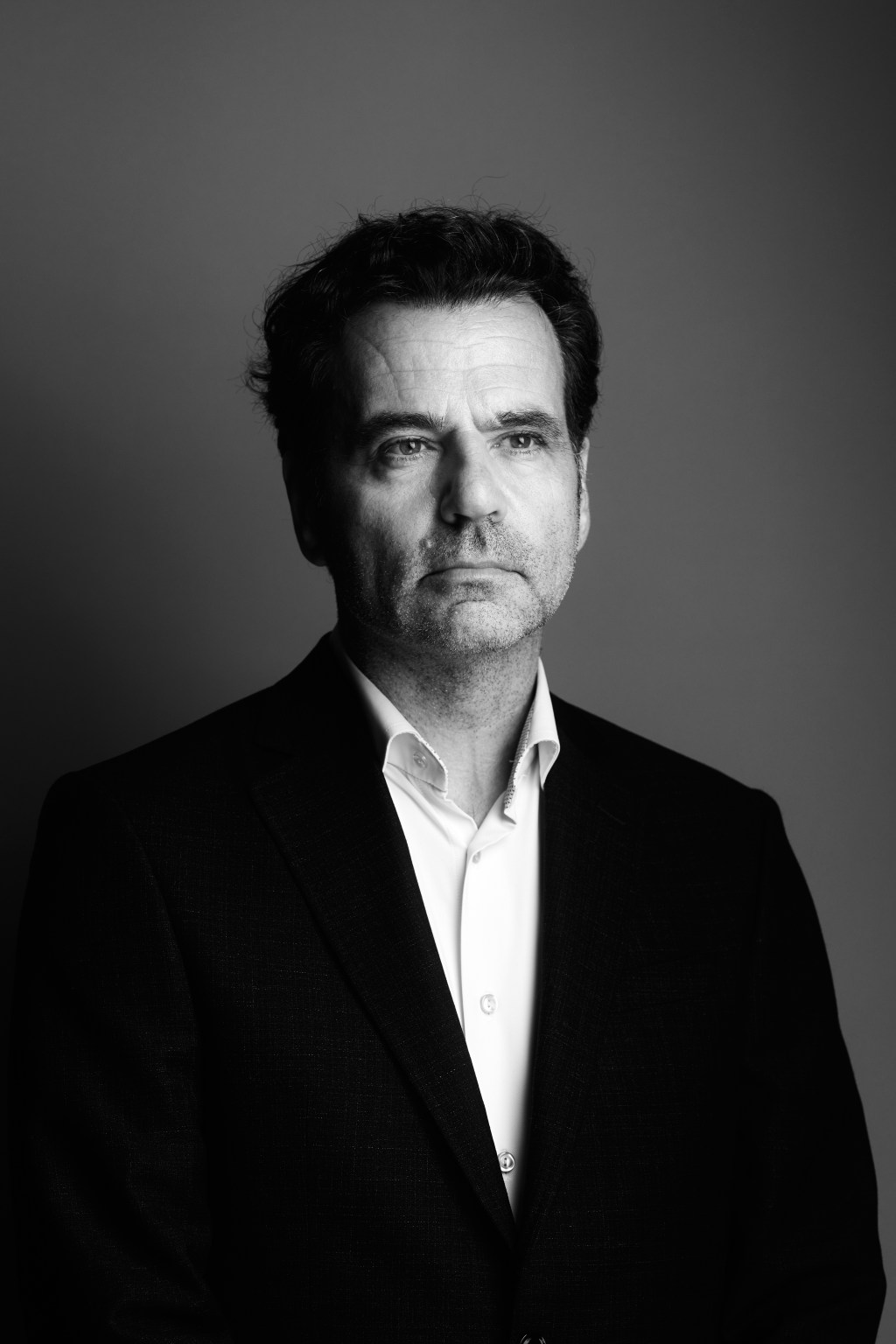
Co-Wri/Dir: Joachim Trier
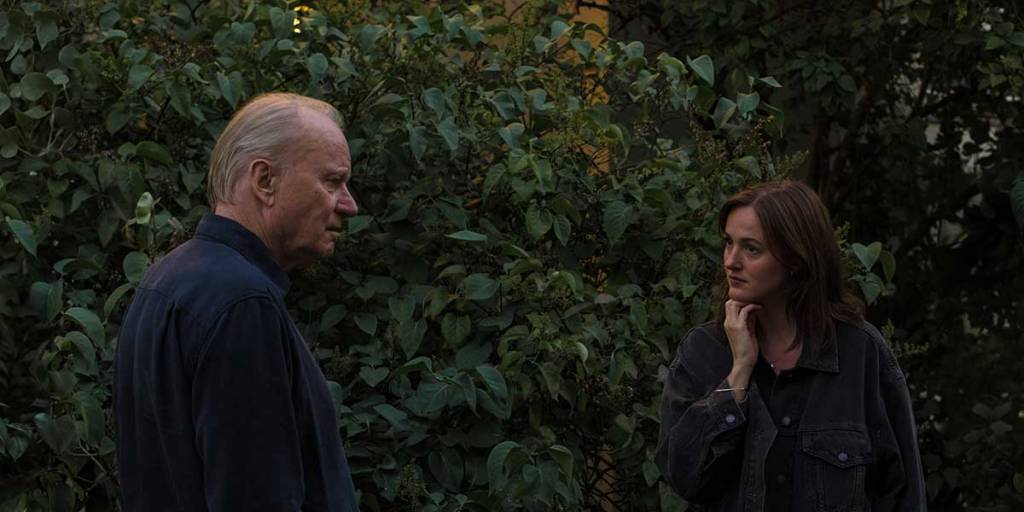
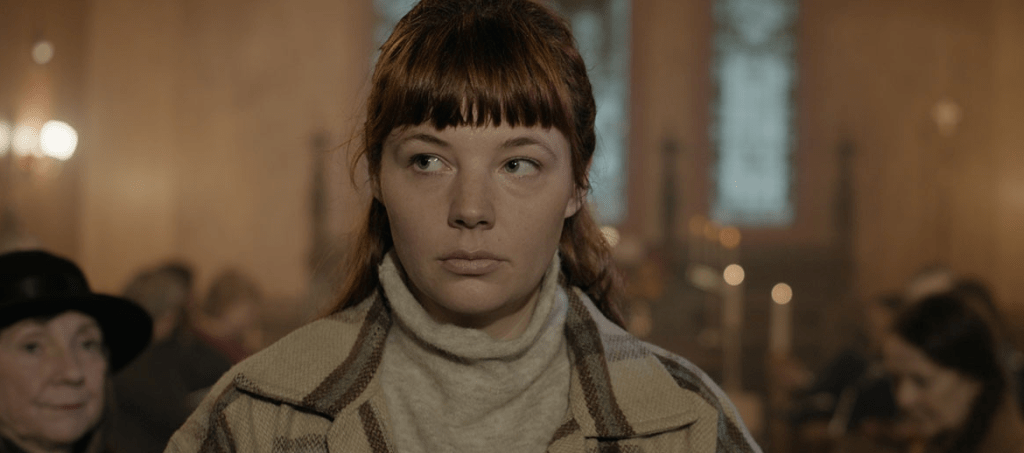
Nora Borg (Renate Reinsve) is a successful stage actress who lives in a grand old house in Oslo. It’s been in her family for generations: it’s where her grandmother killed herself, and where she grew up with her sister Agnes (Inga Ibsdotter Lilleaas) and their mom. Their dad, Gustav, (Stellan Skarsgård) disappeared after their divorce when she was still young, and they haven’t heard much from him in decades. Until now. Their mom just died and she and her sister have to deal with the house and go through all their family’s possessions (that’s the “sentimental value” of the title). And dad owns part of the house, too. But he has a second reason for showing up.
He wants to make a movie there, to use the house as his set. He’s a famous film director, but not in his prime anymore; he hasn’t shot a movie in decades. And he wants Nora in the main role of what is likely his swan song. You’re the only one who can do it, he says, just read the script! Nora refuses; bad blood runs deep. So, partly to get the funding he needs to make the picture, Gustav casts a Hollywood actress to play the role that Nora turned down. Rachel Kemp (Elle Fanning) is a big name, and she’s also a fan of Gustav’s work. What will happen to the house? Will Gustav make his film? And will they ever be on speaking terms again?
Sentimental Value is dramatic comedy about a Norwegian family. It’s full of clever asides and wide-ranging topics, but with a solid core at its centre. What makes Trier such a good director (The Worst Person in the World, Thelma, Oslo August 31st) is he creates believable characters in tough situations but without losing his sense of humour. He constantly plays around with his audience as to what is real and what is
artifice: we see Nora having a deep, emotional breakdown and then discover she’s acting a role on a stage set. He also uses biting satire to get his points across, skewering the superficiality of both Hollywood and bourgeois Norwegian society. He also repeatedly casts from a company of actors in his films. Elle Fanning and Swedish actor Stellan Skarsgård are new, but Renate Reinsve and Anders Danielsen Lie are familiar faces if you’ve ever seen Trier’s movies (and if you haven’t, you should).
Sentimental Value is moving, funny and full of good stuff to think about. I really liked this one.
The Running Man
Co-Wri/Dir: Edgar Wright
Based on a story by Steven King
It’s some point in the not-so-distant future in a dystopian America. A few rich people live luxurious lives, but the majority eke out a precarious existence within the endless sprawl of urban slums. They’re constantly surveilled by cameras, drones and DNA detectors while a brutal paramilitary police force patrols the streets. What keeps the people satisfied? Watching the reality shows and game shows broadcast from a single, big-brother-like monopoly network which controls the government, big business and media.
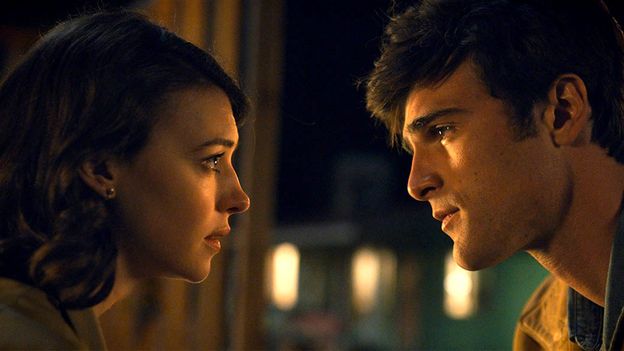
Ben Richards (Glen Powell) is a skilled labourer and union rep. He also has a volatile temper. He points out dangerous problems on the shop floor, which in this world gets you fired. So he’s out of work, his wife depends on tips in a hostess bar, and their 5 year old daughter is dying of an ordinary flu because they can’t afford basic medicine. What to do? There’s only one choice left: compete on THE RUNNING MAN, a reality show where all contestants try to survive for 30 days being hunted by a gang of professional killers. The winner gets a huge cash prize. And the losers pay with their lives. Luckily, the show’s producer, Dan Killian (Josh Brolin) takes a liking to Ben Richards — he’s smart, strong and most of all, angry! And the audience starts to like him… and his messages of rebellion. Can Ben outsmart the powers that be and survive? Or will the Network crush him, like they did with every Runner before him?
The Running Man is a non-stop action movie, with good
acting and an interesting plot. It’s set in the future, but done in a 1980s style, with zines, nerds and gadgets over spacemen and phasers. There are chase scenes using planes, trains and automobiles, and fiery explosions that level a city block. Glen Powell is wonderful in the lead role, appealing and heroic, painted like a Luigi Mangione fighting the corporate super-villain played by a slimy Josh Brolin. Director Edgar Wright — who brought us Toronto’s greatest Scott Pilgrim vs the Universe — keeps it funny and nerdy; he even casts Michael Cera as a nerdy revolutionary.
The Running Man is a lot of fun to watch.
Left-Handed Girl
Co-Wri/Dir: Shih-Ching Tsou
It’s Taipei’s night market, and a small family is moving into a tiny apartment nearby: I-Jing (Nina Ye) a little girl with a wild imagination, I-Ann (Shih-Yuan Ma) a diffident teenager with a chip on her shoulder, and their hardworking mom (Janel Tsai). She’s opening up a noodle stall to pay their basic rent cheque. Dad is nowhere to be seen; he ran off years ago, leaving the family high and dry. I-Jing quickly adjusts to her new kindergarten class and life in the constantly-moving marketplace. She even helps Johnny (Brando Huang) — a huckster with a heart of gold who sells carnival junk to unsuspecting shoppers — by making announcements on his loudspeaker. Mom is constantly busy, cooking and cleaning her stall, but can’t seem to earn a living. She also takes time to visit her ex-husband, now dying of cancer in hospital. Sadly he leaves his
abandoned family nothing but funeral debts and a pet meerkat. And I-Ann — who was once top of her class until she suddenly dropped out — works as a scantily-clad “betel nut beauty” selling smokes and the addictive chewing treat from her boyfriend’s shop.
But things get tense when the kids’ Mom is forced to visit their grandparents to ask for some money to tide them over. Mom’s brother is the golden boy who can do no wrong, and her two sisters both live in nice houses and are unsympathetic about her economic condition. And worst of all is grandpa, who scolds i-Jing for being left handed. He tells her left hand belongs to the devil (which she interprets as having an evil hand over which she has no control.) Now grandma is smuggling migrants through airports, mom faves eviction from the market, I-Ann missed her last period, and tiny I-Jing is turning into an avid shoplifter, using her “devil’s hand” to do the dirty work. Can this dysfunctional family ever pull itself back together?
Left-Handed Girl is a social drama about a family of women living on the brink. It’s tender, shocking and hilarious. It’s full of fast, clang-y music, flashy lights and hyper-saturated colour. It’s specifically Taiwanese in details (from bubble tea to class snobbery) but universal in its emotional appeal. And it’s co-written and edited by Sean Baker (Tangerine, The Florida Project, Red Rocket, Anora), who swept the Oscars last year with Anora. The characters speak Chinese but it’s clearly a Sean Baker movie, full of imperfect women in precarious times. And its Taiwanese-American director Shih-Ching Tsou worked on all of Baker’s films, so this is part of a long term partnership, with her taking the helm. And it’s Taiwan’s selection for best international Oscar.
I loved Left-Handed Girl, too.
Sentimental Value — opening this weekend — and Left-Handed Girl — next weekend — both played at TIFF. And The Running Man is now playing across Canada; check your local listings.
This is Daniel Garber at the Movies, each Saturday morning, on CIUT 89.5 FM and on my website culturalmining.com.
Outcastes. Films reviewed: The Mastermind, Regretting You, Bugonia
Hi, this is Daniel Garber at the Movies for culturalmining.com and CIUT 89.5 FM.
There are a ton of movies opening this weekend with lots of choices for every taste. This week I’m looking at three of them, all about outcasts and rebels. There’s a self-styled art thief in Massachusetts, a daughter fighting her mom when two families are brought together by tragedy in North Carolina, and a pair of cousins trying to save the earth… by kidnapping a CEO they think is an alien.
The Mastermind
Wri/Dir: Kelly Reichardt
It’s 1970 in Framingham, Massachusetts. James Blaine Mooney (Josh O’Connor) is an architect who is down on his luck. He loves his wife Terri (Alana Haim) and their two bright sons, Carl and Tommy (Sterling and Jasper Thompson), but he’s just not earning a living. He has no clients, and is forced to borrow money on the sly from his high-society mom. (Don’t let your father know about this.) He is smart, savvy and full of ideas but spends most of his time puttering around with his ne’erdowell pals. But now he has a get-rich-quick scheme he’s sure will solve all his family problems: stealing modern paintings from his small town art museum.
He tests and calculates every step: a sleepy unarmed guard, no alarms, clear exits, art easily taken off walls. He even has a stolen getaway car, and two henchmen with pantyhose to pull over their faces. It’s foolproof, and they pull it off with barely a hitch. But things goes south when one of the robbers gets caught at another job and spills the beans to the cops. James is labeled the mastermind behind the crime and is forced to flee the town and his family for an uncertain future. Where will he go and how will he survive on the lam?
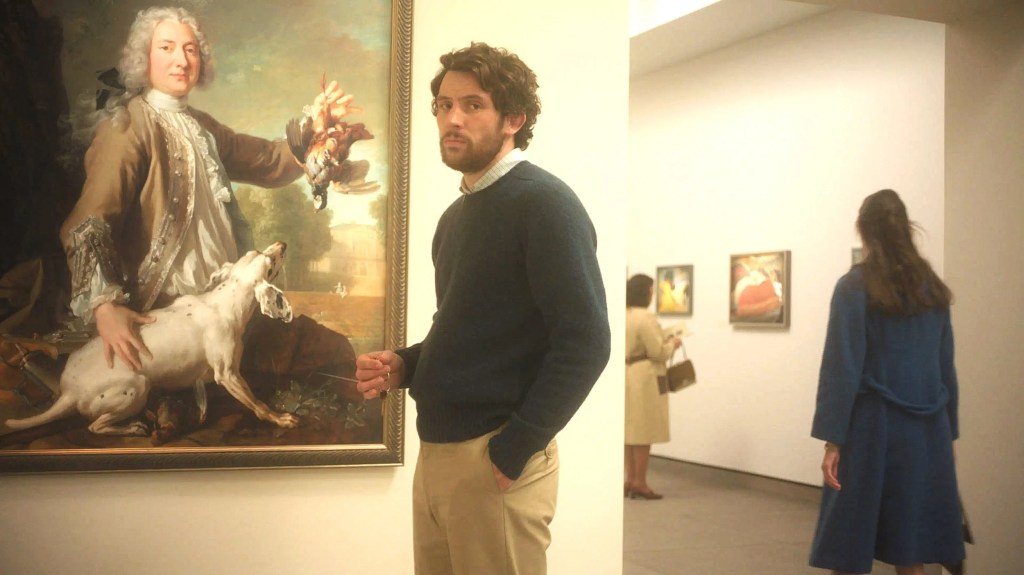
The Mastermind is a brilliant period piece, a portrait of an America full of sketchy bus stations and flophouses, totally free of patriotic nostalgia. It’s set against — but separate from — the widespread antiwar protests of 1970. Josh O’Connor portrays James as a flawed antihero, who is nevertheless sympathetic. He commits his petty crimes wearing wooly sweaters and corduroy pants. The details in the production design are astoundingly precise. Kelly Reichardt is one of the best American directors you’ve probably never heard of. She
makes films, not high-concept schlock and if you haven’t seen her movies, this is a good one to start with. The Mastermind is one of those movies that starts in the middle of things and ends suddenly, before you think it’s over, but it all makes perfect sense.
This is a really good movie.
Regretting You
Wri/Dir: Josh Boone
It’s 17 years ago on a hot summer night in North Carolina. Two teenaged couples are at a pool party: Morgan and Chris, and Jonah and Jenny. Morgan and Jenny are sisters, Chris and Jonah best friends. They say opposites attract; Chris and Jenny are wild partiers, who like getting drunk and having wild sex, while Jonah and Morgan are smart, conscientious and non drinkers. Fast forward to the present.
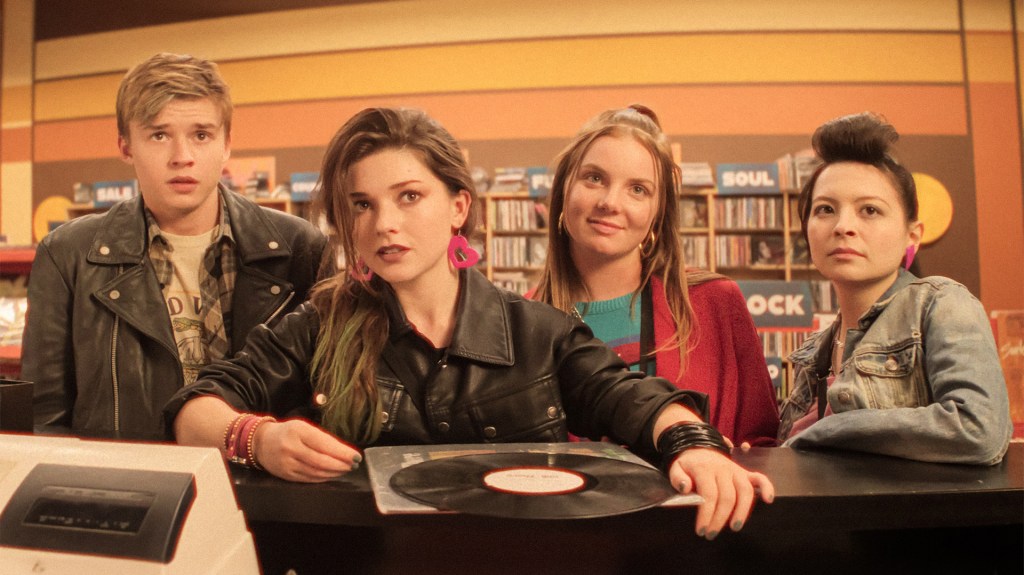
Morgan (Allison Williams) has been married to Chris for 17 years, and they have raised their daughter Clara (Mckenna Grace) since they were still young. Jonah (Luigi-Mangione-lookalike Dave Franco) left town soon after graduation but came back recently and restarted his relationship with Jenny, soon leading to a newborn son. And then there’s Clara: everyone loves her. She’s a high school senior who dreams of becoming an actress after college. She tells her aunt Jenny all the things she can’t tell her mom; she’s like her best friend. She adores her dad Chris, and respects Jonah, who is also her high school teacher. And Clara is crushing on Miller, a popular guy at school,(Mason Thames) who lives on a farm with his gramps, cause his dad is in prison. He likes movies, sucking lollipops and moving roadsigns. But he has a girlfriend so he’s a no-go for Clara.
But everything is messed up when Chris and Jenny are killed in a terrible car crash, leaving Clara without her Dad and her Aunt, Jonah without his lover and the mother of their baby, and Morgan without her sister and the only man she’s ever been with. So Jonah turns to Morgan to form a make-shift family to deal with shock, grief, and the temporary raising of their two kids. (Clara and her Mom aren’t talking.) And while all this is going on, Clara and Miller start hanging out. Can
these estranged family members adjust to the drastic changes? What secrets will be revealed and what hidden loves awakened?
Regretting You is a very conventional drama/romance about two families recovering from unexpected loss. It’s also a coming-of-age story, along with some unrequited love. Based on a popular novel, it’s a very easy movie, with nothing transgressive: its set among church and proms and school plays and going to the movies. The characters are pleasant, and its directed in an easy-to-watch way: texts sent between Clara and Miller are also voiced, so no need to read. The story is divided between the grown ups and the teens, with the teens the more interesting half. But what’s weird about this one is the catastrophic events all happen off-camera, and toward the beginning. The rest of the movie is just about mending relations and recovering from the shocks. So instead of building up to a satisfying emotional purge, this one starts with the dramatic shock and then just coasts.
While I don’t regret seeing Regretting You, it’s not my preferred type of movie.
Bugonia
Dir: Yorgos Lanthimos
High-strung Teddy (Jesse Plemons) and shy, neurodivergent Don (Aidan Delbis) are cousins. They share a dilapidated house they inherited along with an attached farm, where they eke out a meagre existence — dressed in filthy Hazmat suits — through the cultivation of honey bees. But the bees are disappearing. What’s happening to their colony? They also work at a shipping station for a nearby big pharma corporation that specializes in lethal pesticides. Teddy holds a special grudge toward that company for past digressions it inflicted on him and his family.
The company is Auxolith and its CEO is Michelle (Emma Stone), a high-power, alpha careerist. She lives a magazine-like lifestyle in her modern mansion equipped with high security. She is a perfectionist, who only eats heathy food and insists her hair, makeup and power suits are always flawless. She works out using the latest machinery and is fully trained in martial arts. At work, though surrounded by a retinue of
yes-men, she seems oddly sterile and detached from all her employees.
But everything changes when Teddy — with Donny’s help — kidnap Michelle and drag her, undetected, to their lair. They shave her head, tie her to a bed, and cover her skin with weird emollients. Does they want money? Fame? A platform for their manifesto? No! Teddy is convinced Michelle is personally responsible for widespread ecological destruction of the planet — including his bees. And her motive? He is convinced she’s an alien from Andromeda with ties to a mothership parked just outside of the earth. Where do his bizarre theories come from? How can Michelle escape their clutches?
Bugonia is a weird movie pitting an eco-terrorists against a cold billionaire industrialist. Like all of Yorgos Lanthimos’s movies, Bugonia is simultaneously hilarious and disturbing. Grown adults talk like stilted children saying profound but outlandish statements. It’s laden with conspiracy theories, that are no less ridiculous than the corporate-speak the other half uses. Lanthimos likes to cast the same retinue of actors from his past pictures, so Emma Stone and Jesse Plemons are back again playing more quirky oddballs (though Aidan Delbis is entirely new). Bugonia is comical and absurd but also dark.
I really like Lanthimos’s style, but some people hate it; he’s not for everybody. But if you’re looking for something wack and dark and weird, you’ve got to see Bugonia.
Bugonia, Mastermind and Regretting You all open in Toronto this weekend; check your local listings.
This is Daniel Garber at the Movies, each Saturday morning, on CIUT 89.5 FM and on my website culturalmining.com.
Outstanding, great… or just ugly? Films reviewed: Eleanor the Great, Out Standing, The Ugly
Hi, this is Daniel Garber at the Movies for culturalmining.com and CIUT 89.5 FM.
Toronto Palestine Film Festival is on right now, with movies, shorts and docs by and about Palestinians, as well music, cuisine and art to share with other Canadians. This is it’s 17th year and it’s never been more relevant, so check it out.
But this week, I’m looking at three new movies that premiered at TIFF and are all opening theatrically this weekend. There’s an elderly woman who tells a lie, a woman with an “ugly” face who disappears without a trace, and a female officer in the Canadian Army who wishes a certain photo would just go away.
Eleanor the Great
Dir: Scarlett Johansson
Eleanor Morganstein (June Squibb) is a grandmother in her 90s. Since her husband died ten years back, she has shared her Florida condo with her best friend Bessie whom she’s known for 70 years. They do everything together, and work well as a team. Where Bessie is timid, Eleanor is brash and outspoken. If there’s something Bessie wants, Eleanor knows how to get it, even if it involves telling a few fibs. She has chutzpah to spare. But when Bessie suddenly dies, she realizes there’s no reason to stick around, so she packs up her stuff and flies back to New York for the first time in decades. She’s staying with her daughter Lisa (Jessica Hecht) and her grandson Max (Will Price). She’s hoping for some quality time but Lisa’s a worrywart and Max is always busy at school. So she takes up her daughter’s offer to attend some classes at the JCC she signed her up for; maybe she’ll make some friends. The first class is a washout — broadway musicals — so she wanders into another group almost by accident. It’s a support group for Holocaust survivors, and the members urge Eleanor — as a newcomer — to tell her story. She’s not a holocaust survivor, but her best friend Bessie was… and she knows all her memories, especially the death of her brother. So, in deference to Bessie, she tells them to the group as if they’re her own. Why not, right? It goes over well… a bit too well, actually. A teenaged college student Nina (Erin Kellyman) is auditing the group and soon bonds with Eleanor (her mom recently died and her dad is distant and
withdrawn.) The two women bond and start sharing intimate stories.
Nina is in a journalism class, and wants to make a video of her telling her holocaust memories as part of an assignment. Then things get really out of hand: Nina’s dad (Chiwetel Ejiofor) happens to be a popular TV news journalist… and he wants to make Eleanor his next feature. But what will happen to her friendship with Nina — never mind her own family — once the truth inevitably comes out?
Eleanor the Great is a nice, light movie-of-the-week-type drama about death, mourning, and inter-generational relations. It’s a very simple and easy movie, part comedy, part weeper. What’s good about it is the acting. June Squibb — who really is in her 90s — is great as the energetic, down-home Eleanor. (She played another rebellious granny in last year’s hit Thelma.) This is Scarlett Johansson’s first time as a director, and luckily she doesn’t bite off more than she can chew. She concentrates on characters — Squibb and Kellyman are both great in their roles — more than the basic story. And you know what? That’s good enough.
I wouldn’t call Eleanor the Great great, but it’s worth the watch.
Out Standing
Co-Wri/Dir: Mélanie Charbonneau
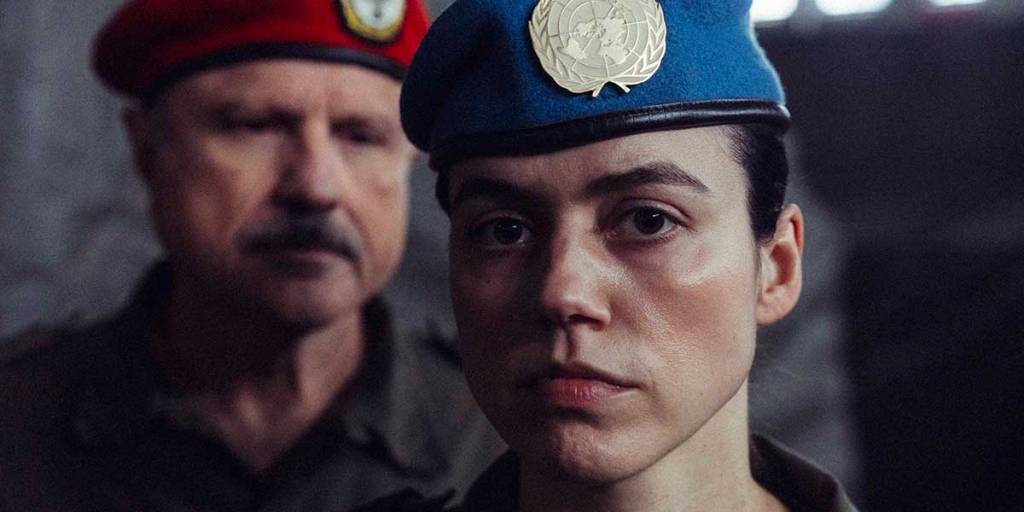
It’s the 1990s, and Captain Perron is leading a troop of UN peacekeeping forces in the former Yugoslavia. Why is this unusual? Sandra Perron (Nina Kiri) is a Canadian woman, the first to lead a squad of infantry soldiers in combat, and the first female to serve in the prestigious 22nd division, known as the Van Doos. Raised as an army brat in bases across Canada, she comes from a long line of soldiers, so it makes sense that she is following in her father’s vocation. She trained as a cadet and received commendations while still a teenager. And she’s the first woman to survive the brutal training that squadron demands. But there’s a photo circulating from her past that’s threatening to derail her military career. It’s a picture of her tied to a tree, barefoot, in the snow and semiconscious.
It was part of her training in a Prisoner of War exercise that went far beyond the normal treatment soldiers are forced to endure. A Canadian woman facing treatment tantamount to torture at CFB Gagetown in New Brunswick. But Captain Perron isn’t the one who released the photo, one fact she didn’t want the photo circulated. She had endured years of hazing bullying, harassment, obscene phone calls, sabotage to her kit, and a hidden campaign by certain officers to get rid of her. They detest the idea of serving alongside or under the command of a woman. And unlike the other women who
attempted to to join the Van Doos, she alone managed to survive and not quit.
Out Standing is a biopic about a trailblazing woman in the Canadian Armed Forces. It’s both moving and disturbing. The title, based on her memoirs, refers both to her achievements and to the notorious photo of her standing tied to a tree. (That pic was eventually published by the press, triggering a wave of shock and disgust across the country, and, one hopes, an improvement in how women are treated in the military.) Nina Kiri gives an excellent performance, totally believable as Perron.
While Hollywood churns out dozens of war movies each year, showcasing the latest weapons and fighter planes, you rarely see a Canadian one. This one is full of details carefully chosen to distinguish how soldiers behave here. The military culture is quite different. Unlike in the US there’s no Sir-yes-sir! And instead of saluting a Canadian soldier stand sharply at attention. I never knew this because you never see it in movies. For this alone it’s a eye-opener. The film is not perfect — there’s a particularly clumsy scene near the end — but altogether it’s a compelling and disturbing look at a Canadian woman’s life in the military.
The Ugly
Wri/Dir: Yeon Sang-ho (Peninsula, Train to Busan)
Lim Yeon-gyu (Kwon Hae-hyo) is a well-known carver of dojang, the name stamps used in Korea like a signature on official documents. He built up his business from scratch while raising his son as a single parent. (His wife ran away soon after the baby was born.) He trained his son Lim Dong-hwan (Park Jeong-min) in every aspect of the craft. Now an adult he is taking over the family business. At this moment, a documentary filmmaker (HAN Ji-hyeon) is celebrating this dad’s life as a national treasure. Why did she choose this man for her documentary? He’s been blind since birth, which makes his many accomplishments even more impressive. But filming is put on hold when a surprise announcement arrives. They’ve found Dong-hwan’s mother decades after she disappeared. Turns out she’s been dead all that time and only her bones remain. This comes as a total shock to Dong-hwan, and it just gets worse.
First his mother’s long lost relatives arrive for the funeral but they’re despicable people who just want to make sure he doesn’t claim any family inheritance.They bullied and beat his mother, a veritable Cinderella raised by this cruel family. It’s also the first time he hears his mother described as ugly. Ugly how? He longs to see a photo of her, something to display at the funeral, but there are no photos anywhere. Of course his blind father doesn’t have one. While Dong-hwan is trying to process all this new information, the filmmaker leaps on it as a great story and insists on continuing the documentary but with a new twist: who killed his mom and why? Together, over a series of interviews with hidden cameras, they uncover
events and people from her past as the tragic puzzle gradually falls into place.
The Ugly is a mystery about a kind-hearted woman — the main character’s mother — and how she is horribly treated because of her looks. It’s a heart wrenching story, a dark, bleak view of humanity with only Dong-hwan (and his mother) as redeeming characters. The story is told as a series of interviews with the various characters and extended flashbacks to what actually happened (The actor who plays Dong-hwa also plays his blind father as a young man in the flashbacks, while Jung Young-hee plays his mother, but always from behind or from the side, without ever revealing her face). In Yeon Sang-ho’s previous movies (Peninsula, Train to Busan) the action hero is surrounded by mutants or zombies or killers. The Ugly is about normal people but they’re just as hideous.
The Ugly is a powerful and dark look at human cruelty and physical beauty.
Eleanor the Great, Out Standing and the Ugly all open this weekend in Toronto; check your local listings. This is Daniel Garber at the Movies, each Saturday morning, on CIUT 89.5 FM and on my website culturalmining.com.
Daniel Garber talks with Jason Buxton about Sharp Corner
Hi, this is Daniel Garber at the Movies for culturalmining.com and CIUT 89.5 FM.
Josh McCall is a mild-mannered, middle-aged man who works at a middle management job in Halifax, Nova Scotia. He loves golf, fine wine and his family. He lives with his wife Rachel, a marriage counsellor, and their young son Max. They’re excited about moving into their new home on a peaceful country road far from the bright city lights. But from their first night, they discover their dream home is actually a nightmare. It’s parked between two hairpin turns on a badly lit road, where cars are constantly crashing. Their front lawn is a danger zone and the death toll of drivers keeps rising. Max is terrified, Rachel says they must move out, but Josh discovers his new mission — to save as many of the inevitable crash victims he can. And his new obsession
overrides his career, his marriage and even his young son. The question is, how far will he go to rescue dying motorists on that sharp corner?
Sharp Corner is a new psychological drama about a man’s altruistic obsession taken to a horrifying level. It’s funny, shocking and more than a bit creepy. The film premiered at TIFF last year and stars Ben Foster and Cobie Smulders as the McCalls. Sharp Corner is co-written and directed by Halifax-based, award-winning filmmaker Jason Buxton. His first film, Blackbird (Review), opened at TIFF in 2012, and was on my “best of” list that year. Blackbird went on to win the Canadian Screen Award for Best First Feature, and Sharp Corner is also gathering awards and high ratings.
I spoke with Jason Buxton in Toronto via Zoom.
Sharp Corner opens across Canada on May 9, 2025.
Two Couples and a Single Mom. Films reviewed: The Wedding Banquet, The Courageous PLUS Hotdocs!
Hi, this is Daniel Garber at the Movies for culturalmining.com and CIUT 89.5 FM.
Hot Docs Toronto’s International Documentary Film Festival, is back with a vengeance, next week after last year’s misadventure in potential ruin. The world breathes a sigh of relief! And there are tons of great films to see, many having their world premieres at the festival. And as aways, rush tickets for daytime shows are available for free for students and seniors. So this week, I’m talking about some of the docs I’m looking forward tov watching. And after that, two new movies, one from the US and another from France. There’s a romcom involving two couples and one fake marriage; and a drama about a struggling single mom and her three young kids.
New films at Hotdocs!
Here are some brief description of upcoming docs that look interesting:
Ai Weiwei’s Turandot is a record of the noted Chinese artist and activist’s production in Rome of Puccini’s opera set in a mythical China, and somehow combines ancient themes with modern politics.
Parade: Queer Acts of Love & Resistance by Winnipeg director Noam Gonick is a comprehensive look at the history of queer politics in Canada from the 1960s to the present, focusing on Pride parades as a catalyst for liberation movements.
Virginial Tangvald directs Ghosts of the Sea about a life spent aboard her famous father’s sailing boat, and the dark secrets her family keeps.
Life After is director Reid Davenport’s examination of Medically Assisted Dying from the point of view of devalued, disabled persons, unwillingly pushed toward death to relieve their very real suffering caused by the absence of necessary care.
Spare My Bones, Coyote! (Jonah Malak) is about a volunteer couple who for years have scouted the desert borderlands to rescue migrants lost and dying in the extreme heat and cold.
Deaf President Now! (Nyle DiMarco, Davis Guggenheim) is about a 1988 student strike at a DC University for the deaf when they hired a hearing president. The protests inspired a generation of disability rights activists.
Sasha Wortzel’s River of Grass looks at the unique ecosystem of the Everglades.
The Dating Game (Violet Du Feng) looks at the crazy lengths unmarried men in China are going through these days to try to land a wife.
Heightened Scrutiny (Sam Feder) looks at ACLU attorney Chase Strangio preparing his landmark case on trans rights before the Supreme Court.
Unwelcomed (Sebastián González and Amílcar Infante) a Chilean film about the violent reaction to migrants who fled Venezuela to seek refuge there.
Shifting Baselines (Julien Elie) is about a small Texan town dominated by gigantic, 50-storey tall rocket ships that are part of the new space race.
These are just a few of the films playing at Hotdocs.
The Wedding Banquet
Co-Wri/Dir: Andrew Ahn
It’s present-day Seattle. Min (Han Gi-Chan) is a man in his twenties from South Korea. He was raised by very rich grandparents, who now expect him to take over the family business. But he doesn’t want to. Min’s an artist who cuts up colourful silk kimonos as his medium. And he’s in love with a guy named Chris (Bowen Yang) and wants to marry him. If his grand-parents ever find out, he’ll be written out of the will. And he’s in the US on a limited visa — he needs a green card. Meanwhile, Angela (Kelly Marie Tran), a science geek who does experiments with worms is in love with Lee, a social worker (Lily Gladstone). They want kids, and artificial insemination is proving to be very expensive. What’s the connection? Chris is good friends with Angela and Min thinks he can pull the wool over his grandparents’s eyes if he “marries” Angela and sends them the video. He gets a green
card, she gets a baby, it’s as easy as pie. Not so fast. Granny (Youn Yuh-jung) is already on a flight from Seoul sending the four of them on a frantic clean up. Can they de-gayify Min and Chris’s home? Can Angela pass as straight? And what will this new wrinkle do to both those couples’ relationships?
The Wedding Banquet is a cute, screwball social comedy. Not uproarious, roll-on-the-floor comedy, but lots of quirky characters and unexpected plot twists. It’s adapted from Ang Lee’s movie of the same name in 1993, but quickly veers on a different path from 30 years ago. The original focused on a clash pf cultures involving a White and Taiwanese couple and the prevailing anti-gay taboos of that generation. In this version, Homophobia is alluded to but kept off screen, and the multi-ethnic humour comes from clueless Asian Americans navigating their way through the vagaries of a traditional
Korean Wedding.The main actors don’t just play gay, they are gay. The cast is very impressive. Lily Gladstone was nominated for an Oscar for Killers of the Flower Moon, Youn Yuh-jung who plays Min’s grandmother, won one for Minari, and the legendary Joan Chen has a great cameo as Angela’s mom. Bowen Yang plays against type, while Kelly Marie Tran of Star Wars fame is endearingly awkward as Angela.
So while not terribly challenging, The Wedding Banquet presents a modern take on gay-asian relationships that is both endearing and gently funny.
The Courageous
Co-Wri/Dir: Jasmin Gordon
It’s a small town in northeastern France. Jule (Ophélia Kolb) is a single mom with three young kids in public school. Claire (Jasmine Kalisz Saurer) is the take-charge older sister. Loïc (Paul Besnier) is friendly, shy, and possibly on the spectrum; and Sami (Arthur Devaux) the youngest is prone to running around and getting in trouble. But one day the kids find themselves in a roadside diner with no mom. Their car is still in the parking lot, but she’s nowhere to be seen. So they take a long walk beside a highway back to their apartment. She shows up the next morning, but with no explanation. Instead she drives them to see what she says is their new home. It’s out of the way, and a bit run down, but much more spacious than their cramped apartment. But mom forces the kids to take cover and climb out the back door when strangers appear at the front.
You see, Mom isn’t completely honest with her kids. She has very little income, is way behind rent, and can barely find enough money to buy then basic food and clothes. And yet she struggles to provide them with normal kid lives: toys, sports and going to birthday parties. But her ventures with petty theft and shoplifting haven’t worked out well. She has an
ankle bracelet to prove it. But their dream home is still up for sale. Can Jule come up with the down payment in time? Or will the law and the system catch up with her?
The Courageous is an amazing family drama about a mother who goes to great lengths to keep her family together. It’s told as a slice of life — starting in the middle and finishing before an obvious end. If you’re looking for an easy-to-watch, crowd-pleaser, you won’t find it here, but the bittersweet story-telling, endearing characters and shocking incidents make it much more satisfying.
Beautiful movie!
The Courageous and The Wedding Banquet opens this weekend in Toronto; check your local listings. Hotdocs runs from Thursday Apr 24, 2025 – Sun, May 4.
This is Daniel Garber at the Movies, each Saturday morning, on CIUT 89.5 FM and on my website culturalmining.com.
Daniel Garber talks with Ingrid Veninger about Crocodile Eyes
Hi, this is Daniel Garber at the Movies for culturalmining.com and CIUT 89.5 FM.
It’s present day Toronto. Independent filmmaker Ruby White (Ingrid Veninger) is working on a documentary about her family. She has stuck a hundred, hot-pink post-it notes on a wall, and is gradually filling in the blanks, using vintage footage she has dug up, and brand new snippets as they happen. Her daughter Sara, an artist, is very pregnant with a four- year-old daughter already there. Little Freya is exploring the world, one blade of grass at a time. Her son Jake is a manager at a movie theatre and a member of a
band. Ruby’s Slovakian parents, Dedo and Baba, still play an active role in their family; her Mom still vivacious, her Dad on his last legs. But with life, death and birth happening all around her, Ruby must decide what to include in her film and what to leave out. What is real and what is fictitious? And what will her family think of the final film?
Crocodile Eyes is a semi-fictional, semi-documentary slice-of-life drama, told through a raw and visceral lens. It’s both heartwarming and shocking. It’s the work of prize-winning, independent filmmaker Ingrid Veninger, whose films have
been shown at TIFF and festivals worldwide. She has also taught and mentored countless other filmmakers, many of whom who have risen to their own fame. I’ve been following her work for the past decade and a half, reviewing movies like the wonderful Modra and the hilarious I Am a Good Person/I Am a Bad Person, and have interviewed her twice on this show about Porcupine Lake (2017), and The Animal Project (2014).
I spoke wth Ingrid Veninger in person, at CIUT 89,5 FM.
Crocodile Eyes is having its world premiere on March 28th at the Canadian Film Fest.
Disappeared. Films reviewed: Dark Match, I’m Still Here
Hi, this is Daniel Garber at the Movies for culturalmining.com and CIUT 89.5 FM.
You may have heard about Sook-Yin Lee’s indie movie Paying For It, starring Dan Beirne as graphic novelist Chester Brown, and Emily Le as Sunny, modelled on Sook-yin herself as a TV VJ in the 1990s. It’s about their relationship after they broke up, when Chester decides only to sleep with paid sex workers. I interviewed Sook-yin and Dan way back in August on this show, and later ranked the movie on my Best-of-the-Year list. Well, good news: you can finally see Paying for It on the big screen starting this weekend. Check it out, it’s very cool, very indie and very local.
But this week I’m looking at two other new movies: a family drama set in Rio de Janeiro in the 1970s, during the military dictatorship; and a horror movie about pro-wrestlers in the sticks of northern Alberta in the 1980s.
Dark Match
Wri/Dir: Lowell Dean
It’s 1988, and a team of pro-wrestlers are getting ready for a big match in a small town somewhere north of Edmonton, Alberta. They’re there under the direction of a sleazy promoter named Rusty Beans (Jonathan Cherry). The wrestlers have worked together for years and know all the rules: the good guys win and the heels lose. This goes for men and women alike. And Nick — aka Miss Behave (Ayisha Issa) — doesn’t like it. She’s a damn good wrestler and wants some wins… along with a raise. But it’s always Kate the Great (Sara Canning) who gets the cheers while she gets the boos. The only ones she can complain to are the enigmatic Enigma (Mo Jabari) who never speaks or takes off his lucha libre mask… and Joe. She spends most of her off-time with Mean Joe Lean (Steven Ogg) a veteran wrestler, and a heel like her. It’s ambiguous whether they’re a couple or “friends with benefits”. Either way, they keep it on the down low. But (back to the story) everything went wrong when she lost her temper in the ring, which left her facing a pay cut and maybe losing her job altogether. Until, out of the blue, Rusty comes by with some good news for a change. They’ve all been offered a gig in a village they’ve never heard of somewhere up north. It pays really well, maybe even a cut of the door. It’s for a dark match — a special wrestling show, for their eyes only, with no cameras present. So they all pile into Rusty’s old rusty van and head into the sticks. When they get there, things seem a bit fishy. Joe think’s they’re all
rednecks or Jesus freaks, led by a mysterious leader in a cowboy hat (Chris Jericho).
But hey, a gig’s a gig. Things get stranger the night before the big event. They stumble into some kind of weird orgy involving handcuffs, a hot tub, a threesome, a suckling pig, and some glowing green plonk. They wake up the next morning with aches and pains all over. But that’s just the beginning. The match is not what they’re used to. There are armed guards with AK47s standing outside the locked door of their green room. And the wrestlers aren’t coming back after their match! What’s going on… and why? Miss Behavin’, Mean Joe Lean and Enigma realize they have to do something… but can they stand up to a crowd of bloodthirsty satanic fans?
Dark Match is a horror movie about a wrestling match gone wild at the headquarters of a bizarre religious cult on the Canadian prairies. It’s bloody and gory with a hint of the
supernatural at work. The cast is composed of both professional actors and pro-wrestlers (who, as we all know, do their own fair share of acting). It’s loaded with 80s music, big hair and grainy video footage with lurid red lighting. I was surprised how much I liked this sleazy, gritty B-movie, and I’m not even a wrestling fan. Of course you have to be comfortable with extreme violence, blood and death — it’s that kind of horror — but it’s also quite funny and goofy, too. So if you’re jonesing for some western-Canadian gore, Dark Match is it.
I’m Still Here
Dir: Walter Salles
It’s the early 1970s in Rio de Janeiro, Brazil. The Paivas are an upper middle class family who live so close to Leblon beach they can walk there barefoot. Eunice, their mom (Fernanda Torres) loves to float in the waves; she finds it relaxing. With five kids to take care of, she needs a bit of down time. Rubens Paiva (Selton Mello), the dad, is an engineer and former congressman for the Labour Party. He loves whisky, cigars and playing foosball with the kids. His firm is working on a huge project, an underground tunnel. But they still find time to get together with their close circle of friends and families: intellectuals, journalists, artists and activists, all on the left. Then there are the five kids: four girls: Veroca, Eliana, Babiu, and Ana, and one boy, Marcello. They love beach volleyball, soccer, pop music and a fluffy dog they find on the beach. Rubens names him Pimpão, after Verona’s shaggy friend.
But a dark cloud hangs over their otherwise idyllic lives. Brazil is ruled by a right-wing military dictatorship and they’re using a series of kidnappings of European diplomats to question and harass anyone vaguely on the ‘left”. Vera is sent off to London for her own safety. Then one day, five sketchy men invade
their home draw the curtains, and without a warrant drive Rubens away to an unnamed location. When Eunice tries to free him, the government denies they ever took him. It’s up to Eunice to take care of the kids as she tries to find him. Has he been disappeared?
I’m Still Here is the incredibly moving, true story of a Brazilian family, based on the bestselling memoirs of their son, Marcello. While it covers the secret arrest of Rubens Paiva by the military dictatorship it’s also about the repercussions it had on the lives of Eunice, their entire family, their friends, and the country of Brazil as a whole. And that’s where it hits you — the intimate details of a remarkable family’s everyday lives: the super-8 movies they record, the records they listen to. I though it was going to be just an historical retelling of an important event. But it’s actually about everything, good and bad, that the family goes through. Now I’m not Brazilian, I don’t live on a beach in Rio, but for some reason I totally identified with this family, I felt a real connection.
Walter Salles directs an epic movie like this every decade or so, films like The Motorcycle Diaries and Central Station.
Apparently he had personal ties to the Paiva family as a young man. Fernanda Torres gives an amazingly nuanced performance as Eunice, that had my eyes tearing up. I’m Still Here has been nominated for three oscars — best actress, best picture and best foreign film — and rightly so. I can’t say enough good things about this movie.
Dark Match and I’m Still Here are both opening this weekend in Toronto; check your local listings.
This is Daniel Garber at the Movies, each Saturday morning, on CIUT 89.5 FM and on my website culturalmining.com.
Hi, this is Daniel Garber at the Movies for culturalmining.com and CIUT 89.5 FM.
it’s the work of award-winning documentary filmmaker Tasha Hubbard, known for her powerful docs featuring indigenous subjects. Meadowlarks is her first narrative feature. I last interviewed Tasha in 2019 on this show about
Laura Poitras, has made two crucial docs so far: Citizen 5 about whistleblower Edward Snowden and
Guillermo del Toro — who splits his time between Toronto and Mexico City — is a specialist in gothic horror, (
You may not have heard of Christian Petzold, but he’s one of the most creative and distinctive German directors around. (
Hungarian filmmaker László Nemes who won an Oscar for his harrowing Son of Saul, and whom I
Raoul Peck is the Haitian filmmaker known for his powerful, political documentaries, like
I first encountered Annemarie Jacir’s film
Steven Soderbergh churns out several new movies each year — some great, some terrible. But I’ll give him the benefit of the doubt on his newest one about art fraud, The Christophers — starring Ian McKellen and James Corden —
Director Claire Denis who grew as a white French woman in colonial West Africa has made so many great movies (White Material, Beau Travaille) that I’ll watch anything she produces. Her latest The Fence is in English, and stars Matt Dillon, Mia 
works as a waitress at the local diner and raises chickens for eggs on the side. They keep their relationship casual and hush-hush.
Sweet Angel Baby is a moving drama about secrets, sex, frustration
Nobody 2
corruption and organized crime; they use the theme park to launder money and smuggle guns and drugs. The local Sheriff (Colin Hanks) is a bad hombre, and on top of the heap is a sadistic gangster kingpin (or queenpin?) named Lendina (played by the much-missed Sharon Stone). She’s as bloodthirsty as she is cruel, and takes notice when an unknown tourist starts interfering with her profit-making.
guns and hand grenades… all set against an aging, seedy amusement park (filmed near Winnipeg!).
Endless Cookie (Peter and Seth Scriver) is a highly original animated film that uses bright colours and stylized characters — in the form of elastic bands, or peaches — to retell the stories of two half brothers, one from the Shamattawa First Nation in Northern Manitoba, the other from Toronto’s Kensington Market.
Coexistence, My Ass by Canadian filmmaker Amber Fares (Speed Sisters:
My Boyfriend the Fascist (Matthias Lintner) is an intimate, personal film about a leftist Italian filmmaker in South Tyrol and his virulently anti-communist Cuban-Italian lover who is drifting further and further to the extreme right.
Supernatural (Ventura Durall) is about an MD forced to deal with the legacy of his own dad, who was famous as a shaman, and a telepathic healer who still has a grateful followers including one woman who swears he saved her life.
Ragnhild Ekner’s Ultras is a stunning, impressionistic look at the shared subculture of superfans at soccer clubs on four continents, including chants and Tifos, both elaborate synchronized formations in the stands and the creation of massive cloth banners that span a stadium and then disappear in just a few minutes.
Another Small Favour
Dante (Michele Morrone), her handsome brooding fiancé; and Portia (Elena Sofia Ricci) Dante’s acid-tongued matriarch. The danger comes from the fact that Dante’s family are connected to the mob, and almost everyone at the party holds a deadly grudge toward at least someone else. Poor Stephanie is left fending off the eye-daggers that everyone is sending her way, but even so, some of the main characters are being killed, one by one. Who is behind these murders? What is their motive? And can Stephanie make it out of there alive?
On Swift Horses
the diner she works at, discussing sure-fire horses to bet on. She makes to he tracks to try her luck. And with some newfound earnings she feels confident enough to pay a visit to Sandra down the road. Is this just a fling? Or the real thing? Will Julius ever join them in San Diego? And what would Lee do if he ever discovered both his brother and his wife are flirting with same-sex partners?
dancing to music in Sandra’s living room in her underwear seems much more sexualized than her having obligatory coitus with her husband. Likewise Elordi as Julius exudes sexual desire in every scene. While the film does verges on the sentimental with its gushing music and tragic near misses, by the end, you’ll be siding with the characters and hoping their love will be eternal.
leave a comment