Presumed guilty. Films reviewed: Mercy, A Private Life PLUS Canada’s Top Ten
Hi, this is Daniel Garber at the Movies for culturalmining.com and CIUT 89.5 FM.
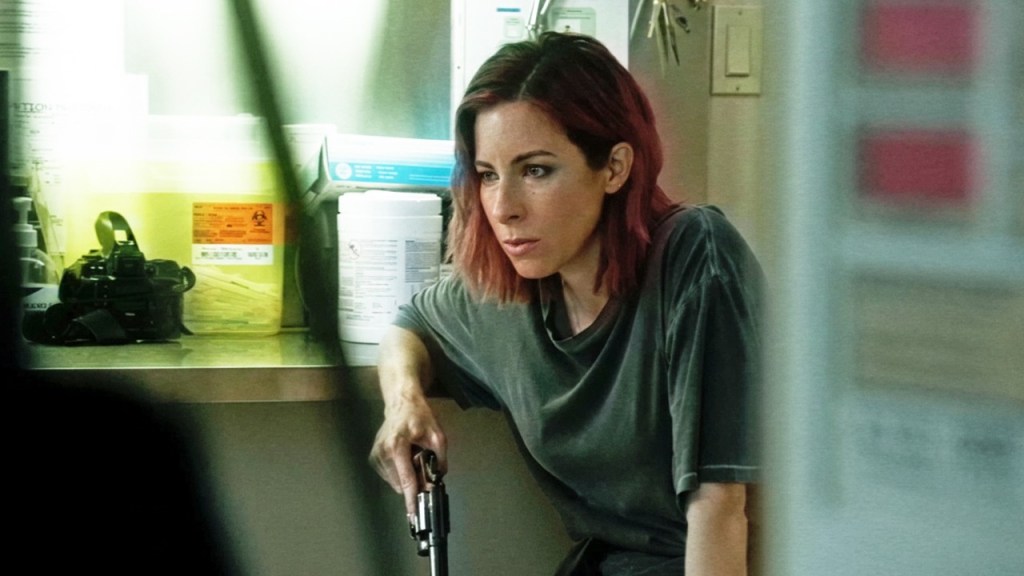
This week, I’m talking about two new movies, both mysteries, about professionals forced to deal with crime that affects their personal lives. There’s a psychiatrist in Paris who uncovers a crime, and a police detective in LA blamed for a crime.
But before that I’m talking about a new series of Canadian films featured at TIFF in February.
Canada’s Top Ten
…is an annual series where programmers choose the best movies made in the previous year. While I haven’t seen all of them, a few really stand out. If you’re a regular listener to this show you may have heard my interviews last fall with Kid Koala about his
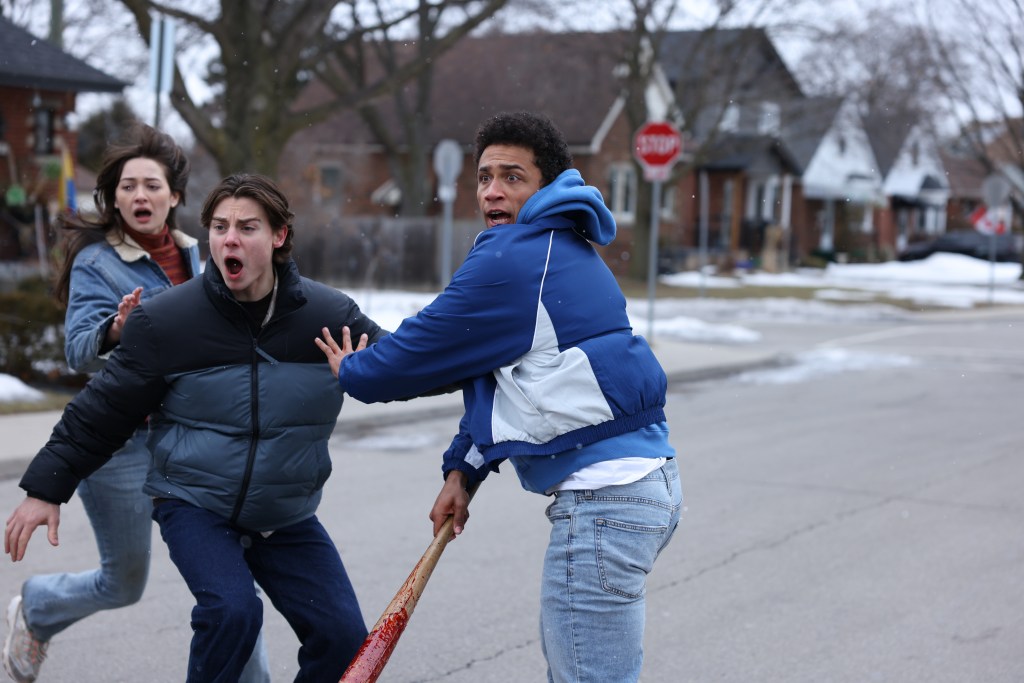
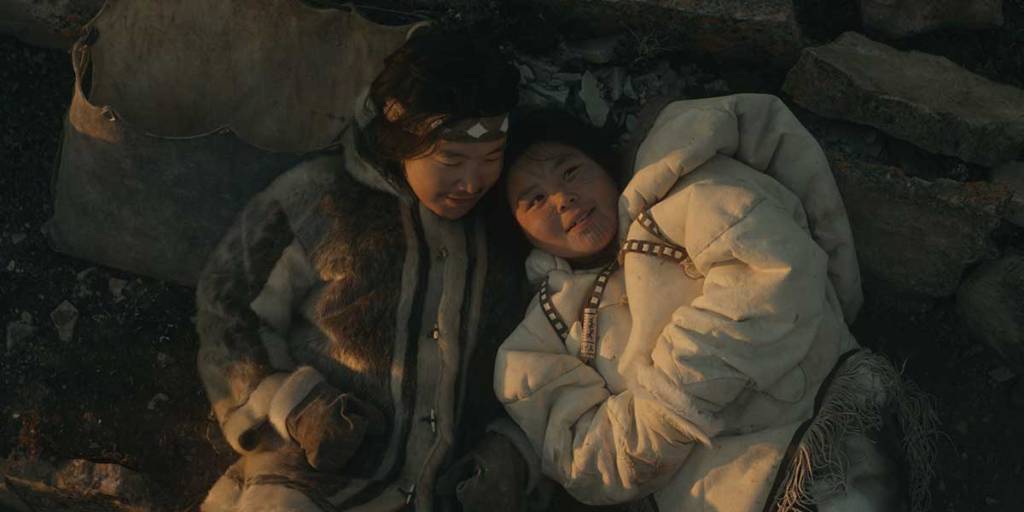
delightful futuristic animated kids’ film Space Cadet, and Inuit auteur Zacharias Kunuk’s amazing timeless folk tale Uiksaringitara (Wrong Husband), as well as my review of Matt Johnson’s hilarious, Nirvanna: the Band, the Show, the Movie. But let me tell you about a couple more that should not be missed.
Blue Heron is director Sophy Romvari’s first feature. It’s about a young artistic couple and their kids who immigrate from Hungary to a small lakeside town in Canada. It’s seen through the eyes of a little girl whose troubled teenaged brother is “acting out”. It also picks up the story, and the characters’ lives, decades later. While it might sound like a mundane drama, it’s actually a heart-wrenching story of one troubled family.
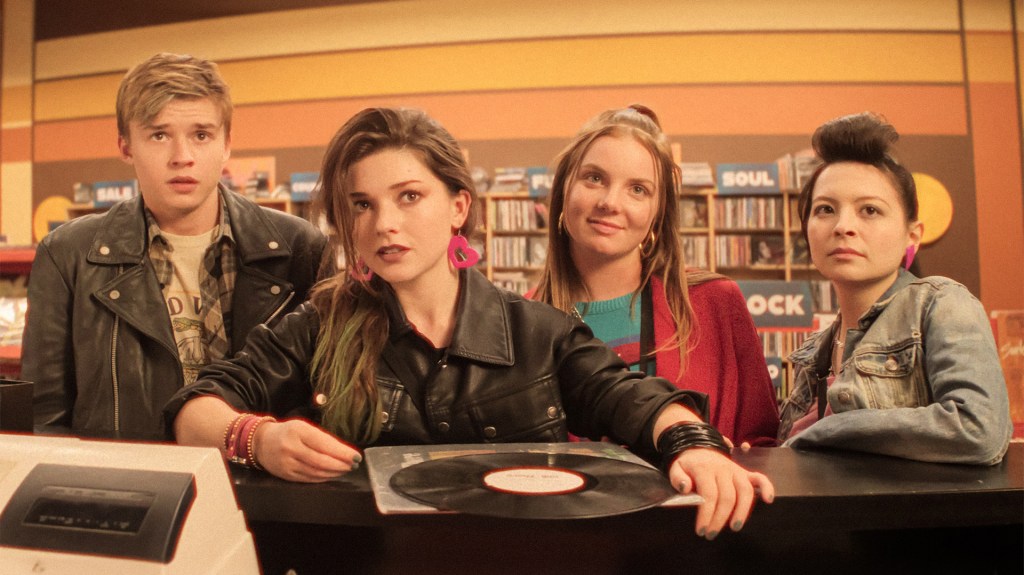
And Mile End Kicks is Chandler Levack’s sophomore follow up to her quirky and tender I Like Movies in 2022. This one’s about a budding rock critic in 2011 Toronto, who sets off to discover Montreal with just a contract in her hand to write a book about Allan’s Morissette. This movie is brilliant and cringey and hilarious, a coming-of-age dramedy about a woman trying to survive within the male dominated world of rock.
These are just two of the movies you must check out at Canada’s Top Ten.
Mercy
Dir: Timur Bekmambetov (Ben Hur)
It’s Los Angeles in the near future, and Chris Raven (Chris Pratt) is a real mess. He is bruised, battered and hungover from a drinking binge the night before… and has no recollection of the past 24 hours. He’s also in an unfamiliar place, a large, empty room, facing a giant video screen. He’s shackled to a chair with electronic instruments attached to his head. He is in the Mercy department, a new experimental court system, where a single person serves as the judge, jury… and executioner. That person is Judge Maddox (Rebecca Ferguson) a woman with straight hair and severe features. Why is Chris there? He’s been charged with first degree murder and has exactly 90 minutes to convince the judge that he’s not guilty beyond a reasonable doubt; if not, he will be executed in that chair. Oh! One more thing: Judge Maddox is actually a computer generated AI avatar, not a real human.
But Chris has a few cards up his sleeve. He’s a lieutenant police detective, so he knows all the legal procedures. Not only that, he and his partner created the Mercy system, so he knows all about it. But he never thought he’d be on the receiving end. Luckily, he has all the surveillance — CCTV, social networks, everyone’s cel phones and complete
government, medical and legal histories — at his shackled fingertips. The bad news is, he seems to have motive, means and opportunity to do the killing, with no other obvious suspects. Can Chris Raven think his way out of this mess in the next 90 minutes? And can he put his destiny in the hands of a soulless, digital simulacrum?
Mercy is a science-fiction police procedural where a falsely accused cop must solve a crime remotely in a very short period of time. It’s also a mystery/action thriller about a dystopian future where machines hold the final authority. The “thrilling” parts are all tied to a constant timed countdown on the screen — like the old TV series “24” — and a “rating” of guilt; a percentage that goes up and down depending on the evidence he presents to prove his innocence.
The problem with this movie is it feels like it was made on someone’s telephone. There’s virtually no physical interaction between any of the various characters throughout the film, just talking heads on the screen, reached by cel. I understand why they had to film movies like that during COVID, but what possible reason could there be for doing it now? I saw it in 3-D, but when all you see are smaller flat screens projected on to larger ones, what’s the point? On the plus side are the few scenes where Raven’s partner Jaq (Kali Reis) zooms around on her flying motorcycle, searching for the bad guys — that part was awesome! And my interest never wavers over the course of the movie. I like the constant countdown, and the steps they take to solve the mysteries. But what I thought would be a subversive Robocop-style indictment of both runaway government surveillance and the looming dangers of AI, instead ends up as a run-of-the-mill police story.
Mercy may hold your attention, but don’t expect anything more.
A Private Life
Dir: Rebecca Zlotowski
It’s a posh arrondissement in present-day Paris. Lilian Steiner (Jodie Foster) is a successful American Freudian psychotherapist who runs her practice all alone, in a clinic attached to her apartment. She has no trouble filling her roster with well-to-do patients seeking psychoanalysis. But recently, a number of bad things happen all at once. A new neighbour plays loud music during office hours, disturbing her clients. One longtime patient suddenly quits, calling her a fraud after he claims a hypnotist cured him of smoking in less than an hour. Another regular misses her appointments twice in a row without telling her — unheard of. Turns out Paula Cohen-Solal is dead, and when she shows up at her shiva, Paula’s husband Simon (Mathieu Amalric) loudly denounces Lilian as the reason his wife killed herself. This combination of events breaks down Lilian’s cool demeanour; to her horror, tears keep rolling down her cheeks at inappropriate times.
She visits her eye doctor — who happens to be her ex-husband Gabi (Daniel Auteuil) — to solve this medical dilemma. He says there are no physical reasons for her tears. So net she visits the hypnotist her angry patient told her about. She manages to stop her tears but, at the same time, lets loose a series of psychosexual dreams and visions of past lives that haunt Lilian’s mind. And she becomes convinced that Paula did not commit suicide but was murdered. And when she decides to investigate, someone breaks into her clinic and steals no money, just certain files. Who is behind the killing? Was there more than just a doctor/patient relationship between Paula and Lilian? And now that she and her ex-
husband Gabi are spending time together again, could be this be the start of a new relationship?
A Private Life is a mystery thriller set within the world of Parisian psychotherapy, it’s devotees, their families and their unspoken private lives. It’s presented in a low-key but ambiguous manner: you’re never quite sure whether a crime took place or even whether what you’re watching is real. It presents infidelity, hidden passions, and personal relations, alongside dreams, fantasies and psychological visions. Sort of a Murder She Wrote on mushrooms. Good acting by the large ensemble cast, especially Jodie Foster, Daniel Auteuil, Virginie Efira as the dead Paula and Sophie Guillemin as the enigmatic hypnotist.
While A Private Life didn’t blow me away, I quite enjoyed both the story and watching Jodie Foster complètement en français.
A Private Life and Mercy both open in Toronto this weekend; check your local listings. And tickets are now available for Canada’s Top Ten, showing at TIFF in February.
This is Daniel Garber at the Movies, each Saturday morning, on CIUT 89.5 FM and on my website culturalmining.com.
Kill, Pray, Dead? Films reviewed: All You Need is Kill, Dead Man’s Wire, The Testament of Ann Lee
Hi, this is Daniel Garber at the Movies for culturalmining.com and CIUT 89.5 FM.
This week, I’m looking at three great new movies with terrifying titles. There’s a religious leader giving her last will and testament, a hostage-taker with populist appeal, and a futuristic killer… who might save the planet.
All You Need is Kill
Co-Dir: Ken’ichirô Akimoto, Yukinori Nakamura
It’s the near future in a sparsely-populated, rural part of Japan. Rita (Ai Mikami) is a young woman waking up to another day. She has bright red hair in a pageboy haircut, with a jaded look on her face. She volunteers at a government project to care for the roots and branches of a giant plant. Exactly one year earlier, an enormous piece of vegetation — known as Darol — landed there from outer space and spread its tentacles for miles in all directions. The mother plant is a giant tower with colourful pointed leaves. It seems weird but harmless, and the volunteers, who wear helmeted space suits, scrub clean its enormous roots each day. Until today, when suddenly the plant spits out a small army of giant-legged flowers — like colourful daisies with hairy petals — resulting in mayhem,destruction and death. Only Rita fights back, killing one of the flowers before being overwhelmed by an intense wave of red light.
Next thing you know, she’s waking up in bed again as if nothing ever happened! Sure enough everyone else at work is alive and well, with no memories of the previous day. Was it just a dream? No, the daisy-monsters attack again, and
everybody — including Rita — dies. This repeats over and over, like a never-ending groundhog day. She tries to escape, tp hide, she trains herself on new fighting techniques she even climbs into an enormous metal exoskeleton… but she always dies in the end.
Life and resistance seem futile, with the red tentacles poised to colonize the earth. Until one day she spots a guy standing alone, observing her with a tiny, flying drone. She is angry and upset… until he tells her, he’s just like her, remembering each day too. And Rita is his hero. Keiji (Natsuki Hanae) is a geek who likes playing computer games and gazing at the stars, keeping himself far removed from danger. But together… can they defeat these awful killer daisies, and save the earth?
All You Need is Kill is an animated, science fiction fantasy, with a bit of unexpected romance thrown in. Based on a Japanese novella by Hiroshi Sakurazaka, it’s already been made into a Hollywood sci-fi action movie, Edge of Tomorrow with Tom Cruise… This one has a very different feel and a female lead. I like the noir mood, set against endless highways and deserted gas stations (rather than quaint Japanese towns). And I love the Rita character as the unflappable, existential heroine, full of nihilistic tendencies. But most of all, I love the art and animation, the colour blast of psychedelic images and cool settings.
All you Need is Kill is satisfying sci-fi anime, without any cheap AI gimmicks.
Dead Man’s Wire
Dir: Gus Van Sant
It’s a cold winter day in Indianapolis in 1977. Tony Kiritsis (Bill Skarsgård: Nosferatu, The Crow, John Wick 4) is in a downtown high-rise. He has an appointment with the head of Meridian Mortgage, the bank he deals with. But M.L.
Hall (Al Pacino), the CEO, is not available: he’s in Florida, drinking cocktails and nibbling burritos. So the vice-president, ML’s son, Dick (Dacre Montgomery) says he’ll meet with him instead. But Tony has a bone to pick. A rather big one. He owned a plot of land he was going to turn into a shopping mall, until he was double-crossed by ML Hall, sabotaging his plans, ruining his life and swindling him out of his fortune. He wants revenge, restitution for the money he lost and a sincere apology. So he walks out of the building with a long gun wired to Dick Hall’s head (what’s known as a dead man’s wire). Any false move… kaboom!
But by this point, the cops have surrounded the building with snipers ready to kill. A cub reporter (Myha’la) who previously only did human interest stories, is there with her news van, scooping the story with eyewitness updates. And in the background is the smouldering Voice of Indianapolis (Coleman Domingo) on transistor and car radios everywhere. Tony manages to take Dick to his apartment, armed with
explosives, and release his demands. But can a regular guy take on a City Hall, a powerful bank and the police force… and survive?
Dead Man’s Wire is a dramatization of a true event that gripped a city in the 1970s. There’s a definite Luigi Mangione feel to it, with a “I’m mad as hell and I’m not going to take it anymore!” vibe, of an ordinary person taking on a corrupt system. The acting is excellent. Bill Skarsgård — with his nervous moustache — wavers between funny and intense, Dacre Montgomery (he played Billy Hargrove in Stranger Things) transforms from terrified Dad to resigned hostage, and Al Pacino manages to convey the repulsiveness of his character in just a few minutes of screen time.
Gus Van Sant is one of the best American directors, but he hasn’t been making many movies — this is his first one in eight years. And though this is a true crime thriller, he aims toward character study rather than cheap, excitement. It’s a period piece and he gets that 1970s midwest urban feel spot on, but also feels oddly appropriate for right now.
And despite the provocative title, Dead Man’s Wire is probably the most laid-back, True Crime thriller you’ll ever see.
The Testament of Ann Lee
Co-Wri/Dir: Mona Fastvold (The World to Come)
It’s Manchester, England in the mid-18th century. Ann Lee (Amanda Seyfried: The Housemaid, Seven Veils, First Reformed, Gringo, Lovelace, Red Riding Hood) is a little girl living a miserable life. She sleeps in a room with a dozen others, including her parents having sex. Put to work in a factory at a very early age — there are no child labour laws — she receives virtually no schooling outside of religious lessons. But she goes out of her way to protect her even younger brother William (Lewis Pullman: The Stranger Prey at Night, The Starling Girl). She eventually marries, but despite repeated tries with her new husband Abraham (Christopher Abbott), all their children die as infants. She joins a new religion, starts preaching to a flock, and begins to gain followers. And though she is childless her devotees call her Mother Lee. After increasingly brutal persecution, she emigrates to the American colonies, alongside her brother and her flock (sponsored by a rich parishioner).
They are called the Shakers, for the ecstatic dancing that is
central to their religion. They force all sins from their bodies by expelling puffs of air even as they dance and writhe in a sexual-seeming way. They sing songs of joy and gratitude, hold egalitarian meetings and are similar to the Quakers, with one crucial difference: No more sex of any kind. Devotees are not born as Shakers they join them in their own free will. As popularity grows, they form colonies all across New England. They become known for their skillful carpentry (furniture made without nails or glue) weaving, and simple, pure lifestyles. Men and women are treated equally, and believe the Messiah will return in female form. But other sects brand them as witches and heretics, and start to attack them and burn down their places of worship. What will happen to Ann Lee and her followers in the new world?
The Testament of Ann Lee is a sweeping, epic historical drama about the Shakers and their founder Ann Lee. It’s also musical, with characters breaking into religious songs and chants throughout the film. They dress in lovely white dresses, and dance in semi-orgasmic circles of ecstasy. The beauty of this story and richness of the characters is portrayed in visually, audibly and emotionally stunning ways. Even the fonts used in the credits are attractive. Which is not surprising, since Fastvold and her creative partner Brady Corbet brought us The Brutalist last year. One small quibble: Amanda Seyfried’s attempt at a Manchester accent. Which she more than made up for in her passionate — and enigmatic — portrayal of Ann Lee.
Highly informative and exquisitely crafted, The Testament of Ann Lee is definitely worth seeing.
The Testament of Ann Lee, Dead Man’s Wire and All You Need is Kill all open in Toronto this weekend; check your local listings.
This is Daniel Garber at the Movies, each Saturday morning, on CIUT 89.5 FM and on my website culturalmining.com.
It’s all lies! Films reviewed: Jay Kelly, Zodiac Killer Project, Wicked: For Good
Hi, this is Daniel Garber at the Movies for culturalmining.com and CIUT 89.5 FM.
This week, I’m looking at three new movies, about people who lie. There’s a movie star who smiles for the cameras, onscreen and off; two witches and a wizard who hides behind his curtain, and a filmmaker who looks at what lies behind True Crime documentaries.
Jay Kelly
Co-Wri/Dir: Noah Baumbach
Jay Kelly (George Clooney) a major Hollywood star known for his action movies, is wrapping up the last scene of his latest film. He gets a few days off before starting his next feature after attending a tribute to him in Tuscany, as his friend and manager, Ron (Adam Sandler) keeps reminding him. But then a series of unfortunate events begins to occur. Ron tells him that Peter (Jim Broadbent) a noted director who launched Jay’s career when he was just an acting student — has died. And his younger daughter says she’s heading off to backpack and ride the rails in Europe before starting University in the fall… meaning his nest will be empty from now on. So when he runs into Tim (Billy Crudup) at Peter’s funeral — a blast from the past who he hasn’t seen in decades — he decides to join him for a drink at one of their old LA haunts. Tim was a method actor, someone so good he could read a menu aloud in a way that will make you cry. But their drinks turn to fisticuffs when Tim blames Jay for stealing his first role, sleeping with his girlfriend and generally ruining his life. Jay leaves the reunion with a black eye and Tim with a broken nose and a smouldering grudge.
So Jay decides on a change of plans: he’ll fly to Europe and surprise his daughter in Paris for some spontaneous fun. But nothing can be spontaneous for an A-list movie star. Jay flies there in his private jet, with a huge entourage, including his manager, hair stylist, PA, bodyguard and publicist (Laura Dern). But aside from his adoring fans, he can’t seem to make friends, spend time with his family, or do anything of lasting value. What’s a lonely, rich-and-famous guy to do?
Jay Kelly is a sardonic look at the hollowness of a Hollywood movie star’s life. Jay Kelly seems to be modelled on George
Clooney’s own career; they even show clips from Clooney’s past films at Jay Kelly’s tribute, thus blurring the line between reality and fiction. Jay Kelly is always flashing his pearly whites, but seems to have no actual feelings, just poses — that his director, or his publicist tells him to do. The movie’s not bad, but it’s hard to have deep feelings about someone so fake, a character that only finds his true self on the silver screen. It’s like he’s always acting. The biggest surprise is Adam Sandler in a serious role, without any bombastic elements. He’s actually good!
Jay Kelly is a cute light story, with a dark undertone. While not fantastic, it’s still worth watching.
Zodiac Killer Project
Dir: Charlie Shackleton
Charlie Shackleton is a documentary filmmaker from the UK who is obsessed with the case of the Zodiac Killer. He was a notorious serial killer who murdered any number of victims in the 1960s around the SF Bay Area, but was never caught. Part of his mystique was the many killings later attributed to him, and the series of cryptic letters sent to his victims and fans. Charlie wants to make a documentary based on a book by a policeman who actually encountered the killer… but negotiations with the authors of the book falls through, thus killing any chance of making the Zodiac Killer doc. Instead he decides to make a doc about how he would have made the doc he can’t make.
So the movie ends up being a spoken word-essay — Charlie’s words throughout — as he walks us through what he would have shot, scene by scene: a road stop outside of San Francisco; an urban street corner in Vallejo; a modernistic suburban church. Mundane images all, but always accompanied by clanky music and his eerie descriptions of what eyewitnesses saw in their search for the Zodiac Killer. Added to this are short clips and commentary of other True Crime docs, including films like Joe Berlinger and Bruce
Sinofsky’s Paradise Lost trilogy, about the three teenagers falsely accused of ritual child murder in West Memphis, Arkansas.
(Which is a great series, btw). But what Charlie points out is, many True Crime directors manipulate viewers using music, camera work and edited interviews to put the suspicion on someone the filmmakers want to blame, but who may or may not be responsible for the crime. And he calls into question the myth of the documentary director as an impartial observer rather than a biased manipulator of the truth.
Zodiac Killer Project is not a normal movie, by any stretch of the imagination (though it is pretty funny) It’s a filmmaker’s monologue on (what I think is) a very interesting topic, that is the deception and self-righteousness behind an entire genre — True Crime; accompanied by extended film images of, frankly, mundane locations. If you’re a cineaste, a movie buff, or a true crime fan, I think you’ll like this one; I do. But if you go expecting the bread-and-butter of True Crime media, the titillating images, the exploitational gross-outs, or self righteous harrumphing about the killer’s innate barbarism, you ain’t gonna find it here.
Wicked: for Good
Dir: Jon M. Chu
It’s another day in the Land of Oz, but things have changed over the past few years. Elphaba (Cynthia Erivo) has been in hiding ever since a massive government propaganda campaign has labeled her the “Wicked Witch of the West”. Her former best friend Glinda (Ariana Grande) is a figurehead who appears before the public in a mechanical bubble. She has no real magic but her job is to keep the peasants calm. She publicly professes her love for handsome Prince Fiyero (Jonathan Bailey) a captain in the army, but he pines only for the green-faced Elphaba. And Elphaba’s little sister Nessarose (Marissa Bode) is now an autocratic Governor, passing vindictive laws. But Nessa, too, suffers from setbacks: her long-time companion, the Munchkin Buck (Ethan Slater) has had enough of her (he’s secretly in love with Glinda.) And under the under the direction of the two scheming bullies with the only real power in this world — the Wizard of Oz (Jeff Goldblum) and Madame (Michelle Yeoh) — Oz is passing ever more draconian laws, including the stripping of all rights from animals, who once lived and worked side by side with
humans. Will Elphaba and Glinda ever be friends again? Can they stop the Wizard’s nefarious plans? And who will Prince Fiyero choose to marry?
Wicked: for Good is part two of the film adaptation of the hit Broadway musical. It’s an intriguingly revisionist version of the original Wizard of Oz story. Dorothy and the cowardly Lion appear but only as insipid background characters, The Wizard of Oz is a bad guy, and the Wicked Witch of the West a potential heroine. It’s 2 1/2 hours long but never boring, including three new songs by Stephen Schwartz that weren’t in the original play. Now, personally, I’m not a fan of that genre of music, but Cynthia Erivo and Ariana Grande’s voices are a pleasure to listen to. It’s visually dead-on, from the artificial, candy-coloured palate of the Emerald City, to cute and rustic Munchkinland. And I love the Art Deco, steam-punk machinery everywhere. It’s exquisite. Great production values all around: sets, costumes, elaborate dance numbers, and, of course, the flying monkeys.
It does feel like the second part of a two-act play — following a year-long intermission — and it is a much darker ride than last year’s Wicked — but I still enjoyed it.
Jay Kelly, Wicked for good and Zodiac Killer Project are all playing now in Toronto; check your local listings.
This is Daniel Garber at the Movies, each Saturday morning, on CIUT 89.5 FM and on my website culturalmining.com.
Halloween-y. Films reviewed: Sew Torn, Kryptic
Hi, this is Daniel Garber at the Movies for culturalmining.com and CIUT 89.5 FM.
Rarely have I seen two movies by the same director playing simultaneously, but that’s what’s happening right now. Richard Linklater (known for classics like Dazed and Confused, Boyhood, and Before Sunrise) is releasing two pictures. Blue Moon is a theatrical-style drama about the night when Rogers & Hart are replaced by Rogers & Hammerstein as the ruling
Broadway musical pair (starring Ethan Hawke, Andrew Scott and Margaret Qualley). And Nouvelle Vague is a tribute to the French New Wave, and in particular, the filming of Jean-Luc Godard’s seminal film Breathless (À bout de souffle) in 1960. The movie’s in French, shot in beautiful B&W, and stars Guillaume Marbeck as Godard, Adrien Rouyard as Truffaut, and Zoey Deutch as Jean Seberg.
Together they make a perfect double-feature.
But it is Hallowe’en, so this week, I’m looking at two first-time features, a couple of Hallowe’en-y movies to watch at home this weekend. There’s a seamstress who witnesses a crime, and a zoologist who thinks she’s seen a mythical beast.
Sew Torn
Co-Wri/Dir: Freddy Macdonald
Barbara (Eve Connolly) is depressed. Up till now, she’s led a simple life. She lives in a remote village in the Swiss alps — a land of schnitzels and yodels — sleeps above her mom’s sewing shop. Barbara lives a cartoonish life carrying a flip phone, and driving a tiny, blue putt-putt car with a giant spool of thread and needle mounted on the back. She calls herself the Travelling Seamstress, and makes house-calls even for the tiniest job. Problem is her mom died recently, and she doesn’t know what to do now. Her work and life seem meaningless without her mother’s guidance. Though technically a grown up, she still feels and acts like a child. But life goes on.
Today’s appointment? Sewing a single button onto a wedding dress worn by a strident, middle-aged woman on her way to the ceremony (Caroline Goodall). But on the road she interrupts a shocking accident involving two armed criminals. Both men — a young guy (Calum Worthy) and a motorcyclist
— lie bleeding on the tarmac, surrounded by plastic packages of white powder, and a suitcase full of Swiss francs. A drug deal gone wrong. But the criminals are strangers, and with all that money up for grabs… should she commit a perfect crime? Or call the police? Or just drive away, like it never happened? Each choice holds potential pitfalls. And what she doesn’t realize is the crime boss behind the whole operation (John Lynch) is cruel, ruthless and headed her way. Which path should Barbara take, and how will they change her future?
Sew Torn is an ingenious, crime/thriller, about a clever seamstress confronting dangerous killers. It’s also a mother-
daughter / father- son coming of age story, with each of the young characters dealing with the legacy of their parents. The story is told and retold, as Barbara experience her various choices. The characters are cute, and the scenery appropriately incongruous. What’s really great are the intricate Rube Goldberg devices Barbara creates to fight off the criminals. All her schemes involve spools of thread, sharp needles and the ubiquitous sewing machines… adding still more surprises to this delightfully violent crime thriller.
Sew Torn is so good.
Kryptic
Dir: Kourtney Roy
Kay Hall (Chloe Pirrie) is a tall, gaunt woman with lanky hair and an intense gaze. She’s part of an afternoon hiking club walking through the hills and mountains of southern BC. Their tour guide tells them they’re in an area teeming with mythical creatures: The Ogopogos, the Sasquatch, the Windigo. In fact, a woman named Barbara Valentine disappeared a few years ago, so it’s important to stick together. Hearing this, Kay promptly veers away from the group into a nearby ravine in the hopes of catching a photo of the local monster. You see, she’s a veterinarian but also a cryptozoologist, in search of the unknown. And then she sees him, on a nearby hill: tall, hairy, stinky and dangerous… and headed her way. She wakes up dazed and confused, covered with a viscous white fluid… and no idea who she is. She has to use her driver’s license to find her name, her car and her home. And she’s haunted by sexually violent visions of her encounter with the creature.
The next day, she sets out on a journey through southwestern BC, in search of the beast… by tracing the steps of the missing Barbara Valentine. She follows the clues through rustic
motels, sleazy roadhouses and trailer parks teeming with drug-fuelled swinger parties. And as she gets closer to finding out the truth, she discovers her own crucial role in all this. What dangerous secrets will her search reveal? Who is she…and what is her attraction to the cryptic beast?
Kryptic is a low-budget, monster/body horror flick set in rural BC, about a woman’s memory, identity and sexual attraction. There’s a fair amount of nudity, pervy sex and gory violence within a haze of alcohol and cannabis smoke. The story is OK (occasionally verging on the ridiculous) but it really takes off
with all the strange characters — mainly women — she meets along the way. Like a faded glamour star running a motel, a die-hard monster hunter dressed like the beast, a barfly with crucial info, and a woman who claims to have had carnal encounters with the monster. Chloe Pirrie is great as Kay, wavering between naive and brazen, whenever her eyes glow green. Kamantha Naidoo is tough but sympathetic. Also notable are Pam Kearns, Jennifer Copping and Patti Allan. I also like the softly threatening and surreal feel of much of the film.
Though far from perfect, Kryptic still has lots of unexpected images to look at on a cold Hallowe’en night.
Sew Torn is now streaming on Shudder while Kryptic is available on Hollywood Suite. And the two Linklater movies — Blue Moon and Nouvelle Vague — are both playing at the TIFF Lightbox in Toronto; check your local listings.
This is Daniel Garber at the Movies, each Saturday morning, on CIUT 89.5 FM and on my website culturalmining.com.
Outcastes. Films reviewed: The Mastermind, Regretting You, Bugonia
Hi, this is Daniel Garber at the Movies for culturalmining.com and CIUT 89.5 FM.
There are a ton of movies opening this weekend with lots of choices for every taste. This week I’m looking at three of them, all about outcasts and rebels. There’s a self-styled art thief in Massachusetts, a daughter fighting her mom when two families are brought together by tragedy in North Carolina, and a pair of cousins trying to save the earth… by kidnapping a CEO they think is an alien.
The Mastermind
Wri/Dir: Kelly Reichardt
It’s 1970 in Framingham, Massachusetts. James Blaine Mooney (Josh O’Connor) is an architect who is down on his luck. He loves his wife Terri (Alana Haim) and their two bright sons, Carl and Tommy (Sterling and Jasper Thompson), but he’s just not earning a living. He has no clients, and is forced to borrow money on the sly from his high-society mom. (Don’t let your father know about this.) He is smart, savvy and full of ideas but spends most of his time puttering around with his ne’erdowell pals. But now he has a get-rich-quick scheme he’s sure will solve all his family problems: stealing modern paintings from his small town art museum.
He tests and calculates every step: a sleepy unarmed guard, no alarms, clear exits, art easily taken off walls. He even has a stolen getaway car, and two henchmen with pantyhose to pull over their faces. It’s foolproof, and they pull it off with barely a hitch. But things goes south when one of the robbers gets caught at another job and spills the beans to the cops. James is labeled the mastermind behind the crime and is forced to flee the town and his family for an uncertain future. Where will he go and how will he survive on the lam?
The Mastermind is a brilliant period piece, a portrait of an America full of sketchy bus stations and flophouses, totally free of patriotic nostalgia. It’s set against — but separate from — the widespread antiwar protests of 1970. Josh O’Connor portrays James as a flawed antihero, who is nevertheless sympathetic. He commits his petty crimes wearing wooly sweaters and corduroy pants. The details in the production design are astoundingly precise. Kelly Reichardt is one of the best American directors you’ve probably never heard of. She
makes films, not high-concept schlock and if you haven’t seen her movies, this is a good one to start with. The Mastermind is one of those movies that starts in the middle of things and ends suddenly, before you think it’s over, but it all makes perfect sense.
This is a really good movie.
Regretting You
Wri/Dir: Josh Boone
It’s 17 years ago on a hot summer night in North Carolina. Two teenaged couples are at a pool party: Morgan and Chris, and Jonah and Jenny. Morgan and Jenny are sisters, Chris and Jonah best friends. They say opposites attract; Chris and Jenny are wild partiers, who like getting drunk and having wild sex, while Jonah and Morgan are smart, conscientious and non drinkers. Fast forward to the present.
Morgan (Allison Williams) has been married to Chris for 17 years, and they have raised their daughter Clara (Mckenna Grace) since they were still young. Jonah (Luigi-Mangione-lookalike Dave Franco) left town soon after graduation but came back recently and restarted his relationship with Jenny, soon leading to a newborn son. And then there’s Clara: everyone loves her. She’s a high school senior who dreams of becoming an actress after college. She tells her aunt Jenny all the things she can’t tell her mom; she’s like her best friend. She adores her dad Chris, and respects Jonah, who is also her high school teacher. And Clara is crushing on Miller, a popular guy at school,(Mason Thames) who lives on a farm with his gramps, cause his dad is in prison. He likes movies, sucking lollipops and moving roadsigns. But he has a girlfriend so he’s a no-go for Clara.
But everything is messed up when Chris and Jenny are killed in a terrible car crash, leaving Clara without her Dad and her Aunt, Jonah without his lover and the mother of their baby, and Morgan without her sister and the only man she’s ever been with. So Jonah turns to Morgan to form a make-shift family to deal with shock, grief, and the temporary raising of their two kids. (Clara and her Mom aren’t talking.) And while all this is going on, Clara and Miller start hanging out. Can
these estranged family members adjust to the drastic changes? What secrets will be revealed and what hidden loves awakened?
Regretting You is a very conventional drama/romance about two families recovering from unexpected loss. It’s also a coming-of-age story, along with some unrequited love. Based on a popular novel, it’s a very easy movie, with nothing transgressive: its set among church and proms and school plays and going to the movies. The characters are pleasant, and its directed in an easy-to-watch way: texts sent between Clara and Miller are also voiced, so no need to read. The story is divided between the grown ups and the teens, with the teens the more interesting half. But what’s weird about this one is the catastrophic events all happen off-camera, and toward the beginning. The rest of the movie is just about mending relations and recovering from the shocks. So instead of building up to a satisfying emotional purge, this one starts with the dramatic shock and then just coasts.
While I don’t regret seeing Regretting You, it’s not my preferred type of movie.
Bugonia
Dir: Yorgos Lanthimos
High-strung Teddy (Jesse Plemons) and shy, neurodivergent Don (Aidan Delbis) are cousins. They share a dilapidated house they inherited along with an attached farm, where they eke out a meagre existence — dressed in filthy Hazmat suits — through the cultivation of honey bees. But the bees are disappearing. What’s happening to their colony? They also work at a shipping station for a nearby big pharma corporation that specializes in lethal pesticides. Teddy holds a special grudge toward that company for past digressions it inflicted on him and his family.
The company is Auxolith and its CEO is Michelle (Emma Stone), a high-power, alpha careerist. She lives a magazine-like lifestyle in her modern mansion equipped with high security. She is a perfectionist, who only eats heathy food and insists her hair, makeup and power suits are always flawless. She works out using the latest machinery and is fully trained in martial arts. At work, though surrounded by a retinue of
yes-men, she seems oddly sterile and detached from all her employees.
But everything changes when Teddy — with Donny’s help — kidnap Michelle and drag her, undetected, to their lair. They shave her head, tie her to a bed, and cover her skin with weird emollients. Does they want money? Fame? A platform for their manifesto? No! Teddy is convinced Michelle is personally responsible for widespread ecological destruction of the planet — including his bees. And her motive? He is convinced she’s an alien from Andromeda with ties to a mothership parked just outside of the earth. Where do his bizarre theories come from? How can Michelle escape their clutches?
Bugonia is a weird movie pitting an eco-terrorists against a cold billionaire industrialist. Like all of Yorgos Lanthimos’s movies, Bugonia is simultaneously hilarious and disturbing. Grown adults talk like stilted children saying profound but outlandish statements. It’s laden with conspiracy theories, that are no less ridiculous than the corporate-speak the other half uses. Lanthimos likes to cast the same retinue of actors from his past pictures, so Emma Stone and Jesse Plemons are back again playing more quirky oddballs (though Aidan Delbis is entirely new). Bugonia is comical and absurd but also dark.
I really like Lanthimos’s style, but some people hate it; he’s not for everybody. But if you’re looking for something wack and dark and weird, you’ve got to see Bugonia.
Bugonia, Mastermind and Regretting You all open in Toronto this weekend; check your local listings.
This is Daniel Garber at the Movies, each Saturday morning, on CIUT 89.5 FM and on my website culturalmining.com.
Not always pretty. Films reviewed: I Really Love my Husband, Orwell: 2+2=5, Roofman
Hi, this is Daniel Garber at the Movies for culturalmining.com and CIUT 89.5 FM.
TIFF is over but Fall Film Festival Season continues in Toronto. FeFF or Female Eye Film Festival is entering its 23rd year, showcasing features, shorts and docs directed by women. This year’s theme is Always Honest, Not Always Pretty, so you can expect some challenging and surprising work from women around the world. Expect innovative screenings, many with the directors present, as well as pitches, workshops and tributes.The festival runs from October 14-19, at the TIFF Lightbox, the Women’s Art Associations of Canada and the City Playhouse Theatre in Vaughan.
So this week, I’m looking at three movies, one from FeFF and two from TIFF. There’s honeymooners in the Caribbean, a famous writer on a tiny Scottish isle, and an ingenious thief, who lives, undetected, in a big box store.
I Really Love my Husband
Co-Wri/Dir: G.G. Hawkins
Teresa (Madison Lanesey) lives in LA with her husband Drew (Travis Quentin Young). They’ve been married for a year but have yet to go on a real honeymoon. They both work at unfulfilling professions with little time for amorous interludes. But that’s about to change: Theresa and Drew are heading south for a week, to relax and spend time with each other on the sandy beaches of Bocas del Toro, Panama. It’s a chain of Caribbean islands known for their blue skies and warm waves. And even when the airline lose their baggage and the promised welcome meal is nowhere to be seen, they are still happy with the place. The manager, a boyish, non-binary beach bum named Paz (Arta Gee), is ready to help make their stay more comfortable, however they can. For Theresa, that means thinking outside the marital envelope. She urges Drew to join with her in seducing Paz. Though hesitant at first, Drew dives into the three-way, head first, and their marriage feels stronger than ever. And Paz promises to take them to
their secret island for one final fling.
But the mood starts to shift when jealousy rears its ugly head. A fourth wheel joins the group to make things even more confusing. Kiki (Lisa Jacqueline Starrett) a ginger-haired influencer with a venomous tongue, is a reality-show reject voted off the island. But she stays on, planting bad ideas in the couples’ heads, Can Teresa and Drew’s marriage endure all these complications? Can the insecure Teresa keep her anger in check?
I Really Love my Husband is a funny, bittersweet rom-com about the doubts plaguing a couple of millennials on a belated honeymoon. It pokes fun at a whole generation — from breakfast fasting to mushroom edibles to friendship stones — exposing some of the worst and silliest trends and fads. The characters are as worried about ratings and social networks as they are about actual love and affection. For a first-time feature by a new director with a largely unknown cast, this is a fun slice of life. Madison Lanesey is nicely sardonic, Arta Gee appropriately chill, and Travis Quentin Young always sweet strumming his guitar. Though not totally original, I Really Love my Husband does seem to capture the zeitgeist of LA’s millennials.
Orwell: 2+2=5
Dir: Raoul Peck
It’s the late 1940s in Scotland’s Inner Hebrides on a tiny, inaccessible island called Jura. George Orwell is there to write a novel in an isolated home, inaccessible by cars. His young son, his sister and their housekeeper keep him company as he sits by his typewriter. He’s dying of tuberculosis but wants to make sure his last book is completed and published. The novel is called 1984 and becomes a crucial part of contemporary culture, even today. You’ve probably heard of Big Brother; or at least the surveillance based reality show it inspired. It has been made into many films and TV shows and is referenced everywhere, Words like sexcrime and concepts like doublethink are firmly imbedded in our culture. The book is about the perpetual war between competing totalitarian nations. But more than that, it’s about the propaganda, mass surveillance and thought- control ordinary people are subject to. The hero, Winston Smith, works for the Ministry of Truth propagandizing Newspeak to the nation. But eventually he too falls victim to the machinations of the government of Oceania, ruled by Big Brother. He is tortured because, although he accepts their ludicrous proposition that 2+2=5, and espouses their slogans (War is Peace!, Ignorance is Strength! Freedom
is Slavery!), he doesn’t really believe them. This story shows that the contents and concepts of 1984 are as relevant today as when Orwell wrote them.
Orwell 2+2=5 is a combination documentary, docudrama and diatribe about Orwell, his writing and its influence on popular culture. It covers not just 1984 but Orwell’s earlier books, including Burmese Days, Homage to Catalonia (he volunteered to fight fascism in the Spanish Civil War), and Animal Farm, his allegorical look at Stalinist Russia. It’s based on both his books and his private correspondence. The movie also uses clips from the many film adaptations of 1984 to tell that story. And finally, it includes a barrage of brand-new news footage of leaders like Trump, Putin, Orban and Xi Jinping. These are altered with Orwellian slogans superimposed in bright colours over the media images.
Raoul Peck is a well-known Haitian documentary filmmaker, and maybe it’s because I already know so much about Orwell and his writings, this movie — with the exception of his last days on Jura — wasn’t as mind blowing as it might have been if it were all new. And it can’t compare to other docs like Peck’s I Am Not Your Negro, his biography of James Baldwin. Even so, Orwell 2+2=5 does stand as a historical document with a good dose of agit-prop.
Roofman
Co-Wri/Dir: Derek Cianfrance
It’s the early 2000s in Charlotte, North Carolina. Jeffrey Manchester (Channing Tatum) is the happy father of a young daughter and twin infants. He’s smart, nimble and observant. But he is underpaid and overworked as his job, and can’t seem to keep the family afloat. When he has to resort to regifting his own childhood toys for his daughter’s birthday party, he realizes something must change. He resorts to a life of crime, involving no violence. He robs McDonalds restaurants by an ingenious method: cutting a hole in the roof after dark, and stealing the cash. After dozens of such robberies the press subs him “Roofman”. His family moves up the social ladder, living the american dream of life with a swank car and and a nicely decorated home. Alas, he is finally caught, and sent to prison. His wife cuts him off, and he can’t even talk to his own kids anymore.
Later, following an ingenious plan, he escapes from prison undetected and looks for a place to hide. Most surprisingly he discovers an unsurveilled corner of a Toys R Us big box store with enough hidden space to make set up a tiny apartment. He initially survives on peanut M&Ms pilfered from the shelves, but eventually moves on to pawning video games and DVDs. And he learns the layout of the cameras and computers, making him virtually invisible… though in plain site. He
surveils the store management instead of vice versa. He has a crush on one employee Leigh (Kirsten Dunst) a single mom with two teenaged daughters. They eventually meet, unexpectedly, at an evangelical church toy drive (he “donates” toys stolen from his Toys R Us). Sparks fly and they become very close, but with Jeff still concealing his life of crime and his current home. Can he start a new life in his own home town without getting caught? Or should he just get the hell out of there?
Roofman is an exciting adventure / romance / comedy based entirely on a true storytelling. It’s funny, clever and constantly surprising. Channing Tatum is brilliant as Jeff, displaying an acrobatic sense of movement and timing, climbing walls, crawling through ceiling tiles or swooshing around cars on foot to avoid detection. The rest of the cast is also great: former teen actor Kirsten Dunst has eased comfortably into middle age and her character is very empathetic; Lakeith Stanfield is Steve, his sketchy war buddy; Aussie Ben Mendelsohn as guileless Pastor Ron, and Peter Dinklage appropriately dislikable as toy store manager Mitch. Filmmaker Derek Cianfrance (he directed the passionate Blue Valentine and the dark The Place Beyond the Pines) hasn’t made a movie in ages, but if he’s looking for a comeback, this is it.
I like Roofman a lot.
Roofman and premiered at TIFF and open in Toronto, this weekend; check your local listings; and I really love my husband is coming soon to FIFF.
This is Daniel Garber at the Movies, each Saturday morning, on CIUT 89.5 FM and on my website culturalmining.com.
Huge changes. Films reviewed: Cloud, Don’t Let’s Go to the Dogs Tonight, Eddington
Hi, this is Daniel Garber at the Movies for culturalmining.com and CIUT 89.5 FM.
This week I’m looking at three great new dramas about people facing huge changes in far-flung places. There’s a man in Japan pursued by unknown enemies; a girl in Zimbabwe on the eve of an election; and a sheriff in New Mexico at the dawn of a pandemic.
Cloud
Wri/Dir: Kiyoshi Kurusawa
It’s present-day Tokyo. Yoshi (Masaki Suda) is a guy in his 20s with a certificate from a vocational school. He’s socially and emotionally challenged. Yoshi lives in a cramped apartment with his girlfriend Akiko (Kotone Furukawa). He works in a factory, pressing clothes, but after three years is still struggling financially with no chance of advancement. Luckily, he has a side hustle: a reselling site where he marks-up cheap goods online and sells them for profit: French designer knock-offs, electronic devices, collectible toys; the content doesn’t matter, just the speed of turnover and how much profit he makes. At the moment, he’s doing so well he decides to quit his factory job, turn his reselling site into a full time occupation and relocate to a large house in the countryside with cheap rent. Akiko agrees to move with him, and he hires a local kid, Sano (Daiken Okudaira) as his assistant. And with the business doing so well, he figures he can relax now and let the cash pour in. But it’s never that simple.
Strange things start happening. Yoshi is knocked off his motorcycle by a wire stretched across a road. Someone tosses a chunk of metal through his glass window. And Sano does an ego-surf on Yoshi’s site and finds online chatter from dissatisfied customers threatening to kill him. (He keeps his website completely anonymous). At the same time, local police are investigating him for fraud, Akiko is reaching her breaking point, and Yoshi fires Sano for using his computer without permission, leaving him all alone in his country home. But when armed masked strangers start showing up at his door, Yoshi realizes it’s time to drop everything and get the hell out of there. Who are these angry strangers? What do they want? And how can he get away?
Cloud is both an almost surreal, cyber suspense thriller and a
cautionary crime drama. Masaki Suda’s plays Yoshi as a man without any self-awareness… who assumes no one else notices him either.
It starts as a slow-burn, but explodes, halfway through, into a violent, action/thriller, with more than one totally unexpected plot turn. Though the main character spends much of his time staring at a distressingly dull website, waiting for buyers to check in, the outside world is full of geometric sets with sharp turns, cloudy windows, green forests and dark shadows. With lush music played against abandoned warehouse walls, Cloud lets suspense carry us through to the shocking finish.
I like this suspenseful crime-thriller a lot.
Don’t Let’s Go to the Dogs Tonight
Co-Wri/Dir: Embeth Davidtz
It’s 1980 in Zimbabwe-Rhodesia. The Bush War is over, and white minority rule has ended, pending its first democratic election. Bobo Fuller (Lexi Venter) is a seven-year old girl who lives with her family on a dried out cattle ranch. She wears her face dirty and blonde hair tangled. Bobo smokes cigarettes and rides her motorbike around the farm with a rifle strapped across her back. She fears two things: ticks and terrorists.
Her mom Nicola (Embeth Davidtz) makes it clear she will never leave her land. As grandma likes to say, we have breeding, not money. She’s a heavy drinker, prone to guzzling brandy and dancing with abandon during her manic episodes. Bobo’s Dad is more reasonable, but disappears for weeks at a time. Her older sister (Rob Van Vuuren) lives there too, but has no time for her bratty little sister.
So Bobo is essentially raised by Sarah (Zikhona Bali) their nanny and housekeeper. Bobo tries ordering her around like a grown up — bring me my porridge! — but Sarah sets her
straight: she’s too young to be bossy. And it’s Sarah who tells her stories, answers her questions and explains what happens to us after we die.
The family gets together with other whites in nearby farms for parties and barbecues. But there’s tension in the air as they await results from the election. Sarah, too is worried: she might be targeted by nationalists if seen taking care taking care of a girl like Bobo. What will happen after the election? And will any changes be permanent?
Don’t Let’s Go to the Dogs Tonight is a drama based on the memoirs of Alexandra “Bobo” Fuller. It’s full of abrasive characters and their casual racism, and pulls no punches in their portrayal. The whole film is shot through the eyes of a little girl, so with the camera kept low, we might just see people’s legs from under a table or an obscured lens when she’s squinting at the sun.
Actress Embeth Davidtz evokes her own South African background (where the movie was shot) in telling Bobo’s story. This is her first time directing, and its a fascinating adventure in creativity. And though her excellent portrayal of a difficult, bi-polar Mom — alongside Zikhona Bali’s terrific turns as Sarah — , it’s really about Lexi Venter as Bobo, who gives a natural performance in every scene, either as the centre of attention or as quiet observer.
Don’t Let’s Go to the Dogs Tonight is an excellent memoir of a difficult period of history.
Eddington
Wri/Dir: Ari Aster
It’s April, 2020 in Eddington, a small town in New Mexico, just as the Covid lockdowns mask mandates are kicking in. Working class Joe Cross (Joaquin Phoenix) is the town Sheriff, just as his dad was before him. He lives in a ramshackle home with his catatonically depressed wife Louise (Emma Stone) and her conspiracy-theory addled mother Dawn (Deirdre O’Connell). He works with his two faithful officers Michael (Micheal Ward) and Lodge (Clifton Collins, Jr).
On the better side of town lives the upper-middle-class Mayor Ted Garcia (Pedro Pascal) — a smooth talker and a consummate politician — who is running for re-election. He is expected to open a mysterious tech conglomerate on the outskirts of town. His son, Eric (Matt Gomez Hidaka) is an arrogant and spoiled rich kid. He hangs out with his friend Brian (Cameron Mann), drinking beer and smoking pot. They are both after idealistic high school student Sarah (Amélie Hoeferle) who they try to impress by quoting Angela Davis. Then comes the news that George Floyd, a Black man in Minneapolis, has been killed by police. Demonstrations follow but the small town is already divided on ideological grounds, with everything recorded on cel phones and posted online: those who wear masks with social distancing, vs those who don’t. But as tensions build, and Mayor Ted publicly humiliates Sheriff Joe, he declares he’s running for mayor, too.
Eddington is a sharp and scathing social satire about life in
America during the pandemic. It’s half dark- comedy and half thriller/horror as it devolves from light absurdity into a hellish fantasy. It covers a huge variety of topics, including religious cults, false memory syndrome, big tech, culture wars, white supremacy, the dark state, and indigenous relations… to name just a few. I love all of Ari Aster’s movies — Heredity, Midsommer and Beau is Afraid — and Eddington, though more of a Western than strictly horror, continues his cycle. While Joaquin Phoenix’s Joe is the film’s focus, it’s actually an ensemble cast with at least 20 crucial roles.
Eddington is brilliant, hilarious and shocking… putting his magnifying glass on all of us, just a few years ago.
it’s a must-see.
Cloud, Don’t Let’s Go to the Dogs Tonight , and Eddington all open this weekend in Toronto; check your local listings.
This is Daniel Garber at the Movies, each Saturday morning, on CIUT 89.5 FM and on my website culturalmining.com.
Intrigue. Films reviewed: The Phoenician Scheme, The Ritual, Ballerina
Hi, this is Daniel Garber at the Movies for culturalmining.com and CIUT 89.5 FM.
imagineNative — Toronto’s own indigenous film and media arts festival — is on now through Sunday with docs, films, exhibitions and performances from around the world with both free and paid events. Check it out!
But this week I’m looking at three new movies: an art house comedy, a religious horror movie and an action thriller. There’s a devious mogul preparing his daughter to take over his busines, a priest attempting an exorcism, and a professional assassin fighting to avenge her dad.
The Phoenician Scheme
Co-Wri/Dir: Wes Anderson (Reviews: Fantastic Mr Fox, Isle of Dogs, The French Dispatch, Asteroid City)
Zsa-Zsa Korda (Benicia Del Toro) is the richest industrialist in the world. He amasses millions by embarking on huge projects in developing countries using virtual slave labour. He’s ruthless and cruel. He has sired a dozen kids whose names he can’t remember and whom he keeps locked up in a threadbare orphanage. Except, one. Liesl (Mia Threapleton) is a novice, brought up in a convent and dresses like a nun but who who has yet to take her vows. Korda is grooming her to take over his huge business interests after he dies. And attempts on his life — like poisons, bombs and sabotaged airplanes — are a routine part of his life. But he always seems to survive. And so he embarks on a grand scheme to involving interconnected tunnels, waterways and cornering global markets. But first he must raise the money from investors. He takes Liesly along with him as he carries out his complex plans. And accompanying them is Bjorn (Michael Cera) a Scandinavian tutor, ostensibly hired to educate his kids, but instead tags along on these journeys. But they face hostile business partners, revolutionaries, spies and assassins, quicksand,
plane crashes and other symbols of disaster. Will his scheme be successful? Will Liesl learn to love him? And will he survive the final attempt on his life?
The Phoenician Scheme is an art-house comedy film, the latest in Wes Anderson’s collection. It’s stylized and formalistic, shot in almost two-dimensional geometric settings with precisely directed sequences. Combining social satire with silliness, it’s wacky and always surprising. It consists of a series of segments as he checks off the list of the projects he planned as he swindles repeated capitalists out of their investments. The story line is punctuated by repeated dreams fantasies of Korda — in his near-death experiences — as he faces judgement in Heaven, but always ending up back again on earth. Threapleton is fun to watch as she gradually transforms from an avowed zealot to a lover of luxury, as Korda replaces her rosary with semiprecious stones, and her simple corncob pipe with an inlayed treasure from Cartier.
Cera is hilarious as the insect-loving tutor Bjorn, and Del Toro is sufficiently both grand and seedy to convey his anti-hero’s character. Like all of Wes Anderson’s films, many members of his stable of actors reappear in short, cute roles: Tom Hanks, Willem Defoe, Bryan Cranston, Charlotte Gainsbourg, Richard Ayoade, Scarlett Johansson, Ris Ahmet, Bill Murray, and Benedict Cumberbatch, to name just a few. Some people are put off by Anderson’s emphasis on style and form — which, admittedly, doesn’t always work — but in this case, I think he’s made a fine movie that’s a pleasure to watch.
The Ritual
Co-Wri/Dir: David Midell
It’s the late 1920s in a small town in Iowa and Father Joseph Steiger (Dan Stevens) is mourning the death of his only brother. But his grief is interrupted by a young woman in his parish. Emma Schmidt (Abigail Cowen) says she is possessed by a demon. For many years she has seen doctors and psychiatrists but no one can explain her strange condition. So she has turned to the Church to cure her, and says only an exorcism can free of from her very real torment. This is unheard of, but the ritual has been approved by the local Bishop, with an expert in demonic possession heading their way. Father Theophilus Riesinger (Al Pacino) is a shaggy-haired little monk who wears a cowl and talks like Tevye from Fiddler on the Roof. But he knows the practice of exorcisms inside and out. Along with a bevy of assorted nuns to help out, the ceremony begins. Emma is tied to the bed as her body writhes. She pukes pea soup and breaks out in weird rashes. The furniture flies around the room as she curses in five languages. But can they exorcise this demon before it consumes her?
The Ritual is a horror movie that (supposedly) reenacts an actual historical event: the performance of an exorcism in the US. The script is based on documents from that era. Thing is it is also the inspiration for William Friedkin’s iconic film The
Exorcist, and the novel, by William Peter Blatty, it was based on. This version has atrocious writing, painful acting, and cheap-ass special effects. Fear and grief is conveyed by actors covering their faces with their hands, over and over. The whole movie is shot with in extreme close-ups using a hand-held camera that jiggle enough to make any viewer feel nauseous. Although the chapters of each ritual is documented, there’s minimal difference from one to the next. It isn’t even vaguely scary, more boring than anything else. It feels more like a Sunday school sermon than a horror movie. Al Pacino? Dan Stevens? These are famous actors! What are they doing in this dreadful movie? They must really be desperate.
The obvious question is, what possessed the filmmakers to attempt to retell a story that’s already been told so well?
What a clunker.
Ballerina
Dir: Len Wiseman
Eve (Ana de Armas) is a little girl raised by her father in a hidden palace somewhere in Eastern Europe. She is kept hidden from the rest of the world for her own safety. Until a man named The Chancellor (Garbiel Byrne) tracks her down, kills her father and takes her away. All she has left to remember her dad by is a music box snow globe with a dancing ballerina inside. She is immediately enrolled in a school run by The Director (Anjelica Huston), a cruel teacher in the tradition of the Ruska Roma who trains her girls to endure the pain of classical ballet dancing. They also learn how to kill their adversaries using fists, kicks, knives or any other dangerous object. Upon graduation, only those with true bloodlust are farmed out across the globe as killers to hire. And Eve is at the top of her class. She is highly successful as an assassin, but has another hidden motive: vengeance for the death of her father and sister.
Her relentless search leads her to a picturesque alpine village
filled with jolly bakers and wood carvers. The women have blond braids and rosy cheeks while the men happily quaff steins of pilsener. Unfortunately, everyone in the village, I mean everyone, is a trained killer. And they happen to belong to a criminal outfit in an uneasy truce with the clan works for. Can she find her father’s killer and escape the village alive?
Ballerina is an action/thriller about a young, female assassin out for revenge. Its a spin-off of the John Wick franchise with many of the same recurring characters, including cameos by Keanu Reeves as John Wick himself. The plot is simple, and the script has relatively few lines. What it does have is fighting and lots of it, which it does really well, whether hand to hand or using enormous lethal weapons. The fight choreography is skillful and creative — it’s ballet. And I liked Ana de Armas as the protagonist… enough that if there were another Ballerina movie, I’d watch that one too. This is good action feature.
Ballerina and The Ritual both open this weekend in Toronto and The Phoenecian Scheme expands across Canada; ; check your local listings;
This is Daniel Garber at the Movies, each Saturday morning, on CIUT 89.5 FM and on my website culturalmining.com.
When to stop. Films reviewed: Friendship, Hurry up Tomorrow, The Old Woman with the Knife
Hi, this is Daniel Garber at the Movies for culturalmining.com and CIUT 89.5 FM.
This week, I’m looking at three new movies — an action thriller, a dark comedy, and a fictional music biopic — all about people who don’t know when to stop. There’s a middle-aged dad looking for a friend, a super-fan looking for the object of her obsession; and an elderly hitman in her declining years who refuses to retire.
Friendship
Wri/Dir: Andrew DeYoung
Craig (Tim Robinson) is an ordinary guy in the suburbs who works at a tech communications firm. He’s geeky and boorish with marginal social skills. He spends time with his wife Katie (Kate Mara) who is in remission and their teenaged son Steven (Jack Dylan Grazer). He likes watching TV or for a real treat ordering the dinner specials at his favourite chain restaurant. But everything changes one day when a package is delivered to his house by mistake. He carries it over, rings the bell, and meets his neighbour for the first time. Austin (Paul Rudd) is everything Craig is not. He’s suave, handsome and self-confident. He’s even a minor celebrity as the weatherman on the local TV station.
And he smiles at Craig. Wow… Craig is ensorcelled. And when Austin takes him under his wing for an adventure in the woods, he is absolutely thrilled. A real friend! But the bromance is short-lived, when he makes a number of unforgivable faux pas at a get together with Austin’s entourage. He’s cancelled and so is their friendship. But Craig refuses to accept it, and vows to do anything to get Austin back. And as his obsession grows so does his hazardous behaviour. Is Craig a stalker or just an unrequited friend. And how far is too far?
Friendship is a very dark and very funny comedy about adult male friendships. Tim Robinson — best known for his show I
Think You Should Leave — is famous for his uncomfortable style of humour. This is comedy that makes you squirm, cringe or look away. You can see the results of his terrible mistakes coming a mile away but there’s you can do to stop it and it’s still painfully funny. Paul Rudd is good as his “straight man” but this is all about Tim Robinson.
I haven’t laughed this hard or this often at a comedy movie in at least six months.
Hurry up Tomorrow
Co-Wri/Dir: Trey Edward Shults
It’s the green room of a huge concert hall. The Weeknd (Toronto musician Abel Tesfaye) is a superstar in the midst of an exhausting world tour. He depends on his mellifluous voice to perform the songs his fans come to see. But he’s tense tonight and his throat is contracting. He’s upset with a voicemail from a woman he knows who recents his selfish and cold behaviour. Now plagued with self-doubt, he doesn’t feel up to performing. But his ever-present manager (Barry Keoghan) convinces him — through a combination of confidence-building words plus copious drugs and alcohol — that he owes it to his fans. But once on stage his voice fails him in the middle of a song and he runs off in disgrace.
There he collides with a super-fan who somehow got past bouncers and security. Anima (Jenna Ortega) offers words of love and comfort. They spend an enchanted day together far from his source of stress. But the next morning brings unanticipated and perilous consequences. Can The Weeknd return to his tour as of that day never happened?
Hurry Up Tomorrow is a complex but deeply flawed look at one day in the life of a singer on his world tour. The story is told at least four times through elliptical points of view. Anima sees herself as The Weeknd’s soulmate who only she can understand. But she is portrayed by the neutral camera as a deranged sadistic arsonist determined to erase her past problems by burning them down — literally. Ortega is allowed to run wild here. Keoghan as his manager sees himself as his best bud, almost his brother, the only one who can save The Weeknd from self-destruction (there are countless shots of him gazing longingly into his eyes.) Neutral camera? A sleazy, mercenary drug dealer. Then there’s the star himself. His mind drifts into hallucinatory depictions from deep in his psyche conveying, paranoia, claustrophobia and childlike helplessness. Neutral camera? A self-obsessed narcissist. So watching it with all these different points of view floating around, it’s hard to tell what’s real and what is a fantasy. Are the frequent tear-filled eyes actual or in one of their
imaginations? I’ve seen director Trey Edward Shults’s features It Comes at Night and Waves, both excellent movies — he’s highly skilled, but this one seems more muddy with less of an identifiable narrative. And it starts with a shockingly inappropriate music video… why? Why? On the other hand, the references to Stephen King movies like The Shining and Misery are much more interesting.
I’m glad I watched Hurry Up Tomorrow, but I wish it were a bit better.
The Old Woman with the Knife
Co-Wri/Dir: Min Kyu-dong
It’s winter in Seoul in the 1970s. A starving young woman, barefoot and dressed in rags is desperately searching for food in the drifting snow like The Little Match Girl. A kindly couple save her life by inviting her into their tiny diner for a meal, and later take her on as a dishwasher in exchange for room and board. But her relatively stable new life is shattered one night when she is cornered by an American GI in the cafe’s kitchen. She manages to fight off his sexual advances until he turns violent and starts to choke her to death with his barehands. In desperation, she grabs a nearby knife and stabs him. He dies. This is witnessed by a man named Ryu (Kim Mu-yeol) who invites her to join a secret organization that specializes in pest control. That’s their euphemism for the murderers, rapists and torturers, the scum of the earth, whom they are hired to kill.
Fifty years later and she’s still at it. Now known as Hornclaw (Lee Hye-yeong), she’s the hitman with the best reputation in the business. No one suspects an unassuming old woman — she can get away from any murder scene without anyone noticing. But she’s showing compassion — a complete taboo in the business — for a stray dog she finds. Her doctor is telling her to slow down, and her boss wants her to retire. Hornclaw, retire? Nevah!
But things really start to change when a brash newcomer
walks in. Bullfight (Kim Sung-cheol) doesn’t know the codes or rules, he just plays it by ear. He’s violent fearless and will stop at nothing to get her out of his way. Can he usurp her seat on the throne? And what grudge does he hold against his rival?
The Old Woman with the Knife is an action thriller with an elderly woman as the protagonist. And if you think this is a Murder She Wrote with little handguns and stilettos you couldn’t be more wrong.
She’s tough as Helen Mirren, and can take down and slice up a room full of thugs singlehandedly. And since it’s a Korean action movie, you can bet there’s a melodramatic subplot and at least one character whose motivation is revenge. (No spoilers.)
I liked this movie a lot.
Friendship, Lady with the Knife and Hurry up Tomorrow all open in Toronto this weekend; check your local listings. This is Daniel Garber at the Movies, each Saturday morning, on CIUT 89.5 FM and on my website culturalmining.com.
Endless Cookie (Peter and Seth Scriver) is a highly original animated film that uses bright colours and stylized characters — in the form of elastic bands, or peaches — to retell the stories of two half brothers, one from the Shamattawa First Nation in Northern Manitoba, the other from Toronto’s Kensington Market.
Coexistence, My Ass by Canadian filmmaker Amber Fares (Speed Sisters:
My Boyfriend the Fascist (Matthias Lintner) is an intimate, personal film about a leftist Italian filmmaker in South Tyrol and his virulently anti-communist Cuban-Italian lover who is drifting further and further to the extreme right.
Supernatural (Ventura Durall) is about an MD forced to deal with the legacy of his own dad, who was famous as a shaman, and a telepathic healer who still has a grateful followers including one woman who swears he saved her life.
Ragnhild Ekner’s Ultras is a stunning, impressionistic look at the shared subculture of superfans at soccer clubs on four continents, including chants and Tifos, both elaborate synchronized formations in the stands and the creation of massive cloth banners that span a stadium and then disappear in just a few minutes.
Another Small Favour
Dante (Michele Morrone), her handsome brooding fiancé; and Portia (Elena Sofia Ricci) Dante’s acid-tongued matriarch. The danger comes from the fact that Dante’s family are connected to the mob, and almost everyone at the party holds a deadly grudge toward at least someone else. Poor Stephanie is left fending off the eye-daggers that everyone is sending her way, but even so, some of the main characters are being killed, one by one. Who is behind these murders? What is their motive? And can Stephanie make it out of there alive?
On Swift Horses
the diner she works at, discussing sure-fire horses to bet on. She makes to he tracks to try her luck. And with some newfound earnings she feels confident enough to pay a visit to Sandra down the road. Is this just a fling? Or the real thing? Will Julius ever join them in San Diego? And what would Lee do if he ever discovered both his brother and his wife are flirting with same-sex partners?
dancing to music in Sandra’s living room in her underwear seems much more sexualized than her having obligatory coitus with her husband. Likewise Elordi as Julius exudes sexual desire in every scene. While the film does verges on the sentimental with its gushing music and tragic near misses, by the end, you’ll be siding with the characters and hoping their love will be eternal.
leave a comment