By Women. Films reviewed: Angela’s Shadow, Samia, Oh, Hi!
Hi, this is Daniel Garber at the Movies for culturalmining.com and CIUT 89.5 FM.
If you’re feeling overwhelmed by big, blockbuster movies, try something smaller. Cinecycle is having a free, open screening of super-8 films this Sunday. Bring your own or watch other people’s — just no videos, please. Also on now at the TIFF Lightbox is Marlee Matlin: Not Alone Anymore, a surprisingly intimate documentary about the Oscar winning deaf actress — a really great doc.
Speaking of films directed by women, this week I’m looking at three more movies wth female directors. There’s a girl in Somalia running in circles, a woman north of Ottawa pulled in two directions, and a couple in New York… whose relationship is tied up in knots.
Angela’s Shadow
Co-Wri/Dir: Jules Koostachin
It’s the 1930s in Ottawa. Angela (Sera-Lys McArthur) is a happy middle-class housewife who lives with her husband Henry (Matthew Kevin Anderson) an aspiring journalist. She’s pregnant with their first child. But everything changes when an urgent letter arrives from her childhood nanny Mary (Renae Morriseau). She writes that she must see Angela on her reserve (Mary is Cree) before the baby is born. While Angela is hesitant, Henry is gung-ho. He loves a good adventure, and hopes to get some good shots and news scoops in Canada’s North. But once they get there, Angela is separated from Henry — she to meet the elders and he to try his hand at “native style” hunting.
Angela is taken to a sacred area where she discovers the
secrets of her past: she was born to a Cree mother and an Irish father, and when both parents died, she was sent to live with her father’s sister in Ottawa. Turns out, Mary is actually her aunt, too, on her mother’s side. This was kept a secret to keep Angela safe from the Residential Schools. And they tell her the meaning of a little girl she keeps imagining.
Henry, meanwhile, is taken on a hunting trip by two young men: Isaiah and Malachi, Angela’s cousins (Asivak and Mahiigan Koostachin). Henry is eager to learn about there way of life, but understands everything from his Christian upbringing. So when he starts to see visions after a sweat lodge, something snaps. And while Angela welcomes her visions and feels an attachment to the land, Henry feels a deep
fear and repulsion, and an urgent need to take his wife out of there. Can they reconcile their differences? Or will their visions prove hazardous to their health?
Angela’s Shadow is an historical drama about a clash of cultures between Anglo and Cree, Christianity and spirituality, and education in residential schools vs the passing on of outlawed culture, language and rituals. Visually, it’s quite lavish, with period costumes, sets, and lush camerawork, a la Murdoch Mysteries. It’s also meticulous in its portrayals of indigenous culture. I found the acting a bit over the top in the beginning, but it redeems itself once it turns into a psychological thriller.
Yes, Angela’s Shadow is a bit melodramatic, but, hey, I like melodramas. This is an engrossing indigenous story about Canada’s chequered history.
Samia
Co-Dir: Yasemin Samdereli, Deka Mohamed
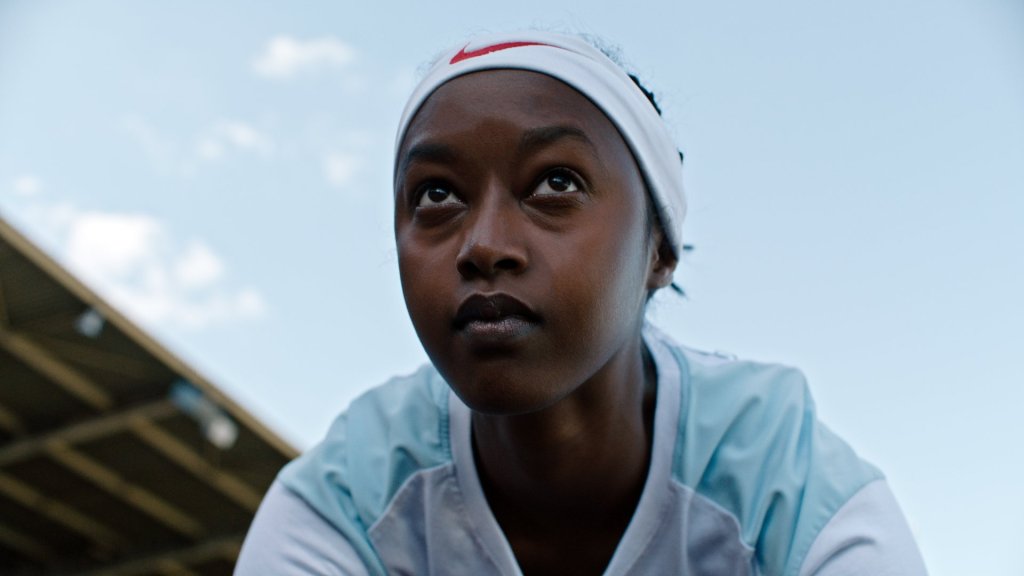
Samia (Riyan Roble) loves to run. Though only a little girl, she places among the top 10 runners in her town’s annual race. She lives in a walled compound with her strict mother, her fun-loving dad, her conservative brother Said, and her singing sister Hodan. She’s also good friends with Ali (Zakaria Mohammed) who is almost like a brother to her; his family shares their compound. But he’s a terrible runner so he appoints himself Samia’s coach.Like Rocky, they train outdoors, racing around corners and down back allies. Their goal? To make her the fastest girl in town! And as they grow older, the teenaged Samia and Ali (llham Mohamed Osman, Elmi Rashid Elmi) discover there’s a world beyond their city, beckoning Samia toward international competition.
But Somalia is unstable, with armed military tanks roaming the streets. Fundamentalists demand all girls wear a head scarf — but what about my running? asks Samia. Regional differences are on the rise and so are religious fights. Local armies and child soldiers are popping up everywhere, making it a dangerous place to live. Can Samia fulfill her dreams in an unstable country? Will she ever make it to the Olympics? And will her family support her if she does?
Samia is a bittersweet, naturalistic biopic inspired by true
events. It’s told in a series of extended flashbacks from her past remembered by an adult Samia, now fleeing Somalia for Italy, via Libya. This is an Italian film, co-directed by a Kurdish German, and an all-Somali cast. It reminds me a lot of Io Capitano (review here) from a few years ago, though this one, while touching and sympathetic, is less triumphant. It’s also rare — the first movie I’ve seen set in Somalia with Somali actors.
I liked this movie.
Oh, Hi!
Co-Wri/Dir: Sophie Brooks
Iris and Isaac (Molly Gordon, Logan Lerman: Indignation, The Lightning Thief) are a young couple in their twenties staying at a BnB in upstate New York. She is pretty, sexy and fond of practical jokes. He is good looking, chill, and open-minded. They’ve been dating for three months, but this one looks like a turning point. Isaac has perfectly arranged everything for the weekend: a beautiful house to stay in with a lake in the back, and delicious meals he cooks for her. And the sex! They are adventurous and passionate together. So when they uncover some bondage material in closet, they decide to try it out. Isaac agrees to be chained to the bed and it works out better than either of them hoped. But somehow the post-coital cuddling leads to some discussions, which reveal she thinks they have a monogamous long term relationship, while he thinks she’s fun and friendly but just another sex partner with no commitment. And all of
this happens while he is still tied to the bed.
Iris does not take this lightly; she feels betrayed. Isaac, on the other hand is genuinely frightened with her jokes about wanting to stab a previous boyfriend to death. And as time passes with little progress, both sides begin to panic. If she lets him go, will he call the cops and have her arrested for kidnapping? Is his life in danger? And when Iris’s best friend Max (Geraldine Viswanathan) and her boyfriend arrive to find Isaac still tied to the bed, it gets even more complicated. How will they ever get themselves out of this colossal mess?
Oh, Hi! is a hilarious sex comedy about trust, relationships and a date gone wrong. While I found some of the relationship psychologizing wasn’t fun, it only made up a small part of the movie. I’ve never seen Molly Gordon before — she co-wrote the script — but she has this uncanny ability to suddenly switch from gorgeous sex-goddess to google-eyed maniac. Logan Lerman is more of the straight man, but carries off his laid-back role quite nicely, considering he’s tied to the bedpost for much of the film. The story itself — along with the unexpected twists it takes — keeps you squirm-laughing almost all the way through. Though the audience at the screening I saw was maybe 80% women (who really seemed to like it), I think there’s lots there for men to think about, too.
This is a very funny movie.
Angela’s Shadow, Samia and Oh, Hi! all open this weekend in Toronto; check your local listings.
This is Daniel Garber at the Movies, each Saturday morning, on CIUT 89.5 FM and on my website culturalmining.com.
Daniel Garber talks with Neil Diamond and Catherine Bainbridge about Red Fever
Hi, this is Daniel Garber at the Movies for culturalmining.com and CIUT 89.5 FM.
Photos by Jeff Harris.
What do a feathered headdress on the cover of Vogue, a 70s pop video by Cher, and the gesture used by fans of the Kansas City chiefs have in common? They’re all about the world’s obsession with North American indigenous culture and how it’s been appropriated by the mainstream for fun and profit. And it’s used and misused everywhere, in Europe, North America — even in Asian culture — but with little or no attributions or compensation ever given to the people who originated them. What’s wrong with this, how
can it be corrected, and what is the cause of Red Fever?
Red Fever is a punchy new documentary that takes a look at cultural appropriation of indigenous art, religion, customs, and their bodies and faces within the mainstream of art, fashion, sports, entertainment, and even democracy. Using fast-moving historical footage, photos and music, it brings us back to the largely unrecognized origins of many aspects of our daily lives. It’s seen through the eyes of
Cree filmmaker Neil Diamond who guides us across oceans and continents, as he confronts, in a humorous way. Neil Diamond is known for Reel Injun, The Last Explorer and One More River. It’s co-directed by Catherine Bainbridge, a Canadian writer, producer and director who co-founded the award-winning indigenous production company Rezolution Pictures, and is best known for co-directing the award doc Rumble: The Indians Who Rocked the World.
I spoke with Neil and Catherine in person, in Toronto during Hot Docs.
Red Fever opens in Toronto on June 14th, 2024 at the TIFF Lightbox.
Daniel Garber talks with Erin Goodpipe and Saxon de Cocq about Treaty Road
Hi, this is Daniel Garber at the Movies for culturalmining.com and CIUT 89.5 FM.
It’s the 1870s in what is now Manitoba. Representatives of the British Crown, the Anishinaabe and the Muskegon Cree are negotiating the ownership and stewardship of the lands there. James McKay, a former fur-trader for the Hudsons Bay Company plays a crucial role in translating for both sides. Treaty 1, the first of a number of such treaties, set the stage for the expansion of European settlements in western Canada. But what did they mean for the indigenous peoples? Were these treaties honoured? And what role do they still play in 2024?
A fascinating, six-part documentary series called Treaty Road
examines in depth the history of these treaties, as seen by the descendants of the original signers and their representatives. Namely, the show’s co-hosts, writer-director Saxon de Cocq of the Métis Nation of Alberta, and artist and educator Erin Goodpipe of the Anishnaabe Standing Buffalo Dakota Nation. Saxon is an accomplished filmmaker who brought us CBC’s The Invincible Sergeant Bill and CIFF’s Land Acknowledgement. Erin is known on stage and screen for productions like RezX, The Other Side, and Bathsheba: Search for Evil.
I spoke with Erin and Saxon via ZOOM.
You can watch Treaty Road on APTN.
With love, from Poland. Films reviewed: March’68, Norwegian Dream, Bones of Crows

Hi, this is Daniel Garber at the Movies for culturalmining.com and CIUT 89.5 FM.
Spring film festival season continues in Toronto in June. The Inside Out festival which ushered in Pride Month, closes tonight with a jukebox musical called Glitter & Doom, a love story based on songs from the Indigo Girls. And TJFF, the Toronto Jewish Film Fest, is just starting up, with an excellent selection of comedies, dramas and documentaries from four continents, viewable online or in person with a number of special guests. And keep your eyes open for the other TJFF, Toronto Japanese Film Festival, beginning next week.
This week, I’m looking at three excellent new movies: two Polish romances, one each from Inside-out and TJFF, plus an epic indigenous drama made in Canada.
March’68
Co-Wri/Dir: Krzysztof Lang
It’s 1967 in Warsaw. Hania (Vanessa Aleksander) is a talented young actress studying theatre. She’s in a rush to view a controversial new play from backstage. It references Adam Mickiewicz, the 19th century Polish poet and playwright. But on the way she is bowled over by a young stranger. Janek (Ignacy Liss) is a student at the same university. She brushes him off but he doggedly follows her as far as the theatre. And — perhaps because of his relentless pursuit — Hania gradually begins to like him. Like turns to love, and soon they’re a couple.
But these are not ordinary times. Władysław Gomułka’s one-party state is cracking down on intellectuals and student dissidents. At the same time, it’s running a harsh purge of all Poles of Jewish descent within the Party’s apparatus. This repression soon spreads to University campuses and throughout the country at large. How does this affect the young couple? Hania’s dad is a neurosurgeon who has just lost his prestigious job in the anti-Jewish campaign. While Janek’s father is a Colonel in the Interior Ministry — basically a spy who holds everyone’s secret files, and is a major figure behind both the crackdown on student protesters and the anti-Jewish purge. Can this Romeo and Juliet couple stay together despite the purge? Or will politics cross generations?
March’68 is an excellent romantic drama set in Warsaw
during that dark, tumultuous and repressive time. (The title refers to the month when the government imposed their harshest laws.) It deftly combines real historical events and figures — from Gomulka to Adam Michnik, a future intellectual and journalist — with the fictional heroes. Through the use of period footage and reenactments, it brings you right into the middle of riots, mass arrests and interrogations alongside Hania and Janek.
This is an excellent movie.
Norwegian Dream
Dir: Leiv Igor Devold
Robert (Hubert Milkowski) is a 19-year-old boy from Bialystok, Poland. He’s starting a new job in Norway at a remote salmon processing plant. He shares an apartment in a crowded, overpriced dormitory with Marek and the rest of the Polish workers at the plant. The foreman assigns Ivar (Karl Bekele Steinland) a young Norwegian man, to train him. He’s patient and thoughtful, and befriends Robert. He’s also Black. Knowing Robert is in need of income, he offers him a weekend job in Trondheim handling the lights for Ivar’s performance. But when Robert finds out what kind of performance it was, he quits in a panic and runs away. Ivar’s a flamboyant drag queen, and Robert is terrified at being seen with him. Is he repulsed by Ivar, or is there a mutual attraction? And could Robert handle a gay relationship within a racist and homophobic environment?
Norwegian Dream is a touching romantic drama set within
the lives of migrant Polish workers in Norway. It’s made in a realistic style, with conversations happening while hundreds of dead salmon roll past on a conveyor belt. It also deals with the bigger issues of class, race, and sexuality. And while told in a simple and straightforward way, it also poses many paradoxes. Ivar may be black, but he’s also the adopted son of the owner of the fish plant and lives in a houseboat, while working-class Robert is just trying to keep his head above water. And though the casual behaviour of the Polish workers’ may be racist and anti-gay, they are also trying to form a union to get a decent wage from their exploitative employers. And while the dialogue — mainly in Polish and English — feels a bit stilted, it actually adds a further element of authenticity to the film.
I like this movie.
Bones of Crows
Wri/Dir: Marie Clements
It’s the early 20th century in Canada. Aline Spears (Grace Dove) is a girl from a Cree nation in Manitoba. She, her brother and sister are taken away from their parents and forcibly put into a residential school. It’s run by priests who feast on fine food and wine while the kids are left hungry. But Aline is given special privileges when Father Jacobs (Remy Girard) discovers she’s a prodigy on the piano. He nurtures her talent and assigns her a special tutor. But despite her new status, she is far from safe, and after suffering unspeakable acts, she and her siblings try to escape the school.
Much later, she joins the military in WWII and is assigned to London where she becomes part of a crucial team sending telegrams in Cree, this creating a code impossible for the Germans to crack. There she falls in love with and marries Adam (Phillip Lewitski) an indigenous member of the Canadian military. But despite their their bravery, they face a hard life back in Canada, their deeds forgotten. Much of her
efforts are now spent caring for their family and trying to protect her little sister Perseverance (Alyssa Wapanatâhk) who has fallen by the wayside. Can Aline’s past violations and injustices ever be rectified?
Blood of Crows is an epic drama with a gripping story about one woman’s amazing life. Although its about Aline, it’s also a metaphor for the treatment of an entire people. It’s a 100+ year long story. Stretching back to confederation, it includes the wiping out of the buffalo, residential schools, the lack of status and Canadian citizenship, denial of services, and the widespread incarceration, death and disappearance suffered by indigenous women. But, don’t worry, this is not meant as a depressing story suffering, it’s actually inspiring, about her descendants who fight for rights and redress. This movie, with its large indigenous cast and crew from the director on down, is both convincing and compelling. I saw this one last fall at TIFF, and it was one of my favourite movies there; I’m so glad it’s finally hitting theatres.
Don’t miss it.
Bones of Crows opens this weekend in Toronto; check your local listings. Norwegian Dream played the Inside Out Film Festival, and March’68 is coming to the Toronto Jewish Film Festival.
This is Daniel Garber at the Movies, each Saturday morning, on CIUT 89.5 FM and on my website, culturalmining.com.
Daniel Garber talks with Buffy Sainte-Marie about Buffy Sainte-Marie: Carry It On at #TIFF22
Hi, this is Daniel Garber at the Movies for culturalmining.com and CIUT 89.5 FM.
Buffy Sainte Marie was born to Cree parents on a reserve in the Qu’Apelle valley Saskatchewan but was adopted and raised by a family with Mi’kmaq roots in Massachusetts. She grew up musically-inclined and sang folk songs in Yorkville and Greenwich Village coffee houses. Her dynamic guitar style and distinctive vibrato set her apart.
The songs she wrote and performed climbed the charts and were covered by hundreds of other musicians, from Elvis to
Donavan, Joni Mitchell to Barbra Streisand. Her song Universal Soldier became an anthem of the anti-war movement while Now That the Buffalo’s Gone did the same for the American Indian Movement. She starred in movies and on TV, became a regular on Sesame Street, won countless awards, and was the first — and for many years only — indigenous person to win an Oscar.
Her story is told in a new documentary by Madison Thomas called Buffy Sainte-Marie: Carry It On. Narrated by Taj Mahal, Robbie Robertson, Joni Mitchell and others, and Buffy Ste Marie herself, it combines period footage and personal photos, dramatizations, and lots of music and concerts, both vintage and new.
I spoke to Buffy Sainte-Marie on site at TIFF22.
Buffy Sainte-Marie: Carry It On had its world premiere at TIFF and is opening at the Hot Docs Cinema later this month.
Daniel Garber talks with Trevor Cameron about his new documentary Shadow of Dumont at ImagineNative
Hi, this is Daniel Garber at the Movies for culturalmining.com and CIUT 89.5 FM.
Trevor Cameron is a Toronto-based writer who has always wanted to make a film about his ancestors… and one in particular. Gabriel Dumont the famed Métis leader who fought in the Battle of Batoche in the Northwest Rebellion (also a famed translator, buffalo hunter, war hero and storyteller). But Trevor didn’t know much about him. Where did he come from, where did he go after the rebellion, what did he do with his life and what became of him?
To answers these question, he got in a camper van and headed out west, to follow in Dumont’s footsteps more than a century later. And he documented his journey on film. The result? A light-hearted road movie about one man discovering his past called Shadow of Dumont.
Shadow of Dumont was written and directed by Trevor Cameron, the award-winning screenwriter, director, and roller-derby champ, known for his work on TV shows like Wapos Bay and Guardians: Evolution. Trevor Cameron’s new documentary Shadow of Dumont premiered at the ImagineNative Film + Media Arts Festival in Toronto.
I spoke with Trevor via Zoom.


leave a comment