Parts of history. Films reviewed: Fanon, Train Dreams, Christy

Posted in 1920s, 1950s, 1990s, Algeria, Biopic, Boxing, Class, Colonialism, Lesbian, LGBT, Politics, Psychiatry, Resistance, Trains, violence by CulturalMining.com on November 9, 2025

Hi, this is Daniel Garber at the Movies for culturalmining.com and CIUT 89.5 FM.

Toronto’s Fall Film Festival season continue with two series on right now. Reelasian features films from Asia and its diaspora, including two great ones from Canada: Min Sook Lee’s heart-wrenching doc There are No Words, and Koala Kid’s whimsical, animated Space Cadet. Cinefranco has movies in French from Europe, Africa, and Quebec, including many Toronto premieres: look out for la Venue de l’Avenir by Cedric Klapisch (Ma Part du Gateau), and le Dernier Souffle by the legendary Costa-Gavras. 

But this week, I’m looking at three new films set in historical eras. There’s a lumberjack at the turn of the previous century, a psychiatrist in Algeria in the 1950s, and a female boxer from West Virginia in the 1990s. 

Fanon

Co-Wri/Dir: Jean-Claude Flamand-Barny

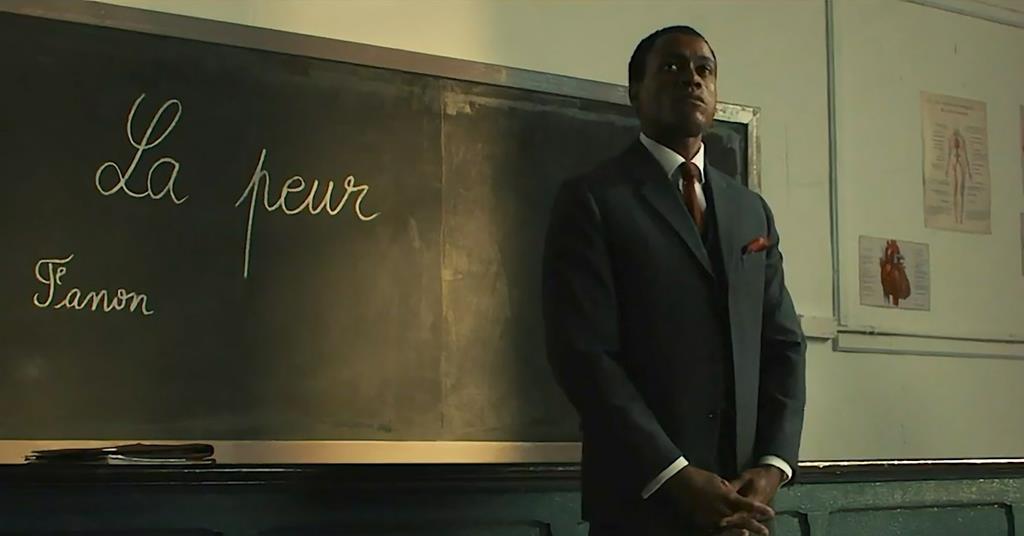
It’s the early 1950s in Algeria. Frantz Fanon (Alexandre Bouyer) is a renowned psychiatrist from the French Island of Martinique. He is starting his new job at a mental hospital. But he’s shocked at how Algerian patients are treated there. In contrast to Europeans, the “savage” north Africans are kept shackled in filthy cells, because of their “barbarous and dangerous” nature. Fanon (who is black) insists his North African patients be treated like any others. He lets them walk in the garden, plant vegetables, play soccer and make friends. Their mental health quickly improves. He’s assisted by diverse Algerian interns and staff: Hocine (Mehdi Senoussi) Jacques (Arthur Dupont) and Alice (Salomé Partouche), all followers of his techniques. But he’s strongly opposed by traditionalists and the French military, who are increasingly violent in their tactics. (Algeria was annexed by France but most of the locals are not considered full citizens.) He and his wife Josie (Déborah François) are upper-middle-class French citizens playing their role supporting the sprawling Empire. Fanon fought the Nazis in WWII. He likes Sartre, elegant suits and and fine wine. But his views are changing. He now writes books (dictated to his wife) about the effect of colonization on the mental health of the colonized in Algeria. Their own self-image is denigrated by their oppressors, he writes, when they internally accept their status as “the other”. Word gets out and he’s invited to join the FLN, (considered terrorists by the French). But the threat of violence reaches his hospital, as personified by Sergeant Rolland (Stanislas Merhar), a particularly violent soldier who checks in as a patient. How can Frantz Fanon simultaneously balance his various roles — as a husband and father, as a Black man serving the French empire, as an innovative psychiatrist, and as an intellectual joining the Algerian struggle for independence?

Fanon is a vibrant biopic about a decade in the life of the renowned author. I find it gripping and fascinating. Alexandre Bouyer is strong and statesman-like in the title role. I’ve known of Fanon for many years — as the author of books like The Wretched of the Earth and Black Skin, White Masks — but never knew about his background in psychiatry. Though occasionally heavy-handed and hagiographic, this movie opened my eyes to the exciting and intellectually stimulating story of his life in Algeria and the history that surrounded it. 

I like this one a lot.

Train Dreams

Co-Wri/Dir: Clint Bentley (Jockey) 

It’s the early twentieth century in the US Northwest. Robert Grainier (Joel Edgerton) is a bearded lumberjack who rarely speaks. He earns his living chopping down trees at migrant lumber camps and building the railroad.  He meets a woman named Gladys (Felicity Jones), they fall in love and build a homestead in a grassy patchl near a flowing river. He cuts all of the wood by hand. Gladys is good with a rifle and shoots foul and deer to eat. The rest they buy in town at a general store owned by Ignatius Jack (Nathaniel Arcand).

He spends lonely months away earning money, but always returns home in the end. He makes friends with a Chinese labourer named Fu Sheng — they don’t talk but that’s fine with Rainier who never has much to stay. But he is shocked when a crowd decides to murder Fu Sheng just because he’s a celestial. He later makes friends with an old-timer named Peebles (William H. Macy) who handles the dynamite explosions. He loves their new baby girl  but his home and family are threatened when a wildfire sweeps through the forest while he’s away. What will Grainier do?

Train Dreams is a series of events in one unremarkable man’s life set along the early 20th century northwestern frontier. A folksy omniscient voice narrates the story, hoping to add profundity; it doesn’t work. The film is meandering,  pointless and stupid. It gives token nods toward environmentalism and against racism but they’re not really part of the plot. I hated this movie from the first few seconds, with its over-produced images and inappropriate soundtrack. We see a guy sawing wood until the camera pulls back revealing…? Nothing, just more trees, as if we’re supposed to applaud the scenery! At times it’s twee, like a Wes Anderson film, but without the humour or intellect. The men all look like they’re posing for a Carhartt fashion shoot. I try to feel sympathy toward Rainier  but he’s deliberately opaque. Worst of all are the Train Dreams of the title — we keep seeing the same montages of flashbacks from previous scenes… but the original ones are as short-lived as his memories of them. 

You might enjoy the pretty pictures in Train Dreams, but I can’t see any other reason to watch this annoying blunderbuss of a film.

Christy

Co-Wri/Dir: David Michôd (The Rover)

It’s 1989 in West Virginia. Christy Salters (Sydney Sweeney) is a high school kid, and a star player on the girls’ basketball team. She’s also in love with her girlfriend Rosie (Jess Gabor), a relationship her mom (Merritt Wever) doesn’t approve. She ends up trying out as a novelty act at a boxing match, and, though she has zero training, she scores a KO on her first try. She’s a natural. She catches the eye of a middle-aged boxing entrepreneur named Jim Martin (Ben Foster). He reluctantly takes her on and lets her train at his gym, but he will not allow her to see — or even talk to — Rosie. He sets her up in a trailer park where he can keep an eye on her. Though a great fighter, she’s isolated and unprotected outside of the ring. 

Christy is a powerhouse. Her career takes off, including a new hairstyle and a trademark pink silk hooded robe to make her look more “feminine”. She knocks out all contenders and after much pressure, the 22-year-old Christy sleeps with the middle- aged Jim… and they eventually marry. 

Her career soars, she meets Don King (hilariously played by Chad Coleman) and is signed to Mike Tyson’s slate. She gains fans worldwide, but her life is micromanaged by her Svengali husband. She may be a professional fighter but he’s twice her size, unstable, and increasingly violent. And he tries matching her up with boxers way above her weight class; that’s just dangerous. Is there any way to escape this oppressive relationship?

Christy is a biopic about the first prizewinning female boxer, who paved the way for a new professional women’s sport. I was hesitant about this one — ugh, yet another boxing movie — but Christy is as good as Rocky. It’s exciting, thrilling and moving, and despite her flaws, Christy Martin’s life is super-sympathetic. Sydney Sweeney is amazing. Yes, it’s Oscar-bait (you can tell by the prosthetic teeth and mullet haircuts, playing down her image as a sex-object) but she totally gets into this role. And Ben Foster is superbly hate-able as Jim — I seriously didn’t realize it was him till the credits rolled; he’s that skillful.

Christy is a good, old-fashioned biopic and a hell of a great boxing movie. 

Train Dreams and Christy both played at TIFF and are opening in Toronto this weekend; check your local listings. And Fanon is premiering today at Cinefranco, 4 pm at the Carlton Cinema.

This is Daniel Garber at the Movies, each Saturday morning, on CIUT 89.5 FM and on my website culturalmining.com.

Hocus-pocus. Films reviewed: Good Fortune, Black Phone 2, Frankenstein

Posted in 1800s, 1980s, Class, comedy, Gothic, Horror, Supernatural by CulturalMining.com on October 18, 2025

Hi, this is Daniel Garber at the Movies for culturalmining.com and CIUT 89.5 FM.

Fall film festival season continues in Toronto with all sorts of movies to catch your fancy. Rendezvous with Madness shows movies about addiction and mental health, accompanied by discussions with the audience. They also have a knack for finding unknown amazing films whose directors or stars end up famous just a few years later (I saw my first Joaquin Trier flick at Rendezvous with Madness!)  Also opening soon are Planet in Focus, with docs about environmentalism and climate change, and Toronto after Dark, on through the weekend, a pioneer in horror and fantasy.

But this week, in honour of Hallowe’en, I’m looking at three movies with a bit of hocus-pocus. There’s a man with a guardian angel, a brother and sister who can speak to the dead, and a mad scientist who wants to builds a new human… out of dead body parts.

Good Fortune

Co-Wri/Dir: Aziz Ansari

Arj (Aziz Ansari) is at a low point in his life. He has a degree in archaeology and lives in LA, but the only work he can find is gig work, deliveries or standing in long lines so rich people don’t have to. He’s so poor he has to sleep in his car. There were a few bright spot in his life; he meets Elena (Keke Palmer) a union organizer at a big box hardware store, and they even went on a date; and he got a short term job as a personal assistant to a billionaire venture capitalist named Jeff (Seth Rogan) whose main activity seems to be sitting in saunas and ice baths. But as luck would have it, he gets fired from the job, things go bad with Elena and even his car — his only possession — gets towed. He’s penniless, in debt, and all alone. What does he have left to live for?

What Arj doesn’t know is he has a guardian angel named Gabriel (Keanu Reeves) looking out for him. In order to save his his life Gabriel — breaking all the angel rules — appears to him. He tells him that he has lots to live for, that money can’t buy happiness, and that Jeff is just as down as he is. And to prove it, he switches their lives. Now Arj has the swank mansion while Jeff is at the gig jobs, barely making enough money to pay for his next meal. The problem is Jeff hates his new life, while Arj has zero complaints about being rich. Gabriel did a boo boo by directly interfering with human lives, and his angel boss Martha (Sandra Oh) tells him, if he doesn’t fix it up, he’s going to lose his wings. Can Arj get Elena to see him again? Will he voluntarily give up all his newfound wealth? Can Jeff survive in his new environment? Will Gabriel manage to make everything right again?

Good Fortune is a light comedy co-written, directed and starring Aziz Ansari. It’s cute and funny, if not terribly original. It combines A Christmas Carol, Eddie Murphy’s Trading Places, and It’s a Wonderful Life, with a bit of updating with current details. I like its portrayal of poverty, in all its miserableness, and the mundane life of Angels is fun, too. Seth Rogan does his same old schtick, but he does it well, Keke Palmer has a low-key role, Aziz is personable, and Keanu Reeves actually smiles — haven’t seen that in a few decades. 

Good Fortune is nothing spectacular but it is cute and totally watchable.

Black Phone 2

Co-Wri/Dir:  Scott Derrickson

It’s wintertime in the early 1980s in the Colorado Rockies. Finney, Gwen and Ernie are three teenaged counsellors in training at a Christian winter camp. There’s a forest, a lake and some spectacular mountains in the background. And they sleep in heated log cabins. But where are all the campers? They stayed home, due to a record- breaking blizzard that closed all the roads. Then why are the three of them there? Gwen (Madeleine McGraw) — who has prophetic dreams — keeps getting messages from her dead mother that tell her to go to this camp. Ernie (Miguel Mora) has a major crush on Gwen and will follow her anywhere. And Finney (Mason Thames) wants to keep on eye on his little sister to make sure nothing bad happens. And the two of them know a lot about bad things happening. A couple years ago, Finn was kidnapped by a sadistic masked serial killer called the Grabber (Ethan Hawke) who murdered countless kids. But a black phone in the basement cell where Finney was locked up allowed him to speak with ghosts of the kids who had died there, and — with the help of Gwen who located him through her dreams — managed to survive, escape and kill the Grabber. But now, years later, the dead seem to be communicating with Finney again, with broken down payphone constantly ringing when he walks past (he dulls his terrifying memories with lots of cannabis). Gwen is even more affected, caught in a fugue state in her half- awake dreams, where she she sleepwalks through the snow in her pyjamas, looking for something.

Now at this deserted camp they are haunted by three scary murdered children sending scratchy messages through Gwen’s dreams and through a broken payphone. And worst of all, the Grabber has somehow reappeared. Can the three of them manage to find the dead boys, solve the mystery of the camp, and survive the return of the terrifying serial killer? Or are they all doomed to die?

Black Phone 2 is a follow-up to the very scary original from a few years back. It keeps all the same characters and actors, plus a few new ones: the camp’s owner Mando (Demián Bichir) and his cowboy daughter Mustang (Arianna Rivas). The story is dominated this time by Gwen not Finney. I love the grainy dream sequences that bridge between sleep and reality. And the pace is steady throughout the film. There are some frightening parts, but it just doesn’t seem as scary as the first one. I think we’re supposed to be terrified to see an invisible Grabber iskating on the ice with a mask on but it just looks kinda silly. The plot of the first movie was straightforward and direct. This one is convoluted and confusing. And it includes a fair amount of spiritual messages and scriptural quotes that don’t really add to the story or to its scariness.

Again totally watchable, good horror, just not as scary as the original one.

Frankenstein

Co-Wri/Dir: Guillermo Del Toro

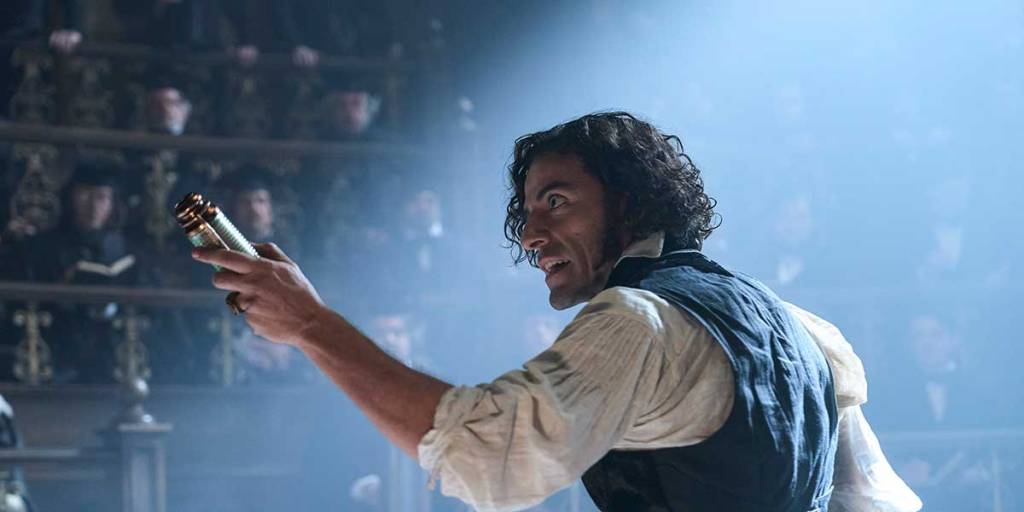
Victor Frankenstein (Oscar Isaac) is a medical student in Victorian England. The son of a minor aristocrat, the world is his for the taking. But when he shows his research in a dramatic performance before his professors — by bringing the head and torso of a dead man back to life using electric shocks — he is immediately expelled. Luckily he finds a benefactor (Christoph Waltz) from the continent to sponsor his research.  Frankenstein sets up his laboratory in an isolated castle. Like a modern prometheus, he goes through piles of dead bodies, cutting out the choicest bits to create his new, superior man. He is joined by his milquetoast younger brother William (Felix Kammerer) and William’s beautiful and intelligent bride Elizabeth (Mia Goth – she has perfect name for this movie). But when the creature (Jacob Elordi) is brought to life using a bolt of lightning, he doesn’t turn out as expected: he is a monster, a brainless slug who can only say one word. His experiment a failure, Frankenstein flees his castle burns down his laboratory, leaving career in ruins, and allowing the monster to die…or did he?

The rest of the movie follows the creature as he grows, learns to speak and read, discovers his own strength and power, and to differentiate between good and bad. But how will he turn out? And will humans ever accept him? 

Guillermo del Toro’s Frankenstein is an entirely new look at Mary Shelley’s novel, unlike any version before it. The green-faced, flat-headed Frankenstein is nowhere to be seen. Elordi is amazing as this tabula rasa with unexpected powers and emotions. He’s a completely sympathetic character for the first time. It’s the scientist who is the real monster in this movie, but one with motives and who can feel remorse. It takes place in locations you’d never associate with Frankenstein, starting aboard a ship in the Arctic. 

There’s also an extended chapter set in a cabin in the woods with a blind hermit. Yes, this Frankenstein is a gothic horror movie — which he’s been making all his life, like Crimson Peak (2015) — but this one takes it to a higher level. It’s visually stunning, wonderfully acted, it’s long but never boring, and besides the violence, gore and horror, there’s also romance and pathos, friendship, beauty and self-discovery.  

What can I say — this is one great Frankenstein.

Frankenstein and Good Fortune which both premiered at TIFF, and Black Phone 2 all open in Toronto this weekend; check your local listings.

This is Daniel Garber at the Movies, each Saturday morning, on CIUT 89.5 FM and on my website culturalmining.com.

The thrill of uncertainty. Films reviewed: Harbin, Babygirl, The Brutalist

Posted in 1900s, 1940s, Art, Class, Espionage, Korea, Sex, SMBD, War by CulturalMining.com on January 4, 2025

Hi, this is Daniel Garber at the Movies for culturalmining.com and CIUT 89.5 FM.

First let me wish you all a Happy New Year! With a new year comes renewal, hope… and potential dread. So this week, I’m looking at three new movies where people face potentially dreadful situations, partly of their own making. There’s an abused architect, a compromised CEO, and a sympathetic assassin. 

Harbin

Co-Wri/Dir: Min-ho Woo

It’s 1909 in Korea. After defeating a European empire in the Russo-Japanese war, Japan is flush with imperial ambition. They want more colonies on the mainland and are looking hungrily at Korea, Manchuria, Mongolia, and China. But some independence-minded Koreans are regrouping to fight Japan. Their leader, Ahn Jung-geun (Hyun Bin), managed to defeat a Japanese battalion in a bloody battle. But when, following international laws, Anh released the disarmed POWs, their leader Mori (Park Hoon) shot a cannon at their base killing everyone except Anh. Now the survivors are meeting in Vladivostok to decide what to do next. This includes Kim (Jo Woo-jin) his closest ally, and Woo, (Park Jeong-min) his biggest rival. And some of them think Anh is a Japanese mole. To atone for his mistakes and to do something big, he vows to assassinate Ito Hirobumi (Lilly Franky: Shoplifters, Like Father, Like Son) one of the top statesmen of Imperial Japan who is calling for the annexation of Korea. 

To do this killing Anh must make his way to Harbin, a rail hub city right on the border of Russia and northeast China where Ito plans to give a public speech. But If he travels by train he will be caught. He must turn to a former comrade turned bandit, Ms Gong (Jeon Yeo-been) to try to secure explosives. But there is a traitor in their midsts, telling the Japanese all their plans. Can they make it to Harbin undetected, find the rat, fool their enemies, and carry out the assassination? Or are they fated to be erased from their country’s history?

Harbin is a vivid and gripping retelling of a famous historical event. It’s a classic cloak & dagger, full of action, thrills, drama, and deception. It’s done in the traditional style, with the name of each character appearing on the screen to help you keep track of which moustachioed fighter is which. But easier said than done, when everyone pulls down the brims of their fedoras to cover their faces. The locations are amazing: Anh crawling across the frozen waters of the Tumen River, horse caravans on the sands of Mongolia, ancient Russian train stations… very impressive! The sets and costumes are great too, with a drunken warlord festooned in animal furs or the ceiling lamps aboard a Russian train, swinging from side to side. If you have any interest in action-thrillers, spy stories or even NE Asian history, Harbin is the film for you.

Babygirl

Co-Wri/Dir: Halina Reijn

Romy (Nicole Kidman) is the CEO of a large, successful corporation that makes automated parcel-sorting equipment — similar to what Amazon has in their warehouses. She lives with her husband Jason a play director (Antonio Banderas) and their two teenage daughters, Isabel and Nora. Her life is almost perfect, but is missing a certain…. je ne said quoi. She is not sexually satisfied. One day she is startled by a vicious dog running rampant outside her office tower. She witnesses a random young man calm the dog down and return it to its owner. Later, inside her office, she is introduced to her latest intern; it’s the same guy she saw outside. Samuel (Harris Dickinson) has an unusually forthright manner, almost rude and overbearing for someone so young. He makes her feel unhinged and yet… intrigued. Who is this twerp, and why is he like that? She finds him overconfident and almost ridiculous. And yet… eventually, to her great surprise, they kiss and sparks fly.

Soon she is secretly meeting him in seedy hotel rooms for furtive sex. But he wants more — total domination over her in an S&M relationship. Romy loves her husband and kids has never done anything like this before. Even though he takes the dominant role, in real life she holds all the cards: she’s older, richer and his boss. She has more to lose, though, and it’s that threat that excites her. And she can’t got enough of him. What will happen if word gets out? Has she bit off more than she can chew?

Babygirl is an erotic drama about an older woman’s fling with a much younger man for the thrill of it all. It’s both highly sexualized and yet uncomfortable to watch in parts. It’s entirely told from Nicole Kidman’s (Before I go to Sleep, Genius, The Beguiled, The Killing of a Sacred Deer,  Boy Erased, The Upside, Destroyer, The Goldfinch,  Bombshell, The Northman) Romy’s point of view; we share her agony, her ecstasy, her cringing embarrassment (he treats her like a domesticated pet). As Samuel, Dickinson is opaque, functioning mainly as her erotic foil. He’s usually an excellent actor (Beach Rats, Triangle of Sadness, Scrapper, The Iron Claw) but in this movie he takes second all the way. Some people love this movie, others despise it. I’m somewhere in between. The plot is just a slight twist to the hoary old cliche of the powerful executive submitting to a dominatrix. I don’t need to watch a grown woman lick milk from a saucer. But other parts are quite exciting and altogether it’s worth it for Nicole Kidman’s performance. 

The Brutalist

Co-Wri/Dir: Brady Corbet

It’s post-WWII. László Tóth (Adrian Brody: Splice, Predators, The French Dispatch, Asteroid City) is a holocaust survivor from Hungary who arrives in America as a displaced person. His wife Erzsébet (Felicity Jones) and niece Zsófia are nowhere to be seen. His cousin Attila (Alessandro Nivola) gives him a place to stay in his furniture store and puts him to work designing and building chairs. Things look up when the son of an oligarch offers him a job redesigning his father’s home library. Laszlo takes to it like a fish out of water, building a modernistic room with synchronized wooden panels and shelves beneath an open skylight. But when the industrialist Harrison Lee Van Buren Sr. (Guy Pearce) sees it, he goes ballistic and fires him without pay. Soon after his cousin falsely accuses him of sleeping with his wife Laszlo finds himself unemployed, homeless and addicted to drugs. He gets work doing manual labour at a ship yard with Gordon (Isaach De Bankolé) a man he befriended earlier until the industrialist who fired him seeks him out ago. Turns out Laszlo was a Bauhaus architect before the war, and the library was featured in modern architecture. Lee immediately rehires him, this time to build a monumental memorial on a hilltop in honour of his mother. But conflicts still trouble the two men’s relationship. Will Laszlo ever complete his masterpiece? Or will Lee crush him with his oppressive and egoistical nature? 

The Brutalist is a moving drama about the American Dream and the class struggle between two men. (The title refers to the Brutalist style of architecture Laszlo favours). It’s a full-fledged four hour epic, compete with an overture, intermission and various story lines within the plot. I’m only giving you a taste of it here, a three-minute review of a four hour movie. It is visually and audibly stunning, both in design and execution, from the score to the crisp camera work, even the surprising credit roll.  The acting is superb — I’m referring to Brody, Pierce, Jones and the rest of the large cast. This is a mature film made by a young director and former child actor. I’ve only seen one other movie by him, Vox Luxe, which, while visually interesting, didn’t have much to it. The Brutalist takes a quantum leap beyond that, filling in all the parts left out of his previous work. The movie is exciting, full of both hope and crushing devastation. It’s so well done that I left the theatre assuming it was a biopic, only later realizing it’s entirely fictional. 

The Brutalist is a stupendous movie that must be seen to be appreciated.

The Brutalist and Babygirl are now playing in Toronto, with Harbin opening this weekend; check your local listings.

This is Daniel Garber at the Movies, each Saturday morning, on CIUT 89.5 FM and on my website culturalmining.com.

Daniel Garber talks with Joshua Oppenheimer about The End at #TIFF24

Posted in Class, Disaster, Family, Interview, Musical, post-apocalypse, Science Fiction by CulturalMining.com on December 15, 2024

Photograph by Jeff Harris.

Hi, this is Daniel Garber at the Movies for culturalmining.com and CIUT 89.5 FM.

It’s some time in the not so distant future. A tight-knit family live in a mansion furnished with old masters and French impressionist paintings on their wall. Their stay-at-home mom is fastidious with keeping things in order. Dad is a retired powerhouse exec who made a killing in the Indonesian oil industry.  And their beloved homeschooled 20-year-old son who is curious about the world and loves playing with his toy train set. This lovely, peaceful household is complemented by their faithful butler, Mom’s best friend, and a doctor who is always on call. But something is wrong here. Why is their skin so pallid, their lighting unnatural, and why don’t they ever go outside? It’s because they’re living in a bunker, hidden deep underground as the planet burns. These people may be the only survivors of the end of the world.

The End is also a new film, a musical drama about the last survivors of climate catastrophe. It’s fascinating and devastating, infused with dry, dark comedy. The End is directed and co-written by award-winning filmmaker Joshua Oppenheimer, best known for his shocking documentaries The Act of Killing and the Look of Silence.

I spoke with Joshua Oppenheimer on-site at TIFF.

The End opens theatrically in Toronto on Dec 13, 2024.

Class. Films reviewed: The Old Oak, Monkey Man, Wicked Little Letters

Posted in 1920s, Action, Clash of Cultures, Class, comedy, Drama, Feminism, India, Politics, Refugees, Thriller, UK, Women by CulturalMining.com on April 6, 2024

Hi, this is Daniel Garber at the Movies for culturalmining.com and CIUT 89.5 FM.

Ordinary people fighting back is an old story, but not a tired one. This week I’m looking at three new movies — one from northern England, one from southern England, and one from India — about people confronting injustice. There are women fighting the courts, a poor man fighting the oligarchs, and a lonely man trying to stop his town’s gradual collapse.

The Old Oak

Dir: Ken Loach (my interview: 2020)

It’s 2016 in a seaside village in northern England. TJ Ballantyne (Dave Turner) is the publican of The Old Oak, one of the few gathering places left standing. But like the town — once a thriving coal pit, but now impoverished and depressed — the pub is not what it used to be. It has few customers aside from a few regulars. The sign is sagging, and half of the building is no longer used.  TJ lives above the pub; he’s lonely and pessimistic. His son won’t speak to him, and he has only a little dog to keep him company. But when a group of Syrian refugees arrives in town, TJ decides to help. Alongside Laura (Claire Rodgerson) he distributes furniture and food — donated through local churches and unions — to the newcomers. They are grateful, but some people resent it. Why are they helping refugees when local kids are going without food and heating? Syrian kids are bullied in schools, and a young photographer Yara (Ebla Mari)’s camera is broken.

What can they do to bring the community together? Together with Yara, Laura, and dozens of volunteers, they reopen a long boarded up section of the Old Oak to provide a place where people can come to eat and spend time together. The photographs on the walls recall the coal miners strike of Thatcher’s England: If you eat together, you stick together, says one sign.  But can they overcome old prejudices to form new friendships? Or will it all fall apart?

The Old Oak is a wonderfully poignant and deeply-moving drama that deals with big issues but on a personal scale. It looks at racism, poverty, unions and scabs, and how geopolitics affect us all.  Like all of Ken Loach’s movies, it  looks at imperfect people from multiple viewpoints. Some you like and end up hating, others seem like villains but you find out later they’re good people. Lots of grey, no black and white (aside from the photographs Yara takes.)

Once again, the script is by Loach’s longtime collaborator Paul Laverty, and the ensemble cast includes both professionals and first-time actors, many hired at the location.

It shows the real Britain, warts and all, not the shiny tourist-attraction you see in Hollywood movies. It’s a tear jerker, with more than one heartbreaking scenes. But it still leaves room for hope. The Old Oak may be Ken Loach’s final film, so you should get out and see it. I really like this film.

Monkey Man

Co-Wri/Dir: Dev Patel

Kid (Dev Patel) is a man with a vengeance — to punish those whose crimes he witnessed as a small child. Raised by his mother in a forest in rural India, he now lives in an unnamed megalopolis in the mythical state of Yatana (= torment, anguish). It is ruled by a god-king followed by throngs of devoted cult-like followers. They kick farmers off their land for corporate profit and persecute minorities with impunity. Kid earns his money as a boxer, beaten up regularly by bigger, stronger men. In the ring, he conceals his face behind a monkey mask, in honour of the god Hanuman whose story his mother had told him as a child. Following a complex scheme, he somehow manages to get work inside an exclusive nightclub ruled by a woman named Queenie (Ashwini Kalsekar). She warns him to never disobey her or step out of his class. He gradually works his way up the latter until he makes it into the kitchen. His goal? To shoot  a corrupt police chief named Rana Singh (Sikandar Kher). But his plans all fail, and he ends up a nearly-dead fugitive, his body floating in a canal. He is rescued and brought back to health by a temple dedicated to Shiva, and run by androgynous priests.

They admire that he, an outcaste, dares to fight authority.  But he needs the strength and skill if he wants to succeed. So, to the sounds of a tabla drum, he trains in the temple, gradually building up his stamina and muscles until he its ready to face his enemies to the death once again. But does he even have a chance against the powers that be?

Monkey Man is a class-struggle action-thriller about one man’s quest for personal vengeance and his plan to overthrow by force corrupt and autocratic leaders. It’s told using intricate plotting, involving dozens of people cooperating for a single goal. And it interweaves visions and sounds, like a  child’s picture book, an elaborate mural, and the thumping of a tabla music. There’s a lot of content to digest. The problem is, a large part of the movie consists of chases and violent fights, and they’re not very good. Blurred shots using a jiggly, hand-held camera may be artistic, but they’re unpleasant and hard to look at. Seasickness is not a valid substitute for good fight choreography.

I admire Dev Patel’s first attempt as a director and his transformation into an action hero, but Monkey Man doesn’t cut it.

Wicked Little Letters

Dir: Thea Sharrock

It’s the 1920s in Littlehampton, Sussex, a small town in southern England. Edith Swan (Olivia Colman) is a middle aged educated woman who still lives with her strict parents in a tiny row house. She reads the bible and quotes its teachings; basically, she’s an uptight prig. She shares a wall with Rose (Jessie Buckley) a migrant from the Emerald Isle. She is fond of drinking and carousing, can swear a blue streak, and is often seen wandering in just a slip outside her home. Rose likes her live-in boyfriend Bill (her husband died in WWI) but most of all, adores her daughter Nancy (Elisha Weir). But her neighbour, Edith’s father Edward Swan (Timothy Spall) despises Rose and her libertine ways, and blames her for everything going wrong in Littlehampton. They live in a tenuous detente, until everything changes when Edith receives a piece of hate mail. The unsigned letter is filled with cruel insults and vulgar words.

And when the letters pile up, the police come to investigate. They arrest Rose for the nasty letters and throw her in jail, despite her protests of innocence. The press picks up the story and it becomes a national scandal. But not everyone believes Rose is guilty. A small group of women, led by Police Officer Gladys Moss (Anjana Vasan), think Rose is innocent and set out to prove it. But can they find the true culprit before the trial? And what will happen to Nancy if her mother ends up behind bars?

Wicked Little Letters is a delightful dark comedy, based on a true story; apparently this was a hot topic 100 years ago. Little is the key word: little letters, Littlehampton, and the kind of petty quarrels that can blow up into serious events. This is a movie that knows it’s own boundaries and sticks to them perfectly, without veering off into remote tangents, flashbacks or lengthy soliloquies. It’s tight, set in tiny homes around town, and in the courthouse and jail. The acting is wonderful — everyone’s a character. Olivia Colman and Jesse Buckley previously co-starred in The Lost Daughter, but I like this one much better. And though it’s a period drama set in 1920s England, it uses colourblind casting, with many roles played by black and brown actors, without racial or ethnic issues ever entering the story (except, of course, Rose being Irish in England).

If you’re looking for a fun night out, I think you’ll like this one.

Wicked Little Letters, Monkey Man and The Old Oak all open this weekend in Toronto: check your local listings.

This is Daniel Garber at the Movies, each Saturday morning, on CIUT 89.5 FM and on my website culturalmining.com.

Some gems at #TIFF23. Films reviewed: The Movie Teller, Do Not Expect Too Much From the End of the World, The Promised Land

Posted in 1700s, 1960s, Chile, Class, Denmark, Family, History, Romania, Rural, Satire, Social Networks by CulturalMining.com on September 16, 2023

Hi, this is Daniel Garber at the Movies for culturalmining.com and CIUT 89.5 FM.

TIFF is coming to an end this weekend, but plenty of movies still playing, with free screenings of Peoples Choice winners, including the Midnight Madness and Platform series. But this week I’m talking about three gems that played the festival, from Chile, Romania and Denmark. There’s a performer in the Pampas, a driver in Romania and a would-be farmer in Jutland.

The Movie Teller

Dir: Lone Scherfig (An Education, The Riot Club, One Day, The Kindness of Strangers)

Based on the Chilean novel by Hernán Rivera Letelier

Maria Margarita and her three brothers Minto, Mauricio and Marcelino, live in a remote company- town in the Pampas where they mine saltpeter. Her mother is a beauty, obsessed with radio soap operas, her father a gruff man with a big moustache. Their biggest source of pleasure is their weekly trip to the local cinema. But when their dad is badly injured  — but not killed — in a work accident, they are suddenly without income. And their father, now in a wheelchair, can’t go to the movies anymore.

So the four kids decide to take the movies to him, by describing what they saw. The three brothers were not very interesting but Maria Margarita blew them all the way with her renditions — the love scenes, the fights, the commentaries all perfectly reproduced.  Soon word spreads and everyone in town wants to watch her perform. But will it solve their deeper problems?  And can it bring their mother home again (she abandoned her family once her husband was injured)?

The Movie Teller is a magnificent, romantic coming-of-age story (each of the four kids are played by three different actors as they grow up). The main events of their lives — like Maria Margarita’s fight with with a dust devil, or her first date with the son of the union organizer — are played out against historical events in Chile, culminating in the US-backed coup that killed Allende and brought dictator Pinochet to power. (You can guess what year it is by the movies they’re seeing). Though a bittersweet story, it feels like a classic drama. Despite the fact they’re in the middle of a desert the film is rich, lush and colourful. And it’s filled with quirky, endearing — or hateable — characters. Danish director Lone Scherfig makes a movie about movies in a cinematic style. 

Wonderful.

Do Not Expect Too Much From the End of the World

Dir: Radu Jude (Bad Luck Banging or Loony Porn)

Angela (Ilinca Manolache) is an overworked PA working for a low-rent film studio in Bucharest. She has bleached-blonde hair and wears a dress covered in metallic sequins. She spends long hours driving across the city on minor assignments. Her latest? To interview people who were badly injured while working at a foreign-owned furniture factor. She sees people missing fingers, paralyzed, or in wheelchairs. But this is not an expose; the company wants this for a promotional campaign telling people to wear their helmets… though most of them weren’t injured on their heads.

Everywhere she goes, she pulls out her smart phone and records a short video she posts on Instagram or TikTok swapping her face with a cartoonish version of Andrew Tate’s. She calls her persona Bobito, who spouts a series of bawdy,  obscene, misogynistic, and  reactionary punchlines, told in the most offensive way possible. Later she picks up marketing exec Doris Goethe (Nina Hoss) from the Austrian furniture company they’re making the film for. Will Angela survive another gruelling day? Or will tiredness turn to a fatal traffic accident?

Do Not Expect Too Much From the End of the World is a biting satirical film about contemporary Romania. It mocks pop culture, government censorship, corporate greed, in a way sure to offend almost everybody. Thereme, Deloitte, KFC, Ukraine, Orban, Putin, Germans, American gun culture,  nothing is off limits. This is an avant-garde film, not a conventional one, with very long takes — as long as half an hour — with no cuts. The scenes in her car are grainy black and white, while other scenes are brightly coloured. There are also clips from a 1981 Romanian movie about a female cab driver in Bucharest and the macho Transylvanian man she meets (the same actors appear in this film 40 years later.) And what Radu Jude film would be complete without a a seemingly endless montage of photos, almost like a slide show?

I think this film is brilliant, just like his previous one, but much easier on the eyes. If you’re OK with political satire and unconventional cinema, you should check this one out. 

The Promised Land (Bastarden)

Co-Wri/Dir: Nikolaj Arcel

It’s Jutland in Denmark in the 18th century. Captain Ludvig Kahlen (Mads Mikkelsen) is trying to start a farm in an expanse of inhospitable heath land. He wants to make his fortune, live in a mansion, and be knighted by the king. He’s the illegitimate son of a nobleman and his maid, who served 25 years in the German army, but left with only a meagre pension. He has Royal permission to start a farm there  — many have tried, none have succeeded — but faces unexpected obstacles. First, there are few people who want to work there. He ends up hiring a husband and his wife, Ann Barbara  (Amanda Collin), fleeing servitude in a manor house at the hands of a noble. He was cruelly tortured, she was sexually assaulted.

Then there’s the noble, Frederik de Schinkel (Simon Bennebjerg) a snotty young man, who craves absolute power over all of Jutland. Just by existing on the land, Kahlen challenges his authority, and de Schinkel goes out of his way to stop him. It also doesn’t help that his beautiful cousin Edel doesn’t want to marry him — she only has eyes for Kahlen. Then there are the vagabonds who live in the woods attacking any passing visitors. That’s where he meets a foul-mouthed little girl named Anmai Mus (Hagberg Melina), who the thieves use as a lure. After much squabbling, and dramatic happenings, he, Ann Barbara and Anmai Mus form a makeshift family to face the elements as they attempt to produce  the first crop ever grown on that land. Will he succeed or fail?

The Promised Land is an epic and novelistic historical drama, about a stubborn and driven man looking to fulfill his big dreams. It’s full of sneak attacks, and revenge plots. Mads Mikkelsen is marvellous as Kahlen, a man who risks his life for the sake of a title or rank, at the expense of the people he really cares about. The large cast is terrific (I mentioned only a few of the Dickensian characters) and the cinematography is panoramic.

This is a fantastic movie.

The Movie Teller, Do Not Expect Too Much From the End of the World, and The Promised Land all played at #TIFF23, which runs through tomorrow. Go to tiff.net for details.

This is Daniel Garber at the Movies, each Saturday morning, on CIUT 89.5 FM and on my website, culturalmining.com.

Scary? Films reviewed: The Beasts, The Last Voyage of the Demeter

Posted in Clash of Cultures, Class, Farming, France, Horror, Romania, Rural, Spain, Supernatural, Thriller, Vampires by CulturalMining.com on August 12, 2023

Hi, this is Daniel Garber at the Movies for culturalmining.com and CIUT 89.5 FM.

August is Emancipation Month in Toronto, commemorating the end of slavery in the British commonwealth, including Canada. So in honour of that there’s a free screening of RasTa: A Soul’s Journey, at Daniels Spectrum in Regent Park on August 13th.

But this week I’m looking at two new, scary movies. There are sailors who want to abandon ship, and farmers who don’t want to leave their land.

The Beasts

Co-Wri/Dir: Rodrigo Sorogoyen

Antoine (Denis Ménochet) and Olga (Marina Foïs) are a middle aged professional couple living in Galicia in northwestern Spain.  He’s a burly, reserved man, while she is direct and no-nonsense. They gave up their lives and careers to settle among the rocky hills, growing organic tomatoes and vegetables. They love the simple life, working hard, breathing the fresh air and taking long walking through the nearby forests and hills They get along well with some of their neighbours, but not all of them. And especially not Xan and Lorenzo, a pair of wiry, adult brothers who keep nomadic horses. Lorenzo (Diego Anido) may be simple-minded but is prone to cruel, practical jokes, with Antoine as the victim. Xan (Luis Zahera) is much worse. Xan insults him, calls him a derogatory name for French people, mutters veiled threats and even spits at him. 

At the centre of their dispute is a contract which Antoine and Olga refuse to sign. A multinational energy corporation wants to turn the village into a wind farm.  But after all the money, time and work they have put into it, they don’t want to throw it all away for a small buyout. It’s their home. This is what makes their neighbours so angry. They want to leave their ancestral homes forever. And as their fight grows, it gradually turns to violence. What will become of them?

The Beasts is an intense, dark drama played out in a clash of cultures and class. The film starts with a group of men physically wrestling with horses in slow motion. This motif comes up later in the movie in an unexpected way. It’s billed as a thriller, but it’s not — I’d call it more of a slow-burn drama, spread out over more than two hours. The dialogue is in French, Spanish and (I’m guessing) Galician, since it doesn’t sound  like any Spanish I’ve ever heard before. 

Is it a good movie? I like the characters, and the acting and the drama, and its beautiful cinematography, locations and music. But the film has a weird structure, with a very long ending after an intense chapter in the middle. It’s less thrilling or scary than it is creepy and disturbing, though it does have a satisfying finish. I just don’t quite get the point of this movie. If you like feeling uncomfortable for a couple hours but not really challenged, then you’ll probably like The Beasts.

The Last Voyage of the Demeter

Dir: André Øvredal

It’s the 1890s and the three-masted Demeter is loading at a Romanian dock, preparing for its voyage to Dover, England. Captain Eliot (Liam Cunningham) has mustered all his sailors on the ship, as well as Wojchek, his first mate (David Dastmalchian), Joseph, his bible-thumping cook (Jon Jon Briones) and his eight-year-old grandson Toby (Woody Norman). It’s the captain’s last voyage so he wants to pass on some of his lore. The only unfamiliar face is Clemens (Corey Hawkins), the ship’s doctor. Not a sailor, but he does hold a medical degree from Cambridge (very uncommon for a black man in Victorian England). But with such a small crew, even the doctor has to take his turn steering the ship and on night watch. But the most unusual thing is this ship’s cargo: a series of large wooden crates filled with dirt and branded with a sinister-looking mark. The locals refuse even to board the ship, but the crew is happy that there’s a big cash bonus if they deliver the cargo in time.

Unfortunately, things start to go wrong pretty quickly. First, a female stowaway is found on board — and sailors considered women on ships bad luck. Anna (Aisling Franciosi) is half dead, speechless and frightened. Clemens keeps her alive with frequent blood transfusions. Then all the ship’s animals — from livestock, to a dog, to even the rats hidden in the hold — are found dead. And then the crew starts disappearing, one by one. Is this a disease? A stowaway killer? Or something even worse? And will the Demeter and its crew ever reach its destination?

The Last Voyage of the Demeter is a well-crafted thriller/horror about a vampire on board a ship, based on Bram Stoker’s Dracula. And — no spoilers here — if this vampire looks familiar, it’s because he’s Nosferatu, the cadaverous, long fingered, pointy-eared  creature made famous by the silent German expressionist masterpiece by FW Murnau, released a full century ago (1922). This Nosferatu can fly, swim, hypnotize its victims and seemingly pass through walls. He’s almost indestructible. The film is beautifully shot in a German studio, with the camera flying down long passageways, into the galley, under tables and up to the sailmasts. The soundtrack is punctuated with tapping sounds that reverberate the length of the ship. The acting is quite good all around. And this vampire is a scary one.

The one thing that’s missing is pathos — with a few exceptions, you don’t feel close or attached to most of the characters. But that’s a minor problem in a good horror movie. And this one gives new life to a very old vampire.

The Last Voyage of the Demeter and the Beasts are both opening this weekend in Toronto, with The Beasts playing at the TIFF Bell Lightbox.

This is Daniel Garber at the Movies, each Saturday morning, on CIUT 89.5 FM and on my website, culturalmining.com.


With love, from Poland. Films reviewed: March’68, Norwegian Dream, Bones of Crows

Posted in 1920s, 1940s, 1960s, Clash of Cultures, Class, Communism, Cree, Indigenous, LGBT, Norway, Poland, Unions, WWII by CulturalMining.com on June 3, 2023

Hi, this is Daniel Garber at the Movies for culturalmining.com and CIUT 89.5 FM.

Spring film festival season continues in Toronto in June. The Inside Out festival which ushered in Pride Month, closes tonight with a jukebox musical called Glitter & Doom, a love story based on songs from the Indigo Girls. And TJFF, the Toronto Jewish Film Fest, is just starting up, with an excellent selection of comedies, dramas and documentaries from four continents, viewable online or in person with a number of special guests. And keep your eyes open for the other TJFF, Toronto Japanese Film Festival, beginning next week. 

This week, I’m looking at three excellent new movies: two Polish romances, one each from Inside-out and TJFF, plus an epic indigenous drama made in Canada.

March’68

Co-Wri/Dir: Krzysztof Lang

It’s 1967 in Warsaw. Hania (Vanessa Aleksander) is a talented young actress studying theatre. She’s in a rush to view a controversial new play from backstage. It references Adam Mickiewicz, the 19th century Polish poet and playwright. But on the way she is bowled over by a young stranger. Janek (Ignacy Liss) is a student at the same university. She brushes him off but he doggedly follows her as far as the theatre. And — perhaps because of his relentless pursuit — Hania gradually begins to like him. Like turns to love, and soon they’re a couple.

But these are not ordinary times. Władysław Gomułka’s one-party state is cracking down on intellectuals and student dissidents. At the same time, it’s running a harsh purge of all Poles of Jewish descent within the Party’s apparatus. This repression soon spreads to University campuses and throughout the country at large. How does this affect the young couple? Hania’s dad is a neurosurgeon who has just lost his prestigious job in the anti-Jewish campaign. While Janek’s father is a Colonel in the Interior Ministry — basically a spy who holds everyone’s secret files, and is a major figure behind both the crackdown on student protesters and the anti-Jewish purge. Can this Romeo and Juliet couple stay together despite the purge? Or will politics cross generations?

March’68 is an excellent romantic drama set in Warsaw during that dark, tumultuous and repressive time. (The title refers to the month when the government imposed their harshest laws.) It deftly combines real historical events and figures — from Gomulka to Adam Michnik, a future intellectual and journalist — with the fictional heroes. Through the use of period footage and reenactments, it brings you right into the middle of riots, mass arrests and interrogations alongside Hania and Janek.

This is an excellent movie.

Norwegian Dream

Dir: Leiv Igor Devold

Robert (Hubert Milkowski) is a 19-year-old boy from Bialystok, Poland. He’s starting a new job in Norway at a remote salmon processing plant. He shares an apartment in a crowded, overpriced dormitory with Marek and the rest of the Polish workers at the plant. The foreman assigns Ivar (Karl Bekele Steinland) a young Norwegian man, to train him. He’s patient and thoughtful, and befriends Robert. He’s also Black. Knowing Robert is in need of income, he offers him a weekend job in Trondheim handling the lights for Ivar’s performance. But when Robert finds out what kind of performance it was, he quits in a panic and runs away. Ivar’s a flamboyant drag queen, and Robert is terrified at being seen with him. Is he repulsed by Ivar, or is there a mutual attraction? And could Robert handle a gay relationship within a racist and homophobic environment?

Norwegian Dream is a touching romantic drama set within the lives of migrant Polish workers in Norway. It’s made in a realistic style, with conversations happening while hundreds of dead salmon roll past on a conveyor belt. It also deals with the bigger issues of class, race, and sexuality. And while told in a simple and straightforward way, it also poses many paradoxes. Ivar may be black, but he’s also the adopted son of the owner of the fish plant and lives in a houseboat, while working-class Robert is just trying to keep his head above water. And though the casual behaviour of the Polish workers’ may be racist and anti-gay, they are also trying to form a union to get a decent wage from their exploitative employers. And while the dialogue — mainly in Polish and English — feels a bit stilted, it actually adds a further element of authenticity to the film. 

I like this movie.

Bones of Crows

Wri/Dir: Marie Clements

It’s the early 20th century in Canada. Aline Spears (Grace Dove) is a girl from a Cree nation in Manitoba. She, her brother and sister are taken away from their parents and forcibly put into a residential school. It’s run by priests who feast on fine food and wine while the kids are left hungry. But Aline is given special privileges when Father Jacobs (Remy Girard) discovers she’s a prodigy on the piano. He nurtures her talent and assigns her a special tutor. But despite her new status, she is far from safe, and after suffering unspeakable acts, she and her siblings try to escape the school.

Much later, she joins the military in WWII and is assigned to London where she becomes part of a crucial team sending telegrams in Cree, this creating a code impossible for the Germans to crack. There she falls in love with and marries Adam (Phillip Lewitski) an indigenous member of the Canadian military. But despite their their bravery, they face a hard life back in Canada, their deeds forgotten. Much of her efforts are now spent caring for their family and trying to protect her little sister Perseverance (Alyssa Wapanatâhk) who has fallen by the wayside.  Can Aline’s past violations and injustices ever be rectified?

Blood of Crows is an epic drama with a gripping story about one woman’s amazing life. Although its about Aline, it’s also a  metaphor for the treatment of an entire people. It’s a 100+ year long story. Stretching back to confederation, it includes the wiping out of the buffalo,  residential schools, the lack of status and Canadian citizenship, denial of services, and the widespread incarceration, death and disappearance suffered by indigenous women. But, don’t worry, this is not meant as a depressing story suffering, it’s actually inspiring, about her descendants who fight for rights and redress. This movie, with its large indigenous cast and crew from the director on down, is both convincing and compelling. I saw this one last fall at TIFF, and it was one of my favourite movies there; I’m so glad it’s finally hitting theatres. 

Don’t miss it.  

Bones of Crows opens this weekend in Toronto; check your local listings. Norwegian Dream played the Inside Out Film Festival, and March’68 is coming to the Toronto Jewish Film Festival.

This is Daniel Garber at the Movies, each Saturday morning, on CIUT 89.5 FM and on my website, culturalmining.com.

Friends and Lovers. Films reviewed: The Starling Girl, The Eight Mountains

Posted in Christianity, Class, Coming of Age, Dance, Drama, Family, Friendship, Italy by CulturalMining.com on May 20, 2023

Hi, this is Daniel Garber at the Movies for culturalmining.com and CIUT 89.5 FM.

Spring Film Festival Season continues in Toronto, with Inside-Out opening next week, followed by TJFF in June.

But this week, I’m looking at two new dramas; one from the US, the other from Italy. There’s a fundamentalist young woman in Kentucky looking for love, and two men in the Italian alps looking for the fundamentals of friendship.

The Starling Girl

Wri/Dir: Laurel Parmet

Jem Starling (Eliza Scanlen) is a 17-year-old girl in Kentucky, creative, pretty and burgeoning with sexual urges. She lives in the Holy Grace Christian community under the strict guidance of her parents and Pastor Taylor. She directs her energy into dance, moving her body to express her true feelings. But the dance troupe is supervised every step of the way and the slightest transgression — be it a visible bra strap or a hint of leg — is labeled selfish or sinful. Too many sins and you get shipped off to the dreaded King’s Valley — and they’ve all seen what happens to people sent there.

Pastor Taylor and her parents believe it’s time for “courtship” — that is Jen spending time with the boy they choose.  They set it up but it does not go well. Ben Taylor is immature, gawky and socially inept. His idea of a good time is joking about chicken droppings. In any case,  Jen has her eyes on the prize: Owen (Lewis Pullman). He’s charismatic and tanned, just back from Puerto Rico. He’s into meditation more than scripture. The only problem is he’s a Taylor, too, the preacher’s eldest son and he’s already married.

They decide to meet on the sly. There first few times are chaste and pure but the two of them are ready to explode. She’s the only real person he’s ever met, the only girl he feels comfortable with, he says.  And Jen is infatuated with him. They start sending text messages or passing little notes to set up secret rendezvous. But there are no secrets in a community this small. Everything leaks out eventually. Is Jen being manipulated by an older, married man? Can Owen be trusted? And are they really in love?

The Starling Girl is a young woman’s coming-of-age drama about sexual frustration and awakening within a restrictive environment. This is filmmaker Laurel Parmet’s first feature and it’s a doozy. Filled with passion, deceit, secrets and lies, it’s a powerful look through a young woman’s eyes. I’ve never seen Eliza Scanlen before, and just assumed she was discovered in a Kentucky diner — but no, she’s yet another Australian actor bursting onto the American scene (and she’s totally convincing.) 

I recommend this one.

The Eight Mountains

Wri/Dir: Felix van Groeningen, Charlotte Vandermeersch

(Based on the novel Le otto montagne by 

Paolo Cognetti)

It’s the 1980s in Piedmont Italy. Pietro is an 11 year old boy who goes to school in Turin, but spends his summers with his parents in a tiny mountain village. There he meets Bruno, also 11, who herds long-horned goats and milks cows in the village. They become instant best friends, playing, fighting and swimming in the crystal clear waters of an isolated alpine lake. Bruno even gives Pietro a new name: Biero, which is Pietro, or stone, in the local dialect. 

Though their moms are around, both of their fathers are rarely there: Bruno’s dad does construction work in Switzerland, while Pietro’s dad is a chemist at a huge plant in Turin. But he visits when he can — he loves the isolation and grandeur of the mountains, and wants to impart his love of them on his son. He takes him on hikes up the local peaks, recording each visit in a diary. Bruno soon joins their climbs (when he’s not apprenticing to make cheese) and their bonds strengthen each summer. But high school brings big changes — school is in the cities not the villages. And it costs money. Pietro’s parents offer to pay for Bruno to study in Turin. Pietro is offended by them taking his best friend away from the mountains — you’ll ruin him! he says. In any case, Bruno’s father won’t allow it. He puts him to work full-time laying bricks at the age of 13.

Pietro drifts apart from his best friend, and breaks all ties with his family to discover himself. 15 years later, he returns to the village and rekindles his friendship with Bruno. But have they drifted too far apart?

The Eight Mountains is a wonderful novelistic drama about friendship and life in the mountains. The story takes place over two decades, with each role played by three actors, child, adolescent and adult, though mostly as the third. Luca Marinelli (Martin Eden  in Martin Eden) is excellent as an almost fragile writer who travels the world looking for his true home, and the eight mountains of the title.  (He also narrates the story).  Alessandro Borghi plays the adult Bruno — burly, bearded and gruff — but filled with self-doubt and conflicting emotions.

I don’t speak Italian, but I love the way the film plays with language and dialect, and communicates literary concepts and foreshadowing but without losing its deep, emotional pull. The film is by the Belgian team of Felix van Groeningen (The Broken Circle Breakdown) and Charlotte Vandermeersch, and it fits perfectly with their past work: it’s quite long (2 1/2 hours) with vivid natural scenery, a moving plot and American-style music. If you’re looking for a good, juicy drama about adult friendships, this is the one to see.

Great movie.

The Eight Mountains and The Starling Girl both open this weekend; check your local listings.

This is Daniel Garber at the Movies, each Saturday morning, on CIUT 89.5 FM and on my website, culturalmining.com.

Smiles and frowns. Films reviewed: Smile, Triangle of Sadness

Posted in Class, Horror, Mental Illness, Psychiatry, Psychological Thriller, Psychology, Supernatural, Thriller by CulturalMining.com on October 8, 2022

Hi, this is Daniel Garber at the Movies for culturalmining.com and CIUT 89.5 FM.

Weather changes with the seasons and so do our moods: one minute it may be sunny, the next dark and overcast. So this week I’m looking at two new movies about changing emotions. There’s a comedy about a frown and a horror movie about a smile.

Smile

Wri/Dir: Parker Finn

Dr Rose Cotter (Sosie Bacon) is a therapist who works in the emergency psych ward at a large New Jersey hospital. She’s always prim and proper, wearing buttoned shirts, with her hair neatly pulled back from her face. She spends most of her time at work, up to 80 hours a week, but on her free time she likes nothing better than sipping white wine in her bungalow, cuddling her fluffy cat Moustache or just chatting with Trevor, her nondescript fiancé. She is devoted to helping her patients, having survived her own mother’s mental illness and suicide when she was a little girl.

It’s just a normal day when she examines a new patient in intake. Laura is a grad student showing signs of paranoid delusions. She is terrified that someone is out to get her. “I’m not crazy, I’m a PhD candidate!” says Laura (as if the two were mutually exclusive).  She’s not sure whether it’s an evil spirit, a ghost or a satanic possession, but whatever it is, it’s been haunting her since she witnessed her prof commit suicide just a few days earlier. It takes the form of people closest to her, that only she can see. And worst of all, it has a horrible smile. And before Rose can do anything, Laura violently kills herself right in front of her… with that awful smile plastered on her face. And from that moment on things feel different for Rose. 

Her nightmares turn into daydreams. She begins to hallucinate — with figures from her past, including a dead patient, reappear before her, smiling. She has very few people to talk to outside of the hospital: Trevor, and her older sister Holly, who only talks about family and real estate. She visits her own former therapist, who refuses to prescribe anti-psychotics, saying it’s just stress and overwork. But Rose knows it’s something more. Everything that happened to Laura — and her professor before her — seems to be inflicted on Rose now. She finally turns to her ex-boyfriend Joel (Kyle Gallner) for help. He’s a police detective now, investigating Laura’s death; perhaps he can find out what’s causing these suicides. Because Rose is sure she’s either going insane, or is controlled by an evil entity… or both! And if she doesn’t do something fast, she’ll be dead in three days. Can Rose figure out what’s happening to her, and stop her impending, smiling suicide? Or is she out of time?

Smile is a good psychological thriller/horror. While it’s occasionally predictable — with some dubiously freudian plot turns — it’s mainly a gripping, scary flick. Great spooky music and some cool visuals, like disorienting, upside down drone shots of a cityscape, and a delightful scene change using the camera’s iris. And lots of cute, smiley-face images popping up everywhere in the background. I’ve never seen Sosie Bacon before, (she’s second generation Hollywood, the daughter of Kevin Bacon and Kyra Sedgwick) but she’s quite good as Rose, gradually transforming from uptight doctor to terrified heroine. 

If you’re in the mood for a good screamer, check out Smile. 

Triangle of Sadness

Wri/Dir: Ruben Östlund

Yaya and Carl (Charlbi Dean, Harris Dickinson) are a millennial power couple. Carl is a fashion model who is featured shirtless in perfume and underwear ads. He is known for his looks. But he still has to show up for cattle-calls. Yaya, though, is an influencer — her posts and selfies are followed by millions, and sponsors are constantly sending her money and goods to promote. But their unequal status spurs an argument. Why does he have to pick up the cheque when they go out to dinner? He’s the man in the relationship but Yaya is much more famous and earns way more money than Carl. It’s just not fair. So she invites him to join her on an elite cruise ship, all expenses paid.

The boat is an exclusive luxury liner, and the passengers are some of the richest people in the world. One couple made billions selling bombs and landmines. Another oligarch, named Dimitri (Zlatko Buric) proudly says he earned his fortune selling shit — literally. He cornered the market in fertilizer. And the staff are trained by Paula, the head of the crew (Vicki Berlin), to fulfill any whims or demands of the passengers no matter how outlandish or nonsensical. And Carl and Yaya soon find out that any casual complaint or criticism of a staff member they might make may lead to their instant dismissal. But the ship hits trouble on the high seas, and the captain (Woody Harrelson), an alcoholic communist, can’t stay sober long enough to prevent a disaster. 

Later, the passengers and staff regroup on a tropical isle, situated somewhere between Gilligan’s Island and Lord of the Flies. But with a new power structure in place, who will make it out of there alive?

Triangle of Sadness — the title refers to that part of the face from the brow to the bridge of the nose that supposedly conveys happy or sad emotions — is a scathing satire about the state of the world. Told in three chapters — in the city, on a ship, and on a remote island — it follows a young couple as they navigate life among the powerful and super-rich. It also shows what could happen if existing power structures (and the money that reinforces them) ceased to exist. Did I mention this is a comedy? I found it bitingly and bitterly hilarious, though at times disgusting. For humour’s sake, it reverses many presumptions: by presenting men — not women — as sexual objects subject to exploitation; and by pulling away the curtains hiding  the transgressions of the rich and powerful.

The acting in this dark comedy — especially by the late Charlbi Dean and Harris Dickinson, as well as Zlatko Buric and Dolly De Leon as Abigail a former toilet cleaner who suddenly finds herself as the big fish in a small pond — is excellent all around. The story is told as a comic fable, intentionally never realistic, with settings, costumes, and music, all reinforcing its farcical nature. This is not Swedish director Ruben Östlund first dark comedy — he previously directed such great movies as The Square and Force Majeure — but Triangle of Sadness is the most extreme of all his films, one that takes his themes beyond the expected limits. Though not universally loved, in my opinion this is one great movie.

Smile is now playing and Triangle of Sadness, which played at #TIFF22 earlier this year, opens at the TIFF Bell Lightbox this weekend.

This is Daniel Garber at the Movies, each Saturday morning, on CIUT 89.5 FM and on my website, culturalmining.com