Men, music and sports. Films reviewed: The History of Sound, Him, EPIC: Elvis Presley in Concert

Posted in 1920s, 1960s, Christianity, Corruption, documentary, Folk Music, Football, LGBT, Music by CulturalMining.com on September 20, 2025

Hi, this is Daniel Garber at the Movies for culturalmining.com and CIUT 89.5 FM.

TIFF is over but the movies keep coming.  So this week, I’m looking at three new American movies, two about music and one about sports. There are two men recording folk songs in the forest, an ambitious quarterback at a training camp in the desert, and a former teen idol wowing audiences on a Vegas stage.

The History of Sound

Dir: Oliver Hermanus

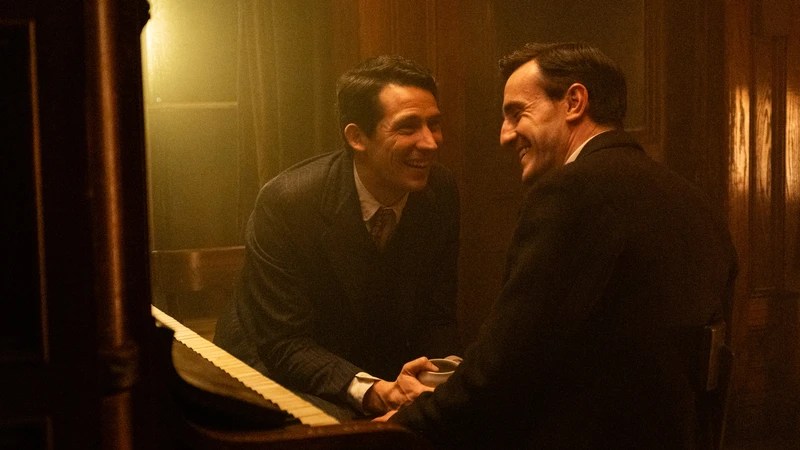
It’s the early 20th Century in rural Kentucky. Lionel (Paul Mescal) likes listening to his father sing while he plays the fiddle. Music for him is different from most folks: he has synesthesia. This means each musical note has a distinct colour, flavour and meaning. Eventually his love of music and beautiful voice wins him a full scholarship to the New England Conservatory of Music. At a Boston pub one night, he recognizes a song his father used to play, coming from a young man at the piano.  David (Josh O’Connor) knows every word. As an ethnomusicologist, he wants to collect as many distinct folk songs and ballads as he can, before they are lost forever. David has perfect pitch and a photographic memory. The two trade songs they know, and somehow, end up in bed together that night. That chance encounter turns into regular trysts at David’s apartment.

Later he invites Lionel to join him in a fieldwork project. They roam across the state of Maine, recording songs everywhere from logging camps to schoolhouses, And they record it all on wax cylinders (this is before flat discs are invented) carefully stored in a leather satchel. And each night they sleep together in a tiny tent. Is this true love? And what will happen to their relationship after the project is finished?

The History of Sound is a touching, bittersweet gay romance — before the word gay existed — set within the larger context of war and music. It’s directed by South African filmmaker Oliver Hermanus (Moffie) and its based on a short story by Ben Shattuck. I wonder if the characters are modelled on Alan Lomax, the ethnomusicologist who recorded thousands of songs and started the folk music revival in the 1950s. Paul Mescal is spot-on as the sensitive kid in a clapboard shack who grows up to be a cosmopolitan musician; as is Josh O’Connor’s  portrayal of an enigmatic musical genius with hidden secrets. The images are as lovely as the music in this tender and moving film.

I really liked it.

Him

Co-Wri/Dir: Justin Tipping

It’s San Antonio, Texas, and their NFL team, the Saviours, is looking for a new quarterback to replace their MVP Isaiah White (Marlon Wayans), due to retire in a year. Cameron Cade (Tyriq Withers) is a young quarterback who lives for football — his father trained him for this since he was a little kid. When he’s offered the position if he agrees to an intense one-on-one, bootcamp with his idol Isaiah White, of course he says yes; this is the fulfillment of all his dream. Thing is, he recently had a serious injury that left him with a bad concussion and a track of staples in his head. If he aggravates his brain, it might end his football career before it starts. But as his father always told him, No Pain, No Gain. Cameron heads out to the training camp in the desert. 

There he encounters absolute luxury: gourmet food and priceless art in a spacious brutalist palace. There are saunas and ice baths, and daily blood transfusions for Isaiah. Cameron too tastes this luxury — and sexual temptations — offered by Isaiah’s entourage, especially the grotesquely made-up wife Elsie White (Julia Fox), an influencer who sells her own line of sex toys. Isaiah is the GOAT — the Greatest of All Time — and his virulent fans wear goat horns on their heads. Cameron, on the other hand, holds onto silver cross. He’s given a series of Squid-Game-like ordeals he must endure before Isaiah gives him the nod. And as the tasks grow increasingly horrific, his morals are severely challenged. Can he pass the tests? And is he ready to give up his innate morality and embrace pro-sports and all it offers?

Him is a psychological thriller about a young man confronting his hero (who is also his nemesis) even as he uncovers the dark underbelly of pro football. It’s produced by Jordan Peele, so you might expect a suspense/thriller with mind-blowing surprises. If so, you’ll be sorely disappointed. What you’ll get instead is more like a highly-stylized, extended music video than a horror film. There’s lots of dazzle and flash — and an equal amount of blood — but it’s never scary or surprising. And director Tipping uses film techniques like a kid playing with toys. Why are people shown in in infrared X-rays? Why a long fashion shot sequence in what’s supposed to be a scary scene? Why do cowboy-hatted cheerleaders continue dancing in the face of horrific deaths? There are some great visual cues — like the aluminium stitches in his skull evoking the side of a football — but it’s all show, no substance in this cheap morality play. 

Him is fun to look at, but there’s nothing there.

EPIC: Elvis Presley in Concert

Dir: Baz Luhrmann

It’s the 1950s. Elvis is the King of Rock and Roll with a series of hits and the nation goes wild over his thrusting pelvis and his soulful voice.  Later, he is drafted into the army where he serves two years. Afterwards he turns to Hollywood where hue churns out a series of hits alongside sex goddesses like Ann-Margaret. And late in the 1960s he signs a multi-year contract to perform before sold-out audiences at a Las Vegas Casino. He’s up there every day, dressed in eggshell blue jumpsuits, covered in silver studs, sequins and spangles, joking with the crowds, and sweating buckets. He is accompanied by a retinue of back up singers, musicians and elaborate lighting. And that is basically how Elvis spends the rest of his life, until he collapses and dies in  Graceland, age 42.

EPIC: Elvis Presley in Concert is a combination documentary and musical performance. Just two years ago, we had both Baz Lurhmann’s biopic Elvis and Sofia Coppola’s Priscilla, two similar stories told from different points of view, neither of which were particularly good. And now, out of nowhere comes this  third one. I’m not an Elvis fan, nor do I like the kitschy

Buzz Luhrmann at EPIC’s world premiere at TIFF50: Photo (c) Jeff Harris

and gaudy films of Baz Luhrmann. Which is why I’m shocked at how much I enjoyed this movie (I saw it on an IMAX screen at TIFF last week, almost by accident.) Ostensibly just a musical record it’s actually a succinct and tight history of the man, so much better than those bloated biopics. 

It’s fantastic, a masterpiece of creative editing, colour restoration and music mixing. It’s absolutely stunning. The songs he sings are mainly hits from the 1960s cover-versions of Bridge Over Troubled Water, You’ve lost that Loving Feeling, and even gospel songs. And over the course of a single song, we see him on stage, in rehearsal, or in the recording studio, shot over many years, but without a break in the music. And despite Luhrmann’s gaudy excess, somehow his capture of Elvis in a psychedelic shirt or sparkling gold belt buckles just looks right. 

EPIC is the perfect concert film.

Him and The History of Music both open this weekend in Toronto; check your local listings;  EPIC: Elvis Presley In Concert played at TIFF and will be released soon.

This is Daniel Garber at the Movies, each Saturday morning, on CIUT 89.5 FM and on my website culturalmining.com.

Movies with two directors. Films reviewed: Abigail, Unsung Hero, Sasquatch Sunset

Posted in 1990s, Australia, Christianity, Family, Horror, Kidnapping, Music, Mystery, Vampires by CulturalMining.com on April 21, 2024

Hi, this is Daniel Garber at the Movies for culturalmining.com and CIUT 89.5 FM.

Not everyone likes every type of movie. Some want to be excited or scared, others want to be gently reassured, and still others expect to be intellectually stimulated. So this week I’m looking at three new movies — a horror, a  family drama, and a strange arthouse flick — basically, something for everyone. There’s a group of kidnappers lured by a huge ransom, a family of Australian musicians with big ambitions, and a near-family of near-humans with very big feet. 

Abigail

Dir: Matt Bettinelli-Olpin, Tyler Gillett (Review: Ready or Not)

Abigail (Alisha Weir) is a poor little rich girl who loves ballet dancing. Though still very young, she is diligently rehearsing the lead role in Swan Lake, complete with tutu and toe shoes. Until she is injected with sedative, dragged from her mansion, and wakes up chained to a bed in a creepy castle far away. Who is responsible? A gang of professional criminals, none of whom have ever met before, but promised 7 million in cash each, if they can babysit Abigail until the whopping ransom arrives the next day. 

The gang consists of Frank (Dan Stevens) a canny former cop, Dean (the late Angus Cloud) their ginger-bearded pothead driver; Peter (Kevin Durand) a musclehead enforcer, Sammy (Kathryn Newton) an expert hacker who favours expensive jewelry; Rickles (William Catlett) a sniper and former marine, and Joey (Melissa Barrera), their de-facto organizer.  She’s the only one talking with the little girl… who is very frightened and distraught. To calm her down, Joey promises nothing bad will happen to her, pinky swear.

But things take a turn when one of the gang is discovered in the kitchen, headless. Even worse, they find out Abigail’s dad is one of the richest — and most dangerous — men in the world, known for cruelly torturing and killing anyone who crosses his path. And then there’s little Abigail herself: she’s not actually a girl — she’s a centuries-old vampire who feeds on human blood… who happens to like ballet. Can the gang escape this house of horrors? Or will they be killed, one by one?

Abigail is a violent and gory vampire horror/thriller. It’s a reboot of the classic story: “if you can stay in a haunted house overnight I’ll give you a million bucks”. It also plays on Agatha Christie’s And Then There Were None, Rian Johnson’s Glass Onion, or Tim Story’s The Blackening, where characters locked in an old house are killed, one by one. That said, the characters — and plot turns — in Abigail are different enough to keep you interested. Yes, there are cliches — a house full of suits of armour and widows that close and lock themselves —  but it also adds shocking new twists to the old vampire myths — like, what happens to vampires when they die? (No spoilers).

If you like mystery and horror, with lots of blood guts and gore, tempered a fair amount of ballet dancing, I think you’ll enjoy Abigail. 

Unsung Hero

Wri/Dir: Richard L. Ramsey, Joel Smallbone

It’s 1991. David Smallbone (Joel Smallbone) is a successful music promoter in Sydney, Australia. He lives with his pregnant wife Helen (Daisy Betts) and six kids in an enormous mansion, and manages tours by big musical stars. But when a bad business deal leaves him completely broke, they all decide to fly halfway around the globe to Memphis, Tennessee. But the promised job awaiting him… wasn’t there, and the pre-arranged rental house was completely empty. Luckily Mum is a quick thinker, and turns their suitcases into beds — who needs furniture, anyway? The kids love playing cricket in the empty rooms. But she still has eight mouths to feed — David, Helen, Becca, Daniel, Luke, Joel, Josh and Ben —  three times a day, and no money to do it. But the heavens are shining bright on the Smallbones and they soon find work gardening and house cleaning, including with some of his former musical clients. The kids are pitching in, too, when they’re not being home-schooled. They have a money jar to pay for food and rent, and a wall chart with things they want and want to pray for; the Smallbones are a devout Christian family. It’s at a Church service that everyone notices what a beautiful and angelic voice Becca, the oldest daughter has (Kirrilee Berger). This provides David with the motivation he needs to get a music contract signed for Becca, thus saving their family from wrack and ruin. But can David and Becca do it? Or will the family fly back to Australia with their collective tails between their legs?

Unsung Hero is a biopic of the real-life Smallbone family, before the kids became famous, as seen through their mother Helen’s eyes. It shows how they pulled themselves back up after a major setback. It’s a faith-based movie, where praying and church play central roles throughout the film. The father David (circa 1991), is played by his actual son (in 2024). And the music they produce — from the beautiful singing of Kirrilee Berger, to the band For King + Country that Joel and Luke later founded — is good. Not to my taste, but it’s actually good. The problem comes from producing a biopic where the subjects have a central role in its content. I grew up in a family of seven and we kids fought verbally and physically all the time. In this movie, though, they are so kind and whitewashed they make the Brady Bunch kids seem like gangstas. Maybe that’s true in this family, but it rings false to me. Way too Hallmark-y. There are also a number of basic faux pas. Like having a flashback within a flashback in the opening scenes — that’s just clumsy editing. 

If you want to watch an inspiring and positive 90s- era story about a musical family’s Christian life, you might like Unsung Hero. Otherwise, I don’t think you’ll get much out of it. 

Sasquatch Sunset

Dir: David Zellner, Nathan Zellner

Somewhere in the redwood forests in Northern California, a pack of four unclassified animals are wandering around searching for food. They are covered in brown and grey hair, walk on two legs, and have opposing thumbs. Are they human, or are they animals? They are Sasquatches, popularly known as the Bigfoot. And they are a lot like us. They eat, sleep and have sex. Urinate, defecate, and puke when they eat something poisonous.  They give birth and die. They play, communicate, make music and look at the stars in the sky. And they come in at least two genders and a number of sizes. 

They commune with nature, and vice versa; snakes, skunks, deer and porcupines happily coexist, and even play with them. Sasquatch are mainly vegetarian though they do eat fish. They also make mistakes, especially the biggest of the four, the alpha Sasquatch. He has a tendency to stick his “stick” where it doesn’t belong. And the other three react loudly and emphatically when he does something he shouldn’t do. But when they encounter signs of humans — felled trees, camping equipment, a paved road — they are shaken to their core. Will they ever spot one of us?

Sasquatch Sunset is a very weird, arthouse film about the journey of Sasquatches in their natural habitat and the encroaching presence of humans. It feels partly like a nature documentary or an anthropological newsreel, but it’s also very funny at times. Sad too. And it has actual characters. They don’t have names but let’s call them the big, mean one, the relaxed one with breasts, the pensive intellectual and the adolescent (Nathan Zellner, Riley Keough, Jesse Eisenberg, Christophe Zajac-Denek). There is also dialogue — grunts and whoops, the banging of sticks and  lots of jumping around and screeching. At first, I couldn’t tell them apart or even what their sex is — they‘re all really hairy! — but it gradually becomes quite apparent. And by the end I think you’ll feel for them and understand them, too.

Sasquatch Sunset is a very strange movie, but I liked it. 

Abigail and Sasquatch Sunset, open this weekend in Toronto, while Unsung Hero starts next Friday; check your local listings.

This is Daniel Garber at the Movies, each Saturday morning, on CIUT 89.5 FM and on my website culturalmining.com.

Current cinema. Films reviewed: Destroy All Neighbours, Freud’s Last Session, T.I.M.

Posted in 1940s, AI, Christianity, comedy, Ghosts, Horror, Ireland, Music, Psychiatry, Robots, UK, WWI, WWII by CulturalMining.com on January 13, 2024

Hi, this is Daniel Garber at the Movies for culturalmining.com and CIUT 89.5 FM.

It’s “award season” when prizes are handed out to the best — or most widely publicized — movies. But not every film is prestigious or a blockbuster. So this week, I’m looking at three new movies — one each from the US, Ireland and England — that might otherwise fall through the cracks. There’s a robot with human traits, a music producer turned serial killer, and a psychoanalyst talking about God. 

Destroy All Neighbours

Wri/Dir: Jonah Ray Rodrigues

William (Jonah Ray Rodrigues) lives in a rundown apartment with his girlfriend Emily (Kiran Deol) a lawyer. He’s tall, skinny, and wears unfashionable clothes and nerd glasses. He works in a studio at the soundboard, helping bands record their music. But sometimes he feels like he’s just a knob- turner, going through the motions. His real passion is recording the ultimate prog-rock album, and is constantly coming up with new ideas, but never finishing it.  Emily encourages him to give up and move on, but he feels he has to do it. But he’s getting more and more tired and frustrated by the people around him. At work, his boss is constantly ragging him for being late. And the latest client, Caleb Bang Jansen is insufferable. Even the panhandler where he parks his car is getting on his nerves. At home, Eleanor, the elderly pothead superintendent (Randee Heller) is constantly calling him for help with the fuses. Another neighbour, Phillip, lets his pet pig roam the halls. But worst of all is the new tenant next door. Vlad (Alex Winter) is hideously ugly, aggressive and incredibly loud, playing non-stop euro disco all night long. Vlad lifts weights using buckets of cement attached to his barbell. He’s a scary guy, William is passive aggressive and terrified of face to face confrontations.

When he finally visits Vlad to ask him to turn down the music, they get in a fight and somehow Vlad ends up impaled on a stake, and — accidentally —  decapitated! William doesn’t know what to do, but finally realizes he has to dispose of the body. But things have changed since Vlad —  new bodies keep piling up — always killed unintentionally by him, by strange coincidences. He becomes a serial killer by default, or a serial manslaughterer, as he likes to say. 

But when the all the people he killed come back to life, he realizes something really strange is going on. Can William keep his boss and girlfriend happy, record his prog rock album, stop killing people, and living a normal life? Is he destined for a very dark future? Or is he just losing his marbles?

Destroy all Neighbours (the title says it all) is a comedy/horror movie, with an emphasis on in-your-face, gross-out humour. So there’s lots of disgusting blood and gore, but it’s always so exaggerated it’s funny, not scary, in the manner of Monte Python or Army of Darkness. Jonah Ray Rodrigues is the writer/ director/star and the current host of Mystery Science Theatre 3000. I admit it’s an acquired taste, and some of the gags and schtick fall flat, but I was laughing more than not. I happen to like that kind of humour (in moderation) but, admittedly, it’s not for everyone. So if you’re into bloody horror-comedy set in L.A.s skid row, or even if you’ve ever had annoying neighbours, I think you’ll love Destroy all Neighbours. 

Freud’s Last Session

Co-Wri/Dir: Matt Brown

It’s September, 1939. Germany has invaded Poland and Great Britain is about to go to war. Sigmund Freud (Anthony Hopkins) and his daughter Anna (Liv Lisa Fries) left their homes and vocations in Vienna after the Anschluss — the unification of Austria and the Third Reich, and moved to London. His office is decorated with the art and bric-a-brac of home: Persian rugs, African fertility statues and Catholic saints. Anna continues to research and give lectures on psychoanalysis and child psychology, but Sigmund, due to his age (he’s 83) and poor health (he’s dying of cancer) rarely leaves his home now. But on this day he has an unusual visitor: CS Lewis (Matthew Goode). Lewis is a don at Oxford where he teaches English and has written a book about Pilgrims Progress. (He later goes on to write The Chronicles of Narnia.) And he’s still suffering from shell shock from WWI. But why are they meeting? Lewis wants to talk with Freud about God and religion. He once was an atheist but now has adopted theism and Christianity as his guiding light. Freud, on the other hand, is a committed atheist and finds all religions equally fascinating and equally false. Still, they have a spirited discussion on a wide range of issues. But certain topics are taboo. For example, Freud refuses to talk about the fact that Anna has a female lover. And Lewis considers his own sexual relationship with his late best friend’s mother as something too private to share. Meanwhile, air raid sirens are going off, Freud is struggling with the oral prosthetic he calls his “Monster” and nobody knows what the future will bring. Will this be Freud’s very last session?

Freud’s Last Session is a fictional historical drama adapted from the successful stage play. There’s no evidence that an elderly Freud and a younger Lewis ever actually met; the story functions more as an intellectual exercise than a theatrical drama. So it’s not captivating, but it did keep my attention. They try to perk it up a bit with flashbacks — Lewis in the trenches in WWI; Freud as a small child — but I found them lacklustre at best. There are some clever touches, where Freud ends up reclining on the settee while Lewis takes on the analysts role. Of course it has nice period costumes and sets, but the main reasons to see this film is first the topics and second the acting. The topics range from sex to psychoanalysis to theology. Devotees of Freud and/or Lewis may get a kick out of it, but no major revelations here. The acting, though is delightful. Hopkins walks through his usual role — along with a few artfully-placed wunderbars and ja ja ja and das ist gut! so we don’t forget he’s Austrian. Goode is more passionate, fearful and sad. Best of all is German actress Liv Lisa Fries (from Babylon Berlin) as Anna Freud, who gets to rush around London looking for meds for her Dad.

Freud’s Last Session is not bad, but not noteworthy, either.

T.I.M.

Co-Wri/Dir: Spencer Brown

Abi and Paul Granger (Georgina Campbell, Mark Rowley) are married, professionals, double-income, no kids, moving into a beautiful, modern home in rural England. It’s at the end of a long country road, with open staircases, glass walls and a huge garden, all paid for and arranged by Abi’s employer. She’s an engineer who specializes in AI robotic prostheses.  She designs the human-looking hands of robots. Paul is currently unemployed, but is in line for a corporate position in London. They’re both looking forward to their first child, and are working hard at it each night.

Now this house is completely on the grid. Everything’s smart — smart windows, locks, heating, computers, lighting — all controlled through a central console, and co-ordinated with their smart watches and  phones. The central console, though, is something her company invented. It’s a Technologically Integrated Manservant, T.I.M. for short, or just Tim. Tim (Eamon Farren) is a humanoid robot with perfect male features, blond hair, and artificial intelligence; he’s constantly learning. He’s a prototype: he can cook gourmet foods, do heavy lifting, play the piano, send and answer emails. Abi’s boss is adamant that all his employees have a T.I.M., so they can get rid of the bugs in the system before the upcoming release. Abi, loves her new toy, but Paul is less enthusiastic. Why did T.I.M. barge into their bedroom while they were making love? T.I.M. says Abi’s blood pressure and temperature had risen, he just wanted to make sure she was OK. But Paul suspects T.I.M. of spying on him. He thinks TIM sends messages to Abi whenever Paul visits Rose their only neighbour (Amara Karan), feeding Abi’s suspicious jealousies. And when he catches T.I.M. perving through Abi’s clothes, he knows something is very wrong. Is T.I.M. morphing into something bad? Can a robot even have feelings? And if things go wrong, who will Abi trust: Paul, the fallible human, or T.I.M., the perfect machine?

T.I.M. is a sci-fi thriller about the potential dire consequences of AI given a human form. This isn’t the first humanoid movie — there have been at least a dozen in the past few years — and some of the plot is predictable. And it does have that “pandemic movie feel” to it, with a tiny cast (just four main characters) located in an isolated country setting, but, in this case, it really works. It’s scary, it’s creepy, it’s interesting. It feeds on your worst fears about electronic devices communicating without your knowledge, and the possibility of the singularity, when humans will no longer be essential. I’m not familiar with any of the actors but the cast is good. The storyline is compelling, and most of all, the movie feels believable. So if you ever feel like your smart phone is a bit too smart, you’ll like this scary, sci-fi thriller. It’s a good one.

Freud’s Last Session opens this weekend in Toronto; check your local listings. Destroy All Neighbours is streaming exclusively on shudder.com, starting today; and T.I.M. is now available digitally and on V.O.D. 

This is Daniel Garber at the Movies, each Saturday morning, on CIUT 89.5 FM and on my website culturalmining.com.

Friends and Lovers. Films reviewed: The Starling Girl, The Eight Mountains

Posted in Christianity, Class, Coming of Age, Dance, Drama, Family, Friendship, Italy by CulturalMining.com on May 20, 2023

Hi, this is Daniel Garber at the Movies for culturalmining.com and CIUT 89.5 FM.

Spring Film Festival Season continues in Toronto, with Inside-Out opening next week, followed by TJFF in June.

But this week, I’m looking at two new dramas; one from the US, the other from Italy. There’s a fundamentalist young woman in Kentucky looking for love, and two men in the Italian alps looking for the fundamentals of friendship.

The Starling Girl

Wri/Dir: Laurel Parmet

Jem Starling (Eliza Scanlen) is a 17-year-old girl in Kentucky, creative, pretty and burgeoning with sexual urges. She lives in the Holy Grace Christian community under the strict guidance of her parents and Pastor Taylor. She directs her energy into dance, moving her body to express her true feelings. But the dance troupe is supervised every step of the way and the slightest transgression — be it a visible bra strap or a hint of leg — is labeled selfish or sinful. Too many sins and you get shipped off to the dreaded King’s Valley — and they’ve all seen what happens to people sent there.

Pastor Taylor and her parents believe it’s time for “courtship” — that is Jen spending time with the boy they choose.  They set it up but it does not go well. Ben Taylor is immature, gawky and socially inept. His idea of a good time is joking about chicken droppings. In any case,  Jen has her eyes on the prize: Owen (Lewis Pullman). He’s charismatic and tanned, just back from Puerto Rico. He’s into meditation more than scripture. The only problem is he’s a Taylor, too, the preacher’s eldest son and he’s already married.

They decide to meet on the sly. There first few times are chaste and pure but the two of them are ready to explode. She’s the only real person he’s ever met, the only girl he feels comfortable with, he says.  And Jen is infatuated with him. They start sending text messages or passing little notes to set up secret rendezvous. But there are no secrets in a community this small. Everything leaks out eventually. Is Jen being manipulated by an older, married man? Can Owen be trusted? And are they really in love?

The Starling Girl is a young woman’s coming-of-age drama about sexual frustration and awakening within a restrictive environment. This is filmmaker Laurel Parmet’s first feature and it’s a doozy. Filled with passion, deceit, secrets and lies, it’s a powerful look through a young woman’s eyes. I’ve never seen Eliza Scanlen before, and just assumed she was discovered in a Kentucky diner — but no, she’s yet another Australian actor bursting onto the American scene (and she’s totally convincing.) 

I recommend this one.

The Eight Mountains

Wri/Dir: Felix van Groeningen, Charlotte Vandermeersch

(Based on the novel Le otto montagne by 

Paolo Cognetti)

It’s the 1980s in Piedmont Italy. Pietro is an 11 year old boy who goes to school in Turin, but spends his summers with his parents in a tiny mountain village. There he meets Bruno, also 11, who herds long-horned goats and milks cows in the village. They become instant best friends, playing, fighting and swimming in the crystal clear waters of an isolated alpine lake. Bruno even gives Pietro a new name: Biero, which is Pietro, or stone, in the local dialect. 

Though their moms are around, both of their fathers are rarely there: Bruno’s dad does construction work in Switzerland, while Pietro’s dad is a chemist at a huge plant in Turin. But he visits when he can — he loves the isolation and grandeur of the mountains, and wants to impart his love of them on his son. He takes him on hikes up the local peaks, recording each visit in a diary. Bruno soon joins their climbs (when he’s not apprenticing to make cheese) and their bonds strengthen each summer. But high school brings big changes — school is in the cities not the villages. And it costs money. Pietro’s parents offer to pay for Bruno to study in Turin. Pietro is offended by them taking his best friend away from the mountains — you’ll ruin him! he says. In any case, Bruno’s father won’t allow it. He puts him to work full-time laying bricks at the age of 13.

Pietro drifts apart from his best friend, and breaks all ties with his family to discover himself. 15 years later, he returns to the village and rekindles his friendship with Bruno. But have they drifted too far apart?

The Eight Mountains is a wonderful novelistic drama about friendship and life in the mountains. The story takes place over two decades, with each role played by three actors, child, adolescent and adult, though mostly as the third. Luca Marinelli (Martin Eden  in Martin Eden) is excellent as an almost fragile writer who travels the world looking for his true home, and the eight mountains of the title.  (He also narrates the story).  Alessandro Borghi plays the adult Bruno — burly, bearded and gruff — but filled with self-doubt and conflicting emotions.

I don’t speak Italian, but I love the way the film plays with language and dialect, and communicates literary concepts and foreshadowing but without losing its deep, emotional pull. The film is by the Belgian team of Felix van Groeningen (The Broken Circle Breakdown) and Charlotte Vandermeersch, and it fits perfectly with their past work: it’s quite long (2 1/2 hours) with vivid natural scenery, a moving plot and American-style music. If you’re looking for a good, juicy drama about adult friendships, this is the one to see.

Great movie.

The Eight Mountains and The Starling Girl both open this weekend; check your local listings.

This is Daniel Garber at the Movies, each Saturday morning, on CIUT 89.5 FM and on my website, culturalmining.com.

Narrative sovereignty. Films reviewed: El Equipo, Praying for Armageddon, The Stroll, Twice Colonized at #HotDocs30

Hi, this is Daniel Garber at the Movies for culturalmining.com and CIUT 89.5 FM.

Hot Docs International Documentary Film Festival is on its last weekend, but with many more terrific movies yet to be seen. If you’re a student or under 25 or over 60, all daytime screenings are free. So be sure to catch a movie today or tomorrow.

This week I’m looking at some of the movies that played at Hot Docs, including ones dealing with narrative sovereignty. There is archaeology vs the military, religion in international politics, indigenous decolonization, and sex workers reclaiming their history.

El Equipo

Dir: Bernardo Ruiz

It’s 1984, in Buenos Aires, Argentina, the Falklands War has just ended and the military Junta has fallen, leaving a fragile democracy in its place. The rule by military and police has ended but over 10,000 people are missing — the “disappeared”. And the Mothers of the Plaza de Mayo demonstrate daily demanding justice for their lost sons and daughters.

Enter Dr. Clyde Snow, a chain-smoking, martini-quaffing Texan in a cowboy hat. He’s a forensic archaeologist, known for authenticating the remains of notorious Nazi Dr Mengele and the victims of serial killer John Wayne Gacy. He’s in Argentina to rattle some bones and expose the skeletons in the closet. But first he needs some help. He recruits young university students — including Mimi Doretti, Patricia Bernardi, and Luis Fondebrieder — from the anthropology and archaeology departments. They are hesitant at first; if there’s another coup, Snow could easily fly back to North America while the students would be among the first to disappear. But they agree to help excavate unmarked graves to prove they were tortured and killed by the police and military. And in some cases to identify the remains. And after studying with Dr Snow, they become internationally renowned, called to investigate massacres and war crimes around the world.

This very moving film documents the group over 40 years, at the trials in Argentina, as well as projects in El Salvador, Guatemala, Ethiopia, Iraqi Kurdistan and Mexico. 

El Equipo is a crucial film.

Praying for Armageddon

Dir: Sonje Hessen Schei, Michael Rowley

Why does the US have such close ties with Israel? According to the US state department, “Americans and Israelis are united by our shared commitment to democracy, economic prosperity, and regional security. American ties to the State of Israel are strong and longstanding.”

Al Jazeera says: “Washington’s unwavering support for Israel is rooted in the aftermath of World War II, the Cold War, pro-Israeli political influence and PR heft.” But there is another, less well-known reason: American Evangelical Christians’ belief that the Rapture and Armageddon cannot occur without the State of Israel controlling the city of Jerusalem. Only then can Jesus return to earth in the End of Days. Armed with a sword, he will smite all those who don’t believe he’s the Messiah; but this who do will ascend to heaven, leaving the world in its wake. 

These beliefs in Armageddon and the End of Times are absolute and unequivocal. That’s part of the reason why Trump moved the US embassy to Jerusalem, and why Evangelicals send so much support to Israel.

It’s a religious thing.

This documentary digs deep into a world of sword-bearing motorcycle gangs, megachurches and ordinary people who believe wholeheartedly in biblical prophesies. It also looks at violence against Palestinians by settlers in the Occupied Territories that their donations support. Pray for Armageddon is a fascinating look at America through a glass darkly by curious Scandinavian filmmakers. 

The Stroll

Dir: Zackary Drucker, Kristen Lovell

The meatpacking district around 14th street in New York City was for decades  the home of trans sex workers who plied their trade at night in cars and alleys around the empty trucks cleared of carcasses. Many were runaways, largely black or hispanic, ostracized by their families, and rejected by the mainstream community. Their only possible work was sex work. They banded together to protect each other from violent johns and the constant threat of arrest and assault by the brutal 6th Police Precinct, using a law known as “walking while trans.” The district is now a gentrified shopping area, but co-director and subject Kristen Lovell returns to her former neighbourhood as she pieces together their shared history. Many of her friends were murdered, beaten or sexually assaulted by police, murdered or sentenced to long prison sentences, especially since Rudolph Giuliani’s crackdown based on the “broken window policy”.

Through period photos and films and new interviews, the film shows them as they fought for their lives and livelihood, often among a disinterested or hostile larger community. It lionizes heroes like activist Sylvia Rivera, who founded STAR (Street Transvestite Action Revolutionaries) are they were then known. But it also shows explicit photographs and the sex-workers own graphic descriptions — some hilarious, others harrowing — of their work and lives.

Although Lovell was once herself the subject of a documentary, The Stroll reframes their story to their own version of history, not that of an outside filmmaker. 

This is what is meant by narrative sovereignty, where the film’s subject is also a director allowed final say on her own portrayal.  

Another example of narrative sovereignty is: 

Twice Colonized

Dir: Lin Alluna, Aaju Peter

It’s the 1970s. Aaju Peter is a young Greenlandic Inuk and a top student. Her parents support her moving to Denmark (Greenland is its colony) to continue her education. She stays there until she is 18, but when she returns home, she finds she can’t talk to anyone — she speaks Danish now but has lost her Greenlandic language and culture. She quickly marries a Canadian and moves to Iqaluit. She is now a practicing lawyer, an Inuit activist and has served as an international delegate at the EU, and the United Nations fighting for indigenous rights and representation. 

But the film is a highly personal view of her life over a seven year period. We follows her return to Denmark, to revisit her past, and confront her worst fears. It also reveals the impact of a terrible death of one member of her family, as well as a bittersweet reunion with another. With beautiful, stark images of life in the arctic, this is an unvarnished portrait that shows Aaju Peter at her best and worst. 

Twice Colonized, The Stroll, Praying for Armageddon and El Equipo are all playing at the Hot Docs Festival through the weekend. Twice Colonized is also opening theatrically next Friday at the Hot Docs cinema in Toronto.

This is Daniel Garber at the Movies, each Saturday morning, on CIUT 89.5 FM and on my website, culturalmining.com.

60s, 70s, 80s. Films reviewed: Cocaine Bear, Jesus Revolution, Metronom

Posted in 1960s, 1970s, 1980s, Animals, Christianity, comedy, Coming of Age, Communism, drugs, Georgia, High School, Hippies, Religion, Romance, Romania by CulturalMining.com on February 25, 2023

Hi, this is Daniel Garber at the Movies for culturalmining.com and CIUT 89.5 FM.

This week, I’m looking at three new movies. There are spiritual revolutionaries in California in the 1960s, teenaged dissidents in Bucharest in the 1970s, and a crazed animal in Georgia in the 1980s.

Cocaine Bear

Dir: Elizabeth Banks

It looks like a typical day in 1985 in the Chattahoochee National Forest in Georgia. Two little kids are playing hooky, three skateboard-riding teenage delinquents are looking for some petty crime to commit, a pair of Scandinavian backpackers are on a hike, and a middle-aged forest ranger is dressed to impress a guy she wants to date. But everything changes when a prop-plane pilot drops a dozen duffel bags of uncut cocaine into the woods… and then promptly dies. Suddenly the supply chain is broken, and out-of-state traffickers looking to retrieve their supply — and the cops who want to nab them — all descend on the park at once. And here’s where the actual movie starts: a huge black bear sticks its nose into the duffel bag and emerges as a frantic, delirious, coke head, forever on the lookout for more snow to blow. Who will find the drugs — the cops, the gangsters, the delinquents, or the children? And who will not be eaten by the bear?

Cocaine Bear is a low-brow, high-concept comedy that’s basically 90 minutes of extreme-gore violence. I was a bit dubious at the beginning, but about half an hour in it started to get really funny. I know it’s stupid-funny, but it still made me laugh. The all-CGI bear is one of the main characters, but there’s a great assortment of humans, too, played by an all-star cast: Margo Martindale as the forest ranger, the late Ray Liotta was the gangster, Alden Ehrenreich as his diffident son, O’Shea Jackson Jr as his henchman, and Keri Russell as a mom searching for the two missing children. It’s hilariously directed by TV actor Elizabeth Banks. Cocaine Bear easily beats Snakes on a Plane and Sharknado as best movie based solely on its title. Supposedly inspired by true events (yeah, right) it has lots of room for ridiculous 80s haircuts, music and other gags to good effect. Stoner movies are a dime a dozen and half of the movies coming out of Hollywood are clearly made by cokeheads, but this may be the first comedy about cocaine I’ve ever seen.  If you’re comfortable laughing at blood, gore and gratuitous violence, along with lots of base humour, I think you’ll love this one. 

Jesus Revolution

Dir: Jon Erwin, Brent McCorkle

It’’s the late 1960s in California, where young people everywhere are tuning in, turning on, and dropping out. One of these kids is Greg Laurie (Joel Courtney), who attends a military academy but would rather be drawing cartoons. He lives in a trailer with his Mom, a  glamorous but alcoholic barfly. He meets a pretty girl named Kathe hanging with the hippies outside a public high school, and decides that’s where he’d rather be. But Kathe is from an upper-class family whose parents frown on Greg. Meanwhile, Chuck Smith (Kelsey Grammer), a local pastor, wonders why no one is coming to his Calvary Chapel anymore. It’s because your a square, his daughter tells him. So she introduces him to a unique man she met at a psychedelic Happening. Lonnie Frisbee (Jonathan Roumie) is a charismatic, touchy-feely type who talks like a hippie and looks like Jesus. He emerged from the sex-and-drug world of Haight Ashbury with a mission from God, and now wants to spread the gospel. Chuck Smith is less than impressed, but decides to give him a try.

Soon there are block-long lineups to hear what Lonnie — and Chuck — have to say. This includes Kathe and Greg, who barely survived a bad acid trip. Lonnie gives Greg a place to live and invites him to join the church. Calvary Chapel is attracting people from everywhere, culminating in mass baptisms in the Pacific ocean. But as their fame grows, so does the friction. The more moderate Chuck frowns on Lonnie’s in-your-face style —  from faith-healing to his talk of being closer to God. Can Greg find a place in this world? Will Kathe’s family ever accept him? And is this a movement or just a flash in the pan?

Jesus Revolution is a retelling of the unexpected upsurge in grassroots Christianity among baby boomers in the 70s. The film is clearly aimed at evangelical church-goers, a subject in which I have absolutely no interest. Zero. Which is why I’m surprised how watchable this film is to a general audience. It’s not preachy — it shows, not tells. It’s well-acted with compelling characters and a surprisingly good story. No angels or miracles here, just regular — flawed but sympathetic — people.  I think it’s because the Erwin Brothers (American Underdog, I Still Believe)have figured out how to make mainstream, faith-based movies that are actually good. The film is based on real people, so I was a bit surprised they never mention that Lonnie Frisbee was actually a gay man who later died of HIV AIDS. I guess it doesn’t fit the story they want to tell That said, if you’re involved in a church or a fan of spiritual films, this might be just what you’re looking for.

Metronom

Wri/Dir: Alexandru Belc 

It’s 1972 in Bucharest, Romania.  Ana and Sarin (Mara Bugarin, Serban Lazarovici) are a beautiful couple still in high school, and madly in love. They both come from “intellectual” families, who are given special privileges in Ceausescu’s communist regime. They go to an elite school together, and hope to pass their Baccalaureates to get into an equally good university. They meet in front of a WWII heroes monument dressed in stylish trench coats and school uniforms. So why is Ana crying? Sarin and his family are emigrating to Germany. That means they’re breaking up for good and will probably never see each other again. Ana is crushed — her world is broken. Which is why she has no interest in going to an afternoon party at a friend’s house, but changes her mind at the least minute. Her father, a law professor, is easy going, but her mother absolutely forbids it. So Ana sneaks out of the apartment and heads to the get-together. This is her last chance before he leaves to make out with Sarin and express her eternal love. 

The party is centred around listening to music — Led Zepplin, Hendrix, The Doors — as played on a radio show called Metronom on Radio Free Europe. Western music is underground, subversive and illicit. They decide to write a letter to the show and pass it on to a French journalist. But two bad things happened. When they make love behind a closed door, Sarin won’t say he loves her. And the party gets raided by the secret police and all the kids are arrested and forced to write confessions. But Ana is so caught up in her relationship she barely notices the interrogation she has landed up in. Who ratted them out to the authorities? And what will happen to Ana?

Metronom is a passionate story of young love in the 1970s under the omnipresent gaze of an authoritarian government. It’s a coming of age story, about heartbreak and the loss of innocence as the real world reveals its ugly face.  

If you’ve never seen a Romanian film before (such as Întregalde, Bad Luck Banging or Loony Porn, Poppy Field, The Whistlers, The Fixer, One Floor Below), this is a good place to start. They all have this feeling of tension, corruption, mistrust and unease, whether they’re set during Ceaucescu’s reign or long after his fall. This one also has hot sex, good music, stark cinematography, and terrific acting, especially Mara Bugarin as Ana. It manages to be a thriller, a romance and a coming-of-age story, all at once.

This is a good one.

Metronom is now playing a the TIFF Bell Lightbox; Cocaine Bear and Jesus Revolution open nationwide this weekend; check your local listings.

This is Daniel Garber at the Movies, each Saturday morning, on CIUT 89.5 FM and on my website, culturalmining.com.

Religious horror. Films reviewed: Knock at the Cabin, Attachment

Posted in Christianity, Denmark, Dreams, Family, Folktale, Ghosts, Horror, Judaism, LGBT, Religion, Romance, Suspense by CulturalMining.com on February 6, 2023

Hi, this is Daniel Garber at the Movies for culturalmining.com and CIUT 89.5 FM.

While some people find solace in religion, others avoid it like the plague. But what happens when religion intrudes on non-believers’ lives? This week, I’m looking at two such horror movies. There’s a dybbuk in Denmark, and an apocalypse in Pennsylvania.

Knock at the Cabin 

Co-Wri/Dir: M. Night Shyamalan 

Eric (Jonathan Groff) and Andrew (Ben Aldridge) are a happily-married couple on vacation in rural Pennsylvania with their beloved adopted daughter Wen (Kristen Cui). They are renting a luxury cabin in the woods to spend some quality time away from their big-city careers. Wen quickly finds her place there, climbing in a treehouse, and catching grasshoppers to put in her terrarium. But her peaceful day is disturbed by an enormous man who approaches her, uninvited. Stranger danger! So when he tells her that he and some friends have some important news to tell them, Wen rushes back to the cabin to warn her dads. But soon there’s a Knock Knock Knock-ing at the cabin door, by a formidable foursome.

The huge man Wen met is Leonard (Dave Bautista), a school teacher; Sabrina (Nikki Amuka-Bird) is a registered nurse; Ardiane (Abby Quinn) is a short-order cook; and Redmond (Rupert Grint) is a bartender.  Though dressed like normal people, they carry frightening weapons made of pitchforks, axe heads and scythes, all welded to long poles. And they’ll break door the door if they don’t let them in. Though the two dads fight back, they’re outnumbered, and soon they’re tied to chairs so they can’t escape.

The Four tell them they must choose one member of their family — Eric, Andrew, or Wen — to die. Why? To avoid an apocalypse. They say God will destroy all creation if this random family doesn’t obey an unexplained order. And they know this is true because of visions of the future they all received. Who are these crazies and why are they here on this day? Why was this family chosen? What does it mean? And should they be believed?

Knock at the Cabin is a high-concept thriller-horror with a pseudo-religious theme. It’s also a simplistic and pointless exercise in absolute stupidity. It’s both laboriously sentimental, and predictable, without M Night Shyamalan’s usual surprises and twists. The movie is ridden with plot holes which I’m going to try to mention a few without spoiling the story. Why should the fate of the entire world be decided by seven Americans in a cabin in Pennsylvania? Why would God make their visions identical to one channel’s TV footage rather than actual events? Shyamalan has made one great movie — The Sixth Sense — a few good ones, and a whole lot of clunkers. I’d place this one near the bottom of the pile. 

Attachment

Wri/Dir: Gabriel Bier Gislason

Leah (Ellie Kendrick) is a PhD candidate from North London. She’s on a short visit to Copenhagen to do some research. That’s where she runs into one of Santa’s elves, all dressed in red. Well not really an elf; Maja (Josephine Park) is actually a former actress in costume for a book reading for little kids. But sparks fly, they wind up in bed together, and realize they were meant for each other. And when Leah breaks her leg (after an unexpected epileptic seizure) Maja helps her travel back to London. But Leah’s flat is not what she expected. 

She lives directly above her mother, Channa (Sofie Gråbøl), a doting woman with superstitious beliefs. (Though born into a non-religious Jewish family in Denmark, Channa’s husband is ultra-orthodox, and kept her acquired beliefs even after he left the family years ago.) But what is disturbing to Maja are all the weird talismans scattered around the apartment: candles that light up mysteriously late at night; bowls with fertility goddess paintings placed face-down beneath furniture; and strange creaking noises that interrupt Maja and Leah’s love-making. And Channa is less than welcoming to her daughter’s new lover. 

So in an effort to fit in, she ventures around the chassidic neighbourhood looking for advice. She stumbles on a bookstore run by a man named

Lev (David Dencik), an expert in Jewish mysticism. He tells her about the Kabbalah, and supernatural entities like golems and dybbuks, and how the dark arts can summon them. Turns out he has  a closer connection than she thought: Lev is Maja’s uncle, and not on good terms with his sister-in-law Channa. Soon there’s a three-way struggle for Leah’s love, even while unexplained supernatural events start happening with increasing frequency. Maja decides it’s time to do something drastic to rescue Leah from this hell-hole… but who can she trust? Channa or Lev? And what is happening to her lover?

is a haunting look at a same-sex romance ensorcelled by folk religion, mysticism and black magic. Using  relatively few special effects it manages to maintain a good level of tension. Dialogue shifts among English, Danish and Yiddish, depending on who is speaking and whom they wish to exclude. The characters are fascinating, especially Sofie Gråbøl’s Channa, a secretive, neurotic alcoholic trying in vain to influence her daughter’s future. Josephine Park is fun as the innocent fish out of water, and Ellie Kendrick — who from certain angles bears an uncanny resemblance to Anne Frank! — deftly handles her transition from normal young woman to something very different. By blending various genres, Attachment manages to add an unexpected twist to the conventional horror movie. 

I like this movie.

Knock at the Cabin opens theatrically this weekend, and Attachment begins streaming later this week on Shudder; check your local listings.

This is Daniel Garber at the Movies, each Saturday morning, on CIUT 89.5 FM and on my website, culturalmining.com.

Daniel Garber talks with Daniel Stamm and Jacqueline Byers about Prey for the Devil

Posted in Bulgaria, Catholicism, Christianity, Horror, Nun, Supernatural, Women by CulturalMining.com on October 22, 2022

Hi, this is Daniel Garber at the Movies for culturalmining.com and CIUT 89.5 FM.

Sister Ann is a nun who works as a nurse in a Catholic hospital. It’s a training hospital, with classes held with in its walls. There are doctors and psychiatrists there to observe and treat the patients. But there is something unique about this medical centre: the patients are possessed and treatment involves an exorcism. Ann believes she has special experience dealing with possession dating back to her childhood. And she wants to train alongside the priests — but that is not allowed. And when she attempts to help a little girl named Natalie, she is chastised by the church for putting herself and the patient in danger. Can she help cure little Natalie? Or will she end up as Prey for the Devil.

Prey for the Devil is a new horror film about possession, exorcism, the supernatural and the Catholic Church. It harkens back to classic films like the Exorcist, but this time from a woman’s point of view. The film is directed by Daniel Stamm, an award-winning German-born filmmaker and documentarian. The film stars Jacqueline Byers an accomplished actress who you may have seen at the Toronto Fringe festival, in movies and in the hit sci-fi series Salvation.

I spoke to Daniel Stamm and Jacqueline Byers in person, on site, in Toronto.

Prey for the Devil had its world premiere at Toronto After Dark on March 19th, and opens in theatres on March 28th. 

Non-TIFF movies. Films reviewed: Nightclubbing, Honk for Jesus, Save Your Soul

Posted in African-Americans, Christianity, comedy, documentary, Music, New York City, Punk, Religion, Satire, Sexual Harassment by CulturalMining.com on September 3, 2022

Hi, this is Daniel Garber at the Movies for culturalmining.com and CIUT 89.5 FM.

TIFF, the Toronto International Film Festival starts in less than a week, and kicks off fall film festival season in Toronto. 

I‘ll be bringing you lots more about TIFF later, but don’t forget the other festivals on this month. Caribbean Tales International Film Festival runs from Sept 7th through the 23rd; The Toronto Independent Film Festival is on from September 14 – 17; and the Toronto Palestine Film Festival opens on September 22nd.

But this week I’m talking about a couple movies not playing at festivals. There’s a documentary about the rise of punk rock in New York City, and a mocumentary about the fall of a Baptist preacher in Atlanta. 

Wri/ Dir: Adamma Ebo

It’s springtime in Atlanta, Georgia, and churchgoers are preparing for Easter. It will also be the date of the triumphant re-opening of a Baptist megachurch, under the direction of Pastor Lee-Curtis Childs (Sterling K. Brown). Along with his wife, “First Lady” Trinitie Childs (Regina Hall) are looking forward to the triumphant return of their flock. But he has important issues to deal with  — like what suit should he wear — his pink Prada, his purple Prada or his periwinkle Prada. Presentation is important. Trinitie, likewise, has been shopping for a particular beaded church hat, the perfect combination of beauty, wealth and reserve. But so far the response has been less than stellar; only a handful of true believers show up for the first Wednesday night service. 

The Pastor is known for his fiery, passionate preaching, about things like the “sins of homosexuality” and other such vices. But he fell from grace after his own sexual dalliances came to light. Nothing illegal — “consenting adults” and all that — but his reputation as a trusted guide and healer is in tatters. Meanwhile a rival church has sprung up down the road. Run by a younger couple, Keon and Shakura Sumpter (Conphidance, Nicole Beharie), their church has no dark clouds hovering overhead. A few of the faithful have stuck with the Pastor, but most of them switched churches. Can Lee-Curtis and Trinitie convince their flock that all is well and it’s time to come home? Can Trinitie stand by her husband after what he did? Or is this the beginning of the end?

Honk for Jesus, Save your Soul is a satirical social comedy about hypocrisy in religion. The title refers to one of their many attempts to get people to come back to the mega-church’s reopening. The film is done in the form of a documentary, an invisible crew that follows them around, unwittingly exposing their embarrassing or horrible behaviour. (Through no fault of her own, the “First Lady” suffers the effects of his misdeeds.) This alternates with off-camera moments, like Lee-Curtis and Trinitie attempting to have sex in bed (apparently, for a man with a mission, he doesn’t want anything missionary-style just from behind with his eyes closed, to her great disappointment.) 

Does this movie work? Only partly. It’s a comedy but it’s rarely funny. The camerawork is well done — from their gaudy suits and the royal thrones they sit on, to poignant images like a tiny black Jesus statue wheeled out in a last attempt. And the acting is very good: Sterling K. Brown perfectly plays the pastor as a conceited show-off, bearing his near-naked body whenever possible. Regina Hall as the always suffering Trinitie — who has to face the vitriol of her former friends — gives a nicely  sympathetic performance. But the movie itself drags. There are few surprises. It feels way too long, and it’s not very funny… it just makes you squirm uncomfortably. Honk for Jesus all you want, but don’t rush to see this one.

Nightclubbing: The Birth of Punk Rock in New York City

Wri/Dir: Danny Garcia

Its the 1960s in a rough neighbourhood in Manhattan. Max’s Kansas City is a restaurant with an upstairs bar and lounge, where musicians perform before small audiences. Its down the street from Andy Warhol’s factory whose denizens hang out there along with writers and artists. But everything changes when the Greenwich Village mainstay, The Gaslight, loses its lease. Its manager moves to Max’s and starts booking bigger and bigger acts. Velvet Underground, establishes its rep there, as a place for independent bands. Iggy Pop meets David Bowie at Max’s and start to collaborate, and the New York Dolls set up camp there. As its fame grows, punk becomes a phenomenon with lots of sex, drugs and rock ’n’ roll. Max’s washrooms double as a notorious site for quickies. Someone in the film says they everyone there was high all the time, with heroine the drug of choice. Malcolm McLaren shows up after Sid Vicious leaves the Sex Pistols and becomes the Doll’s manager, bankrolling their rehab in exchange for them wearing his clothes on the stage. Though CBGBs ends up more famous, it’s Max’s that really starts the punk scene in NY.

Nightclubbing is an oral history of the early days of the NY punk scene told by the musicians themselves, their fans and followers, staff at the clubs, family and friends. Featured artists include Billy Idol, Alice Cooper, Penny Arcade, Sylvain Sylvain, and many many others.

Illustrated with still photos and archive footage, it is meticulously researched and edited into a continuous seamless narrative. And the music never stops.  Some people are on the screen for just a few seconds, with maybe a simple line or two, while others, like Jayne County, provide the funniest and juiciest bits.  And it’s a pretty juicy story. Like did you know Deedee Ramone’s girlfriend tried to pull a Lorena Bobbitt on him when she discovered he was hustling on 53rd st? Or that Max’s owners were busy counterfeiting hundred dollar bills in the back room? The club closed forever in 1981, but its legend lives on. If you’re into the history of early NY punk, Nightclubbing is a must-see.

Nightclubbing: The Birth of Punk Rock in New York City will be playing at the Carlton Cinema in Toronto on September 16th-18th; and you can catch Honk for Jesus, Save your Soul across North America starting this weekend; check your local listings.

This is Daniel Garber at the Movies, each Saturday morning, on CIUT 89.5 FM and on my website, culturalmining.com

Hope? Films reviewed: The Matrix Resurrections, Try Harder, American Underdog

Hi, this is Daniel Garber at the Movies for culturalmining.com and CIUT 89.5 FM.

New Year’s Day is a good time to look toward the future and make plans. So this week I’m looking at three new movies, a drama, a documentary, and a science fiction action /thriller, about looking forward. There’s a football player who dreams of playing for the NFL, a group of high school students who dream of going to Stanford, and a video game creator who dreams of a world completely different from our  own. 

The Matrix Resurrections

Co-Wri/Dir: Lana Wachowski 

Tom Anderson (Keanu Reeves) is a video game maker and programmer in Chicago. His baby is a series called The Matrix —0 there have been three versions so far and the company is thinking of creating a fourth. The game — created and programmed by Tom and financed by his business partner (Jonathan Groff) — is about two fighters named Neo and Trinity who fight in a parallel world against a villain named Smith. At a cafe Tom frequents, he notices a woman named Tiffany (Carrie-Anne Moss), and she notices him, too. Have they met? No, but Trinity and Neo, the characters in the game, look very similar to Tiffany and Tom. And Tom has been having weird dreams and deja vu, so his analyst (Neil Patrick Harris) gives him meds  — blue pills — to keep his mind from wandering. That is, until one day glitches start to appear on his computer matrix, unexplained activity within his own designs. These soon morph into changes in real life: people, (actually characters he created) are appearing in the office! And they know who he is… Bugs (Jessica Henwick), a fighter, and Morpheus (Yahya Abdul Mateen II) are their to explain it all. 

You’re not Tom, they say, you’re Neo. And it isn’t your dreams that are false, it’s your daily life that’s made up. You can pass through mirrors, climb walls, jump off roofs and fly! And if he just stops swallowing those blue pills he’ll see what the world is really like — a futuristic dystopia of people kept alive in rusty pods guarded by scary bots. Will he stay in his current world or break free? What awaits him in the other world? And will Tiffany/Trinity come with him if he goes?

The Matrix Resurrections is the long awaited sequel to the famous Matrix trilogy that has permeated our popular culture. People still use the terms “swallowing the blue pill” to refer to those who go about their daily lives ignoring a darker reality. It incorporates older footage in the forms of dreams and flashbacks, while introducing new characters as well as new actors playing older roles. It’s two and half hours long, much of which is gun fights, chase scenes, and endless SGI images.

Does it work? I’m not a Matrix fanboy, so I have no deep, vested interest in finding out what happens to these characters. I like the new plot twists, and the whole meta-aspect of it (it initially presents the previous episodes as existing in this universe but only as video games). And it’s fun just to watch (though a bit too long). I enjoyed this final version of the Matrix, but it didn’t change my life.

Try Harder

Dir: Debbie Lum

San Francisco’s Lowell School, known for its exceptional test scores and a graduation rate of nearly 100%, is one of the most famous public schools in California. Students there are under pressure — from their parents, other students, and themselves, to achieve high marks, SAT scores and ultimately to get into a prestigious university. This documentary looks at five students as they try to navigate the stress of senior year. 

The film follows the students at school, in their classes, at teams and clubs, and at home. The school — like the city — has a large Asian-American population, mainly of Chinese origin, but explores the stark differences as well, of class race and culture. Some are the kids of recent immigrants, while others are a part of the city’s long history. It also looks at differences in attitudes and stereotypes. This film doesn’t try to dig too deeply or uncover surprising turns; rather it observes and talks to the subjects and lets nature take its course — as they apply to universities and change their expectations over the course of the year. Try Harder is an intimate look at how teenagers handle what many consider the most important year of their lives. 

American Underdog

Dir: Andrew Erwin, Jon Erwin

Kurt Warner (Zachary Levi) is born in small-town Iowa and raised by his divorced mom. Ever since he was a kid he has always wanted to be a pro football player. He practices religiously, till his arm can throw balls like a howitzer. After  high school he makes the team  at Northern Iowa University, but spends most of his time on the bench. One night, at a roadhouse bar, a certain woman catches his eye. Brenda (Anna Paquin) is a no-nonsense former marine who likes line dancing and Country & Western music. But she won’t give Kurt her number. How come? She has two small kids, including one with disabilities, and she doesn’t have the time to waste on guys like him. But Kurt is persistent. He brings her flowers, and more important, just it off with Zach (Hayden Zaller) her legally blind and disabled son. So they start dating. Meanwhile his career is advancing nicely, until he is asked to try out for the Green Bay Packers. Is this his big chance? Nope, he only lasts one day. 

Now he has to work as a stock boy at the local grocery store. Eventually he is recruited to play pro football… well, kinda. It’s a new sport called Arena Football: played indoors on smaller fields, with fewer players and is much faster than the usual game. The years pass, and he’s spotted by someone who wants him to play on for the St Louis Rams — that’s NFL. But can someone who is way too old to be a rookie, and too green to be a pro  ever make it in the NFL? And can he win and keep Brenda’s heart?

American Underdog is a moving family drama and sports biopic based on a true story.  It’s no spoiler to say that Warner ended up taking his team to the Super Bowl and was awarded Most Valuable Player and is now in the NFL Hall of Fame. But this film tells us what led up to it and how he got there.

This is what’s known as a “Christian” or “faith-based”  movie,  a particular American genre, with no nudity, sex, drugs or even cussing. It’s all about cornfields and country music… not my usual cup of tea. Nor am I football fanatic. But you know what? It’s a compelling story, with real situations and interesting characters. It’s not sappy or corny or cheesy, nor is it cringe-worthy (unlike your average Hallmark movie). No. This is an honestly good, nice film. OK, there’s no way — even in a dark room — that you would ever mistake a 40-year-old Zachary Levi for a college student. No way. But that’s beside the point. He’s good, and so is Paquin, and Hayden Zaller as the kid Zach is adorable without ever being cutesy. I saw the Erwin brothers previous Christian film, “I Still Believe” and there’s no comparison — this one is a cut above. 

American Underdog, is now playing theatrically, check your local listings. You can find the Matrix Resurrections in theatres and certain streaming services, while Try Harder is playing at Hot Docs cinema and on VOD.

This is Daniel Garber at the Movies, each Saturday morning, on CIUT 89.5 FM and on my website, culturalmining.com