Big and small. Films Reviewed: Bad Shabbos, Mission Impossible: The Final Reckoning PLUS Inside-Out
Hi, this is Daniel Garber at the Movies for culturalmining.com and CIUT 89.5 FM.
Movies tend to fall into two categories: big-budget blockbusters there to provide spectacles on enormous screens, and small, low budget indie films that tell an intimate story. This week, I’m looking at one of each: An action thriller about a secret agent protecting the planet from evil AI; and a dark comedy about an extended family trying to have dinner. But before that, I’m talking a bit about some new movies opening at Toronto’s Inside Out Film Festival.
Inside Out
This year marks the 35th Anniversary of Inside Out, Toronto’s 2SLGBTQ+ Film Festival showing features and shorts from Canada and around the world. The Festival runs from May 23-June 1st. Here are a few of the films there that caught my attention.
Move Ya Body: The Birth of House
…is a new doc by Elegance Bratton (The Inspection: 2022) that uses historic footage and music tracks along with interviews with the pioneers of house music to trace the development of dance music in the 1990s from a single club in Chicago called The Warehouse to nightclubs in London, Tokyo and around the world. The doc concentrates on the lives of musicians DJs, producers and entrepreneurs who were mainly black and gay who treated House as an expression of race and sexuality in a segregated Chicago.
Starwalker
Co-Wri/Dir: Corey Payette
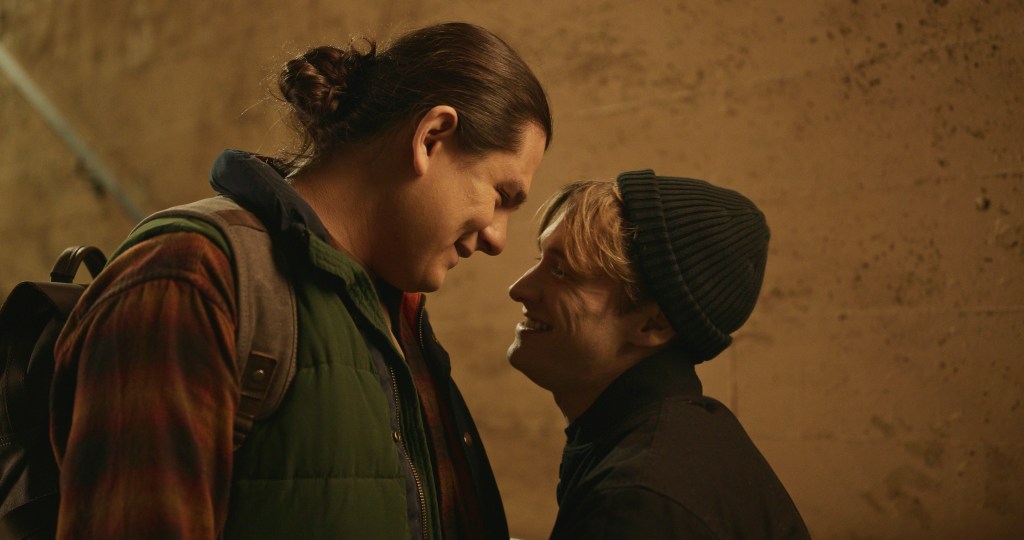
Star, a 2-spirited, Oji-Cree falls for Levi, a guy he meets in a Vancouver park who introduces him to a drag sanctuary called House of Borealis, ruled by Mother. It’s there that Star, who grew up in foster homes, comes out of his shell as an Anishnaabe princess. A musical dramatic romance Starwalker tells its story with all-original songs belted out by powerful voices in solos, duets and choruses, both onstage and off.
Lucky, Apartment
Co-Wri/Dir Garam Kangyu
A young lesbian couple in Seoul buy a condo together but are troubled by the bad smells rising from the apartment beneath them. While one is more concerned about her career, her lover wants to preserve something from the old woman who died there. A true tearjerker, about women in the workplace, queer invisibility, families and lost lives, Lucky Apartment is a deeply moving film.
These are just three of the films now playing at Inside Out.
Bad Shabbos
Co-Wri/Dir: Daniel Robbins
It’s Friday night on the Upper West Side of Manhattan, and, like every Friday night a family is getting together for dinner. David (Jon Bass) is there with his fiancé, Meg (Meghan Leathers); Abby (Milana Vayntrub) with her boyfriend Benjamin (Ashley Zukerman), and Adam (Theo Taplitz) the youngest who still lives at home. They’re there to see their parents Ellen and Richard (Kyra Sedgwick, David Paymer). The candles are set, the brisket’s in the oven. But this is a special night, a look-who’s-coming-to-dinner night, because the meal is for the Jewish sabbath, but the guests, Meg’s devout Catholics parents, are driving in from Milwaukee. The future in-laws are going to meet for the first time, and David and Meg are worried about everything that could go wrong. You see, her parents don’t like arguments at the dinner table… but Abby and Ben are fighting, Adam (who’s on meds) sometimes explodes, Dad likes forcing his pop-psychology theories on everyone and there’s more than a bit of friction between Mom and Meg. Luckily, they all love their building’s doorman Jordan (Cliff Smith, Method Man in the Wu-tang Clan), who assures them he’ll drop by at an appropriate time to smooth the waters.
Meg’s parents are running late, but could arrive any moment, when… something terrible happens, leaving one of the dinner party guests dead… possibly even killed. And as each of the guests discovers what has happened, and who might be held responsible they decide to get the body out of the building before Meg’s parents arrive. But the longer it takes, the less possible it becomes.
Bad Shabbos is dark, drawing room comedy with personality
conflicts, mistaken identities, and lotos secrets. It’s cute and funny, with excellent comic timing, good acting and enough quirky original characters that play against stereotypes to keep it interesting. I’s very much an ensemble, with each character getting their moment in the sun and no one hogging the camera, but a few stand out: Kyra Sedgwick and David Paymer as the parents, Catherine Curtin as Meg’s mom, Theo Taplitz as the coddled and neurotic youngest son, Adam, and of course Method Man as Jordan. Bad Shabbos is a good social comedy.
Mission Impossible: The Final Reckoning
Co-Wri/Dir: Christopher McQuarrie
The world is on the brink: an aggressive AI program (known as the Entity) is taking over everything. And that everything includes the controls behind all atomic bombs. The entity doesn’t care if every human disintegrates. So it’s up to Ethan Hunt (Tom Cruise) and his Impossible Mission team — on direct orders from the US President — to stop it. His mission involves entering a defunct Soviet submarine where the AI programs was once kept, to locate a small but crucial piece of machinery that can stop it. His team includes Grace (Hayley Atwell) a notorious pickpocket and Paris, a cold-blooded assassin; plus most of his usual buddies, like Luther and Benji. But a mysterious supervillain villain named Gabriel (Esai Morales) is doing everything he can to stop him, so he can take control of the Entity for his own nefarious ways. And the entity itself has brainwashed millions to form an invisible army, ready to pop out of nowhere to stop Ethan’s mission. Can Ethan and his Scooby gang save the planet from nuclear destruction?
Mission Impossible: The Final Reckoning is an action/thriller about big things like saving the world. It has atrocious dialogue and a ridiculous plot that makes absolutely no sense. The scenes with American politicians and generals are unintentionally hilarious. It’s about 3 hours long — they could easily have made it in 2. And like many contemporary movies, it doesn’t know how to deal with abstract, digital or AI
weapons, so they replace it with something physical, a McGuffin the hero can hold in his hand. Which, again, makes no sense — you can’t stop a rogue computer program with just a special device, but, hey— it’s a movie.
So, putting all that aside, is it a good movie? Yes, it is. Not in the normal sense, but as entertainment. It’s spectacular, exciting and engrossing. I mentioned the corny dialogue, but the movie also has two very long sequences with no dialogue whatsoever. One has Ethan Hunt inside an abandoned Soviet nuclear submarine on the ocean’s floor in the arctic, that’s filled with seawater and is gradually rolling to greater depths. This scene is as eerie as it is spectacular, feeling as if you’re trapped inside a 1970s Tarkovsky movie. There’s also a scene straight out of a WWI movie, with two pilots aboard propeller planes have fistfights… in midair! Again, no dialogue but lots of exciting action. And I gotta admit, seeing it on a ginormous IMAX screen doesn’t hurt either.
So if you’re in the mood to travel from the north pole to South Africa, in every sort of strange transportation, check out Mission Imposisble.
Mission Impossible: The Final Reckoning and Bad Shabbos both open in Toronto this weekend; check your local listings. And go to insideout.ca for information and tickets.
This is Daniel Garber at the Movies, each Saturday morning, on CIUT 89.5 FM and on my website culturalmining.com.
Dangerous, exotic. Films reviewed: Sinners, Yadang: the Snitch, The Legend of the Ochi
Hi, this is Daniel Garber at the Movies for culturalmining.com and CIUT 89.5 FM.
Hotdocs International Documentary Film festival is on now in Toronto, with free daytime admission for students and seniors. So get out there and watch some docs!
But this week I’m looking at three new movies about unexpected dangers in exotic locales. There are vampires in the Mississippi Delta, snitches in the drug wars of South Korea, and elusive, sharp-toothed creatures on an island in Carpathia.
Sinners
Wri/Dir: Ryan Coogler
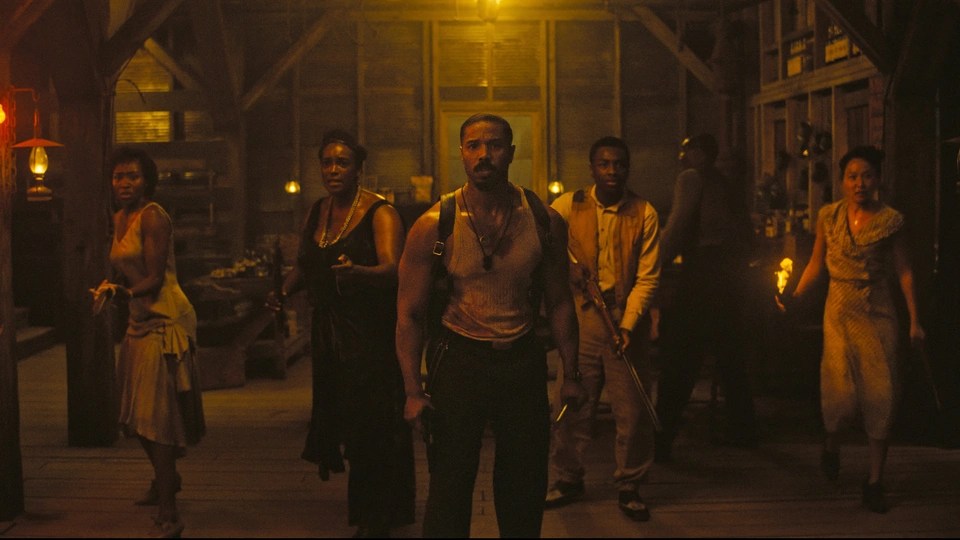
It’s 1932 in a small town in the Mississippi Delta. The Smokestack brothers aka Smoke and Stack (Michael B Jordan: The Fantastic Four, Chronicle) are identical twin who spent years making money working for the mob in Chicago. Now they’re back in town with a truck full of bootleg alcohol, a wad of cash and big ideas on how to make it rich. Namely, they’re opening a juke joint in an abandoned woodmill they bought from a local good ol’ boy. They’re rounding up the necessary musicians, like their cousin Sammie (Miles Caton), the preacher’s son, on blues guitar and Delta Slim (Delroy Lindo) on the piano and mouth organ. Bo and Grace Chow furnish the provisions and Cornbread minds the door. Even Smoke’s and Stack’s ex-partners show up: Mary (Hailee Steinfeld) a glamorous married woman who can pass for white, and Annie (Wunmi Mosaku) an experienced practitioner of Hoodoo. By sunset the place is hopping, the
customers are drinking and gambling, everything is going great, until… a mysterious, smiling stranger who loves Irish music (Jack O’Connell; Seberg, Unbroken, ’71, Starred Up ) appears at the door asking to be let in. They don’t know who he is but he just looks shifty. Turns out he’s a vampire who wants all their blood — not to wipe them out, just to turn everyone over to the dark side. But can the people on the inside keep the demons on the outside until the sun comes up in the morning?
The Sinners is a black history drama about life in the Jim Crow south in the 1930s combined with the action and horror of a conventional genre movie, that succeeds on both fronts. It’s rich in meticulous historical detail in the background: sharecroppers picking cotton in the same fields as their grandparents had as slaves, paid in company scrip not dollars; chain gangs on the highway; and the omnipresent KKK.
All this is counterposed with raunchy dialogue and the sexualized dancing and singing of the juke joint. Every character has a backstory, devoid of cookie-cutter cliches. The costumes, scenery and especially the music — from delta blues to Irish folk songs — evoke that period in a way only a movie can. The acting is superb, though I do wish Michael B Jordan made Smoke and Stack a little less identical. The vampires are more conventional. They still hate garlic, sunlight and stakes through the heart but interestingly these demons lose also racial prejudice once they become vampires. Put this all together and you end up with this amazing movie that’s multifaceted, educational and really fun to watch.
Yadang: The Snitch
Dir: Hwang Byeong-gug
It’s present-day Korea. Lee Kang-su (Kang Ha-neul) is a self-confident young man with a perpetual grin. Why does he swagger and show off his gold lighter? It’s because he’s always two steps ahead of anyone else. He’s a yadang, an informant, and plays a crucial role in the government’s war on drugs. But things weren’t always this way. He was incarcerated after being falsely accused of drug dealing, where he was beaten up and bullied on a daily basis. Until Ku Gwan-hee (Yoo Hai-jin) an ambitious prosecutor pulled him out of that world to be his personal Yadang. Now the two of them are pledged as eternal brothers, functioning like a well-oiled machine, pulling off repeated sting operations and arrests of drug kingpins and thugs across the country. Much to the chagrin of a police detective trying to arrest those same criminals. So Det. Oh Sang-jae (Park Hae-joon) a.k.a. the Jade Emperor of Narcotics Division, finds a Yadang of his own, a rising young actress (Chae Won-been) who is caught using illegal amphetamines as diet pills. Now the lines are drawn and the two sides — the prosecutors and the police — are in direct competition. But the Prosecutor, in his rapid rise to the top, has to make some uncomfortable political alliances, including a rich junkie named Cho Hoon, whose dad just happens to be running for President. Will Cho-hoon’s influence on the Prosecutors rise in power threaten the Yadang’s status and the delicate balance of that world?
Yadang: the Snitch is a Korean action-thriller about
crime, corruption, and the complex relationships among politicians, police and informants in the world of organized drug-crime. Fast moving and compelling, it maintains a frenetic pace throughout the film, with some flashbacks that last only a few seconds. It’s dizzying. It’s also quite violent, sometimes disturbingly so. Luckily, it has interesting characters and a clever plot with enough double- and triple-crosses to keep you guessing until the very end.
Yadang: The Snitch is an entertaining action flic.
The Legend of Ochi
Wri/Dir: Isaiah Saxon
Yuri (Helena Zengel) is a teenaged girl who lives with her dad and adopted brother, Petro. She likes reading library books and listening to loud music. Her farm is on a mountainous island in the Black Sea, off the coast of Romania, and though it’s decades since the fall of Ceausescu, people there still drive Ladas and keep to the old ways. Above all, they fear the Ochi, mythical beasts unique to their island who live in trees, attack sheep and kidnap children. Her Dad (Willem Dafoe) lives in constant fear of the Ochi. He leads a ragtag army of children to capture and kill the monsters… though they have never been successful. Her step-brother Petro (Finn Wolfhard) is a member too, though her rarely speaks. Yuri, on the other hand, is angry at her father and wonders why her mother (Emily Watson) abandoned her. (It’s the Ochi! says her dad.)
One day, when her father sends her out to do her rounds, she finds a small ochi with its paw caught in an animal trap. She frees him and takes him home in her knapsack. He looks like a blue-faced koala until he bares his teeth revealing long pointed fangs. But Yuri is not afraid, she nurses him back to health and eventually the two form an unexpected bond. But can she get him back to his homeland without her father finding out?
The Legend of Ochi is a highly-original adventure story about a young girl and the creature she befriends. It’s warm and delightful. While on the surface it’s a kids’ movie, the
sumptuous, painted scenery and retro feel makes it an instant cult classic. (Think ET, and Charlie and the Chocolate Factory.) It’s full of panpipes and medieval crusaders overladen with Soviet kitsch. Even the odd faces of the kids in the army are straight out of Dr Seuss. I’ve never heard of director Isaiah Saxon before, but I get the impression he’s been doodling pictures of Ochis since he was a little kid. And they are amazing: not cheap-ass CGI, but a combination of puppetry and animatronics that make them seem totally real in their own fantastical way.
I love this movie.
The Legend of the Ochi, Yadang: The Snitch and The Sinners all open this weekend in Toronto; check your local listings. This is Daniel Garber at the Movies, each Saturday morning, on CIUT 89.5 FM and on my website culturalmining.com.
Three generations. Films reviewed: My Dead Friend Zoe, Exhibiting Forgiveness
Hi, this is Daniel Garber at the Movies for culturalmining.com and CIUT 89.5 FM.
It may be the closing of Black History Month, but there are still good movies opening this weekend. So this week, I’m looking at two new American movies, about three-generation families. There’s an Army vet with PTSD whose grandpa has dementia; and an artist with a young son whose dad is addicted to crack.
My Dead Friend Zoe
Co-Wri/Dir: Kyle Hausmann-Stokes
Merit (Sonequa Martin-Green) is a US Army Vet who lives in Portland, Oregon. She was a lightweight vehicle mechanic in Afghanistan, but hasn’t done much since she was discharged. The fact is, like many vets she is depressed and suffers from PTSD. That’s why she goes to a military support group especially for people like her. And she always brings her best friend and fellow vet Zoe (Natalie Morales) with her. Zoe’s the only one who could understand what she’s been going through. But to the group leader, Dr Cole (Morgan Freeman) that’s not enough. He wants her to tell them all what’s the matter. You see, Zoe is dead, and Merit’s the only one who can see her. And unless she shares with the group, Dr Cole won’t sign the form keeping her out of jail.
Then she gets a long distance phone call from her mom
(Gloria Reuben). Merit’s Grandpa (Ed Harris) has lived alone in a beautiful lakeside home outside of Portland since Merit’s Grandma died. He was spotted wandering on a country road near his house. For Merit’s mom, that means he has dementia and so, for his own good, he has to be locked up in a nursing home.
But Grandpa is as stubborn as Merit. They’re both war vets — he’s the one who inspired her to sign up — and they carry similar mental scars. Will Grandpa agree to leave his home? Can Merit ever admit her terrible secret? And why is Zoe still around?
My Dead Friend Zoe is a gentle comedy-drama about the very serious effects war has on American soldiers, and the multigenerational trauma it brings to a mixed-race family. (Like most war movies, it never mentions the people they killed on the other side.) The movie is divided among flashbacks to Merit and Zoe in Afghanistan; Merit and (dead) Zoe in the present day; and the time spent with her Grandfather. Part weeper, part comedy (plus a tiny bit of romance) it has big name stars — like Ed Harris and Morgan Freeman — but not all that much happens. It’s not bad — I like Sonequa Martin-Green and Natalie Morales as Merit and Zoe, and their relationship is the most interesting part of the story — but as a whole, the film is missing its drive.
Exhibiting Forgiveness
Wri/Dir: Titus Kaphar
Tarrell (André Holland) is an artist who lives with his nuclear family in a pretty American suburb. His wife Aisha (Andra Day), also an artist, is a singer-songwriter, and they both adore their three-year-old son. Tarrell paints realistic aspects of his personal history inspired by his own memories and snapshots. They’re painted on enormous, larger-than-life canvases, mounted on the towering walls of their studio. His last show was a smashing success and his agent is pressing him for another (lucrative) show, ASAP. But the images in his paintings are not bucolic… they recall past traumas that Tarrell lived through but has yet to deal with. He frequently wakes up in bed, screaming from night terrors.
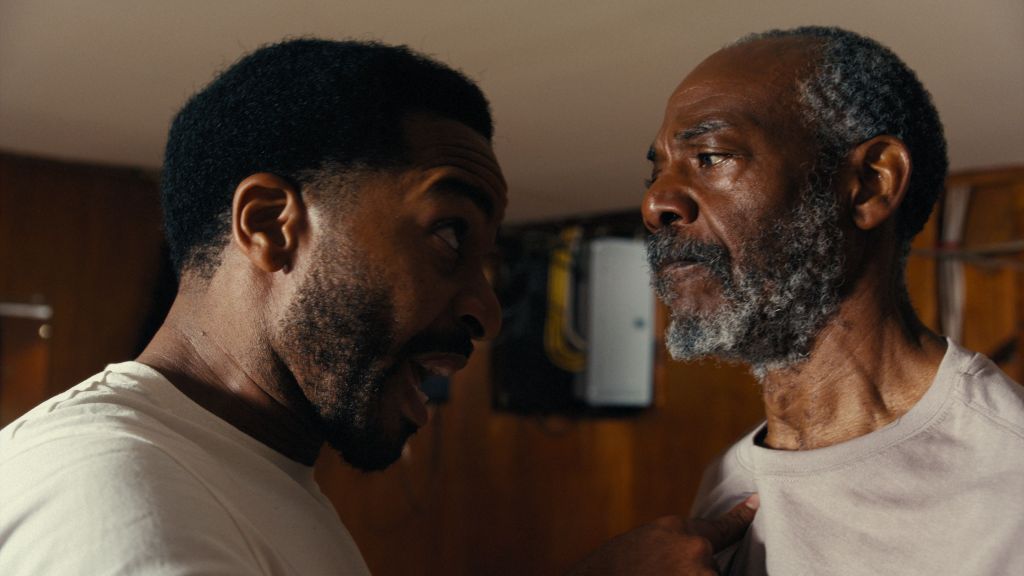
Meanwhile, in a bad part of town, La’Ron (John Earl Jelks) a homeless addict with a long, grey beard, struggles to make it through each day. He ekes out his meagre existence collecting spare change for shining hubcaps and washing cars outside a
skid-row liquor store. But when he ends up in hospital, near-dead after a severe beating by a stickup crook, he decides it’s time to go clean. His brother offers him temporary shelter, and sends him to rehab. His estranged wife Joyce (Aunjanue Ellis-Taylor) forgives him once again in hopes of future familial reconciliation. But what does homeless La’Ron have to do with artist Tarrell? He’s his father, and bad blood flows between them. He taught his son that as a black man, no one will care about him, no one will help him, and unless he gets tough and works extra hard, he’ll never survive and no one will care. But to Tarrell, the abuse visited upon him by his father was mean, self-serving and
sadistic, exploiting his son’s labour to pay for his crack habit. And now La’ron shows up at his door again — what is it he wants now? Can father and son talk honestly? Has La’ron’s nature change? Can Tarrell ever forgive him? And can this extended family be saved?
Exhibiting Forgiveness is a multigenerational look at the hidden fissures and cruelty of masculinity unintentionally visited by fathers upon their sons. It’s rich and moving in its portrayals. The story is told both as a drama and as an artist’s representation of current and past events. We see Tarrell paint three youths; one of them his younger self (Ian Foreman). He later erases two of them by obliterating their images with whitewash on the canvas. In another he cuts his teenaged self out of a painting with an x-acto knife, later draping the missing image on a chair,
So I’m watching this movie with the striking canvases in the paintings — this is not just anonymous crap-art made-up for the movie, it’s the real stuff — but when Tarrell violates the art by splashes white paint or cutting it up… I was a bit disturbed, thinking, OK, the director is making a point, but he’s also destroying another artist’s work. So I looked him up afterwards: The director is an artist, the paintings are his, and cutting up and altering his own canvases is an integral part of his work. He’s primarily an artist, and this is his first film. Watching the movie, I liked the passion of the acting and the emotional (and physical) violence in the characters they portrayed. But once I connected it with Titus Kaphar’s physical art, it suddenly became something much bigger than the sum of its parts.
Exhibiting Forgiveness is an impressive first feature.
My Dead Friend Zoe opens this weekend in Toronto; check your local listings; and Exhibiting Forgiveness is now available on VOD.
This is Daniel Garber at the Movies, each Saturday morning, on CIUT 89.5 FM and on my website culturalmining.com.
Daniel Garber talks with MH Murray and Mark Clennon about I Don’t Know Who You Are at #TIFF23

Hi, this is Daniel Garber at the Movies for culturalmining.com and
CIUT 89.5 FM.
Photographs by Jeff Harris

Benjamin is a talented artist, singer and musician in downtown Toronto. He has a new boyfriend after a messy break up, and is performing again after a long hiatus since his last tour. So why is he manic, frantic and at wits end? Because — after a night of drunken partying — he was sexually assaulted by a stranger, may have been exposed to the HIV virus, and has only 3 days to start taking PEP to stop a potential infection. And he doesn’t have enough money to pay for the prescription. And as the tension and panic grows, so does his sense of despair. Can he ever escape from this
spiral? And does he even know who he is anymore?

I Don’t Know Who You Are is a passionate drama about a gay black man in Toronto facing a seemingly unsurmountable obstacle. The film is M. H. Murray’s first feature, and stars Mark Clennon who also co-wrote the screenplay and performs his own music. MH Murray is a native Torontonian who graduated from York U with a degree in film studied, and created the web series Teenagers. Marc Clennon is a Jamaican-Canadian actor, musician and singer.
I spoke with MH and Mark at #TIFF23 at the Intercontinental Hotel.
I Don’t Know Who You Are had its World Premiere at TIFF23.
Wrong place, wrong time. Films reviewed: The Blackening, Persian Lessons, Asteroid City
Hi, this is Daniel Garber at the Movies for culturalmining.com and CIUT 89.5 FM.
Some movies make you think: that’s where I want to be, I wish that were me on the screen. But other movies have the opposite effect. This week, I’m looking at three new movies in the second category, about people who find themselves in the wrong place at the wrong time. There are friends at a reunion stranded in a cabin in the woods; a man in a disguise imprisoned in a Nazi internment camp; and some space cadets quarantined in a New Mexican desert town.
The Blackening
Dir: Tim Story
It’s Juneteenth, and a group of friends are getting together for a reunion ten years after graduating from college. They’re meeting at an Air BNB to iron out old rivalries and past love affairs, catch up, drink, take drugs, and have fun. But little do they know what awaits them in this cabin in the woods. They’re deep in redneck country, and they all happen to be Black. And somehow, the doors are locking and unlocking, the power is being turned on and off, and their cars are all disabled. And when they discover one of their group is already dead, they realize something is very, very wrong. The only way to save themselves is to correctly answer a series of questions about Black culture and history, as dictated by a creepy, racist board game called The Blackening. The game centres on a hideous plastic head which talks directly to them. If they
make a mistake, someone scary is lurking in the shadows with a crossbow loaded with arrows. Can they escape or defeat the deranged killer? Or will they all end up dead?
The Blackening is a thriller/ horror/comedy that pokes fun at both slasher movies and Black pop culture. It’s meta-horror, like Scream, so everyone knows not to split up, but also that in slasher movies the “sole survivor” is never Black. This allows it to challenge a lot of horror conventions. I had my doubts about his movie — the director, Tim
Story, made The Fantastic 4, one of the worst superhero movies ever (Correction: Fantastic 4, 2015, was dreadful, but was made by Josh Trank; I have never seen Story’s 2005 version) and while I’m always up for another cabin-in-the-woods story, the last few I’ve seen (like Knock at the Cabin) have been less than stellar. Luckily, The Blackening is funny, strange, surprising and very entertaining. It’s an ensemble piece, starring Antoinette Robertson, Dewayne Perkins, Sinqua Walls, Grace Byers, X Mayo, Melvin Gregg and Jermaine Fowler. It’s also more funny than violent — with an emphasis on characters, humour and clever dialogue over blood and guts (but there are some scary parts, too.)
I like this movie.
Persian Lessons
Dir: Vadim Perelman
It’s WWII in German-occupied France. The Nazis are arresting Jews across western Europe detaining them in a French transit camp before they are sent to the Poland for extermination. Gilles (Nahuel Pérez Biscayart: BPM, Deep in the Woods) is a Belgian from Antwerp, a prisoner on a transport truck heading for the camp, when another man trades a book of Persian stories for Gilles’ sandwich. A few minutes later, the guards park the truck and start gunning down all the prisoners by the side of the road… but the book saves his life just before he is executed. He claims to be a Persian, named Reza — a name inscribed in the book — and not a Jew. Soon he’s working in the camp’s kitchen under the supervision of Klaus (Lars Eidinger). He keeps Gilles alive — and away from hard labour splitting rocks in the quarry — because he wants to learn Farsi. Of course Gilles doesn’t speak a word of it, and the book is incomprehensible to him, but to stay alive he has to invent a language and remember all the words, without the Commandant figuring out his ruse. But how long can he keep it up before his deception is exposed?
Persian Lessons is an ingenious and moving dramatic thriller set within WWII and the Holocaust. Strangely, most of the dialogue is in German, because, aside from Gilles and a few others, it’s mainly about the Nazi guards and officers, not the prisoners. Not sure why so much of the movie is about petty rivalries, love affairs and cruelties among the guards, rather than the lives of the prisoners. Even so, it’s still an
interesting story with a surprising twist. Argentinian-French actor Nahuel Pérez Biscayart beautiful plays Gilles as a frail, doe-eyed waif, always on the brink of angsty collapse. While Lars Eidinger, as Klaus — I’ve seen him in at least a dozen movies — is good as always, this time as a cruel but conflicted man with dark hidden secrets.
This is a good one, too.
Asteroid City
Co-Wri/Dir: Wes Anderson
It’s the 1950s in a tiny desert town in New Mexico named Asteroid City after a meteorite hit the earth there. The Space Race is gaining momentum, while the Cold War is chillier than ever. Augie Steenbeck (Jason Schwartzman) is a news photographer with his teenaged son Woodrow (Jake Ryan) and three little daughters. They’re there for Woodrow to reserve a national science prize. In a local diner he meets Midge Campbell (Scarlett Johansson) a famous Hollywood movie star, accompanying her teenaged daughter, also up for a prize. She’s divorced and he’s a widower. There are also tourists, military brass, scientists, astronomers and cowboys, as well local hucksters out to make a quick buck. But everything changes when — in front of everybody — a space ship lands there, and an alien steps out to grab the asteroid and fly away! The government declares emergency measures, and no one is allowed to leave Asteroid City. Will romance bloom in this time of isolation? And will they ever get out of this place?
Asteroid City is a meticulously-crafted, comic pastiche of American pop-culture in the 1950s. It’s filled with atomic bomb tests in the background, and a roadrunner saying beep-beep between scenes. And there are wonderful scenes shot through adjoining motel windows.x As in all Wes Andersen’s movies, there are dozens of characters and an equal number of tiny side-plots. It has cameos by Tom Hanks, Tilda Swinton, Liev Schreiber, Adrian Brody, Hong Chau and Matt Dillon, among countless others. The art direction is impeccable, as is the music, editing, costumes and sets. But for some reason, this time we also have actors breaking the 4th wall, taking off their makeup and talking about the making of this movie. And these actors are also appearing in a stage play about it. And the stage play is being performed on live TV, with a
narrator — all set in the 1950s. While it’s fun to watch all this, it takes an interesting and funny plot and sadly turns it into just another example of Hollywood navel-gazing. For the life of me, I don’t know what all these meta dimensions add to the story.
That said, of course I enjoyed and appreciated this film. Wes Andersen’s movies are always a joy to watch… I just wasn’t as dazzled by this one.
The Blackening, Asteroid City and Persian Lessons all open this weekend in Toronto, with Asteroid City expanding nationwide next week; check your local listings.
This is Daniel Garber at the Movies, each Saturday morning, on CIUT 89.5 FM and on my website, culturalmining.com.
Current cinema. Films reviewed: Babysitter, A Thousand and One, Dungeons & Dragons: Honor Among Thieves
Hi, this is Daniel Garber at the Movies for culturalmining.com and CIUT 89.5 FM.
This week, I’m looking at three new movies, a drama, an adventure-comedy and a sex-comedy. There’s a gang of thieves in the Middle Ages, a middle-aged couple in Québec with a seductive nanny, and a mom in Harlem with an undocumented son.
Babysitter
Wri/Dir: Monia Chokri
Cédric (Patrick Hivon) is a middle-class guy in a Montreal suburb, with an obsession with women’s breasts. He’s happily married with a newborn daughter but his sex life has completely dried up. Maybe that’s why, in a drunken stupor at a UFC fight, he throws himself at a sportscaster on live TV and kisses her. His immortal words Je t’aime Chantal! went viral, and made Cédric famous, but not in a good way. Now he’s on extended leave as the company investigates his sexual harassment. But with a colicky baby, neither he nor his wife on maternity leave Nadine (Monia Chokri) are getting any sleep: the baby never stops crying. So they hire a nanny named Amy (Nadia Tereszkiewicz) to take over some of the pressures of parenthood. And she has a magic touch with the baby, calming her down in an instant.
Amy is 22 years old with beautiful blonde hair and scarlet lips. She is
both innocent and seductive. And soon enough she has Nadine and Cédric under her thumb, with Jean-Michel, Cedric’s brother (Steve Laplante) close behind. But when she shows up the next day in a semi-pornographic “French maid” costume — compete with short skirt, white stockings and high heels — the three of them don’t whether to faint or explode. Will Amy save their marriage by releasing tension, or has she gone too far? Will Cédric ever learn from his misogynistic behaviour? Will Jean-Michel ever get a hold of himself? And why does Amy act like she does?
Babysitter is a funny and campy Québecois sex comedy. It’s done in the classic manner of French and Italian movies from the 60s where the arrival of an unexpected visitor disrupts a whole family, but updated for the “#MeToo” generation. It’s highly stylized done in a retro manner,
with bright red colours popping up in every frame, from lipstick to poppies in the garden. And the main characters’ sexual fantasies are played out in soft focus in their heads, like David Hamilton’s softcore porn of the 1970s. There’s even a gratuitous scene with a group of teenaged girls in hot pants and roller skates gliding down a suburban street, a new generation thumbing its collective nose at uptight middle age. And while the movie seems to be shown through the male gaze, filmmaker Monia Chokri adds a satirical feminist subtext, keeping it entirely tongue in cheek.
A Thousand and One
Wri/Dir: A.V. Rockwell
It’s New York City in the early 1990s. Inez (Teyana Taylor) is a young hairdresser, just released from Riker’s. But when she goes back to her old neighbourhood, no one wants to talk to her and she can’t get her old job back. Worst of all, she is heartbroken to see her six-year-old son Terry maltreated by his foster parents. So one day she simply takes him away with her. And after a few weeks of couch surfing, they find a home in an old Harlem tenement, apartment number 1001. To keep them both safe from the law, she gets Terry a new social security number and a new name. He’s shy and rarely speaks but proves to be an excellent student, so much so his teacher helps him transfer to a highly competitive tech school for bright kids. Inez, meanwhile, gets back together with her boyfriend Lucky (William Catlett). Though he makes it clear he is not Terry’s father, eventually they marry and form a loving family. But life is not easy. They have to deal with an unscrupulous landlord, suspicious teachers and
aggressive cops. And always hanging over their heads is the fact they’re living under fake names and could be caught at any minute.
A Thousand and One is a powerful, realistic and moving drama about the life of a family in Harlem in the 1990s and early 2000s. It’s both heartbreaking and inspiring. It traces their lives through changes of government, from Giuliani’s “Broken Windows” policy through Bloomberg’s “Stop and Frisk”, and how it affects Terry as a young Black man. It’s also a coming of age story, with three actors playing Terry at 6, 13 and 17 — Aaron Kingsley Adetola, Aven Courtney, and Josiah Cross — as he struggles through his best friend, his first crush, and his fractious relationship with his mother as they face the world. I love the period costumes, hair, locations and music. And Teyana Taylor is just amazing as Inez.
A Thousand and One is not a light movie, but it’s a good one.
Dungeons & Dragons: Honor Among Thieves
Co-Wri/Dir: John Francis Daley, Jonathan Goldstein
It’s sometime, somewhere far away in a mythical, mystical, medieval kingdom. Edgin and Holga (Chris Pine, Michelle Rodriguez) are former thieves locked up in a remote panopticon prison. They were caught trying to steal a magic totem but were double crossed by one of their gang. But they manage to escape. Now they want to form a new gang to pull off the ultimate heist: a charm that can bring Edgin’s wife back to life and restore his family including his daughter, Kira. Edgin is the brains, while Holga is the brawn, but they need more. They enlist Simon (Justice Smith) an insecure sorcerer with questionable powers (he earns his living picking pockets at a carnival side show.) Doric (Sophia Lilis) is a ginger-haired druid who can change, in a flash, into any animal she wants, from tiny worm to giant monster. And Xenk
(played by Bridgerton heartthrob Regé-Jean Page) — an honest and noble member of an evil clan — agrees to join the heist but only if its for good reasons, not for profit.
But they must face their former ally Forge a con man (Hugh Grant). Up to now, he has taken care of Edgin’s little girl, but has since crowned himself King in alliance with a nefarious, all-powerful sorceress. To find his daughter, liberate the riches, and defeat the sorceress, the gang must first accomplish a series of nearly-impossible tasks, worthy of Theseus. Can this ragtag gang of miscreants pull it together? Or are they all headed back to prison?
Dungeons and Dragons: Honor among Thieves is a surprisingly entertaining adventure/comedy, based on the role-play board game of the same name. Players will delight in the more obscure references — from Gelatinous Cubes to Owlbears — but ordinary audiences can fully enjoy it without any background. It also incorporates the story-telling
aspects of the game, giving the whole film a rich, mythical feel. I went into this movie expecting nothing — previous Dungeons & Dragons incarnations have been dreadful. I shouldn’t have worried about this nerd paradise, seeing its co-written and directed by none other than John Francis Daley, from the TV cult classic Freaks and Geeks (he was a geek, of course). If you like Game of Thrones or Lord of the Rings, but with more laughs and less excessive gore and ponderous speeches, then you’ll love this one.
Dungeons & Dragons: Honour among Thieves and A Thousand and One both open this weekend; check your local listings. Babysitter is playing at the Canadian Film Fest, on now.
This is Daniel Garber at the Movies, each Saturday morning, on CIUT 89.5 FM and on my website, culturalmining.com.
Daniel Garber talks with Enuka Okuma about Woman Meets Girl at #TBFF!
Hi, this is Daniel Garber at the Movies for culturalmining.com and CIUT 89.5 FM.
It’s present-day Toronto. Annabelle is a bookkeeper in her forties who lives alone and keeps a neat and tidy home. She is single, reserved and has never has been in love. Tessie is an 18-year-old sex worker who has lived on the streets for many years. She exudes sexuality from every pore. So what are they doing together? Annabelle rescued Tessie from an abusive boyfriend and invited her into her home, and now they’re sharing alcohol in a drinking game. But as they get to know each other, and their secrets are revealed, it’s hard to tell who is rescuing whom.
Woman Meets Girl is a sizzling short film about two black
women during one night in Toronto. The film was written, directed and produced by Murry Peeters, and co-stars Chelsea Russell as Tessie and Enuka Okuma as Annabelle. Enuka is an award-winning actress, known for her extensive work on TV shows like Rookie Blue, Working Moms, Madison and Sue Thomas, FBEye, as well as guest roles on 24, Grey’s Anatomy, and NCIS: Los Angeles.
I spoke with Enuka Okuma in L.A. via Zoom from Toronto.
Woman Meets Girl has its world premiere on February 18th, 2023 at the Toronto Black Film Festival and at Queer Screen’s 30th Mardi Gras Film Festival in Sydney, Australia.
Films reviewed: Swan Song, Beyond Monet, Respect
Hi, this is Daniel Garber at the Movies for culturalmining.com and CIUT 89.5 FM.
With the end of lockdowns finally reaching Toronto, people are itching to catch up on what they’ve been missing — from getting their hair cut, going to an art gallery, or listening to a concert on the big screen. This week I’m looking at two movies and one experience. There’s soul in Detroit, hairdressing in Ohio, and French impressionism in downtown Toronto.
Wri/Dir: Todd Stephens
Pat Pitsenbarger (Udo Kier) was once known as the Liberace of Sandusky Ohio, known for his gaudy jewelry, his pastel pantsuits and his flamboyant style. The richest women in town flocked to his hair salon where he could accomplish miracles with just his fingertips and a can of hairspray. But now he’s long-forgotten, a penniless old man living in a nursing home with puke-green walls and fluorescent lights. What happened?
His protege Dee Dee (Jennifer Coolidge) opened up a larger salon across the street from his, poaching his longest clients, including Rita Sloan a millionaire and his oldest patron. Then his lover David died of AIDS. And since this was before same-sex marriage, their shared house was inherited by a distant relative, leaving him homeless. So for Pat, Sandusky is just history. Until a lawyer named Mr Shamrock arrives at his room with a new development. Rita has died, and in her will she insists Pat be the one to style her hair in her coffin. And if he does he’ll inherit
25,000 clams. So Pat sets out on a long journey back to long-lost Sandusky, encountering strange people and places along the way. Will he get there in time for Rita’s swan song? And can he finish the job without any beauty supplies?
Swan Song is a very gentle, low-key, and slow- moving homage to the gradually fading world of small town gay life in America. Though nostalgic, it doesn’t present a white-washed version. It features Pat (loosely based on a real person) as an inveterate shoplifter, Eunice his best friend who is known for loitering in public toilets, as well as the seedy gay bar where they used to lip-synch torch songs. Udo Kier, the great German actor, has fun with his role, injecting his own trademark campiness. Swan Song is a cute and gentle, (though too slow-moving) LGBT comedy.
Claude Monet was a fin-de-siècle French painter who daubed his canvases with bright spring colours. Critics at the time referred to his work derisively as impressionism, thus providing a name for the movement. But as his fame grew, his eyesight faded, and by the end his works veered to the nearly abstract. Today, though, his paintings of fields, gardens, water and most of all waterlilies are among the most famous of that era. Beyond Monet is an exhibition, not of his art, but rather an immersive experience. His works are projected on a circular, 360 degree wall and ceiling, about the size of a football stadium. The works themselves are constantly rising, falling, or gradually turning around inside the exhibition space, so you can see all of it without moving from your area. It’s constructed around a large wooden cupola in the centre, along with shiny, round landing pads spread all around to sit on. The images are softly animated: waves in his paintings rise and fall; in his winter scenes, snow seems to blow against the landscapes, while flowers and lillies bloom before your eyes. And a constantly-shifting — and at times quite lovely — original soundtrack of music and sound effects (like birds, crickets or waves) adds to the mood.
The exhibition is in three parts. The first consists 0f a few curved wooden bridges and some gossamer sheets hanging from the tall ceilings. It also has a series of bilingual signs explain the art. You pass through a hallway festooned with cheap mylar strips, into the main room where the actual show takes place.
Is seeing an original canvas by Monet the same as a projection, however well-rendered and animated, in a large space? No… not even close. This isn’t art, it’s about art. It reminds me of those parks with miniature versions of the Eiffel tower and the Taj Mahal.
What it is, though, is a pleasantly relaxing experience for those who want to appreciate Monet without the trouble of seeing his actual stuff. Interestingly, the entrance features an assortment of empty wooden canvas frames, to remind us, I suppose, that the real art is still on museum walls. But with the pandemic on, perhaps Beyond Monet is a way to get the feeling of his work without travelling far. And the show is well- ventilated, well-spaced and with a limited number of guests at any one time.
Dir: Liesl Tommy
It’s 1952. 10-year-old Aretha Franklin, known as “Ree”, lives in a middle class Detroit neighbourhood. Her father (Forest Whitaker) is a firebrand baptist preacher with a huge congregation. He is a colleague of the Rev Dr Martin Luther King, who Ree calls Uncle Martin. He holds Saturday night get-togethers where little Ree is the featured performer in a musical household. Still a child, she has the voice of a full-grown woman, and performs be-bop and scat singing, not just gospel. Her father intends to make her a star. By the late 50s he gets Aretha (Jennifer Hudson) signed with John Hammond at Columbia Records where she records old jazz standards with a full orchestra. But without any hits.
Then everything changes in the late 60s when she is taken under the wing of producer Jerry Wexler at Atlantic, the man who coined the term Rhythm and Blues. He introduces her to the back-up players at Muscle Shoals, men who know how to feel the music. Aretha brings in her sisters as back up singers, and
the rest is history. She becomes the queen of soul and her songs internationally famous.
This music biopic follows her career over a 20 year period, from 1952 to 1972. And it’s not a smooth and steady ride. It’s called Respect partly because of her hit single but also to point out the lack of it she experiences from both her domineering father and her tempestuous relationship with the often violent and manipulative Ted (Marlon Wayans) her sometime husband and manager. It also exposes the harsh underbelly of her stable, middle-class life. She is raped at an early age (this is implied not shown) and gives birth to a number of sons while still in her teens (her grandma takes care of them.) Her father says she has “demons” inside, but maybe it’s just her trying to break free, whether through her music or alcoholism, from the relentless disrespect and physical and mental abuse she suffers for much of her young life.
Respect is part performance, part melodrama, alternating between a near constant flow of music interspersed with re-enactments with her family, business, and love life. We see her ups and downs (mainly her downs), along with many — maybe too many — fights, tantrums and meltdowns. Biopics have two choices: either hire great actors with mediocre or dubbed voices, or great singers. Hudson is the latter. She has a fantastic voice, featured here in so many genres — gospel, jazz, soul and pop — which holds the movie together. The melodramatic scenes are a mixed bag, some very moving, others cringe-worthy. Whitaker is really good as CL Frankin, and Hudson is in nearly every scene. While Respect is not a great movie, I greatly enjoyed watching it.
Look for Swan Song on VOD and digital formats. Respect opens theatrically in Toronto this weekend — check your local listings. And Beyond Monet is exclusively showing at the Metro Toronto Convention Centre now.
This is Daniel Garber at the Movies, each Saturday morning, on CIUT 89.5 FM and on my website, culturalmining.com
Daniel Garber talks with Kourtney Jackson, Max Shoham and Ella Morton about their films at FOFS
What do the following three stories have in common? An Inuk recalling her history, language and culture amidst the ice floes of Nunavut; three diverse black women in Toronto sharing the unique hair problems they faced during the pandemic; and a young, Jewish-Romanian couple meeting aboard a ship burgeoning with refugees adrift at sea during WWII. These stories are all films featured in The Future Of Film
Showcase — or FOFS. In its eighth year, FOFS has selected 11 new short films made by Canadians under 40.
Kourtney Jackson is a Toronto-based experimental filmmaker whose hybridized, storytelling transcends the physical body. Her film Wash Day looks at three black women talking about bodies, hair, skin, beauty and self-love as they each cleanse themselves in a shower.
Max Shoham, an award-winning, prolific maker of animated short films in diverse genres, has been obsessed with movies since Grade 3. Sophie and Jacob is an animated retelling of Max’s own grandparents’
story about how they met aboard a ship.
Ella Morton is an artist whose still and moving images incorporating obsolete techniques have taken her across Canada and through Scandinavia. Her film Kajanaqtuq combines manipulated analog formats along with recordings of an Inuk’s recollections of her life so far in Nunavut.
I spoke with Ella, Max and Kourtney via Zoom.
You can watch all films playing at FOFS on CBC Gem for free until July 22nd.


leave a comment