Parts of history. Films reviewed: Fanon, Train Dreams, Christy

Posted in 1920s, 1950s, 1990s, Algeria, Biopic, Boxing, Class, Colonialism, Lesbian, LGBT, Politics, Psychiatry, Resistance, Trains, violence by CulturalMining.com on November 9, 2025

Hi, this is Daniel Garber at the Movies for culturalmining.com and CIUT 89.5 FM.

Toronto’s Fall Film Festival season continue with two series on right now. Reelasian features films from Asia and its diaspora, including two great ones from Canada: Min Sook Lee’s heart-wrenching doc There are No Words, and Koala Kid’s whimsical, animated Space Cadet. Cinefranco has movies in French from Europe, Africa, and Quebec, including many Toronto premieres: look out for la Venue de l’Avenir by Cedric Klapisch (Ma Part du Gateau), and le Dernier Souffle by the legendary Costa-Gavras. 

But this week, I’m looking at three new films set in historical eras. There’s a lumberjack at the turn of the previous century, a psychiatrist in Algeria in the 1950s, and a female boxer from West Virginia in the 1990s. 

Fanon

Co-Wri/Dir: Jean-Claude Flamand-Barny

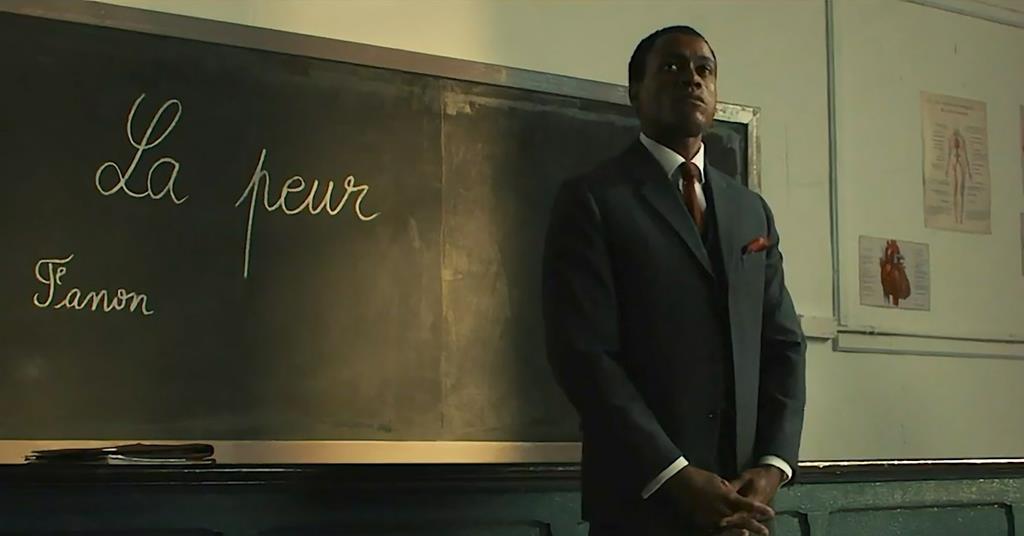
It’s the early 1950s in Algeria. Frantz Fanon (Alexandre Bouyer) is a renowned psychiatrist from the French Island of Martinique. He is starting his new job at a mental hospital. But he’s shocked at how Algerian patients are treated there. In contrast to Europeans, the “savage” north Africans are kept shackled in filthy cells, because of their “barbarous and dangerous” nature. Fanon (who is black) insists his North African patients be treated like any others. He lets them walk in the garden, plant vegetables, play soccer and make friends. Their mental health quickly improves. He’s assisted by diverse Algerian interns and staff: Hocine (Mehdi Senoussi) Jacques (Arthur Dupont) and Alice (Salomé Partouche), all followers of his techniques. But he’s strongly opposed by traditionalists and the French military, who are increasingly violent in their tactics. (Algeria was annexed by France but most of the locals are not considered full citizens.) He and his wife Josie (Déborah François) are upper-middle-class French citizens playing their role supporting the sprawling Empire. Fanon fought the Nazis in WWII. He likes Sartre, elegant suits and and fine wine. But his views are changing. He now writes books (dictated to his wife) about the effect of colonization on the mental health of the colonized in Algeria. Their own self-image is denigrated by their oppressors, he writes, when they internally accept their status as “the other”. Word gets out and he’s invited to join the FLN, (considered terrorists by the French). But the threat of violence reaches his hospital, as personified by Sergeant Rolland (Stanislas Merhar), a particularly violent soldier who checks in as a patient. How can Frantz Fanon simultaneously balance his various roles — as a husband and father, as a Black man serving the French empire, as an innovative psychiatrist, and as an intellectual joining the Algerian struggle for independence?

Fanon is a vibrant biopic about a decade in the life of the renowned author. I find it gripping and fascinating. Alexandre Bouyer is strong and statesman-like in the title role. I’ve known of Fanon for many years — as the author of books like The Wretched of the Earth and Black Skin, White Masks — but never knew about his background in psychiatry. Though occasionally heavy-handed and hagiographic, this movie opened my eyes to the exciting and intellectually stimulating story of his life in Algeria and the history that surrounded it. 

I like this one a lot.

Train Dreams

Co-Wri/Dir: Clint Bentley (Jockey) 

It’s the early twentieth century in the US Northwest. Robert Grainier (Joel Edgerton) is a bearded lumberjack who rarely speaks. He earns his living chopping down trees at migrant lumber camps and building the railroad.  He meets a woman named Gladys (Felicity Jones), they fall in love and build a homestead in a grassy patchl near a flowing river. He cuts all of the wood by hand. Gladys is good with a rifle and shoots foul and deer to eat. The rest they buy in town at a general store owned by Ignatius Jack (Nathaniel Arcand).

He spends lonely months away earning money, but always returns home in the end. He makes friends with a Chinese labourer named Fu Sheng — they don’t talk but that’s fine with Rainier who never has much to stay. But he is shocked when a crowd decides to murder Fu Sheng just because he’s a celestial. He later makes friends with an old-timer named Peebles (William H. Macy) who handles the dynamite explosions. He loves their new baby girl  but his home and family are threatened when a wildfire sweeps through the forest while he’s away. What will Grainier do?

Train Dreams is a series of events in one unremarkable man’s life set along the early 20th century northwestern frontier. A folksy omniscient voice narrates the story, hoping to add profundity; it doesn’t work. The film is meandering,  pointless and stupid. It gives token nods toward environmentalism and against racism but they’re not really part of the plot. I hated this movie from the first few seconds, with its over-produced images and inappropriate soundtrack. We see a guy sawing wood until the camera pulls back revealing…? Nothing, just more trees, as if we’re supposed to applaud the scenery! At times it’s twee, like a Wes Anderson film, but without the humour or intellect. The men all look like they’re posing for a Carhartt fashion shoot. I try to feel sympathy toward Rainier  but he’s deliberately opaque. Worst of all are the Train Dreams of the title — we keep seeing the same montages of flashbacks from previous scenes… but the original ones are as short-lived as his memories of them. 

You might enjoy the pretty pictures in Train Dreams, but I can’t see any other reason to watch this annoying blunderbuss of a film.

Christy

Co-Wri/Dir: David Michôd (The Rover)

It’s 1989 in West Virginia. Christy Salters (Sydney Sweeney) is a high school kid, and a star player on the girls’ basketball team. She’s also in love with her girlfriend Rosie (Jess Gabor), a relationship her mom (Merritt Wever) doesn’t approve. She ends up trying out as a novelty act at a boxing match, and, though she has zero training, she scores a KO on her first try. She’s a natural. She catches the eye of a middle-aged boxing entrepreneur named Jim Martin (Ben Foster). He reluctantly takes her on and lets her train at his gym, but he will not allow her to see — or even talk to — Rosie. He sets her up in a trailer park where he can keep an eye on her. Though a great fighter, she’s isolated and unprotected outside of the ring. 

Christy is a powerhouse. Her career takes off, including a new hairstyle and a trademark pink silk hooded robe to make her look more “feminine”. She knocks out all contenders and after much pressure, the 22-year-old Christy sleeps with the middle- aged Jim… and they eventually marry. 

Her career soars, she meets Don King (hilariously played by Chad Coleman) and is signed to Mike Tyson’s slate. She gains fans worldwide, but her life is micromanaged by her Svengali husband. She may be a professional fighter but he’s twice her size, unstable, and increasingly violent. And he tries matching her up with boxers way above her weight class; that’s just dangerous. Is there any way to escape this oppressive relationship?

Christy is a biopic about the first prizewinning female boxer, who paved the way for a new professional women’s sport. I was hesitant about this one — ugh, yet another boxing movie — but Christy is as good as Rocky. It’s exciting, thrilling and moving, and despite her flaws, Christy Martin’s life is super-sympathetic. Sydney Sweeney is amazing. Yes, it’s Oscar-bait (you can tell by the prosthetic teeth and mullet haircuts, playing down her image as a sex-object) but she totally gets into this role. And Ben Foster is superbly hate-able as Jim — I seriously didn’t realize it was him till the credits rolled; he’s that skillful.

Christy is a good, old-fashioned biopic and a hell of a great boxing movie. 

Train Dreams and Christy both played at TIFF and are opening in Toronto this weekend; check your local listings. And Fanon is premiering today at Cinefranco, 4 pm at the Carlton Cinema.

This is Daniel Garber at the Movies, each Saturday morning, on CIUT 89.5 FM and on my website culturalmining.com.

Daniel Garber talks with Jeff Harris about #TIFF24!

Hi, this is Daniel Garber at the Movies for culturalmining.com and CIUT 89.5 FM.

Photo of Jeff by Daniel Roher

TIFF is the most important film festival in this hemisphere, that gives us hints about the upcoming Awards season, what movies we should look out for, and where contemporary cinema is going. It ended six weeks ago, so it’s a good time to take a look at what TIFF brought us — the hits, flops, changes and sleepers, and just about the TIFF vibe itself. Jeff Harris is a professional photog who has covered TIFF for more than two decades, in photos and features for Macleans, The Walrus, and culturalmining among other outlets. So I’m very pleased have friend of the show Jeff Harris, here, in person, for a spirited discussion about this year’s TIFF.

TIFF 24 RECAP – PART 1

Films discussed include:

  • The Substance
  • The Assessment
  • Bird
  • Heretic
  • Emilia Pérez
  • The End
  • Fanatical: The Catfishing of Tegan and Sara
  • Elton John: Never Too Late
  • The Tragically Hip: No Dress Rehearsal
  • Piece By Piece
  • Better Man

TIFF 24 RECAP – PART 2

Films discussed include:

  • Paul Anka: His Way
  • The Luckiest Man in America
  • The Last Republican
  • The Order
  • The Seed of the Sacred Fig
  • The Girl with the Needle
  • Kill the Jockey
  • Nightbitch

TIFF 24 RECAP – PART 3

Films discussed include:

  • The Life Of Chuck
  • The Wild Robot
  • Mother Mother
  • Pepe
  • Dahomey
  • The Brutalist
  • Riff Raff
  • Nutcrackers

Assorted monsters. Films reviewed: The Apprentice, Piece by Piece, Don’t F**k with Ghosts

Posted in 1980s, Biopic, Canada, comedy, documentary, Donald Trump, Ghosts, Hiphop, Music, Winnipeg by CulturalMining.com on October 12, 2024

Hi, this is Daniel Garber at the Movies for culturalmining.com and CIUT 89.5 FM.

Toronto’s fall film festival season is in full swing with Planet in Focus, celebrating it’s 25th anniversary. It’s running from Tuesday through Sunday next week, with international features and shorts on climate change, activism, environmentalism  and indigenous issues. And on Friday, October 18, there’s a free screening at Hot Docs of We Will Be Brave, about Good Guise, a Toronto collective that sparks conversations around healthy masculinity through art. That’s part of the For Viola series honouring Viola Desmond.

But this is also October, when ghouls and ghosties flock to our screens. So this week, I’m talking about three new movies about various types of monsters. There’s a monstrously popular music producer from Virginia Beach; a notorious real estate developer trained by a monster in New York; and two guys searching for ghosts in Winnipeg.

The Apprentice

Dir: Ali Abassi (Review: Border)

It’s the mid 1970s, and  New York is a wreck, with soaring crime, homelessness and bankruptcy. When the Mayor asks the feds for help, Gerald Ford tells them to “drop dead”. Into the world emerges an ambitious young developer. Donald Trump (Sebastian Stan) was born rich, but cowers under his oppressive father’s rule. Fred Trump (Martin Donovan) a real estate developer from Queens, made his fortune building segregated public housing. Donald is stuck at crap jobs, collecting rent and evicting destitute tenants. But he has big ideas. His plan? To buy the venerable Commodore, an old hotel with 2000 rooms on 42nd street a hotbed of porn palaces and drug dealers. But how can he raise the money with his dad being sued by the feds for his racist rental practices? Donald has an idea. He joins an exclusive club with the hopes of meeting a certain lawyer he thinks can solve all his problems. The lawyer is Roy Cohn (Jeremy Strong) a notorious rightwing  attorney with ties to organized crime. Cohn played a central role in the McCarthy Hearings, and still brags about executing the Rosenbergs. He agrees to take on Donald as his protege, and teaches him his three crucial rules: Attack, attack, attack (whether lawsuits, blackmail or intimidation)  Deny everything , and always declare victory, even when you lose. (See: 2020 election). The club is also where he meets the beautiful and brash Ivana (Maria Bakalova), whom he is destined to marry. She will instill in him a love of garish, nouveau-riche interiors. The film follows these three people’s intertwined lives through the 70s and 80s until Cohn’s death. 

The Apprentice (absolutely no connection to Trump’s much later reality show) is a very dark biopic about the origin of Trump’s bizarre motivations and strategies. Sebastian Stan gives an excellent portrayal of Trump; he’s actually sympathetic for his earnestness and naivety in the beginning, but who spirals into something deeply disturbing by the end. This is not an SNL parody, it’s a realistically developed character. Likewise, Strong plays Roy Cohn as a dead-eyed, sybaritic bully, hosting gay orgies, even while publicly denying his sexuality to the end. He doesn’t look like Roy Cohn, but he sure does act like him. With a great selection of 70s and 80s pop songs throughout the film, and the grotesque golden opulence of Trump’s homes captured on grainy colour film of  the era, The Apprentice is a funny and disturbing biopic.

Piece by Piece

Co-Wri/Dir: Morgan Neville (Review: Best of Enemies)

Pharrell Williams is a highly successful music producer, musician, singer, composer and fashion designer. His work spans the genres from hiphop, to pop music and electronica. But his life hasn’t always been that way. He grows up in a working-class housing area in Virginia Beach, Va. and starts drumming at an early age using kitchen utensils. He’s into Star Trek, Stevie Wonder and Greek Gods (his apartment is actually named Atlantis!) He soon forms a band with his schoolmates, and later, starts working at a nearby recording studio, learning the ins and outs of music producing. 

He soon rises in popularity, both for his own work, and that of the stars he works with, a who’s who of hip hop and pop. He has a succession of hits with Kendrick Lamar, Snoopdog, Timbaland, and Jay-Z, then branches out to include pop stars like Justin Timberlake, Gwen Stefani, Robin Thicke, and Daft Punk, all producing worldwide hits. They come to him for the tracks he creates and samples, as well as a certain je ne sais quoi he adds to their music. But how long will his popularity last?

Piece by Piece is a documentary about the life and career of Pharrell Williams. It’s narrated by Pharrell himself, in an interview with the director, as well as talking heads of most of the stars he’s worked with. What’s unusual about this doc is it’s all done using LEGO animation. Instead of the actual people, you see LEGO people who waddle when they walk and have basic faces painted onto cylindrical plastic heads. But does it work? I’m of mixed feelings. I was expecting a LEGO movie — fast moving, constant jokes, mind-blowing psychedelic animation —  featuring Pharrell, but what I got was an interview with Pharrell using the style of LEGO. (Picture the movie Barbie, but without people just Barbie and Ken dolls) There are some cool creative parts. I love the animation of waves on the beach, the re-creation of video clips, and a cool conceit running through the story — Pharrell’s magic musical touch symbolized by glowing geometric shapes that he puts together for that perfect beat. And I loved the constant music. But in general the images and interviews were more or less the same as any music doc venerating its star— largely unremarkable.  A LEGO recording studio is still just a recording studio. And those  LEGO people are just irritating. This movie is OK, but I was not blown away. 

Don’t F**k with Ghosts

Co-Wri/Dir: Stuart Stone

Stu and Adam (Stuart Stone and Adam Rodness, who co-wrote the script) are a pair of Toronto filmmakers pitching their latest project — Bigfoot! But their financiers have another idea in mind: put together a film proving the existence of ghosts, and it’s sure to be a hit. But, just in case, they take their contract to a ginger- bearded entertainment lawyer (Josh Cruddas) for help.  He warns them to find some real ghosts or else they won’t get paid. So they head off to Winnipeg “the Murder Capital of Canada”. And to help them find the spooks, they enlist a series of experts to help them in their quest. It seems Winnipeg is also the capital of supernatural hustlers: ouija board specialists, psychics, aura readers, fortune tellers, magicians, clowns… even a “ghost sherpa” (Tony Nappo), who takes them on a strange journey involving smoking jackets,  psilocybin and a jacuzzi. They finally locate a house where some grizzly murders once took place. But will they ever find any real ghosts?

Don’t F**k with Ghosts is a low-budget, semi-supernatural Canadian comedy, done in the form of a reality show. So there’s the usual bickering between the two main characters (who also happen to be in-laws), hot mic “gotcha” scenes, and various other embarrassments “accidentally” caught on camera. And no spoilers, but I will say there are some unexpectedly well-done special effects toward the end.

Is Don’t F**k with Ghosts scary? No, not a bit. But is it funny? Well, not too bad…

The Apprentice, Piece by Piece, and Don’t F**K with Ghosts all open this weekend in Toronto; check your local listings. This is Daniel Garber at the Movies, each Saturday morning, on CIUT 89.5 FM and on my website culturalmining.com.

It’s all about the mood. Films reviewed: Bob Marley: One Love, The Taste of Things

Posted in 1800s, 1970s, Biopic, Cooking, Food, France, Jamaica, Music by CulturalMining.com on February 17, 2024

Hi, this is Daniel Garber at the Movies for culturalmining.com and CIUT 89.5 FM.

Many film critics — including myself — say that the most important part of a movie is the story. But that’s not always true. This week, I’m looking at two new movies where it’s all about the vibe, all about the mood, not the plot. There’s a cook cooking in 19th century France, and a musician making music in 1970s Jamaica.

Bob Marley: One Love
Dir: Reinaldo Marcus Green

It’s 1976, in Kingston Jamaica. Bob Marley (Kingsley Ben-Adir) and the Wailers are riding high with a string of worldwide hits. But the city is in turmoil, rocked by gang violence in the run up to a crucial election. US guns are flooding into the country. Bob Marley plans a “Smile Jamaica” concert to bring peace and lessen the tension between supporters of the leftist PM Manning and the pro-American conservative candidate Seaga. Bob — known as Skipper to his friends — is Rastafari, an anti-colonialist, afrocentric religion calling for a return to Africa from Babylon. But just days before the concert, Bob, Rita Marley (Lashana Lynch), and others were shot and wounded in a planned assassination attempt, with cars full of armed gang members invading their compound to stop them from singing. The concert goes through as planned, but they are forced to move to London for safety.

There, they put together their next album, Exodus, and embark on a tour of Europe, to be followed by a triumphant trip to Africa, Bob Marley’s dream. The album is a huge hit, and his fame grows. But there’s trouble brewing between Bob and Rita, who have known each other since they were kids. They also face financial questions — are they being cheated out of their money by backroom management? And a wound to his foot from a soccer game isn’t healing like it should. Can Bob and Rita work out their problems? Will they ever make it to Africa? And can Bob Marley and the Wailers return to Jamaica and live in peace?

Bob Marley: One Love is the long-awaited biopic about the musician and his life. Aside from a few flashbacks to his childhood and his start as a musician, the film focuses on two years of his life in the 1970s. So we see the musicians playing, in studio and at stadium concerts, hanging out in nightclubs and concert halls, or writing new songs at home. We also see them smoking spliffs (a Rastafarian sacrament) and playing soccer or fussball in their off hours. But what we don’t get much of is Bob Marley’s inner thoughts, his love life, his heart and soul. This is a common problem in hagiographic biopics that are approved every step off the way by his family.

Bob Marley is sanctified, but not humanized — there seems to be a glass wall separating the audience from the character. At the same time, there are some fascinating revelations about his past, and interesting glimpses into the workings of Jamaican music scene (mainly through flashbacks). So we get to see Scratch Perry in studio, and the Wailers grooving on stage. The script is not great, it drags a bit, but photography is quite pretty, and the acting (largely played by British actors speaking Jamaican patois) is believable. Most important of all is the music, which sets the vibe that keeps the film moving all the way to the finish.

It’s the music that makes Bob Marley: One Love worth seeing.

The Taste of Things (La passion de Dodin Bouffant)
Co-Wri/Dir: Tran Anh Hung

It’s the late 19th century, in France. Eugenie (Juliette Binoche) is an haut cuisine cook at a chateau, surrounded by a lush vegetable garden. She’s preparing an elaborate meal for Dodin (Benoît Magimel) and his fellow gourmets. She’s assisted by Violette, the maid, and supervised by Dodin. And what a meal it is, with each dish requiring multiple stages, and dozens of steps. Even something as simple as consommé is actually a complex, refined broth known for its subtle flavours. We follow each step, from picking vegetables in the garden, to sautéing the meat, simmering it, and removing the scum.

This day, there’s a new face in the kitchen, Violette’s young niece. Pauline (Bonnie Chagneau-Ravoire) has a preternatural ability to taste all the elements of a dish, despite not yet developing a refined palate. Perhaps she’ll become Eugenie’s apprentice some day? In the meantime Eugenie takes pains to hide her occasional dizzy spells.

After 20 years, Dodin and Eugenie have an unusual relationship; they work together, effortlessly in the kitchen, like a well oiled machine. And at night, if she chooses to do so, Eugenie leaves her chamber unlocked so Dodin can spend the night.
But it’s hard to tell if they are lovers, boss and worker, or husband and wife (with all that entails). What future dishes will they prepare? And will they ever tie the knot?

The Taste of Things is a mouth-watering look at 19th century French cooking. It’s nominally about a relationship, but not really. There’s also a visit to dine with a wealthy prince, and a look at strange new gardening techniques. But the plot is unimportant. As I watched this movie, I wasn’t thinking about why Eugenie has dizzy spells, or trying to keep track of Didot’s gourmet friends. It’s inconsequential.

It’s the food that’s important, the cooking and the eating. I was kept drooling for two hours, trying to guess what they’re making. Oh, that’s vol au vent! What’s with the meringue? Is it Baked Alaska? (a.k.a. omelette à la norvégienne). I was mentally cooking alongside the burbling, burnished copper pots on the wood-burning stove. And the eating is remarkable, too, including a scene where the gourmets cover their heads with white napkins as they consume a tiny songbird (known as ortalans) whole.

Certainly, Binoche and Magimel have chemistry — apparently they were once a couple in real life — but not enough to carry the movie. It’s the food — and the mood — that makes watching it worthwhile.

Bob Marley: One Love and The Taste of Things are both playing now in Toronto; check your local listings.

This is Daniel Garber at the Movies, each Saturday morning, on CIUT 89.5 FM and on my website culturalmining.com.

Famous men. Films reviewed: Anselm, Ferrari, The Iron Claw

Posted in 1950s, 1980s, Art, Biopic, Cars, documentary, Germany, Italy, Pro Wrestling, Sports by CulturalMining.com on December 22, 2023

Hi, this is Daniel Garber at the Movies for culturalmining.com and CIUT 89.5 FM.

The end of the year is coming up, so it’s a good time to reflect on what we’ve done over the past year — or even longer. It’s also useful to look at what famous people did, and whether you would have made the same mistakes — and accomplishments —  that they did. So this week, I’m looking at three new movies — two biopics and a documentary — about famous men from very different backgrounds. There’s a family of pro wrestlers who carry a curse; an Italian industrialist who buries a family secret; and a German painter who digs up unpleasant things from his country’s past.

Anselm

Dir: Wim Wenders

Anselm Kiefer is an artist born into a bombed-out Germany just as WWII was ending. His paintings reflect this, using living, natural media, like wood, grass, leaves, ash and liquified metals. He creates much of his work in isolated factories and warehouses in places like Odenwald, a forest in Germany. He uses the spaces both as a studios and as a source of materials for his work. He resurrects controversial themes once co-opted by the Nazis — like Germanic heroes, nordic gods and Wagnerian winged valkyries— in order to confront a part of his country’s history most of his colleagues were trying to ignore. Especially controversial are a series of photos of himself posing in a Heil Hitler salute in cities across Europe. In fact, though, much of his work focuses on Germany’s history, specifically the Holocaust, featuring quotes from poet Paul Celan. Other paintings show blackened sunflowers beneath cold grey skies, or haunting rows of white sticks. Quite unnerving.

Anselm is a documentary by Wim Wenders that shows him at work making his art. It’s filmed in a format more often used in superhero movies. I’m talking 3-D here — very unusual for an art film.  And, along with the big screen, it gives you a sense of the grandeur of his paintings, which you just don’t get looking at them on your phone or computer screen. They are huge. He creates his work using enormous blowtorches attached to rubber hoses, bulldozers, forklifts and cast iron vats of liquid metals. He works in buildings so big you’d expect them to be smelting steel or building airplanes not painting canvases. There are also some very cool techniques that only seem accessible in the form of film. For example he uses slide and video projections of his work superimposed on an outdoor cloth screen stretched between trees in a forest beneath a dark, starry sky. It also uses actors — played by his and Wim Wenders own family members — to reenact Keifer’s history and the inspirations of many of his themes, including self-portraits of him lying on his back looking at the sky.

To be honest, I had heard of Kiefer and probably seen a painting or two, but knew little about him before this doc. Embarrassingly I even confused his work with that of Gerhard Richter (who also paints large canvases, at times semi-abstract, with references to Germany’s past, as in this fictionalized story of his life). Not any more. Kiefer is as dark and foreboding as Richter is bright and colourful. Now I can say I know a lot about Anselm Kiefer and his art. Is he my favourite artist? No, not by a long shot, but the doc makes his work more interesting and accessible, and now I’d like to see more of it in person. So if you’re into contemporary European art, or a fan of Wim Wenders, you should see Anselm. 

Ferrari 

Dir: Michael Mann

Enzo Ferrari (Adam Driver) is an automobile industrialist with a passion for race cars in Modena, Italy in the 1950s. It’s a typical morning: he kisses his wife Lina (Shailene Woodley) and says goodbye to his son as he drives away from their isolated villa into town.  He has a meeting planned with a new racing car driver for the company’s team. Less typical is the reception he gets when he arrives at his city home and a woman pulls out a gun and shoots him. Laura Ferrari (Penélope Cruz) — is his actual wife! Luckily the bullet misses, but their relationship is clearly not doing well. Their son died and the business is on the rocks. She controls half of Ferrari — they founded the company together with Enzo doing the engineering and Laura handling the business side.

Ferrari makes their money by selling hand-made sportscars to very rich people around the world. And to keep their reputation, they also race. If Ferrari’s team wins, the company’s value goes up and more people buy their cars. But they’re also Enzo’s passion. And though Modena may be a small city, it’s where Italian race cars are made — Not just Ferrari but Maserati, De Tomaso, Lamborghini — they’re all built in or around there. Can Ferrari win the upcoming race? Can the company survive on its own or will they be taken over by a bigger, foreign corporation? Will Enzo ever admit he has a lover and a son? And will his relationship with Laura ever turn back to normal? 

Ferrari is a biopic about the founder of the famed Italian car company, his family and his racing cars. It has some nice locations and authentic looking costumes and sets. Other than that I can’t think of many good things to say about it. This movie is a real clunker.  It’s a corny, melodramatic story filled with stiff dialogue and acting or the occasional overacting by people like Penelope Cruz. The non-italian actors all speak with terrible fake accents. It’s directed by Michael Mann, the notorious 80s TV director who brought us shows like Miami Vice — never known their deep emotions. 

And what’s with Adam Driver? Does he think putting on a suit and hat is enough to turn you into an Italian CEO? He made  House of Gucci just two years ago and now he’s Ferrari. While Gucci was total kitsch, at least it was memorable and (unintentionally) funny. But this one is just a bore.  

The Iron Claw

Wri/Dir: Sean Durkin

It’s the late 1970s in Denton, Texas, near Dallas-Fort Worth. 

The von Erich family is known for its athletic prowess in the world of pro-wrestling for two generations. Their Dad, Fritz, runs the Dallas Sportatorium. He and his wife Doris have four sons, all very close: Kevin (Zac Efron) is following his dad into the world of pro wresting, and adopting his signature move — the Iron Claw of the title. He’s a heavyweight wrestler, big and vascular, and wants to win the coveted heavyweight belt. But he’s shy and tongue-tied whether inside or out of the ring. Kerry (Jeremy Allen White) is on the US Track & Field Olympic team in training for the upcoming games in Moscow. David (Harris Dickinson) is a pro wrestler, too, tag-teaming alongside his brother. He’s not a heavyweight like Kev, but he’s agile, bright, and great at trash talking to the crowds. And Mike (Stanley Simons) the youngest one, is staying away from wrestling altogether, turning instead to music — he’s the lead singer in a band. 

Their lives are lived under the close watch and heavy hand of

This image released by A24 shows Zac Efron, right, in a scene from “The Iron Claw.” (Brian Roedel/A24 via AP)

their father, a hard-ass manager and coach. Winning is everything. Their mom won’t get involved in family disputes — it’s for the boys to work it out. But Fritz is relentless, forcing his sons to do things they don’t really want to do. It’s a rough and hostile world. And hanging over everyone is the von Erich curse. This is because their oldest brother died in a terrible accident when he was just a boy. Kevin finally meets a woman, Pam (Lily James) and the family continues to be close as they pursue their futures as a team. But a dark cloud seems to be holding them all back. Can the brothers survive the harsh world of pro wrestling and the toxic atmosphere created by their father? Or will they succumb to the von Erich curse?

The Iron Claw is a great drama based on the lives of the actual von Erich family. It’s tense, exciting, and emotionally draining. The wrestling scenes are shot in extreme close-up, bringing you right into the ring. Zac Efron (The Greatest Beer Run Ever, At Any Price, Baywatch) plays it strong and dumb, looking like he’s OD-ed on steroids and botox.  Jeremy Allen White (he’s the star of the TV show The Bear) is intense and angry. Harris Dickinson (Beach Rats, Triangle of Sadness, Scrapper) plays a tragicomic character, and newcomer Stanley Simons is a naive innocent kid, totally unsuited for the ring. This is an honest look at the good and bad side of the sport and what a famous wrestling family went through. (Surprised it’s not about the Hart family, but that would be a different movie.)

I went into this film expecting a cheesy biopic, but it had me bawling in my seat by the end. The Iron Claw is a terrific tear-jerker.

Anselm is opening at the TIFF Bell Lightbox this weekend, with The Iron Claw and Ferrari also playing this weekend in Toronto; check your local listings.

This is Daniel Garber at the Movies, each Saturday morning, on CIUT 89.5 FM and on my website, culturalmining.com.

My, my. Films reviewed: My Animal, Maestro

Posted in 1940s, 1950s, 1960s, 1970s, 1980s, Biopic, Canada, Hockey, Horror, LGBT, Music, Werewolves by CulturalMining.com on December 2, 2023

Hi, this is Daniel Garber at the Movies for culturalmining.com and CIUT 89.5 FM.

This week, I’m looking at two new films opening this weekend — a horror movie from Canada and a biopic from the US. There’s a young conductor with his eyes on Carnegie Hall, and a young werewolf with her eyes on a figure skater at the hockey rink.

My Animal 

Dir: Jacqueline Castel

Wri: Jae Matthews

It’s a cold day in the 1980s somewhere in Northern Ontario. Heather (Bobbi Salvör Menuez) is a young woman with blood-red hair. She reads women’s bodybuilding magazines on the sly and watches female pro-wrestlers late at night on TV. She’s athletic herself — works part-time at the arena’s snack bar — and hopes to join the local hockey team as goalie. Heather lives in the outskirts of town with her grizzled dad who runs a diner (Stephen McHattie), her angry, alcoholic mom (Heidi von Palleske) and the twins Cooper and Hardy (Charles and Harrison Halpenny). She and her little brothers inherited red hair from their mom and an unusual trait from their Dad. That’s why their mom keeps everyone shackled to their beds whenever there’s a full moon. Can’t have them running around unwatched after midnight — they might bite someone! Yup… they’re werewolves.

Everyone knows everyone in this town, so when a new face appears at the rink, Heather takes notice. Jonny (Amandla Stenberg) is a beautiful, young, pro figure skater.  She’s kept under tight control by her effeminate father (who is also her ice-dance-partner) and her domineering baseball-player boyfriend (Cory Lipman).

But when Heather meets Jonny, they both sense something electric between them. They start going out late at night to parties and adventures, like dropping acid at the casino with their friend Otto (Joe Apollonio). Heather says she wants to show Jonny new things — if she’s not too scared to try. Are they just friends? Or something more? Will Jonny accept Heather’s shape-shifting… never mind her sexuality? Or will Heather’s late-night risk-taking lead to violence, or even death?

My Animal is a beautiful look at a bittersweet romance between a lesbian, hockey-playing werewolf and a (possibly) straight figure skater.  Although the two lead roles (starring the wonderful Stenberg and cool newcomer Menuez) are played by Americans, they, and the movie itself, feel totally Canadian, from the Zamboni to the snack bar to the snow-swept highway. (It was shot in Timmins, Ontario). I love the look of this film, playing with red, black and white, from Heather’s dark red bed sheets and ginger hair, to the hockey uniforms and maple leaf flags at the rink. From its gorgeous nighttime photography, to its blurry 80s music tracks, it’s relatively low-budget and simple but really good. Appropriately — and keeping with the red and white colour scheme — it won Best Director, Best Screenplay & Best Cinematography at the Blood in the Snow Film Festival. My Animal picks up on paths paved by classic female werewolf pics like Ginger Snaps.

I liked this one a lot.

Maestro

Co-Wri/Dir: Bradley Cooper

It’s 1943 in New York City. Leonard Bernstein (Bradley Cooper) is a musician, composer and conductor in his mid-20s, who suddenly gets a phone call from Carnegie Hall. Their regular conductor is ill, and they want Lennie to come in that day,  without any rehearsals, to take his place.  He leaps into the role, feeling the music and motivating al the musicians to play with passion. The concert is broadcast live on radio, nationwide, to huge response. This kickstarts his future as a conductor and suddenly the world is his oyster. He celebrates his newfound success with his boyfriend David (Matt Bomer) also a musician, and his career starts to soar.

Later, he meets Felicia Montealegre (Carey Mulligan) a broadway actress originally from Chile. They fall in love and raise three children together. He composes movie and stage scores for hit musicals like West Side Story and Candide, and brings largely unknown composers, like Mahler,  into the public eye. But Lennie is never quite ready to give up his gay sex life, and has a series of longtime lovers. Can Lennie and Felicia’s relationship weather both his superstar status and his sexuality? Or will it tear their marriage apart?

Maestro is a biopic about the personal and professional life of the celebrated conductor Leonard Bernstein. The musical side of this film is a visual and audio treat, with extended performances recreated with detailed care, in the original locations, Carnegie Hall, Tanglewood, and a cathedral in London. Beautiful music and photography. The film itself is told chronologically in three parts. The 40s and 50s are filmed in the style of movies from that period — gorgeous black and white, with elliptical scene changes, where he’ll leave his bedroom and walk straight onto a stage in front of a cheering crowd. Cooper perfectly captures Bernstein’s physicality in his conducting, jumping on the platform, thrusting a hand forward or balancing on one foot. The second part is in a grainier faded colour film to represent the 60s and 70s, while the third section is also in colour but with sharp photography, following his increasing fame and his faltering marriage.  These are punctuated by word-for-word recreations of actual interviews.

But there’s a big difference between accuracy and reality. The script seems to be based on actual letters and diaries that Lennie and Felicia wrote at the time.   This makes their lines sound scripted or transcribed, not real.  And in the first section they speak with mannered voices, as if they were characters in a 1940s movie.

Mulligan is wonderful as Felicia, but you wonder, why — in a movie that puts Bernstein’s gayness front and centre — are we seeing detailed and extended  private arguments between Lennie and Felicia, while his relationships with men are kept opaque? And for a movie about sexuality, why is it so non-sexual? Aside from an occasional post- coital cigarette (he was a chain smoker) or a short kiss, it’s kept anodyne and almost fully-dressed, a movie you could watch with your grandparents without blushing.

There are many delightful parts of the film, with good acting all around, and, as I said, the concerts are magnificent… I just never felt like I was learning anything new about Leonard and Felicia or delving deeply into their psyches. 

Maestro is playing now at the TIFF Bell Lightbox, and opening soon at other theatres across Canada — check your local listings. My Animal is also playing nationally at select theatres. 

This is Daniel Garber at the Movies, each Saturday morning, on CIUT 89.5 FM and on my website, culturalmining.

Based on true stories? Films reviewed: Next Goal Wins! May/December

Posted in Acting, Biopic, comedy, Family, melodrama, Polynesia, Sports by CulturalMining.com on November 18, 2023

Hi, this is Daniel Garber at the Movies for culturalmining.com and CIUT 89.5 FM.

Do you have hankering for some good European movies? Well, you can see two movies a night — from Cyprus to Finland, from Bulgaria to Ireland — at the European Union Film Festival, on right now through Nov 30th. The films are showing at the Alliance Francaise where you can buy delicious treats and drinks in the lounge. Best of all, all the movies are free, first come, first served. It’s a small theatre, but line up an hour in advance and you should be good. Go to euffto.com for details.

This week, I’m looking at two new movies. There’s a Hollywood film inspired by an intergenerational love affair, and an uninspired soccer team near the international dateline.

Next Goal Wins!

Dir: Taika Waititi

Thomas (Michael Fassbender) is a professional soccer coach, but one with a bad temper. He’s in the doghouse with his ex-wife Gail and hasn’t seen their daughter in a long time. When he acts out and loses his job, he ends up far, far away — American Samoa, to be precise. He’s there to coach their FIFA World Cup team who played a record-breaking game against Australia. Record breaking in that they lost 31 to zero, making them possibly the worst national soccer team ever. It’s his job to pull the team back together well enough, not that they can become world champions, rather so that they can score a single goal. First problem is he, he’s arrogant and frustrated — he doesn’t want to be there in the first place. He also knows nothing about Samoan culture, so it’s hard to get the team back together again. Third, all the players are quirky in their own way. Can Thomas build back team spirit? Or is that one goal just a pipe dream? 

Next Goal Wins is an extremely light, not-terribly-original sports comedy. The characters themselves are interesting and well-played, embodying Polynesian culture. The team does a sa’asa’a dance (similar to a Maori kata). And the roles are cast with local players, plus indigenous actors from New Zealand, Australia and Polynesia. Jaiyah (Kaimana) the star player on the team is a fa’afafine — someone of a third gender. There’s also a reluctant goalie, a local multi-talented newscaster, and a host of others. Very cute. Problem is this film is so light you could blow it out of the room if you sneeze. There are a lot of chuckles, but the plot is strictly paint-by-numbers — I’ve seen it so many times already. This is Taika Waititi who brought us Jojo Rabbit and Boy, and Hunt for the Wilderpeople. This one just doesn’t live up to that. Yeah, Next Goal Wins is entertaining, but in a very shallow way.

May / December

Wri/Dir: Todd Haynes (Wonderstruck, The Velvet Underground)

Savannah, Georgia, 2011. Elizabeth (Natalie Portman) is a famous movie star preparing for her next role. Its a biopic based on a true story. She’s a method actor so wants to get to know, intimately, all the real-life players in her story. At the top of the list? Gracie (Julianne Moore) and her husband Joe (Charles Melton). They’ve been married for decades, are still deeply in love. Joe is a radiologist and Gracie arranges flowers. And for the first time in a generation, they will soon be empty-nesters with the twins, Charlie and Marie, about to graduate from high school and head off to college.

So why are they making a biopic about this ordinary, even mundane, family? Gracie is 20+ years older than Joe. When they met she was in her 30s married with children… and he was still a very young teenager. They worked together in a local pet shop, had a sexual relationship,  were caught in flagrante delicto in the storage room, and in came the tabloids. Gracie goes to prison, pregnant with his child. They later marry and raise a family… but their story is still a hot button topic, with strangers, even now, sending obscene or abusive packages in the mail. The question remains: Were they a naive couple madly in love? Or was Joe a victim, exploited by a much older woman? And will Elizabeth (the actress) tell their story the way they want it told, or the way she wants to tell it?

May / December is an amazing melodrama told in the style of the so-called “women’s films” of old Hollywood, from the 1920s-60s. The fantastic performances in this movie harken back to Joan Crawford and Bette Davis in their prime. Julianne Moore plays Gracie as an incredibly naive — and insecure — believer in true love… but the character is so multifaceted that by the end you question the whole concept as either a self-delusion or possibly a diabolical plot. And Natalie Portman’s Elizabeth who at first seems to be a genuinely caring person, is gradually revealed as (possibly) the stereotypical Hollywood actor:  mercenary and self-centred unafraid to rundown any innocent bystanders blocking her way. The men, like Joe, are mainly inarticulate lunks. 

Todd Haynes deftly incorporates a gay camp sensibility into the film giving it a slightly surreal and often funny air. The soundtrack is adapted from Joseph Losey’s The Go-Between (1971), a story of forbidden love. But in May/ December, to the sound of dark, gushing melodramatic music, we get Gracie opening the fridge door saying: “I don’t think we have enough hotdogs!” (for a BBQ). A movie like this can easily fall into ridiculousness, but May/December gets it exactly right. This a powerful — and uncomfortable — movie.

I recommend it.

May/December is now playing at the TIFF Bell Lightbox, and Next Goal Wins opens this weekend in Toronto; check your local listings. 

This is Daniel Garber at the Movies, each Saturday morning, on CIUT 89.5 FM and on my website, culturalmining.com.

Directed by Women. Films reviewed: The Blue Caftan, Priscilla, Rodéo

Posted in 1960s, Biopic, Canada, Drama, drugs, Family, LGBT, Morocco, Quebec, Road Movie, Romance by CulturalMining.com on November 4, 2023

Hi, this is Daniel Garber at the Movies for culturalmining.com and CIUT 89.5 FM.

Fall Film Festival Season in Toronto continues in November with Cinéfranco presenting its 26th year of Canadian and International Francophone cinema. This means not just great movies from France, Belgium and Switzerland, but also a Spotlight on the African Diaspora, with films from Congo, Senegal, Tunisia, Algeria and Morocco as well as four new Québec features curated by La Tournée Québec Cinéma.

This week, I’m looking at three new movies directed by women — two of which are playing at Cinéfranco. There’s a craftsman in Morocco with eyes on his apprentice; a trucker in Québec on a road trip with his daughter, and the wife of a certain rock’n’roll singer in a mansion called Graceland. 

The Blue Caftan

Co-Wri/Dir: Maryam Touzani 

Salé, Morocco.

Haliim and Mina (Saleh Bakri, Lubna Azabal) are a childless couple with a small tailor’s shop in the town’s marketplace. Mina is petite with angular features, her black hair pulled back. She runs the front of the store, balancing the books. Halim works at the back. He is tall with blue eyes and a moustache. He’s a maalem, a trained craftsman who sews and embroiders in the traditional way.  No sewing machines here; he does everything by hand. But customers complain he’s taking too long. They want modern, chic clothes not old fashioned caftans. To speed up the process, Mina hires a new apprentice, but with low expectations. They cheat, they steal and they quit after just a few months of training. But Yousef (Ayoub Missioui) is a quiet and gentle soul who really wants to learn. Money is not his goal, he says — he has supported himself since he was eight. But as they all work together on an exquisite blue caftan embroidered with gold thread, Mina notices an unusual dynamic: Halim seems taken by the young  apprentice, who is always close to her husband. And the couple is facing another crisis that could totally change their. Can they solve these problems together?

The Blue Caftan is a beautiful and touching story about an unexpected menage a trois in Morocco. It’s languid and subtle, with a sensual, though not explicit, undertone.  The camera focuses on Halim’s fingers touching Yousef’s hand as he guides him in sewing a thread… or the bare feet of two men revealed behind a door at the local hammam — or bathhouse — looking for some furtive sex. Belgian actress Lubna Azabal gives a powerful as Mina, while Saleh Bakri will move you to tears. I’ve never seen Ayoub Missioui before but he also gives a great performance within the triangle. 

The Blue Caftan captures not just the look of small-town Morocco, but also the the constant sounds of the souk: the voices, music and calls to prayer always drifting through the windows along with the smell of ocean air. 

A beautiful movie. 

Priscilla

Co-Wri/Dir: Sofia Coppola

It’s the late 1950s. Priscilla Beaulieu (Cailee Spaeny) is a 14-year-old American girl on a military base near Bad Nauheim, West Germany. She’s an army brat, living a typical  American life but overseas.  She misses her friends back home and feels stifled on the base. Enter Elvis Presley (Jacob Elordi) the 24-year-old superstar. He’s drafted into the army but manages to live a life of luxury and stardom while serving his time.  But when his pimp — I mean superior officer — asks Priscilla if she’d like to meet Elvis, everything changes. It sets in motion a years-long courtship and their eventual marriage many years later.  And a strange courtship it is. They share a bed, but sex is forbidden. Elvis is always on pharmaceuticals, but when he slips her a sedative, she wakes up two days later with no recollection of what happened.  He chooses what dresses she can wear, what colour to dye her hair — she’s almost like his own personal Barbie doll. And he is always somewhere far away, shooting a movie in Hollywood with Ann-Margaret or recording a record with The Boys, his entourage of old friends and musicians who never leave his side. Is Elvis is cheating on her? Will they ever consummate their relationship? Or will she remain an icon of virtue and purity in his eyes, but with no life of her own?

Priscilla is a biopic about the life of Elvis’s girlfriend and wife from the late 50s to the early 70s. And in the world of celebrity biopics, this a strange one, where the main character functions mainly as a side kick or an afterthought to the much more famous singer. It feels like all the fun stuff is happening off screen, and we’re left with Priscilla waiting for Elvis to come home. We constantly hear about his manager the Colonel but he rarely appears (no Tom Hanks in this version, thank God). As in most of Sofia Coppola’s films, there’s an air of detachment and ennui that only a third-generation Hollywood icon could feel. And though skilfully made, Priscilla left me feeling like I missed the real movie and had to watch this substitute instead. 

Rodéo (Eng. title: Stampede)

Wri/Dir: Joëlle Desjardins Paquette

Serge Jr (Maxime Le Flaguais) is a trucker in Eastern Quebec. He is macho, with long hair and a beard and quick to fight, especially after too much to much to drink.  Maybe that’s why his wife Jessica divorced him.  He likes death metal music, and his prized green semi. He has the truck jacked up with flashing lights and horns, the perfect thing for drag racing. But most of all, he loves his daughter Lily (Lilou Roy-Lanouette). She’s cute, blonde and sharp as a tack. Only ten, but she can already scare grownups with her foul mouth, loud yells and lethal karate moves. But when Serge keeps Lily overnight at a truck rally, against custody rules, Jessica cuts off all ties. She won’t let Lily see her dad anymore.  Until he shows up one day at her karate dojo, ready to roll. They’re heading out on a cross country drive, just the two of them — with Jessica’s permission, he says — to participate in the biggest truck drag race in the country — the Calgary Stampede! So she climbs into his truck and they take off, due west. But is there more to this trip than meets the eye?

Rodéo is a working-class, father-daughter road movie about meeting strange people, getting into trouble, and discovering the much- hated Canada — outside of Quebec — for the very first time. It’s also a bit of a thriller, as the two reveal their secrets and lies even as a larger world closes in on them. The camerawork and art direction is stunning, with flashing coloured lights and clouds of mist, steam and smoke mysteriously following the two of them on their journey. And the acting — and accents — are first rate. 

I like this movie.

Priscilla just opened at the TIFF Bell Lightbox, with the Blue Caftan and Rodéo/Stampede both playing at Cinéfranco at the Carlton Cinema in Toronto.

This is Daniel Garber at the Movies, each Saturday morning, on CIUT 89.5 FM and on my website, culturalmining.com.

Sharks! Films reviewed: NYAD, Dicks: the Musical

Posted in Biopic, comedy, Cuba, Family, LGBT, Musical, Sports, Women by CulturalMining.com on October 21, 2023

Hi, this is Daniel Garber at the Movies for culturalmining.com and CIUT 89.5 FM.

Toronto Fall Film Festival season continues with three festivals on this weekend: ImagineNative, showing indigenous films from around the world, including an art crawl! Toronto After Dark, with action, horror and fantasy and a devoted audience of fans like you’ve never seen;  and Planet in Focus showing some great ecological documentaries, including world premiers. 

But this week I’m talking about two more movies that played at TIFF and are now opening theatrically in Toronto this weekend. There’s a long-distance swimmer battling sharks, and two Wall Street sharks searching for their hidden history.

NYAD

Dir: Jimmy Chin, Elizabeth Chai Vasarhelyi

Diana Nyad (Annette Benning) is a long-distance swimmer, at the top of her game. A competitive swimmer since she was a teen, she broke world records for marathon swimming, starting in 1970. She swims in Naples, Lake Ontario, the English Channel, and other challenges around the world. But her biggest dream is to do something no one has ever done before: swimming from Havana, Cuba to Key West, Florida. But those are shark infested waters, so they build a special metal shark tank to save her from being eaten. Sadly, the swim proves to be a washout, and after that failure, she gives up competitive swimming altogether, becoming a TV sportscaster instead.

Thirty years later, on her 60th birthday, she has an epiphany: looking at herself in the mirror she just sees a “bag of bones”. But with the encouragement of her best friend (and ex-lover) Bonnie Stoll (Jodie Foster), she decides to give it one more try… but only if she agrees to be Diana’s coach. This time, they’re going to do it right. Bonnie finds a guy who knows how to scare away approaching sharks, and a captain who never speaks but knows how to handle a boat. Most important, she finds her a navigator (Rhys Ifans) who knows how to read the gulf stream and the weather to avoid swimming against the tide.

After extensive training they all go to Cuba to start the journey. Diana is armed with a playlist of hundreds of songs inside her head to keep swimming to the rhythm,  and Bonnie has food and water to drop into her mouth all along the way (Diana is not allowed to board or even hold onto the boat for a short rest.) Can a woman in her sixties accomplish something no one in the world has done before? Or is it just a delusion?

Nyad is an inspirational biopic about the famous long-distance swimmer and her many tries at accomplishing a seemingly impossible goal. In general, I hate biopics, sports movies, and inspirational stories. But in this case, it totally works. I wanted to see it mainly because it’s directed by Jimmy Chin and Elizabeth Chai Vasarhelyi, a husband-and-wife team of documentarians who specialize in movies about driven individuals trying to accomplish the dangerous and impossible. Like Free Solo, their Oscar-winning doc about a mountain climber who wants to scale a sheer cliff without nets or other safety measures. But this is their first try directing  actors. Annette Benning plays Diana realistically, as a sometimes difficult, self-centred woman with a 60-year-old body without the usual Hollywood nips and tucks. Jodie Foster and  Rhys Ifans deliver reserved but supportive performances. And the underwater photography is brilliant, all the way through.

If you feel like giving up, watch Nyad for some reasons to keep on trying. 

Dicks: The Musical

Dir: Larry Charles

It’s present-day Manhattan. Trevor (Aaron Jackson) and Craig (Josh Sharp) are dicks — in the sense they are selfish, insensitive and obnoxious. They both sleep with beautiful women on one nights stands and make big bucks in sales, due to their ruthless ambition — they’re Number One in their respective regions. They live next door to each other, but they’ve never actually met.  Until Gloria, their hard-ass boss (Megan Thee Stallion), brings them together in a company-wide competition. It’s hate at first sight… until they make a startling discovery: they’re not just cut-throat rivals, they’re identical twins, separated at birth! They were each raised by one of their parents.

With their sudden ties, they put their careers on hold in favour of a new goal: to meet each other’s parents discover why they did it, and perhaps to bring them together again. Since this is a musical comedy, they switch places using wigs and

disguises. Turns out, both their parents are totally whack. Harris (Nathan Lane), their Dad, is gay and has no interest in remarrying  a woman. Furthermore, he keeps a pair of tiny demons with pointy teeth in his apartment; he calls them the sewer boys, Backpack and Whisper. Evelyn (Megan Mullally) has been a recluse since her vagina fell out, and presumably ran away. Can the two dicks ever get their parents back together again?

Dicks: The Movie is a funny, very campy musical-comedy based on the play of the same name, written by the two stars.  Each song is more ridiculous than the one before, featuring an amazing number with Megan Thee Stallion. And there’s a thread of absurdity running through the entire film.   It simultaneously makes fun of musical comedy while  totally embracing it. And it really is hilarious, like a Parent Trap without kids, or a Fringe comedy with a bigger budget. It’s directed by Larry Charles, best known for Seinfeld, Borat and Curb Your Enthusiasm, so expect lots of ribald, in-your-face comedy. Bowen Yang narrates the story playing God as a gay man, while Nathan Lane and Megan Mullally are hilarious as the eccentric parents. But it’s mainly all about writers and stars Jackson and Sharp.

Never heard of them before, but I can’t wait for the next thing they do.

Dicks the Musical and Nyad both open this weekend in Toronto; check your local listings.

This is Daniel Garber at the Movies, each Saturday morning, on CIUT 89.5 FM and on my website, culturalmining.com.

Movies, big and small. Films reviewed: Theater Camp, Afire, Oppenheimer

Posted in 1930s, 1940s, 1950s, Biopic, Cold War, Communism, Drama, Germany, Musical, Physics, Theatre, WWII by CulturalMining.com on July 22, 2023

Hi, this is Daniel Garber at the Movies for culturalmining.com and CIUT 89.5 FM.

Running out of things to do? I’m looking at three good movies this week, both big and small. There’s an historical drama about a scientists confronting the atom bomb he created, a comedy drama set on the Baltic Sea about vacationers facing a potential forest fire, and a comic mockumentary about summer campers whose beloved camp might close down permanently.

Theater Camp

Dir: Molly Gordon, Nick Lieberman    

It’s July at a theatre camp in the Adirondacks, simply called “Adirond-acts”. It’s where kids, 5-15, come to learnt the craft of acting, dancing and singing. And they put on actual  plays at the end of the summer. The kids love it and so do their counsellors, many of whom used to be campers there.  Glenn (Noah Galvin) is the techie stage manager, while others function as costume, voice, and dance masters as well. Most sought after though are the team of Amos and

Rebecca-Diane (Ben Platt, Molly Gordon), who write and direct an entirely new production each summer. And heading it all is the much beloved Joan (Amy Sedaris) the camp’s founder. But when an unexpected accident leaves Joan in a coma, her dumb-as-a-post son Troy (Jamie Tatro) is forced to take over, thus putting the

The cast of THEATER CAMP. Courtesy of Searchlight Pictures. © 2023 20th Century Studios All Rights Reserved.

whole camp at risk. He fires some long-time teachers operating on austerity mode. And when the financial vultures start circling the camp, trying for a cheap buy-out, things look dire. Even Amos and Rebecca-Diane’s show looks like it might not make it through the summer. Is this the end of Theatre Camp?

Theatre Camp is a delightfully squirmy, clever and hilarious mockumentary about acting. It’s suitably diverse, reflecting the actual live New York theatre scene. The fake doc follows the young players through auditions, casting, rehearsals, and behind-the-scenes action, through to the final production. Obviously these kids have talent — and so do the grownup kids. They manage to act as if they are actors who are acting… which isn’t as easy as it sounds. It’s full of surprises and unexpected oddities — like, this is a musical where Ben Platt doesn’t sing a note. I was laughing through most of it, and if a moviegoer like me can appreciate it, avid playgoers will go wild. The Toronto cast of HadesTown was sitting in my row at the advanced screening on Monday night, and they were whooping it up the entire time. If you like “Theatre”, you’ll love Theatre Camp.

Afire

Dir:  Christian Petzold

It’s summertime in northern Germany. Felix (Langston Uibel) and Leon (Thomas Schubert) are best friends in their twenties spending a few weeks at Felix’s family’s summer home on the Baltic sea. It’s a beautiful place with a thatched roof, just a quick hike away from a sandy beach. Felix is friendly, fit and personable; he’s working on his photo portfolio to get into an arts program. Leon is a published author, trying to finish his second novel. He’s also a chunky, self loathing schlump, both brooding and frustrated. His inappropriately named novel — Club Sandwich — 

is not coming together. And his publisher, Helmut (Matthias Brandt), is dropping by in a few days — what does Leon have to show him? Things get worse when they realize they’re sharing the house with an unknown visitor. Nadja (Paula Beer) is the daughter of a friend of Felix’s mother. She’s working at the ice cream stand in a nearby quaint village. Leon is smitten by her carefree beauty, but tongue-tied whenever he talks with her. Worse still he is kept awake each night by the sounds of Nadja and Devid (Enno Trebs) — the hunky lifeguard at the nearby beach — having loud sex in the next room. And all of this is taking place as wildfires in the forests that surrounds the beach are igniting all around them, as prop planes futilely drop water bombs on the flames. Will Leon’s love be forever unrequited? Can he survive his wonderfully miserable summer vacation?

Afire is a comic drama about a self-centred writer and the people all around him. Like all of Petzold’s films, Afire is spare, precise and minimalist — he never includes a scene — not even a single line — that’s not crucial to the story he’s telling. I love that about him. He deals with very real issues and their potentially tragic consequences, but told almost like a fable. At the same time, he not afraid to make firm moral judgements but always in a humorous way. The tiny cast is excellent, as is the music and cinematography. I like this one a lot. 

Openheimer

Wri/Dir: Christopher Nolan

It’s the 1930s. J Robert Oppenheimer (Cillian Murphy) known as “Oppie” to his friends, is a researcher and scientist at Berkeley. With a distinguished background — he studied at Harvard, Cambridge and Göttingen — he has published crucial papers on physics and quantum mechanics that have changed scientific practices. He hangs out with activists at the University who are trying to unionize the teachers, and lend support to the Republicans in the Spanish Civil war, as fascism creeps across Europe. He also sympathizes with the plight of Jewish scientists in Nazi Germany (not only because his parents are German-Jewish immigrants). Originally from Manhattan, Oppie much prefers the wide- open spaces of New Mexico where his brother lives. His ultimate dream? To somehow combine his two great loves: science and the American southwest. His dream comes true during WWII when he is approached by Groves, a hard-ass army officer (Matt Damon), who wants to set up a top-secret lab. It’s goal? To create an atomic bomb before Germany does. Where? In Los Alamos, New Mexico. Oppenheimer brings in the top scientists to work on it: Feynman, Teller, Fermi, Bohr and many others, living in a jerry-built town in the middle of the desert. But as the prototype nears completion, theory turns to reality. By 1945, Germany has already surrendered, but the US government needs to drop it somewhere to prove they have the ultimate weapon of mass destruction.  How can Oppenheimer both create an atomic bomb and oppose the enormity its use would bring to the world?

Oppenheimer is an sweeping historical drama about the life of a conflicted scientific genius, his lovers, his accomplishments, and a  government that turns against him. It covers three parts of his life: as a student and academic, at Los Alamos, and in the cold war/ McCarthy era that follows WWII. The first part concentrates on his life and work — the parties he attends, the women he sleeps with (Frances Pugh, Emily Blunt), and the leftist political meetings he goes to not as a communist but as a “fellow traveller”. The second part captures the tension, stress and claustrophobia of the Manhattan Project, culminating in the devastating atomic test at Trinity. The third part concentrates on his rivalry with Lewis Strauss a right- wing bureaucrat on the AEC, the Atomic Energy Commission (Robert Downey Jr) and a series of congressional appearances and secret trials Oppenheimer is subjected to. But as a Christopher Nolan film, it is expertly edited to include all three stages simultaneously, bouncing back and forth, while proceeding chronologically, throughout the picture. And punctuated, from the beginning, with incredible animated images of the devastating fireball an atomic weapon brings. 

I’m not a fan of Christopher Nolan’s movies. They’re often overly complicated for no apparent reason, and clumsily including things like time travel dreams and memory. Dunkirk, another historical drama, was exciting but overly nationalistic in its slant. This one avoids almost all of these potential pitfalls, and manages to tell a three-hour, historical drama about science without boring the hell out of the audience. On the negative side, there are so many characters — 40-50 at my count — it’s hard to keep track of who’s who. These are mainly cameos about famous people (Einstein, Niels Bohr, Truman) played by equally famous actors — Tom Conti, Kenneth Branagh, Gary Oldman, Casey Affleck, Rami Malek, to name just a few — who pop up for a few minutes then go away. And aside from the women Oppenheimer sleeps with, virtually everyone else in the movie (much like Dunkirk) is male. Even so, I think Oppenheimer is Nolan’s best film since Memento — it’s exciting, politically intriguing and visually stunning, from the vistas of horseback riding in a western desert, to the terrifying flames of the atomic weapon.  It’s three hours long, but well worth the effort. 

Afire is playing now; check your local listings. And Oppenheimer and Theatre Camp both open this weekend.

This is Daniel Garber at the Movies, each Saturday morning, on CIUT 89.5 FM and on my website, culturalmining.com.