Three generations. Films reviewed: My Dead Friend Zoe, Exhibiting Forgiveness 

Posted in Addiction, African-Americans, Army, Art, Black, Family by CulturalMining.com on March 1, 2025

Hi, this is Daniel Garber at the Movies for culturalmining.com and CIUT 89.5 FM.

It may be the closing of Black History Month, but there are still good movies opening this weekend. So this week, I’m looking at two new American movies, about three-generation families.  There’s an Army vet with PTSD whose grandpa has dementia; and an artist with a young son whose dad is addicted to crack.

My Dead Friend Zoe

Co-Wri/Dir: Kyle Hausmann-Stokes

Merit (Sonequa Martin-Green) is a US Army Vet who lives in Portland, Oregon. She was a lightweight vehicle mechanic in Afghanistan, but hasn’t done much since she was discharged. The fact is, like many vets she is depressed and suffers from PTSD. That’s why she goes to a military support group especially for people like her. And she always brings her best friend and fellow vet Zoe (Natalie Morales) with her.  Zoe’s the only one who could understand what she’s been going through. But to the group leader, Dr Cole (Morgan Freeman) that’s not enough. He wants her to tell them all what’s the matter. You see, Zoe is dead, and Merit’s the only one who can see her. And unless she shares with the group, Dr Cole won’t sign the form keeping her out of jail.

Then she gets a long distance phone call from her mom (Gloria Reuben). Merit’s Grandpa (Ed Harris) has lived alone in a beautiful lakeside home outside of Portland since Merit’s Grandma died. He was spotted wandering on a country road near his house. For Merit’s mom, that means he has dementia and so, for his own good, he has to be locked up in a nursing home. 

But Grandpa is as stubborn as Merit. They’re both war vets — he’s the one who inspired her to sign up — and they carry similar mental scars. Will Grandpa agree to leave his home? Can Merit ever admit her terrible secret? And why is Zoe still around?

My Dead Friend Zoe is a gentle comedy-drama about the very serious effects war has on American soldiers, and the multigenerational trauma it brings to a mixed-race family. (Like most war movies, it never mentions the people they killed on the other side.) The movie is divided among flashbacks to Merit and Zoe in Afghanistan; Merit and (dead) Zoe in the present day; and the time spent with her Grandfather. Part weeper, part comedy (plus a tiny bit of romance) it has big name stars — like Ed Harris and Morgan Freeman — but not all that much happens. It’s not bad — I like Sonequa Martin-Green and Natalie Morales as Merit and Zoe, and their relationship is the most interesting part of the story — but as a whole, the film is missing its drive.

Exhibiting Forgiveness 

Wri/Dir: Titus Kaphar

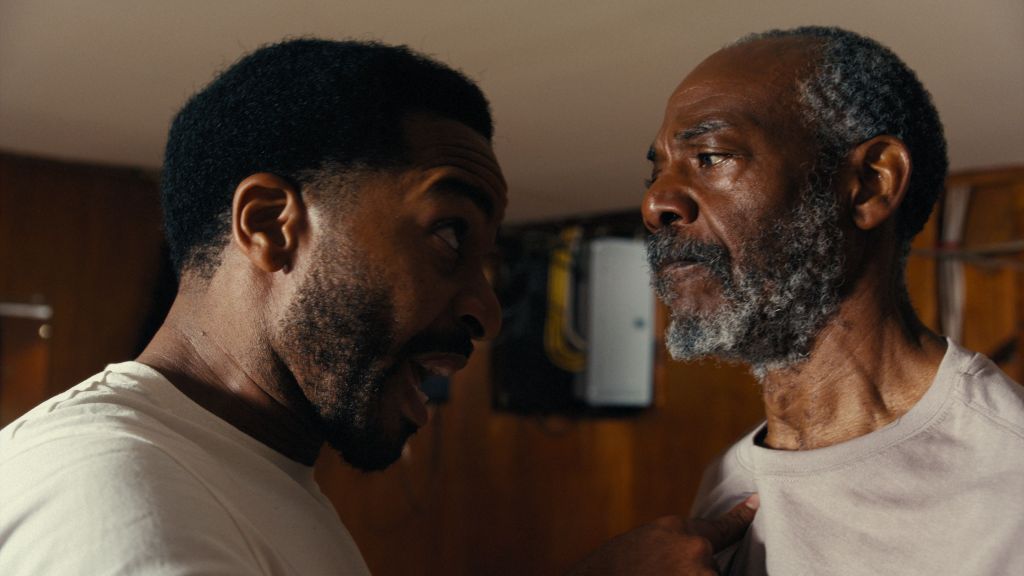
Tarrell (André Holland) is an artist who lives with his nuclear family in a pretty American suburb. His wife Aisha (Andra Day), also an artist, is a singer-songwriter, and they both adore their three-year-old son. Tarrell paints realistic aspects of his personal history inspired by his own memories and snapshots. They’re painted on enormous, larger-than-life canvases, mounted on the towering walls of their studio. His last show was a smashing success and his agent is pressing him for another (lucrative) show, ASAP. But the images in his paintings are not bucolic… they recall past traumas that Tarrell lived through but has yet to deal with. He frequently wakes up in bed, screaming from night terrors.

Meanwhile, in a bad part of town, La’Ron (John Earl Jelks) a homeless addict with a long, grey beard, struggles to make it through each day. He ekes out his meagre existence collecting spare change for shining hubcaps and washing cars outside a skid-row liquor store. But when he ends up in hospital, near-dead after a severe beating by a stickup crook, he decides it’s time to go clean. His brother offers him temporary shelter, and sends him to rehab. His estranged wife Joyce (Aunjanue Ellis-Taylor) forgives him once again in hopes of future familial reconciliation. But what does homeless La’Ron have to do with artist Tarrell? He’s his father, and  bad blood flows between them. He taught his son that as a black man, no one will care about him, no one will help him, and unless he gets tough and works extra hard, he’ll never survive and no one will care. But to Tarrell, the abuse visited upon him by his father was mean, self-serving and sadistic, exploiting his son’s labour to pay for his crack habit. And now La’ron shows up at his door again — what is it he wants now? Can father and son talk honestly? Has La’ron’s nature change? Can Tarrell ever forgive him? And can this extended family be saved?

Exhibiting Forgiveness is a multigenerational look at the hidden fissures and cruelty of masculinity unintentionally visited by fathers upon their sons. It’s rich and moving in its portrayals. The story is told both as a drama and as an artist’s representation of current and past events. We see Tarrell paint three youths; one of them his younger self (Ian Foreman). He later erases two of them by obliterating  their images with whitewash on the canvas. In another he cuts his teenaged self out of a painting with an x-acto knife, later draping the missing image on a chair,

So I’m watching this movie with the striking canvases in the paintings — this is not just anonymous crap-art made-up for the movie, it’s the real stuff — but when  Tarrell violates the art by splashes white paint or cutting it up… I was a bit disturbed, thinking, OK, the director is making a point, but he’s also destroying another artist’s work. So I looked him up afterwards:   The director is an artist, the paintings are his, and cutting up and altering his own canvases is an integral part of his work. He’s primarily an artist, and this is his first film. Watching the movie, I liked the passion of the acting and the emotional (and physical) violence in the characters they portrayed. But once I connected it with Titus Kaphar’s physical art, it suddenly became something much bigger than the sum of its parts. 

Exhibiting Forgiveness is an impressive first feature.

My Dead Friend Zoe opens this weekend in Toronto; check your local listings; and Exhibiting Forgiveness is now available on VOD. 

This is Daniel Garber at the Movies, each Saturday morning, on CIUT 89.5 FM and on my website culturalmining.com.

The thrill of uncertainty. Films reviewed: Harbin, Babygirl, The Brutalist

Posted in 1900s, 1940s, Art, Class, Espionage, Korea, Sex, SMBD, War by CulturalMining.com on January 4, 2025

Hi, this is Daniel Garber at the Movies for culturalmining.com and CIUT 89.5 FM.

First let me wish you all a Happy New Year! With a new year comes renewal, hope… and potential dread. So this week, I’m looking at three new movies where people face potentially dreadful situations, partly of their own making. There’s an abused architect, a compromised CEO, and a sympathetic assassin. 

Harbin

Co-Wri/Dir: Min-ho Woo

It’s 1909 in Korea. After defeating a European empire in the Russo-Japanese war, Japan is flush with imperial ambition. They want more colonies on the mainland and are looking hungrily at Korea, Manchuria, Mongolia, and China. But some independence-minded Koreans are regrouping to fight Japan. Their leader, Ahn Jung-geun (Hyun Bin), managed to defeat a Japanese battalion in a bloody battle. But when, following international laws, Anh released the disarmed POWs, their leader Mori (Park Hoon) shot a cannon at their base killing everyone except Anh. Now the survivors are meeting in Vladivostok to decide what to do next. This includes Kim (Jo Woo-jin) his closest ally, and Woo, (Park Jeong-min) his biggest rival. And some of them think Anh is a Japanese mole. To atone for his mistakes and to do something big, he vows to assassinate Ito Hirobumi (Lilly Franky: Shoplifters, Like Father, Like Son) one of the top statesmen of Imperial Japan who is calling for the annexation of Korea. 

To do this killing Anh must make his way to Harbin, a rail hub city right on the border of Russia and northeast China where Ito plans to give a public speech. But If he travels by train he will be caught. He must turn to a former comrade turned bandit, Ms Gong (Jeon Yeo-been) to try to secure explosives. But there is a traitor in their midsts, telling the Japanese all their plans. Can they make it to Harbin undetected, find the rat, fool their enemies, and carry out the assassination? Or are they fated to be erased from their country’s history?

Harbin is a vivid and gripping retelling of a famous historical event. It’s a classic cloak & dagger, full of action, thrills, drama, and deception. It’s done in the traditional style, with the name of each character appearing on the screen to help you keep track of which moustachioed fighter is which. But easier said than done, when everyone pulls down the brims of their fedoras to cover their faces. The locations are amazing: Anh crawling across the frozen waters of the Tumen River, horse caravans on the sands of Mongolia, ancient Russian train stations… very impressive! The sets and costumes are great too, with a drunken warlord festooned in animal furs or the ceiling lamps aboard a Russian train, swinging from side to side. If you have any interest in action-thrillers, spy stories or even NE Asian history, Harbin is the film for you.

Babygirl

Co-Wri/Dir: Halina Reijn

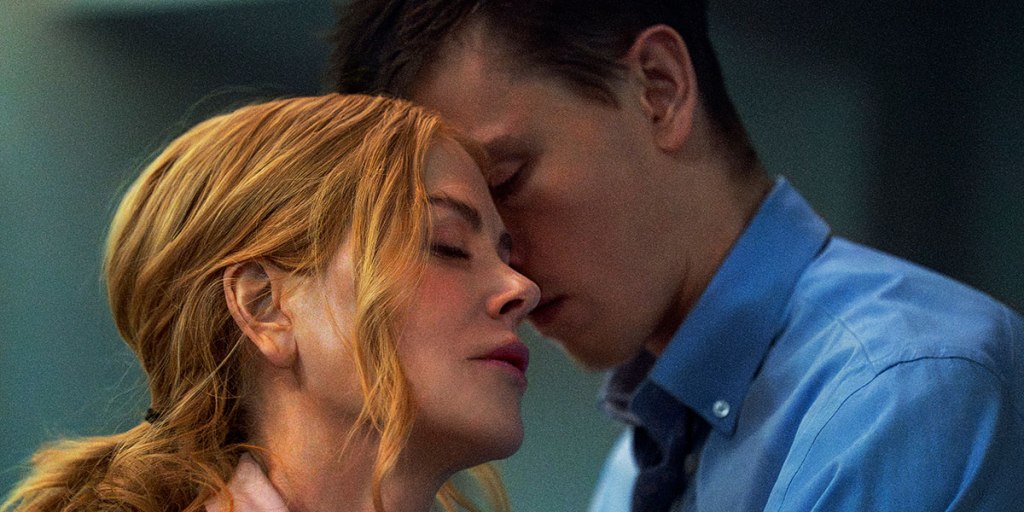
Romy (Nicole Kidman) is the CEO of a large, successful corporation that makes automated parcel-sorting equipment — similar to what Amazon has in their warehouses. She lives with her husband Jason a play director (Antonio Banderas) and their two teenage daughters, Isabel and Nora. Her life is almost perfect, but is missing a certain…. je ne said quoi. She is not sexually satisfied. One day she is startled by a vicious dog running rampant outside her office tower. She witnesses a random young man calm the dog down and return it to its owner. Later, inside her office, she is introduced to her latest intern; it’s the same guy she saw outside. Samuel (Harris Dickinson) has an unusually forthright manner, almost rude and overbearing for someone so young. He makes her feel unhinged and yet… intrigued. Who is this twerp, and why is he like that? She finds him overconfident and almost ridiculous. And yet… eventually, to her great surprise, they kiss and sparks fly.

Soon she is secretly meeting him in seedy hotel rooms for furtive sex. But he wants more — total domination over her in an S&M relationship. Romy loves her husband and kids has never done anything like this before. Even though he takes the dominant role, in real life she holds all the cards: she’s older, richer and his boss. She has more to lose, though, and it’s that threat that excites her. And she can’t got enough of him. What will happen if word gets out? Has she bit off more than she can chew?

Babygirl is an erotic drama about an older woman’s fling with a much younger man for the thrill of it all. It’s both highly sexualized and yet uncomfortable to watch in parts. It’s entirely told from Nicole Kidman’s (Before I go to Sleep, Genius, The Beguiled, The Killing of a Sacred Deer,  Boy Erased, The Upside, Destroyer, The Goldfinch,  Bombshell, The Northman) Romy’s point of view; we share her agony, her ecstasy, her cringing embarrassment (he treats her like a domesticated pet). As Samuel, Dickinson is opaque, functioning mainly as her erotic foil. He’s usually an excellent actor (Beach Rats, Triangle of Sadness, Scrapper, The Iron Claw) but in this movie he takes second all the way. Some people love this movie, others despise it. I’m somewhere in between. The plot is just a slight twist to the hoary old cliche of the powerful executive submitting to a dominatrix. I don’t need to watch a grown woman lick milk from a saucer. But other parts are quite exciting and altogether it’s worth it for Nicole Kidman’s performance. 

The Brutalist

Co-Wri/Dir: Brady Corbet

It’s post-WWII. László Tóth (Adrian Brody: Splice, Predators, The French Dispatch, Asteroid City) is a holocaust survivor from Hungary who arrives in America as a displaced person. His wife Erzsébet (Felicity Jones) and niece Zsófia are nowhere to be seen. His cousin Attila (Alessandro Nivola) gives him a place to stay in his furniture store and puts him to work designing and building chairs. Things look up when the son of an oligarch offers him a job redesigning his father’s home library. Laszlo takes to it like a fish out of water, building a modernistic room with synchronized wooden panels and shelves beneath an open skylight. But when the industrialist Harrison Lee Van Buren Sr. (Guy Pearce) sees it, he goes ballistic and fires him without pay. Soon after his cousin falsely accuses him of sleeping with his wife Laszlo finds himself unemployed, homeless and addicted to drugs. He gets work doing manual labour at a ship yard with Gordon (Isaach De Bankolé) a man he befriended earlier until the industrialist who fired him seeks him out ago. Turns out Laszlo was a Bauhaus architect before the war, and the library was featured in modern architecture. Lee immediately rehires him, this time to build a monumental memorial on a hilltop in honour of his mother. But conflicts still trouble the two men’s relationship. Will Laszlo ever complete his masterpiece? Or will Lee crush him with his oppressive and egoistical nature? 

The Brutalist is a moving drama about the American Dream and the class struggle between two men. (The title refers to the Brutalist style of architecture Laszlo favours). It’s a full-fledged four hour epic, compete with an overture, intermission and various story lines within the plot. I’m only giving you a taste of it here, a three-minute review of a four hour movie. It is visually and audibly stunning, both in design and execution, from the score to the crisp camera work, even the surprising credit roll.  The acting is superb — I’m referring to Brody, Pierce, Jones and the rest of the large cast. This is a mature film made by a young director and former child actor. I’ve only seen one other movie by him, Vox Luxe, which, while visually interesting, didn’t have much to it. The Brutalist takes a quantum leap beyond that, filling in all the parts left out of his previous work. The movie is exciting, full of both hope and crushing devastation. It’s so well done that I left the theatre assuming it was a biopic, only later realizing it’s entirely fictional. 

The Brutalist is a stupendous movie that must be seen to be appreciated.

The Brutalist and Babygirl are now playing in Toronto, with Harbin opening this weekend; check your local listings.

This is Daniel Garber at the Movies, each Saturday morning, on CIUT 89.5 FM and on my website culturalmining.com.

Famous men. Films reviewed: Anselm, Ferrari, The Iron Claw

Posted in 1950s, 1980s, Art, Biopic, Cars, documentary, Germany, Italy, Pro Wrestling, Sports by CulturalMining.com on December 22, 2023

Hi, this is Daniel Garber at the Movies for culturalmining.com and CIUT 89.5 FM.

The end of the year is coming up, so it’s a good time to reflect on what we’ve done over the past year — or even longer. It’s also useful to look at what famous people did, and whether you would have made the same mistakes — and accomplishments —  that they did. So this week, I’m looking at three new movies — two biopics and a documentary — about famous men from very different backgrounds. There’s a family of pro wrestlers who carry a curse; an Italian industrialist who buries a family secret; and a German painter who digs up unpleasant things from his country’s past.

Anselm

Dir: Wim Wenders

Anselm Kiefer is an artist born into a bombed-out Germany just as WWII was ending. His paintings reflect this, using living, natural media, like wood, grass, leaves, ash and liquified metals. He creates much of his work in isolated factories and warehouses in places like Odenwald, a forest in Germany. He uses the spaces both as a studios and as a source of materials for his work. He resurrects controversial themes once co-opted by the Nazis — like Germanic heroes, nordic gods and Wagnerian winged valkyries— in order to confront a part of his country’s history most of his colleagues were trying to ignore. Especially controversial are a series of photos of himself posing in a Heil Hitler salute in cities across Europe. In fact, though, much of his work focuses on Germany’s history, specifically the Holocaust, featuring quotes from poet Paul Celan. Other paintings show blackened sunflowers beneath cold grey skies, or haunting rows of white sticks. Quite unnerving.

Anselm is a documentary by Wim Wenders that shows him at work making his art. It’s filmed in a format more often used in superhero movies. I’m talking 3-D here — very unusual for an art film.  And, along with the big screen, it gives you a sense of the grandeur of his paintings, which you just don’t get looking at them on your phone or computer screen. They are huge. He creates his work using enormous blowtorches attached to rubber hoses, bulldozers, forklifts and cast iron vats of liquid metals. He works in buildings so big you’d expect them to be smelting steel or building airplanes not painting canvases. There are also some very cool techniques that only seem accessible in the form of film. For example he uses slide and video projections of his work superimposed on an outdoor cloth screen stretched between trees in a forest beneath a dark, starry sky. It also uses actors — played by his and Wim Wenders own family members — to reenact Keifer’s history and the inspirations of many of his themes, including self-portraits of him lying on his back looking at the sky.

To be honest, I had heard of Kiefer and probably seen a painting or two, but knew little about him before this doc. Embarrassingly I even confused his work with that of Gerhard Richter (who also paints large canvases, at times semi-abstract, with references to Germany’s past, as in this fictionalized story of his life). Not any more. Kiefer is as dark and foreboding as Richter is bright and colourful. Now I can say I know a lot about Anselm Kiefer and his art. Is he my favourite artist? No, not by a long shot, but the doc makes his work more interesting and accessible, and now I’d like to see more of it in person. So if you’re into contemporary European art, or a fan of Wim Wenders, you should see Anselm. 

Ferrari 

Dir: Michael Mann

Enzo Ferrari (Adam Driver) is an automobile industrialist with a passion for race cars in Modena, Italy in the 1950s. It’s a typical morning: he kisses his wife Lina (Shailene Woodley) and says goodbye to his son as he drives away from their isolated villa into town.  He has a meeting planned with a new racing car driver for the company’s team. Less typical is the reception he gets when he arrives at his city home and a woman pulls out a gun and shoots him. Laura Ferrari (Penélope Cruz) — is his actual wife! Luckily the bullet misses, but their relationship is clearly not doing well. Their son died and the business is on the rocks. She controls half of Ferrari — they founded the company together with Enzo doing the engineering and Laura handling the business side.

Ferrari makes their money by selling hand-made sportscars to very rich people around the world. And to keep their reputation, they also race. If Ferrari’s team wins, the company’s value goes up and more people buy their cars. But they’re also Enzo’s passion. And though Modena may be a small city, it’s where Italian race cars are made — Not just Ferrari but Maserati, De Tomaso, Lamborghini — they’re all built in or around there. Can Ferrari win the upcoming race? Can the company survive on its own or will they be taken over by a bigger, foreign corporation? Will Enzo ever admit he has a lover and a son? And will his relationship with Laura ever turn back to normal? 

Ferrari is a biopic about the founder of the famed Italian car company, his family and his racing cars. It has some nice locations and authentic looking costumes and sets. Other than that I can’t think of many good things to say about it. This movie is a real clunker.  It’s a corny, melodramatic story filled with stiff dialogue and acting or the occasional overacting by people like Penelope Cruz. The non-italian actors all speak with terrible fake accents. It’s directed by Michael Mann, the notorious 80s TV director who brought us shows like Miami Vice — never known their deep emotions. 

And what’s with Adam Driver? Does he think putting on a suit and hat is enough to turn you into an Italian CEO? He made  House of Gucci just two years ago and now he’s Ferrari. While Gucci was total kitsch, at least it was memorable and (unintentionally) funny. But this one is just a bore.  

The Iron Claw

Wri/Dir: Sean Durkin

It’s the late 1970s in Denton, Texas, near Dallas-Fort Worth. 

The von Erich family is known for its athletic prowess in the world of pro-wrestling for two generations. Their Dad, Fritz, runs the Dallas Sportatorium. He and his wife Doris have four sons, all very close: Kevin (Zac Efron) is following his dad into the world of pro wresting, and adopting his signature move — the Iron Claw of the title. He’s a heavyweight wrestler, big and vascular, and wants to win the coveted heavyweight belt. But he’s shy and tongue-tied whether inside or out of the ring. Kerry (Jeremy Allen White) is on the US Track & Field Olympic team in training for the upcoming games in Moscow. David (Harris Dickinson) is a pro wrestler, too, tag-teaming alongside his brother. He’s not a heavyweight like Kev, but he’s agile, bright, and great at trash talking to the crowds. And Mike (Stanley Simons) the youngest one, is staying away from wrestling altogether, turning instead to music — he’s the lead singer in a band. 

Their lives are lived under the close watch and heavy hand of

This image released by A24 shows Zac Efron, right, in a scene from “The Iron Claw.” (Brian Roedel/A24 via AP)

their father, a hard-ass manager and coach. Winning is everything. Their mom won’t get involved in family disputes — it’s for the boys to work it out. But Fritz is relentless, forcing his sons to do things they don’t really want to do. It’s a rough and hostile world. And hanging over everyone is the von Erich curse. This is because their oldest brother died in a terrible accident when he was just a boy. Kevin finally meets a woman, Pam (Lily James) and the family continues to be close as they pursue their futures as a team. But a dark cloud seems to be holding them all back. Can the brothers survive the harsh world of pro wrestling and the toxic atmosphere created by their father? Or will they succumb to the von Erich curse?

The Iron Claw is a great drama based on the lives of the actual von Erich family. It’s tense, exciting, and emotionally draining. The wrestling scenes are shot in extreme close-up, bringing you right into the ring. Zac Efron (The Greatest Beer Run Ever, At Any Price, Baywatch) plays it strong and dumb, looking like he’s OD-ed on steroids and botox.  Jeremy Allen White (he’s the star of the TV show The Bear) is intense and angry. Harris Dickinson (Beach Rats, Triangle of Sadness, Scrapper) plays a tragicomic character, and newcomer Stanley Simons is a naive innocent kid, totally unsuited for the ring. This is an honest look at the good and bad side of the sport and what a famous wrestling family went through. (Surprised it’s not about the Hart family, but that would be a different movie.)

I went into this film expecting a cheesy biopic, but it had me bawling in my seat by the end. The Iron Claw is a terrific tear-jerker.

Anselm is opening at the TIFF Bell Lightbox this weekend, with The Iron Claw and Ferrari also playing this weekend in Toronto; check your local listings.

This is Daniel Garber at the Movies, each Saturday morning, on CIUT 89.5 FM and on my website, culturalmining.com.

Magical kids. Films reviewed: The New Boy, Butterfly Tale, Once Within a Time

Hi, this is Daniel Garber at the Movies for culturalmining.com and CIUT 89.5 FM.

You’ve heard of Peter Pan, right? He’s most famous for not growing up and for believing in fairies. And it’s true, kids are more likely to believe in magic than grown ups. This week, I’m looking at three new movies about the innocence and magic of childhood. There’s a disabled, teenaged butterfly that wants to migrate with his flock; an indigenous boy with magical powers sent to a church-run school; and a group of kids forced to face a fairytale apocalypse.

The New Boy

Wri/Dir: Warwick Thornton (Sweet Country)

It’s the 1940s at a remote Australian Benedictine monastery. Sister Eileen (Kate Blanchett) is excited because there’s a new student arriving soon. She runs the place, ever since the head Benedictine monk died — she keeps this detail a secret from the outside world. The new boy (Aswan Reid) is indigenous, can’t speak English, and has had virtually no contact with white Australia. He has blond hair and brown skin. He sleeps on the floor, not on a bed, and finds forks and spoons a mystery. At the same time, he can conjure up glowing particles to light his way, using just his hands. And he has magical powers: he can speak to trees, and cures people bitten by poisonous snakes.

The sisters teach him out to use an outhouse (which he finds both funny and revolting), and about western ways and foods. Above all, Sister Eileen wants to convert him to Christianity — she lives him deeply, and wants to save his soul. She uses a life-sized wooden statue of Jesus writhing on the cross as the catalyst. She hopes to change him completely, and ultimately to baptize him and give him a Christian name. Will he convert? And what will happen if he does?

The New Boy is a gentle, bittersweet look at religion, colonization, forced assimilation and residential schools (known as boarding schools in Australia), as seen through one boy’s eyes. I found it both inspiring and tragic. Kate Blanchett is wonderful as the scheming but good-hearted nun, while young actor Aswan Reid is remarkable as the unnamed new boy. (The movie opens with a violent fight between him and a soldier in the bush, just one of many surprising scenes he manages to convey without uttering a single word.) Director Warwick Thornton based it partly on his own experiences as a boy in Alice Springs, and those personal details and feelings come through. 

I liked The New Boy a lot.

Butterfly Tale

Dir: Sophie Roy

Patrick (Mena Massoud) is a young monarch butterfly who recently made the transition from caterpillar. He and his best friend Marty are looking forward to joining his village on their annual migration to Mexico. He is especially excited about spending quality time with the girl he’s crushing on, Jennifer (Tatiana Maslany). But there’s a problem. Patrick emerged from his cocoon with mismatched wings, so he’s disabled and can’t fly. And Marty is still a caterpillar. They are teased and bullied by the bigger butterflies as “butter fails”.

Worse still, Patrick’s mom, a leading flier in the “flutter” (what they call their butterfly community) wants him to stay home in the winter. But Patrick and Marty are determined to get there by hook or by crook. Jennifer, a strong flier, is pulling a leaf filled with milkweed so they can all eat on the way. Patric and Marty stowaway aboard that leaf! Little did they know they’ll face tornadoes, big box stores and angry birds posing life threatening dangers on the way. Will Patrick ever learn to fly? Will Marty ever make the transition from caterpillar to butterfly? And will Jennifer get over her hangups? 

Butterfly Tale is an animated, coming-of-age road movie about anthropomorphic  butterflies. They’re basically people, with human hair, faces, and bodies but with big butterfly wings coming out of their backs. They wear T-shirts and hoodies, and worry about adolescent insecurities. (They even have to stop the flight along the way to take a leak.) Little kids might really identify with the characters and like this movie; it has good role models for children with disabilities, and deals with environmental issues. The thing is, it’s not original or funny or risky or challenging anywhere, just a typical adolescent drama, where the people happen to be butterflies. I’m not saying it was uninteresting — it kept my attention the whole time — there just wasn’t much to it.

Once Within a Time

Wri/Dir: Godfrey Reggio

Once upon a time, a bunch of happy kids follow the beckoning voice of a goddess onto a stage. After riding a merry-go-round they start to notice strange happenings. An Adam-and-Eve-like young couple in wire masks take a piece of fruit from a sinister looking apple-man, unleashing terrible events. Smart phones generate robots, a chimp in a monkey suit and another in a VR helmet, huge industrial power-towers, a baobab tree exploding into a mushroom cloud.  Ecological and geopolitical devastation is at hand! Can we survive the end of this world… or maybe start a new one?

Once Within a Time is a phantasmagorical, magic-lantern fable performed on a two dimensional stage beneath a prominent proscenium arch. It’s equal parts live-action, documentary footage, still images, and 3-D stop-motion animation. 

I first saw Godfrey Reggio’s Koyaanasqatsi as a teenager and the barrage of apocalyptic images of corporate uniformity combined with Philip Glass’s pounding music left deep marks in my psyche. This one is kinder and gentler but still effective. It’s co-directed and edited by Jon Kane with amazing vintage special affects from irises to rear projections to dual spectroscope photos. There are tinted black & white shots, shadow puppets, grotesque masks, and dancing robots that evoke everything from Georges Méliès to Guy Maddin to the late Peewee Herman’s Playhouse.  Who knew the apocalypse could be so beautiful? It’s less than an hour in length, but provides about three times that in intensity. If you can, see it on a big screen and just let the images and music overwhelm you.

Great movie. 

Butterfly Tale is now playing in Toronto; check your local listings. The New Boy is a feature at the ImagineNative film festival starting next week. And Once Within a Time is playing tomorrow (Sunday, October 15th, at 5 pm) at the TIFF Bell Lightbox.

This is Daniel Garber at the Movies, each Saturday morning, on CIUT 89.5 FM and on my website, culturalmining.com.

Same-sex couples. Films reviewed: Unicorns, Solo, Rotting in the Sun

Posted in Art, Canada, Cross-dressing, Drag, Gay, Montreal, Quebec, Romance, Screwball Comedy, Sex, UK by CulturalMining.com on September 30, 2023

Hi, this is Daniel Garber at the Movies for culturalmining.com and CIUT 89.5 FM.

Fall Film Festival Season in Toronto continues in October with ImagineNative — brilliant films and art by and about indigenous people in Canada and around the world from 17-22; and Planet in Focus,  the International Environmental film festival, with features, docs and talks on nature, activism, and climate change, from the 12-22. 

This week, I’m looking at three new movies about same-sex relationships, two of which played at #TIFF23. There’s a straight mechanic who unwittingly falls for a drag queen in a London pub; a Quebecois drag queen who falls for a French one in a Montreal bar; and a Chilean artist who meets an American influencer on a nude beach in Mexico.

Unicorns

Co-Dir: Sally El Hosaini, James Krishna Floyd

Luke (Ben Hardy) is a mechanic who lives in Essex, near London. He works at his father’s garage, and spends the rest of his time with his 5 year old son. His wife abandoned them when his kid was still a baby, but luckily his dad will babysit if he’s out on a date. For Luke dating usually means furtive sex and one-night stands with women he hooks with online. But one day, after leaving a London curry house, he stumbles into a nearby nightclub, and is riveted by the eyes of a beautiful woman performing an alluring dance on stage. Clearly, the feelings are mutual — Aysha seeks him out afterwards, for a snog and a grope at the stage door. Only afterwards does Luke realize the woman is actually a man in drag. He freaks and leaves. Aysha (Jason Patel) is disappointed — he thought Luke knew they were in a South Asian drag bar. But Luke is straight and almost sickened by what happened.

Still, there is something there. Luke agrees to act as a paid driver (and unpaid bodyguard) for Aysha and her fellow drag queens. They need transportation to get them safely to private “gaysian” (gay+asian) parties on the down low, in places like Manchester. The tips she gets at these parties pays her rent. Gradually, they get to know one another better. When Aysha really hits it off with his son, Luke starts thinking maybe she is just the woman he’s looking for. Problem is, he’s not trans, he’s a man named Afik. Aysha is just his drag name. Will the attraction still be there if Aysha goes away? And can a straight white man and a gay South Asian drag queen form a couple?

Unicorns is a poignant, romantic drama about two people from two sides of a deep divide. And while there is some shocking violence and unexpected plot turns, the filmmakers  keep it real and subtle. This is co-director James Krishna Floyd’s (of mixed heritage) first feature, and does an excellent job of it. Ben Hardy is a well-known heart throb and soap star in the UK, while Jason Patel is a newcomer — this is his first role. Luckily, the two have amazing chemistry and are compelling to watch. 

This is a good first movie.

Solo

Wri/Dir: Sophie Dupuis

Simon (Theodore Pellerin) is the youngest drag artist at a Montreal bar. He’s naive, trusting and sexually inexperienced. He performs elaborate acts dressed in outfits his older sister helps design. And he always looks forward to visiting his Dad, stepmother and sister for Sunday brunch. His mother is an internationally famous  opera star, who left the family for greener pastures when he was a teen. But everything changes when Olivier (Félix Maritaud) a charismatic older guy in his late twenties shows up at the drag bar direct from Paris. Simon is blown away by his sex-centred drag performances, and wants to learn from him. Soon they are an item, in and out of bed, and onstage. Simon will do anything Olivier wants: moving in together, staying away from his family, even how Simon should perform his own acts.

But the concessions all seem to be one-way. Olivier sleeps with other men, insults Simon’s judgement, and plays mental tricks on him. Around this time, Simon hears some shocking news: his mother is coming to Montreal, back from a triumphant tour off Europe. He hasn’t seen her in years, so this will be the crucial reunion Simon has been longing for and waiting for for so long. How will their meeting go? What role will Olivier play? And will she come to watch his Solo drag performance? 

Solo is a moving and tender portrayal — set within Montreal’s drag community — of a young man forced to face his demons and figure out who are his friends and who are his enemies. I know very little about the drag scene (I’ve never seen Rupaul’s Drag Race, for example) but it doesn’t require outside knowledge to understand what the movie’s trying to say. Theodore Pellerin is amazing as Simon, and — though much less sympathetic — so is Félix Maritaud. And for a movie about drag it’s surprisingly devoid of camp. If you’re looking for a tear-jerker with lots of musical performances, you’ll enjoy Solo.

Rotting in the Sun

Dir: Sebastian Silva

Sebastian Silva (Sebastian Silva) is a jaded Chilean artist and filmmaker who lives in an apartment in Mexico. He enjoys reading books about suicide and depression. When he’s not dodging work deadlines or dealing with construction noise in his minimalist apartment, he’s likely walking his dog Chima, doing pop art paintings of giant cartoony penises, or snorting bumps of  pentobarbital. His beleaguered housekeeper Señora Vero (Catalina Saavedra, in a great performance) takes it all in, but never comments.

On the recommendation of a colleague he takes some time off to relax at a gay nude beach in Zicatela, but is non-plussed by all the body parts on display. When he almost drowns there, he meets Jordan Firstman (Jordan Firstman) an instagram influencer. Jordan thinks it’s Kismet — he saw one of Sebastian’s films just the night before, and here they both are washing up on shore. They must collaborate on a production. Sebastian is less enthusiastic, but Jordan insists. But when he arrives at Sebastian’s door in the city, he is nowhere to be seen. Is he ghosting him? Or has something really bad happened to Sebastian? And will Jordan ever solve this mystery?

Rotting in the Sun is a contemporary indie film in the style of a highly-sexualized comedy. It’s equal parts mystery, screwball comedy, and scathing social satire, with a fair amount of nonchalant, explicit sex. Silva reimagines Mexico as an uber-gay paradise, where the local park fountain has a statue of Michelangelo’s David, the beaches are packed with nude men, and every room in his apartment reveals an orgy behind closed doors. This constant decadence is contrasted with the panicky and naive Señora Vero desperately trying to hide Sebastian’s whereabouts. Silva and Firstman play exaggerated versions of themselves, to hilarious effect.

You know the expression “a bag of dicks”? This movie is a dump truck of dicks. But if you don’t mind looking at lots and lots and lots of penises, you’ll get a kick out of this shockingly subversive comedy. 

Unicorns had its world premiere at TIFF;  Solo had its Toronto premiere there and opens this weekend in Toronto; check your local listings. And Rotting in the Sun — along with a selection of other films by Sebastian Silva —  is now streaming on Mubi.

This is Daniel Garber at the Movies, each Saturday morning, on CIUT 89.5 FM and on my website, culturalmining.com.

August potpouri. Films reviewed: Bad Things, Lasting Impressions, Strays

Posted in 1900s, Animals, Art, comedy, France, Ghosts, Horror, Lesbian, LGBT, Penis by CulturalMining.com on August 19, 2023

Hi, this is Daniel Garber at the Movies for culturalmining.com and CIUT 89.5 FM.

August is a time to relax travel and have fun, not a time when people want to watch serious movies. So this week I’m looking at a potpourri of different sorts of entertainment than you’re probably used to. I’m talking about lesbians in a haunted hotel, French impressionist paintings on a bistro wall, and abandoned talking dogs in a big city. 

Bad Things

Wri/Dir: Stewart Thorndike

It’s dead winter in upstate New York. Ruthie (Gayle Rankin) and her friends are up from the city to spend a night or two at a completely deserted hotel. 

Ruthie inherited the place from her grandmother and has to decide whether to give it a go or sell it. With her, are her enthusiastic girlfriend Cal (Hari Nef: Barbie) their hard-boiled pal Maddie (Rad Pereira) and Maddie’s flirtatious acquaintance Fran (Annabelle Dexter-Jones). And it could be a fun weekend: there’s an indoor swimming pool, karaoke, a huge kitchen and tons of empty rooms for pillow fights or foolin’ around. On the negative side, the hotel might be haunted. Fran is the first one to see ghosts, a little girl worried about her fingers, and a pair of female ski champs. Worse, the ghosts can also see her. But when she freaks, the other three just blame it on drugs. Things heat up when Ruthie cheats on her girlfriend. But when things start getting really scary, like someone wearing a gas mask while brandishing a chainsaw — they have to decide whether to hightail it back to the city, or stick it out. 

Bad Things is a new take on Stanley Kubrick’s The Shining from a feminist perspective. It keeps some of the original concepts but twists them all into something new and original. Instead of blood in the hallway it’s mothers’ milk. And there are lots of psychological thrills and chills — it’s hard to know who is crazy, who’s a ghost, who is living, who is dead, and who is killing them all. The acting is good all around, along with appearances by token heterosexuals, Canadian Jared Abrahamson (American Animals, Hello Destroyer, Hollow in the Land, Sweet Virginia) as Brian the handyman and 80s icon Molly Ringwald as the Woman in Red. Bad Things is a low budget movie shot during the height of the pandemic —  The Shining it ain’t — but it is good, funny and scary.

Lasting Impressions: The Magic of the Impressionists in 3D

When is a painting not a painting? When it’s an experience. Over the past 5-10 years there’s been a boom in exhibitions of the art of famous painters… but without the paintings. Van Gogh, Chagal, Monet — they take a huge space and fill it with enormous moving projections of their most famous works to view as you walk around a warehouse or convention centre temporarily turned into a pop-up gallery. These were especially popular during the pandemic when it was hard to travel. But this show is different: instead of an ersatz art gallery, it’s a show, almost like dinner theatre. You sit at small numbered tables, where servers bring wine and snacks. When the show begins, the lights dim and you turn your chair to face the screen. And here’s where out gets interesting. To the accompaniment of popular French music — Debussy to Charles Aznavour to Ella Fitzgerald —  enormous blowups of French impressionist paintings — sort of a greatest hits — are displayed one by one. The projections use super-saturated colour with intense effect. Part of the paintings are animated: water ripples, clouds drift, leaves shake. And — with the help of 3D glasses —  elements of a painting feel like they’re moving: you’re drifting down a stream, floating above Monet’s waterlilies, or at a ballet rehearsal with poised ballerinas drifting slowly toward you in mid-air. It’s not the same thing as seeing a painting on a wall; this is art as a commodity to be consumed. While the animation doesn’t always work — I’d rather see a Frenchman’s long beard or a Tahitian woman’s hair staying still in a Renoir or Gaugin painting, than to watch it sway rhythmically in the breeze — the technical quality is excellent: great sound and beautiful images. I’m of the view, if you want art, go to a museum — there’s a show on right now of Mary Cassatt’s impressionist painting at the AGO. But if you want a pleasant, nostalgic outing, where you can enjoy choreographed pictures, music and a glass of wine, this is it.

Strays 

Dir: Josh Greenbaum

Reggie is the perfect dog. Though a bit scruffy around the edges, he is loving, faithful, and true to his master Doug (Will Forte). All he wants is a pat on the head and an occasional “good boy”. So what is Reggie (Will Ferrell) doing in a dark alley in some big city? Turns out Doug is a good-for-nothing, scum-of-the-earth master who abandoned poor Reggie 3 hours away from the small town they live in, so the dog could never make his way back home. Reggie is still hopeful — he’s naive and an eternal optimist —  but he is quickly disabused of that notion by some big mean dogs who threaten him. Luckily, the street-smart Bug (Jamie Foxx), comes to his rescue like the Artful Dodger, showing him the lay of the land. Being a stray dog is paradise — you can live like a king with no responsibility. They’re soon joined by two other strays: Maggie (Isla Fisher) an elegant pooch with a keen sense of smell who was traded in by her mistress for a smaller cuter lapdog; and Hunter (Randall Park) a former therapy dog who is always sympathetic.  But when they discover Reggie’s tragic story they decide to help him get revenge. Their mission? For Reggie to find his way back to Doug… and bite off his penis! Will they make it to the town? And what adventures will they encounter along the way?

Strays is a comedy road movie that’s coarse, bawdy, and raunchy. It’s a typical bro movie, with the sort of humour that appeals to 14-year-old boys… you know, lots of jokes about feces, vomit, urine and penises. But somehow, because it’s guileless dogs (not people) telling the jokes, you can laugh all you want without feeling guilty or self conscious. These are real dogs, not CGI images (except when their mouths move). It gets a bit dark at times — jokes about serial killers and lost kids — and I’m really not a fan of explicit, extended images of dog poop… but despite all that, Strays is quite a funny movie. 

Lasting Impressions is now playing at the CAA Mirvish Theatre in Toronto; Bad Things is streaming on Shudder, and Strays is opening across Canada this weekend; check your local listings.

This is Daniel Garber at the Movies, each Saturday morning, on CIUT 89.5 FM and on my website, culturalmining.com.

Daniel Garber talks with Cam Christiansen about Echo of Everything

Posted in Art, Canada, Dance, documentary, Dreams, Music, Psychology, Science, Spirituality by CulturalMining.com on May 6, 2023

Hi, this is Daniel Garber at the Movies for culturalmining.com and CIUT 89.5 FM.

What do punk, gospel, jazz and Andalusian duende music have in common? They all bring an ecstatic reaction from musicians making the music and listeners dancing to it. It’s a primal response dating back thousands of years, with music bringing joy, anger, sadness, and inspiring sex and even violence from its listeners. Are these ecstatic reactions still around today? And are the notes and rhythms we hear an echo of ancient rituals or even primordial sound waves?

Echo of Everything is an amazing new documentary about music and how it affects us emotionally, spiritually and scientifically. A highly personal film it incorporates expressionistic scenes in black and white, philosophic interviews and intense musical performances recorded in supersaturated colour. And running throughout is a constant stream of sound and rhythm, recorded around the world.

Echo of Everything is written and directed by Calgary-based filmmaker and animator Cam Christiansen, known for his award-winning features Wall and I Have Seen the Future.

I spoke with Cam in person, on-site during Hot Docs at the Luma Café at the TIFF Bell Lightbox.

Echo of Everything had its world premiere at Hot Docs and is opening theatrically later this year.

Daniel Garber talks with Kelly Reichardt about Showing Up

Posted in Art, comedy, Drama, Family, Satire, Women by CulturalMining.com on April 15, 2023

Hi, this is Daniel Garber at the Movies for culturalmining.com and CIUT 89.5 FM.

It’s present-day Portland Oregon. Lizzie is an instructor at the College of Arts and Crafts and is preparing her upcoming solo show at a local gallery. She is creating a series of small, clay, glazed sculptures of women in motion. But she also has to deal with the vagaries of daily life: a dysfunctional family, a pigeon wounded by her aggressive cat, a broken water heater, and most of all Jo. Jo is her friend, neighbour, fellow-artist, and absentee landlady. Lizzie holds a long-standing grudge against Jo’s relative success and is carrying on a passive aggressive war against her frenemy. But time is running out. Will she finish her art in time, keep her family alive, and finally take a hot shower? And most important, is anyone showing up for her opening?

Showing Up is a new dramatic comedy that takes an inside look at Portland’s art scene. It’s a subtly satirical examination of real life. Showing Up is the latest work  of filmmaker Kelly Reichardt, known for her rethinking of traditional genres, from westerns to thrillers to dramas, from Meeks Cutoff to Night Moves to Certain Women.

I spoke with Kelly Reichardt in person at the TIFF Bell Lightbox in Toronto, where Showing Up is now playing.

Daniel Garber talks with Jason Logan and Brian D Johnson about The Colour of Ink

Posted in Art, Canada, documentary, Foraging by CulturalMining.com on March 25, 2023

Hi, this is Daniel Garber at the Movies for culturalmining.com and CIUT 89.5 FM.

What do cephalopods, cavemen, and ancient Egyptians have in common? They all used ink, that amazing substance that predates both the written word and humans themselves. But what is it and where does it come from? A stunningly beautiful documentary called The Colour of Ink delves deeply into its history and usage, and explores it as an artistic medium in contemporary times. It follows artist, designer and illustrator Jason Logan, a Toronto-based ink maker, who concocts new colours from an astonishing variety of materials, many of which he forages in nature and creates in his home. The film traces those bottles of ink as they travel around the world — from Brooklyn to Tokyo to Mexico — as other artists incorporate them in their work. 

The Colour of Ink is written and directed by renowned Toronto movie critic, writer  and filmmaker Brian D Johnson. I last spoke with him at this station in 2015 about his previous documentary Al Purdy was Here.

I spoke with Jason Logan and Brian D Johnson in Toronto via Zoom.

The Colour of Ink opens across Canada this weekend, and Jason Logan is running a free, live, foraged ink event on March 25th, 2023 at the Centre for Social Innovation in Toronto.

Unexpected adversaries. Films reviewed: White Noise, Violent Night, All the Beauty and the Bloodshed

Posted in 1980s, Addiction, Art, Christmas, comedy, Conspiracy Theory, Crime, documentary, drugs, Family, Horror, Mental Illness by CulturalMining.com on December 3, 2022

Hi, this is Daniel Garber at the Movies for culturalmining.com and CIUT 89.5 FM.

It’s December now with snow on the ground, time for movies to get your blood boiling. This week I’m looking at three new movies about unexpected adversaries: there’s an artist vs a philanthropist, Scrooge vs Santa… and Elvis vs Hitler?

White Noise

Wri/Dir: Noah Baumbach,

It’s the 80s in a small rustbelt college town.  Jack (Adam Driver) is a professor in the new field of Hitler studies. Along with his wife Babette (Greta Gerwig) they raise their children, from babies to teens, in a modern, blended family. The kids Denise, Heinrich, Steffie and Wilder, are inquisitive  and precocious, and come from various marriages. At work, Jack lectures to worshipful students, and has intellectual discussions with his colleagues. His closest is Murray (Don Cheadle), a prof who specializes in cinematic car crashes, wants to raise Elvis studies to the level of Hitler studies. 

But there is trouble at home. Babette is obsessed with death and dying, and suffers from memory loss and unexplained absences. Denise suspects she’s on prescription drugs — she found a hidden bottle of Dylar, an unheard of medicine.  Meanwhile Jack is terrorized by nightmares and at times actually thinks he’s going to die. All these troubles are pushed aside when a real disaster happens: a truck crashes into a train carrying dangerous chemicals. The result? A toxic cloud floating above the area with unknown effects. The town is evacuated, the family forced to flee by station wagon to Camp Daffodil a weirdly-named military base. Rumours abound at the camp, and no one knows for sure what is happening. Can life return to normal? Will the toxic cloud blow away? Is Babette an addict? Will Jack’s academic secrets be revealed? And where does Dylar come from?

White Noise is a satirical look at dread, suspicion and alienation within an academic setting. It also looks at pop culture, art and the omnipresent consumer economy. I read Don Delillo’s novel when it first came out and I was captivated by the way it captured the dark mood at the time. Noah Baumbach takes a different path, treating the film as a comical period piece where people dress in funny 80s clothes and use obsolete technology. It looks for laughs in scenes like Jack getting tangled up in a kitchen phone cord. I have mixed feelings about this movie. Some parts just seem like running gags about those wacky 80s, turning serious scenes into absurdist jokes. Other parts are brilliant — like the pas-de-deux between Jack and Murray in a joint Hitler-Elvis lecture. Or an actual dance sequence down the aisles of a supermarket in the closing credits. And a cameo by the great Barbara Sukowa as a German nun in a hospital, should not be missed. While I couldn’t get emotionally into the characters or plot — Driver and Gerwig are both good actors but never seem real in this movie — and I felt detached from the film, I did find it interesting and visually pleasing. 

Violent Night

Dir: Tommy Wirkola

It’s Christmas Eve, and the Lightstone family are  gathered on their vast, private estate. Gertrude (Beverley D’Angelo) their autocratic matriarch, puts on an elaborate dinner each year with servants dressed as Nutcracker Suite characters. Her adult two adult children Cam and Alva, their spouses, and the grandkids Gertrude and Bertrude, (known as Trudy and Bert)outdo one another sucking up to her, to get their share of the family’s wealth. Everyone, that is, except little Trudy (Leah Brady), who doesn’t want any money or presents from Santa. She just wants her estranged parents back together again. 

This year, though, something goes terribly wrong: the costumed caterers turn out to be highly-trained paramilitary criminals, there to murder everyone and steal millions from the safe. They’re headed by a bitter man, nicknamed Scrooge (John Leguizamo) who hates Christmas. Little Trudy escapes from the family, hides in the attic, and calls to Santa Claus by walkie-talkie for help. And, to everyone’s shock, a drunken, bearded man in Christmas gear (David Harbour) comes to their rescue. He’s the real thing, but only Trudy believes in him. Can Santa and Trudy fight off dozens of ruthless killers? Can her parents overcome their differences? And can a worn-out, depressed and alcoholic Santa hang on for one more year… or is this the end of Christmas for everyone?

Violent Night is a comedy/action movie about a good little girl and a hard-ass Santa fighting cruel killers using horrific violence of their own. It’s a combination of two Christmas classics: Home Alone and Die Hard, but with the gore-level pumped up a few notches. Trudy’s booby traps turn out to be deadly, while Santa channels his past life as a Viking to wreak havoc with a hammer named Skullcrusher. Does this movie work? Totally! David Barbour (from Stranger Things) is great as a nasty Santa who pukes and pisses off his sleigh. He takes a licking but keeps on kicking. Newcomer Leah Brady as Trudy is cute — maybe too cute — but good enough. And most of the rest of the characters are sufficiently unlikeable to keep the story going. So if you’re looking for a fun and twisted action movie in time for Christmas, Violent Night fits the bill. 

All the Beauty and The Bloodshed

Dir: Laura Poitras

Nan Goldin is an artist known for her photographic portraits of the demimonde, with louche images of drugs, sex, and self-destruction. She rose to fame in the 1980s with her ever-changing performances of “The Ballad of Sexual Dependency”, which combined music and a slide show of her pictures. But far from being a dispassionate observer of the lives of strangers or, worse, an ogler of outcastes, Goldin explicitly documented the lives of her closest friends and herself, including drag queens, junkies, artists and musicians, in various stages of undress. This was also the era of AIDS, which decimated the NY City art scene. Goldin recorded this, too. It was also the start of Act Up and other movements demanding attention from the government and Big Pharma.

Flash forward to the 2000s, when pharmaceutical corporations, through doctors, were strongly pushing prescriptions of opiates as non-addictive relief from the worst levels of pain. In fact they’re highly addictive, and one addict was Goldin herself. Though she kicked the habit, many were still dying from overdoses of opioids. And she noticed something strange. A major sponsor of the galleries and museums that displayed her work were sponsored by noted philanthropists The Sackler Family. And the Sacklers made their fortune through Purdue Corporation, peddling drugs like Oxycontin.  We’re talking the Louvre, the Met, Tate Modern, and the Guggenheim, among others. So she started a protest group called P.A.I.N. (Prescription Addiction Intervention Now) which stages protests in the Sackler wings of museums world-wide.

All the Beauty and The Bloodshed is a fantastic documentary that records Goldin’s life and art, and her battle with the Sacklers. It’s engrossing and revealing, a work of art in its own right. The film includes contemporary footage as well as snapshots and films from Nan Goldin’s own personal history. She’s the cinematographer while the director is Laura Poitras, responsible for the world-changing doc Citizenfour, about Edward Snowden. All the Beauty and the Bloodshed is a rare case of a political documentary that is also respectful of art. It’s visually and audibly stunning and though almost two hours long, it’s totally engrossing; one of the best documentaries of the year.

White Noise is screening at the TIFF Bell Lightbox in Toronto; All the Beauty and the Bloodshed, is playing there and at Hot Docs cinema; while Violent Night opens this weekend across North America; check your local listings.

This is Daniel Garber at the Movies, each Saturday morning, on CIUT 89.5 FM and on my website, culturalmining.com.