Bad Hombres. Films reviewed: Silent Night, Deadly Night, Dust Bunny, One Battle After Another 

Posted in Army, Christmas, comedy, Espionage, Family, FBI, Horror, Kids, Monsters by CulturalMining.com on December 13, 2025

Hi, this is Daniel Garber at the Movies for culturalmining.com and CIUT 89.5 FM.

It’s easy to root for heroes with clean-scrubbed cheeks and virtuous demeanours, but they make for boring movies. Much more challenging are films where the main characters are anti-heroes, fatally flawed and yet still compelling. 

So this week I’m looking at three movies featuring sympathetic portrayals of bad hombres. There’s a murderous Santa Claus, a retired revolutionary, and a monster who lives under your bed. 

Silent Night, Deadly Night

Wri/Dir: Mike P. Nelson

It’s Christmastime and like every year Billy Chapman (Rohan Campbell: Halloween Ends) is on the road again. He’s a drifter in his early 20s, picking up work wherever he can find it. He ends up in a small town, and finds work in a store specializing in Christmas ornaments and memorabilia. He forms a crush on Pamela (Ruby Modine), the young woman who runs the store with her dad. But this place is doubly significant because Christmas is crucial to Billy’s self-identity. You see, when he was just a child, he witnessed his parents brutally murdered by a man dressed as Santa Claus. And now he has taken on that role for himself. Dressed in a Santa suit and wielding an axe, Billy kills one person per day, following his advent calendar, until Christmas. 

So is Billy a psychopathic serial killer? Well, yes… but, like Santa, he punishes naughty people but lets good ones have a merry Christmas. Everyone he murders is bad… real bad. And how does he know this? A voice in his head tells him who to kill. But things change when he finds himself falling in love with Pamela.  And the feelings seem mutual; they somehow click. (She has Explosive Personality Disorder, sort of like his murder sprees only much less violent). Billy thinks it’s time to settle down, maybe give up all the killing. Can Billy ignore the nagging voice in his head? What will happen if he stops killing bad people? And how will Pamela react if she ever finds out the truth about Billy?

Silent Night, Deadly Night is a classic, slasher-horror Christmas movie about a young killer Santa. It’s ostensibly a remake of an 80s film of the same name (and its sequels) but updated to fit our times. It’s bloody, violent and sometimes disgusting but always in a funny, retro-camp style. I’m talking red & black freeze frames, and old-school soundtrack. And it’s shot in Manitoba, complete with hockey games and lumber yards. Ruby Modine is hilarious as Pamela, and Rohan Campbell manages to make his serial-killer Santa almost sympathetic.

Not your typical Christmas flick but if you’re looking for a funny, gross-out slasher, you can’t go wrong with Silent Night, Deadly Night. 

Dust Bunny

Wri/Dir: Bryan Fuller

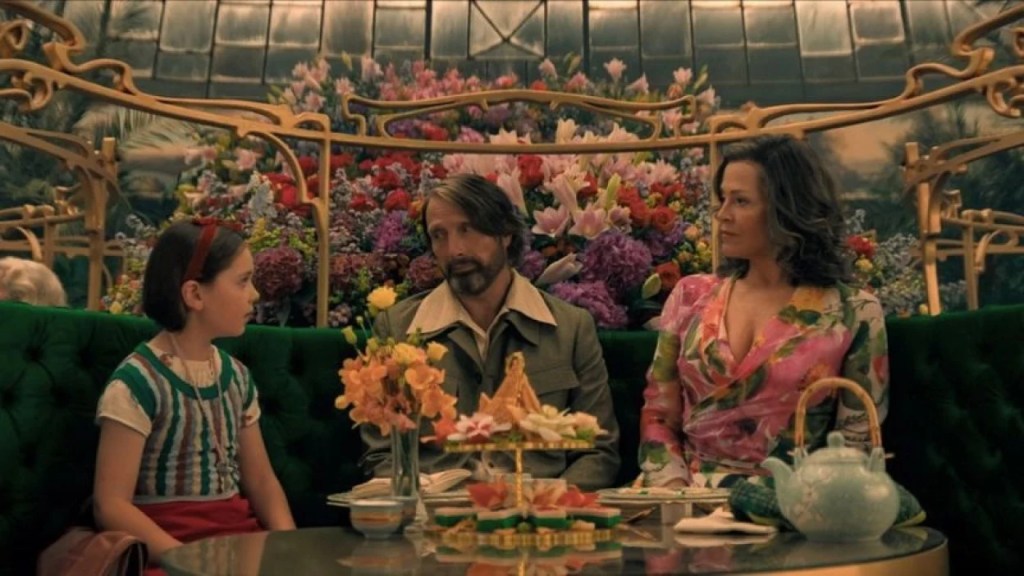
Aurora (Sophie Sloan) is a little girl who lives in a beautiful, antiquated apartment in an unnamed city. She is brave and resourceful with a wild imagination. Aurora has all the clothes, toys and games any girl could ever want. So why is she always so frightened? Because there’s something scary under her bed that won’t go away. It’s a dangerous monster that lives beneath her parquet floorboards, and she’s convinced he’ll eat you up if you ever step on the floor at night. So she gets around on a wooden hippo with wheels, using her mop as a paddle. Her parents tell her repeatedly that there’s nothing under her bed, just dust bunnies, but Aurora refuses to listen. She ends up sleeping on her outdoor fire escape to keep ahead of the monsters. One night she follows a stranger down a dark ally, where she witnesses him slaughtering a dragon. Here’s someone who can keep her safe from the monster — and he lives in her building!  When her parents disappear one night she knows she needs help to stay alive. So she attempts to hire her downstairs neighbour (Mads Mikkelsen: The Promised Land, Indiana Jones and the Dial of Destiny, Riders of Justice, Another Round, The Hunt) as a hitman, to kill the monster hiding beneath her bed. 

Problem is he doesn’t believe in monsters; he thinks someone was sent to get him, and killed her parents by mistake. But in the end, he agrees to help her. This news gets her boss very angry. Uptight and evil Laverne (Sigourney Weaver) wants Aurora dead, since she witnessed one of his assignments (he’s a professional hired killer). Soon others start appearing at her door including a suspicious guy with a moustache (David Dastmalchian) and a dressed-to-kill social worker (Sheila Atim). Who are all these people really? And will no-one listen to Aurora about the monster under her bed?

Dust Bunny is a whimsical horror movie seen through the eyes of a young girl, balancing crime and the supernatural. The hitman making friends with a little girl harkens back to Luc Besson’s classic The Professional (1992), starring Jean Reno and a very young Natalie Portman). But the look and style of this movie is totally different. This is not noir, it’s horror fantasy. It’s exquisitely detailed with flowers painted on walls, brightly coloured outfits and creaky, steampunk gears in an ancient elevator. Sophie Sloan is great as the spunky Aurora and a good foil for a gruff Mads Mickelson. The other adults are all comical caricatures but still fun to watch. And the special effects are amazing using animation and puppetry to convey what Aurora can see.

Though scary in parts, I think Dust Bunny is suitable both for kids and grown ups.

I like this one.

One Battle After Another 

Wri/Dir: Paul Thomas Anderson (Licorice Pizza)

It’s a couple decades ago, somewhere in the American Southwest. An underground revolutionary faction, known as “The French 75”, is carrying out their latest plan: to liberate hundreds of undocumented workers from an ICE-type detention centre. Members of the group have memorized codes and passwords, and only use their nicknames.  

Like JunglePussy and Mae West. Perfidia Beverley Hills (Teyana Taylor) is one of the organizers, and her lover Bob aka Rocket Man (Leonardo DiCaprio) is their fireworks expert. Over the course of the action that night, Perfidia, in a power move, forces their chief enemy, a hardboiled military officer named Col Lockjaw (Sean Penn) to have coercive sex with her. This leaves Lockjaw infatuated, and Perfidia pregnant. After the baby is born, Perfidia is captured by Lockjaw, and rats on her allies, in exchange for witness protection. But she manages to escape to Mexico, while Bob and their newborn-baby Willa hide out in a sanctuary city in California. 

17 years later, Bob has become a useless pothead whose only responsibility is keeping his daughter Willa (Chase Infiniti) safe. She can never leave their house without carrying a tracking device, just in case the feds discover who Bob really is: an underground leftist revolutionary. Willa studies martial arts with her sensei (Benecio Del Toro) and has a close-knit group of friends, named Bluto, Bobo, Riri and Autumn. They’re all getting ready for their high school dance. But little does she realize: her Mom, Perfidia — who she always thought was dead — is back in town; Col Lockjaw is planning a massive attack in order to capture his potential biological daughter; and Bob — following the capture of a key member of the French 75 — is called back to duty by the revolutionary group of his youth. What will become of this estranged family, their allies and their enemies?

One Battle after Another is an amazingly complex and satirical action thriller about a tiny cadre of underground revolutionaries and their rivals the CIA, Ice and the military. Add to this an underground railroad that helps threatened migrants; The Christmas Adventurers — a white supremacist elite fraternity courting Lockjaw as a member — and a monastery full of bad-ass nuns with secret connections… and that’s only part of the complex plot of this movie. 

It’s inspired by Thomas Pynchon’s Vineland, but is set in the present, not the 1970s. Its dialogue is detailed and rich but always tongue in cheek, especially the outlandish names of characters and organizations. It’s also an out-and-out action thriller, with chases and close escapes, gun fights and explosions. Sean Penn acts like someone who has been chopped up and sewn back together, Teyana Taylor is perfection as the double/triple or quadruple agent; this is the first time I’ve ever seen Chase Infiniti, but she’s a powerhouse, and Leo Dicaprio — I’m no fan, but he’s so good in this movie, constantly beaten down but always surviving, like a Die Hard character but on the left. One of his best roles ever.  

The film is beautifully shot in valleys and deserts, in a cinematographic style I’ve never seen before, like a camera mounted to the front of cars as they go up and down a hilly highway. Amazing! Soundtrack, costumes, art direction and the huge cast — many unforgettable roles I haven’t even mentioned yet — all so good.

One Battle After Another is an unforgettable movie. I recommend this one.

Dust Bunny and Silent Night Deadly Night both open in Toronto this weekend; And One Battle after another is still playing in some repertory cinemas; check your local listings.

This is Daniel Garber at the Movies, each Saturday morning, on CIUT 89.5 FM and on my website culturalmining.com.

Three generations. Films reviewed: My Dead Friend Zoe, Exhibiting Forgiveness 

Posted in Addiction, African-Americans, Army, Art, Black, Family by CulturalMining.com on March 1, 2025

Hi, this is Daniel Garber at the Movies for culturalmining.com and CIUT 89.5 FM.

It may be the closing of Black History Month, but there are still good movies opening this weekend. So this week, I’m looking at two new American movies, about three-generation families.  There’s an Army vet with PTSD whose grandpa has dementia; and an artist with a young son whose dad is addicted to crack.

My Dead Friend Zoe

Co-Wri/Dir: Kyle Hausmann-Stokes

Merit (Sonequa Martin-Green) is a US Army Vet who lives in Portland, Oregon. She was a lightweight vehicle mechanic in Afghanistan, but hasn’t done much since she was discharged. The fact is, like many vets she is depressed and suffers from PTSD. That’s why she goes to a military support group especially for people like her. And she always brings her best friend and fellow vet Zoe (Natalie Morales) with her.  Zoe’s the only one who could understand what she’s been going through. But to the group leader, Dr Cole (Morgan Freeman) that’s not enough. He wants her to tell them all what’s the matter. You see, Zoe is dead, and Merit’s the only one who can see her. And unless she shares with the group, Dr Cole won’t sign the form keeping her out of jail.

Then she gets a long distance phone call from her mom (Gloria Reuben). Merit’s Grandpa (Ed Harris) has lived alone in a beautiful lakeside home outside of Portland since Merit’s Grandma died. He was spotted wandering on a country road near his house. For Merit’s mom, that means he has dementia and so, for his own good, he has to be locked up in a nursing home. 

But Grandpa is as stubborn as Merit. They’re both war vets — he’s the one who inspired her to sign up — and they carry similar mental scars. Will Grandpa agree to leave his home? Can Merit ever admit her terrible secret? And why is Zoe still around?

My Dead Friend Zoe is a gentle comedy-drama about the very serious effects war has on American soldiers, and the multigenerational trauma it brings to a mixed-race family. (Like most war movies, it never mentions the people they killed on the other side.) The movie is divided among flashbacks to Merit and Zoe in Afghanistan; Merit and (dead) Zoe in the present day; and the time spent with her Grandfather. Part weeper, part comedy (plus a tiny bit of romance) it has big name stars — like Ed Harris and Morgan Freeman — but not all that much happens. It’s not bad — I like Sonequa Martin-Green and Natalie Morales as Merit and Zoe, and their relationship is the most interesting part of the story — but as a whole, the film is missing its drive.

Exhibiting Forgiveness 

Wri/Dir: Titus Kaphar

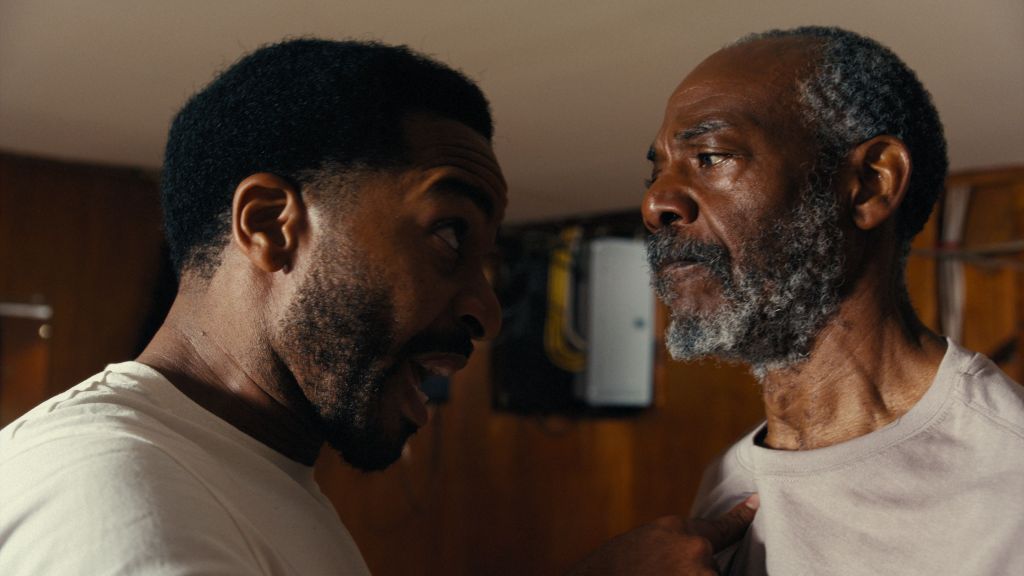
Tarrell (André Holland) is an artist who lives with his nuclear family in a pretty American suburb. His wife Aisha (Andra Day), also an artist, is a singer-songwriter, and they both adore their three-year-old son. Tarrell paints realistic aspects of his personal history inspired by his own memories and snapshots. They’re painted on enormous, larger-than-life canvases, mounted on the towering walls of their studio. His last show was a smashing success and his agent is pressing him for another (lucrative) show, ASAP. But the images in his paintings are not bucolic… they recall past traumas that Tarrell lived through but has yet to deal with. He frequently wakes up in bed, screaming from night terrors.

Meanwhile, in a bad part of town, La’Ron (John Earl Jelks) a homeless addict with a long, grey beard, struggles to make it through each day. He ekes out his meagre existence collecting spare change for shining hubcaps and washing cars outside a skid-row liquor store. But when he ends up in hospital, near-dead after a severe beating by a stickup crook, he decides it’s time to go clean. His brother offers him temporary shelter, and sends him to rehab. His estranged wife Joyce (Aunjanue Ellis-Taylor) forgives him once again in hopes of future familial reconciliation. But what does homeless La’Ron have to do with artist Tarrell? He’s his father, and  bad blood flows between them. He taught his son that as a black man, no one will care about him, no one will help him, and unless he gets tough and works extra hard, he’ll never survive and no one will care. But to Tarrell, the abuse visited upon him by his father was mean, self-serving and sadistic, exploiting his son’s labour to pay for his crack habit. And now La’ron shows up at his door again — what is it he wants now? Can father and son talk honestly? Has La’ron’s nature change? Can Tarrell ever forgive him? And can this extended family be saved?

Exhibiting Forgiveness is a multigenerational look at the hidden fissures and cruelty of masculinity unintentionally visited by fathers upon their sons. It’s rich and moving in its portrayals. The story is told both as a drama and as an artist’s representation of current and past events. We see Tarrell paint three youths; one of them his younger self (Ian Foreman). He later erases two of them by obliterating  their images with whitewash on the canvas. In another he cuts his teenaged self out of a painting with an x-acto knife, later draping the missing image on a chair,

So I’m watching this movie with the striking canvases in the paintings — this is not just anonymous crap-art made-up for the movie, it’s the real stuff — but when  Tarrell violates the art by splashes white paint or cutting it up… I was a bit disturbed, thinking, OK, the director is making a point, but he’s also destroying another artist’s work. So I looked him up afterwards:   The director is an artist, the paintings are his, and cutting up and altering his own canvases is an integral part of his work. He’s primarily an artist, and this is his first film. Watching the movie, I liked the passion of the acting and the emotional (and physical) violence in the characters they portrayed. But once I connected it with Titus Kaphar’s physical art, it suddenly became something much bigger than the sum of its parts. 

Exhibiting Forgiveness is an impressive first feature.

My Dead Friend Zoe opens this weekend in Toronto; check your local listings; and Exhibiting Forgiveness is now available on VOD. 

This is Daniel Garber at the Movies, each Saturday morning, on CIUT 89.5 FM and on my website culturalmining.com.

Deliveries. Films reviewed: Dog, Parallel Mothers PLUS BTFF!

Posted in Animals, Army, Family, History, LGBT, Movies, photography, Road Movie, Spain, War by CulturalMining.com on February 19, 2022

Hi, this is Daniel Garber at the Movies for culturalmining.com and CIUT 89.5 FM.

It’s Black History Month and The Toronto Black Film Festival is on now through Monday, February 21st celebrating its 10th anniversary. It’s showing — get this! — 200 movies, including features, shorts, documentaries, and more, from Canada and around the world. It features the Canadian premier of Krystin Ver Linden’s Alice, starring Common and Keke Palmer. There are also panel discussions, and if you’re an emerging black filmmaker, check out the Fabienne Colas Foundation’s Being Black in Canada program, with films geared specifically to cities like Montreal and Halifax. There’s also a special tribute to the late Sidney Poitier. That’s at the Toronto Black Film Festival – TBFF for short — all happening through Monday. 

This week, I’m looking at two new movies, one from the US, the other from Spain. There’s a war vet delivering a dog, and a fashion photographer delivering her baby.

Dog

Dir: Reid Carolin, Channing Tatum

Jackson Briggs (Channing Tatum) is a vet with a dog. Nothing so unusual about that. Except he’s a veteran, not a veterinarian. And the dog isn’t his. And he’s driving it down the West coast to attend a funeral — the dog is invited, not Briggs. Huh? You see, Briggs wants to reenlist — he’s an Army Ranger. He spent the past three years in a fog of alcohol and drugs, but he’s all dried out now and ready to ship off. But his Captain isn’t so sure. So they make a deal. Briggs drives Lulu, a decommissioned army dog, to the funeral of a member of their company who recently died. Lulu was an important part of his life, so it’s only fitting she should attend his funeral. In exchange, the Captain agrees to look again at Briggs reenlisting.

Lulu, despite her name, is no French poodle. She’s a Belgian Malinois. She looks like a German Shepard but smaller with a charcoal face and pointy ears. They are specially bred for security forces and trained to defend, attack and track. And Lulu has PTSD, she goes crazy if you touch her ears, or if she hears loud noises like thunder, guns or bombs. These are fiercely loyal dogs but they have to trust their owners. And Lulu and Briggs don’t like each other, so she’s muzzled and stuffed into a tiny kennel on the back seat. Soon enough though, she has completely destroyed her plastic prison and is chewing up the carseats. Can Briggs get Lulu to the funeral in time? Or will the two of them tear each other apart first?

Dog is a nice road movie about a man and his dog, and the people they encounter on their journey. People like two beautiful women who practice tantric sex; a dangerous hippie who runs a grow-op; a dog trainer, a psychic, and Briggs’ long-lost daughter.  They wind up in a luxury hotel, in abandoned barns, a night in jail and hitchhiking in the desert. And all along the way, we have Briggs’s non-stop monologue as he talks to Lulu. Luckily, the dog and the actor are interesting and appealing enough to keep your attention with the point of view shifting back and forth between Briggs and Lulu. Dog is a low key comedy-drama, but with enough surprises, laughs — and a few sad parts — to make it a worthwhile watch. 

Parallel Mothers

Dir: Pedro Almodóvar

Janis (Penelope Cruz) is a high-profile photographer  in her late 30s. She’s in a Madrid hospital about to give birth for the first time. There she meets a teenaged girl, also single and pregnant, named Ana (Milena Smit). She comes from a rich family — her dad’s a businessman, her mom an actress — but they are divorced and Ana is less than enthusiastic about raising a kid. Janis, on the other hand, can’t wait. 

Her baby is the result of a fling with a man she photographed once, named Arturo (Israel Elejaide). He’s a forensic anthropologist who works with an organization that disinters, identifies and reburies many of the lost victims of Spain’s fascist dictator Francisco Franco. More than 100,000 people are still missing, many killed by Franco in the Spanish civil war and afterwards. This includes Janis’s own great grandfather and others from her ancestral village. Arturo says he’ll look into her village, but he can’t promise her anything. 

But back to the two mothers. After a few years, one of their babies dies, and the two bond together to raise the surviving kid. But both mothers hold deep dark secrets they have yet to reveal. Can Janis and Ana make it as a couple? What about the child? And then there’s Arturo… and her village?

Parallel Mothers is a wonderful, tender, surprising and moving drama set in Madrid. Like all of Almadòvar’s recent movies, it has an amazing story, told in an eye-pleasing manner, from the opening line to the closing credits. They all share recognizable styles and images, as well as his troop of actors, including Rossy de Palma, but Parallel Mothers is also a unique stand-alone film. If you’re already a fan of Almadòvar, you will love this one and if you’ve never seen his films before, this is a gapped place to start.

Dog opens theatrically in Toronto this weekend; check your local listings. Parallel Mothers is now playing at the TIFF Bell Lightbox.

This is Daniel Garber at the Movies, each Saturday morning, on CIUT 89.5 FM and on my website, culturalmining.com

Daniel Garber talks with filmmakers Yonah Lewis and Calvin Thomas about their two new movies: Spice it Up and White Lie

Posted in Army, Canada, Dance, Depression, Disease, Feminism, Friendship, Pop Culture, Toronto, Women by CulturalMining.com on August 9, 2019

Hi, this is Daniel Garber at the Movies for culturalmining.com and CIUT 89.5 FM.

Photos (#2, #3) of Yonah Lewis, Calvin Thomas and Kacey Rohl at TIFF19 are by Jeff Harris.

René is a Toronto film student at Ryerson, trying to finish her practical thesis. The film she’s directing is about seven young women, who want to join the army. Not individually, but together, all seven, as a group. René’s problem is, in a world full of male film profs, male directors, and male editors, no one seems interested in her Girl Power creativity. They say there’s too much content and not enough narrative. But can René remain true to her vision even as she “spices up” her story?

Spice It Up is a meta-movie dramedy about making a film… and the film the filmmaker’s making. It’s co-directed by Calvin Thomas, Yonah Lewis and Lev Lewis, the founders of Toronto’s Lisa Pictures.

Calvin and Yonah’s newest film White Lie is an intriguing, dark tale of a

White Lie

cash-poor university student who concocts a cancer story to raise donations and make friends.

I spoke with Yonah and Calvin at CIUT 89.5 FM.

Spice it Up opens Friday, August 16 in Toronto at the Tiff Bell Lightbox.

White Lie is having it’s world premier at #TIFF19 this September.

Death Be Not Proud. Films reviewed: The Death of Stalin, Foxtrot

Posted in Army, comedy, Corruption, Death, Drama, Israel, Movies, UK, USSR by CulturalMining.com on March 16, 2018

Hi, this is Daniel Garber at the Movies for culturalmining.com and CIUT 89.5 FM, looking at high-brow and low-brow movies, indie, cult, foreign, festival, documentary, genre and mainstream films, helping you see movies with good taste, movies that taste good, and how to tell the differenc

Which is worse — dying? Or knowing someone’s dying but not knowing when?  This week I’m looking at two great dark comedies that find humour in terrible situations about death. There’s the imminent death of eminent dictator, and the questionable death of an questioning soldier.

The Death of Stalin

Dir: Armando Iannucci

It’s 1953 in the Soviet Union. Joseph Stalin rules the country with an iron fist, and everyone trembles in his presence. So when he orders a recorded copy of a just-completed live musical performance – that wasn’t actually recorded – of course everyone starts to panic. Everyone, it seems, except the musician who played it. She dares to drop a note for him into the re-recorded record envelope. If he reads it, surely her death will follow – and everyone around her. But as fate wll have it, when Stalin reads the message, he falls to the floor with a heart attack.

And with Stalin on his deathbed all his closest political allies come running to see what will happen next, and what their own status will be after he’s gone. There’s Malenkov ((Jeffrey Tambor) Stalin’s right-hand man for 30 years – a bit of a chowderhead but he’s also the one who purges anyone who challenges him. His rival Zhukov (Jason Isaacs) is the proud military leader who beat Hitler in WWII. Molotov (Michael Palin) is the foreign minister (don’t share a cocktail with this guy!) There’s the wily Nikita Krushchev (Steve Buscemi) and the dreaded Beria (Simon Russell Beale), head of the Secret Police (NKVD). And Stalin’s two adult children, his clever daughter Svetlana and his idiot son Vasily, who acts like he’s an aristocrat in a Chekov play. Picture all these historical figures running around all at once, panicking, conspiring, and thinking up ways to best their rivals.

While The Death of Stalin may sound like a dry historical drama, it is anything but. It’s fast-moving, shocking, and hilarious. The director — Armando Iannucci — has made another one of his twisted, foul-mouthed political comedies. This one isn’t in Westminster or The White House, it’s set in the Kremlin instead. The actors are either British – like Michael Palin — or American – like Steve Buscemi – but he lets them keep their real voices, no fake heavy Russian accents here (except from the Russian actors).

The Death of Stalin is a great political comedy.

Foxtrot

Dir: Samuel Maoz

Michael and Daphna (Lior Ashkenazi and Sarah Adler) are a successful Israeli couple Progressive, atheist and sexually open. He’s an architect so their Tel Aviv flat is beautifully designed and tastefully appointed. There lives are nearly perfect… until the day a knock on their door reveals two army officers in uniform. Their son Jonathan, a corporal at a remote posting, has died in the line of duty. Michael is stunned and Daphna collapses to the floor. She is put on meds while Michael stumbles in a daze to talk with his mom in a nursing home.

The army steps in to arrange the funeral, provide the coffin, direct the speech, call their relatives. Don’t worry, they say, we’ll take care of everything. But something is wrong… they can’t provide answers to the most basic questions. Where was he posted? How did he die? And where’s the body? Six hours later they return to say there’s been a terrible mistake. You’re son is still alive.

The story shifts to a remote checkpoint on a purgatorial desert road somewhere near Gehenna. Jonathan (Yonatan Shiray) is posted there with three other young guys. They live in a rusty, ramshackle shipping container made of corrugated steel. It’s slowly disappearing into a muck-filled sinkhole, a couple inches a day. Dinner consists of canned mystery meat cooked on a space heater. They while away their time fiddling with ancient radio receivers, drawing cartoons, telling stories or dancing with a rifle. It’s endless and pointless. Their sole capacity seems to be checking the IDs of passing Palestinians on their way to weddings, funerals or nightclub. The boys approach this job – and their only source of power — with a keen intensity, They shine floodlights at bewildered passersby, force middle aged women to stand in the pouring rain, pointing lethal weapons at their faces, … and worse. That worse incident , and its aermath, brings a new calamity to Jonathan’s family back home, bringing grief, decay and self-harm. Will the family ever recover?

Foxtrot – named after both the dance and the military code – is a dark, ironic and satiric look at the creeping militarization of people’s lives and it’s horrific results. This army is a portrayed as a new Catch-22, one filled with ridiculous errors, secrecy and coverups. The film itself adopts that unexplained mysterious tone – places are left unidentified, some characters not given names. Visions of censorship – symbolized by the black tape covering images of vintage softcore porn – carries over into everyday life and family folklore. The dystopia of the dirty and rusty army post is run by sympathetic characters but is rotten to the core. I called this a dark comedy, but it’s also a very moving drama, cushioned by the absurdist and surreal tone that overlays everything. This is a visually splendid film that relies more on images than dialogue. Foxtrot is a great, but scathingly critical, movie.

I recommend it.

Death of Stalin and Foxtrot both open today in Toronto; check your local listings.

This is Daniel Garber at the Movies, each Friday morning, on CIUT 89.5 FM and on my website, culturalmining.com.


Big Changes, Big Trouble. Films reviewed: Every Day, The Party, Annihilation

Posted in Army, comedy, Fantasy, High School, Horror, Movies, Politics, Romance, Science Fiction, UK, Y.A. by CulturalMining.com on February 23, 2018

Hi, this is Daniel Garber at the Movies for culturalmining.com and CIUT 89.5 FM.

Everybody knows change is good, but big changes can lead to big trouble. This week I’m looking at three good movies about women facing big changes. There’s a British politician with a once-in-a-lifetime career change; a biologist investigating changes that are scientifically impossible; and a high school student whose boyfriend changes bodies once a day.

Every Day

Dir: Michael Sucsy

Rhiannon (Angourie Rice) is a highschool student in Maryland. Her mom’s a careerist, while her dad, since his breakdown, stays at home painting pictures. Her boyfriend Justin (Justice Smith) is a popular athlete… and a bit of a jerk. So she is surprised when he agrees to play hooky and spend the day just with her. It’s the perfect date: They explore downtown Baltimore, he pays attention to her, stops smoking, they share intimate personal stories, find their special song, and for the first time, they actually have fun together. Is this true love? But the next day he’s acting like a douche again, with only vague memories of the day before. It’s like he’s a different person. What’s going on?

What’s going on is he was a different person that day, someone named “A”. “A” is a bodyless being who inhabits a different person each day and — like Cinderella — departs that body at exactly midnight. “A” has no choice of who they’ll wake up as, except that it will be someone their age who lives nearby. “A” could be a boy that day, or a girl, could be black, white or asian, could be straight, gay or trans. Could be ugly or attractive. Rhiannon and “A” have to find each other each day to carry on their relationship. Hint: “A” knowing Rhiannon’s phone number helps a lot. Can their love overcome “A”’s ever-shifting identity?

Every Day is a cool, young adult fantasy/romance that works. It’s set in Maryland, but was shot in Toronto, and it has a Degrassi feel to it, where the multiracial, multigender nature of the cast is omnipresent but not central to the plot. Instead it deals with questions of identity, look-ism, and mental illness.

I liked this movie.

The Party

Wri/Dir: Sally Potter

Janet (Kristin Scott Thomas) is a politician in the UK celebrating her promotion, the pinnacle of her career. Starting tomorrow, she’ll be the Shadow Minister of Health for the opposition Labour Party. So she’s throwing a party for her nearest and dearest. They arrive two- by two . There’s Martha (Cherry Jones) – a lesbian feminist university prof with her earnest partner Jinny.   Cynical April comes with her flaky boyfriend Gottfried (Patricia Clarkson and Bruno Ganz), a self-professed healer. And Tom — a nervous and brittle financier (Cillian Murphy) — comes without his wife Marianne, Janet’s closest friend and workmate. Janet’s husband the grey-bearded Bill (Timothy Spall) sits alone in the parlour spinning vinyl as she bakes her vol-au-vents, to show that a woman can feel at home both in Westminster and in her kitchen. Problem is, her hors d’oeuvres are burning even as her party is collapsing like a house of cards, as each guest reveals a big secret. There’s cocaine, champagne, a fire, broken glass, face slaps… even a handgun.

The Party is a drawing room comedy that pokes fun at the social conceits of a generation of middle-class, leftist baby boomers. It’s the work of Sally Potter, director of Orlando and Ginger and Rosa. Shot in black and white with a wicked musical soundtrack that shifts the mood from scene to scene, it clocks in at just over 70 minutes, as a short-but-sweet English comedy.

Annihilation

Dir: Alex Garland

Lena (Natalie Portman) is a biology prof at Johns Hopkins who specializes in mutating cancer cells. Her husband Kane (Oscar Isaac) – a soldier she met when she was in the army – is missing and presumed dead. But when he shows up at her bedroom door, seemingly with no memory of what happened and how he got there, she decides to investigate. She’s valuable to the military, a woman as comfortable with a petri dish as she is with a submachine gun. She joins a crack team of scientists, all women, headed by the laconic psychologist Dr Ventress (Jennifer Jason Leigh). Their goal is to explore unknown territory within a swampy National Park.

It’s encased in something called “the Shimmer”, a phenomenon eminating from a lighthouse on the coastline.  No one who goes into the Shimmer comes out alive (except for her husband Kane) and it’s getting bigger and bigger each day. From the outside it looks like a giant rainbow-coloured, plastic shower curtain that’s melting upwards. On the inside it’s even stranger, a world where distinctions like “animal/vegetable/mineral” cease to exist. It’s both beautiful and grotesque, filled with Chihuly crystals, human topiary and brightly-coloured tree fungi. Unrelated species are combining and mutating at a rapid rate, into a cancerous growth — just like the cells Lena studies, only prettier. And they’re affecting the five women too, both their minds and their bodies. Video messages they find (left by previous soldiers) only make things worse. Can Lena survive the hideous creatures and her deranged and suspicious teammates before she faces the scariest entity of all?

Annihilation is a terrifying exercise in horror sci-fi psychedelia. It references everything from Arrival, to The Wizard of Oz to Apocalypse Now, as the team paddles their way though a Heart of Darkness in their search for emerald city. Natalie Portman is great as the elegant soldier-scientist, and director Alex Garland brings us a different take on post-apocalyptic images. Annihilation is the kind of psychedelic fantasy that keeps you guessing.

This movie is scary-pretty… and pretty scary.

The Party comes to Toronto next week (check your local listings);  Every Day and Annihilation open today. This is Daniel Garber at the Movies, each Friday morning, on CIUT 89.5 FM and on my website, culturalmining.com.

January 10th, 2013. Political Context in Action Thrillers. Movies reviewed: Zero Dark Thirty, A Darker Truth

Posted in Army, CIA, Cultural Mining, Death, Environmentalism, Protest, Thriller, Uncategorized, US by CulturalMining.com on January 26, 2013

Hi, this is Daniel Garber at the Movies for culturalmining.com and CIUT 89.5 FM, looking at high-brow and low-brow movies, indie, cult, foreign, festival, documentary, genre and mainstream films, helping you see movies with good taste, movies that taste good, and how to tell the difference.

Many people complain that action movies are vapid, pointless pablum, just meaningless flashes and a driving score to keep people distracted. Maybe so. But does adding a political context make an action movie better? This week I’m looking at two movies – both basically action thrillers – that are told within a political context. One’s a celebration of a CIA agent’s role in the assassination Osama Bin Laden, the other’s about a Canadian multinational messing things up in South America.

zero-dark-thirtyZero Dark Thirty

Dir: Catherine Bigelow

Maya (Jessica Chastain) is an up-and-coming CIA agent, with a delicate personality and whispey red hair blowing in the wind. She finds herself in a secret dark site. It’s post- 9/11 and the CIA is trying to find out where the next terrorist attack is going to be, and how they can stop it. She turns to the ruthless Dan (Jason Clarke) as her mentor. He’s a laid-back kinda guy with a scruffy beard who likes to say things like “It’s cool bro… everyone breaks eventually” to the people he’s torturing. He raises cute little monkeys in a cage, right beside the suspects, also kept in zoo-like cages. So she’s soon happily stringing up people, stripping them naked, putting black hoods on them and waterboarding the prisoners, just like the rest of the agents. Pretty grim stuff.

But she’s doing it to save America. As one character says in a dramatic speech: Al Qaeda attacked us from the air, from the land and by sea. We must stop them! And when she personally witnesses a bombing that kills her colleague she makes it her lifelong goal to kill that terrorist mastermind, Osama Bin Laden. (And it’s not a spoiler to say that he’s killed in a Navy SEAL raid on Pakistan in May, 2011.)

Zero Dark Thirty is a very long movie that traces the CIA’s violent, twisted and bumpy path toward getting Bin Laden. Gradually the public and the government seem to lose their original goal of catching the culprit of 9/11, but it’s Maya’s dogged pursuit that gets him in the end.

I thought it was a too-long, and not all that interesting, action movie telling a story we already know, completely from the Jessica Chastain zero dark thirtypoint of view of a CIA agent. It’s not one-sided – it is unsparing in its portrayal of torture – but it seems to make it all just seem like an episode of the TV show “24”, where there’s always a ticking time bomb or a planned terrorist attack ready to happen. If they can get the bad guys to talk – however they do it – any method is OK. The thing is, in real life torture is not OK, and it doesn’t work. Among other things, it talks about the 3000 innocent people killed on 9/11 – a terrible tragedy — but doesn’t seem to mention any of the 100,000s of innocent people, completely unrelated to that event, who were killed by the US and its allies in retaliation. (It does casually mention drones in Afghanistan, but just in passing.) It also portrays terrorism as a constant, never-ending threat, killing people all over the world. And its portrayal of Muslims and especially Arabs was especially simplistic.

(One of the most annoying scenes in the movie looks like it was written by someone who had never met a Muslim. It involves a group of women in black robes and hijab, their faces veiled with niqab. And what happens? Well, in this movie, any woman who covers her face must be up to something devious or sneaky; naturally, they end up being male assassins disguised as women who pull out weapons and mow someone down… Really?)

As a movie, the acting (especially Chastain, Clarke and Jennifer Ehle as another CIA agent) is very good, and the storyline is initially compelling, though its subject matter is extremely disturbing.

But it gets boring in the second half — just people walking through the steps taken to “get” bin Laden. Fun if you’re into Navy Seal recruitment videos, but boring to everyone else. I also thought its portrayal of good guys and bad guys – Us vs Them – overly selective. Every suspect turns out to be a terrorist, who can’t be trusted and is there just to kill us. Not just that, but we should make them hurt bad, not just because it’ll save lives, but because they did bad things to us and our friends and should pay for it. And that torture works.

Zero Dark Thirty is not a good movie.

Another action thriller is

Dark-truth-poster-1A Darker Truth

Dir: Damian Lee

Morgan (Deborah Kara Unger) is a ribbon-cutter, a Toronto heiress at a multinational resource corporation, who cuts ribbons and launches benevolent charities in the company’s name. But when she has an alarming run-in with an Equadorian on the lam her eyes are opened. She decides to investigate her company’s actions in South America where they may be responsible for poisoning water and killing locals, all for the sake of the bottom line. So she hires local talk show host Jack Begosian who has long rallied against what he calls the Great Transformation: corporate commoditization of necessities like water, land and air. Jack’s radio call-in show is called The Truth, but he’s pretty secretive about his own truth – he may have been a CIA agent in his past.

So Jack has to go to Equador, uncover the truth, and bring the Campesino revolutionary Francisco Francis (Forest Whitaker) to safety in Toronto. Francisco and his wife Mia (Eva Longoria) are the only ones speaking up for the endangered locals. But it’s not so easy.

A sniper-assassin named Tor (Kevin Durand) has been hired by the Canadian company to kill Jack and everyone else involved in order to protect their profits and image. Who will live and who will die? Who can be trusted? And will the truth ever be released?

A Dark Truth is another interesting-sounding action thriller that loses some of its steam due to an overly complicated plot. Parts are exciting and dramatic, with a good shoot-out and some interesting plot turns. But some parts are glacial in their painful slowness, like Jack’s scenes with his family wife and son. There are also far too many subplots to care about. The story keeps jumping back and forth across continents, with way too many flashbacks and tons of confusing images (like the heiress lying in a bathtub fully dressed – what does this mean and why do they keep showing it?) The acting is mixed. Durand, Garcia, Unger and Devon Bostick as the young Equadorian are all good, while the usually great Forest Whitaker seems bafflingly flat and uninteresting.

It’s nice to have Toronto playing itself for once, and important topics — like eco-revolutionaries and international intrigue – are rare to see on the big screen, but A Dark Truth is just so-so as an action thriller.

Zero Dark Thirty and A Dark Truth, both open today. Check your local listings. Also opening is Michael Haneke’s fantastic Amour, one of my top ten movies of the year.

This is Daniel Garber at the Movies, each Friday morning on CIUT 89.5 FM and on my website, culturalmining.com .

March 9, 2012. If You Love This Planet. Movies reviewed: The Lorax, John Carter

Hi, this is Daniel Garber at the Movies, for culturalmining.com and CIUT 89.5 FM, looking at high-brow and low-brow movies, indie, cult, foreign, festival, genre and mainstream movies, helping you see movies with good taste, movies that taste good, and how to tell the difference.

With globalization, things affect the whole planet all at once even if they only happen in one place. The Earth is all shook up! Like last year’s earthquake and tsunami in Japan – I remember seeing those horrific scenes of towns being swept away, and the ongoing tension about the nuclear leak at Fukushima.

In gratitude for the support of the international community, the Japan Foundation in Toronto is offering a series of free films next week at Innis College called Light Up Japan. The documentaries are all about what has happened since the disaster in that area and how the people are coping with it. Check out the Japan Foundation ( jftor.org ) for more information.

So in keeping with the theme of global events, this week I’m looking at two movies with whole-planet-sized topics. One is about a kid trying to save the earth from total destruction; the other is a man who finds himself a part of the potential ruin of Mars.

The Lorax

Dir: Chris Renaud and Kyle Balda

Ted lives in Thneedville, a plastic suburban shopping mall town where life controlled by a Mr O’Hare, a nasty rich guy who made his fortune bottling air, and who spies on everyone in town. Ted has a crush on his neighbour Audrey who is into trees – which don’t exist anymore (people use plastic trees instead). Audrey says she wishes she could see one.

So taking his grandmother’s advice, Ted climbs into his vehicle – a sort of a unicycle/ segway/ scooter – and sneaks out of the city to find the Once-lear – the only person who still knows the truth. He discovers that the vast wasteland outside of Thneedville once was a land of rainbows, happy fish, droopy birds, and teddy bears who ate the berries from the puffball trees, and lived happily and peacefully. An industrialist uses the puffballs to make a knitted stringy thing, the thneed, that consumers buy by the millions. He decides it’s cheaper and easer to cut them all down rather than using their puffballs as a renewable resource. Only the Lorax, (a tiny mustachioed environmentalist who descends from the heavens in a thunderstorm) can save the day, if only people will listen. He speaks for the trees…

I thought this movie was OK, but it really seemed to stretch the short Dr Seuss book into a 90 minute song-and-dance musical. It soft-pedals the problems of industrial pollution and consumerism, and reduces the motivation from ardent environmentalism to a boy wanting to kiss a girl. It relegates the Lorax story to flashback status, and kept the wonderful Seuss-like scenes of the valley to a minimum, while over-emphasizing the non-Seuss humdrum suburban scenes, filled with your usual 3-d sitcom characters.

It’s not a bad movie, and of course it’s great to tell kids about environmentalism and privacy, but the songs were dull, the characters not-so-interesting, the story not very original, and the animation and character style not up to what I expect from a Dr Seuss story.

Interesting fact — The Lorax earned more money in its opening weekend than Hugo did in its entire run.

John Carter

Dir: Andrew Stanton

John Carter is a mean and strong fighter, a cavalry man from the civil war. He can escape from jails, scrapple with anyone – weapon or not – is good on horseback and keen with a sword and a rifle. And he doesn’t take sides – Apache or US Army – they’re all the same. He doesn’t want any part of it. He just wants to find his cave of gold in the Arizona desert. But when he encounters a stranger in the cave, and repeats the word Barsoom while touching a glowing amulet, he is magically transported to Mars a land of great civilizations, far beyond earth’s imagination.

Strong John Carter, though smaller than the four-armed tusked Tarks – some of the creatures who live there – soon discovers he can leap high in the air and jump long distances, because of the different gravity there. He soon finds himself in the middle of a huge war between the city of Helium and the bad Zodanga. And he meets Dejah, (a beautiful princess-warrior, as well as a physicist, inventor and a great swordswoman) who is being forceed into marrying a bad guy from the other kingdom. Meanwhile, the shape-shifting super-gods who are manipulating everyone on that planet, are messing things up. It’s up to John Carter to save civilization – but he’s not sure he wants to – he just wants to find the amulet and go back to earth. But with the help of his speedy and faithful dog-monster Woolla, and the noble and honest Thark-guide Sola, he and Dejah must find mutual trust, truth and possibly true love in their search for the secrets of this planet.

As you can tell, this is a very long, plot-heavy story about an adventure on Mars. Like comics, manga and pulp fiction, the story takes precedent over feelings, emotions or characters – it’s more the action, the twists, the background, the secrets, the fights, the betrayals and the fantastical, sex-tinged images. But it carries it through amazingly well in this 2½ hour epic. (People call everything epics now, but this is an actual epic). I thought it was amazing.

It’s done in the style of Frank Frazetta’s illustrations: fiery-eyed women in exotic garb with pendulous breasts and black tresses; snarling men with steely gaze and bared chests, brandishing their swords toward the red skies…..  but through a Disney filter, making it sexy, but not sexual.

It feels more like a Roman sword-and-sandal story than science fiction. (It’s based on Edgar Rice Burroughs’ novels.) It has a mainly British cast, plus Canadian Taylor Kitsch — just great in the title role. I liked Lynn Collins (never heard of her) as Dejah, and Dominic West (The Wire) as one of many assorted bad guys in this cast-of-thousands picture. Want to be overwhelmed by an elaborate, exciting movie getaway, with a complicated fantasy plot that never lets up, even for a second? Then this is the one to see.

The Lorax is playing now, and John Carter opens today in Toronto, and the Japanese documentaries are playing all week at Innis College.

This is Daniel Garber at the Movies each Friday morning on CIUT 89.5 FM, and on my web site CulturalMining.com.

Tagged with: ,

September 30, 2011. Palestine. Films Reviewed: (No) Laughing Matter, Children of the Revolution, Pomegranates and Myrrh PLUS TPFF, We Were Here, Resurrect Dead

Hi, this is Daniel Garber at the Movies, for culturalmining.com and CIUT 89.5 FM, looking at high-brow and low-brow movies, indie, cult, foreign, festival, genre and mainstream movies, helping you see movies with good taste, and movies that taste good, and what the difference is.

It’s fall now — the days are getting shorter and nights are getting colder, and the leaves are starting to turn yellow and red. And the governments might be changing soon, too. There are provincial elections happening across the country, with the Ontario elections happening on October 6th – that’s next Thursday. On a larger scale, there’s another vote coming up in the United Nations’ General Assembly – whether to admit Palestine as a full member state. Well, if you’re curious about the issue and want to know what is being discussed, there’s a film festival on, starting tonight, called the Toronto Palestine Film Festival. The TPFF presents a largely secular, political look at the Israel/Palestine conflict from the Palestinian point of view in a series of movies.

So this week I’m going to look at three movies from that festival – two documentaries and one drama – about terrorism, humour and love; and also talk briefly about two more docs opening in Toronto.

(No) Laughing Matter

Dir: Vanessa Rousselot

Rousselot, a French-Palestinian filmmaker, wants to know if the people in Palestine ever smile, laugh or tell jokes. So she sets out in a car with a camera to try to capture some of the humour — mainly dark humour — that Palestinians (in the West Bank in Jenin, Hebron, Bethlehem, and in Israel In Haifa) use. Is there a particularly style of joke that could be called distinctly Palestinian?

She discovers a few interesting things. First, that the people of Hebron seems to serve as their Newfies or Belgians — the naïve, butt-ends of local jokes. Second, she discovers an elderly man who, at the time of the First Intifada, set about recording and categorizing thousands of local jokes on index cards, which he produces and reads for the camera. The hour-long TV documentary gives a glimpse of everyday people — laughing school girls, a stand-up comic, a shop keeper, a Catholic priest, some angry young men in a coffee house — and how they express themselves, and sometimes use humour as a survival tactic.

Here’s a typical joke from the movie:

A world leader dies and goes to heaven. He is matched up with an old and plain woman. Then he sees Yassir Arafat cuddling a beautiful Marilyn Monroe. He tells God, “Hey that’s not fair! How come you rewarded Arafat over me?” God says, “I’m not rewarding Arafat… I’m punishing Marilyn Monroe.”

Children of the Revolution

Dir: Shane O’Sullivan

This documentary traces the lives of two hugely important radical terrorists/ activists/ revolutionaries – whichever way you choose to label them – who grew up in the two defeated nations from WWII: Japan and Germany. These two notorious figures – Ulrike Meinhof, of the German “Red Army Faction”, and Shigenobu Fusako of the “Japan Red Army” – were even more remarkable in that they were both women. This movie tells their history, as seen through the eyes of their young daughters. The kids were pulled into this turbulent world by their mothers, giving an immediacy rarely seen in movies about such highly-charged controversial figures.

In the late 60’s, their conservative, middle-class societies were suddenly turned upside down. With the convergence of the US Vietnam war and the anti-war movement, the Chinese Cultural Revolution, and unrest in Latin American countries, the new heroes became Mao, Marx and Che. Meinhof worked for a communist-funded tabloid called Konkret and became a part of the radical society that was shaking up Europe. Shigenobu, the granddaughter of a radical right-wing activist, joined the leftist student uprisings that totally changed the power-dynamic in Japanese society (at least temporarily).

Both of these figures fled to Beirut and from there to Syria after meeting with a Palestinian revolutionary. From there, these two women and their contemporaries, on behalf of the Peoples’ Front for the Liberation of Palestine (PFLP), committed a series of hijackings, kidnappings, shootings, bank robberies and bombings, that held the world rapt in the late sixties and seventies. They hijacked planes to North Korea, bombed a jet in Cairo, and led a horrific attack shooting dozens of civilians at Lod Airport in Tel Aviv. It also brought the causes they were advocating to the front page. Markedly different from today’s terrorists, they said they committed their acts for a worldwide revolution, not for their own nation’s or group’s interests.

Through a kid’s eyes their situation was both fascinating and scary. Meinhof’s daughter talks of seeing kids playing on the street when she was little — their game wasn’t Cops and Robbers, but Bader and Meinhof.

Shigenobu’s daughter remembers that kids she knew in the Palestinian refugee camps all wanted to grow up as either doctors, nurses, or fedayeen (guerrillas).

This is a fascinating story, illustrated with countless, vivid B&W snapshots, TV and news clips. Although portrayed in dramatic form in two recent movies (The Bader-Meinhof Complex — about the RAF and United Japan Army about the JRA), this is the first documentary I’ve seen that combines the two. Equally surprising is that it takes a largely sympathetic stance toward the hijackers.

And opening the festival with a screening tonight is:

Pomegranates and Myrrh

Dir: Najwar Najjar

A good-looking, young Christian couple, Kamar and Zaid (Yasmine Elmasri and Ashraf Farah), travel from the West Bank to Jerusalem for a happy wedding party. Zaid’s family are farmers who have an olive grove, and it’s time for the harvest and olive oil press. Meanwhile, Kamar is a modern dancer, whose group is preparing to meet a Palestinian choreographer, Kais (Ali Suliman), who is visiting from Lebanon. They’re preparing a performance of traditional (stomp, stomp, clap, clap) folk dances called Pomegranates and Myrrh.

But things start to go wrong when a happy nighttime picnic in the olive grove is interrupted by Israeli helicopters carrying young soldiers. Zaid is put into a detention center, ostensibly for hitting a soldier, and his family’s olive farm is in danger of being confiscated for “security reasons”.

Now it’s up to the new bride to try to free her husband and at the same time, to stand up to the authorities and hold onto the family land. They hire a sympathetic Israeli lawyer to help them keep the army and encroaching settlers away. But for how long? Will Zaid admit to a lesser charge so he can save his land? Will they manage to get the olive harvest in and pressed on time? And what is Kamar up to with that scarf-wearing choreographer and his trust exercises – does he have designs on her while her husband is in jail?

Pommegranites and Myrrh is a bittersweet drama about love in a time of conflict, beautifully shot, with (sometimes) poetic dialogue. With warm and loving families resisting shadowy settler-terrorists, and faceless, shouting Israeli soldiers chasing after playful children, I thought the movie comes across as somewhat heavy-handed, but it does give a largely unseen look at life — with its very real crises and dangers — through Palestinian eyes.

Also playing this weekend are the great documentaries We Were Here, and Resurrect Dead. We Were Here is a very moving oral history of the AIDS outbreak in the 80’s remembered by some of the people in San Francisco who lived through it. That opens today.

Ressurect Dead is a really unusual documentary about the strange unidentified man who has been leaving tiled messages in the tarmac of city streets across the continent, with a crypto-religious message about the planet Jupiter, historian Toynbee, and Stanley Kubrick. What makes the movie so unique, is that it was made on zero budget by a group of marginal detectives and conspiracy theorists who use things like ham radio to try to find out the messages’ origins, but who are as fascinating as the man they’re trying to find. That’s called Resurrect Dead.

Check local listings for We Were Here and Resurrect Dead, and for more information about the Toronto Palestine Film Festival go to tpff.ca.

This is Daniel Garber at the Movies for CIUT 89.5 FM, and on my web site, Cultural Mining . com.

More Underdogs at Hotdocs! Weibo’s War, Guantanamo Trap, Draquila: Italy Trembles, Hot Coffee, Bury the Hatchet, Melissa-Mom and Me

CulturalMiningmay6

Hi, this is Daniel Garber at the Movies, for culturalmining.com and CIUT 89.5 FM.

Toronto’s Hotdocs, which continues through the weekend, is one of the best documentary festivals in the world. Today I’m going to talk about some more movies about the largely unknown underdogs, in their struggles with huge governments, big business, or with themselves.

Weibo’s War

Dir: David York

Weibo Ludwig is a devout Christian who lives in a remote, isolated colony with his fellow religious settlers in BC, near Alberta. Their lives are food and energy self-sufficient, but, in the 90’s, things began to go wrong. Goats started having frequent stillbirths, and, when a woman also miscarried, they realized their watershed had been contaminated by natural gas wells built right at the edge of their property.

He was later arrested, tried, and jailed for bombs he had set off at wells and pipelines in that energy-rich Alberta area. This movie follows filmmaker David York who was allowed to film inside their compound.

Is Weibo a religious nut or a devoted social activist? Well, he’s certainly religious, but he’s crazy like a fox. The movie shows some of Weibo’s (and those of his fellow settlers’) frequent brushes with the law and the big energy companies

including run-ins with outwardly conciliatory execs from Encana; the seemingly pointless, intimidating, and relentless police raids of their homes to test things like how many ball point there are on one floor, and how many cassette tapes are on another; and their increasingly fractious relationship with the nearby town, where they have found themselves local pariahs following the unexplained shooting death of young woman on their property.

Folk hero, or deranged terrorist?

Maybe both. I left the movie even less certain than before as to who’s to blame and what actually happened. While a bit slow-moving, Weibo’s war did give a first hand look at a legendary Canadian figure, his family and co-religionists, and the unusual junction between Christian fundamentalism and environmental extremism.

Guantanamo Trap

Dir: Thomas Selim Wallner

With the recent killing of Osama Bin Laden, some people are saying that the awful decade between 9/11 until now is finally over. The “War on Terror” has been “won” by the west, and we can turn the page on the whole tragedy and its devastating effect on the American public, and the subsequent hundreds of thousands of Afghanis and Iraqis killed by the US and their allies.

But, inspite of bin Laden’s death, in spite of Obama’s election promises, the prison in Guantanamo Bay, Cuba is still open, with many untried captives still inside. What really happened at Guantanamo, who’s to blame and who got punished?

This film traces four people involved in this awful period: a military lawyer, Diane Beaver, who helped write the notorious memo that declared waterboarding was not torture; Muniz, a religious Turkish-German Muslim man, who was whisked away from Pakistan due to some miscommunication and tortured in Guantanamo; Matthew, a military judge-advocate, also working at Guantanamo (alongside Diane), who leaked a memo with a list of prisoners’ names and countries; and Gonzalo, an activist- lawyer in Spain who wants to prosecute the people really responsible for miscarriages of justice.

This is a very moving and shocking film with previously unseen footage — not just still photos — and first- hand testimony of what went on in Abu Ghraib and Guantanamo Bay. In an awful Catch 22, it seems the people at the top got away scott-free, the whistleblowers were jailed, the low-level torture advocates were scapegoated but allowed to retire to happy, new careers, and the unwitting victims left without apology or explanation. This Canadian film is an excellent, human look at a difficult and controversial topic.

Draquila – Italy Trembles

Dir: Sabina Guzzanti

In 2009, the small Italian city of Aquilla was struck by a dangerous earthquake which damaged the rennaisance buildings in the town centre, killed hundreds of people and left thousands homeless. The director, a comedian and filmmaker uses this disaster to expose the tangled web of corruption, oppression, and scandal at the root of Italian Prime Minister Berlusconi’s empire and its ties to big business, the construction industry Milan, his media empire, the military, police and government, and the Mafia.

Something familiar only to Italians known as “Civil Protection” — a recent government law that allows forcible confinement, exclusive contracts, and strange pay-offs in the name of protection in the case of disasters or threats — has ballooned into a strange and twisted entity that releases unfettered access to government funds, while it gags local government, blocks media coverage, and puts the police in charge. Far from being a temporary measure, it’s occuring daily across Italy, for anything considered to be a “big event” including church parades, housing relocation, and swimming contests.

Comic and political filmmaker Sabina Guzzanti spends most of the movie trying to get into the relocation camps of the earthquake victims, but getting stymied at almost every stop by police and contractors who are loathe to allow public access to anything that might expose corruption or wrongdoing.

And through it all the stoic victims are pushed around like pawns in some international PR game.

Draquila (a reference to all the blood suckers who, laughing immediately after the disaster, gleefully pounced on the disaster as a chance to earn big government contracts) is an enlightening, entertaining and humorous look at the uniquely shady world of Italian politics under Berlusconi.

Hot Coffee

Dir: Susan Saladoff

When a woman who was awarded millions in a lawsuit after she was burnt by hot coffee at a McDonald’s drive through, her story hit the headlines. It became a staple joke for comedians and talk shows, an episode of Seinfeld, and the focus of citizens’ groups objecting to “Frivolous Lawsuits”. But this movie takes a closer look at these seemingly ridiculous awards.

It turns out — and she shows unbelievably brutal photos to prove it — that the elderly woman was horribly injured by the coffee spill; that she initially asked only asked McDonald’s for reimbursement for her medical expenses (McDonald’s offered only a token $800); and that far from being frivolous, it was an incident that followed repeated corporate indifference to similar incidents that had occurred hundreds of times before and kept secret by the companies.

This movie poses that the whole concept of of the term frivolous lawsuits was coined by PR firms working for huge corporations like McDonald’s in order to cut their own losses and limit future pay-offs. She shows similar cases in the US — including malpractice suits, “forced mediation” and the fact no criminal charges were laid after an employee of a US security firm in Iraq was gang raped; and the case of a judge who was in favour of punitive awards in lawsuits, but was forced to fend off accusations and trials brought down on him by right-wing groups, when he should have been on the bench.

The way this movie handles concepts such as “tort reform” (i.e. opposition to lawsuits), and the parties actually pushing for it, reveals the necessity in the US for lawsuits. The filmmaker says corporate donations target liberal judges, lawsuits are being quashed by large corporations, that lawsuits are the only way for individuals to pay for medical damages, and that forced mediation always takes the side of the big companies not individuals.

But for Canadians and others outside of the US, Hot Coffee is as baffling and arcane as the Italian politics in Draquilla. We don’t have elections for judges, no corporate donations to political campaigns, no US-style extended elections beyond a few weeks, no TV ads for local politicians. In Canada trials are generally by judges not by juries; mediation usually refers to their successfully use in union/ management disputes, in lieu of strikes; and our largely public, one-payer health system, that provides lifetime medical care, cuts out many malpractice lawsuits.

Most of all, there are just far fewer lawyers, per capita, in Canada, and Canadians just aren’t as litigious as Americans. I can see the value now of lawsuits, but I’d be bothered if Canadians ever reached the level of US litigation and courtroom interference in the average person’s lives. And it might have been more believable if it hadn’t been so one sided in its relentlessly positive view lawsuits as a purely progressive force, without any look at the abuse that lawyers themselves may play in this phenomenon.

Finally, two more Hotdocs films that deal with issues on a smaller, individual level.

Bury the Hatchet

Dir: Aaron Walker

The annual Mardi Gras in New Orleans has a public, tourist side to it, but also has a deeply ingrained local side full of traditions and customs. This movie takes a look at the “tribes” — competitive teams of Black New Orleans residents — who, with beads and feathers, music and dance, dress in native costumes they design and wear in the parade.

The custom, said to have started with the shelter natives gave escaped slaves, is performed in their honour, with colourful homages to the Indians using mock chants, names and headdresses.

This intensely beautiful, brightly coloured film interviews the elderly men in their various competing clubs, as they recount, using period foootage and pictures, the sometimes violent history of this largely unknown practice. The soundtrack, composed of jazz, blues, R&B and reggae, are as entrancing as the images, in this slow moving, but very visual and aural slice of New Orleans cultural life from the 60’s, through Katrina, until the present.

Melissa-Mom and Me

Dir: Limor Pinhasov

Yael — then known as Jenny — and Melissa, lead a drug-filled, light hearted life as two friends who worked as strippers in a Tokyo nightclub. Yael became a professional photographer in Tel Aviv, while Melissa eventually made her was back to Carolina, to start a very different life. Yael decides to join her here to rekindle their friendship (she still has many videos and photos she had taken of them in Tokyo) and to get her advice on having kids.

This is quite a moving story.

Melissa-mom of the title is indeed a mother — she had left her kids when she went to work as a stripper in Tokyo — and they are now much older and grown up without their own mother. In a dramatically filmed series of revelations, meetings, confrontations, and reconciliations, Melissa’s hidden family secrets are gradually revealed both to her friend Yael, and to the audience. It deals with sin, reponsibility, duty, guilt, friendship, love and family, in an entirely understandable way.

All of these movies are worth watching (depending on your interests). Most of the movies get replayed this weekend, so be sure to come out to see some more great documentaries.

The Hotdocs festival runs from Thursday April 28th to May 8th, and is free – no charge! – for rush seats during the day for anyone with a Student or Senior ID. Check online at hotdocs.ca

This is Daniel Garber at the Movies for CIUT 89.5 FM, and on my web site, CulturalMining.com.