Big. Films reviewed: The Ballad of Wallis Island, Freaky Tales, The Friend
Hi, this is Daniel Garber at the Movies for culturalmining.com and CIUT 89.5 FM.
Holiday Creep. People have been complaining about it for decades: Christmas lights appearing in September, chocolate Easter Eggs on sale in January… but have you ever heard of ‘Halfway to Halloween’ ? Well that’s what they’re calling a new series of films streaming on Shudder in April, marking six months since the last creepy holiday. I haven’t seen them yet, but some of these look really
good. Like the Irish folk-horror FRÉWAKA, and Shadow of God, a Vatican exorcism thriller described as a “cataclysm of biblical proportions”.
But this week I’m looking at three new movies, two dramadies and one found-footage compilation. There are big egos on a remote island, big crime on the streets of Oakland, and a Great Dane in a tiny New York apartment.
The Ballad of Wallis Island
Dir: James Griffiths
Herb McGwyer (Tom Basden) is an irritable English musician who has fallen on hard times. He once was half of McGwyer/Mortimer, a folk-rock duo that dominated the charts of the early 2010s. But they broke up when McGwyer went solo, dumping his partner and lover. While still a name, he has lost any credibility he once had. So he agrees to do a private concert before a small crowd on a remote island… for half a million pounds. He is greeted on the stony beach by an enthusiastic ginger-bearded fellow named Charles Heath (Tim Key). Charles likes bad jokes, bulky sweaters and McGwyer/Mortimer. He’s a super fan, and talks non-stop.
McGuire wishes he’d shut up and leave him alone in his hotel room before the concert. What he doesn’t know is, there is no hotel, just Charles’s rustic stone cottage, the small audience will be just Charles… and it’s not a solo performance, but a double bill. Nell Mortimer (Carey Mulligan) his former partner is on her way from Oregon, and the two haven’t seen each other in more than a decade. Will
McGwyer/Mortimer get back together again? Will the two fall in love again? Or is McGwyer taking the next boat back to the mainland? And where did Charles get all his money?
The Ballad of Wallis Island is a poignant musical- comedy about the big plans of an ordinary fan. It’s done with a faux retro feel, as if the group split up 50 years ago, not 10. Somehow, all of McGwire/Mortimer’s music was released on vintage vinyl, with all their concerts on VHS. And they really do sing: Tom Basden is a actual musician and Carey Mulligan has a lovely voice. Basden wrote the screenplay with the comedic Tom Key, and they’re a hilarious odd couple. But it’s the tender humour of this story that leaves you feeling warm and fuzzy inside.
I liked this movie a lot.
Freaky Tales
Wri/Dir: Anna Boden, Ryan Fleck
It’s 1987 in Oakland California, and trouble is brewing. A gang of neo-nazi skinheads is terrorizing punks (Jack Champion, Ji-young Yoo), by raiding their home base, 924 Gilman, to ruin a concert and smash up some heads. A debt collector (Pablo Pascal) is sent on his last job, to extort some money from a clandestine poker player. A corrupt kingpin (Ben Mendelssohn) is sponsoring a criminal raid on the home of a celebrated basketball player named Sleepy Floyd (Jay Ellis). And Danger Zone (Normani, Dominique Thorne), a pair of wannabe rappers who work at an ice cream parlour, find themselves in a rap battle against a noted misogynist. All these events are happening simultaneously to people leaving the celebrated Grand Lake Cinema after a show. But who will triumph at these battles royales — the good guys or the nazis?
Freaky Tales is an entertaining slice of nostalgia from the 1980s, told in the form of four, vaguely-linked chapters. Apparently they’re based on events that actually happened in Oakland in the 1980s. I love the
look of this movie; it’s littered with 80s colour combos like pale green with lavender. And it liberally plunders images from old films, including The Warriors and David Cronenberg’s Scanners. The soundtrack is terrific, featuring hardcore, metal and hiphop all in one movie. And it’s got big stars like Pedro Pascal, Ben Mendelssohn and even a cameo by Tom Hanks. What’s missing though, is a real story, not just a hodgepodge of battles, fights, and massacres. I get it, it’s a tribute to an era and the city of Oakland, but where are the surprises, twists or experimentation? Not here.
Like I said, I enjoyed watching it, but there’s very little going on beneath its comic-book surface.
The Friend
Wri/Dir: Scott McGehee, David Siegel
Iris (Naomi Watts) is a writer and editor who lives in a sunny, rent controlled apartment in New York City. She teaches creative writing at a local college, but isn’t doing much writing herself. Instead she’s editing the work of her best friend Walter (Bill Murray), her mentor, one-time professor and even once a lover. Problem is, Walter’s dead and besides his unfinished manuscripts, he also left behind three former wives and an adult daughter Val (Sarah Pidgeon) he barely knew.
Iris is dealing with writers’ block, and pressure from his publisher to finish editing his work (“dead Walter is much hotter than living Walter”). Most of all she’s coping with her unexpressed mourning over Walter’s unexpected death. And then, suddenly, she finds herself in charge of Apollo, an enormous and stately Great Dane. For some reason, Walter had decided that Iris, not any of his three widows, would be the one best suited to handle his other best friend. But Iris doesn’t like animals and doesn’t know how to treat them. And it’s not like Walter left her any instructions. Apollo is petulant and bossy, pushing her out of her bed and lording it over her home. He won’t eat his food, he won’t drink his water. Iris is at loose ends. But just as she starts learning how to co-exist with the dog, she faces a bigger
dilemma. It would be devastating to the dog to be torn away from his home yet again. But to discretely keep a Great Dane in a pet-free, rent-controlled apartment is insane… and grounds for eviction. IS there anyway she can save them both? And will Iris and Apollo ever come to terms with Walter’s suicide?
The Friend is a touching comedy about friendship, loss and mourning. For Iris, the friend of the title is both Walter and Apollo. It’s based on a novel by Sigrid Nunez, and it’s told using a literary narrative voice. We listen to Iris the writer, as she deconstructs and rewrites parts of the story we’re watching, even as they happen, with input from the dead writer Walter. Sounds stuffy and academic, right? But although it exists in an world of writing and publishing, this film is funny, sad and deeply moving. Naomi Watts carries the show as the introverted but empathetic writer Iris. And the monumental Great Dane is presented with amazing dignity. Apollo is never comical, nor does he talk, but he manages to convey emotions as deep as any of the human characters.
A very touching film.
The Ballad of Wallis Island, Freaky Tales and The Friend all open this weekend in Toronto; check your local listings.
This is Daniel Garber at the Movies, each Saturday morning, on CIUT 89.5 FM and on my website culturalmining.com.
All Canadian. Films reviewed: Seven Veils, Night of the Zoopocalypse, Shepherds
Hi, this is Daniel Garber at the Movies for culturalmining.com and CIUT 89.5 FM.
Most of the movies we see come out of Hollywood, but now that the US government has declared (economic) war, I figure why not look at more Canadian movies, instead.
So for this week, I’m talking about three new Canadian movies all opening this weekend. There’s a Montreal PR exec who wants to become a shepherd, a wolf in a theme park who doesn’t want to become a zombie, and an opera director in Toronto who says the show must go on.
Seven Veils
Wri/Dir: Atom Egoyan
It’s winter in Toronto. Jeanine (Amanda Seyfried) has flown in for a new project: she has been selected (by the late director) to remount his production of the opera Salome. She knows this version inside and out, as she was his assistant on it while still a student. But by taking on this role, she has opened a pandora’s box of hidden secrets: The male lead, Johann (Michael Kupfer-Radecky), is notorious for his roving hands. Ambur (Ambur Braid) sings the part of Salome but her past misgivings with Johann threaten to erupt. Then there are the understudies. Johann’s second knew Jeanine from their student days, and follows her with puppy dog eyes and long-held hurt. Rachel, Ambur’s understudy, is dating the same woman Ambur used to be with, before she was a superstar.
Jeanine is requested to add personal changes to the remount, but whenever she tries something outrageous, the management swoops in to stop her. And then there’s her home life: She left their young daughter with her husband, but her mother whispers her pretty and young caregiver is sleeping with Jeanine’s husband.All of these pressure-points seem ready to burst at any time. Can Jeanine survive this trouble-filled production? Or is it headed for disaster?
Seven Veils is a dramatic, behind-the scenes look of the remounting of an opera. It has some good acting and lovely cinematography, but it’s laden down by a messy, overly-complicated plot. It feels like a full season of a reality show condensed into 1 hour and 50 minutes. Atom Egoyan filmed this movie even as he was directing a live performance off the same opera with the same singers on the same set. Is this
creative brilliance, or just double-dipping? Egoyan has long been known as a pioneer in incorporating video footage within his films and stage productions. But he went whole hog with this one, including more mixed media than you can shake a stick at: Zoom calls, a snarky podcast recording, a making-of doc filmed on the prop director’s cel phone, and even creepy childhood home videos by Jeanine’s dad. Some of these fall flat — Jeanine’s voiceover narration is embarrassingly clunky. Others examples are brilliant: like a giant projection of Johann’s mouth on a scrim on stage objecting haughtily with any directions Jeanine tries to give him. The film also covers myriad diverse topics, including intersectionality, sexual harassment, women fighting the patriarchy, a severed head, backstabbing, entrapment and revenge.
Way too much stuff to fit in one film, but with enough good parts to keep it going.
Night of the Zoopocalypse
Co-Dir: Ricardo Curtis, Rodrigo Perez-Castro
Gracie is a young wolf who likes hunting on his own. He ignores his Alpha grandma’s warnings to always stay with the pack. After all, what does it matter; they live in a theme park (the Colepepper Zoo) with no predators! But Gracie has spoken too soon. That night, a radioactive meteor crashes through the sky and lands smack-dab into their collective home. Anyone who touches the glowing rock is instantly transformed into a hideous version of their former self with glowing eyes and zombie-like behaviour. The infection spreads across the zoo, with ever more animals being zombified. Luckily Gracie finds safety in the zoo hospital, along with Ash the ostrich, Xavier the lemur, Felix, a self-centred proboscis monkey, Frida a capybara, and a dangerous-looking mountain lion called Dan. If they work together maybe they can fend off this otherworldly ailment; or they could split up and see who can make it out of the park.
Can these creatures find a common aim? Or will they all be zombified before dawn? And what will happen to the outside world once the park’s gates reopen?
Night of the Zoopocalypse is a cute, animated kids movie about animals infected by an alien disease, featuring the voices of David Harbour, Scott Thompson, and Paul Sun-
Hyung Lee. The unoriginal dialogue seems aimed at very young children, not adults, but perhaps zombies are too scary for the youngest ones. But I do like a lot of things in Zoopocalypse, from the obnoxious theme songs, to the eerie Kenny Scharf-like cut-out designs of grotesquely smiling figures. And who couldn’t like Poot, the baby pygmy hippo! If your kids don’t scare easily, I think they’ll like Night of the Zoopocalypse.
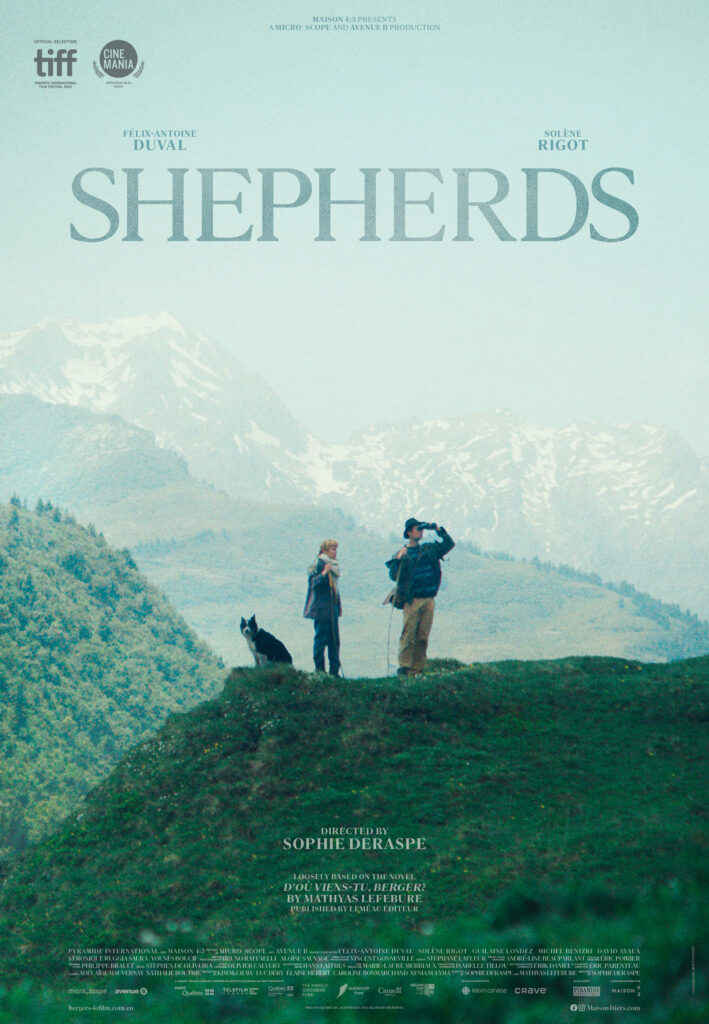
Shepherds (Bergers)
Co-Wri/Dir: Sophie Deraspe (Interview: Antigone)
Mathyas (Félix-Antoine Duval) is a young man who works as a copywriter at a Montreal PR firm. He’s creative, sensitive and ambitious. So what is he doing sipping yellow Pastis in a small town cafe in Provence? To change his life from pointless and unfulfilling to a simpler one, entirely off the grid. He’s in Provence because he wants to become a shepherd. You heard me: someone who herds sheep. And he wants to write a book about his experiences afterwards. He has already bought a requisite black hat and leather satchel, and he’s been boning up on all the books on how to herd sheep. But he’s having trouble finding a sheep breeder willing to take him on. His try is a total wash-out: he’s never stood in a flock of sheep in his life.
So he pays a visit to the local government office, in hopes of getting a work visa. No such luck, but he does meet the cute bureaucrat behind the counter. Elise (Solène Rigot) is smart, pretty and bored with her job, too. She’s impressed by Mathyas’ convictions, but is sorry to tell him you can’t apply from within the country. But he keeps up his correspondence
with her via handwritten snail mail, and her simple responses keep him sane.
He eventually finds under-the-counter work as an apprentice shepherd for a retired, childless couple looking for someone to take over. But he finds the environment hostile and violent, full of cruelty and insanity… nothing like what he was looking for. So when Elise shows up suddenly, he decides to quit. Surprisingly, the two of them are hired almost immediately as a team, to work through the summer tending sheep in a stone cottage way up in the Alps. Can two non-shepherds learn the lay of the land and how to take care of hundreds of pregnant sheep? And will their friendship develop into something more?
Shepherds is a wonderful movie about going back to the land. The story is based on the novel D’où viens tu, berger? by the real Mathyas Lefebure who actually did leave Quebec to seek his fortune as a shepherd in Provence. I’ve always liked Sophie Deraspe’s brilliant films. And while Shepherds is very different from her past work, it’s just as good. Félix-Antoine Duval is amazing as Mathyas with just the right blend of vulnerability and sincerity, like a gawky teenager trapped in an adult’s body. French actress Solène Rigot conveys such warmth she’s totally loveable.
Shepherds is a gorgeous movie with unforgettable images, like rivers of sheep pouring across a valley and through alpine city streets. Absolutely breathtaking. One warning: After watching Bergers, you might consider becoming a shepherd, too.
Night of the Zoopocalypse, Shepherds, and Seven Veils all open this weekend in Toronto; check your local listings. This is Daniel Garber at the Movies, each Saturday morning, on CIUT 89.5 FM and on my website culturalmining.com.
Tough Cookies. Films reviewed: Maria, Flow, The G
Hi, this is Daniel Garber at the Movies for culturalmining.com and CIUT 89.5 FM.
With a rapidly aging population, the traditional image of frightened, little-old cat ladies is gradually shifting to one of strength and cunning. Witness new TV shows like Matlock. So this week I’m looking at two new movies about tough older women and one about a cat. There’s an opera diva in Paris preparing her swan song; a rustbelt widow who wants to go out with a bang; and a cat on a sailboat in a world covered in water.
Maria
Dir: Pablo Larraín (Reviews: Spencer, The Club)
It’s 1977 in Paris, and Maria Callas (Angelina Jolie: Salt, The Tourist, Unbroken) — one of the greatest divas in opera history, is not doing well. She rarely eats, often never leaving the bedroom of her palatial apartments for days at a time. She rarely speaks with anyone anymore, aside from her servants. She runs her butler ragged (Pierfrancesco Favino: The Hummingbird, in a red monkey suit) and she relies on her cook (Alba Rohrwacher: Sworn Virgin, Hungry Hearts, The Ties/Lucci ) for judgement on the quality of her vocal chords.
But she’s not completely alone. She is seeing a pianist for his unvarnished opinion on whether her legendary “voice” has returned. And has agreed to an unheard-of interview with a young journalist named Mandrax (Kodi Smit-McPhee: The Road, The Congress, The Power of the Dog, Memoir of a Snail). But Maria faces a number of problems. She refuses to see a doctor, despite her rapidly declining health, and she won’t stop popping Quaaludes, leading to frequent
hallucinations and delusions. Can her devoted servants save her life? Or is this the end?
Maria is a biopic about the death of a legendary Greek-American diva. The movie begins with her demise at age 53, then goes back in time to show what led up to it. This includes flashbacks to her chubby adolescence in German-occupied Athens in WWII, her failed marriage, and at the peak of career, including trysts with Aristotle Onassis and JFK.
But is this biopic any good? I have very mixed feelings about that. I love the beautifully shot interiors, the ostentatious costumes and the amazing arias provided by recordings of Callas herself. Italian actors Rohrwacher and Favino provide wonderfully painful performances. And, as the latest in a series of films about famous woman by Chilean director Pablo Larraín it has good pedigree, especially Spencer (with Kristen Stewart as Princess Diana). But this movie depends on Angeline Jolie, and she doesn’t carry it off. She always seems to be acting. I don’t see Maria Callas here, I see Jolie posing for the camera, with a haughty face here and a dramatic gestures there; so you rapidly lose sympathy with the main character. Perhaps Maria Callas really did act like that, even behind closed doors, but Jolie plays her somewhere between high camp and kitsch.
Maria is never boring… just a bit embarrassing.
Flow
Co-Wri/Dir: Gints Zilbalodis
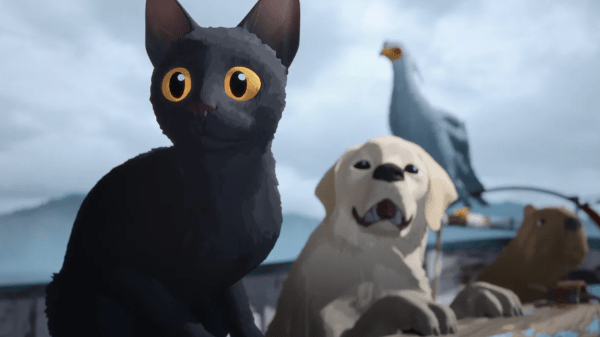
It’s some time in the future, somewhere in the world. A small grey cat with golden eyes and pointy ears is enjoying a walk in the woods. The cat lives by an abandoned old house surrounded by enormous cat statues. The cat is very shy, and fears, most of all, a pack of feral dogs. Suddenly, there’s a stampede of animals running in one direction, full speed. They‘re trying to avoid a massive flood, sweeping away everything in its path. But cat and a friendly, white dog are among its victims. Survival instinct kicks in and eventually cat manages to climb on board a tattered sailboat. There Cat discovers a gentle, sloth-like capybara already on board. Other animals make their way onto the sailboat, including an ingenious lemur, that big, white dog and a majestic-looking phoenix. Together they form an uneasy friendship as they brave a dangerous water-covered world. But can they learn to get along? And is this world worth living in?
Flow is a brilliantly animated film about a picaresque journey by a mismatched troupe of animals. It’s tender, heart moving and lovely to watch. It’s all about friendship and cooperation learned by
animals living in a gently hostile world. And though they behave a tiny bit like humans, there are no people in the story, and no dialogue either; just grunts meows and barks. Dogs still want to fetch. Cats want to catch fish.
And though it’s post-apocalyptic, there is nothing futuristic in this film; human technology is limited to abandoned ancient cities, glass bottles and sailboats; no cars or smartphones to be seen. The science fiction comes in with its universality, where animals from different continents, along with mythical beasts like sea monsters, can randomly encounter and learn from one another. I just watched Flow, and I already want to see it again.
Flow is Latvia’s Oscar submission for Best International Feature.
The G
Wri/Dir: Karl R. Hearne
It’s a rust-belt city somewhere in North America. Ann Hunter (Dale Dickey) is a tough cookie in her 70s, who is feeling depressed. You can see it in every wrinkle on her face. She lives with her ailing husband in their fully-owned condo. He was once a tough guy, but is rapidly sliding into immobility and dementia. She grudgingly takes care of him, and drowns her sorrows in rot-gut alcohol straight from the bottle. Aside from him, she only spends time with Emma, step-granddaughter (Romane Denis). Emma models her life on The G (as she calls her grandmother) someone who doesn’t take crap from anyone. The G also helps her out financially, and doles out hardboiled words of wisdom.
But everything changes when a man in a suit named Rivera (Bruce Ramsay), out of the blue, breaks down The G’s front door, accompanied by two toughs: Matt (Joey Scarpellino), a handsome but simple-minded gardener; and Ralph, a psychopath with bleach blond hair (Jonathan Koensgen). Together they violently shove Ann and her husband into a van, who wind up locked in a threadbare room without a phone, in a nursing home that feels more like a
prison. This is your new home, Rivera says, and there’s nothing you can do to stop me. He’s now their legal guardian and has the documents to prove it; their doctor (a silent partner in the scam) has declared them both incompetent. No one’s allowed to go in or out for the first month. He roughs up her husband to try to find the proverbial pot of gold he thinks they’re hiding. But they underestimate the G, her stubbornness, and her shady connections back in Texas.
Meanwhile, Emma is shocked when she discovers her grandparents have suddenly disappeared, leaving behind just a torn-up home. She scours the city to find them, and makes friends with a caretaker who works at the home (who also happens to be Matt, the friendly thug). It’s too late to save her grandpa but she vows to get the G out of there. And even while Emma is trying to free her, the G has vowed vengeance on all her enemies — and she’s not messing around. Who can they trust? Can two women best a criminal organization? Or will they end up buried alive?
The G is a great revenge thriller about the very real phenomenon of organized criminals attacking and abusing the elderly. It’s dark and disturbing. Dale Dickey blows this movie out of the water, supported by a good Quebecois cast. (It’s shot in Montreal). If you’re looking for a gratifyingly violent revenge flic, this is the one to see.
Maria and Flow are now playing at the TIFF Lightbox, with Maria streaming on MUBI on December 11th; and The G is opening across Canada; check your local listings.
This is Daniel Garber at the Movies, each Saturday morning, on CIUT 89.5 FM and on my website culturalmining.com.
Family-friendly pics at #TIFF24. Films reviewed: The Wild Robot, Sketch
Hi, this is Daniel Garber at the Movies for culturalmining.com and CIUT 89.5 FM.
There’s lots happening in Toronto this weekend. At the Toronto Palestine Film Festival you can watch films and docs, go to concerts, art exhibitions, a brunch, workshops and discussions all weekend long, both online and at the Lightbox. And the Toronto Garlic Festival is on this Sunday on Spadina Road, with food, drinks, a garlic market and culture, too… including me! I’ll be giving a talk on garlic and the movies at 12:00 noon, with free admission.
But today I’m talking about two new, family-friendly movies that were featured at TIFF this year. There are monster drawings that come to life, and a robot stranded on an island that can talk to the animals.
Wild Robot
Co-Wri/Dir: Chris Sanders (Review: How to Train your Dragon)
It’s a small island in North America, sometime in the future. ROZZUM unit 7134 (Lupita Nyong’o) is a robot. She was built for family consumers, the product of a multinational corporation. Powered by AI, she speaks and understands multiple languages and is made to serve. Somehow her box has washed ashore on this island, but the expected suburban home is nowhere to be found. This place is uninhabited… by humans that is, but it’s teeming with wildlife. Deer and moose, bears and foxes, raccoons, porcupines, skunks, beavers, possums and all types of birds, insects and aquatic life. She sees animals ruthlessly killing and eating each other as part of their daily lives. She gazes at them all in wonder, but they regard her cautiously. She has no smell, can’t be eaten, but isn’t a predator either — what good is she?
But for the robot, it’s imperative she complete her assignment, any assignment. So she studies all the animals and learns to speak their languages. And when she rescues a newly-hatched gosling (Kit Connor) from a sly fox (Pedro Pascal), she has finally found her purpose in life: to take care of this newborn bird. You can call me
Roz, she says, but the bird — who bonds with her the second he opens his eyes — would rather call her Mama. So Roz, the little bird, and the somewhat untrustworthy fox form a makeshift family, teaching the bird the facts of life as he grows up. But can they teach him to swim and fly before the great migration south for the winter?
The Wild Robot is an amazingly-moving animated film about nature and technology forming deep bonds of their own with humans nowhere to be seen. But the villains are all man-made. This is a thoroughly well-put-together movie, from the quirky characters, to the funny surprises, to the heart-stopping scenes of suspense. It’s a genuine tear-jerker, but with characters that are just loveable enough to care for, without making you cringe. Roz is a white enamel ball whose accordion arms can spring out and come back, and whose head has neat slots for add-on devices. Her whole body glows in different colours along the seams. I love the art direction, down to the 1950s woodsy, summer- camp font they use for the title. Based on a novel of the same time, it also borrows from classic kids’ literature like the Ugly Duckling, the Jungle Book and Doctor Doolittle, but it still feels completely original. It also features additional voices of Ving Rhames, Mark Hamill, and Catherine O’Hara to name just a few.
I recommend this movie for people of all ages and most robots and animals, too.
Sketch
Wri/Dir: Seth Worley
It’s a small town somewhere in the US. Taylor Wyatt (Tony Hale) lives with his two pre-teen kids Amber (Bianca Belle) and Jack (Kue Lawrence) in a lovely home backing onto a small forest. They’ve all been down in the dumps since their mom died, so Taylor has gone out of his way to hide any pictures of her, to help the family get through this difficult period. And now he’s trying to sell the house — with the help of his sister Liz (D’Arcy Carden), a real estate agent. Maybe that will wipe the emotional slate clean. But it’s not working, as becomes clear when Taylor is called into the kids’ school to talk to the principal. Little Amber is accused of plotting to murder a classmate! And they have a drawing she made to prove it.
Luckily, the sensible guidance counsellor manages to defuse the situation right away. Amber is angry, right? So she gives her a sketch book where she can draw away all her frustrations, however she likes — the book is hers to keep and she doesn’t have to show it to anyone. Better to draw it than to do it, right?
Meanwhile, her brother Jack spends lots of time in the woods where he discovers a small pond that seems to have curative powers. It heals a cut on his hand, and fixes a family heirloom he broke. Maybe if he dumps a box of his mom’s ashes into the water, it will bring her back to life? But Amber finds out and this leads to a big fight, followed by Amber’s sketchbook falling into the pond. And that’s when all the scary monsters she drew with crayons and glitter, start coming to life.
Sketch is a delightful adventure about two kids trying to stop gigantic imaginary creatures — who have come to life — from destroying their town and killing all the people. It’s cute, it’s fun and it’s a bit scary. It’s also a touch psychological and moralistic but not enough to drag it down. Movies like this used to be fairly common, but nowadays it’s almost rare to find a movie that isn’t tied to a game, a toy, a Disney princess or a Marvel superhero. And the special-effect monsters are really cool. What other movie can you get a 30-foot- tall creature wreaking havoc in a cornfield that is clearly made of crayon scribbles? In his first feature, director Seth Worley has created a good, fun, stand-alone movie that kids will love, and parents can enjoy.
Sketch, and The Wild Robot both premiered at TIFF with Wild Robot opening this weekend in Toronto; check your local listings.
This is Daniel Garber at the Movies, each Saturday morning, on CIUT 89.5 FM and on my website culturalmining.com.
Daniel Garber talks with Taviss Edwards and Melissa Peters about Secrets of the Forest
Hi, this is Daniel Garber at the Movies for culturalmining.com and CIUT 89.5 FM.
Kids grow up hearing scary fairytales about the forests — it’s where witches live in gingerbread houses, and the big bad wolf is waiting for them… but are forests really dark, gloomy and dangerous? No! They’re places for exploring, foraging and keeping our planet safe. There are plants that can keep us clean, foods that can keep us healthy, and trees that can talk to us — well, kind of. But who holds these secrets of the forest?
Secrets of the Forest is a new TV series for kids that provides a fascinating, fun and informative look at nature in our forests. Using expert guests, animation and time-lapse photography,
in addition t the live action, it wipes away the myths, and provides a scientific way to learn more. The show is hosted by 10-year-old Taviss Edwards and is directed by Melissa Peters.
Melissa has a decade’s experience in kids’ TV as a host on TVO Kids’ The Space and later as writer and director of shows like Mittens and Pants, Backyard Beats, and The Fabulous Show
with Fay & Fluffy. Taviss is a gifted young equestrian and actress who has also appeared in A Ghost Ruined My Life.
I spoke with Taviss Edwards and Melissa Peters here in Toronto via Zoom.
Secrets of the Forest is available on TVO Kids, TVOkids.com, YouTube and various digital TV services.
Latin America? Films reviewed: Autumn and the Black Jaguar, Satanic Hispanics PLUS #Hotdocs24!
(missing some background music)
Hi, this is Daniel Garber at the Movies for culturalmining.com and CIUT 89.5 FM.
Spring is here, and so is Toronto’s Spring film festival season. And its crowning glory is Hot Docs the world’s biggest International Documentary Film Festival. It’s a month away — it runs from April 25 to May 5 — but now’s a good time to start booking tickets. As usual there are over 100 docs from more than 60 countries, with many international premieres. And, as always, students and seniors (over 60) can go to daytime screenings for free.
They just released the whole festival slate, so here are a few docs that I haven’t seen yet, but look interesting to me. Black Box Diaries is about a young Japanese journalist who was raped, and is taking her case to court in a demand for justice. Grand Theft Hamlet shows some UK actors attempting to mount a production of Shakespeare entirely within the notorious game Grand Theft Auto. Norwegian Democrazy is about extreme street level politics in that country, and Stray Bodies takes a similar look at how people handle bodily restrictions within their own countries can be resisted by crossing national borders within the EU. Pelikan Blue is an animated film about what young Hungarians did to leave the country when the Iron Curtain fell. There are also video diaries: The Here Now Project about how climate change effects people around the world; and XiXi, an intimate look at the innermost thoughts and beliefs of a Chinese improvisation artist living in Europe. Curl Power is a funny and tender examination of five teenage girls over three years on a curling team. And for those interested in musical celebs, there are features about Toronto’s own Peaches, called Teaches of Peaches, and Disco’s Revenge about the legendary musical producer Nile Rogers.
Like I said, Hotdocs is a full month away, but now’s the time to start thinking about it.
This week, though, I’m looking at two movies, one for children and one for definitely for grownups. There’s a girl looking for a wild beast in the jungle, and a man in an El Paso jail trying to explain why he’s the only one to survive a mass killing.
Autumn and the Black Jaguar
Dir: Gilles de Maistre
Autumn Edison (Lumi Pollack) is a young girl in middle school in New York City. She grew up in a rainforest somewhere in Latin America with her environmentalist parents. Her Dad is from the North, her Mom a member of the local indigenous nation. So Autumn treats the jungle as her backyard. As a small child she befriended a baby black jaguar who was left parentless when poachers shot the mother jaguar. So they grew up together. Developers and animal traffickers, led by the evil Poacher, Doria Dargan (Kelly Hope Taylor) wanted to evict her people from their land. They also hunted rare species to sell on the black market. But when Autumn’s mother is killed, her Dad takes her back to North America, where it’s safe. Seven years later, she’s almost a teen, but still hates it up there. No one seems to care about our animal friends or the environment. Especially her biology teacher Anja (Emily Bett Rickards). She wants the class to dissect frogs — can you believe it? — and Autumn refuses to participate in such cruelty. She stages a one-person protest. So she’s suspended from school, and not the first time. Stuck at home, she finds a letter from her uncle in the rain forest, a veritable cry for help. Our lives are teetering on the brink, he writes. They want to build a dam, flooding where we have lived for millennia. And they’re after Hope, the beloved black jaguar!
Autumn takes this as a beacon, calling her back to her ancestral home.
She lies to her father that everything’s fine, and secretly rushes off to the airport. What she doesn’t realize is her teacher — notable for her fear of germs, insecurity and agoraphobia — is somehow following her; she’s afraid Autumn is in danger, and wants to bring her back home. She’s risking her worst phobias to rescue the little girl. But they both end up in the rainforest, alone, with Autumn the one who is confident and at home. Will she find Hope the Jaguar? Will Hope still recognize her? And can they somehow stop the destruction of her culture, and the kidnapping of the last black jaguar?
Autumn and the Black Jaguar is a heart-warming kids’ movie. By kids, I mean little kids. As a grown-up, I found the dialogue klunky at best and cringy at worst, as if written by Chat GBT and edited by Google Translate. The teacher talks like a cartoon character. comically overreacting to everything she sees (as in most kids’ TV shows). But there are also some very cool adventures, like when they climb a tall tree and walk around on top of the forest’s canopy. I think little kids will really like this.
Watching the movie, I was impressed by the CGI version of a Jaguar playing with Autumn — it looked real. Could it be a CGI head superimposed on a friendly dog’s body? But after I did a bit of research, I found out the actress, Lumi Pollack, spent 10 months learning to bond with two actual jaguars. That wild cat is real! Impressive. Which moved it up quite a few notches on my mental score card.
Satanic Hispanics
Dir: Alejandro Brugués, Mike Mendez, Gigi Saul Guerrero, Eduardo Sánchez, Demián Rugna
It’s El Paso, Texas, just across the border from Juarez, Chihuahua. The police discover dozens of dead bodies in an old, abandoned building, with only one man still alive, unarmed, and handcuffed to a metal table. So they arrest him. He calls himself the Traveler (Efren Ramirez) and says he was born here — meaning in the US — and speaks at least 5 languages. But he’s undocumented, with no papers to prove his existence. Still, he pleads for the police to let him go. If they don’t, in 90 minutes they’ll all end up dead, just like the others they found. You see, he says he’s being followed by the Saint of Death, a terrifying, mystical being who wants to kill him. That’s why he’s the traveller: he always has to keep a step ahead of the Saint, to avoid massive bloodshed like this one.
But the cops don’t believe him — they accuse him of drug trafficking. They bring out his cache of strange paraphernalia and ask for an explanation. So, like Scheherazade, he embarks on a series of stories that tell where each item comes from. One of his strangest stories is called Tambien Lo Vi. It’s about a mathematical genius named Gustavo (Demián Salomón) a Rubik’s cube champ who somehow transfers his mental algorithms into light patterns projected on a wall using the light from his cel phone. He flaps his arms wildly flashing… that seems to bridge the gap between the living and the dead.
Other stories deal with a voracious vampire having a night on the town on Halloween — the only time of year when he can dress as a blood sucker in public — and a very bizarre take of a man fighting off a demon using a prodigious weapon known as the Hammer of
Zanzibar that I cannot describe on daytime radio. But back to the main plot: can The Traveller finish his stories before the evil entity arrives to kill us all?
Satanic Hispanics is a compilation horror movie told by 5 directors and countless writers, producers, cast and crew. Each story is told as discrete, complete short film, within the whole movie, but with all sharing a similar look. The directors themselves are originally from Argentina, the US, Mexico and Cuba, with dialogue shifting from English to Spanish to pre-Columbian languages. Being a horror movie, there’s lots of gratuitous violence, blood and guts, some shocks and chills, and some horrible-looking evil entities.
Does it work? Oh yes! Not every segment is perfect, but altogether they tell us some very original and scary stories.
Autumn and the Black Jaguar opens this weekend in Toronto: check your local listings; Satanic Hispanics is currently streaming on Shudder.
This is Daniel Garber at the Movies, each Saturday morning, on CIUT 89.5 FM and on my website culturalmining.com.
August potpouri. Films reviewed: Bad Things, Lasting Impressions, Strays
Hi, this is Daniel Garber at the Movies for culturalmining.com and CIUT 89.5 FM.
August is a time to relax travel and have fun, not a time when people want to watch serious movies. So this week I’m looking at a potpourri of different sorts of entertainment than you’re probably used to. I’m talking about lesbians in a haunted hotel, French impressionist paintings on a bistro wall, and abandoned talking dogs in a big city.
Bad Things
Wri/Dir: Stewart Thorndike
It’s dead winter in upstate New York. Ruthie (Gayle Rankin) and her friends are up from the city to spend a night or two at a completely deserted hotel.
Ruthie inherited the place from her grandmother and has to decide whether to give it a go or sell it. With her, are her enthusiastic girlfriend Cal (Hari Nef: Barbie) their hard-boiled pal Maddie (Rad Pereira) and Maddie’s flirtatious acquaintance Fran (Annabelle Dexter-Jones). And it could be a fun weekend: there’s an indoor swimming pool, karaoke, a huge kitchen and tons of empty rooms for pillow fights or foolin’ around. On the negative side, the hotel might be haunted. Fran is the first one to see ghosts, a little girl worried about her fingers, and a pair of female ski champs. Worse, the ghosts can also see her. But when she freaks, the other three just blame it on drugs. Things heat up when Ruthie cheats on her
girlfriend. But when things start getting really scary, like someone wearing a gas mask while brandishing a chainsaw — they have to decide whether to hightail it back to the city, or stick it out.
Bad Things is a new take on Stanley Kubrick’s The Shining from a feminist perspective. It keeps some of the original concepts but twists them all into something new and original. Instead of blood in the hallway it’s mothers’ milk. And there are lots of psychological thrills and chills — it’s hard to know who is crazy, who’s a ghost, who is living, who is dead, and who is killing them all. The acting is good all around, along with appearances by token heterosexuals, Canadian Jared Abrahamson (American Animals, Hello Destroyer, Hollow in the Land, Sweet Virginia) as Brian the handyman and 80s icon Molly Ringwald as the Woman in Red. Bad Things is a low budget movie shot during the height of the pandemic — The Shining it ain’t — but it is good, funny and scary.
Lasting Impressions: The Magic of the Impressionists in 3D
When is a painting not a painting? When it’s an experience. Over the past 5-10 years there’s been a boom in exhibitions of the art of famous painters… but without the paintings. Van Gogh, Chagal, Monet — they take a huge space and fill it with enormous moving projections of their most famous works to view as you walk around a warehouse or convention centre temporarily turned into a pop-up gallery. These were especially popular during the pandemic when it was hard to travel. But this show is different: instead of an ersatz art gallery, it’s a show, almost like dinner theatre. You sit at small numbered tables, where servers bring wine and snacks. When the show begins, the lights dim and you turn your chair to face the screen. And here’s where out gets interesting. To the accompaniment of popular French music — Debussy to Charles Aznavour to Ella Fitzgerald — enormous blowups of French impressionist paintings — sort of a greatest hits — are displayed one by one. The projections use super-saturated colour with intense effect. Part of the paintings are animated: water ripples, clouds drift, leaves shake. And — with the help of 3D glasses — elements of a painting feel like they’re moving: you’re drifting down a stream, floating above Monet’s waterlilies, or at a ballet rehearsal with poised ballerinas drifting slowly toward you in mid-air. It’s not the same thing as seeing a painting on a wall; this is art as a commodity to be consumed. While the animation doesn’t always work — I’d
rather see a Frenchman’s long beard or a Tahitian woman’s hair staying still in a Renoir or Gaugin painting, than to watch it sway rhythmically in the breeze — the technical quality is excellent: great sound and beautiful images. I’m of the view, if you want art, go to a museum — there’s a show on right now of Mary Cassatt’s impressionist painting at the AGO. But if you want a pleasant, nostalgic outing, where you can enjoy choreographed pictures, music and a glass of wine, this is it.
Strays
Dir: Josh Greenbaum
Reggie is the perfect dog. Though a bit scruffy around the edges, he is loving, faithful, and true to his master Doug (Will Forte). All he wants is a pat on the head and an occasional “good boy”. So what is Reggie (Will Ferrell) doing in a dark alley in some big city? Turns out Doug is a good-for-nothing, scum-of-the-earth master who abandoned poor Reggie 3 hours away from the small town they live in, so the dog could never make his way back home. Reggie is still hopeful — he’s naive and an eternal optimist — but he is quickly disabused of that notion by some big mean dogs who threaten him. Luckily, the street-smart Bug (Jamie Foxx), comes to his rescue like the Artful Dodger, showing him the lay of the land. Being a stray dog is paradise — you can live like a king with no responsibility. They’re soon joined by two other strays: Maggie (Isla Fisher) an elegant pooch with a keen sense of smell who was traded in by her mistress for a smaller cuter lapdog; and Hunter
(Randall Park) a former therapy dog who is always sympathetic. But when they discover Reggie’s tragic story they decide to help him get revenge. Their mission? For Reggie to find his way back to Doug… and bite off his penis! Will they make it to the town? And what adventures will they encounter along the way?
Strays is a comedy road movie that’s coarse, bawdy, and raunchy. It’s a typical bro movie, with the sort of humour that appeals to 14-year-old boys… you know, lots of jokes about feces, vomit, urine and penises. But somehow, because it’s guileless dogs (not people) telling the jokes, you can laugh all you want without feeling guilty or self conscious. These are real dogs, not CGI images (except when their mouths move). It gets a bit dark at times — jokes about serial killers and lost kids — and I’m really not a fan of explicit, extended images of dog poop… but despite all that, Strays is quite a funny movie.
Lasting Impressions is now playing at the CAA Mirvish Theatre in Toronto; Bad Things is streaming on Shudder, and Strays is opening across Canada this weekend; check your local listings.
This is Daniel Garber at the Movies, each Saturday morning, on CIUT 89.5 FM and on my website, culturalmining.com.
60s, 70s, 80s. Films reviewed: Cocaine Bear, Jesus Revolution, Metronom
Hi, this is Daniel Garber at the Movies for culturalmining.com and CIUT 89.5 FM.
This week, I’m looking at three new movies. There are spiritual revolutionaries in California in the 1960s, teenaged dissidents in Bucharest in the 1970s, and a crazed animal in Georgia in the 1980s.
Cocaine Bear
Dir: Elizabeth Banks
It looks like a typical day in 1985 in the Chattahoochee National Forest in Georgia. Two little kids are playing hooky, three skateboard-riding teenage delinquents are looking for some petty crime to commit, a pair of Scandinavian backpackers are on a hike, and a middle-aged forest ranger is dressed to impress a guy she wants to date. But everything changes when a prop-plane pilot drops a dozen duffel bags of uncut cocaine into the woods… and then promptly dies. Suddenly the supply chain is broken, and out-of-state traffickers looking to retrieve their supply — and the cops who want to nab them — all descend on the park at once. And here’s where the
actual movie starts: a huge black bear sticks its nose into the duffel bag and emerges as a frantic, delirious, coke head, forever on the lookout for more snow to blow. Who will find the drugs — the cops, the gangsters, the delinquents, or the children? And who will not be eaten by the bear?
Cocaine Bear is a low-brow, high-concept comedy that’s basically 90 minutes of extreme-gore violence. I was a bit dubious at the beginning, but about half an hour in it started to get really funny. I know it’s stupid-funny, but it still made me laugh. The all-CGI bear is one of the main characters, but there’s a great assortment of humans, too, played by an all-star cast: Margo Martindale as the forest ranger, the late Ray Liotta was the gangster, Alden Ehrenreich as his diffident son, O’Shea
Jackson Jr as his henchman, and Keri Russell as a mom searching for the two missing children. It’s hilariously directed by TV actor Elizabeth Banks. Cocaine Bear easily beats Snakes on a Plane and Sharknado as best movie based solely on its title. Supposedly inspired by true events (yeah, right) it has lots of room for ridiculous 80s haircuts, music and other gags to good effect. Stoner movies are a dime a dozen and half of the movies coming out of Hollywood are clearly made by cokeheads, but this may be the first comedy about cocaine I’ve ever seen. If you’re comfortable laughing at blood, gore and gratuitous violence, along with lots of base humour, I think you’ll love this one.
Jesus Revolution
Dir: Jon Erwin, Brent McCorkle
It’’s the late 1960s in California, where young people everywhere are tuning in, turning on, and dropping out. One of these kids is Greg Laurie (Joel Courtney), who attends a military academy but would rather be drawing cartoons. He lives in a trailer with his Mom, a glamorous but alcoholic barfly. He meets a pretty girl named Kathe hanging with the hippies outside a public high school, and decides that’s where he’d rather be. But Kathe is from an upper-class family whose parents frown on Greg. Meanwhile, Chuck Smith (Kelsey Grammer), a local pastor, wonders why no one is coming to his Calvary Chapel anymore. It’s because your a square, his
daughter tells him. So she introduces him to a unique man she met at a psychedelic Happening. Lonnie Frisbee (Jonathan Roumie) is a charismatic, touchy-feely type who talks like a hippie and looks like Jesus. He emerged from the sex-and-drug world of Haight Ashbury with a mission from God, and now wants to spread the gospel. Chuck Smith is less than impressed, but decides to give him a try.
Soon there are block-long lineups to hear what Lonnie — and Chuck — have to say. This includes Kathe and Greg, who barely survived a bad acid trip. Lonnie gives Greg a place to live and invites him to join the church. Calvary Chapel is attracting people from everywhere,
culminating in mass baptisms in the Pacific ocean. But as their fame grows, so does the friction. The more moderate Chuck frowns on Lonnie’s in-your-face style — from faith-healing to his talk of being closer to God. Can Greg find a place in this world? Will Kathe’s family ever accept him? And is this a movement or just a flash in the pan?
Jesus Revolution is a retelling of the unexpected upsurge in grassroots Christianity among baby boomers in the 70s. The film is clearly aimed at evangelical church-goers, a subject in which I have absolutely no interest. Zero. Which is why I’m surprised how watchable this film is to a general audience. It’s not preachy — it shows, not tells. It’s well-acted with compelling characters and a surprisingly good story. No angels or miracles here, just regular — flawed but sympathetic — people. I think it’s because the Erwin Brothers (American Underdog, I Still Believe)have figured out how to make mainstream, faith-based movies that are actually good. The film is based on real people, so I was a bit surprised they never mention that Lonnie Frisbee was actually a gay man who later died of HIV AIDS. I guess it doesn’t fit the story they want to tell That said, if you’re involved in a church or a fan of spiritual films, this might be just what you’re looking for.
Metronom
Wri/Dir: Alexandru Belc
It’s 1972 in Bucharest, Romania. Ana and Sarin (Mara Bugarin, Serban Lazarovici) are a beautiful couple still in high school, and madly in love. They both come from “intellectual” families, who are given special privileges in Ceausescu’s communist regime. They go to an elite school together, and hope to pass their Baccalaureates to get into an equally good university. They meet in front of a WWII heroes monument dressed in stylish trench coats and school uniforms. So why is Ana crying? Sarin and his family are emigrating to Germany. That means they’re breaking up for good and will probably never see each other again. Ana is crushed — her world is broken. Which is why she has no interest in going to an afternoon party at a friend’s house, but changes her mind at the least minute. Her father, a law professor, is easy going, but her mother absolutely forbids it. So Ana sneaks out of the apartment and heads to the get-together. This is her last chance before he leaves to make out with Sarin and express her eternal love.
The party is centred around listening to music — Led Zepplin,
Hendrix, The Doors — as played on a radio show called Metronom on Radio Free Europe. Western music is underground, subversive and illicit. They decide to write a letter to the show and pass it on to a French journalist. But two bad things happened. When they make love behind a closed door, Sarin won’t say he loves her. And the party gets raided by the secret police and all the kids are arrested and forced to write confessions. But Ana is so caught up in her relationship she barely notices the interrogation she has landed up in. Who ratted them out to the authorities? And what will happen to Ana?
Metronom is a passionate story of young love in the 1970s under the omnipresent gaze of an authoritarian government. It’s a coming of age story, about heartbreak and the loss of innocence as the real world reveals its ugly face.
If you’ve never seen a Romanian film before (such as Întregalde, Bad Luck Banging or Loony Porn, Poppy Field, The Whistlers, The Fixer, One Floor Below), this is a good place to start. They all have this feeling of tension, corruption, mistrust and unease, whether they’re set during Ceaucescu’s reign or long after his fall. This one also has hot sex, good music, stark cinematography, and terrific acting, especially Mara Bugarin as Ana. It manages to be a thriller, a romance and a coming-of-age story, all at once.
This is a good one.
Metronom is now playing a the TIFF Bell Lightbox; Cocaine Bear and Jesus Revolution open nationwide this weekend; check your local listings.
This is Daniel Garber at the Movies, each Saturday morning, on CIUT 89.5 FM and on my website, culturalmining.com.
Talking, listening, fighting back. Films reviewed: No Bears, Puss in Boots, Women Talking
Hi, this is Daniel Garber at the Movies for culturalmining.com and CIUT 89.5 FM.
It’s holiday time with lots of new movies for people of all ages. This week I’m looking at three new movies opening on Christmas weekend. There are women in a barn, talking; a movie director in a village, listening; and a cat in a hat, fighting.
Wri/Dir: Jafar Panahi
Jafar Panahi is an Iranian filmmaker from Tehran. His current project is about a glamorous middle-aged couple trying to escape to freedom in Europe. But Panahi is forbidden by law from making movies or leaving the country. So he’s doing the next best thing: directing his film in long-distance using his cellphone and laptop. It’s being shot in a picturesque city in Turkey, while he’s renting an apartment in a tiny Azerbaijani village in Iran. It’s close to the border an area rife with black market smugglers. Panahi can speak some Azeri but is unfamiliar with local traditions. So he likes talking pictures of the locals. And here’s where he runs into trouble.
A young couple wants to get married and leave the village. But the woman was promised to another man at birth. Now everyone thinks Panahi caught the young couple in a photograph. The couple want him to destroy the photo, while the groom’s family want a copy to prove her dishonour. Meanwhile, across the border, another crisis is threatening the film movie. As he gets pulled deeper and deeper into the world of local politics and feuds, his work — and possibly his life — is at risk. Will he ever finish his film? And what will happen to the two couples — the actor-lovers in Turkey and secret lovers back home?
No Bears is a neorealist movie about making a film, the film
he’s making, and how real life gets in the way. It’s about honour, revenge and identity. It also exposes the image of “the director as a dispassionate observer and documentarian” as a myth. Panahi’s very presence in a small village disrupts their lives and leads to unforeseen consequences. He plays himself, who in real life is forbidden from making films — accused of propaganda against the system. Any movie that’s against the system is one I want to watch. But this means it was shot openly in Turkey but secretly in Iran. No Bears is a clever, humorous and complex film with an unexpected conclusion. I liked this one.
Co-Dir: Joel Crawford, Januel Mercado
Puss in Boots is a cat in a hat who wears boots, and carries a sword. He’s known for both his fencing skills and his rapier-like wit. He lives a fairytale life — literally. He exists in a world where those stories are real. He’s both a hero and an outlaw, sought by bounty-hunters everywhere. But as a cat with nine lives he has no fear of death and will fight monsters and villains, alike. Until one day his doctor tells him he’d better slow down because he’s on his last life. If he is killed again, that’s the end, no more Puss in Boots. So he reluctantly decides to retire. He gives up his identity, and becomes an ordinary orange cat named Pickles in a home for abandoned cats. Now he has to use a litter box, eat cat chow and say “meow”. How humiliating! But his past catches up to him with some surprise visitors: Kitty Softpaws, another outlaw he left standing at the altar; and Goldilocks and the Three Bears. They all want him to help find a map to a fallen star that can grant a wish. Goldilocks wants a proper family, Kitty is looking for her future, and Puss in Boots wants his 9 lives back. Accompanied by a little dog named Perro he sets out to steal the map from the evil Little Jack
Horner (who is now quite big and bakes pies for living). But he must fight off his rivals, journey through a mystical forest, and find the magic star if he wants to stay alive. And he is being pursued by a truly scary villain, the Big Bad Wolf, a huge killer carrying a sickle in each hand.
Puss in Boots is a kids’ cartoon comedy set in the world of Shrek, where nursery rhymes and fairytales coexist with Alice in Wonderland and the Wizard of Oz. It’s somehow simultaneously a spaghetti western and medieval Europe. It features the voices of Antonio Banderas, Salma Hayek and Florence Pugh. What’s good about it? I’ll watch any cartoon, especially one with cool psychedelic images. This one has a few funny bits, along with a neat journey-adventure story. On the negative side, it’s not very funny, the lines are predictable and the story is both unoriginal and forgettable. And I’m not sure why they switch to two-dimensional jerky animation whenever there’s a fight scene. But I still enjoyed it, even if it’s just glowing bright colours on a giant screen.
Dir: Sarah Polley
It’s summertime at an Anabaptist colony somewhere in the US. It’s 2010, but it could be 1910; forget about cel phones and computers. There are no cars, radios, no electric lights — they still use lanterns. Even more unusual, there are no men around, only women and kids. What’s going on?
One of the women woke up in the middle of the night to find a man physically attacking her. She fought him off and beat him with a stick. Suddenly everything made sense. Countless women in the colony had woken up in the past with bruises and blood, but up till now, the men had insisted out was just a dream, her imagination or the work of Satan. Turns out the men have been raping women for years now and denying it, using cow tranquilizers. Now they are at the police station baling out one of their attackers. So all the women face an enormous decision: should they stay and fight back? Or should they just pack up the kids and go, leaving the place forever?
They designate the women and girls from three families to decide for all of them. Now they’re gathered in a barn to debate the issues and make the big decision. And one man, a school teacher named August — not part of the colony; his family was excommunicated — is there to record it all on paper; the
women were never taught to read or write. What will their decision be?
Women Talking is a movie about women talking, but it is much deeper than that. It’s a devastating story, a scathing indictment of endemic physical and sexual violence against women in their own homes. Though it’s never shown on the screen, nor are its perpetrators, its results are always apparent. One woman has a scar on her face, one woman is mysteriously pregnant, others have missing teeth or black eyes, and another has panic attacks, seemingly for no reason. And now they’re really angry,
not just for the violence, but because they’ve been lied to for so many years. There’s a spontaneous wellspring of grassroots feminism suddenly bursting loose.
The storytelling is very simple — it sticks to the barn, the fields, their houses and horses and buggies; it’s all they’ve experienced. At the same time, perhaps because they can’t write, they are amazingly eloquent speakers. It’s based on the novel by Canadian author Miriam Toewes who grew up in a Mennonite community. (The film never specifies their denomination or location, giving it a timeless, universal feeling.) It provides an internal view of life in the colony, with different opinions expressed passionately by each character. And it’s very well-acted by an ensemble cast, including Rooney Mara, Jesse Buckley, Claire Foy, Frances McDormand, Sheila McCarthy, Ben Whishaw. And despite the grave topic, the movie itself is more fulfilling than depressing. I’ve seen it twice, and appreciated it much more the second time — Women Talking is a subtle movie that deserves your attention.
Puss n Boots: The Last Wish, No Bears and Women Talking, all opened this weekend; check your local listings.
This is Daniel Garber at the Movies, each Saturday morning, on CIUT 89.5 FM and on my website, culturalmining.com.
A donkey and a wolf. Films reviewed: Eo, She Said
Hi, this is Daniel Garber at the Movies for culturalmining.com and CIUT 89.5 FM.
Fall Film Festival Season continues in Toronto with the EU film festival, offering free screenings from across Europe from now till Dec 2 at the Alliance Française. The Ekran film festival is also on now, showing the latest Polish movies at the Revue Cinema on Roncevalles; and Blood in the Snow or B.I.T.S. features made-in-Canada horror movies next week at the Elizabeth Bader Theatre from November 24-26th.
But this week I’m looking at two new movies about animals. There’s a defenceless donkey in Poland, and a dangerous wolf in Hollywood.
EO
Co-Wri/Dir: Jerzy Skolimowski
Eo is an adorable miniature donkey who works at a one-ring circus. He is lovingly cared for by a woman dressed in red, who performs with him on stage. But when animal rights activists close the circus down, Eo finds himself pulling a wooden cart full of scrap metal at a junk yard. Later he is trucked off to an elegant estate that raises championship horses. From there he’s sold to a farmer, wanders through a wolf-filled forest on his own, and fights off dangerous football hooligans. His journeys take him across Europe, among the rich and poor, the kind and cruel, but will he ever be reunited with his long lost love?
Eo is an incredibly beautiful and tender film about an adorable
donkey and the people — both good and bad — he encounters. Oe never speaks, but conveys his emotions through tear-filled eyes, cuddling gestures and loud angry wails. This is not a cutesy animal movie, it’s about adult emotions — like lust, betrayal, cruelty and violence. Stunningly cinematic, the film tells its story in an impressionistic manner, as seen through a donkey’s eyes. Periodically the entire screen is blood red; but there are also breathtaking, panoramic views of palazzi in Italy, manors in Poland, magnificent white horses, ancient, arched bridges,
green fields, flowing rivers, and dark skies: gorgeous images that can only be appreciated on a big screen. There’s very little dialogue, in Polish, English, French and Italian, with most of the meaning conveyed visually. There are cameo appearances by actors like Isabelle Huppert, but Eo (and the donkeys who play him) is the real star.
Jerzy Skolimowski, who attended the Łódź Film School, is not as well known as fellow alumni Andrzej Wajda, Roman Polanski and Krzysztof Kieślowski, but I think his films are just as amazing, with a dream-like quality.
OE must not be missed.
It’s 2015, in New York City. Meghan Twohey and Jodi Kantor are two investigative reporters within the juggernaut of that Gray Lady, the New York Times. Meghan (Grey Mulligan) is following a string of women all of whom say the Republican candidate for president, Donald Trump, sexually harassed them in the past. But they are all afraid to come forward in public. When she finally does get a woman willing to reveal her name in print, she suffers terribly, sent packages of human excrement in the mail, while Meghan gets death threats. So she takes maternal leave to care for her first baby.
Meanwhile, cub reporter Jodi Kantor (Zoe Kazan), also married with two young kids, is pursuing a very different story. Hollywood actress Rose McGowan is hinting that someone at Miramax, that extraordinarily successful independent movie studio, sexually harassed her in the past. Jodi wants to find out whodunnit — Rose isn’t saying — and to get her to commit to details on the record. So she turns to Meghan for help. How do I get women to talk? The two of them join forces, doing extensive research stretching back decades, using legal documents, withdrawn lawsuits, secret payments, and
clandestine Non-disclosure agreements. They discover there are women as far away as London and Hong Kong who suffered from horrible incidents of bullying, abuse, and sexual assault, all of which were later covered up. And the arrows pointed toward one man: Harvey Weinstein. Can the reporters get even one woman to commit using her name in an article against the formidable and frightening Hollywood powerbroker? Or will the paper be forced to retract it’s allegations?
She Said is a fascinating retelling of two journalists pursuing a major story just a few years ago. It takes us deep into the weeds of investigative journalism. And it’s told like a police procedural, as the journalists slowly uncover the facts. The thing is, computer screens and cel phones do not make for good cinema. Hollywood seems to churn out these newsroom dramas every couple years, including Spotlight about the Boston Globe’s revelation of pedophile priests, and The Post about the Washington Post and the Pentagon Papers. This is one is about the New York Times. So we sit through lots of dull editorial meetings.
Luckily, most of the story takes us out of the office and into the real world, with the reporters knocking on doors and approaching victims who haven’t spoken of the incidents for 30 years. This — and the victims’ own stories, always spoken verbally, never reenacted— is where it gets interesting and moving. The film faces problems telling a history that’s still happening (Although convicted and in prison, Weinstein has yet to be tried for many other alleged crimes.) And it’s all about real, living people, so it runs the risk of anodyne (if truthful) portrayals of the characters. Luckily the acting is terrific, and the characters — not just the reporters, but the sources — are believable. And Maria Schrader is an excellent German director (she did last year’s I’m Your Man), who knows how to avoid those excessive blubbery, gushing “Hollywood moments” that ruin so many movies. She Said might not be a great movie, but it is the first one about this major issue, and projects it on a wider screen. As they keep saying in the movie, it’s not about one man, it’s about an entire system that protects and supports the powerful and persecutes their victims.
EO is playing tonight at Ekran, Toronto’s Polish film festival, and opens next Friday at the TIFF Bell Lightbox. She Said starts this weekend; check your local listings.
This is Daniel Garber at the Movies, each Saturday morning, on CIUT 89.5 FM and on my website, culturalmining.com.


leave a comment