Big and small. Films Reviewed: Bad Shabbos, Mission Impossible: The Final Reckoning PLUS Inside-Out

Posted in 1980s, 1990s, Action, AI, Anishnaabe, Black, comedy, Death, Disaster, Drag, Family, Judaism, LGBT, Music by CulturalMining.com on May 23, 2025

Hi, this is Daniel Garber at the Movies for culturalmining.com and CIUT 89.5 FM.

Movies tend to fall into two categories: big-budget blockbusters there to provide spectacles on enormous screens, and small, low budget indie films that tell an intimate story. This week, I’m looking at one of each:  An action thriller about a secret agent protecting the planet from evil AI; and a dark comedy about an extended family trying to have dinner. But before that, I’m talking a bit about some new movies opening at Toronto’s Inside Out Film Festival.

Inside Out

This year marks the 35th Anniversary of Inside Out, Toronto’s 2SLGBTQ+ Film Festival showing features and shorts from Canada and around the world. The Festival runs from May 23-June 1st. Here are a few of the films there that caught my attention. 

Move Ya Body: The Birth of House 

…is a new doc by Elegance Bratton (The Inspection: 2022) that uses historic footage and music tracks along with interviews with the pioneers of house music to trace the development of dance music in the 1990s from a single club in Chicago called The Warehouse to nightclubs in London, Tokyo and around the world. The doc concentrates on the lives of musicians DJs, producers and entrepreneurs who were mainly black and gay who treated House as an expression of race and sexuality in a segregated Chicago.

Starwalker

Co-Wri/Dir: Corey Payette

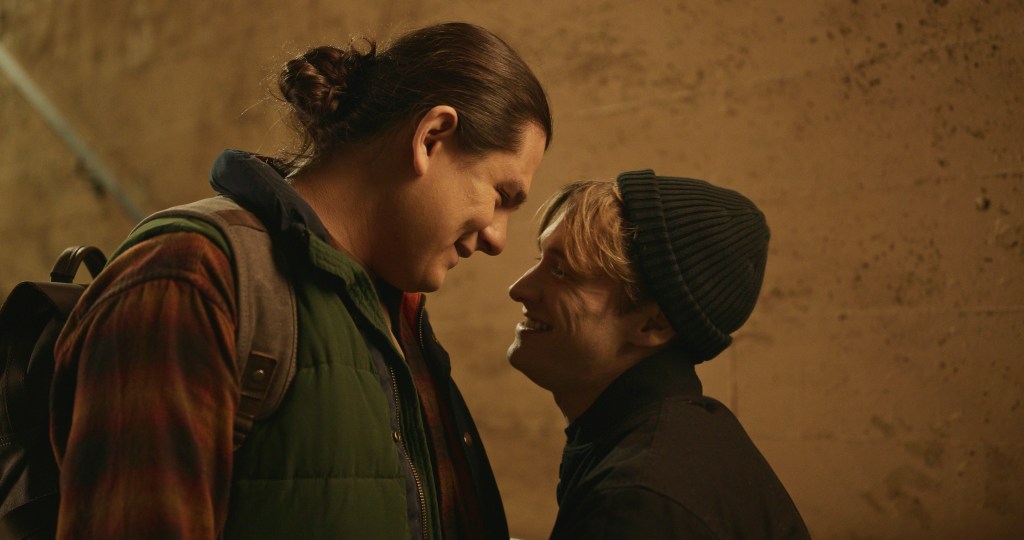
Star, a 2-spirited, Oji-Cree falls for Levi, a guy he meets in a Vancouver park who introduces him to a drag sanctuary called House of Borealis, ruled by Mother. It’s there that Star, who grew up in foster homes,  comes out of his shell as an Anishnaabe princess. A musical dramatic romance Starwalker tells its story with all-original songs belted out by powerful voices in solos, duets and choruses, both onstage and off.

Lucky, Apartment

Co-Wri/Dir Garam Kangyu 

A young lesbian couple in Seoul buy a condo together but are troubled by the bad smells rising from the apartment beneath them. While one is more concerned about her career, her lover wants to preserve something from the old woman who died there. A true tearjerker, about women in the workplace, queer invisibility, families and lost lives, Lucky Apartment is a deeply moving film.

These are just three of the films now playing at Inside Out.

Bad Shabbos

Co-Wri/Dir: Daniel Robbins

It’s Friday night on the Upper West Side of Manhattan, and, like every Friday night a family is getting together for dinner. David (Jon Bass) is there with his fiancé, Meg (Meghan Leathers); Abby (Milana Vayntrub) with her boyfriend Benjamin (Ashley Zukerman), and Adam (Theo Taplitz) the youngest who still lives at home. They’re there to see their parents Ellen and Richard (Kyra Sedgwick, David Paymer). The candles are set, the brisket’s in the oven. But this is a special night, a look-who’s-coming-to-dinner night, because the meal is for the Jewish sabbath, but the guests, Meg’s devout Catholics parents, are driving in from Milwaukee. The future in-laws are going to meet for the first time, and David and Meg are worried about everything that could go wrong. You see, her parents don’t like arguments at the dinner table… but Abby and Ben are fighting, Adam (who’s on meds) sometimes  explodes, Dad likes forcing his pop-psychology theories on everyone and there’s more than a bit of friction between Mom and Meg. Luckily, they all love their building’s doorman Jordan (Cliff Smith, Method Man in the Wu-tang Clan), who assures them he’ll drop by at an appropriate time to smooth the waters.

Meg’s parents are running late, but could arrive any moment, when… something terrible happens, leaving one of the dinner party guests dead… possibly even killed. And as each of the guests discovers what has happened, and who might be held responsible they decide to get the body out of the building before Meg’s parents arrive.  But the longer it takes, the less possible it becomes. 

Bad Shabbos is dark, drawing room comedy with personality conflicts, mistaken identities, and lotos secrets. It’s cute and funny, with excellent comic timing, good acting and enough quirky original characters that play against stereotypes to keep it interesting. I’s very much an ensemble, with each character getting their moment in the sun and no one hogging the camera, but a few stand out: Kyra Sedgwick and David Paymer as the parents, Catherine Curtin as Meg’s mom, Theo Taplitz as the coddled and neurotic youngest son, Adam, and of course Method Man as Jordan. Bad Shabbos is a good social comedy.

Mission Impossible: The Final Reckoning

Co-Wri/Dir: Christopher McQuarrie

The world is on the brink: an aggressive AI program (known as the Entity) is taking over everything. And that everything includes the controls behind all atomic bombs. The entity doesn’t care if every human disintegrates. So it’s up to Ethan Hunt (Tom Cruise) and his Impossible Mission team — on direct orders from the US President — to stop it. His mission involves entering a defunct Soviet submarine where the AI programs was once kept, to locate a small but crucial piece of machinery that can stop it. His team includes Grace (Hayley Atwell) a notorious pickpocket and Paris, a cold-blooded assassin; plus most of his usual buddies, like Luther and Benji. But a mysterious supervillain villain named Gabriel (Esai Morales) is doing everything he can to stop him, so he can take control of the Entity for his own nefarious ways. And the entity itself has brainwashed millions to form an invisible army, ready to pop out of nowhere to stop Ethan’s mission. Can Ethan and his Scooby gang save the planet from nuclear destruction?

Mission Impossible: The Final Reckoning is an action/thriller about big things like saving the world. It has atrocious dialogue and a ridiculous plot that makes absolutely no sense. The scenes with American politicians and generals are unintentionally hilarious. It’s about 3 hours long — they could easily have made it in 2. And like many contemporary movies, it doesn’t know how to deal with abstract, digital or AI weapons, so they replace it with something physical, a McGuffin the hero can hold in his hand. Which, again, makes no sense — you can’t stop a rogue computer program with just a special device, but, hey— it’s a movie.

So, putting all that aside, is it a good movie? Yes, it is. Not in the normal sense, but as entertainment. It’s spectacular, exciting and engrossing. I mentioned the corny dialogue, but the movie also has two very long sequences with no dialogue whatsoever. One has Ethan Hunt inside an abandoned Soviet nuclear submarine on the ocean’s floor in the arctic, that’s filled with seawater and is gradually rolling to greater depths. This scene is as eerie as it is spectacular, feeling as if you’re trapped inside a 1970s Tarkovsky movie. There’s also a scene straight out of a WWI movie, with two pilots aboard propeller planes have fistfights… in midair! Again, no dialogue but lots of exciting action. And I gotta admit, seeing it on a ginormous IMAX screen doesn’t hurt either.

So if you’re in the mood to travel from the north pole to South Africa, in every sort of strange transportation, check out Mission Imposisble.

Mission Impossible: The Final Reckoning  and Bad Shabbos both open in Toronto this weekend; check your local listings. And go to insideout.ca for information and tickets.

This is Daniel Garber at the Movies, each Saturday morning, on CIUT 89.5 FM and on my website culturalmining.com.

Trapped. Films reviewed: Captives, Here, Emilia Pèrez

Posted in 1800s, 1950s, 1960s, 1970s, AI, Crime, Family, France, Mental Illness, Mexico, Musical, Tom Hanks, Trans, Women by CulturalMining.com on November 1, 2024

Hi, this is Daniel Garber at the Movies for culturalmining.com and CIUT 89.5 FM.

Toronto Fall Film Festival Season continues with Cinefranco showing  contemporary French language movies from around the world at the Carlton Cinema. But this week, I’m looking at three new movies about traps. There’s a big-hearted woman trapped in a male drug-lord’s body, a French woman trapped in a mental hospital, and a movie camera trapped… in somebody’s living room!

Captives

Co-Wri/Dir: Arnaud des Pallières

It’s Paris in the late 19th century. Fanni Devander (Mélanie Thierry) is an elegant and educated woman searching for her mother. She disappeared when Fanni was just a child, but she has reasons to believe she is locked away somewhere in the city’s mental hospital. So Fanni voluntarily checks herself in to try to find her. Pitié-Salpêtrière is a home for the destitute, people with mental illness, learning disabilities or epilepsy, convicted criminals and even some foundling children. The one common factor is they’re all “undesirables” and all women. But once inside she realizes you can check in, but you can’t check out. It’s a de facto prison, presided over by the Matronly Bobette (Josiane Balasko),  and a hench-woman who would make Nurse Ratchet look like Florence Nightingale. Bobette’s one obsession is to perfectly execute their upcoming ball featuring her patients singing and dancing before a crowd of wealthy patrons. 

Fanni quickly learns the ropes and makes allies with Hersilie, a music teacher (Carole Bouquet)  and a lesbian school teacher with an eating disorder. And she finally meets a nearsighted older woman named Camomile (Yolande Moreau) who just might be her real mother. Can Fanni perform at the ball and safely escape with her supposed mother? Or will they all be stuck there forever? 

Captives is a fascinating historical thriller about the treatment of women in state institutions. It’s harrowing in parts — including scenes of torture — as Fanni navigates class and hierarchy within this enclosed universe. I purposely only mentioned some of the characters and plot turns, because the surprise is what makes it worth watching. But rest assured, it’s full of great acting, pathos, and beautiful period costumes — even within that terrible place.

I like this one.

Here

Dir: Robert Zemeckis (Reviews: Flight, Allied)

Ricky (Tom Hanks) is a teenaged baby boomer living the American dream. His Dad and Mom (Paul Bettany and Kelly Reilly) have lived in a house across the street from Ben Franklin’s historical home since they bought it on the GI Bill after WWII. Now Ricky and his kid brother and sister happily share the place, congregating in the living room for holidays, dinners, or just to watch TV. Ricky wants to be an artist, while his girlfriend Margaret (Robin Wright) dreams of going to law school. Unfortunately, when she gets pregnant while they’re both still in high school, they marry and settle down, still within Ricky (now called Richard’s) parents’ home. Life goes on, and the decades pass, and people are born, live and die. But will they always stay “here” in the same house?

Here is a movie about a place, specifically a living room facing the picture window and the street beyond. The camera never movies. It follows this location not just for Ricky’s family, but also the dinosaurs, the ice age, indigenous people, Ben Franklin, and various couples across the 20th century, constantly jumping back and forth in time. The one constant is the frame, the fourth wall, which never shifts. Picture this: a pop-up square will appear with different furniture and wallpaper in it, taking you to another era, in the style of a virtual staging of a house for sale on a real estate website. Indeed we get to meet real estate agents throughout the twentieth century. Which makes sense because its really about the place, not the meat puppets who wander around in it.

Does this new, experimental concept work?  No!  It’s indescribably awful.

I cannot convey the aesthetic revulsion I felt viewing this horrible non-movie movie. It features a de-aged, 68-year-old Tom Hanks playing himself as a teenager with a fake young teenage face plastered on, but who still talks and walks like the old man he is. What were they thinking?! Here is a tired, platitudinous high-concept exercise in futility disguised as an innovative film. All the characters are painful cliches, including a token black family whose sole purpose seems to be to recite a version of Ta-Nehisi Coates Letter to My Son… to their son.

Keep in mind, Zemeckis is known both for classics like Back to the Future but also unforgivable, semi-animated dreck like Polar Express and Forrest Gump. Here falls neatly into the dreck pile.

Emilia Pérez

Co-Wri/Dir: Jacques Audiard 

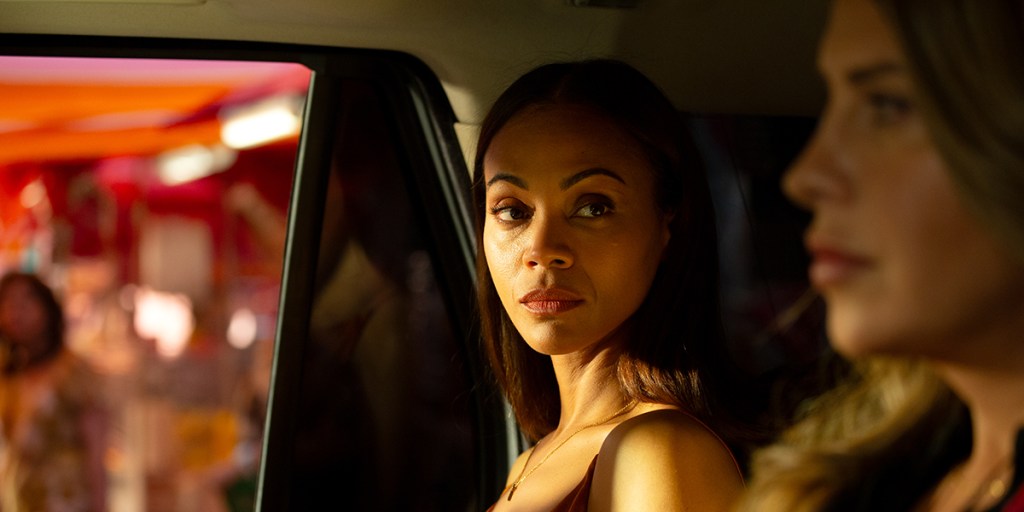
Rita (Zoe Saldaña) is an ambitious young defence lawyer in Mexico City. She spends hours crafting powerful opening statements for trials, but, as a black woman —  originally from the Dominican Republic — she gets none of the credit. But somebody is watching her and appreciates her skill. She finds out who, when she’s kidnapped with a black hood over her head and driven into the middle of the desert. There she meets the notorious head of a huge drug cartel, personally responsible for countless killings. Juan “Manitas” Del Monte, the cartel chief, needs her to help him disappear, in a way no one — including his wife Jessi (Selena Gomez) — will ever find him again.

The twist? This murderous, pock-marked, bearded monster… is trans, and wants to shed the awful male body and face, to live the rest of her life as an attractive woman. She needs someone she can trust to handle all this, both the finances and the surgery, leaving no paper trail. In exchange, Rita will have all the money she needs for the rest of her life, and her own private firm.

Years later, she meets with a potential client, a fabulously rich European woman named Emilia Pèrez (Karla Sofía Gascón). It’s her client from years back, who wants to re-enter the world and be reunited with her beloved family, all of whom think she is dead. And to atone for some of her past sins without revealing who she was. What will happen to these three remarkable women in the next chapter of their lives?

Emilia Pérez is an incredibly passionate and shocking movie. It’s simultaneously an action-thriller, an epic drama, and a musical. Yes, that’s right, a musical, where  characters do break into songs and dances throughout the film. But with its latin beats and shouting crowds, it’s the sort of songs you rarely encounter in a musical.  Zoe Saldaña is amazing as this tough-as-nails lawyer, and Karla Sofía Gascón, a Spanish actress I’ve never seen before, is unmatchable, both as Perez, and as the drug lord Manitas. (She’s a  transwoman herself.) French director Audiard (who previously brought us masterpieces like A Prophet, and Rust and Bone) seems to have no trouble creating a Mexican musical. I gotta say, Netflix churns out a load of content, most of which is forgettable crap, but, every year, they also produce a few really remarkable films. Emilia Pèrez is one of those.

I strongly recommend this movie.

Here and Amelia Perez both open this weekend in Toronto; check your local listings. And Captives is having its English Canada premiere at 8:45 tonight (Saturday, Nov 2, 2024) at Cinefranco at the Carlton.

This is Daniel Garber at the Movies, each Saturday morning, on CIUT 89.5 FM and on my website culturalmining.com.

Current cinema. Films reviewed: Destroy All Neighbours, Freud’s Last Session, T.I.M.

Posted in 1940s, AI, Christianity, comedy, Ghosts, Horror, Ireland, Music, Psychiatry, Robots, UK, WWI, WWII by CulturalMining.com on January 13, 2024

Hi, this is Daniel Garber at the Movies for culturalmining.com and CIUT 89.5 FM.

It’s “award season” when prizes are handed out to the best — or most widely publicized — movies. But not every film is prestigious or a blockbuster. So this week, I’m looking at three new movies — one each from the US, Ireland and England — that might otherwise fall through the cracks. There’s a robot with human traits, a music producer turned serial killer, and a psychoanalyst talking about God. 

Destroy All Neighbours

Wri/Dir: Jonah Ray Rodrigues

William (Jonah Ray Rodrigues) lives in a rundown apartment with his girlfriend Emily (Kiran Deol) a lawyer. He’s tall, skinny, and wears unfashionable clothes and nerd glasses. He works in a studio at the soundboard, helping bands record their music. But sometimes he feels like he’s just a knob- turner, going through the motions. His real passion is recording the ultimate prog-rock album, and is constantly coming up with new ideas, but never finishing it.  Emily encourages him to give up and move on, but he feels he has to do it. But he’s getting more and more tired and frustrated by the people around him. At work, his boss is constantly ragging him for being late. And the latest client, Caleb Bang Jansen is insufferable. Even the panhandler where he parks his car is getting on his nerves. At home, Eleanor, the elderly pothead superintendent (Randee Heller) is constantly calling him for help with the fuses. Another neighbour, Phillip, lets his pet pig roam the halls. But worst of all is the new tenant next door. Vlad (Alex Winter) is hideously ugly, aggressive and incredibly loud, playing non-stop euro disco all night long. Vlad lifts weights using buckets of cement attached to his barbell. He’s a scary guy, William is passive aggressive and terrified of face to face confrontations.

When he finally visits Vlad to ask him to turn down the music, they get in a fight and somehow Vlad ends up impaled on a stake, and — accidentally —  decapitated! William doesn’t know what to do, but finally realizes he has to dispose of the body. But things have changed since Vlad —  new bodies keep piling up — always killed unintentionally by him, by strange coincidences. He becomes a serial killer by default, or a serial manslaughterer, as he likes to say. 

But when the all the people he killed come back to life, he realizes something really strange is going on. Can William keep his boss and girlfriend happy, record his prog rock album, stop killing people, and living a normal life? Is he destined for a very dark future? Or is he just losing his marbles?

Destroy all Neighbours (the title says it all) is a comedy/horror movie, with an emphasis on in-your-face, gross-out humour. So there’s lots of disgusting blood and gore, but it’s always so exaggerated it’s funny, not scary, in the manner of Monte Python or Army of Darkness. Jonah Ray Rodrigues is the writer/ director/star and the current host of Mystery Science Theatre 3000. I admit it’s an acquired taste, and some of the gags and schtick fall flat, but I was laughing more than not. I happen to like that kind of humour (in moderation) but, admittedly, it’s not for everyone. So if you’re into bloody horror-comedy set in L.A.s skid row, or even if you’ve ever had annoying neighbours, I think you’ll love Destroy all Neighbours. 

Freud’s Last Session

Co-Wri/Dir: Matt Brown

It’s September, 1939. Germany has invaded Poland and Great Britain is about to go to war. Sigmund Freud (Anthony Hopkins) and his daughter Anna (Liv Lisa Fries) left their homes and vocations in Vienna after the Anschluss — the unification of Austria and the Third Reich, and moved to London. His office is decorated with the art and bric-a-brac of home: Persian rugs, African fertility statues and Catholic saints. Anna continues to research and give lectures on psychoanalysis and child psychology, but Sigmund, due to his age (he’s 83) and poor health (he’s dying of cancer) rarely leaves his home now. But on this day he has an unusual visitor: CS Lewis (Matthew Goode). Lewis is a don at Oxford where he teaches English and has written a book about Pilgrims Progress. (He later goes on to write The Chronicles of Narnia.) And he’s still suffering from shell shock from WWI. But why are they meeting? Lewis wants to talk with Freud about God and religion. He once was an atheist but now has adopted theism and Christianity as his guiding light. Freud, on the other hand, is a committed atheist and finds all religions equally fascinating and equally false. Still, they have a spirited discussion on a wide range of issues. But certain topics are taboo. For example, Freud refuses to talk about the fact that Anna has a female lover. And Lewis considers his own sexual relationship with his late best friend’s mother as something too private to share. Meanwhile, air raid sirens are going off, Freud is struggling with the oral prosthetic he calls his “Monster” and nobody knows what the future will bring. Will this be Freud’s very last session?

Freud’s Last Session is a fictional historical drama adapted from the successful stage play. There’s no evidence that an elderly Freud and a younger Lewis ever actually met; the story functions more as an intellectual exercise than a theatrical drama. So it’s not captivating, but it did keep my attention. They try to perk it up a bit with flashbacks — Lewis in the trenches in WWI; Freud as a small child — but I found them lacklustre at best. There are some clever touches, where Freud ends up reclining on the settee while Lewis takes on the analysts role. Of course it has nice period costumes and sets, but the main reasons to see this film is first the topics and second the acting. The topics range from sex to psychoanalysis to theology. Devotees of Freud and/or Lewis may get a kick out of it, but no major revelations here. The acting, though is delightful. Hopkins walks through his usual role — along with a few artfully-placed wunderbars and ja ja ja and das ist gut! so we don’t forget he’s Austrian. Goode is more passionate, fearful and sad. Best of all is German actress Liv Lisa Fries (from Babylon Berlin) as Anna Freud, who gets to rush around London looking for meds for her Dad.

Freud’s Last Session is not bad, but not noteworthy, either.

T.I.M.

Co-Wri/Dir: Spencer Brown

Abi and Paul Granger (Georgina Campbell, Mark Rowley) are married, professionals, double-income, no kids, moving into a beautiful, modern home in rural England. It’s at the end of a long country road, with open staircases, glass walls and a huge garden, all paid for and arranged by Abi’s employer. She’s an engineer who specializes in AI robotic prostheses.  She designs the human-looking hands of robots. Paul is currently unemployed, but is in line for a corporate position in London. They’re both looking forward to their first child, and are working hard at it each night.

Now this house is completely on the grid. Everything’s smart — smart windows, locks, heating, computers, lighting — all controlled through a central console, and co-ordinated with their smart watches and  phones. The central console, though, is something her company invented. It’s a Technologically Integrated Manservant, T.I.M. for short, or just Tim. Tim (Eamon Farren) is a humanoid robot with perfect male features, blond hair, and artificial intelligence; he’s constantly learning. He’s a prototype: he can cook gourmet foods, do heavy lifting, play the piano, send and answer emails. Abi’s boss is adamant that all his employees have a T.I.M., so they can get rid of the bugs in the system before the upcoming release. Abi, loves her new toy, but Paul is less enthusiastic. Why did T.I.M. barge into their bedroom while they were making love? T.I.M. says Abi’s blood pressure and temperature had risen, he just wanted to make sure she was OK. But Paul suspects T.I.M. of spying on him. He thinks TIM sends messages to Abi whenever Paul visits Rose their only neighbour (Amara Karan), feeding Abi’s suspicious jealousies. And when he catches T.I.M. perving through Abi’s clothes, he knows something is very wrong. Is T.I.M. morphing into something bad? Can a robot even have feelings? And if things go wrong, who will Abi trust: Paul, the fallible human, or T.I.M., the perfect machine?

T.I.M. is a sci-fi thriller about the potential dire consequences of AI given a human form. This isn’t the first humanoid movie — there have been at least a dozen in the past few years — and some of the plot is predictable. And it does have that “pandemic movie feel” to it, with a tiny cast (just four main characters) located in an isolated country setting, but, in this case, it really works. It’s scary, it’s creepy, it’s interesting. It feeds on your worst fears about electronic devices communicating without your knowledge, and the possibility of the singularity, when humans will no longer be essential. I’m not familiar with any of the actors but the cast is good. The storyline is compelling, and most of all, the movie feels believable. So if you ever feel like your smart phone is a bit too smart, you’ll like this scary, sci-fi thriller. It’s a good one.

Freud’s Last Session opens this weekend in Toronto; check your local listings. Destroy All Neighbours is streaming exclusively on shudder.com, starting today; and T.I.M. is now available digitally and on V.O.D. 

This is Daniel Garber at the Movies, each Saturday morning, on CIUT 89.5 FM and on my website culturalmining.com.

Almost human. Films reviewed: Shin Ultraman, M3GAN plus the best movies of 2022!

Posted in AI, Fantasy, Horror, Japan, Monsters, Robots, Science, Science Fiction by CulturalMining.com on January 7, 2023

Hi, this is Daniel Garber at the Movies for culturalmining.com and CIUT 89.5 FM.

Happy New Year, everybody!

As we move closer to an uncertain future, we’re finding it harder to tell the difference between a human and a robot, or human thoughts vs artificial intelligence. This week, I’m looking at two new movies about almost humans. There’s a semi-human superhero who comes from outer space, and a cute little robot doll with a very dark side.

But before that, I’m going to run through what I think were some of the best movies of 2022.

Best movies of 2022

Every year, I see hundreds of movies so it’s hard to narrow it down to just a few, for that reason only I don’t include documentaries, like Laura Poitras’s fantastic All the Beauty and the Bloodshed; nor cartoons, like Guillermo Del Toro’s Pinnochio, only movies that I saw on a movie screen and reviewed last year. There are many  other good, or even great movies I saw, but here are what I think are the best movies of 2022, in alphabetical order:

All Quiet on the Western Front, Dir: Edward Berger

Armageddon Time, Dir: James Gray

Broker, Dir: Kore-eda Hirokazu

EO, Dir: Jerzy Skolimowski

The Innocents, Dir: Eskil Vogt

Memoria, Dir: Apichatpong Weerasathakul

Nope Dir: Jordan Peele

The Northman, Dir: Robert Eggers

Tár, Dir: Todd Field

Triangle of Sadness, Dir: Ruben Östlund

The Whale, Dir: Darren Aronofsky


Shin Ultraman

Dir: Shinji Higuchi

It’s present-day Tokyo, and things are not going well. Previously unknown monsters  — or “S-Class Species” — keep appearing from nowhere and wreaking havoc across Japan. They’re drilling holes, smashing dams and sucking up electrical power like slurpees. Luckily, there’s a government body that handles cases like this. They’re the S-Class Species Suppression Protocol, or SSSP. The head guy, Tamura, gives the orders, while the scientists investigate. Strategist Kaminaga (Saitoh Takumi) is a nerdy, introvert who speaks with no inflections or emotions. He works with newcomer analyst Asami (Nagasawa Masami) his exact opposite, an assertive woman who wants Kaminaga to be her buddy. And two more members round up their team.

Fortunately, whenever the Kaiju monsters appear, a strange giant man, dressed in a silver and red suit, arrives to save the day. He is dubbed Ultraman, protecting Japan from these strange invaders. But why does Kaminaga always disappear when Ultraman arrives? And is he human, alien, or somewhere in between?

The Japanese government — and the rest of the world — takes notice. They want to find out where Ultraman comes from and what his secret powers are. Things get more complicated when a benevolent-seeming alien arrives on earth, saying he will handle international relations from now on. But no one realizes his real aim — to take over and kill all the homo sapiens on the planet… unless Ultraman and the SSSP stop him first.

Shin Ultraman is a purist reboot of the classic Japanese 1960s TV show. I remember seeing reruns as a kid, and really liking it. This new version is a re-creation set in present-day Japan, but with nothing particularly contemporary or different from the original. It does include some political content — government politicians and bureaucrats who repeatedly make the wrong decisions — and the other characters are modernized.  Watching this movie — which I enjoyed! — it seemed identical to what I remembered, until I re-watched bits of the original, and was shocked at how bad and campy the special effects had been. Here the CGI and costumes are much, much better. But it preserves the sombre and earnest tone that geeky, sci-fi devotees demand. If you’re a fan of Ultraman, or of Japanese kaiju movies in general, you won’t be disappointed — this is the real thing.

M3gan

Dir:  Gerard Johnstone

Gemma (Allison Williams) is an inventor who, as part of a team, develops toys at a conglomerate called “Funki”. Their last big success was a Furby knock-off, but it’s losing market share, so they need a new hit. All their hopes lie on a project she’s been secretly working on for a long time, but it’s not quite ready yet. It’s code-named M3gan — Model 3 Generative Android — and is a robot in the form of a smart and pretty little girl. With a titanium core and sophisticated AI memory, she can talk, walk and act like a real human. 

More than that, Megan’s artificial intelligence lets her learn and change as she grows up. By bonding with her primary owner, she’s not just a toy, she’s a friend for any little girl. But she wouldn’t come cheap — she’s priced more like a car than a toy. Gemma’s boss is pushing her to finish Megan’s prototype, ASAP, to attract new investors, when, suddenly, disaster strikes. In a freak accident, her sister and brother-in-law are killed by a snowplow on a ski trip, leaving their 10-year-old daughter — Gemma’s niece — an orphan.  Cady (Violet McGraw) needs someone to turn to in her hour of grief, and Gemma, as her closest living relative, is appointed her guardian. But she knows nothing about parenting;  she lives alone and devotes all her time to her career.

So, to kill two birds with one stone, she brings M3gan home to take care of Cady, even while she works on the toy’s programming in time for the big launch. She observes them interacting through a one-way mirror in a glassed-in playroom at the company. Megan has only one overriding rule: to protect Cady from any danger, both physical and emotional. Cady loves M3gan, who is very protective of her best friend. But when she allows them outside of the lab, things turn dark. And when the dead bodies start piling up, Gemma realizes something is terribly wrong with her design. Can she fix Gemma before she goes rogue? Or is it too late?

M3gan is a thriller-horror take on the classic story — dating back to Frankenstein — about the bad things that can come out of a benevolent scientist’s experiment. It’s also about bad grown-ups and evil kids — in addition to M3gan — facing their comeuppance. For a movie that doesn’t ever take itself top seriously,  it succeeds in being both kinda scary and funny. It has lots of kitschy, fake toy ads, and your usual stock characters, like grumpy boss, noisy neighbour, spoiled kids. Beware: there is a fair amount of violence, including a disturbing scene where a boy assaults M3gan thinking she’s a doll, so definitely not suitable for everyone, but I liked it. Allison Williams is excellent as Gemma, and Megan (composed of actor Amie Donald, the voice of Jenna Davis and lots of CGI) is a doll villain that’s weird enough that I think we’ll be seeing lots more of her.

M3gan opens this weekend; check your local listings. And you can see Shin Ultraman on January 11th and 12th at the TIFF Bell Lightbox. 

This is Daniel Garber at the Movies, each Saturday morning, on CIUT 89.5 FM and on my website, culturalmining.com.