Unusual road movies. Films reviewed: Nirvanna, the Band, the Show, the Movie; The Long Walk, Sirât PLUS #TIFF50!
Hi, this is Daniel Garber at the Movies for culturalmining.com and CIUT 89.5 FM.
If you’re in Toronto this weekend, get your collective ass down to “Festival Street” — King st, from University to
Spadina — to celebrate TIFF’s 50th anniversary. Even if you can’t afford the tickets, they’re tons to see and do. They’re giving away loads of free stuff, like Italian beer, cold brew coffee, Korean noodles… and even free mouthwash. Why
mouthwash? Why any of this… they’re promotions. But they’re all free! Free outdoor movies, too, each night in David Pecaut Square. And if you’re into celebs, you might see stars like Scarlet Johansen, Mia Goth, Keanu Reeves and
Jodie Foster, just a few expected to show up.
This week I’m looking at three new road movies, two opening at TIFF. There are European ravers driving through the Sahara desert, 50 boys in a dystopian America on a walkathon for their lives, and two Toronto musicians time-travelling on Queen St West in a magic bus.
Nirvanna, the Band, the Show, the Movie
Co-Wri/Dir: Matt Johnson
It’s about 17 years ago in downtown Toronto. Aspiring musicians Matt Johnson and Jay McCarrol (played by themselves) are composing music and planning elaborate schemes to get invited to play on the stage at the Rivoli on Queen St West But so far no luck. The band is called “Nirvanna”, with an extra N; but they sound more broadway than grunge. They live in a Toronto row house with a trailer home parked behind. Fast forward a few decades and Matt and Jay are still trying to get booked at the Rivoli for the first time. Matt’s latest scheme? To jump off the top of the CN Tower with parachutes and land inside the Skydome in the middle of a Blue Jays game. That should get enough attention to get their band booked, right? But as Matt’s ridiculous schemes get ever more outlandish and dangerous, Jay becomes increasingly frustrated. And when they somehow manage to travel back in time, a la Back to the Future, thus changing history, it messes up everything and their band might cease to exist. Can the two of them get back together in time to save the band… and their own lives?
Nirvanna… is an uproariously funny pseudo-documentary, done in the manner of Borat, but more gently Canadian. I absolutely love Matt Johnson (The Dirties, Blackberry), with his cringey sense of humour, always lightly dipped in horror and disaster. I’m not familiar with Jay McCarrol, but he’s an excellent musician and a perfect foil for Johnson’s grandstanding ineptitude. The
time travel is accomplished because they’ve been filming the series for about 20 years. As for the special effects, I’m still not sure if they actually jumped off the CN tower… but it sure looks like they did. Breaking news: I literally just spoke with the filmmakers: Matt says it’s all real, Jay says it’s all fake. Either way, Nirvanna now stands beside Scott Pilgrim as the most Toronto-y movie of the century.
The Long Walk
Dir: Francis Lawrence (The Hunger Games: The Ballad of Songbirds and Snakes)
It’s the corn belt in a dystopian, future United States. The country is a military dictatorship and the people live in poverty. Fifty young men, one from each state, have signed up for an annual race. The winner gets a huge cash prize as well as any dream he wishes to fulfil. His triumph will add a sense of hope and pride to the country’s citizens — or so the contest’s organizer, The Major barks at the boys (played by an unrecognizable Mark Hamill).
One competitor, Ray (Cooper Hoffman: Licorice Pizza) introduces himself to other players, and quickly makes friends with Pete (David Jonsson). They soon added Art Baker from Louisiana (Tut Nyuot) who wants to win the money, and Hank Olsen (Ben Wang) a nerdy-looking guy with a wisecracking, urban accent. They call themselves the four musketeers, and vow to look out for each other. Some of the racers keep to themselves. Barkovitch, (Charlie Plummer: Lean on Pete, The Return) a rabble rousing misanthrope hurls discouraging insults at his competitors. Collie (Joshua Odjick) is an indigenous man who walks to the beat of a different drum. And an ultra-fit athlete (Garrett Wareing) is so sure of his own victory he doesn’t even grace anyone with a response. The problem is, there can only be one winner. And the 49 losers? They will all be dead. You see, it’s a race to the death, and anyone who lags behind the requisite three miles an hour is summarily murdered by soldiers in tanks rolling beside the walkers. If anyone lags in their walk three times — including drinking, tying your shoes or even sleeping — they die. Who will survive this gruelling competition?
The Long Walk is a dark dystopian road movie movie about
male bonding, friendship and resistance to an autocratic state. It’s shot in a rustic, sepia tones in marked contrast to its horror theme. It’s based on a story by Stephen King, and directed by Francis Lawrence who brought us the Hunger Games movies. While it doesn’t hold back on violent blood, guts, and despair, at least it keeps alive some feeling of hope throughout. The Long Walk is totally watchable, the acting is great and I like the characters. But — maybe because of the story’s inevitability — it never really grabbed me. This could have been a deeply moving weeper, but instead it’s just a gruesome race, with a wee bit of political consciousness.
Sirât
Dir: Oliver Laxe
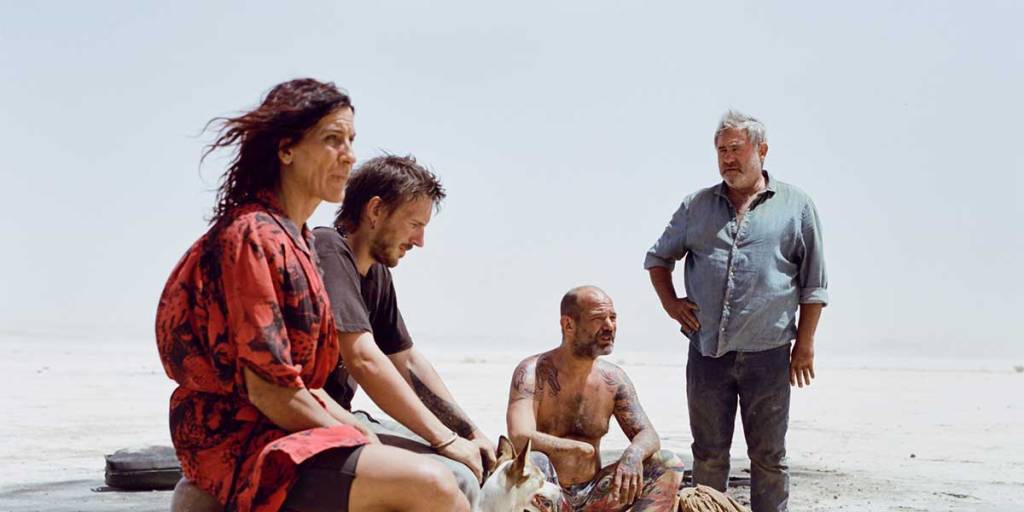
It’s a red sandstone skyline somewhere in Northwest Africa. A huge wall of speakers is spewing heavy drum and bass rhythms out of a wall of speakers, with hundreds of semi-nude dancers moving in a throbbing crowd. It’s a European rave attracting people who look like they’ve been moving to the music since the 1990s. Totally out of place are a middle aged Spanish man named Luis (Sergi López) and his young son Esteban (Bruno Núñez Arjona). They’re handing tiny leaflets to everyone they see, about their missing daughter/sister. She’s also a raver but hasn’t been seen in years. Suddenly the music stops, soldiers march in and one if them starts shouting through a megaphone: the area must be evacuated immediately, with all Europeans following the military back to safety. With much grumbling, the dancers pile into makeshift schoolbuses move out of the area… until suddenly two vehicles — an ATV and a military transport truck — veer off track and head in the opposite direction. They’re going south toward a legendary rave near Mauritania. In a split-second decision, Luis and Esteban decide to follow
them in their urban SUV, of their best chance of finding the missing girl. The crusty ravers don’t want them to follow but agree to let them tag along.
And a ragtag bunch they are, with weathered features, pierces and tattoos, peg-legs and missing limbs. They speak French, Spanish and English.But they also have a wicked sense of humour, and an overriding communal spirit. What no-one seems to realize is they’re driving headfirst into the impossible terrain of the western Sahara desert in the middle of a revolutionary war.
Sirat is a fantastic, nihilistic road movie, that combines elements of Mad Max, Nomadland and Waiting for Godot. It takes you on the twists and turns of disaster, keeping you on your toes all the way. I’m not revealing any more of the plot, but suffice it to say it thumbs its nose at traditional Hollywood narratives. The acting seems very close to documentary style, and apart from López as Luis, all the cast seems to be non-actors playing themselves. (They are called by their real names.)
If you can stand the shock, you must see Sirat.
Sirat and Nirvanna, the Band, the Show, the Movie are both premiering at TIFF right now; and The Long Walk opens across Canada on Sept 12.
This is Daniel Garber at the Movies, each Saturday morning, on CIUT 89.5 FM and on my website culturalmining.com.
Huge changes. Films reviewed: Cloud, Don’t Let’s Go to the Dogs Tonight, Eddington
Hi, this is Daniel Garber at the Movies for culturalmining.com and CIUT 89.5 FM.
This week I’m looking at three great new dramas about people facing huge changes in far-flung places. There’s a man in Japan pursued by unknown enemies; a girl in Zimbabwe on the eve of an election; and a sheriff in New Mexico at the dawn of a pandemic.
Cloud
Wri/Dir: Kiyoshi Kurusawa
It’s present-day Tokyo. Yoshi (Masaki Suda) is a guy in his 20s with a certificate from a vocational school. He’s socially and emotionally challenged. Yoshi lives in a cramped apartment with his girlfriend Akiko (Kotone Furukawa). He works in a factory, pressing clothes, but after three years is still struggling financially with no chance of advancement. Luckily, he has a side hustle: a reselling site where he marks-up cheap goods online and sells them for profit: French designer knock-offs, electronic devices, collectible toys; the content doesn’t matter, just the speed of turnover and how much profit he makes. At the moment, he’s doing so well he decides to quit his factory job, turn his reselling site into a full time occupation and relocate to a large house in the countryside with cheap rent. Akiko agrees to move with him, and he hires a local kid, Sano (Daiken Okudaira) as his assistant. And with the business doing so well, he figures he can relax now and let the cash pour in. But it’s never that simple.
Strange things start happening. Yoshi is knocked off his motorcycle by a wire stretched across a road. Someone tosses a chunk of metal through his glass window. And Sano does an ego-surf on Yoshi’s site and finds online chatter from dissatisfied customers threatening to kill him. (He keeps his website completely anonymous). At the same time, local police are investigating him for fraud, Akiko is reaching her breaking point, and Yoshi fires Sano for using his computer without permission, leaving him all alone in his country home. But when armed masked strangers start showing up at his door, Yoshi realizes it’s time to drop everything and get the hell out of there. Who are these angry strangers? What do they want? And how can he get away?
Cloud is both an almost surreal, cyber suspense thriller and a
cautionary crime drama. Masaki Suda’s plays Yoshi as a man without any self-awareness… who assumes no one else notices him either.
It starts as a slow-burn, but explodes, halfway through, into a violent, action/thriller, with more than one totally unexpected plot turn. Though the main character spends much of his time staring at a distressingly dull website, waiting for buyers to check in, the outside world is full of geometric sets with sharp turns, cloudy windows, green forests and dark shadows. With lush music played against abandoned warehouse walls, Cloud lets suspense carry us through to the shocking finish.
I like this suspenseful crime-thriller a lot.
Don’t Let’s Go to the Dogs Tonight
Co-Wri/Dir: Embeth Davidtz
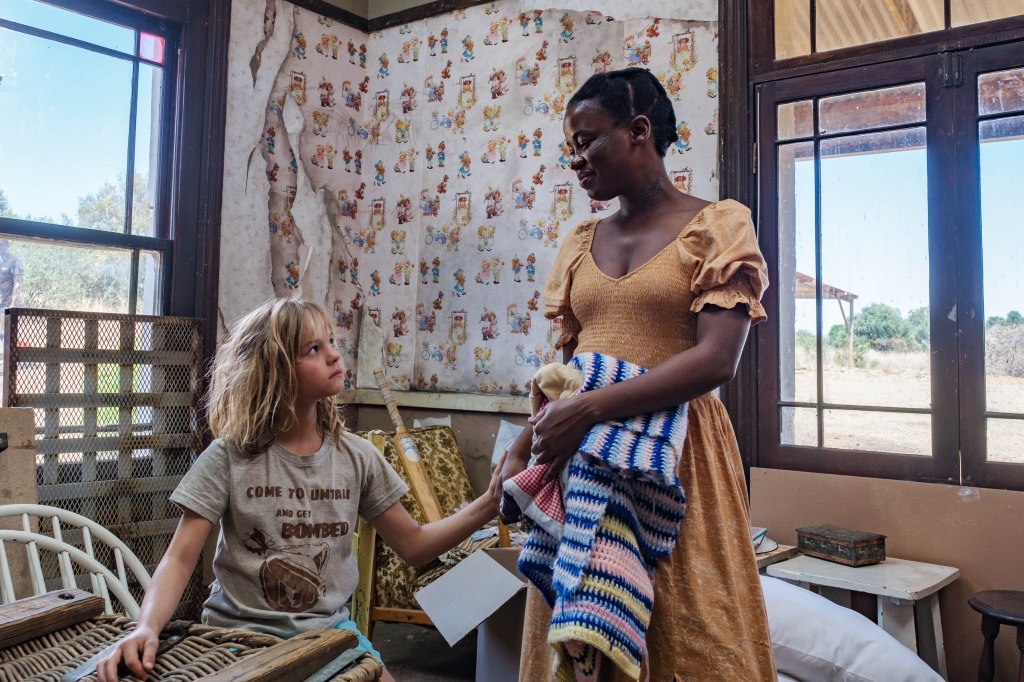
It’s 1980 in Zimbabwe-Rhodesia. The Bush War is over, and white minority rule has ended, pending its first democratic election. Bobo Fuller (Lexi Venter) is a seven-year old girl who lives with her family on a dried out cattle ranch. She wears her face dirty and blonde hair tangled. Bobo smokes cigarettes and rides her motorbike around the farm with a rifle strapped across her back. She fears two things: ticks and terrorists.
Her mom Nicola (Embeth Davidtz) makes it clear she will never leave her land. As grandma likes to say, we have breeding, not money. She’s a heavy drinker, prone to guzzling brandy and dancing with abandon during her manic episodes. Bobo’s Dad is more reasonable, but disappears for weeks at a time. Her older sister (Rob Van Vuuren) lives there too, but has no time for her bratty little sister.
So Bobo is essentially raised by Sarah (Zikhona Bali) their nanny and housekeeper. Bobo tries ordering her around like a grown up — bring me my porridge! — but Sarah sets her
straight: she’s too young to be bossy. And it’s Sarah who tells her stories, answers her questions and explains what happens to us after we die.
The family gets together with other whites in nearby farms for parties and barbecues. But there’s tension in the air as they await results from the election. Sarah, too is worried: she might be targeted by nationalists if seen taking care taking care of a girl like Bobo. What will happen after the election? And will any changes be permanent?
Don’t Let’s Go to the Dogs Tonight is a drama based on the memoirs of Alexandra “Bobo” Fuller. It’s full of abrasive characters and their casual racism, and pulls no punches in their portrayal. The whole film is shot through the eyes of a little girl, so with the camera kept low, we might just see people’s legs from under a table or an obscured lens when she’s squinting at the sun.
Actress Embeth Davidtz evokes her own South African background (where the movie was shot) in telling Bobo’s story. This is her first time directing, and its a fascinating adventure in creativity. And though her excellent portrayal of a difficult, bi-polar Mom — alongside Zikhona Bali’s terrific turns as Sarah — , it’s really about Lexi Venter as Bobo, who gives a natural performance in every scene, either as the centre of attention or as quiet observer.
Don’t Let’s Go to the Dogs Tonight is an excellent memoir of a difficult period of history.
Eddington
Wri/Dir: Ari Aster
It’s April, 2020 in Eddington, a small town in New Mexico, just as the Covid lockdowns mask mandates are kicking in. Working class Joe Cross (Joaquin Phoenix) is the town Sheriff, just as his dad was before him. He lives in a ramshackle home with his catatonically depressed wife Louise (Emma Stone) and her conspiracy-theory addled mother Dawn (Deirdre O’Connell). He works with his two faithful officers Michael (Micheal Ward) and Lodge (Clifton Collins, Jr).
On the better side of town lives the upper-middle-class Mayor Ted Garcia (Pedro Pascal) — a smooth talker and a consummate politician — who is running for re-election. He is expected to open a mysterious tech conglomerate on the outskirts of town. His son, Eric (Matt Gomez Hidaka) is an arrogant and spoiled rich kid. He hangs out with his friend Brian (Cameron Mann), drinking beer and smoking pot. They are both after idealistic high school student Sarah (Amélie Hoeferle) who they try to impress by quoting Angela Davis. Then comes the news that George Floyd, a Black man in Minneapolis, has been killed by police. Demonstrations follow but the small town is already divided on ideological grounds, with everything recorded on cel phones and posted online: those who wear masks with social distancing, vs those who don’t. But as tensions build, and Mayor Ted publicly humiliates Sheriff Joe, he declares he’s running for mayor, too.
Eddington is a sharp and scathing social satire about life in
America during the pandemic. It’s half dark- comedy and half thriller/horror as it devolves from light absurdity into a hellish fantasy. It covers a huge variety of topics, including religious cults, false memory syndrome, big tech, culture wars, white supremacy, the dark state, and indigenous relations… to name just a few. I love all of Ari Aster’s movies — Heredity, Midsommer and Beau is Afraid — and Eddington, though more of a Western than strictly horror, continues his cycle. While Joaquin Phoenix’s Joe is the film’s focus, it’s actually an ensemble cast with at least 20 crucial roles.
Eddington is brilliant, hilarious and shocking… putting his magnifying glass on all of us, just a few years ago.
it’s a must-see.
Cloud, Don’t Let’s Go to the Dogs Tonight , and Eddington all open this weekend in Toronto; check your local listings.
This is Daniel Garber at the Movies, each Saturday morning, on CIUT 89.5 FM and on my website culturalmining.com.
Wolf men and assassins. Films reviewed: Wolf Man, Soundtrack to a Coup d’Etat
Hi, this is Daniel Garber at the Movies for culturalmining.com and CIUT 89.5 FM.
It may be cold outside, but things are burning up on the big screen. This week I’m looking a two new movies, a thriller horror and a documentary. There are wolf men in Oregon, and assassins in Congo.
Wolf Man
Co-Wri/Dir: Leigh Whannell
It’s present-day San Francisco. Blake (Christopher Abbot) is a lapsed writer who devotes his life to his wife and daughter. Charlotte (Julia Garner) is a careerist who is rarely at home, so Blake takes on the parenting role. He spends all his time with their precocious 10-year-old daughter, Ginger (Matilda Firth). But he and Charlotte are constantly bickering about her absentee-mom-ism. So when a package arrives with his late father’s will and a set of keys, he wonders if this is the miracle they need to keep thew family together. He has inherited — a house, a barn, and countless acres of lush green forest — the beautiful country he grew up in. Blake suggests the three of them go on a road trip together for some quality time. Young Blake was raised in isolation by a hard-ass survivalist who was strict and demanding toward his motherless son. That’s why Blake is so indulgent towards Ginger, who still dresses like a Disney princess at age 10.
So off they head for his isolated cabin in remote Oregon. But
what Blake seems to have forgotten is there are wolves in them thar hills! Big bad wolves, mean ugly wolves, the kind who stand on two feet and like wolfing down people like them. Sure enough, as they approach their farm one of them woolfies drives their u-haul off the road… and they’re forced to run for their lives. Luckily the house is still wolf-proof, with iron bars on all the windows. Unluckily, Blake gets himself slashed by the Wolf Man, and he’s changing into something different. Can he keep his vulpine urges in check and protect his family from harm? Or will he be the biggest danger to them of all?
Wolf Man is a cabin-in-the-woods werewolf movie with a few new twist. In this version, people don’t turn into wolves on a full moon and then change back again; they’re in it for the long haul. And these werewolves aren’t sleek, or sexy or furry, never mind cute or loveable. They’re more like zombies infected with a horrible virus that makes their teeth and hair fall out and their skin go bumpy and gross. These werewolves want to eat flesh and blood, preferably human. Once infected, they can no longer speak or understand people.
There’s no sex in this movie, not even a kiss, it’s totally sterile. In this neck of the woods everyone’s a guy, with literally no women at all. And every man could be a wolf man. Women and girls are urban sophisticates, while men and boys are potential redneck killers. Christopher Abbot plays Blake as a male Oprah mom who is inevitably drawn back to the dangerous manliness he grew up with. Julia Garner’s Charlotte is a less developed character, just an aloof woman forced to either scream and run or fight back.
There are a lot of misfires in this movie. Charlotte dresses in black and white like an English barrister emerging from a courtroom; but turns out she’s a journalist leaving her newsroom… huh?? Blake who grew up in a world of misery and death that he left far behind, now decides to take his family back there… for vacation? Why? There are some good parts, too. Like when the story is told through a werewolf’s eyes and ears, we hear the pounding footsteps of a tiny insect, and see the world as a glowing colourful prism — very cool.
But not enough to save a story that doesn’t quite cut it.
Soundtrack to a Coup d’Etat
Co-Wri/Dir: Johan Grimonprez
It’s June 30, 1960, and the Democratic Republic of Congo is reborn as a free, democratic state, after nearly a century of brutal colonial rule under the King of Belgium. Leopold II is notorious for chopping off the hands of men, women and children who didn’t produce their quota of rubber. Congo (under the Union Minière) is a very rich country full of diamonds, copper, tin, and uranium, extracted and shipped to Europe and the US. Its rubber and copper were crucial to winning the world wars and their uranium fuelled the atomic bombs dropped on Japan. Its first elected prime minister, Patrice Lumumba, gives a speech on independence day, celebrating the transfer of power from their previous colonial rulers. He rightly condemns the colonial atrocities and speaks out in favour of the non-aligned movement (former colonies in Europe and Asia). While his speech is well-received locally, Europeans — including the Belgian
royal family — are shocked and aghast. Will they lose control of the Union Minière, and will the US give up its uranium source? Not a chance. They accuse Lumumba of being a communist, despite his stressing independence and nationalism. So they declare Katanga, an area rich in minerals, as independent from the DRC. The seceded state is essentially ruled by white Europeans and Rhodesian mercenary police and a military that operates with impunity, kidnapping miners and bombing uncooperative villages.
The US (especially the CIA), fearing the so-called communist Lumumba, launch a two-pronged campaign: a covert one, involving assassinations, bombings, kidnappings and regime change; and a diplomatic one, where famous American jazz musicians are flown to independent African states to perform as ambassadors of Jazz. Louis Armstrong, Dizzy Gillespie, Nina Simone and Max Roach, have no idea they ware working
for a CIA front. By January, 1961, the wildly popular Lumumba is dead, assassinated in Katanga with Belgian and American complicity.
Soundtrack of a Coup d’Etat is a fantastic documentary that retells the events of those six months. The doc is 2 1/2 hours long, so I can only give you the briefest outline of what it’s about. But the film itself is amazing, covering everything from pan-African nationalism and the Cold War, to non-aligned nations, colonialism, and the UN. We hear Malcolm X in Harlem, Andrée Blouin on women’s rights in Africa, Castro in NY, and Nikita Khrushchev’s famous shoe speech (where apparently he didn’t actually say what they said he said) in the general assembly. It’s filled with compelling imagery: Alan Dulles the head of the CIA smoking his pipe; a North Rhodesian mercenary recounting the tens of thousands of people they killed with impunity; the Soviets crushing Hungary, and Voice of America broadcasts. There are hilarious propaganda newsreels like the US parachuting record players and vinyl discs across the iron curtain. And through it all, jazz music from America to Africa.
The film is made of excerpts from previously-made audio
documentaries combined with non-stop black and white footage and stills. Most cuts are only about 2-3 seconds, giving the whole film the feeling of a glorious collage of African history. (It’s similar to the films of Adam Curtis, but without his spoken narration.) Many of the subtitles are large fonts superimposed on photos in blues, yellows and pinks, like the cover of a Blue Note jazz album.
A crucial historical document and a work of art, Johan Grimonprez’s Soundtrack to a Coup d’Etat is a must-see.
Soundtrack to a Coup d’Etat and Wolf Man both open this weekend in Toronto; check your local listings.
This is Daniel Garber at the Movies, each Saturday morning, on CIUT 89.5 FM and on my website culturalmining.com.
Daniel Garber talks with Charles Uwagbai about Kipkemboi
Hi, this is Daniel Garber at the Movies for culturalmining.com and CIUT 89.5 FM.
Kipkemboi is a young man who lives with his family in a small town in Kenya. His parents may be farmers but he has been a gifted mathematician since he was a child. He can tell you how many birds are flying in a flock in the sky, scored 100% on his SATs and has been accepted into MIT. But an unexpected family tragedy has kept him close to home. Instead, he has invented a new financial algorithm that allows him — with unbelievable accuracy — to predict stock market gains and losses worldwide. All operated out of a simple mud hut. But when word gets out, police, military, and foreign interests descend on his village to take everything away. He’s accused of being a criminal or even a terrorist. Can Kipkemboi outrun and outsmart the powers that be?
Kipkemboi is the name of a highly entertaining, dramatic film
filled with humour, thrills and romance. Kipkemboi is the first Canada-Kenya co-production ever made and word is spreading. It’s directed by Charles Uwagbai and stars Thamela Mpumlwana in the title role. Charles is a Canadian-based director known for The Ghost and the Tout, Esohe and Charlie Charlie, and whose work has been seen on Netflix, Amazon Prime Video and Canal Plus.
I spoke with Charles Uwagbai in Toronto via ZOOM>
Kipkemboi recently had its gala premiere in Toronto, will be streaming on CBC Gem in 2025, and is currently showing in theatres at film festivals worldwide.
Road movies. Io Capitano, Ordinary Angels, Drive Away Dolls
Hi, this is Daniel Garber at the Movies for culturalmining.com and CIUT 89.5 FM.
The road from the festival circuit to your local cinema is a slow and tortuous one. I reviewed Meredith Hana-Brown’s Seagrass — a moving drama about a young couple and their daughters at an island retreat in BC — five months ago, but it’s finally hitting theatres this weekend — check it out! (Review here).
So, in recognition of that long and twisted path, this week I’m looking at three new road movies. There’s two lesbians in their twenties driving south from Philly, two teenaged boys travelling across the Sahara desert from Dakar, and a middle-aged hairdresser trying to get a little girl to a far-off hospital in time for a transplant.
Io Capitano
Co-Wri/Dir: Matteo Garrone
It’s present-day in Dakar, Senegal. Seydou (Seydou Sarr) is a 16-year-old student who works part time as a builder. With his best friend Moussa (Moustapha Fall) they’re saving money for a major purchase. Their goal? To travel to Europe to make it big as singer-songwriters. But though Seydou’s mother and others object — People die at sea! Europe is not like what they show on TV — the two boys sneak out one night, and head off on their journey. They buy their tickets for a long trip across the Sahara, via Mali and Niger to Tripoli, Libya, and from their on to Europe. They are promised modern new trucks to whiz them there. But they soon discover, the world is full of thieves, swindlers, and worse. They are forced to pay bribes to cross borders. Anyone who falls out of the rusty flatbed trucks is left behind to die. They are set upon by cruel bandits, separating the boys, with Seydou sent to a prison run by the Libyan Mafia. Inmates are subject to extortion and torture. And those who survive are sold into de facto slavery. But, somehow, Seydou makes it to Tripoli. Now he has to find Moussa, and get a boat to take them to Italy. But what will the future bring?
Io Capitano is a powerful, heartfelt drama about two young
migrants trying to reach Europe. Seydou is a heroic figure who gradually matures from boy to man to leader. (The title means I am the Captain.) Garrone, as in most of his films (Reviews: Dogman, Reality, Gomorrah), again casts first-time actors in the main roles, giving the movie a hyper-realistic feel. Seydou, for one, is amazing, totally believable. And lest you think this is a gruelling journey, it is also filled with music, dance and magical fantasies that appear in Seydou’s mind.
Io Capitano is an uplifting and heroic story.
Ordinary Angels
Co-Wri/Dir: Jon Gunn (Writer/Producer: I Still Believe, American Underdog, Jesus Revolution)
It’s the 1990s in Louisville, Kentucky. Sharon (Hilary Swank) is a hair stylist who owns a beauty parlour. She’s known for her sparkling skirts, fringed leather jackets, and her long, curly hair with frosted tips. She likes getting drunk at roadhouses and dancing on the bar. But her best friend and coworker Rose (Tamala Jones), sees trouble ahead if she doesn’t stop drinking. Clearly, Sharon needs something — a lover, a religion, or a cause — to devote herself to. But her first marriage was a bomb (her adult son won’t even talk with her), and going to church isn’t her thing. But when she spots a local newspaper headline — Man’s wife dies, his 5-year-old daughter is suffering from a rare illness — she decides to do something about it. She starts raising funds at the hair salon, and spreading awareness of this family’s plight. Ed Schmitt (Alan Ritchson) is a simple roofer in debt half a million bucks, and his daughter Michelle (Emily Mitchell) needs expensive treatment. Sharon starts giving him envelopes of cash she raises, but he doesn’t feel comfortable. Why is this strange alcoholic woman giving him money?
But the kids and Ed’s mom take to Sharon like bees to honey.
She helps him balance his books, and raises money from the bigwigs in Louisville. Soon everyone knows about Michelle’s plight. But when the big day comes for a liver transplant, the city is closed down by a freak snowstorm. And the hospital is halfway across the country. Are Sharon — and the community’s — wits and determination be enough to save a dying girl?
Ordinary Angels is an uplifting, non-preachy faith-based drama about an ordinary woman trying to change the world. It feels a bit manipulative at times, with gushing music, and twinkling stars overhead . Ed barely talks — he’s the strong, silent type, just yes ma’am, no ma’am — and little dying Michelle is way too cute. Luckily, Hilary Swank is just great as the indefatigable Sharon, a woman who won’t take “no” for an answer. Yeah, the movie is a little bit forced and a little too long, but it also tugs your heart-strings in just the right places. And it’s great seeing a large group of people working together in an attempt to save a life. (It’s based on a true story.)
So if you like tear-jerkers, this one is a two-hankie classic, one that’ll leave you crying, for sure.
Drive Away Dolls
Co-Wri/Dir: Ethan Coen
It’s 1999 in Philadelphia.
Jamie and Marion are best friends, but couldn’t be more different. Jamie (Margaret Qualley) has a southern drawl and a wild-at-heart attitude. She’s always up for a roll in the hay with any chick she meets in a lesbian bar. Marian (Geraldine Vishvanathan) is reserved and uptight, stuck in a futureless, cubicle office job. But when Jamie’s long-time girlfriend Sukie (Beanie Feldstein) catches her cheating in their own apartment, she goes ballistic. Sukie is a hot-headed cop and Jamie knows when it’s time to skedaddle. So she decides to go for a drive home to Tallahassee with Marian as her co-pilot. Luckily, Jamie knows about a great deal at Drive Away autos — they deliver the car to Tallahassee and they get the ride for free. What they don’t know, is they’re driving the wrong car, carrying unexpected cargo in the trunk: a metal suitcase… and a human head!
You see, that metal suitcase contains something of crucial importance to someone with a lot of power, and a gang of ruthless men want it back. And they’re racing down the highway trying to catch up with
Jamie and Marion and take back the suitcase. But the clueless pair are taking their own sweet time, with Jamie smoking pot and meeting up with nubile soccer players in honky-tonk bars and sleazy motel rooms on the way, while Marion has to deal with over-zealous redneck sheriffs. But the criminals are steadily getting closer, and who knows what will happen if they meet. What’s in the metal suitcase? Can Jamie and Marion stay friends? And is there something deeper going on between them?
Drive Away Dolls is an unapologetic B-movie, a non-stop comedy-thriller about lesbians on the road. It’s full of wanton sex and gratuitous violence, though nothing overly explicit. It also features cameos by A-listers like Matt Damon, Pedro Pascal and Colman Domingo. And it’s all strangely interspersed with vintage, psychedelic soft-core hippy-porn, (its meaning only revealed at the end). This is like a Coen Brothers movie, but no Joel. Instead Ethan is paired with longtime film-editor (and wife) Tricia Cooke who also co-directed and cowrote it, apparently based on her own salad days. It’s great raunchy fun. The only thing that puzzles me is, in a movie that’s all about lesbians, why does the trailers completely hide that fact? (Not to mention changing the title from Drive Away Dykes to Drive Away Dolls.) But I guess you have to sell a movie to a broader audience or you won’t get the crowds.
Either way, I really enjoyed this one.
Io Capitano is now playing at the TIFF Lightbox; with Drive Away Dolls and Ordinary Angels both opening theatrically this weekend in Toronto; check your local listings.
This is Daniel Garber at the Movies, each Saturday morning, on CIUT 89.5 FM and on my website culturalmining.com.
Daniel Garber talks with Sam Soko and Lauren deFilippo at #TIFF22 about their new doc Free Money
Hi, this is Daniel Garber at the Movies for culturalmining.com and CIUT 89.5 FM.
Photos of Lauren DeFilippo a
nd Sam Soko by Jeff Harris.
Kogutu is a poor, east African village in Kenya. Some of the villagers have kids who can’t afford schooling, while others have a bleak future ahead of them. Various foreign NGOs have come and gone over the years, leaving poverty and disappointment in their wake. But the latest one tries a different tact: They’re offering a monthly stipend paid to all adult members of the village for over a decade, to see if this transforms their lives. But what’s the catch? And what do they mean by “free money”?
Free Money is a new documentary that looks at the effects of
UBI, Universal Basic Income, on the people who receive it, and those who don’t. The film was made over many years tracing changes in the villagers, concentrating on the lives of three villagers. The film is directed by two award-winning
documentarians. Lauren DeFilippo’s film acclaimed doc Ailey played theatrically in Toronto and across North America. and Nairobi-based Sam Soko’s film Softie was a big hit at Toronto’s Hot Docs International documentary film fest.
Free Money had its world premiere at TIFF.
I spoke with Lauren and Sam on-site at #TIFF22.
Humans and other animals. Films reviewed: We Are As Gods, Beast
Hi, this is Daniel Garber at the Movies for culturalmining.com and CIUT 89.5 FM.
This week I’m talking about two new movies, about humans and other animals. There’s a man who wishes he’d never met a lion face to face, and another man who wishes woolly mammoths walked the earth again.
Wri/ Dir: David Alvarado, Jason Sussberg
Stewart Brand is a man who was at the centre of many of the 20th century’s biggest changes, including psychedelic drugs, environmentalism, personal computers, hacking, and The Whole Earth Catalog. Born in a small city in the midwest he liked playing with wild animals as a child, making friends with squirrels, ‘possums and ducks. He studied biology at Stanford, but by the early 60s wound up in San Francisco, around the time of Ken Kesey’s experimentation with psychedelic drugs. He joined the Merry Pranksters, dropping acid, dancing around and generally having a wild hippie good time.
This was during the Space Race, when the US and USSR were competing at the exploration of outer space. But what Stewart wanted was a photograph of the earth from up there. He publicly and loudly demanded such a photo, and eventually someone took it. It became the cover of a technologically friendly, do-it-yourself guidebook called the Whole Earth Catalog, which embraced environmentalism and conservationism through DIY tools and simple technology. Filled with geodesic domes and quonset huts, it showed how to co-exist in a natural setting. A huge bestseller, it inspired many within the baby
boomers’ burgeoning youth culture.
He was also around in the earliest stages of Apple computers, inspiring both Steve Jobs and Steve Wozniak. Fast forward to the present: Stewart Brand is back in the spotlight, attempting to change the world by “de-extincting” long-lost plants and animals. He points out how entire species that used to dominate North America — from the American chestnut tree to the passenger pigeon — which were wiped out over the course of a few decades about 100 years ago. But their DNA remains, and, he says, with some genetic tweaking, they could be restored. Why is this so important? Because our system is made up of complex, intertwining and interdependent species and when even one disappears it causes a major natural reorganization.
But that’s not all. Building on the work of Pleistocene Park in Siberia (the subject of another doc), he promotes the reintroduction of large animals (like wooly mammoths) into our biosphere. Maybe new flocks of pre-historic elephants, camels, wild horses and buffalo now missing from these areas will help stop global warming by allowing the permafrost to survive.
We Are As Gods is a documentary about Brand, his life and his ideas. The title comes from an epigraph from the Whole Earth Catalogue. Yes, some his ideas sounds ridiculous at first listen, but the film makes a believable argument for a real-life Jurassic Park (Pleistocene actually) — despite the dangers it could pose. He’s also a really interesting character, both smart and ridiculous — he admits to mistakes such as inhaling a tank of laughing gas (nitrous oxide) each week for a couple of years. The movie includes period footage, TV videos, still photos and new interviews with friends, his ex-wife, family members and various scientists. Lots of interesting stuff, packed into one documentary.
Dir: Baltasar Kormákur
It’s summertime in South Africa. Dr. Nate Samuels (Idris Elba) a well-off physician from New York, arrives in a remote game park with his two daughters, Mer and Norah. Mer (Iyana Halley) is angry at her father, but but is swept away by the beauty and grandeur of the African bush. Her little sister Norah (Leah Jeffries), is more innocent and naive. This visit is a homecoming of sorts. Their late mom (she died of cancer in New York) came from a nearby Tsonga village where she met their dad. They were introduced by Uncle Martin (Sharlto Copley), as the kids call him. He’s a game ranger who helps stop poachers from killing the animals, and he’s their host. He shows them giraffes and wildebeests and introduces them to a pride of lions one of whom he raised — they all run to him like playful pups. Lions are social animals, he explains. The lionesses hunt for food, while the lions protect the pride if threatened. Otherwise they don’t attack people.
Which is why all of them — including Martin — are shocked and frightened when, later, another lion violently attacks their jeep. It seems poachers had killed his entire pride except him,
leaving only the rogue beast looking for vengeance — and they’re not his first target. But can a middle-aged doctor and his two teenaged girls fight off a lion three times their size? Or are they all doomed?
Beast is a dramatic thriller set amidst the spectacular beauty of South Africa. After a mundane start, it quickly turns into a heart-thumper, as one impossible situation follows another as the four of them try to escape this monster. Idris Elba portrays Nate as a neglectful dad but a caring doctor, devoted to saving patients not killing animals. But he also has to connect with his daughters who don’t completely trust him. (He was never around when their mother — his wife — was dying).
I assume the animals were all CGI, but they’re believable enough that you can’t tell. The music spans the continent with tunes from Nigeria to South Africa. I have to admit I saw the trailer and the movie looked pretty bad — a rich American going to Africa to shoot lions? But that’s not what it’s about at all. Though not deeply moving, it’s actually a fun movie with a compact story and all-around good acting. It’s directed by the under-appreciated
Icelandic filmmaker Baltasar Kormákur; I’ve seen a few of his movies (like Contraband, 2 Guns, The Deep), and he’s always really good at manipulating sympathetic characters through enormous disasters. He’s not afraid of moving the viewer deep into swampy water, up trees, on top of small mountains or through disorienting tunnels, so you feel you’re a part of it all. So if you’re looking for some well-made thrills, check out Beast.
You can catch Beast this weekend across Canada, check your local listings; and We Are As Gods opens today in select US theatres, and on VOD in September.
This is Daniel Garber at the Movies, each Saturday morning, on CIUT 89.5 FM and on my website, culturalmining.com
Daniel Garber talks with Canadaland’s Jesse Brown about The White Saviours
Hi, this is Daniel Garber at the Movies for culturalmining.com and CIUT 89.5 FM.
It’s the mid-1990s. A 12-year-old boy in Thornhill, Ontario grabs the headlines for his advocacy of exploited and enslaved kids around the world with the simple words: Free The Children.
Craig Kielberger, along with his brother Mark, started an international charity which grew exponentially. Eventually, as the WE organization, it became one of Canada’s biggest and most famous charities, educating young people in developing countries around the world, as well as forming a wildly popular, self-empowerment youth movement in schools across North America.
But by the summer of 2020, in the midst of the pandemic, it started to collapse. The WE charity’s name became tarnished with accusations of conflict of interest within the government, when they were awarded a $900 million student grant contract. This led to the resignation of Minister of Finance Bill Morneau… and the eventual shutdown of the WE charity in Canada. What happened?
A new six-part investigative documentary called The White Saviours takes a look at the Kielbergers and We Charity, delving into the dark underbelly of this Canadian icon. And what they find isn’t always nice.
The White Saviours is a fascinating and at times shocking examination filled with new interviews with anonymous insiders, along with public recordings of the main players themselves. The White Saviours is now available as a podcast on Canadaland, the platform known for its rabble-rousers, whistleblowers, mudslingers, and all-around shit disturbers. Canadaland was founded by publisher and editor-in-chief Jesse Brown, whom you’ve probably heard on CIUT on Tuesdays from 9-10 am. They produce excellent podcasts like The Commons, The Backbench and the eponymous Canadaland itself.
I spoke to Jesse Brown in Toronto, via ZOOM.
You can listen to The White Saviours here.
Daniel Garber talks with Rebecca Snow about Pandora’s Box
Hi, this is Daniel Garber at the Movies for culturalmining.com and CIUT 89.5 FM.
It’s as old as humanity, directly experienced by more than half the population, and indirectly by the rest; is crucial to our existence as a species. And yet it’s treated as a dirty and shameful taboo. It’s omnipresent yet never mentioned in public.
I’m talking about menstruation. And because we never talk
about it, women and girls suffer social discrimination and economic hardship, at work and at home, in schools and in prisons. Isn’t it time we open this Pandora’s Box?
Pandora’s Box: Lifting the Lid on Menstruation is a new documentary that delves into its history and culture, and looks at human rights advocates around the world — in India, Kenya, North America and Europe — who are trying to normalize periods and to make them affordable, safe and accessible. It’s written and directed by Rebecca Snow, an award-winning Canadian filmmaker who specializes in social issue documentaries.
Pandora’s Box premiers on Monday, March 8th, International Women’s Day.
I spoke with Rebecca Snow in Toronto, via ZOOM. (Some of the dialogue is inaudible, due to technical difficulties.)
Issues. Films reviewed: Minari, Test Pattern, The Mauritanian
Movies are entertainment, but they can also inform. This week I’m looking at three new American movies that look at important issues. There’s a Korean-American family living the immigrant experience in Arkansas, a black woman dealing with sexual assault in Texas, and a young man enduring prison life in Guantanamo Bay.
Wri/Dir: Lee Isaac Chung
It’s rural Arkansas in the 1980s. Young David (Alan Kim) just moved there from California with his small family, just his sister Anne and his parents. He’s not allowed to run and play because of his heart murmur. His Dad (Steven Yuen) spent their life savings on a plot of land and an old mobile home. He wants to start a new life there, growing vegetables for the burgeoning Korean-American market, immigrants like themselves. He’s sure they’ll make a fortune. In the mean time, Mom and Dad (Yeri Han) have to continue working at a poultry factory where they sort newly-hatched chicks. The girl chicks go to poultry farmers, while the boy chicks are incinerated and belched out of a sinister-looking chimney behind the plant. The problem is, despite Dad’s relentless enthusiasm, Mom hates it there and wants to move back to California. She’s a city girl. So they’re fighting all the time adding to their kids’ anxiety. To calm
the waters they get Grandma, Mom’s mother (Yuh-jung Youn), to come live with them.
She shares a room with David who doesn’t know what to make of her. She cracks foul-mouthed jokes and ogles pro-wrestlers on TV. When he wets his bed, she tells him his ding-dong is broken. You’re not a real grandmother, he says. Mom is unhappy, and Dad is increasingly on edge — farming isn’t as easy as it looks. Will the family business go bust? Can David and Grandma learn to get along? What about his heart murmur? And can a dysfunctional family learn to like one another?
Minari (the title refers to a leafy vegetable grandma plants by a stream in the woods) is a warm, tender and funny look at the lives of an immigrant family trying to make it. It’s told through the point of view of an anxious little kid observing the strangeness of rural Arkansas. Things like diviners renting themselves out to find wells, and their grizzly old farm hand (Will Patton), prone to bursting into prayers and exorcisms at a moment’s notice. The storytelling is rich and colourful, the locations are warm and rustic, the acting is terrific, and while the plot is bittersweet, it leaves you with a good feeling.
Wri/Dir: Shatara Michelle Ford
It’s Austin Texas.
Renesha (Brittany S. Hall) is a beautiful young black executive originally from Dallas. She’s starting her new job as a manager at a pet-rescue charity. She lives with Evan (Will Brill) a scruffy, white tattoo artist. They met at a nightclub and are deeply in love. And to celebrate her new position, Amber (Gail Bean) takes her on a “girl’s’ night out” at a local bar. She promises Evan she’ll be home early to get a good night’s sleep. But she wakes up, hungover, dizzy, disoriented and in pain, in the bed of a strange man. What happened?
Evan can tell, it was something bad. She was sexually assaulted by a stranger, a rich, e-commerce guy they met at the bar who plied her with drinks and strong drugs. Momentary flashbacks start appearing in her head, adding to her unease. Renesha just wants to shower and sleep, but Evan insists they go to a hospital to pick up a rape kit. What follows is a gruelling exercise in medical incompetence, legal boundaries, and an unsympathetic system, as the two of them travel from
hospital to hospital trying to get the tests done. What effect will that night have on Renesha? Can she go back to work? Can their relationship survive? And will justice be served?
Test Pattern is a dark look at the results of a sexual assault on one woman and the ripple effects on her boyfriend. The story alternates between a study of that one awful day after, and of the much nicer times in their relationship leading up to it. It also chronicles the indignities a woman has to endure — things like not being allowed to urinate before she takes the tests — at the worst possible time, as they try to preserve evidence of the assault. Test Pattern is not a happy movie, but rather a sympathetic and realistic view of trauma.
Dir: Kevin MacDonald
It’s November, 2001, on the western edge of the Sahara Desert. Mohamedou Ould Slahi (Tahar Rahim) is a young man, from engineering student in Mauritania. He’s celebrating with family and friends in a huge tent, when black limos pull up. It’s the corrupt local police force. The US authorities, they say, are going crazy since 9/11. They just want to talk to you about something. That’s the last his family saw him. Five years later, Nancy Hollander (Jodie Foster) a successful partner at an Albuquerque, law firm, decides to investigate his case. With the help of a young associate named Teri (Shailene Woodley) she discovers Mohamadou is being held without charge, in Guantanamo. The government is going to try him in court, under the prosecution of a military lawyer named Crouch (Benedict Cumberbatch). They agree to be his pro
bono defence attorneys because that’s how trials work. But the cards are stacked against them. He is one of Al Qaeda’s main recruiters, a close friend of Osama Bin Laden, personally connected to one of the hijackers on 9/11, and responsible; for the deaths of more than 3000 Americans. (Or so they say.)
But when they fly out to Gitmo to meet the defendant, his story seems quite different. In a series of redacted letters, he records his experiences over the past 5 years, at the hands of CIA and military interrogators. Is Mohamadou a terrorist, or just a random guy they arrested? Is the evidence against him real? What did they do to him at Guantanamo? And will he ever be released from that hell hole?
The Mauritanian is a harrowing legal drama based on the true case of Mohamadou Slahi. The film deals with torture, corruption, secrecy and a flawed legal system. French actor Tahar Rahim is terrific as Mohamadou, the main character of the movie, as he records what life is really like in that notorious complex. Foster, Woodley and Cumberbatch (with a very believable southern accent) support him well, though in less exciting roles.
Test Pattern is now playing digitally at the Revue Cinema; Minari starts today; and the Mauritanian opens on Tuesday.
This is Daniel Garber at the Movies, each Friday morning, on CIUT 89.5 FM and on my website, culturalmining.com


leave a comment