Unusual road movies. Films reviewed: Nirvanna, the Band, the Show, the Movie; The Long Walk, Sirât PLUS #TIFF50!
Hi, this is Daniel Garber at the Movies for culturalmining.com and CIUT 89.5 FM.
If you’re in Toronto this weekend, get your collective ass down to “Festival Street” — King st, from University to
Spadina — to celebrate TIFF’s 50th anniversary. Even if you can’t afford the tickets, they’re tons to see and do. They’re giving away loads of free stuff, like Italian beer, cold brew coffee, Korean noodles… and even free mouthwash. Why
mouthwash? Why any of this… they’re promotions. But they’re all free! Free outdoor movies, too, each night in David Pecaut Square. And if you’re into celebs, you might see stars like Scarlet Johansen, Mia Goth, Keanu Reeves and
Jodie Foster, just a few expected to show up.
This week I’m looking at three new road movies, two opening at TIFF. There are European ravers driving through the Sahara desert, 50 boys in a dystopian America on a walkathon for their lives, and two Toronto musicians time-travelling on Queen St West in a magic bus.
Nirvanna, the Band, the Show, the Movie
Co-Wri/Dir: Matt Johnson
It’s about 17 years ago in downtown Toronto. Aspiring musicians Matt Johnson and Jay McCarrol (played by themselves) are composing music and planning elaborate schemes to get invited to play on the stage at the Rivoli on Queen St West But so far no luck. The band is called “Nirvanna”, with an extra N; but they sound more broadway than grunge. They live in a Toronto row house with a trailer home parked behind. Fast forward a few decades and Matt and Jay are still trying to get booked at the Rivoli for the first time. Matt’s latest scheme? To jump off the top of the CN Tower with parachutes and land inside the Skydome in the middle of a Blue Jays game. That should get enough attention to get their band booked, right? But as Matt’s ridiculous schemes get ever more outlandish and dangerous, Jay becomes increasingly frustrated. And when they somehow manage to travel back in time, a la Back to the Future, thus changing history, it messes up everything and their band might cease to exist. Can the two of them get back together in time to save the band… and their own lives?
Nirvanna… is an uproariously funny pseudo-documentary, done in the manner of Borat, but more gently Canadian. I absolutely love Matt Johnson (The Dirties, Blackberry), with his cringey sense of humour, always lightly dipped in horror and disaster. I’m not familiar with Jay McCarrol, but he’s an excellent musician and a perfect foil for Johnson’s grandstanding ineptitude. The
time travel is accomplished because they’ve been filming the series for about 20 years. As for the special effects, I’m still not sure if they actually jumped off the CN tower… but it sure looks like they did. Breaking news: I literally just spoke with the filmmakers: Matt says it’s all real, Jay says it’s all fake. Either way, Nirvanna now stands beside Scott Pilgrim as the most Toronto-y movie of the century.
The Long Walk
Dir: Francis Lawrence (The Hunger Games: The Ballad of Songbirds and Snakes)
It’s the corn belt in a dystopian, future United States. The country is a military dictatorship and the people live in poverty. Fifty young men, one from each state, have signed up for an annual race. The winner gets a huge cash prize as well as any dream he wishes to fulfil. His triumph will add a sense of hope and pride to the country’s citizens — or so the contest’s organizer, The Major barks at the boys (played by an unrecognizable Mark Hamill).
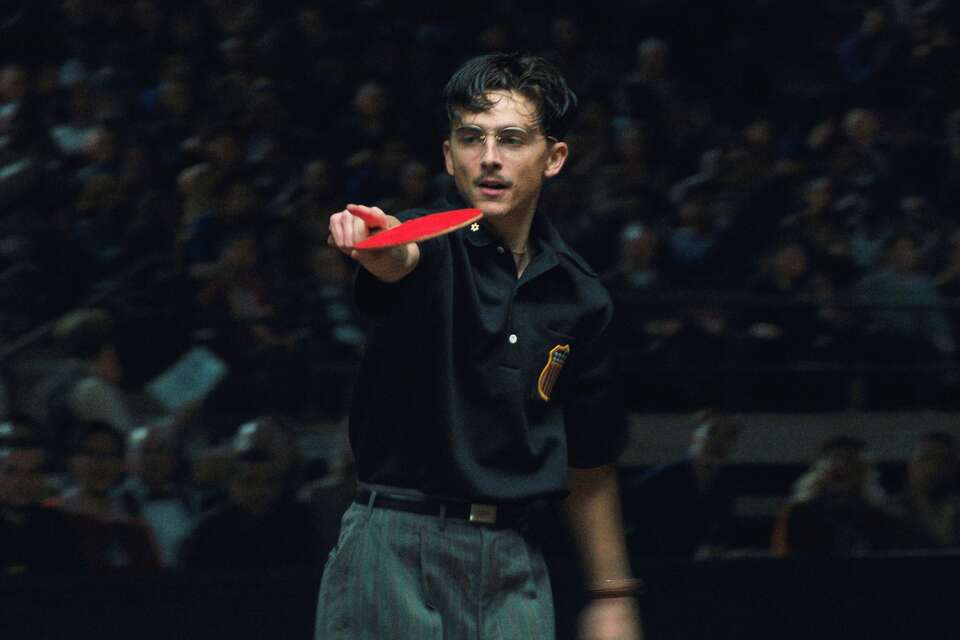
One competitor, Ray (Cooper Hoffman: Licorice Pizza) introduces himself to other players, and quickly makes friends with Pete (David Jonsson). They soon added Art Baker from Louisiana (Tut Nyuot) who wants to win the money, and Hank Olsen (Ben Wang) a nerdy-looking guy with a wisecracking, urban accent. They call themselves the four musketeers, and vow to look out for each other. Some of the racers keep to themselves. Barkovitch, (Charlie Plummer: Lean on Pete, The Return) a rabble rousing misanthrope hurls discouraging insults at his competitors. Collie (Joshua Odjick) is an indigenous man who walks to the beat of a different drum. And an ultra-fit athlete (Garrett Wareing) is so sure of his own victory he doesn’t even grace anyone with a response. The problem is, there can only be one winner. And the 49 losers? They will all be dead. You see, it’s a race to the death, and anyone who lags behind the requisite three miles an hour is summarily murdered by soldiers in tanks rolling beside the walkers. If anyone lags in their walk three times — including drinking, tying your shoes or even sleeping — they die. Who will survive this gruelling competition?
The Long Walk is a dark dystopian road movie movie about
male bonding, friendship and resistance to an autocratic state. It’s shot in a rustic, sepia tones in marked contrast to its horror theme. It’s based on a story by Stephen King, and directed by Francis Lawrence who brought us the Hunger Games movies. While it doesn’t hold back on violent blood, guts, and despair, at least it keeps alive some feeling of hope throughout. The Long Walk is totally watchable, the acting is great and I like the characters. But — maybe because of the story’s inevitability — it never really grabbed me. This could have been a deeply moving weeper, but instead it’s just a gruesome race, with a wee bit of political consciousness.
Sirât
Dir: Oliver Laxe
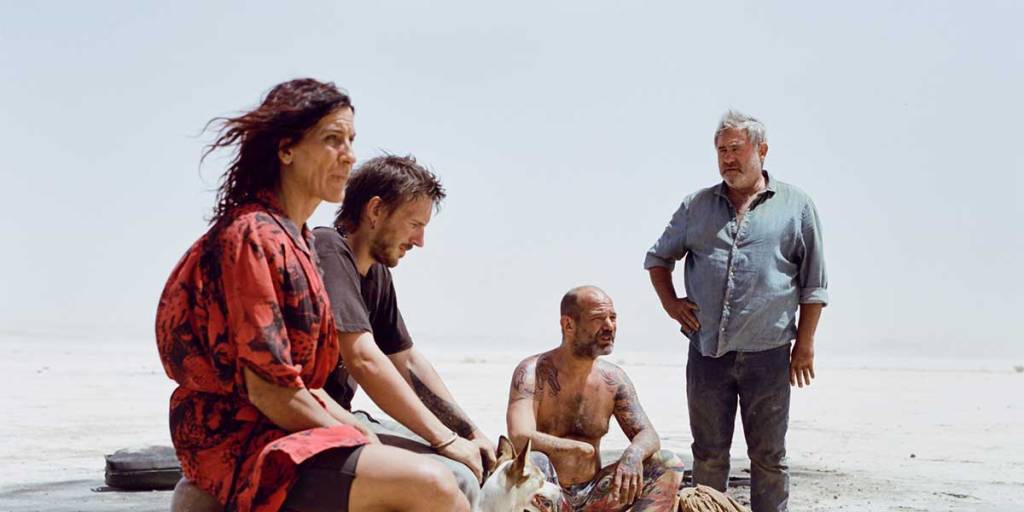
It’s a red sandstone skyline somewhere in Northwest Africa. A huge wall of speakers is spewing heavy drum and bass rhythms out of a wall of speakers, with hundreds of semi-nude dancers moving in a throbbing crowd. It’s a European rave attracting people who look like they’ve been moving to the music since the 1990s. Totally out of place are a middle aged Spanish man named Luis (Sergi López) and his young son Esteban (Bruno Núñez Arjona). They’re handing tiny leaflets to everyone they see, about their missing daughter/sister. She’s also a raver but hasn’t been seen in years. Suddenly the music stops, soldiers march in and one if them starts shouting through a megaphone: the area must be evacuated immediately, with all Europeans following the military back to safety. With much grumbling, the dancers pile into makeshift schoolbuses move out of the area… until suddenly two vehicles — an ATV and a military transport truck — veer off track and head in the opposite direction. They’re going south toward a legendary rave near Mauritania. In a split-second decision, Luis and Esteban decide to follow
them in their urban SUV, of their best chance of finding the missing girl. The crusty ravers don’t want them to follow but agree to let them tag along.
And a ragtag bunch they are, with weathered features, pierces and tattoos, peg-legs and missing limbs. They speak French, Spanish and English.But they also have a wicked sense of humour, and an overriding communal spirit. What no-one seems to realize is they’re driving headfirst into the impossible terrain of the western Sahara desert in the middle of a revolutionary war.
Sirat is a fantastic, nihilistic road movie, that combines elements of Mad Max, Nomadland and Waiting for Godot. It takes you on the twists and turns of disaster, keeping you on your toes all the way. I’m not revealing any more of the plot, but suffice it to say it thumbs its nose at traditional Hollywood narratives. The acting seems very close to documentary style, and apart from López as Luis, all the cast seems to be non-actors playing themselves. (They are called by their real names.)
If you can stand the shock, you must see Sirat.
Sirat and Nirvanna, the Band, the Show, the Movie are both premiering at TIFF right now; and The Long Walk opens across Canada on Sept 12.
This is Daniel Garber at the Movies, each Saturday morning, on CIUT 89.5 FM and on my website culturalmining.com.
Daniel Garber talks with Ross “Memphis” Pambrun about Red River Gold on APTN
Hi, this is Daniel Garber at the Movies for culturalmining.com and CIUT 89.5 FM.
It’s 1870, and John A McDonald is the first Prime Minister of a newly-confederated Canada. And he doesn’t like what’s going on in the Red River Settlement led by Louis Riel. The PM wants to crush what he calls a rebellion. So he sends soldiers up the Dawson Trail a newly surveyed road that connects the great Lakes to the Prairies. And soldiers need to get paid, so a courier on horseback is sent on the trail with heavy satchels stuffed with gold coins. But somewhere on the way from what is now known as Thunder Bay to Winnipeg, he lost all the
gold… and it has never been seen since. What has become of that Red River Gold?
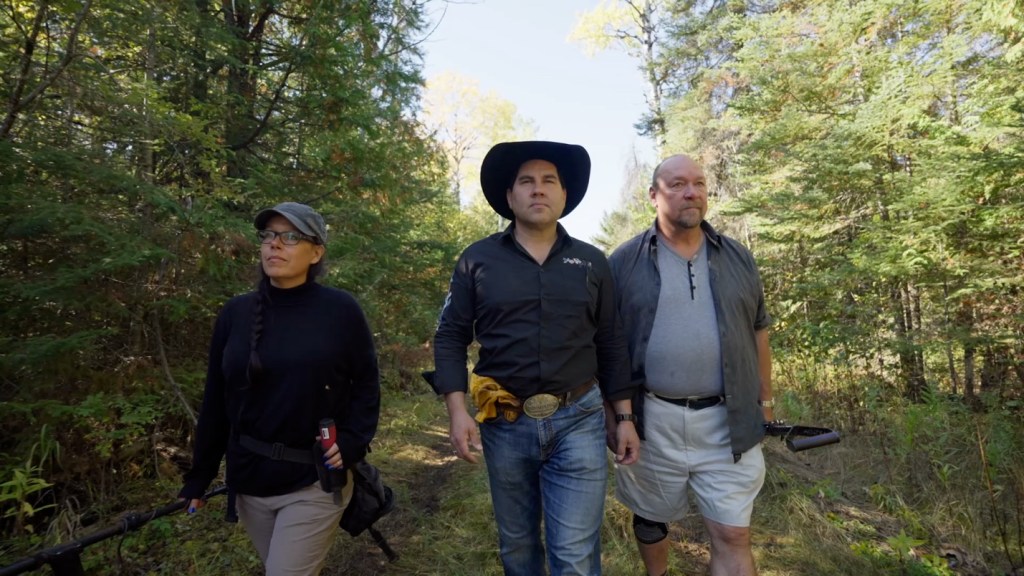
Red River Gold is the name of a new documentary series that follows Métis Treasure hunters looking for $1M worth of lost gold coins. It’s history, it’s geography, it’s archaeology, and it’s a brand new adventure. The series is directed by Saxon de Cocq who I spoke with on this show last year. Red River Gold features Ross “Memphis” Pambrun, a Winnipeg-based Métis musician, fire chief, raconteur and the owner and operator of a satellite data company. He and his two co-hosts take us down that trail throughout the season in their quest for gold and history.
Red River Gold is now playing on APTN — the Aboriginal People’s Television Network — and on their streaming site Lumi.
I spoke with Ross “Memphis” Pambrun in Calgary via ZOOM.
Dangerous, exotic. Films reviewed: Sinners, Yadang: the Snitch, The Legend of the Ochi
Hi, this is Daniel Garber at the Movies for culturalmining.com and CIUT 89.5 FM.
Hotdocs International Documentary Film festival is on now in Toronto, with free daytime admission for students and seniors. So get out there and watch some docs!
But this week I’m looking at three new movies about unexpected dangers in exotic locales. There are vampires in the Mississippi Delta, snitches in the drug wars of South Korea, and elusive, sharp-toothed creatures on an island in Carpathia.
Sinners
Wri/Dir: Ryan Coogler
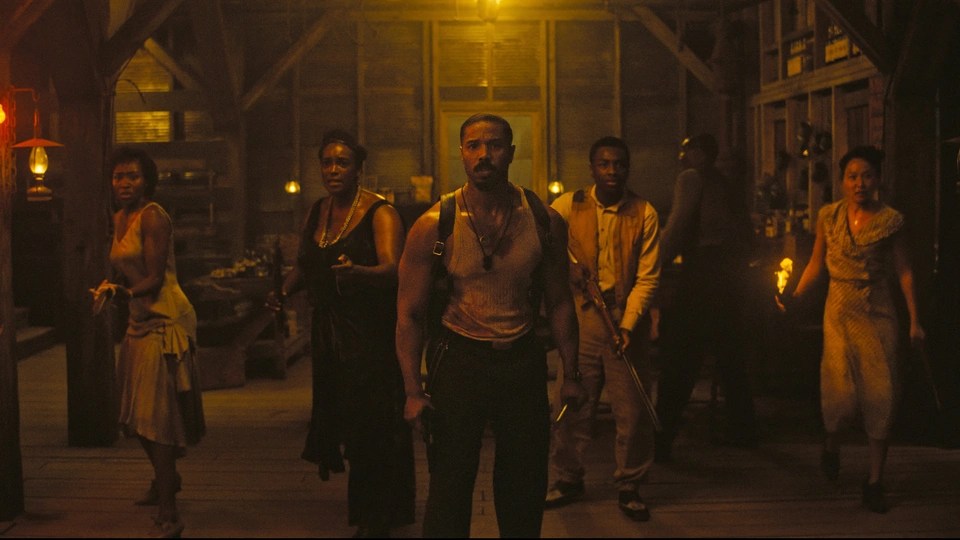
It’s 1932 in a small town in the Mississippi Delta. The Smokestack brothers aka Smoke and Stack (Michael B Jordan: The Fantastic Four, Chronicle) are identical twin who spent years making money working for the mob in Chicago. Now they’re back in town with a truck full of bootleg alcohol, a wad of cash and big ideas on how to make it rich. Namely, they’re opening a juke joint in an abandoned woodmill they bought from a local good ol’ boy. They’re rounding up the necessary musicians, like their cousin Sammie (Miles Caton), the preacher’s son, on blues guitar and Delta Slim (Delroy Lindo) on the piano and mouth organ. Bo and Grace Chow furnish the provisions and Cornbread minds the door. Even Smoke’s and Stack’s ex-partners show up: Mary (Hailee Steinfeld) a glamorous married woman who can pass for white, and Annie (Wunmi Mosaku) an experienced practitioner of Hoodoo. By sunset the place is hopping, the
customers are drinking and gambling, everything is going great, until… a mysterious, smiling stranger who loves Irish music (Jack O’Connell; Seberg, Unbroken, ’71, Starred Up ) appears at the door asking to be let in. They don’t know who he is but he just looks shifty. Turns out he’s a vampire who wants all their blood — not to wipe them out, just to turn everyone over to the dark side. But can the people on the inside keep the demons on the outside until the sun comes up in the morning?
The Sinners is a black history drama about life in the Jim Crow south in the 1930s combined with the action and horror of a conventional genre movie, that succeeds on both fronts. It’s rich in meticulous historical detail in the background: sharecroppers picking cotton in the same fields as their grandparents had as slaves, paid in company scrip not dollars; chain gangs on the highway; and the omnipresent KKK.
All this is counterposed with raunchy dialogue and the sexualized dancing and singing of the juke joint. Every character has a backstory, devoid of cookie-cutter cliches. The costumes, scenery and especially the music — from delta blues to Irish folk songs — evoke that period in a way only a movie can. The acting is superb, though I do wish Michael B Jordan made Smoke and Stack a little less identical. The vampires are more conventional. They still hate garlic, sunlight and stakes through the heart but interestingly these demons lose also racial prejudice once they become vampires. Put this all together and you end up with this amazing movie that’s multifaceted, educational and really fun to watch.
Yadang: The Snitch
Dir: Hwang Byeong-gug
It’s present-day Korea. Lee Kang-su (Kang Ha-neul) is a self-confident young man with a perpetual grin. Why does he swagger and show off his gold lighter? It’s because he’s always two steps ahead of anyone else. He’s a yadang, an informant, and plays a crucial role in the government’s war on drugs. But things weren’t always this way. He was incarcerated after being falsely accused of drug dealing, where he was beaten up and bullied on a daily basis. Until Ku Gwan-hee (Yoo Hai-jin) an ambitious prosecutor pulled him out of that world to be his personal Yadang. Now the two of them are pledged as eternal brothers, functioning like a well-oiled machine, pulling off repeated sting operations and arrests of drug kingpins and thugs across the country. Much to the chagrin of a police detective trying to arrest those same criminals. So Det. Oh Sang-jae (Park Hae-joon) a.k.a. the Jade Emperor of Narcotics Division, finds a Yadang of his own, a rising young actress (Chae Won-been) who is caught using illegal amphetamines as diet pills. Now the lines are drawn and the two sides — the prosecutors and the police — are in direct competition. But the Prosecutor, in his rapid rise to the top, has to make some uncomfortable political alliances, including a rich junkie named Cho Hoon, whose dad just happens to be running for President. Will Cho-hoon’s influence on the Prosecutors rise in power threaten the Yadang’s status and the delicate balance of that world?
Yadang: the Snitch is a Korean action-thriller about
crime, corruption, and the complex relationships among politicians, police and informants in the world of organized drug-crime. Fast moving and compelling, it maintains a frenetic pace throughout the film, with some flashbacks that last only a few seconds. It’s dizzying. It’s also quite violent, sometimes disturbingly so. Luckily, it has interesting characters and a clever plot with enough double- and triple-crosses to keep you guessing until the very end.
Yadang: The Snitch is an entertaining action flic.
The Legend of Ochi
Wri/Dir: Isaiah Saxon
Yuri (Helena Zengel) is a teenaged girl who lives with her dad and adopted brother, Petro. She likes reading library books and listening to loud music. Her farm is on a mountainous island in the Black Sea, off the coast of Romania, and though it’s decades since the fall of Ceausescu, people there still drive Ladas and keep to the old ways. Above all, they fear the Ochi, mythical beasts unique to their island who live in trees, attack sheep and kidnap children. Her Dad (Willem Dafoe) lives in constant fear of the Ochi. He leads a ragtag army of children to capture and kill the monsters… though they have never been successful. Her step-brother Petro (Finn Wolfhard) is a member too, though her rarely speaks. Yuri, on the other hand, is angry at her father and wonders why her mother (Emily Watson) abandoned her. (It’s the Ochi! says her dad.)
One day, when her father sends her out to do her rounds, she finds a small ochi with its paw caught in an animal trap. She frees him and takes him home in her knapsack. He looks like a blue-faced koala until he bares his teeth revealing long pointed fangs. But Yuri is not afraid, she nurses him back to health and eventually the two form an unexpected bond. But can she get him back to his homeland without her father finding out?
The Legend of Ochi is a highly-original adventure story about a young girl and the creature she befriends. It’s warm and delightful. While on the surface it’s a kids’ movie, the
sumptuous, painted scenery and retro feel makes it an instant cult classic. (Think ET, and Charlie and the Chocolate Factory.) It’s full of panpipes and medieval crusaders overladen with Soviet kitsch. Even the odd faces of the kids in the army are straight out of Dr Seuss. I’ve never heard of director Isaiah Saxon before, but I get the impression he’s been doodling pictures of Ochis since he was a little kid. And they are amazing: not cheap-ass CGI, but a combination of puppetry and animatronics that make them seem totally real in their own fantastical way.
I love this movie.
The Legend of the Ochi, Yadang: The Snitch and The Sinners all open this weekend in Toronto; check your local listings. This is Daniel Garber at the Movies, each Saturday morning, on CIUT 89.5 FM and on my website culturalmining.com.
Daniel Garber talks with Charles Uwagbai about Kipkemboi
Hi, this is Daniel Garber at the Movies for culturalmining.com and CIUT 89.5 FM.
Kipkemboi is a young man who lives with his family in a small town in Kenya. His parents may be farmers but he has been a gifted mathematician since he was a child. He can tell you how many birds are flying in a flock in the sky, scored 100% on his SATs and has been accepted into MIT. But an unexpected family tragedy has kept him close to home. Instead, he has invented a new financial algorithm that allows him — with unbelievable accuracy — to predict stock market gains and losses worldwide. All operated out of a simple mud hut. But when word gets out, police, military, and foreign interests descend on his village to take everything away. He’s accused of being a criminal or even a terrorist. Can Kipkemboi outrun and outsmart the powers that be?
Kipkemboi is the name of a highly entertaining, dramatic film
filled with humour, thrills and romance. Kipkemboi is the first Canada-Kenya co-production ever made and word is spreading. It’s directed by Charles Uwagbai and stars Thamela Mpumlwana in the title role. Charles is a Canadian-based director known for The Ghost and the Tout, Esohe and Charlie Charlie, and whose work has been seen on Netflix, Amazon Prime Video and Canal Plus.
I spoke with Charles Uwagbai in Toronto via ZOOM>
Kipkemboi recently had its gala premiere in Toronto, will be streaming on CBC Gem in 2025, and is currently showing in theatres at film festivals worldwide.
Guy stuff. Films reviewed: The Fall Guy, The Ride Ahead, Pelikan Blue
Hi, this is Daniel Garber at the Movies for culturalmining.com and CIUT 89.5 FM.
This week, I have some movies about guy stuff — two documentaries and an action movie. There’s a guy in Sydney not afraid to get his hands dirty, a guy in New Hampshire who wants to know the real dirt, and three guys in Budapest playing dirty with some train tickets.
The Fall Guy
Dir: David Leitch
Colt Seavers (Ryan Gosling) is the stunt double for a heartthrob Hollywood action star named Tom Ryder (Aaron Taylor-Johnson). Tom claims to do all his own stunts but those in the know know it’s Colt falling off buildings, crashing cars, and catching fire. Colt loves the excitement and thrill of doing the undoable — and he’s really good at it, too. Especially at his current film, because he works beside a camera operator named Jody (Emma Blunt). They’re spending time together, on and off duty, trading quips on set or making out behind the klieg lights. It’s his dream job. Until a terrible accident breaks his back, and he disappears from the scene entirely. And from Jody, too. Until, 18 months later, he gets a call from a producer. Gail (Hannah Waddingham), a big shaker and mover, wants him on Tom’s latest flick, a sci-fi action rom-com. He doesn’t want to, until she drops the other shoe: Jody is directing this movie and she specifically asked for him.
So off he flies to Sydney, Australia, to join a shoot in progress. It’s a shlock-fest about a space
cowboy fighting aliens using weapons that look like heavy-metal guitars. Turns out Jody had no idea he’s coming and is still offended he dumped her for no good reason. Then Gail, the producer, asks for Colt’s help. Tom has disappeared with a gang of undesirables and she’s worried he’s in trouble. Can’t Colt find and rescue him? If not they’ll have to cancel the movie… and Jody’s career (this is her first time as a director). Tom agrees, but soon discovers he’s the target of a slew of gunmen, trying to get back a missing video. Can Colt rescue Tom, survive the bullets, catch the baddies and make it back to set in time to woo the love of his life?
The Fall Guy is a combination rom-com and action movie set within the confine of the film industry. So it’s full of references to mediocre movies. I thought the witty banter wasn’t particularly clever, and the plot twists propelling the story pretty threadbare. There are lots of unnecessary
jokes written into the script with a nudge and a wink. Like when Jody asks Colt if she should use a split screen in the film she’s directing… immediately after which The Fall Guy movie starts using a split screen, too. That’s just weak. And yet I walked out of this film feeling totally entertained. Why?
First of all the acting is great, all the main characters well-played, especially Gosling’s Colt Seavers. More than that, though, the action is really good. The chase scenes are elaborate, the fight scenes are like watching ballet, and even the gratuitous explosions — and there are quite a few of them — are just fun to watch. And of course, in a movie about stuntmen, the stunts are all done just right. So if you’re looking for a couple of hours of forgettable entertainment, this one’s for you.
The Ride Ahead
Dir: Dan Habib, Samuel Habib
Samuel Habib is a young man who lives with his parents in Concord New Hampshire. He has tattoos, likes music and sports. He went to public school and is getting ready for college, but realizes he hasn’t yet done a lot of things many high school kids have already done: things like going on a date or having sex. Yes, the media is filled with sexual images and porn but rarely relevant to people like him. Samuel is disabled. The thing is, movies and TV shows portray people like him in one of three ways: get help, get cured or die. He wants some advice that’s relevant to him, preferably NOT from his parents (awkward…) And he can’t stand being talked down to or underestimated by people who only see his disability. So he decides to go to the source and talk with some well-known disabled people, including many of his heroes. He does it — and makes a film out of it.
He meets with musician Keith Jones, co-founder of Krip-Hop, for some basic rules about having sex. Says Jones: “always remember: put a bag on it!”Judy Heumann, the late, great leader of the Disability Rights Movement, says “using a wheelchair means spending a lot of time staring at people’s butts!”
Andrew Peterson who lives with Fetal Alcohol Spectrum Disorder tells how he became a long-distance runner and a sports coach. And Maysoon Zayid, a Palestinian-American

Dan and Samuel Habib, The Ride Ahead at HotDocs, Photo by Jeff Harris
stand-up comic, provides both constant humour and some really tough talk. The film takes Sam (and his father, co-director Dan Habib) across the country, in boats, planes and automobiles, each of which pose separate accessibility issues, especially airplanes; Samuel uses an electric wheelchair to get around and they don’t go well with those tight spaces on planes. He also turns to his own big brother for all-around moral support and inspiration. But will Sam ever move beyond his parents’ house?
The Ride Ahead is a touching, funny and informative documentary told from the subject’s point of view. It helps correct a lot of misconceptions about disabilities, and introduces a lot of other things you probably never considered. The film is made in the form of a dialogue between Samuel, his dad and the people he encounters, often with the camera positioned either facing him or facing out. At times, Samuel’s both the subject and the filmmaker. He can speak, but in the film mainly uses an electronically generated voice whose texts he writes in advance.
I liked this documentary a lot, partly the way it makes people with disabilities the subject not the object. It covers diverse intellectual territory, from disability rights to ableism and disability justice. It also deals frankly with real aspects of everyday life. And the cast and crew, both behind and in front of the camera, from editor to soundtrack, are largely disabled themselves.
The Ride Ahead is a good movie to watch.
Pelikan Blue
Wri/Dir: László Csáki
It’s the late 1980s in Budapest, Hungary and the iron curtain may be rattling but it’s not yet opened. Still, the government is introducing new measures. It’s now legal to keep foreign currency and travel abroad. Everyone, especially young people, are dying to see what it’s like in Western Europe. But train tickets are prohibitively expensive, and no one has any money. When three guys — Rozi, Petya, and Akos — buy a forged ticket on the black market, they are dismayed and disgusted by its poor quality: smudged ink, misspelled words… They’d be caught immediately. They can do better than that using just advanced planning and simple high school chemistry. So they decide to take the bull by the horns, and make themselves some fake tickets. This involves spying on the sellers, stealing some covers, and getting a phony rubber stamp made (not an easy task in communist Hungary). But they also have to buy a cheap ticket, bleach out the ink and carefully enscribe the forgery through a page of Pelican Blue carbon paper.
After much trial and error, they manage to ride a train to Scandinavia for pocket change. But
when they get back, rumours leak, and everyone wants a piece of the action. Should they expand their business or get out of it before the police find out?
Pelikan Blue is a beautiful, animated feature-length documentary that follows the story over three decades, using old voice recordings and new interviews. This is basically a heist movie, but one involving minimal stakes — just forged tickets across Europe. But what really struck me was the stunning art. It involves the garish lavenders and electric blues of 1980s colours, distinct characters, and simple but instantly recognizable images: a payphone, an answering machines, the brutalist rooftops of Budapest. Backgrounds are brushed with tempera paints, and the faces have squashed noses, and eyes that are tiny green dots. I cannot describe the joy I felt looking at this animation, it’s unique, it’s amazing, it’s handmade, it’s just so cool. There’s also a chill soundtrack of 1990s Hungarian music percolating through the whole film. There are lots of funny parts, and some psychedelic dream sequences, too…I just can’t get enough of Pelikan Blue.
The Fall Guy opens this weekend; check your local listings. The Ride Ahead, Pelikan Blue are two of the many movies playing at Hot Docs through Sunday.
This is Daniel Garber at the Movies, each Saturday morning, on CIUT 89.5 FM and on my website culturalmining.com.
Latin America? Films reviewed: Autumn and the Black Jaguar, Satanic Hispanics PLUS #Hotdocs24!
(missing some background music)
Hi, this is Daniel Garber at the Movies for culturalmining.com and CIUT 89.5 FM.
Spring is here, and so is Toronto’s Spring film festival season. And its crowning glory is Hot Docs the world’s biggest International Documentary Film Festival. It’s a month away — it runs from April 25 to May 5 — but now’s a good time to start booking tickets. As usual there are over 100 docs from more than 60 countries, with many international premieres. And, as always, students and seniors (over 60) can go to daytime screenings for free.
They just released the whole festival slate, so here are a few docs that I haven’t seen yet, but look interesting to me. Black Box Diaries is about a young Japanese journalist who was raped, and is taking her case to court in a demand for justice. Grand Theft Hamlet shows some UK actors attempting to mount a production of Shakespeare entirely within the notorious game Grand Theft Auto. Norwegian Democrazy is about extreme street level politics in that country, and Stray Bodies takes a similar look at how people handle bodily restrictions within their own countries can be resisted by crossing national borders within the EU. Pelikan Blue is an animated film about what young Hungarians did to leave the country when the Iron Curtain fell. There are also video diaries: The Here Now Project about how climate change effects people around the world; and XiXi, an intimate look at the innermost thoughts and beliefs of a Chinese improvisation artist living in Europe. Curl Power is a funny and tender examination of five teenage girls over three years on a curling team. And for those interested in musical celebs, there are features about Toronto’s own Peaches, called Teaches of Peaches, and Disco’s Revenge about the legendary musical producer Nile Rogers.
Like I said, Hotdocs is a full month away, but now’s the time to start thinking about it.
This week, though, I’m looking at two movies, one for children and one for definitely for grownups. There’s a girl looking for a wild beast in the jungle, and a man in an El Paso jail trying to explain why he’s the only one to survive a mass killing.
Autumn and the Black Jaguar
Dir: Gilles de Maistre
Autumn Edison (Lumi Pollack) is a young girl in middle school in New York City. She grew up in a rainforest somewhere in Latin America with her environmentalist parents. Her Dad is from the North, her Mom a member of the local indigenous nation. So Autumn treats the jungle as her backyard. As a small child she befriended a baby black jaguar who was left parentless when poachers shot the mother jaguar. So they grew up together. Developers and animal traffickers, led by the evil Poacher, Doria Dargan (Kelly Hope Taylor) wanted to evict her people from their land. They also hunted rare species to sell on the black market. But when Autumn’s mother is killed, her Dad takes her back to North America, where it’s safe. Seven years later, she’s almost a teen, but still hates it up there. No one seems to care about our animal friends or the environment. Especially her biology teacher Anja (Emily Bett Rickards). She wants the class to dissect frogs — can you believe it? — and Autumn refuses to participate in such cruelty. She stages a one-person protest. So she’s suspended from school, and not the first time. Stuck at home, she finds a letter from her uncle in the rain forest, a veritable cry for help. Our lives are teetering on the brink, he writes. They want to build a dam, flooding where we have lived for millennia. And they’re after Hope, the beloved black jaguar!
Autumn takes this as a beacon, calling her back to her ancestral home.
She lies to her father that everything’s fine, and secretly rushes off to the airport. What she doesn’t realize is her teacher — notable for her fear of germs, insecurity and agoraphobia — is somehow following her; she’s afraid Autumn is in danger, and wants to bring her back home. She’s risking her worst phobias to rescue the little girl. But they both end up in the rainforest, alone, with Autumn the one who is confident and at home. Will she find Hope the Jaguar? Will Hope still recognize her? And can they somehow stop the destruction of her culture, and the kidnapping of the last black jaguar?
Autumn and the Black Jaguar is a heart-warming kids’ movie. By kids, I mean little kids. As a grown-up, I found the dialogue klunky at best and cringy at worst, as if written by Chat GBT and edited by Google Translate. The teacher talks like a cartoon character. comically overreacting to everything she sees (as in most kids’ TV shows). But there are also some very cool adventures, like when they climb a tall tree and walk around on top of the forest’s canopy. I think little kids will really like this.
Watching the movie, I was impressed by the CGI version of a Jaguar playing with Autumn — it looked real. Could it be a CGI head superimposed on a friendly dog’s body? But after I did a bit of research, I found out the actress, Lumi Pollack, spent 10 months learning to bond with two actual jaguars. That wild cat is real! Impressive. Which moved it up quite a few notches on my mental score card.
Satanic Hispanics
Dir: Alejandro Brugués, Mike Mendez, Gigi Saul Guerrero, Eduardo Sánchez, Demián Rugna
It’s El Paso, Texas, just across the border from Juarez, Chihuahua. The police discover dozens of dead bodies in an old, abandoned building, with only one man still alive, unarmed, and handcuffed to a metal table. So they arrest him. He calls himself the Traveler (Efren Ramirez) and says he was born here — meaning in the US — and speaks at least 5 languages. But he’s undocumented, with no papers to prove his existence. Still, he pleads for the police to let him go. If they don’t, in 90 minutes they’ll all end up dead, just like the others they found. You see, he says he’s being followed by the Saint of Death, a terrifying, mystical being who wants to kill him. That’s why he’s the traveller: he always has to keep a step ahead of the Saint, to avoid massive bloodshed like this one.
But the cops don’t believe him — they accuse him of drug trafficking. They bring out his cache of strange paraphernalia and ask for an explanation. So, like Scheherazade, he embarks on a series of stories that tell where each item comes from. One of his strangest stories is called Tambien Lo Vi. It’s about a mathematical genius named Gustavo (Demián Salomón) a Rubik’s cube champ who somehow transfers his mental algorithms into light patterns projected on a wall using the light from his cel phone. He flaps his arms wildly flashing… that seems to bridge the gap between the living and the dead.
Other stories deal with a voracious vampire having a night on the town on Halloween — the only time of year when he can dress as a blood sucker in public — and a very bizarre take of a man fighting off a demon using a prodigious weapon known as the Hammer of
Zanzibar that I cannot describe on daytime radio. But back to the main plot: can The Traveller finish his stories before the evil entity arrives to kill us all?
Satanic Hispanics is a compilation horror movie told by 5 directors and countless writers, producers, cast and crew. Each story is told as discrete, complete short film, within the whole movie, but with all sharing a similar look. The directors themselves are originally from Argentina, the US, Mexico and Cuba, with dialogue shifting from English to Spanish to pre-Columbian languages. Being a horror movie, there’s lots of gratuitous violence, blood and guts, some shocks and chills, and some horrible-looking evil entities.
Does it work? Oh yes! Not every segment is perfect, but altogether they tell us some very original and scary stories.
Autumn and the Black Jaguar opens this weekend in Toronto: check your local listings; Satanic Hispanics is currently streaming on Shudder.
This is Daniel Garber at the Movies, each Saturday morning, on CIUT 89.5 FM and on my website culturalmining.com.
Road movies. Io Capitano, Ordinary Angels, Drive Away Dolls
Hi, this is Daniel Garber at the Movies for culturalmining.com and CIUT 89.5 FM.
The road from the festival circuit to your local cinema is a slow and tortuous one. I reviewed Meredith Hana-Brown’s Seagrass — a moving drama about a young couple and their daughters at an island retreat in BC — five months ago, but it’s finally hitting theatres this weekend — check it out! (Review here).
So, in recognition of that long and twisted path, this week I’m looking at three new road movies. There’s two lesbians in their twenties driving south from Philly, two teenaged boys travelling across the Sahara desert from Dakar, and a middle-aged hairdresser trying to get a little girl to a far-off hospital in time for a transplant.
Io Capitano
Co-Wri/Dir: Matteo Garrone
It’s present-day in Dakar, Senegal. Seydou (Seydou Sarr) is a 16-year-old student who works part time as a builder. With his best friend Moussa (Moustapha Fall) they’re saving money for a major purchase. Their goal? To travel to Europe to make it big as singer-songwriters. But though Seydou’s mother and others object — People die at sea! Europe is not like what they show on TV — the two boys sneak out one night, and head off on their journey. They buy their tickets for a long trip across the Sahara, via Mali and Niger to Tripoli, Libya, and from their on to Europe. They are promised modern new trucks to whiz them there. But they soon discover, the world is full of thieves, swindlers, and worse. They are forced to pay bribes to cross borders. Anyone who falls out of the rusty flatbed trucks is left behind to die. They are set upon by cruel bandits, separating the boys, with Seydou sent to a prison run by the Libyan Mafia. Inmates are subject to extortion and torture. And those who survive are sold into de facto slavery. But, somehow, Seydou makes it to Tripoli. Now he has to find Moussa, and get a boat to take them to Italy. But what will the future bring?
Io Capitano is a powerful, heartfelt drama about two young
migrants trying to reach Europe. Seydou is a heroic figure who gradually matures from boy to man to leader. (The title means I am the Captain.) Garrone, as in most of his films (Reviews: Dogman, Reality, Gomorrah), again casts first-time actors in the main roles, giving the movie a hyper-realistic feel. Seydou, for one, is amazing, totally believable. And lest you think this is a gruelling journey, it is also filled with music, dance and magical fantasies that appear in Seydou’s mind.
Io Capitano is an uplifting and heroic story.
Ordinary Angels
Co-Wri/Dir: Jon Gunn (Writer/Producer: I Still Believe, American Underdog, Jesus Revolution)
It’s the 1990s in Louisville, Kentucky. Sharon (Hilary Swank) is a hair stylist who owns a beauty parlour. She’s known for her sparkling skirts, fringed leather jackets, and her long, curly hair with frosted tips. She likes getting drunk at roadhouses and dancing on the bar. But her best friend and coworker Rose (Tamala Jones), sees trouble ahead if she doesn’t stop drinking. Clearly, Sharon needs something — a lover, a religion, or a cause — to devote herself to. But her first marriage was a bomb (her adult son won’t even talk with her), and going to church isn’t her thing. But when she spots a local newspaper headline — Man’s wife dies, his 5-year-old daughter is suffering from a rare illness — she decides to do something about it. She starts raising funds at the hair salon, and spreading awareness of this family’s plight. Ed Schmitt (Alan Ritchson) is a simple roofer in debt half a million bucks, and his daughter Michelle (Emily Mitchell) needs expensive treatment. Sharon starts giving him envelopes of cash she raises, but he doesn’t feel comfortable. Why is this strange alcoholic woman giving him money?
But the kids and Ed’s mom take to Sharon like bees to honey.
She helps him balance his books, and raises money from the bigwigs in Louisville. Soon everyone knows about Michelle’s plight. But when the big day comes for a liver transplant, the city is closed down by a freak snowstorm. And the hospital is halfway across the country. Are Sharon — and the community’s — wits and determination be enough to save a dying girl?
Ordinary Angels is an uplifting, non-preachy faith-based drama about an ordinary woman trying to change the world. It feels a bit manipulative at times, with gushing music, and twinkling stars overhead . Ed barely talks — he’s the strong, silent type, just yes ma’am, no ma’am — and little dying Michelle is way too cute. Luckily, Hilary Swank is just great as the indefatigable Sharon, a woman who won’t take “no” for an answer. Yeah, the movie is a little bit forced and a little too long, but it also tugs your heart-strings in just the right places. And it’s great seeing a large group of people working together in an attempt to save a life. (It’s based on a true story.)
So if you like tear-jerkers, this one is a two-hankie classic, one that’ll leave you crying, for sure.
Drive Away Dolls
Co-Wri/Dir: Ethan Coen
It’s 1999 in Philadelphia.
Jamie and Marion are best friends, but couldn’t be more different. Jamie (Margaret Qualley) has a southern drawl and a wild-at-heart attitude. She’s always up for a roll in the hay with any chick she meets in a lesbian bar. Marian (Geraldine Vishvanathan) is reserved and uptight, stuck in a futureless, cubicle office job. But when Jamie’s long-time girlfriend Sukie (Beanie Feldstein) catches her cheating in their own apartment, she goes ballistic. Sukie is a hot-headed cop and Jamie knows when it’s time to skedaddle. So she decides to go for a drive home to Tallahassee with Marian as her co-pilot. Luckily, Jamie knows about a great deal at Drive Away autos — they deliver the car to Tallahassee and they get the ride for free. What they don’t know, is they’re driving the wrong car, carrying unexpected cargo in the trunk: a metal suitcase… and a human head!
You see, that metal suitcase contains something of crucial importance to someone with a lot of power, and a gang of ruthless men want it back. And they’re racing down the highway trying to catch up with
Jamie and Marion and take back the suitcase. But the clueless pair are taking their own sweet time, with Jamie smoking pot and meeting up with nubile soccer players in honky-tonk bars and sleazy motel rooms on the way, while Marion has to deal with over-zealous redneck sheriffs. But the criminals are steadily getting closer, and who knows what will happen if they meet. What’s in the metal suitcase? Can Jamie and Marion stay friends? And is there something deeper going on between them?
Drive Away Dolls is an unapologetic B-movie, a non-stop comedy-thriller about lesbians on the road. It’s full of wanton sex and gratuitous violence, though nothing overly explicit. It also features cameos by A-listers like Matt Damon, Pedro Pascal and Colman Domingo. And it’s all strangely interspersed with vintage, psychedelic soft-core hippy-porn, (its meaning only revealed at the end). This is like a Coen Brothers movie, but no Joel. Instead Ethan is paired with longtime film-editor (and wife) Tricia Cooke who also co-directed and cowrote it, apparently based on her own salad days. It’s great raunchy fun. The only thing that puzzles me is, in a movie that’s all about lesbians, why does the trailers completely hide that fact? (Not to mention changing the title from Drive Away Dykes to Drive Away Dolls.) But I guess you have to sell a movie to a broader audience or you won’t get the crowds.
Either way, I really enjoyed this one.
Io Capitano is now playing at the TIFF Lightbox; with Drive Away Dolls and Ordinary Angels both opening theatrically this weekend in Toronto; check your local listings.
This is Daniel Garber at the Movies, each Saturday morning, on CIUT 89.5 FM and on my website culturalmining.com.
A New World? Films reviewed: Going In, Poor Things
Hi, this is Daniel Garber at the Movies for culturalmining.com and CIUT 89.5 FM.
December is supposed to be a time for fun and relaxation, so this week, I’m looking at two new movies that you might find fun to watch. There’s a comedy/action movie set 40 years ago in Toronto, and a wild comedic fable set a century ago in Europe.
Going In
Wri/Dir: Evan Rissi
It’s the late 1980s in Toronto. Leslie Booth (Evan Rissi) is a young lecturer who waxes eloquent about Hegelian dialectics to bored college students. He doesn’t smoke, drink or cuss and stays away from drugs. He even goes to bed early if his on-again, off-again girlfriend isn’t spending the night. But everything changes when a strange man, all dressed in black, starts showing up everywhere he goes. Reuben (Ira Goldman) is a Jamaican-Canadian who wears a huge Star of David around his neck. He used to be Leslie’s best friend, going out on the town every night, but haven’t seen each other for five years. And Leslie has been on the straight and narrow ever since.
But Reuben needs his help, and is calling in a favour. His brother has disappeared, and he suspects it’s the work of a Toronto drug kingpin named Feng (Victor D.S. Man). Feng has cornered the market on a highly-addictive pill hitting the streets known as Pearl. Users love the experience, but addicts end up looking like zombies with solid white eyes. Reuben wants to penetrate this Triad and save his brother’s life, but the only way to do it is to get hold of a pair of tickets to Feng’s annual tournament. So Leslie joins with Reuben
and finds himself falling into old habits, snorting coke and frequenting sleazy bars to get more information. But the closer they get to their target the more dangerous it all looks. What is that tournament about? And can they rescue Reuben’s and get out unscathed?
Going In is a Toronto action/comedy movie set in — and in the style of — the 1980s. It’s also a buddy movie with a black guy and a white guy, like Lethal Weapon, Beverley Hills Cop or Silver Streak. But unlike those Hollywood hits, Going In is a micro- budget movie — we’re talking tens of thousands not hundreds of millions — with unknown actors and minimal special effects. Evan Rissi
wrote, directed and stars as Leslie, while Ira Goldman who plays Reuben also produced it. And Victor D.S. Man as the villain looks like he walked straight out of an old Hong Kong flick.
Surprisingly, this movie works. It’s clearly low-budget but it doesn’t seem slapdash. While it plays into a lot of film conventions and stereotypes, there are some very original scenes that I’ve never seen before — like the tournament they’re trying so hard to get into (no spoilers) It also has a good soundtrack, a b-ball match, some fight scenes and even a psychedelic out-of-body experience. And it’s not afraid to have the CN Tower constantly popping up in the background, to remind us that it’s Toronto, not NY, Detroit, Boston, Phillie or any of the other cities Toronto usually pretends to be in movies shot here. Keep in mind that this is a DIY movie, not from a big studio, and you might get a kick out of it.
Poor Things
Dir: Yorgos Lanthimos
Max McCandles (Ramy Youssef) is a medical student in Victorian England. He regularly attends surgical demonstrations by Dr Godwin Baxter (an unrecognizable Willem Dafoe) a controversial scientist with outrageous ideas. Baxter’s face is grotesque, like something that was cut into pieces and sewn back together. But the doctor takes a liking to shy Max, and hires him to live in his home and look after his daughter Bella (Emma Stone). Bella is a beautiful woman in her late 20s, but who behaves like a recently-hatched duckling just learning to walk. She has a vocabulary of just six words, and is given to stabbing, tearing or biting anything put in front of her. But with Max’s help, she quickly learns to speak and think, and is full of questions about the world. She is not allowed out of her home — it’s too dangerous, they say. You see, Bella is an adult woman with a baby’s brain implanted in her skull, one of the mad scientist’s latest experiments. As she matures, she and Max fall in love and plan their wedding — though still in a strictly patriarchal relationship (she refers to her father/creator Godwin Baxter as God for short.) But before they can marry, a scoundrel named Duncan Wedderburn (Mark Ruffalo) shows up on the scene. He sweeps Bella off her feet with the introduction of something new into her vocabulary — sexual pleasure — which she greatly enjoys. He
promises endless sexual satisfaction and rollicking new adventures if she follows him on his trip. Bella realizes Duncan is a cad and a rake but agrees to go with him anyway, postponing her marriage to Max indefinitely or at least until after she sees the world.
She sets off on this journey with Duncan aboard an ocean liner docking in various ports which she naively explores and learns from what she sees. She’s the ultimate fish out pf water, a novelty to all she meets, because she speaks so frankly and forthrightly. Bella has yet to learn basic societal rules about class, money, capitalism, sex, nudity and modesty. She explores this strange world scientifically and logically, much to Duncan’s dismay. Who is she really and where did she come from? Is sex a market commodity or something more personal? Will her naivety lead to disaster? Or will she return,
triumphant, to London with her innocence intact?
Poor Things is a brilliant social satire about sex, class, feminism, and society. It incorporates elements of 18th century novels like Fanny Hill, Tom Jones and Candide. It’s surreal, absurdist and psychedelic, but ultimately comes across as a fable or a morality play. It’s all filmed on an elaborate set (shot in Hungary), in a weird, steampunk Europe that never existed beneath a sky filled with blimps and zeppelins. (It looks like Terry Gilliam’s movie Brazil.) The costumes are outrageous — Bella has enormous shoulder pads bigger than her head. Emma Stone is amazing as Bella, though Mark Ruffalo overdoes it as Duncan — teetering between funny and ridiculous.
I’ve been following Yorgos Lanthimos’s films since Dogtooth in 2009, and this one revisits many of his earliest themes: absurdist humour; adults who speak awkwardly like small children, and who grow up isolated, never
allowed to leave their home, by a dictatorial, god-like father figure. It feels like Dogtooth Part Two: The Outside World. But now he commands a big enough budget to build ornate sets, costumes and wigs, with dozens of fascinating characters. I’m sure some of you will hate this movie, or be offended by it, but I think it’s absolutely brilliant.
Poor Things opens this weekend in Toronto; check your local listings. Going In is available digitally online across North America, from December 19th.
This is Daniel Garber at the Movies, each Saturday morning, on CIUT 89.5 FM and on my website culturalmining.
Family movies worth watching. Films reviewed: The Boy and the Heron, The Three Musketeers: d’Artagnan
Hi, this is Daniel Garber at the Movies for culturalmining.com and CIUT 89.5 FM.
With the holidays upon us and lots of families getting together, it’s hard to find movies that interest kids without boring adults. But this week, I’m looking at two new movies — from Japan and France — that families can actually enjoy together, and without any product placement whatsoever. There’s a boy in 1940s Japan searching for his mother, and a young swordsman in 1620s France looking for adventure.
The Boy and the Heron
Wri/Dir: Hayao Miyazaki
It’s 1943 in Japan, during WWII. Mahito is a teenaged schoolboy who recently moved away from Tokyo with his dad after his mother died, into a huge country house where his aunt Natsuko (his mom’s younger sister) lives. He is troubled by the fact his father has married Natsuko — who looks very much like his mother — and treats her almost as if they’re the same person . The house sits near a placid pond by a crumbling stone tower. Aside from his aunt, there is a bevy of old biddies who work on the estate. Mahito feels lost and abandoned and is bullied at school. One day on the way home he hits himself in the head with a rock, to make it look like he was attacked at school. Now bedridden, he
recovers in his new home, disturbed only by an enormous heron who taps at the glass of his window. But things take a strange turn when he is lured on a journey to the old tower by the heron, who it turns out… can talk! The Heron says if Mahito is looking for his mother, the he knows where to look. Chased by Kiriko, one of the elderly maids, he decides to enter the tower to see what’s what.
From there, he finds himself in a new universe, completely unlike anything he’s seen before. It’s a place where people and ghosts, the living and the dead, coexist. There are talking animals, including giant, fascistic parakeets marching under the sway of a military dictator. He joins forces with a brave and strong sailor, a young woman who looks somehow familiar to him. And tiny, floating bubble-creatures known as warawara, who
can cross to the real world from this other world. Can Mahito survive the dangers that await him? Can he rescue his mother and take her back home? Or will he be trapped there forever?
The Boy and the Heron is a brilliant animated story about a boy who visits a strange otherworld. It’s surreal and psychedelic. It deals with concepts like birth and death, reincarnation, souls, spirits, ghosts and gods, all situated within an authoritarian wartime Japan. It’s the work of Hayao Miyazaki’s Ghibli Studios, and is partially based on his own childhood. A master animated filmmaker, Miyazaki supposedly retired about a decade ago, but apparently never stopped drawing, and this is the result: an amazing burst of creativity and imagination. The Boy and The Heron is a beautiful — and sometimes heartbreaking — movie.
I recommend this one.

© 2023 CHAPTER 2/PATHE FILMS/M6 FILMS
LES TROIS MOUSQUETAIRES : D’ARTAGNAN
réal. : Martin Bourboulon. int. : François Civil, Vincent Cassel, Romain Duris, Pio Marmaï, Eva Green, Louis Garrel, Vicky Krieps, Lhyna Khoudri, Jacob Fortune-Lloyd, Marc Barbé, Patrick Mille, Julien Frison (de la Comédie-Française), Raph Amoussou.
pays : France. durée : 2 h 02. dist. : Pathé
Sortie en salle le 5 avril 2023
The Three Musketeers: D’Artagnan
Dir: Martin Bourboulon
It’s the 1620s in France. Charles d’Artagnan (François Civil) is a brash young man from Gascony travelling on horseback to Paris. He wants to join the famed musketeers, an elite force serving under Louis XIII (Louis Garrel). On the way he witnesses a crime involving a stage coach, a sealed letter, and a mysterious woman in a black-hooded cape. When he comes to the rescue of a besieged woman in the coach, she shoots him! He is buried alive, but that doesn’t stop him. He makes his way to the palace, looking worse for the wear, and manages to sneak in to present his credentials. However, though a fine fighter, he can be both clumsy and arrogant and somehow offends three separate men, each of whom challenges him to a duel. He shows up at the assigned hour, prepared to die. Turns out the three men all know each other: Athos (Vincent Cassel) Porthos (Pio Marmaï) and Aramis (Romain Duris) all widely known for their sword skills and lusty habits. But before the duels can begin they are accosted by a small army of soldiers, working for Cardinal Richelieu. All for one they say, and d’Artagnan joins them in the fight, soon proving his
mettle. The three men are of course, the Three Musketeers.
Now, having been invited to join the cadets, but not the elite musketeer corps, d’Artagnan moves into an apartment near Constance (Lyna Khoudri) — a personal confident of the queen— whom he fell in love with at first sight. But trouble is brewing. The King’s brother (along with Cardinal Richelieu) is plotting to send the country to war with the Protestants — meaning, England. The Queen (Vicky Krieps) is romantically involved with the Duke of Buckingham. Athos is accused of murder but says he has no recollection of the night’s events (he was drunk, as usual). And the Queen — who rashly gave a diamond necklace to Buckingham as a keepsake — is ordered by the king to wear it at an upcoming ball. And of course there’s the mysterious Milady (Eva Green) who seems to be involved in all the intrigue swirling around the palace. Can they rescue the necklace, stop Athos’s execution, uncover a secret plot and prevent an upcoming war? And will d’Artagnan ever be accepted by the Three Musketeers?
The Three Musketeers is, of course, the latest version of the classic swashbuckler based on the novel by Alexandre Dumas. It’s a Hollywood perennial; they release countless versions of this film, usually once a decade, stretching back to silent movies, featuring stars like Douglas Fairbanks and Adolph Menjou, Gene Kelly and Lana Turner, Raquel Welch and
Oliver Reed, Charlie Sheen and Keifer Sutherland. And these are just the Hollywood ones; there also have been many French versions, like this one, plus Mexican, Japanese, Italian… you name it. The story has action, intrigue, adventures, romance and comedy. So how does this one stand up?
I found it very enjoyable, sticking close to the original book, but with enough new or unfamiliar parts to keep you guessing. Less “bodice-ripping,” more fighting. In this version, the musketeers actually use their muskets — so there are gun fights, not just sword fights. Porthos is polysexual — he’ll sleep with anyone that movies. And this d’Artagnan is dirtier, poorer and scruffier than usual, but the actor (François Civil) does have electric appeal. There are horseback chase scenes, masked balls, overheard plot turns and daring escapes — I love this stuff. It’s shot among lush forests, cliff-side beaches, in crowded marketplaces or dark palace corridors. Warning: this is part one of two films, and leaves you with a bit of a cliff-hanger.
Personally, I think Richard Lester’s 1973 version is the best, but this one definitely holds its own.
The Boy and the Heron and The Three Musketeers, Part 1: D’Artagnan are both playing now at select theatres across Canada; check your local listings.
This is Daniel Garber at the Movies, each Saturday morning, on CIUT 89.5 FM and on my website, culturalmining.
Halloweeniness! Films reviewed: Five Nights at Freddy’s, The Killer, Suzume
Hi, this is Daniel Garber at the Movies for culturalmining.com and CIUT 89.5 FM.
Toronto Fall Film Festival Season continues with Rendezvous with Madness, showing and discussing films about addiction and mental health, on now through November 5th. And on the horizon are Cinefranco, showing great French- language movies from Canada, Europe and Africa starting Nov 3rd; and ReelAsian Film Fest, celebrating its 27th incarnation, featuring pan-Asian cinema, events and media artists beginning on Nov 8th.
But this week I’m talking about three new genre movies — an action- thriller, a horror and an animated fantasy — just in time for Halloween. There’s a hitman tying up loose ends, a night watchman guarding animatronic beasts, and a Japanese schoolgirl closing doors.
Five Nights at Freddy’s
Co-Wri/Dir: Emma Tammi
(Based on the game by Scott Cawthon)
Mike (Josh Hutcherson) is a night watchman at a crumbling, former kids’ pizza emporium. He’s working there because, since their parents died, he needs to take care of his little sister Abby (Piper Rubio). Abby is withdrawn and introverted; she spends most of her days drawing pictures. Mike is especially protective of her, since their brother Garret was abducted by a stranger years earlier and never found. Now he’s worried social services will take her away and give custody to their sinister aunt Jane (Mary Stuart Masterson). And without a steady job, he’s a lost cause.
The thing is, Freddy’s is a weird and creepy place, filled with rusty old animatronic figurines — Freddy, Foxie, Bonnie, Chica, and Cupcake — life-sized robotic creatures that once welcomed kids to the restaurant… until children started disappearing in the 1980s, and the place was closed down. Luckily, Vanessa (Elizabeth Lail) a friendly local cop, is always dropping by to make sure Mike is OK. (Is there a possible romance brewing?) But once ghosts of the abducted kids start appearing in his dreams — and he wakes up with real-life wounds — Mike starts to question the entire job. And when Abby gets involved
and is playing with the animatronic creatures, things start to look ominous. Can Mike protect Abby from her new “friends”? Will Aunt Jane take her away? And will he ever discover what happened to their brother Garret?
Five Nights at Freddy’s is a light kids’ horror movie about a haunted restaurant, a sort of a Chuck E Cheese from hell. It’s based on a computer game from the early 2000s, which dictates a lot of the characters, plot and even the images. Which gives an ultra-simplistic feel to the movie. The movie mainly takes place inside the dusty pizza emporium, filled with retro video screens and pinball machines; and the scenes with the animatronic characters are uniquely creepy and cool. But in general, the film is predictable, repetitive and not terribly original. But I’ve never actually played the game. The audience where I saw it was screaming and yelling at every line, revelation or scene-change, so, clearly, if you’re already a fan, you’ll love it. Personally, I enjoyed watching it, but found it instantly forgettable.
The Killer
Dir: David Fincher
A self-described ordinary man (Michael Fassbender) who likes egg McMuffins and 70s sitcoms is camping out in a Paris office building, across from a hotel. He enjoys listening to The Smiths whenever he needs to relax. He normally lives in a palatial estate in the Dominican Republic. So what is he doing in Paris and why is he sleeping on a table? He’s a hitman assigned to assassinate a stranger through hotel window. Don’t take it the wrong way; he’s not a bad guy, it’s just his job. But when the assignment goes wrong, everything falls apart. Now he thinks killers are tracking him, and his girlfriend is attacked and almost killed inside his home. Who can he trust? So he sets out to discover who exactly has turned on him, and once he figures that out, he plans to systematically kill them all. But will he succeed in his revenge plot?
The Killer is an action/thriller based on a graphic novel and told from the viewpoint of a sympathetic murderer. There are chase scenes and stake-outs, fistfights and shoot-outs, everything you’d expect in a thriller. It’s chock-full of violence and death, but the twist is it’s narrated in a light and breezy voice-over by the killer himself.
Fassbender is a great actor, here at his wiriest, and surrounded by a top-notch cast: including Tilda Swinton, Charles Parnell and Arliss Howard. And it’s directed by David Fincher who brought us Fight Club and The Usual Suspects. And it has recurring gags, like the killer using fake names taken from 70s sitcoms (Archie Bunker and Richie Cunningham) to hide his identity. So why isn’t it very good? The problem is the story is more pointless than it is funny or exciting or interesting. It’s lots of action, not so many thrills. The plot itself is plodding, going from numbered chapter to chapter about the next person he’s going to encounter and possibly kill. It just leaves you feeling hollow — killers killing killers. Sure, The Killer is totally watchable as an action movie, it just doesn’t live up to its potential. Instead it elevates mundaneness into mock profundity.
Suzume
Wri/Dir: Shinkai Makoto
Suzume is a teenage girl in Kyushu, Japan. She has lived with her aunt since her single mom died when she was four, but she’s still troubled by nightmares. One day, on her way to school, a handsome young man asks her for directions to an abandoned part of town. Intrigued, she follows him and discovers a strange, freestanding door and a small statue of a cat. After she walks through the door, everything seems the same… and yet somehow different. She can now see things other people can’t — like a huge red plume rising into the sky. The cat, Daijin, comes to life and starts talking. The stranger, named Souta, explains what’s going on. He’s a closer, one of only a few people who can close those doors using a special key. The red plume is actually a giant worm — it’s what causes the earthquakes and tsunamis in Japan. And it will be a disaster unless he closes these doors wherever they start to open. But when the cat turns Souta into a little, three-legged chair, things start to get more complicated. Can Suzume do Souta’s work? Can she turn him back into a human? Can they stop Daijin the cat from causing any more problems? And what will Suzume’s aunt do if she just takes off?
Suzume is a beautiful fantasy-adventure about a girl trying to save the
world. It’s a picaresque story that spans Japan’s islands, historic sites and the very diverse people at work — from a hostess bar to a bath house — she meets on her journey. It’s fascinating, exciting, and full of surprises. Beautiful images and a nostalgic soundtrack — full of Japanese pop songs from the 70s and 80s — make it a pleasure to watch. It’s especially meaningful in Japan because it takes place in 2023, exactly 100 years after the Great Kanto Earthquake flattened Tokyo. Add to this a semi-romantic story full of world-altering decisions (no spoilers) and you’ll get why it’s so good. The director Shinkai Makoto who brought us the smash hit Your Name again deftly handles tricky stuff like time and space and alternate realities and unrequited love.
If you like Japanese anime, Suzume is a must-see.
Five Nights at Freddy’s and Suzume both open this weekend in Toronto — check your local listings — with The Killer showing exclusively at the TIFF Bell Lightbox.
This is Daniel Garber at the Movies, each Saturday morning, on CIUT 89.5 FM and on my website, culturalmining.com.
leave a comment