Canadian Film Fest! Movies reviewed: The Players, To the Moon, Skeet
Hi, this is Daniel Garber at the Movies for culturalmining.com and CIUT 89.5 FM.
With the warmer weather, spring film festival season comes to Toronto, starting with the Canadian Film Fest. It features world-, national- and local premieres of great Canadian movies that will be opening later this year. It has a wide variety of genres and topics — sci-fi, comedies, dramas and documentaries — from across the land. They’re very accessible and a lot of fun, and they bring to light current topics unique to this country. And each screening includes a feature and a short film along with the filmmakers themselves in person.
So this week, I’m writing some shorter-than-normal reviews to give you an idea of what’s playing at the CFF this year. There’s a teenaged girl in Toronto trying to broaden her horizons, an ex-con in Saint Johns, trying to follow the straight and narrow, and a middle-aged single dad in Halifax who does ritual dances to the moon.
The Players
Wri/Dir: Sarah Galea-Davis
It’s summer in the early 1990s in Toronto. Emily (Stefani Kimber) is a naive but listless 15 year old girl who wishes her parents would get back together. Her dad moved when her mom returned to University and started sleeping with her prof. But Emily thinks she’s found her calling when she runs into an experimental theatre group in a park, and successfully auditions for a show. But this is no ordinary theatrical troupe. It’s run by a Svengali-like director named Reinhardt (Eric Johnson) and his girlfriend actress Marley (Jess Salgueiro). Rehearsals last for hours, full of primal screams and heavy body contact. Emily is in heaven, viewing herself and the world in brand new ways. Reinhardt pays special attention to Emily, giving her readings in French literature so she can really “understand” the art their creating (an eight-hour version of Hamlet). Even when she spends days at the studio without going home, and strange bruises start appearing on her body, she accepts that it’s part of becoming an actor. But the cultish nature of the group, and Reinhardt’s increasingly dangerous, abusive and sexualized behaviour starts to gnaw at Emily’s psyche. Should she see it through, or get the hell out of that place while she still can?
The Players is a gripping, coming-of-age drama about life as a
young actress in the 1990s, long before the #MeToo movement. It’s first exhilarating and then horrifying. Stefani Kimber is excellent and well-rounded as Emily, through whose eyes the entire story is told. And though it’s director Sarah Galea-Davis first feature, it’s powerful and prescient.
To the Moon
Wri/Dir: Kevin Hartford
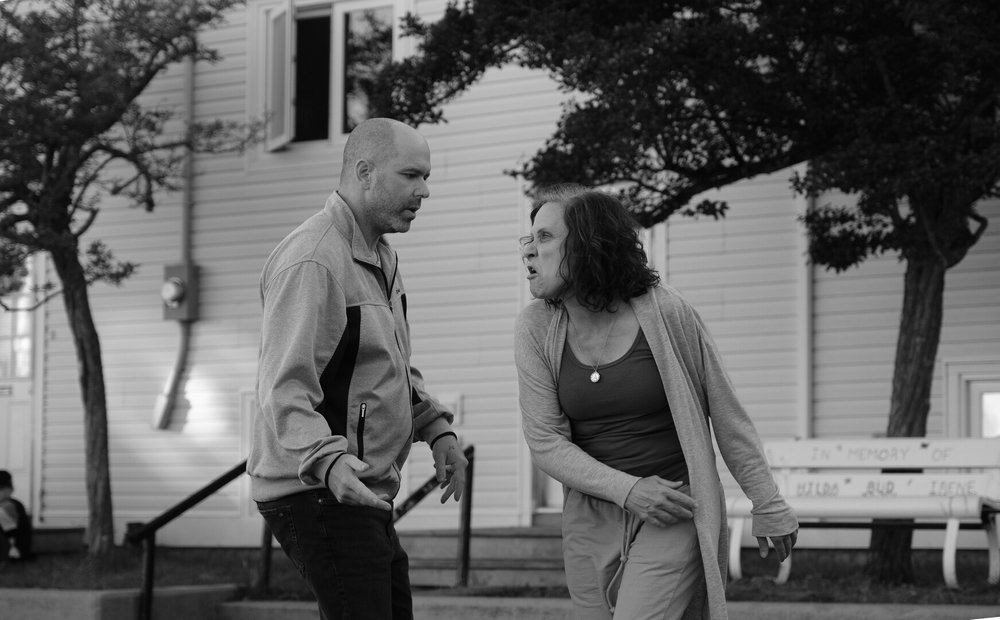
Sam (Jacob Sampson) is a corporate executive in Halfax, Nova Scotia. He has recently moved to a picturesque suburb with his rudderless teenaged daughter Ella (Phoebe Rex); his wife died soon after Ella was born. Since then he has given up all sex and dating. Instead, each morning, Sam and Ella do an elaborate dance ritual, ostensibly to stop the moon from crashing into earth! But everything changes when Sam’s sexuality begins to reveal itself when he meets an attractive man at a lunch spot. Is Sam gay? Ella, meanwhile, auditions for a play at her new school, in the hopes of meeting a guy she has a crush on… but is thwarted at every step by a cruel, bully-girl named Isobel. And all of Sam and Ella’s lives are observed by Claire (Amy Groening) a neurotic and nosy next-door neighbour novelist, facing writers block. Can Ella find
satisfaction at her new school? Can Sam come out as gay, even to himself? And what will happen to their lives if they stop doing the sacred moon dance?
To the Moon is a funny, oddball comedy set in Nova Scotia. It’s the kind of comedy where every character is quirky and armed with a quick witty comeback. It’s cute though hard to believe, but what’s truly hard to believe is the totally unexpected wack ending (no spoilers here.) This may be the first film of Kevin Hartford I’ve ever seen, but it has the blessing of Thom Fitzgerald, the film’s producer, who is an icon in the world of LGBT movies and directed two classics: The Hanging Garden and Cloudburst. If you’re looking for a zany gay comedy from down east, check out To The Moon.
Skeet
Co-Wri/Dir: Nik Sexton
St John’s, Newfoundland. Billy Skinner (Sean Dalton) is a skeet, a tough-guy enforcer who did three years hard time for violent crime. Now he’s out again, back in his sketchy neighbourhood, still ruled by a gangster-poet named Leo (Garth Sexton). But things look worse than what he left. His brother can barely walk, his former crime buddy collects empty beer cans, his mom’s a fentanyl head, and she snorted all the money he was sending her to take care of his teenaged son Brandon (Jackson Petten). But Billy is determined to turn his life around — no more crime or fighting. He’s gets a job mopping floors at the chicken plant, spends time with his son, stays off drugs and attends an obligatory support group. And strangest of all, makes friends with his neighbour Mo (Jay Abdo), a taxi driver, one of many Syrian refugees recently
housed in his neighbourhood. Can Billy shake off the cursed Skinner family name? Or will he revert to life as a skeet?
Skeet is a moving and hard-hitting drama about a ne’erdowell trying to make it in the tough parts of St Johns. Well acted and shot in glorious black and white, it gives us a sympathetic portrayal of the bleak parts of Newfoundland we rarely if ever see. Luckily, director Nik Sexton — who has honed his craft for years at the Rick Mercer Report and This Hour has 22 Minutes — doesn’t know how not to be funny, so there’s enough humour to keep it from being a drag. I guess you could call Skeet Donnie Dumphy’s evil twin.
Great movie.
Skeet won People’s Pick for Best Flick (Nik Sexton) at CFF.
The Players won Best Director award (Sarah Galea-Davis) and Best Acting award (Stefani Kimber) at CFF.
Skeet, To the Moon, and The Players are three of the movies premiering at the Canadian Film Festival, running Monday March 24th through Saturday, March 29 at the Scotiabank cinema in Toronto. Go to canfilmfest.ca for tickets and showtimes.
This is Daniel Garber at the Movies, each Saturday morning, on CIUT 89.5 FM and on my website culturalmining.com.
Three generations. Films reviewed: My Dead Friend Zoe, Exhibiting Forgiveness
Hi, this is Daniel Garber at the Movies for culturalmining.com and CIUT 89.5 FM.
It may be the closing of Black History Month, but there are still good movies opening this weekend. So this week, I’m looking at two new American movies, about three-generation families. There’s an Army vet with PTSD whose grandpa has dementia; and an artist with a young son whose dad is addicted to crack.
My Dead Friend Zoe
Co-Wri/Dir: Kyle Hausmann-Stokes
Merit (Sonequa Martin-Green) is a US Army Vet who lives in Portland, Oregon. She was a lightweight vehicle mechanic in Afghanistan, but hasn’t done much since she was discharged. The fact is, like many vets she is depressed and suffers from PTSD. That’s why she goes to a military support group especially for people like her. And she always brings her best friend and fellow vet Zoe (Natalie Morales) with her. Zoe’s the only one who could understand what she’s been going through. But to the group leader, Dr Cole (Morgan Freeman) that’s not enough. He wants her to tell them all what’s the matter. You see, Zoe is dead, and Merit’s the only one who can see her. And unless she shares with the group, Dr Cole won’t sign the form keeping her out of jail.
Then she gets a long distance phone call from her mom
(Gloria Reuben). Merit’s Grandpa (Ed Harris) has lived alone in a beautiful lakeside home outside of Portland since Merit’s Grandma died. He was spotted wandering on a country road near his house. For Merit’s mom, that means he has dementia and so, for his own good, he has to be locked up in a nursing home.
But Grandpa is as stubborn as Merit. They’re both war vets — he’s the one who inspired her to sign up — and they carry similar mental scars. Will Grandpa agree to leave his home? Can Merit ever admit her terrible secret? And why is Zoe still around?
My Dead Friend Zoe is a gentle comedy-drama about the very serious effects war has on American soldiers, and the multigenerational trauma it brings to a mixed-race family. (Like most war movies, it never mentions the people they killed on the other side.) The movie is divided among flashbacks to Merit and Zoe in Afghanistan; Merit and (dead) Zoe in the present day; and the time spent with her Grandfather. Part weeper, part comedy (plus a tiny bit of romance) it has big name stars — like Ed Harris and Morgan Freeman — but not all that much happens. It’s not bad — I like Sonequa Martin-Green and Natalie Morales as Merit and Zoe, and their relationship is the most interesting part of the story — but as a whole, the film is missing its drive.
Exhibiting Forgiveness
Wri/Dir: Titus Kaphar
Tarrell (André Holland) is an artist who lives with his nuclear family in a pretty American suburb. His wife Aisha (Andra Day), also an artist, is a singer-songwriter, and they both adore their three-year-old son. Tarrell paints realistic aspects of his personal history inspired by his own memories and snapshots. They’re painted on enormous, larger-than-life canvases, mounted on the towering walls of their studio. His last show was a smashing success and his agent is pressing him for another (lucrative) show, ASAP. But the images in his paintings are not bucolic… they recall past traumas that Tarrell lived through but has yet to deal with. He frequently wakes up in bed, screaming from night terrors.
Meanwhile, in a bad part of town, La’Ron (John Earl Jelks) a homeless addict with a long, grey beard, struggles to make it through each day. He ekes out his meagre existence collecting spare change for shining hubcaps and washing cars outside a
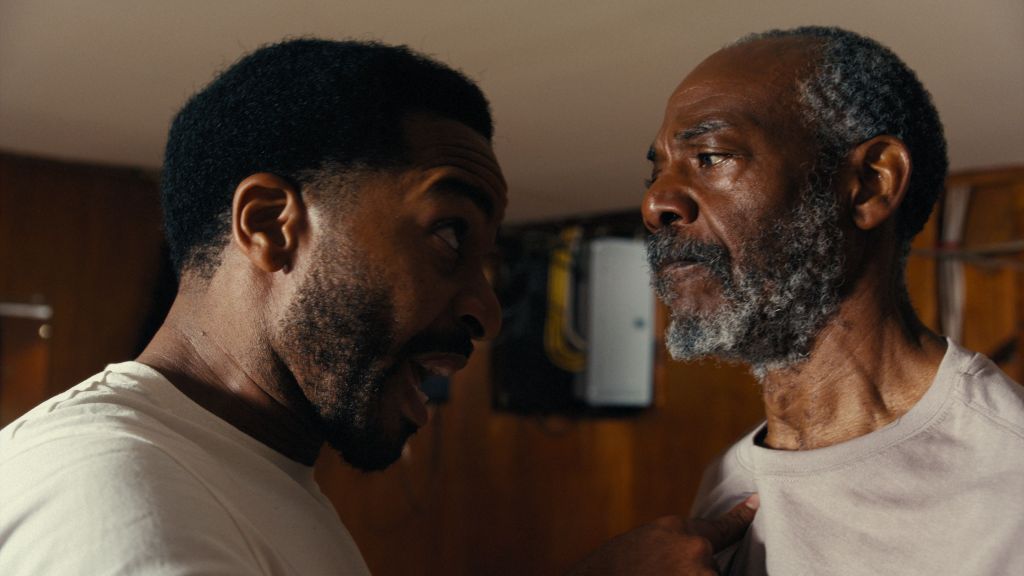
skid-row liquor store. But when he ends up in hospital, near-dead after a severe beating by a stickup crook, he decides it’s time to go clean. His brother offers him temporary shelter, and sends him to rehab. His estranged wife Joyce (Aunjanue Ellis-Taylor) forgives him once again in hopes of future familial reconciliation. But what does homeless La’Ron have to do with artist Tarrell? He’s his father, and bad blood flows between them. He taught his son that as a black man, no one will care about him, no one will help him, and unless he gets tough and works extra hard, he’ll never survive and no one will care. But to Tarrell, the abuse visited upon him by his father was mean, self-serving and
sadistic, exploiting his son’s labour to pay for his crack habit. And now La’ron shows up at his door again — what is it he wants now? Can father and son talk honestly? Has La’ron’s nature change? Can Tarrell ever forgive him? And can this extended family be saved?
Exhibiting Forgiveness is a multigenerational look at the hidden fissures and cruelty of masculinity unintentionally visited by fathers upon their sons. It’s rich and moving in its portrayals. The story is told both as a drama and as an artist’s representation of current and past events. We see Tarrell paint three youths; one of them his younger self (Ian Foreman). He later erases two of them by obliterating their images with whitewash on the canvas. In another he cuts his teenaged self out of a painting with an x-acto knife, later draping the missing image on a chair,
So I’m watching this movie with the striking canvases in the paintings — this is not just anonymous crap-art made-up for the movie, it’s the real stuff — but when Tarrell violates the art by splashes white paint or cutting it up… I was a bit disturbed, thinking, OK, the director is making a point, but he’s also destroying another artist’s work. So I looked him up afterwards: The director is an artist, the paintings are his, and cutting up and altering his own canvases is an integral part of his work. He’s primarily an artist, and this is his first film. Watching the movie, I liked the passion of the acting and the emotional (and physical) violence in the characters they portrayed. But once I connected it with Titus Kaphar’s physical art, it suddenly became something much bigger than the sum of its parts.
Exhibiting Forgiveness is an impressive first feature.
My Dead Friend Zoe opens this weekend in Toronto; check your local listings; and Exhibiting Forgiveness is now available on VOD.
This is Daniel Garber at the Movies, each Saturday morning, on CIUT 89.5 FM and on my website culturalmining.com.
Americans abroad. Films reviewed: Queer, September 5, Oh Canada
Hi, this is Daniel Garber at the Movies for culturalmining.com and CIUT 89.5 FM.
This week I’m looking at three new movies set in the 1950s, 60s and 70s, about Americans abroad. There’s a novelist in Mexico City, a TV sportswriter in Munich, and a documentary filmmaker in Montreal.
Queer
Dir: Luca Guadagnino (I am Love, A Bigger Splash, Call me by your Name, Suspiria)
It’s the 1950s in Mexico City. William Lee (Daniel Craig) is a middle-aged American writer addicted to heroine who hangs around local bar called Ship Ahoy. If he doesn’t get completely drunk he might spend the night with a man he meets. He’s friends with other flamboyant ex-pats, especially Joe (Jason Schwartzman) a portly, bearded man who shares Lee’s lascivious predilections. Lately, he has had his eyes on Eugene Alerton (Drew Starkey), an ex-GI who spends most of his days playing chess with an older red-haired woman. Eugene is no “queer”, but is up to talking with Lee.
After repeated drinks, and some opiates he eventually shares Lee’s bed in his seedy rental. Lee is smitten, Eugene content. Later the two head south in their quest for ever more potent drugs culminating in a journey toward the ultimate psychedelic experience. They end up in the Ecuadorean Amazon, in a remote shack guarded by a vicious but slow-moving three toed sloth. Inside, a mysterious doctor (Lesley Manville) holds the answers to all their questions. Is Eugene the man of his dreams? Will they ever reach hallucinatory
nirvana? Or is life just an illusion?
Queer is a bizarre, sex-and-drug-filled psychedelic fantasy. It’s divided into three chapters: their meeting in Mexico City; their journey south; and their adventures in Ecuador. It’s adapted from William S Burroughs’ semi-autobiographical novel written in the 1950s but not published for another 34 years. It swerves wildly between actual memoirs and pure imagination. Burroughs was a writer in the beat movement, and was married and had a son with another writer Joan Vollmer (perhaps she’s the red-haired woman Mary in the film).
The thing is, Queer is not a grave, serious movie, it’s a high-camp comic fantasy. Psychedelia has always been difficult to film, and there’s a fine line between the profound and the ridiculous. Some scenes, like the unfortunate semi-nude, interpretive dance sequence, falls on the (unintentionally) funny side. Others scenes were kinda cool. It’s a beautiful film to watch, for its music, set, costumes and art direction. Shot
entirely in Rome’s Cinecitta, it’s never meant to look realistic. Daniel Craig plays Burroughs not as the usual chill junkie observer, but as a panting and sweating horndog, with bulging eyes, nearly choking on his own lust.
If your looking for a sentimental romance a la Call Me by You Name, or a deeply profound meditation on psychedelic trips, this ain’t it. But if you just want a weird and funny drug-infused dream-filled movie with lots of soft-core gay sex, you’ll probably have a great time.
September 5
Co-Wri/Dir: Tim Fehlbaum
It’s September 5, 1972 at the Munich Summer Olympics and the crowds are roaring. Americans are glued to their sets watching the US cleaning up, with swimmer Mark Spitz winning an unheard of seven gold medals. ABC is the perennial loser of the top three networks. So their sportscasters are thrilled to have won exclusive coverage rights. The team behind the cameras are hard at work. Geoffrey Mason (John Magaro) is the newbie, trying to prove his chops. His boss Marvin (Ben Chaplin) wants things to run smoothly, and his boss’s boss (Peter Sarsgaard) is thinking of the bigger picture. Jacques (Zinedine Soualem) is their French cameraman with Marianne (Leonie Benesch) the only woman on the team, is a German journalist, and their de facto translator. Everything is great until they hear gunshots… not at the games, but at the nearby Olympic village. A group of masked militants, known as the Black September Organization is holding Israel’s Olympic team hostage.
Suddenly, the ABC sportscasters realize they are the only American TV journalists in Munich. They have the cameras, the boom mics and the broadcast and satellite rights ready to send stories home. They shift their telephoto lenses from pointing toward the swimming pools to the athletes’ dormitories, trying to catch a glimpse of the hostages. What
will happen next? Will German authorities step in? And can a sports crew handle crisis news?
September 5 is a journalistic thriller about 24 hours at the Munich Olympics. Despite its title, this isn’t about the Israel/Palestine conflict — they barely delve into it. That’s just the backdrop. What it really looks at is how a team of US journalists — at the right place at the wrong time — figure out how to get the news out even as the crisis grows. I love the period details: giant-sized spools of reel-to-reel videotapes, and how little white tiles on a black background were superimposed onto a sports channel screen. So cool. I’ve never heard of Swiss director Tim Fehlbaum before, but he keeps the action moving in the midst of constantly shifting mayhem. The acting is ok, but best by far is Leonie Benesch who starred in last year’s The Teacher’s Lounge. I went into this movie full of dread. It’s clearly Oscar-bait; Hollywood churns out journalistic dramas every year. But this one is surprisingly good, and had my heart pumping all the way through. If you’re looking for some journalistic excitement, check out September 5.
Oh Canada
Co-Wri/Dir: Paul Schrader (First Reformed)
Based on the story by Russell Banks
Leo Fife (Richard Gere) is a renowned documentary filmmaker in Montreal. He is getting ready for an interview in his own living room in the grand old home he shares with his wife Emma (Uma Thurman). The director, Malcolm (Michael Imperioli) and his crew are longtime admirers of Leo’s legendary work. After crossing the northern border in the 1960s to protest the war in Vietnam, he ended filming docs that changed the course of history. He uncovered the use of Agent Orange at the military base in Gagetown, New Brunswick, and became a university prof teaching young journalists how to make movies. Now, decades later, Leo is on his deathbed, dying of cancer, so Malcolm wants to record his final thoughts.
Leo treats this film as a confession — he wants to clear the record. He starts by talking about his first wife and son, a family he left behind in Virginia. But she’s not the only skeleton in his closet. His past life is full of lies, deceptions and possibly terrible acts. Emma doesn’t like him talking like this and wants him to stop. Leo’s nurse thinks can’t take all this stress. But the filmmakers persist and Leo perseveres. Are any of his stories true? Was he a good man or a bad man? And what do we really know about Leo Fife?
Oh Canada is a fictional story about a day in the life of an American filmmaker and activist recalling his past. It’s a simple concept with a slight plot. It’s structurally divided between the documentary being made about him, and his
hidden past, shown in a series of flashbacks (He is played by Jacob Elordi as his younger self.) The film is almost too simple. But with Paul Schrader at the helm, you know there’s going to be more to it. He wrote Taxi Driver and Raging Bull for Scorsese, and directed movies like The Yakuza (1974) First Reformed (2017) and American Gigolo (1980) that also starred Richard Gere.
Unfortunately, Gere is the weakest part of this film; he rants and complains, but there’s no heart in his performance. The film’s called Oh Canada, but it’s really Oh America. It was entirely shot there, with so-called Canadian characters using americanisms like “restroom”. What’s interesting is Schrader’s use of false visual narratives. There are flashback scenes where Elordi as a young Leo is suddenly replaced by a contemporary Gere while all the other characters remain unchanged. Likewise, the names of past lovers seem to melt away. Perhaps Leo has dementia, or maybe this contrasts Leo’s current story with his past truths. Also interesting is the way we see Leo’s face throughout the eye of Malcolm’s camera, giving it a meta aspect that messes with your brain.
Oh Canada is not one of Schrader’s better films, but there’s enough stuff going on to keep it intriguing.
Oh Canada, Queer and September 5 all open this weekend in Toronto; check your local listings.
This is Daniel Garber at the Movies, each Saturday morning, on CIUT 89.5 FM and on my website culturalmining.com.
Unobtainable, unsustainable, inevitable. Films reviewed: Bookworm, Monkey on a Stick, Smile 2
Hi, this is Daniel Garber at the Movies for culturalmining.com and CIUT 89.5 FM.
Toronto Fall Film Festival season continues with Rendezvous with Madness presenting docs and dramas, features and shorts, about addiction and mental health followed by in-person discussions, starting on October 25th.
But this week, I’m looking at three new films, a kids’ movie, a doc and a horror film. There’s a precocious girl looking for the unobtainable; a group of deranged gurus trying to hold onto the unsustainable; and a pop starch wants to escape the inevitable.
Bookworm
Co-Wri/Dir: Ant Timpson
Mildred (Nell Fisher) is a young girl who lives with her mom in New Zealand. She loves reading but hates school. Her desk is surrounded by leather-bound books alongside a microscope, a telescope, a typewriter and a record player. She talks like a grownup, and is obsessed by wild animals. Her dream? To catch on film a black panther said to be roaming in the woods (along with a big fat cash prize for anyone who can take a picture of it.) But her plans all change when her mother is sent to hospital in critical condition following an exploding toaster. That’s when her biological father comes into the picture. He flies in from America to save the day.
Strawn (Elijah Wood) is a professional magician — he prefers “illusionist” — who loves magic: like making small things disappear or pulling coins from behind someone’s ears. Most people are wowed by Strawn’s prestidigitations and puppy dog eyes, but not Mildred. She scoffs at magic and is quick to reveal all his tricks. They two are opposites at heart. If you say “David Copperfield” she thinks of Dickens while he thinks of the
magician. Nonetheless, they are stuck together for now, so he agrees to take her camping. But little do they know of the exciting adventures and frightening dangers — like criminals, wild animals and crazy escapes — that lie ahead.
Bookworm is a very cute coming-of-age adventure about two strangers put together to form a makeshift family. It feels like a cross between a Roald Dahl Matilda and Taika Waititi’s Hunt for the Wilderpeople. It’s shot in the New Zealand wilderness amidst stunning mountains, cliffs and lakes. Nell Fisher is adorable as the obnoxiously mature Mildred, while Elijah Wood is equally adorable as the man-child who won’t grow up. I wanted to see this one because I loved director Ant Timpson’s bizarre debut, the violent comedy Come to Daddy. Bookworm is as different as any film could be but just as enjoyable.
I liked this one a lot.
Monkey on a Stick
Dir: Jason Lapeyre
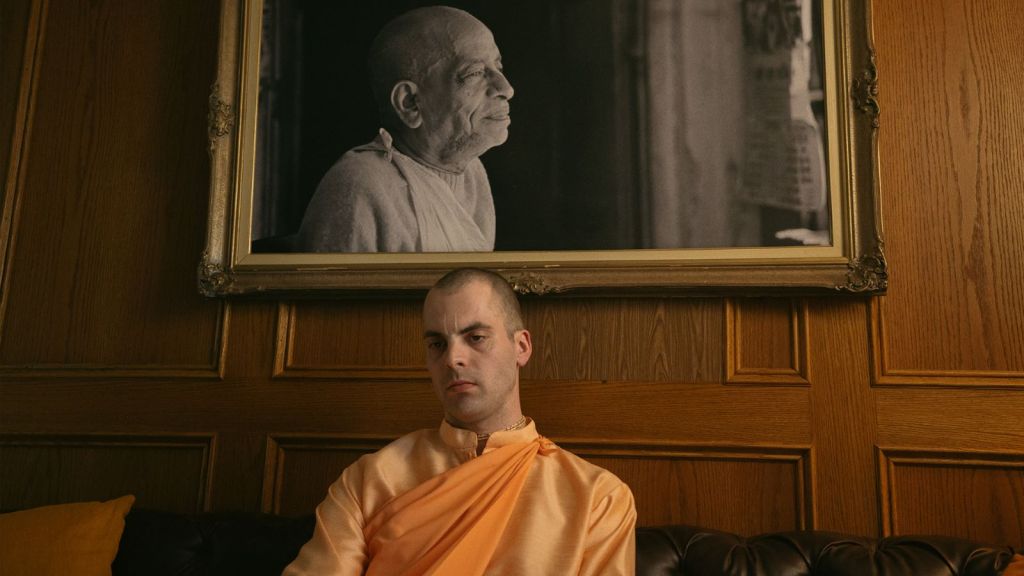
It’s 1965 and America is in high hippie mode. A. C. Bhaktivedanta Swami Prabhupada arrives in New York City from Calcutta. He’s there to sell books, including his own translation of the Baghdad Gita. But he ends up heading the Hare Krishna movement, a vast multinational phenomenon, a religion that espouses dancing, singing and chanting mantras in order to achieve a better afterlife. After picking up many devotees in New York, the movement exploded in popularity once he reaches California. Allen Ginzburg endorses it and George Harrison writes a song about it. Countless people join the religion, throwing away material possessions to dance, chant and collect alms in airports. But when the Swami dies, he leaves behind eleven gurus. That’s when things start to fall apart. This documentary — based on a bestselling book — exposes the crimes and excesses of the Hare Krishna movement in the 1970s and 80s.
One guru — in order to generate more money — sets up a drug ring of devotees instructed to smuggle hash from Pakistan to Canada. They have ties to the mob, leading to a series of violent crimes until it is finally exposed. Another guru collects automatic weapons, and goes on a shooting spree in California. A third guru — a self-declared Swami — the scariest of them all, builds himself an ornate golden castle in West Virginia, while his disciples — who have given away all their worldly
possessions — live in a shanty town beside the castle without toilet paper or plumbing. He later plans murders and is suspected of molesting children.
In fact, the movement as a whole is riddled with problems. Women are treated as inferior beings who distract male practitioners from their religious obligations. Homosexuality is strictly forbidden as is all sex outside marriage. And heavy censorship prevails — no TV, magazines, newspapers, movies, or books are allowed, except for one official newspaper. And by the second generation — the 1970s and 80s, when most of the documentary takes place — kids are sent to schools with teachers who have no training. They lock kids in dark closets or dump them in trashcans as punishment, among even worse crimes.
Monkey on a Stick is a documentary that looks at crimes of the Hare Krishna movement. It’s told using talking heads — including former devotees — period footage, and many reenactments, with actors visually demonstrating what the narrators are talking about. There’s also a series of random people sharing their views on religion, God and the afterlife. Though quite disturbing in parts, on the whole, it’s a fascinating story that exposes events I had never heard about before.
Smile 2
Wri/Dir: Parker Finn
Skye Riley (Naomi Scott) is a pop superstar, about to launch a worldwide tour. She lives in a luxury apartment on Park Avenue, and can buy anything she wants. She’s busy 24/7 at dance rehearsals, talk show appearances and autograph signings, under the constant supervision of her stage mom (Rosemarie DeWitt) and her PA (Miles Gutierrez-Riley). It’s her big comeback, after a year of rehab. This follows a bout of addiction culminating in a terrible car crash that killed her boyfriend and put her in intensive care. A year later, she still suffers from intense pain, pain so bad she is forced to buy opioids on the sly. But everything changes when she witnesses her high school friend (and drug supplier), Lewis (Lucas Gage) kill himself in front of her eyes in the most gruesome manner imaginable. And he dies with a rictus grin plastered on his face.
That’s when things start to go bad. Everywhere she looks she
sees that awful smile. It’s like she caught a disease by witnessing her friend’s death. She starts seeing people who aren’t really there, and experiencing events that never happened — even though they feel so real. She begins to doubt her sanity. It’s like some alien presence has lodged itself into her brain. Her friends, family and colleagues look at her in a strange way, even as she fears she’ll end up dead in a matter of days, with that same awful smile. Can she break this smile cycle? Or is she headed for insanity and death?
Smile 2 is a genuinely-scary psychological thriller/ horror about fame, celebrity, and a deadly condition passed on from person to person. It’s also one of those Hollywood rarities: a sequel that’s demonstrably better than the original. Naomi Scott is terrific as Skye, a punky, self-centred celebrity; Skye’s not just a horror movie screamer, she’s a real character, complete with a psyche and a believable back story. The movie itself is really well made, with beautiful art direction, cool choreography, and ingenious camerawork and editing, where a scene can flip, elliptically, from an elevator ride to an overhead view of the street. Warning: it’s quite violent, so if you don’t like seeing blood and guts, stay away. But otherwise, Smile 2 is a really good, heart-pounding genre movie.
Bookworm, Monkey on a Stick and Smile 2 all open this weekend in Toronto; check your local listings.
This is Daniel Garber at the Movies, each Saturday morning, on CIUT 89.5 FM and on my website culturalmining.com.
Actors. Films reviewed: Look at Me, Hey Victor PLUS CFF
Hi, this is Daniel Garber at the Movies for culturalmining.com and CIUT 89.5 FM.
Spring has not yet sprung, but it should kick in soon with the Canadian Film Fest on March 18-23rd, at the Scotiabank Theatre in Toronto. With features and shorts, including world premieres, there’s something for almost everybody. It opens with a film about a Trinidadian who comes to Toronto to sell doubles from a street stall to try to help his estranged, dying dad. It’s called Doubles. There’s a drama about Syrian refugees called Valley of Exile by Anna Fahr; a science fiction comedy called With Love and a Major Organ… that organ being a removable heart. (Directed by Kim Albright.) And the festival is closing with The Burning Season by Winnipegger Sean Garrity, starring his longtime collaborator Jonas Chernick. So if you’ve never been to the Canadian Film Fest, maybe you should give it a try this year — the movies are surprisingly good.
But this week I’m looking at two more Canadian movies, both about actors playing fictional versions of themselves. There’s an indigenous former child actor trying to rescue his career, and a needy actor who craves attention but hates his own looks.
Look at Me
Wri/Dir: Taylor Olson
Taylor (Taylor Olson) is a handsome, young actor in Halifax with a square jaw and strawberry blond hair. He loves attention (Look at me! Look at me! Look at me! is every actor’s driving force). He’s also an insecure, body-conscious guy, with an eating disorder. He binges, he purges, he vomits into the toilet. Sometimes he lifts weights to build up muscle, or fasts so his body will look more desirable — whether at an audition or on an online dating site. But when he gains weight he hates himself — he’s fat-phobic — and the cycle starts up again. He has casual sex with girls and guys he meets. He even forges a long-term relationship with a single mom he loves (Stephanie
MacDonald)… but how long can it last?
Look at Me is a B&W, fictional autobiography on film, a scathing — and humorous — self-examination that exposes Taylor’s innermost thoughts and fears. His face and body morphs almost on camera, as his insecurities rise to the surface. Based on his play, this is Taylor’s funny and tragic cri de coeur, about vanity, fat phobia, and self-loathing.
An excellent performance.
Hey, Viktor
Wri/Dir: Cody Lightning
Cody (Cody Lightning) is an actor who has fallen on hard times. His most famous role was as a child actor in the film Smoke Signals, 25 years earlier. He played young Victor, Adam Beach’s character, as a child. But it’s been a downward spiral since then. Now he’s a sloppy, washed-out drunk, swigging from his mickey as he stumbles through his day.
Only Kate (Hannah Cheesman) a beanpole blond and his best
friend and manager, still cares about him. She helps him him eke out work in his profession, if not exactly what he’s looking for. Like roles in gay-for-pay porn movies (ouch!) and teaching kids acting lessons. He and Kate have written dozens of scripts but none have taken off.
Thing is, Cody is dead-set on doing a sequel to Smoke Signals, possibly Hollywood’s first movie with an all-indigenous director, writer and cast, including Adam Beach, Gary Farmer, Irene Bedard, Simon Baker, and Cody himself. (Kate claims to have Cherokee blood, but no one takes it seriously.) But you can’t make a movie without money. As luck would have it, they meet a crazy, gun-toting German pawn broker (Phil Burke) who happens to be a huge fan of that film. He says he’ll put up all the money as long as the original cast are in the sequel. Can
Cody pull himself together enough to make a movie? Can he find a full crew willing to work on it? And what about all those actors? And will he actually spend the money on the film or just dive headfirst into a bucket of cocaine?
Hey Viktor is a bawdy and raunchy comedy about an indigenous actor trying to rescue his career. It’s full of outrageous stunts, like attempting to throw a live baby out of a window. Aside from a few (very funny) side characters, almost everyone plays a fictionalized version of themselves, all using their real names. I thought it was pretty funny, varying wildly between tongue in cheek satire and in your face humour. But most of all this is a show piece of Cody Lightning himself, the writer, director and star. He strips down and exposes… well, everything, with the hope of baring his soul.
And it works.
Hey, Viktor opens next week in Toronto; check your local listings. Look at Me premieres at the Canadian Film Festival on March 19th.
This is Daniel Garber at the Movies, each Saturday morning, on CIUT 89.5 FM and on my website culturalmining.com.
Women at work. Films reviewed: I.S.S., Memory, The Teachers’ Lounge
Hi, this is Daniel Garber at the Movies for culturalmining.com and CIUT 89.5 FM.
In traditional movies (and even contemporary ones) men are typically portrayed at work with women at home. But that’s not real life for most people. So this week I’m looking at three new movies about women around the world at work. There’s a social worker in New York who meets a man with dementia; a teacher in Germany with a rebellious student; and an astronaut in space interacting with cosmonauts.
I.S.S.
Dir: Gabriela Cowperthwaite (review: Our Friend)
It’s present day in the thermosphere. Kira (Ariana DeBose) is a biologist on board the international space station, manned equally by Russians and Americans, an example of world peace, scientific cooperation and mutual respect. It’s her first day in space, and she feels weird and queazy living without gravity. She does love the cake and vodka, though. The space station has a ramshackle feel to it, with exposed wires and old video screens, but gets used to it pretty soon.
She’s there to conduct experiments on mice, alongside her Russian counterpart Alexey (Pilou Asbæk). Also on board are Gordon (Chris Messina) a moustached astronaut, and Christian (John Gallagher Jr.) a US Air Force officer; and on the other team, the beautiful and glamorous cosmonaut Weronika (Masha Mashkova) and Nicolai (Costa Ronin), representing the Russian military. Gordon and Weronica — who seem especially close — are impressively bilingual, while the rest get by with broken English and Russian.
In honour of her first day in space, Kira’s teammates show her something very few people have ever seen: a view of the peaceful, blue planet without conflict or national boundaries. But everything changes a few days into her voyage, when communication breaks with earth and secret messages arrive to both teams: Since the US and Russia are in conflict on earth, they’re ordered to seize control of the space station…by any means necessary. What is really happening down there? Can international friendship override their planetary orders? Or is the space station doomed?
I.S.S. is a classic, smart, sci-fi space opera with a contemporary twist. The acting is not bad, though I had trouble distinguishing between the two Russian men who have similar builds, faces and brown beards. And at the beginning of this movie, the non-gravity scenes looked very fake. But after a few minutes everything looked normal again. I liked the taut structure of the film, the constant tension, and the shifting if alliances among the six players. The film also takes you out of the ship, into an unplanned and untethered journey in space. There’s even a guest appearance by the famed Canadarm, but this one was clunky and concrete and a little bit dangerous. With geopolitics as fragile as they are these days, this film’s themes seem especially appropriate. While there is some violence, ISS kept me interested the whole time.
Memory
Wri/Dir: Michel Franco
(review: New Order)
Sylvia (Jessica Chastain) is a social worker in New York at a home for adults with mental disabilities. Sylvia goes to AA meetings regularly; she’s stayed totally dry since the year before her 13-year-old daughter Anna (Brooke Timber) was born. They occasionally spends time with Sylvia’s sister Olivia’s family (Merritt Wever), but she’s very protective; she doesn’t want Anna to start drinking, smoking or taking drugs with her cousins. One evening, heading home after a high school reunion, she notices a man looking at her. He follows her home from a distance and spends the night outside her door in the pouring rain. Who is he and what is their connection? His name is Saul (Peter Sarsgaard) and — according to the card he wears around his neck — his emergency contact is his brother Isaac (Josh Charles).
Sylvia painfully remembers Saul as part of a group of older boys who sexual abused her when she was still in Junior High. It was one of a number of incidents that drove her to the alcoholism and depression she still carries with her. She agrees to meet him in the park so she can make him answer for his crimes. But to her chagrin she learns he has severe memory loss caused by early-onset dementia. She also
discovers — through a third party — that he could’t have attacked her; he hadn’t even moved to that area yet when the incidents she remembers took place.
Later, Isaac hires her as a part-time caregiver — he says Saul never stops talking about her. She’s just supposed to keep him company in his home and make sure he doesn’t wander away. This puts them in a strange situation. He clearly likes her… but does she have feelings for him? And what will happen if their relationship changes from caregiver/patient to lovers?
Memory is a terrific drama about two troubled adults learning to understand each other despite their own deficits. It’s filled with shocking plot turns and secret revelations that totally change your perception as it goes. But through it all, the heart and warmth of the main characters always comes through. I wanted to see this because it’s by the fantastic Mexican filmmaker Michel Franco (the stunning New Order in 2020), but this one is totally different. While it also deals with issues of class, crime and family, it is as thoughtful and complex as New Order is hair-raising and revolting. Memory comes through as an unexpectedly powerful film while retaining a lightly playful and always unpredictable core.
Really interesting movie.
The Teachers Lounge
Co-Wri/Dir: Ilker Çatak
A public school in present-day Germany. Frau Nowak (Leonie Benesch) is a new, Grade 4 teacher, and her kids just love her. She has them instantly clapping twice when noise gets out of hand, and chanting answers to her when she poses daily questions. She does trust games, physical exercises and is always positive, but doesn’t let cheaters get away with it. She also encourages the kids to be creative in problem solving, especially, Oskar (Leonard Stettnisch), clearly the smartest kid in the class.
Between classes, she rests in the teachers’ lounge. But there’s trouble brewing. Someone is stealing cash from other kids’ wallets, and her students are forced — not by Frau Nowak — to point out potential suspects, who are pulled out of class by the admin. This leads to a feeling of distrust and tension. She thinks the problem isn’t with the kids, it’s with grownups — she sees teachers pilfering money from the coffee fund piggy bank. So one day she deliberately leaves her wallet in her jacket and steps out with her laptop set up to tape everything while she’s gone.
Sure enough, she notices some of her money is missing, and an arm (though no face) in a distinctive blouse is recorded reaching into her pocket. She privately confronts a woman wearing the same blouse that day and demands her money back. The woman Frau Kuhn (Eva Löbau) vehemently denies it. She’s a longtime staff who manages the school office, while Frau Nowak is a newcomer. The case goes to the principal’s office and Frau Kuhn is put on leave. The problem is, Oskar — the top student — is Frau Kuhn’s son. And he demands Frau Nowak publicly apologize for lying about her mom — or she’ll
regret it. The news goes viral among the students, staff and even the parents, till it spirals out of control. Can this problem ever be resolved? Who, if anyone needs to apologize? And what will happen if they don’t?
The Teachers’ Lounge is a fantastic drama that explores school life from a dozen angles. While the story is told from Frau Nowak’s point of view, it brings in tons of distinct characters, from the kids in her class, to the journalists at the school paper, to the complaining parents, the gossipy teachers, the bullies, the teachers pets, and the ordinary students just trying to fit in. Leonie Benesch is amazing as Frau Nowak, as she struggles to maintain control while doing the right thing as she sees it, even as she sees her students’ trust crumbling around here. This is a realy great movie, deep, realistic, moving and really well-acted. It’s Germany’s entry as best foreign language film at the Oscars, and I can see why.
Excellent movie.
Memory, I.S.S., and The Teachers’ Lounge all open this weekend in Toronto; check your local listings. And for some great new Canadian films, shorts and docs, be sure to check out the Milton Film Festival next weekend, January 26-28 at the FirstOntario Arts Center, in Milton.
This is Daniel Garber at the Movies, each Saturday morning, on CIUT 89.5 FM and on my website culturalmining.com.
Unexpected adversaries. Films reviewed: White Noise, Violent Night, All the Beauty and the Bloodshed
Hi, this is Daniel Garber at the Movies for culturalmining.com and CIUT 89.5 FM.
It’s December now with snow on the ground, time for movies to get your blood boiling. This week I’m looking at three new movies about unexpected adversaries: there’s an artist vs a philanthropist, Scrooge vs Santa… and Elvis vs Hitler?
Wri/Dir: Noah Baumbach,
It’s the 80s in a small rustbelt college town. Jack (Adam Driver) is a professor in the new field of Hitler studies. Along with his wife Babette (Greta Gerwig) they raise their children, from babies to teens, in a modern, blended family. The kids Denise, Heinrich, Steffie and Wilder, are inquisitive and precocious, and come from various marriages. At work, Jack lectures to worshipful students, and has intellectual discussions with his colleagues. His closest is Murray (Don Cheadle), a prof who specializes in cinematic car crashes, wants to raise Elvis studies to the level of Hitler studies.
But there is trouble at home. Babette is obsessed with death and dying, and suffers from memory loss and unexplained absences. Denise suspects she’s on prescription drugs — she found a hidden bottle of Dylar, an unheard of medicine. Meanwhile Jack is terrorized by nightmares and at times actually thinks he’s going to die. All these troubles are pushed aside when a real disaster happens: a truck crashes into a train carrying dangerous chemicals. The result? A toxic cloud floating above the area with unknown effects. The town is
evacuated, the family forced to flee by station wagon to Camp Daffodil a weirdly-named military base. Rumours abound at the camp, and no one knows for sure what is happening. Can life return to normal? Will the toxic cloud blow away? Is Babette an addict? Will Jack’s academic secrets be revealed? And where does Dylar come from?
White Noise is a satirical look at dread, suspicion and alienation within an academic setting. It also looks at pop culture, art and the omnipresent consumer economy. I read Don Delillo’s novel
when it first came out and I was captivated by the way it captured the dark mood at the time. Noah Baumbach takes a different path, treating the film as a comical period piece where people dress in funny 80s clothes and use obsolete technology. It looks for laughs in scenes like Jack getting tangled up in a kitchen phone cord. I have mixed feelings about this movie. Some parts just seem like running gags about those wacky 80s, turning serious scenes into absurdist jokes. Other parts are brilliant — like the pas-de-deux between Jack and Murray in a joint Hitler-Elvis lecture. Or an actual dance sequence down the aisles of a supermarket in the closing credits. And a cameo by the great Barbara Sukowa as a German nun in a hospital, should not be missed. While I couldn’t get emotionally into the characters or plot — Driver and Gerwig are both good actors but never seem real in this movie — and I felt detached from the film, I did find it interesting and visually pleasing.
Dir: Tommy Wirkola
It’s Christmas Eve, and the Lightstone family are gathered on their vast, private estate. Gertrude (Beverley D’Angelo) their autocratic matriarch, puts on an elaborate dinner each year with servants dressed as Nutcracker Suite characters. Her adult two adult children Cam and Alva, their spouses, and the grandkids Gertrude and Bertrude, (known as Trudy and Bert)outdo one another sucking up to her, to get their share of the family’s wealth. Everyone, that is, except little Trudy (Leah Brady), who doesn’t want any money or presents from Santa. She just wants her estranged parents back together again.
This year, though, something goes terribly wrong: the costumed caterers turn out to be highly-trained paramilitary criminals, there to murder everyone and steal millions from the safe. They’re headed by a bitter man, nicknamed Scrooge (John Leguizamo) who hates Christmas. Little Trudy escapes from the family, hides in the attic, and calls to Santa Claus by walkie-talkie for help. And, to everyone’s shock, a drunken, bearded man in Christmas gear (David Harbour) comes to their rescue. He’s the real thing, but only Trudy believes in him. Can Santa and Trudy fight off dozens of ruthless killers? Can her parents overcome their differences? And can a worn-out, depressed and alcoholic Santa hang on for one more year… or is this the end of Christmas for everyone?
Violent Night is a comedy/action movie about a good little girl
and a hard-ass Santa fighting cruel killers using horrific violence of their own. It’s a combination of two Christmas classics: Home Alone and Die Hard, but with the gore-level pumped up a few notches. Trudy’s booby traps turn out to be deadly, while Santa channels his past life as a Viking to wreak havoc with a hammer named Skullcrusher. Does this movie work? Totally! David Barbour (from Stranger Things) is great as a nasty Santa who pukes and pisses off his sleigh. He takes a licking but keeps on kicking. Newcomer Leah Brady as Trudy is cute — maybe too cute — but good enough. And most of the rest of the characters are sufficiently unlikeable to keep the story going. So if you’re looking for a fun and twisted action movie in time for Christmas, Violent Night fits the bill.
All the Beauty and The Bloodshed
Dir: Laura Poitras
Nan Goldin is an artist known for her photographic portraits of the demimonde, with louche images of drugs, sex, and self-destruction. She rose to fame in the 1980s with her ever-changing performances of “The Ballad of Sexual Dependency”, which combined music and a slide show of her pictures. But far from being a dispassionate observer of the lives of strangers or, worse, an ogler of outcastes, Goldin explicitly documented the lives of her closest friends and herself, including drag queens, junkies, artists and musicians, in various stages of undress. This was also the era of AIDS, which decimated the NY City art scene. Goldin recorded this, too. It was also the start of Act Up and other movements demanding attention from the government and Big Pharma.
Flash forward to the 2000s, when pharmaceutical
corporations, through doctors, were strongly pushing prescriptions of opiates as non-addictive relief from the worst levels of pain. In fact they’re highly addictive, and one addict was Goldin herself. Though she kicked the habit, many were still dying from overdoses of opioids. And she noticed something strange. A major sponsor of the galleries and museums that displayed her work were sponsored by noted philanthropists The Sackler Family. And the Sacklers made their fortune through Purdue Corporation, peddling drugs like Oxycontin. We’re talking the Louvre, the Met, Tate Modern, and the Guggenheim, among others. So she started a protest group called P.A.I.N. (Prescription Addiction Intervention Now) which stages protests in the Sackler wings of museums world-wide.
All the Beauty and The Bloodshed is a fantastic documentary that records Goldin’s life and art, and her battle with the Sacklers. It’s engrossing and revealing, a work of art in its own right. The film includes contemporary footage as well as snapshots and films from Nan Goldin’s own personal history. She’s the cinematographer while the director is Laura Poitras, responsible for the world-changing doc Citizenfour, about Edward Snowden. All the Beauty and the Bloodshed is a rare case of a political documentary that is also respectful of art. It’s visually and audibly stunning and though almost two hours long, it’s totally engrossing; one of the best documentaries of the year.
White Noise is screening at the TIFF Bell Lightbox in Toronto; All the Beauty and the Bloodshed, is playing there and at Hot Docs cinema; while Violent Night opens this weekend across North America; check your local listings.
This is Daniel Garber at the Movies, each Saturday morning, on CIUT 89.5 FM and on my website, culturalmining.com.
Advances in Technology. Films reviewed: The Automat, Dope is Death, After Yang
Hi, this is Daniel Garber at the Movies for culturalmining.com and CIUT 89.5 FM.
Technology, whether we find it good or bad, always affects our lives. This week, I’m looking at three movies — two documentaries and a science fiction drama — that look at advances in technology. There’s a new type of restaurant a hundred years ago that sells hot food out of metal and glass dispensers; a clinic 50 years ago that uses acupuncture to detox heroin addicts; and a future world where androids serve as siblings.
Dir: Lisa Hurwitz
It’s the 1920s in New York and the city is booming. 300,000 women work as stenographers and they — along with everyone else — all need to eat lunch. And one modern restaurant chain, Horn & Hardart’s Automat, is serving them all. Art Deco palaces welcome anyone with a nickel to buy a slice of pie or a cup of steaming French-press coffee expelled through shiny brass dolphin heads. Customers share marble topped tables with whoever sits down beside them. And behind stacks and rows of pristine glass and metal drawers, a nickel or two dropped in a slot opens the door to a single servings of macaroni and cheese, creamed spinach, baked beans, or Salisbury steak all made at a central commissary and shipped out that very same day. At its peak they served 800,000 diners each day in NY and Philadelphia (where the chain was founded). But what goes up must come down. I wandered into an automat just once as a teenager and never went back. It was disgusting, the food looked unpalatable and aside from the novelty of buying a stale, egg salad
sandwiches behind a little glass door, I couldn’t see why anyone would go there. But its fans from earlier generations remember it well, swearing by their specialties like strawberry rhubarb pies.
The Automat is a fun and breezy look at this fabled restaurant chain, and its rise and fall. It interviews former owners, staff and customers, including celebrities like Mel Brooks and Carl Reiner. And although the doc was shot pretty recently, many of the featured interviewees — like Ruth Bader Ginzburg and Colin Powell — have sadly passed away. This is an interesting doc about an almost forgotten phenomenon.
Wri/Dir: Mia Donovan (Inside Lara Roxx)
It’s the early 1970s in the South Bronx, NY and heroin use is rampant. Nixon has declared a war on drugs, devoting money to incarceration and maintenance programs (like methadone), but nothing for detoxification and ending addiction. So black, brown and white activists in groups like the Black Panthers and the Young Lords decided to take action. They occupied Lincoln Hospital and managed to open a detox clinic there. The program was led by Dr Mutulu Shakur, (that’s Tupac Shakur’s step-father, and a separatist activist in the Republic of New Afrika movement.) who tried something new — acupuncture! A half dozen medics went up to Montreal and returned a couple years later as medically-trained acupuncturists, staffing the new clinic, specifically to
relieve drug addicts from their need for heroin.
Dope is Death is a brilliant, politically-informed historical documentary that looks at all the people involved in this movement— interviewing former addicts, acupuncturists and political activists. Sadly many were jailed or went underground following a brutal FBI crackdown. This film includes pristine colour footage from the era, along with period posters, photos, and audio and video interviews. Although most of the film is set in NY city, the story takes us exotic locales from Montreal to Beijing. Sadly this fascinating doc was released during covid, but it’s finally showing on the big screen one day next week in Toronto.
Dir: Kogonada
It’s the near future somewhere in the world. Kyra and Jake (Jodie Turner-Smith, Colin Farrell) are a happily married couple with a daughter named Mika (Malea Emma Tjandrawidjaja). To help Mika cope with differences (Mika is Black and English, Jake white and Irish, and she was adopted as an infant from mainland China) they purchase an android named Yang. He is programmed to help Mika discover fun facts about her heritage and learn to speak Chinese. Yang (Justin H Min) is like a gentle adult brother, there to explain and comfort her while her parents are away (mom works in an office, while dad sells tea leaves — his obsession — out of a small shop). But when Yang malfunctions and stops working altogether, that is, he dies, little Kyra is devastated,
sending the family on a downward spiral. It’s up to Jake to try to bring them back together by preserving Yang’s thoughts and memories. But in trying to save him, Jake discovers new things about their lives, and Yang’s, things he knew nothing about.
After Yang is an unusual science fiction movie, without space ships, laser beams, or violence of any kind. In this future world people (or at least this family) live in stunning glass and wooden houses and dress in colourful hand-sewn clothing. They hilariously compete as a family in online dancing competitions (this has to be seen to be believed). Jake’s investigations
uncover Yang’s hidden past lives, before he lived with them, including a woman he was in love with. This is a very low-key and visually-pleasing look at a future just like our present but prettier… and where artificial intelligence plays a crucial part in our lives. It also deals with privacy, death, technology and everyday middle class problems. The director incorporates experimental film techniques in the movie, things like multiple repetitions of some of the lines to convey the way we — or an android — might remember things. Characters rarely show strong emotions; everything is repressed. And to tell you the truth, not much happens. So while not completely satisfying, After Yang is still a pleasure to watch.
After Yang opens this weekend in Toronto; check your local listings. And Hot Docs Cinema is featuring special screenings of The Automat and Dope is Death next week, with the directors present for Q&As; go to hotdocs.ca for details.
This is Daniel Garber at the Movies, each Saturday morning, on CIUT 89.5 FM and on my website, culturalmining.com.
In depth. Films reviewed: The Velvet Underground, Kímmapiiyipitssini: The Meaning of Empathy, The Power of the Dog
Hi, this is Daniel Garber at the Movies for culturalmining.com and CIUT 89.5 FM.
We are all flooded each day with new images and stories, both broadcast and online, but don’t they all seem to be fleeting and ethereal, lasting no longer than the average news cycle or two. Rarely do we get in-depth examinations of anything. But movies can do that, opening your eyes to deeper thoughts. So this week I’m looking at three new movies — a western and two feature-length docs —that look at things up close. There’s cowboys in Montana, First Nations in Alberta, and avant-garde rockers in Greenwich Village.
Wri/Dir: Todd Haynes
It’s the early 1960s. Lou Reed is a Brooklyn-born teenager who lives in suburban Long Island. He’s depressed and his parents send him for electroshock therapy. He teaches himself guitar listening to doo-wop and rockabilly on the radio. Later at university in Syracuse, he studies under Delmore Schwartz. He goes to Harlem with his girlfriend to buy hard drugs and writes poems about furtive sex with men he meets in dark alleys. John Cale is the son of a coal miner in Wales who studies classical music in London. They meet in the Village and start a band within the exploding world of avant-garde film, music, art and poetry. Velvet Underground plays long, drawn-out tones with a dark drone grinding in the background, combining Reed’s dark lyrics and Cale’s musicality (he plays viola in a rock band!) They perform at Andy Warhol’s Factory and Nico, the enigmatic European
actress, completes their sound. Though never a huge success and breaking up after a few years, the Velvets influenced generations of musicians.
This two-hour doc looks at the band itself (Reed and Cale, along with Moe Tucker and Sterling Morrison) and where it fit within New York’s burgeoning underground scene. Aside from the usual suspects, it talks about or interviews unexpected faces,
musicians Jonathan Richman and Jackson Browne, and experimental filmmakers like Jonas Mekas and Jack Smith. Aside from its meticulous retelling of group’s history, it’s the look of this doc that really blew me away. Todd Haynes exploits that era’s avant-garde film techniques, from split screens to three-quarter projections, along with a good dose of 60s pop culture. And there’s a constant stream of music from start to finish, including rare tracks of early songs before they found their groove. I had to watch The Velvet Underground on my laptop but this beautiful documentary deserves to be appreciated on a movie screen.
Kímmapiiyipitssini: The Meaning of Empathy
Dir: Elle-Máijá Tailfeathers
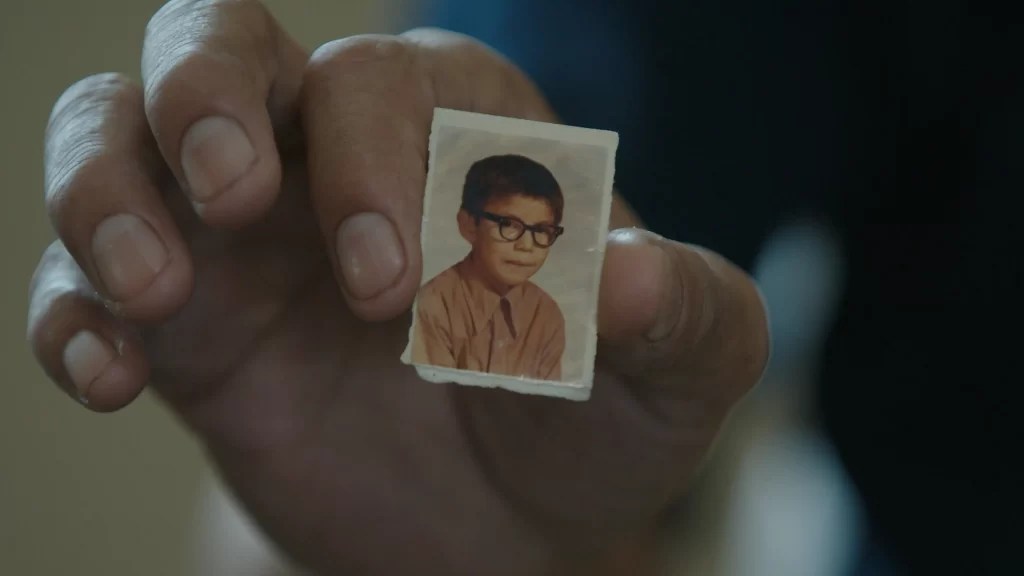
It’s the mid-2010s and opioids are ravaging the Kainai Blackfoot First Nation in Alberta (that’s the largest reserve in Canada). Families are torn apart, and hundreds of lives are lost. The abstinence and cold-turkey programs just aren’t working, especially for the most marginalized, who end up homeless in cities. So instead they start up harm reduction centres like those pioneered on the streets of Vancouver’s Downtown Eastside. This highly-personal documentary follows a number of addicts — of both opioids and alcohol — as they enter harm-reduction treatments and through its various stages. It’s spearheaded by the filmmaker’s own mother, Dr Esther
Tailfeathers, a physician, but also includes Social workers, EMS, nurses and councellors, in drop ins, detox centres, hospitals and clinics, both on the reserve and in nearby cities like Lethbridge.
As the title suggests, caring and empathy saves more lives than punishment, threats or abstinence. Rather than kicking people out, it embraces them while standing by to treat overdoses, and on a bigger scale helping them find purpose and meaning, along with food, shelter and medical care. The doc also looks at the intergenerational causes that led to these addictions, from broken treaties to residential schools. Kímmapiiyipitssini: The Meaning of Empathy is gruelling in parts — and not an easy film to watch — but it is one that turns despair into hope.
Wri/Dir: Jane Campion
It’s the 1920s. Phil Burbank (Benedict Cumberbatch) is durned mean cuss. He owns a ranch in Montana with his brother George (Jesse Plemons), and regularly drives cattle with his posse of young cowboys. They always stop by a roadhouse run by the widow Rose (Kirsten Dunst) and her skinny sensitive son Peter (Kodi Smit-McPhee). Phil went to one of them Ivy League schools in the east, but they don’t know nuthin about the life of a cowboy. He learned everything from an older buckaroo when he was just a lad, and now keeps a shrine to him in his stables. But like I said, Phil is a mean bastard who directs his venom all around him. He calls his brother fatso, and
when George marries Rose, Phil torments her and drives her to drink. And he calls her son Pete a pansy. Until… Pete discovers Phil’s secret. He finds his illicit porn stash and catches him in a hidden grove luxuriating in mud-covered self-love. That’s when Phil changes his mind and decides to mentor Pete in the old cowboy ways. But is that what Pete is really after?
I walked into The Way of the Dog at TIFF expecting a conventional Western, but I saw something much bigger than that. It’s a subversive twist on a classic genre. It’s set in the 1920s, avoiding the blatantly racist portrayals of indigenous
people in most Westerns (the “Indians” in “Cowboys and Indians”) which take place in the 19th century when settlers were slaughtering them with impunity in their western migration. This one is set 50 years later. There are also no hold-ups or show-downs; guns don’t play a major war in this Western. It’s directed by Jane Campion who won big time awards for The Piano thirty years ago, but I hadn’t heard much about her for a long time. So I wasn’t expecting much. But this film really shocked me with its gothic tone, complex characters and twisted plot. The interplay between Cumberbatch and Cody-Smit is fascinating. All of this played out against the wide, western skies (it was actually filmed in New Zealand) makes The Power of The Dog a really great movie.
The Velvet Underground is playing theatrically in Canada for one night only, Sunday, Nov 28th at 8 pm, at the Rogers Hot Docs cinema in Toronto; and Kímmapiiyipitssini: The Meaning of Empathy opens today, also at Hot Docs; and The Power of the Dog just opened at the Tiff Bell Lightbox.
This is Daniel Garber at the Movies, each Saturday morning, on CIUT 89.5 FM and on my website, culturalmining.com.
Hi, this is Daniel Garber at the Movies for culturalmining.com and CIUT 89.5 FM.


leave a comment