Sensory extremes. Films reviewed: Black Bag, Novocaine
Hi, this is Daniel Garber at the Movies for culturalmining.com and CIUT 89.5 FM.
March break is coming to a close, so I have two genre movies — an action comedy and a spy thriller — you might want to watch this weekend. There’s a London spy who suspects everyone, and a San Diego bank manager who feels nothing.
But before that I’m going to tell you about some other movies you might not know about.
Unusual movies to catch in Toronto
If you’re into the indie music scene, there’s a special screening tonight at the TIFF Lightbox. We Forgot to Break Up is a movie about the rise and fall of a small-town gender queer band that goes from performing in a barn in rural Ontario to attempting to make it big in downtown Toronto. Its headed by rising young actor/musician Lane Webber, the songs are by Torquil Campbell, and the soundtrack includes Peaches, Gentleman Reg, and The Hidden Cameras. I saw this one at Inside Out last year, and I quite liked it.
Also playing at the Lightbox is the new Goethe Institute’s series Extra.Ordinary showing three great new German flics. I haven’t seen any of these yet (two will be Toronto premieres) but GoetheFilms programming is always top-notch. Similarly, the Japan Foundation is screening Still Walking, a classic by fave director Kore-eda Hirokazu, next week.
And finally, I bet you’ve never heard of Terrible Fest, have
you? Well it’s a Super 8, B-Movie short film festival at Eyesore Cinema on March 25 and 30th, including titles like these: Wallet Monster, Dirty Show with Video Hoser, Air Fryer Slaughter, and of course that future cult-classic Girls Just Want to Have Kill. You can get a pass to all the films for just 12 bucks.
So, if you feel like going to a movie, but don’t want something too conventional, there are still alternatives to see.
Black Bag
Dir: Steven Soderbergh
George (Michael Fassbender) is a high ranked bureaucrat at Mi6, London’s international spy agency. He’s trying to find the identity of a suspected double agent. But instead of one name, the asset gives him a list with five names on it, and only one is the traitor. So he invites them all to a dinner party. Interestingly, four of the 5 are couples: Freddie and Clarissa (Tom Burke, Marisa Abela) and James and Zoe (Regé-Jean Page, Naomie Harris). And the fifth? It’s his own wife Kathryn (Cate Blanchett) whom he loves dearly, but if she’s the double agent, it’s his duty to catch her in the act.
Apparently, one of them possesses information about a top secret weapon and is peddling it to the Russians. This weapon is so terrible it could kill tens of thousands and plunge us into WWIII. And to George’s dismay, Kate is on a secret mission on the Continent, exchanging information for cash. Can George uncover the truth? Is Katherine the villain? And if so, will he turn her in?
Black Bag is a classic British spy-thriller, with everything
going for it. It’s done in the style of a Le Carre novel. Michael Fassbender, Cate Blanchett and Naomie Harris provide star appeal. And the director/writer team of Steven Soderbergh with David Koepp are a winning combination (they released another movie Presence, just a few weeks ago, which I liked). So why does Black Bag suck so bad? The script is terrible, with an array of dull, unsympathetic characters, and a cookie-cutter plot. The witty repartee you expect from a British spy movie is totally missing. But I manly blame this one on Soderbergh himself, its director, editor and cinematographer. He’s like a film student with his first video camera, fooling around just for fun as he figures out how it works. The opening scene follows George around from behind until it finally reveals his face. Why? No reason, it doesn’t surprise
you or advance the story, it’s just there. In other scenes we get to watch all the characters looking up from below their chins. Overly-bright candles at a dinner table obscure the characters’ faces. (What do audiences want to see? Candles or faces?) The music seems off-kilter with the mood. It’s all just so sloppy, distracting and off-putting, making the whole movie feel like a rush-job.
Admittedly, the story does get interesting in the last 15-20 minute, but it’s way too late to redeem this dud.
What a shame, Black Bag could have been so good.
Novocaine
Dir: Dan Berk, Robert Olsen
Nathan Caine (Jack Quaid) is a mild-mannered assistant manager at a San Diego savings bank who lives a highly- sheltered life. He doesn’t drink, he doesn’t go on dates, he doesn’t even go out at night. All sharp corners in his office are blunted by tennis balls. He won’t even chew sharp foods — anything that hasn’t been through a blender will never get past his lips. Why? He’s afraid he’ll hurt himself and not know it. You see, he suffers from a rare medical condition called CIPA; he can’t feel pain. When he was a school kid, bullies beat him up just for the novelty of it; they called him Novocaine.
When Nate’s not at work, he spends most of his time playing video games with online friends, including his best buddy Roscoe (Jacob Batalon) a guy he’s never actually met. But everything changes one day when Sherry (Amber Midthunder), a woman he has a major crush on at work,
shows genuine interest in him. They actually go on a date, and it’s like a door to a whole new world opens up for him. He tries solid food (Is this what pie is? I love pie!) and has sex for the first time. He decides Sherry is is his life partner, the love of his life, the reason for his existence… and he will never let her go. That’s why he’s so upset when a gang of murderous thieves (dressed in Santa suits) storm into the bank, kill the manager, clear out the safe and drive off with Sherry as their hostage. The cops seem uninterested in catching the criminals — they even suspect Nate. He decides to throw caution to the wind, and hunt down those criminals himself, using his medical condition as sort of a super power. They can’t stop him because he feels no pain. Can he defeat the bad guys through willpower alone? And will he get to Sherry in time?
Novocaine is a brand-new take on gory action/ comedy, with a twisted plot, funny characters and surprisingly good acting. Jack Quaid is the ultimate Hollywood nepo-baby, the offspring of Dennis Quaid and Meg Ryan. Awful, right? No — in Novocaine, he’s amazing, both endearing and self-effacing. Amber Midthunder (who is currently starring in two different movies) is very appealing, and together they have obvious chemistry.
Novocaine has all the requisite action sequences — fight scenes, shoot outs and chases — but it manages to combine them in new ways. I can’t stand “gorno” or torture porn; it’s upsetting to watch people suffering from excessive, constant pain. And there’s tons of it in this movie: Nate gets shot by arrows, scalded with boiling oil, tortured with knives and scissors, muscles bruised and bones broken. But because he is totally oblivious to pain, he turns squirms into laughter. Obviously the violence is explicit and plentiful, so if you can’t stand it, stay away. But there are so many clever, disarming twists that the violence never overpowers the laughs.
I found Novocaine totally entertaining.
Black Bag and Novocaine both open this weekend in Toronto; check your local listings.
This is Daniel Garber at the Movies, each Saturday morning, on CIUT 89.5 FM and on my website culturalmining.com.
Dangerous jobs? Movies reviewed: Love Hurts, Dark Nuns, Bring Them Down
Hi, this is Daniel Garber at the Movies for culturalmining.com and CIUT 89.5 FM.
Look at Me, a movie from Nova Scotia about an insecure, bisexual actor with an eating disorder, is finally opening in Toronto! In a review about year ago, I called it a “scathing — and humorous — self-examination that exposes Taylor Olsen’s innermost thoughts and fears.” Check it out.
But this week, I’m looking at three new movies (two by first-time directors) from around the world. They’re all about people who work at peaceful and innocuous jobs who encounter danger and even death. There’s a Catholic nun in South Korea, a real estate agent in Milwaukee, Wisconsin, and a sheep farmer in rural Ireland.
Dark Nuns
Dir: Hyeok-jae Kwon
Somewhere in Korea, a teenaged boy named Hae-Jun (Moon Woo-jin) is suffering from a serious illness. The doctors are baffled by his condition; nothing they try is working. But Sister Giunia (Song Hye-kyo) a Catholic nun, identifies the problem immediately: the boy is possessed. You see, Sister Giunia is a Dark Nun, a woman born with indigenous shamanistic powers. She can hear what demons say. And this boy needs a full-blown exorcism. But she can’t do it alone.
She turns to Sister Michela (Jeon Yeo-been), a much younger nun, for help. A Dark Nun like herself, Michela is adept at reading tarot cards,
and can use her powers to see vision, and manifestations of evil. But she is a nun now, and a nurse. She said goodbye to all that mumbo-jumbo years ago, and, besides it’s expressly forbidden by the Church — especially Father Paolo (Lee Jin-wook). He may be a scholar of exorcism, but he doesn’t believe in it. But Giunia is convinced the boy will die unless they intervene. Can she get sister Michela to come aboard? Will the church ever let them do it? And can two nuns and a stammering shaman defeat Satan himself?
Dark Nuns is a pretty typical exorcism/horror movie but with a twist: It incorporates Buddhism and Shamanism within a Catholic ritual. There are a lot of quirks in this movie. Like why do all the Korean priests and nuns have Italian names, like Paolo, and Michela? Are they Ninja Turtles? And the exorcism seemed way off: heavy on the holy water — she pours gallon after gallon of it on the kid! — but awfully light on bibles, crosses or rosary beads. Then there’s the biggest problem of all: it’s a horror movie, but it just isn’t scary. What’s good about this movie? I like the way it compares Korean patriarchal neo-Confucianism with a Catholic Church keeping women out of positions of power. I’m intrigued by the culture-clash of Christianity meets Shamanism. But if you’re looking for a Korean horror movie about shamans and possession, you should watch last year’s Exhuma, instead.
Love Hurts
Dir: Jonathan Eusebio
It’s Valentine’s Day in the suburbs of Milwaukee, and Marvin Gable (Ke Huy Quan) is busy baking heart-shaped cookies. No, he’s not in love or in a relationship; all his efforts are focussed on his career as a real estate agent. And he considers all his clients as his friends. But everything changes when a valentine’s day letter appears on his desk. Rose (Ariana DeBose) is back in town. You see, before he went straight, he used to be a killer employed by his older brother Knuckles (Daniel Wu) who is a powerful local gangster. And killing Rose was his last job. The thing is, he didn’t kill her and now everyone wants to have a word to Marvin Gable. There’s the poet-assassin Raven (Mustafa Shakir) along with a slew of other killers, with weird names like King, Otis Merlo and Kippy. Can he dodge the bullets and kill the killers, without harming all the clients trying to buy his houses? Or will he be dragged back into a dark world he thought he had left far behind?
Love Hurts is an action movie about people trying to kill each other. Despite the extreme violence it’s told a light and somewhat humorous manner. Unfortunately, it’s also tedious and predictable. The dialogue is dumb, the plot is basically non-existent. (There is also a rom-com sub-plot, with various characters falling in love with their respective crushes, but that seems like an afterthought more than part of the story.) So what’s good about it? Two things. Jonathan Eusebio is
obviously a first-time director, but what he is not new at is fight scenes. He’s a highly experienced fight choreographer, and luckily most of the movie consists of creative takes on people throwing knives and kicks as they destroy the interiors of houses and video stores. This I like. First time I’ve ever witnessed a killing using a bubble tea straw. And the cast is appealing too. It’s nice to see Ke Huy Quan back again after his big comeback in Everything, Everywhere, All at Once. He’s funny! So are Ariana DeBose, Lio Tipton, Sean Astin and Drew Scott… the whole crew.
Is this a good movie? Not really, but it’s very light, easy to watch, and the fight scenes are well-done.
Bring Them Down
Wri/Dir: Chris Andrews
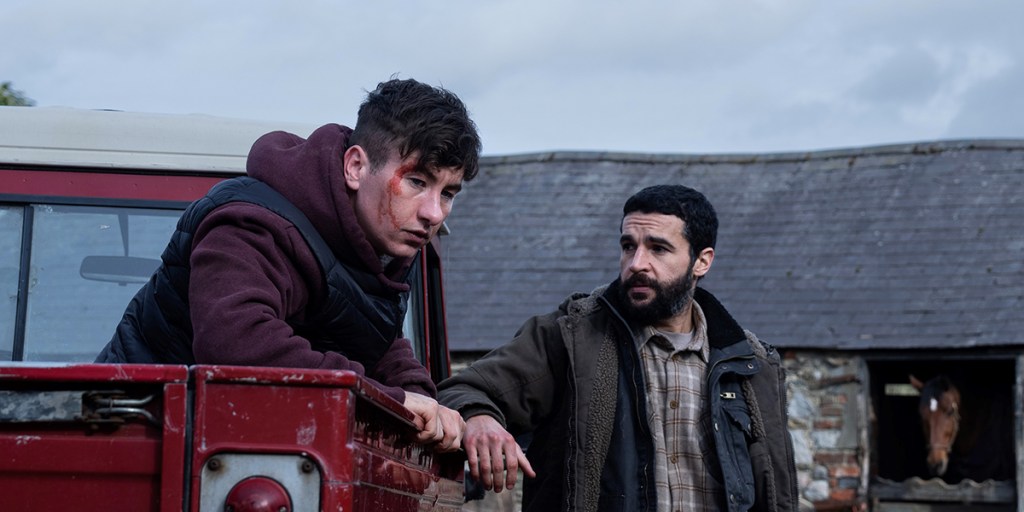
It’s rural Ireland in the present day. Michael (Christopher Abbott) runs a one-man sheep farm, where prize-winning rams graze on rocky hillsides. His abusive dad Ray (Colm Meaney) sits in the kitchen all day shouting angry epithets in Irish at Michael about all the things he’s doing wrong. In the next sheep farm over, young Jack Keeley (Barry Keoghan) does much the same as Michael but not very well. His dad Gary (Paul Ready) — who is Michael’s age — tries to keep things going but the farm is bleeding money. Gary is married to Caroline (Nora-Jane Noone), Michael’s ex, and Jack can see his parents are not getting along. Michael hasn’t seen her for 20 years, ever since a car accident killed his mother and sent Caroline to hospital with serious injuries (The accident was Michael’s fault).
But their relatively bucolic lives are interrupted when two rams disappear from Michael’s flock. And there’s only one place they can go — to the Keeley farm just over the hill. But Jack claims they both suddenly died and he threw their bodies into a pit…a very unlikely story. This signals the start of a feud between the two families, involving simmering grudges, sheep poachers, and organized crime. Can their conflicts ever be resolved? Or are both farms headed for
ruin, violence and possibly even death?
Bring Them Down is a violent, suspenseful drama about escalating grudges between two houses. It’s done in that chop-up style popular among some European arthouse directors where the narrative is not told chronologically. Your perception of “who is to blame for what” gradually shifts as new scenes fill in the blanks. I liked the acting and the dialogue — half of which is in Irish — and it has a compelling plot. The settings are just beautiful, with wide panoramic views of hillsides at dusk and dawn, and images like Michael carrying a lame sheep draped over his shoulders. There are also some strikingly original tableaux like the sheep at an auction house. This is a good first film — it reminds me of Frozen River and Winter’s Bone, all serious looks at crime in rural settings. But why are all these movies about brooding Irish men so depressing? What miserable lives these people seem to lead! If there were a bit of humour or love, Bring them Down would have been a lot easier to take.
But it’s still a good movie, anyway.
Dark Nuns, Love Hurts, and Bring them Down are all opening this weekend in Toronto; check your local listings. This is Daniel Garber at the Movies, each Saturday morning, on CIUT 89.5 FM and on my website culturalmining.com.
World premieres at #TIFF24. Films reviewed: Relay, We Live In Time, Hard Truths
Hi, this is Daniel Garber at the Movies for culturalmining.com and CIUT 89.5 FM.
TIFF is on its final weekend, but there are still many movies left to watch, including free screenings on Sunday of all the the Peoples Choice winners. So this week, I’m only talking about movies that had their World Premieres at TIFF. There’s an overly angry woman, a secret agent for hire, and a love affair that turns serious.
Relay
Dir: David Mackenzie (Review: Starred Up)
Ash (Riz Ahmed) runs an unusual business in New York City. It’s for whistle blowers who are afraid for their lives and their family’s and want to make peace with their previous employer and return the incriminating evidence. The genius of Ash’s work is that neither side — the whistle blower and the corporation — know who he is… and both sides pay him. A win-win situation, at least for him. He relays information using an intermediary phone service connected to an ASL keyboard for the deaf that can’t be traced. And he always keeps one copy of the evidence just in case the employer ever reneges on the deal.
His latest client is a biologist named Sarah (Lily James), a would be whistle-blower who has proof of malfeasance by a big agro conglomerate she worked for. But now she wants out, because she’s afraid a gang of thugs working for the company (Sam Worthington, and three others) are going to kill her. Problem is Ash — who never lets his guard down — is smitten by the beautiful and sympathetic Sarah, who he goes out of his way to protect. Can Ash keep her safe from unknown forces? And is there something deeper going on between them?
Relay is an ingenious action film that doubles as a corporate spy flick. It’s full of complex schemes involving the postoffice, telephone services and communication devices. As well as lethal fights. Riz Ahmed is one of those actors who is so good that you can just go and see anything he’s in. Luckily, Relay is a super-taut thriller, with constant suspense, near-misses and clever chase scenes. Beware: you’ll be his with an enormous twist near the end (no spoilers) that will totally blindside you. I’m still trying to figure out whether it’s plausible ir not, but either way, this is a great thriller.
We Live In Time
Dir: John Crowley (Reviews: The Goldfinch, Brooklyn)
Almut (Florence Pugh) is a chef in London whose restaurant is taking off. She had a long-term relationship with a woman, but eventually separated. Tobias (Andrew Garfield) works for Weetabix — yes the breakfast cereal — and has been living with his dad since his first wife divorced him. The two meet with a bang. Literally. She runs him over with her car. But this is no hit and run. She sticks around until he gets out of hospital, and invites him for dinner at her restaurant. Sparks fly and their relationship begins. But certain obstacles lie in their path. Is there any point to marriage? Should they have kids? And what happens when she is diagnosed with cancer?
We Live In Time is a surprisingly good romance. Most romances veer either toward slapstick comedy or treacly cornball. This one does neither. The time in th entitle is reflected in it’s narrative, which hope back and forth between different stages of their lives. And it’s full of evocative details, like when Almut — the chef — teaches Tobias the best way to crack an egg (on a flat surface, she says) While it’s clearly Oscar bait (what with the cancer and baby details artfully placed), it’s also a fully enjoyable and moving film to watch. Irish director John Crowley knows what he’s doing; he brought us movies the classic Brooklyn. Frances Pugh does Almut as tough but lovable while Andrew plays it goofy and sweet.
This is good one.
Hard Truths
Co-Wri/Dir: Mike Leigh (Reviews: Peterloo, Mr Turner)
Pansy (Marianne Jean-Baptiste) is a middle-aged woman who lives with her family in a quiet London suburb. Her husband Curtley (David Webber), a plumbing contractor, is away most of the day, while their son Moses (Tuwaine Barrett) in his twenties locks himself in his room with his ear phones on playing video games. Perhaps because Pansy is so hard to deal with. When Moses goes for a walk, she yells at him to stay away from police or he’ll be arrested for walking while black. And when Courtley is home she subjects him to a non-stop abusive barrage of complaints and insults about his work, the neighbours, a baby down the street, animals, germs and being disrespected.
Meanwhile, Pansy’s sister Chantal (Michele Austin) lives with her two successful daughters. Chantal is kind and amiable, listening to problems and gossip as she does her clients’ hair. And she — like everyone else — wonders why her sister Pansy is so angry bitter and paranoid all the time. And can she get her to visit the cemetery on Mother’s Day?
The topics — kinship, loss, mental illness — seem ordinary but the movie is anything but. Hard Truths is a searing comedy-drama about two black families in London. By comedy-drama I mean you will be laughing uproariously through the first half and then crying through the second. It’s just fantastic. The character development, the dialogue, and the acting are dead on. Marianne Jean-Baptist is so funny and so real and so moving, she’s a phenomenon to behold. If she doesn’t get an Oscar nomination for this, I will be shocked. She co-starred with Brenda Blethyn in another Mike Leigh movie, Secrets and Lies, thirty years ago, and this one is even better.
I would call Hard Truths a perfect movie.
Relay, We Live in Time, Hard Truths, all had their world premieres at TIFF .
This is Daniel Garber at the Movies, each Saturday morning, on CIUT 89.5 FM and on my website culturalmining.com.
Bad destinations. Films reviewed: Borderlands, Only Flows the River, Cuckoo
Hi, this is Daniel Garber at the Movies for culturalmining.com and CIUT 89.5 FM.
Looking for fun and adventure? Look no further. This week I have three new movies from around the world: a supernatural thriller set in Bavaria, a dark mystery in northwestern China, and an action comedy that takes place…in outer space!
Borderlands
Co-Wri/Dir: Eli Roth
It’s outer space in a post-apocalyptic future dominated by a multi planetary corporation known as Atlas. The worst place in the universe is the planet Pandora, once prosperous, but now decrepit and desolate. That’s where Atlas CEO’s daughter still lives. Pandora is a mecca for treasure hunters looking for a legendary vault, one that will provide limitless wealth to its discoverer. Tiny Tina (Ariana Greenblatt) Atlas’s teenaged daughter, still lives there. But when she is kidnapped by Roland, an ex-soldier (Kevin Hart) and Krieg, a deranged, masked muscleman (Florian Munteanu) Atlas is furious, not least because his daughter may hold the key to that vault. So Atlas (Edgar Ramírez) approaches Lilith (Cate Blanchett) to bring her home. Lilith is a hard-boiled bounty hunter, notorious for her ruthlessness; she’ll shoot anyone who gets in her way. And she hates Pandora more than most, having lived a traumatic childhood there. But business is business, so when Atlas offers an enormous sum of money to compete this “simple” job, she flies off to rescue Tiny Tina.
Problem is it’s anything but simple. Tiny Tina doesn’t want to be rescued. She’s also dangerous: the cute teddy bears she carries are lethal explosives. Eventually they form a truce: Lilith, Roland Tina, and Krieg, along with Claptrap — a wise-cracking R2D2 — and Tannis (Jamie Lee Curtis) an academic with a sketchy past. But can they fight off all those dangerous treasure hunters? And who in this group can be trusted?
Borderlands is a science fiction action/comedy based on a video game. It’s filled with strangely shaped vehicles, scary monsters and cool weapons. It has pretty good special effects and a stellar cast. Unfortunately, the movie kinda sucks. It’s like a third-rate Mad Max. Eli Roth, is a competent, though gory, horror director, but he totally missed the boat with this one. The story stays close to the original game, but who wants to watch characters advancing to higher levels in a game you’re not playing? It just doesn’t translate into a movie plot: Cross a bridge before it
collapses. Enter the elevator before the bad guys attack… Boooring. The jokes are not funny, the script is awful, the CGI is relentless, and the characters are shamelessly stolen from movies like Blade Runner, Star Wars, Indiana Jones and Tank Girl.
Perhaps fans of the game will enjoy seeing their favourite characters on the big screen, but otherwise I can’t see any reason to watch this.
Only the River Flows
Co-Wri/Dir: Wei Shujun
It’s the early 1990’s in China. Detective Ma Zhe (Zhu Yilong) is a recent arrival to Banpo, a rundown small town on the Yellow River. HIs wife is pregnant with their one child, He was an award winning cop back in Yunnan before transferring here and the ambitious Police Chief (Hou Tianlai) has high hopes. He wants to move the police HQ to an abandoned cinema. But first, Ma’s team must prove its crime-solving talent. Lucky for Ma a kid finds a dead body by the riverbank. It’s an old lady who tends her geese but rarely interacts with anybody else. She lives with a formerly homeless drifter she adopted, who people in the village call Mad Man. However any evidence was washed away with the flowing river. A similar killing is discovered a few days later by the river; a local poet, whose writing ties him to a single woman.
There are a lot of seemingly unconnected clues. A cassette tape found near a crime contains crucial information recorded on it. One interrogated witness admits his guilt —- but is he telling the truth? The more clues they find, the less sure Ma is. And the longer he takes to close the file, the more agitated his ping-pong-playing Police Chief becomes. Eventually, truth merges with fantasy until Ma can’t tell his dreams from reality. Can he regain his clear
head and catch the real killer (or killers)? Or will this case be his last?
Only the River Flows is a policier portraying an earlier China that’s dirty and poor. Though it involves a series of killings, the mystery is less important than the mood: dark, wet and crumbling. There are some surprisingly memorable scenes: like a primitive CSI where they strike a hog carcass to determine which knife was used in the killing. The film manages to be cynical and satirical, without being out-and-out depressing, poking fun at things like the PRCs obsession with official banners and awards. The acting is good, but the camerawork and art direction is great, infusing the film with a miserable nostalgia. I’ve never seen a film by Wei Shujun before, but his reputation precedes him. And he was born after the film takes place.
Not bad at all.
Cuckoo
Wri/Dir: Tillman Singer
It’s the forests of Bavaria, in the not-so-distant past. Gretchen (Hunter Schafer) is a depressed and angry 17-year-old who carries a switchblade in her pocket. She likes scowling and playing goth music on her electric guitar. She was sent to Germany to stay with her divorced dad, his second wife and their kid Alma (Mila Lieu) after her mom died. They live in a modern house near a seedy, isolated resort — named after the cuckoo — that they want to develop. The hotel is owned and run by a slimy control freak named Herr König (Dan Stevens), who hires Gretchen to work at the front desk; We need more English speakers, he says.
But she soon discovers this guesthouse is no picnic. Female visitors are prone to vomiting and keeling over in the lobby. Strange noises and powerful invisible waves, coming from nowhere, wreak havoc with their brains. And when Gretchen rides her bike home one night — over Herr Konig’s objections — she is closely followed and nearly killed by a terrifying hooded woman — with round glasses and grasping claws — running all the way. She narrowly escapes by seeking refuge inside the local hospital. But the police dismiss her scary experiences as a prank by local kids. Her family and their friends (except her mute half-sister Alma, and a bearded detective named Henry) seem to have turned against her. The longer Gretchen stays there, the more beaten up she gets, with an arm in a sling and gauze across her forehead. But every attempt to escape is thwarted by invisible forces, fueled by time gaps in her memory. Can she ever get away from this godforsaken place? And who are the scary people here: Demons? Vampires? Werewolves?
Cuckoo is a highly-original story of a sensitive teenaged girl
trapped in a bizarre situation. It’s a fantasy thriller/horror but different from anything I’ve seen. It’s not set in any particular era but probably the 1990s. (Picture older hospital rooms, endless rows of filing cabinets) Writer-Director Tillman Singer also composed some of the songs. The acting is excellent, and more than that, the actors really seem to enjoy their strange characters, especially Hunter Schafer (Euphoria) and Dan Stevens (Downton Abbey). Cuckoo is funny, sexy, scary, totally unpredictable and weird as all get-out.
I loved this one.
Borderlands, Only the River Flows, and Cuckoo all open this weekend in Toronto; check your local listings.
This is Daniel Garber at the Movies, each Saturday morning, on CIUT 89.5 FM and on my website culturalmining.com.
Through the grapevine. Films reviewed: Twisters, Widow Clicquot
Hi, this is Daniel Garber at the Movies for culturalmining.com and CIUT 89.5 FM.
Is your headspace being dominated by thoughts of politics and elections? If so, you need some distractions! I’ve got just the thing for a hot day like today. This week, I’m looking at two new summer movies — an historical drama and a disaster-thriller — both about strong women. There’s a widow who risks the wrath of grapes, and a meteorologist who throws caution to the wind.
Twisters
Dir: Lee Isaac Chung (Review: Minari)
Kate (Daisy Edgar-Jones) is a meteorologist. Not the weatherman who writes numbers on a green screen on your local TV news; she’s the real thing, with an important job at a government bureau in New York City. So what is she doing in Oklahoma? The state is facing an unusual number of major tornadoes all at once. She was invited down there by Javi (Anthony Ramos), an old classmate and study-buddy who worked with her on her experiment involving using polymers to stop tornadoes. But the experiment went wrong, killing the rest of their team, thus taking away any desire she once had to chase tornadoes. And yet here she is back in Oklahoma. She’s lending a hand to Javi’s corporate sponsors, who supply shiny white SUVs in exchange for some crucial tornado info.
But she faces severe competition. The place is swarming with
adventure seekers, journalists and tourists. Tyler (Glenn Powell) is a cowboy huckster — a self-described “Tornado Wrangler” — who sells T-shirts and coffee mugs with his own grinning face on them. He’s a “chaser”, someone who seeks out tornadoes and gets as close to them as he can without being sucked away. His gimmick is to shoot fireworks up into tornadoes as they pass by. Looks great on YouTube… He drives a souped-up red jeep, and speeds ahead of Javi’s white vans. But Kate is in a league all her own. She can look at a dandelion and predict, with amazing accuracy, which way the next tornado is coming. And Tyler starts to take note. Who should Kate side with — serious Javi, or aw-shucks Tyler? And will any of them survive the big storm on the horizon?
Twisters is a thriller disaster movie about… well, tornadoes and the people who chase them. That’s most of the movie. It’s kind of a sequel to the movie Twister (1996) but shares none of the same characters, actors, or plot lines, except that they’re both about tornado chasers. There’s definite electricity between Kate and Tyler — Glenn Powell is brimming with charisma, and the appealing Englishwoman Daisy Edgar-Jones plays a credible American (though not much off an Oklahoman) — but those sparks never catch fire. If you’re expecting love, lust or sex, you chose the wrong movie. There’s not even a single kiss here. What you do get is amazing special effects: collapsing water towers, exploding oil refineries, roofs torn off buildings, streetcars running off their tracks…and lots sandlots of people holding onto something solid to avoid being swept away. I don’t know about you, but I really like disaster movies. Who needs a plot when you get to watch the world collapse?
Widow Clicquot
Dir: Thomas Napper
It’s the early 1800s in Napoleonic France. Madame Barbe-Nicole Ponsardin Clicquot (Haley Bennet) is a wealthy aristocrat from Champagne. In her early twenties she is married off to the equally rich François Clicquot (Tom Sturridge) who inherited vast vineyards. Although she dislikes him at first — he is somewhere between eccentric and crazy — she grows to love his childlike, playful exuberance. The guy has tousled hair and wears diaphanous pirate shirts, while Madame dresses in breezy white blouses. Soon he has her singing to grape vines, too. When she’s not in the vineyards, she’s in her laboratory studying wine sediment in beakers and test tubes. But eventually his eccentricity turns erratic, sometimes slipping into accidental violence. Madame sends their daughter off to the Abbee, but by their 6th year together, he is dead.
Now she’s a widow, and heir to the estate, but the trustees have never heard of a woman vintner. They offer her a fair settlement and tell her to take the money and run. Never!, cries widow Clicquot. These vines, this terroir it’s Francois’ soul! And she feels personally attached to it, too. But everything goes wrong. They buy cheap glass bottles which explode. And selling wine across borders is a no-no during the Napoleonic wars. She turns to Louis (Sam Riley) a wine salesman, for help. She needs to get her latest concoction — a dry pink wine with tiny bubbles — to the market. It’s the only thing that can save her grapes and the chateau she lives in. But will her new type of wine ever catch on?
Widow Clicquot is a historical drama filled with the expected
stories: passionately swooning lovers, double-crossing colleagues, floppy hair and costumes and verdant green valleys. It’s also about a rich woman who dares to fights the system. Not all that much happens in this movie which makes it drag in the middle. Tom Sturridge is ridiculous as the flakey husband, Haley Bennet is better though still stiff, as Madame, and Sam Riley as the travelling salesman is the best of those three. I was dreading a total corporate kiss-ass for the famous champagne maker, but it wasn’t that way at all. It’s based on a book that portrays her as a determined woman, despite her flaws, so two points for that. It’s not a spoiler that she is the famous Veuve Clicquot who basically invented modern champagne. And I liked the historical aspects.
Widow Clicquot is not a great movie, but lubricate yourself with enough flutes of Veuve and you won’t really care.
Widow Clicquot and Twisters both open this weekend in Toronto; check your local listings.
This is Daniel Garber at the Movies, each Saturday morning, on CIUT 89.5 FM and on my website culturalmining.com.
Daniel Garber talks with Charles Uwagbai about Kipkemboi
Hi, this is Daniel Garber at the Movies for culturalmining.com and CIUT 89.5 FM.
Kipkemboi is a young man who lives with his family in a small town in Kenya. His parents may be farmers but he has been a gifted mathematician since he was a child. He can tell you how many birds are flying in a flock in the sky, scored 100% on his SATs and has been accepted into MIT. But an unexpected family tragedy has kept him close to home. Instead, he has invented a new financial algorithm that allows him — with unbelievable accuracy — to predict stock market gains and losses worldwide. All operated out of a simple mud hut. But when word gets out, police, military, and foreign interests descend on his village to take everything away. He’s accused of being a criminal or even a terrorist. Can Kipkemboi outrun and outsmart the powers that be?
Kipkemboi is the name of a highly entertaining, dramatic film
filled with humour, thrills and romance. Kipkemboi is the first Canada-Kenya co-production ever made and word is spreading. It’s directed by Charles Uwagbai and stars Thamela Mpumlwana in the title role. Charles is a Canadian-based director known for The Ghost and the Tout, Esohe and Charlie Charlie, and whose work has been seen on Netflix, Amazon Prime Video and Canal Plus.
I spoke with Charles Uwagbai in Toronto via ZOOM>
Kipkemboi recently had its gala premiere in Toronto, will be streaming on CBC Gem in 2025, and is currently showing in theatres at film festivals worldwide.
Guy stuff. Films reviewed: The Fall Guy, The Ride Ahead, Pelikan Blue
Hi, this is Daniel Garber at the Movies for culturalmining.com and CIUT 89.5 FM.
This week, I have some movies about guy stuff — two documentaries and an action movie. There’s a guy in Sydney not afraid to get his hands dirty, a guy in New Hampshire who wants to know the real dirt, and three guys in Budapest playing dirty with some train tickets.
The Fall Guy
Dir: David Leitch
Colt Seavers (Ryan Gosling) is the stunt double for a heartthrob Hollywood action star named Tom Ryder (Aaron Taylor-Johnson). Tom claims to do all his own stunts but those in the know know it’s Colt falling off buildings, crashing cars, and catching fire. Colt loves the excitement and thrill of doing the undoable — and he’s really good at it, too. Especially at his current film, because he works beside a camera operator named Jody (Emma Blunt). They’re spending time together, on and off duty, trading quips on set or making out behind the klieg lights. It’s his dream job. Until a terrible accident breaks his back, and he disappears from the scene entirely. And from Jody, too. Until, 18 months later, he gets a call from a producer. Gail (Hannah Waddingham), a big shaker and mover, wants him on Tom’s latest flick, a sci-fi action rom-com. He doesn’t want to, until she drops the other shoe: Jody is directing this movie and she specifically asked for him.
So off he flies to Sydney, Australia, to join a shoot in progress. It’s a shlock-fest about a space
cowboy fighting aliens using weapons that look like heavy-metal guitars. Turns out Jody had no idea he’s coming and is still offended he dumped her for no good reason. Then Gail, the producer, asks for Colt’s help. Tom has disappeared with a gang of undesirables and she’s worried he’s in trouble. Can’t Colt find and rescue him? If not they’ll have to cancel the movie… and Jody’s career (this is her first time as a director). Tom agrees, but soon discovers he’s the target of a slew of gunmen, trying to get back a missing video. Can Colt rescue Tom, survive the bullets, catch the baddies and make it back to set in time to woo the love of his life?
The Fall Guy is a combination rom-com and action movie set within the confine of the film industry. So it’s full of references to mediocre movies. I thought the witty banter wasn’t particularly clever, and the plot twists propelling the story pretty threadbare. There are lots of unnecessary
jokes written into the script with a nudge and a wink. Like when Jody asks Colt if she should use a split screen in the film she’s directing… immediately after which The Fall Guy movie starts using a split screen, too. That’s just weak. And yet I walked out of this film feeling totally entertained. Why?
First of all the acting is great, all the main characters well-played, especially Gosling’s Colt Seavers. More than that, though, the action is really good. The chase scenes are elaborate, the fight scenes are like watching ballet, and even the gratuitous explosions — and there are quite a few of them — are just fun to watch. And of course, in a movie about stuntmen, the stunts are all done just right. So if you’re looking for a couple of hours of forgettable entertainment, this one’s for you.
The Ride Ahead
Dir: Dan Habib, Samuel Habib
Samuel Habib is a young man who lives with his parents in Concord New Hampshire. He has tattoos, likes music and sports. He went to public school and is getting ready for college, but realizes he hasn’t yet done a lot of things many high school kids have already done: things like going on a date or having sex. Yes, the media is filled with sexual images and porn but rarely relevant to people like him. Samuel is disabled. The thing is, movies and TV shows portray people like him in one of three ways: get help, get cured or die. He wants some advice that’s relevant to him, preferably NOT from his parents (awkward…) And he can’t stand being talked down to or underestimated by people who only see his disability. So he decides to go to the source and talk with some well-known disabled people, including many of his heroes. He does it — and makes a film out of it.
He meets with musician Keith Jones, co-founder of Krip-Hop, for some basic rules about having sex. Says Jones: “always remember: put a bag on it!”Judy Heumann, the late, great leader of the Disability Rights Movement, says “using a wheelchair means spending a lot of time staring at people’s butts!”
Andrew Peterson who lives with Fetal Alcohol Spectrum Disorder tells how he became a long-distance runner and a sports coach. And Maysoon Zayid, a Palestinian-American

Dan and Samuel Habib, The Ride Ahead at HotDocs, Photo by Jeff Harris
stand-up comic, provides both constant humour and some really tough talk. The film takes Sam (and his father, co-director Dan Habib) across the country, in boats, planes and automobiles, each of which pose separate accessibility issues, especially airplanes; Samuel uses an electric wheelchair to get around and they don’t go well with those tight spaces on planes. He also turns to his own big brother for all-around moral support and inspiration. But will Sam ever move beyond his parents’ house?
The Ride Ahead is a touching, funny and informative documentary told from the subject’s point of view. It helps correct a lot of misconceptions about disabilities, and introduces a lot of other things you probably never considered. The film is made in the form of a dialogue between Samuel, his dad and the people he encounters, often with the camera positioned either facing him or facing out. At times, Samuel’s both the subject and the filmmaker. He can speak, but in the film mainly uses an electronically generated voice whose texts he writes in advance.
I liked this documentary a lot, partly the way it makes people with disabilities the subject not the object. It covers diverse intellectual territory, from disability rights to ableism and disability justice. It also deals frankly with real aspects of everyday life. And the cast and crew, both behind and in front of the camera, from editor to soundtrack, are largely disabled themselves.
The Ride Ahead is a good movie to watch.
Pelikan Blue
Wri/Dir: László Csáki
It’s the late 1980s in Budapest, Hungary and the iron curtain may be rattling but it’s not yet opened. Still, the government is introducing new measures. It’s now legal to keep foreign currency and travel abroad. Everyone, especially young people, are dying to see what it’s like in Western Europe. But train tickets are prohibitively expensive, and no one has any money. When three guys — Rozi, Petya, and Akos — buy a forged ticket on the black market, they are dismayed and disgusted by its poor quality: smudged ink, misspelled words… They’d be caught immediately. They can do better than that using just advanced planning and simple high school chemistry. So they decide to take the bull by the horns, and make themselves some fake tickets. This involves spying on the sellers, stealing some covers, and getting a phony rubber stamp made (not an easy task in communist Hungary). But they also have to buy a cheap ticket, bleach out the ink and carefully enscribe the forgery through a page of Pelican Blue carbon paper.
After much trial and error, they manage to ride a train to Scandinavia for pocket change. But
when they get back, rumours leak, and everyone wants a piece of the action. Should they expand their business or get out of it before the police find out?
Pelikan Blue is a beautiful, animated feature-length documentary that follows the story over three decades, using old voice recordings and new interviews. This is basically a heist movie, but one involving minimal stakes — just forged tickets across Europe. But what really struck me was the stunning art. It involves the garish lavenders and electric blues of 1980s colours, distinct characters, and simple but instantly recognizable images: a payphone, an answering machines, the brutalist rooftops of Budapest. Backgrounds are brushed with tempera paints, and the faces have squashed noses, and eyes that are tiny green dots. I cannot describe the joy I felt looking at this animation, it’s unique, it’s amazing, it’s handmade, it’s just so cool. There’s also a chill soundtrack of 1990s Hungarian music percolating through the whole film. There are lots of funny parts, and some psychedelic dream sequences, too…I just can’t get enough of Pelikan Blue.
The Fall Guy opens this weekend; check your local listings. The Ride Ahead, Pelikan Blue are two of the many movies playing at Hot Docs through Sunday.
This is Daniel Garber at the Movies, each Saturday morning, on CIUT 89.5 FM and on my website culturalmining.com.
Class. Films reviewed: The Old Oak, Monkey Man, Wicked Little Letters
Hi, this is Daniel Garber at the Movies for culturalmining.com and CIUT 89.5 FM.
Ordinary people fighting back is an old story, but not a tired one. This week I’m looking at three new movies — one from northern England, one from southern England, and one from India — about people confronting injustice. There are women fighting the courts, a poor man fighting the oligarchs, and a lonely man trying to stop his town’s gradual collapse.
The Old Oak
Dir: Ken Loach (my interview: 2020)
It’s 2016 in a seaside village in northern England. TJ Ballantyne (Dave Turner) is the publican of The Old Oak, one of the few gathering places left standing. But like the town — once a thriving coal pit, but now impoverished and depressed — the pub is not what it used to be. It has few customers aside from a few regulars. The sign is sagging, and half of the building is no longer used. TJ lives above the pub; he’s lonely and pessimistic. His son won’t speak to him, and he has only a little dog to keep him company. But when a group of Syrian refugees arrives in town, TJ decides to help. Alongside Laura (Claire Rodgerson) he distributes furniture and food — donated through local churches and unions — to the newcomers. They are grateful, but some people resent it. Why are they helping refugees when local kids are going without food and heating? Syrian kids are bullied in schools, and a young photographer Yara (Ebla Mari)’s camera is broken.
What can they do to bring the community together? Together with Yara,
Laura, and dozens of volunteers, they reopen a long boarded up section of the Old Oak to provide a place where people can come to eat and spend time together. The photographs on the walls recall the coal miners strike of Thatcher’s England: If you eat together, you stick together, says one sign. But can they overcome old prejudices to form new friendships? Or will it all fall apart?
The Old Oak is a wonderfully poignant and deeply-moving drama that deals with big issues but on a personal scale. It looks at racism, poverty, unions and scabs, and how geopolitics affect us all. Like all of Ken Loach’s movies, it looks at imperfect people from multiple viewpoints. Some you like and end up hating, others seem like villains but you find out later they’re good people. Lots of grey, no black and white (aside from the photographs Yara takes.)
Once again, the script is by Loach’s longtime collaborator Paul Laverty, and the ensemble cast includes both professionals and first-time actors, many hired at the location.
It shows the real Britain, warts and all, not the shiny tourist-attraction you see in Hollywood movies. It’s a tear jerker, with more than one heartbreaking scenes. But it still leaves room for hope. The Old Oak may be Ken Loach’s final film, so you should get out and see it. I really like this film.
Monkey Man
Co-Wri/Dir: Dev Patel
Kid (Dev Patel) is a man with a vengeance — to punish those whose crimes he witnessed as a small child. Raised by his mother in a forest in rural India, he now lives in an unnamed megalopolis in the mythical state of Yatana (= torment, anguish). It is ruled by a god-king followed by throngs of devoted cult-like followers. They kick farmers off their land for corporate profit and persecute minorities with impunity. Kid earns his money as a boxer, beaten up regularly by bigger, stronger men. In the ring, he conceals his face behind a monkey mask, in honour of the god Hanuman whose story his mother had told him as a child. Following a complex scheme, he somehow manages to get work inside an exclusive nightclub ruled by a woman named Queenie (Ashwini Kalsekar). She warns him to never disobey her or step out of his class. He gradually works his way up the latter until he makes it into the kitchen. His goal? To shoot a corrupt police chief named Rana Singh (Sikandar Kher). But his plans all fail, and he ends up a nearly-dead fugitive, his body floating in a canal. He is rescued and brought back to health by a temple dedicated to Shiva, and run by androgynous priests.
They admire that he, an outcaste, dares to fight authority. But he needs the strength and skill if he wants to succeed. So, to the sounds of a tabla drum, he trains in the temple, gradually building up his stamina and muscles until he its
ready to face his enemies to the death once again. But does he even have a chance against the powers that be?
Monkey Man is a class-struggle action-thriller about one man’s quest for personal vengeance and his plan to overthrow by force corrupt and autocratic leaders. It’s told using intricate plotting, involving dozens of people cooperating for a single goal. And it interweaves visions and sounds, like a child’s picture book, an elaborate mural, and the thumping of a tabla music. There’s a lot of content to digest. The problem is, a large part of the movie consists of chases and violent fights, and they’re not very good. Blurred shots using a jiggly, hand-held camera may be artistic, but they’re unpleasant and hard to look at. Seasickness is not a valid substitute for good fight choreography.
I admire Dev Patel’s first attempt as a director and his transformation into an action hero, but Monkey Man doesn’t cut it.
Wicked Little Letters
Dir: Thea Sharrock
It’s the 1920s in Littlehampton, Sussex, a small town in southern England. Edith Swan (Olivia Colman) is a middle aged educated woman who still lives with her strict parents in a tiny row house. She reads the bible and quotes its teachings; basically, she’s an uptight prig. She shares a wall with Rose (Jessie Buckley) a migrant from the Emerald Isle. She is fond of drinking and carousing, can swear a blue streak, and is often seen wandering in just a slip outside her home. Rose likes her live-in boyfriend Bill (her husband died in WWI) but most of all, adores her daughter Nancy (Elisha Weir). But her neighbour, Edith’s father Edward Swan (Timothy Spall) despises Rose and her libertine ways, and blames her for everything going wrong in Littlehampton. They live in a tenuous detente, until everything changes when Edith receives a piece of hate mail. The unsigned letter is filled with cruel insults and vulgar words.
And when the letters pile up, the police come to investigate. They arrest Rose for the nasty letters and throw her in jail, despite her protests of innocence. The press picks up the story and it becomes a national scandal. But not everyone believes Rose is guilty. A small group of women, led by Police Officer Gladys Moss (Anjana Vasan), think Rose is innocent and set out to prove it. But can they find the true culprit before the trial? And what will happen to Nancy if her
mother ends up behind bars?
Wicked Little Letters is a delightful dark comedy, based on a true story; apparently this was a hot topic 100 years ago. Little is the key word: little letters, Littlehampton, and the kind of petty quarrels that can blow up into serious events. This is a movie that knows it’s own boundaries and sticks to them perfectly, without veering off into remote tangents, flashbacks or lengthy soliloquies. It’s tight, set in tiny homes around town, and in the courthouse and jail. The acting is wonderful — everyone’s a character. Olivia Colman and Jesse Buckley previously co-starred in The Lost Daughter, but I like this one much better. And though it’s a period drama set in 1920s England, it uses colourblind casting, with many roles played by black and brown actors, without racial or ethnic issues ever entering the story (except, of course, Rose being Irish in England).
If you’re looking for a fun night out, I think you’ll like this one.
Wicked Little Letters, Monkey Man and The Old Oak all open this weekend in Toronto: check your local listings.
This is Daniel Garber at the Movies, each Saturday morning, on CIUT 89.5 FM and on my website culturalmining.com.
A New World? Films reviewed: Going In, Poor Things
Hi, this is Daniel Garber at the Movies for culturalmining.com and CIUT 89.5 FM.
December is supposed to be a time for fun and relaxation, so this week, I’m looking at two new movies that you might find fun to watch. There’s a comedy/action movie set 40 years ago in Toronto, and a wild comedic fable set a century ago in Europe.
Going In
Wri/Dir: Evan Rissi
It’s the late 1980s in Toronto. Leslie Booth (Evan Rissi) is a young lecturer who waxes eloquent about Hegelian dialectics to bored college students. He doesn’t smoke, drink or cuss and stays away from drugs. He even goes to bed early if his on-again, off-again girlfriend isn’t spending the night. But everything changes when a strange man, all dressed in black, starts showing up everywhere he goes. Reuben (Ira Goldman) is a Jamaican-Canadian who wears a huge Star of David around his neck. He used to be Leslie’s best friend, going out on the town every night, but haven’t seen each other for five years. And Leslie has been on the straight and narrow ever since.
But Reuben needs his help, and is calling in a favour. His brother has disappeared, and he suspects it’s the work of a Toronto drug kingpin named Feng (Victor D.S. Man). Feng has cornered the market on a highly-addictive pill hitting the streets known as Pearl. Users love the experience, but addicts end up looking like zombies with solid white eyes. Reuben wants to penetrate this Triad and save his brother’s life, but the only way to do it is to get hold of a pair of tickets to Feng’s annual tournament. So Leslie joins with Reuben
and finds himself falling into old habits, snorting coke and frequenting sleazy bars to get more information. But the closer they get to their target the more dangerous it all looks. What is that tournament about? And can they rescue Reuben’s and get out unscathed?
Going In is a Toronto action/comedy movie set in — and in the style of — the 1980s. It’s also a buddy movie with a black guy and a white guy, like Lethal Weapon, Beverley Hills Cop or Silver Streak. But unlike those Hollywood hits, Going In is a micro- budget movie — we’re talking tens of thousands not hundreds of millions — with unknown actors and minimal special effects. Evan Rissi
wrote, directed and stars as Leslie, while Ira Goldman who plays Reuben also produced it. And Victor D.S. Man as the villain looks like he walked straight out of an old Hong Kong flick.
Surprisingly, this movie works. It’s clearly low-budget but it doesn’t seem slapdash. While it plays into a lot of film conventions and stereotypes, there are some very original scenes that I’ve never seen before — like the tournament they’re trying so hard to get into (no spoilers) It also has a good soundtrack, a b-ball match, some fight scenes and even a psychedelic out-of-body experience. And it’s not afraid to have the CN Tower constantly popping up in the background, to remind us that it’s Toronto, not NY, Detroit, Boston, Phillie or any of the other cities Toronto usually pretends to be in movies shot here. Keep in mind that this is a DIY movie, not from a big studio, and you might get a kick out of it.
Poor Things
Dir: Yorgos Lanthimos
Max McCandles (Ramy Youssef) is a medical student in Victorian England. He regularly attends surgical demonstrations by Dr Godwin Baxter (an unrecognizable Willem Dafoe) a controversial scientist with outrageous ideas. Baxter’s face is grotesque, like something that was cut into pieces and sewn back together. But the doctor takes a liking to shy Max, and hires him to live in his home and look after his daughter Bella (Emma Stone). Bella is a beautiful woman in her late 20s, but who behaves like a recently-hatched duckling just learning to walk. She has a vocabulary of just six words, and is given to stabbing, tearing or biting anything put in front of her. But with Max’s help, she quickly learns to speak and think, and is full of questions about the world. She is not allowed out of her home — it’s too dangerous, they say. You see, Bella is an adult woman with a baby’s brain implanted in her skull, one of the mad scientist’s latest experiments. As she matures, she and Max fall in love and plan their wedding — though still in a strictly patriarchal relationship (she refers to her father/creator Godwin Baxter as God for short.) But before they can marry, a scoundrel named Duncan Wedderburn (Mark Ruffalo) shows up on the scene. He sweeps Bella off her feet with the introduction of something new into her vocabulary — sexual pleasure — which she greatly enjoys. He
promises endless sexual satisfaction and rollicking new adventures if she follows him on his trip. Bella realizes Duncan is a cad and a rake but agrees to go with him anyway, postponing her marriage to Max indefinitely or at least until after she sees the world.
She sets off on this journey with Duncan aboard an ocean liner docking in various ports which she naively explores and learns from what she sees. She’s the ultimate fish out pf water, a novelty to all she meets, because she speaks so frankly and forthrightly. Bella has yet to learn basic societal rules about class, money, capitalism, sex, nudity and modesty. She explores this strange world scientifically and logically, much to Duncan’s dismay. Who is she really and where did she come from? Is sex a market commodity or something more personal? Will her naivety lead to disaster? Or will she return,
triumphant, to London with her innocence intact?
Poor Things is a brilliant social satire about sex, class, feminism, and society. It incorporates elements of 18th century novels like Fanny Hill, Tom Jones and Candide. It’s surreal, absurdist and psychedelic, but ultimately comes across as a fable or a morality play. It’s all filmed on an elaborate set (shot in Hungary), in a weird, steampunk Europe that never existed beneath a sky filled with blimps and zeppelins. (It looks like Terry Gilliam’s movie Brazil.) The costumes are outrageous — Bella has enormous shoulder pads bigger than her head. Emma Stone is amazing as Bella, though Mark Ruffalo overdoes it as Duncan — teetering between funny and ridiculous.
I’ve been following Yorgos Lanthimos’s films since Dogtooth in 2009, and this one revisits many of his earliest themes: absurdist humour; adults who speak awkwardly like small children, and who grow up isolated, never
allowed to leave their home, by a dictatorial, god-like father figure. It feels like Dogtooth Part Two: The Outside World. But now he commands a big enough budget to build ornate sets, costumes and wigs, with dozens of fascinating characters. I’m sure some of you will hate this movie, or be offended by it, but I think it’s absolutely brilliant.
Poor Things opens this weekend in Toronto; check your local listings. Going In is available digitally online across North America, from December 19th.
This is Daniel Garber at the Movies, each Saturday morning, on CIUT 89.5 FM and on my website culturalmining.
Halloweeniness! Films reviewed: Five Nights at Freddy’s, The Killer, Suzume
Hi, this is Daniel Garber at the Movies for culturalmining.com and CIUT 89.5 FM.
Toronto Fall Film Festival Season continues with Rendezvous with Madness, showing and discussing films about addiction and mental health, on now through November 5th. And on the horizon are Cinefranco, showing great French- language movies from Canada, Europe and Africa starting Nov 3rd; and ReelAsian Film Fest, celebrating its 27th incarnation, featuring pan-Asian cinema, events and media artists beginning on Nov 8th.
But this week I’m talking about three new genre movies — an action- thriller, a horror and an animated fantasy — just in time for Halloween. There’s a hitman tying up loose ends, a night watchman guarding animatronic beasts, and a Japanese schoolgirl closing doors.
Five Nights at Freddy’s
Co-Wri/Dir: Emma Tammi
(Based on the game by Scott Cawthon)
Mike (Josh Hutcherson) is a night watchman at a crumbling, former kids’ pizza emporium. He’s working there because, since their parents died, he needs to take care of his little sister Abby (Piper Rubio). Abby is withdrawn and introverted; she spends most of her days drawing pictures. Mike is especially protective of her, since their brother Garret was abducted by a stranger years earlier and never found. Now he’s worried social services will take her away and give custody to their sinister aunt Jane (Mary Stuart Masterson). And without a steady job, he’s a lost cause.
The thing is, Freddy’s is a weird and creepy place, filled with rusty old animatronic figurines — Freddy, Foxie, Bonnie, Chica, and Cupcake — life-sized robotic creatures that once welcomed kids to the restaurant… until children started disappearing in the 1980s, and the place was closed down. Luckily, Vanessa (Elizabeth Lail) a friendly local cop, is always dropping by to make sure Mike is OK. (Is there a possible romance brewing?) But once ghosts of the abducted kids start appearing in his dreams — and he wakes up with real-life wounds — Mike starts to question the entire job. And when Abby gets involved
and is playing with the animatronic creatures, things start to look ominous. Can Mike protect Abby from her new “friends”? Will Aunt Jane take her away? And will he ever discover what happened to their brother Garret?
Five Nights at Freddy’s is a light kids’ horror movie about a haunted restaurant, a sort of a Chuck E Cheese from hell. It’s based on a computer game from the early 2000s, which dictates a lot of the characters, plot and even the images. Which gives an ultra-simplistic feel to the movie. The movie mainly takes place inside the dusty pizza emporium, filled with retro video screens and pinball machines; and the scenes with the animatronic characters are uniquely creepy and cool. But in general, the film is predictable, repetitive and not terribly original. But I’ve never actually played the game. The audience where I saw it was screaming and yelling at every line, revelation or scene-change, so, clearly, if you’re already a fan, you’ll love it. Personally, I enjoyed watching it, but found it instantly forgettable.
The Killer
Dir: David Fincher
A self-described ordinary man (Michael Fassbender) who likes egg McMuffins and 70s sitcoms is camping out in a Paris office building, across from a hotel. He enjoys listening to The Smiths whenever he needs to relax. He normally lives in a palatial estate in the Dominican Republic. So what is he doing in Paris and why is he sleeping on a table? He’s a hitman assigned to assassinate a stranger through hotel window. Don’t take it the wrong way; he’s not a bad guy, it’s just his job. But when the assignment goes wrong, everything falls apart. Now he thinks killers are tracking him, and his girlfriend is attacked and almost killed inside his home. Who can he trust? So he sets out to discover who exactly has turned on him, and once he figures that out, he plans to systematically kill them all. But will he succeed in his revenge plot?
The Killer is an action/thriller based on a graphic novel and told from the viewpoint of a sympathetic murderer. There are chase scenes and stake-outs, fistfights and shoot-outs, everything you’d expect in a thriller. It’s chock-full of violence and death, but the twist is it’s narrated in a light and breezy voice-over by the killer himself.
Fassbender is a great actor, here at his wiriest, and surrounded by a top-notch cast: including Tilda Swinton, Charles Parnell and Arliss Howard. And it’s directed by David Fincher who brought us Fight Club and The Usual Suspects. And it has recurring gags, like the killer using fake names taken from 70s sitcoms (Archie Bunker and Richie Cunningham) to hide his identity. So why isn’t it very good? The problem is the story is more pointless than it is funny or exciting or interesting. It’s lots of action, not so many thrills. The plot itself is plodding, going from numbered chapter to chapter about the next person he’s going to encounter and possibly kill. It just leaves you feeling hollow — killers killing killers. Sure, The Killer is totally watchable as an action movie, it just doesn’t live up to its potential. Instead it elevates mundaneness into mock profundity.
Suzume
Wri/Dir: Shinkai Makoto
Suzume is a teenage girl in Kyushu, Japan. She has lived with her aunt since her single mom died when she was four, but she’s still troubled by nightmares. One day, on her way to school, a handsome young man asks her for directions to an abandoned part of town. Intrigued, she follows him and discovers a strange, freestanding door and a small statue of a cat. After she walks through the door, everything seems the same… and yet somehow different. She can now see things other people can’t — like a huge red plume rising into the sky. The cat, Daijin, comes to life and starts talking. The stranger, named Souta, explains what’s going on. He’s a closer, one of only a few people who can close those doors using a special key. The red plume is actually a giant worm — it’s what causes the earthquakes and tsunamis in Japan. And it will be a disaster unless he closes these doors wherever they start to open. But when the cat turns Souta into a little, three-legged chair, things start to get more complicated. Can Suzume do Souta’s work? Can she turn him back into a human? Can they stop Daijin the cat from causing any more problems? And what will Suzume’s aunt do if she just takes off?
Suzume is a beautiful fantasy-adventure about a girl trying to save the
world. It’s a picaresque story that spans Japan’s islands, historic sites and the very diverse people at work — from a hostess bar to a bath house — she meets on her journey. It’s fascinating, exciting, and full of surprises. Beautiful images and a nostalgic soundtrack — full of Japanese pop songs from the 70s and 80s — make it a pleasure to watch. It’s especially meaningful in Japan because it takes place in 2023, exactly 100 years after the Great Kanto Earthquake flattened Tokyo. Add to this a semi-romantic story full of world-altering decisions (no spoilers) and you’ll get why it’s so good. The director Shinkai Makoto who brought us the smash hit Your Name again deftly handles tricky stuff like time and space and alternate realities and unrequited love.
If you like Japanese anime, Suzume is a must-see.
Five Nights at Freddy’s and Suzume both open this weekend in Toronto — check your local listings — with The Killer showing exclusively at the TIFF Bell Lightbox.
This is Daniel Garber at the Movies, each Saturday morning, on CIUT 89.5 FM and on my website, culturalmining.com.
leave a comment