Hi, this is Daniel Garber at the Movies for culturalmining.com and CIUT 89.5 FM.
Photos by Jeff Harris.
It’s a sunny, summer day at Toronto’s Union Station.Werther, a young dandy from Westmount, has just arrived with his neurotic, best friend Paul. Werther is there to pick up a family heirloom, and to explore the town. But soon after his arrival he meets Charlotte, a pretty, witty and kind young woman. It’s her birthday! They end up discussing Salinger, dancing a waltz together and smoking a joint. Werther is smitten: this is the woman he wants to marry! He plans to sweep her off her feet. But things are not so simple. Charlotte serves as a defacto mother to her six orphaned siblings, and is engaged to Albert, a much older and more successful lawyer. Can young Werther win Charlotte’s heart? Or is he headed for disaster?
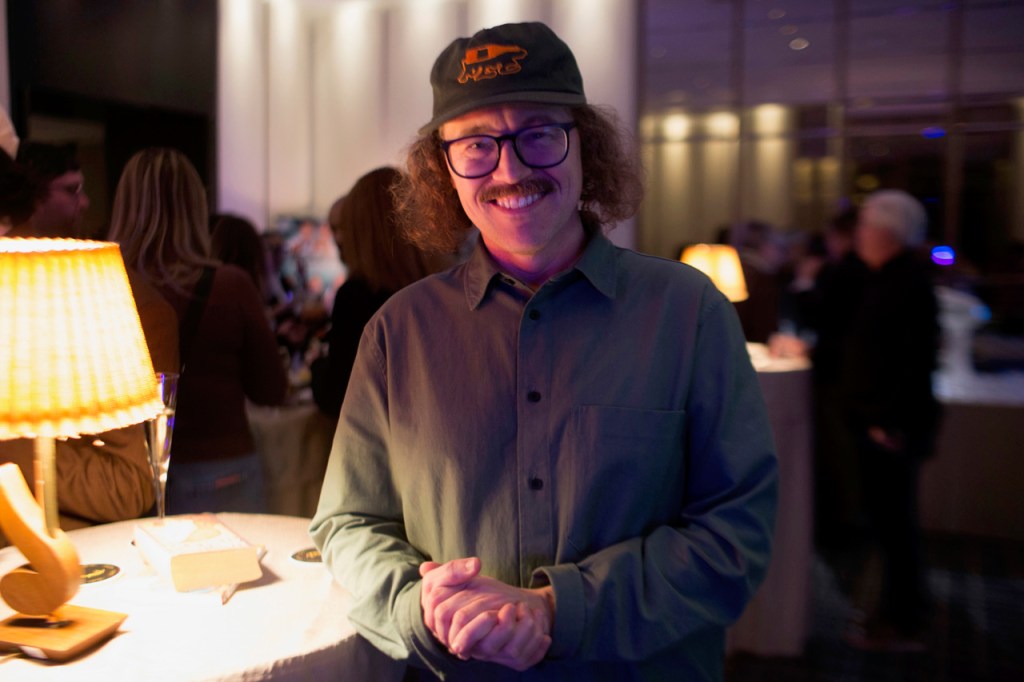
Young Werther is a new Canadian romantic comedy based on Goethe’s famous 18th century coming-of-age novel, updated to modern times. It’s a love triangle full of passion and lovelorn loss. It’s written and directed by award-winning,Toronto-based filmmaker José Avelino Gilles Corbett Lourenço. José is best known for his short films and music videos but also has an accomplished history in advertising. This is his first feature.
I spoke with José in Toronto via ZOOM.
Young Werther had its world premiere at TIFF24 and is now playing in Toronto.
Hi, this is Daniel Garber at the Movies for culturalmining.com and CIUT 89.5 FM.
Mark your calendars, boys and girls, because the annual Canada’s Top Ten film series starts in just a few weeks. If you’re into highly original movies, you really gotta check this out. I’ve already reviewed many of them, or interviewed them already, but there’s lots left to discover.Things like David Cronenberg’s The Shrouds, a truly bizarre mystery about an entrepreneur who invents burial shrouds that allow you to see in real time the decaying buried body of your loved one. It stars Vincent Cassell, Diane Kruger and Guy Pearce. Or Kazik Radwanski (Interview: 2013) & Samantha Chater’s brilliant Matt & Mara, with an almost totally improvised script follows old friends (Matt Johnson, Deragh Campbell) who suddenly meet each other again, opening a real can of worms. There are also short films at this festival — I can’t wait to see NFB animator Torill Kove’s latest short Maybe Elephants; her films are just enchanting. And I’m curious what Canadian actor Connor Jessup is up to now with his short film Julian and the Wind. He starred in the movies Blackbird (2013) Closet Monster (2016) and the Netflix series Locke and Key (2021) but I have never seen his own work. These are just a few of the great movies in Canada’s Top Ten and they’re all showing at the TIFF Lightbox in Toronto.
But this week, I’m looking at two new movies, one from Iran (via Germany), and another one from Spain (via the US). There are three female activists looking for freedom in Tehran; and two female writers looking for peace in New York.
The Seed of the Sacred Fig
Co-Wri/Dir: Mohammad Rasoulof
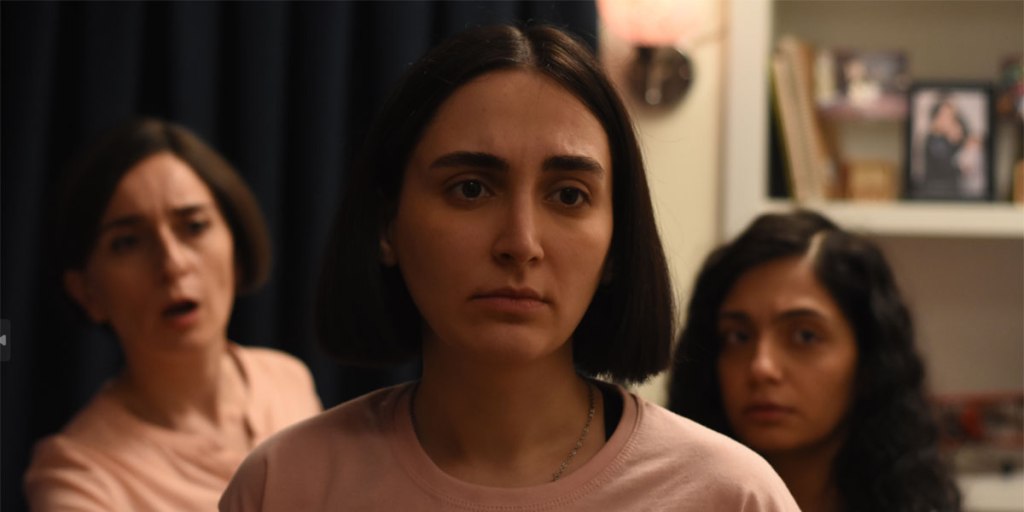
Najmeh (Soheila Golestani) and Iman (Missagh Zareh) are a happily married couplein Tehran. They live out their two daughters, Rezvahn (Mahsa Rostami) and Sana (Setareh Maleki). The kids fight a lot, but the family is still close and trusting; no secrets here.But everything changes once their Dad — a government bureaucrat — gets a promotion. He is issued a gun for protection, due to the nature of his new position. You see, he is now sort of a judge within the Islamic Revolutionary Court. This means convicting and sentencing anyone accused of disobeying religious or political laws, ranging from women who expose their uncovered hair, to anyone caught insulting the Supreme Leader or the government itself. And especially anyone caught at a pro-democracy demonstration.
But when Rezvahn’s best friend Sadaf gets beaten up at a demo, and they hide her in the apartment they have to keep it from her Dad. Is he responsible for this crackdown? And when his gun disappears, Iman suspects everyone. Has his family turned on him? A wall of distrust divides the family, threatening its very existence. Can they reconcile or is it too late?
The Seed of the Sacred Fig is a powerful and harrowing drama about distrust and betrayal, within a family torn apart by the influence of an authoritarian government on all of their lives. It was shot entirely in Iran, on the sly, by noted director Mohammad Rasoulof who smuggled it out of the country. (It was edited in Germany.)He fled for obvious reasons: he was sentenced to 8 years in prison, and corporal punishment — that’s whipping — for his film work.
Two thirds of it was shot within a claustrophobic apartment in Tehran, two years ago, right when a women-led, pro-democracy movement was in full swing. The final third was shot outdoors in a spectacularly eerie lunar landscape, shifting in tone from tense psychological drama to a genuine action/thriller. This movie is neither short nor easy to watch, but it is amazing.
I recommend this one.
The Room Next Door
Co-Wri/Dir: Pedro Almodovar
Ingrid (Julianne Moore) is a successful novelist who lives in New York. At a book signing — her latest one is about her fear of dying — an old acquaintance approaches her. She tells Ingrid that Martha (Tilda Swinton), her old friend from University days, is dying of cancer. Can’t she visit her in hospital? Ingrid hasn’t seen her in decades, though they had been quite close. They even once had a boyfriend in common, Damian (John Turturro). And while Ingrid stayed close to home, Martha (Tilda Swinton) became a renowned war reporter for the NY Times. Her travels took her around the world covering frontline battles in West Africa and the Middle East. They are both happy to see each other again, and Ingrid loves keeping Martha company as she recounts some of her past adventures.
That is until Martha makes a big request. Her death is inevitable, but she hopes Ingrid will stay with her in the room next door (hence the title) so someone will be around when the inevitable happens. (Ingrid is estranged from her only daughter). And though deathly afraid of death, Ingrid agrees. They move to a gorgeous isolated wood-and-glasscountry home. But what will happen next?
The Room Next Door is a touhing, gentle story about two old friends reunited under bittersweet circumstances. Though clearly an Almodovar movie it differs in two ways. This is his first English language feature, and the dialogue seems stilted and clumsy, at least at the very beginning, but interestingly, I stopped noticing it after the first few minutes. Second, the passionate melodrama, the sex, the outrageous humour I expect to see in any Almodovar movie aren’t there. Any conflicts, secrets, betrayals or revelations are few and far between. Instead it is subtle, soft, and gentle. And yet it still clearly is Almodovar’s work. The set design, colour palette, camerawork, thestructure and the music are instantly recognizable. I love the gorgeous, two-coloured wooden lounge chairs by the swimming pool, the clothes they wear, the soundtrack. Almodovar loves long, intricately told flashbacks, and stories within stories like The Arabian Nights. It satisfies your brain and your heart. And Tilda Swinton and Julianne Moore are just right in their roles.
So in the end, though The Room Next Door was not the Almodovar film I expected to see, it was still satisfying to watch.
The Room Next Door and The Seed of the Sacred Fig are both opening this weekend in Toronto; check your local listings.
This is Daniel Garber at the Movies, each Saturday morning, on CIUT 89.5 FM and on my website culturalmining.com.
leave a comment