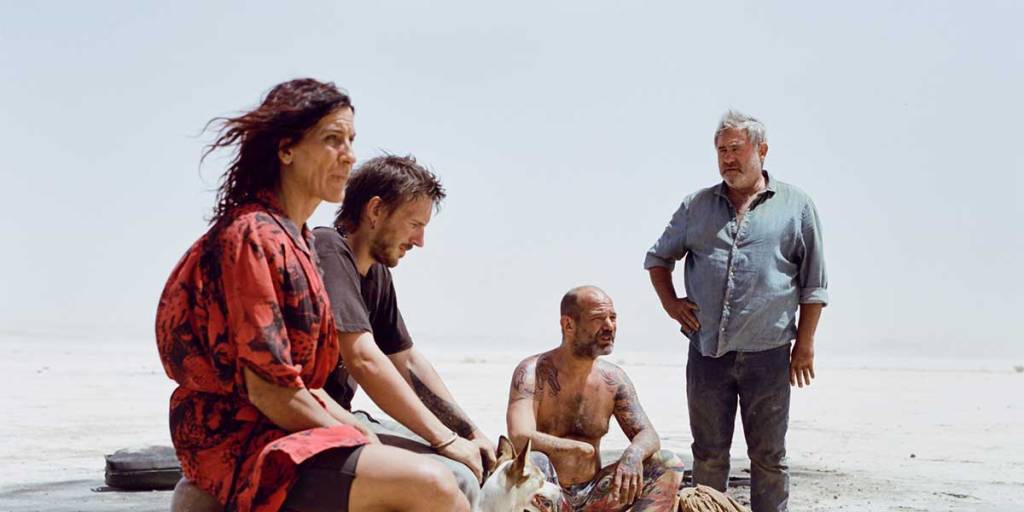
Not always pretty. Films reviewed: I Really Love my Husband, Orwell: 2+2=5, Roofman
Hi, this is Daniel Garber at the Movies for culturalmining.com and CIUT 89.5 FM.
TIFF is over but Fall Film Festival Season continues in Toronto. FeFF or Female Eye Film Festival is entering its 23rd year, showcasing features, shorts and docs directed by women. This year’s theme is Always Honest, Not Always Pretty, so you can expect some challenging and surprising work from women around the world. Expect innovative screenings, many with the directors present, as well as pitches, workshops and tributes.The festival runs from October 14-19, at the TIFF Lightbox, the Women’s Art Associations of Canada and the City Playhouse Theatre in Vaughan.
So this week, I’m looking at three movies, one from FeFF and two from TIFF. There’s honeymooners in the Caribbean, a famous writer on a tiny Scottish isle, and an ingenious thief, who lives, undetected, in a big box store.
I Really Love my Husband
Co-Wri/Dir: G.G. Hawkins
Teresa (Madison Lanesey) lives in LA with her husband Drew (Travis Quentin Young). They’ve been married for a year but have yet to go on a real honeymoon. They both work at unfulfilling professions with little time for amorous interludes. But that’s about to change: Theresa and Drew are heading south for a week, to relax and spend time with each other on the sandy beaches of Bocas del Toro, Panama. It’s a chain of Caribbean islands known for their blue skies and warm waves. And even when the airline lose their baggage and the promised welcome meal is nowhere to be seen, they are still happy with the place. The manager, a boyish, non-binary beach bum named Paz (Arta Gee), is ready to help make their stay more comfortable, however they can. For Theresa, that means thinking outside the marital envelope. She urges Drew to join with her in seducing Paz. Though hesitant at first, Drew dives into the three-way, head first, and their marriage feels stronger than ever. And Paz promises to take them to
their secret island for one final fling.
But the mood starts to shift when jealousy rears its ugly head. A fourth wheel joins the group to make things even more confusing. Kiki (Lisa Jacqueline Starrett) a ginger-haired influencer with a venomous tongue, is a reality-show reject voted off the island. But she stays on, planting bad ideas in the couples’ heads, Can Teresa and Drew’s marriage endure all these complications? Can the insecure Teresa keep her anger in check?
I Really Love my Husband is a funny, bittersweet rom-com about the doubts plaguing a couple of millennials on a belated honeymoon. It pokes fun at a whole generation — from breakfast fasting to mushroom edibles to friendship stones — exposing some of the worst and silliest trends and fads. The characters are as worried about ratings and social networks as they are about actual love and affection. For a first-time feature by a new director with a largely unknown cast, this is a fun slice of life. Madison Lanesey is nicely sardonic, Arta Gee appropriately chill, and Travis Quentin Young always sweet strumming his guitar. Though not totally original, I Really Love my Husband does seem to capture the zeitgeist of LA’s millennials.
Orwell: 2+2=5
Dir: Raoul Peck
It’s the late 1940s in Scotland’s Inner Hebrides on a tiny, inaccessible island called Jura. George Orwell is there to write a novel in an isolated home, inaccessible by cars. His young son, his sister and their housekeeper keep him company as he sits by his typewriter. He’s dying of tuberculosis but wants to make sure his last book is completed and published. The novel is called 1984 and becomes a crucial part of contemporary culture, even today. You’ve probably heard of Big Brother; or at least the surveillance based reality show it inspired. It has been made into many films and TV shows and is referenced everywhere, Words like sexcrime and concepts like doublethink are firmly imbedded in our culture. The book is about the perpetual war between competing totalitarian nations. But more than that, it’s about the propaganda, mass surveillance and thought- control ordinary people are subject to. The hero, Winston Smith, works for the Ministry of Truth propagandizing Newspeak to the nation. But eventually he too falls victim to the machinations of the government of Oceania, ruled by Big Brother. He is tortured because, although he accepts their ludicrous proposition that 2+2=5, and espouses their slogans (War is Peace!, Ignorance is Strength! Freedom
is Slavery!), he doesn’t really believe them. This story shows that the contents and concepts of 1984 are as relevant today as when Orwell wrote them.
Orwell 2+2=5 is a combination documentary, docudrama and diatribe about Orwell, his writing and its influence on popular culture. It covers not just 1984 but Orwell’s earlier books, including Burmese Days, Homage to Catalonia (he volunteered to fight fascism in the Spanish Civil War), and Animal Farm, his allegorical look at Stalinist Russia. It’s based on both his books and his private correspondence. The movie also uses clips from the many film adaptations of 1984 to tell that story. And finally, it includes a barrage of brand-new news footage of leaders like Trump, Putin, Orban and Xi Jinping. These are altered with Orwellian slogans superimposed in bright colours over the media images.
Raoul Peck is a well-known Haitian documentary filmmaker, and maybe it’s because I already know so much about Orwell and his writings, this movie — with the exception of his last days on Jura — wasn’t as mind blowing as it might have been if it were all new. And it can’t compare to other docs like Peck’s I Am Not Your Negro, his biography of James Baldwin. Even so, Orwell 2+2=5 does stand as a historical document with a good dose of agit-prop.
Roofman
Co-Wri/Dir: Derek Cianfrance
It’s the early 2000s in Charlotte, North Carolina. Jeffrey Manchester (Channing Tatum) is the happy father of a young daughter and twin infants. He’s smart, nimble and observant. But he is underpaid and overworked as his job, and can’t seem to keep the family afloat. When he has to resort to regifting his own childhood toys for his daughter’s birthday party, he realizes something must change. He resorts to a life of crime, involving no violence. He robs McDonalds restaurants by an ingenious method: cutting a hole in the roof after dark, and stealing the cash. After dozens of such robberies the press subs him “Roofman”. His family moves up the social ladder, living the american dream of life with a swank car and and a nicely decorated home. Alas, he is finally caught, and sent to prison. His wife cuts him off, and he can’t even talk to his own kids anymore.
Later, following an ingenious plan, he escapes from prison undetected and looks for a place to hide. Most surprisingly he discovers an unsurveilled corner of a Toys R Us big box store with enough hidden space to make set up a tiny apartment. He initially survives on peanut M&Ms pilfered from the shelves, but eventually moves on to pawning video games and DVDs. And he learns the layout of the cameras and computers, making him virtually invisible… though in plain site. He
surveils the store management instead of vice versa. He has a crush on one employee Leigh (Kirsten Dunst) a single mom with two teenaged daughters. They eventually meet, unexpectedly, at an evangelical church toy drive (he “donates” toys stolen from his Toys R Us). Sparks fly and they become very close, but with Jeff still concealing his life of crime and his current home. Can he start a new life in his own home town without getting caught? Or should he just get the hell out of there?
Roofman is an exciting adventure / romance / comedy based entirely on a true storytelling. It’s funny, clever and constantly surprising. Channing Tatum is brilliant as Jeff, displaying an acrobatic sense of movement and timing, climbing walls, crawling through ceiling tiles or swooshing around cars on foot to avoid detection. The rest of the cast is also great: former teen actor Kirsten Dunst has eased comfortably into middle age and her character is very empathetic; Lakeith Stanfield is Steve, his sketchy war buddy; Aussie Ben Mendelsohn as guileless Pastor Ron, and Peter Dinklage appropriately dislikable as toy store manager Mitch. Filmmaker Derek Cianfrance (he directed the passionate Blue Valentine and the dark The Place Beyond the Pines) hasn’t made a movie in ages, but if he’s looking for a comeback, this is it.
I like Roofman a lot.
Roofman and premiered at TIFF and open in Toronto, this weekend; check your local listings; and I really love my husband is coming soon to FIFF.
This is Daniel Garber at the Movies, each Saturday morning, on CIUT 89.5 FM and on my website culturalmining.com.
Unusual road movies. Films reviewed: Nirvanna, the Band, the Show, the Movie; The Long Walk, Sirât PLUS #TIFF50!
Hi, this is Daniel Garber at the Movies for culturalmining.com and CIUT 89.5 FM.
If you’re in Toronto this weekend, get your collective ass down to “Festival Street” — King st, from University to
Spadina — to celebrate TIFF’s 50th anniversary. Even if you can’t afford the tickets, they’re tons to see and do. They’re giving away loads of free stuff, like Italian beer, cold brew coffee, Korean noodles… and even free mouthwash. Why
mouthwash? Why any of this… they’re promotions. But they’re all free! Free outdoor movies, too, each night in David Pecaut Square. And if you’re into celebs, you might see stars like Scarlet Johansen, Mia Goth, Keanu Reeves and
Jodie Foster, just a few expected to show up.
This week I’m looking at three new road movies, two opening at TIFF. There are European ravers driving through the Sahara desert, 50 boys in a dystopian America on a walkathon for their lives, and two Toronto musicians time-travelling on Queen St West in a magic bus.
Nirvanna, the Band, the Show, the Movie
Co-Wri/Dir: Matt Johnson
It’s about 17 years ago in downtown Toronto. Aspiring musicians Matt Johnson and Jay McCarrol (played by themselves) are composing music and planning elaborate schemes to get invited to play on the stage at the Rivoli on Queen St West But so far no luck. The band is called “Nirvanna”, with an extra N; but they sound more broadway than grunge. They live in a Toronto row house with a trailer home parked behind. Fast forward a few decades and Matt and Jay are still trying to get booked at the Rivoli for the first time. Matt’s latest scheme? To jump off the top of the CN Tower with parachutes and land inside the Skydome in the middle of a Blue Jays game. That should get enough attention to get their band booked, right? But as Matt’s ridiculous schemes get ever more outlandish and dangerous, Jay becomes increasingly frustrated. And when they somehow manage to travel back in time, a la Back to the Future, thus changing history, it messes up everything and their band might cease to exist. Can the two of them get back together in time to save the band… and their own lives?
Nirvanna… is an uproariously funny pseudo-documentary, done in the manner of Borat, but more gently Canadian. I absolutely love Matt Johnson (The Dirties, Blackberry), with his cringey sense of humour, always lightly dipped in horror and disaster. I’m not familiar with Jay McCarrol, but he’s an excellent musician and a perfect foil for Johnson’s grandstanding ineptitude. The
time travel is accomplished because they’ve been filming the series for about 20 years. As for the special effects, I’m still not sure if they actually jumped off the CN tower… but it sure looks like they did. Breaking news: I literally just spoke with the filmmakers: Matt says it’s all real, Jay says it’s all fake. Either way, Nirvanna now stands beside Scott Pilgrim as the most Toronto-y movie of the century.
The Long Walk
Dir: Francis Lawrence (The Hunger Games: The Ballad of Songbirds and Snakes)
It’s the corn belt in a dystopian, future United States. The country is a military dictatorship and the people live in poverty. Fifty young men, one from each state, have signed up for an annual race. The winner gets a huge cash prize as well as any dream he wishes to fulfil. His triumph will add a sense of hope and pride to the country’s citizens — or so the contest’s organizer, The Major barks at the boys (played by an unrecognizable Mark Hamill).
One competitor, Ray (Cooper Hoffman: Licorice Pizza) introduces himself to other players, and quickly makes friends with Pete (David Jonsson). They soon added Art Baker from Louisiana (Tut Nyuot) who wants to win the money, and Hank Olsen (Ben Wang) a nerdy-looking guy with a wisecracking, urban accent. They call themselves the four musketeers, and vow to look out for each other. Some of the racers keep to themselves. Barkovitch, (Charlie Plummer: Lean on Pete, The Return) a rabble rousing misanthrope hurls discouraging insults at his competitors. Collie (Joshua Odjick) is an indigenous man who walks to the beat of a different drum. And an ultra-fit athlete (Garrett Wareing) is so sure of his own victory he doesn’t even grace anyone with a response. The problem is, there can only be one winner. And the 49 losers? They will all be dead. You see, it’s a race to the death, and anyone who lags behind the requisite three miles an hour is summarily murdered by soldiers in tanks rolling beside the walkers. If anyone lags in their walk three times — including drinking, tying your shoes or even sleeping — they die. Who will survive this gruelling competition?
The Long Walk is a dark dystopian road movie movie about
male bonding, friendship and resistance to an autocratic state. It’s shot in a rustic, sepia tones in marked contrast to its horror theme. It’s based on a story by Stephen King, and directed by Francis Lawrence who brought us the Hunger Games movies. While it doesn’t hold back on violent blood, guts, and despair, at least it keeps alive some feeling of hope throughout. The Long Walk is totally watchable, the acting is great and I like the characters. But — maybe because of the story’s inevitability — it never really grabbed me. This could have been a deeply moving weeper, but instead it’s just a gruesome race, with a wee bit of political consciousness.
Sirât
Dir: Oliver Laxe
It’s a red sandstone skyline somewhere in Northwest Africa. A huge wall of speakers is spewing heavy drum and bass rhythms out of a wall of speakers, with hundreds of semi-nude dancers moving in a throbbing crowd. It’s a European rave attracting people who look like they’ve been moving to the music since the 1990s. Totally out of place are a middle aged Spanish man named Luis (Sergi López) and his young son Esteban (Bruno Núñez Arjona). They’re handing tiny leaflets to everyone they see, about their missing daughter/sister. She’s also a raver but hasn’t been seen in years. Suddenly the music stops, soldiers march in and one if them starts shouting through a megaphone: the area must be evacuated immediately, with all Europeans following the military back to safety. With much grumbling, the dancers pile into makeshift schoolbuses move out of the area… until suddenly two vehicles — an ATV and a military transport truck — veer off track and head in the opposite direction. They’re going south toward a legendary rave near Mauritania. In a split-second decision, Luis and Esteban decide to follow
them in their urban SUV, of their best chance of finding the missing girl. The crusty ravers don’t want them to follow but agree to let them tag along.
And a ragtag bunch they are, with weathered features, pierces and tattoos, peg-legs and missing limbs. They speak French, Spanish and English.But they also have a wicked sense of humour, and an overriding communal spirit. What no-one seems to realize is they’re driving headfirst into the impossible terrain of the western Sahara desert in the middle of a revolutionary war.
Sirat is a fantastic, nihilistic road movie, that combines elements of Mad Max, Nomadland and Waiting for Godot. It takes you on the twists and turns of disaster, keeping you on your toes all the way. I’m not revealing any more of the plot, but suffice it to say it thumbs its nose at traditional Hollywood narratives. The acting seems very close to documentary style, and apart from López as Luis, all the cast seems to be non-actors playing themselves. (They are called by their real names.)
If you can stand the shock, you must see Sirat.
Sirat and Nirvanna, the Band, the Show, the Movie are both premiering at TIFF right now; and The Long Walk opens across Canada on Sept 12.
This is Daniel Garber at the Movies, each Saturday morning, on CIUT 89.5 FM and on my website culturalmining.com.
American battles. Films reviewed: G20, Drop, Warfare PLUS National Canadian Film Day!
Hi, this is Daniel Garber at the Movies for culturalmining.com and CIUT 89.5 FM.
Yearning for some Can-Con? We’ll mark your calendars: next Wednesday is Canada Film Day with over 1700 screenings and discussions about great Canadian movies across this country! In Toronto alone, directors and actors like Sophie Desraspe, Helen Lee, Eric Peterson, and Cody Lightning will be there at the screenings. There’s also a Town Hall discussion of Canadian culture with Don McKellar, Mary Walsh and Elle-Maija Tailfeathers. Canadian Films suddenly seem acutely relevant. Go to canfilmday.ca for showtimes.
But this week, I’m looking at three new movies from south of the border. There are Navy Seals in Iraq attacked by armed combatants; the US President locked in hand-to-hand combat with international terrorists; and a single mom terrorized by her cel phone.
G20
Dir: Patricia Riggen
It’s a resort hotel in Capetown, South Africa, and US President Danielle Sutton (Viola Davis), America’s first black female POTUS is preparing for the G20 summit. When she’s not practicing martial arts with her Secret Service bodyguard Manny (Ramón Rodríguez) she’s hanging with her family: loving husband Derek and her two teenaged kids. Serena, the older one, (Marsai Martin) is an accomplished hacker who can sneak, undetected, out of any building, even the White House. President Sutton is decked out in an elegant red evening gown — complete with cape — for the all-important photo-op. But something is rotten in the city of Capetown. There’s a conspiracy at work, led by evil Aussie mercenaries. And now armed soldiers are rounding up the presidents and their families! If they can pull this off, they’ll have trillions in “untraceable” crypto currency, and the leaders of the most powerful nations in the world will grovel at their feet.
But some of the leaders have escaped their clutches. Sutton, the elderly Korean First Lady, the pompous British PM, and a few others have form an impromptu posse. Can this ragtag group of heads of state beat the musclebound mercenaries in a contest of physical strength and mental acuity? Or is this world doomed?
G20 is a ludicrous but fun action thriller, told from the point
of view of a female, superhero-type president. This is not a unique movie theme: Many Americans love venerating their presidents. Think: Harrison Ford in Air Force One or even Abraham Lincoln Vampire Hunter. But G20 is so silly… The villains carry the bitcoin wallet — with all the money — as if it’s a physical object, a MacGuffin they have to possess. And they eforce the leaders to read a nonsense speech (the quick brown fox jumps over the lazy dog) so they can make a deep-fake video… as if world leaders haven’t made hundreds of speeches already. A 60-year-old president who’s also an Iraq War hero and also a jiujitsu champ. Sure, why not…? It’s just a movie. The main story may be a hackneyed farce, but Viola Davis is a joy to watch.
Not a masterpiece but a watchable TV movie.
Drop
Dir: Christopher Landon
Violet (Meghann Fahy) is dressed-up but nervous. She’s on her first date since her husband died, five years ago. A single mom and an online therapist, she likes working from home so she can keep a close eye on Toby, her adorable, autistic son. But her wacky sister Jen (Violett Beane) insists she step out of her shell and have some fun. Jen’s babysitting Toby tonight to give her all the time she needs. And if there’s no chemistry with the guy she’s meeting, she can always just leave. So here she is in a fancy restaurant with a dramatic view of the city. In comes Henry (Brandon Sklenar) her first date, and there’s instant attraction. Henry is handsome, rugged and friendly, and has a steady job at City Hall. He likes her looks, her smarts and her honesty. They go to their table and start the date.
But the electricity between is interrupted by anonymous memes and texts that keep appearing on her phone, apparently dropped by someone somewhere in the restaurant. The messages become threatening, along with a warning: if you tell anything to Henry (the guy she just met) we’ll kill your son. Followed by live security footage from her home… with a masked man roving her halls with a gun. Whoever it is has control of all her security cameras and all the cels in the restaurant. They can see and hear everything she’s doing.
They want her to commit a crime in plain view, and there’s no way to stop them. Can Violet save her son and outsmart this invisible villain on this date from hell?
Drop is a classic suspense thriller that plays on our fear of technology and surveillance. Afterwards I realized there are some major plot holes or impossibilities, but they don’t stand out while watching it. It’s a tightly budgeted Blumhouse movie so the actors are likeable but not A-list, and everything takes place in two tight locations – her home and the restaurant. It uses psychological fear instead of pyrotcechnics. And it works. This is a good, traditional suspense thriller, the kind where the tension keeps growing and never lets up.
I like this one.
Warfare
Co-Wri/Co-Dir: Alex Garland (Ex Machina, Annihilation, Civil War), Ray Mendoza
It’s November, 2006, in Ramadi, a city in central Iraq, between Baghdad and Fallujah. Ray (D’Pharaoh Woon-A-Tai) is leading a squad of Navy Seals on a mission. They commandeer two houses, knocking down walls and pushing the families into their bedrooms. They’re setting up for a long wait, until a marine unit arrives with tanks to evacuate them. But armed enemy soldiers are setting up on nearby roofs, taking pot-shots at them. And when the tank finally arrives, the Seals are ambushed by an IED buried in the road. The Iraqi soldiers they are working with are killed, while some of their own are badly injured. They have to pull their bodies back into the house and try to save who they can. Can they fight off the insurgents until the Marines arrive? And who will survive this tense battle?
Warfare is a hyper-realistic depiction of an actual battle in Iraq as remembered by the US soldiers who were there (including writer/director Ray Mendoza). It’s not like your usual war movie. The film favours accuracy over character- building or back stories. And the characters speak in military jargon, full of Frogmen (navy seals), Bushmen (an aerial unit, overhead) and many more I couldn’t catch. The cast is
excellent, especially Woon-A-Tai, Will Poulter (The Revenant, We’re The MIllers, Midsommar) and Cosmo Jarvis — it really felt like you’re there, witnessing actual soldiers, showing bravery, camaraderie, and brotherhood. What the movie doesn’t deal with is why? Why were they there at all? What did that particular mission accomplish? Where are all those WMDs, the supposed reason for this war? Thousands of US soldiers were killed there, and many times more tragically killed themselves afterwards. And an estimated one million civilians in Afghanistan, Pakistan and the Middle East were wiped out, millions more displaced and the whole region made unstable till today… and for what?
I’m glad I saw Warfare — it’s a rare chance to experience a non-jingoistic, up-close and personal look at US soldiers on the frontline. But don’t go to this docudrama expecting to be entertained. Because fun… it ain’t
G20 is now screening on Prime Video, and Warfare and Drop both open this weekend in Toronto; check your local listings. This is Daniel Garber at the Movies, each Saturday morning, on CIUT 89.5 FM and on my website culturalmining.com.
Daniel Garber talks with Mehdi Fikri about After the Fire at #TIFF23

Hi, this is Daniel Garber at the Movies for culturalmining.com and CIUT 89.5 FM.
Photograph by Jeff Harris

Driss, Malika, Karim and Nour are close-knit siblings who live in the banlieux of Strasbourg, France, sworn by their late mother to stay together. When the black sheep, Karim turns to drugs and petty crime, Malika writes him off as a lost cause. But when he is arrested and dies in police custody, she decides to take action. And as she finds herself the main spokesperson for large scale protesters and rioters, she must learn to navigate the world of French politics, justice, media and police. Can Malika find justice for Karim after the fires have ended?
After the Fire is a stirring, dynamic, and hard-hitting look at immigrant communities — personified by one family — fighting back against an oppressive establishment. It’s exciting, surprising and deeply moving. It’s French writer and filmmaker Mehdi Fikri’s first feature, and it had it’s world premiere at TIFF.
Mehdi talks about the justice system, political films, BPM, La haine, Camélia Jordana, media training, Algerian music… and more!
I spoke with Mehdi in person at #TIFF23.
Daniel Garber talks with Chandler Levack about I Like Movies
Hi, this is Daniel Garber at the Movies for culturalmining.com and CIUT 89.5 FM.
It’s 2002 in Burlington Ontario, a suburb of Hamilton.
Lawrence is an eccentric, self-centred 16-year-old boy who lives in a small bungalow with his widowed mom. He spends most of his time with his best friend Matt, the two of them watching SNL at weekend sleepovers. They’re making an end-of-the-year film together at school. Lawrence lives and breathes movies, consuming stacks from his local video store. His long-term ambition? To become an auteur. But first he’ll have to study cinema at NYU (“Canadian universities are too… Canadian”).
To pay for it, he needs big bucks. But when he gets a job at a video chain store, everything changes. He hits it off with the store manager, the older woman who hired him. But no more
time for sleepovers, or making his film. His relationship with his doting mom is in a shambles, and he begins to doubt he’ll get into any University. Is just liking movies… enough?
I Like Movies is a coming-of-age comedy that premiered at TIFF. It explores the life of an aspiring filmmaker in a lifeless Canadian suburb. It’s written and directed by prize-wining filmmaker, writer and movie critic Chandler Levack.
I spoke with Chandler in Toronto via ZOOM.
I Like Movies opens on March 10, 2023.
Oscar contenders, 2023. Films reviewed: Saint Omer, The Son, Living
Hi, this is Daniel Garber at the Movies for culturalmining.com and CIUT 89.5 FM.
This week, I’m looking at three potential Oscar contenders opening this weekend. There’s a writer in Paris attending a trial, a bureaucrat in London whose life is a trial, and a Dad dealing with the trials and tribulations of a mentally ill son.
Wri/Dir: Alice Diop
It’s the early 2000s in a Parisian suburb. Laurence Coly (Guslagie Malanda) is on trial for murder. She admits to leaving the infant on a beach to be washed away with the tides one moonlit night, but why she did it is not so simple. She’s a Senegalese-French woman from Dakar, in Paris as a student. She is beautiful, articulate, poised and intelligent; not your usual murder suspect. As her mother (Salimata Kamate) told her, education and politesse are the two most important traits. But after a series of events she ends up living in a small apartment as a grey-haired, married man’s mistress — no longer in university, with no friends, no job, no future. And virtually no one knows she was pregnant nor that she gave birth at home. She existed in a strange limbo world.
All of this is taken in by Rama (Kayije Kagame) a novelist and
university prof in Paris. She is following the trial in person, for a new book she’s writing about Medea. Like Laurence, she’s a French intellectual, and a black woman of West African background. More than that, she’s estranged from her mother and is in her first trimester of pregnancy. In a sea of white faces in the courtroom, she feels both a connection and a revulsion toward Laurence. Could this be me on trial? she wonders. And will I be a fit mother?
Saint Omer is a devastatingly powerful courtroom drama as seen through an observer’s eyes. It’s the opposite of a Law & Order episode — no smoking guns or pot twists. Rather it’s Laurence’s retelling of her story before judge and jury Rama’s reactions that carries all the power. It’s intentionally filled with subtle ambiguity so you’re never quite sure whether Laurence is lying and being coached to do so, or if she’s completely sincere. With women holding most of the key roles — including the judge and the defence council — it strips away some misconceptions. The acting (by actress Malanda and artist/performer Kagame) is superb, and the filmmaking amazing. This is documentary filmmaker Alice Drop’s first drama. Somehow, she takes the drab wooden panels of a classroom and a courtroom and turns them into something pulsing with emotion.
This is a great movie.
Wri/Dir: Florian Zeller
Beth and Peter (Vanessa Kirby, Hugh Jackman) are a newly married, upper-middle class couple with a new baby. All I going well until they get an unexpected knock on the door. His teenaged son Nicholas (Zen McGrath) says he can’t take living his mom anymore (Laura Dern) a full-time nurse whom Peter divorced and abandoned a few years earlier. What a dilemma! He can’t turn away his own flesh and blood, can he? But Nicholas is difficult to live with. It seems he stopped going to school months ago — without telling his parents. And Beth finds him scary. What if he does something to our baby— how can I trust him? So they check him into a psych ward without his consent. But what can they do in the long run with this troublesome teen?
The Son is an overwrought melodrama about divorced parents forced to care for their troubled son. It deals with anguish, anger and regret but only from the parents’ perspective, never from the son’s. He’s just a pain in the ass… and possibly a threat! This movie falls in that sub-genre of sympathetic parents forced to deal with sons who “selfishly” choose to become drug addicts or mental ill. How dare they! Despite what the parents try, those bad sons are criminals and liars at heart who can never be trusted. This dreadful collection of
never-watch movies includes Beautiful Boy, with Timothy Chalamet and Ben is Back, starring Julia Roberts and Lucas Hedges. This one has equal star power, and is just as hard to watch. It’s especially disappointing because it’s Florian Zeller’s follow-up to The Father a few years back about an elderly man slipping into dementia (Anthony Hopkins, who also appears in this film), as its unreliable narrator. But don’t be fooled. The Son has no redeeming features and is truly one of the worst movies of 2022.
Living
Wri/Dir: Oliver Hermanus
It’s Londin in the 1950s. Williams (Bill Nighy) is a mundane municipal bureaucrat, the head of public works at County Hall. He spends most of his time at his desk — along with his subordinates Rusbridger, Middleton and Hart — keeping busy by ignoring piles of files and requests. Whenever troublesome locals appear, like a group of mothers requesting they build a tiny playground in a vacant lot, they’re quickly disposed of by sending them to another department in the endless bureaucratic labyrinth of city hall. The newly-hired Wakeling is quickly discouraged from working too hard — an empty inbox means you’re doing something wrong. The sole woman, Margaret (Aimee Lou Wood), is thinking of quitting to take a managerial job at a local restaurant. Since his wife died,
Williams has lived a humdrum existence sharing his home with his adult son and daughter-in- law. But everything changes when his doctor brings him some terrible `news: incurable cancer, 6 months left to live. Suddenly everything takes on new meaning as he decides to start enjoying life and making things better for others. But is it too late?
Living is a period drama about life in post-war London. It captures the spark that can be reawakened in even the most humdrum person’s existence. It follows the night Williams spends in the demimonde led by an alcoholic bohemian he meets in a cafe; the days spent helping Margaret, for the chance to share in her youth and vitaity; and a project he hoped to complete in his final days.
I approached this movie with trepidation, because it’s a remake of Kurosawa’s Ikiru, one of my favourite movies of all time, which I didn’t want to see ruined. Happily, Living it is wonderful film in its own right. Maybe only a writer like UK novelist Kazuo Ishiguro could transport a story from Tokyo to London, while staying true to its original meaning and structure, even while giving this very Japanese film a distinctly English feel. Bill Nighy (who usually plays silly characters in crap movies) is wonderfully understated in this one. And South African director Oliver Hermanus, who brought us the great Moffie, again puts his all into the film he’s making.
I recommend this movie.
Living, Saint Omer, and The Son all open this weekend in Toronto, with the latter two playing at the TIFF Bell Lightbox; check your local listings.
This is Daniel Garber at the Movies, each Saturday morning, on CIUT 89.5 FM and on my website, culturalmining.com.
Talking, listening, fighting back. Films reviewed: No Bears, Puss in Boots, Women Talking
Hi, this is Daniel Garber at the Movies for culturalmining.com and CIUT 89.5 FM.
It’s holiday time with lots of new movies for people of all ages. This week I’m looking at three new movies opening on Christmas weekend. There are women in a barn, talking; a movie director in a village, listening; and a cat in a hat, fighting.
Wri/Dir: Jafar Panahi
Jafar Panahi is an Iranian filmmaker from Tehran. His current project is about a glamorous middle-aged couple trying to escape to freedom in Europe. But Panahi is forbidden by law from making movies or leaving the country. So he’s doing the next best thing: directing his film in long-distance using his cellphone and laptop. It’s being shot in a picturesque city in Turkey, while he’s renting an apartment in a tiny Azerbaijani village in Iran. It’s close to the border an area rife with black market smugglers. Panahi can speak some Azeri but is unfamiliar with local traditions. So he likes talking pictures of the locals. And here’s where he runs into trouble.
A young couple wants to get married and leave the village. But the woman was promised to another man at birth. Now everyone thinks Panahi caught the young couple in a photograph. The couple want him to destroy the photo, while the groom’s family want a copy to prove her dishonour. Meanwhile, across the border, another crisis is threatening the film movie. As he gets pulled deeper and deeper into the world of local politics and feuds, his work — and possibly his life — is at risk. Will he ever finish his film? And what will happen to the two couples — the actor-lovers in Turkey and secret lovers back home?
No Bears is a neorealist movie about making a film, the film
he’s making, and how real life gets in the way. It’s about honour, revenge and identity. It also exposes the image of “the director as a dispassionate observer and documentarian” as a myth. Panahi’s very presence in a small village disrupts their lives and leads to unforeseen consequences. He plays himself, who in real life is forbidden from making films — accused of propaganda against the system. Any movie that’s against the system is one I want to watch. But this means it was shot openly in Turkey but secretly in Iran. No Bears is a clever, humorous and complex film with an unexpected conclusion. I liked this one.
Co-Dir: Joel Crawford, Januel Mercado
Puss in Boots is a cat in a hat who wears boots, and carries a sword. He’s known for both his fencing skills and his rapier-like wit. He lives a fairytale life — literally. He exists in a world where those stories are real. He’s both a hero and an outlaw, sought by bounty-hunters everywhere. But as a cat with nine lives he has no fear of death and will fight monsters and villains, alike. Until one day his doctor tells him he’d better slow down because he’s on his last life. If he is killed again, that’s the end, no more Puss in Boots. So he reluctantly decides to retire. He gives up his identity, and becomes an ordinary orange cat named Pickles in a home for abandoned cats. Now he has to use a litter box, eat cat chow and say “meow”. How humiliating! But his past catches up to him with some surprise visitors: Kitty Softpaws, another outlaw he left standing at the altar; and Goldilocks and the Three Bears. They all want him to help find a map to a fallen star that can grant a wish. Goldilocks wants a proper family, Kitty is looking for her future, and Puss in Boots wants his 9 lives back. Accompanied by a little dog named Perro he sets out to steal the map from the evil Little Jack
Horner (who is now quite big and bakes pies for living). But he must fight off his rivals, journey through a mystical forest, and find the magic star if he wants to stay alive. And he is being pursued by a truly scary villain, the Big Bad Wolf, a huge killer carrying a sickle in each hand.
Puss in Boots is a kids’ cartoon comedy set in the world of Shrek, where nursery rhymes and fairytales coexist with Alice in Wonderland and the Wizard of Oz. It’s somehow simultaneously a spaghetti western and medieval Europe. It features the voices of Antonio Banderas, Salma Hayek and Florence Pugh. What’s good about it? I’ll watch any cartoon, especially one with cool psychedelic images. This one has a few funny bits, along with a neat journey-adventure story. On the negative side, it’s not very funny, the lines are predictable and the story is both unoriginal and forgettable. And I’m not sure why they switch to two-dimensional jerky animation whenever there’s a fight scene. But I still enjoyed it, even if it’s just glowing bright colours on a giant screen.
Dir: Sarah Polley
It’s summertime at an Anabaptist colony somewhere in the US. It’s 2010, but it could be 1910; forget about cel phones and computers. There are no cars, radios, no electric lights — they still use lanterns. Even more unusual, there are no men around, only women and kids. What’s going on?
One of the women woke up in the middle of the night to find a man physically attacking her. She fought him off and beat him with a stick. Suddenly everything made sense. Countless women in the colony had woken up in the past with bruises and blood, but up till now, the men had insisted out was just a dream, her imagination or the work of Satan. Turns out the men have been raping women for years now and denying it, using cow tranquilizers. Now they are at the police station baling out one of their attackers. So all the women face an enormous decision: should they stay and fight back? Or should they just pack up the kids and go, leaving the place forever?
They designate the women and girls from three families to decide for all of them. Now they’re gathered in a barn to debate the issues and make the big decision. And one man, a school teacher named August — not part of the colony; his family was excommunicated — is there to record it all on paper; the
women were never taught to read or write. What will their decision be?
Women Talking is a movie about women talking, but it is much deeper than that. It’s a devastating story, a scathing indictment of endemic physical and sexual violence against women in their own homes. Though it’s never shown on the screen, nor are its perpetrators, its results are always apparent. One woman has a scar on her face, one woman is mysteriously pregnant, others have missing teeth or black eyes, and another has panic attacks, seemingly for no reason. And now they’re really angry,
not just for the violence, but because they’ve been lied to for so many years. There’s a spontaneous wellspring of grassroots feminism suddenly bursting loose.
The storytelling is very simple — it sticks to the barn, the fields, their houses and horses and buggies; it’s all they’ve experienced. At the same time, perhaps because they can’t write, they are amazingly eloquent speakers. It’s based on the novel by Canadian author Miriam Toewes who grew up in a Mennonite community. (The film never specifies their denomination or location, giving it a timeless, universal feeling.) It provides an internal view of life in the colony, with different opinions expressed passionately by each character. And it’s very well-acted by an ensemble cast, including Rooney Mara, Jesse Buckley, Claire Foy, Frances McDormand, Sheila McCarthy, Ben Whishaw. And despite the grave topic, the movie itself is more fulfilling than depressing. I’ve seen it twice, and appreciated it much more the second time — Women Talking is a subtle movie that deserves your attention.
Puss n Boots: The Last Wish, No Bears and Women Talking, all opened this weekend; check your local listings.
This is Daniel Garber at the Movies, each Saturday morning, on CIUT 89.5 FM and on my website, culturalmining.com.
War movies at #TIFF22. Films reviewed: The Inspection, The Greatest Beer Run Ever, All Quiet on the Western Front
Hi, this is Daniel Garber at the Movies for culturalmining.com and CIUT 89.5 FM.
When military budgets soar, and “war games” are held more frequently, when Presidents and Prime Ministers make speeches about liberty and democracy, when lots of military experts start appearing on cable news networks, rattling their sabres… it usually means governments are gearing up for war. And art imitates life. War movies — you know, the kind of films with all-male casts showing bravery and camaraderie, and lots and lots of guns, tanks and bombs — are becoming popular again.
This week I’m talking about three new war movies that had their world premieres at TIFF. There’s high schoolers in Germany who want to enlist in WWI, a guy from New York who wants to bring beer to his buddies in Vietnam, and a homeless black, gay man who wants to join the marines.
Wri/Dir: Elegance Bratton
Ellis French (Jeremy Pope) is a 25-year old man who sleeps in a homeless shelter in Jersey City, NJ. His single mother (Gabrielle Union), threw him out as a teenager when he came out as gay. He spent the next 10 years living on the streets. Now he plans a new beginning: to turn his life around by joining the marines. But bootcamp is not a nurturing environment. As the sergeants say, we are going to break you all down, and if you survive it, we’ll build you back up again. The breaking down process consists of bullying and violence visited on anyone deviating the norm, be they gay, muslim or just insecure. Sgt Laws (Bokeem Woodbine), in particular, has it in for French, and seems to want kill him — literally. Another recruit, Harvey (McCaul Lombardi) goes out of his way to make French’s life in bootcamp unbearable.
Luckily he does find a few friends, including Sgt Rosales, who takes his side. Can he survive bootcamp and become a marine? And can he ever make his estranged mother proud of him again?
The inspection is based on the memoirs of the film’s writer/director Elegance Bratton. It’s a passionate and deeply-moving first film about a gay son and his fundamentalist
mother, while trying to succeed in a toxic environment. There have been many movies before about life in bootcamp (especially Stanley Kubrick’s Full Metal Jacket) even for a gay man (the South African film Moffie, for example) but The Inspection is still a new take. My only criticism is it seems to be, as a whole, an “oorah-oorah” celebration of military life, despite the prejudice and corruption within it. Without a negative thought, anywhere, about war itself.
Co-Wri/Dir: Peter Farrelly
It’s 1967 in Inwood, N.Y., a white, working-class neighbourhood in northern Manhattan. Chicky Donohue (Zach Efron) is a high school drop out who sleeps in everyday and during waking hours can usually be found getting drunk with his buddies at a local bar. Full of piss and vinegar, Chick has lots of big ideas but rarely follows through; no one take him seriously. Lots of his friends and neighbours either signed up or were drafted to serve in Vietnam, but his time served in the Merchant Marines exempts him. His sister marches in rallies against the Vietnam War at Columbia, but Chicky is firmly on the America, Love it Or Leave it side.
But one day, sitting at the bar with his friends, he wonders why no one
is doing anything for their buddies in Nam: Minogue, Pappas, Duggan and the rest. So he boasts he’ll buy them some beer and give it to them personally. And that’s what he does — fills a duffel bag with cans of PBR, signs up on a ship headed for Saigon, and just goes there. His ship captain gives him three days to find his friends if he ever wants to leave Vietnam. The only Americans who travel in that country are journalists or military. And no one goes north into battle zones voluntarily. Except Chicky. He starts tracking them down to everyone else’s disbelief. As they say, only someone as dumb as him could survive a trip like this.
He happily passes as a CIA agent until he witnesses what they actually do (like the torture and murder of prisoners). And the Vietnamese in the countryside aren’t welcoming him with open arms — they’re terrified he’s going to murder them. And those bombers all around? They’re dropping napalm everywhere. Later he joins forces with a journalist (Russel Crowe) to discover the truth. But will he ever get the beer to his buddies and make it back alive?
The Greatest Beer Run Ever is a fun and fast-moving bro-dramedy based on a true story. It’s set during the Tet Offensive as the war escalates. It has a terrific soundtrack of 60s pop and psychedelic music. Zach Efron is good as a dumb cluck who gradually wakes up to what the war is really about. And while there are some Vietnamese characters, like most American war movies, it’s all about America. It’s hard to tell whether this film is pro-war or anti-war; rather it seems to be pro-soldiers but against the war in Vietnam and especially the lies the generals told.
All Quiet on the Western Front (Im Westen nichts Neues)
Dir: Edward Berger
(based on the novel by Erich Maria Remarque)
It’s 1917 and the world is at war. Paul Bäumer (Felix Kammerer) is a skinny student with glasses at a Catholic boys’ school in a German town. After a rousing speech by their schoolmaster — who dubs the boys “Iron Youth” — all of his classmates rush to join the fight for God, the Kaiser and the Fatherland. But Paul is still too young to enlist, so he forges a letter to sign up with his friends, looking forward to the fun and adventure that surely lies ahead.
But once they arrive in occupied northern France, they soon
discover this war consists of an endless wasteland of trenches. The “new” uniforms they’re fitted with are recycled from the bodies of dead soldiers. They are forced to train wearing horrible gas masks, and thrown into battle. And a hellish fight it is. Paul — along with his friends Haie, Kropp, Müller, Kat and Tjaden — soon realizes that the only way they’re going home is in a coffin.
All Quiet on the Western Front is a scathing look at the machinery of war and how it uses soldiers as cannon fodder. Even while a German diplomat (Daniel Brühl) is busy negotiating armistice, the generals continue killing as many soldiers as they can until the bitter end. The film graphically shows soldiers incinerated by flame throwers, shot, bombed, stabbed by bayonets, and run over by tanks… even killed in brutal, hand-to-hand combat by the main sympathetic characters. While it provides some relief — one soldier steals a goose from a farm to the joy of his squad-mates; another falls for an art deco poster of a French woman that he sticks to the trench wall — there’s a feeling of doom pervading the entire movie. It has good acting, a
soundtrack that is as brilliantly ominous as the theme from Jaws, the photography is deadly, and the makeup — soldiers’ faces coated in a deathly layer of mud and blood — is especially striking. It’s as violent as American movies like Saving Private Ryan, or Hacksaw Ridge, but without the veneer of heroism and bravery. It shows the futility of warfare in all its enormity. This is a gruelling and shocking testament against all war and the military industrial complex.
All Quiet on the Western Front, The Inspection and The Greatest Beer Run Ever all had their world premieres at TIFF, which continues through the weekend.
This is Daniel Garber at the Movies, each Saturday morning, on CIUT 89.5 FM and on my website, culturalmining.com
The Best Movies of 2021!
Hi, this is Daniel Garber at the Movies for culturalmining.com and CIUT 89.5 FM.
I’m back again to tell you my choices for the best movies of 2021, high brow and low brow, both Oscar worthy and mainstream including genre movies, conventional and experimental, big stars and unknowns, high budget, low budget. This year is especially strange because the award season was pushed forward a few months and lots of movies were dug up and released rom years earlier. And, at least in Toronto, movie theatres were barely open most of the time. So it’s hard to know whether a movie is from this year, last year or somewhere in the future.
I see and review hundreds of movies each year, so how do I narrow it down? No sequels — the movies have to stand alone — no documentaries (even though there were some amazing ones this year) and no franchise or superhero movies. These are all movies that were released over the past year, either at festivals or commercially.
Here are what I think are the best movies of the year, in alphabetical order:
Benediction (Terence Davies) An acerbic look at the life and loves of British poet Sigfried Sassoon
Beyond the Infinite Two Minutes
(Junta Yamaguchi) a brilliant low budget sci-fi comedy about small-scale time travel, done without special effects
Cryptozoo (Dash Shaw) whack arthouse animation about a zoo for mythical creatures
Drive My Car (Hamaguchi Ryuske) a
long and pensive movie about a play director whose actors can’t understand one another.
Licorice Pizza (Paul Thomas Andersion) is a brilliant coming of age story set in the early 1970s in the San Fernando Valley
Lune (Aviva Armour-Ostroff, Arturo Pérez Torres) about a bi-
polar anti-apartheid activist in Toronto and her relationship with her daughter
Mothering Sunday ( Eva Husson) — set in the 1930s about a clandestine love affair between a n orphan servant who later becomes a writer and her young upperclass neighbour.
Pig (Michael Sarnoski) a movie about a reclusive truffle hunter
(Nicolas Cage) who enters the restaurant world in search of his kidnapped pig
The Power of the Dog (Jane Campion) a new-style of western about the secrets of a Montana rancher in the 1920s
Petite Maman (Céline Sciamma) about a little girl who
encounters her mother when she was her age
Spencer (Pablo Larrain) an imagined character-study of Princess Diana’s mind during her Christmastime break top with Prince Charles.
Titane (Julia Ducournau) A deranged serial killer who has sex
with a car and then disguises herself as the long lost son of a fire station chief.
Undine (Christian Petzold) about an etherial romance between a woman who works in a museum and a man who thinks she’s a mermaid.
There are lots of other great movies that deserve a mention:
I’m your Man (Germany)
True Mothers (Japan)
Sun Children (Iran)
One Second (China)
Last Night in Soho (UK)
French Dispatch (US)
Benedetta (France)
Tick Tick Boom (US)
And one again, here are the best movies from 2021 that are somehow special or amazing or shocking or surprising or moving.
Benediction
Beyond the Infinite Two Minutes
Cryptozoo
Drive My Car
Licorice Pizza
Lune
Mothering Sunday
Pig
The Power of the Dog
Petite Maman
Spencer
Titane
Undine
This is Daniel Garber at the Movies, each Saturday morning, on CIUT 89.5 FM and on my website, culturalmining.com
Issues. Films reviewed: Minari, Test Pattern, The Mauritanian
Movies are entertainment, but they can also inform. This week I’m looking at three new American movies that look at important issues. There’s a Korean-American family living the immigrant experience in Arkansas, a black woman dealing with sexual assault in Texas, and a young man enduring prison life in Guantanamo Bay.
Wri/Dir: Lee Isaac Chung
It’s rural Arkansas in the 1980s. Young David (Alan Kim) just moved there from California with his small family, just his sister Anne and his parents. He’s not allowed to run and play because of his heart murmur. His Dad (Steven Yuen) spent their life savings on a plot of land and an old mobile home. He wants to start a new life there, growing vegetables for the burgeoning Korean-American market, immigrants like themselves. He’s sure they’ll make a fortune. In the mean time, Mom and Dad (Yeri Han) have to continue working at a poultry factory where they sort newly-hatched chicks. The girl chicks go to poultry farmers, while the boy chicks are incinerated and belched out of a sinister-looking chimney behind the plant. The problem is, despite Dad’s relentless enthusiasm, Mom hates it there and wants to move back to California. She’s a city girl. So they’re fighting all the time adding to their kids’ anxiety. To calm
the waters they get Grandma, Mom’s mother (Yuh-jung Youn), to come live with them.
She shares a room with David who doesn’t know what to make of her. She cracks foul-mouthed jokes and ogles pro-wrestlers on TV. When he wets his bed, she tells him his ding-dong is broken. You’re not a real grandmother, he says. Mom is unhappy, and Dad is increasingly on edge — farming isn’t as easy as it looks. Will the family business go bust? Can David and Grandma learn to get along? What about his heart murmur? And can a dysfunctional family learn to like one another?
Minari (the title refers to a leafy vegetable grandma plants by a stream in the woods) is a warm, tender and funny look at the lives of an immigrant family trying to make it. It’s told through the point of view of an anxious little kid observing the strangeness of rural Arkansas. Things like diviners renting themselves out to find wells, and their grizzly old farm hand (Will Patton), prone to bursting into prayers and exorcisms at a moment’s notice. The storytelling is rich and colourful, the locations are warm and rustic, the acting is terrific, and while the plot is bittersweet, it leaves you with a good feeling.
Wri/Dir: Shatara Michelle Ford
It’s Austin Texas.
Renesha (Brittany S. Hall) is a beautiful young black executive originally from Dallas. She’s starting her new job as a manager at a pet-rescue charity. She lives with Evan (Will Brill) a scruffy, white tattoo artist. They met at a nightclub and are deeply in love. And to celebrate her new position, Amber (Gail Bean) takes her on a “girl’s’ night out” at a local bar. She promises Evan she’ll be home early to get a good night’s sleep. But she wakes up, hungover, dizzy, disoriented and in pain, in the bed of a strange man. What happened?
Evan can tell, it was something bad. She was sexually assaulted by a stranger, a rich, e-commerce guy they met at the bar who plied her with drinks and strong drugs. Momentary flashbacks start appearing in her head, adding to her unease. Renesha just wants to shower and sleep, but Evan insists they go to a hospital to pick up a rape kit. What follows is a gruelling exercise in medical incompetence, legal boundaries, and an unsympathetic system, as the two of them travel from
hospital to hospital trying to get the tests done. What effect will that night have on Renesha? Can she go back to work? Can their relationship survive? And will justice be served?
Test Pattern is a dark look at the results of a sexual assault on one woman and the ripple effects on her boyfriend. The story alternates between a study of that one awful day after, and of the much nicer times in their relationship leading up to it. It also chronicles the indignities a woman has to endure — things like not being allowed to urinate before she takes the tests — at the worst possible time, as they try to preserve evidence of the assault. Test Pattern is not a happy movie, but rather a sympathetic and realistic view of trauma.
Dir: Kevin MacDonald
It’s November, 2001, on the western edge of the Sahara Desert. Mohamedou Ould Slahi (Tahar Rahim) is a young man, from engineering student in Mauritania. He’s celebrating with family and friends in a huge tent, when black limos pull up. It’s the corrupt local police force. The US authorities, they say, are going crazy since 9/11. They just want to talk to you about something. That’s the last his family saw him. Five years later, Nancy Hollander (Jodie Foster) a successful partner at an Albuquerque, law firm, decides to investigate his case. With the help of a young associate named Teri (Shailene Woodley) she discovers Mohamadou is being held without charge, in Guantanamo. The government is going to try him in court, under the prosecution of a military lawyer named Crouch (Benedict Cumberbatch). They agree to be his pro
bono defence attorneys because that’s how trials work. But the cards are stacked against them. He is one of Al Qaeda’s main recruiters, a close friend of Osama Bin Laden, personally connected to one of the hijackers on 9/11, and responsible; for the deaths of more than 3000 Americans. (Or so they say.)
But when they fly out to Gitmo to meet the defendant, his story seems quite different. In a series of redacted letters, he records his experiences over the past 5 years, at the hands of CIA and military interrogators. Is Mohamadou a terrorist, or just a random guy they arrested? Is the evidence against him real? What did they do to him at Guantanamo? And will he ever be released from that hell hole?
The Mauritanian is a harrowing legal drama based on the true case of Mohamadou Slahi. The film deals with torture, corruption, secrecy and a flawed legal system. French actor Tahar Rahim is terrific as Mohamadou, the main character of the movie, as he records what life is really like in that notorious complex. Foster, Woodley and Cumberbatch (with a very believable southern accent) support him well, though in less exciting roles.
Test Pattern is now playing digitally at the Revue Cinema; Minari starts today; and the Mauritanian opens on Tuesday.
This is Daniel Garber at the Movies, each Friday morning, on CIUT 89.5 FM and on my website, culturalmining.com


leave a comment