Award season. Films reviewed: The Secret Agent, Eternity, Hamnet
Hi, this is Daniel Garber at the Movies for culturalmining.com and CIUT 89.5 FM.
One of the nice things about Toronto is the huge variety of people, music sports and culture. Imagine what mash ups they can generate! I just saw a show called Opera Mania, which combined actual singers from Opera Revue and genuine tag-team pro wrestlers! We were literally in ringside seats, arms-length from fighters body-slamming to the romance of Carmen’s Toreador and opera singers bouncing off the ropes while warbling flawless arias! All on a real-live wrestling ring. Never in my life…
This week, I’m looking at three new movies that played at TIFF this year and are finally being released theatrically. There’s an action thriller set in 1970s Brazil, an historical drama in Elizabethan England, and a rom-com set somewhere this side of heaven.
The Secret Agent
Wri/Dir: Kleber Mendonça Filho
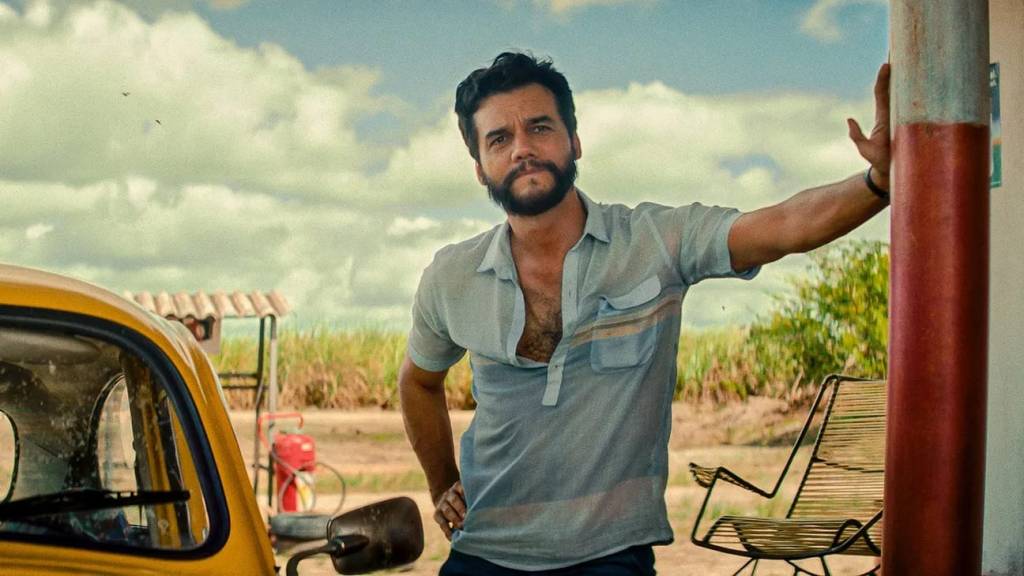
It’s the 1970s in Brazil. Marcelo (Wagner Moura) is a bearded, bushy-haired prof heading north from Sao Paolo — where he’s lived for many years — to Recife. He’s trying to keep a step ahead of the authoritarian government’s agents and to make sure his son is being safely taken care of. What he doesn’t realize is a pair of ruthless hitmen have been hired to rub him out. He shows up at Dona Sebastiana’s home, which she has transformed into a safe haven. It’s a place where political activists (like Marcelo), dissidents, leftists, refugees from Portuguese speaking Angola, gay men, and other persecuted individuals can find a safe place to hide. Because of the importance of secrecy, they only use code names. And everyone is a bit wary of strangers. Marcelo changes both his name and his look, from hippy to clean cut, with an official-looking moustache, and lands a job at the highly corrupt local police force. They take a liking to him and place him in plain view at the station. He uses his job to look for his late mother’s missing papers, to clear up a long-held mystery. He also gets to see his son, who is staying with his late wife’s dad who runs a movie theatre. Can Marcelo
secure his son’s safety, discover his family history, and keep his identity a secret from the two men who want him dead?
The Secret Agent a taut action thriller set in 1970s Brazil, before the fall of the military dictatorship. Always exciting and fast-moving with a complex plot, it’s full of disguises, bugging, lurid newspaper headlines, chase scenes and shootouts. Lots of blood. The plot is revealed both through flashbacks and flash forwards — strange scenes where unexplained present-day researchers are looking through old files to find out what really happened in this case. Wagner Moura is a total movie star, who switches identity more times than you realize over the course of the film. Now, I can’t help comparing this to last year’s stunning Brazilian drama I’m Still Here, also set during the dictatorship, but they are very different movies. This one is mainly there for the entertainment, sort of an I’m Still Here-lite.
But this is not a complaint — I loved this movie.
Eternity
Co-Wri/Dir: David Freyne (Review: Dating Amber)
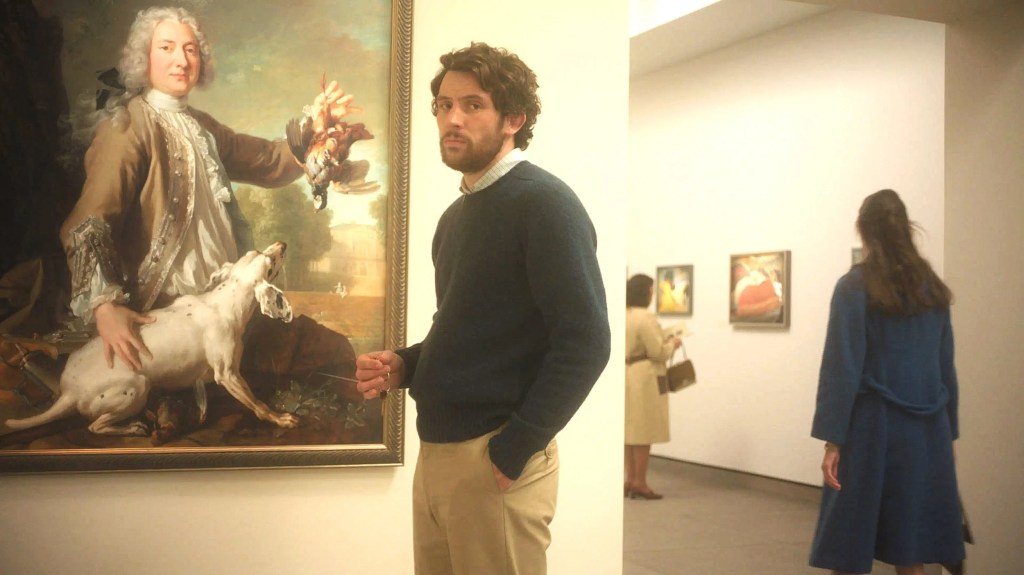
Larry and Joan (Miles Teller, Elizabeth Olsen) are a happily married elderly couple, heading to a grandchild’s birthday party. Sure, they argue all the time, but that’s because they know each other so well. And they have to deal with Joan’s cancer.. But when Larry chokes to death on a pretzel at the party, he suddenly finds himself in a strange new world. It’s like Grand Central Station, with trains departing every few minutes. Is he in Heaven? No, it’s a way-station called The Junction, where you choose where to spend eternity. And to help with that decision, there’s a huge convention space with hundreds of booths, each catering to specific tastes. Maybe you like museums, or the great outdoors, or lying on a beach. Or maybe you want to spend eternity as a tourist in 1960s Paris, where everyone speaks English but with a heavy French accent. There’s something for everyone, and you have a week to decide. But Larry wants to wait for Joan, so they can choose a place together. Anna (Da’Vine Joy Randolph) is his AC (afterlife coordinator) who is supposed to help him on his way, but doesn’t approve of him sticking around. Luckily he finds a sympathetic ear in Luke, a handsome young bartender (Callum Turner) to whom he pours out all his troubles.
He finally consents to leave the Junction, when… he sees Joan just arriving! She’s young and beautiful, in her early 20s (Larry is in the body of his 35-year-old self; when you die you revert to your favourite age.) Now that all his troubles are solved, he’s ready to leave with Joan. But not so fast! Joan was married before she met Larry and her husband died in the Korean War. And it just happens that her late first husband is none other than Luke, the Bartender. He’s been waiting for
Joan in the junction for 60 years. Will Joan choose to spend eternity with Larry, her long time partner? Or with her first true love?
Eternity is a fantasy/ romantic comedy with an unusual view of the afterlife. It’s a “high concept” movie with a simple question: should you choose a lifelong partner, or a passionate lover? And there are some fun parts: I liked the cheesy convention centre, the commuter train motif, and the Archives they visit (no spoiler). But they don’t do much with it; it devolves into a very basic rom-com, barely exploring the potentially fun aspects of the story. A former teen idol, Miles Teller plays his role as a grumpy old man trapped in a younger man’s body, but he does it in a most unappealing way. Callum Turner as Luke is also uninspiring, and while Elizabeth Olson is better as their object of interest, there’s still not much to go on. Da’Vine Joy Randolph and John Early provide much-needed comic relief as the ACs, but you can’t rescue a ship that already sank.
I wouldn’t want to spend eternity with any of them.
Hamnet
Co-Wri/Dir: Chloe Zhao
(Reviews: Songs My Brother Taught Me, Nomadland)
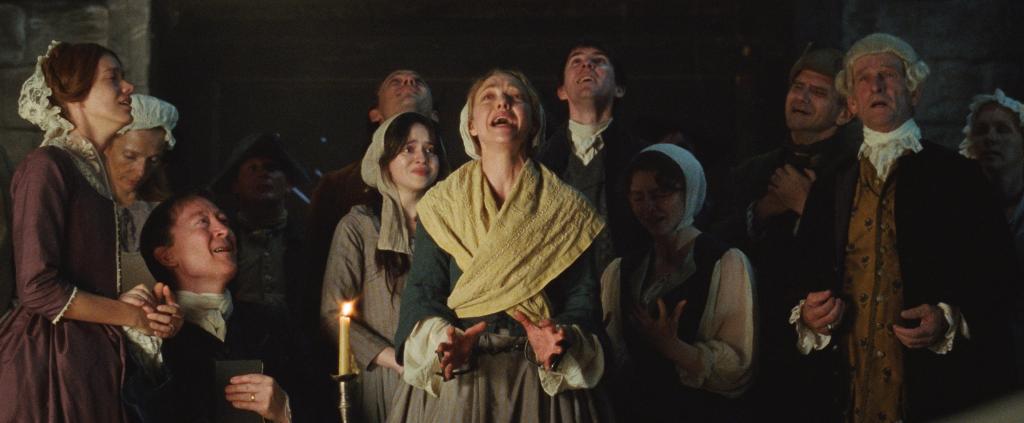
It’s England in the late 16th century. Will (Paul Mescal) is a part-time tutor expected to follow in his family business as a glover. But his Dad is nasty and cruel, so he wants to get as far away from him as he can. One day he meets a young woman named Agnes (Jessie Buckley), like no one he’s ever met before. She’s a witch and a healer who knows how to make poultices and tinctures, and carries a trained falcon on her arm. She knows all the secrets of the forest, including the sacred caves and ancient trees, passed on to her for generations. She is suspicious of Will’s worth, but eventually he proves his love, they marry and have children. Although he spends much of his time in the city, when he’s home he loves playing with the twins, especially his son Hamnet whom he teaches how to defend himself with a wooden sword. So Will and Agnes are crushed when Hamnet succumbs to the plague while Will is away writing. 
How will they deal with the death of their young son?
Hamnet is a lovely, rich and extremely moving film about William Shakespeare, his wife and the death of their son. It’s based on the novel by Maggie O’Farrell. It starts as a slow-moving historical romance, with lots and lots of details about daily life in Elizabethan England. You almost think — what’s the point of this movie? But then it turns into an amazing, emotional story, culminating in a no-holds- barred performance of Hamlet, which Will wrote about their son. (Noah Jupe, the actor who plays Hamlet in the play-in-the-movie is the real life brother of Jacobi Jupe, who plays Hamnet). Paul Mescal is appropriately restrained as Will, but Jesse Buckley holds nothing back, she puts her heart and soul into this role. If you’re not gushing tears by the end of this movie, I don’t know what to say.
Hamnet is a must-see.
Secret Agent, Eternity, and Hamnet are all playing right now in Toronto; check your local listings.
This is Daniel Garber at the Movies, each Saturday morning, on CIUT 89.5 FM and on my website culturalmining.com.
Outcastes. Films reviewed: The Mastermind, Regretting You, Bugonia
Hi, this is Daniel Garber at the Movies for culturalmining.com and CIUT 89.5 FM.
There are a ton of movies opening this weekend with lots of choices for every taste. This week I’m looking at three of them, all about outcasts and rebels. There’s a self-styled art thief in Massachusetts, a daughter fighting her mom when two families are brought together by tragedy in North Carolina, and a pair of cousins trying to save the earth… by kidnapping a CEO they think is an alien.
The Mastermind
Wri/Dir: Kelly Reichardt
It’s 1970 in Framingham, Massachusetts. James Blaine Mooney (Josh O’Connor) is an architect who is down on his luck. He loves his wife Terri (Alana Haim) and their two bright sons, Carl and Tommy (Sterling and Jasper Thompson), but he’s just not earning a living. He has no clients, and is forced to borrow money on the sly from his high-society mom. (Don’t let your father know about this.) He is smart, savvy and full of ideas but spends most of his time puttering around with his ne’erdowell pals. But now he has a get-rich-quick scheme he’s sure will solve all his family problems: stealing modern paintings from his small town art museum.
He tests and calculates every step: a sleepy unarmed guard, no alarms, clear exits, art easily taken off walls. He even has a stolen getaway car, and two henchmen with pantyhose to pull over their faces. It’s foolproof, and they pull it off with barely a hitch. But things goes south when one of the robbers gets caught at another job and spills the beans to the cops. James is labeled the mastermind behind the crime and is forced to flee the town and his family for an uncertain future. Where will he go and how will he survive on the lam?
The Mastermind is a brilliant period piece, a portrait of an America full of sketchy bus stations and flophouses, totally free of patriotic nostalgia. It’s set against — but separate from — the widespread antiwar protests of 1970. Josh O’Connor portrays James as a flawed antihero, who is nevertheless sympathetic. He commits his petty crimes wearing wooly sweaters and corduroy pants. The details in the production design are astoundingly precise. Kelly Reichardt is one of the best American directors you’ve probably never heard of. She
makes films, not high-concept schlock and if you haven’t seen her movies, this is a good one to start with. The Mastermind is one of those movies that starts in the middle of things and ends suddenly, before you think it’s over, but it all makes perfect sense.
This is a really good movie.
Regretting You
Wri/Dir: Josh Boone
It’s 17 years ago on a hot summer night in North Carolina. Two teenaged couples are at a pool party: Morgan and Chris, and Jonah and Jenny. Morgan and Jenny are sisters, Chris and Jonah best friends. They say opposites attract; Chris and Jenny are wild partiers, who like getting drunk and having wild sex, while Jonah and Morgan are smart, conscientious and non drinkers. Fast forward to the present.
Morgan (Allison Williams) has been married to Chris for 17 years, and they have raised their daughter Clara (Mckenna Grace) since they were still young. Jonah (Luigi-Mangione-lookalike Dave Franco) left town soon after graduation but came back recently and restarted his relationship with Jenny, soon leading to a newborn son. And then there’s Clara: everyone loves her. She’s a high school senior who dreams of becoming an actress after college. She tells her aunt Jenny all the things she can’t tell her mom; she’s like her best friend. She adores her dad Chris, and respects Jonah, who is also her high school teacher. And Clara is crushing on Miller, a popular guy at school,(Mason Thames) who lives on a farm with his gramps, cause his dad is in prison. He likes movies, sucking lollipops and moving roadsigns. But he has a girlfriend so he’s a no-go for Clara.
But everything is messed up when Chris and Jenny are killed in a terrible car crash, leaving Clara without her Dad and her Aunt, Jonah without his lover and the mother of their baby, and Morgan without her sister and the only man she’s ever been with. So Jonah turns to Morgan to form a make-shift family to deal with shock, grief, and the temporary raising of their two kids. (Clara and her Mom aren’t talking.) And while all this is going on, Clara and Miller start hanging out. Can
these estranged family members adjust to the drastic changes? What secrets will be revealed and what hidden loves awakened?
Regretting You is a very conventional drama/romance about two families recovering from unexpected loss. It’s also a coming-of-age story, along with some unrequited love. Based on a popular novel, it’s a very easy movie, with nothing transgressive: its set among church and proms and school plays and going to the movies. The characters are pleasant, and its directed in an easy-to-watch way: texts sent between Clara and Miller are also voiced, so no need to read. The story is divided between the grown ups and the teens, with the teens the more interesting half. But what’s weird about this one is the catastrophic events all happen off-camera, and toward the beginning. The rest of the movie is just about mending relations and recovering from the shocks. So instead of building up to a satisfying emotional purge, this one starts with the dramatic shock and then just coasts.
While I don’t regret seeing Regretting You, it’s not my preferred type of movie.
Bugonia
Dir: Yorgos Lanthimos
High-strung Teddy (Jesse Plemons) and shy, neurodivergent Don (Aidan Delbis) are cousins. They share a dilapidated house they inherited along with an attached farm, where they eke out a meagre existence — dressed in filthy Hazmat suits — through the cultivation of honey bees. But the bees are disappearing. What’s happening to their colony? They also work at a shipping station for a nearby big pharma corporation that specializes in lethal pesticides. Teddy holds a special grudge toward that company for past digressions it inflicted on him and his family.
The company is Auxolith and its CEO is Michelle (Emma Stone), a high-power, alpha careerist. She lives a magazine-like lifestyle in her modern mansion equipped with high security. She is a perfectionist, who only eats heathy food and insists her hair, makeup and power suits are always flawless. She works out using the latest machinery and is fully trained in martial arts. At work, though surrounded by a retinue of
yes-men, she seems oddly sterile and detached from all her employees.
But everything changes when Teddy — with Donny’s help — kidnap Michelle and drag her, undetected, to their lair. They shave her head, tie her to a bed, and cover her skin with weird emollients. Does they want money? Fame? A platform for their manifesto? No! Teddy is convinced Michelle is personally responsible for widespread ecological destruction of the planet — including his bees. And her motive? He is convinced she’s an alien from Andromeda with ties to a mothership parked just outside of the earth. Where do his bizarre theories come from? How can Michelle escape their clutches?
Bugonia is a weird movie pitting an eco-terrorists against a cold billionaire industrialist. Like all of Yorgos Lanthimos’s movies, Bugonia is simultaneously hilarious and disturbing. Grown adults talk like stilted children saying profound but outlandish statements. It’s laden with conspiracy theories, that are no less ridiculous than the corporate-speak the other half uses. Lanthimos likes to cast the same retinue of actors from his past pictures, so Emma Stone and Jesse Plemons are back again playing more quirky oddballs (though Aidan Delbis is entirely new). Bugonia is comical and absurd but also dark.
I really like Lanthimos’s style, but some people hate it; he’s not for everybody. But if you’re looking for something wack and dark and weird, you’ve got to see Bugonia.
Bugonia, Mastermind and Regretting You all open in Toronto this weekend; check your local listings.
This is Daniel Garber at the Movies, each Saturday morning, on CIUT 89.5 FM and on my website culturalmining.com.
Broken. Films reviewed: Parthenope, The Unbreakable Boy, The Monkey
Hi, this is Daniel Garber at the Movies for culturalmining.com and CIUT 89.5 FM.
This week, I’m looking at three new movies: there’s a boy with breakable bones, a toy monkey who could break your bones, and a woman whose beauty breaks every man’s heart.
Parthenope
Wri/Dir: Paolo Sorrentino (Reviews: Youth, Hand of God, The Great Beauty)
It’s Naples, 1950 and a woman gives birth in the waters of the Tyrrhenian Sea. The baby is called Parthenope, named for both the city and the Greek myth. She grows up to be a young woman of epic beauty and legendary intellect (Celeste Dalla Porta). Men who try to seduce her, find their own words silenced by her pithy comebacks. Her days are filed with a search for beauty, happiness and meaning. She absorbs everything she reads, from John Cheever to Claude Levi-Strauss. Her closest friends are her brother Sandrino (Dario Aita) and Raimondo (Daniele Rienzo) the son of a maid. Together they form sort of a quasi menage a trois.
Parthenope aces her orals and is accepted into the prestigious anthropology department at the local university. From there she follows three very different paths: Academia — a professor takes her under his wing; Love, deciding which of her countless suitors should she consent to sleep with; and the
city of Naples, itself. Along the way she encounters a corrupt and carnal bishop, a depressed superstar diva, a millionaire with a private helicopter, and many others. But will any of these people provide her with the answers she seeks?
Parthenope is a gorgeous and sumptuous look at post-war Naples as seen through the eyes of a beautiful woman as she lives her life. Celeste Dalla Porta is appealing to watch, but she is opaque and impenetrable: she merely observes without ever doing anything. Paolo Sorrentino is known for his his beautiful images, especially women as objects of desire. But he doesn’t seem to know what to do with a woman as his subject. Instead we get a hollow simulacrum of a main character, who drifts aimlessly but happily through her life as she encounters quirky strangers. I love the photography, the scenery, the people and the music — a collection of bright and shiny colours — but watching Parthenope leaves you feeling like you just flipped the glossy pages of a fashion magazine: superficially attractive but pointless.
The Unbreakable Boy
Co-Wri/Dir: Jon Gunn (Reviews: Ordinary Angels, I Still Believe, American Underdog, Jesus Revolution)
Scott (Zachary Levi) is a young salesman with big ambitions: he plans to move to Manhattan someday and make it big. But in the meantime, he likes golf, fine wine and travelling. He spends most of his time with his best friend Joe, a burley bearded man who is always giving him advice (Drew Powell). One day he meets a pretty and charming woman named Teresa (Meghann Fahy). Sparks fly, and nine months later, she gives birth to Austin (Jacob Laval). They’re not married but decide to bring him up together. But there’s a catch: he requires special care. Like his mom, Austin has Osteogenesis imperfecta (OI), a genetic condition that makes your bones very brittle. He suffers his first fracture in the birth canal, with many more breakages to follow. Eventually he is joined by a younger brother, Logan, who doesn’t share his breakability.
13 years later, Austin — aka the Aus-man — is now a happy school kid with a vivid imagination. He’s also on the autistic spectrum, but contrary to stereotypes, he’s outgoing, talkative and attends normal classes. He talks constantly, just like his dad. (I forgot to mention: Scott’s best friend Joe is imaginary) But all is not well. The family is deeply in debt. Austin is bullied at school. And Scott is drinking way too much, especially since he lost his job. Can the family pull itself back together? Or are they headed for ruin?
The Unbreakable Boy is a very cute, true story about an ordinary family working together to overcome their problems. As narrated by Jacob Laval as the Aus Man, it’s simple, touching and funny. I like the way it demystifies kids with
medical conditions and autism. And unlike most medical dramas, it’s not a weeper, though perhaps overly earnest. One warning: it is a faith-based movie, generally a red flag for cringe. Not my thing. Thankfully this one avoids most of the problems of that genre; preachiness and finger wagging and in-your-face prayers. If you’re in the mood for a light, informative, feel-good Christian movie that won’t make you squirm, check this one out.
The Monkey
Wri/Dir: Osgood Perkins (Reviews: Longlegs, Gretel and Hansel)
Hal and Bill (Christian Convery) are identical twins, but they couldn’t be more different. Bill, who was born a few minutes earlier, is self confident, athletic and aggressive. Hal is withdrawn and wears glasses as he tries to keep out of Bill’s way. But his brother is a bully, humiliating and hurting Hal on a daily basis, using a posse of popular girls as his private army. The two live with their single Mom (Tatiana Maslany) ever since their Dad, an airline pilot, walked away one day and never came back. When the boys go through the many souvenirs he brought home from around the world, they uncover something very unusual. It’s a mechanical automaton that’s an organ-grinder monkey. You wind him up and he plays a drum to the sound of carnival music. A harmless toy, right? Not exactly. When the drumstick comes down something terrible happens. Like when their babysitter is accidentally decapitated at a Benihana restaurant. But when it kills their beloved mother, the boys decided to hide the monkey somewhere that it can do no more harm. They are adopted by their aunt and uncle, a pair of swingers in small-town Maine. But they too are eventually killed in gruesome accidents. Was the money to blame?
Flash-forward 25 years. Hal (Theo James) still lives in Maine close to his teenaged son Petey (Colin O’Brien). He visits him only once a year, to lesson the chances of the cursed monkey in harming him. But then two cataclysmic events threaten Hal’s normal
life. First, Petey’s stepfather Ted (Elijah Wood) announces his plans to adopt him, making this the last time Hal will see him. Second, a series of terrible events are killing countless people in and around the town he grew up in. Can Hal find that damned Monkey and stop it from killing someone else? And can he simultaneously spend his last days with his son while keeping him out of danger?
The Monkey is a shocking and disgustingly hilarious movie about an evil toy and the people it affects. It’s done in a retro style, like Mad Magazine meets the Twilight Zone. It’s directed by Oz Perkins, known for his stylized movies that feel like fairytales (Gretel and Hansel) or nightmares (Longlegs). With this one, based on a short story by Stephen King, he seems to have found a happy medium. Simultaneously comical and grotesque, you watch the movie waiting with baited breath for the next disaster to happen. Theo James is perfect as the hapless Hal, but so is every other character in this weird movie, each given their own minute of ghastly glory: a pawn shop owner, a girl gang, a real estate agent, a pot dealer, a televangelist… it’s a limitless, mind-blowing romp. The Monkey is grotesque comedy/horror at its peak.
I love this movie.
Parthenope, The Unbreakable Boy, and The Monkey all open this weekend in Toronto; check your local listings.
This is Daniel Garber at the Movies, each Saturday morning, on CIUT 89.5 FM and on my website culturalmining.com.
Disappeared. Films reviewed: Dark Match, I’m Still Here
Hi, this is Daniel Garber at the Movies for culturalmining.com and CIUT 89.5 FM.
You may have heard about Sook-Yin Lee’s indie movie Paying For It, starring Dan Beirne as graphic novelist Chester Brown, and Emily Le as Sunny, modelled on Sook-yin herself as a TV VJ in the 1990s. It’s about their relationship after they broke up, when Chester decides only to sleep with paid sex workers. I interviewed Sook-yin and Dan way back in August on this show, and later ranked the movie on my Best-of-the-Year list. Well, good news: you can finally see Paying for It on the big screen starting this weekend. Check it out, it’s very cool, very indie and very local.
But this week I’m looking at two other new movies: a family drama set in Rio de Janeiro in the 1970s, during the military dictatorship; and a horror movie about pro-wrestlers in the sticks of northern Alberta in the 1980s.
Dark Match
Wri/Dir: Lowell Dean
It’s 1988, and a team of pro-wrestlers are getting ready for a big match in a small town somewhere north of Edmonton, Alberta. They’re there under the direction of a sleazy promoter named Rusty Beans (Jonathan Cherry). The wrestlers have worked together for years and know all the rules: the good guys win and the heels lose. This goes for men and women alike. And Nick — aka Miss Behave (Ayisha Issa) — doesn’t like it. She’s a damn good wrestler and wants some wins… along with a raise. But it’s always Kate the Great (Sara Canning) who gets the cheers while she gets the boos. The only ones she can complain to are the enigmatic Enigma (Mo Jabari) who never speaks or takes off his lucha libre mask… and Joe. She spends most of her off-time with Mean Joe Lean (Steven Ogg) a veteran wrestler, and a heel like her. It’s ambiguous whether they’re a couple or “friends with benefits”. Either way, they keep it on the down low. But (back to the story) everything went wrong when she lost her temper in the ring, which left her facing a pay cut and maybe losing her job altogether. Until, out of the blue, Rusty comes by with some good news for a change. They’ve all been offered a gig in a village they’ve never heard of somewhere up north. It pays really well, maybe even a cut of the door. It’s for a dark match — a special wrestling show, for their eyes only, with no cameras present. So they all pile into Rusty’s old rusty van and head into the sticks. When they get there, things seem a bit fishy. Joe think’s they’re all
rednecks or Jesus freaks, led by a mysterious leader in a cowboy hat (Chris Jericho).
But hey, a gig’s a gig. Things get stranger the night before the big event. They stumble into some kind of weird orgy involving handcuffs, a hot tub, a threesome, a suckling pig, and some glowing green plonk. They wake up the next morning with aches and pains all over. But that’s just the beginning. The match is not what they’re used to. There are armed guards with AK47s standing outside the locked door of their green room. And the wrestlers aren’t coming back after their match! What’s going on… and why? Miss Behavin’, Mean Joe Lean and Enigma realize they have to do something… but can they stand up to a crowd of bloodthirsty satanic fans?
Dark Match is a horror movie about a wrestling match gone wild at the headquarters of a bizarre religious cult on the Canadian prairies. It’s bloody and gory with a hint of the
supernatural at work. The cast is composed of both professional actors and pro-wrestlers (who, as we all know, do their own fair share of acting). It’s loaded with 80s music, big hair and grainy video footage with lurid red lighting. I was surprised how much I liked this sleazy, gritty B-movie, and I’m not even a wrestling fan. Of course you have to be comfortable with extreme violence, blood and death — it’s that kind of horror — but it’s also quite funny and goofy, too. So if you’re jonesing for some western-Canadian gore, Dark Match is it.
I’m Still Here
Dir: Walter Salles
It’s the early 1970s in Rio de Janeiro, Brazil. The Paivas are an upper middle class family who live so close to Leblon beach they can walk there barefoot. Eunice, their mom (Fernanda Torres) loves to float in the waves; she finds it relaxing. With five kids to take care of, she needs a bit of down time. Rubens Paiva (Selton Mello), the dad, is an engineer and former congressman for the Labour Party. He loves whisky, cigars and playing foosball with the kids. His firm is working on a huge project, an underground tunnel. But they still find time to get together with their close circle of friends and families: intellectuals, journalists, artists and activists, all on the left. Then there are the five kids: four girls: Veroca, Eliana, Babiu, and Ana, and one boy, Marcello. They love beach volleyball, soccer, pop music and a fluffy dog they find on the beach. Rubens names him Pimpão, after Verona’s shaggy friend.
But a dark cloud hangs over their otherwise idyllic lives. Brazil is ruled by a right-wing military dictatorship and they’re using a series of kidnappings of European diplomats to question and harass anyone vaguely on the ‘left”. Vera is sent off to London for her own safety. Then one day, five sketchy men invade
their home draw the curtains, and without a warrant drive Rubens away to an unnamed location. When Eunice tries to free him, the government denies they ever took him. It’s up to Eunice to take care of the kids as she tries to find him. Has he been disappeared?
I’m Still Here is the incredibly moving, true story of a Brazilian family, based on the bestselling memoirs of their son, Marcello. While it covers the secret arrest of Rubens Paiva by the military dictatorship it’s also about the repercussions it had on the lives of Eunice, their entire family, their friends, and the country of Brazil as a whole. And that’s where it hits you — the intimate details of a remarkable family’s everyday lives: the super-8 movies they record, the records they listen to. I though it was going to be just an historical retelling of an important event. But it’s actually about everything, good and bad, that the family goes through. Now I’m not Brazilian, I don’t live on a beach in Rio, but for some reason I totally identified with this family, I felt a real connection.
Walter Salles directs an epic movie like this every decade or so, films like The Motorcycle Diaries and Central Station.
Apparently he had personal ties to the Paiva family as a young man. Fernanda Torres gives an amazingly nuanced performance as Eunice, that had my eyes tearing up. I’m Still Here has been nominated for three oscars — best actress, best picture and best foreign film — and rightly so. I can’t say enough good things about this movie.
Dark Match and I’m Still Here are both opening this weekend in Toronto; check your local listings.
This is Daniel Garber at the Movies, each Saturday morning, on CIUT 89.5 FM and on my website culturalmining.com.
Americans abroad. Films reviewed: Queer, September 5, Oh Canada
Hi, this is Daniel Garber at the Movies for culturalmining.com and CIUT 89.5 FM.
This week I’m looking at three new movies set in the 1950s, 60s and 70s, about Americans abroad. There’s a novelist in Mexico City, a TV sportswriter in Munich, and a documentary filmmaker in Montreal.
Queer
Dir: Luca Guadagnino (I am Love, A Bigger Splash, Call me by your Name, Suspiria)
It’s the 1950s in Mexico City. William Lee (Daniel Craig) is a middle-aged American writer addicted to heroine who hangs around local bar called Ship Ahoy. If he doesn’t get completely drunk he might spend the night with a man he meets. He’s friends with other flamboyant ex-pats, especially Joe (Jason Schwartzman) a portly, bearded man who shares Lee’s lascivious predilections. Lately, he has had his eyes on Eugene Alerton (Drew Starkey), an ex-GI who spends most of his days playing chess with an older red-haired woman. Eugene is no “queer”, but is up to talking with Lee.
After repeated drinks, and some opiates he eventually shares Lee’s bed in his seedy rental. Lee is smitten, Eugene content. Later the two head south in their quest for ever more potent drugs culminating in a journey toward the ultimate psychedelic experience. They end up in the Ecuadorean Amazon, in a remote shack guarded by a vicious but slow-moving three toed sloth. Inside, a mysterious doctor (Lesley Manville) holds the answers to all their questions. Is Eugene the man of his dreams? Will they ever reach hallucinatory
nirvana? Or is life just an illusion?
Queer is a bizarre, sex-and-drug-filled psychedelic fantasy. It’s divided into three chapters: their meeting in Mexico City; their journey south; and their adventures in Ecuador. It’s adapted from William S Burroughs’ semi-autobiographical novel written in the 1950s but not published for another 34 years. It swerves wildly between actual memoirs and pure imagination. Burroughs was a writer in the beat movement, and was married and had a son with another writer Joan Vollmer (perhaps she’s the red-haired woman Mary in the film).
The thing is, Queer is not a grave, serious movie, it’s a high-camp comic fantasy. Psychedelia has always been difficult to film, and there’s a fine line between the profound and the ridiculous. Some scenes, like the unfortunate semi-nude, interpretive dance sequence, falls on the (unintentionally) funny side. Others scenes were kinda cool. It’s a beautiful film to watch, for its music, set, costumes and art direction. Shot
entirely in Rome’s Cinecitta, it’s never meant to look realistic. Daniel Craig plays Burroughs not as the usual chill junkie observer, but as a panting and sweating horndog, with bulging eyes, nearly choking on his own lust.
If your looking for a sentimental romance a la Call Me by You Name, or a deeply profound meditation on psychedelic trips, this ain’t it. But if you just want a weird and funny drug-infused dream-filled movie with lots of soft-core gay sex, you’ll probably have a great time.
September 5
Co-Wri/Dir: Tim Fehlbaum
It’s September 5, 1972 at the Munich Summer Olympics and the crowds are roaring. Americans are glued to their sets watching the US cleaning up, with swimmer Mark Spitz winning an unheard of seven gold medals. ABC is the perennial loser of the top three networks. So their sportscasters are thrilled to have won exclusive coverage rights. The team behind the cameras are hard at work. Geoffrey Mason (John Magaro) is the newbie, trying to prove his chops. His boss Marvin (Ben Chaplin) wants things to run smoothly, and his boss’s boss (Peter Sarsgaard) is thinking of the bigger picture. Jacques (Zinedine Soualem) is their French cameraman with Marianne (Leonie Benesch) the only woman on the team, is a German journalist, and their de facto translator. Everything is great until they hear gunshots… not at the games, but at the nearby Olympic village. A group of masked militants, known as the Black September Organization is holding Israel’s Olympic team hostage.
Suddenly, the ABC sportscasters realize they are the only American TV journalists in Munich. They have the cameras, the boom mics and the broadcast and satellite rights ready to send stories home. They shift their telephoto lenses from pointing toward the swimming pools to the athletes’ dormitories, trying to catch a glimpse of the hostages. What
will happen next? Will German authorities step in? And can a sports crew handle crisis news?
September 5 is a journalistic thriller about 24 hours at the Munich Olympics. Despite its title, this isn’t about the Israel/Palestine conflict — they barely delve into it. That’s just the backdrop. What it really looks at is how a team of US journalists — at the right place at the wrong time — figure out how to get the news out even as the crisis grows. I love the period details: giant-sized spools of reel-to-reel videotapes, and how little white tiles on a black background were superimposed onto a sports channel screen. So cool. I’ve never heard of Swiss director Tim Fehlbaum before, but he keeps the action moving in the midst of constantly shifting mayhem. The acting is ok, but best by far is Leonie Benesch who starred in last year’s The Teacher’s Lounge. I went into this movie full of dread. It’s clearly Oscar-bait; Hollywood churns out journalistic dramas every year. But this one is surprisingly good, and had my heart pumping all the way through. If you’re looking for some journalistic excitement, check out September 5.
Oh Canada
Co-Wri/Dir: Paul Schrader (First Reformed)
Based on the story by Russell Banks
Leo Fife (Richard Gere) is a renowned documentary filmmaker in Montreal. He is getting ready for an interview in his own living room in the grand old home he shares with his wife Emma (Uma Thurman). The director, Malcolm (Michael Imperioli) and his crew are longtime admirers of Leo’s legendary work. After crossing the northern border in the 1960s to protest the war in Vietnam, he ended filming docs that changed the course of history. He uncovered the use of Agent Orange at the military base in Gagetown, New Brunswick, and became a university prof teaching young journalists how to make movies. Now, decades later, Leo is on his deathbed, dying of cancer, so Malcolm wants to record his final thoughts.
Leo treats this film as a confession — he wants to clear the record. He starts by talking about his first wife and son, a family he left behind in Virginia. But she’s not the only skeleton in his closet. His past life is full of lies, deceptions and possibly terrible acts. Emma doesn’t like him talking like this and wants him to stop. Leo’s nurse thinks can’t take all this stress. But the filmmakers persist and Leo perseveres. Are any of his stories true? Was he a good man or a bad man? And what do we really know about Leo Fife?
Oh Canada is a fictional story about a day in the life of an American filmmaker and activist recalling his past. It’s a simple concept with a slight plot. It’s structurally divided between the documentary being made about him, and his
hidden past, shown in a series of flashbacks (He is played by Jacob Elordi as his younger self.) The film is almost too simple. But with Paul Schrader at the helm, you know there’s going to be more to it. He wrote Taxi Driver and Raging Bull for Scorsese, and directed movies like The Yakuza (1974) First Reformed (2017) and American Gigolo (1980) that also starred Richard Gere.
Unfortunately, Gere is the weakest part of this film; he rants and complains, but there’s no heart in his performance. The film’s called Oh Canada, but it’s really Oh America. It was entirely shot there, with so-called Canadian characters using americanisms like “restroom”. What’s interesting is Schrader’s use of false visual narratives. There are flashback scenes where Elordi as a young Leo is suddenly replaced by a contemporary Gere while all the other characters remain unchanged. Likewise, the names of past lovers seem to melt away. Perhaps Leo has dementia, or maybe this contrasts Leo’s current story with his past truths. Also interesting is the way we see Leo’s face throughout the eye of Malcolm’s camera, giving it a meta aspect that messes with your brain.
Oh Canada is not one of Schrader’s better films, but there’s enough stuff going on to keep it intriguing.
Oh Canada, Queer and September 5 all open this weekend in Toronto; check your local listings.
This is Daniel Garber at the Movies, each Saturday morning, on CIUT 89.5 FM and on my website culturalmining.com.
Tough Cookies. Films reviewed: Maria, Flow, The G
Hi, this is Daniel Garber at the Movies for culturalmining.com and CIUT 89.5 FM.
With a rapidly aging population, the traditional image of frightened, little-old cat ladies is gradually shifting to one of strength and cunning. Witness new TV shows like Matlock. So this week I’m looking at two new movies about tough older women and one about a cat. There’s an opera diva in Paris preparing her swan song; a rustbelt widow who wants to go out with a bang; and a cat on a sailboat in a world covered in water.
Maria
Dir: Pablo Larraín (Reviews: Spencer, The Club)
It’s 1977 in Paris, and Maria Callas (Angelina Jolie: Salt, The Tourist, Unbroken) — one of the greatest divas in opera history, is not doing well. She rarely eats, often never leaving the bedroom of her palatial apartments for days at a time. She rarely speaks with anyone anymore, aside from her servants. She runs her butler ragged (Pierfrancesco Favino: The Hummingbird, in a red monkey suit) and she relies on her cook (Alba Rohrwacher: Sworn Virgin, Hungry Hearts, The Ties/Lucci ) for judgement on the quality of her vocal chords.
But she’s not completely alone. She is seeing a pianist for his unvarnished opinion on whether her legendary “voice” has returned. And has agreed to an unheard-of interview with a young journalist named Mandrax (Kodi Smit-McPhee: The Road, The Congress, The Power of the Dog, Memoir of a Snail). But Maria faces a number of problems. She refuses to see a doctor, despite her rapidly declining health, and she won’t stop popping Quaaludes, leading to frequent
hallucinations and delusions. Can her devoted servants save her life? Or is this the end?
Maria is a biopic about the death of a legendary Greek-American diva. The movie begins with her demise at age 53, then goes back in time to show what led up to it. This includes flashbacks to her chubby adolescence in German-occupied Athens in WWII, her failed marriage, and at the peak of career, including trysts with Aristotle Onassis and JFK.
But is this biopic any good? I have very mixed feelings about that. I love the beautifully shot interiors, the ostentatious costumes and the amazing arias provided by recordings of Callas herself. Italian actors Rohrwacher and Favino provide wonderfully painful performances. And, as the latest in a series of films about famous woman by Chilean director Pablo Larraín it has good pedigree, especially Spencer (with Kristen Stewart as Princess Diana). But this movie depends on Angeline Jolie, and she doesn’t carry it off. She always seems to be acting. I don’t see Maria Callas here, I see Jolie posing for the camera, with a haughty face here and a dramatic gestures there; so you rapidly lose sympathy with the main character. Perhaps Maria Callas really did act like that, even behind closed doors, but Jolie plays her somewhere between high camp and kitsch.
Maria is never boring… just a bit embarrassing.
Flow
Co-Wri/Dir: Gints Zilbalodis
It’s some time in the future, somewhere in the world. A small grey cat with golden eyes and pointy ears is enjoying a walk in the woods. The cat lives by an abandoned old house surrounded by enormous cat statues. The cat is very shy, and fears, most of all, a pack of feral dogs. Suddenly, there’s a stampede of animals running in one direction, full speed. They‘re trying to avoid a massive flood, sweeping away everything in its path. But cat and a friendly, white dog are among its victims. Survival instinct kicks in and eventually cat manages to climb on board a tattered sailboat. There Cat discovers a gentle, sloth-like capybara already on board. Other animals make their way onto the sailboat, including an ingenious lemur, that big, white dog and a majestic-looking phoenix. Together they form an uneasy friendship as they brave a dangerous water-covered world. But can they learn to get along? And is this world worth living in?
Flow is a brilliantly animated film about a picaresque journey by a mismatched troupe of animals. It’s tender, heart moving and lovely to watch. It’s all about friendship and cooperation learned by
animals living in a gently hostile world. And though they behave a tiny bit like humans, there are no people in the story, and no dialogue either; just grunts meows and barks. Dogs still want to fetch. Cats want to catch fish.
And though it’s post-apocalyptic, there is nothing futuristic in this film; human technology is limited to abandoned ancient cities, glass bottles and sailboats; no cars or smartphones to be seen. The science fiction comes in with its universality, where animals from different continents, along with mythical beasts like sea monsters, can randomly encounter and learn from one another. I just watched Flow, and I already want to see it again.
Flow is Latvia’s Oscar submission for Best International Feature.
The G
Wri/Dir: Karl R. Hearne
It’s a rust-belt city somewhere in North America. Ann Hunter (Dale Dickey) is a tough cookie in her 70s, who is feeling depressed. You can see it in every wrinkle on her face. She lives with her ailing husband in their fully-owned condo. He was once a tough guy, but is rapidly sliding into immobility and dementia. She grudgingly takes care of him, and drowns her sorrows in rot-gut alcohol straight from the bottle. Aside from him, she only spends time with Emma, step-granddaughter (Romane Denis). Emma models her life on The G (as she calls her grandmother) someone who doesn’t take crap from anyone. The G also helps her out financially, and doles out hardboiled words of wisdom.
But everything changes when a man in a suit named Rivera (Bruce Ramsay), out of the blue, breaks down The G’s front door, accompanied by two toughs: Matt (Joey Scarpellino), a handsome but simple-minded gardener; and Ralph, a psychopath with bleach blond hair (Jonathan Koensgen). Together they violently shove Ann and her husband into a van, who wind up locked in a threadbare room without a phone, in a nursing home that feels more like a
prison. This is your new home, Rivera says, and there’s nothing you can do to stop me. He’s now their legal guardian and has the documents to prove it; their doctor (a silent partner in the scam) has declared them both incompetent. No one’s allowed to go in or out for the first month. He roughs up her husband to try to find the proverbial pot of gold he thinks they’re hiding. But they underestimate the G, her stubbornness, and her shady connections back in Texas.
Meanwhile, Emma is shocked when she discovers her grandparents have suddenly disappeared, leaving behind just a torn-up home. She scours the city to find them, and makes friends with a caretaker who works at the home (who also happens to be Matt, the friendly thug). It’s too late to save her grandpa but she vows to get the G out of there. And even while Emma is trying to free her, the G has vowed vengeance on all her enemies — and she’s not messing around. Who can they trust? Can two women best a criminal organization? Or will they end up buried alive?
The G is a great revenge thriller about the very real phenomenon of organized criminals attacking and abusing the elderly. It’s dark and disturbing. Dale Dickey blows this movie out of the water, supported by a good Quebecois cast. (It’s shot in Montreal). If you’re looking for a gratifyingly violent revenge flic, this is the one to see.
Maria and Flow are now playing at the TIFF Lightbox, with Maria streaming on MUBI on December 11th; and The G is opening across Canada; check your local listings.
This is Daniel Garber at the Movies, each Saturday morning, on CIUT 89.5 FM and on my website culturalmining.com.
Trapped. Films reviewed: Captives, Here, Emilia Pèrez
Hi, this is Daniel Garber at the Movies for culturalmining.com and CIUT 89.5 FM.
Toronto Fall Film Festival Season continues with Cinefranco showing contemporary French language movies from around the world at the Carlton Cinema. But this week, I’m looking at three new movies about traps. There’s a big-hearted woman trapped in a male drug-lord’s body, a French woman trapped in a mental hospital, and a movie camera trapped… in somebody’s living room!
Captives
Co-Wri/Dir: Arnaud des Pallières
It’s Paris in the late 19th century. Fanni Devander (Mélanie Thierry) is an elegant and educated woman searching for her mother. She disappeared when Fanni was just a child, but she has reasons to believe she is locked away somewhere in the city’s mental hospital. So Fanni voluntarily checks herself in to try to find her. Pitié-Salpêtrière is a home for the destitute, people with mental illness, learning disabilities or epilepsy, convicted criminals and even some foundling children. The one common factor is they’re all “undesirables” and all women. But once inside she realizes you can check in, but you can’t check out. It’s a de facto prison, presided over by the Matronly Bobette (Josiane Balasko), and a hench-woman who would make Nurse Ratchet look like Florence Nightingale. Bobette’s one obsession is to perfectly execute their upcoming ball featuring her patients singing and dancing before a crowd of wealthy patrons.
Fanni quickly learns the ropes and makes allies with Hersilie, a music teacher (Carole Bouquet) and a lesbian school teacher with an eating disorder. And she finally meets a nearsighted older woman named Camomile (Yolande Moreau) who just might be her real mother. Can Fanni perform at the ball and safely escape
with her supposed mother? Or will they all be stuck there forever?
Captives is a fascinating historical thriller about the treatment of women in state institutions. It’s harrowing in parts — including scenes of torture — as Fanni navigates class and hierarchy within this enclosed universe. I purposely only mentioned some of the characters and plot turns, because the surprise is what makes it worth watching. But rest assured, it’s full of great acting, pathos, and beautiful period costumes — even within that terrible place.
I like this one.
Here
Dir: Robert Zemeckis (Reviews: Flight, Allied)
Ricky (Tom Hanks) is a teenaged baby boomer living the American dream. His Dad and Mom (Paul Bettany and Kelly Reilly) have lived in a house across the street from Ben Franklin’s historical home since they bought it on the GI Bill after WWII. Now Ricky and his kid brother and sister happily share the place, congregating in the living room for holidays, dinners, or just to watch TV. Ricky wants to be an artist, while his girlfriend Margaret (Robin Wright) dreams of going to law school. Unfortunately, when she gets pregnant while they’re both still in high school, they marry and settle down, still within Ricky (now called Richard’s) parents’ home. Life goes on, and the decades pass, and people are born, live and die. But will they always stay “here” in the same house?
Here is a movie about a place, specifically a living room facing the picture window and the street beyond. The camera never movies. It follows this location not just for Ricky’s family, but also the dinosaurs, the ice age, indigenous people, Ben Franklin, and various couples across the 20th century, constantly jumping back and forth in time. The one constant is the frame, the fourth wall, which never shifts. Picture this: a pop-up square will appear with different furniture and wallpaper in it, taking you to another era, in the style of a virtual staging of a house for sale on a real estate
website. Indeed we get to meet real estate agents throughout the twentieth century. Which makes sense because its really about the place, not the meat puppets who wander around in it.
Does this new, experimental concept work? No! It’s indescribably awful.
I cannot convey the aesthetic revulsion I felt viewing this horrible non-movie movie. It features a de-aged, 68-year-old Tom Hanks playing himself as a teenager with a fake young teenage face plastered on, but who still talks and walks like the old man he is. What were they thinking?! Here is a tired, platitudinous high-concept exercise in futility disguised as an innovative film. All the characters are painful cliches, including a token black family whose sole purpose seems to be to recite a version of Ta-Nehisi Coates Letter to My Son… to their son.
Keep in mind, Zemeckis is known both for classics like Back to the Future but also unforgivable, semi-animated dreck like Polar Express and Forrest Gump. Here falls neatly into the dreck pile.
Emilia Pérez
Co-Wri/Dir: Jacques Audiard
Rita (Zoe Saldaña) is an ambitious young defence lawyer in Mexico City. She spends hours crafting powerful opening statements for trials, but, as a black woman — originally from the Dominican Republic — she gets none of the credit. But somebody is watching her and appreciates her skill. She finds out who, when she’s kidnapped with a black hood over her head and driven into the middle of the desert. There she meets the notorious head of a huge drug cartel, personally responsible for countless killings. Juan “Manitas” Del Monte, the cartel chief, needs her to help him disappear, in a way no one — including his wife Jessi (Selena Gomez) — will ever find him again.
The twist? This murderous, pock-marked, bearded monster… is trans, and wants to shed the awful male body and face, to live the rest of her life as an attractive woman. She needs someone she can trust to handle all this, both the finances and the surgery, leaving no paper trail. In exchange, Rita will have all the money she needs for the rest of her life, and her own private firm.
Years later, she meets with a potential client, a fabulously rich European woman named Emilia Pèrez (Karla Sofía Gascón). It’s
her client from years back, who wants to re-enter the world and be reunited with her beloved family, all of whom think she is dead. And to atone for some of her past sins without revealing who she was. What will happen to these three remarkable women in the next chapter of their lives?
Emilia Pérez is an incredibly passionate and shocking movie. It’s simultaneously an action-thriller, an epic drama, and a musical. Yes, that’s right, a musical, where characters do break into songs and dances throughout the film. But with its latin beats and shouting crowds, it’s the sort of songs you rarely encounter in a musical. Zoe Saldaña is amazing as this tough-as-nails lawyer, and Karla Sofía Gascón, a Spanish actress I’ve never seen before, is unmatchable, both as Perez, and as the drug lord Manitas. (She’s a transwoman herself.) French director Audiard (who previously brought us masterpieces like A Prophet, and Rust and Bone) seems to have no trouble creating a Mexican musical. I gotta say, Netflix churns out a load of content, most of which is forgettable crap, but, every year, they also produce a few really remarkable films. Emilia Pèrez is one of those.
I strongly recommend this movie.
Here and Amelia Perez both open this weekend in Toronto; check your local listings. And Captives is having its English Canada premiere at 8:45 tonight (Saturday, Nov 2, 2024) at Cinefranco at the Carlton.
This is Daniel Garber at the Movies, each Saturday morning, on CIUT 89.5 FM and on my website culturalmining.com.
Films reviewed: Your Monster, Drive Back Home, Conclave
Hi, this is Daniel Garber at the Movies for culturalmining.com and CIUT 89.5 FM.
More Film Festivals are coming up soon, with ReelAsian, Cinefranco and BITS, Blood in the Snow, just around the corner.
But this week, I’m looking at three great new movies. There’s a consortium of cardinals locked in their chambers; a monster discovered in a closet by a NY actress, and a Toronto man forced out of his closet by the police.
Your Monster
Wri/Dir: Caroline Lindy
It’s present day Manhattan. Laura (Melissa Barrera) is a triple threat — she can sing, dance and act. She’s helping her boyfriend Jacob (Edmund Donovan) write his breakout musical, soon to open on Broadway with her in the lead role. But when she gets sick — the big C! — and needs surgery, he dumps her — out of the blue — while still in hospital. And casts another actress (Meghann Fahy), in her part. The surgery is a success but Laura is a total wreck. She’s doubly devastated, both from the sudden end of her five year relationship and for being cheated out of her big break. Her anger, frustration and self pity are all ready to explode. That’s when she makes an unexpected discovery. There’s a monster in her closet!
The creature (Tommy Dewey) is an actual monster, bearded with long hair, sharp teeth and leonine features, who talks like a dude. Apparently he has lived there all her life (she grew up in this house) she just never saw him before. It’s hate and fear at first sight. He threatens to tear out her throat and eat her alive — and tells her to
leave the place and never come back. Meanwhile, Laura shows up for the audition uninvited and becomes the understudy for her own role. But things gradually warm up at home, as Laura and her monster get to know each other. But can she take him to the Halloween Ball? Will she ever get to perform her role on stage? And will her boyfriend ever take her back?
Your Monster is a very cute, rom-com/horror with a fair bit of singing, too. It’s a riff on Disney’s Beauty and the Beast but with a funnier monster and brooding beauty with a lot of anger inside. Melissa Barrera and Tommy Dewey have lots of chemistry while Edmund Donovan is suitably villainous as the bad boyfriend. He looks strangely like Jared Kushner. The movie as a whole is enjoyable and adorable. It takes a funny concept to its extreme. I like the costumes, I like tight script — the whole movie is much better than I expected. There’s a play within the play (half the scenes are rehearsals or performances) but even the “real” home scenes are theatrical. Your Monster will make a great date movie, but just keep in mind there’s a bit of horror within this rom-com.
Drive Back Home
Wri/Dir: Michael Clowater
It’s 1970 in the village of Stanley, New Brunswick.
Weldon (Charlie Creed-Miles) is a mechanic who lives with his mom, his wife and his son in the house he was born and grew up in. One night he gets a long distance phone call from Toronto. His estranged younger brother Perly (Alan Cumming) — an advertising exec who he hasn’t heard from in many years — has been arrested for gross indecency (meaning consensual sex with another man). The cop lays it out. If you can pick him up and take him home, all charges will be dropped. If not, he’s going to prison for five years. So Weldon loads up his pickup truck with enough sandwiches and gasoline for a long trip and leaves his village for the first time in his life. He’s terrified of having to speak French so he takes a circuitous route avoiding Montreal altogether.
He picks up Perly from the cop shop but there is no love lost between them. Perly is a city boy who wears a jaunty cravat while his big brother is a hick, who’s never seen a high-rise apartment or an answering machine. He just wants to drive back home. Perly isn’t a happy camper either: His marriage is a shambles, his career has tanked and his dog is dead, since the cops arrested him. But what’s left for him in Toronto? And so they begin their long journey home. But what secrets will be revealed along the way?
Drive Back Home is a bittersweet drama about family and trauma. It’s done in the style of classic Canadian Road movies, like Don
Shebib’s Goin’ Down the Road, but this one is about leaving the big city. Their trip through rural Ontario and Quebec alternates between scenic beauty, rustic kindness, and vicious, small-town bigotry. Canada was still rife with homophobic hatred at the time — it was only decriminalized a year earlier, and there are disturbing gay-bashing scenes in this film along with a lot of homophobic F bombs.
The two main actors are English and Scottish but both quite good, and maintain decent Canadian accents, gruff for Creed Miles and arch for Cumming. The rest of the cast features prominent Canadian actors, with Clare Coulter as Adelaide, the hard-ass mom, Guy Sprung, as a Francophone farmer, Dan Beirne as a priest and Alexandre Bourgeois as a young guy they meet in a roadhouse bar. Drive Back Home is a moving look at Canada’s bad ol’ days.
Conclave
Dir: Edward Berger
A hush hangs over the Vatican; his holiness the Pope is dead. And the world’s Cardinals, in red robes with white mitres, are congregating to choose the next pontiff from within their group. Ballots are secret, but until one receives 2/3 of the votes, they are literally locked-in, no contact with the outside world. What are their criteria for the next pope? He must be virtuous and humble, but also healthy and strong. And he must be honest as the Pope is infallible. Bishop Lawrence (Ralph Fiennes) is the Dean in charge of the highly secretive process. The most popular candidates: Bellini (Stanley Tucci), a modest liberal reformer, Tedesco (Sergio Castellitto), a bombastic traditionalist, and the highly respected Adeyami (Lucian Msamati). But Lawrence is privy to new information just before the lockdown. A drunken monsignor alleges the Pope fired Tremblay (John Lithgow) just before he died. And mystery man, Benitez (Carlos Diehz), appears out of nowhere claiming to be the Cardinal of Kabul, Afghanistan. And then there are the nuns, including Sister Agnes (Isabella Rossellini) who remain
silent but see and hear everything. Which bishop will they choose to turn the conclave’s smoke from black to white?
Conclave is a stunningly- good thriller about secrets and subterfuge within the Vatican. The constant changes of political alliances as well as shocking revelations will keep your rapt attention until the very end. It presents a Vatican that’s both exquisite and decadent, with black mould spreading on it’s columns. It’s all the work of German director Edward Berger who made All Quiet on the Western Front, with Volker Bertelmann’s powerful music, and fascinating camerawork. It was filmed at Rome’s famous Cinecitta studio who are always deft at recreating the Vatican. I love this constant attention to detail — red sealing wax, Latin prayers, and tortellini soup.The acting is superb, especially Ralph Fiennes. I’ve never been a fan, but he is just sooo good in this role, maybe his best I’ve ever seen. Altogether, this makes Conclave a great night out.
Your Monster and Conclave both open this weekend in Toronto; check your local listings. And Drive Back Home is having its Toronto premiere tonight at CAMH on Queen West as part of the Rendezvous with Madness film fest.
This is Daniel Garber at the Movies, each Saturday morning, on CIUT 89.5 FM and on my website culturalmining.com.
Unobtainable, unsustainable, inevitable. Films reviewed: Bookworm, Monkey on a Stick, Smile 2
Hi, this is Daniel Garber at the Movies for culturalmining.com and CIUT 89.5 FM.
Toronto Fall Film Festival season continues with Rendezvous with Madness presenting docs and dramas, features and shorts, about addiction and mental health followed by in-person discussions, starting on October 25th.
But this week, I’m looking at three new films, a kids’ movie, a doc and a horror film. There’s a precocious girl looking for the unobtainable; a group of deranged gurus trying to hold onto the unsustainable; and a pop starch wants to escape the inevitable.
Bookworm
Co-Wri/Dir: Ant Timpson
Mildred (Nell Fisher) is a young girl who lives with her mom in New Zealand. She loves reading but hates school. Her desk is surrounded by leather-bound books alongside a microscope, a telescope, a typewriter and a record player. She talks like a grownup, and is obsessed by wild animals. Her dream? To catch on film a black panther said to be roaming in the woods (along with a big fat cash prize for anyone who can take a picture of it.) But her plans all change when her mother is sent to hospital in critical condition following an exploding toaster. That’s when her biological father comes into the picture. He flies in from America to save the day.
Strawn (Elijah Wood) is a professional magician — he prefers “illusionist” — who loves magic: like making small things disappear or pulling coins from behind someone’s ears. Most people are wowed by Strawn’s prestidigitations and puppy dog eyes, but not Mildred. She scoffs at magic and is quick to reveal all his tricks. They two are opposites at heart. If you say “David Copperfield” she thinks of Dickens while he thinks of the
magician. Nonetheless, they are stuck together for now, so he agrees to take her camping. But little do they know of the exciting adventures and frightening dangers — like criminals, wild animals and crazy escapes — that lie ahead.
Bookworm is a very cute coming-of-age adventure about two strangers put together to form a makeshift family. It feels like a cross between a Roald Dahl Matilda and Taika Waititi’s Hunt for the Wilderpeople. It’s shot in the New Zealand wilderness amidst stunning mountains, cliffs and lakes. Nell Fisher is adorable as the obnoxiously mature Mildred, while Elijah Wood is equally adorable as the man-child who won’t grow up. I wanted to see this one because I loved director Ant Timpson’s bizarre debut, the violent comedy Come to Daddy. Bookworm is as different as any film could be but just as enjoyable.
I liked this one a lot.
Monkey on a Stick
Dir: Jason Lapeyre
It’s 1965 and America is in high hippie mode. A. C. Bhaktivedanta Swami Prabhupada arrives in New York City from Calcutta. He’s there to sell books, including his own translation of the Baghdad Gita. But he ends up heading the Hare Krishna movement, a vast multinational phenomenon, a religion that espouses dancing, singing and chanting mantras in order to achieve a better afterlife. After picking up many devotees in New York, the movement exploded in popularity once he reaches California. Allen Ginzburg endorses it and George Harrison writes a song about it. Countless people join the religion, throwing away material possessions to dance, chant and collect alms in airports. But when the Swami dies, he leaves behind eleven gurus. That’s when things start to fall apart. This documentary — based on a bestselling book — exposes the crimes and excesses of the Hare Krishna movement in the 1970s and 80s.
One guru — in order to generate more money — sets up a drug ring of devotees instructed to smuggle hash from Pakistan to Canada. They have ties to the mob, leading to a series of violent crimes until it is finally exposed. Another guru collects automatic weapons, and goes on a shooting spree in California. A third guru — a self-declared Swami — the scariest of them all, builds himself an ornate golden castle in West Virginia, while his disciples — who have given away all their worldly
possessions — live in a shanty town beside the castle without toilet paper or plumbing. He later plans murders and is suspected of molesting children.
In fact, the movement as a whole is riddled with problems. Women are treated as inferior beings who distract male practitioners from their religious obligations. Homosexuality is strictly forbidden as is all sex outside marriage. And heavy censorship prevails — no TV, magazines, newspapers, movies, or books are allowed, except for one official newspaper. And by the second generation — the 1970s and 80s, when most of the documentary takes place — kids are sent to schools with teachers who have no training. They lock kids in dark closets or dump them in trashcans as punishment, among even worse crimes.
Monkey on a Stick is a documentary that looks at crimes of the Hare Krishna movement. It’s told using talking heads — including former devotees — period footage, and many reenactments, with actors visually demonstrating what the narrators are talking about. There’s also a series of random people sharing their views on religion, God and the afterlife. Though quite disturbing in parts, on the whole, it’s a fascinating story that exposes events I had never heard about before.
Smile 2
Wri/Dir: Parker Finn
Skye Riley (Naomi Scott) is a pop superstar, about to launch a worldwide tour. She lives in a luxury apartment on Park Avenue, and can buy anything she wants. She’s busy 24/7 at dance rehearsals, talk show appearances and autograph signings, under the constant supervision of her stage mom (Rosemarie DeWitt) and her PA (Miles Gutierrez-Riley). It’s her big comeback, after a year of rehab. This follows a bout of addiction culminating in a terrible car crash that killed her boyfriend and put her in intensive care. A year later, she still suffers from intense pain, pain so bad she is forced to buy opioids on the sly. But everything changes when she witnesses her high school friend (and drug supplier), Lewis (Lucas Gage) kill himself in front of her eyes in the most gruesome manner imaginable. And he dies with a rictus grin plastered on his face.
That’s when things start to go bad. Everywhere she looks she
sees that awful smile. It’s like she caught a disease by witnessing her friend’s death. She starts seeing people who aren’t really there, and experiencing events that never happened — even though they feel so real. She begins to doubt her sanity. It’s like some alien presence has lodged itself into her brain. Her friends, family and colleagues look at her in a strange way, even as she fears she’ll end up dead in a matter of days, with that same awful smile. Can she break this smile cycle? Or is she headed for insanity and death?
Smile 2 is a genuinely-scary psychological thriller/ horror about fame, celebrity, and a deadly condition passed on from person to person. It’s also one of those Hollywood rarities: a sequel that’s demonstrably better than the original. Naomi Scott is terrific as Skye, a punky, self-centred celebrity; Skye’s not just a horror movie screamer, she’s a real character, complete with a psyche and a believable back story. The movie itself is really well made, with beautiful art direction, cool choreography, and ingenious camerawork and editing, where a scene can flip, elliptically, from an elevator ride to an overhead view of the street. Warning: it’s quite violent, so if you don’t like seeing blood and guts, stay away. But otherwise, Smile 2 is a really good, heart-pounding genre movie.
Bookworm, Monkey on a Stick and Smile 2 all open this weekend in Toronto; check your local listings.
This is Daniel Garber at the Movies, each Saturday morning, on CIUT 89.5 FM and on my website culturalmining.com.
The Penguin Lessons
Jaber), the school’s cleaning woman.
AUM: The Cult at the End of the World
Popular music and anime videos extolling Asahara attract lots of favourable media attention, and detached young Japanese join in droves to experience miracles like levitation. These followers drink his bathwater or take tiny transfusions of his blood, even as he drains their bank accounts dry. Others have wires attached to their brains. Only bland food is permitted, no sex, no free-thinking. The cult expands internationally, migrating to Moscow once the Soviet Union falls, converting countless Russians to their cause. And while they’re there, they get ahold of military-grade artillery, chemical and biological weapons which they ship back to Japan. And eventually this leads to the horrific Sarin gas killings, in Tokyo and Matsumoto.
Bob Trevino Likes It
Barbie Ferreira plays Lily as a non-stop faucet. She weeps in the opening, she cries in the middle and bawls at the end. And as the viewer, I cried along with her. John Leguizamo — once known for his over-the-top comedy — is at his most restrained in this one. But despite all the tears, it’s told in a light, humorous way.
leave a comment