Parts of history. Films reviewed: Fanon, Train Dreams, Christy

Posted in 1920s, 1950s, 1990s, Algeria, Biopic, Boxing, Class, Colonialism, Lesbian, LGBT, Politics, Psychiatry, Resistance, Trains, violence by CulturalMining.com on November 9, 2025

Hi, this is Daniel Garber at the Movies for culturalmining.com and CIUT 89.5 FM.

Toronto’s Fall Film Festival season continue with two series on right now. Reelasian features films from Asia and its diaspora, including two great ones from Canada: Min Sook Lee’s heart-wrenching doc There are No Words, and Koala Kid’s whimsical, animated Space Cadet. Cinefranco has movies in French from Europe, Africa, and Quebec, including many Toronto premieres: look out for la Venue de l’Avenir by Cedric Klapisch (Ma Part du Gateau), and le Dernier Souffle by the legendary Costa-Gavras. 

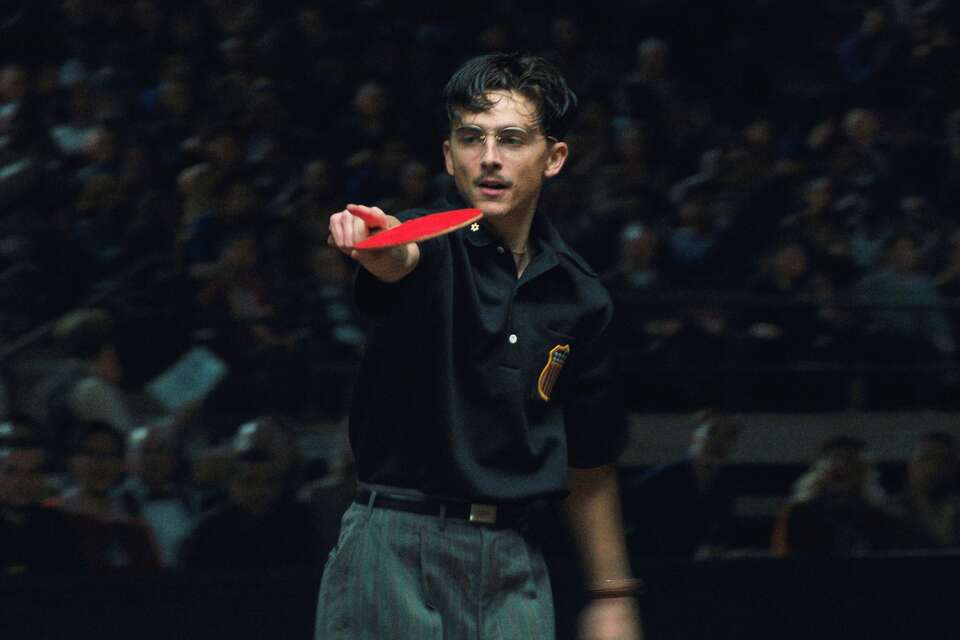
But this week, I’m looking at three new films set in historical eras. There’s a lumberjack at the turn of the previous century, a psychiatrist in Algeria in the 1950s, and a female boxer from West Virginia in the 1990s. 

Fanon

Co-Wri/Dir: Jean-Claude Flamand-Barny

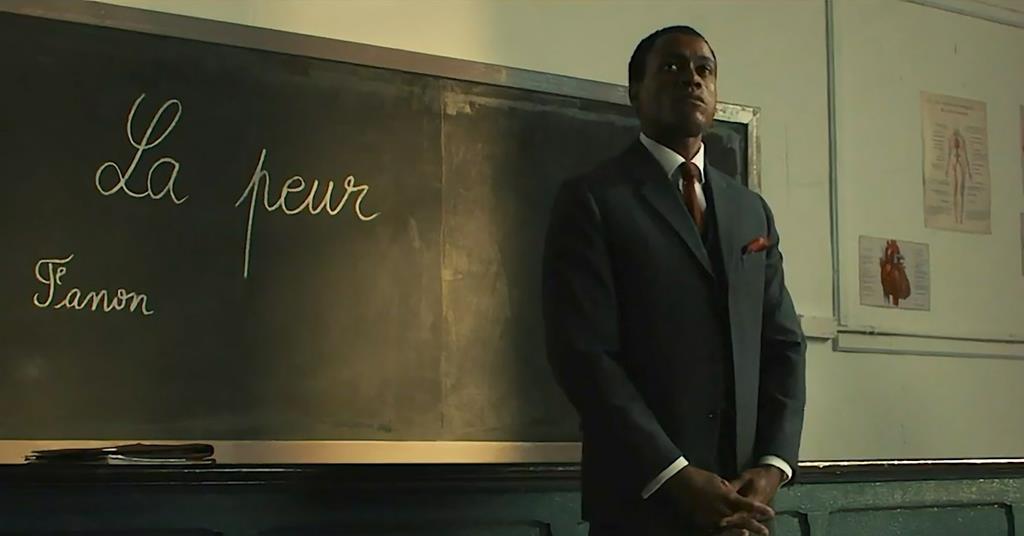
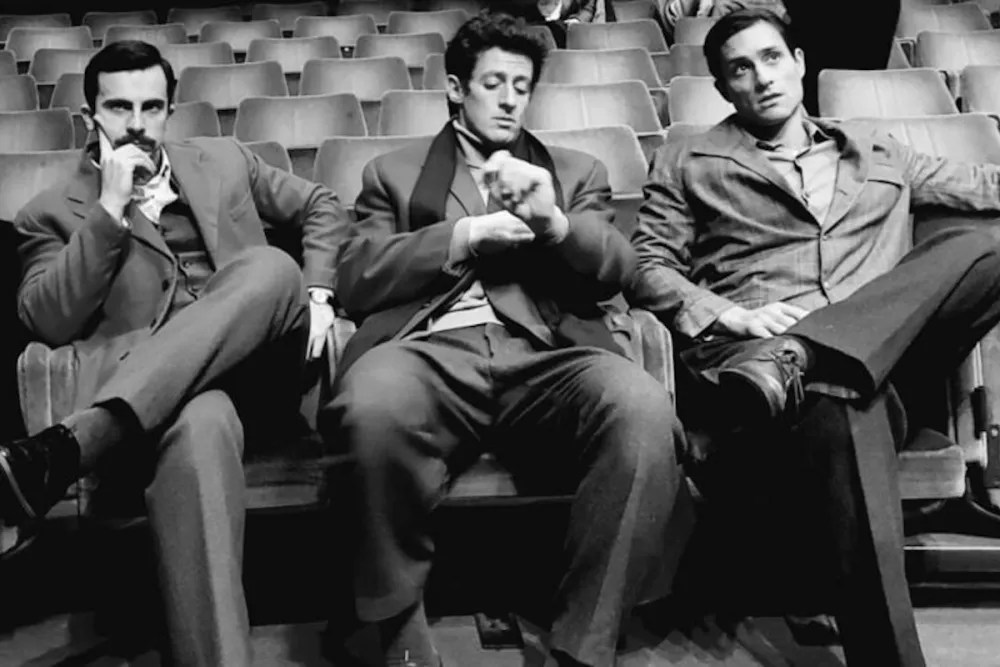
It’s the early 1950s in Algeria. Frantz Fanon (Alexandre Bouyer) is a renowned psychiatrist from the French Island of Martinique. He is starting his new job at a mental hospital. But he’s shocked at how Algerian patients are treated there. In contrast to Europeans, the “savage” north Africans are kept shackled in filthy cells, because of their “barbarous and dangerous” nature. Fanon (who is black) insists his North African patients be treated like any others. He lets them walk in the garden, plant vegetables, play soccer and make friends. Their mental health quickly improves. He’s assisted by diverse Algerian interns and staff: Hocine (Mehdi Senoussi) Jacques (Arthur Dupont) and Alice (Salomé Partouche), all followers of his techniques. But he’s strongly opposed by traditionalists and the French military, who are increasingly violent in their tactics. (Algeria was annexed by France but most of the locals are not considered full citizens.) He and his wife Josie (Déborah François) are upper-middle-class French citizens playing their role supporting the sprawling Empire. Fanon fought the Nazis in WWII. He likes Sartre, elegant suits and and fine wine. But his views are changing. He now writes books (dictated to his wife) about the effect of colonization on the mental health of the colonized in Algeria. Their own self-image is denigrated by their oppressors, he writes, when they internally accept their status as “the other”. Word gets out and he’s invited to join the FLN, (considered terrorists by the French). But the threat of violence reaches his hospital, as personified by Sergeant Rolland (Stanislas Merhar), a particularly violent soldier who checks in as a patient. How can Frantz Fanon simultaneously balance his various roles — as a husband and father, as a Black man serving the French empire, as an innovative psychiatrist, and as an intellectual joining the Algerian struggle for independence?

Fanon is a vibrant biopic about a decade in the life of the renowned author. I find it gripping and fascinating. Alexandre Bouyer is strong and statesman-like in the title role. I’ve known of Fanon for many years — as the author of books like The Wretched of the Earth and Black Skin, White Masks — but never knew about his background in psychiatry. Though occasionally heavy-handed and hagiographic, this movie opened my eyes to the exciting and intellectually stimulating story of his life in Algeria and the history that surrounded it. 

I like this one a lot.

Train Dreams

Co-Wri/Dir: Clint Bentley (Jockey) 

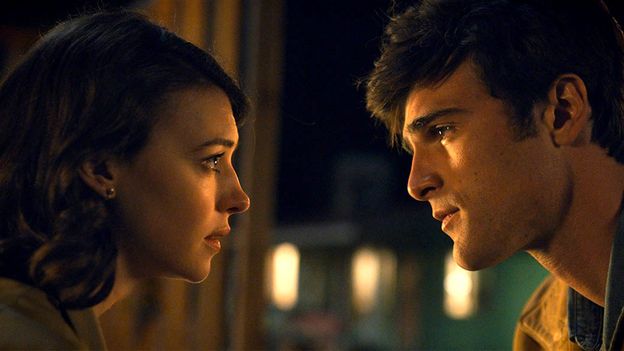
It’s the early twentieth century in the US Northwest. Robert Grainier (Joel Edgerton) is a bearded lumberjack who rarely speaks. He earns his living chopping down trees at migrant lumber camps and building the railroad.  He meets a woman named Gladys (Felicity Jones), they fall in love and build a homestead in a grassy patchl near a flowing river. He cuts all of the wood by hand. Gladys is good with a rifle and shoots foul and deer to eat. The rest they buy in town at a general store owned by Ignatius Jack (Nathaniel Arcand).

He spends lonely months away earning money, but always returns home in the end. He makes friends with a Chinese labourer named Fu Sheng — they don’t talk but that’s fine with Rainier who never has much to stay. But he is shocked when a crowd decides to murder Fu Sheng just because he’s a celestial. He later makes friends with an old-timer named Peebles (William H. Macy) who handles the dynamite explosions. He loves their new baby girl  but his home and family are threatened when a wildfire sweeps through the forest while he’s away. What will Grainier do?

Train Dreams is a series of events in one unremarkable man’s life set along the early 20th century northwestern frontier. A folksy omniscient voice narrates the story, hoping to add profundity; it doesn’t work. The film is meandering,  pointless and stupid. It gives token nods toward environmentalism and against racism but they’re not really part of the plot. I hated this movie from the first few seconds, with its over-produced images and inappropriate soundtrack. We see a guy sawing wood until the camera pulls back revealing…? Nothing, just more trees, as if we’re supposed to applaud the scenery! At times it’s twee, like a Wes Anderson film, but without the humour or intellect. The men all look like they’re posing for a Carhartt fashion shoot. I try to feel sympathy toward Rainier  but he’s deliberately opaque. Worst of all are the Train Dreams of the title — we keep seeing the same montages of flashbacks from previous scenes… but the original ones are as short-lived as his memories of them. 

You might enjoy the pretty pictures in Train Dreams, but I can’t see any other reason to watch this annoying blunderbuss of a film.

Christy

Co-Wri/Dir: David Michôd (The Rover)

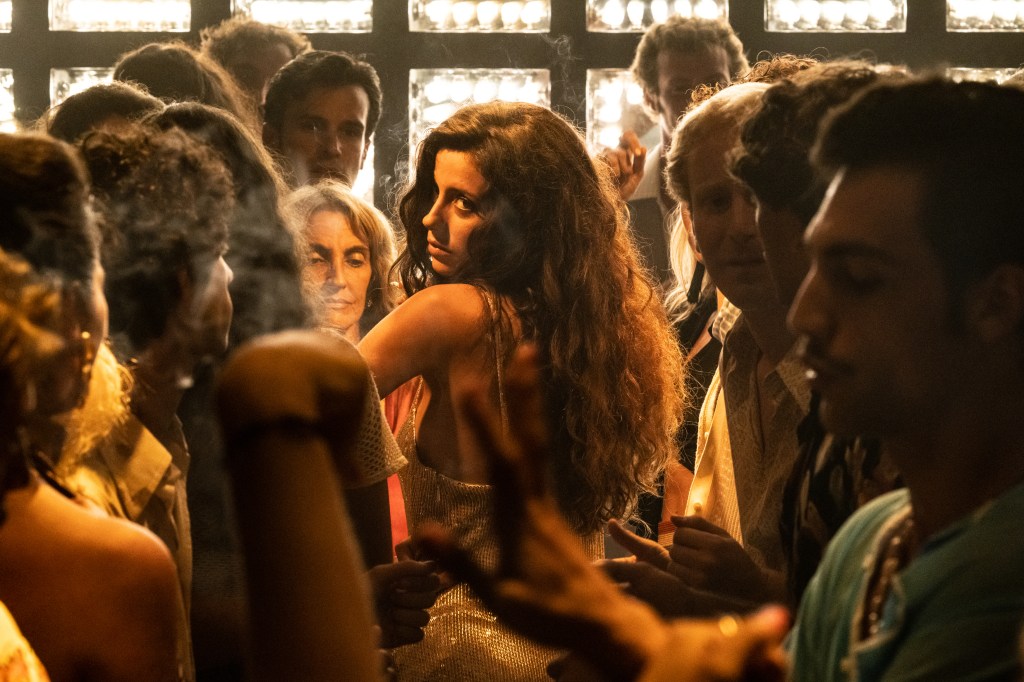
It’s 1989 in West Virginia. Christy Salters (Sydney Sweeney) is a high school kid, and a star player on the girls’ basketball team. She’s also in love with her girlfriend Rosie (Jess Gabor), a relationship her mom (Merritt Wever) doesn’t approve. She ends up trying out as a novelty act at a boxing match, and, though she has zero training, she scores a KO on her first try. She’s a natural. She catches the eye of a middle-aged boxing entrepreneur named Jim Martin (Ben Foster). He reluctantly takes her on and lets her train at his gym, but he will not allow her to see — or even talk to — Rosie. He sets her up in a trailer park where he can keep an eye on her. Though a great fighter, she’s isolated and unprotected outside of the ring. 

Christy is a powerhouse. Her career takes off, including a new hairstyle and a trademark pink silk hooded robe to make her look more “feminine”. She knocks out all contenders and after much pressure, the 22-year-old Christy sleeps with the middle- aged Jim… and they eventually marry. 

Her career soars, she meets Don King (hilariously played by Chad Coleman) and is signed to Mike Tyson’s slate. She gains fans worldwide, but her life is micromanaged by her Svengali husband. She may be a professional fighter but he’s twice her size, unstable, and increasingly violent. And he tries matching her up with boxers way above her weight class; that’s just dangerous. Is there any way to escape this oppressive relationship?

Christy is a biopic about the first prizewinning female boxer, who paved the way for a new professional women’s sport. I was hesitant about this one — ugh, yet another boxing movie — but Christy is as good as Rocky. It’s exciting, thrilling and moving, and despite her flaws, Christy Martin’s life is super-sympathetic. Sydney Sweeney is amazing. Yes, it’s Oscar-bait (you can tell by the prosthetic teeth and mullet haircuts, playing down her image as a sex-object) but she totally gets into this role. And Ben Foster is superbly hate-able as Jim — I seriously didn’t realize it was him till the credits rolled; he’s that skillful.

Christy is a good, old-fashioned biopic and a hell of a great boxing movie. 

Train Dreams and Christy both played at TIFF and are opening in Toronto this weekend; check your local listings. And Fanon is premiering today at Cinefranco, 4 pm at the Carlton Cinema.

This is Daniel Garber at the Movies, each Saturday morning, on CIUT 89.5 FM and on my website culturalmining.com.

Halloween-y. Films reviewed: Sew Torn, Kryptic

Posted in 1950s, 1960s, British Columbia, Canada, Crime, Horror, Monsters, Switzerland, Thriller by CulturalMining.com on November 1, 2025

Hi, this is Daniel Garber at the Movies for culturalmining.com and CIUT 89.5 FM.

Rarely have I seen two movies by the same director playing simultaneously, but that’s what’s happening right now. Richard Linklater (known for classics like Dazed and Confused, Boyhood, and Before Sunrise) is releasing two pictures. Blue Moon is a theatrical-style drama about the night when Rogers & Hart are replaced by Rogers & Hammerstein as the ruling Broadway musical pair (starring Ethan Hawke, Andrew Scott and Margaret Qualley). And Nouvelle Vague is a tribute to the French New Wave, and in particular, the filming of Jean-Luc Godard’s seminal film Breathless (À bout de souffle) in 1960. The movie’s  in French, shot in beautiful B&W, and  stars Guillaume Marbeck as Godard, Adrien Rouyard as Truffaut, and Zoey Deutch as Jean Seberg.

Together they make a perfect double-feature. 

But it is Hallowe’en, so this week, I’m looking at two first-time features, a couple of Hallowe’en-y movies to watch at home this weekend. There’s a seamstress who witnesses a crime, and a zoologist who thinks she’s seen a mythical beast.

Sew Torn

Co-Wri/Dir: Freddy Macdonald

Barbara (Eve Connolly) is depressed. Up till now, she’s led a simple life. She lives in a remote village in the Swiss alps — a land of schnitzels and yodels — sleeps above her mom’s sewing shop. Barbara lives a cartoonish life carrying a flip phone, and driving a tiny, blue putt-putt car with a giant spool of thread and needle mounted on the back. She calls herself the Travelling Seamstress, and makes house-calls even for the tiniest job. Problem is her mom died recently, and she doesn’t know what to do now. Her work and life seem meaningless without her mother’s guidance. Though technically a grown up, she still feels and acts like a child. But life goes on. 

Today’s appointment? Sewing a single button onto a wedding dress worn by a strident, middle-aged woman on her way to the ceremony (Caroline Goodall). But on the road she interrupts a shocking accident involving two armed criminals. Both men — a young guy (Calum Worthy) and a motorcyclist — lie bleeding on the tarmac, surrounded by  plastic packages of white powder, and a suitcase full of Swiss francs. A drug deal gone wrong. But the criminals are strangers, and with all that money up for grabs… should she commit a perfect crime? Or call the police? Or just drive away, like it never happened? Each choice holds potential pitfalls. And what she doesn’t realize is the crime boss behind the whole operation (John Lynch) is cruel, ruthless and headed her way. Which path should Barbara take, and how will they change her future?

Sew Torn is an ingenious, crime/thriller, about a clever seamstress confronting dangerous killers. It’s also a mother- daughter / father- son coming of age story, with each of the young characters dealing with the legacy of their parents. The story is told and retold, as Barbara experience her various choices. The characters are cute, and the scenery appropriately incongruous. What’s really great are the intricate Rube Goldberg devices Barbara creates to fight off the criminals. All her schemes involve spools of thread, sharp needles and the ubiquitous sewing machines… adding still more surprises to this delightfully violent crime thriller.

Sew Torn is so good.

Kryptic 

Dir: Kourtney Roy

Kay Hall (Chloe Pirrie) is a tall, gaunt woman with lanky hair and an intense gaze. She’s part of an afternoon hiking club walking through the hills and mountains of southern BC. Their tour guide tells them they’re in an area teeming with mythical creatures: The Ogopogos, the Sasquatch,  the Windigo. In fact, a woman named Barbara Valentine disappeared a few years ago, so it’s important to stick together. Hearing this, Kay promptly veers away from the group into a nearby ravine in the hopes of catching a photo of the local monster. You see, she’s a veterinarian but also a cryptozoologist, in search of the unknown. And then she sees him, on a nearby hill: tall, hairy, stinky and dangerous… and headed her way. She wakes up dazed and confused, covered with a viscous white fluid… and no idea who she is. She has to use her driver’s license to find her name, her car and her home. And she’s haunted by sexually violent visions of her encounter with the creature. 

The next day, she sets out on a journey through southwestern BC, in search of the beast… by tracing the steps of the missing Barbara Valentine. She follows the clues through rustic motels, sleazy roadhouses and trailer parks teeming with drug-fuelled swinger parties.  And as she gets closer to finding out the truth, she discovers her own crucial role in all this. What dangerous secrets will her search reveal? Who is she…and what is her attraction to the cryptic beast?

Kryptic is a low-budget, monster/body horror flick set in rural BC, about a woman’s memory, identity and sexual attraction. There’s a fair amount of nudity, pervy sex and gory violence within a haze of alcohol and cannabis smoke. The story is OK (occasionally verging on the ridiculous) but it really takes off with all the strange characters — mainly women — she meets along the way. Like a faded glamour star running a motel, a die-hard monster hunter dressed like the beast, a barfly with crucial info, and a woman who claims to have had carnal encounters with the monster. Chloe Pirrie is great as Kay, wavering between naive and brazen, whenever her eyes glow green. Kamantha Naidoo is tough but sympathetic. Also notable are Pam Kearns, Jennifer Copping and Patti Allan.  I also like the softly threatening and surreal feel of much of the film. 

Though far from perfect, Kryptic still has lots of unexpected images to look at on a cold Hallowe’en night. 

Sew Torn is now streaming on Shudder while Kryptic is available on Hollywood Suite. And the two Linklater movies — Blue Moon and Nouvelle Vague — are both playing at the TIFF Lightbox in Toronto; check your local listings.

This is Daniel Garber at the Movies, each Saturday morning, on CIUT 89.5 FM and on my website culturalmining.com.

It’s dangerous! Films reviewed: Daniela Forever, Apocalypse in the Tropics, We Were Dangerous

Posted in 1950s, Brazil, Coming of Age, Fantasy, High School, Horror, Indigenous, Maori, New Zealand, Politics, Religion, Romance, Spain by CulturalMining.com on July 12, 2025

Hi, this is Daniel Garber at the Movies for culturalmining.com and CIUT 89.5 FM.

Guillermo del Toro, the celebrated director who splits his time between Mexico and Canada, has curated a series of classic Canadian horror movies called From Rabid to Skinamarink: Canadian Movie Madness, playing at the TIFF Lightbox this weekend.  I happen to have seen everyone of them myself, and I totally agree with del Toro’s selection.  You can catch Canadian gems like the feminist werewolf drama Ginger Snaps, Vincenzo Natali’s cult-hit Cube, Kyle Edward Ball’s experimental Skinamarink, and many more. 

But this week, I’m looking at three new movies from abroad: a surreal fantasy from Spain, a politically documentary from Brazil, and a period drama from New Zealand.

Daniela Forever

Wri/Dir: Nacho Vigalondo

It’s present-day Madrid. Nicolas (Henry Golding: Crazy Rich Asians) is a popular DJ at the city’s hottest nightclubs. But he is thrown into a deep depression when his girlfriend, an artist named Daniela (Beatrice Grannò: The White Lotus) is killed by a negligent driver just outside his home. But things take a turn for the better when a good friend of his, Victoria (Nathalie Poza), tells him of a new, experimental drug that might be just what he needs. But it’s top secret, filled with non-disclosure clauses, and requires regular visits to the pharmaceutical labs. The scientists there tell him each pill, if taken just before bed, will produce lucid dreams, real visions where he can control the content and won’t forget about them when he wakes up. This means he can bring Daniela back to life, at least while he sleeps. But he soon discovers its limitations: he can’t dream about something he’s never seen. If he turns down an ally he’s never visited, it will be covered in unformed, writhing grey matter. Kinda creepy.

Daniela seems artificial at first, but as time progresses, she starts turning real. She even produces creative ideas and thoughts that he doesn’t remember ever experiencing in the awake world. And far from seeming etherial, his lucid dreams are now wide- screen images in living colour, while awake time is small and drab. He can take Daniela to new places just by thinking about them and opening a door, and change the city of Madrid into something out of one of her paintings. But he soon realizes, not everything is going the way he planned. And when things from his dream world start appearing in awake time, he has to wonder what is real? Can he be in love with someone who doesn’t exist? And can she ever really love him if she’s just a figure of his imagination?

Forever Daniela is a highly- creative science fiction romance about love, death and reality. While it sounds like a Black Mirror jump-scare thriller, it actually avoids most  “bad” things except for the sadness of mourning. It also has a very surprising twist at the end (no spoilers). The film is Spanish, but most of the dialogue is in English. Henry Golding (Crazy Rich Asians) is appealing as the leading man, but runs into a bit of acting trouble when he tries to do a full-fledged meltdown. The special effects are excellent, fooling around with unusual concepts like daytime light and shadows in a nighttime environment. I quite like the writer/director Nacho Vigalondo

for the way he incorporates horror movie elements within an otherwise realistic context (like his film Colossal a few years ago.) So if you’re looking for something that’s surreal and supernatural but told in a positive, though bittersweet, way, I think you’ll like Daniela Forever.

Apocalypse in the Tropics

Wri/Dir: Petra Costa

Brasilia — a capital city  designed, planned and built from the ground up — was meant to be modern, secular and democratic. But after a coup-d’etat in 1964, Brazil became something other than democratic: a military dictatorship which ruled for the next two decades. So when a new, populist right-wing leader with military ties emerged in the 2010s, many Brazilians were wary of democracy falling again. But Jair Bolsonaro was different, a politician who changed his power base when he forged ties with evangelical Christians. 

Apocalypse in the Tropics traces Brazilian politics over the past decade and the rise in religion within government policies. It also gives background, from the building of the capital, through the military coup, American evangelist Billy Graham, the return to democracy, and more recent developments. It uses beautiful period footage, lush music and symbolic paintings — like Hieronymus Bosch’s Garden of Earthly Delights —  as a metaphoric portrayal of millenarian changes in Brazilian politics. It is narrated by the filmmaker and includes her one-on-one interviews with Bolsonaro, current President Luiz Inácio Lula da Silva, and the wildly popular televangelist, Silas Malafaia, who served as Bolsonaro’s right-hand man. We witness Malafaia’s sermons before huge crowds — shouting his opposition to same-sex marriage, abortion rights, and feminism — as well as intimate conversations aboard his private plane. The doc also shows new footage of the beloved capital Brazilia occupied and trashed by massive demonstrators, who called for a coup after Bolsonaro’s defeat. 

Apocalypse in the Tropics is a follow-up to Petra Costa’s 2019 film The Edge of Democracy with similar footage, style, and topic but concentrating this time on religion’s role in government policies. I’m not sure if this is a sequel, a reshoot or a continuation, but either way, it’s as aesthetically beautiful as it is disturbing. 

We Were Dangerous

Wri/Dir  Josephine Stewart-Te Whiu

It’s the 1950s on a small island somewhere off the coast of New Zealand, where three girls share a cabin: Daisy, Nelly and Lou (Manaia Hall, Erana James, and Nathalie Morris). They were sent there by the authorities or their parents. Te Motu is a school for “incorrigible” girls or, as the administrators call them, “whores, queers, delinquents and sexual deviants.” Many are orphans or runaways caught stealing food, like Daisy or Nelly. Lou is the exception. She comes from a rich family but was caught making out with her (female) tutor. The school operates under the strict rule of Matron (Rima Te Wiata), who has a cruel streak a mile long. Raised by nuns, she feels the only way to cure these girls’ bad attitudes is through the bible and the lash. Naturally the girls all want to get the hell out of there, but it’s hard to escape from an isolated island in the south pacific. The purpose of the school is to turn bad girls into happy homemakers. They are given lessons in diction and manners but not reading or math. Matron is frustrated by their outcome: She says they are “too stupid for school, to uncivilized to be maids and too barbaric to work”. Every so often, Matron is visited by men in suits from the mainland, one of whom suggests a horrifying treatment. But when Nelly find out, the three girls decide they have to do something to stop it.

We Were Dangerous is a moving, coming-of-age story about girls surviving in 1950s New Zealand. It’s bright and exuberant, full of playfulness and dancing, Haka and history, and though fictional, it tackles the very real issue of the mistreatment of indigenous girls. The acting is excellent all around, full of subtle clues and delightful details. For a first film, Stewart-Te Whiu avoids many potential stumbles and instead gives us a solid film that’s fun to watch. It played at ImagineNative this year, and is definitely worth seeing.


Apocalypse in the Tropics is playing this weekend at HotDocs and will be streaming on Netflix this coming week; Daniela Forever opens this weekend in Toronto; check your local listings; and We Were Dangerous is available now on VOD.

This is Daniel Garber at the Movies, each Saturday morning, on CIUT 89.5 FM and on my website culturalmining.com.

Intrigue. Films reviewed: The Phoenician Scheme, The Ritual, Ballerina

Posted in 1920s, 1950s, Action, comedy, Crime, Horror, Nun, Religion, Satanism, Thriller, violence by CulturalMining.com on June 7, 2025

Hi, this is Daniel Garber at the Movies for culturalmining.com and CIUT 89.5 FM.

imagineNative — Toronto’s own indigenous film and media arts festival — is on now through Sunday with docs, films, exhibitions and performances from around the world with both free and paid events.  Check it out!

But this week I’m looking at three new movies: an art house comedy, a religious horror movie and an action thriller. There’s a devious mogul preparing his daughter to take over his busines, a priest attempting an exorcism, and a professional assassin fighting to avenge her dad.

The Phoenician Scheme 

Co-Wri/Dir: Wes Anderson (Reviews: Fantastic Mr Fox, Isle of Dogs, The French Dispatch, Asteroid City)

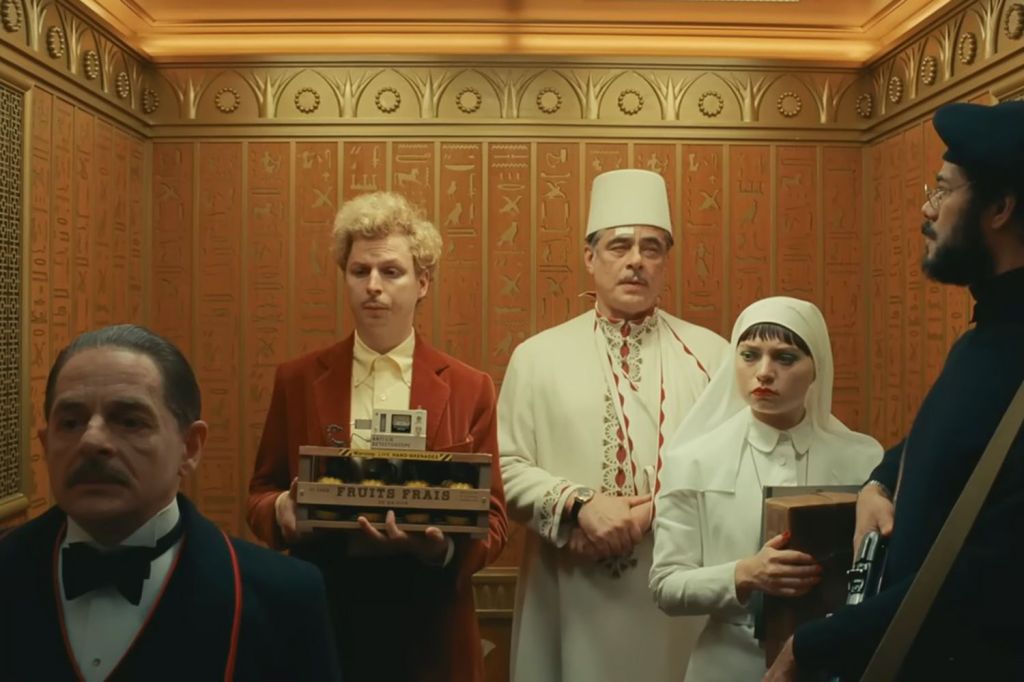
Zsa-Zsa Korda (Benicia Del Toro) is the richest industrialist in the world. He amasses millions by embarking on huge projects in developing countries using virtual slave labour. He’s ruthless and cruel. He has sired a dozen kids whose names he can’t remember and whom he keeps locked up in a threadbare orphanage. Except, one. Liesl (Mia Threapleton) is a novice, brought up in a convent and dresses like a nun but who who has yet to take her vows. Korda is grooming her to take over his huge business interests after he dies. And attempts on his life — like poisons, bombs and sabotaged airplanes — are a routine part of his life. But he always seems to survive. And so he embarks on a grand scheme to involving interconnected tunnels, waterways and cornering global markets. But first he must raise the money from investors. He takes Liesly along with him as he carries out his complex plans. And accompanying them is Bjorn (Michael Cera) a Scandinavian tutor, ostensibly hired to educate his kids, but instead tags along on these journeys. But they face hostile business partners, revolutionaries, spies and assassins, quicksand, plane crashes and other symbols of disaster. Will his scheme be successful? Will Liesl learn to love him? And will he survive the final attempt on his life?

The Phoenician Scheme is an art-house comedy film, the latest in Wes Anderson’s collection. It’s stylized and formalistic, shot in almost two-dimensional geometric settings with precisely directed sequences. Combining social satire with silliness, it’s wacky and always surprising. It consists of a series of segments as he checks off the list of the projects he planned as he swindles repeated capitalists out of their investments. The story line is punctuated by repeated dreams fantasies of Korda — in his near-death experiences — as he faces judgement in Heaven, but always ending up back again on earth. Threapleton is fun to watch as she gradually transforms from an avowed zealot to a lover of luxury, as Korda replaces her rosary with semiprecious stones, and her simple corncob pipe with an inlayed treasure from Cartier. Cera is hilarious as the insect-loving tutor Bjorn, and Del Toro is sufficiently both grand and seedy to convey his anti-hero’s character. Like all of Wes Anderson’s films, many members of his stable of actors reappear in short, cute roles: Tom Hanks, Willem Defoe, Bryan Cranston, Charlotte Gainsbourg, Richard Ayoade, Scarlett Johansson, Ris Ahmet, Bill Murray, and Benedict Cumberbatch, to name just a few. Some people are put off by Anderson’s emphasis on style and form — which, admittedly, doesn’t always work — but in this case, I think he’s made a fine movie that’s a pleasure to watch. 

The Ritual

Co-Wri/Dir: David Midell

It’s the late 1920s in a small town in Iowa and Father Joseph Steiger (Dan Stevens) is mourning the death of his only brother. But his grief is interrupted by a young woman in his parish. Emma Schmidt (Abigail Cowen) says she is possessed by a demon. For many years she has seen doctors and psychiatrists but no one can explain her strange condition. So she has turned to the Church to cure her, and says only an exorcism can free of from her very real torment. This is unheard of, but the ritual has been approved by the local Bishop, with an expert in demonic possession heading their way. Father Theophilus Riesinger (Al Pacino) is a shaggy-haired little monk who wears a cowl and talks like Tevye from Fiddler on the Roof. But he knows the practice of exorcisms inside and out. Along with a bevy of assorted nuns to help out, the ceremony begins. Emma is tied to the bed as her body writhes. She  pukes pea soup and breaks out in weird rashes. The furniture flies around the room as she curses in five languages. But can they exorcise this demon before it consumes her?

The Ritual is a horror movie that (supposedly)  reenacts an actual historical event: the performance of an exorcism in the US. The script is based on documents from that era. Thing is it is also the inspiration for William Friedkin’s iconic film The Exorcist, and the novel, by William Peter Blatty, it was based on. This version has atrocious writing, painful acting, and cheap-ass special effects. Fear and grief is conveyed by actors covering their faces with their hands, over and over. The whole movie is shot with in extreme close-ups using a hand-held camera that jiggle enough to make any viewer feel nauseous. Although the chapters of each ritual is documented, there’s minimal difference from one to the next. It isn’t even vaguely scary, more boring than anything else. It feels more like a Sunday school sermon than a horror movie. Al Pacino? Dan Stevens? These are famous actors! What are they doing in this dreadful movie? They must really be desperate. 

The obvious question is, what possessed the filmmakers to attempt to retell a story that’s already been told so well?

What a clunker. 

Ballerina

Dir: Len Wiseman

Eve (Ana de Armas) is a little girl raised by her father in a hidden palace somewhere in Eastern Europe. She is kept hidden from the rest of the world for her own safety. Until a man named The Chancellor  (Garbiel Byrne) tracks her down, kills her father and takes her away. All she has left to remember her dad by is a music box snow globe with a dancing ballerina inside. She is immediately enrolled in a school run by The Director (Anjelica Huston), a cruel teacher in the tradition of the Ruska Roma who trains her girls to endure the pain of classical ballet dancing. They also learn how to kill their adversaries using fists, kicks, knives or any other dangerous object. Upon graduation, only those with true bloodlust are farmed out across the globe as killers to hire. And Eve is at the top of her class. She is highly successful as an assassin, but has another hidden motive: vengeance for the death of her father and sister.

Her relentless search leads her to a picturesque alpine village filled with jolly bakers and wood carvers. The women have blond braids and rosy cheeks while the men happily quaff steins of pilsener. Unfortunately, everyone in the village, I mean everyone, is a trained killer. And they happen to belong to a criminal outfit in an uneasy truce with the clan works for. Can she find her father’s killer and escape the village alive?

Ballerina is an action/thriller about a young, female assassin out for revenge. Its a spin-off of the John Wick franchise with many of the same recurring characters, including cameos by Keanu Reeves as John Wick himself. The plot is simple, and the script has relatively few lines. What it does have is fighting and lots of it, which it does really well, whether hand to hand or using enormous lethal weapons. The fight choreography is skillful and creative — it’s ballet. And I liked Ana de Armas as the protagonist… enough that if there were another Ballerina movie, I’d watch that one too. This is good action feature.

Ballerina and The Ritual both open this weekend in Toronto and The Phoenecian Scheme expands across Canada; ; check your local listings;

This is Daniel Garber at the Movies, each Saturday morning, on CIUT 89.5 FM and on my website culturalmining.com.

Beautiful. Films reviewed:Beautiful Evening, Beautiful Day, Two Women, Bring Her Back

Posted in 1950s, Adoption, Australia, comedy, Croatia, Horror, LGBT, Montreal, Movies, Sex by CulturalMining.com on May 31, 2025

Hi, this is Daniel Garber at the Movies for culturalmining.com and CIUT 89.5 FM.

This week I’m looking at three new movies: a historical drama, a sex comedy and a thriller/horror. There are four filmmakers facing censorship in Yugoslavia, two sexually frustrated moms in Montreal, and a pair of siblings in Australia who find themselves in a very strange foster home.

Beautiful Evening,  Beautiful Day

Wri/Dir: Ivona Juka

It’s 1957 in Zagreb, Yugoslavia, where a group of filmmakers are shooting a drama. Lovro (Dado Ćosić) its director and Nenad (Đorđe Galić) its writer are both national heroes. While still university students, they led a revolt against the Nazis and Ustashe, the Croation Fascist Party and later joined the resistance. As did Stevan (Slaven Došlo), their cinematographer. But the government doesn’t like their movie; it’s not patriotic enough. So they send in an apparatchik named Emir (Emir Hadžihafizbegović) who specializes in propaganda. Emir is there to “fix” the movie, with a new storyline, dialogue and actors. But also to catch and punish filmmakers who aren’t towing the party line. Tito’s Yugoslavia, though a “non-aligned” country, is warming up toward the post-Stalinist Soviet government. And is also conducting a crackdown on dissidents and undesirables in the arts. In particular, homosexuals. And this includes long time lovers Lovro and Nenad, Stevan and other gay men working on the film, all of whom had risked their lives as anti-fascist partisans in the past.

The filmmakers are interrogated, bribed, threatened, and even tortured when asked to name names… but production continues. Emir treats it all like just another job… until, four of the men he’s spying on save his life. Now Emir faces a dilemma: follow the rules or his own conscience. Can the lovers stay together? Will they finish their film? Or will the administration gather enough evidence to convict them of the serious crime of being gay and sentence them to a penal colony? 

Beautiful Evening, Beautiful Day is a powerful drama about a group of gay men in 1950s Yugoslavia, and the harsh persecution they faced for their sexuality. It’s both tender and brutal, with touching scenes and horrific violence. Although the story is fiction, it’s based on director Ivona Juka’s own research she did for her PhD dissertation. Gay men did play an important role in the resistance, and hundreds were later imprisoned and tortured by the government. 

The film boasts excellent acting and stunning B&W cinematography by Dragan Ruljančić. It sheds light on a topic which until now has been virtually non-existent in Yugoslavian cinema. This is an excellent indie movie that deserves to be seen.

Two Women (Deux Femmes en Or)

Dir: Chloé Robichaud

It’s wintertime in Montreal. Florence and Violette (Karine Gonthier-Hyndman, Laurence Leboeuf) are next door neighbours in a housing coop. They can be seen gazing longingly out their windows. Florence, a translator, has a 10 year old son with her common law husband David (Mani Soleymanlou). Vivi is on maternity leave taking care of their new baby daughter, while her husband Benoit (French actor Félix Moati) is on the road. He makes a good salary in pharma sales (and is having a secret affair with a younger woman he works with). But Vivi is losing sleep over a sound she keeps hearing: a Caaaw, Caaaw, Caaaw coming through her walls. Is it a crow? A crying baby? Or, the most likely reason, it’s her neighbour Florence loudly performing her orgasms through the thin apartment walls. She casually brings it up to her, but there the penny drops: Florence admits she hasn’t had sex for many years. It can’t be her; she’s on anti-depressants which totally destroyed her sex drive. But why should both their lives be so miserable?

They decide it’s time to have fun. Florence goes off her meds, and the two of them start hanging out in bars. They’re also viewing men differently than they used to. The exterminator, the cable guy, the housecleaner, the window washer, the linesman… why should these neglected moms pass on all these potential sexual adventures? But how would their husbands react to sudden changes in their wives’ behaviour? And what will happen to their marriages?

Two Women is a delightful, bittersweet comedy about a pair of sexually frustrated mothers in Montréal and how they deal with their non-functional marriages. It’s sexy, silly, satirical and savvy. The main characters are as likely to be seen seducing a plumber, as quoting Simone de Beauvoir or discussing the ramifications of the #Metoo movement on Facebook. 

Count on Québec to thumb its nose at sexual prudishness in mainstream North America, meaning lots of casual full frontal nudity (as well as from every other conceivable angle). Now apparently this is a remake of Claude Fournier’s hit film from 1970 starring Monique Mercure. I’ve never seen the original but let me tell you, Two Women is a great one all on it’s own. Loved it.

Bring Her Back

Co-Wri/Dir: Danny and Michael Philippou (Talk to me)

It’s a normal day in Australia. Andy (Billy Barratt) is Piper’s (Sora Wong) step-brother; a few years older, but they share the same Dad. Piper is visually impaired but doesn’t use a white cane — she doesn’t like people staring at her. She’s funny and self-confident, but  Andy still keeps an eye out on her at school; some kids can be cruel. But their lives are torn apart that day when they discover their father dead in the shower.

They’re immediately sent to child services, who attempt to send them to separate places —  Andy has a juvenile record —  but they insist on remaining together; he’s basically Piper’s caregiver. In the end the social worker sends them off to stay with a kindly foster mom until she can find them a permanent home. The house is cluttered and shabby, with a drained swimming pool in the back and a padlocked toolshed. Laura (Sally Hawkins) is funny, wacky, and more than a bit eccentric. She’s overjoyed to have them there since her husband’s gone, and her daughter — who was blind like Piper — is dead. She’s quick to introduce them to her favourite dog — but he’s stuffed! Taxidermy.  And then there’s her son Oliver, a little boy with a shaved head and a vacant look on his face. He seems innocent… until he catches their cat and starts to eat it, alive!

He’s been a bit off since their accident, Laura says. Piper really likes her, so Andy tries not to interfere. But bad things start to happen. Andy is wetting his bed at night —  he hasn’t done that since he was a little kid, and Laura is whispering stuff to Piper all the time, turning her against him. He knows there’s something really wrong here, but he can’t figure out what it is. Why is there a chalk circle around the house? Why is Oliver acting so strange? And what’s in that shed? But when he discovers the truth… is it too late?

Bring Her Back is a relentlessly terrifying horror movie about a frightened teenaged boy and his innocent step-sister. It’s every kid’s nightmare — trapped in a potentially dangerous place, ignored by authorities, and gaslit by a foster mom who is supposed to be on their side. The movie starts with a cold open, a  horrific, found-footage VHS snuff film, that remains unexplained for much off the film. Frustrating and terrifying, this movie keeps you on tenterhooks till the end. The Phillipou brothers (identical twins) weave a contemporary fairytale as scary as the Brothers Grimm. Great acting, beautifully made, but quite difficult to watch.

Bring her Back is brilliant horror like you seldom see. 

Two Women (which premiered at Inside Out), Beautiful Evening, Beautiful Day, and Bring Her Back all open in Toronto this weekend; check your local listings.

This is Daniel Garber at the Movies, each Saturday morning, on CIUT 89.5 FM and on my website culturalmining.com.

Hate and Love. Films reviewed: Another Simple Favour, On Swift Horses PLUS more Hotdocs!

Posted in 1950s, Crime, Death, documentary, Drama, Gambling, LGBT, Mystery, Romance, Secrets, Sex, Thriller by CulturalMining.com on May 3, 2025

Hi, this is Daniel Garber at the Movies for culturalmining.com and CIUT 89.5 FM.

This week I’m looking at two new movies, a dark comedy and a romantic drama. There’s a true-crime writer in search of a killer on the Isle of Capri, and a dishonourably discharged sailor looking for forbidden love in the casinos of Las Vegas.

But first… with Hotdocs continuing through the weekend, here are some more documentaries playing there that caught my fancy.

Endless Cookie (Peter and Seth Scriver) is a highly original animated film that uses bright colours and stylized characters — in the form of elastic bands, or peaches — to retell the stories of two half brothers, one from the Shamattawa First Nation in Northern Manitoba, the other from Toronto’s Kensington Market.

Coexistence, My Ass by Canadian filmmaker Amber Fares (Speed Sisters: Interview, 2015) looks at an Israeli stand-up comic who uses her tragic hilarity — in Hebrew, Arabic and English — as a scathing critique of her own country’s policies.


My Boyfriend the Fascist (Matthias Lintner) is an intimate, personal film about a leftist Italian filmmaker in South Tyrol and his virulently anti-communist Cuban-Italian lover who is drifting further and further to the extreme right.

Supernatural (Ventura Durall) is about an MD forced to deal with the legacy of his own dad, who was famous as a shaman, and a telepathic healer who still has a grateful followers including one woman who swears he saved her life.

And finally…

Ragnhild Ekner’s Ultras is a stunning, impressionistic look at the shared subculture of superfans at soccer clubs on four continents, including chants and Tifos, both elaborate synchronized formations in the stands and the creation of massive cloth banners that span a stadium and then disappear in just a few minutes.  

All of these played at Hotdocs, including some with additional screenings this weekend.

Another Small Favour

Dir: Paul Feig

It’s summer in Connecticut, and Stephanie, a writer and single mom (Anna Kendrick), is sending her son off to camp. Which gives her time to promote her latest book, “The Faceless Blonde” a true-crime saga of adultery, deceit and murder. She knows the story better than anyone since she’s the one who lived through it all (barely) and helped the police catch the murderess and lock her up.

So imagine her surprise when she receives a fancy invitation to a wedding on the Isle of Capri. It includes  a private jet, a luxury hotel suite and a seat at the head table as Maid of Honour. What’s the catch? The bride is Emily (Blake Lively) the very same convicted killer who tried to murder her! Somehow, Emily’s out of prison and betrothed to a fabulously wealthy and powerful man.

Naturally, Stephanie is suspicious. How could she trust the woman who tried to kill her? But in the end, she decides to go — and film it all for her popular vlog.  The location is lavish… but also dangerous, with a notorious cliff where many had met their maker. Guests include Sean (Henry Golding) Emily’s bitter ex-husband; Linda (Allison Janney), Emily’s conniving aunt and Margaret (Elizabeth Perkins), her batty mother; Dante (Michele Morrone), her handsome brooding fiancé; and Portia (Elena Sofia Ricci) Dante’s acid-tongued matriarch. The danger comes from the fact that Dante’s family are connected to the mob, and almost everyone at the party holds a deadly grudge toward at least someone else. Poor Stephanie is left fending off the eye-daggers that everyone is sending her way, but even so, some of the main characters are being killed, one by one. Who is behind these murders? What is their motive? And can Stephanie make it out of there alive?

Another Simple Favour is a dark comedy/thriller about killers killing other killers at a wedding. Apparently it’s a sequel to a similar movie that came out in 2018, but I can’t compare it to that since I never saw it. I can compare it to other high-budget movies made especially for streaming sites (This one is premiering on Prime). It shares their characteristics: famous directors, top stars, exotic locales, racy dialogue and designer costumes. Thing is, Another Simple Favour is a comedy but 2/3 of the jokes fall flat, and a mystery but highly contrived. The writing and directing are both mediocre at best. The characters are simplistic and just so-so, including a whole bunch I didn’t bother mentioning because they have no obvious role other than that they were in the original film. Blake Lively’s Emily tosses the C-word like party favours at a wedding. Her character just doesn’t seem believable. Henry Golding is irritating, and Elizabeth Perkins is embarrassingly bad. Happily, Allison Janney is fun and Anna Kendrick is truly delightful. And, yes, it’s crap but it’s fun crap, and it kept me interested even though I knew it was bad. If I had bought a ticket to Another Simple Favour in a theatre, I’d feel ripped-off, but since it’s a TV movie on a streaming site, it left me feeling mildly entertained. 

On Swift Horses

Dir: Daniel Minahan

It’s the 1950s in San Diego after the Korean War. Muriel (Daisy Edgar-Jones) and Lee (Will Poulter) are a newly-married couple who moved west from Kansas to seek their fortune. While Lee is infatuated with his new wife, Muriel is more reserved. He wants to move into a new house in a suburban development, but she is reticent to leave the city… until she meets  Sandra (Sasha Calle) a woman whose house borders the new development. She’s single, independent and mysterious, someone Muriel can spend time with. But they’re both waiting for Lee’s younger brother Julius (Jacob Elordi) to show up, and kick in his share of the mortgage. The problem is while Lee is an ordinary grunt, his brother is tall, dark and handsome with huge ambitions. He’s not like us, Lee says. 

Indeed, he has moved to Nevada to make big bucks in Vegas as a card shark. But he soon realizes since you can’t beat a casino, so you may as well join them. They place him in the unfinished rafters immediately above the game tables where he looks down through holes to spot card counters and cheaters. There he meets Henry (Diego Calva) a Mexican who shares his duties. It’s hot up there so they strip down to white singlets. Soon they’re sharing an apartment and then a bed; secretly, of course. Is this love? 

Meanwhile, back in San Diego, Muriel overhears regulars at the diner she works at, discussing sure-fire horses to bet on. She makes to he tracks to try her luck. And with some newfound earnings she feels confident enough to pay a visit to Sandra down the road. Is this just a fling? Or the real thing? Will Julius ever join them in San Diego? And what would Lee do if he ever discovered both his brother and his wife are flirting with same-sex partners?

On Swift Horses is a romantic drama about love in repressive 1950s America. It recreates the era with detailed period sets and music set against paintbrush desert sunsets. It’s passionate and erotic with a novelistic scope (based on the book by Shannon Pufahl). The main characters both find themselves doing illicit and mildly illegal things — gambling — to support their highly illegal actions — same sex relationships. Though never explicit, somehow Edgar-Jones as Muriel spitting an olive pit into Sandra’s open hand, or dancing to music in Sandra’s living room in her underwear seems much more sexualized than her having obligatory coitus with her husband. Likewise Elordi as Julius exudes sexual desire in every scene. While the film does verges on the sentimental with its gushing music and tragic near misses, by the end, you’ll be siding with the characters and hoping their love will be eternal.

On Swift Horses is now playing; check your local listings. and Another Simple Favour is streaming on Prime 

This is Daniel Garber at the Movies, each Saturday morning, on CIUT 89.5 FM and on my website culturalmining.com.

Broken. Films reviewed: Parthenope, The Unbreakable Boy, The Monkey

Posted in 1950s, 1960s, 1970s, Autism, comedy, Family, Horror, Italy, Women by CulturalMining.com on February 22, 2025

Hi, this is Daniel Garber at the Movies for culturalmining.com and CIUT 89.5 FM.

This week, I’m looking at three new movies: there’s a boy with breakable bones, a toy monkey who could break your bones, and a woman whose beauty breaks every man’s heart. 

Parthenope

Wri/Dir: Paolo Sorrentino (Reviews: Youth, Hand of God, The Great Beauty)

It’s Naples, 1950 and a woman gives birth in the waters of the Tyrrhenian Sea. The baby is called Parthenope, named for both the city and the Greek myth. She grows up to be a young woman of epic beauty and legendary intellect (Celeste Dalla Porta). Men who try to seduce her, find their own words silenced by her pithy comebacks. Her days are filed with a search for beauty, happiness and meaning. She absorbs everything she reads, from John Cheever to Claude Levi-Strauss. Her closest friends are her brother Sandrino (Dario Aita) and Raimondo (Daniele Rienzo) the son of a maid. Together they form sort of a quasi menage a trois.

Parthenope aces her orals and is accepted into the prestigious anthropology department at the local university. From there she follows three very different paths: Academia — a professor takes her under his wing; Love, deciding which of her countless suitors should she consent to sleep with; and the city of Naples, itself. Along the way she encounters a corrupt and carnal bishop, a depressed superstar diva, a millionaire with a private helicopter, and many others. But will any of these people provide her with the answers she seeks?

Parthenope is a gorgeous  and sumptuous look at post-war Naples as seen through the eyes of a beautiful woman as she lives her life. Celeste Dalla Porta is appealing to watch, but she is opaque and impenetrable: she merely observes without ever doing anything. Paolo Sorrentino is known for his his beautiful images, especially women as objects of desire. But he doesn’t seem to know what to do with a woman as his subject. Instead we get a hollow simulacrum of a main character, who drifts aimlessly but happily through her life as she encounters quirky strangers. I love the photography, the scenery, the people and the music — a collection of bright and shiny colours — but watching Parthenope leaves you feeling like you just flipped the glossy pages of a fashion magazine: superficially attractive but pointless.

The Unbreakable Boy

Co-Wri/Dir: Jon Gunn (Reviews: Ordinary Angels, I Still Believe, American Underdog, Jesus Revolution)

Scott (Zachary Levi) is a young salesman with big ambitions: he plans to move to Manhattan someday and make it big. But in the meantime, he likes golf, fine wine and travelling. He spends most of his time with his best friend Joe, a burley bearded man who is always giving him advice (Drew Powell). One day he meets a pretty and charming woman named Teresa (Meghann Fahy). Sparks fly, and nine months later, she gives birth to Austin (Jacob Laval). They’re not married but decide to bring him up together. But there’s a catch: he requires special care. Like his mom, Austin has Osteogenesis imperfecta (OI), a genetic condition that makes your bones very brittle. He suffers his first fracture in the birth canal, with many more breakages to follow. Eventually he is joined by a younger brother, Logan, who doesn’t share his breakability.  

13 years later, Austin — aka the Aus-man — is now a happy school kid with a vivid imagination. He’s also on the autistic spectrum, but contrary to stereotypes, he’s outgoing, talkative and attends normal classes. He talks constantly, just like his dad. (I forgot to mention: Scott’s best friend Joe is imaginary) But all is not well. The family is deeply in debt. Austin is bullied at school. And Scott is drinking way too much, especially since he lost his job. Can the family pull itself back together? Or are they headed for ruin?

The Unbreakable Boy is a very cute, true story about an ordinary family working together to overcome their problems. As narrated by Jacob Laval  as the Aus Man, it’s simple, touching and funny. I like the way it demystifies kids with medical conditions and autism. And unlike most medical dramas, it’s not a weeper, though perhaps overly earnest. One warning: it is a faith-based movie, generally a red flag for cringe. Not my thing. Thankfully this one avoids most of the problems of that genre; preachiness and finger wagging and in-your-face prayers. If you’re in the mood for a light, informative, feel-good Christian movie that won’t make you squirm, check this one out.

The Monkey

Wri/Dir: Osgood Perkins (Reviews: Longlegs, Gretel and Hansel)

Hal and Bill (Christian Convery) are identical twins, but they couldn’t be more different. Bill, who was born a few minutes earlier, is self confident, athletic and  aggressive. Hal is withdrawn and wears glasses as he tries to keep out of Bill’s way. But his brother is a bully, humiliating and hurting Hal on a daily basis, using a posse of popular girls as his private army.  The two live with their single Mom (Tatiana Maslany) ever since their Dad, an airline pilot, walked away one day and never came back. When the boys go through the many souvenirs he brought home from around the world, they uncover something very unusual. It’s a mechanical automaton that’s an organ-grinder monkey. You wind him up and he plays a drum to the sound of carnival music. A harmless toy, right? Not exactly. When the drumstick comes down something terrible happens. Like when their babysitter is accidentally decapitated at a Benihana restaurant. But when it kills their beloved mother, the boys decided to hide the monkey somewhere that it can do no more harm. They are adopted by their aunt and uncle, a pair of swingers in small-town Maine. But they too are eventually killed in gruesome accidents. Was the money to blame? 

Flash-forward 25 years. Hal (Theo James) still lives in Maine close to his teenaged son Petey (Colin O’Brien). He visits him only once a year, to lesson the chances of the cursed monkey in harming him. But then two cataclysmic events threaten Hal’s normal life. First, Petey’s stepfather Ted (Elijah Wood) announces his plans to adopt him, making this the last time Hal will see him. Second, a series of terrible events are killing countless people in and around the town he grew up in. Can Hal find that damned Monkey and stop it from killing someone else? And can he simultaneously spend his last days with his son while keeping him out of danger?

The Monkey is a shocking and disgustingly hilarious movie about an evil toy and the people it affects. It’s done in a retro style, like Mad Magazine meets the Twilight Zone. It’s directed by Oz Perkins, known for his stylized movies that feel like fairytales (Gretel and Hansel) or nightmares (Longlegs). With this one, based on a short story by Stephen King, he seems to have found a happy medium. Simultaneously comical and grotesque, you watch the movie waiting with baited breath for the next disaster to happen. Theo James is perfect as the hapless Hal, but so is every other character in this weird movie, each given their own minute of ghastly glory: a pawn shop owner, a girl gang, a real estate agent, a pot dealer, a televangelist… it’s a limitless, mind-blowing romp. The Monkey is grotesque comedy/horror at its peak.

I love this movie. 

Parthenope, The Unbreakable Boy, and The Monkey all open this weekend in Toronto; check your local listings.

This is Daniel Garber at the Movies, each Saturday morning, on CIUT 89.5 FM and on my website culturalmining.com.

Americans abroad. Films reviewed: Queer, September 5, Oh Canada

Posted in 1950s, 1960s, 1970s, Addiction, Canada, Dreams, drugs, Germany, Journalism, LGBT, Mexico, Resistance, Sex, Sports, TV, US, War by CulturalMining.com on December 14, 2024

Hi, this is Daniel Garber at the Movies for culturalmining.com and CIUT 89.5 FM.

This week I’m looking at three new movies set in the 1950s, 60s and 70s, about Americans abroad. There’s a novelist in Mexico City, a TV sportswriter in Munich, and a documentary filmmaker in Montreal.

Queer 

Dir: Luca Guadagnino (I am Love, A Bigger Splash, Call me by your Name, Suspiria)

It’s the 1950s in Mexico City. William Lee (Daniel Craig) is a middle-aged American writer addicted to heroine who hangs around local bar called Ship Ahoy. If he doesn’t get completely drunk he might spend the night with a man he meets. He’s friends with other flamboyant ex-pats, especially Joe (Jason Schwartzman) a portly, bearded man who shares Lee’s lascivious predilections. Lately, he has had his eyes on Eugene Alerton (Drew Starkey), an ex-GI who spends most of his days playing chess with an older red-haired woman. Eugene is no “queer”, but is up to talking with Lee.

After repeated drinks, and some opiates he eventually shares Lee’s bed in his seedy rental. Lee is smitten, Eugene content. Later the two head south in their quest for ever more potent drugs culminating in a journey toward the ultimate psychedelic experience. They end up in the Ecuadorean Amazon, in a remote shack guarded by a vicious but slow-moving three toed sloth. Inside, a mysterious doctor (Lesley Manville) holds the answers to all their questions. Is Eugene the man of his dreams? Will they ever reach hallucinatory nirvana? Or is life just an illusion?

Queer is a bizarre, sex-and-drug-filled psychedelic fantasy. It’s divided into three chapters: their meeting in Mexico City; their journey south; and their adventures in Ecuador.  It’s adapted from William S Burroughs’ semi-autobiographical novel written in the 1950s but not published for another 34 years. It swerves wildly between actual memoirs and pure imagination. Burroughs was a writer in the beat movement, and was married and had a son with another writer Joan Vollmer (perhaps she’s the red-haired woman Mary in the film).

The thing is, Queer is not a grave, serious movie, it’s a high-camp comic fantasy. Psychedelia has always been difficult to film, and there’s a fine line between the profound and the ridiculous. Some scenes, like the unfortunate semi-nude, interpretive dance sequence, falls on the (unintentionally) funny side. Others scenes were kinda cool. It’s a beautiful film to watch, for its music, set, costumes and art direction. Shot entirely in Rome’s Cinecitta, it’s never meant to look realistic. Daniel Craig plays Burroughs not as the usual chill junkie observer, but as a panting and sweating horndog, with bulging eyes, nearly choking on his own lust. 

If your looking for a sentimental romance a la Call Me by You Name, or a deeply profound meditation on psychedelic trips, this ain’t it. But if you just want a weird and funny drug-infused dream-filled movie with lots of soft-core gay sex, you’ll probably have a great time.

September 5

Co-Wri/Dir: Tim Fehlbaum

It’s September 5, 1972 at the Munich Summer Olympics and the crowds are roaring. Americans are glued to their sets watching the US cleaning up, with swimmer Mark Spitz winning an unheard of seven gold medals.  ABC is the perennial loser of the top three networks. So their sportscasters are thrilled to have won exclusive coverage rights. The team behind the cameras are hard at work. Geoffrey Mason (John Magaro) is the newbie, trying to prove his chops. His boss Marvin (Ben Chaplin) wants things to run smoothly, and his boss’s boss (Peter Sarsgaard) is thinking of the bigger picture. Jacques (Zinedine Soualem) is their French cameraman with Marianne (Leonie Benesch) the only woman on the team, is a German journalist, and their de facto translator. Everything is great until they hear gunshots… not at the games, but at the nearby Olympic village. A group of masked militants, known as the Black September Organization is holding Israel’s Olympic team hostage. 

Suddenly, the ABC sportscasters realize they are the only American TV journalists in Munich. They have the cameras, the boom mics and the broadcast and satellite rights ready to send stories home. They shift their telephoto lenses from pointing toward the swimming pools to the athletes’ dormitories, trying to catch a glimpse of the hostages. What will happen next? Will German authorities step in? And can a sports crew handle crisis news?

September 5 is a journalistic thriller about 24 hours at the Munich Olympics. Despite its title, this isn’t about the Israel/Palestine conflict — they barely delve into it. That’s just the backdrop. What it really looks at is how a team of US journalists — at the right place at the wrong time —  figure out how to get the news out even as the crisis grows. I love the period details: giant-sized spools of reel-to-reel videotapes, and how little white tiles on a black background were superimposed onto a sports channel screen. So cool. I’ve never heard of Swiss director Tim Fehlbaum before, but he keeps the action moving in the midst of constantly shifting mayhem. The acting is ok, but best by far is Leonie Benesch who starred in last year’s The Teacher’s Lounge. I went into this movie full of dread. It’s clearly Oscar-bait; Hollywood churns out journalistic dramas every year. But this one is surprisingly good, and had my heart pumping all the way through. If you’re looking for some journalistic excitement, check out September 5. 

Oh Canada

Co-Wri/Dir: Paul Schrader (First Reformed)

Based on the story by Russell Banks   

Leo Fife (Richard Gere) is a renowned documentary filmmaker in Montreal. He is getting ready for an interview in his own living room in the grand old home he shares with his wife Emma (Uma Thurman).  The director, Malcolm (Michael Imperioli) and his crew are longtime admirers of Leo’s legendary work. After crossing the northern border in the 1960s to protest the war in Vietnam, he ended filming docs that changed the course of history. He uncovered the use of Agent Orange at the military base in Gagetown, New Brunswick, and became a university prof teaching young journalists how to make movies. Now, decades later, Leo is on his deathbed, dying of cancer, so Malcolm wants to record his final thoughts.

Leo treats this film as a confession — he wants to clear the record. He starts by talking about his first wife and son, a family he left behind in Virginia. But she’s not the only skeleton in his closet. His past life is full of lies, deceptions and possibly terrible acts. Emma doesn’t like him talking like this and wants him to stop. Leo’s nurse thinks can’t take all this stress. But the filmmakers persist and Leo perseveres.  Are any of his stories true? Was he a good man or a bad man? And what do we really know about Leo Fife?

Oh Canada is a fictional story about a day in the life of an American filmmaker and activist recalling his past. It’s a simple concept with a slight plot. It’s structurally divided between the documentary being made about him, and his hidden past, shown in a series of flashbacks (He is played by Jacob Elordi as his younger self.) The film is  almost too simple. But with Paul Schrader at the helm, you know there’s going to be more to it. He wrote Taxi Driver and Raging Bull for Scorsese, and directed movies like The Yakuza (1974) First Reformed (2017) and American Gigolo (1980) that also starred Richard Gere.

Unfortunately, Gere is the weakest part of this film; he rants and complains, but there’s no heart in his performance. The film’s called Oh Canada, but it’s really Oh America. It was entirely shot there, with so-called Canadian characters using americanisms like “restroom”. What’s interesting is Schrader’s use of false visual narratives. There are  flashback scenes where Elordi as a young Leo is suddenly replaced by a contemporary Gere while all the other characters remain unchanged. Likewise, the names of past lovers seem to melt away. Perhaps Leo has dementia, or maybe this contrasts Leo’s current story with his past truths. Also interesting is the way we see Leo’s face throughout the eye of Malcolm’s camera, giving it a meta aspect that messes with your brain.

Oh Canada is not one of Schrader’s better films, but there’s enough stuff going on to keep it intriguing. 

Oh Canada, Queer and September 5 all open this weekend in Toronto; check your local listings.

This is Daniel Garber at the Movies, each Saturday morning, on CIUT 89.5 FM and on my website culturalmining.com.

Tough Cookies. Films reviewed: Maria, Flow, The G

Posted in 1950s, 1960s, 1970s, Animals, Animation, Corruption, Crime, France, Latvia, Opera, Vengeance, Women by CulturalMining.com on November 30, 2024

Hi, this is Daniel Garber at the Movies for culturalmining.com and CIUT 89.5 FM.

With a rapidly aging population, the traditional image of frightened, little-old cat ladies is gradually shifting to one of strength and cunning. Witness new TV shows like Matlock. So this week I’m looking at two new movies about tough older women and one about a cat. There’s an opera diva in Paris preparing her swan song; a rustbelt widow who wants to go out with a bang; and a cat on a sailboat in a world covered in water.

Maria

Dir: Pablo Larraín (Reviews: Spencer, The Club)

It’s 1977 in Paris, and Maria Callas (Angelina Jolie: Salt, The Tourist, Unbroken) — one of the greatest divas in opera history, is not doing well. She rarely eats, often never leaving the bedroom of her palatial apartments for days at a time. She rarely speaks with anyone anymore, aside from her servants. She runs her butler ragged (Pierfrancesco Favino: The Hummingbird, in a red monkey suit) and she relies on her cook (Alba Rohrwacher: Sworn Virgin, Hungry Hearts, The Ties/Lucci ) for judgement on the quality of her vocal chords. 

But she’s not completely alone. She is seeing a pianist for his unvarnished opinion on whether her legendary “voice” has returned. And has agreed to an unheard-of interview with a young journalist named Mandrax (Kodi Smit-McPhee: The Road, The Congress, The Power of the Dog, Memoir of a Snail). But Maria faces a number of problems. She refuses to see a doctor, despite her rapidly declining health, and she won’t stop popping Quaaludes, leading to frequent hallucinations and delusions. Can her devoted servants save her life? Or is this the end?

Maria is a biopic about the death of a legendary Greek-American diva. The movie begins with her demise at age 53, then goes back in time to show what led up to it. This includes flashbacks to her chubby adolescence in German-occupied Athens in WWII, her failed marriage, and at the peak of career, including trysts with Aristotle  Onassis and JFK. 

But is this biopic any good? I have very mixed feelings about that. I love the beautifully shot interiors, the ostentatious costumes and the amazing arias provided by recordings of Callas herself. Italian actors Rohrwacher and Favino provide wonderfully painful performances. And, as the latest in a series of films about famous woman by Chilean director Pablo Larraín it has good pedigree, especially Spencer (with Kristen Stewart as Princess Diana). But this movie depends on Angeline Jolie, and she doesn’t carry it off. She always seems to be acting. I don’t see Maria Callas here, I see Jolie posing for the camera, with  a haughty face here and a dramatic gestures there; so you rapidly lose sympathy with the main character. Perhaps Maria Callas really did act like that, even behind closed doors, but Jolie plays her somewhere between high camp and kitsch. 

Maria is never boring… just a bit embarrassing. 

Flow

Co-Wri/Dir: Gints Zilbalodis

It’s some time in the future, somewhere in the world. A small grey cat with golden eyes and pointy ears is enjoying a walk in the woods. The cat lives by an abandoned old house surrounded by enormous cat statues. The cat is very shy, and fears, most of all, a pack of feral dogs. Suddenly, there’s a stampede of animals running in one direction, full speed. They‘re trying to avoid a massive flood, sweeping away everything in its path. But cat and a friendly, white dog are among its victims. Survival instinct kicks in and eventually cat manages to climb on board a tattered sailboat. There Cat discovers a gentle, sloth-like capybara already on board. Other animals make their way onto the sailboat, including an ingenious lemur, that big, white dog and a majestic-looking phoenix. Together they form an uneasy friendship as they brave a dangerous water-covered world. But can they learn to get along? And is this world worth living in?

Flow is a brilliantly animated film about a picaresque journey by a mismatched troupe of animals. It’s tender, heart moving and lovely to watch. It’s all about friendship and cooperation learned by animals living in a gently hostile world. And though they behave a tiny bit like humans, there are no people in the story, and no dialogue either; just grunts meows and barks. Dogs still want to fetch. Cats want to catch fish.  

And though it’s post-apocalyptic, there is nothing futuristic in this film; human technology is limited to abandoned ancient cities, glass bottles and sailboats; no cars or smartphones to be seen. The science fiction comes in with its universality, where animals from different continents, along with mythical beasts like sea monsters, can randomly encounter and learn from one another. I just watched Flow, and I already want to see it again.

Flow is Latvia’s Oscar submission for Best International Feature.

The G

Wri/Dir: Karl R. Hearne

It’s a rust-belt city somewhere in North America. Ann Hunter (Dale Dickey) is a tough cookie in her 70s, who is feeling depressed. You can see it  in every wrinkle on her face. She lives with her ailing husband in their fully-owned condo. He was once a tough guy, but is rapidly sliding into immobility and dementia. She grudgingly takes care of him, and drowns her sorrows in rot-gut alcohol straight from the bottle. Aside from him, she only spends time with Emma, step-granddaughter (Romane Denis). Emma models her life on The G (as she calls her grandmother) someone who doesn’t take crap from anyone. The G also helps her out financially, and doles out hardboiled words of wisdom.

But everything changes when a man in a suit  named Rivera (Bruce Ramsay), out of the blue, breaks down The G’s front door, accompanied by two toughs:  Matt (Joey Scarpellino), a handsome but simple-minded gardener; and Ralph, a psychopath with bleach blond hair (Jonathan Koensgen). Together they violently shove Ann and her husband into a van, who wind up locked in a threadbare room without a phone, in a nursing home that feels more like a prison. This is your new home, Rivera says, and there’s nothing you can do to stop me. He’s now their legal guardian and has the documents to prove it; their doctor (a silent partner in the scam) has declared them both incompetent. No one’s allowed to go in or out for the first month. He roughs up her husband to try to find the proverbial pot of gold he thinks they’re hiding. But they underestimate the G, her stubbornness, and her shady connections back in Texas.

Meanwhile, Emma is shocked when she discovers her grandparents have suddenly disappeared, leaving behind just a torn-up home. She scours the city to find them, and makes friends with a caretaker who works at the home (who also happens to be Matt, the friendly thug). It’s too late to save her grandpa but she vows to get the G out of there. And even while Emma is trying to free her, the G has vowed vengeance on all her enemies — and she’s not messing around. Who can they trust? Can two women best a criminal organization? Or will they end up buried alive? 

The G is a great revenge thriller about the very real phenomenon of organized criminals attacking and abusing the elderly. It’s dark and disturbing. Dale Dickey blows this movie out of the water, supported by a good Quebecois cast. (It’s shot in Montreal). If you’re looking for a gratifyingly violent revenge flic, this is the one to see.

Maria and Flow are now playing at the TIFF Lightbox, with Maria streaming on MUBI on December 11th; and The G is opening across Canada; check your local listings.

This is Daniel Garber at the Movies, each Saturday morning, on CIUT 89.5 FM and on my website culturalmining.com.

Trapped. Films reviewed: Captives, Here, Emilia Pèrez

Posted in 1800s, 1950s, 1960s, 1970s, AI, Crime, Family, France, Mental Illness, Mexico, Musical, Tom Hanks, Trans, Women by CulturalMining.com on November 1, 2024

Hi, this is Daniel Garber at the Movies for culturalmining.com and CIUT 89.5 FM.

Toronto Fall Film Festival Season continues with Cinefranco showing  contemporary French language movies from around the world at the Carlton Cinema. But this week, I’m looking at three new movies about traps. There’s a big-hearted woman trapped in a male drug-lord’s body, a French woman trapped in a mental hospital, and a movie camera trapped… in somebody’s living room!

Captives

Co-Wri/Dir: Arnaud des Pallières

It’s Paris in the late 19th century. Fanni Devander (Mélanie Thierry) is an elegant and educated woman searching for her mother. She disappeared when Fanni was just a child, but she has reasons to believe she is locked away somewhere in the city’s mental hospital. So Fanni voluntarily checks herself in to try to find her. Pitié-Salpêtrière is a home for the destitute, people with mental illness, learning disabilities or epilepsy, convicted criminals and even some foundling children. The one common factor is they’re all “undesirables” and all women. But once inside she realizes you can check in, but you can’t check out. It’s a de facto prison, presided over by the Matronly Bobette (Josiane Balasko),  and a hench-woman who would make Nurse Ratchet look like Florence Nightingale. Bobette’s one obsession is to perfectly execute their upcoming ball featuring her patients singing and dancing before a crowd of wealthy patrons. 

Fanni quickly learns the ropes and makes allies with Hersilie, a music teacher (Carole Bouquet)  and a lesbian school teacher with an eating disorder. And she finally meets a nearsighted older woman named Camomile (Yolande Moreau) who just might be her real mother. Can Fanni perform at the ball and safely escape with her supposed mother? Or will they all be stuck there forever? 

Captives is a fascinating historical thriller about the treatment of women in state institutions. It’s harrowing in parts — including scenes of torture — as Fanni navigates class and hierarchy within this enclosed universe. I purposely only mentioned some of the characters and plot turns, because the surprise is what makes it worth watching. But rest assured, it’s full of great acting, pathos, and beautiful period costumes — even within that terrible place.

I like this one.

Here

Dir: Robert Zemeckis (Reviews: Flight, Allied)

Ricky (Tom Hanks) is a teenaged baby boomer living the American dream. His Dad and Mom (Paul Bettany and Kelly Reilly) have lived in a house across the street from Ben Franklin’s historical home since they bought it on the GI Bill after WWII. Now Ricky and his kid brother and sister happily share the place, congregating in the living room for holidays, dinners, or just to watch TV. Ricky wants to be an artist, while his girlfriend Margaret (Robin Wright) dreams of going to law school. Unfortunately, when she gets pregnant while they’re both still in high school, they marry and settle down, still within Ricky (now called Richard’s) parents’ home. Life goes on, and the decades pass, and people are born, live and die. But will they always stay “here” in the same house?

Here is a movie about a place, specifically a living room facing the picture window and the street beyond. The camera never movies. It follows this location not just for Ricky’s family, but also the dinosaurs, the ice age, indigenous people, Ben Franklin, and various couples across the 20th century, constantly jumping back and forth in time. The one constant is the frame, the fourth wall, which never shifts. Picture this: a pop-up square will appear with different furniture and wallpaper in it, taking you to another era, in the style of a virtual staging of a house for sale on a real estate website. Indeed we get to meet real estate agents throughout the twentieth century. Which makes sense because its really about the place, not the meat puppets who wander around in it.

Does this new, experimental concept work?  No!  It’s indescribably awful.

I cannot convey the aesthetic revulsion I felt viewing this horrible non-movie movie. It features a de-aged, 68-year-old Tom Hanks playing himself as a teenager with a fake young teenage face plastered on, but who still talks and walks like the old man he is. What were they thinking?! Here is a tired, platitudinous high-concept exercise in futility disguised as an innovative film. All the characters are painful cliches, including a token black family whose sole purpose seems to be to recite a version of Ta-Nehisi Coates Letter to My Son… to their son.

Keep in mind, Zemeckis is known both for classics like Back to the Future but also unforgivable, semi-animated dreck like Polar Express and Forrest Gump. Here falls neatly into the dreck pile.

Emilia Pérez

Co-Wri/Dir: Jacques Audiard 

Rita (Zoe Saldaña) is an ambitious young defence lawyer in Mexico City. She spends hours crafting powerful opening statements for trials, but, as a black woman —  originally from the Dominican Republic — she gets none of the credit. But somebody is watching her and appreciates her skill. She finds out who, when she’s kidnapped with a black hood over her head and driven into the middle of the desert. There she meets the notorious head of a huge drug cartel, personally responsible for countless killings. Juan “Manitas” Del Monte, the cartel chief, needs her to help him disappear, in a way no one — including his wife Jessi (Selena Gomez) — will ever find him again.

The twist? This murderous, pock-marked, bearded monster… is trans, and wants to shed the awful male body and face, to live the rest of her life as an attractive woman. She needs someone she can trust to handle all this, both the finances and the surgery, leaving no paper trail. In exchange, Rita will have all the money she needs for the rest of her life, and her own private firm.

Years later, she meets with a potential client, a fabulously rich European woman named Emilia Pèrez (Karla Sofía Gascón). It’s her client from years back, who wants to re-enter the world and be reunited with her beloved family, all of whom think she is dead. And to atone for some of her past sins without revealing who she was. What will happen to these three remarkable women in the next chapter of their lives?

Emilia Pérez is an incredibly passionate and shocking movie. It’s simultaneously an action-thriller, an epic drama, and a musical. Yes, that’s right, a musical, where  characters do break into songs and dances throughout the film. But with its latin beats and shouting crowds, it’s the sort of songs you rarely encounter in a musical.  Zoe Saldaña is amazing as this tough-as-nails lawyer, and Karla Sofía Gascón, a Spanish actress I’ve never seen before, is unmatchable, both as Perez, and as the drug lord Manitas. (She’s a  transwoman herself.) French director Audiard (who previously brought us masterpieces like A Prophet, and Rust and Bone) seems to have no trouble creating a Mexican musical. I gotta say, Netflix churns out a load of content, most of which is forgettable crap, but, every year, they also produce a few really remarkable films. Emilia Pèrez is one of those.

I strongly recommend this movie.

Here and Amelia Perez both open this weekend in Toronto; check your local listings. And Captives is having its English Canada premiere at 8:45 tonight (Saturday, Nov 2, 2024) at Cinefranco at the Carlton.

This is Daniel Garber at the Movies, each Saturday morning, on CIUT 89.5 FM and on my website culturalmining.com.