Pleasant danger. Films reviewed: How to Train a Dragon, The Life of Chuck PLUS TJFF!

Posted in 1940s, 1960s, Dragons, Fairytales, Fantasy, Finland, France, Kids by CulturalMining.com on June 14, 2025

Hi, this is Daniel Garber at the Movies for culturalmining.com and CIUT 89.5 FM.

As the days get longer and the skies get warmer, people want to go out and have fun, looking for an enjoyable night out. So this week, I’m looking at two new entertaining, feel-good movies, that at first glance seem to be just the opposite. One’s about horrible monsters terrorizing a small island, the other’s about the end of the world. 

But before that, let me tell you about a few movies playing at the Toronto Jewish Film Festival showing movies from around the world through this weekend, and digitally until June 18th.

TJFF, 2025

The festival opened with Once Upon My Mother, (Ma Mere, Dieu et Sylvie Vartan), bilingual-Canadian director Ken Scott’s (review: Starbuck) humorous look at the memoir of Roland Perez, a renowned Parisian attorney and writer. He’s the 6th child in a crowded family of Moroccan immigrants born with a clubfoot in 1963, but whose driven mother, Esther (wonderfully played by Leïla Bekhti), refuses to accept it. She — and will power alone  — will make him walk, no, dance!, as if there were no physical problems standing in his way. These efforts are all done to the tunes of pop singer Sylvie Vartan on his sisters’ record player, as he struggles to learn to read.

This is a charming and quirky family comedy.

In The Other, documentarian Joy Sela attempts the impossible: to film people from two sides of an intractable conflict — that of Israel and Palestine — talking frankly with each other. Ordinary Israelis, and Palestinians from the West Bank, East Jerusalem, Gaza and those from Israel proper, voluntarily getting together. People on both sides of this polarizing conflict, whose families or friends have been killed, kidnapped, jailed or persecuted, attempt to share personal photos and stories, and actually get to know “The Other”. While most of the film was shot before the enormities of the current Gaza war took place, it’s still important in that it holds out the hope of peace and understanding, and the end of this brutal war and the events and conditions that led up to it.

Never Alone (by Finnish director Klaus Härö) is a true story set in Helsinki in 1942, where an outspoken, prominent businessman, Abraham Stiller (Ville Virtanen), comes to the rescue of a group of Jewish refugees who arrive by ship from Austria. And soon after, Stiller has a noisy run-in in his store with a random man who loudly opposes the presence of refugees. What he doesn’t realize is he has picked a fight with Arno Anthoni, a Nazi collaborator and the head of the Finnish State Police. The movie has a noir-ish feel, full of secret papers, clandestine backroom deals, and shadowy prison cells. Never Alone is a tense, historical drama that looks at Finland’s somewhat spotty record in the first half of WWII.

How to Train Your Dragon

Co-Wri/Dir: Dean DeBlois

It’s the middle ages on a remote, mountainous island populated by a multicultural Viking consortium. They speak with Scottish brogues and wear pointy horns on their helmets. Their biggest problem? Dragons — of every shape and form —  who steal their sheep and wreak havoc. Stoic, the island’s ridiculously bearded chieftain (Gerard Butler) leads them repeatedly into dangerous battles with these fire-breathing monsters, in the hope of someday discovering their lair, and killing them all. But young Hiccup (Mason Thames), an inventive, non-conformist, doesn’t want to kill dragons. He’s a lover, not a fighter, and has a major crush on the young swordswoman Astrid (Nico Parker).  When he discovers a disabled Night Fury dragon that he names Toothless, Hiccup fashions a prosthesis so he can fly again. He trains Toothless to fill a space somewhere between rival, best friend and pet. And by closely observing his strengths and foibles Hiccup learns all the dragons’s secrets. But his dad — the Chieftain — enrols him in a gladiator-like training camp, full of ambitious viking wannabes — like Snotlout, Fishlegs, Ruffnut and Tuffnut,—  to teach him to kill the beasts, including his secret best friend. Are dragons the dreaded enemies of the Vikings, or are they just big misunderstood puppy dogs?

If “How to Train Your Dragon” sounds familiar, it’s because it’s a live action remake of the hit 2010 3-D animated kids’ movie by the same name. (And in the same vein, this review is largely the same as the one I wrote 15 years ago. If they can do it, so can I) But I was a bit trepidacious about what they might do to the cartoon version which I really liked. Well no need to worry. It’s similar but not identical. The animated version is funnier and goofier. I like the new costumes, especially the furry mukluks they all wear. Part of the cast — like Gerard Butler —  are back again, and the newbies, especially Mason Thames, with his cartoon-like features, fit their parts fine. But as I watched this one on the big screen, I was blown away by the spectacular mid air flying scenes, where Hiccup rides through the skies on Toothless’s back. I don’t remember that from the first one. When I looked at my old review, there it was. The “…effects were great…with a lot of breathtaking scenes and battles, and a good amount of suspense. At times it felt like being part of a good video game – weaving between rock formations, through the clouds, under the northern lights – and I mean that as a compliment.”

This may be a kids’ movie, but I totally enjoyed watching How to Train Your Dragon all over again.

The Life of Chuck

Co-Wri/Dir: Mike Flanagan

Marty (Chiwetel Ejiofor) is a school teacher in a bucolic small town… who feels a bit strange. Things aren’t functioning like they used do. Everyday people and buildings disappear, even as the stars in the sky fizzle out, one by one. The one thing that is working are posters, billboards, skywriters and flashy ads everywhere celebrating an unknown man named Chuck. Who is this Chuck? What’s going on? Is this the end of the world? Yes, it is… well, sort of.

But then comes act two.

A well dressed man in a business suit hears a busker playing the drums in a city square in Boston. He begins to dance, first alone, and then with a ginger-haired woman, who, caught up in the excitement, joins him. Here is the ‘Chuck’ Krantz (Tom Hiddleston) we’ve been hearing so much about. Act three fills in the blanks: where Chuck came from (played here as a young man by Jacob Tremblay), why he is so central to this story, and what he represents for this world, and how magic plays a small part.

While The Life of Chuck is ostensibly a film about the end of the world as seen through horror-meister Stephen King’s eyes —  the man who brought us The Shining, and Carrie and Misery and Cujo and Pet Semetary —  it’s actually a sweet and gentle revelatory movie that owes more to the poems of Walt Whitman than to any ghosts or vampires.

I have to admit, I’m no fan of Tom Hiddleston I didn’t like him in the Hank Williams biopic, or as Loki in the Thor Movies.  But he is perfect in this movie about Chuck. So if you’re in the mood for a really nice, inspiring, easy-to-watch movie with lots of semi-profundities, you should see the uncategorizable and always surprising Life of Chuck.

I really liked this one.

How TO Train Your Dragon and The Life of Chuck open this weekend in Toronto; check your local listings. Never Alone, The Other and Ma Mere, Dieu et Sylvie Vartan. Are among many films playing at TJFF in person and digitally.

This is Daniel Garber at the Movies, each Saturday morning, on CIUT 89.5 FM and on my website culturalmining.com.

The thrill of uncertainty. Films reviewed: Harbin, Babygirl, The Brutalist

Posted in 1900s, 1940s, Art, Class, Espionage, Korea, Sex, SMBD, War by CulturalMining.com on January 4, 2025

Hi, this is Daniel Garber at the Movies for culturalmining.com and CIUT 89.5 FM.

First let me wish you all a Happy New Year! With a new year comes renewal, hope… and potential dread. So this week, I’m looking at three new movies where people face potentially dreadful situations, partly of their own making. There’s an abused architect, a compromised CEO, and a sympathetic assassin. 

Harbin

Co-Wri/Dir: Min-ho Woo

It’s 1909 in Korea. After defeating a European empire in the Russo-Japanese war, Japan is flush with imperial ambition. They want more colonies on the mainland and are looking hungrily at Korea, Manchuria, Mongolia, and China. But some independence-minded Koreans are regrouping to fight Japan. Their leader, Ahn Jung-geun (Hyun Bin), managed to defeat a Japanese battalion in a bloody battle. But when, following international laws, Anh released the disarmed POWs, their leader Mori (Park Hoon) shot a cannon at their base killing everyone except Anh. Now the survivors are meeting in Vladivostok to decide what to do next. This includes Kim (Jo Woo-jin) his closest ally, and Woo, (Park Jeong-min) his biggest rival. And some of them think Anh is a Japanese mole. To atone for his mistakes and to do something big, he vows to assassinate Ito Hirobumi (Lilly Franky: Shoplifters, Like Father, Like Son) one of the top statesmen of Imperial Japan who is calling for the annexation of Korea. 

To do this killing Anh must make his way to Harbin, a rail hub city right on the border of Russia and northeast China where Ito plans to give a public speech. But If he travels by train he will be caught. He must turn to a former comrade turned bandit, Ms Gong (Jeon Yeo-been) to try to secure explosives. But there is a traitor in their midsts, telling the Japanese all their plans. Can they make it to Harbin undetected, find the rat, fool their enemies, and carry out the assassination? Or are they fated to be erased from their country’s history?

Harbin is a vivid and gripping retelling of a famous historical event. It’s a classic cloak & dagger, full of action, thrills, drama, and deception. It’s done in the traditional style, with the name of each character appearing on the screen to help you keep track of which moustachioed fighter is which. But easier said than done, when everyone pulls down the brims of their fedoras to cover their faces. The locations are amazing: Anh crawling across the frozen waters of the Tumen River, horse caravans on the sands of Mongolia, ancient Russian train stations… very impressive! The sets and costumes are great too, with a drunken warlord festooned in animal furs or the ceiling lamps aboard a Russian train, swinging from side to side. If you have any interest in action-thrillers, spy stories or even NE Asian history, Harbin is the film for you.

Babygirl

Co-Wri/Dir: Halina Reijn

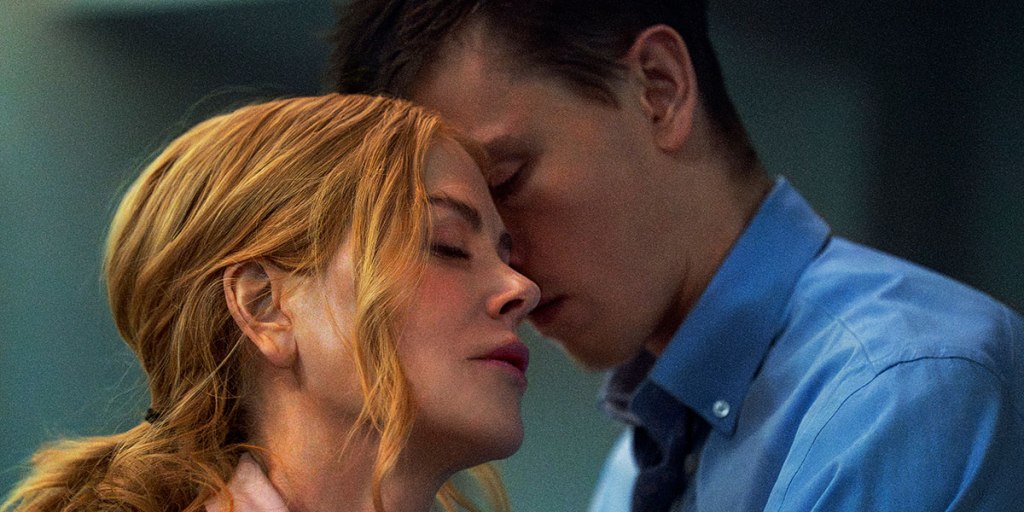
Romy (Nicole Kidman) is the CEO of a large, successful corporation that makes automated parcel-sorting equipment — similar to what Amazon has in their warehouses. She lives with her husband Jason a play director (Antonio Banderas) and their two teenage daughters, Isabel and Nora. Her life is almost perfect, but is missing a certain…. je ne said quoi. She is not sexually satisfied. One day she is startled by a vicious dog running rampant outside her office tower. She witnesses a random young man calm the dog down and return it to its owner. Later, inside her office, she is introduced to her latest intern; it’s the same guy she saw outside. Samuel (Harris Dickinson) has an unusually forthright manner, almost rude and overbearing for someone so young. He makes her feel unhinged and yet… intrigued. Who is this twerp, and why is he like that? She finds him overconfident and almost ridiculous. And yet… eventually, to her great surprise, they kiss and sparks fly.

Soon she is secretly meeting him in seedy hotel rooms for furtive sex. But he wants more — total domination over her in an S&M relationship. Romy loves her husband and kids has never done anything like this before. Even though he takes the dominant role, in real life she holds all the cards: she’s older, richer and his boss. She has more to lose, though, and it’s that threat that excites her. And she can’t got enough of him. What will happen if word gets out? Has she bit off more than she can chew?

Babygirl is an erotic drama about an older woman’s fling with a much younger man for the thrill of it all. It’s both highly sexualized and yet uncomfortable to watch in parts. It’s entirely told from Nicole Kidman’s (Before I go to Sleep, Genius, The Beguiled, The Killing of a Sacred Deer,  Boy Erased, The Upside, Destroyer, The Goldfinch,  Bombshell, The Northman) Romy’s point of view; we share her agony, her ecstasy, her cringing embarrassment (he treats her like a domesticated pet). As Samuel, Dickinson is opaque, functioning mainly as her erotic foil. He’s usually an excellent actor (Beach Rats, Triangle of Sadness, Scrapper, The Iron Claw) but in this movie he takes second all the way. Some people love this movie, others despise it. I’m somewhere in between. The plot is just a slight twist to the hoary old cliche of the powerful executive submitting to a dominatrix. I don’t need to watch a grown woman lick milk from a saucer. But other parts are quite exciting and altogether it’s worth it for Nicole Kidman’s performance. 

The Brutalist

Co-Wri/Dir: Brady Corbet

It’s post-WWII. László Tóth (Adrian Brody: Splice, Predators, The French Dispatch, Asteroid City) is a holocaust survivor from Hungary who arrives in America as a displaced person. His wife Erzsébet (Felicity Jones) and niece Zsófia are nowhere to be seen. His cousin Attila (Alessandro Nivola) gives him a place to stay in his furniture store and puts him to work designing and building chairs. Things look up when the son of an oligarch offers him a job redesigning his father’s home library. Laszlo takes to it like a fish out of water, building a modernistic room with synchronized wooden panels and shelves beneath an open skylight. But when the industrialist Harrison Lee Van Buren Sr. (Guy Pearce) sees it, he goes ballistic and fires him without pay. Soon after his cousin falsely accuses him of sleeping with his wife Laszlo finds himself unemployed, homeless and addicted to drugs. He gets work doing manual labour at a ship yard with Gordon (Isaach De Bankolé) a man he befriended earlier until the industrialist who fired him seeks him out ago. Turns out Laszlo was a Bauhaus architect before the war, and the library was featured in modern architecture. Lee immediately rehires him, this time to build a monumental memorial on a hilltop in honour of his mother. But conflicts still trouble the two men’s relationship. Will Laszlo ever complete his masterpiece? Or will Lee crush him with his oppressive and egoistical nature? 

The Brutalist is a moving drama about the American Dream and the class struggle between two men. (The title refers to the Brutalist style of architecture Laszlo favours). It’s a full-fledged four hour epic, compete with an overture, intermission and various story lines within the plot. I’m only giving you a taste of it here, a three-minute review of a four hour movie. It is visually and audibly stunning, both in design and execution, from the score to the crisp camera work, even the surprising credit roll.  The acting is superb — I’m referring to Brody, Pierce, Jones and the rest of the large cast. This is a mature film made by a young director and former child actor. I’ve only seen one other movie by him, Vox Luxe, which, while visually interesting, didn’t have much to it. The Brutalist takes a quantum leap beyond that, filling in all the parts left out of his previous work. The movie is exciting, full of both hope and crushing devastation. It’s so well done that I left the theatre assuming it was a biopic, only later realizing it’s entirely fictional. 

The Brutalist is a stupendous movie that must be seen to be appreciated.

The Brutalist and Babygirl are now playing in Toronto, with Harbin opening this weekend; check your local listings.

This is Daniel Garber at the Movies, each Saturday morning, on CIUT 89.5 FM and on my website culturalmining.com.

Twentieth century troubles. Films reviewed: White Bird, Hold Your Breath, Saturday Night

Posted in 1930s, 1940s, 1970s, comedy, Depression, France, Nazi, Psychological Thriller, Romance, TV, WWII, Y.A. by CulturalMining.com on October 5, 2024

Hi, this is Daniel Garber at the Movies for culturalmining.com and CIUT 89.5 FM.

Lots and lots of movies coming to Toronto. Opening this weekend is the monster comedy Frankie Freako by Toronto’s own Steven Kostanski; and next week, look out for the Goethe Films, Aftermath: Echoes of War series featuring classics by Fassbinder and Wim Wenders at the TIFF Lightbox.

But today, I’m looking at three new movies, all set in the 20th Century. There’s dustbowl horror in 1930s Oklahoma, Nazi occupation in 1940s France, and the opening night of a live TV show in 1970s New York City.

White Bird

Dir: Marc Forster

It’s 1943, during WWII, in a picturesque French village near the Swiss border. Sarah Blum (Ariella Glaser) is a happy middle class kid in her school with high marks and many friends. And she loves drawing pictures in the margins of her notebook. One young boy clearly has a crush on her.  Julien (Orlando Schwerdt) is smart and kind, but also a victim of bullying. Not only does his father work in the sewers but Julien has a brace on one leg and uses a crutch to get around, making him a ready target for cruel bullies. But things change rapidly under the Nazi Occupation. Sarah and the other Jewish kids are pulled out of class one day to be deported to the camps. She alone manages to escape and hide in the woods. But the former class bullies are now classroom Nazis and they’re always on the look out for Sarah. Luckily she has a saviour — it’s Julien, of course, who lets her hide in the hayloft of his barn. As the months go by, he serves as her one-man classroom, relating the lessons she misses each day. And as they get to know each other better, they grow closer — is love at hand? And can they keep her hidden during the Nazi Occupation?

White Bird is an historical romantic drama. Adapted from a YA graphic novel by R. J. Palacio, it’s a sequel to an earlier book (also adapted into a film) called Wonder. The historical plot is framed by a kid named Julien in present-day New York, whose French Grand-mère (Helen Mirren) is telling him a story from her youth. I found the movie OK, with some real weepy moments. It does have odd details: why is the French resistance’s oath Vive l’Humanité!? But I like the graphic novel feel of the whole thing, with rapid story development and unexpected twists and turns. If you’re looking for a good, historical, teenaged tearjerker, check out White Bird.

Hold Your Breath

Co-Dir: Karrie Crouse, William Joines

It’s 1933 on the Oklahoma panhandle. Margaret Bellum (Sarah Paulson) lives with her two daughters on a farm. Life is miserable. Once their land was covered with acres of wheat, the cows and horses thriving in the barn. But years of drought has turned their land into a giant dustbowl. It’s so bad that you can choke to death in a dust storm. Her husband Henry is in Philadelphia looking for paid work, leaving the three women alone, waiting for his first paycheque to arrive so they can join him. Rose (Amiah Miller) the older daughter is yearning to see a big city, while little sister Ollie, who is deaf (Alona Jane Robbins) is shy and easily frightened. Especially so since Rose read her a scary book about The Gray Man, a mythical bogeyman who embodies the terror of a dust storm. The neighbours are nervous, too — rumours abound that a drifter made his way into someone’s home and killed all the women. 

So Margaret is on high alert, her rifle cocked and ready to fire, when a drifter appears in their barn. Wallace Grady (Ebon Moss-Bachrach) calms her down, saying he knows her husband who told him to check up on his family. I’m a man of the cloth, he says, and a faith healer. But strange unexplained things start happening. Is he a killer or a pastor? Does he have supernatural powers? Or is he the mythical Gray Man?

Hold Your Breath is a psychological thriller in a gothic setting. It’s spooky and creepy, and a little bit scary, full of feelings of suspicion and psychosis. the acting, especially Sarah Paulson, is quite good. One thing I found interesting is, though it’s ostensibly set during the Great Depression, it feels like an allegory of the recent pandemic. The family puts on elaborate white face masks to protect from the lethal dust whenever they go outside, are afraid to leave their home, and they are terrified of an unknown invisible enemy who can “get inside their home and their bodies unnoticed, just by breathing”. 

Nothing is very surprising here, and the story seemed less scary than tragic, but if you’re heavily into southern gothic horror, I think you’ll appreciate Hold your Breath.

Saturday Night 

Co-Wri/Dir: Jason Reitman

It’s October 11, 1975 in New York City, and in a few hours a new show will be broadcast live across the United States. It’s a new concept; not the “live” part; that was a staple of TV programming from its earliest days. What’s new are the guests — Jim Henson and his muppets — the comedians — Andy Kaufman and George Carlin —  the controversial topics, the live musicians, and the “not ready for prime time” players.  The show is meant otherwise be produced on the fly with minimal rehearsals — they plan to read their lines from cue cards or just wing it. The show is Saturday Night Live, and up until the moment it airs, no one’s sure whether the show will be canceled even before it starts. 

It’s up to the creators Lorne Michaels (Gabriel LaBelle) and Dick Ebersol to get the show ready in time. Lorne is working closely with his writer (and partner) Rosie Shuster (Rachel Sennot). But he’s badgered by network VPs who seem to be determined to make it fail. On top of this, John Belushi has passed out somewhere, the union crew refuse to put the set together, they can’t find a live audience to sit in a studio at midnight, snd all the local station bosses are there with their own gripes.

What can a guy do?

Saturday Night is an instantly forgettable but warmly nostalgic look at the start of an iconic TV show.  More surprising is the movie is genuinely funny. A lot funnier, in fact,  than the TV show it’s celebrating. This is not a documentary; it’s a comic dramatization of what might have been going on that first night, exactly 50 years ago next week. There’s an enormous cast, with every producer, writer and comic portrayed by people who weren’t even born when that show started.

I love the frenetic energy running through this film, as the camera flies around the set following a plethora of characters all talking at once as they try to get the show on the air. It has a cast of thousands, it’s fun to watch and never boring. Like I said, there’s nothing much to it, but I enjoyed Saturday Night.

Saturday Night and White Bird both open this weekend in Toronto; check your local listings. Hold Your Breath is now streaming on Disney+.

This is Daniel Garber at the Movies, each Saturday morning, on CIUT 89.5 FM and on my website culturalmining.com.

“B” movies. Films reviewed: The Boy in the Woods, Blackwater Lane, The Bikeriders

Posted in 1940s, 1960s, 1970s, Coming of Age, Crime, Gangs, Ghosts, Gothic, Holocaust, photography, Poland, Psychological Thriller, Suspense, WWII by CulturalMining.com on June 22, 2024

Hi, this is Daniel Garber at the Movies for culturalmining.com and CIUT 89.5 FM.

In weather like this, don’t you want to be watching a movie in an air-conditioned theatre? I sure do. This week I’m looking at three new “B” movies, as in the letter B. There’s a biker gang in the 1960s; a serial killer on the loose on Blackwater Lane in an English town; and a boy trying to survive in the woods in WWII.

The Boy in the Woods

Wri/Dir: Rebecca Snow (Pandora’s box: Interview)

It’s 1943 in Nazi-occupied Poland. The city of Buczacz is home to Poles, Jews and Ukrainians who lived together in relative peace, until the German invasion. But by 1943 the Jews were in captivity, soon to be executed or deported. 12-year-old Max (Jett Klyne) wants to stay with his mother and younger sister, but when they are loaded onto trucks, she insists Max escape. His aunt has arranged for him to stay on a farm until the war is over.  Joska (Richard Armitage) helps him out by burning his clothes, dressing him in peasant garb and hat, and giving him a new name and history: if you want to survive, he says, you must totally change your identity. But following a near-death experience when the police come knocking at his door looking for hidden Jews, Joska decides it’s too dangerous to keep him there any longer.  He finds him a cave in the forest to hide in, and gives him lifesaving advice: where he can find running water, which mushrooms or berries are safe to eat, and how to snare a rabbit and light a fire. 

Max has no possessions except the knife Joska gave him and a white feather he finds. After many close calls, he meets an even younger boy, Yanek (David Kohlsmith), who has lost his family. Now Max has someone else to look out for. Together they try to fight the elements and escape their many potential enemies. But how long can two children survive alone in the woods?

The Boy in the Woods is a moving dramatization based on the memoirs of Canadian artist and writer Maxwell Smart. It’s similar to Jerzy Kosinski’s The Painted Bird. I found it quite touching in parts; it’s a holocaust movie but with a different look — none of the expected ghettos or concentrations camps. It’s also a Canadian film, so, to me, the woods themselves — the trees and plants and streams —  feel nice and familiar, not scary and alienating, despite the harrowing episodes he experiences there. I also don’t understand why everyone speaks English but put on heavy, generic European accents. But these are quibbles. In general I thought it works well as a gripping personal history about a 12-year-old kid trying to survive in wartime.

Blackwater Lane

Dir: Jeff Celentano 

Cass (Minka Kelly) is a strikingly beautiful young woman who teaches theatre arts at a posh English private school. She likes G&Ts and tarot cards. She lives in an isolated but beautiful manor house — surrounded by a lush forest, a verdant pond and tall hedges — with her husband Matthew  (Dermot Mulroney), a business executive. When there are problems with her home life, she can always turn to her best friend and confidant, Rachel (Maggie Grace). They’ve known each other since they were kids. And she enjoys flirting with the seductive John (Alan Calton), a fellow teacher at her school. But her peaceful life is disrupted when she sees a woman in a car on Blackwater Lane in a thunderstorm. Turns out the woman is dead, and her murderer — possibly a serial killer — is still on the loose. That’s when strange things start happening to her. Edward, (Judah Cousin) a student who seems to have a crush on her, keeps showing up unexpectedly. A sketchy builder knocks on her door saying she asked him to repair the alarm system — which she has no memory of. She starts hearing strange creaks and knocks all around the house, and strange shadows appear just out of sight calling her name. An inquisitive police detective (Natalie Simpson) comes around when she calls, but sees nothing. And her husband keeps reminding Cass of her frequent memory loss, and wild imagination, as he calls it. But when dead birds, a fox and a blood soaked knife keep appearing and disappearing, she realized something is going wrong. Is she encountering ghosts in the old haunted house? Is the serial killer out to get her?  Is he someone she knowns? And is she being gaslit by a stranger, or losing her mind?

Blackwater Lane is a psychological thriller, about a woman who can’t convince anyone else that her life is threatened. It’s loaded with classic suspense and mystery — almost gothic in story, but not in style. It’s based on a bestselling novel by B.A. Paris. Thing is, it has a movie-of-the-week feeling to it, good but not great, loaded with many clichés. The acting varies from OK to mediocre, and there are way too many scenes that end with slow fades. And the ending is a messy attempt to try to tie up all the loose ends. Even so, I always find it fun to watch this kind of psychological thriller late at night. 

Bikeriders

Wri/Dir: Jeff Nichols

Kathy (Jodie Comer) is a working-class woman in the mid 1960s.She lives in the midwest near Chicago. One day she wanders into a tough local bar and is smitten by a young guy playing pool. Benny (Austin Butler) is the sort of bad boy she knows to stay away from. But when a tough, fatherly figure, Johnny (Tom Hardy) tells her she should feel safe, they’re just a bunch of guys in a motorcycle club, she lets her guard down a bit. Benny takes her for a ride on his hog, heads out on the highway… and they fall in love. Eventually Benny moves in with her and they start a normal happy life. Thing is, Benny is not the kind of guy who likes to be tied down — he’s a free spirit, never happier than when he’s on the road with his buds. He’s also a firecracker, and neither the threat of  violence or jail will calm him down. Johnny, the leader of the Vandals, doesn’t look for trouble. But if anyone challenges his leadership, he’s always ready for a fight — fists or knives, your choice. But as the years go by, Kathy tells Benny he has to choose — keep riding with Johnny and the boys, or stay with her and their baby.  But with teenagers who don’t know the rules trying to join the gang, its hierarchy starts to crumble. Which way will Benny turn?

The Bikeriders is an historical drama about the rise and file of the Vandals motorcycle club. Though it concentrates on those three characters — all very well acted — it’s really an ensemble piece with a dozen other characters: Zipco (Michael Shannon), Wahoo (Beau Knapp), Cockroach (Emory Cohen), Funny Sonny (Norman Reedus), Corky (Karl Glusman), The Kid (Toby Wallace) — each with their on quirks and personalities. It’s based on a famous collection of pics of motorcycle gangs in the 60s and 70s taken by photographer Danny Lyons. Naturally, the cinematography is of top quality, as are the clothes, hair, tats, and music. What it doesn’t have is much of a plot, just a series of linked vignettes. Instead, for reasons unknown, they bring the photographer (Mike Faist) into the story, thus alienating the viewers by keeping us at arms length from the characters. The thing is, Jeff Nichols is not just good, he’s a great director. And he redeems himself in the last third, where there are some really powerful scenes. With great acting and a huge talented cast — though far from perfect, the Bikeriders is a good movie to watch.

The Bikeriders and The Boy in the Woods both open this weekend in Toronto; check your local listings. And Blackwater Lane also opens, both theatrically and VOD.

This is Daniel Garber at the Movies, each Saturday morning on CIUT 89.5 FM and on my website culturalmining.com.

Authoritarian. Films reviewed: Humane, Occupied City PLUS Hotdocs!

Posted in 1940s, Canada, Death, documentary, Holocaust, Horror, Netherlands, Thriller, WWII by CulturalMining.com on April 27, 2024

Hi, this is Daniel Garber at the Movies for culturalmining.com and CIUT 89.5 FM.

This is a busy weekend, with tons of new releases, so many that’s it’s hard to keep them straight. Like these two, I covered last fall at TIFF: a first feature about a man sexually assaulted on the streets of Toronto called I Don’t Know Who You Are; and a sharp social satire from Romania about a woman who takes on the offensive persona of Andrew Tate online, called Do Not Expect Too Much from the End of the World. I dare you to remember those two titles: I Don’t Know Who You Are, and Do Not Expect Too Much from the End of the World.

But this week, I’m looking at two new movies set in totalitarian regimes. There’s a city in the future where medically assisted death is mandatory, and a city in the past under Nazi occupation.

But first, some more news about the Hot Docs festival, on now.

Hot Docs

Films are showing now through next weekend in Toronto, with daytime screenings free for students and seniors, and many of the filmmakers and subjects on hand for a Q&A. Here are some I’m looking forward to seeing: The Ride Ahead is a coming-of-age look at a young disabled man navigating dating, love, and sex. Fly looks at the extremely dangerous sport of base jumping and the people who do it. And Any Other Way: The Jackie Shane Story about a Nashville-born soul singer who became a chart-topping trans entertainer in Toronto… before disappearing. All of these and many more are playing now at Hotdocs… and students and seniors can see daytime screenings for free.

Humane
Dir: Caitlin Cronenberg

It’s the near future, in a huge mansion in a city like Toronto. Charles York (Peter Gallagher) is a famous TV anchorman, someone everyone looks up to and trusts. Tonight he’s having his dysfunctional family — four adult children — in his home for a special announcement: Rachel (Emily Hampshire), the selfish oldest child, who works for big pharma; Jared (Jay Baruchel) an arrogant professor, known for his right-wing cable news punditry; Noah (Sebastian Chacon) a neurotic piano prodigy turned drug addict, now in a 12-step program; and the youngest, Ashley (Alanna Bale), an insecure and unsuccessful aspiring actress. Charles’s second wife, Dawn, a restauranteur, who is there too, has prepared an exquisite meal. But why are they all there? Charles and Dawn have agreed to “enlist” in a heavily promoted government program to serve as role models. Enlist is a euphemism for voluntary death. After an ecological disaster, the worlds’ governments have declared there are too many people, so 20% of the population is expect to die to save the planet — voluntarily of course (the government sends a cheque to families that enlist).

The York family is shocked they’re planning to die right after dinner. But when Charles goes through with it, Dawn is nowhere to be seen — she got cold feet and ran away. And that’s when armed guards appear at the door. Bob (Enrico Colantoni), a former prison guard now working for a private agency that enforces these laws, says he’s there to claim two cadavers. And if Dawn isn’t there, it has to be another body from the family — and he doesn’t care whether it’s Rachel, Jared, Noah, or Ashley. It’s up to them to decide who dies. What will happen to the York family?

Humane is a dark, drawing-room horror-thriller about a futuristic, dystopian world. It deals with class issues, kinship, racism and authoritarian laws. It’s told in a creepy, tongue-in-cheek manner, reminiscent of movies like Robocop, and never loses its dark, ironic humour. It is horror, though, so be be prepared for a fair amount of violence and blood. It’s Caitlin Cronenberg (David Cronenberg’s daughter)’s first feature and it’s surprisingly good. Well paced, low-budget, with a good, largely Canadian cast, it neatly captures the widespread helplessness, suspicion and fear spawned during the Covid years.

I’m impressed.

Occupied City
Dir: Steve McQueen

What happens to a city after a major event by an occupying power wipes out a large portion of its population? A new documentary looks at the city of Amsterdam under the Nazi occupation from 1940-1945. It’s a geographical look at various places and addresses during that period, but without any footage, photographs or recordings from that era. Instead, it films exactly what Amsterdam is today with a narrator’s voice describing what happened to the people who lived there under the Nazis. So we see things like people dancing or doing yoga, kids at school, an art museum, and the elderly at a musical performance. But we hear about how that location was once a prison, or a site used for deportation. Children hid — like Anne Frank — in one home; in another, a collaborator sent them to their deaths in a concentration camp. Each segment ends with a simple description of the building today, like “demolished”. The building no longer stands but the history remains.

Occupied City is a meticulously precise journey through that city, played against a history of occupation and genocide.
The unseen camera spins its way through Amsterdam, from the red light district to public squares, along streetcar tracks and up to rooftops looking down at the peopler below. It covers all types of current demonstrations, including angry anti-vaxers, and anarchists pursued by swarms of police drones. Did you know the Germans melted down most of Amsterdam’s church bells to make munitions? It’s filled with obscure historical facts like that. Amsterdam-born Bianca Stigter wrote the script based on her book, Atlas of an Occupied City: Amsterdam 1940-1945. It’s directed by the great UK filmmaker Steve McQueen. The two are a couple and frequent collaborators, which gives this a highly personal feel. One thing you should know, though: the film is over four hours long! Four hours!!

Even so, it wasn’t a strain to watch, I found it warm and enveloping, offering a constant, soothing contrast between horrific words and mundane images.

I liked this film, but be sure to dress comfortably and bring lots of water.

Hotdocs is on now, Humane and Occupied City both open this weekend at the TIFF Lightbox and elsewhere; check your local listings.

This is Daniel Garber at the Movies, each Saturday morning, on CIUT 89.5 FM and on my website culturalmining.com.

Current cinema. Films reviewed: Destroy All Neighbours, Freud’s Last Session, T.I.M.

Posted in 1940s, AI, Christianity, comedy, Ghosts, Horror, Ireland, Music, Psychiatry, Robots, UK, WWI, WWII by CulturalMining.com on January 13, 2024

Hi, this is Daniel Garber at the Movies for culturalmining.com and CIUT 89.5 FM.

It’s “award season” when prizes are handed out to the best — or most widely publicized — movies. But not every film is prestigious or a blockbuster. So this week, I’m looking at three new movies — one each from the US, Ireland and England — that might otherwise fall through the cracks. There’s a robot with human traits, a music producer turned serial killer, and a psychoanalyst talking about God. 

Destroy All Neighbours

Wri/Dir: Jonah Ray Rodrigues

William (Jonah Ray Rodrigues) lives in a rundown apartment with his girlfriend Emily (Kiran Deol) a lawyer. He’s tall, skinny, and wears unfashionable clothes and nerd glasses. He works in a studio at the soundboard, helping bands record their music. But sometimes he feels like he’s just a knob- turner, going through the motions. His real passion is recording the ultimate prog-rock album, and is constantly coming up with new ideas, but never finishing it.  Emily encourages him to give up and move on, but he feels he has to do it. But he’s getting more and more tired and frustrated by the people around him. At work, his boss is constantly ragging him for being late. And the latest client, Caleb Bang Jansen is insufferable. Even the panhandler where he parks his car is getting on his nerves. At home, Eleanor, the elderly pothead superintendent (Randee Heller) is constantly calling him for help with the fuses. Another neighbour, Phillip, lets his pet pig roam the halls. But worst of all is the new tenant next door. Vlad (Alex Winter) is hideously ugly, aggressive and incredibly loud, playing non-stop euro disco all night long. Vlad lifts weights using buckets of cement attached to his barbell. He’s a scary guy, William is passive aggressive and terrified of face to face confrontations.

When he finally visits Vlad to ask him to turn down the music, they get in a fight and somehow Vlad ends up impaled on a stake, and — accidentally —  decapitated! William doesn’t know what to do, but finally realizes he has to dispose of the body. But things have changed since Vlad —  new bodies keep piling up — always killed unintentionally by him, by strange coincidences. He becomes a serial killer by default, or a serial manslaughterer, as he likes to say. 

But when the all the people he killed come back to life, he realizes something really strange is going on. Can William keep his boss and girlfriend happy, record his prog rock album, stop killing people, and living a normal life? Is he destined for a very dark future? Or is he just losing his marbles?

Destroy all Neighbours (the title says it all) is a comedy/horror movie, with an emphasis on in-your-face, gross-out humour. So there’s lots of disgusting blood and gore, but it’s always so exaggerated it’s funny, not scary, in the manner of Monte Python or Army of Darkness. Jonah Ray Rodrigues is the writer/ director/star and the current host of Mystery Science Theatre 3000. I admit it’s an acquired taste, and some of the gags and schtick fall flat, but I was laughing more than not. I happen to like that kind of humour (in moderation) but, admittedly, it’s not for everyone. So if you’re into bloody horror-comedy set in L.A.s skid row, or even if you’ve ever had annoying neighbours, I think you’ll love Destroy all Neighbours. 

Freud’s Last Session

Co-Wri/Dir: Matt Brown

It’s September, 1939. Germany has invaded Poland and Great Britain is about to go to war. Sigmund Freud (Anthony Hopkins) and his daughter Anna (Liv Lisa Fries) left their homes and vocations in Vienna after the Anschluss — the unification of Austria and the Third Reich, and moved to London. His office is decorated with the art and bric-a-brac of home: Persian rugs, African fertility statues and Catholic saints. Anna continues to research and give lectures on psychoanalysis and child psychology, but Sigmund, due to his age (he’s 83) and poor health (he’s dying of cancer) rarely leaves his home now. But on this day he has an unusual visitor: CS Lewis (Matthew Goode). Lewis is a don at Oxford where he teaches English and has written a book about Pilgrims Progress. (He later goes on to write The Chronicles of Narnia.) And he’s still suffering from shell shock from WWI. But why are they meeting? Lewis wants to talk with Freud about God and religion. He once was an atheist but now has adopted theism and Christianity as his guiding light. Freud, on the other hand, is a committed atheist and finds all religions equally fascinating and equally false. Still, they have a spirited discussion on a wide range of issues. But certain topics are taboo. For example, Freud refuses to talk about the fact that Anna has a female lover. And Lewis considers his own sexual relationship with his late best friend’s mother as something too private to share. Meanwhile, air raid sirens are going off, Freud is struggling with the oral prosthetic he calls his “Monster” and nobody knows what the future will bring. Will this be Freud’s very last session?

Freud’s Last Session is a fictional historical drama adapted from the successful stage play. There’s no evidence that an elderly Freud and a younger Lewis ever actually met; the story functions more as an intellectual exercise than a theatrical drama. So it’s not captivating, but it did keep my attention. They try to perk it up a bit with flashbacks — Lewis in the trenches in WWI; Freud as a small child — but I found them lacklustre at best. There are some clever touches, where Freud ends up reclining on the settee while Lewis takes on the analysts role. Of course it has nice period costumes and sets, but the main reasons to see this film is first the topics and second the acting. The topics range from sex to psychoanalysis to theology. Devotees of Freud and/or Lewis may get a kick out of it, but no major revelations here. The acting, though is delightful. Hopkins walks through his usual role — along with a few artfully-placed wunderbars and ja ja ja and das ist gut! so we don’t forget he’s Austrian. Goode is more passionate, fearful and sad. Best of all is German actress Liv Lisa Fries (from Babylon Berlin) as Anna Freud, who gets to rush around London looking for meds for her Dad.

Freud’s Last Session is not bad, but not noteworthy, either.

T.I.M.

Co-Wri/Dir: Spencer Brown

Abi and Paul Granger (Georgina Campbell, Mark Rowley) are married, professionals, double-income, no kids, moving into a beautiful, modern home in rural England. It’s at the end of a long country road, with open staircases, glass walls and a huge garden, all paid for and arranged by Abi’s employer. She’s an engineer who specializes in AI robotic prostheses.  She designs the human-looking hands of robots. Paul is currently unemployed, but is in line for a corporate position in London. They’re both looking forward to their first child, and are working hard at it each night.

Now this house is completely on the grid. Everything’s smart — smart windows, locks, heating, computers, lighting — all controlled through a central console, and co-ordinated with their smart watches and  phones. The central console, though, is something her company invented. It’s a Technologically Integrated Manservant, T.I.M. for short, or just Tim. Tim (Eamon Farren) is a humanoid robot with perfect male features, blond hair, and artificial intelligence; he’s constantly learning. He’s a prototype: he can cook gourmet foods, do heavy lifting, play the piano, send and answer emails. Abi’s boss is adamant that all his employees have a T.I.M., so they can get rid of the bugs in the system before the upcoming release. Abi, loves her new toy, but Paul is less enthusiastic. Why did T.I.M. barge into their bedroom while they were making love? T.I.M. says Abi’s blood pressure and temperature had risen, he just wanted to make sure she was OK. But Paul suspects T.I.M. of spying on him. He thinks TIM sends messages to Abi whenever Paul visits Rose their only neighbour (Amara Karan), feeding Abi’s suspicious jealousies. And when he catches T.I.M. perving through Abi’s clothes, he knows something is very wrong. Is T.I.M. morphing into something bad? Can a robot even have feelings? And if things go wrong, who will Abi trust: Paul, the fallible human, or T.I.M., the perfect machine?

T.I.M. is a sci-fi thriller about the potential dire consequences of AI given a human form. This isn’t the first humanoid movie — there have been at least a dozen in the past few years — and some of the plot is predictable. And it does have that “pandemic movie feel” to it, with a tiny cast (just four main characters) located in an isolated country setting, but, in this case, it really works. It’s scary, it’s creepy, it’s interesting. It feeds on your worst fears about electronic devices communicating without your knowledge, and the possibility of the singularity, when humans will no longer be essential. I’m not familiar with any of the actors but the cast is good. The storyline is compelling, and most of all, the movie feels believable. So if you ever feel like your smart phone is a bit too smart, you’ll like this scary, sci-fi thriller. It’s a good one.

Freud’s Last Session opens this weekend in Toronto; check your local listings. Destroy All Neighbours is streaming exclusively on shudder.com, starting today; and T.I.M. is now available digitally and on V.O.D. 

This is Daniel Garber at the Movies, each Saturday morning, on CIUT 89.5 FM and on my website culturalmining.com.

Dark movies. Films reviewed: Night Swim, The Zone of Interest, All of us Strangers

Posted in 1940s, Death, Drama, Family, Ghosts, Holocaust, Horror, LGBT, Nazi, Sports, Thriller, UK by CulturalMining.com on January 5, 2024

Hi, this is Daniel Garber at the Movies for culturalmining.com and CIUT 89.5 FM.

With winter comes grey skies and cold winds that can chill you to the bone.  So this week I’m looking at three new movies with a dark theme. There’s an evil swimming pool, a Nazi Commandant, and a man visiting his parents… who died decades earlier.

Night Swim

Co-Wri/Dir: Bryce McGuire

Ray and Eve Waller (Wyatt Hawn Russell, Kerry Condon) are moving into a new home in suburban Minneapolis-St Paul. Their two kids, Izzie and Eliot, are less than pleased to be moving again. Izzie (Amélie Hoeferle) is popular and athletic, so she’ll have no trouble making new friends, but her little brother Eliot (Gavin Warren) is shy and withdrawn. But they are all happy their new home has a huge, built-in swimming pool, whose water comes directly from an underground hot spring. Ray used to be a pro baseball player but was forced to retire because he has Progressive Multiple Sclerosis. He hopes exercise and physio will help him recover and return to pro ball, though his doctor thinks that’s unlikely. Until Ray starts to improve  — with a great gain in strength and stamina — which Rayattributes to the waters in their pool. But all is not well in swimming pool-land. There’s something strange in those waters. Apparently, a little girl drowned there 30 years earlier. Next, Eliot’s cat disappers. And now everyone in the family is seeing creatures — and hearing voices! — when they spend too much time underwater. What is going on? Is this pool haunted? Do its waters hold magical powers? And can it be trusted around Izzie and Eliot?

Nightswim is a thriller/horror where the unlikely villain is a swimming pool. While the title “night swim” hints at skinny dipping (or other vaguely erotic plot devices) this film is strictly P.G. No sex, no nudity, just all around spookiness. Even Izzie’s crush is on a squeaky clean Christian swim club member. It’s all about families and little league. But is it scary? Maybe a little. There are some disturbing and violent scenes, but for the most part it’s pretty tame. I love the underwater camera work — you see the swimmers from an unknown point of view somewhere deep down in the water. Sometimes the pool feels a hundred feet deep. And the cast is pretty good, especially Kerry Condon (The Banshees of Inisherin). On the other hand, there are a lot of red herrings — scares that don’t go anywhere. And there’s a little plastic pool toy, a wind-up boat, that I guess is supposed to terrify moviegoers, but it just doesn’t.

Night Swim is not bad, but it’s not very scary, either. 

The Zone of Interest

Dir: Jonathan Glazer 

It’s the 1940s in Poland. Rudolph Höss (Christian Friedel) is a careerist member of the Nazi SS who is doing very well for himself. He lives a comfortable, middle class life in a nice suburban home with his wife Hedwig (Sandra Hüller) and his daughter and two sons. There are attentive staff to serve their every need, along with all the luxuries of modern living. Rudolf is later transferred to an office job in Germany, but his family stays behind to enjoy their cherished home. He eventually is transferred back again and they continue to live their wonderful lives. Except there’s a twist. His job is Commandant of Auschwitz-Birkenau, a death camp where 1.1 million people were being murdered.

But except for a few small hints of what’s going on inside the camp, it’s pretty easy for the Höss family to ignore all of that. The subtle hints include women fighting over newly-arrived stolen clothes; Rudolf having clandestine sex with a female prisoner; and human body parts floating past Rudolf and the kids while they bathe in the river. In one poignant scene the daughter plays a piano piece she found scrawled on a piece of paper by one of the prisoners. She leaves apples tucked into shrubbery by the wall in the hope of helping the music’s composer. But it all ends up with him and other prisoners killed because of what she did. And that scene is filmed using a green, night-vision camera, presumably from the point of view of the guards.

Zone of Interest is a drama about the lifestyles of the SS during the Holocaust. It’s loosely based on a novel by Martin Amis, and wholly embraces Hannah Arendt’s concept of the “banality of evil” — that the men who carried out mass murder were just boring, ordinary bureaucrats.  But it’s really about the supposition that everyone already knows everything there is to know about the Nazi death camps, so why not make a Holocaust movie all about the Nazis, instead. And Glazer (review: Under the Skin) does that very well. He’s an innovative and fascinating filmmaker.  But let me ask you this: do you really want to spend one hour and 45 minutes watching a boring but creepy Nazi family living their mundane daily lives just outside of Auschwitz? 

I sure don’t. 

All of Us Strangers

Wri/Dir: Andrew Haigh (Lean on Pete, 45 Years)

Adam (Andrew Scott) is a guy in his forties who lives on the 27th floor of a new condo in London. He’s working on a screenplay. Adam is gentle quiet and a bit depressed. One night, when a fire alarm goes off, he has to step out of the building, and he realizes he’s the only one in the tower, except a man he sees in a window. Later, Harry (Paul Mescal) the guy he saw, shows up at his door. He’s a real charmer in his 20s, and talks his way inside.  They chat, flirt, and eventually end up in bed together.

But aside from Harry and the script he’s writing, there’s something else on Adam’s mind. One day he spontaneously hops on a train out to the London suburb where he grew up. He walks to his childhood home and thinks he sees a boy in his old bedroom window. So he knocks on the door. And to his surprise, it’s his Mum and Dad (Claire Foy, Jamie Bell) still living in the same house. Except “living” isn’t quite right; they both died in an accident in the 1980s when he was twelve, leaving his as an orphan. But here they are, the same age as they were then, now younger than Adam is now, but still his parents. They don’t know how long they’ll still be there but they want to make use of this time. Could he take Harry to meet them? How will they react if he tells them he’s gay? Or is this just a fleeting dream?

All of us Strangers is a lovely fantasy drama about isolation and alienation vs family, companionship and love. It’s languidly paced and elegantly presented, though with a surprising end. It’s full of wide, panoramic sunsets, open fields, and empty parks. I’ve never thought of London this way, but in All of us Strangers, this city is nearly empty and full of natural beauty, seen through the window of his high-rise condo. From the excellent tiny cast — Andrew Scott, Paul Mescal, Claire Foy and Jane Bell — to the exquisite cinematography, this is a well-crafted film that manages to be —simultaneously — eerie, dreamlike and romantic.

I like this one.

The Zone of Interest is now playing, with Night Swim and All of us Strangers both opening this weekend in Toronto; check your local listings.

This is Daniel Garber at the Movies, each Saturday morning, on CIUT 89.5 FM and on my website, culturalmining.

Family movies worth watching. Films reviewed: The Boy and the Heron, The Three Musketeers: d’Artagnan

Posted in 1600s, 1940s, Adventure, Animation, Fantasy, France, Japan, Kids, Swashbuckler, WWII by CulturalMining.com on December 9, 2023

Hi, this is Daniel Garber at the Movies for culturalmining.com and CIUT 89.5 FM.

With the holidays upon us and lots of families getting together, it’s hard to find movies that interest kids without boring adults. But this week, I’m looking at two new movies — from Japan and France — that families can actually enjoy together, and without any product placement whatsoever.  There’s a boy in 1940s Japan searching for his mother, and a young swordsman in 1620s France looking for adventure.

The Boy and the Heron

Wri/Dir: Hayao Miyazaki

It’s 1943 in Japan, during WWII. Mahito is a teenaged schoolboy who recently moved away from Tokyo with his dad  after his mother died, into a huge country house where his aunt Natsuko (his mom’s younger sister) lives. He is troubled by the fact his father has married Natsuko — who looks very much like his mother — and treats her almost as if they’re the same person . The house sits near a placid pond by a crumbling stone tower. Aside from his aunt, there is a bevy of old biddies who work on the estate. Mahito feels lost and abandoned and is bullied at school. One day on the way home he hits himself in the head with a rock, to make it look like he was attacked at school. Now bedridden, he recovers in his new home, disturbed only by an enormous heron who taps at the glass of his window. But things take a strange turn when he is lured on a journey to the old tower by the heron, who it turns out… can talk! The Heron says if  Mahito is looking for his mother, the he knows where to look. Chased by Kiriko, one of the elderly maids, he decides to enter the tower to see what’s what. 

From there, he finds himself in a new universe, completely unlike anything he’s seen before. It’s a place where people and ghosts, the living and the dead, coexist.  There are  talking animals, including giant, fascistic parakeets marching under the sway of a military dictator. He joins forces with a brave and strong sailor, a young woman who looks somehow familiar to him. And tiny, floating bubble-creatures known as warawara, who can cross to the real world from this other world. Can Mahito survive the dangers that await him? Can he  rescue his mother and take her back home? Or will he be trapped there forever?

The Boy and the Heron is a brilliant animated story about a boy who visits a strange otherworld. It’s surreal and psychedelic. It deals with concepts like birth and death, reincarnation, souls, spirits, ghosts and gods, all situated within an authoritarian wartime Japan. It’s the work of Hayao Miyazaki’s Ghibli Studios, and is partially based on his own childhood. A master animated filmmaker, Miyazaki supposedly retired about a decade ago, but apparently never stopped drawing, and this is the result: an amazing burst of creativity and imagination. The Boy and The Heron is a beautiful — and sometimes heartbreaking — movie.

I recommend this one.

© 2023 CHAPTER 2/PATHE FILMS/M6 FILMS
LES TROIS MOUSQUETAIRES : D’ARTAGNAN
réal. : Martin Bourboulon. int. : François Civil, Vincent Cassel, Romain Duris, Pio Marmaï, Eva Green, Louis Garrel, Vicky Krieps, Lhyna Khoudri, Jacob Fortune-Lloyd, Marc Barbé, Patrick Mille, Julien Frison (de la Comédie-Française), Raph Amoussou.
pays : France. durée : 2 h 02. dist. : Pathé
Sortie en salle le 5 avril 2023

The Three Musketeers: D’Artagnan

Dir: Martin Bourboulon

It’s the 1620s in France. Charles d’Artagnan (François Civil) is a brash young man from Gascony travelling on horseback to Paris. He wants to join the famed musketeers, an elite force serving under Louis XIII (Louis Garrel). On the way he witnesses a crime involving a stage coach, a sealed letter, and a mysterious woman in a black-hooded cape. When he comes to the rescue of a besieged woman in the coach, she shoots him! He is buried alive, but that doesn’t stop him. He makes his way to the palace, looking worse for the wear, and manages to sneak in to present his credentials.  However, though a fine fighter, he can be both clumsy and arrogant and somehow offends three separate men, each of whom challenges him to a duel.  He shows up at the assigned hour, prepared to die. Turns out the three men all know each other: Athos (Vincent Cassel) Porthos (Pio Marmaï) and Aramis (Romain Duris) all widely known for their sword skills and lusty habits. But before the duels can begin they are accosted by a small army of soldiers, working for Cardinal Richelieu. All for one they say, and d’Artagnan joins them in the fight, soon proving his mettle. The three men are of course, the Three Musketeers. 

Now, having been invited to join the cadets, but not the elite musketeer corps, d’Artagnan moves into an apartment near Constance (Lyna Khoudri) — a personal confident of the queen— whom he fell in love with at first sight. But trouble is brewing. The King’s brother (along with Cardinal Richelieu) is plotting to send the country to war with the Protestants — meaning, England. The Queen (Vicky Krieps) is romantically involved with the Duke of Buckingham. Athos is accused of murder but says he has no recollection of the night’s events (he was drunk, as usual). And the Queen — who rashly gave a diamond necklace to Buckingham as a keepsake — is ordered by the king to wear it at an upcoming ball. And of course there’s the mysterious Milady (Eva Green) who seems to be involved in all the intrigue swirling around the palace.  Can they rescue the necklace, stop Athos’s execution, uncover a secret plot and prevent an upcoming war? And will d’Artagnan ever be accepted by the Three Musketeers?

The Three Musketeers is, of course, the latest version of the classic swashbuckler based on the novel by Alexandre Dumas. It’s a Hollywood perennial; they release countless versions of this film, usually once a decade, stretching back to silent movies, featuring stars like Douglas Fairbanks and Adolph Menjou, Gene Kelly and Lana Turner, Raquel Welch and Oliver Reed, Charlie Sheen and Keifer Sutherland. And these are just the Hollywood ones; there also have been many French versions, like this one, plus Mexican, Japanese, Italian… you name it. The story has action, intrigue, adventures, romance and comedy. So how does this one stand up? 

I found it very enjoyable, sticking close to the original book, but with enough new or unfamiliar parts to keep you guessing. Less “bodice-ripping,” more fighting. In this version, the musketeers actually use their muskets — so there are gun fights, not just sword fights. Porthos is polysexual — he’ll sleep with anyone that movies. And this d’Artagnan is dirtier, poorer and scruffier than usual, but the actor (François Civil) does have electric appeal. There are horseback chase scenes, masked balls, overheard plot turns and daring escapes — I love this stuff. It’s shot among lush forests, cliff-side beaches, in crowded marketplaces or dark palace corridors.  Warning: this is part one of two films, and leaves you with a bit of a cliff-hanger.

Personally, I think Richard Lester’s 1973 version is the best, but this one definitely holds its own. 

The Boy and the Heron and The Three Musketeers, Part 1:  D’Artagnan are both playing now at select theatres across Canada; check your local listings.

This is Daniel Garber at the Movies, each Saturday morning, on CIUT 89.5 FM and on my website, culturalmining.

My, my. Films reviewed: My Animal, Maestro

Posted in 1940s, 1950s, 1960s, 1970s, 1980s, Biopic, Canada, Hockey, Horror, LGBT, Music, Werewolves by CulturalMining.com on December 2, 2023

Hi, this is Daniel Garber at the Movies for culturalmining.com and CIUT 89.5 FM.

This week, I’m looking at two new films opening this weekend — a horror movie from Canada and a biopic from the US. There’s a young conductor with his eyes on Carnegie Hall, and a young werewolf with her eyes on a figure skater at the hockey rink.

My Animal 

Dir: Jacqueline Castel

Wri: Jae Matthews

It’s a cold day in the 1980s somewhere in Northern Ontario. Heather (Bobbi Salvör Menuez) is a young woman with blood-red hair. She reads women’s bodybuilding magazines on the sly and watches female pro-wrestlers late at night on TV. She’s athletic herself — works part-time at the arena’s snack bar — and hopes to join the local hockey team as goalie. Heather lives in the outskirts of town with her grizzled dad who runs a diner (Stephen McHattie), her angry, alcoholic mom (Heidi von Palleske) and the twins Cooper and Hardy (Charles and Harrison Halpenny). She and her little brothers inherited red hair from their mom and an unusual trait from their Dad. That’s why their mom keeps everyone shackled to their beds whenever there’s a full moon. Can’t have them running around unwatched after midnight — they might bite someone! Yup… they’re werewolves.

Everyone knows everyone in this town, so when a new face appears at the rink, Heather takes notice. Jonny (Amandla Stenberg) is a beautiful, young, pro figure skater.  She’s kept under tight control by her effeminate father (who is also her ice-dance-partner) and her domineering baseball-player boyfriend (Cory Lipman).

But when Heather meets Jonny, they both sense something electric between them. They start going out late at night to parties and adventures, like dropping acid at the casino with their friend Otto (Joe Apollonio). Heather says she wants to show Jonny new things — if she’s not too scared to try. Are they just friends? Or something more? Will Jonny accept Heather’s shape-shifting… never mind her sexuality? Or will Heather’s late-night risk-taking lead to violence, or even death?

My Animal is a beautiful look at a bittersweet romance between a lesbian, hockey-playing werewolf and a (possibly) straight figure skater.  Although the two lead roles (starring the wonderful Stenberg and cool newcomer Menuez) are played by Americans, they, and the movie itself, feel totally Canadian, from the Zamboni to the snack bar to the snow-swept highway. (It was shot in Timmins, Ontario). I love the look of this film, playing with red, black and white, from Heather’s dark red bed sheets and ginger hair, to the hockey uniforms and maple leaf flags at the rink. From its gorgeous nighttime photography, to its blurry 80s music tracks, it’s relatively low-budget and simple but really good. Appropriately — and keeping with the red and white colour scheme — it won Best Director, Best Screenplay & Best Cinematography at the Blood in the Snow Film Festival. My Animal picks up on paths paved by classic female werewolf pics like Ginger Snaps.

I liked this one a lot.

Maestro

Co-Wri/Dir: Bradley Cooper

It’s 1943 in New York City. Leonard Bernstein (Bradley Cooper) is a musician, composer and conductor in his mid-20s, who suddenly gets a phone call from Carnegie Hall. Their regular conductor is ill, and they want Lennie to come in that day,  without any rehearsals, to take his place.  He leaps into the role, feeling the music and motivating al the musicians to play with passion. The concert is broadcast live on radio, nationwide, to huge response. This kickstarts his future as a conductor and suddenly the world is his oyster. He celebrates his newfound success with his boyfriend David (Matt Bomer) also a musician, and his career starts to soar.

Later, he meets Felicia Montealegre (Carey Mulligan) a broadway actress originally from Chile. They fall in love and raise three children together. He composes movie and stage scores for hit musicals like West Side Story and Candide, and brings largely unknown composers, like Mahler,  into the public eye. But Lennie is never quite ready to give up his gay sex life, and has a series of longtime lovers. Can Lennie and Felicia’s relationship weather both his superstar status and his sexuality? Or will it tear their marriage apart?

Maestro is a biopic about the personal and professional life of the celebrated conductor Leonard Bernstein. The musical side of this film is a visual and audio treat, with extended performances recreated with detailed care, in the original locations, Carnegie Hall, Tanglewood, and a cathedral in London. Beautiful music and photography. The film itself is told chronologically in three parts. The 40s and 50s are filmed in the style of movies from that period — gorgeous black and white, with elliptical scene changes, where he’ll leave his bedroom and walk straight onto a stage in front of a cheering crowd. Cooper perfectly captures Bernstein’s physicality in his conducting, jumping on the platform, thrusting a hand forward or balancing on one foot. The second part is in a grainier faded colour film to represent the 60s and 70s, while the third section is also in colour but with sharp photography, following his increasing fame and his faltering marriage.  These are punctuated by word-for-word recreations of actual interviews.

But there’s a big difference between accuracy and reality. The script seems to be based on actual letters and diaries that Lennie and Felicia wrote at the time.   This makes their lines sound scripted or transcribed, not real.  And in the first section they speak with mannered voices, as if they were characters in a 1940s movie.

Mulligan is wonderful as Felicia, but you wonder, why — in a movie that puts Bernstein’s gayness front and centre — are we seeing detailed and extended  private arguments between Lennie and Felicia, while his relationships with men are kept opaque? And for a movie about sexuality, why is it so non-sexual? Aside from an occasional post- coital cigarette (he was a chain smoker) or a short kiss, it’s kept anodyne and almost fully-dressed, a movie you could watch with your grandparents without blushing.

There are many delightful parts of the film, with good acting all around, and, as I said, the concerts are magnificent… I just never felt like I was learning anything new about Leonard and Felicia or delving deeply into their psyches. 

Maestro is playing now at the TIFF Bell Lightbox, and opening soon at other theatres across Canada — check your local listings. My Animal is also playing nationally at select theatres. 

This is Daniel Garber at the Movies, each Saturday morning, on CIUT 89.5 FM and on my website, culturalmining.

Magical kids. Films reviewed: The New Boy, Butterfly Tale, Once Within a Time

Hi, this is Daniel Garber at the Movies for culturalmining.com and CIUT 89.5 FM.

You’ve heard of Peter Pan, right? He’s most famous for not growing up and for believing in fairies. And it’s true, kids are more likely to believe in magic than grown ups. This week, I’m looking at three new movies about the innocence and magic of childhood. There’s a disabled, teenaged butterfly that wants to migrate with his flock; an indigenous boy with magical powers sent to a church-run school; and a group of kids forced to face a fairytale apocalypse.

The New Boy

Wri/Dir: Warwick Thornton (Sweet Country)

It’s the 1940s at a remote Australian Benedictine monastery. Sister Eileen (Kate Blanchett) is excited because there’s a new student arriving soon. She runs the place, ever since the head Benedictine monk died — she keeps this detail a secret from the outside world. The new boy (Aswan Reid) is indigenous, can’t speak English, and has had virtually no contact with white Australia. He has blond hair and brown skin. He sleeps on the floor, not on a bed, and finds forks and spoons a mystery. At the same time, he can conjure up glowing particles to light his way, using just his hands. And he has magical powers: he can speak to trees, and cures people bitten by poisonous snakes.

The sisters teach him out to use an outhouse (which he finds both funny and revolting), and about western ways and foods. Above all, Sister Eileen wants to convert him to Christianity — she lives him deeply, and wants to save his soul. She uses a life-sized wooden statue of Jesus writhing on the cross as the catalyst. She hopes to change him completely, and ultimately to baptize him and give him a Christian name. Will he convert? And what will happen if he does?

The New Boy is a gentle, bittersweet look at religion, colonization, forced assimilation and residential schools (known as boarding schools in Australia), as seen through one boy’s eyes. I found it both inspiring and tragic. Kate Blanchett is wonderful as the scheming but good-hearted nun, while young actor Aswan Reid is remarkable as the unnamed new boy. (The movie opens with a violent fight between him and a soldier in the bush, just one of many surprising scenes he manages to convey without uttering a single word.) Director Warwick Thornton based it partly on his own experiences as a boy in Alice Springs, and those personal details and feelings come through. 

I liked The New Boy a lot.

Butterfly Tale

Dir: Sophie Roy

Patrick (Mena Massoud) is a young monarch butterfly who recently made the transition from caterpillar. He and his best friend Marty are looking forward to joining his village on their annual migration to Mexico. He is especially excited about spending quality time with the girl he’s crushing on, Jennifer (Tatiana Maslany). But there’s a problem. Patrick emerged from his cocoon with mismatched wings, so he’s disabled and can’t fly. And Marty is still a caterpillar. They are teased and bullied by the bigger butterflies as “butter fails”.

Worse still, Patrick’s mom, a leading flier in the “flutter” (what they call their butterfly community) wants him to stay home in the winter. But Patrick and Marty are determined to get there by hook or by crook. Jennifer, a strong flier, is pulling a leaf filled with milkweed so they can all eat on the way. Patric and Marty stowaway aboard that leaf! Little did they know they’ll face tornadoes, big box stores and angry birds posing life threatening dangers on the way. Will Patrick ever learn to fly? Will Marty ever make the transition from caterpillar to butterfly? And will Jennifer get over her hangups? 

Butterfly Tale is an animated, coming-of-age road movie about anthropomorphic  butterflies. They’re basically people, with human hair, faces, and bodies but with big butterfly wings coming out of their backs. They wear T-shirts and hoodies, and worry about adolescent insecurities. (They even have to stop the flight along the way to take a leak.) Little kids might really identify with the characters and like this movie; it has good role models for children with disabilities, and deals with environmental issues. The thing is, it’s not original or funny or risky or challenging anywhere, just a typical adolescent drama, where the people happen to be butterflies. I’m not saying it was uninteresting — it kept my attention the whole time — there just wasn’t much to it.

Once Within a Time

Wri/Dir: Godfrey Reggio

Once upon a time, a bunch of happy kids follow the beckoning voice of a goddess onto a stage. After riding a merry-go-round they start to notice strange happenings. An Adam-and-Eve-like young couple in wire masks take a piece of fruit from a sinister looking apple-man, unleashing terrible events. Smart phones generate robots, a chimp in a monkey suit and another in a VR helmet, huge industrial power-towers, a baobab tree exploding into a mushroom cloud.  Ecological and geopolitical devastation is at hand! Can we survive the end of this world… or maybe start a new one?

Once Within a Time is a phantasmagorical, magic-lantern fable performed on a two dimensional stage beneath a prominent proscenium arch. It’s equal parts live-action, documentary footage, still images, and 3-D stop-motion animation. 

I first saw Godfrey Reggio’s Koyaanasqatsi as a teenager and the barrage of apocalyptic images of corporate uniformity combined with Philip Glass’s pounding music left deep marks in my psyche. This one is kinder and gentler but still effective. It’s co-directed and edited by Jon Kane with amazing vintage special affects from irises to rear projections to dual spectroscope photos. There are tinted black & white shots, shadow puppets, grotesque masks, and dancing robots that evoke everything from Georges Méliès to Guy Maddin to the late Peewee Herman’s Playhouse.  Who knew the apocalypse could be so beautiful? It’s less than an hour in length, but provides about three times that in intensity. If you can, see it on a big screen and just let the images and music overwhelm you.

Great movie. 

Butterfly Tale is now playing in Toronto; check your local listings. The New Boy is a feature at the ImagineNative film festival starting next week. And Once Within a Time is playing tomorrow (Sunday, October 15th, at 5 pm) at the TIFF Bell Lightbox.

This is Daniel Garber at the Movies, each Saturday morning, on CIUT 89.5 FM and on my website, culturalmining.com.