More Cabins in the Woods. Films reviewed: Anemone, Queen of Bones, Bone Lake
Hi, this is Daniel Garber at the Movies for culturalmining.com and CIUT 89.5 FM.
From Goldilocks to Hansel and Gretel, we’ve all grown up with an innate fear and fascination of cabins in the woods. They’re isolated, mysterious and possibly dangerous. And that goes for movies, too, with cabins in the woods a common recurring theme, especially in horror movies. So this week, I’m looking at three such movies all opening this weekend.
There’s a fugitive in a house made of stone, a pair of twins looking for the Queen of Bones, and a young couple renting a place beside Bone Lake.
Anemone
Co-Wri/Dir: Ronan Day-Lewis
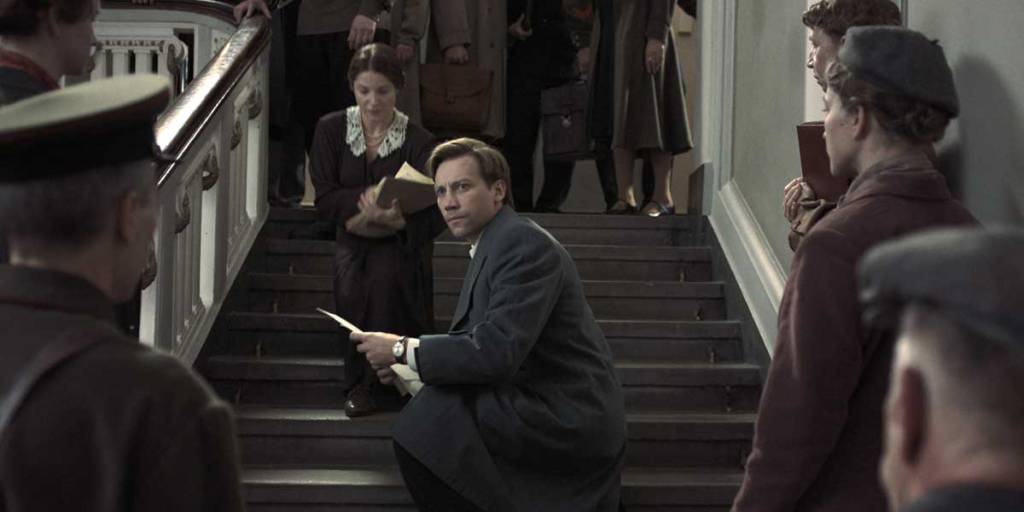
Jem and Nessa (Sean Bean, Samantha Morton) are a comfortably couple raising their 19 year old son Brian (Samuel Bottomley). So why is Brian at home in his room? He got in a fight and nearly beat the other guy to death. He’s depressed and frustrated, and desperately needs the help that they can’t provide. So Nessa asks Jem to do something he’s sworn never to do: find a man who disappeared 20 years ago. So Jem, armed with only a cryptic piece of paper with longitudinal measurements and a sealed letter from Nessa, sets out for a journey into a forest somewhere in the UK.
His clues lead him to a stone hut, literally in the middle of nowhere. As he approaches, a grizzled old man almost blows his head off with a rifle, but, just in time, he recognizes the sound of a clicking, childhood toy. It’s Ray (Daniel Day-Lewis) a fugitive from justice, who has been hidden away all this time. He is somehow connected to a killing that occurred during The Troubles in Northern Ireland. Not only that, he’s Jem’s big brother. What happened all those years back, what is Ray’s connection to Nessa and Brian, and will he agree to come out of hiding?
Anemone is a passionate and personal story about brothers, fathers and family history. Along the way, there’s lots of whiskey spilt and dirty jokes told, along with hiking and camping, punch-outs and wrestling. Lots of guy stuff, a Man’s-Own story. And it’s filmed among spectacular scenery, a stone beach, a glowing moon, distant hills and mountains. Just
gorgeous. Daniel Day- Lewis — who retires every 5-10 years, then makes another movie — puts a lot into his role, and Sean Bean is excellent as his foil. Samuel Bottomley seems like another Barry Keoghan. And there are some cool dreamlike sequences, and I even shed a tear near the end. But the movie as a whole just doesn’t seem quite right. It’s too contrived, too set up. I got a lot out of it aesthetically, but found it hard to connect emotionally. It’s directed by Daniel’s son Ronan and they wrote it together, but it’s just OK, not great.
Maybe it’s too weak a script and too strong an actor for a first-time directors to handle.
Queen of Bones
Dir: Robert Budreau
It’s the 1930s in a small house deep in the woods outside Portland, Oregon. Fraternal twins Lily and Sam are in their early teens. They were raised together by their single dad, a devout Christian (Martin Freeman). He’s a craftsman who makes exquisite violins to order. Lily (Julia Butters) takes after her mom, a violin virtuoso, while Sam (Jacob Tremblay) is more interested in trains and cars — he wants to be a mechanic, though his family still rides a horse and buggy. Their father has always said their mother died before they were born and it’s a miracle they came out alive, but they still wonder about what happened to her. And around this time, when they both reach puberty, Lily starts seeing strange cryptic signs carved into trees in the woods. What could they mean? She has dreams about wolves, and, if she concentrates hard enough, she thinks she can control the weather.
One day, Ida-May (Taylor Schilling) a local shopkeeper, drops by their home. She flirts with their dad, as they’re both widowed. But she also leaves behind a trunk of the twins’ mother’s possessions they inherited from their late grandfather. It’s full of shawls and dresses. But hidden at the bottom is a book of spells and incantations written by her mom. Lily hopes they can explain the mysteries surrounding her mother. But they have to keep it hidden from their dad, who abhors anything related to witchcraft, and keeps the
twins separated from anyone but him. Who is the Queen of the Bones? Was their mom a witch?Did Lily inherit her powers? And is there someone out there who can answer all these questions?
The Queen of Bones is a fairytale about a pair of twins trying to find a witch while evading their over-protective father. It’s low-budget, and simple, but kinda neat. It’s told in a series of short chapters, leading inexorably toward a dramatic end. Though set in Oregon, the locations and some of the cast is Canadian, from Jacob Tremblay (he was the little boy in Room) to the great stage actor Clare Coulter. Julia Butters is excellent as Lily.
I like witches and fairytales and cabins in the woods so, while not a terrific movie, I enjoyed it anyway.
Bone Lake
Dir: Mercedes Bryce Morgan
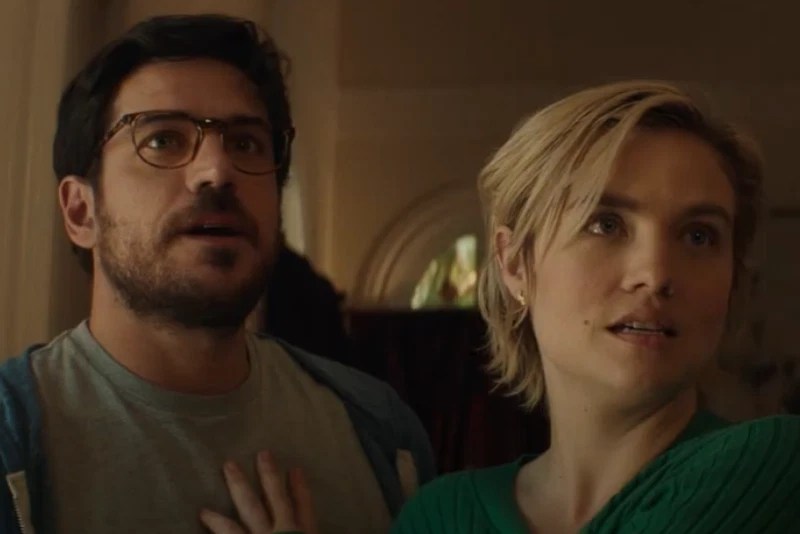
Sage and Diego are a professional couple heading for a luxury weekend in the country. Diego (Marco Pigossi) teaches creative writing at a community college but wants to write a novel. Sage (Maddie Hasson) is a freelance journalist known for her provocative features about sex toys. They are at a turning point in their relationship. Sage has agreed to take a desk job — an editing position — so Diego can pursue his dream for a year. And unbeknownst to her, he plans to propose to her, with his late grandmother’s ring. But when they get there, The BnB they rented is far from the rustic cabin they expected. It’s an enormous, elegant mansion on a huge lot overlooking a lake. It seems way too fancy for what they payed, but they decide not to look a gift horse in the mouth. They settle quite nicely in their new digs. Until another couple shows up claiming they rented the house for the weekend, too!
Sage and Diego decide to go with the flow, and let them share the place — it’s a huge mansion, remember. And the other couple happens to be younger, better-looking and scantily dressed. The appropriately-named Cin, short for Cinnamon (Andra Nechita), looks like a model, and so does her boyfriend, Will (Alex Roe). While Sage and Diego are looking for some alone time, Can and Will prefer games, both sexual
and psychological. Together they explore the locked rooms in the house, one quite sexual, another occult. Cin and Will proceed to ingratiate themselves into Sage and Diego’s lives, splitting them apart for intimate talks… and possible seductions. But as the games turn serious, no one knows who to trust. Who is behind this weird house, and what do they want?
Bone Lake is a psychological thriller about the relations between two couples in an isolated house in the woods. What starts out as a sex comedy, gradually shifts into a violent thriller/horror. There are hints from the start — the opening scene involves a naked couple pursued by unknown assailants carrying crossbows — but it’s left ambiguous whether it’s just
a scene from Diego’s novel or an actual event within the movie. While not entirely original, there’s more than enough enough sex and violence to keep you interested. The acting’s good and the tension is palpable.
All in all, Bone Lake is pretty good horror.
Anemone and Bone Lake both open this weekend in Toronto; check your local listings. And Queen of Bones is now available digitally and on demand.
This is Daniel Garber at the Movies, each Saturday morning, on CIUT 89.5 FM and on my website culturalmining.com.
By Women. Films reviewed: Angela’s Shadow, Samia, Oh, Hi!
Hi, this is Daniel Garber at the Movies for culturalmining.com and CIUT 89.5 FM.
If you’re feeling overwhelmed by big, blockbuster movies, try something smaller. Cinecycle is having a free, open screening of super-8 films this Sunday. Bring your own or watch other people’s — just no videos, please. Also on now at the TIFF Lightbox is Marlee Matlin: Not Alone Anymore, a surprisingly intimate documentary about the Oscar winning deaf actress — a really great doc.
Speaking of films directed by women, this week I’m looking at three more movies wth female directors. There’s a girl in Somalia running in circles, a woman north of Ottawa pulled in two directions, and a couple in New York… whose relationship is tied up in knots.
Angela’s Shadow
Co-Wri/Dir: Jules Koostachin
It’s the 1930s in Ottawa. Angela (Sera-Lys McArthur) is a happy middle-class housewife who lives with her husband Henry (Matthew Kevin Anderson) an aspiring journalist. She’s pregnant with their first child. But everything changes when an urgent letter arrives from her childhood nanny Mary (Renae Morriseau). She writes that she must see Angela on her reserve (Mary is Cree) before the baby is born. While Angela is hesitant, Henry is gung-ho. He loves a good adventure, and hopes to get some good shots and news scoops in Canada’s North. But once they get there, Angela is separated from Henry — she to meet the elders and he to try his hand at “native style” hunting.
Angela is taken to a sacred area where she discovers the
secrets of her past: she was born to a Cree mother and an Irish father, and when both parents died, she was sent to live with her father’s sister in Ottawa. Turns out, Mary is actually her aunt, too, on her mother’s side. This was kept a secret to keep Angela safe from the Residential Schools. And they tell her the meaning of a little girl she keeps imagining.
Henry, meanwhile, is taken on a hunting trip by two young men: Isaiah and Malachi, Angela’s cousins (Asivak and Mahiigan Koostachin). Henry is eager to learn about there way of life, but understands everything from his Christian upbringing. So when he starts to see visions after a sweat lodge, something snaps. And while Angela welcomes her visions and feels an attachment to the land, Henry feels a deep
fear and repulsion, and an urgent need to take his wife out of there. Can they reconcile their differences? Or will their visions prove hazardous to their health?
Angela’s Shadow is an historical drama about a clash of cultures between Anglo and Cree, Christianity and spirituality, and education in residential schools vs the passing on of outlawed culture, language and rituals. Visually, it’s quite lavish, with period costumes, sets, and lush camerawork, a la Murdoch Mysteries. It’s also meticulous in its portrayals of indigenous culture. I found the acting a bit over the top in the beginning, but it redeems itself once it turns into a psychological thriller.
Yes, Angela’s Shadow is a bit melodramatic, but, hey, I like melodramas. This is an engrossing indigenous story about Canada’s chequered history.
Samia
Co-Dir: Yasemin Samdereli, Deka Mohamed
Samia (Riyan Roble) loves to run. Though only a little girl, she places among the top 10 runners in her town’s annual race. She lives in a walled compound with her strict mother, her fun-loving dad, her conservative brother Said, and her singing sister Hodan. She’s also good friends with Ali (Zakaria Mohammed) who is almost like a brother to her; his family shares their compound. But he’s a terrible runner so he appoints himself Samia’s coach.Like Rocky, they train outdoors, racing around corners and down back allies. Their goal? To make her the fastest girl in town! And as they grow older, the teenaged Samia and Ali (llham Mohamed Osman, Elmi Rashid Elmi) discover there’s a world beyond their city, beckoning Samia toward international competition.
But Somalia is unstable, with armed military tanks roaming the streets. Fundamentalists demand all girls wear a head scarf — but what about my running? asks Samia. Regional differences are on the rise and so are religious fights. Local armies and child soldiers are popping up everywhere, making it a dangerous place to live. Can Samia fulfill her dreams in an unstable country? Will she ever make it to the Olympics? And will her family support her if she does?
Samia is a bittersweet, naturalistic biopic inspired by true
events. It’s told in a series of extended flashbacks from her past remembered by an adult Samia, now fleeing Somalia for Italy, via Libya. This is an Italian film, co-directed by a Kurdish German, and an all-Somali cast. It reminds me a lot of Io Capitano (review here) from a few years ago, though this one, while touching and sympathetic, is less triumphant. It’s also rare — the first movie I’ve seen set in Somalia with Somali actors.
I liked this movie.
Oh, Hi!
Co-Wri/Dir: Sophie Brooks
Iris and Isaac (Molly Gordon, Logan Lerman: Indignation, The Lightning Thief) are a young couple in their twenties staying at a BnB in upstate New York. She is pretty, sexy and fond of practical jokes. He is good looking, chill, and open-minded. They’ve been dating for three months, but this one looks like a turning point. Isaac has perfectly arranged everything for the weekend: a beautiful house to stay in with a lake in the back, and delicious meals he cooks for her. And the sex! They are adventurous and passionate together. So when they uncover some bondage material in closet, they decide to try it out. Isaac agrees to be chained to the bed and it works out better than either of them hoped. But somehow the post-coital cuddling leads to some discussions, which reveal she thinks they have a monogamous long term relationship, while he thinks she’s fun and friendly but just another sex partner with no commitment. And all of
this happens while he is still tied to the bed.
Iris does not take this lightly; she feels betrayed. Isaac, on the other hand is genuinely frightened with her jokes about wanting to stab a previous boyfriend to death. And as time passes with little progress, both sides begin to panic. If she lets him go, will he call the cops and have her arrested for kidnapping? Is his life in danger? And when Iris’s best friend Max (Geraldine Viswanathan) and her boyfriend arrive to find Isaac still tied to the bed, it gets even more complicated. How will they ever get themselves out of this colossal mess?
Oh, Hi! is a hilarious sex comedy about trust, relationships and a date gone wrong. While I found some of the relationship psychologizing wasn’t fun, it only made up a small part of the movie. I’ve never seen Molly Gordon before — she co-wrote the script — but she has this uncanny ability to suddenly switch from gorgeous sex-goddess to google-eyed maniac. Logan Lerman is more of the straight man, but carries off his laid-back role quite nicely, considering he’s tied to the bedpost for much of the film. The story itself — along with the unexpected twists it takes — keeps you squirm-laughing almost all the way through. Though the audience at the screening I saw was maybe 80% women (who really seemed to like it), I think there’s lots there for men to think about, too.
This is a very funny movie.
Angela’s Shadow, Samia and Oh, Hi! all open this weekend in Toronto; check your local listings.
This is Daniel Garber at the Movies, each Saturday morning, on CIUT 89.5 FM and on my website culturalmining.com.
Dangerous, exotic. Films reviewed: Sinners, Yadang: the Snitch, The Legend of the Ochi
Hi, this is Daniel Garber at the Movies for culturalmining.com and CIUT 89.5 FM.
Hotdocs International Documentary Film festival is on now in Toronto, with free daytime admission for students and seniors. So get out there and watch some docs!
But this week I’m looking at three new movies about unexpected dangers in exotic locales. There are vampires in the Mississippi Delta, snitches in the drug wars of South Korea, and elusive, sharp-toothed creatures on an island in Carpathia.
Sinners
Wri/Dir: Ryan Coogler
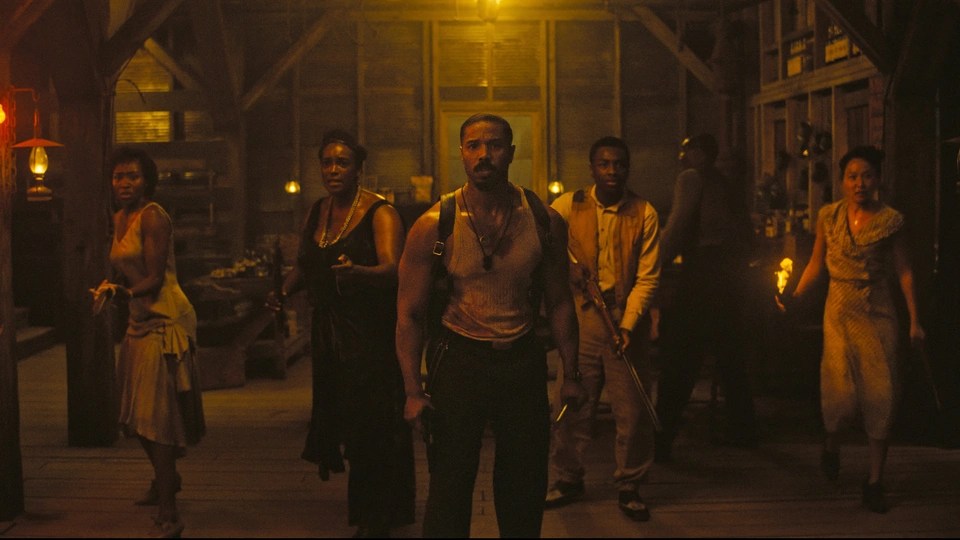
It’s 1932 in a small town in the Mississippi Delta. The Smokestack brothers aka Smoke and Stack (Michael B Jordan: The Fantastic Four, Chronicle) are identical twin who spent years making money working for the mob in Chicago. Now they’re back in town with a truck full of bootleg alcohol, a wad of cash and big ideas on how to make it rich. Namely, they’re opening a juke joint in an abandoned woodmill they bought from a local good ol’ boy. They’re rounding up the necessary musicians, like their cousin Sammie (Miles Caton), the preacher’s son, on blues guitar and Delta Slim (Delroy Lindo) on the piano and mouth organ. Bo and Grace Chow furnish the provisions and Cornbread minds the door. Even Smoke’s and Stack’s ex-partners show up: Mary (Hailee Steinfeld) a glamorous married woman who can pass for white, and Annie (Wunmi Mosaku) an experienced practitioner of Hoodoo. By sunset the place is hopping, the
customers are drinking and gambling, everything is going great, until… a mysterious, smiling stranger who loves Irish music (Jack O’Connell; Seberg, Unbroken, ’71, Starred Up ) appears at the door asking to be let in. They don’t know who he is but he just looks shifty. Turns out he’s a vampire who wants all their blood — not to wipe them out, just to turn everyone over to the dark side. But can the people on the inside keep the demons on the outside until the sun comes up in the morning?
The Sinners is a black history drama about life in the Jim Crow south in the 1930s combined with the action and horror of a conventional genre movie, that succeeds on both fronts. It’s rich in meticulous historical detail in the background: sharecroppers picking cotton in the same fields as their grandparents had as slaves, paid in company scrip not dollars; chain gangs on the highway; and the omnipresent KKK.
All this is counterposed with raunchy dialogue and the sexualized dancing and singing of the juke joint. Every character has a backstory, devoid of cookie-cutter cliches. The costumes, scenery and especially the music — from delta blues to Irish folk songs — evoke that period in a way only a movie can. The acting is superb, though I do wish Michael B Jordan made Smoke and Stack a little less identical. The vampires are more conventional. They still hate garlic, sunlight and stakes through the heart but interestingly these demons lose also racial prejudice once they become vampires. Put this all together and you end up with this amazing movie that’s multifaceted, educational and really fun to watch.
Yadang: The Snitch
Dir: Hwang Byeong-gug
It’s present-day Korea. Lee Kang-su (Kang Ha-neul) is a self-confident young man with a perpetual grin. Why does he swagger and show off his gold lighter? It’s because he’s always two steps ahead of anyone else. He’s a yadang, an informant, and plays a crucial role in the government’s war on drugs. But things weren’t always this way. He was incarcerated after being falsely accused of drug dealing, where he was beaten up and bullied on a daily basis. Until Ku Gwan-hee (Yoo Hai-jin) an ambitious prosecutor pulled him out of that world to be his personal Yadang. Now the two of them are pledged as eternal brothers, functioning like a well-oiled machine, pulling off repeated sting operations and arrests of drug kingpins and thugs across the country. Much to the chagrin of a police detective trying to arrest those same criminals. So Det. Oh Sang-jae (Park Hae-joon) a.k.a. the Jade Emperor of Narcotics Division, finds a Yadang of his own, a rising young actress (Chae Won-been) who is caught using illegal amphetamines as diet pills. Now the lines are drawn and the two sides — the prosecutors and the police — are in direct competition. But the Prosecutor, in his rapid rise to the top, has to make some uncomfortable political alliances, including a rich junkie named Cho Hoon, whose dad just happens to be running for President. Will Cho-hoon’s influence on the Prosecutors rise in power threaten the Yadang’s status and the delicate balance of that world?
Yadang: the Snitch is a Korean action-thriller about
crime, corruption, and the complex relationships among politicians, police and informants in the world of organized drug-crime. Fast moving and compelling, it maintains a frenetic pace throughout the film, with some flashbacks that last only a few seconds. It’s dizzying. It’s also quite violent, sometimes disturbingly so. Luckily, it has interesting characters and a clever plot with enough double- and triple-crosses to keep you guessing until the very end.
Yadang: The Snitch is an entertaining action flic.
The Legend of Ochi
Wri/Dir: Isaiah Saxon
Yuri (Helena Zengel) is a teenaged girl who lives with her dad and adopted brother, Petro. She likes reading library books and listening to loud music. Her farm is on a mountainous island in the Black Sea, off the coast of Romania, and though it’s decades since the fall of Ceausescu, people there still drive Ladas and keep to the old ways. Above all, they fear the Ochi, mythical beasts unique to their island who live in trees, attack sheep and kidnap children. Her Dad (Willem Dafoe) lives in constant fear of the Ochi. He leads a ragtag army of children to capture and kill the monsters… though they have never been successful. Her step-brother Petro (Finn Wolfhard) is a member too, though her rarely speaks. Yuri, on the other hand, is angry at her father and wonders why her mother (Emily Watson) abandoned her. (It’s the Ochi! says her dad.)
One day, when her father sends her out to do her rounds, she finds a small ochi with its paw caught in an animal trap. She frees him and takes him home in her knapsack. He looks like a blue-faced koala until he bares his teeth revealing long pointed fangs. But Yuri is not afraid, she nurses him back to health and eventually the two form an unexpected bond. But can she get him back to his homeland without her father finding out?
The Legend of Ochi is a highly-original adventure story about a young girl and the creature she befriends. It’s warm and delightful. While on the surface it’s a kids’ movie, the
sumptuous, painted scenery and retro feel makes it an instant cult classic. (Think ET, and Charlie and the Chocolate Factory.) It’s full of panpipes and medieval crusaders overladen with Soviet kitsch. Even the odd faces of the kids in the army are straight out of Dr Seuss. I’ve never heard of director Isaiah Saxon before, but I get the impression he’s been doodling pictures of Ochis since he was a little kid. And they are amazing: not cheap-ass CGI, but a combination of puppetry and animatronics that make them seem totally real in their own fantastical way.
I love this movie.
The Legend of the Ochi, Yadang: The Snitch and The Sinners all open this weekend in Toronto; check your local listings. This is Daniel Garber at the Movies, each Saturday morning, on CIUT 89.5 FM and on my website culturalmining.com.
Blacks, Jews and Irishmen. Films reviewed: The Piano Lesson, A Real Pain, Small Things Like These
Hi, this is Daniel Garber at the Movies for culturalmining.com and CIUT 89.5 FM.
Fall Film Festival Season continues with the EU Film Fest, showing free films from across Europe at Spadina Theatre starting on the 14th.
This week, I’m looking at three family dramas. There’s Black siblings in Pittsburgh, Jewish cousins in Warsaw, and an Irish dad with his five daughters, in… well, Ireland.
The Piano Lesson
Dir: Malcolm Washington
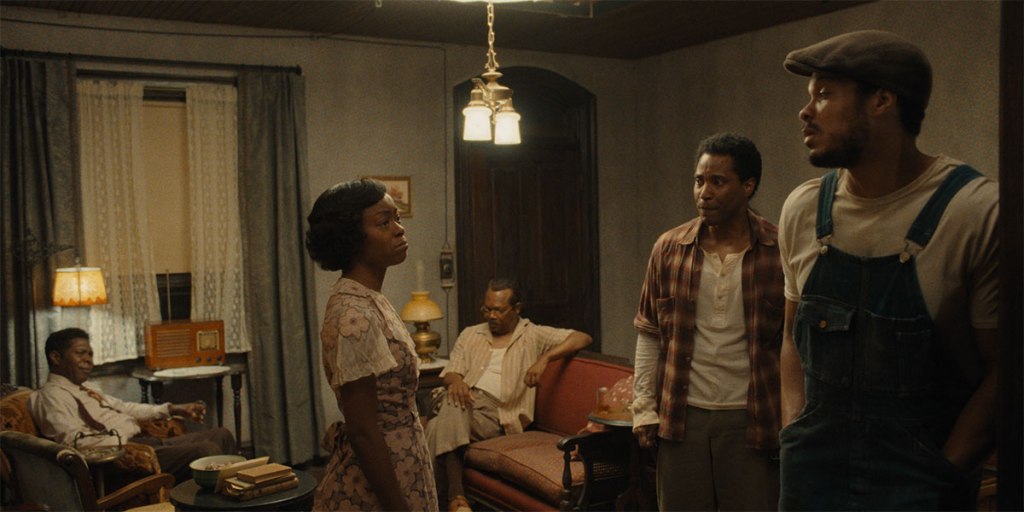
It’s 1936. Boy Willie Charles (John David Washington) and his friend Lymon are driving north from Mississippi with a truckload of watermelons, to visit his sister Berniece (Danielle Deadwyler) in Pittsburgh, Pennsylvania. She’s living with their uncle Doaker (Samuel L. Jackson). Once they sell the melons, Boy Willie plans to take his share of the profit (along with his savings) to purchase Sutter’s land. That’s the same place where his great grandparents were slaves, and where he still toils the land as a share-cropper. This is his one chance to own it. But he’ll only have enough money if he sells the family piano. That’s why he’s visiting Pittsburgh. But Berniece refuses to sell it. Why? She grew up playing that piano, and more to the point it has family faces elegantly carved into the wood itself, dating back to pre-Civil War days. Besides, she says, that piano is haunted… and the ghost is getting meaner. Meanwhile various family and friends, like a trickster and a preacher, are congregating at this house with different motives for being there. Can Boy Willie and Berniece come to terms about the piano? Or will bad spirits — both supernatural and human — ruin everything first?
The Piano Lesson is an excellent filmed version of playwright August Wilson’s drama. Fine acting all around, with Danielle Deadwyler outstanding as Berniece. Now, plays and movies are two different things. Actors emote louder and move bigger on
stage (so everyone can see and hear them). And even the blocking and dialogue is different. Movies are no more real, but different. This Piano Lesson is very much a play. So I was a bit put off by it’s style… until the my brain started watching it as a play, at which point I really liked it.
If you notice a lot of Washingtons here, it’s no coincidence. Denzel Washington is the producer, and actor John David and director Malcolm are both sons of his. Denzel is committed to putting all ten of August Wilson’s Pittsburg Cycle on the big screen to preserve crucial Black American culture. Witness Fences in 2016 and Ma Rainey’s Black Bottom in 2020. The Piano Lesson is a fine addition to this series and should be watched.
A Real Pain
Wri/Dir: Jesse Eisenberg
Benji and David Kaplan are cousins in their 30s, as close as brothers, but totally different. Benji (Kieran Culkin) is loud, gregarious, obnoxious and larger than life. He likes to raise a ruckus and mess things up. He lives alone in Binghamton, NY. David is shy, insecure and withdrawn. He’s married with a small kid and lives in Manhattan. He’s in a constant state of dithering and worrying. They’re travelling together to Poland to explore their family’s heritage. Their grandmother was Polish and a Holocaust survivor.
Benji was very close to her and devastated by her recent death, much more so than David. They’re part of a small tour group, all Jewish. Their guide (Will Sharpe) is a nerdy English guy, very accommodating. Also on the tour are Marcia (Jennifer Grey) who suffers from intergenerational trauma; Eloge (Kurt Egyiawan) from Winnipeg but originally from Rwanda where he survived Tutsi genocide; and a middle-class couple whose family immigrated from Poland generations ago but want to see where they came from. (“We’re Mayflower Jews”, he says).
Their journey takes in cultural and historical sites across Poland, but the closer they get to the concentration camp where their
grandmother was imprisoned, the more agitated Benji gets. He slips into shouted diatribes and lectures, causing scenes within their group and in public places — to David’s acute embarrassment. Can they both make it through the whole tour? Or will one of them drop out?
A Real Pain is a low-key, social comedy — yes, a comedy — about the uncomfortable dynamics within a family. it’s actually pretty funny, No slapstick or pratfalls, rather unexpected squirmy riffs on the two main characters’ personalities. (Like Benji telling David his bare feet are gorgeous, making him stare at them for the rest of the trip.) It’s told in a series of clever vignettes over the course of the trip, all hovering over unvoiced feelings of personal and collective mourning. I’m always suspicious when actors play at directing, but this is no vanity pic. Eisenberg stays suitably subdued, letting Culkin go wild.
I like this movie.
Small Things Like These
Dir: Tim Mielants
It’s winter in a small town in Ireland in the 1980s. Bill Furlong (Cillian Murphy) is a working man who scrubs coal dust off his hands and face each day. But he doesn’t work in a coal mine; he has his own business, built from scratch, selling coal. His wife Eileen (Eileen Walsh) and his eldest daughter handle the finances. One day, he’s making a delivery when he’s alarmed to see a teenaged girl being dragged, kicking and screaming, into the local convent. That’s not right. She may be unmarried and pregnant, but why are they kidnapping that poor girl?
So he steps inside to take a look. It’s the Magdalene Laundries, a Church organization that operates across Ireland, to care for unwed mothers. They put the babies up for adoption, and the girls and young women are trained to work as industrial laundresses. But to Bill it seems almost like a prison, where the girls are treated horribly. When one girl runs over, begging him to help her escape, he doesn’t know to do. The nuns quickly disabuse him of any notions he might have, and rush him out the front door.
But Bill has history. He was brought up in this same town by his own single mum, who chose to stay away from that convent. He was bullied as a child because of this, but he still remembers how his mother — and her employer, an independently wealthy woman — defied the church. He feels he has to do something for that girl. But the nuns have their fingers in every pie; the school, government, they’re even a client of his own business. Should he confront the cold-eyed Sister Mary (Emily Watson) who runs everything? Or should he just worry about his own family, and pretend nothing is wrong?
Small Things Like These is a deeply-moving drama about families, moral dilemmas and the checkered history of the Catholic Church in Ireland. This is the third such movie, after The Magdalene
Sisters and Philomena, but its repercussions are still very much alive. Cillian Murphy — who you probably recognize from Oppenheimer or Peaky Blinders — once again pulls you into the character he plays. He rarely speaks but the emotion in his features really affect you. So if you’re looking for a real tear-jerker, this is the one to watch.
A Real Pain, Small Things Like These, and The Piano Lesson all open in Toronto this weekend; check your local listings.
This is Daniel Garber at the Movies, each Saturday morning, on CIUT 89.5 FM and on my website culturalmining.com.
Twentieth century troubles. Films reviewed: White Bird, Hold Your Breath, Saturday Night
Hi, this is Daniel Garber at the Movies for culturalmining.com and CIUT 89.5 FM.
Lots and lots of movies coming to Toronto. Opening this weekend is the monster comedy Frankie Freako by Toronto’s own Steven Kostanski; and next week, look out for the Goethe Films, Aftermath: Echoes of War series featuring classics by Fassbinder and Wim Wenders at the TIFF Lightbox.
But today, I’m looking at three new movies, all set in the 20th Century. There’s dustbowl horror in 1930s Oklahoma, Nazi occupation in 1940s France, and the opening night of a live TV show in 1970s New York City.
White Bird
Dir: Marc Forster
It’s 1943, during WWII, in a picturesque French village near the Swiss border. Sarah Blum (Ariella Glaser) is a happy middle class kid in her school with high marks and many friends. And she loves drawing pictures in the margins of her notebook. One young boy clearly has a crush on her. Julien (Orlando Schwerdt) is smart and kind, but also a victim of bullying. Not only does his father work in the sewers but Julien has a brace on one leg and uses a crutch to get around, making him a ready target for cruel bullies. But things change rapidly under the Nazi Occupation. Sarah and the other Jewish kids are pulled out of class one day to be deported to the camps. She alone manages to escape and hide in the woods. But the former class bullies are now classroom Nazis and they’re always on the look out for Sarah. Luckily she has a saviour — it’s Julien, of course, who lets her hide in the hayloft of his barn. As the months go by, he serves as her one-man classroom, relating the lessons she misses each day. And as they get to know each other better, they grow closer — is love at hand? And can they keep her hidden during the Nazi Occupation?
White Bird is an historical romantic drama. Adapted from a YA
graphic novel by R. J. Palacio, it’s a sequel to an earlier book (also adapted into a film) called Wonder. The historical plot is framed by a kid named Julien in present-day New York, whose French Grand-mère (Helen Mirren) is telling him a story from her youth. I found the movie OK, with some real weepy moments. It does have odd details: why is the French resistance’s oath Vive l’Humanité!? But I like the graphic novel feel of the whole thing, with rapid story development and unexpected twists and turns. If you’re looking for a good, historical, teenaged tearjerker, check out White Bird.
Hold Your Breath
Co-Dir: Karrie Crouse, William Joines
It’s 1933 on the Oklahoma panhandle. Margaret Bellum (Sarah Paulson) lives with her two daughters on a farm. Life is miserable. Once their land was covered with acres of wheat, the cows and horses thriving in the barn. But years of drought has turned their land into a giant dustbowl. It’s so bad that you can choke to death in a dust storm. Her husband Henry is in Philadelphia looking for paid work, leaving the three women alone, waiting for his first paycheque to arrive so they can join him. Rose (Amiah Miller) the older daughter is yearning to see a big city, while little sister Ollie, who is deaf (Alona Jane Robbins) is shy and easily frightened. Especially so since Rose read her a scary book about The Gray Man, a mythical bogeyman who embodies the terror of a dust storm. The neighbours are nervous, too — rumours abound that a drifter made his way into someone’s home and killed all the women.
So Margaret is on high alert, her rifle cocked and ready to fire,
when a drifter appears in their barn. Wallace Grady (Ebon Moss-Bachrach) calms her down, saying he knows her husband who told him to check up on his family. I’m a man of the cloth, he says, and a faith healer. But strange unexplained things start happening. Is he a killer or a pastor? Does he have supernatural powers? Or is he the mythical Gray Man?
Hold Your Breath is a psychological thriller in a gothic setting. It’s spooky and creepy, and a little bit scary, full of feelings of suspicion and psychosis. the acting, especially Sarah Paulson, is quite good. One thing I found interesting is, though it’s ostensibly set during the Great Depression, it feels like an allegory of the recent pandemic. The family puts on elaborate white face masks to protect from the lethal dust whenever they go outside, are afraid to leave their home, and they are terrified of an unknown invisible enemy who can “get inside their home and their bodies unnoticed, just by breathing”.
Nothing is very surprising here, and the story seemed less scary than tragic, but if you’re heavily into southern gothic horror, I think you’ll appreciate Hold your Breath.
Saturday Night
Co-Wri/Dir: Jason Reitman
It’s October 11, 1975 in New York City, and in a few hours a new show will be broadcast live across the United States. It’s a new concept; not the “live” part; that was a staple of TV programming from its earliest days. What’s new are the guests — Jim Henson and his muppets — the comedians — Andy Kaufman and George Carlin — the controversial topics, the live musicians, and the “not ready for prime time” players. The show is meant otherwise be produced on the fly with minimal rehearsals — they plan to read their lines from cue cards or just wing it. The show is Saturday Night Live, and up until the moment it airs, no one’s sure whether the show will be canceled even before it starts.
It’s up to the creators Lorne Michaels (Gabriel LaBelle) and Dick Ebersol to get the show ready in time. Lorne is working closely with his writer (and partner) Rosie Shuster (Rachel Sennot). But he’s badgered by network VPs who seem to be determined to make it fail. On top of this, John Belushi has passed out somewhere, the union crew refuse to put the set together, they can’t find a live
audience to sit in a studio at midnight, snd all the local station bosses are there with their own gripes.
What can a guy do?
Saturday Night is an instantly forgettable but warmly nostalgic look at the start of an iconic TV show. More surprising is the movie is genuinely funny. A lot funnier, in fact, than the TV show it’s celebrating. This is not a documentary; it’s a comic dramatization of what might have been going on that first night, exactly 50 years ago next week. There’s an enormous cast, with every producer, writer and comic portrayed by people who weren’t even born when that show started.
I love the frenetic energy running through this film, as the camera flies around the set following a plethora of characters all talking at once as they try to get the show on the air. It has a cast of thousands, it’s fun to watch and never boring. Like I said, there’s nothing much to it, but I enjoyed Saturday Night.
Saturday Night and White Bird both open this weekend in Toronto; check your local listings. Hold Your Breath is now streaming on Disney+.
This is Daniel Garber at the Movies, each Saturday morning, on CIUT 89.5 FM and on my website culturalmining.com.
Pot o’ Gold. Films reviewed: French Girl, One Life, Love Lies Bleeding
Hi, this is Daniel Garber at the Movies for culturalmining.com and CIUT 89.5 FM.
Tomorrow is St Paddy’s day so this week I’m looking at three new movies, from Canada, England and the US, about people looking for their own pot o’ gold. There’s a New Yorker in Quebec looking for love, an Englishman in wartime Prague searching for orphans to rescue, and a young woman in New Mexico looking to flee to Vegas with her bodybuilder girlfriend.
French Girl
Wri/Dir: James A. Woods, Nicolas Wright
Sophie and Gordon are an unmarried couple in New York in their late 30s. Gordon Kinski (Zach Braff) is an eighth grade English teacher in a public school in Brooklyn. He loves donning 16th century tunics to teach Shakespeare to 14 year olds. Sophie Tremblay (Evelyne Brochu) is a wizard in the kitchen — professional kitchens that is. She’s the chef at a popular restaurant. They’re getting ready for a long-planned vacation in upstate New York, far away from their jobs. But their plans are changed when a strange woman appears. Ruby (Vanessa Hudgens) is a celebrity chef with cooking shows and restaurants all around the world. She wants Sophie to audition for executive chef at her newest branch. The restaurant is in the Chateau Frontenac in Quebec City, Sophie’s home town. For Gordon, who has rarely left NY City, Quebec is terra incognito. But he agrees to come with her, thinking it’s the perfect time to propose marriage. He also will offer moral support and meet her family. And what a family it is.
The Tremblays live on their sheep farm near Quebec City. There’s an angry Dad, a doting mom, a gossipy older sister, and Junior
(Antoine Olivier Pilon) an intimidating cage boxer who collects samurai swords. And then there’s their elderly grandma who has a tendency to pop up beside their bed when they’re having sex. Gordon, who speaks no French, feels very out of place, but still tries desperately to fit in. What he doesn’t know, but the
family does, is that Ruby, Sophie’s potential future boss, is also her former lover. Will Sophie get the job? Will her family accept Gordon? And is the rich and glamorous Ruby competing with him for Sophie’s hand?
French Girl is a funny and cute romcom about a culture clash between an eccentric family and a fish out of water. It’s also bilingual — the Tremblays speak French while Gordon and Ruby speak English. While French Girl follows many of the cliches and conventions of a romantic comedy, it still seems sweet, fresh and delightful.
I liked it despite myself.
One Life
Dir: James Hawes
It’s the late 1980s in a small city in England. Nicky Winton (Anthony Hopkins) is a retired stockbroker who lives with his wife Greta (Lena Olin). They’re expecting a visit soon from their expecting daughter, so she tells him to throw out all his junk to make way for baby. He has tons of files and papers from the 1930s he hasn’t looked at in years. Plus a treasured leather briefcase with a photo album in it. Everything in the album happened in 1938. That was when Hitler invaded Czechoslovakia to annex the “Sudetenland”, sending thousands of refugees — including Jews, intellectuals, leftists, Socialists, and Communists — to Prague to stay out of Nazi hands.
A much younger Nicky (Johnny Flynn) visits Prague and is overwhelmed by all the refugees, including countless children, many orphans, living in the streets. He wonders, how many children could he transport by train to England before Germany invades Prague? There were similar programs for kids in Austria and Germany, but not Czechoslovakia. His German-born mom (Helena Bonham-Carter) says she’ll do whatever she can to help. And a team in Prague is recording names of kids
who can be saved. Can Nicky convince the British government to issue visas, raise the needed funds, and find foster parents to take care of them? Will he get them out before the Nazis march in? Or is it a fools game?
One Life is an historical drama — based on a true story — about an unsung hero and what he accomplished in 1938. The story jumps back and forth between the 30s and the 80s, half about the daring mission of a young man, and half about the old Nicky telling his story. I wanted to see this film for two reasons: because of the story — who doesn’t want to see children rescued from the Nazis? — and because it’s directed by James Hawes, who brought us that excellent TV spy thriller series Slow Horses. Sadly, One Life couldn’t possibly be less thrilling. While there are a few touching moments near the end, most of this film is as slow as molasses. Hopkins sleepwalks through his part while the audience nods off.
Sad to say, One Life is a snooze fest.
Love Lies Bleeding
Co-Wri/Dir: Rose Glass
It’s 30 years ago in a small town in New Mexico. Lou (Kristen Stewart) works at her estranged father’s hardcore gym, a rusty warehouse filled with muscleheads spouting No Pain No Gain slogans. Most of her time is spent unclogging toilets with her bare hands or fending off the amorous advances of a crackhead named Daisy (Anna Baryshnikov). It’s a hell-hole. Until a breath of fresh air blows in through the door. Jackie (Katy O’Brian) is a competitive bodybuilder in pink and purple lycra with big hair and bigger muscles. She’s an Okie just passing though town on her way to a competition in Vegas. But when she decks two lugs who threaten Lou, it’s love at first punch. Soon they’re making passionate love in Lou’s lonely apartment. Soon enough, she’s supplying Jackie with steroids to reach body perfection before they head off to Vegas.
But all is not well in rural New Mexico. Lou’s brother in law, JJ (Dave Franco) is a mega-douche who works for her Dad, Lou Sr’s (Ed Harris). Lou Sr is a crime boss who runs the town from his gaudy mansion. When JJ’s not cheating on his wife (Lou’s sister), he’s beating her up. And he has hired Jackie to work at Lou Sr’s gun club, after she agreed to have sex with him. (She doesn’t yet know that Lou is related to all of them). But when the truth comes out, and Lou’s sister ends up in ER, Jackie is
jacked. She slips into a manic ‘roid rage looking for revenge, while pulling Lou into a spiral of violence, death and retribution. Will Jackie make it to Vegas? Will someone pay for the murders? And where will the dead bodies go?
Love Lies Bleeding is a brilliantly dark film noir, about small-town crime in the southwest. It’s filled with distorted psychedelic fantasies within a tragic world. It’s also a love story filled with lots of hot lesbian sex. The production design is amazing. Most of the characters sport 80s mullets and the whole movie pulses with a driven soundtrack and neon colours. This is only Rose Glass’s second feature (after Saint Maud) but she once again incorporates real settings within a surreal plot. This one includes a behind-the-scenes look at professional bodybuilding, complete with spray-on suntans and their strangely contorted muscle-popping poses. But beware — the
movie is filled with shocking, graphic violence. Dave Franco is great as a sleaze ball, a grizzled Ed Harris is suitably sinister as a crime boss with foot long greasy blond hair spouting beneath a completely bald tonsure. Anna Baryshnikov (the dancer’s daughter!) is perfect as a hippy girl long past her prime. And Kristen Stewart and newcomer Katy O’Brian absolutely sizzle together.
If you’re looking for a crime-thriller that’s gripping, shocking and aesthetically stunning, don’t miss Love Lies Bleeding.
One Life, French Girl, and Love Lies Bleeding all open this weekend in Toronto; check your local listings.
This is Daniel Garber at the Movies, each Saturday morning, on CIUT 89.5 FM and on my website culturalmining.com.
Movies, big and small. Films reviewed: Theater Camp, Afire, Oppenheimer
Hi, this is Daniel Garber at the Movies for culturalmining.com and CIUT 89.5 FM.
Running out of things to do? I’m looking at three good movies this week, both big and small. There’s an historical drama about a scientists confronting the atom bomb he created, a comedy drama set on the Baltic Sea about vacationers facing a potential forest fire, and a comic mockumentary about summer campers whose beloved camp might close down permanently.
Theater Camp
Dir: Molly Gordon, Nick Lieberman
It’s July at a theatre camp in the Adirondacks, simply called “Adirond-acts”. It’s where kids, 5-15, come to learnt the craft of acting, dancing and singing. And they put on actual plays at the end of the summer. The kids love it and so do their counsellors, many of whom used to be campers there. Glenn (Noah Galvin) is the techie stage manager, while others function as costume, voice, and dance masters as well. Most sought after though are the team of Amos and
Rebecca-Diane (Ben Platt, Molly Gordon), who write and direct an entirely new production each summer. And heading it all is the much beloved Joan (Amy Sedaris) the camp’s founder. But when an unexpected accident leaves Joan in a coma, her dumb-as-a-post son Troy (Jamie Tatro) is forced to take over, thus putting the

The cast of THEATER CAMP. Courtesy of Searchlight Pictures. © 2023 20th Century Studios All Rights Reserved.
whole camp at risk. He fires some long-time teachers operating on austerity mode. And when the financial vultures start circling the camp, trying for a cheap buy-out, things look dire. Even Amos and Rebecca-Diane’s show looks like it might not make it through the summer. Is this the end of Theatre Camp?
Theatre Camp is a delightfully squirmy, clever and hilarious mockumentary about acting. It’s suitably diverse, reflecting the actual live New York theatre scene. The fake doc follows the young players through auditions, casting, rehearsals, and behind-the-scenes action, through to the final production. Obviously these kids have talent — and so do the grownup kids. They manage to act as if they are actors who are acting… which isn’t as easy as it sounds. It’s full of surprises and unexpected oddities — like, this is a musical where Ben Platt doesn’t sing a note. I was laughing through most of it, and if a moviegoer like me can appreciate it, avid playgoers will go wild. The Toronto cast of HadesTown was sitting in my row at the advanced screening on Monday night, and they were whooping it up the entire time. If you like “Theatre”, you’ll love Theatre Camp.
Afire
Dir: Christian Petzold
It’s summertime in northern Germany. Felix (Langston Uibel) and Leon (Thomas Schubert) are best friends in their twenties spending a few weeks at Felix’s family’s summer home on the Baltic sea. It’s a beautiful place with a thatched roof, just a quick hike away from a sandy beach. Felix is friendly, fit and personable; he’s working on his photo portfolio to get into an arts program. Leon is a published author, trying to finish his second novel. He’s also a chunky, self loathing schlump, both brooding and frustrated. His inappropriately named novel — Club Sandwich —
is not coming together. And his publisher, Helmut (Matthias Brandt), is dropping by in a few days — what does Leon have to show him? Things get worse when they realize they’re sharing the house with an unknown visitor. Nadja (Paula Beer) is the daughter of a friend of Felix’s mother. She’s working at the ice cream stand in a nearby quaint village. Leon is smitten by her carefree beauty, but tongue-tied whenever he talks with her. Worse still he is kept awake each night by the sounds of Nadja and Devid (Enno Trebs) — the hunky lifeguard at the nearby beach — having loud sex in the
next room. And all of this is taking place as wildfires in the forests that surrounds the beach are igniting all around them, as prop planes futilely drop water bombs on the flames. Will Leon’s love be forever unrequited? Can he survive his wonderfully miserable summer vacation?
Afire is a comic drama about a self-centred writer and the people all around him. Like all of Petzold’s films, Afire is spare, precise and minimalist — he never includes a scene — not even a single line — that’s not crucial to the story he’s telling. I love that about him. He deals with very real issues and their potentially tragic consequences, but told almost like a fable. At the same time, he not afraid to make firm moral judgements but always in a humorous way. The tiny cast is excellent, as is the music and cinematography. I like this one a lot.
Openheimer
Wri/Dir: Christopher Nolan
It’s the 1930s. J Robert Oppenheimer (Cillian Murphy) known as “Oppie” to his friends, is a researcher and scientist at Berkeley. With a distinguished background — he studied at Harvard, Cambridge and Göttingen — he has published crucial papers on physics and quantum mechanics that have changed scientific practices. He hangs out with activists at the University who are trying to unionize the teachers, and lend support to the Republicans in the Spanish Civil war, as fascism creeps across Europe. He also sympathizes with the plight of Jewish scientists in Nazi Germany (not only because his parents are German-Jewish immigrants). Originally from Manhattan, Oppie much prefers the wide- open spaces of New Mexico where his brother lives. His ultimate dream? To somehow combine his two great loves: science and the American southwest. His dream comes true during WWII when he is approached by Groves, a hard-ass army officer (Matt Damon), who wants to set up a top-secret lab. It’s goal? To create an atomic bomb before Germany does. Where? In Los Alamos, New Mexico. Oppenheimer brings in the top scientists to work on it: Feynman, Teller, Fermi, Bohr and many others, living in a jerry-built town in the middle of the desert. But as the prototype nears completion, theory turns to reality. By 1945, Germany has already surrendered, but the US government
needs to drop it somewhere to prove they have the ultimate weapon of mass destruction. How can Oppenheimer both create an atomic bomb and oppose the enormity its use would bring to the world?
Oppenheimer is an sweeping historical drama about the life of a conflicted scientific genius, his lovers, his accomplishments, and a government that turns against him. It covers three parts of his life: as a student and academic, at Los Alamos, and in the cold war/ McCarthy era that follows WWII. The first part concentrates on his life and work — the parties he attends, the women he sleeps with (Frances Pugh, Emily Blunt), and the leftist political meetings he goes to not as a communist but as a “fellow traveller”. The second part captures the tension, stress and claustrophobia of the Manhattan Project, culminating in the devastating atomic test at Trinity. The third part concentrates on his rivalry with Lewis Strauss a right- wing bureaucrat on the AEC, the Atomic Energy Commission (Robert Downey Jr) and a series of congressional appearances and secret trials Oppenheimer is subjected to. But as a Christopher Nolan film, it is expertly edited to include all three stages simultaneously, bouncing back and forth, while proceeding chronologically, throughout the picture. And punctuated, from the beginning, with incredible animated images of the devastating fireball an atomic weapon brings.
I’m not a fan of Christopher Nolan’s movies. They’re often overly complicated for no apparent reason, and clumsily including things like time travel dreams and memory. Dunkirk, another historical drama, was exciting but overly nationalistic in its slant. This one avoids almost all of these potential pitfalls, and manages to tell a three-hour, historical drama about science without boring the hell out of the audience. On the negative side, there are so many characters — 40-50 at my count — it’s hard to keep track of who’s
who. These are mainly cameos about famous people (Einstein, Niels Bohr, Truman) played by equally famous actors — Tom Conti, Kenneth Branagh, Gary Oldman, Casey Affleck, Rami Malek, to name just a few — who pop up for a few minutes then go away. And aside from the women Oppenheimer sleeps with, virtually everyone else in the movie (much like Dunkirk) is male. Even so, I think Oppenheimer is Nolan’s best film since Memento — it’s exciting, politically intriguing and visually stunning, from the vistas of horseback riding in a western desert, to the terrifying flames of the atomic weapon. It’s three hours long, but well worth the effort.
Afire is playing now; check your local listings. And Oppenheimer and Theatre Camp both open this weekend.
This is Daniel Garber at the Movies, each Saturday morning, on CIUT 89.5 FM and on my website, culturalmining.com.
Daniel Garber talks with Valerie Kontakos and David Bourla about Queen of the Deuce

Hi, this is Daniel Garber at the Movies for culturalmining.com and CIUT 89.5 FM.
New York City in the 1970s is a gritty city with a chip on its shoulder. Crime is rampant, and its government faces bankruptcy. But it’s also exploding with creativity and freedom of expression, in film, theatre, music and art, while the sexual revolution, the women’s movement and gay rights are in full swing. The city’s centre is 42nd street, and the strip running from Times Square to the Port Authority and north on 8th ave is filled with porn theatres and peep shows. And on top of it all sits a Jewish Greek-American woman, Chelly Wilson, ruling over her porn empire.
Queen of the Deuce is a fantastic new documentary about Chelly’s
life, her work, her family and the world she built. Born in Thessaloniki, she hid her children, escaped the Nazi invasion, and gradually made her way to the top of the NY porn movie industry. The doc includes personal photos and letters, period footage, animation and talking heads to give a first-hand look at a previously unknown hero.
The film was directed by Valerie Kontakos, a well-known documentarian, founder of the NY Greek Film festival and on the Board of Directors of the Greek Cinematheque. The film features members of Chelly’s family, including her grandson, David Bourla, a screenwriter in his own right, known for action films like Push.
I spoke with Valerie in Athens and David in New York City from Toronto, via Zoom.
Queen of the Deuce is playing in Toronto at the Hot Docs Cinema as part of TJFF on June 3rd, 2023.
Humans and machines. Films reviewed: L’homme Parfait, Pinocchio
Hi, this is Daniel Garber at the Movies for culturalmining.com and CIUT 89.5 FM.
In these troubled times, many feel daunted by quickly-changing technology, and wait with trepidation the eventual coming of the Singularity: the day robots and artificial intelligence become smarter than humans. What will happen to us after the Singularity?
This week I’m looking at two new movies about the increasingly thin line separating people from machines. There’s a woodcutter in Italy who creates a puppet that acts like a boy; and a woman in France who buys a robot that acts like a man.
Co-wri/Dir: Xavier Durringer
It’s the near future, somewhere in France.
Franck and Florence (Didier Bourdon, Valérie Karsenti) are a happily unmarried middle-aged couple with two kids, Max and Victoire. Florence has an office job, while Franck works from home. He’s an actor who is writing that blockbuster screenplay which will turn his career around. But it’s been three years now with no sign of progress, and his agent isn’t exactly banging on his door with acting jobs. And even though Franck is at home all day, it’s Florence who ends up cooking, cleaning and taking care of the kids. But enough is enough. She puts in an order and two days later a large box arrives at their door. Meet Bobby (Pierre-François Martin-Laval): a realistic-looking male robot: strong, smart and friendly. He has artificially blue eyes and speaks in a monotone. With a variety of built-in options, from Salsa dancing to Krav Maga, soon Bobby is whipping up boeuf bourgognon, ironing their sheets and telling bedtime stories to the kids. And his artificial intelligence means, like Siri, he listens to — and remembers — everything he hears.
But there are side effects. Florence may love all the free time she has now, but Franck
feels stripped of all his fatherly duties. Bobby is better at bowling. Bobby can fix a broken car engine in a flash. Bobby can select the best wine, say the right thing, buy the right gift. Franck feels increasingly left out. And when he accidentally sees Bobby’s “standard equipment” he feels second-rate and useless. Meanwhile, Florence feels sexually neglected and doesn’t understand why. Is Bobby ruining their marriage? Will Florence ever activate Bobby’s forbidden love-love button? Or can Franck reactivate their relationship?
L’homme parfait is a French comedy about robots, technology and middle-age crises. It’s also a clear knock-off of last year’s German hit I’m Your Man (they actually give it a nod by saying Bobby is manufactured in Germany). It’s conventional, predictable, and anything but subversive, in the style of those cheap-ass Hollywood comedies in the ‘80s and ‘90s. That said, it did make me laugh more than once. What can I say — no one will call L’homme parfait a great movie, but it is a funny, low-brow sex-comedy in an emerging sub-genre: humanoid robots.
Dir: Guillermo del Toro and Mark Gustafson
Geppetto is a wood carver who lives with his beloved son Carlo in a small village in Tuscany. He carves everything in town from wooden clogs for Carlo, to Christ on the Cross in their local church. But when a WWI bomb drops on the village killing his son, Geppetto becomes a reclusive alcoholic, spending all his time crying by Carlo’s grave. Two decades later, in drunken rage, he chops down a knotty pine tree that grew from a pinecone Carlo found on his last day alive, and roughly carves a new boy — with wobbly knees and elbows, rough-hewn hair and a long piece of wood for a nose — all modelled on his son. He calls him little pine, or Pinocchio. What he doesn’t realize is a blue cricket (the story’s narrator) lives inside a hole in the wood the boy is made of.
After Geppetto passes out, a magical wood sprite, out of sympathy for the old man, brings Pinocchio to life. She gives the cricket responsibility of taking care of the kid and teaching him right from wrong. The new-born boy is clumsy and dangerous, a tabula rasa taking in all around him. He exalts in learning and gleefully smashes everything he sees. Soon the discovers Pinocchio with different reactions. Some call him an abomination, the work of the Devil. Podesta, a member of Mussolini’s Fascist Party, thinks Pinocchio can be the ultimate weapon, a soldier who cannot die. And a sleazy carnival barker named Count Volpe, and his sinister sidekick, a monkey named
Spazzatura, see him as a money-maker, a living puppet he can exploit at his circus. Being pulled in all directions, can Pinocchio ever find his way back to his father and creator Gepetto?
Pinocchio is a dark retelling of the 19th century Italian classic. It’s masterfully-made using stop-motion animation of dolls and puppets, in the style of Rudolph the Red-Nosed Reindeer or A Nightmare Before Christmas. Gone are the cutesy Disney costumes and hats; this Pinocchio is bare-bones wood all the way, with clothing hacked onto his body. The naughty boy is made of knotty pine. It’s partly a musical, with characters spontaneously breaking into song (some good, some not), especially at the circus. But it’s also, like all of del Toro’s movies, dark, sad and scary. It deals with theft, alcoholism and death. And by transplanting the story into fascist wartime Italy (similar to Spain in Pan’s Labyrinth), he makes it even darker.
In addition to Gregory Mann, David Bradley and Ewen McGregor — as, Pinocchio, Geppetto and the cricket — other voices include Tilda Swinton, Kate Blanchett, Rob Perlman, and Finn Wolfhard as Candlewick, Pinocchio’s frenemy. But it’s the characters themselves, animated on the screen, that really make this movie. If I saw this as a little kid, I guarantee, Pinocchio would have given me nightmares. But as a grown-up, I found it a sad and very moving story, beautifully made.
Pinocchio is now playing at the TIFF Bell Lightbox, and L’homme parfait is one of many films screening at Cinefranco till Tuesday and then digitally till the end of the month.
This is Daniel Garber at the Movies, each Saturday morning, on CIUT 89.5 FM and on my website, culturalmining.com.
Gems at #TIFF22. Films reviewed: The Hummingbird, Will-o’-the-Wisp, Unruly
Hi, this is Daniel Garber at the Movies for culturalmining.com and CIUT 89.5 FM.
TIFF is finished and after viewing 45+ movies I feel pretty good about it. You’ll be hearing a lot more about TIFF movies like The Fablemans, The Whale, The Glass Onion, Women Talking, The Wonder and The Banshees of Inisherin by the end of the year, but there are also a lot of movies, gems and sleepers, that get left by the wayside, without all the studios promoting them. So this week I’m talking about some of the other movies I saw there — from Italy, Denmark and Portugal — that deserve to be noticed. There’s a rebellious girl trapped on a remote island; a little prince seeking the facts of life in a firehouse; and a man called hummingbird whose fate is guided by a series of unusual events.
Dir: Francesca Archibugi
Marco Carerra is a man who places great importance on seemingly random occurrences. Take a fatal plane ride, for example. When he’s a student in Florence in the early 1980s he starts winning big at poker. But when he boards a plane heading for Yugoslavia with his gaming partner, Duccio, that man begins to freak, shouting hysterically at other passengers that they all are “dead” and the seats on the plane are ruined and decrepit. Marco is eventually forced to pull Duccio off the plane, thus missing the flight and their big card game. But it crashes, killing everyone on board. And Marco, with his deep belief in the significance of ordinary events, ends up marrying the flight attendant who also missed that flight. It’s just fate.
Another important date happened at their summer home on the beautiful Tyrhennian shoreline. The Carrera’s summer home is right next door to the Lattes’ house. And Marco has a huge crush on the beautiful Luisa, their daughter. But the night he thought he would lose his virginity to Luisa (for whom he would hold a torch forever) was also the night when his quarrelling parents went out for the evening, his brooding brother Giancarlo got so drunk he passed out, and their
sorely neglected sister Adele committed suicide, turning all their worlds upside down.
The Hummingbird — Marco’s nickname as an unusually small child until a sudden growth spurt in his teens after his father enrols him in hormone treatment — is a wonderful, novelistic movie that traces the intricately woven story of Marco’s life, his love, his family, his wife, his daughter and eventually his
granddaughter. But not in any obvious order. The story jumps back and forth between his childhood, his adolescence, and his middle and old age, keeping you guessing as to why he did what he did. When I say novelistic, I mean literally, with multiple characters coming in and out of his life making shocking revelations along the way, and calling into question his fundamental beliefs. It’s based on the novel Il colibrì by Sandro Veronesi which won the Strega Prize, Italy’s greatest fiction award, and it does feel like a classic story. What’s really surprising is it was published in 2020, during the pandemic, and the film must have been made since then. The movie stars Pierfrancesco Favino as the adult Marco, Berenice Bejo as Luisa Lattes, Nanni Moretti as Marco’s friend, a psychiatrist (no spoilers here), and Kasia Smutniak as his tempestuous wife.
Keep an eye out for this sleeper and be sure watch it when it comes out.
Dir: João Pedro Rodrigues
It’s present-day Portugal. Prince Alfredo (Mauro Costa) is a pale young prince with curly blond hair. heir to the crown. He lives in a palace full of statues and paintings recalling his family’s colonial history. (Though the country gave up its monarchy in 1910, his mother still considers Republican and Castilian the two worst insults in their language.) But with Alfredo coming of age his father, the king, decides to tell him what’s what. He takes him for a walk through the royal forest to admire the tall pine trees there. But his father’s description of tumescent tree trunks throbbing with sap so excites the lad, that he is forced to rethink his future. He doesn’t want to be king anymore, now he wants to be a fireman — specifically one who will protect those trees, about which he has an erotic attachment.
At the fire station, Afonso (André Cabral) a handsome black student is tasked with introducing the prince to the firehouse and the forest. He introduces him to the other fireman, they practice exercises, search and rescues, recussitation, fireman carries, and sliding down poles, but for Alfredo, everything has a sexual subtext. Soon the subtext turns to out-and-out sex, with the two young fireman rolling
around on the forest floor while shouting pornographic and racist epithets in the throws of ecstasy. But can the the little prince find happiness in the arms of a fireman? Or are his regal responsibilities too heavy a burden to bear?
Will o’the Wisp is one of the strangest, least classifiable films you’ve ever seen. It’s an historical romantic science fiction comedy, and an arthouse-modern dance-
musical satire. It’s only 67 minutes long, but in that short time you’ll see The-Sound-of-Music kids in school uniforms singing weird songs as they pop their heads out from behind trees; homoerotic exercise montages, and elaborate dance routines on the firehouse floor. I can’t say I understood all the cultural references that had the Portuguese viewers in the audience howling with laughter, but I could experience the beauty, ridiculousness and shock running throughout the picture.
Co-Wri/Dir: Malou Reymann
It’s the 1930s in a working-class Copenhagen neighbourhood. Maren (Emilie Kroyer Koppel) is a free-thinking teenaged girl who knows what she likes and what she hates. She likes getting drunk, dancing to jazz and hooking up with guys. And she hates authority figures — including her mom — telling her what to do. But when her family cuts her off and she becomes a ward of the state, she doesn’t realize her past actions will have grave consequences. She refuses to cooperate with a doctor (Anders Heinrichsen) trying to diagnose her “ailment”. He declares her unruly and out of control, and sends her off to a remote island known for its hospital for mentally handicapped women. Sprogø island is festooned with pretty flowers and picturesque homes where the patients are taught to be submissive, cooperative, quiet girls, under the watchful eye of Nurse Nielsen (Lene Maria Christensen). They are schooled in sewing, cooking and cleaning on the all-female island (though Marin is able to secretly meet with a young repairman). It’s a hospital, not a prison, she is told, but there’s no way to escape. And if you disobey, or even spread bad attitudes, you are strapped to a table and kept in solitary confinement.
Her roommate, Sørine (Jessica Dinnage) acts as the rat, reporting on any woman
who disobeys the rules. But as Maren gets to know her better she soon discovers the real reason for Sørine’s behaviour: she just wants to be reunited with the child they took away from her. Will Maren learn to accept her fate? Will she find a way to escape the island? Or is she stuck there forever?
Unruly is a deeply moving drama based on an actual hospital that operated in Denmark until the 1960s. Its many crimes included involuntary sterilization, mis-diagnoses, torture and authoritarian rule. Instead of having a series of stock characters, with easy to categorize heroes and villains, all the women develop over the course of the film, giving it an unexpected profundity. This film is a lovely and tragic look at a terribly flawed institution and the people it affected.
Will-o’-the-Wisp, The Hummingbird, and Unruly all premiered at TIFF.
This is Daniel Garber at the Movies, each Saturday morning, on CIUT 89.5 FM and on my website, culturalmining.com


leave a comment