Hocus-pocus. Films reviewed: Good Fortune, Black Phone 2, Frankenstein

Posted in 1800s, 1980s, Class, comedy, Gothic, Horror, Supernatural by CulturalMining.com on October 18, 2025

Hi, this is Daniel Garber at the Movies for culturalmining.com and CIUT 89.5 FM.

Fall film festival season continues in Toronto with all sorts of movies to catch your fancy. Rendezvous with Madness shows movies about addiction and mental health, accompanied by discussions with the audience. They also have a knack for finding unknown amazing films whose directors or stars end up famous just a few years later (I saw my first Joaquin Trier flick at Rendezvous with Madness!)  Also opening soon are Planet in Focus, with docs about environmentalism and climate change, and Toronto after Dark, on through the weekend, a pioneer in horror and fantasy.

But this week, in honour of Hallowe’en, I’m looking at three movies with a bit of hocus-pocus. There’s a man with a guardian angel, a brother and sister who can speak to the dead, and a mad scientist who wants to builds a new human… out of dead body parts.

Good Fortune

Co-Wri/Dir: Aziz Ansari

Arj (Aziz Ansari) is at a low point in his life. He has a degree in archaeology and lives in LA, but the only work he can find is gig work, deliveries or standing in long lines so rich people don’t have to. He’s so poor he has to sleep in his car. There were a few bright spot in his life; he meets Elena (Keke Palmer) a union organizer at a big box hardware store, and they even went on a date; and he got a short term job as a personal assistant to a billionaire venture capitalist named Jeff (Seth Rogan) whose main activity seems to be sitting in saunas and ice baths. But as luck would have it, he gets fired from the job, things go bad with Elena and even his car — his only possession — gets towed. He’s penniless, in debt, and all alone. What does he have left to live for?

What Arj doesn’t know is he has a guardian angel named Gabriel (Keanu Reeves) looking out for him. In order to save his his life Gabriel — breaking all the angel rules — appears to him. He tells him that he has lots to live for, that money can’t buy happiness, and that Jeff is just as down as he is. And to prove it, he switches their lives. Now Arj has the swank mansion while Jeff is at the gig jobs, barely making enough money to pay for his next meal. The problem is Jeff hates his new life, while Arj has zero complaints about being rich. Gabriel did a boo boo by directly interfering with human lives, and his angel boss Martha (Sandra Oh) tells him, if he doesn’t fix it up, he’s going to lose his wings. Can Arj get Elena to see him again? Will he voluntarily give up all his newfound wealth? Can Jeff survive in his new environment? Will Gabriel manage to make everything right again?

Good Fortune is a light comedy co-written, directed and starring Aziz Ansari. It’s cute and funny, if not terribly original. It combines A Christmas Carol, Eddie Murphy’s Trading Places, and It’s a Wonderful Life, with a bit of updating with current details. I like its portrayal of poverty, in all its miserableness, and the mundane life of Angels is fun, too. Seth Rogan does his same old schtick, but he does it well, Keke Palmer has a low-key role, Aziz is personable, and Keanu Reeves actually smiles — haven’t seen that in a few decades. 

Good Fortune is nothing spectacular but it is cute and totally watchable.

Black Phone 2

Co-Wri/Dir:  Scott Derrickson

It’s wintertime in the early 1980s in the Colorado Rockies. Finney, Gwen and Ernie are three teenaged counsellors in training at a Christian winter camp. There’s a forest, a lake and some spectacular mountains in the background. And they sleep in heated log cabins. But where are all the campers? They stayed home, due to a record- breaking blizzard that closed all the roads. Then why are the three of them there? Gwen (Madeleine McGraw) — who has prophetic dreams — keeps getting messages from her dead mother that tell her to go to this camp. Ernie (Miguel Mora) has a major crush on Gwen and will follow her anywhere. And Finney (Mason Thames) wants to keep on eye on his little sister to make sure nothing bad happens. And the two of them know a lot about bad things happening. A couple years ago, Finn was kidnapped by a sadistic masked serial killer called the Grabber (Ethan Hawke) who murdered countless kids. But a black phone in the basement cell where Finney was locked up allowed him to speak with ghosts of the kids who had died there, and — with the help of Gwen who located him through her dreams — managed to survive, escape and kill the Grabber. But now, years later, the dead seem to be communicating with Finney again, with broken down payphone constantly ringing when he walks past (he dulls his terrifying memories with lots of cannabis). Gwen is even more affected, caught in a fugue state in her half- awake dreams, where she she sleepwalks through the snow in her pyjamas, looking for something.

Now at this deserted camp they are haunted by three scary murdered children sending scratchy messages through Gwen’s dreams and through a broken payphone. And worst of all, the Grabber has somehow reappeared. Can the three of them manage to find the dead boys, solve the mystery of the camp, and survive the return of the terrifying serial killer? Or are they all doomed to die?

Black Phone 2 is a follow-up to the very scary original from a few years back. It keeps all the same characters and actors, plus a few new ones: the camp’s owner Mando (Demián Bichir) and his cowboy daughter Mustang (Arianna Rivas). The story is dominated this time by Gwen not Finney. I love the grainy dream sequences that bridge between sleep and reality. And the pace is steady throughout the film. There are some frightening parts, but it just doesn’t seem as scary as the first one. I think we’re supposed to be terrified to see an invisible Grabber iskating on the ice with a mask on but it just looks kinda silly. The plot of the first movie was straightforward and direct. This one is convoluted and confusing. And it includes a fair amount of spiritual messages and scriptural quotes that don’t really add to the story or to its scariness.

Again totally watchable, good horror, just not as scary as the original one.

Frankenstein

Co-Wri/Dir: Guillermo Del Toro

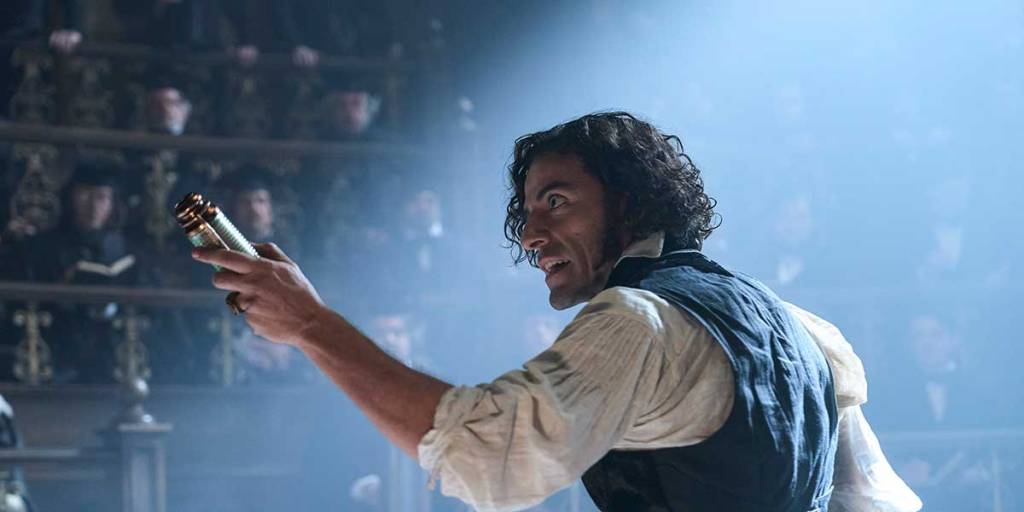
Victor Frankenstein (Oscar Isaac) is a medical student in Victorian England. The son of a minor aristocrat, the world is his for the taking. But when he shows his research in a dramatic performance before his professors — by bringing the head and torso of a dead man back to life using electric shocks — he is immediately expelled. Luckily he finds a benefactor (Christoph Waltz) from the continent to sponsor his research.  Frankenstein sets up his laboratory in an isolated castle. Like a modern prometheus, he goes through piles of dead bodies, cutting out the choicest bits to create his new, superior man. He is joined by his milquetoast younger brother William (Felix Kammerer) and William’s beautiful and intelligent bride Elizabeth (Mia Goth – she has perfect name for this movie). But when the creature (Jacob Elordi) is brought to life using a bolt of lightning, he doesn’t turn out as expected: he is a monster, a brainless slug who can only say one word. His experiment a failure, Frankenstein flees his castle burns down his laboratory, leaving career in ruins, and allowing the monster to die…or did he?

The rest of the movie follows the creature as he grows, learns to speak and read, discovers his own strength and power, and to differentiate between good and bad. But how will he turn out? And will humans ever accept him? 

Guillermo del Toro’s Frankenstein is an entirely new look at Mary Shelley’s novel, unlike any version before it. The green-faced, flat-headed Frankenstein is nowhere to be seen. Elordi is amazing as this tabula rasa with unexpected powers and emotions. He’s a completely sympathetic character for the first time. It’s the scientist who is the real monster in this movie, but one with motives and who can feel remorse. It takes place in locations you’d never associate with Frankenstein, starting aboard a ship in the Arctic. 

There’s also an extended chapter set in a cabin in the woods with a blind hermit. Yes, this Frankenstein is a gothic horror movie — which he’s been making all his life, like Crimson Peak (2015) — but this one takes it to a higher level. It’s visually stunning, wonderfully acted, it’s long but never boring, and besides the violence, gore and horror, there’s also romance and pathos, friendship, beauty and self-discovery.  

What can I say — this is one great Frankenstein.

Frankenstein and Good Fortune which both premiered at TIFF, and Black Phone 2 all open in Toronto this weekend; check your local listings.

This is Daniel Garber at the Movies, each Saturday morning, on CIUT 89.5 FM and on my website culturalmining.com.

Daniel Garber talks with Ross “Memphis” Pambrun about Red River Gold on APTN

Posted in 1800s, Adventure, Canada, History, Indigenous, Métis, TV, Winnipeg by CulturalMining.com on May 18, 2025

Hi, this is Daniel Garber at the Movies for culturalmining.com and CIUT 89.5 FM.

It’s 1870, and John A McDonald is the first Prime Minister of a newly-confederated Canada. And he doesn’t like what’s going on in the Red River Settlement led by Louis Riel.  The PM wants to crush what he calls a rebellion. So he sends soldiers up the Dawson Trail a newly surveyed road that connects the great Lakes to the Prairies. And soldiers need to get paid, so a courier on horseback is sent on the trail with heavy satchels stuffed with gold coins. But somewhere on the way from what is now known as Thunder Bay to Winnipeg, he lost all the gold… and it has never been seen since. What has become of that Red River Gold?

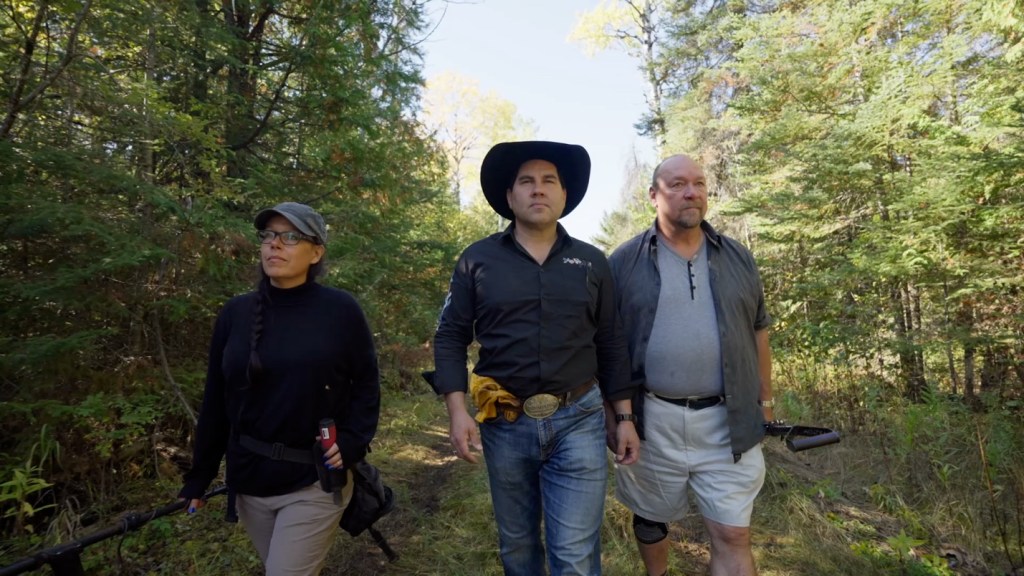
Red River Gold is the name of a new documentary series that follows Métis Treasure hunters looking for $1M worth of lost gold coins. It’s history, it’s geography, it’s archaeology, and it’s a brand new adventure. The series is directed by Saxon de Cocq who I spoke with on this show last year. Red River Gold features Ross “Memphis” Pambrun, a Winnipeg-based Métis musician, fire chief, raconteur and the owner and operator of a satellite data company. He and his two co-hosts take us down that trail throughout the season in their quest for gold and history.

Red River Gold is now playing on APTN — the Aboriginal People’s Television Network —  and on their streaming site Lumi. 

I spoke with Ross “Memphis” Pambrun in Calgary via ZOOM.

Bobby, Robbie and Tom. Films reviewed: A Complete Unknown, Better Man, Nosferatu

Posted in 1800s, 1960s, 1990s, Folk, Gothic, Horror, Music, Thriller, UK, Vampires by CulturalMining.com on December 21, 2024

Hi, this is Daniel Garber at the Movies for culturalmining.com and CIUT 89.5 FM.

Christmas is coming in just a few days, so this week I’m looking at three new movies — two musical biopics and a gothic horror — all opening on the 25th. There’s a  young man named Bobby who hails from Minnesota, another named Robbie who looks like a gorilla, and a third named Tom who is headed for Transylvania. 

A Complete Unknown

Co-Wri/Dir:James Mangold (Indiana Jones…)

It’s 1961 in Greenwich Village. Bobby Dylan (Timothée Chalamet: Dune, The French Dispatch, Call Me by Your Name, ) is a 19 year old boy from Minnesota, who arrives penniless with just a guitar on his back. The Village is the centre of the folk revival sweeping across America, alongside the civil rights and anti-war movements. Bobby is looking for his hero Woody Guthrie (Scoot McNairy), and tracks him down at a Psychiatric Hospital in New Jersey. Guthrie is suffering from a debilitating case of Hunnington’s disease. He communicates using grunts and gestures, but clearly likes Bobby’s songs. Pete Seeger (Edward Norton) — the folk giant and political activist — is there too, visiting Woody. He takes Bob under his wing and later introduces him at an open mic show at the Gaslight Cafe. There he meets the beautiful and talented Joan Baez (Monica Barbaro), a wildly popular folksinger and activist in her own right.

Bob’s still broke and prone to couch surfing, but soon settles into a casual relationship with Sylvie Russo (Elle Fanning: Somewhere, Super 8, Ginger and Rosa, Neon Demon, Twentieth Century Women, The Beguiled,  The Roads Not Taken, Mary Shelley). Is it love? And despite his unconventional voice, he quickly attracts fans — including stars like Johnny Cash — and his recording career takes off. Joan Baez adapts some of his songs with great success, and the two of them go on tour together — where they become intimate on and off stage. But Bob feels constrained by the folk community and wants to forge new musical pathways. What will happen when Bob Dylan goes electric?

A Complete Unknown: The Ballad of a True Original is a biopic about Bob Dylan. It spans a relatively short period of his life and music from his arrival in New York until the Newport Folk Festival of 1965. Chalamet is excellent as the young Bob Dylan, portraying him both as kind and self centred, ambitious and indifferent… usually sitting around in his underwear strumming a guitar. Norton is surprisingly believable as Pete Seeger. Elle Fanning, as Dylan’s neglected lover, seems less real, more of a cinematic concoction to add a romantic undertone to the story. Indeed, much of the plot and characters are invented out of whole cloth— with Dylan’s approval.

What’s really good though is the music. 75% of the movie is just singing and playing instruments, performed by the actors themselves. Maybe it’s me, but those songs, those joyful songs… they made me sing along and literally brought tears to my eyes. Live concerts, jams, hootenannies, jamborees, recording gigs… this movie includes everything. Whatever its false notes or historical inaccuracies, the music makes it. 

I enjoyed this movie so much.

Better Man

Co-Wri/Dir: Michael Gracey

It’s the 1980s in Stoke-on-Trent, England. Robbie Williams (Jonno Davies) is a boy who lives with his dad, mum and grandmother (Steve Pemberton, Kate Mulvany, and Alison Steadman). He goes to Catholic school where he’s the class clown. He loves singing, acting and telling jokes. He’s not particularly talented but he is charming and cheeky, always ready with a smile, a wink, and a  wiggle. He longs for approval from his neglectful father, but rarely gets it. So he vows to become famous some day to prove his worth. Unfortunately he’s the only one who thinks he can make it. Still, somehow he passes the auditions and is invited to join a new boy band called Take That.

Robbie doesn’t mind performing semi-clad at gay bars; their popularity is growing, and their catchy tunes are being listened to. And when they finally make it big, he is dazzled by the adoration of countless fans. He falls for the allure of alcohol, drugs and willing sex partners.  But why isn’t he making much money? It’s because he doesn’t write the songs, he just performs them.His drug use is getting out of hand. When he quits the band for a solo career, thing look rough. Will his own talent ever be recognized? Will his father ever be proud of him? And can he overcome the self doubt that plagues his career?

Better Man is a music biopic about the rise, fall and rise again of the pop singer and performer. The music and plot of this film are both pretty basic. What’s interesting is how he is portrayed. Through the use of CGI, Robbie Williams  looks like a human but with the features and fur of a chimpanzee. No one ever mentions it, he doesn’t eat bananas or climb trees, but throughout the movie, he looks like an ape. It represents the self-doubt and insecurity that drives him.

Director Michael Gracey had his start as an animator who learned special effects from the ground up, which leaves him with a vast supply of techniques to dazzle audiences. He has no fear of green screens and embraces CGI whole heartedly. Most of the movie feels like a non-stop, never-ending music video, expertly made. I’m not a fan of boy-band pop, but the sparkling presentation makes Better Man fun to watch.

Nosferatu 

Co-Wri/Dir: Robert Eggers (Lighthouse Eggers interview, The Northman, The VVitch Reviews)

It’s the 1830s in a small port city in Northern Germany. Thomas and Ellen Hutter (Nicholas Hoult, Lily-Rose Depp) are a young couple, passionately in love. To support their family and any future kids, Tom has a new position at a financial firm, run by the eccentric Mr Knock. Tom is a Bob Cratchit, always trying to please his boss. His first assignment: to visit a fabulously wealthy noble, have him sign a contract, and accompany him back to the city. It seems like a simple task. But Ellen is dead-set against it. Count Orlov cannot be trusted — he will kill you, Tom, she says. How does she know? The nightmares she’s had since adolescence predict it.

But, despite her warnings, Tom heads off to Transylvania. Count Orlov’s (Bill Skarsgård) castle is intimidating, set amongst the stark Carpathian mountain, and none of the local villagers dare to go with him, even draped in ropes of garlic. Tom braves it on his own, but finds the Count mysterious and oppressive. The castle is filled of vicious wolves and with rats. Tom wakes up each morning feeling drained, with teeth marks on his torso.

Meanwhile, back in Germany, Ellen is tormented with nightmares, driving her toward insanity, despite help from her friends Friedrich and Anna (Aaron Taylor-Johnson, Emma Corrin). Tom disappears and, when the Count arrives in the German town, unaccompanied, people start dropping dead from the plague. Can Tom and Ellen free themselves of Count Orlov’s treachery? And what are this vampire’s real motives? 

Nosferatu is a remake of Murnau’s 1922 silent film, which in turn was an adaptation of Bram Stoker’s Dracula. But far from being just another vampire movie, this one is totally original. It’s sexualized, scary, funny and grotesque. I saw it in IMAX in all its gothic glory. 

Murnau’s Nosferatu was a masterpiece of German expressionism, both modern and iconoclastic; Ironically, this one, made a century later, is deeply rooted in the distant past. Robert Eggers loves this old stuff, and pays meticulous attention to every word of the script and every frame of the film. It’s full of unnecessary but delightful scenes, like Roma singers and Magyar slap dancers, and rat infested canals. Eggers went to Transylvania just to capture that castle on film. He gives us a new Dracula, no Bela Lugosi accent or widow’s peak. This Nosferatu is a burly, imposing man, draped in fur robes, with a grand Hungarian moustache. His skin and muscles are rotting away, putrid with decay. He is driven not by an insatiable thirst for human blood but by lust: he covets a woman. 

If you’re into new explorations in horror, I think you’ll love Nosferatu.

Better Man, A Complete Unknown, and Nosferatu all open on Christmas Day in Toronto; check your local listings.

This is Daniel Garber at the Movies, each Saturday morning, on CIUT 89.5 FM and on my website culturalmining.com.

Trapped. Films reviewed: Captives, Here, Emilia Pèrez

Posted in 1800s, 1950s, 1960s, 1970s, AI, Crime, Family, France, Mental Illness, Mexico, Musical, Tom Hanks, Trans, Women by CulturalMining.com on November 1, 2024

Hi, this is Daniel Garber at the Movies for culturalmining.com and CIUT 89.5 FM.

Toronto Fall Film Festival Season continues with Cinefranco showing  contemporary French language movies from around the world at the Carlton Cinema. But this week, I’m looking at three new movies about traps. There’s a big-hearted woman trapped in a male drug-lord’s body, a French woman trapped in a mental hospital, and a movie camera trapped… in somebody’s living room!

Captives

Co-Wri/Dir: Arnaud des Pallières

It’s Paris in the late 19th century. Fanni Devander (Mélanie Thierry) is an elegant and educated woman searching for her mother. She disappeared when Fanni was just a child, but she has reasons to believe she is locked away somewhere in the city’s mental hospital. So Fanni voluntarily checks herself in to try to find her. Pitié-Salpêtrière is a home for the destitute, people with mental illness, learning disabilities or epilepsy, convicted criminals and even some foundling children. The one common factor is they’re all “undesirables” and all women. But once inside she realizes you can check in, but you can’t check out. It’s a de facto prison, presided over by the Matronly Bobette (Josiane Balasko),  and a hench-woman who would make Nurse Ratchet look like Florence Nightingale. Bobette’s one obsession is to perfectly execute their upcoming ball featuring her patients singing and dancing before a crowd of wealthy patrons. 

Fanni quickly learns the ropes and makes allies with Hersilie, a music teacher (Carole Bouquet)  and a lesbian school teacher with an eating disorder. And she finally meets a nearsighted older woman named Camomile (Yolande Moreau) who just might be her real mother. Can Fanni perform at the ball and safely escape with her supposed mother? Or will they all be stuck there forever? 

Captives is a fascinating historical thriller about the treatment of women in state institutions. It’s harrowing in parts — including scenes of torture — as Fanni navigates class and hierarchy within this enclosed universe. I purposely only mentioned some of the characters and plot turns, because the surprise is what makes it worth watching. But rest assured, it’s full of great acting, pathos, and beautiful period costumes — even within that terrible place.

I like this one.

Here

Dir: Robert Zemeckis (Reviews: Flight, Allied)

Ricky (Tom Hanks) is a teenaged baby boomer living the American dream. His Dad and Mom (Paul Bettany and Kelly Reilly) have lived in a house across the street from Ben Franklin’s historical home since they bought it on the GI Bill after WWII. Now Ricky and his kid brother and sister happily share the place, congregating in the living room for holidays, dinners, or just to watch TV. Ricky wants to be an artist, while his girlfriend Margaret (Robin Wright) dreams of going to law school. Unfortunately, when she gets pregnant while they’re both still in high school, they marry and settle down, still within Ricky (now called Richard’s) parents’ home. Life goes on, and the decades pass, and people are born, live and die. But will they always stay “here” in the same house?

Here is a movie about a place, specifically a living room facing the picture window and the street beyond. The camera never movies. It follows this location not just for Ricky’s family, but also the dinosaurs, the ice age, indigenous people, Ben Franklin, and various couples across the 20th century, constantly jumping back and forth in time. The one constant is the frame, the fourth wall, which never shifts. Picture this: a pop-up square will appear with different furniture and wallpaper in it, taking you to another era, in the style of a virtual staging of a house for sale on a real estate website. Indeed we get to meet real estate agents throughout the twentieth century. Which makes sense because its really about the place, not the meat puppets who wander around in it.

Does this new, experimental concept work?  No!  It’s indescribably awful.

I cannot convey the aesthetic revulsion I felt viewing this horrible non-movie movie. It features a de-aged, 68-year-old Tom Hanks playing himself as a teenager with a fake young teenage face plastered on, but who still talks and walks like the old man he is. What were they thinking?! Here is a tired, platitudinous high-concept exercise in futility disguised as an innovative film. All the characters are painful cliches, including a token black family whose sole purpose seems to be to recite a version of Ta-Nehisi Coates Letter to My Son… to their son.

Keep in mind, Zemeckis is known both for classics like Back to the Future but also unforgivable, semi-animated dreck like Polar Express and Forrest Gump. Here falls neatly into the dreck pile.

Emilia Pérez

Co-Wri/Dir: Jacques Audiard 

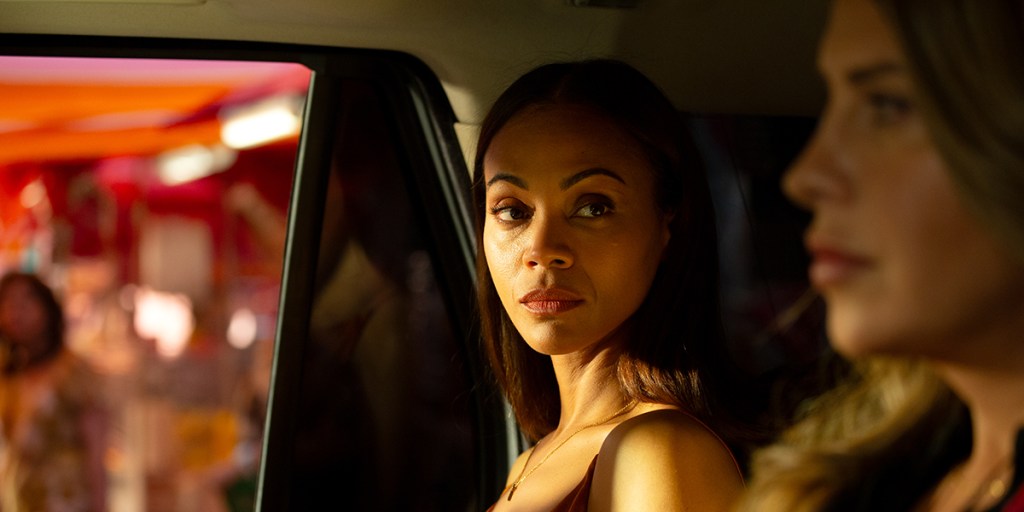
Rita (Zoe Saldaña) is an ambitious young defence lawyer in Mexico City. She spends hours crafting powerful opening statements for trials, but, as a black woman —  originally from the Dominican Republic — she gets none of the credit. But somebody is watching her and appreciates her skill. She finds out who, when she’s kidnapped with a black hood over her head and driven into the middle of the desert. There she meets the notorious head of a huge drug cartel, personally responsible for countless killings. Juan “Manitas” Del Monte, the cartel chief, needs her to help him disappear, in a way no one — including his wife Jessi (Selena Gomez) — will ever find him again.

The twist? This murderous, pock-marked, bearded monster… is trans, and wants to shed the awful male body and face, to live the rest of her life as an attractive woman. She needs someone she can trust to handle all this, both the finances and the surgery, leaving no paper trail. In exchange, Rita will have all the money she needs for the rest of her life, and her own private firm.

Years later, she meets with a potential client, a fabulously rich European woman named Emilia Pèrez (Karla Sofía Gascón). It’s her client from years back, who wants to re-enter the world and be reunited with her beloved family, all of whom think she is dead. And to atone for some of her past sins without revealing who she was. What will happen to these three remarkable women in the next chapter of their lives?

Emilia Pérez is an incredibly passionate and shocking movie. It’s simultaneously an action-thriller, an epic drama, and a musical. Yes, that’s right, a musical, where  characters do break into songs and dances throughout the film. But with its latin beats and shouting crowds, it’s the sort of songs you rarely encounter in a musical.  Zoe Saldaña is amazing as this tough-as-nails lawyer, and Karla Sofía Gascón, a Spanish actress I’ve never seen before, is unmatchable, both as Perez, and as the drug lord Manitas. (She’s a  transwoman herself.) French director Audiard (who previously brought us masterpieces like A Prophet, and Rust and Bone) seems to have no trouble creating a Mexican musical. I gotta say, Netflix churns out a load of content, most of which is forgettable crap, but, every year, they also produce a few really remarkable films. Emilia Pèrez is one of those.

I strongly recommend this movie.

Here and Amelia Perez both open this weekend in Toronto; check your local listings. And Captives is having its English Canada premiere at 8:45 tonight (Saturday, Nov 2, 2024) at Cinefranco at the Carlton.

This is Daniel Garber at the Movies, each Saturday morning, on CIUT 89.5 FM and on my website culturalmining.com.

Through the grapevine. Films reviewed: Twisters, Widow Clicquot

Posted in 1800s, Action, Climate Change, Disaster, Feminism, France, Thriller, Tornadoes, Women by CulturalMining.com on July 20, 2024

Hi, this is Daniel Garber at the Movies for culturalmining.com and CIUT 89.5 FM.

Is your headspace being dominated by thoughts of politics and elections? If so, you need some distractions! I’ve got just the thing for a hot day like today. This week, I’m looking at two new summer movies — an historical drama and a disaster-thriller — both about strong women. There’s a widow who risks the wrath of grapes, and a meteorologist who throws caution to the wind.

Twisters

Dir: Lee Isaac Chung (Review: Minari)

Kate (Daisy Edgar-Jones) is a meteorologist. Not the weatherman who writes numbers on a green screen on your local TV news; she’s the real thing, with an important job at a government bureau in New York City. So what is she doing in Oklahoma? The state is facing an unusual number of major tornadoes all at once. She was invited down there by Javi (Anthony Ramos), an old classmate and study-buddy who worked with her on her experiment involving using polymers to stop tornadoes. But the experiment went wrong, killing the rest of their team, thus taking away any desire she once had to chase tornadoes. And yet here she is back in Oklahoma. She’s lending a hand to Javi’s corporate sponsors, who supply shiny white SUVs in exchange for some crucial tornado info. 

But she faces severe competition. The place is swarming with adventure seekers, journalists and  tourists. Tyler (Glenn Powell) is a cowboy huckster — a self-described “Tornado Wrangler” — who sells T-shirts and coffee mugs with his own grinning face on them. He’s a “chaser”, someone who seeks out tornadoes and gets as close to them as he can without being sucked away. His gimmick is to shoot fireworks up into tornadoes as they pass by. Looks great on YouTube… He drives a souped-up red jeep, and speeds ahead of Javi’s white vans. But Kate is in a league all her own. She can look at a dandelion and predict, with amazing accuracy, which way the next tornado is coming.  And Tyler starts to take note. Who should Kate side with — serious Javi, or aw-shucks Tyler? And will any of them survive the big storm on the horizon?

Twisters is a thriller  disaster movie about… well, tornadoes and the people who chase them. That’s most of the movie. It’s kind of a sequel to the movie Twister (1996) but shares none of the same characters, actors, or plot lines, except that they’re both about tornado chasers. There’s definite electricity between Kate and Tyler —  Glenn Powell is brimming with charisma, and the appealing Englishwoman Daisy Edgar-Jones plays a credible American (though not much off an Oklahoman) — but those sparks never catch fire. If you’re expecting love, lust or sex, you chose the wrong movie. There’s not even a single kiss here. What you do get is amazing special effects: collapsing water towers, exploding oil refineries, roofs torn off buildings, streetcars running off their tracks…and lots sandlots of people holding onto something solid to avoid being swept away.  I don’t know about you, but I really like disaster movies. Who needs a plot when you get to watch the world collapse?

Widow Clicquot

Dir: Thomas Napper

It’s the early 1800s in Napoleonic France. Madame Barbe-Nicole Ponsardin Clicquot (Haley Bennet) is a wealthy aristocrat from Champagne. In her early twenties she is married off to the equally rich François Clicquot (Tom Sturridge) who inherited vast vineyards. Although she dislikes him at first — he is somewhere between eccentric and crazy — she grows to love his childlike, playful exuberance. The guy has tousled hair and wears diaphanous pirate shirts, while Madame dresses in breezy white blouses. Soon he has her singing to grape vines, too. When she’s not  in the vineyards, she’s in her laboratory studying wine sediment in beakers and test tubes.  But  eventually his eccentricity turns erratic, sometimes  slipping into accidental violence. Madame sends their daughter off to the Abbee, but by their 6th year together, he is dead.

Now she’s a widow, and heir to the estate, but the trustees have never heard of a woman vintner. They offer her a fair settlement and tell her to take the money and run. Never!, cries widow Clicquot. These vines, this terroir it’s Francois’ soul! And she feels personally attached to it, too. But everything goes wrong. They buy cheap glass bottles which explode. And selling wine across borders is a no-no during the Napoleonic wars. She turns to Louis (Sam Riley) a wine salesman, for help. She needs to get her latest concoction — a dry pink wine with tiny bubbles — to the market. It’s the only thing that can save her grapes and the chateau she lives in. But will her new type of wine ever catch on?

Widow Clicquot is a historical drama filled with the expected stories: passionately swooning lovers, double-crossing colleagues, floppy hair and costumes and verdant green valleys. It’s also about a rich woman who dares to fights the system. Not all that much happens in this movie which makes it drag in the middle. Tom Sturridge is ridiculous as the flakey husband, Haley Bennet is better though still stiff, as Madame, and Sam Riley as the travelling salesman is the best of those three. I was dreading a total corporate kiss-ass for the famous champagne maker, but it wasn’t that way at all. It’s based on a book that portrays her as a determined woman, despite her flaws, so two points for that. It’s not a spoiler that she is the famous Veuve Clicquot who basically invented modern champagne. And I liked the historical aspects.

Widow Clicquot is not a great movie, but lubricate yourself with enough flutes of Veuve and you won’t really care.

Widow Clicquot and Twisters both open this weekend in Toronto; check your local listings.

This is Daniel Garber at the Movies, each Saturday morning, on CIUT 89.5 FM and on my website culturalmining.com.

Parents and their children. Films reviewed: Tuesday, Kidnapped

Posted in 1800s, Courtroom Drama, Death, Denial, Drama, Fairytales, Family, Italy, Politics, Religion, Supernatural, UK by CulturalMining.com on June 15, 2024

Hi, this is Daniel Garber at the Movies for culturalmining.com and CIUT 89.5 FM.

Sunday is Fathers Day, so this week I’m looking at two movies about parents and children. There’s a mother whose daughter is threatened by a big ugly bird, and parents whose son is kidnapped by the Pope.

Tuesday

Wri/Dir: Daina Oniunas-Pusic

Tuesday (Lola Petticrew) is a teenaged girl in London who is dying of an incurable disease. She likes comics and drawing. She spends most of her time in her bedroom with her Nurse Billie (Leah Harvey) or else in the walled garden outside her home, because she is too weak to get around anymore. She only sees her mother at night when she comes home from work. Until a stranger shows up in her life. It’s a huge bird, like a giant parrot, covered in filthy, black feathers. He is death incarnate, and he’s come to take her away by placing his wing over her body. But instead, she asks to talk to him. She helps him clean up, revealing colourful plumage, and she tells him a joke — the first time he’s laughed in centuries. So he lets her live, for now, but she can’t tell anyone about him. Meanwhile Tuesday’s mom Zora (Julia Louis-Dreyfus), has a secret of her own. She quit work a long time ago, to take care of her dying daughter. But she can’t face it; instead she spends all day sitting alone in a nearby park, doing nothing. And she’s been selling off all their possessions to help pay for the nurse. But everything changes when Tuesday tells her about her imaginary friend… and Zora is shocked to find she’s telling the truth. But she refuses to accept her daughter’s death, and takes an extraordinarily drastic step to stop the inevitable from happening. But what will these new changes bring to the family and the world and can Zora ever accept the inevitable loss waiting to happen.

Tuesday is an unusual but strangely moving fantasy about a mother and daughter confronting death. It starts out a bit odd, and gradually turns into a very strange movie indeed. But while it deals with some horrific ideas, it’s not a horror movie. It has supernatural elements, but it’s not meant to be scary. And despite its religious concepts of life and death, it’s not a faith-based movie. What it is is a very moving, mother/daughter drama about death. Julie Louis Dreyfuss, best known for her deadpan comedy in Seinfeld and Veep, plays it straight in this one, and really bares her soul in a deeply moving performance. And Lola Petticrew is equally sympathetic as Tuesday. This is nothing like most movies you see, but very effective nonetheless; come prepared both to laugh and cry.

I really liked this movie.

Kidnapped

Co-Wri/Dir:  Marco Bellocchio

It’s the 1850s in a middle-class neighbourhood in Bologna.  Salomone Mortara (Fausto Russo Alesi) lives with his wife Marianna Padovani Mortara (Barbara Ronchi) and their children. One night there is a banging on their front door: it’s the police demanding an inspection. They want to see Edgardo Mortara, an angelic little boy, number six of eight kids. Local officials are apologetic, but they must hand him over, under the orders of Father Feletti (Fabrizio Gifuni), the local inquisitor. But surely there’s some mistake, they say, what could this little boy have done? He was secretly baptized as a baby by his maid, they say, and no Christian child can be brought up in a Jewish family. Bologna — and much of Italy — was then part of the Papal States, where the government, the police, and the judiciary were all under the direct rule of the Vatican’s representatives and ultimately Pope Pius IX. And despite their vehement  objections and petitions, they whisk the crying child off to Rome. 

He is brought to the House of Catachumens, a special school for converts to be taught the Latin Mass. Little Edgardo (Enea Sala) misses his family terribly but a friend he meets says if you want to go home soon, just cooperate and learn the prayers, you don’t have to believe them. His flabbergasted father and devastated mother are desperately trying to get him out of there, but to no avail. But the story has caught the eye of the international press, making banner headlines in Paris, London and New York. And this makes Pope Pius IX even more steadfast in his beliefs. Will the family all convert to Catholicism to get back their son? Will Pope Pius relent and let him go home again? And who will the little boy choose as his guardians: his Mama and Papa or Il Papa, the Pope himself?

Kidnapped: The Abduction of Edgardo Mortara is an overwhelming drama based on true historic events. Though little-known today, it had a huge affect on world politics, history and, ultimately, the unification of Italy. It takes place in their homes of Bologna, The Roman Ghetto, in courtrooms, on canals, and within the Vatican itself. Its powerful music, lush photography and opulent sets and costumes support the passionate almost melodramatic acting. Barbara Ronchi is fantastic as Mrs Mortara, while Paolo Pierobon as Pope Pius comes across as a creepily salacious Mafia don, cuddling up to his favourite little boy and letting him hide beneath his robes (as he had huddled in his mother’s skirts when first abducted.) It also veers into fantasy within the dreams of various characters, from little Edgardo who dreams of de-crucifying Jesus so he can go home, and the Pope who has nightmares of being forcibly circumcised by a gang of rabbis. Kidnapped is an amazingly powerful  historical drama set within the changing tides of 19th century Europe.

On a personal note, my childhood next door neighbour, Mrs Sharon Stahl, ended up writing her doctoral theological dissertation on this case, so I had head about it many years ago and it’s amazing to finally see it dramatized on the big screen.

Fantastic movie.

Tuesday is now playing at the TIFF Lightbox, and Kidnapped also opened this weekend; check your local listings. 

This is Daniel Garber at the Movies, each Saturday morning, on CIUT 89.5 FM and on my website culturalmining.com.

Daniel Garber talks with Erin Goodpipe and Saxon de Cocq about Treaty Road

Posted in 1800s, 1900s, Anishnaabe, Canada, Cree, documentary, First Nations, History, Indigenous, Métis, TV by CulturalMining.com on March 9, 2024

Hi, this is Daniel Garber at the Movies for culturalmining.com and CIUT 89.5 FM.

It’s the 1870s in what is now Manitoba. Representatives of the British Crown, the Anishinaabe and the Muskegon Cree are negotiating the ownership and stewardship of the lands there. James McKay, a former fur-trader for the Hudsons Bay Company plays a crucial role in translating for both sides. Treaty 1, the first of a number of such treaties, set the stage for the expansion of European settlements in western Canada. But what did they mean for the indigenous peoples? Were these treaties honoured? And what role do they still play in 2024?

A fascinating, six-part documentary series called Treaty Road examines in depth the history of these treaties, as seen by the descendants of the original signers and their representatives. Namely, the show’s co-hosts, writer-director Saxon de Cocq of the Métis Nation of Alberta, and artist and educator Erin Goodpipe of the Anishnaabe Standing Buffalo Dakota Nation. Saxon is an accomplished filmmaker who brought us CBC’s The Invincible Sergeant Bill  and CIFF’s Land Acknowledgement. Erin is known on stage and screen for productions like RezX, The Other Side, and Bathsheba: Search for Evil.

I spoke with Erin and Saxon via ZOOM.

You can watch Treaty Road on APTN.

It’s all about the mood. Films reviewed: Bob Marley: One Love, The Taste of Things

Posted in 1800s, 1970s, Biopic, Cooking, Food, France, Jamaica, Music by CulturalMining.com on February 17, 2024

Hi, this is Daniel Garber at the Movies for culturalmining.com and CIUT 89.5 FM.

Many film critics — including myself — say that the most important part of a movie is the story. But that’s not always true. This week, I’m looking at two new movies where it’s all about the vibe, all about the mood, not the plot. There’s a cook cooking in 19th century France, and a musician making music in 1970s Jamaica.

Bob Marley: One Love
Dir: Reinaldo Marcus Green

It’s 1976, in Kingston Jamaica. Bob Marley (Kingsley Ben-Adir) and the Wailers are riding high with a string of worldwide hits. But the city is in turmoil, rocked by gang violence in the run up to a crucial election. US guns are flooding into the country. Bob Marley plans a “Smile Jamaica” concert to bring peace and lessen the tension between supporters of the leftist PM Manning and the pro-American conservative candidate Seaga. Bob — known as Skipper to his friends — is Rastafari, an anti-colonialist, afrocentric religion calling for a return to Africa from Babylon. But just days before the concert, Bob, Rita Marley (Lashana Lynch), and others were shot and wounded in a planned assassination attempt, with cars full of armed gang members invading their compound to stop them from singing. The concert goes through as planned, but they are forced to move to London for safety.

There, they put together their next album, Exodus, and embark on a tour of Europe, to be followed by a triumphant trip to Africa, Bob Marley’s dream. The album is a huge hit, and his fame grows. But there’s trouble brewing between Bob and Rita, who have known each other since they were kids. They also face financial questions — are they being cheated out of their money by backroom management? And a wound to his foot from a soccer game isn’t healing like it should. Can Bob and Rita work out their problems? Will they ever make it to Africa? And can Bob Marley and the Wailers return to Jamaica and live in peace?

Bob Marley: One Love is the long-awaited biopic about the musician and his life. Aside from a few flashbacks to his childhood and his start as a musician, the film focuses on two years of his life in the 1970s. So we see the musicians playing, in studio and at stadium concerts, hanging out in nightclubs and concert halls, or writing new songs at home. We also see them smoking spliffs (a Rastafarian sacrament) and playing soccer or fussball in their off hours. But what we don’t get much of is Bob Marley’s inner thoughts, his love life, his heart and soul. This is a common problem in hagiographic biopics that are approved every step off the way by his family.

Bob Marley is sanctified, but not humanized — there seems to be a glass wall separating the audience from the character. At the same time, there are some fascinating revelations about his past, and interesting glimpses into the workings of Jamaican music scene (mainly through flashbacks). So we get to see Scratch Perry in studio, and the Wailers grooving on stage. The script is not great, it drags a bit, but photography is quite pretty, and the acting (largely played by British actors speaking Jamaican patois) is believable. Most important of all is the music, which sets the vibe that keeps the film moving all the way to the finish.

It’s the music that makes Bob Marley: One Love worth seeing.

The Taste of Things (La passion de Dodin Bouffant)
Co-Wri/Dir: Tran Anh Hung

It’s the late 19th century, in France. Eugenie (Juliette Binoche) is an haut cuisine cook at a chateau, surrounded by a lush vegetable garden. She’s preparing an elaborate meal for Dodin (Benoît Magimel) and his fellow gourmets. She’s assisted by Violette, the maid, and supervised by Dodin. And what a meal it is, with each dish requiring multiple stages, and dozens of steps. Even something as simple as consommé is actually a complex, refined broth known for its subtle flavours. We follow each step, from picking vegetables in the garden, to sautéing the meat, simmering it, and removing the scum.

This day, there’s a new face in the kitchen, Violette’s young niece. Pauline (Bonnie Chagneau-Ravoire) has a preternatural ability to taste all the elements of a dish, despite not yet developing a refined palate. Perhaps she’ll become Eugenie’s apprentice some day? In the meantime Eugenie takes pains to hide her occasional dizzy spells.

After 20 years, Dodin and Eugenie have an unusual relationship; they work together, effortlessly in the kitchen, like a well oiled machine. And at night, if she chooses to do so, Eugenie leaves her chamber unlocked so Dodin can spend the night.
But it’s hard to tell if they are lovers, boss and worker, or husband and wife (with all that entails). What future dishes will they prepare? And will they ever tie the knot?

The Taste of Things is a mouth-watering look at 19th century French cooking. It’s nominally about a relationship, but not really. There’s also a visit to dine with a wealthy prince, and a look at strange new gardening techniques. But the plot is unimportant. As I watched this movie, I wasn’t thinking about why Eugenie has dizzy spells, or trying to keep track of Didot’s gourmet friends. It’s inconsequential.

It’s the food that’s important, the cooking and the eating. I was kept drooling for two hours, trying to guess what they’re making. Oh, that’s vol au vent! What’s with the meringue? Is it Baked Alaska? (a.k.a. omelette à la norvégienne). I was mentally cooking alongside the burbling, burnished copper pots on the wood-burning stove. And the eating is remarkable, too, including a scene where the gourmets cover their heads with white napkins as they consume a tiny songbird (known as ortalans) whole.

Certainly, Binoche and Magimel have chemistry — apparently they were once a couple in real life — but not enough to carry the movie. It’s the food — and the mood — that makes watching it worthwhile.

Bob Marley: One Love and The Taste of Things are both playing now in Toronto; check your local listings.

This is Daniel Garber at the Movies, each Saturday morning, on CIUT 89.5 FM and on my website culturalmining.com.

A New World? Films reviewed: Going In, Poor Things

Posted in 1800s, 1980s, Action, Adventure, Canada, comedy, Coming of Age, Fantasy, Feminism, Sex, Sex Trade, Toronto by CulturalMining.com on December 15, 2023

Hi, this is Daniel Garber at the Movies for culturalmining.com and CIUT 89.5 FM.

December is supposed to be a time for fun and relaxation, so this week, I’m looking at two new movies that you might find fun to watch. There’s a comedy/action movie set 40 years ago in Toronto, and a wild comedic fable set a century ago in Europe. 

Going In

Wri/Dir: Evan Rissi

It’s the late 1980s in Toronto. Leslie Booth (Evan Rissi) is a young lecturer who waxes eloquent about Hegelian dialectics to bored college students. He doesn’t smoke, drink or cuss and stays away from drugs. He even goes to bed early if his on-again, off-again girlfriend isn’t spending the night. But everything changes when a strange man, all dressed in black, starts showing up everywhere he goes. Reuben (Ira Goldman) is a Jamaican-Canadian who wears a huge Star of David around his neck. He used to be Leslie’s best friend, going out on the town every night, but haven’t seen each other for five years. And Leslie has been on the straight and narrow ever since. 

But Reuben needs his help, and is calling in a favour. His brother has disappeared, and he suspects it’s the work of a Toronto drug kingpin named Feng (Victor D.S. Man). Feng has cornered the market on a highly-addictive pill hitting the streets known as Pearl. Users love the experience, but addicts end up looking like zombies with solid white eyes. Reuben wants to penetrate this Triad and save his brother’s life, but the only way to do it is to get hold of a pair of tickets to Feng’s annual tournament. So Leslie joins with Reuben and finds himself falling into old habits, snorting coke and frequenting sleazy bars to get more information. But the closer they get to their target the more dangerous it all looks. What is that tournament about? And can they rescue Reuben’s and get out unscathed?

Going In is a Toronto action/comedy movie set in — and in the style of — the 1980s. It’s also a buddy movie with a black guy and a white guy, like Lethal Weapon, Beverley Hills Cop or Silver Streak. But unlike those Hollywood hits, Going In is a micro- budget movie — we’re talking tens of thousands not hundreds of millions —  with unknown actors and minimal special effects. Evan Rissi wrote, directed and stars as Leslie, while Ira Goldman who plays Reuben also produced it. And Victor D.S. Man as the villain looks like he walked straight out of an old Hong Kong flick.

Surprisingly, this movie works. It’s clearly low-budget but it doesn’t seem slapdash. While it plays into a lot of film conventions and stereotypes, there are some very original scenes that I’ve never seen before — like the tournament they’re trying so hard to get into (no spoilers) It also has a good soundtrack, a b-ball match, some fight scenes and even a psychedelic out-of-body experience. And it’s not afraid to have the CN Tower constantly popping up in the background, to remind us that it’s Toronto, not NY, Detroit, Boston, Phillie or any of the other cities Toronto usually pretends to be in movies shot here. Keep in mind that this is a DIY movie, not from a big studio, and you might get a kick out of it. 

Poor Things

Dir: Yorgos Lanthimos

Max McCandles (Ramy Youssef) is a medical student in Victorian England. He regularly attends surgical demonstrations by Dr Godwin Baxter (an unrecognizable Willem Dafoe) a controversial scientist with outrageous ideas. Baxter’s face is grotesque, like something that was cut into pieces and sewn back together. But the doctor takes a liking to shy Max, and hires him to live in his home and look after his daughter Bella (Emma Stone). Bella is a beautiful woman in her late 20s, but who behaves like a recently-hatched duckling just learning to walk. She has a vocabulary of just six words, and is given to stabbing, tearing or biting anything put in front of her. But with Max’s help, she quickly learns to speak and think, and is full of questions about the world. She is not allowed out of her home — it’s too dangerous, they say. You see, Bella is an adult woman with a baby’s brain implanted in her skull, one of the mad scientist’s latest experiments. As she matures, she and Max fall in love and plan their wedding — though still in a strictly patriarchal relationship (she refers to her father/creator Godwin Baxter as God for short.) But before they can marry, a scoundrel named Duncan Wedderburn (Mark Ruffalo) shows up on the scene. He sweeps Bella off her feet with the introduction of something new into her vocabulary — sexual pleasure — which she greatly enjoys. He promises endless sexual satisfaction and rollicking new adventures if she follows him on his trip. Bella realizes Duncan is a cad and a rake but agrees to go with him anyway, postponing her marriage to Max indefinitely or at least until after she sees the world. 

She sets off on this journey with Duncan aboard an ocean liner docking in various ports which she naively explores and learns from what she sees. She’s the ultimate fish out pf water, a novelty to all she meets, because she speaks so frankly and forthrightly. Bella has yet to learn basic societal rules about class, money, capitalism, sex, nudity and modesty. She explores this strange world scientifically and logically, much to Duncan’s dismay. Who is she really and where did she come from? Is sex a market commodity or something more personal? Will her naivety lead to disaster? Or will she return, triumphant, to London with her innocence intact? 

Poor Things is a brilliant social satire about sex, class, feminism, and society. It incorporates elements of 18th century novels like Fanny Hill, Tom Jones and Candide. It’s surreal, absurdist and psychedelic, but ultimately comes across as a fable or a morality play. It’s all filmed on an elaborate set (shot in Hungary), in a weird, steampunk Europe that never existed beneath a sky filled with blimps and zeppelins. (It looks like Terry Gilliam’s movie Brazil.) The costumes are outrageous — Bella has enormous shoulder pads bigger than her head. Emma Stone is amazing as Bella, though Mark Ruffalo overdoes it as Duncan — teetering between funny and ridiculous. 

I’ve been following Yorgos Lanthimos’s films since Dogtooth in 2009, and this one revisits many of his earliest themes: absurdist humour; adults who speak awkwardly like small children, and who grow up isolated, never allowed to leave their home, by a dictatorial, god-like father figure. It feels like Dogtooth Part Two: The Outside World. But now he commands a big enough budget to build ornate sets, costumes and wigs, with dozens of fascinating characters. I’m sure some of you will hate this movie, or be offended by it, but I think it’s absolutely brilliant. 

Poor Things opens this weekend in Toronto; check your local listings. Going In is available digitally online across North America, from December 19th.

This is Daniel Garber at the Movies, each Saturday morning, on CIUT 89.5 FM and on my website culturalmining.

Films reviewed: Orlando: My Political Biography, Fallen Leaves

Posted in 1600s, 1700s, 1800s, 1900s, Finland, France, LGBT, Noir, Politics, Romantic Comedy, Trans by CulturalMining.com on November 25, 2023

Hi, this is Daniel Garber at the Movies for culturalmining.com and CIUT 89.5 FM.

Toronto’s Fall film festival season continues in December with the Jayu Human Rights film festival showing insightful documentaries on pertinent issues, along with a slam poetry competition at the Ace Hotel.

But this week, I’m looking at two new European movies that played at TIFF this year and are now in cinemas. There are trans shape-shifters in France and lonely job-seekers in Finland.

Orlando: My Political Biography

Wri/Dir: Paul B. Preciado

It’s 17th century, Elizabethan England. Orlando is a teenaged boy, a handsome courtier in the Queen’s castle. He’s also an aspiring writer, waxing lyrical on oak trees and winter frosts. He falls in love with Sasha, a blonde, Russian aristocrat. But at the age of 30, he wakes from a deep sleep transformed into a woman. Orlando’s life takes her (and him) through various guises over hundreds of years, to capitals as far away as Constantinople, until finally returning by ship to 20th century London, where they finally complete and publish their book. Such is the “biography” of Orlando in Virginia Woolf’s famous novel. So what’s different about this film?

For one thing, the entire cast is trans or non-binary, as is Preciado, the director. And the cast is huge. Each version of Orlando is played by another actor, their sex, gender and sexuality presented in a myriad of ways.  Orlando is plural in this incarnation.  Not just that, Orlando’s race, colour and language also shifts, with the actors ages ranging from small children to the elderly. Some characters wear chainmail like Joan of Arc, while others recline, luxuriantly,  in an Ottoman seraglio. The one common factor is their Elizabethan white neck ruffs, the fashion of the day.

Orlando, My Political Biography is not the first film version of the novel — far from it.  It seems to attract the most experimental and avant garde filmmakers out there.  German director Ulrike Ottinger made Freak Orlando in 1981 which entirely rejects the conventions of both narrative and art movies. English director Sally Potter (see: The Roads Not Taken, The Party,  Ginger and Rosa)’s Orlando of 1992 starred Tilda Swinton as the various Orlandos and featured Jimmy Sommerville singing up in a tree.

But this French political biography adopts Bertolt Brecht’s (and Jean-Luc Godard’s) method of deliberately alienating the audience to promote a political stand. Each Orlando introduces their scene by announcing directly to the camera their real /adopted name and personal history, followed by their Orlando passage, often reading directly from a copy of Woolf’s book. But it remains engaging because of the beauty of the photography and costumes and the sincerity of the players in the film. Settings vary from deliberately artificial backdrops to an exquisite forest and a grotesque Parisian catacomb.

The political stance is complex, and involves a rejection of the accepted binary. Some take issue with psychiatrists, surgeons and pharmacists having control of their identities and bodies. Says one young Orlando: you must hate your genitals if you want the doctor to give you hormones… but I don’t hate my genitals. Says another: I adopted a ridiculous caricature of masculinity for a year after transitioning before realizing I shouldn’t erase my personal history just because I’m trans.

Orlando, My Political Biography is equal parts intellectual lecture, political diatribe, performance art, and cinematic experiment, and, most surprisingly… it works.

Fallen Leaves

Wri/Dir: Aki Kaurismaki

It’s typical day in Helsinki, Finland. 

Ansa (Alma Pöysti), a single woman in her thirties, works at a low-paying job in a supermarket. She lives in a small apartment and subsists on frozen microwave dinners. She likes listening to relaxing music, but her bakelite radio only plays bad news from the Ukrainian war these days. She does go out occasionally to a local karaoke bar, with her best friend Liisa (Nuppu Koivu). There she encounters — but doesn’t actually meet — Holappa (Jussi Vatanen). Holappa is a depressed guy who works as a welder at a small factory. He lives in the company dorm, along with acquaintances and his best friend and confident Huotari (Janne Hyytiäinen). He handles his depression with constant drinking, which only gets him more depressed. After a few near misses they finally meet face to face. Their first date? A zombie movie at a local rep cinema. Sparks fly and they vow to meet again soon. But various unfortunate coincidences seem destined to keep these soulmates far apart. Can they ever find happiness together? Or is this a relationship that can never happen?

Fallen Leaves is a tragicomic proletarian love story par excellence. Its also a deadpan comedy, which despite it’s nearly tragic atmosphere, will have you laughing and crying all the way through. If you’ve ever seen an Aki Kaurismaki  movie before you’ll instantly recognize his style: seedy bars, bearded bikers, dark rock n roll, and a noir-ish, retro feel. Similar to Jim Jarmusch, but much funnier. It also deals with real-life issues like alcoholism and poverty. Ansa loses her job for taking home an expired cookie instead of throwing it away, while Holappa is driven close to self- destruction by his constant boozing. If you haven’t seen his movies before, Fallen Leaves is a great one to start.

Everything in this film is retro. Finland is the high-tech home of Nokia and Supercell, but in Kaurismaki’s world the characters use avocado coloured landlines,  with cel phones or video games nowhere to be seen. Computers seem relegated to internet cafes. Phone numbers are written on slips of paper, blown away with the wind. Movie theatres only play classics, and every bar is on skid row. 

At the same time, there’s always a niceness and sweetness burbling just below the surface of the humdrum futility of everyday life. Fallen Leaves is a wonderfully depressing movie with a feel-good atmosphere. I love this movie.

Fallen Leaves and Orlando My Political Biography are  both playing now at the TIFF Bell Lightbox, and at other theatres across Canada — check your local listings.

This is Daniel Garber at the Movies, each Saturday morning, on CIUT 89.5 FM and on my website culturalmining.com.