Hi, this is Daniel Garber at the Movies for culturalmining.com and CIUT 89.5 FM.
If you want a break from all the big-budget blockbusters, why not turn to Europe for some great stuff. This week, I’m looking at three European movies all set in the 20th century. There’s a kafkaesque drama about an earnest prosecutor in 1930s Stalinist Russia; an animated biopic about a writer/director from Marseilles; and a coming-of-age body-horror drama set in an imaginary France.
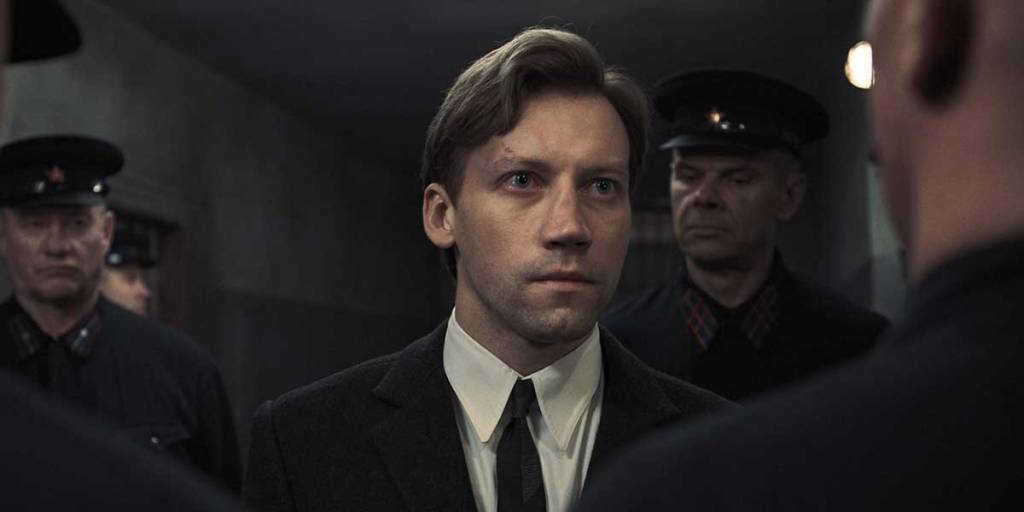 Two Prosecutors
Dir: Sergey Loznitsa
It’s 1937 in Bryansk, a small city in the southwest of Soviet Russia. Kornev (Alexander Kuznetsov) is a young and earnest communist party member, still wet behind the ears. He just graduated with honours from law school and is starting a new position as investigative prosecutor. (The lawyer who previously held his position mysteriously disappeared.) Kornev recently received a letter from an inmate at the local prison, saying he has urgent information to pass on to the prosecutor. This letter is remarkable for a number of reasons: Letters like this never leave the prison; it’s written in human blood; and most important, Kornev has met the man who wrote it. But when he arrives at the forbidding prison gates he realizes that talking to a prisoner is no ordinary task. He is stymied at every stage: forced to wait for hours in an empty room; told by the warden that there are thousands of inmates there so he can’t possibly find him (Kornev has his block and cell number); and that the prisoner is suffering from a contagious disease, so for medical reasons, no one can visit him. But the lawyer is persistent and finally is let in to meet the man.
The prisoner Stepniak (Aleksandr Filippenko) is a lawyer himself and his message is grave. The NKVD (the forerunner of the KGB) is corruptly arresting all the old Bolsheviks and local party bosses, charging them with counterrevolutionary behaviour, and then executing them once they confess. Stepniak doesn’t trust Kornev, but when he repeats, word for word, the speech Stefaniak himself gave at his law school, he realizes this is an honourable man. He reveals the horrible scars left from his constant torture. Only you, he says, can stop this terrible situation. You must go to Moscow immediately to meet with Stalin (or another top politburo member), and let them know about the terrible situation in Bryansk. So he sets out by train to do his duty for his country. But will his trip actually change anything? Or is he heading for disaster?
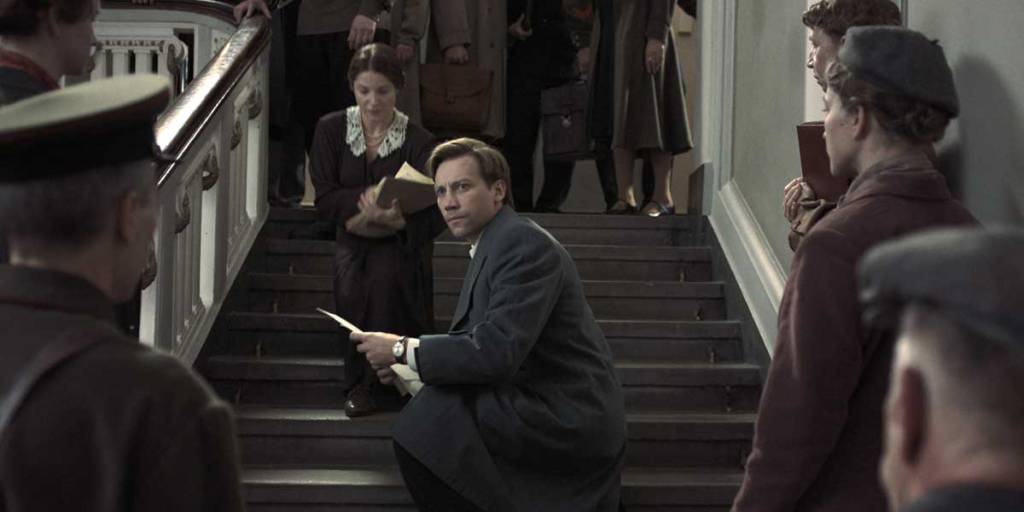
Two Prosecutors is a dark historical drama about Stalin’s Great Purge in 1937 in which between 700,000 – 1.2 million people were arrested and executed, wiping out much of the civil service, party members, kulaks, and others. The film is slow-moving but powerful — like many Russian movies. It’s told in a series of compelling chapters, including a monologue of an old soldier on a train, based on Gogol’s Dead Souls. And the scenes in Moscow’s Byzantine bureaucracy are both absurd and chilling.
Not an easy film to watch, but a compelling one.

A Magnificent Life
Co-Wri/Dir: Sylvain Chomet
It’s the turn of the previous century in a mountainous region of France. Marcel Pagnol is a little boy who likes writing poetry and is trying to invent a perpetual motion device. When he grows up, he wants to be a writer or a millionaire. But you can’t be both, his parents tell him. He grows up in Marseilles, passes his baccalaureate and becomes a Latin teacher, but still wants to write. So at the first chance, he moves to Paris with his young wife, for all the opportunities it offers. But they are forced to live in a garret, not the wonderful lifestyle he expected. Still, he bangs away at his broken-down typewriter in hopes of writing a successful manuscript. He tries his hand as a playwright under a pen name, bit with little success. Critics hate his work, audiences are indifferent, and even his own father is less than impressed. His wife, fed up with his repeated failures, leaves him.
Finally, though, he has a hit, and eventually returns to his roots for inspiration, creating characters for the Parisian Theatre who speak like they do in Marseilles. Audience fill his halls and eventually, a Hollywood mogul arrives at his door. He options one of Pagnol’s scripts and releases a “talkie” — under the great Alexander Korda. It’s a huge success and Pagnol uses the profits to open his own studio in Marseilles. One success follows another (along with a series of lovers) as his career and reputation grows. He survives the German Occupation, eventually selling his studio rather than work as a Nazi propagandist. But at some point in the 1950s, his popularity seems to wane. Then Elle magazine asks him to write a serialized memoir of his childhood. And somewhere along the way, his boyhood self — young Marcel — who had followed him for most of his young life, reappears and helps him pick up his pen again.

A Magnificent Life is an animated biopic based on the memoirs of the producer, director and writer Marcel Pagnol. It covers most of the major events of his life along with short clips from his stage plays and films. I’m vaguely aware of Pagnol’s works, but mainly through remakes — like Fanny, Jean de Florette and Manon des Sources made after his death. Perhaps devotees will get more from this tribute than I did. But I found it boring and tedious, chronologically plodding along from one event to the next. It’s also dubbed into English, though much of the humour seems based on regional French dialects (I think they use Welsh accents in the English version), resulting in stiff and clumsy dialogue. The illustrations are quite beautiful but I found the animation — the movement of these images — pedestrian. The one interesting twist is the spirit of a young Marcel who appears as partly real and partly imaginary: other characters physically interact with little Marcel (Pagnol’s younger self) without realizing who he is. But Marcel, like the film, eventually fades away.
This movie would be a lot more magnificent if it weren’t entirely lacking in passion, humour, whimsy and tears.

Alpha
Wri/Dir: Julia Ducournau
It’s the 1990s in a foggy French port city. Alpha (Mélissa Boros) is a young teenage girl with glasses who lives with her single mom, a doctor (Golshifteh Farahani). There’s a mysterious virus going around, one with frightening side effects: those infected develop white patches on their skin, which eventually morph into obsidian or white marble-looking statues with ripples of dark lines. Anyone showing signs of the virus is shunned. Maman spends most of her time at her hospital, which serves both as a refuge for those infected and as palliative care (there is no known cure or vaccine). But Alpha is forced to share her bedroom with a newcomer, a stranger. Amin (Tahar Rahim) is actually her uncle — her mother’s brother — who met her years ago when she was just a child. But now, as then, he’s a junkie, always looking for his next fix. He’s there to detox, so his sister can save his life.
But everything changes when Alpha goes to a late night house party with her sort-of boyfriend Adrien. He gets her high but then leaves her unguarded. She awakens in a misty haze to someone giving her a prison-style tattoo: needles jabbing black dye into her shoulder in the shape of an A (for Alpha). And everybody knows how this virus spreads through blood and body fluids. Was the needle clean? Has she been infected? When she arrives back at school with a bloody patch on her arm, rumours start to circulate. Girls bully her in the gym locker room. and she almost drowns in the swimming pool. But the Principal, instead of coming down on her side, says — without any evidence — she must stay home until they know for sure she’s negative. How will Alpha handle her new status? Will Amin ever shake his addiction? And can Maman protect her daughter and brother even while tending to the her patients at the hospital?
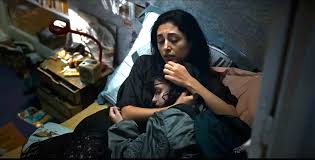
Alpha is a coming-of age story set in an era of fear and uncertainty. It’s brilliant, rich, creative and multifaceted. Ducournau has invented an imaginary 20th century France filled with an angry populous striking out at non-existent enemies… but tempered by Alpha’s charming naivety. It uses elements of body horror to convey the panic and fear during both the HIV epidemic in the 80s and 90s and the recent pandemic. And it incorporates the Berber language, mysticism and magic, within Alpha’s extended family.

The acting is superb, both the more famous Rahim and Farahani, but also newcomers like Boros as Alpha, and many of the smaller roles. I loved Ducournau’s shocking, over-the-top film Titane, with its gender-shifting sex and violence. But Alpha is so much more complex. It’s tender, intimate and personal.
This is one excellent movie.
Alpha, A Magnificent Life and Two Prosecutors all open this weekend in Toronto; check your local listings. This is Daniel Garber at the Movies, each Saturday morning, on CIUT 89.5 FM and on my website culturalmining.com.
 Cultural Mining
Leave a comment