
Hi, this is Daniel Garber at the Movies for culturalmining.com and CIUT 89.5 FM.
This week, I’m talking about two new movies, both mysteries, about professionals forced to deal with crime that affects their personal lives. There’s a psychiatrist in Paris who uncovers a crime, and a police detective in LA blamed for a crime.
But before that I’m talking about a new series of Canadian films featured at TIFF in February.

Canada’s Top Ten
…is an annual series where programmers choose the best movies made in the previous year. While I haven’t seen all of them, a few really stand out. If you’re a regular listener to this show you may have heard my interviews last fall with Kid Koala about his delightful futuristic animated kids’ film Space Cadet, and Inuit auteur Zacharias Kunuk’s amazing timeless folk tale Uiksaringitara (Wrong Husband), as well as my review of Matt Johnson’s hilarious, Nirvanna: the Band, the Show, the Movie. But let me tell you about a couple more that should not be missed.

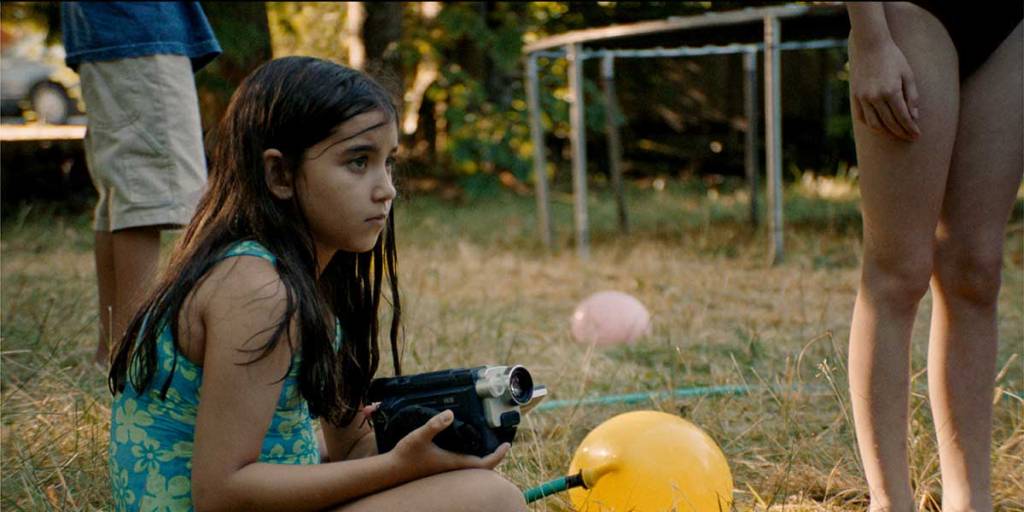
Blue Heron is director Sophy Romvari’s first feature. It’s about a young artistic couple and their kids who immigrate from Hungary to a small lakeside town in Canada. It’s seen through the eyes of a little girl whose troubled teenaged brother is “acting out”. It also picks up the story, and the characters’ lives, decades later. While it might sound like a mundane drama, it’s actually a heart-wrenching story of one troubled family.
And Mile End Kicks is Chandler Levack’s sophomore follow up to her quirky and tender I Like Movies in 2022. This one’s about a budding rock critic in 2011 Toronto, who sets off to discover Montreal with just a contract in her hand to write a book about Allan’s Morissette. This movie is brilliant and cringey and hilarious, a coming-of-age dramedy about a woman trying to survive within the male dominated world of rock.

These are just two of the movies you must check out at Canada’s Top Ten.

Mercy
Dir: Timur Bekmambetov (Ben Hur)
It’s Los Angeles in the near future, and Chris Raven (Chris Pratt) is a real mess. He is bruised, battered and hungover from a drinking binge the night before… and has no recollection of the past 24 hours. He’s also in an unfamiliar place, a large, empty room, facing a giant video screen. He’s shackled to a chair with electronic instruments attached to his head. He is in the Mercy department, a new experimental court system, where a single person serves as the judge, jury… and executioner. That person is Judge Maddox (Rebecca Ferguson) a woman with straight hair and severe features. Why is Chris there? He’s been charged with first degree murder and has exactly 90 minutes to convince the judge that he’s not guilty beyond a reasonable doubt; if not, he will be executed in that chair. Oh! One more thing: Judge Maddox is actually a computer generated AI avatar, not a real human.
But Chris has a few cards up his sleeve. He’s a lieutenant police detective, so he knows all the legal procedures. Not only that, he and his partner created the Mercy system, so he knows all about it. But he never thought he’d be on the receiving end. Luckily, he has all the surveillance — CCTV, social networks, everyone’s cel phones and completegovernment, medical and legal histories — at his shackled fingertips. The bad news is, he seems to have motive, means and opportunity to do the killing, with no other obvious suspects. Can Chris Raven think his way out of this mess in the next 90 minutes? And can he put his destiny in the hands of a soulless, digital simulacrum?
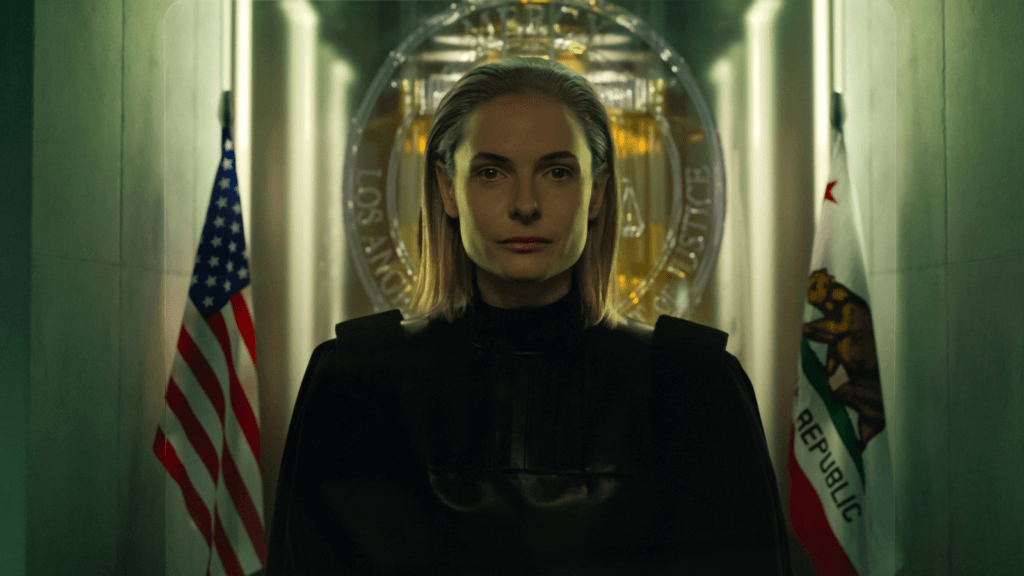
Mercy is a science-fiction police procedural where a falsely accused cop must solve a crime remotely in a very short period of time. It’s also a mystery/action thriller about a dystopian future where machines hold the final authority. The “thrilling” parts are all tied to a constant timed countdown on the screen — like the old TV series “24” — and a “rating” of guilt; a percentage that goes up and down depending on the evidence he presents to prove his innocence.
The problem with this movie is it feels like it was made on someone’s telephone. There’s virtually no physical interaction between any of the various characters throughout the film, just talking heads on the screen, reached by cel. I understand why they had to film movies like that during COVID, but what possible reason could there be for doing it now? I saw it in 3-D, but when all you see are smaller flat screens projected on to larger ones, what’s the point? On the plus side are the few scenes where Raven’s partner Jaq (Kali Reis) zooms around on her flying motorcycle, searching for the bad guys — that part was awesome! And my interest never wavers over the course of the movie. I like the constant countdown, and the steps they take to solve the mysteries. But what I thought would be a subversive Robocop-style indictment of both runaway government surveillance and the looming dangers of AI, instead ends up as a run-of-the-mill police story.
Mercy may hold your attention, but don’t expect anything more.
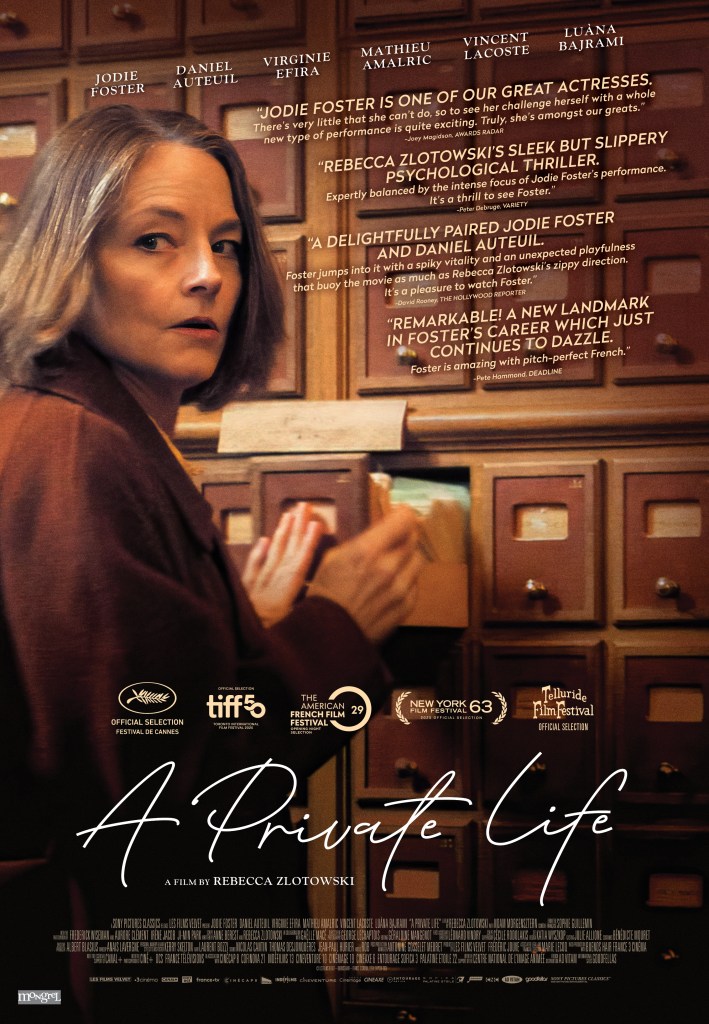
A Private Life
Dir: Rebecca Zlotowski
It’s a posh arrondissement in present-day Paris. Lilian Steiner (Jodie Foster) is a successful American Freudian psychotherapist who runs her practice all alone, in a clinic attached to her apartment. She has no trouble filling her roster with well-to-do patients seeking psychoanalysis. But recently, a number of bad things happen all at once. A new neighbour plays loud music during office hours, disturbing her clients. One longtime patient suddenly quits, calling her a fraud after he claims a hypnotist cured him of smoking in less than an hour. Another regular misses her appointments twice in a row without telling her — unheard of. Turns out Paula Cohen-Solal is dead, and when she shows up at her shiva, Paula’s husband Simon (Mathieu Amalric) loudly denounces Lilian as the reason his wife killed herself. This combination of events breaks down Lilian’s cool demeanour; to her horror, tears keep rolling down her cheeks at inappropriate times.
She visits her eye doctor — who happens to be her ex-husband Gabi (Daniel Auteuil) — to solve this medical dilemma. He says there are no physical reasons for her tears. So net she visits the hypnotist her angry patient told her about. She manages to stop her tears but, at the same time, lets loose a series of psychosexual dreams and visions of past lives that haunt Lilian’s mind. And she becomes convinced that Paula did not commit suicide but was murdered. And when she decides to investigate, someone breaks into her clinic and steals no money, just certain files. Who is behind the killing? Was there more than just a doctor/patient relationship between Paula and Lilian? And now that she and her ex-husband Gabi are spending time together again, could be this be the start of a new relationship?
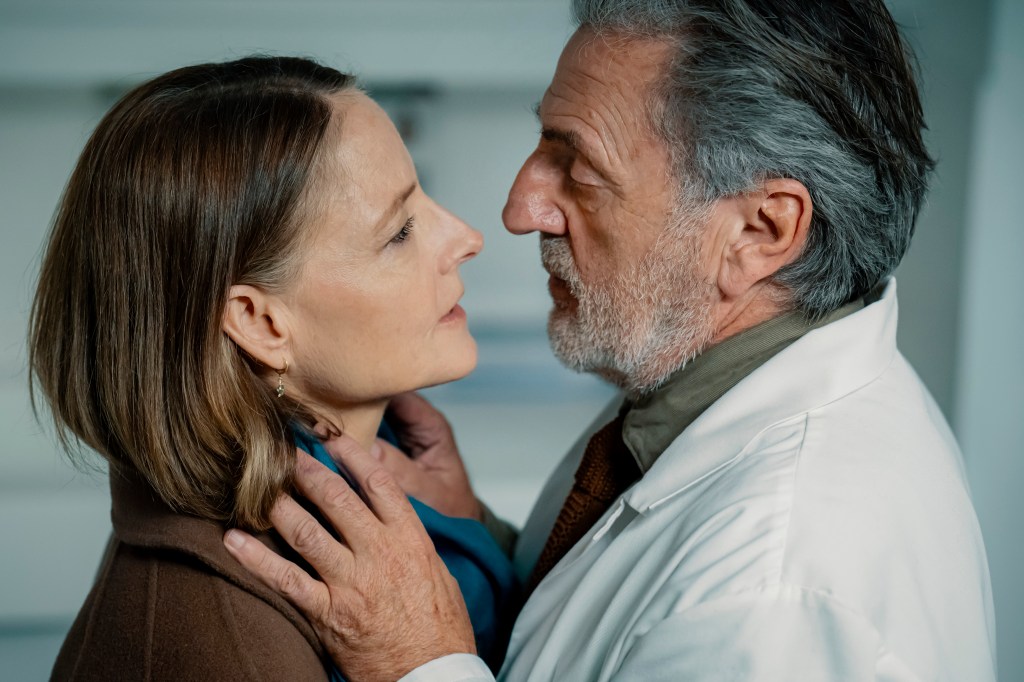
A Private Life is a mystery thriller set within the world of Parisian psychotherapy, it’s devotees, their families and their unspoken private lives. It’s presented in a low-key but ambiguous manner: you’re never quite sure whether a crime took place or even whether what you’re watching is real. It presents infidelity, hidden passions, and personal relations, alongside dreams, fantasies and psychological visions. Sort of a Murder She Wrote on mushrooms. Good acting by the large ensemble cast, especially Jodie Foster, Daniel Auteuil, Virginie Efira as the dead Paula and Sophie Guillemin as the enigmatic hypnotist.
While A Private Life didn’t blow me away, I quite enjoyed both the story and watching Jodie Foster complètement en français.
A Private Life and Mercy both open in Toronto this weekend; check your local listings. And tickets are now available for Canada’s Top Ten, showing at TIFF in February.
This is Daniel Garber at the Movies, each Saturday morning, on CIUT 89.5 FM and on my website culturalmining.com.
 Cultural Mining
Leave a comment