Outstanding, great… or just ugly? Films reviewed: Eleanor the Great, Out Standing, The Ugly
Hi, this is Daniel Garber at the Movies for culturalmining.com and CIUT 89.5 FM.
Toronto Palestine Film Festival is on right now, with movies, shorts and docs by and about Palestinians, as well music, cuisine and art to share with other Canadians. This is it’s 17th year and it’s never been more relevant, so check it out.
But this week, I’m looking at three new movies that premiered at TIFF and are all opening theatrically this weekend. There’s an elderly woman who tells a lie, a woman with an “ugly” face who disappears without a trace, and a female officer in the Canadian Army who wishes a certain photo would just go away.
Eleanor the Great
Dir: Scarlett Johansson
Eleanor Morganstein (June Squibb) is a grandmother in her 90s. Since her husband died ten years back, she has shared her Florida condo with her best friend Bessie whom she’s known for 70 years. They do everything together, and work well as a team. Where Bessie is timid, Eleanor is brash and outspoken. If there’s something Bessie wants, Eleanor knows how to get it, even if it involves telling a few fibs. She has chutzpah to spare. But when Bessie suddenly dies, she realizes there’s no reason to stick around, so she packs up her stuff and flies back to New York for the first time in decades. She’s staying with her daughter Lisa (Jessica Hecht) and her grandson Max (Will Price). She’s hoping for some quality time but Lisa’s a worrywart and Max is always busy at school. So she takes up her daughter’s offer to attend some classes at the JCC she signed her up for; maybe she’ll make some friends. The first class is a washout — broadway musicals — so she wanders into another group almost by accident. It’s a support group for Holocaust survivors, and the members urge Eleanor — as a newcomer — to tell her story. She’s not a holocaust survivor, but her best friend Bessie was… and she knows all her memories, especially the death of her brother. So, in deference to Bessie, she tells them to the group as if they’re her own. Why not, right? It goes over well… a bit too well, actually. A teenaged college student Nina (Erin Kellyman) is auditing the group and soon bonds with Eleanor (her mom recently died and her dad is distant and
withdrawn.) The two women bond and start sharing intimate stories.
Nina is in a journalism class, and wants to make a video of her telling her holocaust memories as part of an assignment. Then things get really out of hand: Nina’s dad (Chiwetel Ejiofor) happens to be a popular TV news journalist… and he wants to make Eleanor his next feature. But what will happen to her friendship with Nina — never mind her own family — once the truth inevitably comes out?
Eleanor the Great is a nice, light movie-of-the-week-type drama about death, mourning, and inter-generational relations. It’s a very simple and easy movie, part comedy, part weeper. What’s good about it is the acting. June Squibb — who really is in her 90s — is great as the energetic, down-home Eleanor. (She played another rebellious granny in last year’s hit Thelma.) This is Scarlett Johansson’s first time as a director, and luckily she doesn’t bite off more than she can chew. She concentrates on characters — Squibb and Kellyman are both great in their roles — more than the basic story. And you know what? That’s good enough.
I wouldn’t call Eleanor the Great great, but it’s worth the watch.
Out Standing
Co-Wri/Dir: Mélanie Charbonneau
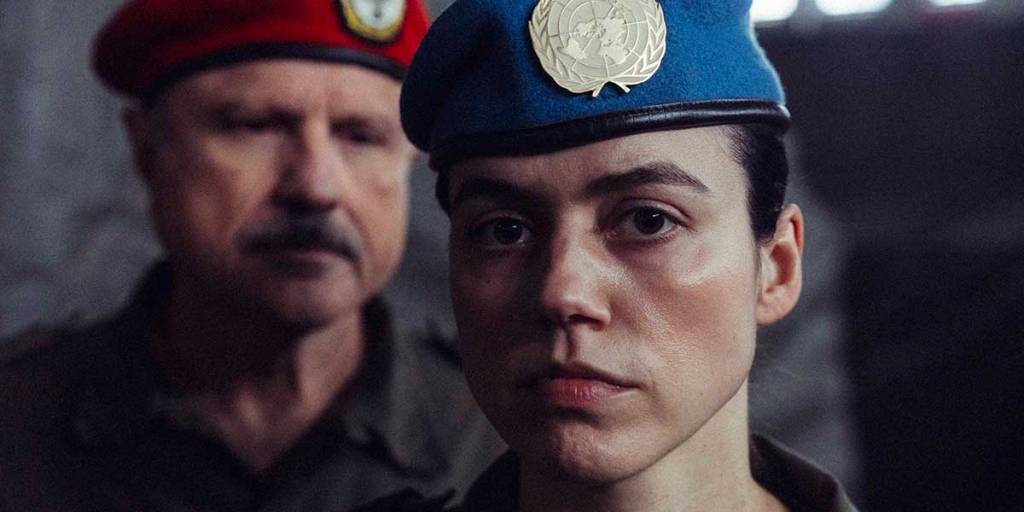
It’s the 1990s, and Captain Perron is leading a troop of UN peacekeeping forces in the former Yugoslavia. Why is this unusual? Sandra Perron (Nina Kiri) is a Canadian woman, the first to lead a squad of infantry soldiers in combat, and the first female to serve in the prestigious 22nd division, known as the Van Doos. Raised as an army brat in bases across Canada, she comes from a long line of soldiers, so it makes sense that she is following in her father’s vocation. She trained as a cadet and received commendations while still a teenager. And she’s the first woman to survive the brutal training that squadron demands. But there’s a photo circulating from her past that’s threatening to derail her military career. It’s a picture of her tied to a tree, barefoot, in the snow and semiconscious.
It was part of her training in a Prisoner of War exercise that went far beyond the normal treatment soldiers are forced to endure. A Canadian woman facing treatment tantamount to torture at CFB Gagetown in New Brunswick. But Captain Perron isn’t the one who released the photo, one fact she didn’t want the photo circulated. She had endured years of hazing bullying, harassment, obscene phone calls, sabotage to her kit, and a hidden campaign by certain officers to get rid of her. They detest the idea of serving alongside or under the command of a woman. And unlike the other women who
attempted to to join the Van Doos, she alone managed to survive and not quit.
Out Standing is a biopic about a trailblazing woman in the Canadian Armed Forces. It’s both moving and disturbing. The title, based on her memoirs, refers both to her achievements and to the notorious photo of her standing tied to a tree. (That pic was eventually published by the press, triggering a wave of shock and disgust across the country, and, one hopes, an improvement in how women are treated in the military.) Nina Kiri gives an excellent performance, totally believable as Perron.
While Hollywood churns out dozens of war movies each year, showcasing the latest weapons and fighter planes, you rarely see a Canadian one. This one is full of details carefully chosen to distinguish how soldiers behave here. The military culture is quite different. Unlike in the US there’s no Sir-yes-sir! And instead of saluting a Canadian soldier stand sharply at attention. I never knew this because you never see it in movies. For this alone it’s a eye-opener. The film is not perfect — there’s a particularly clumsy scene near the end — but altogether it’s a compelling and disturbing look at a Canadian woman’s life in the military.
The Ugly
Wri/Dir: Yeon Sang-ho (Peninsula, Train to Busan)
Lim Yeon-gyu (Kwon Hae-hyo) is a well-known carver of dojang, the name stamps used in Korea like a signature on official documents. He built up his business from scratch while raising his son as a single parent. (His wife ran away soon after the baby was born.) He trained his son Lim Dong-hwan (Park Jeong-min) in every aspect of the craft. Now an adult he is taking over the family business. At this moment, a documentary filmmaker (HAN Ji-hyeon) is celebrating this dad’s life as a national treasure. Why did she choose this man for her documentary? He’s been blind since birth, which makes his many accomplishments even more impressive. But filming is put on hold when a surprise announcement arrives. They’ve found Dong-hwan’s mother decades after she disappeared. Turns out she’s been dead all that time and only her bones remain. This comes as a total shock to Dong-hwan, and it just gets worse.
First his mother’s long lost relatives arrive for the funeral but they’re despicable people who just want to make sure he doesn’t claim any family inheritance.They bullied and beat his mother, a veritable Cinderella raised by this cruel family. It’s also the first time he hears his mother described as ugly. Ugly how? He longs to see a photo of her, something to display at the funeral, but there are no photos anywhere. Of course his blind father doesn’t have one. While Dong-hwan is trying to process all this new information, the filmmaker leaps on it as a great story and insists on continuing the documentary but with a new twist: who killed his mom and why? Together, over a series of interviews with hidden cameras, they uncover
events and people from her past as the tragic puzzle gradually falls into place.
The Ugly is a mystery about a kind-hearted woman — the main character’s mother — and how she is horribly treated because of her looks. It’s a heart wrenching story, a dark, bleak view of humanity with only Dong-hwan (and his mother) as redeeming characters. The story is told as a series of interviews with the various characters and extended flashbacks to what actually happened (The actor who plays Dong-hwa also plays his blind father as a young man in the flashbacks, while Jung Young-hee plays his mother, but always from behind or from the side, without ever revealing her face). In Yeon Sang-ho’s previous movies (Peninsula, Train to Busan) the action hero is surrounded by mutants or zombies or killers. The Ugly is about normal people but they’re just as hideous.
The Ugly is a powerful and dark look at human cruelty and physical beauty.
Eleanor the Great, Out Standing and the Ugly all open this weekend in Toronto; check your local listings. This is Daniel Garber at the Movies, each Saturday morning, on CIUT 89.5 FM and on my website culturalmining.com.
Men, music and sports. Films reviewed: The History of Sound, Him, EPIC: Elvis Presley in Concert
Hi, this is Daniel Garber at the Movies for culturalmining.com and CIUT 89.5 FM.
TIFF is over but the movies keep coming. So this week, I’m looking at three new American movies, two about music and one about sports. There are two men recording folk songs in the forest, an ambitious quarterback at a training camp in the desert, and a former teen idol wowing audiences on a Vegas stage.
The History of Sound
Dir: Oliver Hermanus
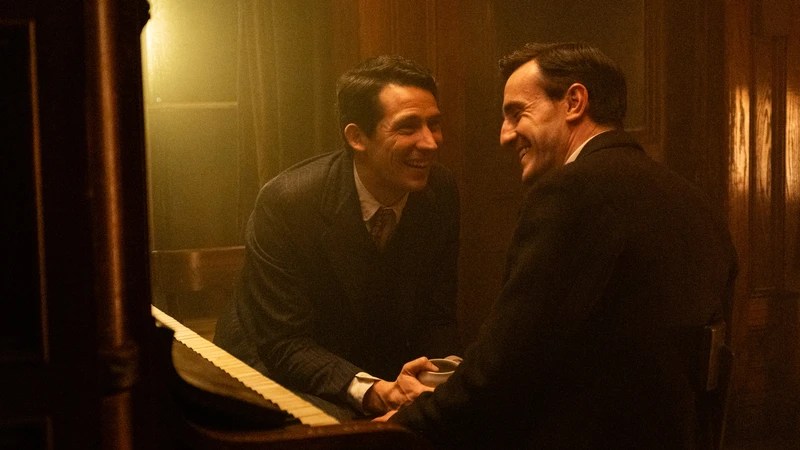
It’s the early 20th Century in rural Kentucky. Lionel (Paul Mescal) likes listening to his father sing while he plays the fiddle. Music for him is different from most folks: he has synesthesia. This means each musical note has a distinct colour, flavour and meaning. Eventually his love of music and beautiful voice wins him a full scholarship to the New England Conservatory of Music. At a Boston pub one night, he recognizes a song his father used to play, coming from a young man at the piano. David (Josh O’Connor) knows every word. As an ethnomusicologist, he wants to collect as many distinct folk songs and ballads as he can, before they are lost forever. David has perfect pitch and a photographic memory. The two trade songs they know, and somehow, end up in bed together that night. That chance encounter turns into regular trysts at David’s apartment.
Later he invites Lionel to join him in a fieldwork project. They roam across the state of Maine, recording songs everywhere from logging camps to schoolhouses, And they record it all on wax cylinders (this is before flat discs are invented) carefully
stored in a leather satchel. And each night they sleep together in a tiny tent. Is this true love? And what will happen to their relationship after the project is finished?
The History of Sound is a touching, bittersweet gay romance — before the word gay existed — set within the larger context of war and music. It’s directed by South African filmmaker Oliver Hermanus (Moffie) and its based on a short story by Ben Shattuck. I wonder if the characters are modelled on Alan Lomax, the ethnomusicologist who recorded thousands of songs and started the folk music revival in the 1950s. Paul Mescal is spot-on as the sensitive kid in a clapboard shack who grows up to be a cosmopolitan musician; as is Josh O’Connor’s portrayal of an enigmatic musical genius with hidden secrets. The images are as lovely as the music in this tender and moving film.
I really liked it.
Him
Co-Wri/Dir: Justin Tipping
It’s San Antonio, Texas, and their NFL team, the Saviours, is looking for a new quarterback to replace their MVP Isaiah White (Marlon Wayans), due to retire in a year. Cameron Cade (Tyriq Withers) is a young quarterback who lives for football — his father trained him for this since he was a little kid. When he’s offered the position if he agrees to an intense one-on-one, bootcamp with his idol Isaiah White, of course he says yes; this is the fulfillment of all his dream. Thing is, he recently had a serious injury that left him with a bad concussion and a track of staples in his head. If he aggravates his brain, it might end his football career before it starts. But as his father always told him, No Pain, No Gain. Cameron heads out to the training camp in the desert.
There he encounters absolute luxury: gourmet food and priceless art in a spacious brutalist palace. There are saunas and ice baths, and daily blood transfusions for Isaiah. Cameron too tastes this luxury — and sexual temptations — offered by Isaiah’s entourage, especially the grotesquely made-up wife Elsie White (Julia Fox), an influencer who sells her own line of sex toys. Isaiah is the GOAT — the Greatest of All Time — and his virulent fans wear goat horns on their
heads. Cameron, on the other hand, holds onto silver cross. He’s given a series of Squid-Game-like ordeals he must endure before Isaiah gives him the nod. And as the tasks grow increasingly horrific, his morals are severely challenged. Can he pass the tests? And is he ready to give up his innate morality and embrace pro-sports and all it offers?
Him is a psychological thriller about a young man confronting his hero (who is also his nemesis) even as he uncovers the dark underbelly of pro football. It’s produced by Jordan Peele, so you might expect a suspense/thriller with mind-blowing surprises. If so, you’ll be sorely disappointed. What you’ll get instead is more like a highly-stylized, extended music video than a horror film. There’s lots of dazzle and flash — and an equal amount of blood — but it’s never scary or surprising. And director Tipping uses film techniques like a kid playing with toys. Why are people shown in in infrared X-rays? Why a long fashion shot sequence in what’s supposed to be a scary scene? Why do cowboy-hatted cheerleaders continue dancing in the face of horrific deaths? There are some great visual cues — like the aluminium stitches in his skull evoking the side of a football — but it’s all show, no substance in this cheap morality play.
Him is fun to look at, but there’s nothing there.
EPIC: Elvis Presley in Concert
Dir: Baz Luhrmann
It’s the 1950s. Elvis is the King of Rock and Roll with a series of hits and the nation goes wild over his thrusting pelvis and his soulful voice. Later, he is drafted into the army where he serves two years. Afterwards he turns to Hollywood where hue churns out a series of hits alongside sex goddesses like Ann-Margaret. And late in the 1960s he signs a multi-year contract to perform before sold-out audiences at a Las Vegas Casino. He’s up there every day, dressed in eggshell blue jumpsuits, covered in silver studs, sequins and spangles, joking with the crowds, and sweating buckets. He is accompanied by a retinue of back up singers, musicians and elaborate lighting. And that is basically how Elvis spends the rest of his life, until he collapses and dies in Graceland, age 42.
EPIC: Elvis Presley in Concert is a combination documentary and musical performance. Just two years ago, we had both Baz Lurhmann’s biopic Elvis and Sofia Coppola’s Priscilla, two similar stories told from different points of view, neither of which were particularly good. And now, out of nowhere comes this third one. I’m not an Elvis fan, nor do I like the kitschy

Buzz Luhrmann at EPIC’s world premiere at TIFF50: Photo (c) Jeff Harris
and gaudy films of Baz Luhrmann. Which is why I’m shocked at how much I enjoyed this movie (I saw it on an IMAX screen at TIFF last week, almost by accident.) Ostensibly just a musical record it’s actually a succinct and tight history of the man, so much better than those bloated biopics.
It’s fantastic, a masterpiece of creative editing, colour restoration and music mixing. It’s absolutely stunning. The songs he sings are mainly hits from the 1960s cover-versions of Bridge Over Troubled Water, You’ve lost that Loving Feeling, and even gospel songs. And over the course of a single song, we see him on stage, in rehearsal, or in the recording studio, shot over many years, but without a break in the music. And despite Luhrmann’s gaudy excess, somehow his capture of Elvis in a psychedelic shirt or sparkling gold belt buckles just looks right.
EPIC is the perfect concert film.
Him and The History of Music both open this weekend in Toronto; check your local listings; EPIC: Elvis Presley In Concert played at TIFF and will be released soon.
This is Daniel Garber at the Movies, each Saturday morning, on CIUT 89.5 FM and on my website culturalmining.com.
TIFF gems. Films reviewed: Girl, I Swear, Cover-Up
Hi, this is Daniel Garber at the Movies for culturalmining.com and CIUT 89.5 FM.
TIFF, Toronto’s International Film Festival is winding down after a busy week, but there is still a lot to see, including the People’s Choice awards offering free screenings of the winning films tomorrow. So this week I’m looking at three terrific movies that premiered at TIFF but aren’t getting the degree of coverage I think they deserve. There’s a coming-of-age story about a girl in Taiwan, a biopic about a man in Scotland, and a documentary about a legendary American journalist.
Girl
Wri/Dir: Shu Qi
Lin Xiaoli (Bai Xiao-Ying) is a working class tween in middle school in Taiwan. She lives with her mom, and her domineering stepdad who terrorizes her mother and her. Xiaoli hides inside a zip-up wardrobe in her bedroom as protection from his violent outbursts. He works as a mechanic in his Uncle’s garage, and usually comes home drunk to the gills. Her Mom works in a hair salon and makes artificial flowers at home to earn extra money, but takes out her anger on her much smaller daughter. Xiaoli takes care of her younger sister, who is favoured by both her parents. At school she tries to stay unnoticed to avoid more of the violence and anxiety he gets at home.
Until she meets a vivacious girl named Li Lily (Lin Pin-Tung). Lily lived in the States for a few years but now she’s back and living with her grandparents who let her do whatever she
wants. Though the too are complete opposites, Lily is helping Xiaoli climb out of her shell. And one day they cut class, wear makeup, smoke a cigarette, go to a video cafe, sing songs, and eventually meet a bunch teenaged boys riding motor scooters. But will this day change her life in a good way… or in a bad way?
Girl is a realistic coming-of- age drama set in the previous millennium (with no computers or cel phones) and full of poignant details. It’s a very moving story about parental abuse passed down through generations, but it’s also full of hope. It follows the points of view of all the main characters, not just
Xiaoli. Now, I have a rule, I avoid first films at TIFF directed by actors. Why? They’re usually crap. Vanity pics, Oscar bate, self-serving vehicles or relentless navel gazing. Shu Qi is a very famous Taiwanese actress, and Girl is her first try at directing. Luckily, it’s really good. She has acted in three movies by Hou Hsiao Hsien and Girl resembles his films in both style and content, though a totally original take. It’s rough and violent in parts, which is hard to handle in a realistic movie, but there’s lots of sweet stuff, too.
Girl is an excellent first feature.
I Swear
Wri/Dir: Kirk Jones
It’s the late 1990s. John Davidson (Scott Ellis Watson) is a popular teenager in Galashiels, Scotland He’s starting at a new school, getting friendly with a girl he fancies, and is the prized goalie on the local boys’ football team. His Dad has even arranged for a scout to the next match. But then something unexpected happens. He starts twitching in class, just a little at first, like a nervous tic. But it soon turns to rapid movements, facial contortions, and barking sounds. Followed by spitting, random punching and the uttering of the most offensive words. He gets caned by the headmaster for acting the ckown, his mother makes him eat his meals on the floor facing the fireplace. HIs father abandons his family. His onetime girlfriend slaps his face and other kids bully him at school, But none of it is intentional; he has Tourette’s syndrome.
Decades later, John (Robert Aramayo) still lives with his mother, heavily sedated, not allowed to speak with anyone for fear of an incident. A miserable existence indeed. Until he runs into an old school friend who invites him for dinner at home. He repeatedly declines — for good reason — until his friend’s mom Dottie (Maxine Peake), a psychiatric nurse
diagnosed with cancer, insist he come in for spaghetti dinner. The first thing he says to her is You’re dying of cancer, haha! before skulking away, mortified. But Dottie brushes it off as the most honest thing she’s heard in years. She invites him back, and tells him to stop apologizing for things that aren’t his fault. Eventually he moves in to try to live a normal life. But is that possible with Tourettes?
I Swear is a comedy/drama, based on a true story, about one man’s life with Tourette’s. The title refers to the profane and deeply offensive words that spew forth from his moth at the worst possible times. It’s mortifying but also excruciatingly funny, and the two actors who play him, Watson and Aramayo, exude sympathy and humour in every scene, despite their seemingly insurmountable problems. I laughed my ass off for most of this film (whenever I wasn’t crying out of sympathy). I Swear tells a heart-warming story, even as it educates — without lecturing — about Tourette’s.
I strongly recommend this feel-good movie.
Cover-Up
Wri/Dir: Laura Poitras (All The Beauty and the Bloodshed)
and Mark Obenhaus
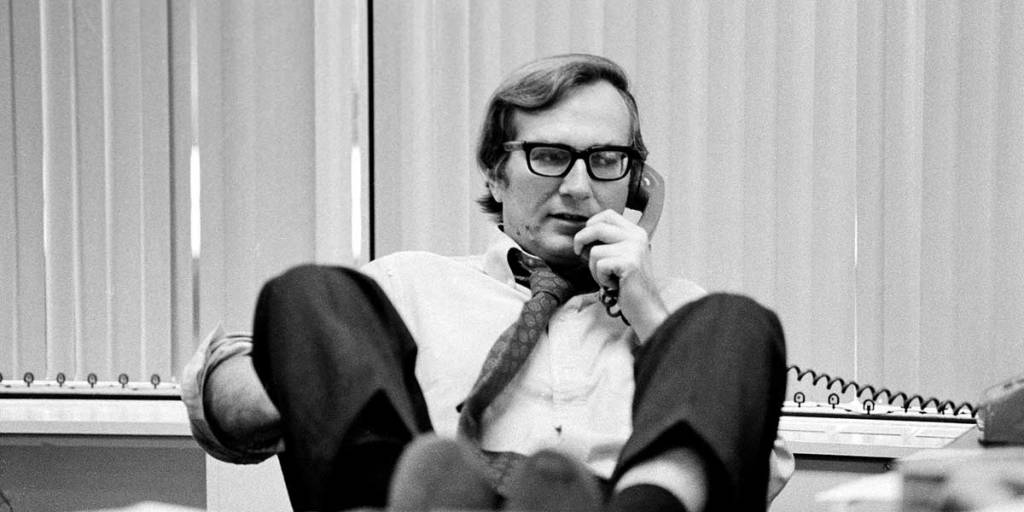
It’s the 1960s and America is at war. Sy Hersh, a freelance reporter, hears a rumour of mass murder in Vietnam by American troops. He speaks with GIs on base and the soldiers accused of these crimes. He also got a hold of a secret military investigation the massacre. And the facts he finds are horrifying. There include synchronized sexual assaults and murders of hundreds of women, men and children, and even babies, by American soldiers. Hersh blames My Lai on General Westmoreland and others who ordered the mass killings — which happened in a number of places on the same day — solely for the purpose of raising the body count. They needed more dead bodies to prove they were winning the war. The story has major repercussions all the way to the top — Nixon and Kissinger were recorded calling Hersh a son of a bitch — and played a role in turning public sentiment away from the war. For Hersh, My Lai is the first of many crucial stories he breaks in the decades to come. He becomes the NY Times daily reporter on the Watergate scandal. He uncovers US involvement in Pinochet’s bloody coup in Chile and the assassination of
Allende; illegal CIA infiltration of anti-war groups, the secret bombing of Cambodia, the invasion of Gaza (ongoing), and the abuse and torture of Iraqis by American soldiers during the Gulf War at the infamous Abu Ghraib prison.
Cover-Up is a journalistic documentary about journalism itself. It features historical documents and period photos and film — many very disturbing — new interviews with people involved in the stories, and extended talks with Sy Hersh, who at the age of 88 is still a full-time journalist. You get to see
him see at work talking to anonymous sources and vetting incoming photos and leaks. He’s a bit prickly about protecting his sources even from the documentary makers (who take care never to reveal anyone still alive), because it’s that core of consciences bureaucrats, soldiers, and spies who still uphold the constitution and flout illegal coverups. They’re the sources who keep freedom of the press alive.
After the TIFF screening, Hersh said that American journalism is in a bad state with reporters running scared. How many important stories are being gagged or stifled now — or in the past — under White House pressure? It shows how badly we need more adversarial journalists who question the powers that be and uncover what they’re hiding.
And that’s what Cover-Up is all about.
I Swear, Girl and Cover-Up all played at TIFF and should be released over the next few months. This is Daniel Garber at the Movies, each Saturday morning, on CIUT 89.5 FM and on my website culturalmining.com.
Daniel Garber talks with Min Sook Lee about There are No Words at TIFF
Hi, this is Daniel Garber at the Movies for culturalmining.com and CIUT 89.5 FM.
Photos by Jeff Harris.
It’s the 1970s, and the Lee family — Dad, Mom and three daughters — are experiencing the typical immigrant life in Toronto. A brash dad and a soft-spoken mom spend all their time in the family convenience store so the girls can study for school in their high-rise apartment tower. But everything
changes when, seemingly out of nowhere, their mom dies by suicide, leaving only a few photos and silent memories. Now, decades later, one of those sisters has made a documentary about their hidden past… but there are no words to describe the shocking family history and generational trauma she unveils.
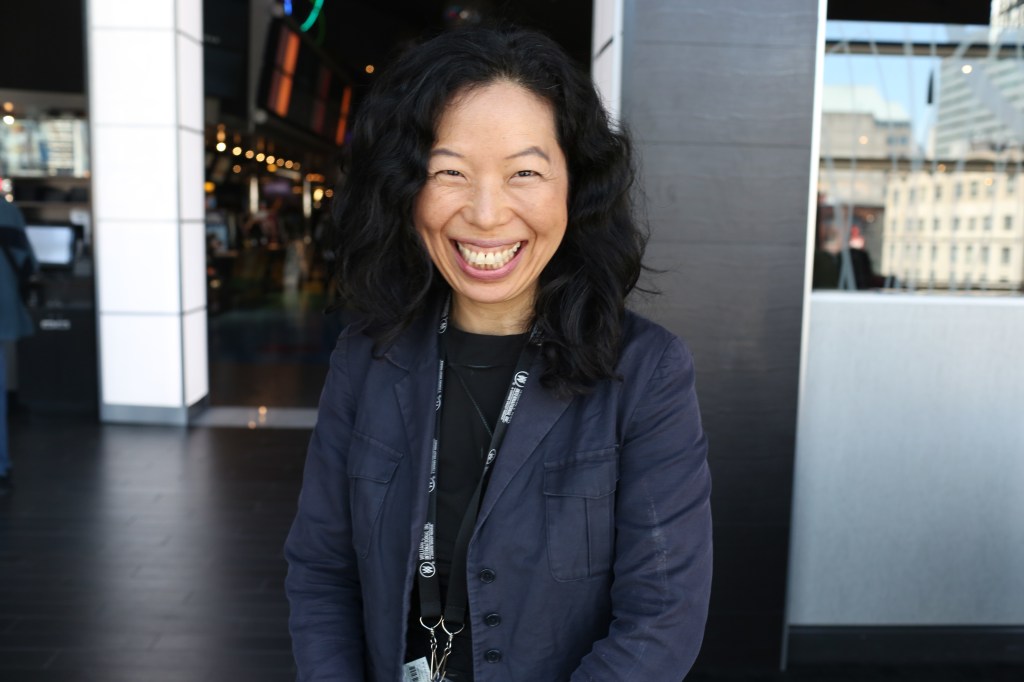
The film’s called There are no Words, and is written and directed by multiple award-winning Toronto-based documentary filmmaker Min Sook Lee. She is known for her moving documentaries that bring crucial global political issues down to a personal scale, as in
her doc Migrant Dreams in 2016, the last time I spoke with her on this show.
Incorporating period news footage and photos with new interviews with her family’s relatives and friends in Canada and Korea, as well as a shocking and revelatory talk with her father, There are No Words is a highly personal heart-wrenching look at the filmmaker’s own hidden family history.
I spoke with Min Sook Lee via Zoom.
There are No Words had its world premiere at TIFF, played at ReelAsian and will be released theatrically.
Unusual road movies. Films reviewed: Nirvanna, the Band, the Show, the Movie; The Long Walk, Sirât PLUS #TIFF50!
Hi, this is Daniel Garber at the Movies for culturalmining.com and CIUT 89.5 FM.
If you’re in Toronto this weekend, get your collective ass down to “Festival Street” — King st, from University to
Spadina — to celebrate TIFF’s 50th anniversary. Even if you can’t afford the tickets, they’re tons to see and do. They’re giving away loads of free stuff, like Italian beer, cold brew coffee, Korean noodles… and even free mouthwash. Why
mouthwash? Why any of this… they’re promotions. But they’re all free! Free outdoor movies, too, each night in David Pecaut Square. And if you’re into celebs, you might see stars like Scarlet Johansen, Mia Goth, Keanu Reeves and
Jodie Foster, just a few expected to show up.
This week I’m looking at three new road movies, two opening at TIFF. There are European ravers driving through the Sahara desert, 50 boys in a dystopian America on a walkathon for their lives, and two Toronto musicians time-travelling on Queen St West in a magic bus.
Nirvanna, the Band, the Show, the Movie
Co-Wri/Dir: Matt Johnson
It’s about 17 years ago in downtown Toronto. Aspiring musicians Matt Johnson and Jay McCarrol (played by themselves) are composing music and planning elaborate schemes to get invited to play on the stage at the Rivoli on Queen St West But so far no luck. The band is called “Nirvanna”, with an extra N; but they sound more broadway than grunge. They live in a Toronto row house with a trailer home parked behind. Fast forward a few decades and Matt and Jay are still trying to get booked at the Rivoli for the first time. Matt’s latest scheme? To jump off the top of the CN Tower with parachutes and land inside the Skydome in the middle of a Blue Jays game. That should get enough attention to get their band booked, right? But as Matt’s ridiculous schemes get ever more outlandish and dangerous, Jay becomes increasingly frustrated. And when they somehow manage to travel back in time, a la Back to the Future, thus changing history, it messes up everything and their band might cease to exist. Can the two of them get back together in time to save the band… and their own lives?
Nirvanna… is an uproariously funny pseudo-documentary, done in the manner of Borat, but more gently Canadian. I absolutely love Matt Johnson (The Dirties, Blackberry), with his cringey sense of humour, always lightly dipped in horror and disaster. I’m not familiar with Jay McCarrol, but he’s an excellent musician and a perfect foil for Johnson’s grandstanding ineptitude. The
time travel is accomplished because they’ve been filming the series for about 20 years. As for the special effects, I’m still not sure if they actually jumped off the CN tower… but it sure looks like they did. Breaking news: I literally just spoke with the filmmakers: Matt says it’s all real, Jay says it’s all fake. Either way, Nirvanna now stands beside Scott Pilgrim as the most Toronto-y movie of the century.
The Long Walk
Dir: Francis Lawrence (The Hunger Games: The Ballad of Songbirds and Snakes)
It’s the corn belt in a dystopian, future United States. The country is a military dictatorship and the people live in poverty. Fifty young men, one from each state, have signed up for an annual race. The winner gets a huge cash prize as well as any dream he wishes to fulfil. His triumph will add a sense of hope and pride to the country’s citizens — or so the contest’s organizer, The Major barks at the boys (played by an unrecognizable Mark Hamill).
One competitor, Ray (Cooper Hoffman: Licorice Pizza) introduces himself to other players, and quickly makes friends with Pete (David Jonsson). They soon added Art Baker from Louisiana (Tut Nyuot) who wants to win the money, and Hank Olsen (Ben Wang) a nerdy-looking guy with a wisecracking, urban accent. They call themselves the four musketeers, and vow to look out for each other. Some of the racers keep to themselves. Barkovitch, (Charlie Plummer: Lean on Pete, The Return) a rabble rousing misanthrope hurls discouraging insults at his competitors. Collie (Joshua Odjick) is an indigenous man who walks to the beat of a different drum. And an ultra-fit athlete (Garrett Wareing) is so sure of his own victory he doesn’t even grace anyone with a response. The problem is, there can only be one winner. And the 49 losers? They will all be dead. You see, it’s a race to the death, and anyone who lags behind the requisite three miles an hour is summarily murdered by soldiers in tanks rolling beside the walkers. If anyone lags in their walk three times — including drinking, tying your shoes or even sleeping — they die. Who will survive this gruelling competition?
The Long Walk is a dark dystopian road movie movie about
male bonding, friendship and resistance to an autocratic state. It’s shot in a rustic, sepia tones in marked contrast to its horror theme. It’s based on a story by Stephen King, and directed by Francis Lawrence who brought us the Hunger Games movies. While it doesn’t hold back on violent blood, guts, and despair, at least it keeps alive some feeling of hope throughout. The Long Walk is totally watchable, the acting is great and I like the characters. But — maybe because of the story’s inevitability — it never really grabbed me. This could have been a deeply moving weeper, but instead it’s just a gruesome race, with a wee bit of political consciousness.
Sirât
Dir: Oliver Laxe
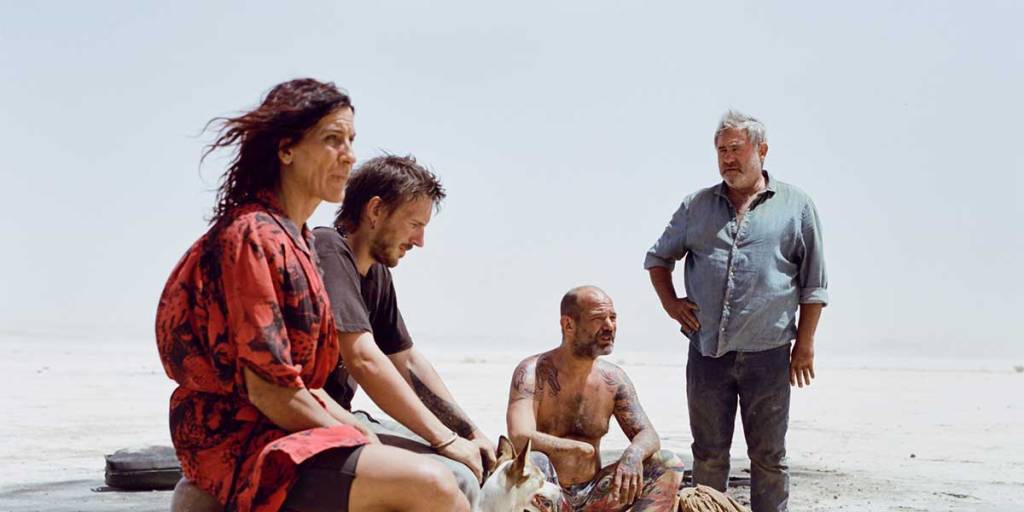
It’s a red sandstone skyline somewhere in Northwest Africa. A huge wall of speakers is spewing heavy drum and bass rhythms out of a wall of speakers, with hundreds of semi-nude dancers moving in a throbbing crowd. It’s a European rave attracting people who look like they’ve been moving to the music since the 1990s. Totally out of place are a middle aged Spanish man named Luis (Sergi López) and his young son Esteban (Bruno Núñez Arjona). They’re handing tiny leaflets to everyone they see, about their missing daughter/sister. She’s also a raver but hasn’t been seen in years. Suddenly the music stops, soldiers march in and one if them starts shouting through a megaphone: the area must be evacuated immediately, with all Europeans following the military back to safety. With much grumbling, the dancers pile into makeshift schoolbuses move out of the area… until suddenly two vehicles — an ATV and a military transport truck — veer off track and head in the opposite direction. They’re going south toward a legendary rave near Mauritania. In a split-second decision, Luis and Esteban decide to follow
them in their urban SUV, of their best chance of finding the missing girl. The crusty ravers don’t want them to follow but agree to let them tag along.
And a ragtag bunch they are, with weathered features, pierces and tattoos, peg-legs and missing limbs. They speak French, Spanish and English.But they also have a wicked sense of humour, and an overriding communal spirit. What no-one seems to realize is they’re driving headfirst into the impossible terrain of the western Sahara desert in the middle of a revolutionary war.
Sirat is a fantastic, nihilistic road movie, that combines elements of Mad Max, Nomadland and Waiting for Godot. It takes you on the twists and turns of disaster, keeping you on your toes all the way. I’m not revealing any more of the plot, but suffice it to say it thumbs its nose at traditional Hollywood narratives. The acting seems very close to documentary style, and apart from López as Luis, all the cast seems to be non-actors playing themselves. (They are called by their real names.)
If you can stand the shock, you must see Sirat.
Sirat and Nirvanna, the Band, the Show, the Movie are both premiering at TIFF right now; and The Long Walk opens across Canada on Sept 12.
This is Daniel Garber at the Movies, each Saturday morning, on CIUT 89.5 FM and on my website culturalmining.com.
leave a comment