By Women. Films reviewed: Angela’s Shadow, Samia, Oh, Hi!

Hi, this is Daniel Garber at the Movies for culturalmining.com and CIUT 89.5 FM.

If you’re feeling overwhelmed by big, blockbuster movies, try something smaller. Cinecycle is having a free, open screening of super-8 films this Sunday. Bring your own or watch other people’s — just no videos, please.  Also on now at the TIFF Lightbox is Marlee Matlin: Not Alone Anymore, a surprisingly intimate documentary about the Oscar winning deaf actress — a really great doc.

Speaking of films directed by women, this week I’m looking at three more movies wth female directors. There’s a girl in Somalia running in circles, a woman north of Ottawa pulled in two directions, and a couple in New York… whose relationship is tied up in knots.

Angela’s Shadow

Co-Wri/Dir: Jules Koostachin

It’s the 1930s in Ottawa. Angela (Sera-Lys McArthur) is a happy middle-class housewife who lives with her husband Henry (Matthew Kevin Anderson) an aspiring journalist.  She’s pregnant with their first child.  But everything changes when an urgent letter arrives from her childhood nanny Mary (Renae Morriseau). She writes that she must see Angela on her reserve (Mary is Cree) before the baby is born. While Angela is hesitant, Henry is gung-ho. He loves a good adventure, and hopes to get some good shots and news scoops in Canada’s North. But once they get there, Angela is separated from Henry — she to meet the elders and he to try his hand at “native style” hunting.

Angela is taken to a sacred area where she discovers the secrets of her past: she was born to a Cree mother and an Irish father, and when both parents died, she was sent to live with her father’s sister in Ottawa. Turns out, Mary is actually her aunt, too, on her mother’s side. This was kept a secret to keep Angela safe from the  Residential Schools. And they tell her the meaning of a little girl she keeps imagining.

Henry, meanwhile, is taken on a hunting trip by two young men: Isaiah and Malachi, Angela’s cousins (Asivak and Mahiigan Koostachin). Henry is eager to learn about there way of life, but understands everything from his Christian upbringing. So when he starts to see visions after a sweat lodge, something snaps. And while Angela welcomes her visions and feels an attachment to the land, Henry feels a deep fear and repulsion, and an urgent need to take his wife out of there. Can they reconcile their differences? Or will their visions prove hazardous to their health?

Angela’s Shadow is an historical drama about a clash of cultures between Anglo and Cree, Christianity and spirituality, and education in residential schools vs the passing on of outlawed culture, language and rituals. Visually, it’s quite lavish, with period costumes, sets, and lush camerawork, a la Murdoch Mysteries. It’s also meticulous in its portrayals of indigenous culture. I found the acting a bit over the top in the beginning, but it redeems itself once it turns into a psychological thriller. 

Yes, Angela’s Shadow is a bit melodramatic, but, hey,  I like melodramas. This is an engrossing indigenous story about Canada’s chequered history.

Samia

Co-Dir: Yasemin Samdereli, Deka Mohamed   

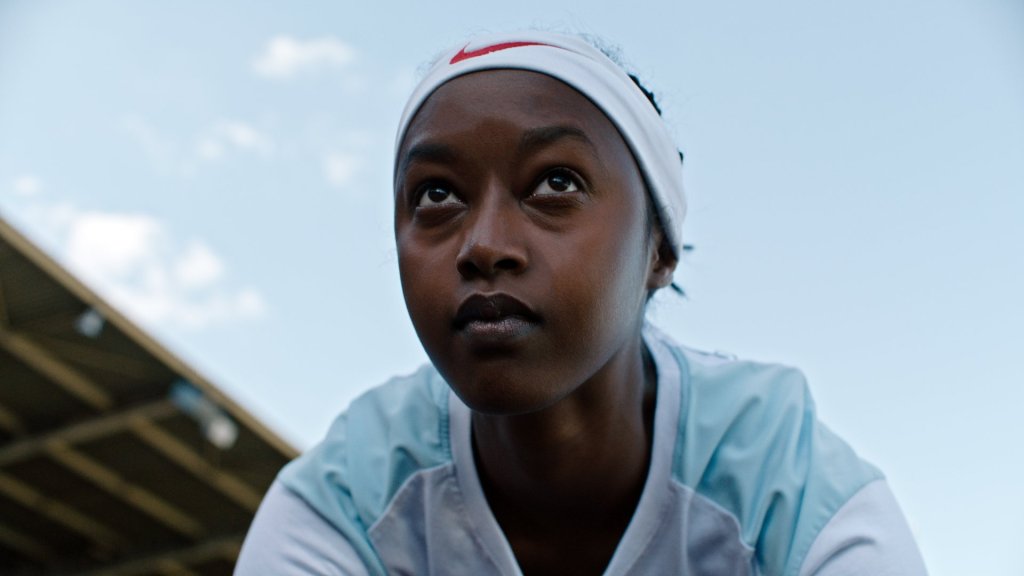
Samia (Riyan Roble) loves to run. Though only a little girl, she places among the top 10 runners in her town’s annual race. She lives in a walled compound with her strict mother, her fun-loving dad, her conservative brother Said, and her singing sister Hodan. She’s also good friends with Ali (Zakaria Mohammed) who is almost like a brother to her; his family shares their compound. But he’s a terrible runner so he appoints himself Samia’s coach.Like Rocky, they train outdoors, racing around corners and down back allies. Their goal? To make her the fastest girl in town! And as they grow older, the teenaged Samia and Ali (llham Mohamed Osman, Elmi Rashid Elmi) discover there’s a world beyond their city, beckoning Samia toward international competition.

But Somalia is unstable, with armed military tanks roaming the streets. Fundamentalists demand all girls wear a head scarf — but what about my running? asks Samia. Regional differences are on the rise and so are religious fights. Local armies and child soldiers are popping up everywhere, making it a dangerous place to live. Can Samia fulfill her dreams in an unstable country? Will she ever make it to the Olympics? And will her family support her if she does?

Samia is a bittersweet, naturalistic biopic inspired by true events. It’s told in a series of extended flashbacks from her past remembered by an adult Samia, now fleeing Somalia for Italy, via Libya. This is an Italian film, co-directed by a Kurdish German, and an all-Somali cast. It reminds me a lot of Io Capitano (review here) from a few years ago, though this one, while touching and sympathetic, is less triumphant. It’s also rare — the first movie I’ve seen set in Somalia with Somali actors.

I liked this movie.

Oh, Hi!

Co-Wri/Dir: Sophie Brooks

Iris and Isaac (Molly Gordon, Logan Lerman: Indignation, The Lightning Thief) are a young couple in their twenties staying at a BnB in upstate New York. She is pretty, sexy and fond of practical jokes. He is good looking, chill, and open-minded. They’ve been dating for three months, but this one looks like a turning point. Isaac has perfectly arranged everything for the weekend: a beautiful house to stay in with a lake in the back, and delicious meals he cooks for her. And the sex! They are adventurous and passionate together. So when they uncover some bondage material in closet, they decide to try it out. Isaac agrees to be chained to the bed and it works out better than either of them hoped. But somehow the post-coital cuddling leads to some discussions, which reveal she thinks they have a monogamous long term relationship, while he thinks she’s fun and friendly but just another sex partner with no commitment. And all of this happens while he is still tied to the bed.

Iris does not take this lightly; she feels betrayed. Isaac, on the other hand is genuinely frightened with her jokes about wanting to stab a previous boyfriend to death. And as time passes with little progress, both sides begin to panic. If she lets him go, will he call the cops and have her arrested for kidnapping? Is his life in danger? And when Iris’s best friend Max (Geraldine Viswanathan) and her boyfriend arrive to find Isaac still tied to the bed, it gets even more complicated. How will they ever get themselves out of this colossal mess?

Oh, Hi! is a hilarious sex comedy about trust, relationships and a date gone wrong. While I found some of the relationship psychologizing wasn’t fun, it only made up a small part of the movie. I’ve never seen Molly Gordon before —  she co-wrote the script — but she has this uncanny ability to suddenly switch from gorgeous sex-goddess to google-eyed maniac. Logan Lerman is more of the straight man, but carries off his laid-back role quite nicely, considering he’s tied to the bedpost for much of the film. The story itself — along with the unexpected  twists it takes — keeps you squirm-laughing almost all the way through. Though the audience at the screening I saw was maybe 80% women (who really seemed to like it), I think there’s lots there for men to think about, too.

This is a very funny movie.

Angela’s Shadow, Samia and Oh, Hi! all open this weekend in Toronto; check your local listings.

This is Daniel Garber at the Movies, each Saturday morning, on CIUT 89.5 FM and on my website culturalmining.com.

Huge changes. Films reviewed: Cloud, Don’t Let’s Go to the Dogs Tonight, Eddington

Posted in 1980s, Africa, comedy, Coming of Age, Covid-19, Crime, Internet, Japan, Thriller, Western by CulturalMining.com on July 18, 2025

Hi, this is Daniel Garber at the Movies for culturalmining.com and CIUT 89.5 FM.

This week I’m looking at three great new dramas about people facing huge changes in far-flung places. There’s a man in Japan pursued by unknown enemies; a girl in Zimbabwe on the eve of an election; and a sheriff in New Mexico at the dawn of a pandemic. 

Cloud

Wri/Dir: Kiyoshi Kurusawa

It’s present-day Tokyo. Yoshi (Masaki Suda) is a guy in his 20s with a certificate from a vocational school. He’s socially and emotionally challenged. Yoshi lives in a cramped apartment with his girlfriend Akiko (Kotone Furukawa). He works in a factory, pressing clothes, but after three years is still struggling financially with no chance of advancement. Luckily, he has a side hustle: a reselling site where he marks-up cheap goods online and sells them for profit: French designer knock-offs, electronic devices, collectible toys; the content doesn’t matter, just the speed of turnover and how much profit he makes. At the moment, he’s doing so well he decides to quit his factory job, turn his reselling site into a full time occupation and relocate to a large house in the countryside with cheap rent. Akiko agrees to move with him, and he hires a local kid, Sano (Daiken Okudaira) as his assistant. And with the business doing so well, he figures he can relax now and let the cash pour in. But it’s never that simple. 

Strange things start happening. Yoshi is knocked off his motorcycle by a wire stretched across a road.  Someone tosses a chunk of metal through his glass window. And Sano does an ego-surf on Yoshi’s site and finds online chatter from dissatisfied customers threatening to kill him. (He keeps his website completely anonymous). At the same time, local police are investigating him for fraud, Akiko is reaching her breaking point, and Yoshi fires Sano for using his computer without permission, leaving him all alone in his country home. But when armed masked strangers start showing up at his door, Yoshi realizes it’s time to drop everything and get the hell out of there. Who are these angry strangers? What do they want? And how can he get away?

Cloud is both an almost surreal, cyber suspense thriller and a cautionary crime drama. Masaki Suda’s plays Yoshi as a man without any self-awareness… who assumes no one else notices him either.

It starts as a slow-burn, but explodes, halfway through, into a violent, action/thriller, with more than one totally unexpected plot turn. Though the main character spends much of his time staring at a distressingly dull website, waiting for buyers to check in, the outside world is full of geometric sets with sharp turns, cloudy windows, green forests and dark shadows. With lush music played against abandoned warehouse walls, Cloud lets suspense carry us through to the shocking finish. 

I like this suspenseful crime-thriller a lot.

Don’t Let’s Go to the Dogs Tonight

Co-Wri/Dir: Embeth Davidtz

It’s 1980 in Zimbabwe-Rhodesia. The Bush War is over, and white minority rule has ended, pending its first democratic election. Bobo Fuller (Lexi Venter) is a seven-year old girl who lives with her family on a dried out cattle ranch. She wears her face dirty and blonde hair tangled. Bobo smokes cigarettes and rides her motorbike around the farm with a rifle strapped across her back. She fears two things: ticks and terrorists.

Her mom Nicola (Embeth Davidtz) makes it clear she will never leave her land. As grandma likes to say, we have breeding, not money. She’s a heavy drinker, prone to guzzling brandy and dancing with abandon during her manic episodes. Bobo’s Dad is more reasonable, but disappears for weeks at a time. Her older sister (Rob Van Vuuren) lives there too, but has no time for her bratty little sister.

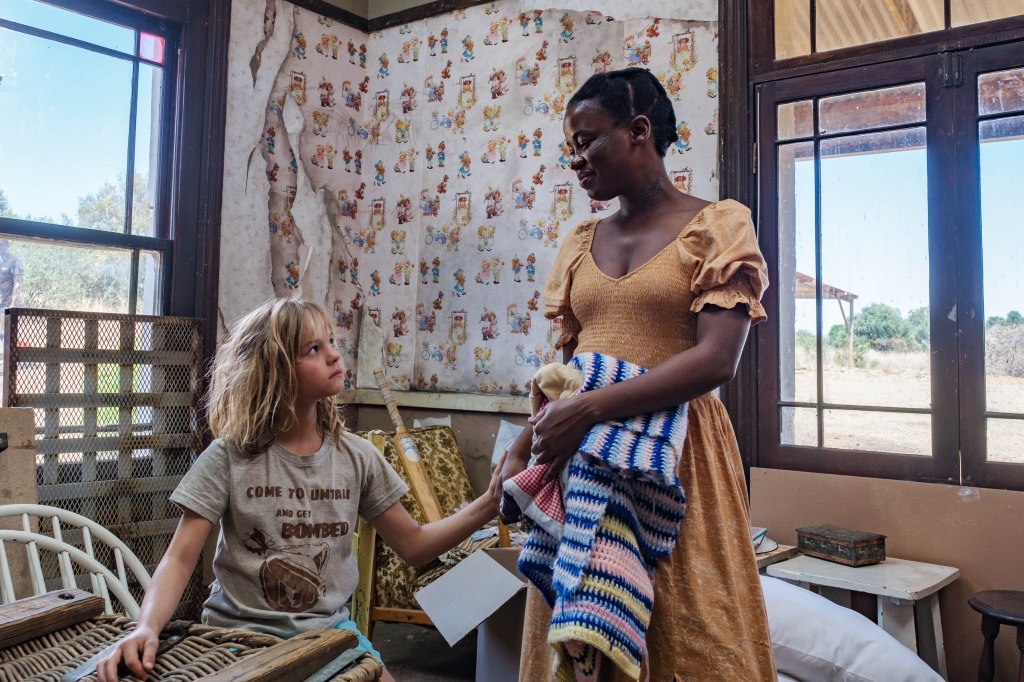
So Bobo is essentially raised by Sarah (Zikhona Bali) their nanny and housekeeper. Bobo tries ordering her around like a grown up — bring me my porridge! — but Sarah sets her straight: she’s too young to be bossy. And it’s Sarah who tells her stories, answers her questions and explains what happens to us after we die.

The family gets together with other whites in nearby farms for parties and barbecues. But there’s tension in the air as they await results from the election. Sarah, too is worried: she might be targeted by nationalists if seen taking care taking care of a girl like Bobo. What will happen after the election? And will any changes be permanent?

Don’t Let’s Go to the Dogs Tonight is a drama based on the memoirs of Alexandra “Bobo” Fuller. It’s full of abrasive characters and their casual racism, and pulls no punches in their portrayal. The whole film is shot through the eyes of a little girl, so with the camera kept low, we might just see people’s legs from under a table or an obscured lens when she’s squinting at the sun.

Actress Embeth Davidtz evokes her own South African background (where the movie was shot) in telling Bobo’s story. This is her first time directing, and its a fascinating adventure in creativity. And though her excellent portrayal of a difficult, bi-polar Mom — alongside Zikhona Bali’s terrific turns as Sarah — , it’s really about Lexi Venter as Bobo, who gives a natural performance in every scene, either as the centre of attention or as quiet observer.  

Don’t Let’s Go to the Dogs Tonight is an excellent memoir of a difficult period of history.

Eddington

Wri/Dir: Ari Aster

It’s April, 2020 in Eddington, a small town in New Mexico, just as the Covid lockdowns mask mandates are kicking in. Working class Joe Cross (Joaquin Phoenix) is the town Sheriff, just as his dad was before him. He lives in a ramshackle home with his catatonically depressed wife Louise (Emma Stone) and her conspiracy-theory addled mother Dawn (Deirdre O’Connell). He works with his two faithful officers Michael (Micheal Ward) and Lodge (Clifton Collins, Jr).

On the better side of town lives the upper-middle-class Mayor Ted Garcia (Pedro Pascal) —  a smooth talker and a consummate politician — who is running for re-election. He is expected to open a mysterious tech conglomerate on the outskirts of town. His son, Eric (Matt Gomez Hidaka) is an arrogant and spoiled rich kid. He hangs out with his friend Brian (Cameron Mann), drinking beer and smoking pot. They are both after idealistic high school student Sarah (Amélie Hoeferle) who they try to impress by quoting Angela Davis. Then comes the news that George Floyd, a Black man in Minneapolis, has been killed by police. Demonstrations follow but the small town is already divided on ideological grounds, with everything recorded on cel phones and posted online: those who wear masks with social distancing, vs those who don’t. But as tensions build, and Mayor Ted publicly humiliates Sheriff Joe, he declares he’s running for mayor, too. 

Eddington is a sharp and scathing social satire about life in America during the pandemic. It’s half dark- comedy and half thriller/horror as it devolves from light absurdity into a hellish fantasy. It covers a huge variety of topics, including religious cults, false memory syndrome, big tech, culture wars, white supremacy, the dark state, and indigenous relations… to name just a few. I love all of Ari Aster’s movies — Heredity, Midsommer and Beau is Afraid — and Eddington, though more of a Western than strictly horror, continues his cycle. While Joaquin Phoenix’s Joe is the film’s focus, it’s actually an ensemble cast with at least 20 crucial roles.

Eddington is brilliant, hilarious and shocking… putting his magnifying glass on all of us, just a few years ago.

it’s a must-see.

Cloud, Don’t Let’s Go to the Dogs Tonight , and Eddington all open this weekend in Toronto; check your local listings.

This is Daniel Garber at the Movies, each Saturday morning, on CIUT 89.5 FM and on my website culturalmining.com.

It’s dangerous! Films reviewed: Daniela Forever, Apocalypse in the Tropics, We Were Dangerous

Posted in 1950s, Brazil, Coming of Age, Fantasy, High School, Horror, Indigenous, Maori, New Zealand, Politics, Religion, Romance, Spain by CulturalMining.com on July 12, 2025

Hi, this is Daniel Garber at the Movies for culturalmining.com and CIUT 89.5 FM.

Guillermo del Toro, the celebrated director who splits his time between Mexico and Canada, has curated a series of classic Canadian horror movies called From Rabid to Skinamarink: Canadian Movie Madness, playing at the TIFF Lightbox this weekend.  I happen to have seen everyone of them myself, and I totally agree with del Toro’s selection.  You can catch Canadian gems like the feminist werewolf drama Ginger Snaps, Vincenzo Natali’s cult-hit Cube, Kyle Edward Ball’s experimental Skinamarink, and many more. 

But this week, I’m looking at three new movies from abroad: a surreal fantasy from Spain, a politically documentary from Brazil, and a period drama from New Zealand.

Daniela Forever

Wri/Dir: Nacho Vigalondo

It’s present-day Madrid. Nicolas (Henry Golding: Crazy Rich Asians) is a popular DJ at the city’s hottest nightclubs. But he is thrown into a deep depression when his girlfriend, an artist named Daniela (Beatrice Grannò: The White Lotus) is killed by a negligent driver just outside his home. But things take a turn for the better when a good friend of his, Victoria (Nathalie Poza), tells him of a new, experimental drug that might be just what he needs. But it’s top secret, filled with non-disclosure clauses, and requires regular visits to the pharmaceutical labs. The scientists there tell him each pill, if taken just before bed, will produce lucid dreams, real visions where he can control the content and won’t forget about them when he wakes up. This means he can bring Daniela back to life, at least while he sleeps. But he soon discovers its limitations: he can’t dream about something he’s never seen. If he turns down an ally he’s never visited, it will be covered in unformed, writhing grey matter. Kinda creepy.

Daniela seems artificial at first, but as time progresses, she starts turning real. She even produces creative ideas and thoughts that he doesn’t remember ever experiencing in the awake world. And far from seeming etherial, his lucid dreams are now wide- screen images in living colour, while awake time is small and drab. He can take Daniela to new places just by thinking about them and opening a door, and change the city of Madrid into something out of one of her paintings. But he soon realizes, not everything is going the way he planned. And when things from his dream world start appearing in awake time, he has to wonder what is real? Can he be in love with someone who doesn’t exist? And can she ever really love him if she’s just a figure of his imagination?

Forever Daniela is a highly- creative science fiction romance about love, death and reality. While it sounds like a Black Mirror jump-scare thriller, it actually avoids most  “bad” things except for the sadness of mourning. It also has a very surprising twist at the end (no spoilers). The film is Spanish, but most of the dialogue is in English. Henry Golding (Crazy Rich Asians) is appealing as the leading man, but runs into a bit of acting trouble when he tries to do a full-fledged meltdown. The special effects are excellent, fooling around with unusual concepts like daytime light and shadows in a nighttime environment. I quite like the writer/director Nacho Vigalondo

for the way he incorporates horror movie elements within an otherwise realistic context (like his film Colossal a few years ago.) So if you’re looking for something that’s surreal and supernatural but told in a positive, though bittersweet, way, I think you’ll like Daniela Forever.

Apocalypse in the Tropics

Wri/Dir: Petra Costa

Brasilia — a capital city  designed, planned and built from the ground up — was meant to be modern, secular and democratic. But after a coup-d’etat in 1964, Brazil became something other than democratic: a military dictatorship which ruled for the next two decades. So when a new, populist right-wing leader with military ties emerged in the 2010s, many Brazilians were wary of democracy falling again. But Jair Bolsonaro was different, a politician who changed his power base when he forged ties with evangelical Christians. 

Apocalypse in the Tropics traces Brazilian politics over the past decade and the rise in religion within government policies. It also gives background, from the building of the capital, through the military coup, American evangelist Billy Graham, the return to democracy, and more recent developments. It uses beautiful period footage, lush music and symbolic paintings — like Hieronymus Bosch’s Garden of Earthly Delights —  as a metaphoric portrayal of millenarian changes in Brazilian politics. It is narrated by the filmmaker and includes her one-on-one interviews with Bolsonaro, current President Luiz Inácio Lula da Silva, and the wildly popular televangelist, Silas Malafaia, who served as Bolsonaro’s right-hand man. We witness Malafaia’s sermons before huge crowds — shouting his opposition to same-sex marriage, abortion rights, and feminism — as well as intimate conversations aboard his private plane. The doc also shows new footage of the beloved capital Brazilia occupied and trashed by massive demonstrators, who called for a coup after Bolsonaro’s defeat. 

Apocalypse in the Tropics is a follow-up to Petra Costa’s 2019 film The Edge of Democracy with similar footage, style, and topic but concentrating this time on religion’s role in government policies. I’m not sure if this is a sequel, a reshoot or a continuation, but either way, it’s as aesthetically beautiful as it is disturbing. 

We Were Dangerous

Wri/Dir  Josephine Stewart-Te Whiu

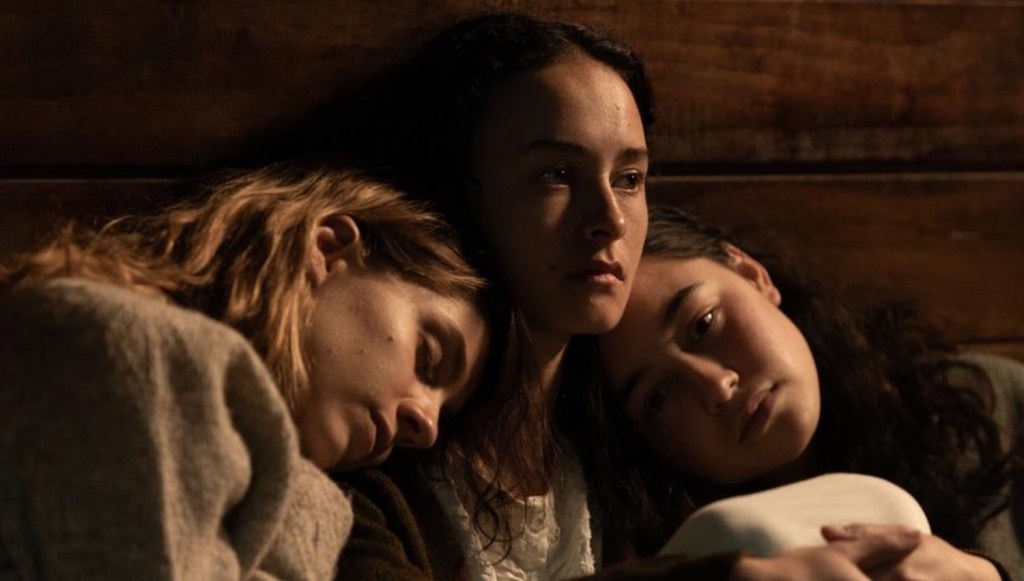
It’s the 1950s on a small island somewhere off the coast of New Zealand, where three girls share a cabin: Daisy, Nelly and Lou (Manaia Hall, Erana James, and Nathalie Morris). They were sent there by the authorities or their parents. Te Motu is a school for “incorrigible” girls or, as the administrators call them, “whores, queers, delinquents and sexual deviants.” Many are orphans or runaways caught stealing food, like Daisy or Nelly. Lou is the exception. She comes from a rich family but was caught making out with her (female) tutor. The school operates under the strict rule of Matron (Rima Te Wiata), who has a cruel streak a mile long. Raised by nuns, she feels the only way to cure these girls’ bad attitudes is through the bible and the lash. Naturally the girls all want to get the hell out of there, but it’s hard to escape from an isolated island in the south pacific. The purpose of the school is to turn bad girls into happy homemakers. They are given lessons in diction and manners but not reading or math. Matron is frustrated by their outcome: She says they are “too stupid for school, to uncivilized to be maids and too barbaric to work”. Every so often, Matron is visited by men in suits from the mainland, one of whom suggests a horrifying treatment. But when Nelly find out, the three girls decide they have to do something to stop it.

We Were Dangerous is a moving, coming-of-age story about girls surviving in 1950s New Zealand. It’s bright and exuberant, full of playfulness and dancing, Haka and history, and though fictional, it tackles the very real issue of the mistreatment of indigenous girls. The acting is excellent all around, full of subtle clues and delightful details. For a first film, Stewart-Te Whiu avoids many potential stumbles and instead gives us a solid film that’s fun to watch. It played at ImagineNative this year, and is definitely worth seeing.


Apocalypse in the Tropics is playing this weekend at HotDocs and will be streaming on Netflix this coming week; Daniela Forever opens this weekend in Toronto; check your local listings; and We Were Dangerous is available now on VOD.

This is Daniel Garber at the Movies, each Saturday morning, on CIUT 89.5 FM and on my website culturalmining.com.

Scary creatures. Films reviewed: Jurassic World Rebirth, 40 Acres, Sorry Baby

Posted in Action, African-Americans, Canada, Cannibalism, College, comedy, Dinosaurs, post-apocalypse, Science Fiction by CulturalMining.com on July 5, 2025

Hi, this is Daniel Garber at the Movies for culturalmining.com and CIUT 89.5 FM.

Yorgos Lanthimos, who brought us films like The Favourite and Poor Things, didn’t come from nowhere; he’s been directing weird, original movies for two decades. One of his first — and one of my first reviews on this show — is Dogtooth, which still holds a place in my heart. It’s being re-released on the big screen in July, so if you haven’t seen it, now’s your chance.

But this week, I’m looking at three new movies about people dealing with scary creatures. There are dinosaurs on the equator, cannibals on the prairies, and a monster in a New England college town.

Jurassic World: Rebirth

Dir: Gareth Edwards

It’s present-day New York City, where giant, benign  dinosaurs amble through city parks. Bennet (Scarlett Johansson) is a hard-boiled mercenary who dares to go where you’re not supposed to be to steal things you aren’t supposed have. Her latest client? A certain Mr Krebs (Rupert Friend), the sketchy rep of a Big Pharma multinational. And the job? To bring back blood samples from three of the biggest and most dangerous dinosaurs in the world: one from the sea, one from the sky, and one from the ground. The only place these creatures live is around the equator, in areas international law says we can’t go. But Bennet will, along with her longtime collaborator Kinkaid (Mahershala Ali) and their henchmen. Rounding out the pack is Dr Loomis (Jonathan Bailey) a palaeontologist whose dream has always been to see the dinosaurs (whose fossils he studies) alive and in the flesh.

Along the way they rescue a family whose plans — to sail across the Atlantic —  are capsized when their boat is attacked by a giant sea monster. They all end up on an island, full of hybrid dinosaurs created in labs a generation ago by genetic scientists who abandoned the project when it became too dangerous. But which of them will survive 24 hours among those killer beasts?

Jurassic World: Rebirth is an action adventure, the latest instalment in the ongoing franchise. It’s a cautionary tale of what happens when ambitious scientists bring dinosaurs back to life to build a profitable theme park. Ironically, while the theme parks are gone, the movie feels like a series of carnival rides. First you’re in a speedboat escaping something in the water, then you’re hanging from a cliff, avoiding killer Pterodactyls… Which makes it fun and entertaining, but in an entirely predictable way.

I loved the thrill of the raptors in the first Jurassic Park, but the weird and artificial dino-hybrids in this version look more sad or silly than scary. 

40 Acres

Co-Wri/Dir: R.T. Thorne 

It’s the near future in rural Canada after an apocalyptic pandemic has left the whole world in ruins, starving for food. Hailey Freeman (Danielle Deadwyler) lives on the same farm her African-American ancestors moved to after the US Civil War. She’s a hard-ass mom who rules her family like a sergeant (she spent time in the military). Her oldest son, Manny, (Kataem O’Connor) still responds to her questions with only a yes ma’am / no ma’am. Though they live a calm and peaceful life — trading goods with other farmers using shortwave radio and a shared depot —  just outside the gate marauders rove around, trying to break into farms and steal their coveted farmland. The Freemans are a blended family, Black and indigenous, with Galen as Dad (Michael Greyeyes) Hailey as Mom, the older kids from previous marriages, and the younger kids born here. They are trained not just how to plant and harvest, but also how to handle heavy artillery, hidden beneath their house. Hailey may operate in a constant state of paranoia, but there are reasons for her extreme caution. If the predators at the gate break through, they won’t just take the farm, they’ll eat the family. Yes, the outsiders are cannibals!

But Manny is growing up, and when he sees a beautiful young woman (Milcania Diaz-Rojas) swimming in a lake outside the farm, he is stricken with equal parts love and lust. And when she appears at the fence begging for help he sneaks her inside. Can she be trusted? Or is she a cannibal? And could this mean the end of the Freemans?

40 Acres is a post-apocalyptic, science fiction action thriller. It’s gripping, surprising and pretty scary. It presents an unusual point of view, combining an American individualistic, top-down, gun-friendly “get off of my lawn” attitude with a multicultural, work-together Canadian ethos. It’s also a zombie-pocalypse movie, but without the walking dead — it’s humans who do the killing and eating. And in between violent shootouts and fights, the lovely cinematography gives us lots of misty cornfields and lush forests on which to feast our eyes. But the biggest reason to see 40 Acres is Danielle Deadwyler, a dynamic powerhouse in her role as Hailey. 

All I can say is: Wow!

Sorry Baby

Wri/Dir Eva Victor

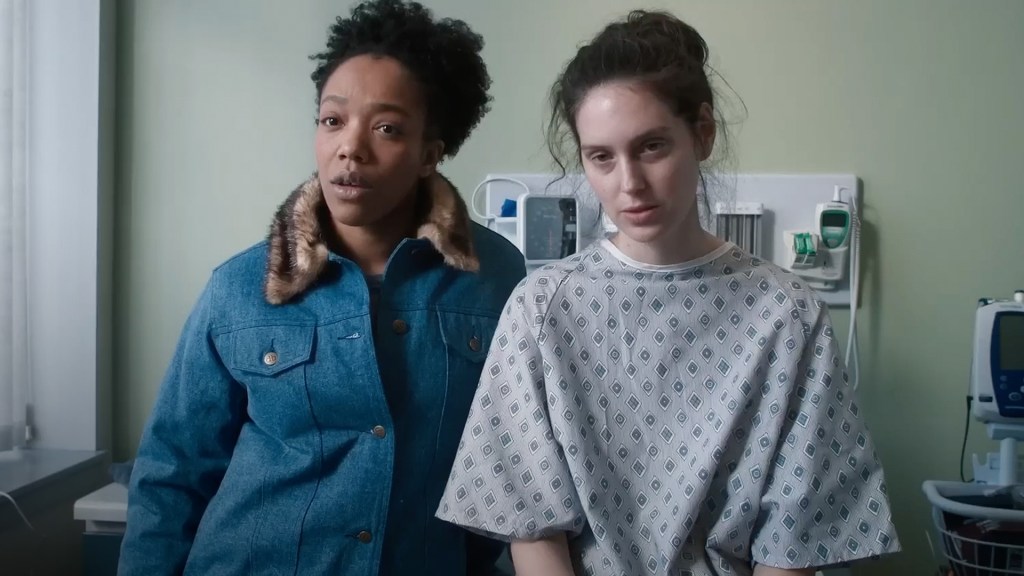
Agnes is an assistant prof in English Lit at a small liberal arts college in New England. She’s lonely, depressed and frightened living in a draughty home with just her cat to keep her company. Well, that and a neighbour who  occasionally drops to share her bed (Lucas Hedges). Thankfully, her best friend and former housemate Lydie (Naomi Ackie) is back for a much-needed visit. They lived together as grad students, but while Lydie found work — and a female lover — in New York City, Agnes is trapped in the same college,  with same home, same faculty, same courses… she even works out of the same office that used to belong to her thesis advisor. On the surface, she has achieved all the measures of academic success… so why is Agnes so miserable?

Flashback to a few years ago. Even as she is struggling to finish her grad thesis, something very bad happens to her: she is sexually assaulted on campus by someone she knows very well. Though Lydie is supportive, her doctor and the school administration are not. The bad thing is made worse by how messed up she gets afterwards. How can Agnes deal with, accept and overcome her past? 

Sorry Baby is a deeply personal coming-of-age story about one woman’s life in the academic world and the dark incident that colours it. Now, I bet you’re thinking: this is an important issue, but it sounds like a real drag so I don’t want to watch it. And listening to how I just described it, I understand why you’d think that. But you’d be totally wrong. This is a very funny, sardonic dark comedy, with quirky characters and realistic situations anyone can relate to; the sexual assault is never shown, only talked about. And the film is packed with brilliant scenes: Agnes talking with a snack bar owner, meeting Lydie’s unfriendly partner and their new baby, serving jury duty, her relationship with her sex buddy, and dealing with her fellow student and detestable rival Natasha (wonderfully played by Kelly McCormack). So I really liked watching this movie but was wondering who is this actress I’ve never seen before, sort of a new Aubrey Plaza?  But it wasn’t till the final credits rolled that I realized the writer/director is also the lead actress! Eva Victor plays a literary version of herself. 

Sorry, Baby is her first film and it’s pretty fantastic.

Jurassic World: Rebirth, 40 Acres and Sorry Baby all open this weekend in Toronto; check your local listings.

This is Daniel Garber at the Movies, each Saturday morning, on CIUT 89.5 FM and on my website culturalmining.com.