Hi, this is Daniel Garber at the Movies for culturalmining.com and CIUT 89.5 FM.
August is Emancipation Month in Toronto, commemorating the end of slavery in the British commonwealth, including Canada. So in honour of that there’s a free screening of RasTa: A Soul’s Journey, at Daniels Spectrum in Regent Park on August 13th.
But this week I’m looking at two new, scary movies. There are sailors who want to abandon ship, and farmers who don’t want to leave their land.
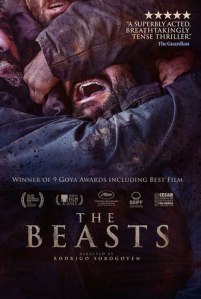 The Beasts
Co-Wri/Dir: Rodrigo Sorogoyen
Antoine (Denis Ménochet) and Olga (Marina Foïs) are a middle aged professional couple living in Galicia in northwestern Spain. He’s a burly, reserved man, while she is direct and no-nonsense. They gave up their lives and careers to settle among the rocky hills, growing organic tomatoes and vegetables. They love the simple life, working hard, breathing the fresh air and taking long walking through the nearby forests and hills They get along well with some of their neighbours, but not all of them. And especially not Xan and Lorenzo, a pair of wiry, adult brothers who keep nomadic horses. Lorenzo (Diego Anido) may be simple-minded but is prone to cruel, practical jokes, with Antoine as the victim. Xan (Luis 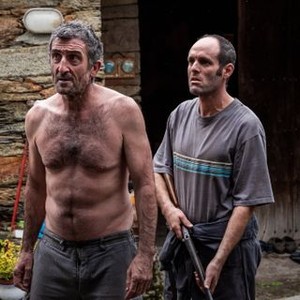 Zahera) is much worse. Xan insults him, calls him a derogatory name for French people, mutters veiled threats and even spits at him.
At the centre of their dispute is a contract which Antoine and Olga refuse to sign. A multinational energy corporation wants to turn the village into a wind farm. But after all the money, time and work they have put into it, they don’t want to throw it all away for a small buyout. It’s their home. This is what makes their neighbours so angry. They want to leave their ancestral homes forever. And as their fight grows, it gradually turns to violence. What will become of them?
The Beasts is an intense, dark drama played out in a clash of cultures and class. The film starts with a group of men physically wrestling with horses in slow motion. This motif comes up later in the movie in an 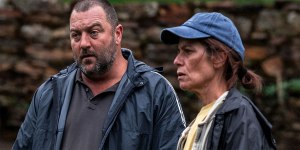 unexpected way. It’s billed as a thriller, but it’s not — I’d call it more of a slow-burn drama, spread out over more than two hours. The dialogue is in French, Spanish and (I’m guessing) Galician, since it doesn’t sound like any Spanish I’ve ever heard before.
Is it a good movie? I like the characters, and the acting and the drama, and its beautiful cinematography, locations and music. But the film has a weird structure, with a very long ending after an intense chapter in the middle. It’s less thrilling or scary than it is creepy and disturbing, though it does have a satisfying finish. I just don’t quite get the point of this movie. If you like feeling uncomfortable for a couple hours but not really challenged, then you’ll probably like The Beasts.
 The Last Voyage of the Demeter
Dir: André Øvredal
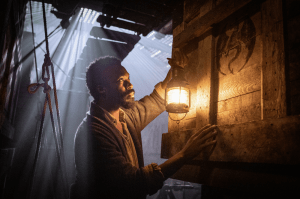
It’s the 1890s and the three-masted Demeter is loading at a Romanian dock, preparing for its voyage to Dover, England. Captain Eliot (Liam Cunningham) has mustered all his sailors on the ship, as well as Wojchek, his first mate (David Dastmalchian), Joseph, his bible-thumping cook (Jon Jon Briones) and his eight-year-old grandson Toby (Woody Norman). It’s the captain’s last voyage so he wants to pass on some of his lore. The only unfamiliar face is Clemens (Corey Hawkins), the ship’s doctor. Not a sailor, but he does hold a medical degree from Cambridge (very uncommon for a black man in Victorian England). But with such a small crew, even the doctor has to take his turn steering the ship and on night watch. But the most unusual thing is this ship’s cargo: a series of large wooden crates filled 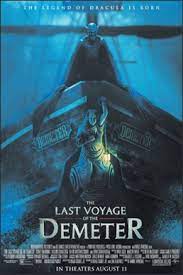 with dirt and branded with a sinister-looking mark. The locals refuse even to board the ship, but the crew is happy that there’s a big cash bonus if they deliver the cargo in time.
Unfortunately, things start to go wrong pretty quickly. First, a female stowaway is found on board — and sailors considered women on ships bad luck. Anna (Aisling Franciosi) is half dead, speechless and frightened. Clemens keeps her alive with frequent blood transfusions. Then all the ship’s animals — from livestock, to a dog, to even the rats hidden in the hold — are found dead. And then the crew starts disappearing, one by one. Is this a disease? A stowaway killer? Or something even worse? And will the Demeter and its crew ever reach its destination?
The Last Voyage of the Demeter is a well-crafted thriller/horror about a vampire on board a ship, based on Bram Stoker’s Dracula. And — no spoilers here — if this vampire looks familiar, it’s because he’s Nosferatu, the cadaverous, long fingered, pointy-eared creature made famous by the silent German expressionist masterpiece by FW Murnau, released a full century ago (1922). This Nosferatu can fly, 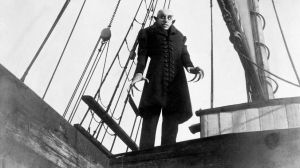 swim, hypnotize its victims and seemingly pass through walls. He’s almost indestructible. The film is beautifully shot in a German studio, with the camera flying down long passageways, into the galley, under tables and up to the sailmasts. The soundtrack is punctuated with tapping sounds that reverberate the length of the ship. The acting is quite good all around. And this vampire is a scary one.
The one thing that’s missing is pathos — with a few exceptions, you don’t feel close or attached to most of the characters. But that’s a minor problem in a good horror movie. And this one gives new life to a very old vampire.
The Last Voyage of the Demeter and the Beasts are both opening this weekend in Toronto, with The Beasts playing at the TIFF Bell Lightbox.
This is Daniel Garber at the Movies, each Saturday morning, on CIUT 89.5 FM and on my website, culturalmining.com.

 Cultural Mining
Leave a comment